

这是用户在 2025-7-7 19:49 为 https://www.mdpi.com/1424-8220/22/16/6060 保存的双语快照页面,由 沉浸式翻译 提供双语支持。了解如何保存?
 
 
Review  开放访问评论

Research Progress in Distributed Acoustic Sensing Techniques
分布式声学传感技术的研究进展

by 1,*,   作者 Ying Shang 1,
1,* , 孙茂成
1,    1 , 王晨 1,    1 , 杨健 1,    1 , 杜元凯 1,    1 , 易继超 1,    1 , 赵文安 1,
1 , 王莹莹
2 and    1 , 赵燕杰 1
2 和倪佳生
1
Laser Institute, Qilu University of Technology (Shandong Academy of Sciences), Jinan 250101, China
齐鲁工业大学(山东省科学院)激光研究所,济南 250101
2
College of Science, Shandong Jianzhu University, Jinan 250101, China
山东建筑大学 理学院, 中国 济南 250101
*
Author to whom correspondence should be addressed.
通信应收件人的作者。
Sensors 2022, 22(16), 6060; https://doi.org/10.3390/s22166060
传感器 2022, 22(16), 6060;https://doi.org/10.3390/s22166060
Submission received: 13 June 2022 / Revised: 9 August 2022 / Accepted: 9 August 2022 / Published: 13 August 2022
收到意见:2022 年 6 月 13 日 / 修订:2022 年 8 月 9 日 / 接受日期:2022 年 8 月 9 日 / 发布时间:2022 年 8 月 13 日
(This article belongs to the Topic Advance and Applications of Fiber Optic Measurement)
(本文属于 Advance and Applications of Fiber Optic Measurement 主题)

Abstract  抽象

Distributed acoustic sensing techniques based on Rayleigh scattering have been widely used in many applications due to their unique advantages, such as long-distance detection, high spatial resolution, and wide sensing bandwidth. In this paper, we provide a review of the recent advancements in distributed acoustic sensing techniques. The research progress and operation principles are systematically reviewed. The pivotal technologies and solutions applied to distributed acoustic sensing are introduced in terms of polarization fading, coherent fading, spatial resolution, frequency response, signal-to-noise ratio, and sensing distance. The applications of the distributed acoustic sensing are covered, including perimeter security, earthquake monitoring, energy exploration, underwater positioning, and railway monitoring. The potential developments of the distributed acoustic sensing techniques are also discussed.
基于瑞利散射的分布式声学传感技术因其独特的优势,如远距离探测、高空间分辨率和宽传感带宽,已被广泛应用于许多应用。在本文中,我们回顾了分布式声学传感技术的最新进展。系统回顾了研究进展和运行原则。介绍了应用于分布式声学传感的关键技术和解决方案,包括偏振衰落、相干衰落、空间分辨率、频率响应、信噪比和传感距离。涵盖了分布式声学传感的应用,包括周界安全、地震监测、能源勘探、水下定位和铁路监测。还讨论了分布式声学传感技术的潜在发展。
Keywords:
distributed acoustic sensing; optical fiber sensor; optical time domain reflectometry; Rayleigh backscattering; performance boost
关键词:分布式声学传感;光纤传感器;光时域反射仪;瑞利反向散射;性能提升

1. Introduction  1. 引言

Optical fiber sensing techniques are an important means of evaluating the degree of a country’s informatization [1,2]. Scattered light in the optical fiber is used as the information carrier to sense and transmit the changes in external physical quantities. The scattered light in an optical fiber includes Raman, Brillouin, and Rayleigh scattering. Among these, the first two types are related to the vibrationally excited state of the optical fiber, and both involve inelastic scattering. The difference between the two types is that the former interacts with optical phonons and the latter interacts with acoustic phonons [3,4,5].
光纤传感技术是评价一个国家信息化程度的重要手段 [ 1, 2]。光纤中的散射光用作信息载体,以感知和传输外部物理量的变化。光纤中的散射光包括拉曼散射、布里渊散射和瑞利散射。其中,前两种与光纤的振动激发态有关,都涉及非弹性散射。这两种类型的区别在于前者与光声子相互作用,后者与声声子相互作用 [ 3, 4, 5]。
Rayleigh scattering was introduced because the inhomogeneous refractive index is generated by the inhomogeneous distribution of the optical fiber material [6]. Rayleigh scattering is a linear process because the scattered power is proportional to the incident power. In addition, it is also known as elastic scattering because the frequency of the scattered light does not change compared to the incident light. To date, it has been widely used in the field of distributed sensing because of its strong scattered light intensity and lack of frequency shifting. Thus, distributed acoustic sensing (DAS) techniques based on Rayleigh scattering have attracted intensive research due to their unique distributed sensing performance and high sensitivity measurement capability in applications [7,8,9,10,11].
引入瑞利散射是因为不均匀的折射率是由光纤材料的不均匀分布产生的 [ 6]。瑞利散射是一个线性过程,因为散射功率与入射功率成正比。此外,它也被称为弹性散射,因为与入射光相比,散射光的频率没有变化。迄今为止,它因其强烈的散射光强度和无频移而在分布式传感领域得到了广泛的应用。因此,基于瑞利散射的分布式声学传感 (DAS) 技术因其独特的分布式传感性能和高灵敏度测量能力而受到深入研究 [ 7, 8, 9, 10, 11]。
Distributed detection is used to measure the variation information along the sensing fiber by detecting the backscattering. In 1976, Barnoski et al. first proposed the optical time domain reflectometer (OTDR) technique according to the design concept of LiDAR [12] and applied it to detect the loss of optical fiber links.
分布式检测用于通过检测反向散射来测量沿传感光纤的变化信息。1976 年,Barnoski 等人根据 LiDAR 的设计理念 [ 12] 首次提出了光时域反射仪 (OTDR) 技术,并将其应用于检测光纤链路的损耗。
Since the OTDR cannot respond to the phase modulation information caused by interference events, Healy et al. proposed the concept of coherent OTDR (COTDR) in 1982 to further improve the performance of the system [13]. In 1993, Taylor et al. proposed a high-sensitivity phase-sensitive OTDR (Φ-OTDR) technique [14], from which DAS entered the qualitative detection stage.
由于 OTDR 无法响应干扰事件引起的相位调制信息,Healy 等人于 1982 年提出了相干 OTDR (COTDR) 的概念,以进一步提高系统的性能 [ 13]。1993 年,Taylor 等人提出了一种高灵敏度相位敏感 OTDR (Φ-OTDR) 技术 [ 14],DAS 从此进入定性检测阶段。
In order to extract the information of external physical quantities, the phase demodulation technologies are proposed to demodulate the interferometric signal within the RBS. In 2013, Newson et al. proposed phase demodulation based on a 3 × 3 coupler [15]. In 2015, Li et al. proposed a phase-generating carrier (PGC) demodulation method [16]. In 2016, Rao et al. used IQ demodulation to process optical fiber stretching signals [17], from which DAS entered the quantitative detection stage.
为了提取外部物理量的信息,提出了相位解调技术对 RBS 内的干涉信号进行解调。2013 年,Newson 等人提出了基于 3 × 3 耦合器的相位解调 [ 15]。2015 年,Li 等人提出了一种相位发生载波 (PGC) 解调方法 [ 16]。2016 年,Rao 等人使用 IQ 解调处理光纤拉伸信号 [ 17],DAS 从此进入定量检测阶段。
Currently, DAS techniques have undergone great development due to the improvement in performance indicators [18] (Figure 1), such as polarization fading, coherent fading, spatial resolution, frequency response, signal-to-noise ratio, and detection distance.
目前,由于偏振衰落、相干衰落、空间分辨率、频率响应、信噪比和检测距离等性能指标的提高 [ 18] (图 1),DAS 技术已经有了很大的发展。
Figure 1. The history of DAS development.
图 1.DAS 的发展历史。
In this paper, first, the basic sensing principles of the DAS system are introduced, and then the technical difficulties and solutions of DAS techniques in terms of polarization fading, coherent fading, spatial resolution, frequency response, signal-to-noise ratio, and detection distance are demonstrated. The latest progress of DAS techniques is also described in the fields of perimeter security, earthquake monitoring, energy exploration, underwater positioning, and railway monitoring. Finally, a summary of DAS techniques is presented.
本文首先介绍了 DAS 系统的基本传感原理,然后论证了 DAS 技术在偏振衰落、相干衰落、空间分辨率、频率响应、信噪比和探测距离等方面的技术难点和解决方案。DAS 技术的最新进展还描述了周界安全、地震监测、能源勘探、水下定位和铁路监测等领域。最后,对 DAS 技术进行了总结。

2. Basic Sensing Principle
2. 基本传感原理

OTDR is the basis for distributed detection. DAS systems mainly include the phase sensitive optical time domain reflectometer (Φ-OTDR) and the coherent optical time domain reflectometer (COTDR). When a certain length of the sensing optical fiber is immersed in the external physical field environment (such as acoustic wave, temperature, vibration, or strain), the unit length and refractive index of the optical fiber are changed via the elasto-optical or thermo-optical effect, which causes the optical features (amplitude or phase) of the RBS within that optical fiber. The quantity of the external physical field can be recovered by detection and demodulation.
OTDR 是分布式检测的基础。戴思科技 DAS 系统主要包括相敏光时域反射仪 (Φ-OTDR) 和相干光时域反射仪 (COTDR)。当一定长度的传感光纤浸入外部物理场环境(如声波、温度、振动或应变)中时,光纤的单位长度和折射率通过弹性光学或热光效应发生变化,从而产生该光纤内 RBS 的光学特性(幅度或相位)。外部物理场的量可以通过检测和解调来恢复。

2.1. Principle of OTDR Techniques
2.1. OTDR 技术原理

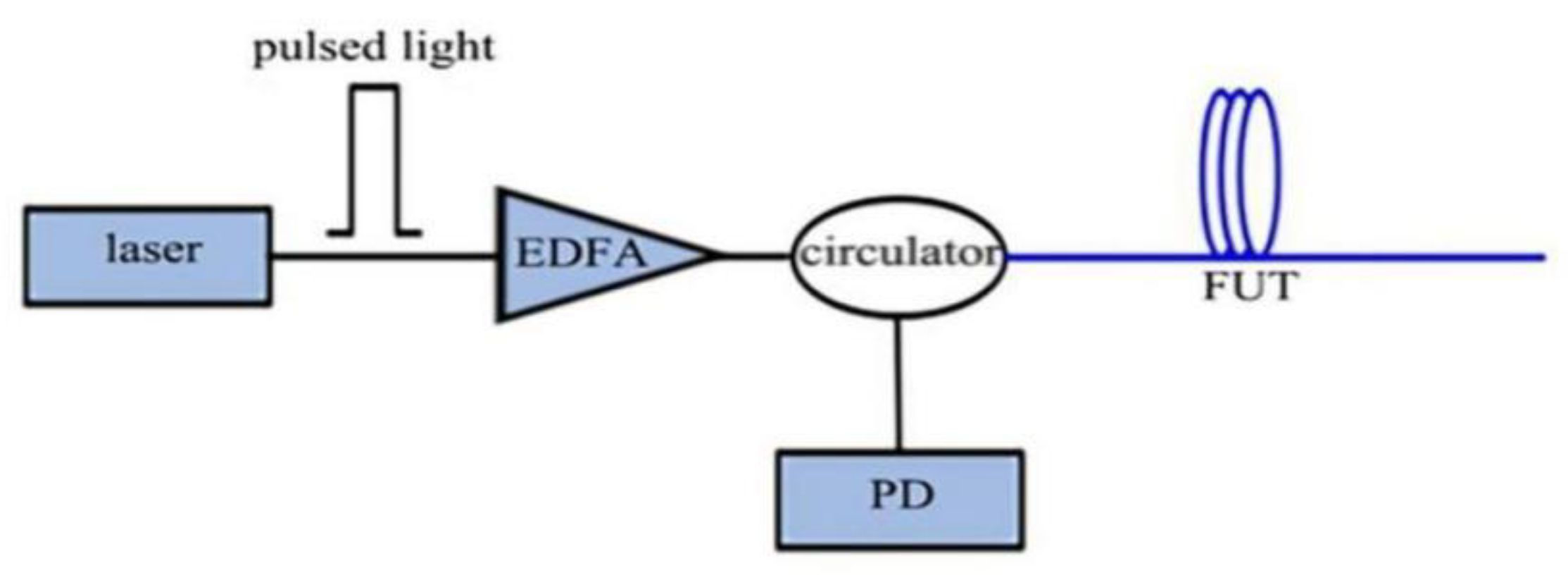
When an optical pulse is injected into the optical fiber under test (FUT), the RBS generates different round-trip times at different positions, which are received by the photodetector (PD). The RBS intensity at each position of the optical fiber is obtained by analyzing the electrical signal output from the PD. The position of the scattering point is related to the return time of the RBS. The round-trip time at the input can be expressed as:
当光脉冲注入被测光纤 (FUT) 时,RBS 在不同位置产生不同的往返时间,由光电探测器 (PD) 接收。光纤每个位置的 RBS 强度是通过分析 PD 输出的电信号获得的。散射点的位置与 RBS 的返回时间有关。输入端的往返时间可以表示为:
z = c σ 2 n = v g σ 2 ,
where σ is the time of backscattered detection, vg is the group speed in the optical fiber, and the factor of 2 means that only the backscattered pulse is needed to return to the detector. Under ideal conditions of the uniform refractive index of the optical fiber, the amplitude of the backscattered light at any point is proportional to the amplitude of the forward propagating light at that position, because Rayleigh backscattered light is a linear process [19] (Figure 2).
其中 σ 是反向散射检测的时间,v g 是光纤中的群速,系数 2 表示只需要反向散射脉冲返回探测器。在光纤均匀折射率的理想条件下,任何点的反向散射光的振幅与该位置前向传播光的振幅成正比,因为瑞利反向散射光是一个线性过程 [ 19] (图 2)。
Figure 2. OTDR structure diagram.
图 2.OTDR 结构图。

2.2. Principle of Φ-OTDR Techniques
2.2. Φ-OTDR 技术原理

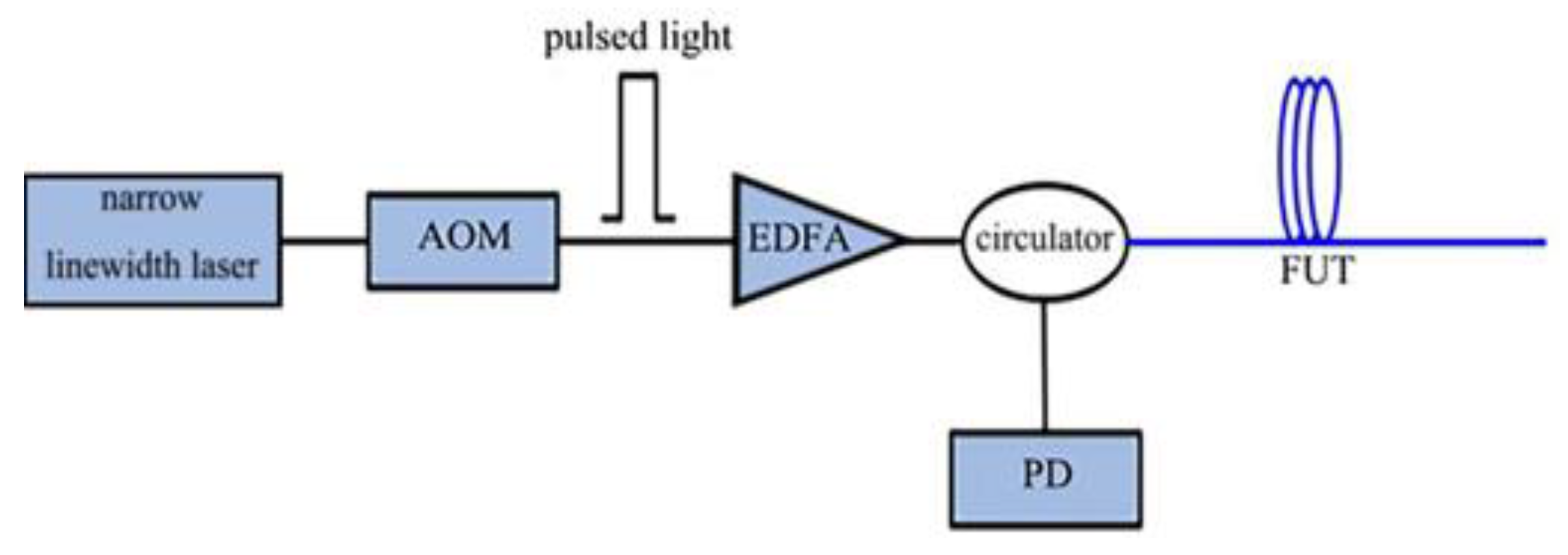
To address the defect that traditional OTDR techniques cannot respond to external interference, Φ-OTDR techniques evolved from traditional OTDR techniques; the main difference between the two is the choice of laser, with Φ-OTDR techniques having more demanding requirements. In Φ-OTDR, the line width of the laser is very narrow, usually less than 100 kHz, so the coherent length is much longer than the pulse width. When a certain section of optical fiber is affected by interference, it changes the phase of the RBS passing through the corresponding position, leading to the change in the RBS’s intensity due to the interference effect.
为了解决传统 OTDR 技术无法响应外部干扰的缺陷,Φ-OTDR 技术从传统的 OTDR 技术演变而来;两者的主要区别在于激光器的选择,Φ-OTDR 技术的要求更高。在 Φ-OTDR 中,激光器的线宽非常窄,通常小于 100 kHz,因此相干长度比脉冲宽度长得多。当光纤的某一段受到干扰时,它会改变 RBS 通过相应位置的相位,导致 RBS 的强度因干扰效应而发生变化。
A narrow linewidth laser (NLL) emitting highly coherent light is used as the light source, an acousto-optic modulator (AOM) is used to convert the continuous light into a probe pulse, and an erbium-doped fiber amplifier (EDFA) is used to compensate for the previous optical path and the loss of power to the optical path devices. The amplified detection pulses are injected into the sensing optical fiber via a circulator (CIR). Then, its RBS light is delivered through the CIR to a PD [20] (Figure 3).
发射高度相干光的窄线宽激光器 (NLL) 用作光源,声光调制器 (AOM) 用于将连续光转换为探测脉冲,掺铒光纤放大器 (EDFA) 用于补偿先前的光路和光路器件的功率损失。放大的检测脉冲通过环行器 (CIR) 注入传感光纤。然后,它的 RBS 光通过 CIR 传递到 PD [ 20] (图 3)。
Figure 3. Φ-OTDR structure diagram.
图 3.Φ-OTDR 结构图。

2.3. Principle of COTDR Techniques
2.3. COTDR 技术原理

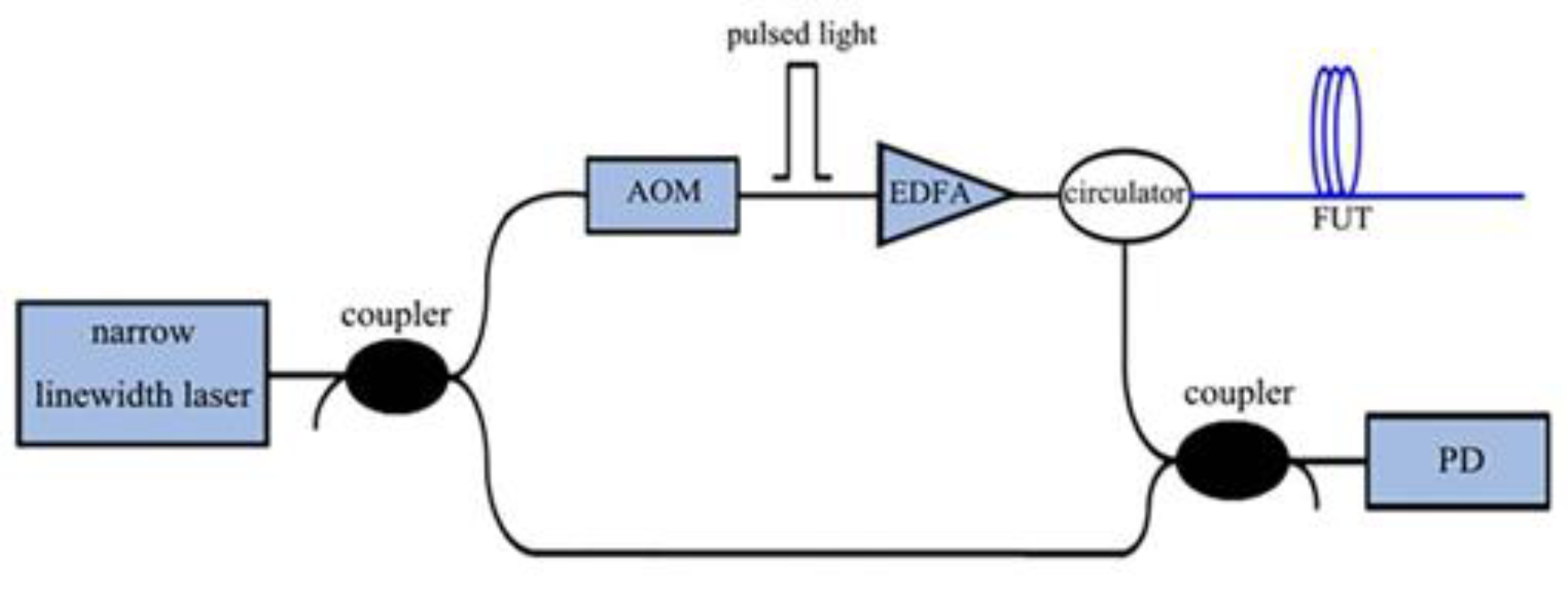
Coherent detection techniques were introduced on the basis of Φ-OTDR; they process the beat frequency signal of the local signal and the Rayleigh backscattering signal, and can sense the phase information and position of the external vibration signal in real time. The main difference between COTDR and traditional OTDR is that the former uses a narrow linewidth laser having a stable frequency and much longer coherence length than that of a FUT. By comparing the electrical fields before and after modulation, it can be expressed as:
在 Φ-OTDR 的基础上引入了相干检测技术;它们处理本地信号的拍频信号和瑞利背向散射信号,并能实时感知外部振动信号的相位信息和位置。COTDR 与传统 OTDR 的主要区别在于,前者使用窄线宽激光器,具有稳定的频率和比 FUT 长得多的相干长度。通过比较调制前后的电场,可以表示为:
E l ( t ) = P l e j 2 π v 0 t ,
and:  和:
E p ( t ) = P p e j ( 2 π v 0 t + 2 π f 0 t ) α ( t H p ) ,
where α(t) is the window function, Hp is the probe pulse width, f0 is the carrier frequency, Pp and Pl are the power of the RBS light and the local light respectively, and v0 is the laser’s center frequency. Then the photoelectric field of the PD can be expressed as:
其中 α() 是窗口函数,H p 是探测脉冲宽度, 0 是载波频率,P p 和 P 分别是 RBS 光和局部光的功率,v 0 是激光器的中心频率。那么 PD 的光电场可以表示为:
E R ( t ) = i = 1 N E i e j [ 2 π v 0 ( t σ i ) + 2 π f 0 ( t σ i ) ] α ( t σ i H p ) ,
where N is the number of the scattering points along the FUT, σi is the round-trip time of the i scattering point, and Ei is its photoelectrical field amplitude [21] (Figure 4).
其中 N 是沿 FUT 的散射点的数量,σ 是散射点的往返时间,Ei 是其光电场振幅 [ 21] (图 4)。
Figure 4. COTDR structure diagram.
图 4.COTDR 结构图。

3. Research Progress  3. 研究进展

3.1. Polarization Fading  3.1. 偏振衰落

The birefringence phenomenon results in polarization fading because the polarization state of the output light is different from that of the reference light [22]. The main feature of polarization fading is the random fluctuations of amplitude of the beat frequency signal of the interference between the signal light and the reference light. The amplitude of the scattered waveform is close to zero at some positions when polarization fading occurs in the phase demodulation.
双折射现象导致偏振衰落,因为输出光的偏振状态与参考光的偏振状态不同 [ 22]。偏振衰落的主要特点是信号光与参考光之间干涉的拍频信号振幅的随机波动。当相位解调中出现极化衰落时,散射波形的幅度在某些位置接近于零。
As early as the 1970s, the fading phenomenon was preliminarily studied in the fields of optical imaging [23] and wireless communication [24]. At present, it is addressed using polarization-maintaining fiber depolarization [25], Faraday rotating mirrors [26], input polarization state control [27], high-speed polarization modulation [28], diversity reception [29], etc.
早在 1970 年代,光学成像 [ 23] 和无线通信 [ 24] 领域就初步研究了衰落现象。目前,使用保偏光纤去极化 [ 25]、法拉第旋转镜 [ 26]、输入极化状态控制 [ 27]、高速极化调制 [ 28]、分集接收 [ 29] 等来解决。
In 2014, Wu et al. proposed a stable coherent and polarization maintaining light path structure with up to 40% visibility of interference fringes [30]. With the development of the technique, dual frequency probe pulses could be used to suppress polarization fading. In 2015, Alekseev et al. used the dual-pulse diverse frequency probe signal for phase signal reconstruction at any positions on the Φ-OTDR system, and experimental results demonstrated the feasibility of the scheme [31]. Although the scheme had significant limitations and was not yet mature enough for the control of both pulses, the experiment demonstrated the feasibility of the method and provided a direction for later researchers to suppress polarization fading. In 2017, Chen et al. proposed a new form of phase detection that effectively suppressed the effect of polarization fading. Experiments showed two simultaneous vibrations were detected in a 35 km optical fiber with an SNR of more than 26 dB [32].
2014 年,Wu 等人提出了一种稳定的相干和偏振保持光路结构,干涉条纹的可见度高达 40% [ 30]。随着该技术的发展,双频探针脉冲可用于抑制极化衰落。2015 年,Alekseev 等人使用 Φ-OTDR 系统上任意位置的双脉冲分频探测信号进行相位信号重建,实验结果证明了该方案的可行性 [ 31]。尽管该方案有很大的局限性,并且还不够成熟,无法控制这两个脉冲,但实验证明了该方法的可行性,并为后来的研究人员提供了抑制偏振衰落的方向。2017 年,Chen 等人提出了一种新的相位检测形式,可有效抑制偏振衰落的影响。实验表明,在 35 km 的光纤中检测到两次同步振动,SNR 超过 26 dB [ 32]。
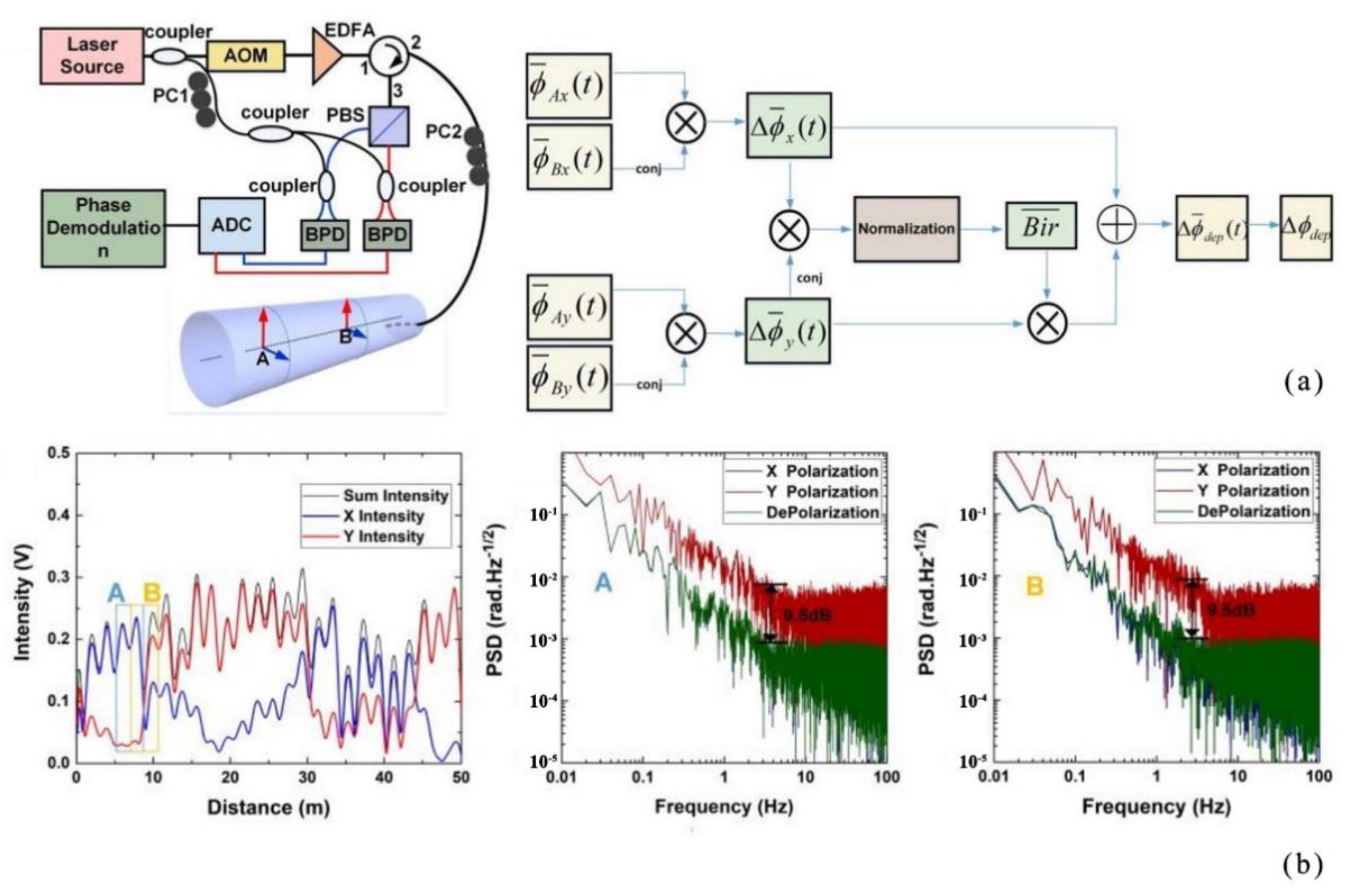
In 2020, Sun et al. proposed a distributed optical fiber acoustic sensing demodulation scheme based on a dynamic birefringence estimation [33] (Figure 5). The experimental results showed the effective suppression of the drastic polarization change, which was about 9.5 dB. The uniform background noise averaged about 1.2 × 10⁻³ Rad / Hz at different positions.
2020 年,Sun 等人提出了一种基于动态双折射估计的分布式光纤声传感解调方案 [ 33] ( 图 5 )。实验结果表明,有效抑制了约 9.5 dB 的剧烈极化变化。均匀的背景噪声平均约为 1.2 × 10 −3 Rad / Hz 在不同位置。
Figure 5. (a) Experimental setup and demodulation procedure. (b) Backscattered light intensity of backscattering enhanced fiber in different polarized states; PSD of fiber section A; PSD of fiber section B in X polarized state, Y polarized state and depolarized algorithm [33].
图 5.(a) 实验装置和解调程序。(b) 不同偏振态下背向散射增强光纤的背向散射光强度;纤维截面 A 的 PSD;X 极化态、Y 极化态和去极化算法下光纤段 B 的 PSD [ 33]。
In 2020, Rao et al. first proposed the bipolar Golay coding Φ-OTDR laser scan-rate problem with heterodyne detection function and adopted a real-time compensation (frequency drift compensation for the laser) method for its solution [34]. The method combined the spectrum extraction and remix methods to suppress polarization fading. Experiments showed that, compared with the unipolar code case, the SNR was improved by 7.1 dB within the sensing range of 10 km, the spatial resolution reached 0.92 m, and the measurement time was 1/2 of the original. By solving the frequency drift and fading problems, the distributed sensing capability of optical pulse coding (OPC) Φ-OTDR was realized, and the bipolar scheme could be applied in many other coding schemes, providing more possibilities for OPC to enter Φ-OTDR.
2020 年,Rao 等人首次提出了具有外差检测功能的双极 Golay 编码 Φ-OTDR 激光扫描速率问题,并采用实时补偿(激光器的频率漂移补偿)方法进行求解 [ 34]。该方法结合了光谱提取和重新混合方法,以抑制偏振衰落。实验表明,与单极码情况相比,在 10 km 的感知范围内,SNR 提高了 7.1 dB,空间分辨率达到 0.92 m,测量时间是原来的 1/2。通过解决频率漂移和衰落问题,实现了光脉冲编码 (OPC) Φ-OTDR 的分布式传感能力,双极方案可以应用于许多其他编码方案,为 OPC 进入 Φ-OTDR 提供了更多可能性。
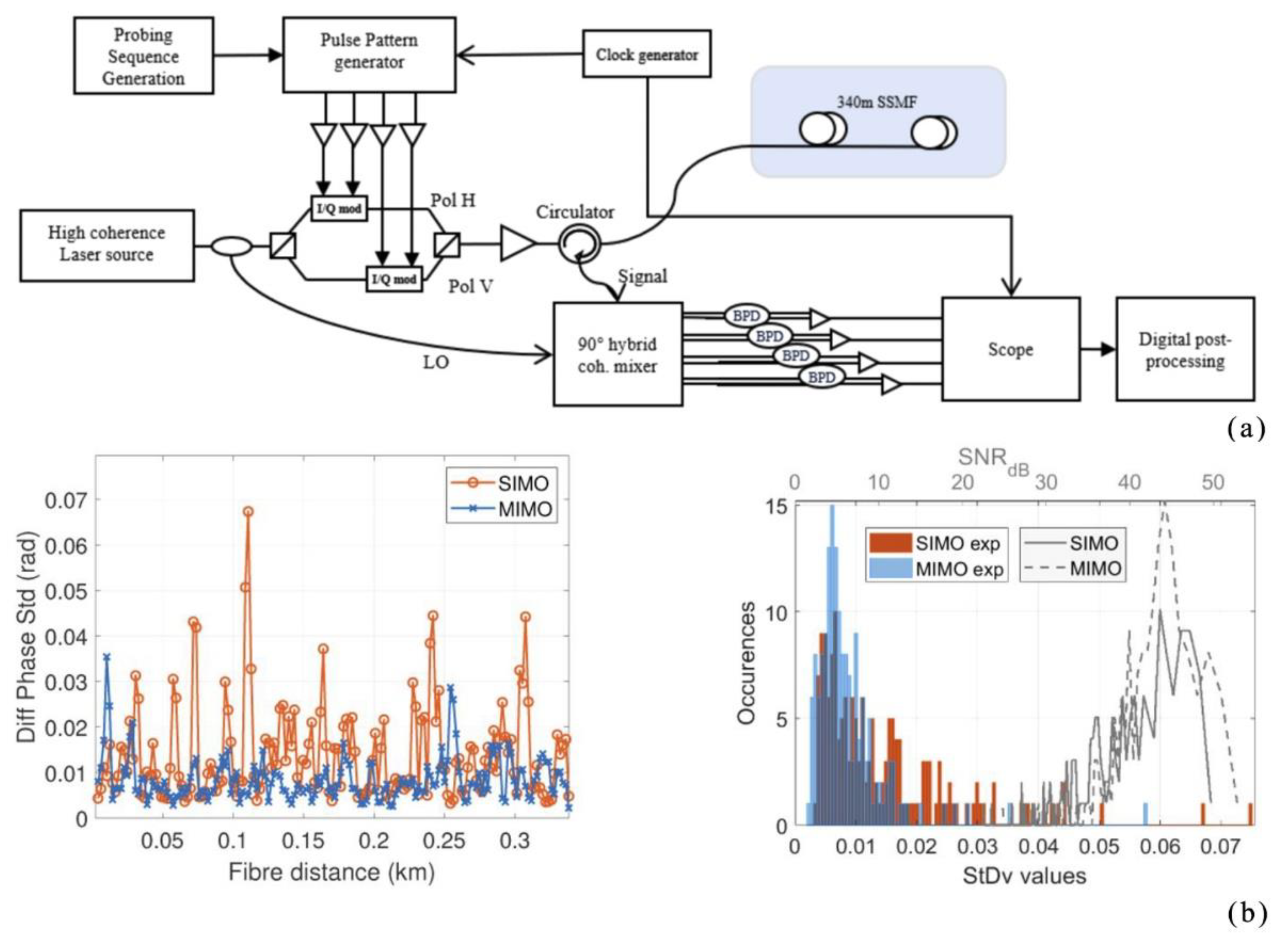
In 2020, Guerrier et al. proposed a coherent-MIMO sensing technique, which was based on the Φ-OTDR system [35] (Figure 6). The transmitter adopted double polarization multiplexing and the receiver adopted polarization diversity. A comparison of two-phase estimation methods for multiple polarization input-multiple polarization output sensing (MIMO) and single polarization input–multiple polarization output sensing (SIMO) led to the conclusion that coherent-MIMO sensing techniques outperform partial polarization diversity sensing techniques in terms of sensitivity. The polarization effect had little influence on the double polarization detection of the optical fiber sensor, which reduced the probability of false alarms in the system and greatly improved its sensitivity. It is of great significance to further study the double polarization demodulation of the optical fiber sensor.
2020 年,Guerrier 等人提出了一种基于 Φ-OTDR 系统的相干 MIMO 传感技术 [ 35] ( 图 6 )。发射器采用双极化复用,接收器采用极化分集。对多极化输入-多极化输出传感 (MIMO) 和单极化输入-多极化输出传感 (SIMO) 的两相估计方法进行比较,得出的结论是,相干 MIMO 传感技术在灵敏度方面优于部分极化分集传感技术。偏振效应对光纤传感器的双偏振检测影响不大,降低了系统内误报的概率,大大提高了其灵敏度。进一步研究光纤传感器的双偏振解调具有重要意义。
Figure 6. (a) Experimental setup. (b) SIMO and MIMO measurements on 340 m SSMF, no perturbation applied [35].
图 6.(a) 实验装置。(b) 在 340 m SSMF 上进行的 SIMO 和 MIMO 测量,未施加扰动 [ 35]。
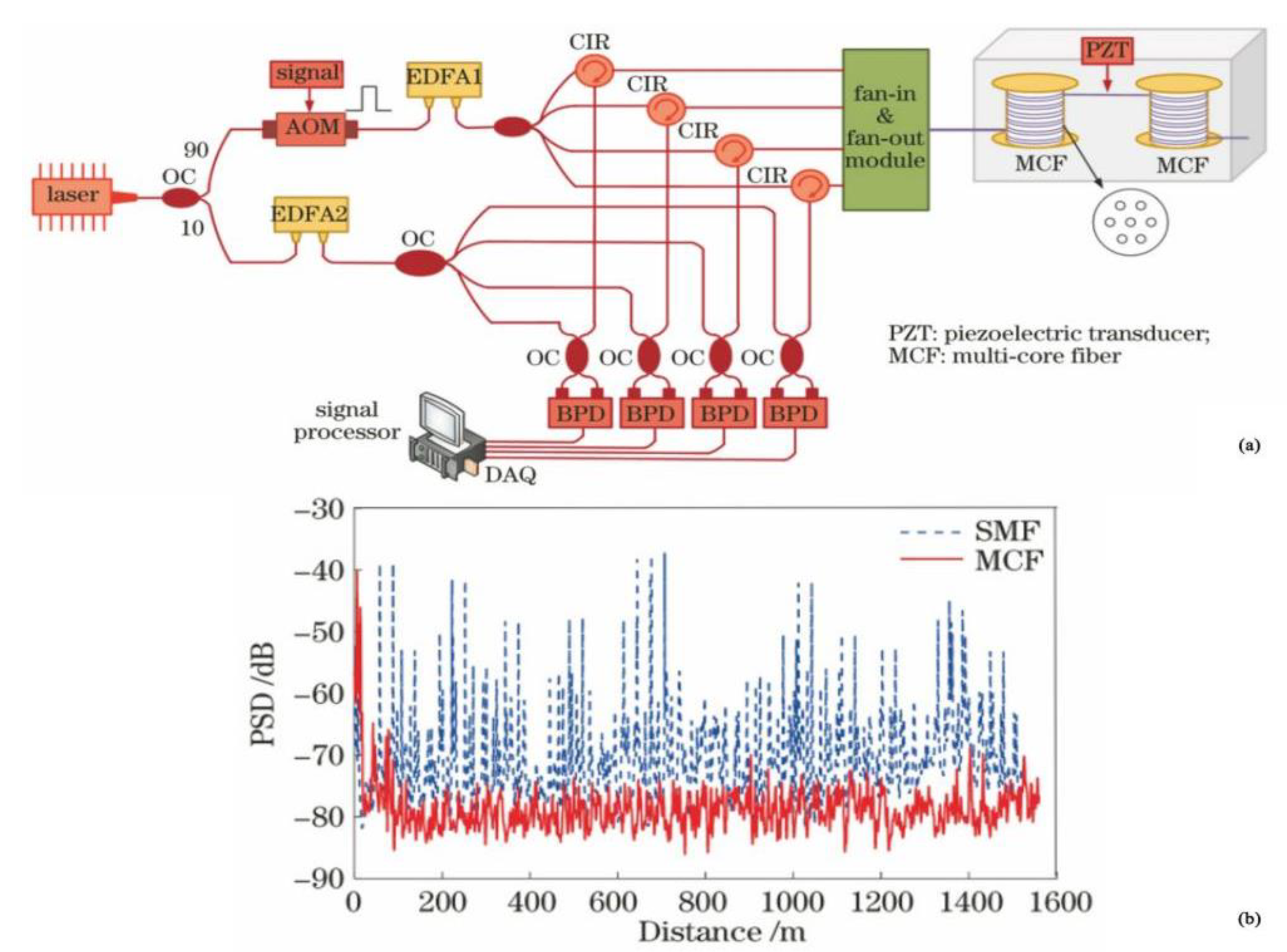
In 2021, Gu et al. proposed a new spatial diversity technique based on multi-core optical fiber [36] (Figure 7). By means of a fan-in and fan-out module, the independent transmission and centralized reception of signals were carried out in the four cores of the multi-core optical fiber, and the multiple signals were effectively combined by the coherent combining techniques. The experimental results showed that the external interference signal was well reconstructed, the signal fading was suppressed, and the noise floor of the system was decreased to 5.2 dB compared with the optimized single-mode optical fiber system. The sensor exhibited a high level of performance with a minimum noise floor of −85 dB.
2021 年,Gu 等人提出了一种基于多芯光纤的新型空间分集技术 [ 36] ( 图 7 )。通过扇入扇出模块,在多芯光纤的四芯中进行信号的独立发射和集中接收,并通过相干组合技术将多个信号有效组合。实验结果表明,与优化的单模光纤系统相比,外部干扰信号重建良好,信号衰落得到抑制,系统本底噪声降低至 5.2 dB。该传感器表现出高水平的性能,最小本底噪声为 −85 dB。
Figure 7. (a) Experimental setup. (b) PSD of SMF and MCF at the frequency of 2.5 kHz [36].
图 7.(a) 实验装置。(b) SMF 和 MCF 在 2.5 kHz 频率下的 PSD [ 36]。
In 2021, Ogden et al. analyzed a COTDR system that was based on a frequency multiplexed pulse sequence structure [37]. The method was implemented by increasing the average power injected into the optical fiber, thereby suppressing polarization fading while reducing noise, improving the linearity of the sensor, and achieving a minimum detectable strain of 0.6   p ε / Hz . The research progress for suppressing polarization fading is summarized in Table 1.
2021 年,Ogden 等人分析了一种基于频率多路复用脉冲序列结构的 COTDR 系统 [ 37]。该方法是通过增加注入光纤的平均功率来实现的,从而抑制偏振衰落,同时降低噪声,提高传感器的线性度,并实现 0.6 的最小可检测应变   p ε / Hz 。表 1 总结了抑制偏振衰落的研究进展。
Table 1. Research progress for suppression of polarization fading.
表 1.抑制偏振衰落的研究进展。
In summary, to solve the polarization fading problem, researchers changed the optical path structure at an early stage. However, the suppression effect of polarization fading problem was not obvious due to the hardware problem at that time. In recent years, phase extraction was proposed by using the dual-pulse diverse frequency probe signal. This is able to detect two simultaneous vibrations, but still has limitations and cannot be carried out on a large scale. Recently, researchers started from the principle of the generation of polarization fading, and the method of simultaneous improvement of software and hardware, such as the demodulation scheme based on dynamic birefringence, was demonstrated. Frequency drift was proposed using the bipolar Golay coding technique with the heterodyne detection function. This significantly improved the system performance compared with traditional unipolar coding, but spatial resolution must be improved. The sensitivity was optimized by spatial diversity techniques, but the experimental system was more complex. The changing pulse sequence technique was used for fading suppression and can greatly reduce the noise, but it requires a large amount of technical support and the system cost is high. In general, the bipolar coding technique, spatial diversity technique, and changing pulse sequence technique are not mature enough, but this does not affect their future improvements for solving the problem of polarization fading and improving the system performance.
综上所述,为了解决偏振衰落问题,研究人员在早期就改变了光路结构。但是,由于当时的硬件问题,偏振衰落问题的抑制效果并不明显。近年来,提出了利用双脉冲分频探测信号进行相位提取。这能够同时检测到两个振动,但仍然有局限性,无法大规模进行。近年来,研究人员从极化衰落产生的原理出发,论证了软硬件同时完善的方法,如基于动态双折射的解调方案。使用具有外差检测功能的双极 Golay 编码技术提出了频率漂移。与传统的单极编码相比,这显著提高了系统性能,但必须提高空间分辨率。灵敏度通过空间分集技术进行了优化,但实验系统更复杂。采用改变脉冲序列技术进行衰落抑制,可以大大降低噪声,但需要大量的技术支持,系统成本高。总的来说,双极编码技术、空间分集技术和改变脉冲序列技术还不够成熟,但这并不影响它们未来对解决极化衰落问题和提高系统性能的改进。

3.2. Coherent Fading  3.2. 相干衰落

Coherent fading relates to light fluctuating up and down of Φ-OTDRs when narrow linewidth lasers having a long coherence length detect intra-pulse interference of the RBS generated by the pulsed light. The RBS become weaker or even converges to zero at certain locations, resulting in random detection blind spots in the time and frequency domains because of coherent fading. In turn, the process of phase demodulation causes a sharp deterioration in the signal-to-noise ratio, and the reconstructed phase information of the external signal is far from the actual situation, leading to serious consequences of missed or even false alarms [38,39].
当具有长相干长度的窄线宽激光器检测到脉冲光产生的 RBS 的脉冲内干扰时,相干衰落与 Φ-OTDR 上下波动的光有关。RBS 在某些位置变得更弱,甚至收敛到零,由于相干衰落,导致时域和频域中出现随机检测盲点。反过来,相位解调的过程导致信噪比急剧恶化,重建的外部信号相位信息与实际情况相去甚远,导致漏报甚至误报的严重后果 [ 38, 39]。
In order to solve the problems caused by coherent fading, researchers conducted a series of studies, such as pulse coding techniques, frequency division multiplexing (FDM), and internal pulse division methods [40,41]. The pulse coding techniques using the multi-frequency pulse method have poor fading suppression because they need different detection pulses of different frequencies, and exhibit a large variability from pulse to pulse. Based on the above problems, in 2018, Cai et al. proposed a new method based on the differential phase shift pulse (DPSP) technique to improve the original phase extraction method. The phase can be demodulated by the amplitude threshold to reduce the probability of coherent fading [42].
为了解决相干衰落带来的问题,研究人员进行了一系列研究,如脉冲编码技术、频分复用 (FDM) 和内部脉冲分频法 [ 40, 41]。使用多频脉冲方式的脉冲编码技术需要不同频率的不同检测脉冲,并且脉冲间的可变性很大,因此衰落抑制效果较差。基于上述问题,2018 年,Cai 等人提出了一种基于差分相移脉冲 (DPSP) 技术的新方法,以改进原来的相位提取方法。相位可以通过幅度阈值解调,以降低相干衰落的可能性 [ 42]。
In 2021, He et al. proposed a phase-shift transform method to suppress the coherent fading of Φ-OTDR based on the original multi-frequency pulse method. The detected signal was first decomposed and the π phase shift of a signal with complementary amplitude was obtained. The false phase was corrected by synthesizing the complementary signal. This experiment not only allowed the intensity fluctuations above 60 dB to be reduced to 15 dB, but also reduced the standard deviation of the differential phase to 0.0224 [43].
2021 年,He 等人在原始多频脉冲方法的基础上提出了一种相移变换方法,以抑制 Φ-OTDR 的相干衰落。首先对检测到的信号进行分解,得到具有互补幅度的信号的π相移。通过合成互补信号来校正假相位。该实验不仅使 60 dB 以上的强度波动降低到 15 dB,而且将差分相位的标准差降低到 0.0224 [ 43]。
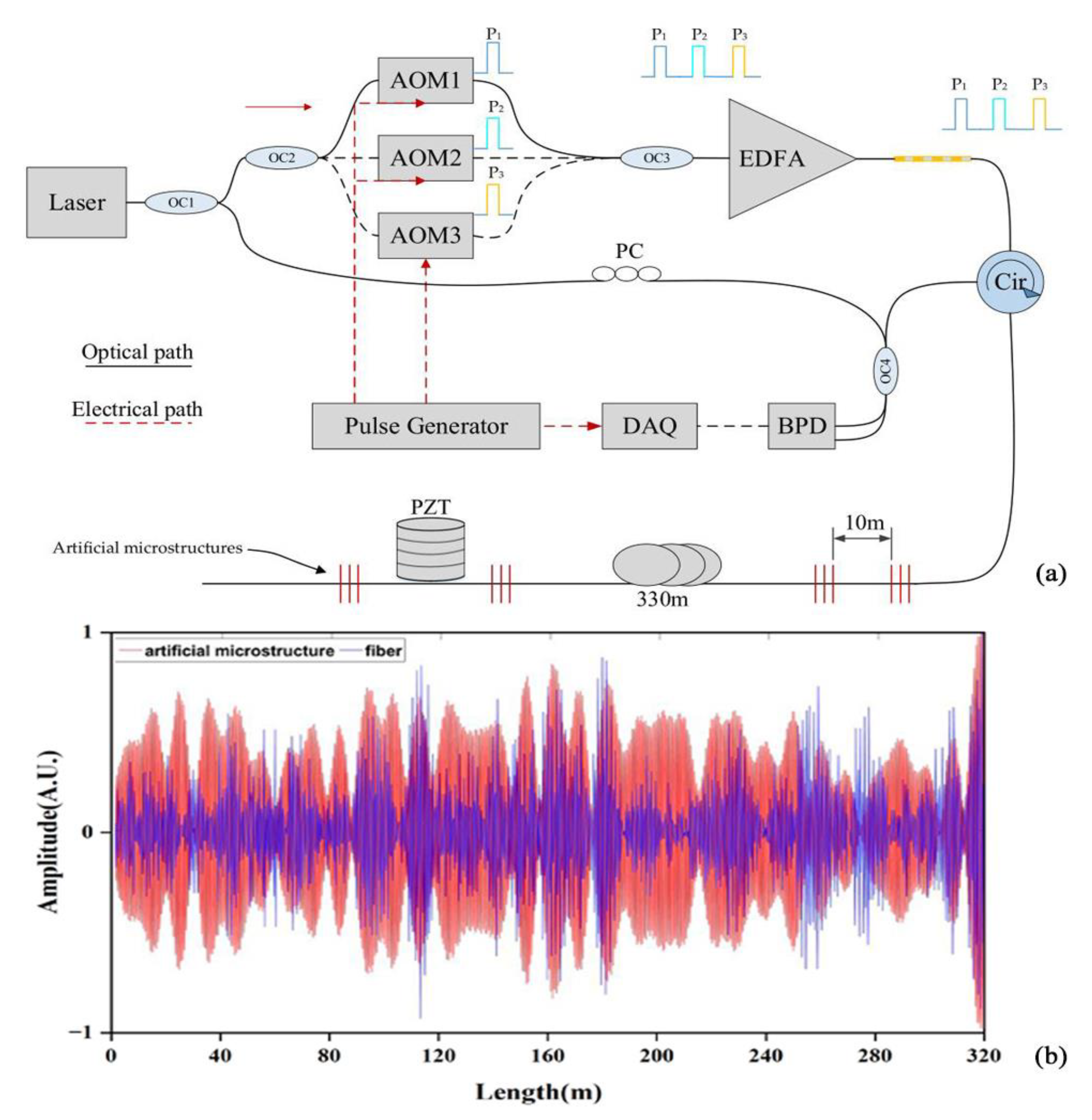
To ensure the desired outcome without sacrificing spatial resolution, in 2019, Zhang et al. proposed a coherent fading suppression method based on frequency division multiplexing (FDM) Φ-OTDR to keep the signal distortion induced by coherent fading in the order of 10−2 [44] (Figure 8).
为了在不牺牲空间分辨率的情况下确保预期的结果,2019 年,Zhang 等人提出了一种基于频分复用 (FDM) Φ-OTDR 的相干衰落抑制方法,以将相干衰落引起的信号失真保持在 10 左右 −2 [ 44] ( 图 8)。
Figure 8. (a) Experimental setup. (b) The beat frequency signal [44].
图 8.(a) 实验装置。(b) 拍频信号 [ 44]。
In order to meet the performance requirements of commercial fields such as wireless communication, FDM based on the above proof can effectively suppress coherent fading. In 2021, Zhang et al. proposed a method to suppress coherent fading by Φ-OTDR based on space division multiplexing (SDM), and the experimental results proved that the method could greatly reduce the distortion rate of the signal to maintain it below 2%. This was useful in significantly improving the monitoring performance of commercial systems [45].
为了满足无线通信等商业领域的性能要求,基于上述证明的 FDM 可以有效抑制相干衰落。2021 年,Zhang 等人提出了一种基于空分复用 (SDM) 的 Φ-OTDR 抑制相干衰落的方法,实验结果证明,该方法可以大大降低信号的失真率,使其保持在 2% 以下。这对于显著提高商业系统的监测性能非常有用 [ 45]。
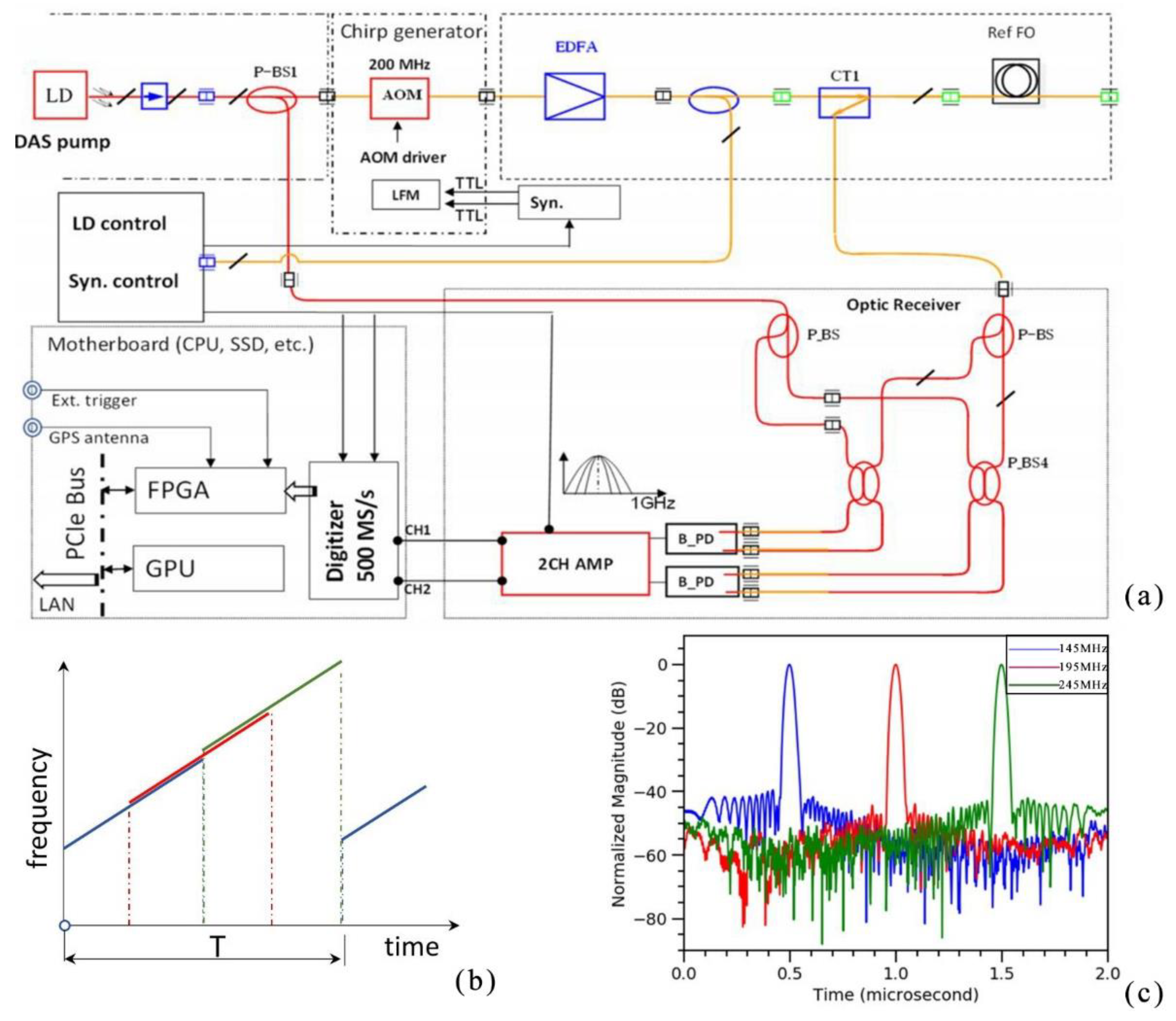
In 2021, He et al., proposed a method using time-gated digital-optical frequency domain reflectometry (TGD-OFDR) to suppress the coherent fading of Φ-OTDR [46] (Figure 9). The chirped pulses were divided into overlapping bands and reassembled after digital decoding to achieve a maximum detectable range of 80 km. The superiority of the approach was proven in practical tests. The research progress for the suppression of coherent fading is summarized in Table 2.
2021 年,He 等人提出了一种使用时间门控数字光频域反射计 (TGD-OFDR) 来抑制 Φ-OTDR 相干衰落的方法 [ 46] (图 9)。啁啾脉冲被分成重叠的频段,并在数字解码后重新组装,以实现 80 km 的最大可探测距离。该方法的优越性在实际测试中得到了证明。表 2 总结了抑制相干衰落的研究进展。
Figure 9. (a) Experimental setup. (b) Chirped pulse and sub-division into bands (offset for visibility, frequency change is linear over entire range). (c) Corresponding frequency bands used during signal processing [46].
图 9.(a) 实验装置。(b) 啁啾脉冲和细分为波段(为能见度而偏移,频率变化在整个范围内是线性的)。(c) 信号处理过程中使用的相应频段 [ 46]。
Table 2. Research progress for suppression of coherent fading.
表 2.抑制相干衰落的研究进展。
In summary, a large number of techniques have been proposed to suppress coherent fading. The DPSP can reduce the probability of interference without sacrificing the vibration response bandwidth, but cannot be widely used due to the limitation of complex experimental operations and performance loss. The phase shift transform technique greatly improves on the weaknesses of the traditional multi-frequency pulse method and has the ability to correct for shifted phases; moreover, although the system is more complex, it does not require complex frequency/phase modulation. FDM can not only suppress the distortion rate of the signal caused by coherent fading to 1.26%, but also improves the overall frequency corresponding range, which requires greater hardware and changes the original system structure. The SDM technique is not as accurate as the FDM technique, but its structure is simple and it can effectively be adapted to commercial use. The TGD-OFDR technique can ensure scattered light detection with a high enough SNR, and its commercial performance index is also relatively outstanding, exceeding other commercial devices in traditional SM fiber.
总之,已经提出了大量技术来抑制相干衰落。DPSP 可以在不牺牲振动响应带宽的情况下降低干扰概率,但由于实验作复杂和性能损失的限制,不能得到广泛应用。相移变换技术大大改进了传统多频脉冲方法的弱点,具有校正移相的能力;此外,虽然系统更复杂,但它不需要复杂的频率/相位调制。FDM 不仅可以将相干衰落引起的信号失真率抑制到 1.26%,还可以提高整体频率对应范围,这需要更大的硬件并改变原有的系统结构。SDM 技术不如 FDM 技术准确,但其结构简单,可以有效地适应商业用途。TGD-OFDR 技术可以保证具有足够高 SNR 的散射光检测,其商业性能指标也相对突出,超过了传统 SM 光纤中的其他商用设备。

3.3. Spatial Resolution  3.3. 空间分辨率

Spatial resolution is the minimum distance that an optical fiber sensing system can effectively identify two individual events. It is one of the main parameters used to measure DAS system performance.
空间分辨率是光纤传感系统可以有效识别两个单独事件的最小距离。它是用于测量 DAS 系统性能的主要参数之一。
In general, the spatial resolution is mainly influenced by the pulse width, which can be written as:
一般来说,空间分辨率主要受脉冲宽度的影响,可以写成:
Δ z = c T w 2 n ,
where Δ z   is the spatial resolution, c is the speed of light, and T w and n are the pulse width and the refractive index of the optical fiber, respectively. However, the pulse width is inversely proportional to the SNR and the sensing distance. Determining how to balance these three parameters is of great significance to researchers.
其中 Δ z   是空间分辨率, c 是光速, T w n 分别是光纤的脉冲宽度和折射率。但是,脉冲宽度与 SNR 和感应距离成反比。确定如何平衡这三个参数对研究人员来说具有重要意义。
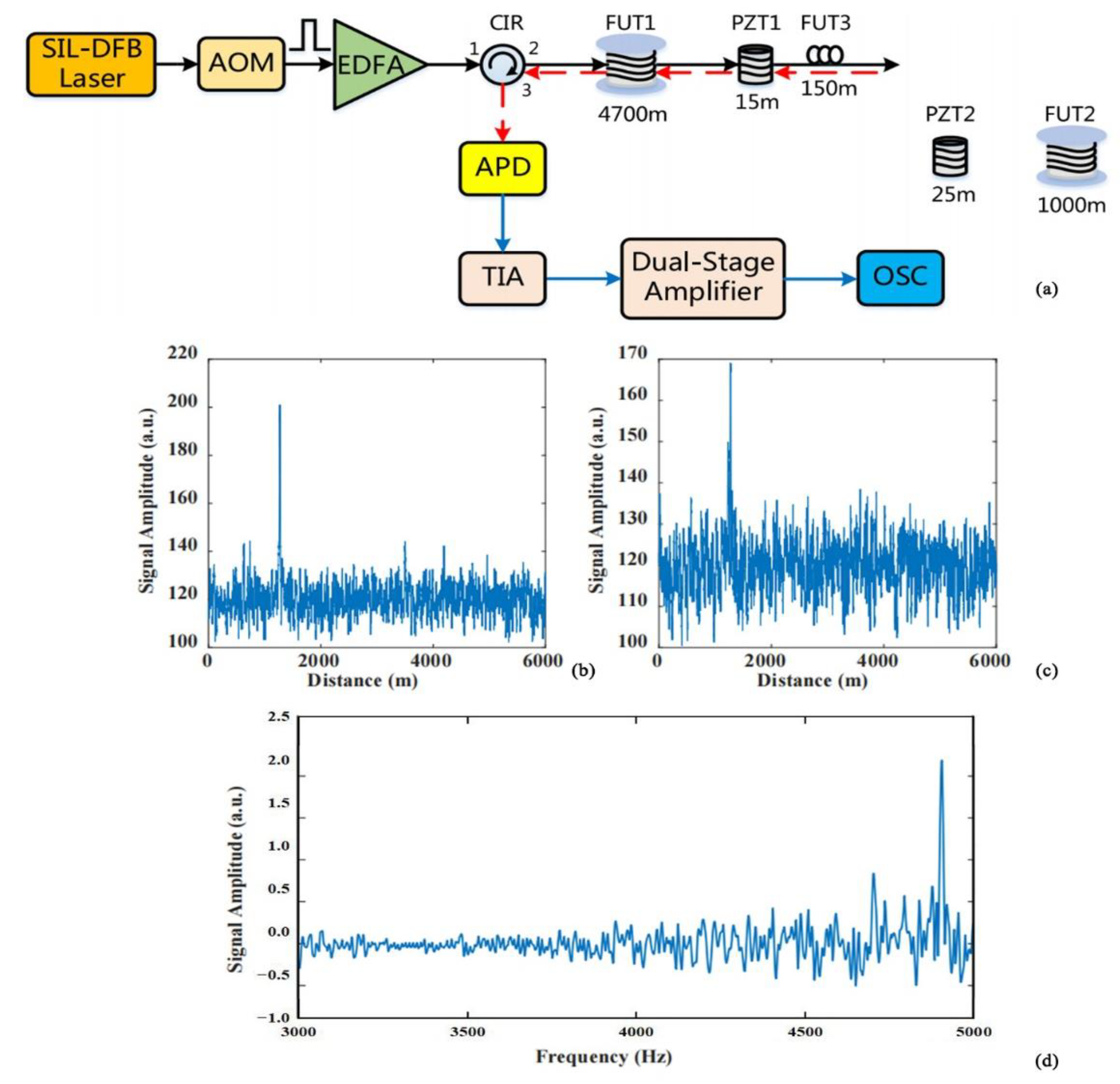
Improved sensing system structure and optical path devices have been used to improve the spatial resolution of the system. In 2016, Shang et al. added an interferometer on the basis of the traditional optical path, recovered the phase information via the phase carrier demodulation algorithm, and realized a flat frequency response curve and 10 m spatial resolution [47]. In response to the shortcomings of conventional piezoelectric transducer (PZT) modulation, such as low efficiency and insufficient performance, in 2021, Ma et al. proposed an optical fiber PGC modulation structure based on a LiNbO3 through-waveguide phase modulator [48]. This structure had greatly improved performance compared to the traditional interferometer, was capable of detecting weak acoustic signals, and achieved a spatial resolution of 10 m. It provided a new research idea for the development of DAS systems. In 2021, Zhu et al. established a new Φ-OTDR optical path system [49] (Figure 10). This system used a distributed feedback (DFB) semiconductor laser combined with an optical waveguide ring resonator (OWRR) as the light source, and its linewidth and stability were excellent at a reduced cost. It offered the advantages of compactness, ease of integration, and high interference immunity. Simultaneous measurements of two vibration sources could be made over 4700 m of fiber with a spatial resolution of 13 m.
改进的传感系统结构和光路器件已被用于提高系统的空间分辨率。2016 年,Shang 等人在传统光路的基础上增加了干涉仪,通过相位载波解调算法恢复相位信息,实现了平坦的频率响应曲线和 10 m 的空间分辨率 [ 47]。针对传统压电换能器(PZT)调制效率低、性能不足等缺点,马等人在 2021 年提出了一种基于 LiNbO 3 穿波导相位调制器的光纤 PGC 调制结构[48]。与传统干涉仪相比,这种结构的性能大大提高,能够检测微弱的声学信号,并实现了 10 m 的空间分辨率。它为 DAS 系统的开发提供了新的研究思路。2021 年,Zhu 等人建立了一种新的 Φ-OTDR 光路系统 [ 49] ( 图 10 )。该系统使用分布式反馈 (DFB) 半导体激光器结合光波导环谐振器 (OWRR) 作为光源,其线宽和稳定性优异,但成本较低。它具有紧凑、易于集成和高抗干扰性等优点。可以在 4700 m 的光纤上同时测量两个振动源,空间分辨率为 13 m。
Figure 10. (a) Experimental setup. Localization of vibration sources at different frequencies: (b) 8 Hz; (c) 4.9 kHz. (d) FFT frequency spectrum at the 4.9-kHz vibration point [49].
图 10.(a) 实验装置。不同频率的振动源定位:(b) 8 Hz;(c) 4.9 kHz。(d) 4.9 kHz 振动点的 FFT 频谱 [ 49]。
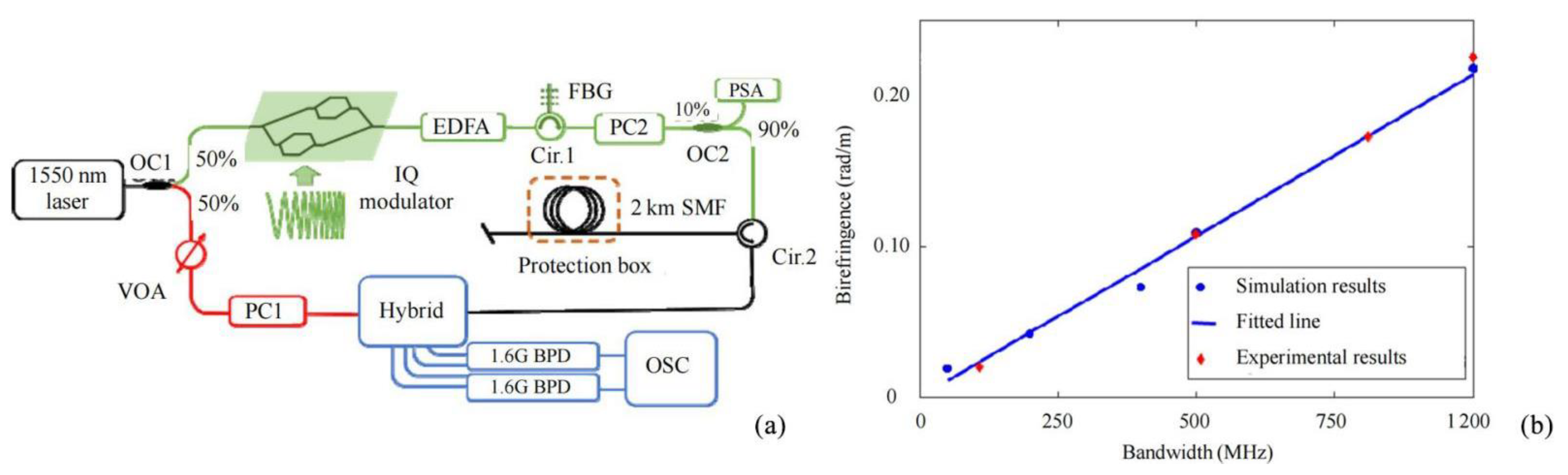
High spatial resolution was achieved using narrow width optical pulses or by introducing a swept pulse compression mechanism. In 2019, He et al. proposed a distributed acoustic sensor scheme that was independent of polarization fading that overcame the trade-off between spatial resolution and the sensing distance of conventional Φ-OTDR [50]. The spatial resolution was determined by the bandwidth and mismatch ratio of the chirped pulses rather than the pulse duration, so the spatial resolution could be adjusted to suit the actual requirements by varying the mismatch ratio. The system was available with a spatial resolution of up to 2 m. In 2021, Wang et al. proposed a new method for birefringence measurement using the RBS wave in a single-mode optical fiber [51] (Figure 11). The experiment showed a spatial resolution of 8.6 cm and an average birefringence of 0.234 rad/m. It was shown for the first time that spatial resolution was essential for optical fiber birefringence measurement, and provided an effective tool for characterizing the polarization properties of optical fiber links. In 2021, Qian et al. proposed the chirped pulse conversion algorithm (CPCA), which was based on converting a normal detection pulse into an equivalent chirped detection pulse by convolving the chirp coefficients of the received signal from a Φ-OTDR system [52]. The algorithm demodulated the chirped pulse Φ-OTDR in the Rayleigh interferogram pattern (RIP) to quantify the dynamic strain of the conventional Φ-OTDR. In contrast to the complex and expensive drawbacks of conventional chirp modulation, the generation of equivalent chirp pulses by means of digital processing had the advantage of being simple and inexpensive. The method allowed full quantification of the perturbation to achieve a spatial resolution of 4 m.
使用窄宽度光脉冲或引入扫描脉冲压缩机制实现了高空间分辨率。2019 年,He 等人提出了一种独立于偏振衰落的分布式声学传感器方案,克服了传统 Φ-OTDR 的空间分辨率和感应距离之间的权衡 [ 50]。空间分辨率由啁啾脉冲的带宽和失配比决定,而不是脉冲持续时间,因此可以通过改变失配比来调整空间分辨率以适应实际要求。该系统的空间分辨率高达 2 m。2021 年,Wang 等人提出了一种在单模光纤中使用 RBS 波进行双折射测量的新方法 [ 51] ( 图 11 )。实验显示空间分辨率为 8.6 cm,平均双折射为 0.234 rad/m。该研究首次表明,空间分辨率对于光纤双折射测量至关重要,并为表征光纤链路的偏振特性提供了有效的工具。2021 年,Qian 等人提出了啁啾脉冲转换算法 (CPCA),该算法的基础是通过卷积 Φ-OTDR 系统接收信号的啁啾系数,将正常检测脉冲转换为等效的啁啾检测脉冲 [ 52]。该算法解调瑞利干涉图模式 (RIP) 中的啁啾脉冲 Φ-OTDR,以量化传统 Φ-OTDR 的动态应变。与传统线性调频调制复杂且昂贵的缺点相比,通过数字处理生成等效线性调频脉冲具有简单且成本低廉的优势。 该方法允许对扰动进行完全量化,以实现 4 m 的空间分辨率。
Figure 11. (a) Experimental setup. (b) Demodulated birefringence of simulation and experiments [51].
图 11.(a) 实验装置。(b) 模拟和实验的解调双折射 [ 51]。
To determine the relationship between spatial resolution and SNR, in 2019, Zhang et al. proposed a sensing scheme with multiple spatial resolutions (MSRs) for analyzing Φ-OTDR sensing systems. This scheme could recover vibration events with different interference ranges in a single test with the best SNR while maintaining the same detection frequency range. The results demonstrated that it was extremely important to select the proper spatial resolution, which was beneficial to improving the SNR of the sensing system [53].
为了确定空间分辨率与 SNR 之间的关系,2019 年,Zhang 等人提出了一种具有多个空间分辨率 (MSR) 的传感方案,用于分析 Φ-OTDR 传感系统。该方案可以在保持相同检测频率范围的情况下,以最佳信噪比在单次测试中恢复具有不同干扰范围的振动事件。结果表明,选择合适的空间分辨率极为重要,这有利于提高传感系统的 SNR [ 53]。
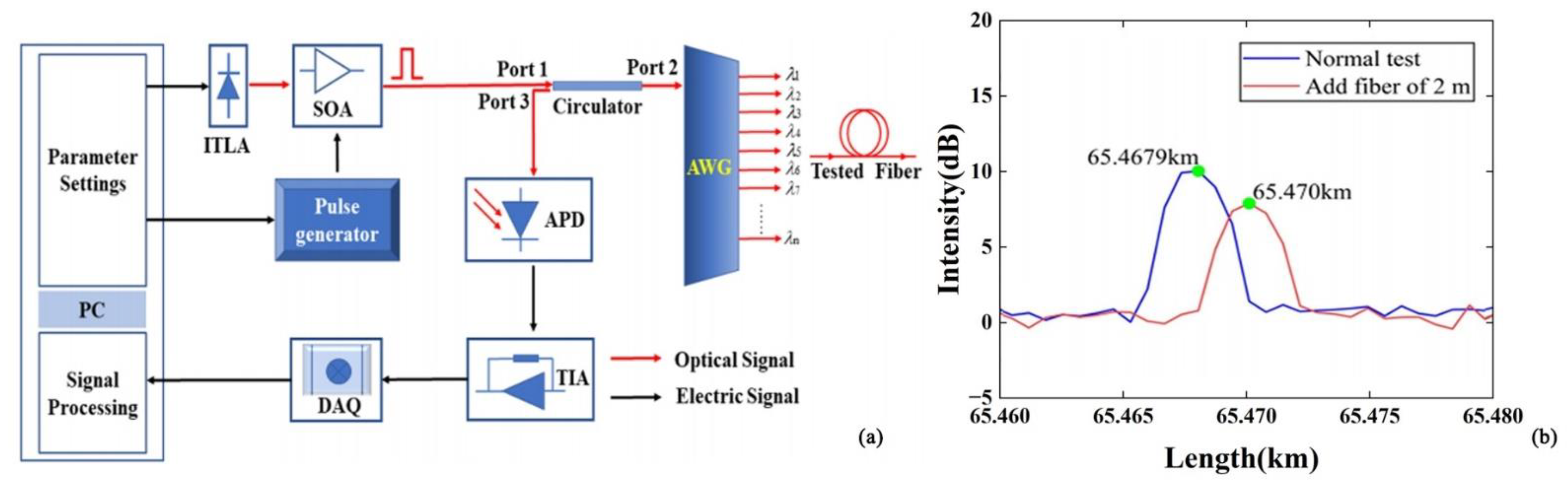
Multiplexing techniques can also improve the spatial resolution of the sensing system. In 2021, Gong et al. proposed an OTDR system for dense wavelength division multiplexing passive optical networks (DWDM-PONs). The system was selected to achieve wavelength tunability by selecting an integrated tunable laser assembly (ITLA) as the light source and using wavelet denoising to reconstruct the pulsed light to achieve a spatial resolution of 2 m [54] (Figure 12). The research progress for spatial resolution enhancement is summarized in Table 3.
多路复用技术还可以提高传感系统的空间分辨率。2021 年,Gong 等人提出了一种用于密集波分复用无源光网络 (DWDM-PON) 的 OTDR 系统。通过选择集成可调谐激光组件 (ITLA) 作为光源并使用小波去噪来重建脉冲光以实现 2 m 的空间分辨率 [ 图 12] ,选择该系统来实现波长可调性。表 3 总结了空间分辨率增强的研究进展。
Figure 12. (a) Experimental setup. (b) The result of spatial resolution measurement [54].
图 12.(a) 实验装置。(b) 空间分辨率测量的结果 [ 54]。
Table 3. Research progress on for spatial resolution enhancement.
表 3.空间分辨率增强研究进展.
In summary, the previous researchers added an interferometer from the optical path structure to improve the spatial resolution of the system, but the system structure was complex. Recently, they complemented the interferometer with a laser structure, such as the LiNbO3 straight-through waveguide phase modulator and DFB lasers, which increased the system cost but provided more hardware options to improve the spatial resolution. In terms of techniques, pulse compression techniques, multiplexing techniques, and distributed optical amplification techniques have become the main trend in development because they cannot only greatly improve the spatial resolution of the sensing system, but also optimize the optical path.
综上所述,以前的研究人员从光路结构中增加了干涉仪,以提高系统的空间分辨率,但系统结构很复杂。最近,他们用激光结构补充了干涉仪,例如 LiNbO 3 直通波导相位调制器和 DFB 激光器,这增加了系统成本,但提供了更多的硬件选项来提高空间分辨率。在技术方面,脉冲压缩技术、多路复用技术和分布式光放大技术已成为发展的主要趋势,因为它们不仅大大提高了传感系统的空间分辨率,而且优化了光路。

3.4. Frequency Response  3.4. 频率响应

In the DAS system, the frequency response reflects the characterization of the frequency range of the system response to external disturbances. The higher the frequency response, the wider the application range of the system. Moreover, more kinds of signals can be effectively detected. However, the time intervals between the detection of optical pulses cannot be less than the round-trip time of the light in the optical fiber, so the frequency response of the system is limited by the sensing range, and these factors are inversely proportional to each other. Determination of how to balance the relationship between these two actors has become an important part of the development of DAS techniques.
在 DAS 系统中,频率响应反映了系统对外部干扰的响应的频率范围的特征。频率响应越高,系统的应用范围就越广。此外,可以有效检测更多种类的信号。但是,光脉冲检测之间的时间间隔不能小于光在光纤中的往返时间,因此系统的频率响应受到感应范围的限制,并且这些因素彼此成反比。确定如何平衡这两个参与者之间的关系已成为 DAS 技术发展的重要组成部分。
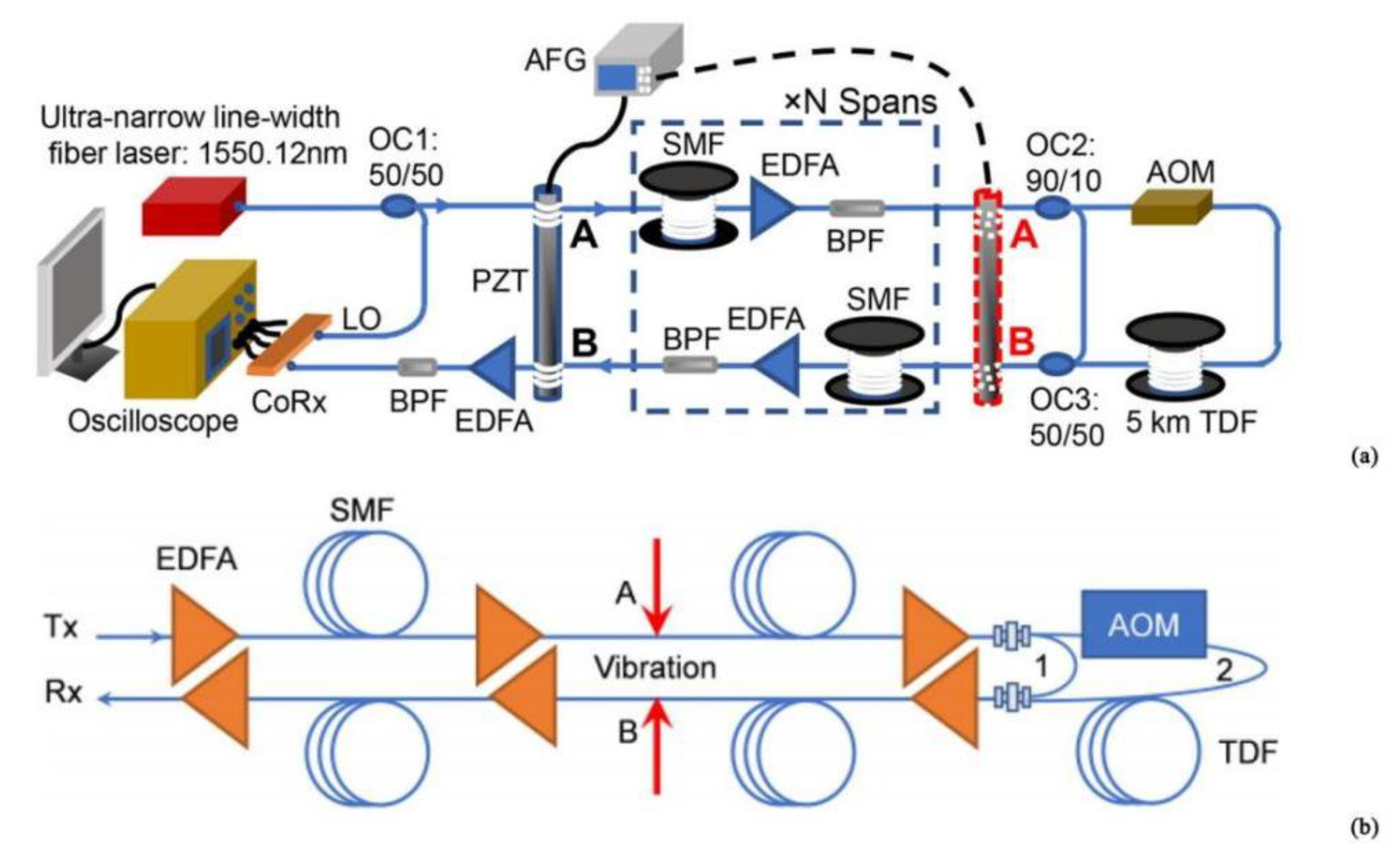
In order to balance the relationship between these two factors, researchers carried out a large amount of research in recent years. In 2016, Li et al. proposed a broadband double-frequency ultrasound measurement system for distributed fiber laser sensors in liquid media [55]. In comparing various fiber laser sensors, this system proved that DBR optical fiber laser sensors performed better in broadband double-frequency ultrasound measurements. In 2018, Shang et al. proposed a Φ-OTDR system using broadband weak optical fiber Bragg grating arrays to achieve large temperature resistance of the distributed acoustic sensor [56]. Simultaneous tests at 18 and 50 °C with large local temperature differences resulted in a relatively flat frequency response from 20 to 1200 Hz. In 2021, Yan et al. proposed an ultra-long distributed sensor based on forwarding transmission, coherent detection, and frequency-shifted optical delay lines for ultra-wide frequency from infrasound to ultrasound testing [57] (Figure 13). Compared with the existing distributed sensors, this scheme had the advantages of simple system and sensing structures, ultra-wide frequency response, and ultra-long sensing distance. It enabled ultra-long distributed sensing and could be used to greatly improve performance indicators of the DAS systems.
为了平衡这两个因素之间的关系,研究人员近年来开展了大量的研究。2016 年,Li 等人提出了一种用于液体介质中分布式光纤激光传感器的宽带双频超声测量系统 [ 55]。在比较各种光纤激光传感器时,该系统证明 DBR 光纤激光传感器在宽带双频超声测量中表现更好。2018 年,Shang 等人提出了一种利用宽带弱光纤布拉格光栅阵列的 Φ-OTDR 系统,以实现分布式声学传感器的大耐温性 [ 56]。在 18 °C 和 50 °C 下同时进行测试,局部温差较大,导致 20 至 1200 Hz 的频率响应相对平坦。2021 年,Yan 等人提出了一种基于转发传输、相干检测和频移光延迟线的超长分布式传感器,用于从次声到超声测试的超宽频 [ 57] ( 图 13 )。与现有的分布式传感器相比,该方案具有系统和传感结构简单、频率响应超宽、传感距离超长等优点。它实现了超长距离分布式传感,可用于大幅提高 DAS 系统的性能指标。
Figure 13. (a) Experimental setup. (b) Schematic diagram of the localization principle [57].
图 13.(a) 实验装置。(b) 定位原理示意图 [ 57]。
In addition to improving the system structure, the researchers also adopted the idea of frequency division multiplexing to process the collected signals to realize the spread spectrum of the Φ-OTDR system. In 2019, Zhang et al. proposed a Φ-OTDR system based on an ultra-weak optical fiber Bragg grating (UWFBG) array and frequency division multiplexing (FDM) scheme to expand the frequency response bandwidth (FRB) of the Φ-OTDR system [58]. The experimental results showed that vibration frequencies up to 440 kHz could be detected along the 330 m UWFBG. This was about 3 times higher than the upper FRB limit of conventional systems, and provided a wider FRB and enhanced visibility characteristics for the performance enhancement of the Φ-OTDR system. In 2021, a quasi-DAS system based on a heterogeneous frequency double pulse chain and an array of WFBGs was proposed by Liu et al. [59]. Interference signals at different carrier frequencies were obtained by injecting four different sets of double pulses continuously into a weak optical fiber Bragg grating (WFBG)-sensing optical fiber. This achieved a detection frequency response of 2 kHz and provided a direction for the development of high response frequency for the DAS systems. In 2021, He et al. proposed a new type of distributed optical fiber acoustic sensor based on time delay sampling and frequency division multiplexing of sparse-wideband signals [60] (Figure 14). The sensor could detect two vibration frequencies at the same position, and, by colliding with the frequencies of these two vibrations in three sampling sequences, demodulation could be performed. The system achieved a high SNR of 25 dB, and addressed the trade-off between the measurable distance and the maximum measurable frequency.
除了改进系统结构外,研究人员还采用了频分复用的思想,对收集到的信号进行处理,以实现 Φ-OTDR 系统的扩频。2019 年,Zhang 等人提出了一种基于超弱光纤布拉格光栅 (UWFBG) 阵列和频分复用 (FDM) 方案的 Φ-OTDR 系统,以扩展 Φ-OTDR 系统的频率响应带宽 (FRB) [ 58]。实验结果表明,沿 330 m UWFBG 可以检测到高达 440 kHz 的振动频率。这比传统系统的 FRB 上限高出约 3 倍,并为 Φ-OTDR 系统的性能增强提供了更宽的 FRB 和增强的可见性特性。2021 年,Liu 等人提出了一种基于异构频率双脉冲链和 WFBG 阵列的准 DAS 系统 [ 59]。通过将四组不同的双脉冲连续注入弱光纤布拉格光栅 (WFBG) 传感光纤中,获得不同载波频率的干扰信号。这实现了 2 kHz 的检测频率响应,并为 DAS 系统的高响应频率的发展提供了方向。2021 年,He 等人提出了一种基于稀疏宽带信号时延采样和频分复用的新型分布式光纤声学传感器 [ 60] ( 图 14 )。该传感器可以检测同一位置的两个振动频率,并通过在三个采样序列中与这两个振动的频率发生碰撞,可以进行解调。该系统实现了 25 dB 的高 SNR,并解决了可测量距离和最大可测量频率之间的权衡问题。
Figure 14. (a) Experimental setup; red is polarization-maintaining fiber. (b) Time domain recovered waveform of vibrations [60].
图 14.(a) 实验装置;红色是保偏光纤。(b) 时域恢复的振动波形 [ 60]。
The above studies all involved single-mode fibers; however, as the use of multimode fibers has increased, improving their frequency response is urgently needed. In 2021, Murrey et al. proposed a distributed multimode optical fiber Φ-OTDR sensing system [61]. A high-speed camera was used to collect the Rayleigh backscattered light and build a complete backscattered speckle field together with a local oscillator. It achieved a bandwidth of 400 Hz over 2 km of multimode optical fiber. The research progress for spatial resolution enhancement is summarized in Table 4.
以上研究均涉及单模光纤;然而,随着多模光纤使用的增加,迫切需要改善其频率响应。2021 年,Murrey 等人提出了一种分布式多模光纤 Φ-OTDR 传感系统 [ 61]。使用高速相机收集瑞利背向散射光,并与本振一起构建完整的背向散射散斑场。它在 400 km 的多模光纤上实现了 2 Hz 的带宽。表 4 总结了空间分辨率增强的研究进展。
Table 4. Research progress for frequency response enhancement.
表 4.频率响应增强研究进展.
In summary, the researchers previously improved DAS systems using hardware parts as lasers and advanced the maturity of the DAS system structure. Recently, the UWFBG method, the FDM method, and a combination of the two methods has been used to enhance the frequency response of the sensors, providing a significant improvement compared to traditional methods. However, the UWFBG method requires complex structure and has high costs. The FDM method requires more sophisticated demodulation algorithms, and was selected as the most suitable method after careful consideration by researchers.
总之,研究人员之前使用硬件部件作为激光器改进了 DAS 系统,并提高了 DAS 系统结构的成熟度。最近,UWFBG 方法、FDM 方法以及两种方法的组合已被用于增强传感器的频率响应,与传统方法相比,提供了显着的改进。然而,UWFBG 方法结构复杂,成本高。FDM 方法需要更复杂的解调算法,经过研究人员的仔细考虑,被选为最合适的方法。

3.5. Signal-to-Noise Ratio
3.5. 信噪比

The signal-to-noise ratio (SNR) is an important index of the DAS system. The greater the noise, the worse the quality of the obtained signal, and the lower the SNR. This leads to the insensitivity of the system to the signal, reducing the overall performance of the DAS system, and having serious consequences such as missed or even false alarms. The main sources of DAS noise include environmental noise, fading noise, mode noise, and system noise, of which mode noise is affected by polarization fading, coherence fading, fiber strain, and nonlinear effects.
信噪比 (SNR) 是 DAS 系统的重要指标。噪声越大,获得的信号质量越差,SNR 越低。这导致系统对信号不敏感,降低 DAS 系统的整体性能,并产生漏报甚至误报等严重后果。DAS 噪声的主要来源包括环境噪声、衰落噪声、模式噪声和系统噪声,其中模式噪声受偏振衰落、相干衰落、光纤应变和非线性效应的影响。
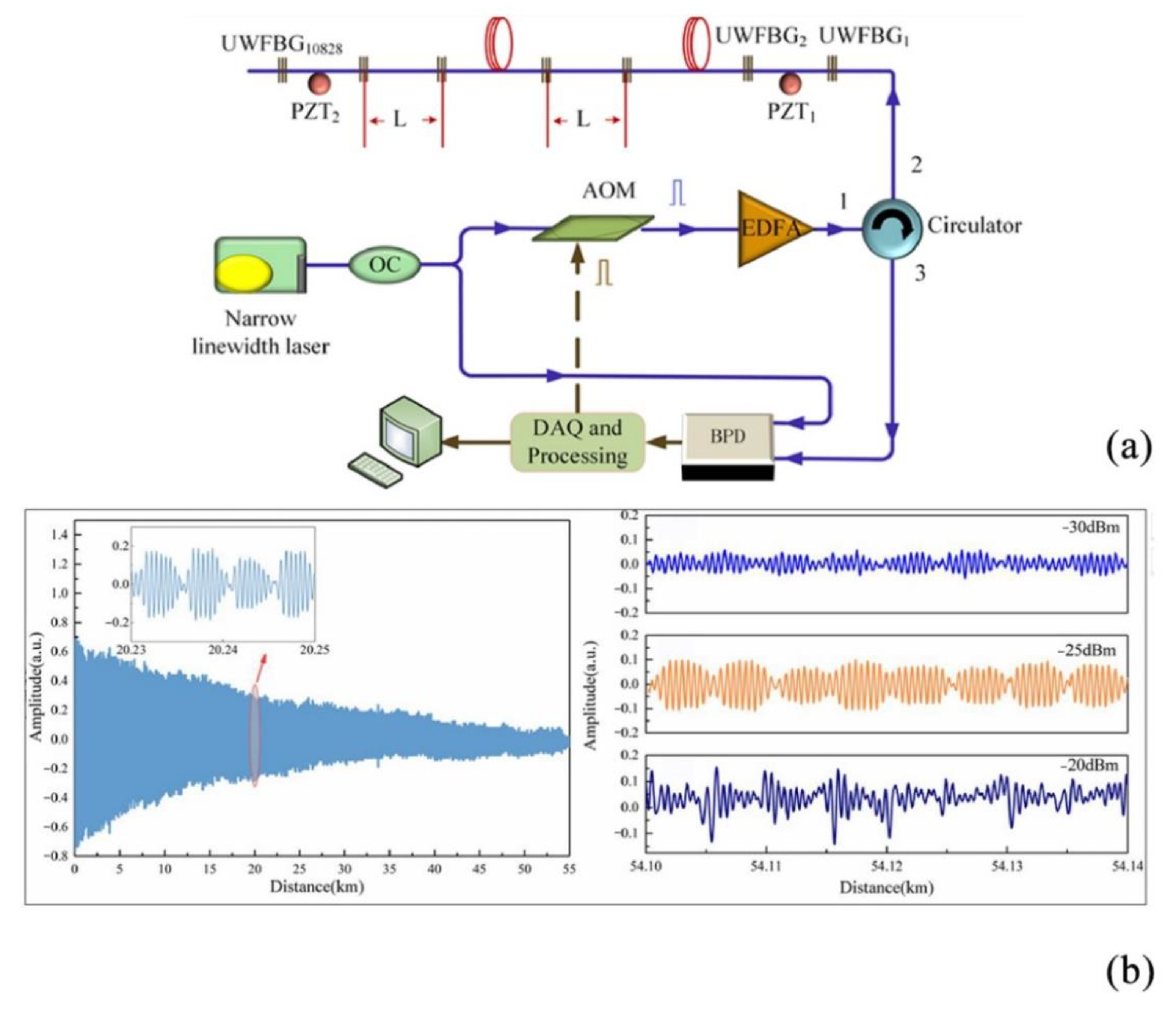
In order to improve the SNR of DAS systems and enhance their sensitivity, researchers have undertaken several studies. In the previous sections, the SNR was improved by reducing the noise. However, the improvement can also be achieved by compensating for or reducing the transmission loss. In 2017, Zhang et al. used optical fibers embedded with UWFBGs for dynamic strain measurement of Φ-OTDR and demodulated the signal phase by an asymmetric 3 × 3 coupler [62]. Experimental results demonstrated that the system could obtain an SNR higher than 56 dB. In 2020, Yang et al. proposed an enhanced distributed optical fiber sensor based on UWFBGs to improve the system SNR, which achieved a system SNR higher than 59.2 dB by using an unbalanced Michelson interferometer (MI) and a 3 × 3 coupler for phase modulation [63]. Based on this, in 2022, Yang et al. used UWFBG and coherent detection to demonstrate that a high extinction ratio and balanced input pulse optical power could improve the performance of the sensing system to obtain a higher SNR [64] (Figure 15). The system structure can also be changed to improve the system SNR. In 2021, Cai et al. proposed a dense multichannel integrated DAS system to solve the system noise problem while eliminating the fading problem, and experimentally demonstrated that the method improved the system SNR by 20 dB [65].
为了提高 DAS 系统的 SNR 并提高其灵敏度,研究人员进行了多项研究。在前面的部分中,通过降低噪声提高了 SNR。但是,也可以通过补偿或减少传输损耗来实现改进。2017 年,Zhang 等人使用嵌入 UWFBG 的光纤进行 Φ-OTDR 的动态应变测量,并通过不对称的 3 × 3 耦合器解调信号相位 [ 62]。实验结果表明,该系统可以获得高于 56 dB 的 SNR。2020 年,Yang 等人提出了一种基于 UWFBG 的增强型分布式光纤传感器来提高系统 SNR,通过使用非平衡迈克尔逊干涉仪 (MI) 和 3 × 3 耦合器进行相位调制,实现了高于 59.2 dB 的系统 SNR [ 63]。基于此,Yang 等人在 2022 年使用 UWFBG 和相干检测证明,高消光比和平衡输入脉冲光功率可以提高传感系统的性能,从而获得更高的 SNR [ 64] ( 图 15 )。还可以更改系统结构以提高系统 SNR。2021 年,Cai 等人提出了一种密集多通道集成 DAS 系统,在消除衰落问题的同时解决了系统噪声问题,并实验证明该方法将系统信噪比提高了 20 dB [ 65]。
Figure 15. (a) Experimental setup. (b) Raw beat frequency signal [64].
图 15.(a) 实验装置。(b) 原始拍频信号 [ 64]。
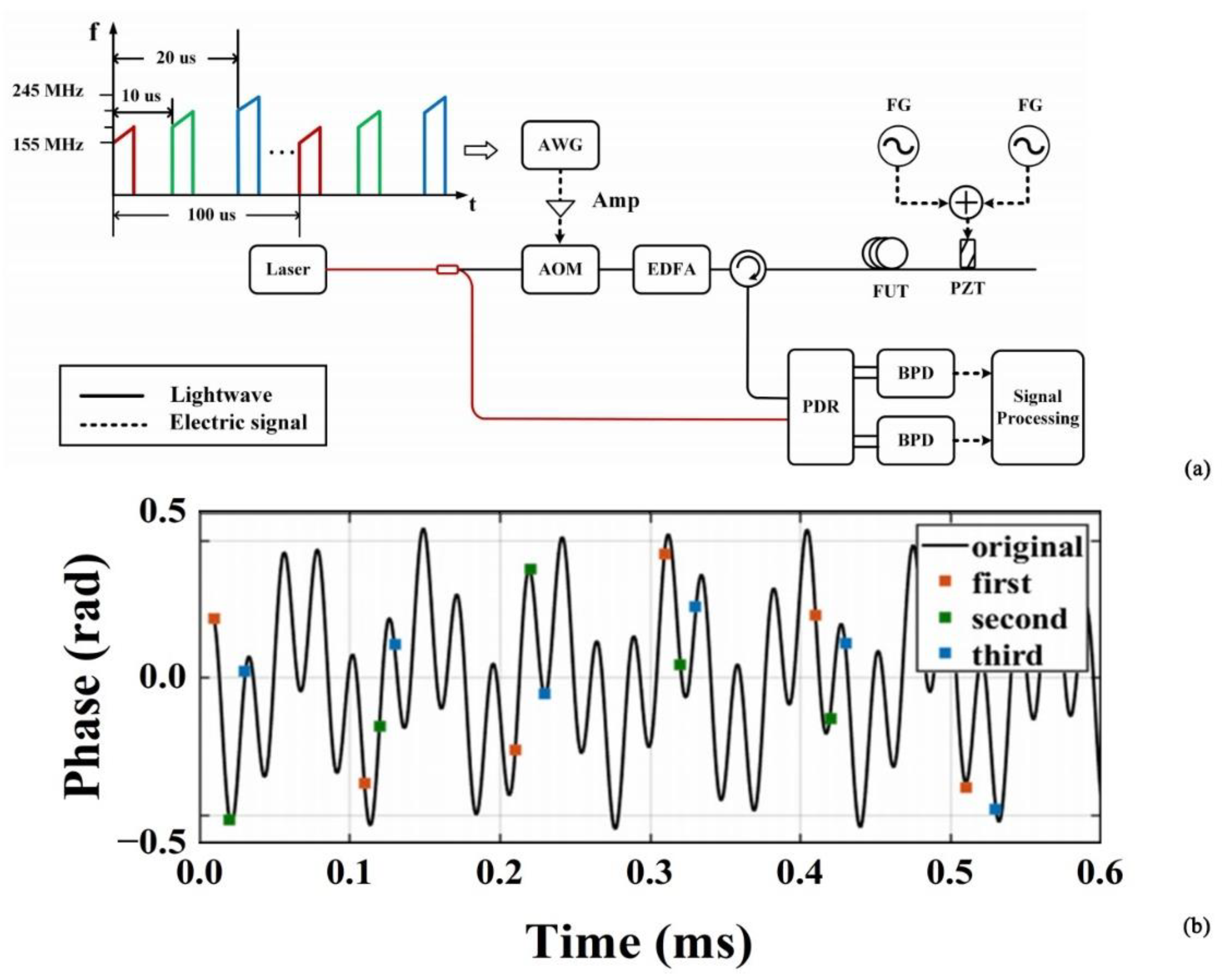
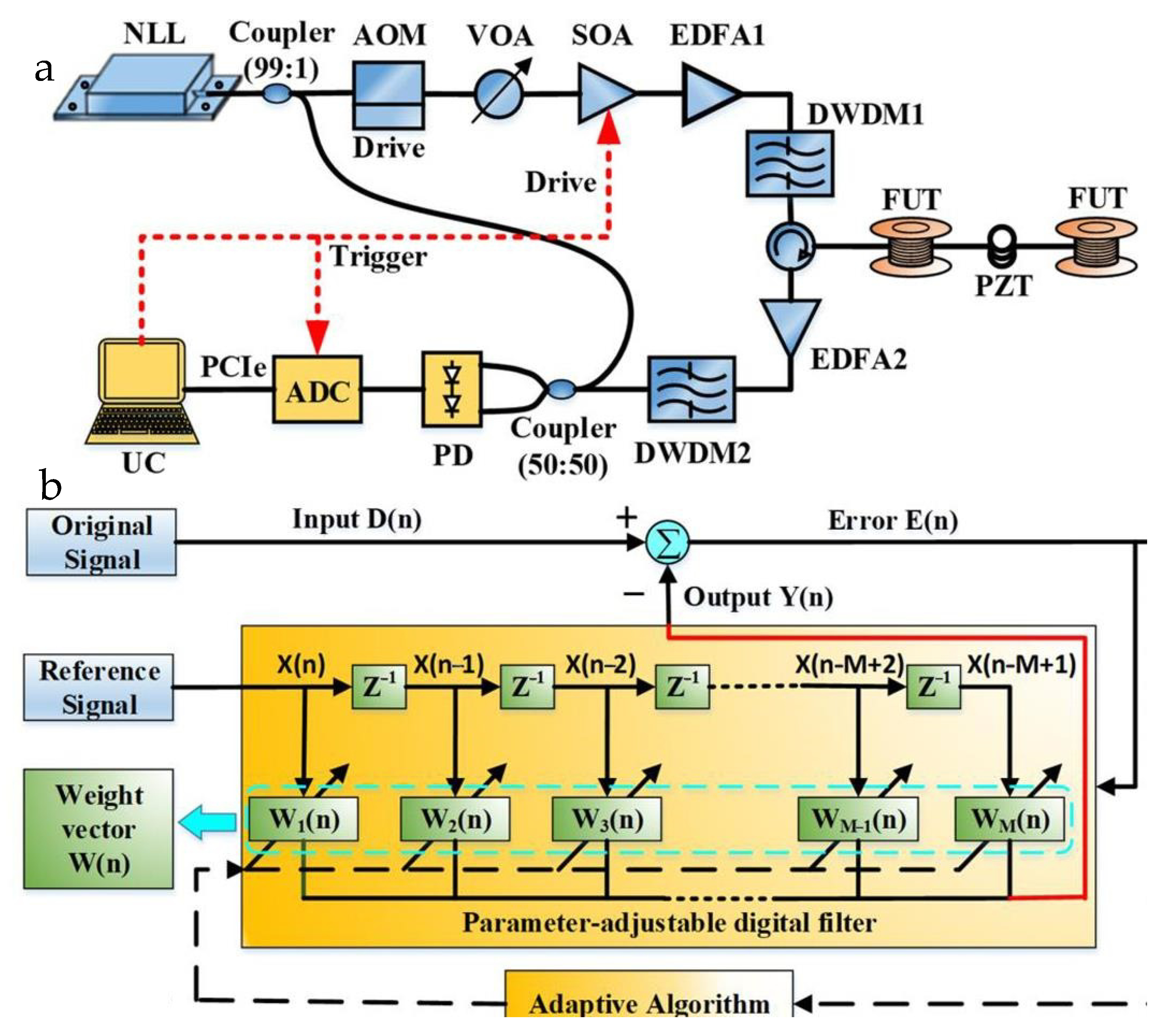
In 2020, Jin et al. first adopted an acousto-optic modulator cascaded with a semiconductor optical amplifier to improve the extinction ratio of the system, and later used time-frequency analysis and minimum mean square error algorithms for amplitude demodulation and phase demodulation to improve the SNR of the system to 42.2 dB [66] (Figure 16). Due to their popularity, artificial intelligence (AI) and machine learning (ML) can be applied to DAS systems to improve the system SNR. In 2021, Zhang et al. proposed a method using the optimal peak-seeking algorithm combined with machine learning for signal identification, which greatly improved the system SNR, and the experimental results provided potential applications for Φ-OTDR devices and future implementations of machine learning algorithms [67]. The research progress for SNR enhancement is summarized in Table 5.
2020 年,Jin 等人首先采用了与半导体光放大器级联的声光调制器来提高系统的消光比,后来使用时频分析和最小均方误差算法进行幅度解调和相位解调,将系统的 SNR 提高到 42.2 dB [ 66] (图 16)。由于人工智能 (AI) 和机器学习 (ML) 的普及,它们可以应用于 DAS 系统以提高系统 SNR。2021 年,Zhang 等人提出了一种使用最优寻峰算法结合机器学习进行信号识别的方法,大大提高了系统 SNR,实验结果为 Φ-OTDR 器件和机器学习算法的未来实现提供了潜在的应用[ 67]。表 5 总结了 SNR 增强的研究进展。
Figure 16. (a) Experimental setup. (b) Schematic diagram of adaptive filtering based on least mean square error (LMS) algorithm [66].
图 16.(a) 实验装置。(b) 基于最小均方误差 (LMS) 算法的自适应滤波示意图 [ 66]。
Table 5. Research progress on SNR enhancement.
表 5.SNR 增强研究进展.
In summary, although special fibers can effectively improve the SNR of the system, it also has the disadvantage of high cost and increasing the complexity of the system. In recent years, researchers also adopted algorithms to improve the SNR of the system; for example, the least mean square error algorithm has the advantages of low cost and simple operation. The introduction of artificial intelligence and machine learning models has greatly improved the performance of the system by processing the signals. This may become a popular direction in the future, but the operation is relatively difficult and requires more advanced technical conditions.
综上所述,特种纤维虽然可以有效提高系统的信噪比,但也存在成本高、系统复杂性增加的缺点。近年来,研究人员还采用了算法来提高系统的 SNR;例如,最小均方误差算法具有成本低、作简单的优点。人工智能和机器学习模型的引入通过处理信号大大提高了系统的性能。这可能会成为未来流行的方向,但作相对困难,需要更先进的技术条件。

3.6. Detection Distance  3.6. 检测距离

Optical fiber is a sensor of the DAS system. Under ideal conditions, the transmission of optical fiber is loss-free, but in the real state, the loss of light will increase with the increase in the transmission distance. The detection distance is proportional to the amount of detected light energy, and the main method of increasing the detection distance is to increase the energy of the detected light. Researchers first used optical amplifiers to increase the optical power of incident light, but was not able to amplify without limit, and was limited by nonlinear effects.
光纤是 DAS 系统的传感器。在理想条件下,光纤的传输是无损耗的,但在实际状态下,光的损耗会随着传输距离的增加而增加。检测距离与检测到的光能量成正比,增加检测距离的主要方法是增加检测到的光的能量。研究人员首先使用光放大器来增加入射光的光功率,但无法无限放大,并且受到非线性效应的限制。
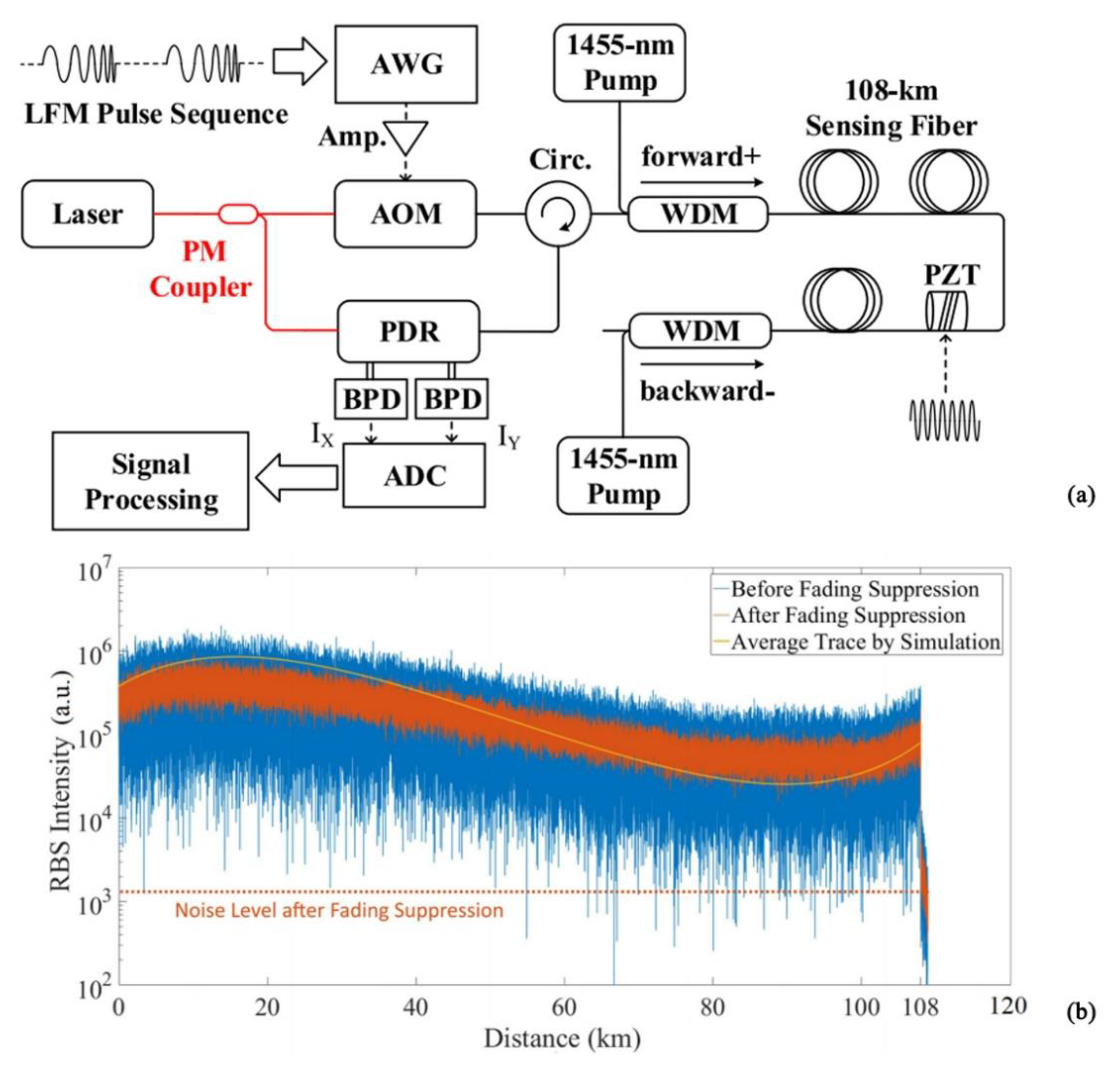
In order to perform long-distance detection and eliminate the drawbacks of traditional long-distance detection methods, in 2018, Fu et al. designed a hybrid DAS system integrating a Brillouin optical time domain analyzer (BOTDA) and Φ-OTDR with a sensing distance of 150.62 km [68]. However, in the course of the study, it was found that the nonlinear effects in the stimulated Brillouin scattering had a more serious impact on the detection distance compared with the stimulated Raman scattering. In 2019, He et al. proposed a long-distance and high-sensitivity DAS system based on the time-gated digital optical frequency domain reflection method, which used bidirectional distributed Raman amplification to achieve long-distance measurement [69] (Figure 17). The length of the experimental optical fiber was about 108 km. For the first time, a strain sensitivity of 220 and harmonic-free linear inversion were achieved on a 100 km optical fiber.
为了进行远距离检测并消除传统远距离检测方法的弊端,2018 年,Fu 等人设计了一种集成了布里渊光时域分析仪 (BOTDA) 和 Φ-OTDR 的混合 DAS 系统,感应距离为 150.62 km [ 68]。然而,在研究过程中,发现与受激拉曼散射相比,受激布里渊散射中的非线性效应对检测距离的影响更为严重。2019 年,He 等人提出了一种基于时间选通数字光频域反射法的长距离高灵敏度 DAS 系统,该系统采用双向分布式拉曼放大实现远距离测量 [ 69] ( 图 17 )。实验光纤的长度约为 108 公里。首次在 100 km 光纤上实现了 220 的应变灵敏度和无谐波线性反演。
Figure 17. (a) Experimental setup. (b) RBS intensity–distance trace of 108 km sensing fiber with bi-directional first-order distributed Raman amplification [69].
图 17.(a) 实验装置。(b) 具有双向一阶分布式拉曼放大的 108 km 传感光纤的 RBS 强度-距离轨迹 [ 69]。
In 2019, Cedilnik et al. proposed a maximum reachable DAS without inline amplification [70]. Up to 112 km could be achieved without any optimization, extending the coverage of any DAS system by optimizing the form of optical fiber combinations. This DAS system also has an extended range using a single standard optical fiber. The creation of these two methods will enable future DAS systems to move over long distances.
2019 年,Cedilnik 等人提出了一种无需在线扩增即可达到的最大可到达 DAS [ 70]。无需任何优化即可实现长达 112 公里的传输距离,通过优化光纤组合的形式扩展了任何 DAS 系统的覆盖范围。该 DAS 系统还使用单根标准光纤扩展了范围。这两种方法的创建将使未来的 DAS 系统能够长距离移动。
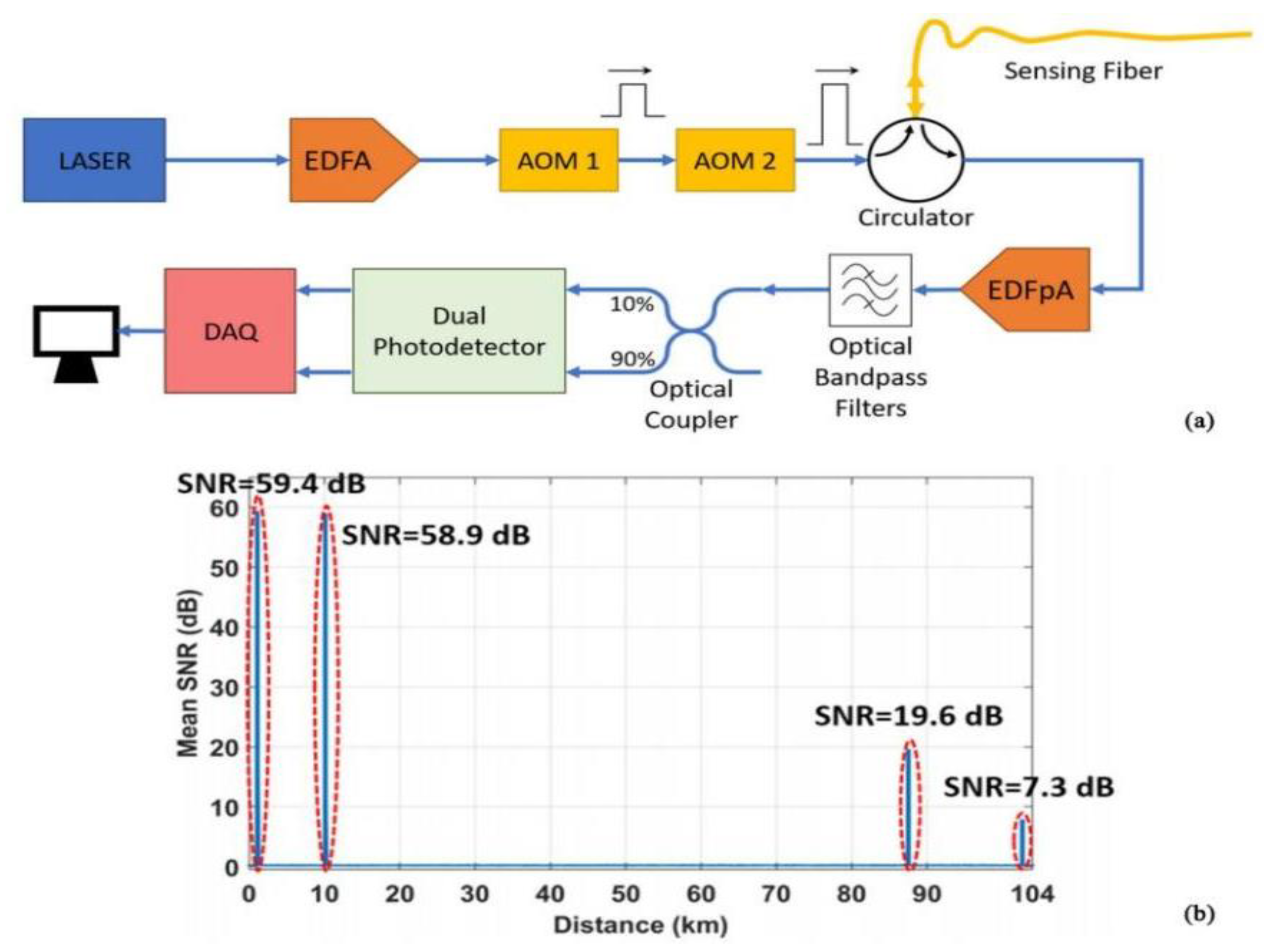
In addition to the widely used distributed amplification method, in recent years, researchers have used low-loss enhancement fibers to enhance the detection distance. In 2019, Uyar et al. proposed an ultra-long range distributed optical fiber acoustic sensing system using a double acoustic light modulator and a double photodetector technique [71] (Figure 18). The double acoustic optical modulator scheme reduced the coherent noise by generating optical pulses with an extinction ratio of less than 110 dB, while the double photodetector scheme was designed to achieve a high dynamic range. The system was selected to process a signal of 102.7 km, yielding the maximum SNR of 24.7 dB. This was the highest distance reported for a Φ-OTDR distributed acoustic sensor system based on direct detection.
除了广泛使用的分布式扩增方法外,近年来,研究人员还使用低损耗增强光纤来提高检测距离。2019 年,Uyar 等人提出了一种使用双声光调制器和双光电探测器技术的超长距离分布式光纤声学传感系统 [ 71] ( 图 18 )。双声光调制器方案通过产生消光比小于 110 dB 的光脉冲来降低相干噪声,而双光电探测器方案旨在实现高动态范围。选择该系统处理 102.7 km 的信号,产生 24.7 dB 的最大 SNR。这是基于直接检测的 Φ-OTDR 分布式声学传感器系统报告的最高距离。
Figure 18. (a) Experimental setup. (b) Mean SNR versus distance along the test fiber [72].
图 18.(a) 实验装置。(b) 平均 SNR 与沿测试光纤的距离 [ 72]。
In 2021, Masoudi et al. proposed a DAS with a sensing range of more than 150 km by adding a low-loss enhanced backscattering optical fiber to a single-mode optical fiber [72]. The measurement system had a frequency range of 0.1 to 100 Hz and a spatial resolution of 5 m. The minimum detectable strain at 1 Hz for this combined system was 40 nε. The research progress for detection distance enhancement is summarized in Table 6.
2021 年,Masoudi 等人通过在单模光纤上增加低损耗增强型背向散射光纤,提出了一种感应距离超过 150 km 的 DAS [ 72]。测量系统的频率范围为 0.1 至 100 Hz,空间分辨率为 5 m。该组合系统在 1 Hz 时的最小可检测应变为 40 nε。表 6 总结了提高检测距离的研究进展。
Table 6. Research progress for detection distance enhancement.
表 6.提高探测距离的研究进展。
In summary, two optical path systems can greatly improve the detection distance. However, researchers must consider how to maximize the performance of these systems. Improving the hardware facilities of the optical path system, such as with the use of bi-directional distributed Raman amplification or two cascaded acoustic-optical modulators, can improve detection distance, but increases the complexity of the system while increasing the operational difficulties. The low-loss optical fibers have the disadvantage of high cost, and require the researchers to carefully consider and select the most suitable method.
综上所述,两个光路系统可以大大提高检测距离。但是,研究人员必须考虑如何最大限度地提高这些系统的性能。改进光路系统的硬件设施,例如使用双向分布式拉曼放大或两个级联声光调制器,可以提高检测距离,但会增加系统的复杂性,同时增加作难度。低损耗光纤具有成本高的缺点,需要研究人员仔细考虑并选择最合适的方法。

4. Application  4. 应用

4.1. Perimeter Security  4.1. 边界安全

Perimeter security has long been a core condition for the safety of people’s lives and property, and national political stability. It plays an important role in border lines, railway stations, airports, gas stations, large substations, and other areas [73]. The DAS system has the characteristics of a wide monitoring range, a high degree of concealment, strong environmental adaptability, and lack of a blind area. It is highly suitable for application in the field of perimeter security. In recent years, the perimeter security research related to DAS has continued to develop, and the challenge for perimeter security projects is to improve the classification and recognition effect.
周界安全长期以来一直是人民生命财产安全和国家政治稳定的核心条件。它在边境线、火车站、机场、加油站、大型变电站等领域发挥着重要作用 [ 73]。DAS 系统具有监测范围广、隐蔽性高、环境适应性强、无盲区等特点。它非常适合在周界安全领域应用。近年来,与 DAS 相关的周界安全研究不断发展,周界安全项目面临的挑战是提高分类和识别效果。
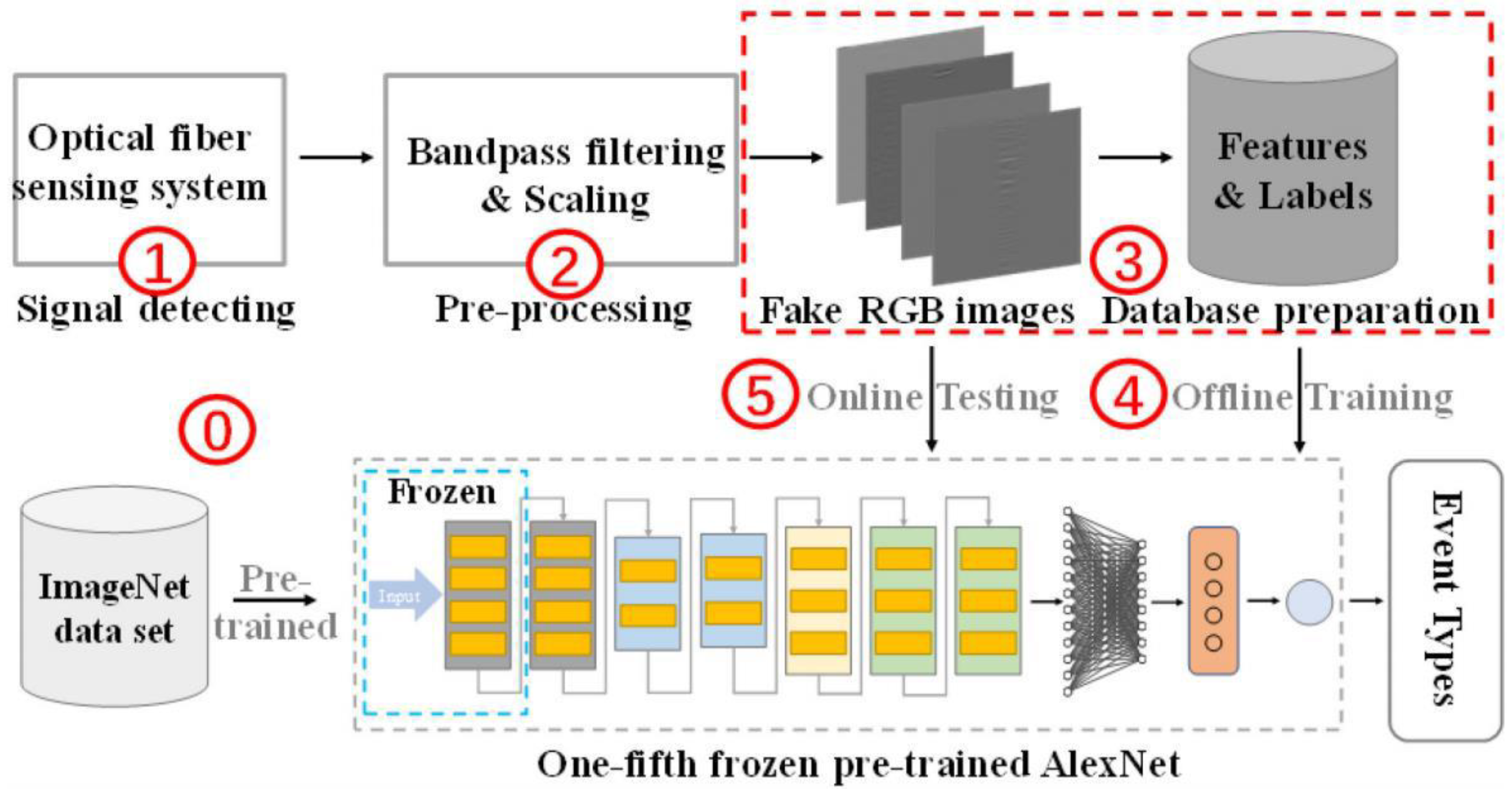
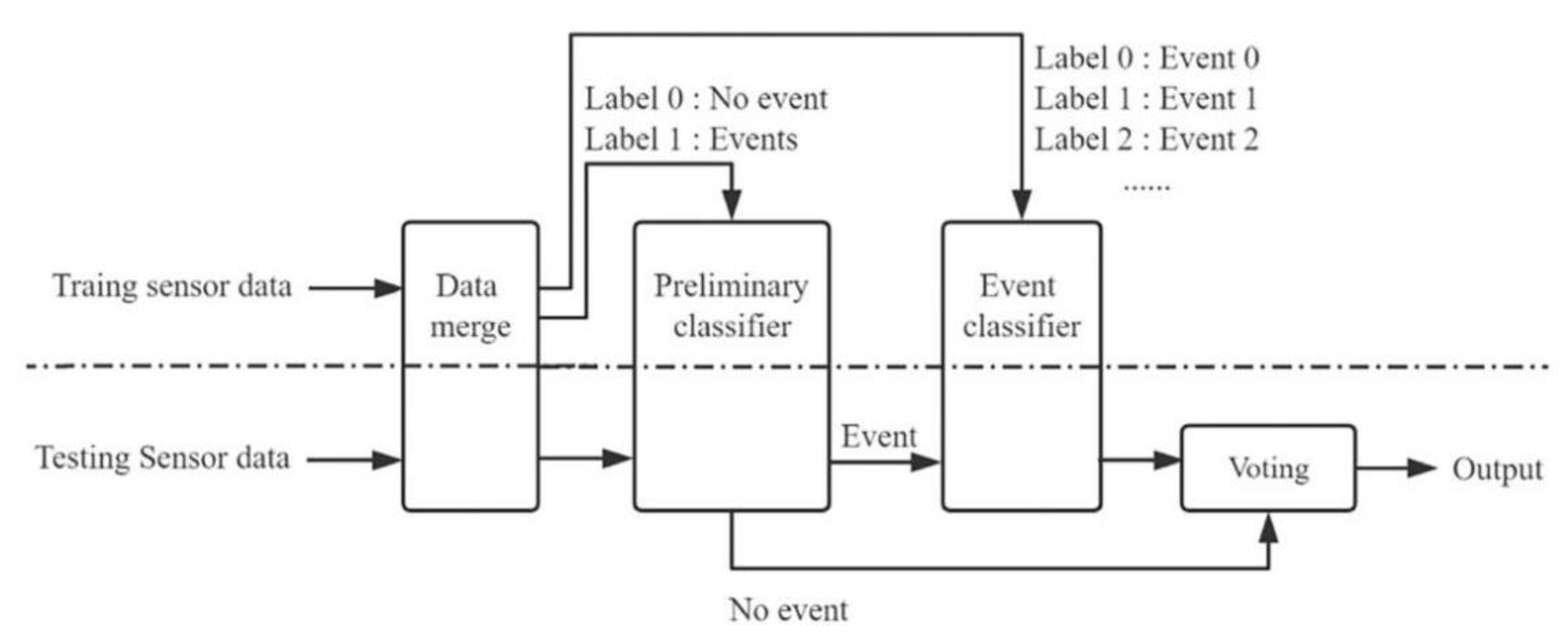
Conventional class recognition algorithms have low accuracy. Although deep learning-based classification and recognition algorithms have high accuracy, they take a long time to train and require a large amount of computation. In 2021, Shi et al., from Shantou University, proposed an event recognition method based on transfer training. The experiment was conducted on 4252 groups of samples based on 8 events; Alex Net was pre-trained for 1/5 of the samples, and then trained for the remaining samples. Partial training achieved a classification accuracy of 96.16% in less than 5 min [74] (Figure 19).
传统的类识别算法准确率较低。尽管基于深度学习的分类和识别算法具有很高的准确性,但它们需要很长时间来训练并且需要大量的计算。2021 年,来自汕头大学的 Shi 等人提出了一种基于迁移训练的事件识别方法。实验基于 4252 个事件对 8 组样本进行;Alex Net 对 1/5 的样本进行了预训练,然后对其余样本进行了训练。部分训练在不到 5 分钟的时间内实现了 96.16% 的分类准确率 [ 74] (图 19)。
Figure 19. Classification method steps [74].
图 19.分类方法步骤 [ 74]。
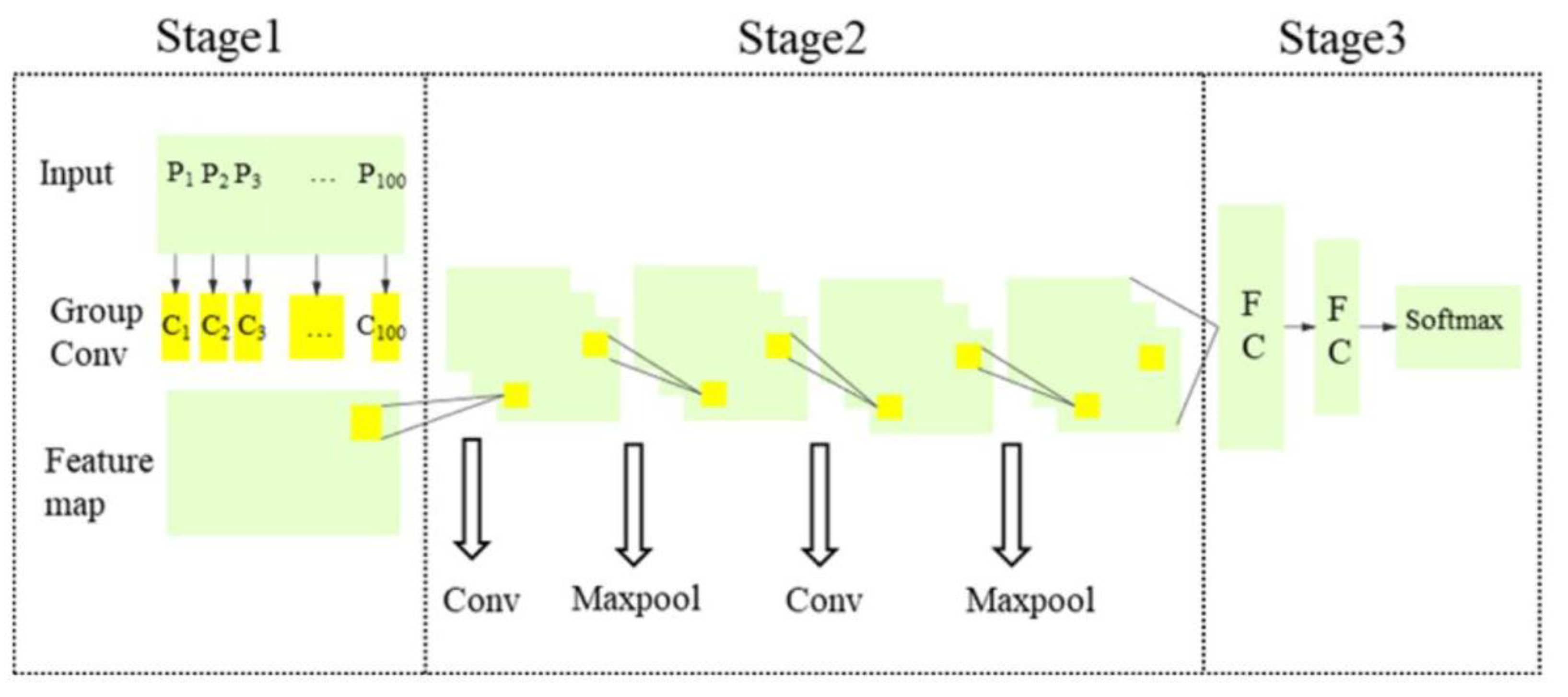
In field applications, multiple vibrations often occur in close positions, resulting in the collected vibration signals being mixed signals of multiple signals. To improve the accuracy of intrusion classification at a reduced cost, in 2002 Ni et al., from the Laser Institute of Shandong Academy of Sciences, proposed a recognition algorithm, 100 G-Net, based on a group convolution neural network. The recognition of nine common signals including four mixed signals was realized. Under the condition of a recognition speed of 20 ms/sample, the recognition accuracy of the verification set reached 97.5% [75] (Figure 20).
在现场应用中,近距离经常发生多次振动,导致收集到的振动信号是多个信号的混合信号。为了以更低的成本提高入侵分类的准确性,2002 年,来自山东省科学院激光研究所的 Ni 等人提出了一种基于群卷积神经网络的识别算法 100 G-Net。实现了 9 个常见信号的识别,包括 4 个混合信号。在 20 ms/样本的识别速度条件下,验证集的识别准确率达到 97.5% [ 75] ( 图 20 )。
Figure 20. 100 G-Net structure diagram [75].
图 20.100 G-Net 结构图 [ 75]。
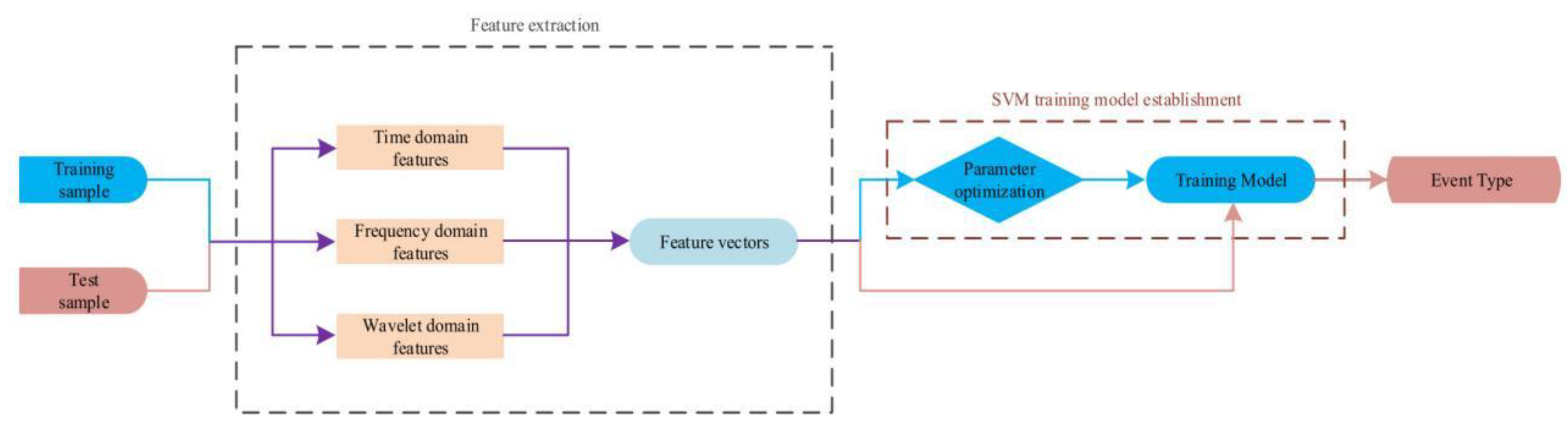
Existing optical fiber sensing technologies and data analysis methods have been combined to reduce system complexity. In 2021, Shi et al. proposed an interferometric optical fiber perimeter security system that was based on multi-domain feature fusion and support vector machines (SVMs). The system was used to classify and identify non-intrusion, climbing, shaking, iron bar knocking, and optical fiber cable shearing, and achieved an average classification accuracy of 94.4% [76] (Figure 21). The latest progress for perimeter security research is summarized in Table 7.
现有的光纤传感技术和数据分析方法已相结合,以降低系统复杂性。2021 年,Shi 等人提出了一种基于多域特征融合和支持向量机 (SVM) 的干涉光纤边界安全系统。该系统用于对非侵入、攀爬、晃动、铁杆敲击和光缆剪切进行分类和识别,平均分类准确率达到 94.4% [ 76] (图 21)。表 7 总结了边界安全研究的最新进展。
Figure 21. The classification algorithm flow [76].
图 21.分类算法流程 [ 76]。
Table 7. Summary of perimeter security applications.
表 7.外围安全应用程序摘要。

4.2. Earthquake Monitoring
4.2. 地震监测

Earthquakes are among the disasters that endanger people’s lives and the safety of property. Research into earthquake monitoring is important to ensure people’s safety and social stability. The conventional earthquake monitoring method requires dense placement of earthquake monitoring instruments on the ground surface, excavation, and backfilling of the involved strata when laying sensing optical fiber cables, which greatly increases the project cycle and cost. By comparison, the DAS techniques realizes the dynamic strain detection of the optical fiber by measuring the phase change of the backscattered light in the optical fiber and then realizes the recording of the earthquake wave field [77]. This is expected to solve the current problems of the high data acquisition cost, limited coverage, and unsuitability for urban implementation in seismic detection [78].
地震是危及人们生命和财产安全的灾难之一。地震监测研究对于确保人们的安全和社会稳定非常重要。常规的地震监测方法在铺设传感光缆时,需要在地表密集放置地震监测仪器、挖掘和回填涉到的地层,这大大增加了工程周期和成本。相比之下,DAS 技术通过测量光纤中背向散射光的相位变化来实现光纤的动态应变检测,然后实现地震波场的记录 [ 77]。这有望解决目前地震探测中数据采集成本高、覆盖范围有限、不适合城市实施等问题 [ 78]。
In December 2018 and December 2019, Wang et al. conducted observation experiments twice in the urban area of Binchuan County, Yunnan Province, using the standard single mode fiber provided by China Mobile and the air gun source signal. The artificial drop weight signal was observed, which successfully verified the possibility of urban communication optical cable as for earthquake early warning and underground structure observation, and provided a new direction for DAS research and earthquake monitoring research [79].
2018 年 12 月和 2019 年 12 月,Wang 等人在云南省滨川县市区进行了两次观测实验,使用中国移动提供的标准单模光纤和气枪源信号。对人工落锤信号进行观测,成功验证了城市通信光缆用于地震预警和地下结构观测的可能性,为 DAS 研究和地震监测研究提供了新的方向[79]。
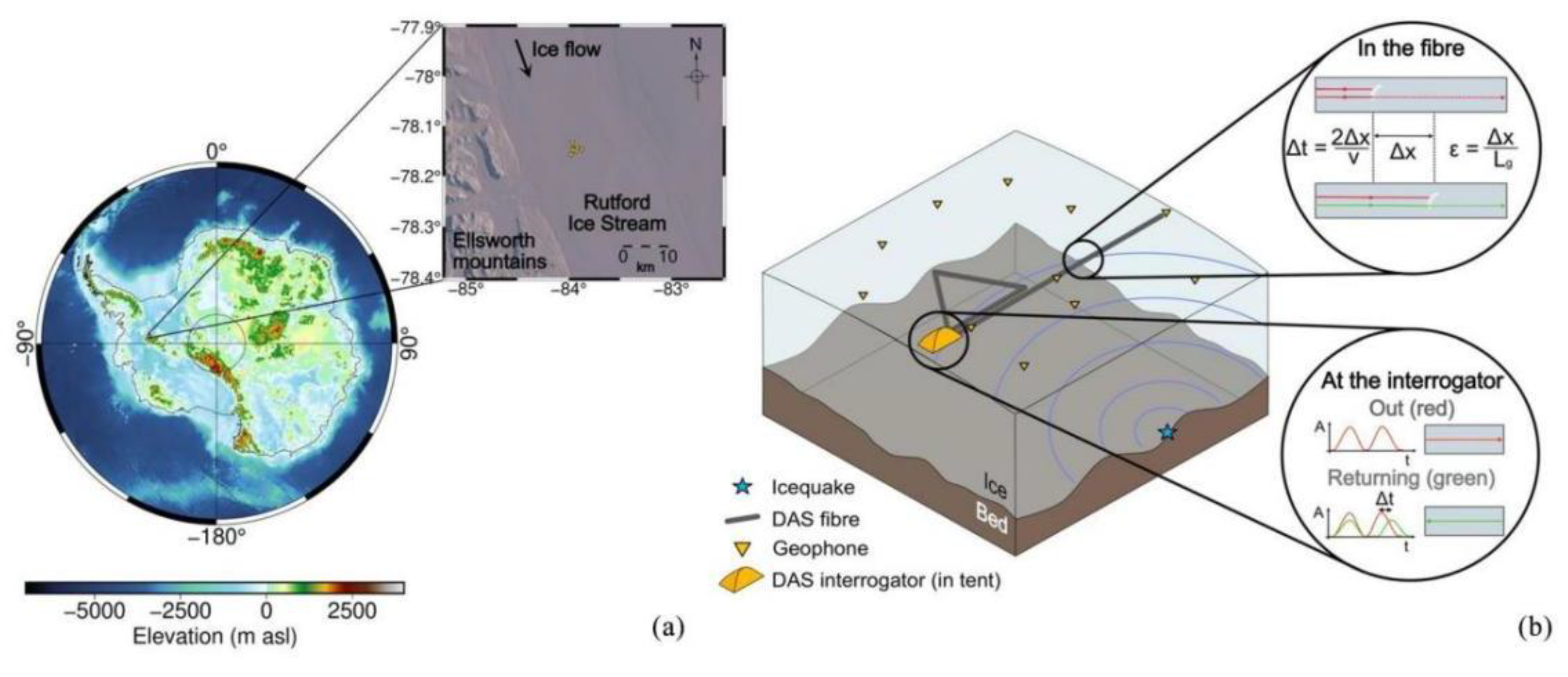
In 2021, Hudson et al. proposed a method using a two-dimensional DAS array as an effective multi-component sensor to accurately characterize the transverse wave splitting caused by anisotropic ice structures. They used the glacial environment as an analogy to other earthquake environments, and the methodology and conclusions obtained in this work contributed to the implementation of DAS systems for applications in other microearthquake environments. When the DAS system was at a lower and near-quasi-static frequency, the spectral SNR and bandwidth measured by the superposition of multiple DAS channels were significantly improved compared to those of a single geophone [80] (Figure 22).
2021 年,Hudson 等人提出了一种使用二维 DAS 阵列作为有效的多分量传感器的方法,以准确表征各向异性冰结构引起的横波分裂。他们使用冰川环境作为其他地震环境的类比,这项工作中获得的方法和结论有助于实施 DAS 系统在其他微地震环境中的应用。当 DAS 系统处于较低且接近准静态的频率时,与单个检波器相比,通过多个 DAS 通道叠加测量的频谱 SNR 和带宽显着提高 [ 80] (图 22)。
Figure 22. (a) Map and schematic showing experimental setup. (b) Schematic diagram of the experiment with the triangle and line fiber configurations [80].
图 22.(a) 显示实验装置的地图和示意图。(b) 三角形和线光纤配置的实验示意图 [ 80]。
In the field of sensing, although the exploration of natural disasters such as earthquakes and tsunamis, or of unknown terrains such as sea beds and rift valleys, has continued, the accompanying risk factors must be taken seriously. At present, the distributed optical fiber acoustic sensing techniques can be very helpful to avoid danger. However, due to the weak RBS light, the optical fiber sensing signal decays exponentially, and it is difficult to achieve long-distance detection.
在传感领域,尽管对地震和海啸等自然灾害或海床和裂谷等未知地形的勘探仍在继续,但必须认真对待随之而来的风险因素。目前,分布式光纤声学传感技术对避免危险非常有帮助。但是,由于 RBS 光较弱,光纤传感信号呈指数衰减,难以实现远距离检测。
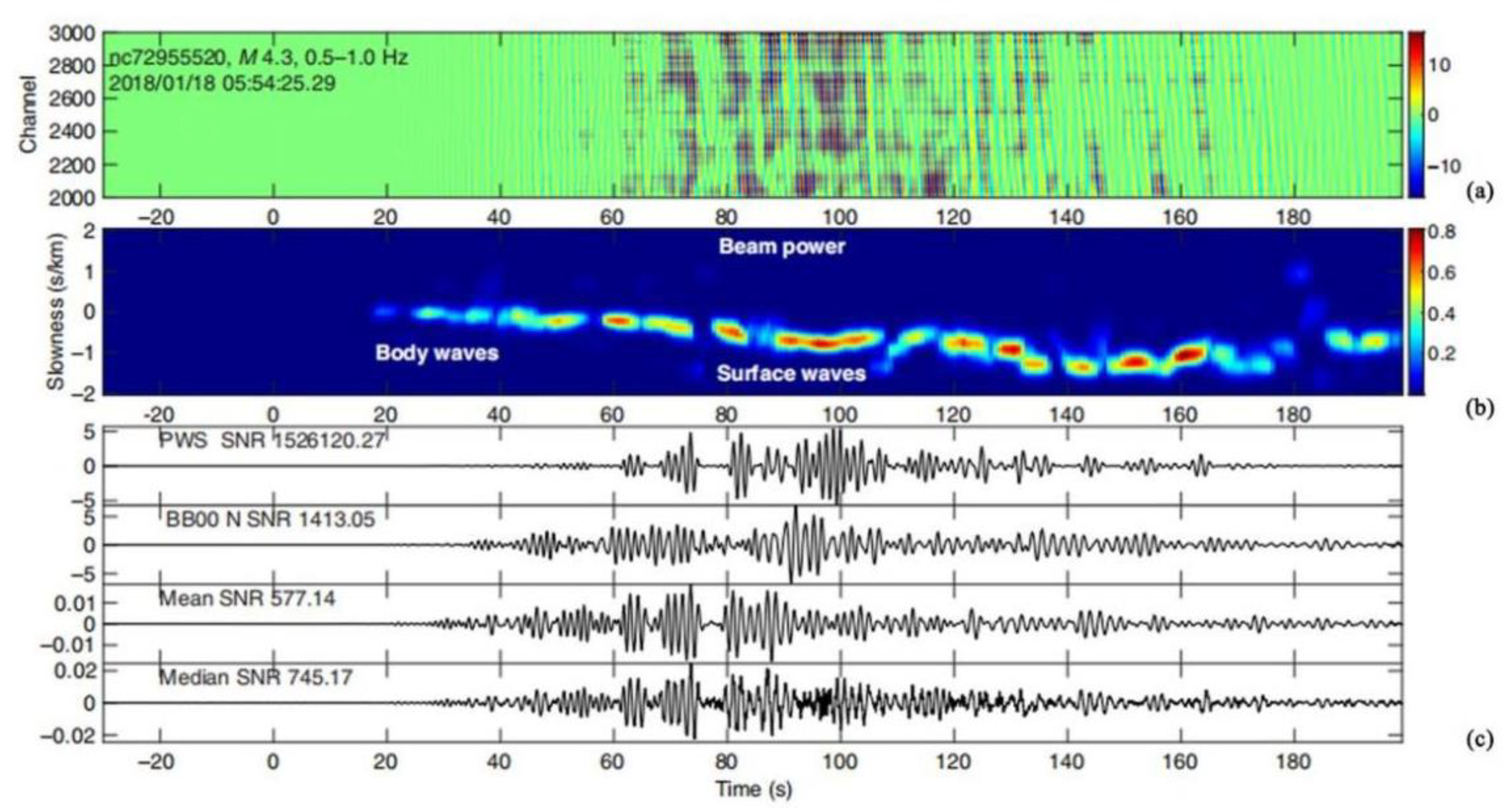
In 2021, Avinash et al. used a dark-fiber DAS array located in the Sacramento Basin of Northern California to detect small earthquakes in the geyser geothermal field at a distance of about 100 km [81] (Figure 23). All earthquakes of M ≥ 2.4 during the experiment were successfully detected by analyzing DAS data for 45 consecutive days. The latest progress in earthquake monitoring is summarized in Table 8.
2021 年,Avinash 等人使用位于北加州萨克拉门托盆地的暗光纤 DAS 阵列探测了约 100 公里外间歇泉地热场中的小地震 [ 81] ( 图 23 )。通过连续 45 天的 DAS 数据分析,成功探测到实验期间所有 M ≥ 2.4 级地震。地震监测的最新进展总结于表 8 中。
Figure 23. Beamforming results at channels 2000–3000 (subarray aperture 2 km) for an M4.3 earthquake. (a) Record section showing filtered waveforms. (b) Vespagram (beam power in the 0–1 range as a function of slowness and time). (c) Traces from the top to bottom [81].
图 23.M4.3 地震在 2000–3000 通道(子阵列孔径 2 km)处的波束形成结果。(a) 显示滤波波形的 Record 部分。(b) Vespagram(光束功率在 0–1 范围内,是缓慢和时间的函数)。(c) 从上到下的轨迹 [ 81]。
Table 8. Summary of earthquake monitoring applications.

4.3. Energy Exploration

Oil, natural gas, and coal are important strategic resources in China, and the exploration techniques for these resources have been continually studied. Energy exploration techniques can greatly reduce the cost of extraction, improve the accuracy of extraction, and improve the energy pattern in China [82]. Conventional exploration techniques consume large amounts of human and material resources, and are limited by high temperature and pressure, which prevent the exploration requirements from being met. By comparison, the DAS system with optical fiber cable as the main transmission body has a high spatial and temporal resolution, in addition to a large sensing distance, which can cope with the complex geological environment and meet the technical requirements of the surface detector and in-well detector. An increasing number of researchers have started to study the earthquake wave detection techniques of DAS [83].
To investigate the relationship between behavior and ground movement deformation during coal mining, in 2019, Chai et al. used distributed optical fiber monitoring techniques to record the strain on the ground surface [84]. The experiment proved that the distributed optical fiber monitoring technique was expected to replace traditional coal mine monitoring and provided a theoretical basis for surface subsidence prediction, geohazard evaluation, and surface subsidence control in mining areas.
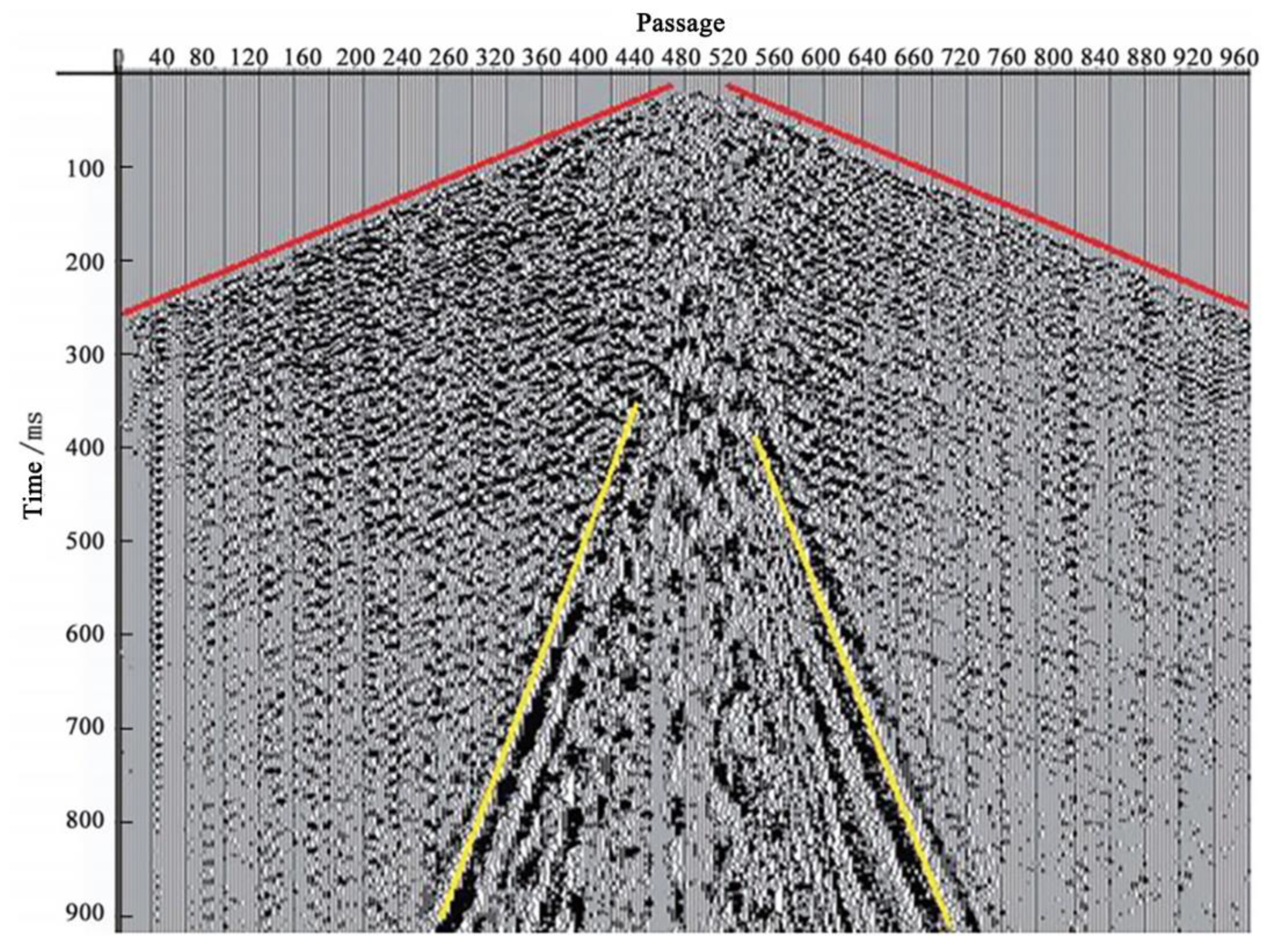
In 2021, Wang et al., from the Laser Institute of Shandong Academy of Sciences, designed a distributed optical fiber acoustic monitoring system for oil and gas seismic wave exploration and development. The optical cable was used as a sensor to detect the sound signal, and the phase modulation and demodulation techniques based on back Rayleigh scattering were adopted to realize the test of 10 m spatial resolution and −145.35 dB sound pressure sensitivity. The field exploration of seismic bombs and guns was carried out [85] (Figure 24). The earthquake wave signal acquisition and processing were completed, and clear formation inversion information was obtained.
Figure 24. DAS earthquake wave test data [85].
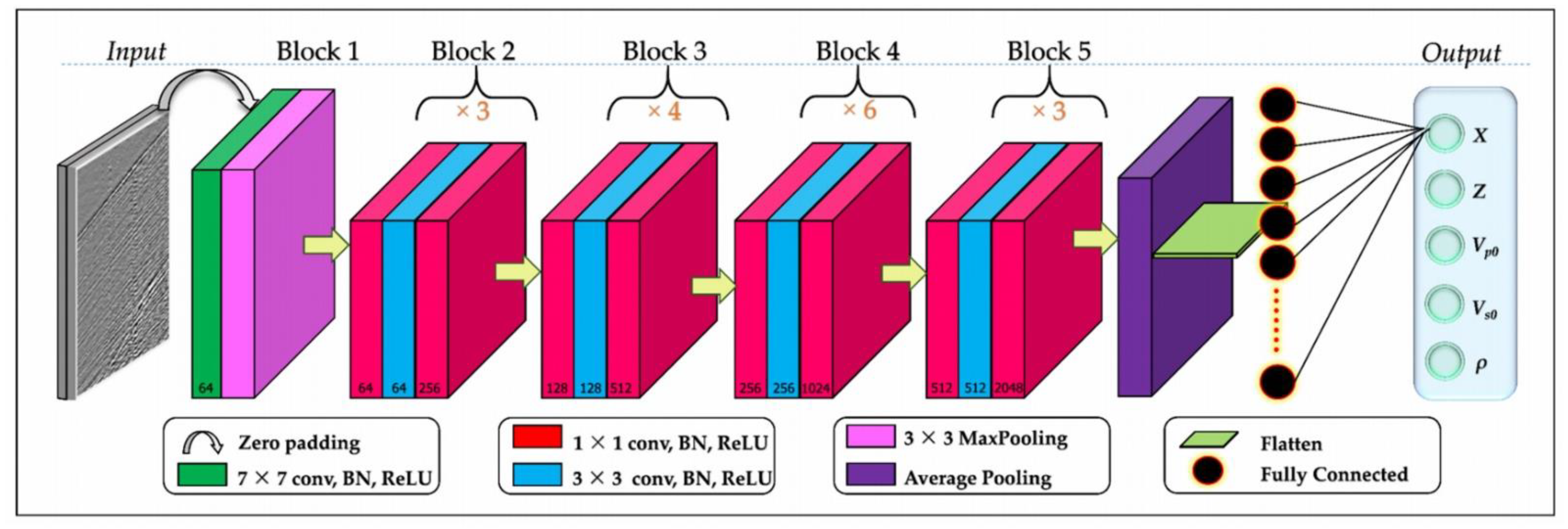
In 2021, Wamriew et al. proposed a new deep learning method for real-time/semi-real-time processing of large volumes of DAS data [86] (Figure 25). The method was trained on publicly available data from Phase 2C hydraulic fracturing augmentation at the FORGE research site near Milford, Utah, USA, and ray tracing was used in generating the training dataset. Finally, in situ DAS microearthquake data acquired from hydraulic fracturing operations were used for validation. The results showed that the model was able to learn the relationship between microearthquake waveform data and event location, and was a high accuracy velocity model. The latest progress for energy exploration is summarized in Table 9.
Figure 25. Deep convolutional neural network architecture used in the study. Green, blue, and red cuboids represent multi-channel feature maps with the number of channels shown at the bottom of the cuboids [86].
Table 9. Summary of energy exploration applications.

4.4. Underwater Positioning

Underwater positioning techniques comprise one of the important research elements in marine resource exploration and marine military defense. The DAS system has the ability to adapt to complex environments and has a wide monitoring range [87]. It can achieve long-distance underwater monitoring through submarine optical fiber cable and plays an important role in marine oil and gas mineral development, submarine optical fiber cable pipeline laying, maintenance, and other projects, and ship and submarine mobilization, in addition to marine catastrophic geological research and underwater archaeological exploration.
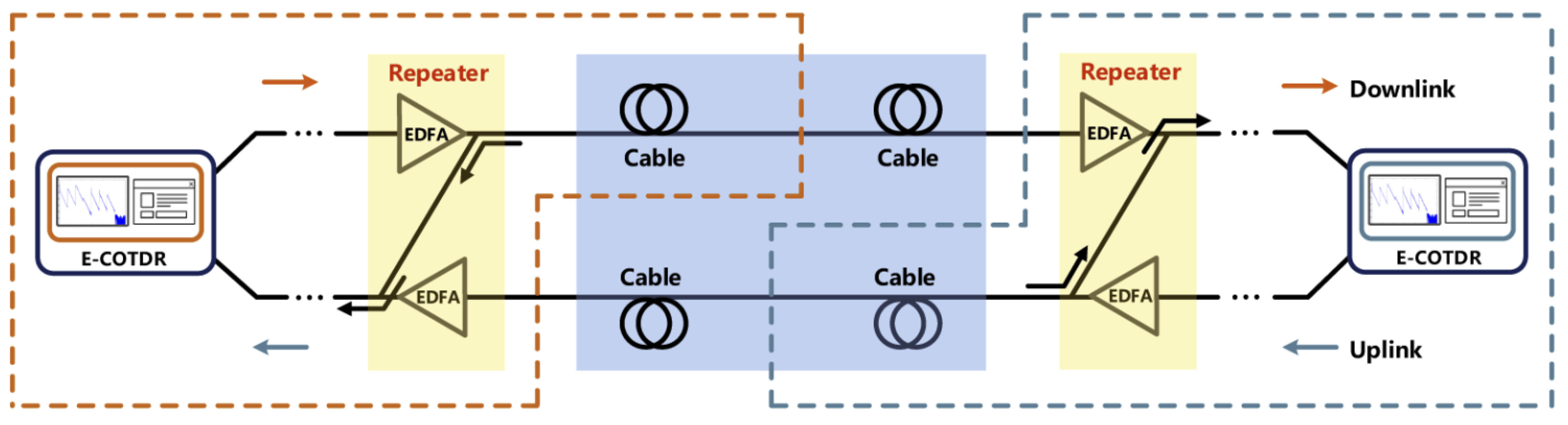
Submarine optical cable is expensive, and its environment is harsh. Determining how to monitor submarine optical cables is particularly important. In order to realize timely monitoring, and advance prediction of failure of, submarine optical cables, in 2021, Zhang et al. proposed a submarine optical cable detection system based on enhanced coherent optical time domain reflectometry (E-COTDR) [88]. In the experiment, the system achieved 121 km full coverage monitoring for multi-span cascaded submarine cables of more than 1000 km, and, at the same time, also measured the loss of submarine cables. The approach improved performance compared to that of traditional submarine cable monitoring methods (Figure 26).
Figure 26. Schematic diagram of submarine cable link [88].
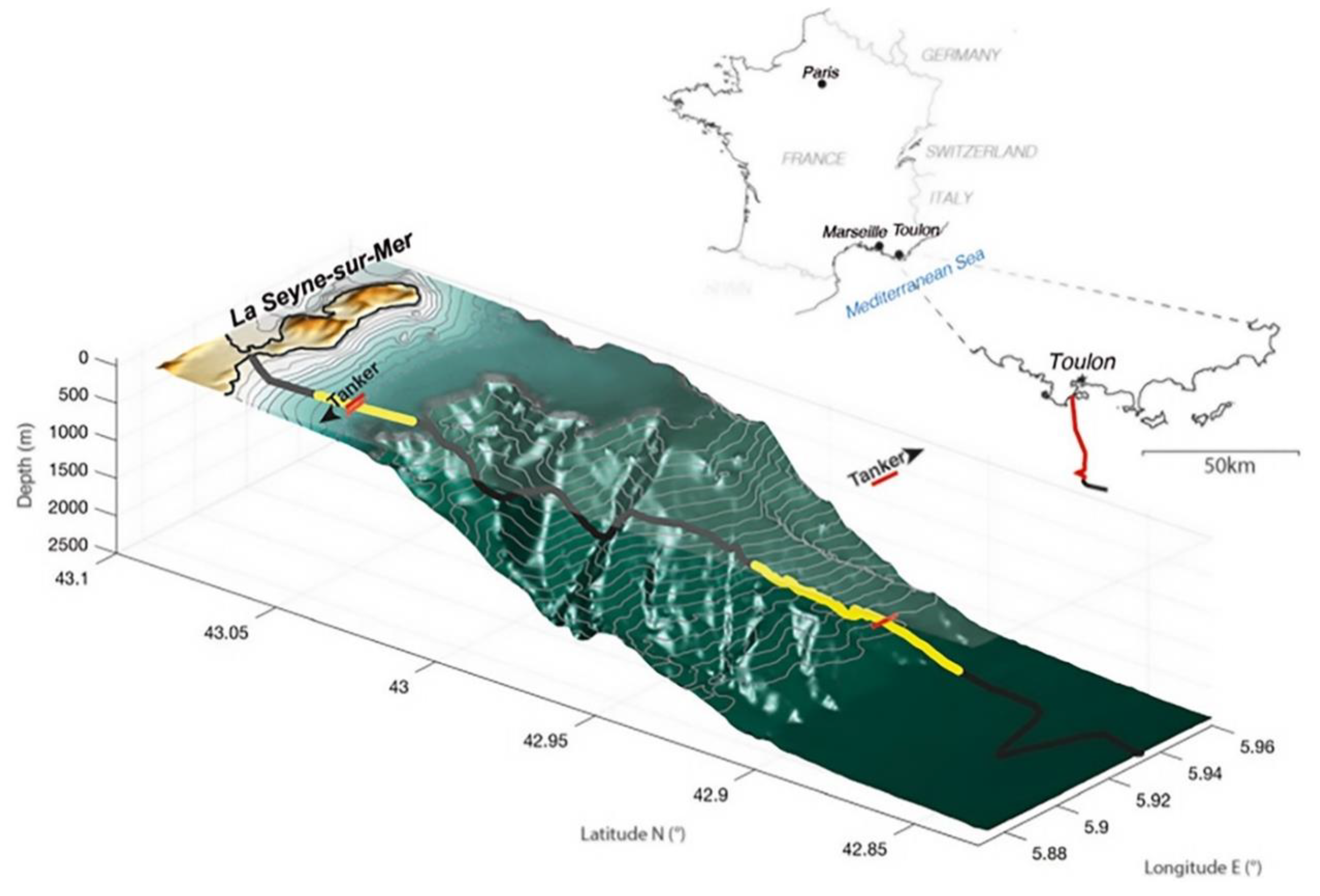
In 2021, Rivet et al. conducted an experiment on a 41.5 km long optical cable near the French port of Toulon, using an oil tanker sailing near the optical cable and the position map of the detected optical cable. From the 5.8 km offshore water depth of 85 m to the 20 km offshore water depth of 2000 m, the acoustic signal measured by DAS was used for analysis, and beamforming was used to obtain the hull trajectory at the 85 m water depth [89] (Figure 27). At the 2000 m water depth, due to serious signal attenuation, the hull track was obtained, but the frequency band signal was still detected below 50 Hz.
Figure 27. Position map of optical cable detection [89].
In 2021, Liu et al. proposed an underwater localization system that effectively recovered acoustic signals [90]. The system was based on a phase-sensitive optical time domain reflectometer with 3D printed sensing elements as the base optical path, and used a time-difference (TDOA) algorithm for the 3D position. The method was flexible in its operation and could be changed to suit practical needs, and showed great potential for development.
In 2022, Xu et al. used an optical frequency comb (OFC) formed by multi-frequency detection pulses for underwater localization. The approach proved to be well-adapted for the underwater environment and provided a new measurement method for future underwater positioning [91]. The latest progress for underwater positioning research is summarized in Table 10.
Table 10. Summary of underwater positioning applications.

4.5. Railway Monitoring

As a result of the global increase in traffic demand, railways are playing a more important role, and railway safety issues are becoming increasingly prominent. Train positioning and trajectory monitoring, track safety detection, and safety detection along the line are of great significance to the safe operation of railways [92]. Because railway tracks are exposed to nature all year round, they are subjected to wind, rain, freeze–thaw cycles, and train loads [93], which may lead to many unexpected situations. At present, railway inspection mainly relies on manpower and safety inspections of trains [94]. However, due to the characteristics of railway’s day and night operations, conventional railway monitoring methods have been unable to meet the growing demand. Thus, distributed fiber acoustic sensing techniques have become a key trend in railway inspection because they can achieve real-time detection of track conditions.
In 2021, Wang et al. took the high-speed railway track as the research object, constructed a track and train detection system based on distributed fiber acoustic sensing, and proposed a new track state detection scheme with the deep convolutional network as the core. In this system, the incident checks included those of a crack, beam joint, switch, and lower road. The final recognition accuracy rate reached 98.04% [95] (Figure 28).
Figure 28. The diagram of the event recognition system [95].
Accurate tracking of the true position of trains on the track is the basis of all modern railway monitoring concepts. It is important to provide sufficient safe separation between trains at all times [96,97]. An accurate, reliable, and simple train tracking techniques is an essential foundation for these new concepts.
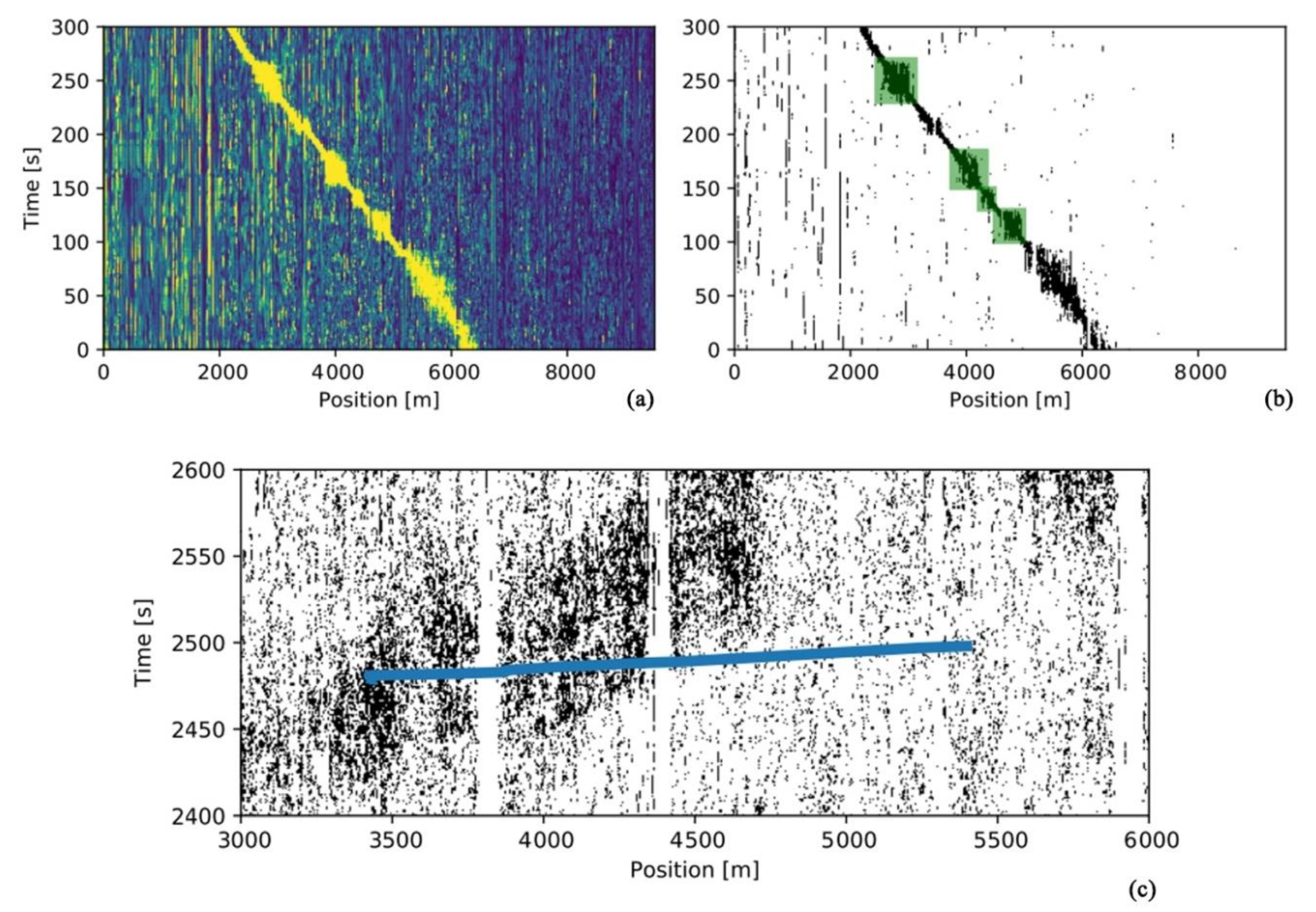
In 2019, Kowarik et al. analyzed data from Deutsche Bahn’s ICE 4 trains to locate train signals along with temporal or spatial directions in the data, using track-view, train-view, and bogie cluster data analysis. The approach allowed train speeds to be determined in three different ways, and the study presented new approaches for train monitoring [98]. In 2020, Christoph et al. proposed a real-time train tracking algorithm. The performance was tested in tunnels with standard cable trenches and on open tracks with directly connected cables [99] (Figure 29). The study provided a new idea for train positioning.
Figure 29. (a) Subsampled signal through band energy calculation. (b) Train detection result for a train on test site 2; the green boxes indicate coupled cable segments; the background without the train shows increased noise. (c) False positive train track due to false positive vibration detection [99].
Artificial intelligence (AI) and machine learning (ML) are also very effective for train monitoring. In 2022, Huang et al. used optical fiber cable as a sensing and transmission tool to implement traffic monitoring and cable failure prevention on telecommunication networks with the help of artificial intelligence (AI) and machine learning (ML) technologies. Thus, the study provided strong support for the construction of future smart cities [100]. The latest progress for railway monitoring is summarized in Table 11.
Table 11. Summary of railway monitoring applications.

5. Conclusions

This paper systematically reviews the research and application progress of DAS techniques. The latest research progress is specified in terms of polarization fading, coherent fading, spatial resolution, frequency response, signal-to-noise ratio, and detection distance. DAS techniques now also play a non-negligible role in applications such as soil salinity and ocean measurement. At present, DAS techniques are not mature enough and the event recognition rate for practical applications is low. There is still a considerable gap compared to conventional point sensors in terms of sensitivity and other aspects. A balance is needed in the relationship between pulse width, SNR, and sensing distance, and the relationship between frequency range and sensing range. With the breakthroughs in detection distance, sensitivity, multi-parameter monitoring, and multi-dimension monitoring, in addition to the combination with deep learning and neural networks, DAS techniques will play an important role in many fields due to their unique advantages.

Author Contributions

Conceptualization: Y.S. and C.W.; investigation: Y.S. and M.S.; writing—original draft preparation: M.S., J.Y. (Jian Yang), Y.D. and J.Y. (Jichao Yi); writing—review and editing: Y.S., C.W., W.Z. and Y.W.; supervision: Y.Z. and J.N. All authors have read and agreed to the published version of the manuscript.

Funding

This research was funded by Key R&D Program of Shandong Province (Major Technological Innovation Project) (2021CXGC010704), National Natural Science Foundation of China (62005137), Colleges and Universities Youth Innovation and techniques Support Program of Shandong Province (2019KJJ004), Natural Science Foundation of Shandong Province (ZR2020QF092), Joint Natural Science Foundation of Shandong Province (ZR2021LLZ014), and Science, education and industry integration innovation pilot project of Qilu university of techniques (2022PY008, 2022PX002).

Institutional Review Board Statement

Not applicable.

Informed Consent Statement

Not applicable.

Data Availability Statement

Data openly available in a public repository.

Conflicts of Interest

The authors declare no conflict of interest.

Correction Statement

This article has been republished with a minor correction to the Funding statement. This change does not affect the scientific content of the article.

References

  1. Zhao, Z. Optical Fiber Communication and Optical Fiber Sensing; Shanghai Science and techniques Literature Publishing: Shanghai, China, 1993; pp. 1–2. [Google Scholar]
  2. Rogers, A.J. Polarization-optical time domain reflectometry: A technique for the measurement of field distributions. Appl. Optics. 1981, 20, 1060–1074. [Google Scholar] [CrossRef] [PubMed]
  3. Zhang, Q.; Guo, Q.; Guo, X.; He, L.; Li, Y. Optical fiber sensing techniques based on Rayleigh backscattering curve. IEEE ITOEC 2022, 6, 2074–2077. [Google Scholar]
  4. Bao, X.Y.; Chen, L. Recent progress in distributed fiber optic sensors. Sensors 2012, 12, 8601–8639. [Google Scholar] [CrossRef] [PubMed]
  5. Nakazawa, M. Rayleigh backscattering theory for single-mode optical fibers. JOSA 1983, 73, 1175–1180. [Google Scholar] [CrossRef]
  6. Fan, X.; Yang, G.; Wang, S.; Liu, Q.; He, Z.Y. Distributed fiber-optic vibration sensing based on phase extraction from optical reflectometry. J. Lightwave Technol. 2017, 35, 3281–3288. [Google Scholar] [CrossRef]
  7. Huang, X.; Zhang, H.; Liu, K.; Liu, T.G. Fully modelling based intrusion discrimination in optical fiber perimeter security system. Opt. Fiber Technol. 2018, 45, 64–70. [Google Scholar] [CrossRef]
  8. Nishimura, T.; Emoto, K.; Nakahara, H.; Miura, S.; Yamamoto, M.; Sugimura, S.; Ishikawa, A.; Kimura, T. Source location of volcanic earthquakes and subsurface characterization using fiber-optic cable and distributed acoustic sensing system. Sci. Rep. 2021, 11, 6319. [Google Scholar] [CrossRef]
  9. Lucia, F.D.; Zambrozi, P.J.; Frazatto, F.; Piazzetta, M.; Gobbi, A. Design, fabrication and characterization of SAW pressure sensors for offshore oil and gas exploration. Sens. Actuator. A Phys. 2015, 222, 322–328. [Google Scholar] [CrossRef]
  10. Shang, Y.; Wang, C.; Zhang, Y.; Zhao, W.A.; Ni, J.S.; Peng, G.D. Non-Intrusive Pipeline Flow Detection Based on Distributed Fiber Turbulent Vibration Sensing. Sens. 2022, 22, 4044. [Google Scholar] [CrossRef]
  11. Bruni, S.; Goodall, R.; Mei, T.X.; Tsunashima, H. Control and monitoring for railway vehicle dynamics. Veh. Syst. Dyn. 2007, 45, 743–779. [Google Scholar] [CrossRef]
  12. Barnoski, M.K.; Jensen, S.M. Fiber waveguides: A novel technique for investigating attenuation characteristics. Appl. Opt. 1976, 15, 2112–2115. [Google Scholar] [CrossRef] [PubMed]
  13. Healey, P.; Malyon, D.J. OTDR in single-mode fiber at 1.5 μm using homodyne detection. Electron. Lett. 1982, 18, 862–863. [Google Scholar] [CrossRef]
  14. Taylor, H.F.; Lee, C.E. Apparatus and Method for Fiber Optic Intrusion Sensing. U.S. Patent USOO5194847A, 16 March 1993. [Google Scholar]
  15. Masoudi, A.; Belal, M.; Newson, T.P. A distributed optical fiber dynamic strain sensor based on phase-OTDR. Meas. Sci. Technol. 2013, 24, 085204. [Google Scholar]
  16. Fang, G.; Xu, T.; Feng, S.; Li, F. Phase-sensitive optical time domain reflectometer based on phase-generated carrier algorithm. J. Lightwave Technol. 2015, 33, 2811–2816. [Google Scholar] [CrossRef]
  17. Dong, Y.; Chen, X.; Liu, E.; Fu, C.; Zhang, H.; Lu, Z. Quantitative measurement of dynamic nanostrain based on a phase-sensitive optical time domain reflectometer. Appl. Optics. 2016, 55, 7810–7815. [Google Scholar] [CrossRef]
  18. Sun, Y.; Xu, H.; Wang, S.; Xie, F.; Huang, Y. Distributed fiber acoustic sensing system based on polarization diversity techniques. Opt. Commun. Tech. 2020, 44, 5–9. [Google Scholar]
  19. Lu, P.; Lalam, N.; Badar, M.; Liu, B.; Chorpening, B.T.; Buric, M.P.; Ohodnicki, P.R. Distributed optical fiber sensing: Review and perspective. Appl. Phys. Rev. 2019, 6, 041302. [Google Scholar] [CrossRef]
  20. Liu, S.; Yu, F.; Hong, R.; Xu, W.; Shao, L.Y.; Wang, F. Advances in phase-sensitive optical time-domain reflectometry. Opto-Electron. Adv. 2022, 5, 1–28. [Google Scholar] [CrossRef]
  21. He, Z.Y.; Liu, Q. Optical fiber distributed acoustic sensors: A review. J. Lightwave Technol. 2021, 39, 3671–3686. [Google Scholar] [CrossRef]
  22. Zhou, J.; Pan, Z.; Ye, Q.; Cai, H.W.; Qu, R.; Fang, Z. Characteristics and Explanations of interference fading of a phi-OTDR with a multi-frequency source. J. Lightwave Technol. 2013, 31, 2947–2954. [Google Scholar] [CrossRef]
  23. Goldsmith, A. Wireless Communications; Cambridge University Press: Cambridge, UK, 2007. [Google Scholar]
  24. Goodman, J.W. Statistical Properties of Laser Speckle Patterns. Top. Appl. Phys. 1975, 9, 9–75. [Google Scholar]
  25. Juarez, J.C.; Maier, E.W.; Choi, K.N.; Taylor, H.F. Distributed fiber-optic intrusion sensor system. J. Lightwave Technol. 2005, 23, 2081–2087. [Google Scholar] [CrossRef]
  26. Peng, F.; Duan, N.; Rao, Y.J.; Li, J. Real-Time Position and Speed Monitoring of Trains Using Phase-Sensitive OTDR. IEEE Photonics Technol. Lett. 2014, 26, 2055–2057. [Google Scholar] [CrossRef]
  27. Peng, F.; Wu, H.; Jia, X.; Wang, Z.N. Ultra-long high-sensitivity Φ-OTDR for high spatial resolution intrusion detection of pipelines. Opt. Express. 2014, 22, 13804–13810. [Google Scholar] [CrossRef]
  28. Miller, D.; Parker, T.; Kashikar, S.; Todorov, M.; Bostick, T. Vertical Seismic Profiling Using a Fiber-optic Cable as a Distributed Acoustic Sensor. In Proceedings of the 74th EAGE Conference & Exhibition, Copenhagen, Denmark, 4–7 June 2012. [Google Scholar]
  29. Ren, M.; Lu, P.; Chen, L.; Bao, X.Y. Theoretical and experimental analysis of Φ-OTDR based on polarization diversity detection. IEEE Photonics Technol. Lett. 2016, 28, 697–700. [Google Scholar] [CrossRef]
  30. Wu, Y.; Bian, P.; Zhao, J.; Ai, X. An interferometric fiber optic sensor for eliminating polarization fading. Chin. J. Sci. Instrument. 2014, 4, 889–893. [Google Scholar]
  31. Alekseev, A.E.; Vdovenko, V.S.; Gorshkov, B.G. A phase-sensitive optical time-domain reflectometer with dual-pulse diverse frequency probe signal. Laser Phys. 2015, 25, 065101. [Google Scholar] [CrossRef]
  32. Chen, D.; Liu, Q.; He, Z.Y. Phase-detection distributed fiber-optic vibration sensor without fading-noise based on time-gated digital OFDR. Opt. Express. 2017, 25, 8315–8325. [Google Scholar] [CrossRef]
  33. Liu, Y.; Li, H.; Liu, T.G.; Fan, C.; Yan, Z.; Liu, D.; Sun, Q.Z. Polarization dependent noise suppression for fiber distributed acoustic sensor with birefringence estimation. CLEO Appl. Tech. Opt. Soc. Am. 2020, 10, 18. [Google Scholar]
  34. Wu, Y.; Wang, Z.N.; Xiong, J.; Jiang, J.; Rao, Y.J. Bipolar-coding Φ-OTDR with interference fading elimination and frequency drift compensation. J. Lightwave Technol. 2020, 38, 6121–6128. [Google Scholar] [CrossRef]
  35. Guerrier, S.; Dorize, C.; Awwad, E.; Renaudier, J. Introducing coherent MIMO sensing, a fading-resilient, polarization-independent approach to Φ-OTDR. Opt. Express. 2020, 28, 21081–21094. [Google Scholar] [CrossRef] [PubMed]
  36. Gu, J.; Lv, B.; Yang, J.; Wang, Z.; Ye, L.; Ye, Q.; Qu, R.; Cai, H.W. Multicore fiber distributed acoustic sensing. Acta Opt. Sinica. 2021, 41, 0706003. [Google Scholar]
  37. Ogden, H.M.; Murray, M.J.; Murray, J.B.; Kirkendall, C.; Redding, B. Frequency multiplexed coherent Φ-OTDR. Sci. Rep. 2021, 11, 17921. [Google Scholar] [CrossRef] [PubMed]
  38. Cui, K.; Liu, F.; Wang, K. Interference-fading-suppressed pulse-coding Φ-OTDR using spectrum extraction and rotated-vector-sum method. IEEE Photonics Technol. Lett. 2021, 13, 1–6. [Google Scholar] [CrossRef]
  39. Zhao, Z.; Wu, H.; Hu, J. Interference fading suppression in Φ-OTDR using space-division multiplexed probes. Opt. Express. 2021, 29, 15452–15462. [Google Scholar] [CrossRef]
  40. Cao, C.; Wang, F.; Pan, Y.; Zhang, X.; Chen, X.; Chen, Q.; Lu, J. Suppression of signal fading with multi-wavelength laser in polarization OTDR. IEEE Photonics Technol. Lett. 2017, 29, 1824–1827. [Google Scholar] [CrossRef]
  41. Cimini, L. Analysis and simulation of a digital mobile channel using orthogonal frequency division multiplexing. IEEE Trans. Cogn. Commun. Netw. 1985, 33, 665–675. [Google Scholar] [CrossRef]
  42. Wang, X.; Lu, B.; Wang, Z.; Cai, H. Interference-fading-free Φ-OTDR based on differential phase shift pulsing techniques. IEEE Photonics Technol. Lett. 2018, 31, 39–42. [Google Scholar] [CrossRef]
  43. Kishida, K.; Guzik, A.; Nishiguchi, K.; He, Z. Development of real-time time gated digital (TGD) OFDR method and its performance verification. Sensors 2021, 21, 4865. [Google Scholar] [CrossRef]
  44. Hu, Y.; Meng, Z.; Zabihi, M.; Zhang, X.; Zhang, Y. Performance enhancement methods for the distributed acoustic sensors based on frequency division multiplexing. Electronics 2019, 8, 617. [Google Scholar] [CrossRef]
  45. Zhang, Y.; Liu, J.; Xiong, F.; Zhang, X. A space-division multiplexing method for fading noise suppression in the Φ-OTDR system. Sensors 2021, 21, 1694. [Google Scholar] [CrossRef]
  46. He, H.; Yan, L.; Qian, H.; He, Z. Suppression of the interference fading in phase-sensitive OTDR with phase-shift transform. J. Lightwave Technol. 2021, 39, 295–302. [Google Scholar] [CrossRef]
  47. Shang, Y.; Wang, C.; Liu, X.; Wang, C.; Zhao, W.; Peng, G. Optical distributed acoustic sensing based on the phase optical time-domain reflectometry. Infrared Laser Eng. 2017, 46, 321003. [Google Scholar]
  48. Ma, F.; Song, N.; Wang, X.; Wang, P.; Ma, H.; Wang, Y.; Peng, X.; Yu, J. Fiber-optic distributed acoustic sensor utilizing LiNbO3 straight through waveguide phase modulator. Opt. Express. 2021, 29, 15425–15433. [Google Scholar] [CrossRef] [PubMed]
  49. Zhu, X.; Li, X.; Zhang, R.; Zhao, Z.; Kong, M. Using DFB laser self-injection locked to an optical waveguide ring resonator as a light source of Φ-OTDR. Appl. Optics. 2021, 60, 9769–9773. [Google Scholar] [CrossRef]
  50. Chen, D.; Liu, Q.; Wang, Y.; Li, H.; He, Z.Y. Fiber-optic distributed acoustic sensor based on a chirped pulse and a non-matched filter. Opt. Express. 2019, 27, 29415–29424. [Google Scholar] [CrossRef]
  51. Chen, Y.; Fu, Y.; Xiong, J.; Wang, Z.N. Distributed fiber birefringence measurement using pulse-compression Φ-OTDR. Photonic Sens. 2021, 11, 402–410. [Google Scholar] [CrossRef]
  52. Qian, H.; Luo, B.; He, H.; Zhou, Y.; Zou, X.; Pan, W.; Yan, L. Distributed dynamic strain sensing in coherent Φ-OTDR with pulse conversion algorithm. Opt. Lett. 2021, 46, 1668–1671. [Google Scholar] [CrossRef]
  53. Shan, Y.; Ji, W.; Wang, Q.; Zhang, X. Performance optimization for phase-sensitive OTDR sensing system based on multi-spatial resolution analysis. Sensors 2018, 19, 83. [Google Scholar] [CrossRef]
  54. Gong, P.; Jiang, X.; Zhou, J.; Xie, L. Wavelength-tunable OTDR for DWDM-PON based on optimized wavelet denoising. IEEE Photonics Technol. Lett. 2021, 33, 1347–1350. [Google Scholar] [CrossRef]
  55. Li, B.; Guo, X.; Lv, C.G. Double-frequency ultrasonic measurement based on fiber laser sensor. Inf. techniques. 2016, 40, 21–24. [Google Scholar]
  56. Wang, C.; Shang, Y.; Zhao, W.; Liu, X.; Wang, C.; Yu, H.; Yang, M.; Peng, G. Distributed acoustic sensor using broadband weak FBG array for large temperature tolerance. IEEE Sens. J. 2018, 18, 2796–2800. [Google Scholar] [CrossRef]
  57. Yan, Y.; Khan, F.N.; Zhou, B.; Lau, A.P.T.; Lu, C.; Guo, C. Forward transmission based ultra-long distributed vibration sensing with wide frequency response. IEEE Sens. J. 2021, 39, 2241–2249. [Google Scholar] [CrossRef]
  58. Zhang, Y.; Fu, S.; Chen, Y.; Ding, Z.; Shan, Y.; Wang, F.; Chen, M.; Zhang, X.; Meng, Z. A visibility enhanced broadband phase-sensitive OTDR based on the UWFBG array and frequency-division-multiplexing. Opt. Fiber Technol. 2019, 53, 101995. [Google Scholar] [CrossRef]
  59. Liang, G.; Niu, P.; Jiang, J.; Wang, S.; Wang, Y.; Xia, J.; Wang, T.; Ding, Z.; Xu, T.; Liu, T.G. Heterogeneous-frequency-double-pulse chain and weak FBG array for quasi-distributed acoustic sensing with improved response bandwidth. Appl. Optics. 2021, 60, 7740–7744. [Google Scholar] [CrossRef] [PubMed]
  60. Deng, Y.; Liu, Q.; He, Z.Y. Distributed fiber-optic acoustic sensor for sparse-wideband vibration sensing with time delay sampling. IEEE Sens. J. 2021, 21, 13290–13295. [Google Scholar] [CrossRef]
  61. Murray, M.J.; Redding, B. Distributed multimode fiber Φ-OTDR sensor using a high-speed camera. OSA Continuum. 2020, 4, 579–588. [Google Scholar] [CrossRef]
  62. Zhang, X.; Sun, Z.; Shan, Y.; Zhang, Y. A high performance distributed optical fiber sensor based on Φ-OTDR for dynamic strain measurement. IEEE Photon. J. 2017, 9, 1–12. [Google Scholar] [CrossRef]
  63. Li, C.; Tang, J.; Jiang, Y.; Yang, M. An enhanced distributed acoustic sensor with large temperature tolerance based on ultra-weak fiber Bragg grating array. IEEE Photon. J. 2020, 12, 1–11. [Google Scholar] [CrossRef]
  64. Yang, M.; Zhan, H.; Cheng, C.; Tang, J. Large-capacity and long-distance distributed acoustic sensing based on an ultra-weak fiber Bragg grating array with an optimized pulsed optical power arrangement. Opt. Express. 2022, 30, 16931–16937. [Google Scholar] [CrossRef]
  65. Wang, Z.; Yang, J.; Gu, J.; Cai, H. Practical performance enhancement of DAS by using dense multichannel signal integration. J. Lightwave Technol. 2021, 39, 6348–6354. [Google Scholar] [CrossRef]
  66. Wang, Y.; Zou, J.; Xu, Y.; Bao, Q.; Jin, B. Optical fiber vibration sensor using least mean square error algorithm. Sensors 2020, 20, 2000. [Google Scholar] [CrossRef] [PubMed]
  67. Zhang, Y.; Zhou, T.; Ding, Z.; Zhang, X. Classification of interference-fading tolerant Φ-OTDR signal using optimal peak-seeking and machine learning. Chin. Opt. Lett. 2021, 19, 030601. [Google Scholar] [CrossRef]
  68. Fu, Y.; Wang, Z.N.; Zhu, R.C.; Xue, N.; Jiang, J.; Lu, C.; Zhang, B.; Yang, L.; Atubga, D.; Rao, Y.J. Ultra-long-distance hybrid BOTDA/Φ-OTDR. Sensors 2018, 18, 976–984. [Google Scholar] [CrossRef]
  69. Chen, D.; Liu, Q.; He, Z.Y. 108-km distributed acoustic sensor with 220-pε/√Hz strain resolution and 5-m spatial resolution. J. Lightwave Technol. 2019, 37, 2901276. [Google Scholar] [CrossRef]
  70. Cedilnik, G.; Lees, G.; Schmidt, P.E.; Herstrøm, S.; Geisler, T. Pushing the reach of fiber distributed acoustic sensing to 125 km without the use of amplifification. IEEE Sens. J. 2019, 3, 1–4. [Google Scholar] [CrossRef]
  71. Uyar, F.; Onat, T.; Unal, C.; Kartaloglu, T.; Ozbay, E.; Ozdur, I. A Direct Detection fiber optic distributed acoustic sensor with a mean SNR of 7.3 dB at 102.7 km. IEEE Sens. J. 2019, 11, 1–8. [Google Scholar] [CrossRef]
  72. Masoudi, A.; Brambilla, G.; Beresna, M. 152km-range single-ended distributed acoustic sensor based on in-line optical amplification and micro machined enhanced backscattering fiber. Opt. Lett. 2021, 46, 552–555. [Google Scholar] [CrossRef]
  73. Hennin, S.; Germana, G.; Garcia, L. Integrated Perimeter Security System. In Proceedings of the 2007 IEEE Conference on Technologies for Homeland Security, Woburn, MA, USA, 16–17 May 2007; pp. 70–75. [Google Scholar]
  74. Shi, Y.; Li, Y.; Zhao, Y.; Zhuang, Z.; Jiang, T. An easy access method for event recognition of Φ-OTDR sensing system based on transfer learning. J. Lightwave Technol. 2021, 39, 4548–4555. [Google Scholar] [CrossRef]
  75. Yan, S.; Shang, Y.; Wang, C.; Zhao, W.; Ni, J.S. Mixed intrusion events recognition based on group convolutional neural networks in DAS system. IEEE Sens. J. 2022, 22, 678–684. [Google Scholar] [CrossRef]
  76. Shi, J.; Cui, K.; Wang, H.; Ren, Z.; Zhu, R. An Interferometric optical fiber perimeter security system based on multi-domain feature fusion and SVM. IEEE Sens. J. 2021, 21, 9194–9202. [Google Scholar] [CrossRef]
  77. Wang, T.; Gao, S.; Zhang, L.; Li, G.; Li, Y.; Chen, J. Earthquake emergency response framework on campus based on multi-source data monitoring. J. Clean Prod. 2019, 238, 117965. [Google Scholar] [CrossRef]
  78. Papp, B.; Donno, D.; Martin, J.E.; Hartog, H. A study of the geophysical response of distributed fiber optic acoustic sensors through laboratory-scale experiments. Geophys. Prospect. 2016, 65, 1186–1204. [Google Scholar] [CrossRef]
  79. Wang, B.; Zeng, X.; Song, Z.; Li, X.; Yang, J. Seismic observation and subsurface structure detection using urban communication fiber optic cables. Sci. Bull. 2021, 66, 2590–2595. [Google Scholar]
  80. Hudson, T.S.; Baird, A.F.; Kendall, J.M.; Kufner, S.K.; Brisbourne, A.M.; Smith, A.M.; Butcher, A.; Chalari, A.; Clarke, A. Distributed acoustic sensing (DAS) for natural microseismicity studies: A case study from antarctica. JGR Solid Earth. 2021, 126, 2020JB021493. [Google Scholar] [CrossRef]
  81. Nayak, A.; Ajo-Franklin, J. Distributed acoustic sensing using dark fiber for array detection of regional earthquakes. Seismol. Res. Lett. 2021, 92, 2441–2452. [Google Scholar] [CrossRef]
  82. Xu, B.; Lin, B. Exploring the spatial distribution of distributed energy in China. Energy. Econ. 2022, 107, 105828. [Google Scholar] [CrossRef]
  83. Du, Q.; Wang, C.; Shang, Y.; Liu, X.H.; Zhao, Q.; Cao, B.; Zhao, W.; Ni, J.S.; Wang, C. Fiber optic distributed seismic wave detection system and its deployment optimization research. Shandong Sci. 2017, 30, 7. [Google Scholar]
  84. Chai, J.; Lei, W.; Du, W.; Yuan, Q.; Zhu, L.; Zhang, D.; Li, H. Experimental study on distributed optical fiber sensing monitoring for ground surface deformation in extra-thick coal seam mining under ultra-thick conglomerate. Opt. Fiber Technol. 2019, 53, 102006. [Google Scholar] [CrossRef]
  85. Wang, C.; Shang, Y.; Wang, C.; Wang, Y.Y.; Liu, X. Distributed fiber optic acoustic seismic wave exploration techniques. Shandong Sci. 2021, 34, 8. [Google Scholar]
  86. Wamriew, D.; Pevzner, R.; Maltsev, E.; Pissarenko, D. Deep neural networks for detection and position of microseismic events and velocity model inversion from microseismic data acquired by distributed acoustic sensing array. Sensors 2021, 21, 6627. [Google Scholar] [CrossRef] [PubMed]
  87. Wang, Z.; Feng, X.; Han, G.; Sui, Y.; Qin, H. EODL: Energy optimized distributed localization method in three-dimensional underwater acoustic sensors networks. Comput. Netw. 2018, 141, 179–188. [Google Scholar] [CrossRef]
  88. Chen, X.; Zou, N.; Liang, L.; Zhang, X.; Zhang, Y. Submarine cable monitoring system based on enhanced COTDR with simultaneous loss measurement and vibration monitoring ability. Opt. Express. 2021, 29, 13115–13128. [Google Scholar] [CrossRef]
  89. Rivet, D.; de Cacqueray, B.; Sladen, A. Preliminary assessment of ship detection and trajectory evaluation using distributed acoustic sensing on an optical fiber telecom cable. J. Acoust. Soc. Am. 2021, 149, 2615–2627. [Google Scholar] [CrossRef] [PubMed]
  90. Liu, Z.; Zhang, L.; Wei, H.; Xiao, Z.; Qiu, Z.; Sun, R.; Pang, F.; Wang, T. Underwater acoustic source localization based on phase-sensitive optical time domain reflectometry. Opt. Express. 2021, 29, 12880–12892. [Google Scholar] [CrossRef]
  91. Xu, X.; Qian, Z.; Bi, Y.; Xue, B.; Wu, H. Underwater dynamic distance measurement using a cross-sampling dual-comb. Opt. Commun. 2022, 517, 128319. [Google Scholar] [CrossRef]
  92. Milne, D.; Masoudi, A.; Ferro, E.; Watson, G.; Pen, L.L. An analysis of railway track behaviour based on distributed fiber acoustic sensing. Mech. Syst. Signal. Proc. 2020, 142, 106769. [Google Scholar] [CrossRef]
  93. Palese, J.W.; Zarembski, A.M.; Attoh-Okine, N.O. Methods for aligning near-continuous railway track inspection data. Proc. Inst. Mech. Eng. Part. F-J. Rail Rapid Transit. 2020, 234, 709–721. [Google Scholar] [CrossRef]
  94. Kaewunruen, S.; Chiengson, C. Railway track inspection and maintenance priorities due to dynamic coupling effects of dipped rails and differential track settlements. Eng. Fail. Anal. 2018, 93, 157–171. [Google Scholar] [CrossRef]
  95. Wang, S.; Liu, F.; Liu, B. Research on application of deep convolutional network in high-speed railway track inspection based on distributed fiber acoustic sensing. Opt. Commun. 2021, 492, 126981. [Google Scholar] [CrossRef]
  96. Gao, S.; Dong, H.; Ning, B.; Zhang, Q. Cooperative prescribed performance tracking control for multiple high-speed trains in moving block signaling system. IEEE Trans. Intell. Transp. Syst. 2018, 20, 2740–2749. [Google Scholar] [CrossRef]
  97. Hill, R.J.; Bond, L.J. Modelling moving-block railway signalling systems using discrete-event simulation. In Proceedings of the 1995 IEEE ASME Joint Railroad Conference, Baltimore, MD, USA, 4–6 April 1995; pp. 105–111. [Google Scholar]
  98. Kowarik, S.; Hussels, M.T.; Chruscicki, S.; Münzenberger, S.; Lämmerhirt, S.; Pohl, P.; Schubert, M. Fiber optic train monitoring with distributed acoustic sensing: Conventional and neural network data analysis. Sensors 2020, 20, 450. [Google Scholar] [CrossRef]
  99. Wiesmeyr, C.; Litzenberger, M.; Waser, M.; Papp, A.; Garn, H.; Neunteufel, G.; Döller, H. Real-time train tracking from distributed acoustic sensing data. Appl. Sci. 2020, 10, 448. [Google Scholar] [CrossRef]
  100. Huang, M.; Han, S.; Narisetty, C. AI-driven applications over telecom networks by distributed fiber optic sensing technologies. SPIE 2022, 12028, 116–121. [Google Scholar]
Figure 1. The history of DAS development.
Sensors 22 06060 g001
Figure 2. OTDR structure diagram.
Sensors 22 06060 g002
Figure 3. Φ-OTDR structure diagram.
Sensors 22 06060 g003
Figure 4. COTDR structure diagram.
Sensors 22 06060 g004
Figure 5. (a) Experimental setup and demodulation procedure. (b) Backscattered light intensity of backscattering enhanced fiber in different polarized states; PSD of fiber section A; PSD of fiber section B in X polarized state, Y polarized state and depolarized algorithm [33].
Sensors 22 06060 g005
Figure 6. (a) Experimental setup. (b) SIMO and MIMO measurements on 340 m SSMF, no perturbation applied [35].
Sensors 22 06060 g006
Figure 7. (a) Experimental setup. (b) PSD of SMF and MCF at the frequency of 2.5 kHz [36].
Sensors 22 06060 g007
Figure 8. (a) Experimental setup. (b) The beat frequency signal [44].
Sensors 22 06060 g008
Figure 9. (a) Experimental setup. (b) Chirped pulse and sub-division into bands (offset for visibility, frequency change is linear over entire range). (c) Corresponding frequency bands used during signal processing [46].
Sensors 22 06060 g009
Figure 10. (a) Experimental setup. Localization of vibration sources at different frequencies: (b) 8 Hz; (c) 4.9 kHz. (d) FFT frequency spectrum at the 4.9-kHz vibration point [49].
Sensors 22 06060 g010
Figure 11. (a) Experimental setup. (b) Demodulated birefringence of simulation and experiments [51].
Sensors 22 06060 g011
Figure 12. (a) Experimental setup. (b) The result of spatial resolution measurement [54].
Sensors 22 06060 g012
Figure 13. (a) Experimental setup. (b) Schematic diagram of the localization principle [57].
Sensors 22 06060 g013
Figure 14. (a) Experimental setup; red is polarization-maintaining fiber. (b) Time domain recovered waveform of vibrations [60].
Sensors 22 06060 g014
Figure 15. (a) Experimental setup. (b) Raw beat frequency signal [64].
Sensors 22 06060 g015
Figure 16. (a) Experimental setup. (b) Schematic diagram of adaptive filtering based on least mean square error (LMS) algorithm [66].
Sensors 22 06060 g016
Figure 17. (a) Experimental setup. (b) RBS intensity–distance trace of 108 km sensing fiber with bi-directional first-order distributed Raman amplification [69].
Sensors 22 06060 g017
Figure 18. (a) Experimental setup. (b) Mean SNR versus distance along the test fiber [72].
Sensors 22 06060 g018
Figure 19. Classification method steps [74].
Sensors 22 06060 g019
Figure 20. 100 G-Net structure diagram [75].
Sensors 22 06060 g020
Figure 21. The classification algorithm flow [76].
Sensors 22 06060 g021
Figure 22. (a) Map and schematic showing experimental setup. (b) Schematic diagram of the experiment with the triangle and line fiber configurations [80].
Sensors 22 06060 g022
Figure 23. Beamforming results at channels 2000–3000 (subarray aperture 2 km) for an M4.3 earthquake. (a) Record section showing filtered waveforms. (b) Vespagram (beam power in the 0–1 range as a function of slowness and time). (c) Traces from the top to bottom [81].
Sensors 22 06060 g023
Figure 24. DAS earthquake wave test data [85].
Sensors 22 06060 g024
Figure 25. Deep convolutional neural network architecture used in the study. Green, blue, and red cuboids represent multi-channel feature maps with the number of channels shown at the bottom of the cuboids [86].
Sensors 22 06060 g025
Figure 26. Schematic diagram of submarine cable link [88].
Sensors 22 06060 g026
Figure 27. Position map of optical cable detection [89].
Sensors 22 06060 g027
Figure 28. The diagram of the event recognition system [95].
Sensors 22 06060 g028
Figure 29. (a) Subsampled signal through band energy calculation. (b) Train detection result for a train on test site 2; the green boxes indicate coupled cable segments; the background without the train shows increased noise. (c) False positive train track due to false positive vibration detection [99].
Sensors 22 06060 g029
Table 1. Research progress for suppression of polarization fading.
表 1.抑制偏振衰落的研究进展。
Published Date  发布日期Researchers  研究者Polarization Fading   偏振衰落
Suppression Scheme  抑制方案
Performance  性能
CJSI, 2014  CJSI,2014 年Wu, et al.  Wu 等人。Coherent and polarization maintaining light path structure
相干和偏振保持光路结构
Interference fringe visibility up to 40%
干扰条纹可见性高达 40%
LP, 2015  LP, 2015 年Alekseev, et al.  Alekseev 等人。Dual-pulse   双脉冲
diverse frequency probe signal
不同频率的探头信号
OE, 2017  OE, 2017 年He, et al.  He, et al.Phase-detection  相位检测SNR: 26 dB  信噪比: 26 dB
CLEO, 2020  CLEO,2020 年Sun, et al.  Sun 等人。Dynamic birefringence estimation
动态双折射估计
Suppress about 9.5 dB noise
抑制约 9.5 dB 的噪声
JLT, 2020  JLT,2020 年Rao, et al.  Rao 等人。Bipolar Golay coding  双极 Golay 编码Suppress about 7.1 dB noise
抑制约 7.1 dB 的噪声
OE, 2020  OE, 2020 年Guerrier, et al.  Guerrier 等人。Coherent-MIMO sensing  相干 MIMO 传感Improve sensitivity  提高灵敏度
AOS, 2021  AOS,2021 年Cai, et al.  Cai 等人。Spatial diversity  空间多样性Suppress about 5.2 dB noise
抑制约 5.2 dB 的噪声
SR, 2021  SR, 2021 年Ogden, et al.  Ogden 等人。Frequency multiplexed  频率多路复用
pulse sequence  脉冲序列
Strain noise:  应变噪声:
0.6 pε/√Hz  0.6 pε/√赫兹
Table 2. Research progress for suppression of coherent fading.
Published DateResearchersCoherent Fading
Suppression Scheme
Performance
IEEE, 2018Cai, et al.DPSPSensing distance: 2.4 km
Elec, 2019Zhang, et al.FDMDistortion rate: 1.26%
JLT, 2021He, et al.Phase-shift transformStandard deviation of differential phase: 0.0224
Sens, 2021Zhang, et al.SDMdistortion rate: <2%
Sens, 2021He, et al.TGD-OFDRSensing distance: 80 km
Table 3. Research progress on for spatial resolution enhancement.
Published DateResearchersSpatial Resolution
Enhancement Scheme
Spatial Resolution
ILE, 2016Shang, et al.Phase carrier
demodulation algorithm
10 m
OE, 2019He, et al.Chirped pulse2 m
Sens, 2019Zhang, et al.MSR
OE, 2021Ma, et al.LiNbO3 straight-through waveguide
phase modulator
10 m
AO, 2021Zhu, et al.DFB with OWRR13 m
PS, 2021Wang, et al.Pulse-Compression0.086 m
OL, 2021Qian, et al.CPCA4 m
IEEE, 2021Gong, et al.DWDM-PON2 m
Table 4. Research progress for frequency response enhancement.
Published DateResearchersFrequency Response
Enhancement Scheme
Frequency Response
IT, 2016Li, et al.DBR fiber laser sensor
IEEE, 2018Shang, et al.Broadband weak
FBG array
1200 Hz @ 400 m
OFT, 2019Zhang, et al.UWFBG with FDM440,000 Hz @ 330 m
IEEE, 2021Yan, et al.Ultra-long
Distributed sensor
20,000 Hz @ 615,000 m
AO, 2021Liu, et al.FDM2000 Hz @ 70,000 m
IEEE, 2021He, et al.Time delay sampling with FDM47,000 Hz @ 10,000 m
OSA, 2021Murrey, et al.High-speed camera with time-gated
local oscillator
400 Hz @ 2000 m
Table 5. Research progress on SNR enhancement.
Published DateResearchersSignal-to-Noise Ratio
Enhancement Scheme
Signal-to-Noise Ratio
IEEE, 2017Zhang, et al.UWFBGs58 dB
OSA, 2020Yang, et al.UWFBGs59.2 dB
Sens, 2020Jin, et al.Least mean square error algorithm42.2 dB
JLT, 2021Cai, et al.Dense multichannel signal integration20 dB
COL, 2021Zhang, et al.Optimal peak-seeking and machine learning
OSA, 2022Yang, et al.UWFBG array with coherent detection40.01 dB
Table 6. Research progress for detection distance enhancement.
Published DateResearchersDetection Distance
Enhancement Scheme
Detection Distance
Sens, 2018Fu, et al.BOTDR + Φ-OTDR150.62 km
JLT, 2019He, et al.Bi-directional distributed Raman amplification108 km
IEEE, 2019Cedilnik, et al.Two cascaded
acousto-optic modulators
102.7 km
IEEE, 2019Uyar, et al.Low-loss optical fiber125 km
OL, 2021Masoudi, et al.Low-loss enhanced-
backscattering fiber
150 km
Table 7. Summary of perimeter security applications.
Published DateResearchersMethods
JLT, 2021Shi, et al.Transfer training recognition algorithm
IEEE, 2021Shi, et al.Security system with multi-domain feature fusion
IEEE, 2022Ni, et al.100 G-Net recognition algorithm
Table 8. Summary of earthquake monitoring applications.
Published DateResearchersMethods
SCP, 2019Wang, et al.Perimeter security
JSE, 2021Hudson, et al.Two-dimensional DAS array
SRL, 2021Avinash, et al.Dark-fiber DAS array
Table 9. Summary of energy exploration applications.
Published DateResearchersMethods
OFT, 2019Chai, et al.Perimeter security
SDS, 2021Wang, et al.Propose monitoring system
Sens, 2021Wamriew, et al.Deep learning methods for real-time/semi-real-time data processing
Table 10. Summary of underwater positioning applications.
Published DateResearchersMethods
JASA, 2021Rivet, et al.Detection of oil tankers at sea
OE, 2021Liu, et al.Underwater localization system
OE, 2021Zhang, et al.Submarine cable
OC, 2022Xu, et al.OFC
Table 11. Summary of railway monitoring applications.
Published DateResearchersMethods
Sens, 2019Kowarik, et al.Cluster data analysis
OE, 2020Christoph, et al.Real-time train tracking algorithm
OC, 2021Wang, et al.Track train detection system
SPIE, 2022Huang, et al.AI and ML technologies
Publisher’s Note: MDPI stays neutral with regard to jurisdictional claims in published maps and institutional affiliations.

Share and Cite

MDPI and ACS Style

Shang, Y.; Sun, M.; Wang, C.; Yang, J.; Du, Y.; Yi, J.; Zhao, W.; Wang, Y.; Zhao, Y.; Ni, J. Research Progress in Distributed Acoustic Sensing Techniques. Sensors 2022, 22, 6060. https://doi.org/10.3390/s22166060

AMA Style

Shang Y, Sun M, Wang C, Yang J, Du Y, Yi J, Zhao W, Wang Y, Zhao Y, Ni J. Research Progress in Distributed Acoustic Sensing Techniques. Sensors. 2022; 22(16):6060. https://doi.org/10.3390/s22166060

Chicago/Turabian Style

Shang, Ying, Maocheng Sun, Chen Wang, Jian Yang, Yuankai Du, Jichao Yi, Wenan Zhao, Yingying Wang, Yanjie Zhao, and Jiasheng Ni. 2022. "Research Progress in Distributed Acoustic Sensing Techniques" Sensors 22, no. 16: 6060. https://doi.org/10.3390/s22166060

APA Style

Shang, Y., Sun, M., Wang, C., Yang, J., Du, Y., Yi, J., Zhao, W., Wang, Y., Zhao, Y., & Ni, J. (2022). Research Progress in Distributed Acoustic Sensing Techniques. Sensors, 22(16), 6060. https://doi.org/10.3390/s22166060

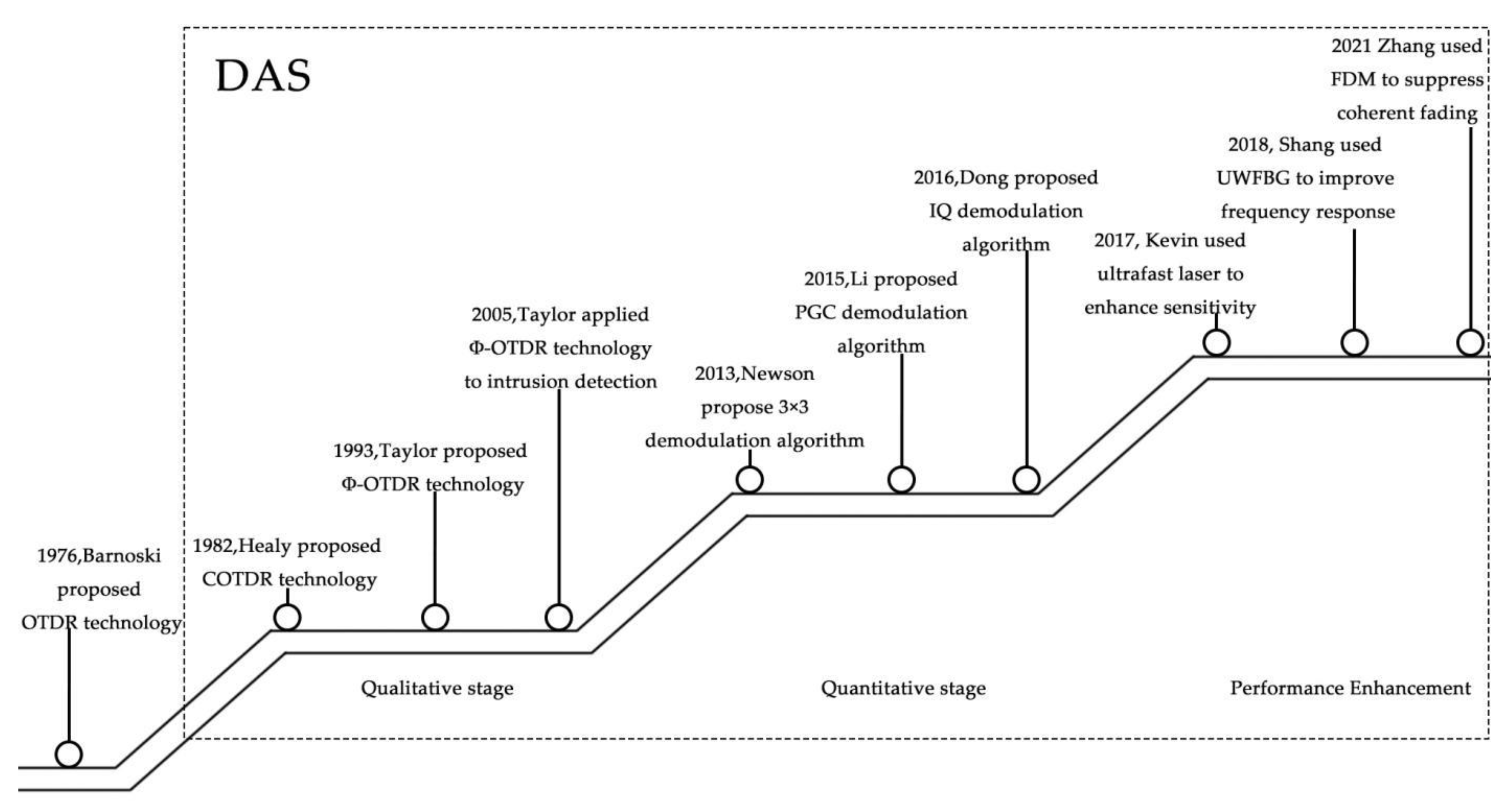
Note that from the first issue of 2016, this journal uses article numbers instead of page numbers. See further details here.

Article Metrics

Citations

Crossref
 
Scopus
 
ads
 
PubMed
 
PMC
 
Web of Science
 
Google Scholar

Article Access Statistics

Created with Highcharts 4.0.4Chart context menuArticle access statisticsArticle Views9. Apr10. Apr11. Apr12. Apr13. Apr14. Apr15. Apr16. Apr17. Apr18. Apr19. Apr20. Apr21. Apr22. Apr23. Apr24. Apr25. Apr26. Apr27. Apr28. Apr29. Apr30. Apr1. May2. May3. May4. May5. May6. May7. May8. May9. May10. May11. May12. May13. May14. May15. May16. May17. May18. May19. May20. May21. May22. May23. May24. May25. May26. May27. May28. May29. May30. May31. May1. Jun2. Jun3. Jun4. Jun5. Jun6. Jun7. Jun8. Jun9. Jun10. Jun11. Jun12. Jun13. Jun14. Jun15. Jun16. Jun17. Jun18. Jun19. Jun20. Jun21. Jun22. Jun23. Jun24. Jun25. Jun26. Jun27. Jun28. Jun29. Jun30. Jun1. Jul2. Jul3. Jul4. Jul5. Jul6. Jul7. Jul0k2.5k5k7.5k10k12.5k
For more information on the journal statistics, click here.
Multiple requests from the same IP address are counted as one view.
Back to Top  返回页首Top