


Sharpe ratio 夏普比率
In finance, the Sharpe ratio (also known as the Sharpe index, the Sharpe measure, and the reward-to-variability ratio) measures the performance of an investment such as a security or portfolio compared to a risk-free asset, after adjusting for its risk. It is defined as the difference between the returns of the investment and the risk-free return, divided by the standard deviation of the investment returns. It represents the additional amount of return that an investor receives per unit of increase in risk.
在金融领域,夏普比率(又称夏普指数、夏普度量值、报酬与波动性比率)用于衡量经风险调整后,某项投资(如证券或投资组合)相较于无风险资产的绩效表现。其定义为投资收益与无风险收益之差除以投资收益的标准差。该比率代表投资者每单位风险增加所获得的超额收益。
It was named after William F. Sharpe,[1] who developed it in 1966.
该比率由威廉·F·夏普 [1] 于 1966 年提出,并以其姓氏命名。
Definition 定义
[edit]Since its revision by the original author, William Sharpe, in 1994,[2] the ex-ante Sharpe ratio is defined as:
自原作者威廉·夏普 [2] 于 1994 年修订后,事前夏普比率定义为:
![{\displaystyle S_{a}={\frac {E[R_{a}-R_{b}]}{\sigma _{a}}}={\frac {E[R_{a}-R_{b}]}{\sqrt {\mathrm {var} [R_{a}-R_{b}]}}},}](https://wikimedia.org/api/rest_v1/media/math/render/svg/e4e9275387f0d8268289e152b3da43671aae171c)
where is the asset return, is the risk-free return (such as a U.S. Treasury security). is the expected value of the excess of the asset return over the benchmark return, and is the standard deviation of the asset excess return. The t-statistic will equal the Sharpe Ratio times the square root of T (the number of returns used for the calculation).
其中 表示资产回报率, 表示无风险回报率(如美国国债)。 是资产回报率超越基准回报率超额部分的期望值, 则是资产超额回报率的标准差。t 统计量等于夏普比率乘以 T(用于计算的回报率数量)的平方根。


![{\displaystyle E[R_{a}-R_{b}]}](https://wikimedia.org/api/rest_v1/media/math/render/svg/aa08600a0263abb71ca7bbc7c0c2bfc8412d20c8)

The ex-post Sharpe ratio uses the same equation as the one above but with realized returns of the asset and benchmark rather than expected returns; see the second example below.
事后夏普比率采用与上述相同的公式,但使用资产和基准的实际回报率而非预期回报率;详见下方第二个示例。
The information ratio is a generalization of the Sharpe ratio that uses as benchmark some other, typically risky index rather than using risk-free returns.
信息比率是夏普比率的泛化形式,其基准采用其他(通常是风险指数)而非无风险回报率。
Use in finance 在金融领域的应用
[edit]The Sharpe ratio seeks to characterize how well the return of an asset compensates the investor for the risk taken. When comparing two assets, the one with a higher Sharpe ratio appears to provide better return for the same risk, which is usually attractive to investors.[3]
夏普比率旨在衡量资产回报对投资者所承担风险的补偿程度。当比较两种资产时,夏普比率较高的资产似乎能在同等风险下提供更优回报,这通常对投资者具有吸引力。 [3]
However, financial assets are often not normally distributed, so that standard deviation does not capture all aspects of risk. Ponzi schemes, for example, will have a high empirical Sharpe ratio until they fail. Similarly, a fund that sells low-strike put options will have a high empirical Sharpe ratio until one of those puts is exercised, creating a large loss. In both cases, the empirical standard deviation before failure gives no real indication of the size of the risk being run.[4]
然而金融资产往往不呈正态分布,因此标准差无法全面反映风险特征。例如庞氏骗局在崩盘前始终呈现较高的经验夏普比率。同理,出售低行权价看跌期权的基金在被行权前也会保持高经验夏普比率,但行权将导致巨额亏损。这两种情况中,崩盘前的经验标准差并不能真正体现实际承担的风险规模。 [4]
Even in less extreme cases, a reliable empirical estimate of Sharpe ratio still requires the collection of return data over sufficient period for all aspects of the strategy returns to be observed. For example, data must be taken over decades if the algorithm sells an insurance that involves a high liability payout once every 5–10 years, and a high-frequency trading algorithm may only require a week of data if each trade occurs every 50 milliseconds, with care taken toward risk from unexpected but rare results that such testing did not capture (see flash crash).
即使在非极端情况下,要获得可靠的夏普比率实证估计值,仍需采集足够长周期的收益数据以观察策略收益的所有特征。例如:若算法销售的保险产品每 5-10 年需承担一次高额赔付责任,则需采集数十年数据;而高频交易算法若每 50 毫秒执行一次交易,可能仅需一周数据即可,但需谨慎防范测试未能捕捉的意外罕见风险(参见闪崩事件)。
Additionally, when examining the investment performance of assets with smoothing of returns (such as with-profits funds), the Sharpe ratio should be derived from the performance of the underlying assets rather than the fund returns (Such a model would invalidate the aforementioned Ponzi scheme, as desired).
此外,在评估具有收益平滑特性的资产(如分红基金)投资表现时,夏普比率应当基于底层资产而非基金收益进行计算(该模型将使前述庞氏骗局失效,如愿)。
Sharpe ratios, along with Treynor ratios and Jensen's alphas, are often used to rank the performance of portfolio or mutual fund managers. Berkshire Hathaway had a Sharpe ratio of 0.79 for the period 1976 to 2017, higher than any other stock or mutual fund with a history of more than 30 years. The stock market[specify] had a Sharpe ratio of 0.49 for the same period.[5]
夏普比率与特雷诺比率、詹森阿尔法常被用于评估投资组合或共同基金经理人的业绩表现。1976 至 2017 年间,伯克希尔·哈撒韦的夏普比率达 0.79,高于其他任何存续超 30 年的股票或共同基金。同期 [specify] 股市的夏普比率为 0.49。 [5]
Tests 检验
[edit]Several statistical tests of the Sharpe ratio have been proposed. These include those proposed by Jobson & Korkie[6] and Gibbons, Ross & Shanken.[7]
学界已提出多种夏普比率的统计检验方法,包括乔布森-科基 [6] 及吉本斯-罗斯-尚肯 [7] 提出的检验方案。
History 历史
[edit]In 1952, Andrew D. Roy suggested maximizing the ratio "(m-d)/σ", where m is expected gross return, d is some "disaster level" (a.k.a., minimum acceptable return, or MAR) and σ is standard deviation of returns.[8] This ratio is just the Sharpe ratio, only using minimum acceptable return instead of the risk-free rate in the numerator, and using standard deviation of returns instead of standard deviation of excess returns in the denominator. Roy's ratio is also related to the Sortino ratio, which also uses MAR in the numerator, but uses a different standard deviation (semi/downside deviation) in the denominator.
1952 年,安德鲁·D·罗伊提出最大化"(m-d)/σ"比率,其中 m 代表预期总收益,d 为"灾难水平"(又称最低可接受回报率或 MAR),σ代表收益的标准差。 [8] 该比率正是夏普比率,仅分子采用最低可接受回报率替代无风险利率,分母采用收益标准差替代超额收益标准差。罗伊比率也与索提诺比率相关——后者分子同样采用 MAR 指标,但分母使用不同的标准差(半方差/下行偏差)。
In 1966, William F. Sharpe developed what is now known as the Sharpe ratio.[1] Sharpe originally called it the "reward-to-variability" ratio before it began being called the Sharpe ratio by later academics and financial operators. The definition was:
1966 年,威廉·F·夏普提出了现今被称为夏普比率的指标。 [1] 该指标最初被夏普称为"收益-波动性比率",后由学界和金融从业者改称为夏普比率。其定义为:
![{\displaystyle S={\frac {E[R-R_{f}]}{\sqrt {\mathrm {var} [R]}}}.}](https://wikimedia.org/api/rest_v1/media/math/render/svg/7c94f17578aaee1e08590e46281ab4b67ff18af2)
Sharpe's 1994 revision acknowledged that the basis of comparison should be an applicable benchmark, which changes with time. After this revision, the definition is:
夏普在 1994 年的修订版中承认,比较基准应采用随时间变化的适用基准。修订后的定义为:
![{\displaystyle S={\frac {E[R-R_{b}]}{\sqrt {\mathrm {var} [R-R_{b}]}}}.}](https://wikimedia.org/api/rest_v1/media/math/render/svg/d54973db1901fd6f25c55d4bb88fddc75b0fe09f)
Note, if is a constant risk-free return throughout the period,
需注意,若 代表整个期间的恒定无风险回报,

![{\displaystyle {\sqrt {\mathrm {var} [R-R_{f}]}}={\sqrt {\mathrm {var} [R]}}.}](https://wikimedia.org/api/rest_v1/media/math/render/svg/a2442cc0508672b53119ec433014d5f30e02fd9a)
The (original) Sharpe ratio has often been challenged with regard to its appropriateness as a fund performance measure during periods of declining markets.[9]
原始夏普比率在市场下行时期作为基金业绩衡量指标的合理性经常受到质疑。 [9]
Examples 示例
[edit]Example 1 示例一
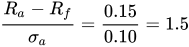
Suppose the asset has an expected return of 15% in excess of the risk free rate. We typically do not know if the asset will have this return. We estimate the risk of the asset, defined as standard deviation of the asset's excess return, as 10%. The risk-free return is constant. Then the Sharpe ratio using the old definition is
假设该资产预期获得 15%超过无风险利率的回报。通常我们无法确定资产能否实现该回报。我们估算资产风险(定义为资产超额回报的标准差)为 10%。无风险回报维持不变。则采用旧定义计算的夏普比率为
Example 2
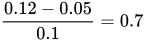
An investor has a portfolio with an expected return of 12% and a standard deviation of 10%. The rate of interest is 5%, and is risk-free.
某投资者持有的投资组合预期回报率为 12%,标准差为 10%。无风险利率为 5%。
The Sharpe ratio is:
夏普比率为:
Strengths and weaknesses 优势和劣势
[edit]A negative Sharpe ratio means the portfolio has underperformed its benchmark. All other things being equal, an investor typically prefers a higher positive Sharpe ratio as it has either higher returns or lower volatility. However, a negative Sharpe ratio can be made higher by either increasing returns (a good thing) or increasing volatility (a bad thing). Thus, for negative values the Sharpe ratio does not correspond well to typical investor utility functions.
负夏普比率意味着投资组合表现不及基准。在其他条件相同时,投资者通常偏好更高的正夏普比率,因其代表更高收益或更低波动性。然而,负夏普比率可通过提高收益(有利因素)或增加波动性(不利因素)来提升数值。因此,对于负值情况,夏普比率与典型投资者效用函数的对应关系并不理想。
The Sharpe ratio is convenient because it can be calculated purely from any observed series of returns without need for additional information surrounding the source of profitability. However, this makes it vulnerable to manipulation if opportunities exist for smoothing or discretionary pricing of illiquid assets. Statistics such as the bias ratio and first order autocorrelation are sometimes used to indicate the potential presence of these problems.
夏普比率的便利性在于仅需观察收益序列即可计算,无需额外了解盈利来源。但这也使其易受操纵——若存在平滑收益或对非流动性资产进行主观定价的机会。偏倚比率和一阶自相关等统计量常被用于提示此类问题的潜在存在。
While the Treynor ratio considers only the systematic risk of a portfolio, the Sharpe ratio considers both systematic and idiosyncratic risks. Which one is more relevant will depend on the portfolio context.
特雷诺比率仅考虑投资组合的系统性风险,而夏普比率同时涵盖系统性风险和特质性风险。具体适用性取决于投资组合的情境特征。
The returns measured can be of any frequency (i.e. daily, weekly, monthly or annually), as long as they are normally distributed, as the returns can always be annualized. Herein lies the underlying weakness of the ratio – asset returns are not normally distributed. Abnormalities like kurtosis, fatter tails and higher peaks, or skewness on the distribution can be problematic for the ratio, as standard deviation doesn't have the same effectiveness when these problems exist.[10]
所测量的回报频率可以是任意的(即每日、每周、每月或每年),只要它们呈正态分布,因为这些回报总能被年化处理。这正是该比率的潜在弱点所在——资产回报实际上并不服从正态分布。诸如峰度(尖峰厚尾现象)、分布偏度等异常情况都会对比率计算造成问题,因为当存在这些分布缺陷时,标准差无法发挥同等效力。 [10]
For Brownian walk, Sharpe ratio is a dimensional quantity and has units , because the excess return and the volatility are proportional to and correspondingly. Kelly criterion is a dimensionless quantity, and, indeed, Kelly fraction is the numerical fraction of wealth suggested for the investment.
对于布朗运动,夏普比率 是一个有量纲量,具有单位 ,因为超额收益 和波动率 分别与 和 成正比。凯利准则则是无量纲量,事实上凯利分数 就是建议用于投资的财富数值比例。


In some settings, the Kelly criterion can be used to convert the Sharpe ratio into a rate of return. The Kelly criterion gives the ideal size of the investment, which when adjusted by the period and expected rate of return per unit, gives a rate of return.[11]
在某些情境下,可运用凯利准则将夏普比率转换为回报率。该准则提供了理想的投资规模,经周期和单位预期回报率调整后,即可得出具体回报率。 [11]
The accuracy of Sharpe ratio estimators hinges on the statistical properties of returns, and these properties can vary considerably among strategies, portfolios, and over time.[12]
夏普比率估计值的准确性取决于收益的统计特性,而这些特性在不同策略、投资组合及不同时期可能存在显著差异。 [12]
Drawback as fund selection criteria
作为基金筛选标准的缺陷
[edit]Bailey and López de Prado (2012)[13] show that Sharpe ratios tend to be overstated in the case of hedge funds with short track records. These authors propose a deflated Sharpe ratio that takes into account the asymmetry and fat-tails of the returns' distribution, sample length, and selection bias. With regards to the selection of portfolio managers on the basis of their Sharpe ratios, these authors have proposed a Sharpe ratio indifference curve[14] This curve illustrates the fact that it is efficient to hire portfolio managers with low and even negative Sharpe ratios, as long as their correlation to the other portfolio managers is sufficiently low.
Bailey 和 López de Prado(2012) [13] 指出,对于历史业绩较短的对冲基金,夏普比率往往被高估。这些学者提出了一种调整后的夏普比率,该指标综合考虑了收益分布的不对称性和厚尾特性、样本长度以及选择偏差。关于依据夏普比率筛选投资组合经理的问题,他们提出了夏普比率无差异曲线 [14] 。该曲线揭示:只要基金经理与其他经理人的相关性充分低,即使其夏普比率较低甚至为负值,聘用这类经理人仍具备效率。
Goetzmann, Ingersoll, Spiegel, and Welch (2002) determined that the best strategy to maximize a portfolio's Sharpe ratio, when both securities and options contracts on these securities are available for investment, is a portfolio of selling one out-of-the-money call and selling one out-of-the-money put. This portfolio generates an immediate positive payoff, has a large probability of generating modestly high returns, and has a small probability of generating huge losses. Shah (2014) observed that such a portfolio is not suitable for many investors, but fund sponsors who select fund managers primarily based on the Sharpe ratio will give incentives for fund managers to adopt such a strategy.[15]
Goetzmann、Ingersoll、Spiegel 和 Welch(2002 年)研究发现,当证券及其期权合约均可用于投资时,最大化投资组合夏普比率的最佳策略是构建一个包含卖出一份价外看涨期权和卖出一份价外看跌期权的组合。该组合能产生即时正回报,大概率获得适度高回报,但小概率引发巨额亏损。Shah(2014 年)指出此类组合并不适合多数投资者,但依据夏普比率遴选基金经理的基金发起人,会激励基金经理采用这种策略。 [15]
In recent years, many financial websites have promoted the idea that a Sharpe Ratio "greater than 1 is considered acceptable; a ratio higher than 2.0 is considered very good; and a ratio above 3.0 is excellent." While it is unclear where this rubric originated online, it makes little sense since the magnitude of the Sharpe ratio is sensitive to the time period over which the underlying returns are measured. This is because the nominator of the ratio (returns) scales in proportion to time; while the denominator of the ratio (standard deviation) scales in proportion to the square root of time. Most diversified indexes of equities, bonds, mortgages or commodities have annualized Sharpe ratios below 1, which suggests that a Sharpe ratio consistently above 2.0 or 3.0 is unrealistic.[citation needed]
近年来,许多金融网站宣扬"夏普比率超过 1 被视为可接受;超过 2.0 视为很好;高于 3.0 则堪称优异"的观点。尽管这种评价标准在网上的出处不明,但其合理性存疑——因为夏普比率的数值对基础收益率测算的时间周期极为敏感。这是由于该比率的分子(收益率)与时间成正比,而分母(标准差)却与时间的平方根成正比。大多数股票、债券、抵押贷款或大宗商品的多元化指数年化夏普比率都低于 1,这表明持续高于 2.0 或 3.0 的夏普比率是不现实的。 [citation needed]
See also 另请参阅
[edit]- Bias ratio 偏置比率
- Calmar ratio 卡尔玛比率
- Capital asset pricing model
资本资产定价模型 - Coefficient of variation
变异系数 - Deflated Sharpe ratio 通缩调整夏普比率
- Hansen–Jagannathan bound
汉森-贾甘南边界 - Information ratio 信息比率
- Jensen's alpha 詹森阿尔法
- List of financial performance measures
财务绩效衡量指标列表 - Modern portfolio theory 现代投资组合理论
- Omega ratio 欧米茄比率
- Risk adjusted return on capital
风险调整资本回报率 - Roy's safety-first criterion
罗伊安全第一准则 - Signal-to-noise ratio 信号噪声比
- Sortino ratio 索提诺比率
- Sterling ratio 斯特林比率
- Treynor ratio 特雷诺比率
- Upside potential ratio 上行潜力比率
- V2 ratio
- Z score
References 参考文献
[edit]- ^ Jump up to: a b Sharpe, W. F. (1966). "Mutual Fund Performance". Journal of Business. 39 (S1): 119–138. doi:10.1086/294846.
- ^ Sharpe, William F. (1994). "The Sharpe Ratio". The Journal of Portfolio Management. 21 (1): 49–58. doi:10.3905/jpm.1994.409501. S2CID 55394403. Retrieved 12 June 2012.
- ^ Gatfaoui, Hayette. "Sharpe Ratios and Their Fundamental Components: An Empirical Study". IESEG School of Management.
- ^ Agarwal, Vikas; Naik, Narayan Y. (2004). "Risks and Portfolio Decisions Involving Hedge Funds". The Review of Financial Studies. 17 (1): 63–98. doi:10.1093/rfs/hhg044. ISSN 0893-9454. JSTOR 1262669.
- ^ Frazzini, Andrea; Kabiller, David; Pedersen, Lasse Heje (1 September 2018). "Buffett's Alpha". Financial Analysts Journal. doi:10.2469/faj.v74.n4.3. hdl:10398/5c1cd30d-a404-44ae-9578-7710cec23ea4. ISSN 0015-198X.
安德烈亚·弗拉齐尼;大卫·卡比勒;拉斯·海耶·佩德森(2018 年 9 月 1 日)。《巴菲特的阿尔法》。《金融分析师期刊》。doi: 10.2469/faj.v74.n4.3。hdl: 10398/5c1cd30d-a404-44ae-9578-7710cec23ea4。ISSN 0015-198X。 - ^ Jobson JD; Korkie B (September 1981). "Performance hypothesis testing with the Sharpe and Treynor measures". The Journal of Finance. 36 (4): 888–908. doi:10.1111/j.1540-6261.1981.tb04891.x. JSTOR 2327554.
乔布森 JD;科基 B(1981 年 9 月)。"利用夏普比率和特雷诺比率进行绩效假设检验"。《金融学杂志》。36(4): 888– 908。doi:10.1111/j.1540-6261.1981.tb04891.x。JSTOR 2327554。 - ^ Gibbons M; Ross S; Shanken J (September 1989). "A test of the efficiency of a given portfolio". Econometrica. 57 (5): 1121–1152. CiteSeerX 10.1.1.557.1995. doi:10.2307/1913625. JSTOR 1913625.
吉本斯 M;罗斯 S;尚肯 J(1989 年 9 月)。"特定投资组合效率的检验"。《计量经济学》。57(5): 1121– 1152。CiteSeerX 10.1.1.557.1995。doi:10.2307/1913625。JSTOR 1913625。 - ^ Roy, Arthur D. (July 1952). "Safety First and the Holding of Assets". Econometrica. 20 (3): 431–450. doi:10.2307/1907413. JSTOR 1907413.
- ^ Scholz, Hendrik (2007). "Refinements to the Sharpe ratio: Comparing alternatives for bear markets". Journal of Asset Management. 7 (5): 347–357. doi:10.1057/palgrave.jam.2250040. S2CID 154908707.
- ^ "Understanding The Sharpe Ratio". Retrieved 14 March 2011.
"理解夏普比率"。检索于 14 March 2011。 - ^ Wilmott, Paul (2007). Paul Wilmott introduces Quantitative Finance (Second ed.). Wiley. pp. 429–432. ISBN 978-0-470-31958-1.
Wilmott, Paul (2007). Paul Wilmott 介绍量化金融(第二版). Wiley. 第 429-432 页. ISBN 978-0-470-31958-1。 - ^ Lo, Andrew W. (July–August 2002). "The Statistics of Sharpe Ratios". Financial Analysts Journal. 58 (4).
罗闻全(2002 年 7-8 月)。《夏普比率统计学》。《金融分析师期刊》58(4)。 - ^ Bailey, D. and M. López de Prado (2012): "The Sharpe Ratio Efficient Frontier", Journal of Risk, 15(2), pp.3–44. Available at https://ssrn.com/abstract=1821643
贝利,D.与 M·洛佩兹·德·普拉多(2012 年):《夏普比率有效边界》。《风险期刊》15(2),第 3-44 页。详见 https://ssrn.com/abstract=1821643 - ^ Bailey, D. and M. Lopez de Prado (2013): "The Strategy Approval Decision: A Sharpe Ratio Indifference Curve approach", Algorithmic Finance 2(1), pp. 99–109 Available at https://ssrn.com/abstract=2003638
贝利,D.与 M·洛佩兹·德·普拉多(2013 年):《策略审批决策:基于夏普比率无差异曲线的方法》。《算法金融》2(1),第 99-109 页。详见 https://ssrn.com/abstract=2003638 - ^ Shah, Sunit N. (2014), The Principal-Agent Problem in Finance, CFA Institute, p. 14
沙阿,苏尼特·N.(2014),《金融中的委托代理问题》,CFA 协会,第 14 页
Further reading 延伸阅读
[edit]- Lo, Andrew W. "The statistics of Sharpe ratios." Financial analysts journal 58.4 (2002): 36–52 https://doi.org/10.2469/faj.v58.n4.2453
Lo, Andrew W. 《夏普比率的统计学分析》.《金融分析师杂志》第 58 卷第 4 期(2002 年):36–52 https://doi.org/10.2469/faj.v58.n4.2453 - Bacon Practical Portfolio Performance Measurement and Attribution 2nd Ed: Wiley, 2008. ISBN 978-0-470-05928-9
培根《实用投资组合绩效衡量与归因(第二版)》:威利出版社,2008 年。ISBN 978-0-470-05928-9 - Bruce J. Feibel. Investment Performance Measurement. New York: Wiley, 2003. ISBN 0-471-26849-6
布鲁斯·J·费贝尔《投资绩效衡量管理》。纽约:威利出版社,2003 年。ISBN 0-471-26849-6 - Steven E. Pav. The Sharpe Ratio: Statistics and Applications. CRC Press, 2022. ISBN 978-1-032-01930-7
史蒂文·E·帕夫《夏普比率:统计与应用》。CRC 出版社,2022 年。ISBN 978-1-032-01930-7 - Goetzmann, William; Ingersoll, Jonathan; Spiegel, Matthew; Welch, Ivo (2002), Sharpening Sharpe Ratios (PDF), National Bureau of Economic Research.
戈茨曼,威廉;英格索尔,乔纳森;斯皮格尔,马修;韦尔奇,伊沃 (2002),《优化夏普比率》(PDF),美国国家经济研究局。 - Shah, Sunit N. (2014), The Principal-Agent Problem in Finance, CFA Institute
沙阿,苏尼特·N. (2014),《金融中的委托代理问题》,CFA 协会
External links 外部链接
[edit]- The Sharpe ratio 夏普比率
- Generalized Sharpe Ratio
广义夏普比率 - All Hail the Sharpe Ratio – Uses and abuses of the Sharpe Ratio
赞颂夏普比率——夏普比率的正确运用与误用 - "A Comparison of Different Measures of Risk-adjusted Return". September 2013.
《风险调整后收益的不同衡量方式比较》. 2013 年 9 月 - What is a good Sharpe Ratio? – Some example calculations of Sharpe ratios
何为理想的夏普比率?——夏普比率计算示例 - Sharpe ratio in MS excel – Risk adjusted return calculations
Excel 中的夏普比率——风险调整后收益计算 - Calculating and Interpreting Sharpe Ratios online – Cloud calculator
在线计算与解读夏普比率——云端计算器