


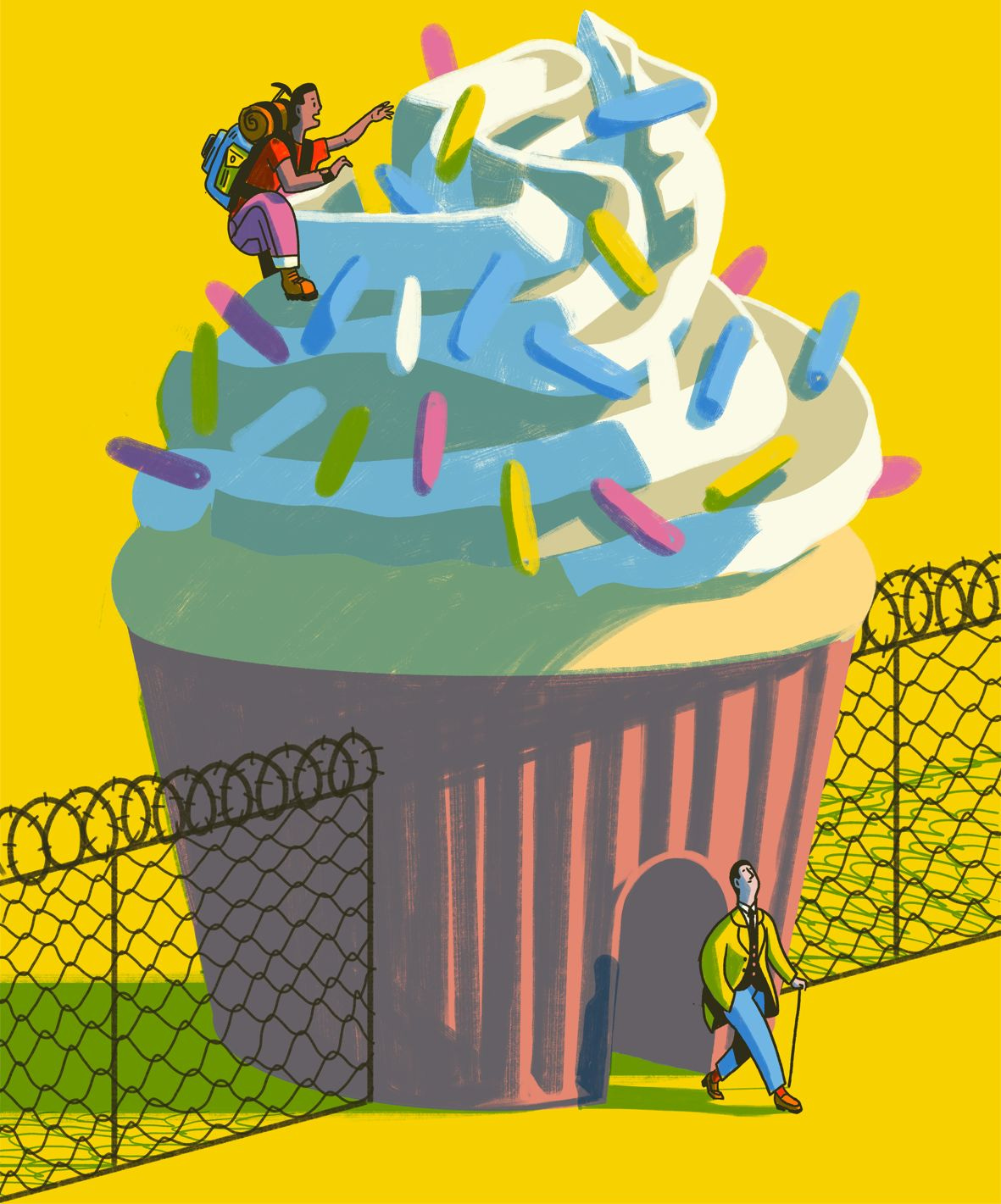
亚历山大·诺顿 (Alexander Naughton) 插图
Sometimes, I see someone on the internet say something that I think is so completely backwards, so 100% off, that I feel thankful for their help in locating what is actually true. Their statement provides a sort of True South that can be used to locate True North.
有时,我在网上看到有人说一些我认为完全颠倒黑白 、 完全错误的言论,我真心感谢他们能帮我找到真相。他们的言论提供了一种“真南”,可以用来找到“真北”。
In this case, it’s this tweet about willpower — which, without actually using the word willpower, propagates the idea that there are two kinds of people: those who can act according to willed precommitments (“Type 1”), and those who can’t (“Type 2”).
在这种情况下,这是一条关于意志力的推文 ——虽然没有真正使用意志力这个词,但它传播了这样一种观点:人有两种:一种人可以按照自愿的预先承诺行事(“第 1 类”),另一种人不能(“第 2 类”)。

To illuminate my thinking about this tweet, and the subject of willpower generally, I’d like to share the following facts about myself.
为了阐明我对这条推文以及意志力这个主题的思考,我想分享以下关于我自己的事实。
In undergrad, I earned two degrees in four years, while working multiple jobs and serving as editor in chief of the student newspaper. I went on to graduate near the top of my class at Yale Law. For most of those years, I was drinking alone every night to the point of blacking out.
我在本科四年里获得了两个学位,期间做过几份工作,还担任过学生报纸的主编。后来我以接近全班前几名的成绩从耶鲁法学院毕业。那几年里,我大部分时间都独自一人喝酒,直到喝得不省人事。I once made an extremely stupid weight loss bet that required me to fast five days a week for eight weeks straight. I won. Now, I take Ozempic to make it hard to overeat, and I take testosterone to make it easy to exercise.
我曾经为了减肥打了个极其愚蠢的赌,要求我每周禁食五天,连续八周。结果我赢了。现在,我服用奥兹匹克(Ozempic)来控制暴饮暴食,还服用睾酮来让自己更容易运动。I lost more than 3 years of my life to a drug addiction that cost me my job, savings, most of my friends, and for a time the ability to walk. I got clean dozens of times during that period, but relapsed over and over. I just could not stop. In the 4 years after I got sober, I worked my way up from a friend’s personal assistant to the CEO of a multi-billion-dollar organization.
我因毒瘾而失去了三年多的生命,失去了工作、积蓄、大部分朋友,甚至一度丧失了行走能力。那段时间,我戒掉了几十次毒瘾,但又一次次复发。我就是停不下来 。戒毒后的四年里,我从朋友的私人助理一路晋升为一家价值数十亿美元的公司的首席执行官。Every morning I get up two hours early to work on the book I’m writing or on a Substack post before going off to work. And every evening I waste about an hour on activities that I don’t endorse, that don’t make me happier or better rested or more fulfilled — that probably have the opposite effect, actually.
每天早上我都会早起两个小时,先写完我正在写的书,或者在 Substack 上发帖,然后再去上班。而每天晚上,我都会浪费大约一个小时去做一些我并不赞同的事情,这些事情不会让我更快乐、更放松、更充实——实际上,这些事情可能只会带来相反的效果。
So: Which kind of person am I, Type 1 or Type 2? How would you rate my ability to “simply decide to do something and then do it”?
那么:我是哪一种人?第一类还是第二类?你如何评价我“简单地决定做某事,然后就去做”的能力?
How much willpower would you say I have?
你认为我的意志力有多强?
Here is what I think: Willpower is an incoherent concept invented by smug people who think they have it in order to denigrate people who they think don’t. People tacitly act as though it’s synonymous with effort or grindy determination. But in most cases where willpower is invoked, the person who is trying and failing to adhere to some commitment is exerting orders of magnitude more effort than the person who is succeeding.
我是这样认为的:意志力是一个语无伦次的概念,是由那些自以为拥有意志力的人发明出来的,目的是贬低那些他们认为没有意志力的人。人们心照不宣地把它当成努力或坚持不懈的决心的同义词。但在大多数情况下,当意志力被提及时,那些试图坚持承诺却失败的人,付出的努力远比那些成功的人要多得多。
During my time in 12-step programs, I met plenty of people who’d lost their kids to addiction — sometimes to divorce, sometimes to foster care. I can guarantee that, in their efforts to resist that outcome, most of them tried harder, exerted more “willpower,” than the average person has applied to anything in their life. And yet, faced with a slew of cases like this, many people will think “what a damnable lack of willpower,” and not “wow, addiction must have a kind of power I’ve never experienced in my life.”
在我参与12步戒毒计划期间,我遇到过很多孩子因毒瘾而丧生的人——有的是因为离婚,有的是因为寄养。我可以保证,为了抵制这种后果,他们中的大多数人都付出了比普通人一生中投入的更多努力,发挥了更大的“意志力”。然而,面对如此多的案例,许多人会想“真是意志力的匮乏”,而不是“哇,毒瘾一定拥有一种我这辈子从未体验过的力量”。
Not many of us will lose our kids to addiction, but it’s not because we’re out there trying so much harder not to.
我们中很少有人会因为孩子上瘾而失去他们,但这并不是因为我们付出了巨大的努力才没有让他们上瘾。
The word should be thrown in the garbage. It is a concept that rots our imagination. It obscures the fact that motivation is complex, and that there is massive variation in how hard some things are for different people.
这个词应该扔进垃圾桶。它的概念腐蚀了我们的想象力。它掩盖了动机的复杂性,以及某些事情对不同人来说难度的巨大差异。
When self-applied positively, e.g. “I did this through willpower, and that other person did not,” the word allows us to convert the good fortune of excess capacity into a type of virtue — twice as lucky, to have the sort of luck that’s mistaken for virtue. Resist the temptation to be confused by this, or it will make you childish, and callous.
当这个词用在积极方面时,例如“我凭借意志力做到了这一点,而其他人没有”,它让我们能够将过剩能力带来的好运转化为一种美德——拥有那种被误认为美德的运气,就是一种双倍的幸运。抵制这种被混淆的诱惑,否则它会让你变得幼稚和冷酷。
When self-applied negatively, e.g., “I wish I had more willpower,” the word is a way to slip into a kind of defensible helplessness, rather than trying to compose intelligent solutions to behavioral issues.
当自我消极地运用时,例如“我希望我有更多的意志力”,这个词是一种陷入一种可辩护的无助感的方式,而不是试图为行为问题制定明智的解决方案。
And it’s this last thing that really gets me about the idea of willpower. At first blush it sounds like the kind of idea that should increase agency. I just have to try harder! But, in fact, the idea of willpower reduces agency, by obscuring the real machinery of motivation, and the truth that if your life is well-designed, it should feel easy to live up to your ideals, rather than hard.
正是这最后一点让我对意志力的概念产生了兴趣。乍一看,这听起来像是那种应该能增强行动力的概念。 我只需要更加努力! 但事实上,意志力的概念反而削弱了行动力,因为它掩盖了动机的真正机制,也掩盖了一个事实:如果你的人生规划得当, 实现理想应该很容易 ,而不是很难。
Learning this was part of the education addiction gave me. To win against addiction, you have to make the fight as easy as possible by totally remaking your life. On top of all sorts of other work, you have to put as much distance as you can between yourself and the people, places, and situations that trigger you to use. The point is not to valiantly struggle; the point is to minimize the struggle that is necessary.
学习这一点,是成瘾带给我的教育的一部分。要想战胜成瘾,你必须彻底重塑你的生活,让这场斗争变得尽可能轻松。除了做各种其他工作之外,你还必须尽可能地远离那些诱发你吸毒的人、地点和情况。关键不在于勇敢地抗争;而在于尽量减少必要的挣扎。
Having won this fight, I have zero compunction about making my goals as easy as possible to achieve. For example, my body has made it totally clear that I need to do resistance training, or I’ll be rewarded with poor physical health and poorer mental health. But my mind has made it totally clear that I will not go to a gym to do it, regardless. So, I have a personal trainer come to my house twice a week and force me to pick up the weights.
赢得这场斗争后,我毫不犹豫地让自己的目标尽可能容易实现。比如,我的身体已经明确地告诉我,我需要做阻力训练,否则我的身体健康和心理健康都会恶化。但我的内心也明确地告诉我,无论如何,我都不会去健身房做阻力训练。所以,我每周请一位私人教练来我家两次,强迫我举重。
Perhaps I could demand discipline of myself, or at the very least feel bad that it’s worth it for me to exchange money for someone else’s time. But I have more important things to coerce myself about.
或许我可以严格要求自己,或者至少应该为自己用金钱换取别人的时间而感到难过。但我还有更重要的事情需要强迫自己去做。
The Myth of Willpower is the idea that virtue lies in exerting extreme effort to overcome obstacles, and that any success attained without effort is actually bad, bordering on immoral. The truth is that high-agency people are always looking for shortcuts. They are never thinking, “how can I work hard and demonstrate my willpower,” but rather, “how can I get results faster by maximizing my leverage?”
I almost always try to accomplish the thing I want to accomplish using as little effort as I can, because there are endless good uses of my time and energy, and spending less of them where they’re not needed frees them up to spent somewhere else.
To be clear, I am aware that shortcut-free hard work is sometimes necessary, and can be ennobling. Training for narrowly difficult tasks that require mastery or conditioning — like running a marathon, or playing Bach’s violin partitas — can force you to confront your physical and emotional limits in a way that is both personality-expanding and healthily humbling. I’m not saying you should never work hard, and there is probably something important about the human experience, something vital, that you miss out on if you never experience the application of grinding endurance to an endeavor that can’t be accomplished in any other way.
What I’m saying is that you should choose hard work if hard work is the desired result. If it’s not, and you can take a shortcut, take a fucking shortcut.
Sign up to be notified when my book, You Can Just Do Things, is available for purchase.


I feel like I've had debates about this in some shape or another with people for my whole life.
I'm naturally inclined to work hard, to take the difficult path. But it always hurts me a little on the inside when people don't realize working hard isn't the point. Or they fail to realize that people who are struggling are in fact actually struggling i.e. trying very hard to ameliorate their issues.
The ultimate irony being that many times the implicit idea behind working hard is to make things easier in the future - you lift weights so your muscles become more efficient, you train so you (or your body) can respond faster. It's all in an effort to make things easier.
So it's a bit of a triple threat for anyone who can't solve their troubles - you try harder, achieve less, and get judged harsher.
Loved the post!
I really enjoyed reading this. Heretical and brilliant, thanks for writing it.
Willpower as a moral category is conceptually goofy. The cultural imagining of willpower as a neutral, static, cognitive trait that you can either righteously, effortlessly juice for unlimited virtuous energy or simply forsake (resulting in severe loserdom and psychogenic decrepitude) is a very funny folk-psych abstraction.
What is the animus of executive function? A hot moral muscle ain't it!