The Democratic Party is in crisis, and it goes far beyond the stereotypical “Dems in Disarray” headlines. The party’s popularity numbers are abysmal: a March poll by NBC News found that only 27 percent of registered voters have positive views of the Democrats, the lowest since the poll began in 1990. Other polls have found that the approval rating of congressional Democrats is underwater among Democratic voters, with only around a third expressing satisfaction with the Democrats’ performance on Capitol Hill. (Nearly 80 percent of Republicans, by contrast, approve of the congressional GOP.) Even big donors are beginning to tighten their purse-strings.
民主党正处于危机之中,它远远超出了刻板印象中的“民主党混乱”的头条新闻。该党的支持率数据很糟糕:NBC 新闻 3 月份的一项民意调查发现,只有 27%的登记选民对民主党持积极看法,这是自 1990 年民意调查开始以来的最低水平。其他民意调查发现,国会民主党人的支持率在民主党选民中处于低谷,只有大约三分之一的人对民主党在国会山的表现表示满意。(相比之下,近 80% 的共和党人赞成国会共和党。即使是大捐助者也开始收紧他们的钱包。
While masked, heavily armed, unidentified men are grabbing people off the streets, senior Democrats are either nowhere to be found or making milquetoast statements.
当蒙面、全副武装、身份不明的男子在街上抓人时,高级民主党人要么无处可寻,要么发表温和的言论。
A good illustration of the depths of the crisis: on Saturday, June 14, an estimated 5 million people around the country participated in the anti-Trump “No Kings” protests. It was one of the largest protests in American history, mobilizing between 1 and 2 percent of the entire U.S. population in the streets. There is clearly a groundswell of anti-MAGA political energy across the country, and yet the most recent Quinnipiac University poll found that 53 percent of Democrats disapprove of how the Democratic Party is doing in Congress. Senate Minority Leader Chuck Schumer’s approval rating, in particular, is hovering around 17 percent—and given Schumer’s vocal support for Israel’s strikes on Iran, that number is likely only to plummet more.
这场危机的严重程度很好地说明了这一点:6 月 14 日星期六,全国估计有 500 万人参加了反特朗普的“无王”抗议活动。这是美国历史上规模最大的抗议活动之一,动员了美国总人口的 1% 到 2% 走上街头。全国范围内显然存在着反 MAGA 政治能量的浪潮,但昆尼皮亚克大学最近的民意调查发现,53% 的民主党人不赞成民主党在国会的表现。尤其是参议院少数党领袖查克·舒默(Chuck Schumer)的支持率徘徊在 17% 左右——鉴于舒默直言不讳地支持以色列对伊朗的打击,这一数字可能只会进一步下降。
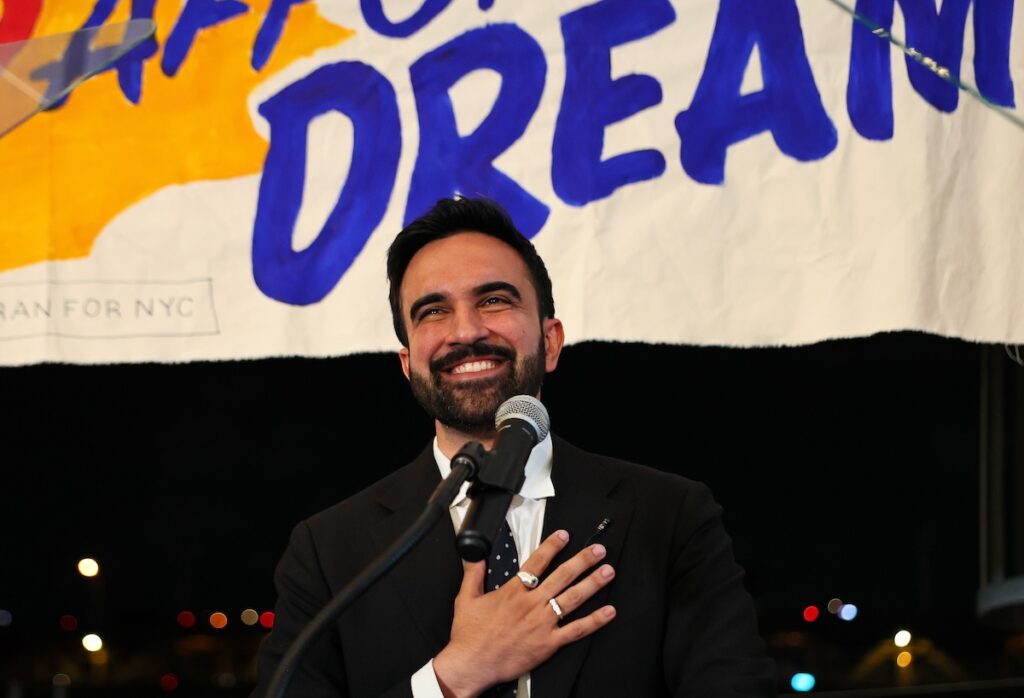
And then there’s Zohran Mamdani. His decisive victory in the New York mayoral primary on Tuesday against establishment sex pest Andrew Cuomo, the former-governor-son-of-a-former-governor, underlines how Democrats have finally arrived at their Tea Party moment: voters fed up with the feckless, corrupt dealings and nepotism of a hollowed-out Democratic Party registered their dissatisfaction in the highest-profile race of 2025, succeeding despite a torrent of national criticism and propaganda from the establishment. Though he now faces another hurdle in the general election this fall, there is a very good chance that a thirty-three-year-old pro-Palestinian Muslim democratic socialist will be the next mayor of the largest city in America, displacing disgraced Democrat and former NYPD captain Eric Adams.
然后是佐兰·马姆达尼。周二,他在纽约市长初选中决定性地战胜了建制派性害虫安德鲁·科莫(Andrew Cuomo),这位前州长的儿子,突显了民主党人最终如何到达了他们的茶党时刻:厌倦了空心化的民主党的无能、腐败的交易和裙带关系的选民在 2025 年最引人注目的竞选中表达了他们的不满,尽管建制派的全国批评和宣传如潮水般涌来,但仍取得了成功。 尽管他现在在今年秋天的大选中面临另一个障碍,但这位 33 岁的亲巴勒斯坦穆斯林民主社会主义者很有可能成为美国最大城市的下一任市长,取代名誉扫地的民主党人、前纽约警察局队长埃里克·亚当斯。
How did we get here? Democratic voters are furious with the party’s leadership for failing to live up to their own word last year, when senior Democrats called Trump a fascist and threat to American democracy. Those Democrats were right, as the deployment earlier this month of National Guardsmen and active-duty Marines to Los Angeles to quell largely peaceful anti-ICE protests only further confirms. But while masked, heavily armed, unidentified men are grabbing people off the streets and federal agents are throwing Democratic senators to the ground for attending news conferences, those same senior leaders are either nowhere to be found (Kamala Harris) or offering milquetoast statements (Schumer: “we need immediate answers to what the hell went on”). The left, meanwhile, remains furious over the establishment’s support for the Gaza genocide. And the party is still reeling from Joe Biden’s catastrophic decision to run for re-election in light of his physical and mental incapacitation.
我们是怎么走到这一步的?民主党选民对该党领导层去年未能兑现自己的诺言感到愤怒,当时民主党高级人士称特朗普是法西斯主义者,对美国民主构成威胁。这些民主党人是对的,因为本月早些时候向洛杉矶部署国民警卫队和现役海军陆战队员以平息基本上和平的反 ICE 抗议活动只会进一步证实这一点。但是,当蒙面、全副武装、身份不明的男子在街上抓人,联邦特工将参加新闻发布会的民主党参议员扔到地上时,这些高级领导人要么无处可寻(卡马拉·哈里斯),要么发表温和的声明( 舒默 :“我们需要立即回答到底发生了什么”)。与此同时,左翼仍然对建制派对加沙种族灭绝的支持感到愤怒。鉴于乔·拜登的身心丧失,他竞选连任的灾难性决定,该党仍在为之感到震惊。
Part of the problem for Democrats is that there is little consensus about what exactly the party stands for in concrete policy terms beyond unconditional support for Israel, some attention to climate change, and vaguely defined commitments to racial, gender, and sexuality equity (never mind the establishment’s backing of Cuomo after his resignation following sexual harassment allegations). Liberal pundits Ezra Klein and Derek Thompson have attempted to lay out a more affirmative agenda—“abundance”—in their recent book of the same title. Any positive vision for the Democratic Party should certainly include the expansion of the state’s capacity to do things, but—as Sandeep Vaheesan argued in these pages last month—Klein and Thompson’s thinking remains structured in many ways by neoliberalism, and anyway much of the actually existing political muscle for the “abundance agenda” is astroturfed from wealthy Silicon Valley donors.
民主党人面临的部分问题是,除了对以色列的无条件支持、对气候变化的一些关注以及对种族、性别和性行为公平的模糊承诺之外,该党在具体政策方面到底代表什么几乎没有达成共识(更不用说建制派在科莫因性骚扰指控而辞职后对他的支持)。自由派专家埃兹拉·克莱因(Ezra Klein)和德里克·汤普森(Derek Thompson)试图在他们最近的同名书中提出一个更积极的议程——“丰盛”。对民主党的任何积极愿景当然应该包括扩大国家做事的能力,但是——正如桑迪普·瓦希桑(Sandeep Vaheesan)上个月在这些页面中所说的那样——克莱因和汤普森的思想在许多方面仍然由新自由主义构建,无论如何,“富裕议程”的许多实际存在的政治力量都是来自富有的硅谷捐助者。
Perhaps this is the reason that abundance featured so prominently at WelcomeFest, the self-described “largest public gathering of centrist Democrats” that took place earlier this month. Speakers included Andrew Rotherham, a major nonprofit leader who reprimanded Florida Democrats for opposing Ron DeSantis’s “Don’t Say Gay” bill; blogger and Biden White House whisperer Matthew Yglesias, who blamed “The Groups”—his favored term for progressive advocacy organizations aimed at shaping party policy—for the Democrats’ electoral woes; and economist Josh Barro, who said point-blank in an interview with New York congressman Ritchie Torres that “when I look at policies in New York that stand in the way of abundance. . . if you look under the hood, you eventually find a labor union at the end.”
Another key factor behind the implosion of the Democratic establishment is that it once again proved incapable of accommodating major internal reform. Twenty-five-year-old liberal activist David Hogg, elected as one of five vice-chairs of the Democratic National Committee (DNC) in February, said he would not run again after a vote to hold new vice-chair elections passed with an overwhelming majority earlier this month on nominally procedural grounds.
The trouble started in April when Hogg announced plans to use his PAC, Leaders We Deserve, to support primary challenges by young progressives against “out-of-touch, ineffective” Democrats in safe blue congressional districts. Democrats have long struggled with a gerontocracy problem: even with the recent elevation of younger leaders like Minority Leader Hakeem Jeffries—fifty-four years old—the average age of Democratic leadership in the House remains seventy-two. (The average for GOP leadership, by contrast, is forty-eight.) Hogg’s initiative was one of the first serious programs within the Democratic Party apparatus to take this problem seriously, along with the related problem of Democrats in safe deep-blue districts essentially phoning in their cushy backbencher jobs.
DNC chair Ken Martin disputes that the bid for a re-do of vice-chair elections was retaliation for Hogg’s attacks on complacent incumbents. But come on. In a conversation leaked to Politico, Martin complained that Hogg has “essentially destroyed any chance I have” to successfully assert his leadership as DNC honcho and prevented him from raising the money necessary to establish his credibility. Hogg, for his part, has thrown the weight of his PAC into a special election to replace the late Gerry Connolly’s Northern Virginia seat—he has endorsed Irene Shin, a thirty-seven-year-old member of the Virginia House of Delegates who boasts a moderately center-left political résumé, including a stint as finance director for Kamala Harris’s Senate campaign.
Until quite recently, Hogg had few trappings of anti-establishment political radicalism. He rose to national prominence as a high school student after surviving the Parkland school shooting in February 2018, soon becoming the face of progressive gun-control activism. A month later he served as a co-organizer of the March for Our Lives protests, an outgrowth of the left-liberal protest energy of the Women’s March the previous year. He was featured, alongside his fellow student organizers, on the cover of Time and was included in the magazine’s list of the 100 most influential people of the year. He wrote a bestselling book about the shooting and student organizing and enrolled in Harvard in 2019.
In short, Hogg was extremely well positioned for a career in mainstream liberal Democratic politics. He even tweeted out in June 2018, “I love capitalism.” (He stepped down from March for Our Lives in February 2021 at the same time that he launched an ill-fated business venture with a tech entrepreneur to create a pillow company to compete with Trump backer Mike Lindell’s MyPillow.)
There is nothing particularly remarkable about Hogg’s political commitments. Until his launch of Leaders We Deserve, he had never offered serious criticism of the party or its leadership outside of criticizing the records of some Democrats on gun control. In other words, he made a career out of showing fealty to Democrats, dismissing the left’s critiques of the party’s corruption by corporate cash and declining to endorse either Bernie Sanders or Elizabeth Warren in the 2020 primary. People can change their minds, of course—one certainly wishes more would do so after seeing how the party operates up close, from the inside. But even now, Hoggs’s PAC does not endorse a specific policy platform and makes no mention on its website of substantive reform proposals for the party beyond running younger people. Since stating he won’t run again for vice-chair he has moved to the left, endorsing Mamdani—but to repeat, only after he was no long attempting to instigate reform from a position within the party leadership.
Why, then, considering that Hogg’s vision for the Democratic Party while at the DNC was easily reconcilable with the centrists at WelcomeFest, did Liam Kerr, a cofounder of the PAC that hosts the conference, go scorched-earth against Hogg on his Substack?
Part of the answer is that Hogg, to a considerable degree, owes his political career to what philosopher Olúfẹ́mi Táíwò has called “deference politics.” The phenomenon evolved out of a certain strain of left-wing organizing practices in the 2010s and spread to liberal spaces where ideas like “progressive stacks” and “centering” people who belong to marginalized groups flourished. In its strongest form, Táíwò notes, deference politics not only encourages passing the mic to representatives of oppressed communities. It promotes a culture where criticism of such representatives’ views is viewed with reflexive suspicion—a sign of wayward refusal to defer to those who know better.
Another problem, Táíwò emphasizes, is that the people who populate influential advocacy organizations and the halls of power are rarely the typical member of the groups they purport to speak for. Deference politics thus falls prey to “elite capture,” “the control over political agendas and resources by a group’s most advantaged people.” Hogg is a young, middle-class white man—and young, middle-class white men are hardly marginalized as a group in American life. But Hogg is also a survivor of gun violence and benefited from deference on those grounds as a young activist.
Centrist bloviating about “The Groups” misses the most consequential case of elite deference politics: the form practiced by the party establishment itself.
According to critics of “The Groups,” deference politics and elite capture are at the heart of the Democratic Party’s problems, leading to the elevation of politically marginal activists who alienate majorities either by talking in very unpopular ways or by extracting unpopular policy concessions. Sociologist Musa al-Gharbi’s We Have Never Been Woke made that case forcefully last year, garnering praise from the likes of David Brooks, Thomas Chatterton Williams, and Geoff Shullenberger. But what Hogg’s career—and his looming ouster from the DNC—underline is that al-Gharbi’s “wokeness” and Táíwò’s “deference politics” exist in tangled connection with another, much more insidious form of deference politics: deference to authority, hierarchy, and power, often mobilized through the language of overcoming oppression or marginalization. The effect is to reinforce the problem of elite impunity.
Of course, this form of elite deference has suffused Democratic politics for a long time, and I am hardly the first to point it out—socialist thinkers have been saying so for years. Over the last decade this politics has only intensified in reaction to a more and more viable challenge from the populist left. The cult of personality that developed around Ruth Bader Ginsburg, whom Dahlia Litwick infamously argued was “indispensable” on the Supreme Court in 2014 amid calls for her to retire so that a liberal seat on the Court might be preserved, is a case in point. Ginsburg’s defenders insisted that her critics were being sexist, ageist, and ungrateful by calling for the feminist icon to step down—a line of defense that did not age well after her death and replacement by Amy Coney Barrett, one of the key votes in the Dobbs decision overturning Roe v. Wade.
Elite deference politics breeds elite political entitlement, often defended by explicit appeals to identity. This was a strong part of the rationale for Hillary Clinton’s 2016 presidential bid—it was Clinton’s turn after Obama to be president, the line went—and it animated the fury of so many Clinton stalwarts at Sanders’s candidacy. The left’s antipathy for Clinton was dismissed first as the misogyny of the so-called “Bernie Bros” and then as racism, a refusal to listen to Black voters in the primaries. Later, in 2020, concerns about Biden’s age and fitness for the presidency were brushed aside—even by people who raised similar concerns about Sanders—again on the grounds of ageism. The point is that centrist bloviating about “The Groups” misses the most consequential case of elite deference politics. The form practiced by the party establishment itself is vastly more responsible for the party’s plight in 2025 than environmental and racial justice nonprofits.
The controversy ignited by the publication of Jake Tapper and Alex Thompson’s recent book Original Sin, a classic political gossip journalism vivisection of Biden’s decision to run for a second term, underscores the point. If we the revelations are to be believed, then the Democratic Party—really the American liberal establishment writ large—engaged in a deliberate conspiracy to conceal, downplay, and dismiss the extent of Biden’s mental and physical incapacitation, culminating in his disastrous debate performance against Trump in June 2024. This is a scandal of the gravest possible seriousness, one that indicts not just Biden himself but his family, his close advisors, senior Democratic Party leaders, and many media figures, including Tapper and Thompson themselves. (Like many elite journalists, they evidently chose to sit on a crucial political story until after the election in order to sell books.)
The book also exposes the Democratic Party’s narratives about Trump—that he is morally and mentally unfit for office and a narcissistic liar—as fundamentally hollow. According to Tapper and Thompson, Biden was mentally unfit for office, could not come to terms with his diminishment due to his narcissism, and actively misled the public until it was too late. And because contemporary liberal political culture demands deference to power, authority, and the ideals of technocratic competence and meritocracy—as one of Biden’s staffers infamously put it, the president was “just that fucking good”—there was no serious challenge to Biden’s authority until his disastrous debate performance finally mobilized elite Democrats against him. And even then, Biden stayed in the race for nearly a month!
In a recent book, political scientists Daniel Schlozman and Sam Rosenfeld argue that both the Democratic and Republican parties have been hollowed out. The parties, they write, are “organizationally top-heavy and poorly rooted” and “dominated by satellite groups,” so they “command little respect in the eyes of voters and activists alike.” This is a significant reason why Biden was able to run for re-election in the first place and why it took so long for him to exit the race after the fateful debate with Trump last year. But the culprits behind the hollowing out are different for the two parties, Schlozman and Rosenfeld contend. The GOP has been “pulled to radicalism” by the “committed actors” of the American conservative movement, culminating in Trump’s cult of personality. The Democrats, meanwhile, have been “rendered listless by conflicting actors”—which is to say, the challenges inherent in maintaining a coalition in a party with historically working-class political and economic commitments with the rise of new and powerful professional and corporate constituencies.
Hoggs’s purge suggests a hard limit to internal party reformism. But things are changing, and Mamdani points the way forward.
The problem with this story is that Democrats are also beset by personality cults—which are a key aspect of elite deference politics. Just consider the enduring reverence for Barack Obama, whose presidency accelerated the hollowing out of the party and culminated in the election of Trump—but who, like Harris, has now basically renounced any place on the national stage as the country slides more and more into authoritarianism. With the Democratic Party infrastructure, such as it is, serving less as a mode of governance of a party committed to contesting political power and more as a spoils system for the consultant class no matter whether they help candidates win or lose—witness the $20 million being raised to finance the Speaking with American Men project, whose leadership includes a former Biden 2020 campaign staffer and a former Texas congressman who unsuccessfully challenged Ted Cruz for his Senate seat—there is little incentive to take success in politics seriously.
An important part of the solution for Democrats, Schlozman and Rosenfeld argue, is the resubstantiation of party organizations and institutions that are responsive to civil society organizations, in particular organized labor. Additionally, it is crucial to avoid the mistakes made after Obama’s election, where state and local parties were essentially left to wither on the vine. But the Hogg affair—and his subsequent move to the left—suggests a new path forward for the Democratic coalition.
On the one hand, his purge seems to suggest a hard limit to internal reformism as a strategy in the Democratic Party. Sanders’s supporters and the broader field of democratic socialists already learned as much when they contested various party leadership positions and internal rules changes under the first Trump administration—a campaign that was only partially successful. Hogg, emphatically not part of this populist wing, was feted by the Democratic establishment until he made a direct challenge to elite deference politics.
But on the other hand, things are changing rapidly at the DNC. The last chair, Jaime Harrison, owed his position to nepotism and favor-trading—he was a protégé of South Carolina party boss Jim Clyburn, who essentially served as kingmaker in the 2020 primary. Ken Martin, by contrast, is the former chair of the Minnesota Democratic-Farmer-Labor Party (which has dominated Minnesota state politics for the past generation in spite of the Upper Midwest’s red shift) and has pledged to shore up the party’s relationship with organized labor and set the party back on a fifty-state strategy, reversing the increasingly obsessive focus on messaging only to swing-state voters.
Martin’s vision for the party is generally at odds with the vision voiced at WelcomeFest. The Abundists are a well-organized and well-financed faction of the Democratic coalition, seeking to reassert megadonor- and Silicon Valley–friendly politics over the party. In other words, they are the faction of elite deference politics. The primary competing vision is left-wing populism: a politics centered on grassroots political mobilization, skepticism of large donors and Big Tech and other corporate monopolies, explicit demands for higher taxation of the wealthy, and a robust commitment to public goods in health care, education, and housing. Sanders, Alexandria Ocasio-Cortez, and now Mamdani are the public faces of this formation.
Hogg tried to leverage the ambiguous legacy of liberal activist culture during the first Trump administration, pursuing social and cultural capital within the party establishment. He hit a dead end because his hybrid approach of deference and elite deference politics, while a savvy strategy when it comes to personal aggrandizement, is a terrible strategy for building an effective political faction. But he learned his lesson. He endorsed Zohran Mamdani. And as Mamdani’s dramatic upset makes clear, his is the path forward for Democrats and the left: a robust, big-tent grassroots political organization that incorporates the populism rather than shutting it out and speaks to the need of younger generations of voters fed up with a sclerotic party establishment.
It’s about damn time.
Independent and nonprofit, Boston Review relies on reader funding. To support work like this, please donate here.


