To enjoy SCMP Plus on a mobile device, you’ll need to open or download our mobile app.
要在移动设备上享受 SCMP Plus 服务,您需要打开或下载我们的移动应用程序。
要在移动设备上享受 SCMP Plus 服务,您需要打开或下载我们的移动应用程序。
Please note that an SCMP Plus subscription is required for access.
DAILY PULSE 每日脉搏
Yuan stablecoin, China-EU summit and more
人民币稳定币、中欧峰会等更多内容
Published: 5:00PM, 18 Jul 2025
发布时间:2025 年 7 月 18 日 下午 5 点
发布时间:2025 年 7 月 18 日 下午 5 点
Shanghai took tentative steps towards creating a yuan stablecoin, and the world’s first yuan-denominated tokenised fund entered the market as technology developments support China’s push for wider international use of its currency.
上海在创建人民币稳定币方面迈出了试探性步伐,随着技术发展支持中国推动其货币更广泛国际使用,世界上首支人民币计价代币化基金进入市场。
上海在创建人民币稳定币方面迈出了试探性步伐,随着技术发展支持中国推动其货币更广泛国际使用,世界上首支人民币计价代币化基金进入市场。
City leaders in Shanghai have ordered a study into the feasibility of introducing stablecoins, the Post reported this week, citing two local officials familiar with the matter who asked not to be identified. China Asset Management’s Hong Kong arm, ChinaAMC, introduced the tokenised fund on Thursday ahead of the city’s implementation of a stablecoin regime on August 1 (See: SCMP Plus Factsheet). Stablecoins are digital tokens with a fixed value in a currency, such as the dollar or yuan.
据《南华早报》本周报道,上海地方领导人已下令研究引入稳定币的可行性,报道引述了两位不愿透露姓名的知情地方官员。中资资产管理公司在周四推出了代币化基金,该基金将于 8 月 1 日(见:SCMP Plus 事实清单)在上海实施稳定币制度之前推出。稳定币是以某种货币(如美元或人民币)为基准价值的数字代币。
据《南华早报》本周报道,上海地方领导人已下令研究引入稳定币的可行性,报道引述了两位不愿透露姓名的知情地方官员。中资资产管理公司在周四推出了代币化基金,该基金将于 8 月 1 日(见:SCMP Plus 事实清单)在上海实施稳定币制度之前推出。稳定币是以某种货币(如美元或人民币)为基准价值的数字代币。
US lawmakers also this week passed the Genius Act, which will create a legal framework for stablecoins, potentially bolstering confidence in the tokens and boosting their use. The technology may become a new US-China battleground as Beijing has softened opposition to stablecoins, partly because they could reduce reliance on US-dominated financial systems and pare the dollar’s roughly 60 per cent share of international payments.
美国立法者本周也通过了天才法案,该法案将创建稳定币的法律框架,可能增强对代币的信心并促进其使用。随着北京对稳定币的反对态度有所缓和,这项技术可能成为中美之间新的战场,部分原因是稳定币可以减少对美国主导的金融体系的依赖,并减少美元在国际支付中约 60%的份额。
美国立法者本周也通过了天才法案,该法案将创建稳定币的法律框架,可能增强对代币的信心并促进其使用。随着北京对稳定币的反对态度有所缓和,这项技术可能成为中美之间新的战场,部分原因是稳定币可以减少对美国主导的金融体系的依赖,并减少美元在国际支付中约 60%的份额。
The worldwide financial system needs to rewrite its rules for a future of stablecoins, an economic adviser to the Bank for International Settlements, the central bank for central banks, told the Post.
China is also building use of Africa as a test bed for yuan by adding an agreement with Egypt to accords with South Africa and Nigeria. The Egyptian pact includes potential central-bank currency swaps and plans to ease cross-border payments in yuan.
Efforts to globalise the Chinese currency are being supported by concerns about the sustainability of US government debt and potentially dollar weakness. China pared its exposure to these risks by cutting holdings of US Treasuries for a third month in a row in May to a fresh 16-year low. (See: SCMP Plus Factsheet).
The week that was
-
Sustained growth: China’s economy largely weathered trade tensions in the second quarter, with growth only cooling to 5.2 per cent from 5.4 per cent in the preceding three months. The figure, which was in line with expectations, keeps the economy on track to meet a full-year growth target of about 5 per cent. June exports rose by 5.8 per cent and imports by 1.1 per cent, both of which beat expectations. New-home prices fell 0.3 per cent in June from a month earlier, the biggest decrease in eight months. June retail sales rose 4.8 per cent year on year and industrial output was up by 5.8 per cent, according to the National Bureau of Statistics.
-
Trade war: US Treasury Secretary Scott Bessent told investors “not to worry about August 12,” the date when a 90-day tariff truce between China and the United States is due to expire. He also expects a new round of talks with Chinese Vice-Premier He Lifeng in the coming weeks. President Donald Trump announced a fourth bilateral trade agreement, this time with Indonesia (See: SCMP Plus Trump 2.0 Tariff Tracker). US commerce officials have also launched a probe into imports of drones and polysilicon, two sectors in which China holds a global lead.
-
Nvidia China: US chip giant Nvidia will resume deliveries of H20 semiconductors in China after the Trump administration dropped curbs imposed in April. Rival AMD will also restart shipments of MI308 processors. Nvidia custom-designed the H20 to comply with earlier US export curbs (See: China Future Tech). China’s antitrust regulator approved US chip-design software giant Synopsys’ US$35 billion acquisition of Ansys less than two weeks after the Trump administration lifted export controls in the sector.
-
Taiwan-US transit: Taiwan’s leader, William Lai, plans to stop over in New York and Texas in August on his way to Paraguay, sources told the Post, drawing complaints from Beijing. Paraguay is one of 12 countries worldwide that has formal diplomatic ties with Taiwan. Paraguayan President Santiago Peña said this week that his country would “stand firmly by Taiwan,” its ally of 68 years, in a speech that coincided with a visit by Taiwan’s foreign minister, Lin Chia-lung (林佳龍).
-
China-Australia: Australian Prime Minister Anthony Albanese met Chinese President Xi Jinping during a state visit to China and said that Australia was committed to a one-China policy and opposed to Taiwanese independence. The Financial Times earlier reported that Pentagon officials had pressed Japan and Australia over what they would do in the event of conflict over Taiwan. Albanese said Australia did not support unilateral action in the Taiwan Strait. Separately, China’s top diplomat, Wang Yi, reaffirmed China-Russia ties in talks with Russian counterpart Sergey Lavrov and agreed a restart of direct flights to India.
The week ahead
-
China-EU summit: Top Chinese and EU officials may hold a long-anticipated summit in Beijing on Thursday amid efforts to reset relations in light of Trump’s assault on global trade. The talks have reportedly been pared to one day from two, partly due to EU pessimism about what can be achieved. In the run-up to the summit, Airbus signed a deal with its Chinese partner, increasing localisation of A321 aircraft production.
-
Fentanyl action: Stricter Chinese regulations on two chemicals used in the manufacture of fentanyl take effect on Sunday. The government announced in June that it would place 4-piperidone and 1-Boc-4-piperidone under enhanced controls. President Trump this week praised China for “making big steps” in combating the illicit trade in fentanyl, a powerful opioid responsible for tens of thousands of deaths in the US.
-
Scholarships scrutiny: Seven US universities face a Tuesday deadline to provide lawmakers with information about ties to China’s main body for state-funded scholarships. John Moolenaar, the head of the House Select Committee on the Chinese Communist Party, sent letters to the institutions last week requesting that they reassess and justify relations with the Chinese Scholarship Council. Dartmouth College, Temple University, the University of Tennessee and the University of Notre Dame were among the seven institutions, along with the Davis, Irvine and Riverside campuses of the University of California.
-
Legco elections: Nominations to fill 93 vacancies on Hong Kong’s 1,500-strong election committee open on Tuesday. The window closes on August 4, with voting scheduled for September 7. The body will pick 40 of the 90 candidates for the city’s December 7 Legislative Council election. A bill expanding the scope for punishing Hong Kong lawmakers who misbehave in office could be approved as early as Wednesday.
-
Video game release: China’s next hit video game, Wuchang: Fallen Feathers, is released on Thursday. Pre-orders for the title, from Sichuan province-based Chengdu Lingze Technology, have already made it a bestseller on Steam, a digital games store. The release follows the success of Black Myth: Wukong, which has sold 25 million copies worldwide. It was developed by Tencent-backed Game Science.
Previous editions 过往版本
News Agenda 新闻议程
31
Jul
NEWS AGENDA
31JulPolitburo meeting – July
31 Jul 2025 (TBC)
Communst Party monthly meeting
Featured Opinion 精选评论

Fred Teng
Opinion | Forward-looking global firms are bullish on China, despite geopolitical tensions
观点 | 尽管地缘政治紧张,前瞻性全球企业对中国持乐观态度


Umair Pervez Khan 乌迈尔·佩尔韦兹·汗
and 和 Gulshan Rafiq 古尔沙·拉菲克
Opinion | Are China, Pakistan, Bangladesh quietly planting region’s new framework?
观点 | 中巴孟是否在悄然构建地区新框架?

Nicholas Spiro 尼古拉斯·斯皮罗
Macroscope | Trump’s crusade against the Fed turning US into an emerging market
宏观视角 | 特朗普反美联储的斗争将美国变成新兴市场

James David Spellman 詹姆斯·大卫·斯佩尔曼
Opinion | China is the US’ target, but Trump’s chip policies miss the mark
评论 | 中国是美国的目标,但特朗普的芯片政策误打误撞

Adam Au 亚当·奥
Opinion | In a world swept up in AI hype, Hong Kong can be the voice of reason
评论 | 在人工智能热潮席卷全球的世界中,香港可以是理性的声音

Nikola Mikovic 尼科拉·米科维奇
Opinion | The EU is doing itself no trade favours in pushing China on Russia
观点 | 欧盟在对华施压俄罗斯问题上损害自身贸易利益
HIGHLIGHTS FROM SCMP PLUS
SCMP+ 精选内容
SCMP+ 精选内容
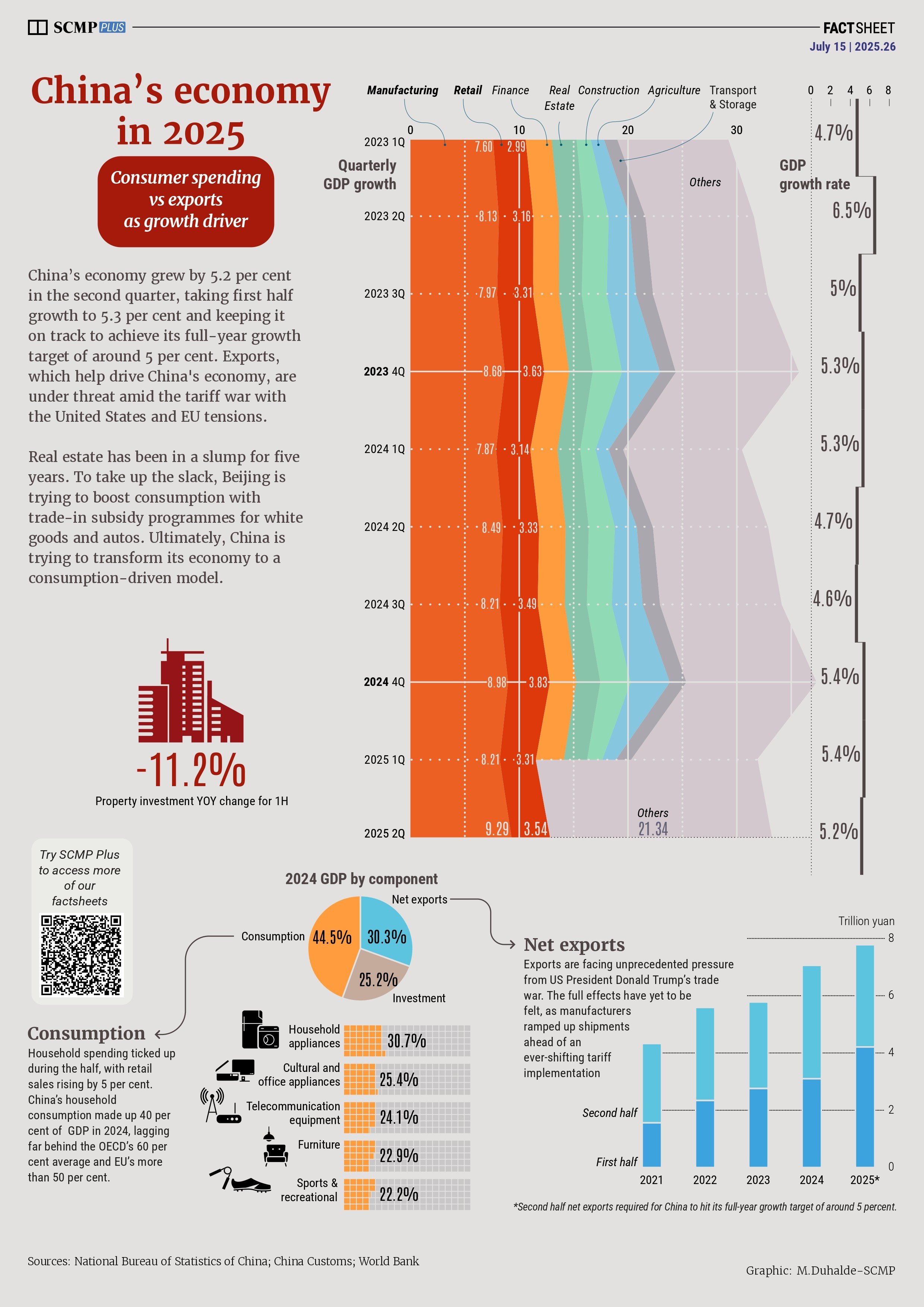
FactSheet 数据速览The Chinese economy expanded 5.3 per cent in the first half of the year, in line with the government’s target, as consumption stimulus measures helped offset a real-estate slump and trade tensions.
Economic growth in China 中国经济增长
The Chinese economy expanded 5.3 per cent in the first half of the year, in line with the government’s target, as consumption stimulus measures helped offset a real-estate slump and trade tensions.
今年上半年,中国经济增长了 5.3%,符合政府目标,消费刺激措施帮助抵消了房地产低迷和贸易紧张局势的影响。
China Future Tech Briefing
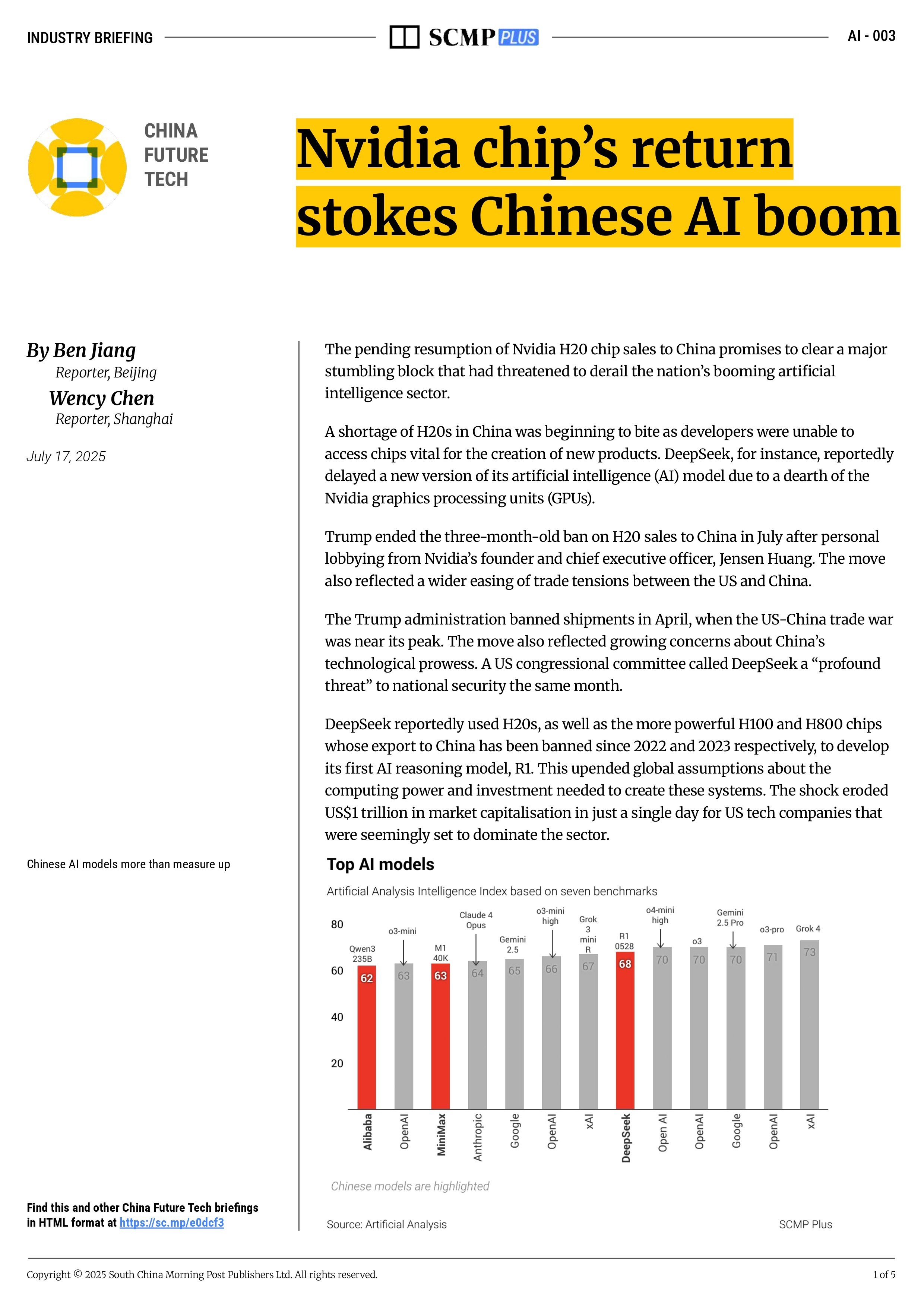
中国未来科技简报AI | Nvidia chip’s return stokes Chinese AI boom
US lifting of export ban on the tech giant’s H20 processors will boost DeepSeek and other Chinese tech firms’ development of AI tools.
中国未来科技简报
AI | Nvidia chip’s return stokes Chinese AI boom
人工智能 | 英伟达芯片回归刺激中国人工智能热潮
US lifting of export ban on the tech giant’s H20 processors will boost DeepSeek and other Chinese tech firms’ development of AI tools.
美国解除对科技巨头 H20 处理器的出口禁令,将促进 DeepSeek 和其他中国科技公司在 AI 工具开发方面的进步。
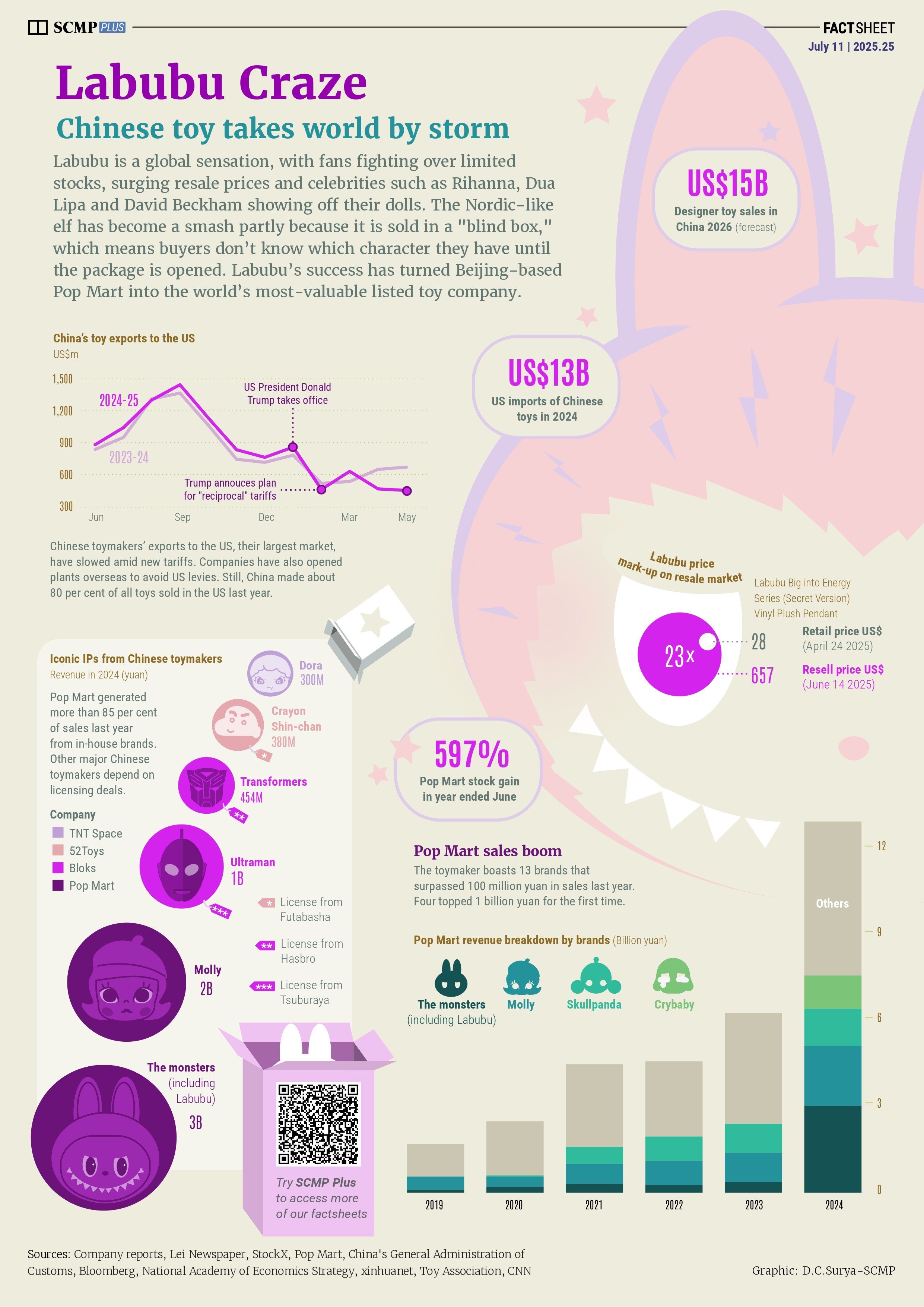
FactSheet 事实清单Beijing-based Pop Mart has become the world’s most-valuable listed toy company on the back of demand for Labubu, a Nordic-like elf that has won fans around the world.
Labubu mania Labubu 狂热
Beijing-based Pop Mart has become the world’s most-valuable listed toy company on the back of demand for Labubu, a Nordic-like elf that has won fans around the world.
总部位于北京的泡泡玛特凭借全球受欢迎的 Labubu——一个像北欧仙子的角色,已成为全球最值钱的上市玩具公司。
Open Questions | ‘Mutually assured economic destruction’ cools trade war: Stein
开放性问题 | “相互确保经济毁灭”降温贸易战:斯坦
Quick Digest 快速摘要Trump 2.0 tariffs tracker


