











The team proposes to optimize the public childcare application process to make it easier for new parents
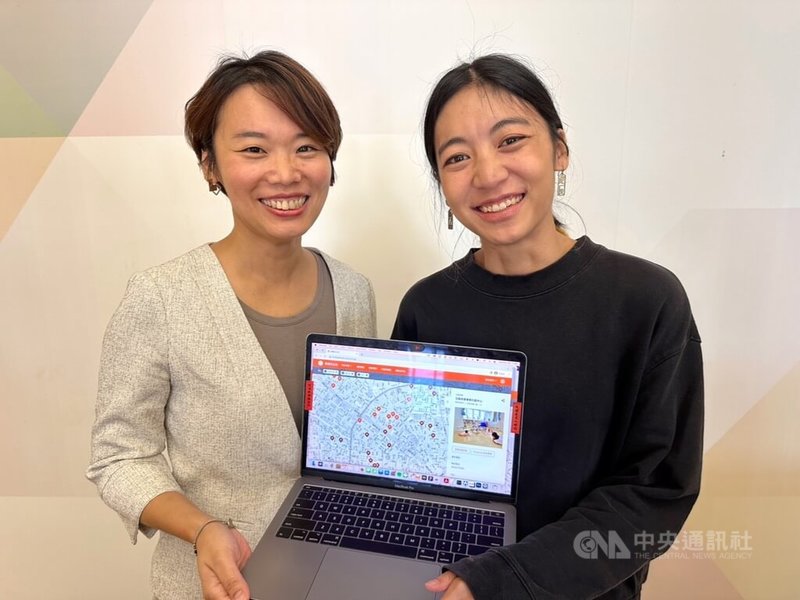
The Citizens team proposed a solution to "optimize the digital process for public daycare applications," hoping to reduce the burden on parents, government agencies, and public daycare centers. The proposal was recognized as a demonstration project for the Ministry of Digitalization's Citizen Technology Pilot Site. Pictured: Senior Service Designer Sandra (right) and Senior User Researcher Hsu Hsueh-fen (left) demonstrate the demonstration website. (Photo by Su Si-yun, CNA, December 10, 2013)
Taipei, 10th (CNA reporter Su Siyun) – A citizen group, recognizing the pain points of the cumbersome public daycare application process, has proposed an optimized system to help new parents instantly understand the required application documents and track the status of their waiting list. The team's proposal has been recognized as a Citizen Technology Demonstration Project by the Ministry of Digitalization, and the source code is expected to be released by the end of this year for use by any local government.
This year, the Ministry of Digitalization launched its first "Citizen Technology Experimental Field Demonstration Project," hoping to leverage the power of the public to solve social challenges. The "Let's Go Front" team developed a solution for "digital optimization of public childcare application processes," which was selected as a demonstration project and awarded a grant. Minister of Digitalization Tang Feng noted that the results are highly applicable and have the potential to be replicated in more counties and cities to improve administrative efficiency.
"Public childcare" is the abbreviation for public childcare or public infant care services, which provide childcare services for infants and young children under the age of 2. However, the number of public childcare centers and the application process vary from county to county. Many parents have to register for public childcare places as soon as they register their infants and young children's household registration.
While some counties and cities have established public childcare application systems, many still find the process like a slog. In Taichung City, for example, residents must check the websites of each public childcare provider to confirm information such as fees and locations. In addition to the application form, applications must also be submitted to various agencies for household registration and comprehensive income tax assessment certificates. Disadvantaged groups are also required to provide supporting documentation, and a waiting list is then ranked based on eligibility.
Sandra, the team's proposer and senior service designer, told CNA reporters that many of her friends have become new parents and found that they have to spend a lot of time to understand the public daycare application process. The qualification review and lottery waiting list also put a burden on the administrative agencies. She hopes to help make public daycare registration online. The goal is to reduce the burden on parents, public departments and public daycare institutions.
The system created by the team has three major features. The first is a "one-stop function". People no longer have to go to each website one by one to check public childcare and application information as in the past. People can quickly check public childcare information and waiting status from the map page, and clearly see examples of required documents and how to obtain them. This can reduce the risk of application errors when people apply for documents.
Second, it reduces the time spent on repetitive application submissions. Team member and senior user researcher Xu Xuefen explained that if someone wants to apply to three public daycare centers, they need to prepare three copies of all the information. With the system optimized, they hope to be able to submit a single, complete application to multiple daycare centers.
Third, the system will notify parents via email when the waiting list for public childcare changes, preventing them from missing out on calls. The team also plans to automatically sort the waiting list by status and facilitate online responses, reducing the administrative burden on public childcare agencies and social services bureaus.
The current practice is to publish a monthly waiting list on the Taichung City Social Affairs Bureau's website. The public can find out their waiting list status by clicking on a PDF file for each public daycare center. Hsu Hsueh-fen explained that it's difficult for parents to make a decision within two or three days of learning they've been put on the waiting list for a public daycare center. "If the child has already adapted to their current nanny or private daycare, they might hesitate to change," she explained. By providing immediate notification of the waiting list status, parents can plan ahead.
With the assistance of the Digital Department, the team coordinated with the Taichung City Government. During the development process, they also interviewed Taichung parents, public childcare units, and Taichung City Social Affairs Bureau staff to understand the needs of all parties.
Sandra said that the planned registration system includes an applicant registration platform, a public daycare management system and a social affairs bureau management system. The database and back-end design have been completed, and some demonstration functions have been completed on the front end. Although it is not a system that can be used immediately, it can already provide the outside world with a clear imagination.
Subscribe to the Good Morning World e-newsletter and get 10 things happening around the world in 3 minutes every day
 請輸入正確的電子信箱格式
As for the challenges of the development process, Sandra said that the team members were a five-person team formed by friends who introduced each other. Later, more than 10 people actually joined in to help. Everyone communicated online during extra time after get off work, and also needed to adapt to the public sector's model. Although the process was tiring, "If there is a chance to use it in the future, I think it will be very good."
The system is currently a demonstration project, and when the public can actually use it depends on the Taichung City Government's subsequent plans. However, the team will open source the code by the end of this year. Conceptually, it's like building the wheels first, so those who need it can directly adapt and use it without having to develop it from scratch. Sandra said that after the results are open sourced, she will ultimately benefit from it. If she has children in the future, she will also have the opportunity to use the convenient public childcare application process. (Editor: Su Zhizong) 1121210


The text, images and videos on this website may not be reproduced, publicly broadcast or transmitted, or used without authorization.
Air pollution is hitting motorcyclists, so beware of cancer cell invasion