
Modern digital tools make it easy to “capture” information from a wide variety of sources. We know how to snap a picture, type out some notes, record a video, or scan a document. Getting this content from the outside world into the digital world is trivial.
现代数字工具让我们能轻松从各种来源"捕获"信息。我们懂得如何拍照、记笔记、录视频或扫描文档。将这些内容从现实世界转移到数字世界易如反掌。
It’s even easier to get content that is already digital from one app to another. We know how to copy and paste text, save an image from a webpage, archive an email attachment, or import a video file.
转移现成的数字内容到不同应用间更为简单。我们掌握复制粘贴文本、保存网页图片、归档邮件附件或导入视频文件的操作。
What is difficult is not transferring content from place to place, but transferring it through time.
真正的难点不在于跨空间转移内容,而在于跨时间传递知识。
You know what I mean: you read a book, investing hours of mental labor in understanding the ideas it presents. You finish the book with a feeling of triumph that you’ve gained a valuable body of knowledge.
你明白我的意思:读完一本书,投入数小时脑力理解其中观点,合上书时满心欢喜,仿佛获得了宝贵的知识财富。
But then what? 然后呢?
You may try to apply the science-based methods the book recommends, only to realize it’s not quite as clear-cut as you thought. You may try to change the way you eat, exercise, communicate, or work, trusting in the power of habits. But then the everyday demands of life come rushing back, and you forget what motivated you in the first place.
或许你尝试运用书中推荐的科学方法,却发现实际操作并不如想象中明确;或许你决心改变饮食、运动、沟通或工作方式,寄望于习惯的力量。但生活的洪流很快卷土重来,最初的动力早已遗忘。
At this point, people take different paths. Some give up, labeling all “self-help” books a waste of time. Others decide it’s just a problem of remembering everything they read, and invest in fancy memorization techniques. And many people become “infovores,” force-feeding themselves endless books, articles, and courses, in the hope that something will stick.
此时人们分道扬镳:有人放弃,宣称所有"自助类"书籍都是浪费时间;有人归咎于记忆问题,钻研各种记忆术;更多人成为"信息饕餮",强迫自己吞噬无数书籍、文章和课程,指望有些内容能留下印记。
I want to suggest an alternative to all the approaches above: what you read is good and useful and very important, you’re just reading it at the wrong time.
我想提出另一种可能:你阅读的内容本身优质实用且极其重要,只是阅读时机不对。
You’re reading about time management techniques now, but they will only be useful two years from now, when you become a manager and have much greater demands on your time.
此刻研读时间管理技巧,但这些知识真正发挥作用是在两年后你成为经理、时间需求激增之时。
You’re watching YouTube videos on online marketing now, but that knowledge can only be put to use in 9 months, when your new online course gets off the ground.
现在观看网络营销视频,但这些知识九个月后才会派上用场——当你的新在线课程正式启动之际。
You’re talking to a prospect about his goals and challenges now, but when you could really use that information is next year, when he is taking bids for a huge new contract.
此刻与潜在客户探讨其目标挑战,但这些信息真正产生价值是在明年——当他为重大新合同招标之时。
The challenge of knowledge is not acquiring it. In our digital world, you can acquire almost any knowledge at almost any time.
知识的挑战不在于获取。在数字时代,几乎任何知识都能随时获取。
The challenge is knowing which knowledge is worth acquiring. And then building a system to forward bits of it through time, to the future situation or problem or challenge where it is most applicable, and most needed.
真正的挑战在于辨别哪些知识值得获取,并建立系统将其分时段输送至未来最适用、最需要的场景、问题或挑战中。
At that future point, when you’re applying that knowledge directly to a real-world challenge, you won’t have to worry about memorizing it, integrating it, or even fully understanding it. You will only have to apply it, and any gaps in your understanding will very quickly reveal themselves. By the time you’re done solving a real problem with it, book knowledge has become experiential knowledge. And experiential knowledge is something you carry with you forever.
当未来那个时刻来临,你将知识直接应用于现实挑战时,无需担忧记忆、整合或完全理解的问题。只需付诸实践,理解上的任何缺口都会快速显现。当你真正用它解决实际问题后,书本知识便转化为经验知识——这种知识将永远与你同在。
This is the job of a “second brain” — an external, integrated digital repository for the things you learn and the resources from which they come. It is a storage and retrieval system, packaging bits of knowledge into discrete packets that can be forwarded to various points in time to be reviewed, utilized, or deleted.
这正是"第二大脑"的使命——作为外部的集成化数字知识库,存储你所学的内容及其来源。这个存储检索系统将知识分装成独立单元,可输送至不同时间节点供查阅、运用或删除。
In The PARA Method, I described a universal system for organizing any kind of digital information from any source. It is a “good enough” system, maintaining notes according to their actionability (which takes just a moment to determine), instead of their meaning (which is ambiguous and depends on the context).
在《PARA 方法》中,我描述了一个适用于任何来源、任何数字信息的通用组织系统。这是一个"足够好"的体系,它根据信息的可操作性(只需片刻即可判断)而非意义(模糊且依赖上下文)来管理笔记。
The four top-level categories of PARA — Projects, Areas, Resources, and Archives — are designed to facilitate this process of forwarding knowledge through time.
PARA 系统的四大顶级分类——项目(Projects)、领域(Areas)、资源(Resources)和归档(Archives)——正是为促进知识在时间维度上的持续传递而设计。
- By placing a note in a project folder, you are essentially scheduling it for review on the short time horizon of an individual project
将笔记放入项目文件夹,本质上就是将其安排在单个项目的短期时间范围内进行回顾 - Notes in area folders are scheduled for less frequent review, whenever you evaluate that area of your work or life
区域文件夹中的笔记会安排较少频率的回顾,每当你评估工作或生活的该领域时进行 - Notes in resource folders stand ready for review if and when you decide to take action on that topic
资源文件夹中的笔记随时待命,待您决定对该主题采取行动时即可查阅 - And notes in archive folders are in “cold storage,” available if needed but not scheduled for review at any particular time
归档文件夹中的笔记处于"冷冻状态",需要时可调用,但不会安排特定时间进行回顾
Note that we have re-created the tickler file, except instead of strict time-based horizons (daily, weekly, monthly, annually), they are scheduled contingently — if X happens, when Y arrives, if I want to do Z, etc.
请注意我们重建了待办提醒系统,只不过原先严格基于时间周期(每日/每周/每月/每年)的触发机制,现在改为条件触发——当 X 事件发生时,当 Y 条件达成时,当我想做 Z 事项时等等
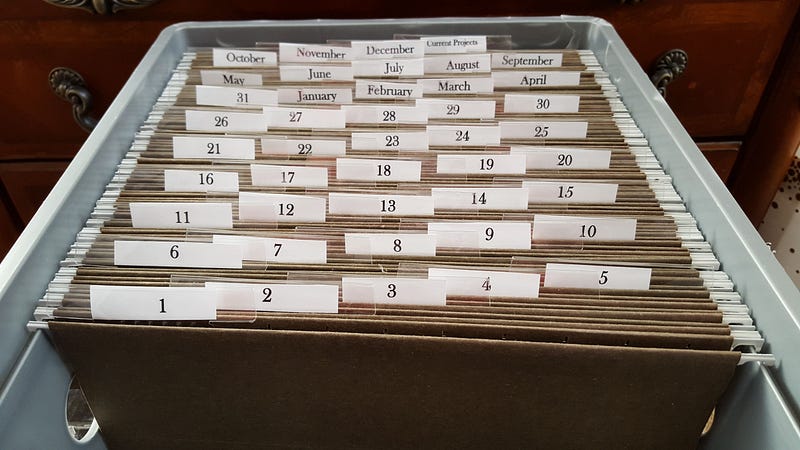
Planning in terms of contingencies gives us all the benefits of planning and researching, without locking us into rigid routines. We have the ability to massively accelerate, using our repository of accumulated notes as rocket fuel. But the actual decision of whether or not to accelerate, and critically, in which direction, we leave to our Future Self, who is older and wiser.
基于可能性的规划让我们既能享受计划与研究带来的益处,又不会被僵化的常规所束缚。我们拥有强大的加速能力,积累的笔记库如同火箭燃料般提供动力。但关于是否加速、尤其是朝哪个方向加速的关键决策,我们留给更年长睿智的未来自己来定夺。
PARA answers how these “packets of knowledge” are organized: in discrete notes, sorted into 4 categories according to actionability, and resurfaced using RandomNote.
PARA 方法解答了这些"知识包"如何被组织:分散在独立笔记中,按可执行性分为 4 类,并通过 RandomNote 功能重现。
But now we turn to a more fundamental question: how are these packets made? Once we capture something, how do we structure the note so that it’s easily discoverable and usable in the future? How do we make sure what we’re saving today adds value to future projects, even when we can’t predict or even imagine what those projects might be?
但现在我们要探讨一个更根本的问题:这些知识包是如何形成的?当我们捕获信息后,如何构建笔记才能使其在未来易于发现和使用?如何确保今天保存的内容能为未来项目增值,即便我们无法预测甚至想象那些项目会是什么?
That is the job of Progressive Summarization.
这正是渐进式总结的任务所在。
Note-first knowledge management
笔记优先的知识管理
There are two primary schools of thought on how to organize a note-taking program (or really any body of information, but I’ll use terms specific to note-taking apps):
关于如何组织笔记系统(实际上适用于任何信息体系,但我会使用笔记应用专用术语),存在两大主要思想流派:
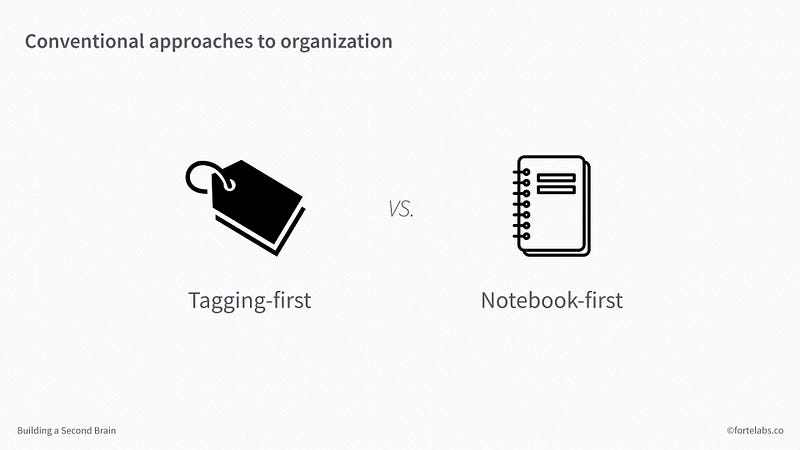
Tagging-first approaches argue that there should be no explicit hierarchy of notes, notebooks, and stacks. Notes are envisioned as an ever-changing, virtual matrix of interconnected, free-floating ideas. Because many tags can be applied to one note, there are multiple pathways to discover any given note. Locating notes in specific notebooks and folders is seen as limiting and static.
标签优先派主张不应存在笔记、笔记本和堆栈的明确层级结构。笔记被视为一个不断变化的虚拟矩阵,由相互关联的自由浮动想法构成。由于单个笔记可添加多个标签,因此存在多种发现路径。将笔记固定在特定笔记本和文件夹中被视为具有局限性和静态性。
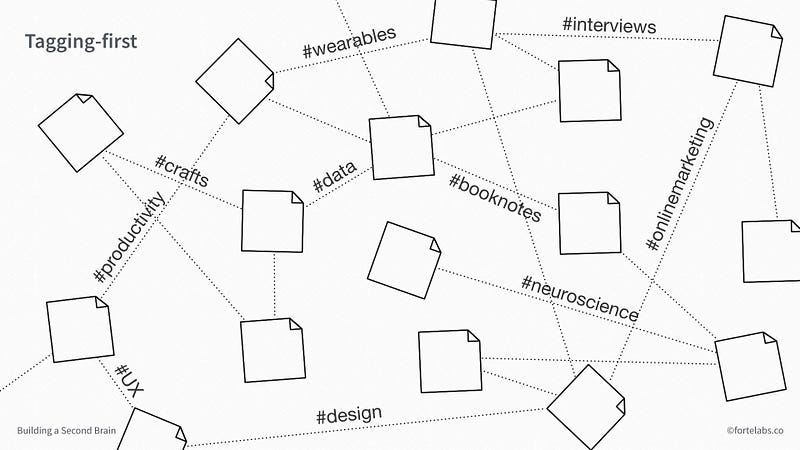
Although tags have their uses, I don’t believe they work as a primary organizational system. In my experience, relying on tagging is too fragile and requires too much maintenance, spreading attention too uniformly across all notes whether or not they are truly valuable. The virtual matrix sounds cool and futuristic, but our minds are not made to work well with such abstract concepts — we understand placing one thing in one place intuitively and automatically.
尽管标签有其用途,但我认为它们无法作为主要的组织系统。根据我的经验,依赖标签过于脆弱且需要过多维护,它会将注意力过于均匀地分散在所有笔记上,无论这些笔记是否真正有价值。虚拟矩阵听起来很酷且充满未来感,但我们的大脑并不擅长处理如此抽象的概念——我们天生就能凭直觉自动理解将某物放在特定位置的行为。
The second conventional approach to organizing notes is notebook-first. This basically translates how we organize things in the physical world — in a series of discrete containers — into the digital world.
第二种传统的笔记整理方法是笔记本优先法。这本质上就是将我们在物理世界整理物品的方式——即放入一系列独立容器中——照搬到数字世界。

Notebook-first is better than tagging-first, in my opinion, mostly because it stays out of the way. It doesn’t try to automate and encroach upon the deeply intuitive act of making connections and seeing patterns. PARA on its own is a notebook-first system.
在我看来,优先使用笔记本比优先打标签更好,主要是因为它不会妨碍思考。它不会试图自动化或干扰建立联系、发现模式这种高度直觉性的行为。PARA 本身就是一个以笔记本优先的系统。
But if we stopped there, it would still be woefully inadequate for an economy based on creative output. As the tagging enthusiasts correctly point out, notebooks and folders actually suppress the serendipity and randomness that is at the heart of a creative lifestyle.
但如果我们止步于此,对于以创意产出为基础的经济体系而言,这仍然远远不够。正如标签热衷者们正确指出的那样,笔记本和文件夹实际上抑制了偶然性和随机性——而这正是创意生活方式的核心所在。
I propose a way to break the impasse: a note-first approach.
我提出一种打破僵局的方法:笔记优先策略。

I propose we make the design of individual notes the primary factor, instead of tags or notebooks. This has many advantages:
我建议我们将单个笔记的设计作为主要考量因素,而非标签或笔记本。这样做有许多优势:
- It works well with any other organizational system, without depending on them (including but not limited to tags and notebooks, if you want to use those)
它能与任何其他组织系统良好配合,而不依赖于它们(包括但不限于标签和笔记本,如果你想使用这些功能的话) - It makes all work you do on your notes value-added, because you’re spending close to 100% of the time engaging directly with the content itself
它让你在笔记上投入的所有工作都产生增值,因为你将接近 100%的时间直接用于内容本身 - It can more easily survive migrations to other devices, storage locations, and even programs, because note content is much more likely to be preserved than overarching structure
它能更轻松地适应设备迁移、存储位置变更甚至程序更换,因为笔记内容比整体结构更有可能被保留下来 - It cultivates skills (succinct communication, finding the core of an idea, visual thinking, etc.) that are inherently valuable and highly transferrable to other activities
它能培养一些本质上极具价值且可高度迁移到其他活动的技能(简洁表达、捕捉观点核心、视觉化思考等) - It makes your notes more legible and useful to others (unlike your internal notebook structure, which is only for your use), promoting collaboration and sharing
这使你的笔记对他人更具可读性和实用性(不同于仅供个人使用的内部笔记本结构),从而促进协作与分享
With a note-first approach, your notes become like individual atoms — each with its own unique properties, but ready to be assembled into elements, molecules, and compounds that are far more powerful.
采用"笔记优先"方法后,你的笔记就像独立原子——每个都具备独特属性,但随时可组合成更强大的元素、分子和化合物。
Designing discoverable notes
设计可发现的笔记
A note-first approach to knowledge management means we have to think about design. You are, in a very real sense, designing a product for a demanding customer — Future You.
知识管理的"笔记优先"方法意味着我们必须考虑设计。在非常现实的意义上,你是在为一位苛刻的客户——未来的你——设计产品。
Future You doesn’t necessarily trust that everything Past You put into your notes is valuable. Future You is impatient and skeptical, demanding proof upfront that the time they spend reviewing notes will be worthwhile. You’ve gotta “sell them” on the idea of reviewing a given note, including all the stages any salesperson has to master: gaining attention, inspiring interest, establishing credibility, stoking desire, and making a case for action NOW.
未来的你并不完全相信过去的你在笔记中记录的所有内容都有价值。未来的你缺乏耐心且多疑,要求提前证明花时间回顾笔记是值得的。你需要"推销"回顾某条笔记的想法,包括掌握所有销售环节:吸引注意、激发兴趣、建立可信度、点燃欲望,以及立即采取行动的理由。
As if all that wasn’t intimidating enough, you have to do this for every single note without spending any extra time. You don’t have extra time, do you?
如果这还不够令人生畏,你还必须对每条笔记都这样做,且不能额外花费时间。你没有多余时间,对吧?
Let’s start at the beginning: at the heart of every design, we are trying to balance priorities. You want one thing, but it has to be balanced against something else that you also want.
让我们从头开始:所有设计的核心都在于权衡优先级。你想要某样东西,但必须与你同样想要的另一样东西取得平衡。
You want a vehicle to protect its occupants, but you can’t just add layers and layers of titanium armor plating. You have to balance safety against weight and cost.
你希望车辆能保护乘员,但不能只是不断叠加钛合金装甲层。必须在安全性、重量和成本之间取得平衡。
You want a phone to have the longest possible battery life, but you can’t just give it a 10-pound brick of a battery. You have to balance battery life against size and usability.
你希望手机电池续航尽可能长,但不能直接装上 10 磅重的电池块。必须在续航时长、设备尺寸和可用性之间取得平衡。
In the case of notes, I believe the two priorities we are trying to balance are discoverability and understanding.
对于笔记而言,我认为需要权衡的两个核心要素是:可发现性与理解度。
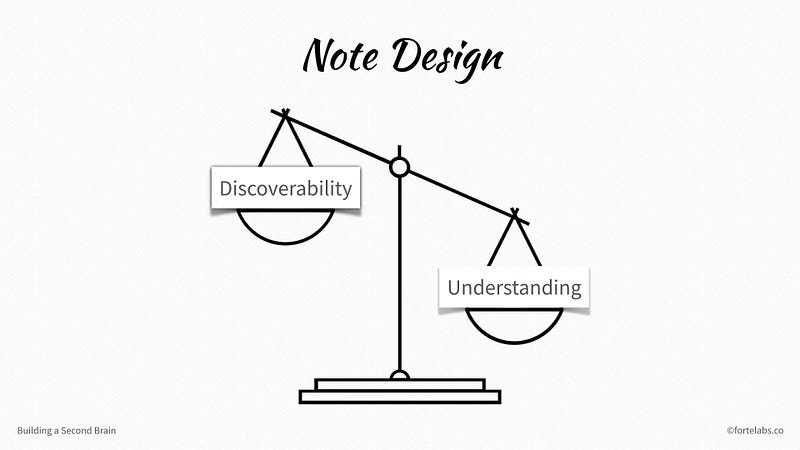
Making a note discoverable involves making it small, simple, and easy to digest. We accomplish this using compression: creating highly condensed summaries, without all the fluff.
要让笔记易于发现,需要使其简短、简洁且易于消化。我们通过压缩来实现这一点:创建高度浓缩的摘要,去除所有冗余内容。
But we also want to make our notes understandable. This involves including all the context: the details, the examples, and cited sources to be sure nothing falls through the cracks.
但同时我们也希望笔记易于理解。这需要包含完整的背景信息:细节、示例和引用来源,确保没有任何遗漏。
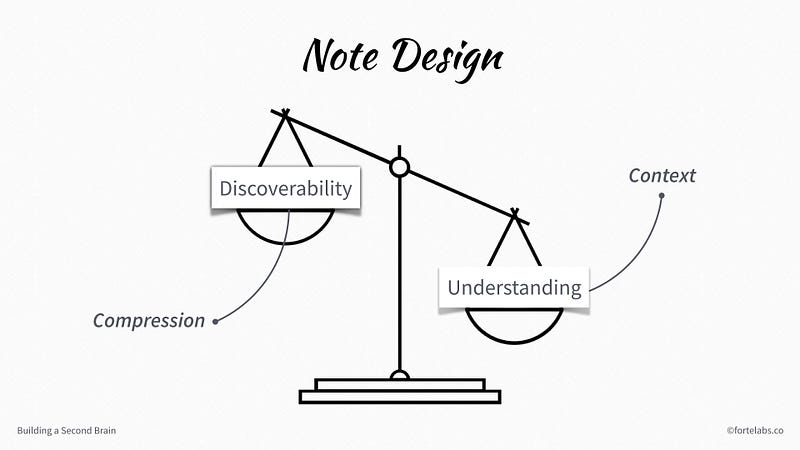
This is a difficult tradeoff because you cannot compress something without losing some of its context.
这是一个难以权衡的问题,因为压缩内容必然会丢失部分背景信息。
You cannot summarize an article without discarding most of its points. You cannot make a highlight reel of a video without cutting out most of the footage. You cannot give an 18-minute TED talk without leaving out most of your ideas.
摘要文章时不得不舍弃大部分观点;制作视频集锦时不得不剪掉多数画面;进行 18 分钟的 TED 演讲时不得不省略大部分想法。
In making decisions about what to keep, you are inevitably making decisions about what to throw away.
在决定保留什么内容时,你不可避免地也在决定舍弃什么。
Compression vs. context 压缩与语境
There’s a natural tension between the two, compression and context.
压缩与语境之间天然存在着张力。
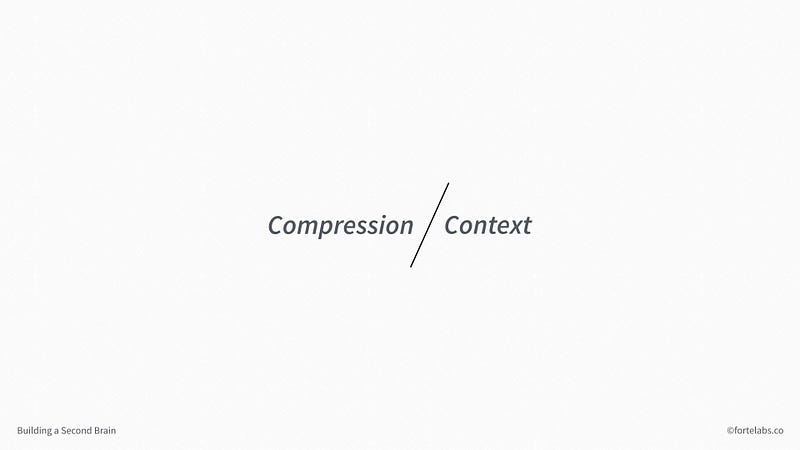
To communicate anything, you have to compress it, like communicating a huge amount of life experience in a wise saying. But in doing so, you lose a lot of the context that made that wisdom valuable in the first place.
任何信息的传递都需要压缩,就像用一句箴言概括大量人生经验。但这样做时,你会丢失许多最初赋予这些智慧价值的背景信息。
Let’s look at some examples.
让我们看几个例子。
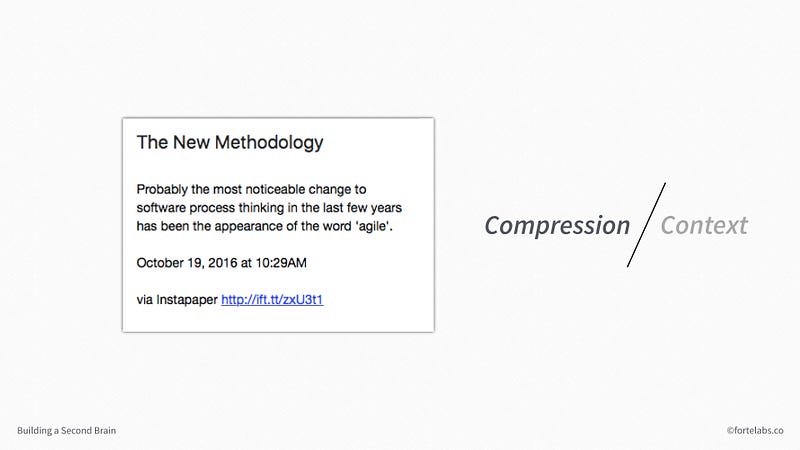
If we compress a note too much, in other words, we make a summary that is too brief, we lose the context and it loses all meaning. In the note above, for example, the information it contains is highly discoverable — I can get the gist of it with just a glance.
如果我们把笔记压缩得太过,换句话说,制作过于简短的摘要,就会丢失上下文,使其完全失去意义。以上述笔记为例,其中包含的信息具有极高的可发现性——我只需扫一眼就能抓住要点。
But if I come across this note a year from now, I’ll have no idea what it means or why it’s important. It’s too compressed.
但如果一年后我再看到这条笔记,我将完全不明白它的含义或重要性。它被压缩得过头了。
But we can go too far in the opposite direction too. If we make something totally understandable, in other words, if we include every little detail and bit of context, it loses its discoverability.
但我们也可能走向另一个极端。如果我们让内容变得完全易懂,换句话说,如果包含所有细枝末节和背景信息,它就会丧失可发现性。
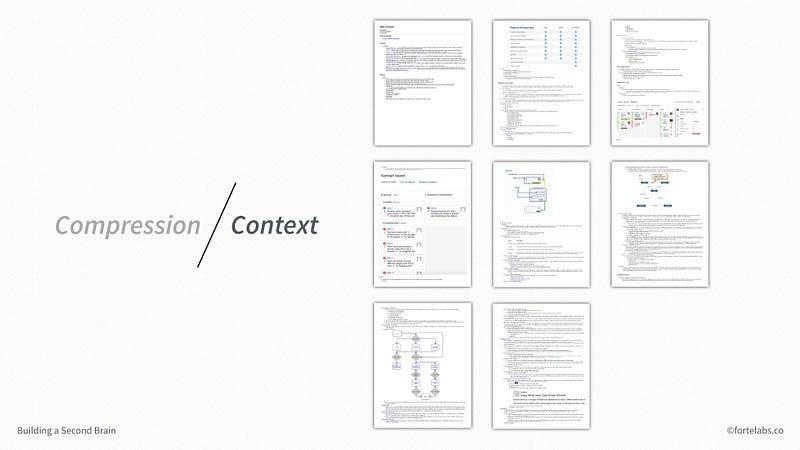
The example above is my notes on the task management software Jira. It has lots of context, making it highly understandable. But it’s not discoverable at all. It would probably take me a couple hours and tremendous mental effort to read through this note and remember enough context to decide whether or not it’s useful. The main points and key insights are hidden somewhere in the noise.
上面这个例子是我关于任务管理软件 Jira 的笔记。它包含大量背景信息,因此非常容易理解。但完全不具备可发现性。我可能需要花费数小时并耗费巨大精力通读这条笔记,才能回忆起足够的背景来判断它是否有用。主要观点和关键见解都淹没在信息噪音中了。
Getting the balance between compression and context right is not a trivial matter. When the time comes for Future You to decide whether or not to review this note, seconds count. Because Future You will likely be looking for a solution to a problem, not casual reading, they will be making snap decisions on a tight timeline. Faced with a wall of text of questionable value, they are unlikely to take the risk of committing time for review.
在压缩信息与保留上下文之间取得平衡并非易事。当未来的你需要决定是否重读这条笔记时,分秒必争。因为那时的你很可能是在寻找问题解决方案,而非休闲阅读,必须在紧迫时间内快速决策。面对价值存疑的大段文字,你不太可能冒险投入时间重读。
This means that all the summarizing work your Past Self did on this note is wasted. It didn’t pay off back then, and it doesn’t pay off in the future. You successfully sent a packet of information forward through time, but not in a state where it could survive the journey.
这意味着你过去在这条笔记上做的所有摘要工作都白费了。当初没有产生价值,未来也不会带来回报。你确实成功让信息包穿越了时间,却没能让它以可存活的状态抵达彼岸。
Opportunistic compression
机会性压缩
I’ve found that most people do just fine on the context side of the equation. We know how to take exhaustive notes on a book, a presentation, or a class.
我发现大多数人在保留上下文方面都做得不错。我们擅长为书籍、演讲或课程做详尽笔记。
Progressive Summarization focuses therefore on rebalancing the equation. It is a method for opportunistic compression — summarizing and condensing a piece of information in small spurts, spread across time, in the course of other work, and only doing as much or as little as the information deserves.
渐进式摘要法正是为了重新平衡这个等式。它采用机会性压缩策略——在其他工作过程中,分散在不同时间点,根据信息价值进行适度地摘要与浓缩。
If you remember, compression is a means to improving discoverability. So our design challenge when creating a note is:
要记住,压缩是提升可发现性的手段。因此创建笔记时的设计挑战是:
“How do I make what I’m consuming right now easily discoverable for my future self?”
"如何让我此刻吸收的内容容易被未来的自己发现?"
This isn’t an easy question to answer, because you have no idea what Future You remembers, is interested in, or is working on. You have to summarize the note without knowing what it will be used for. It is general purpose summarization, a much greater challenge than extracting takeaways for just one specific project.
这个问题很难回答,因为你无从知晓未来的自己记得什么、对什么感兴趣、正在做什么。你必须在不知道笔记用途的情况下进行摘要,这是比针对特定项目提取要点困难得多的通用型摘要任务。
Progressive Summarization works in “layers” of summarization. Layer 0 is the original, full-length source text.
渐进式摘要法通过"分层摘要"实现。第 0 层是原始完整文本。
Layer 1 is the content that I initially bring into my note-taking program. I don’t have an explicit set of criteria on what to keep. I just capture anything that feels insightful, interesting, or useful.
第 1 层是我最初导入笔记程序的内容。我没有明确的取舍标准,只捕捉那些有洞见、有趣或有用的内容。
This can include virtually any type of media, but for this article I will focus on text. There are many ways of doing this:
这几乎可以包含任何媒体类型,但本文聚焦于文本。具体方式包括:
- Copy a paragraph of text from a PDF I’m reading, and paste it into the Evernote menu bar helper
从阅读的 PDF 中复制段落,粘贴到 Evernote 菜单栏助手 - Type my random thoughts into a new note on the Evernote mobile app
在 Evernote 移动应用中新建笔记记录随机想法 - Dropping a Word document onto the Evernote icon in the dock on my Mac, which adds it to a note as an attachment
将 Word 文档拖拽到 Mac 程序坞的 Evernote 图标,以附件形式添加到笔记 - Downloading all my Kindle highlights from a book using Bookcision, and then copying and pasting them into a new note
使用 Bookcision 下载 Kindle 电子书的所有标注,复制粘贴到新笔记 - Forward an email with useful information to my personal import address, which automatically imports the whole email to a note
将含有实用信息的邮件转发至我的个人导入地址,该地址会自动将整封邮件导入为笔记 - Highlight the best passages of an online article using the web highlighter Liner, which exports directly to Evernote
使用网页标注工具 Liner 在线文章中的精华段落进行高亮标注,该工具可直接导出至 Evernote
The examples above are from my recommended program Evernote (iOS, Android, Mac, Windows, browsers), but all the major note-taking platforms support the above functionality in one way or another: Bear (Mac and iOS), Simplenote (iOS, Android, Mac, Windows, Linux), Microsoft OneNote (iOS, Android, Mac, Windows), and Google Keep (browsers, iOS, Android).
上述示例来自我推荐的笔记程序 Evernote(支持 iOS、Android、Mac、Windows 及浏览器平台),但所有主流笔记平台均以不同形式支持上述功能:Bear(Mac 和 iOS)、Simplenote(iOS、Android、Mac、Windows、Linux)、Microsoft OneNote(iOS、Android、Mac、Windows)以及 Google Keep(浏览器、iOS、Android)。
Layer 1 is the starting point of Progressive Summarization, like the bedrock on which everything else is built:
第一层是渐进式总结的起点,如同构筑一切的基础岩层:
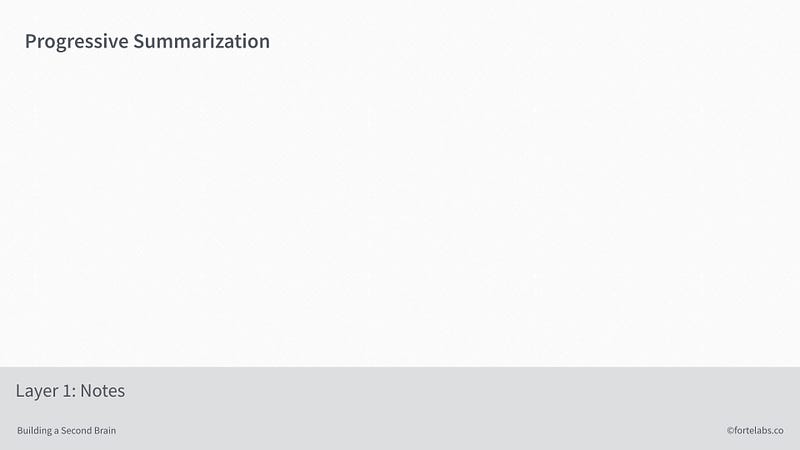
Layer 2 is the first round of true summarization, in which I bold only the best parts of the passages I’ve imported. Again, I have no explicit criteria. I look for keywords, key phrases, and key sentences that I feel represent the core or essence of the idea being discussed.
第二层是真正的首轮总结,在此环节我仅对导入段落中最精华的部分进行加粗处理。同样,我没有明确的筛选标准。我会寻找能体现所讨论观点核心或精髓的关键词、关键短语和关键句子。
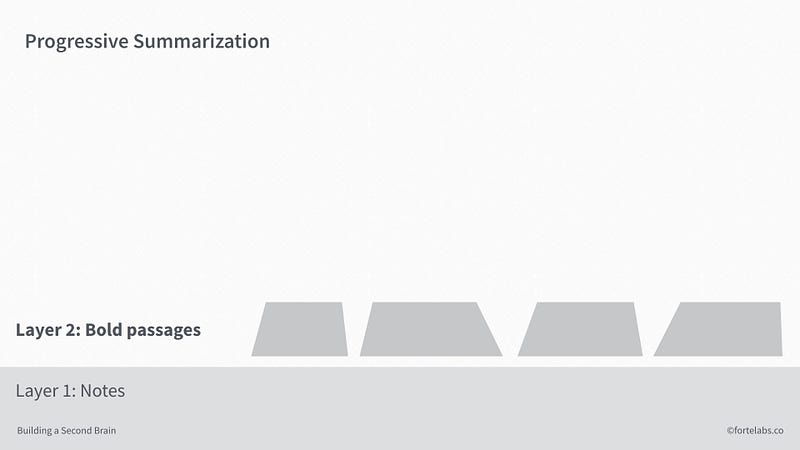
I do this bolding layer at a later time, when I’m already reviewing this note anyway. I’m essentially using the attention I’m already spending for a dual purpose: to “buy” the information I need for the project at hand, and also to summarize the note for future use. If you have to pay attention to something, it comes in handy to be able to double-spend.
我通常会在稍后阶段进行这层加粗处理,也就是在已经需要审阅这条笔记的时候。本质上,我是在把已经投入的注意力双重利用:既为当前项目"购买"所需信息,同时也为未来使用对笔记进行摘要。当你必须关注某些内容时,能够一箭双雕总是事半功倍。
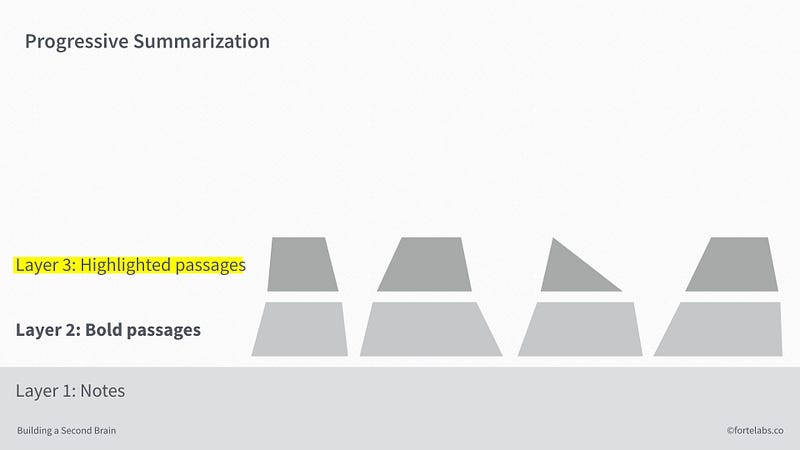
For Layer 3, I switch to highlighting, so I can make out the smaller number of highlighted passages among all the bolded ones. This time, I’m looking for the “best of the best,” only highlighting something if it is truly unique or valuable. And again, I’m only adding this third layer when I’m already reviewing the note anyway.
到了第三层,我会改用高亮标记,这样就能在众多加粗内容中辨识出更少量的高亮段落。这次筛选标准是"优中选优",只有当内容确实独特或极具价值时才会高亮标记。同样地,这第三层处理也仅在我本就打算重阅笔记时才会添加。
For Layer 4, I’m still summarizing, but going beyond highlighting the words of others, to recording my own. For a small number of notes that are the most insightful, I summarize layers 2 and 3 in an informal executive summary at the top of the note, restating the key points in my own words.
在第四层,我仍在进行总结,但不再局限于高亮他人的文字,而是开始记录自己的见解。对于少数最具洞察力的笔记,我会在笔记顶部以非正式的摘要形式总结第二层和第三层内容,用自己的话重述关键要点。
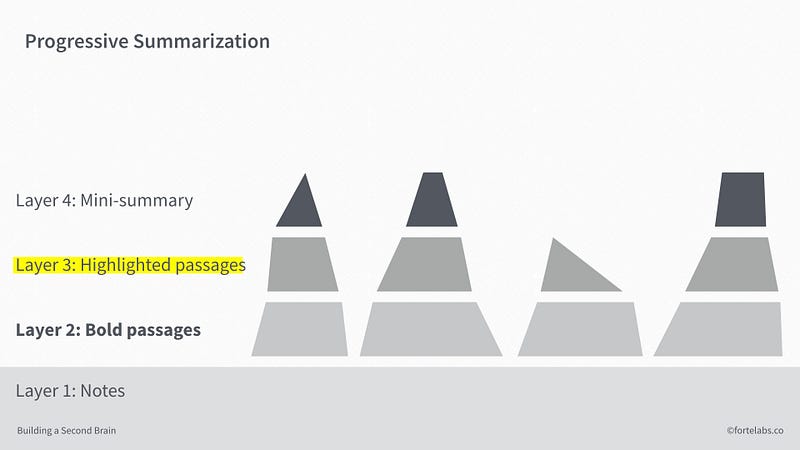
Note that all the previous layers are preserved in context, giving you the freedom to leave things out without worrying that you’ll lose them. Summarization is risky — you may be making the wrong decision about what’s important. But with the safety net of multiple layers of preserved notes, you can strike out decisively on daring intellectual expeditions.
需要注意的是,之前所有层级的内容都完整保留在上下文中,让你可以自由取舍而不必担心丢失信息。总结是有风险的——你可能错误判断了哪些内容重要。但有了多层保留笔记作为安全网,你就可以在知识探索的冒险之旅中果断前行。
And finally, for a tiny minority of sources, the ones that are so powerful and exciting I want them to become part of how I think and work immediately, I remix them. After pulling them apart and dissecting them from every angle in layers 1–4, I add my own personality and creativity and turn them into something else.
最后,对于极少数那些极具影响力、令我兴奋不已的资料,我希望它们能立即融入我的思维和工作方式,于是我会对其进行重构。在通过前四层拆解并从各个角度剖析后,我会加入自己的个性和创造力,将其转化为全新的内容。
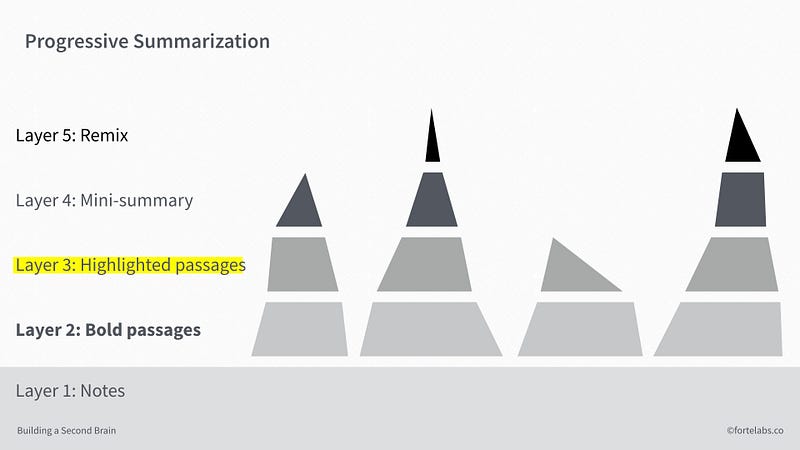
This could include a blog post interpreting, critiquing, or extending the argument an author is making, such as in Strategically Constrained, The Inner Game of Work, and Supersizing the Mind.
这可能包括一篇博客文章,对作者的观点进行解读、批评或延伸,例如在《战略性约束》、《工作的内在博弈》和《心智超载》中所探讨的内容。
But it doesn’t have to be difficult or time-consuming. It could even be…(gasp) fun! Making a sketch, designing a slide, recording a short video on your phone, and sharing on social media are all forms of wrestling deeply with information.
但这不必是困难或耗时的过程,甚至可能(惊讶地)充满乐趣!绘制草图、设计幻灯片、用手机录制短视频并在社交媒体分享,都是深度消化信息的表现形式。
我关于《丰田套路》这本书的第一条推文风暴
In Part II, we’ll look at some examples of Progressive Summarization in action.
在第二部分,我们将看到渐进式总结的实际应用案例。
Follow us for the latest updates and insights around productivity and Building a Second Brain on X, Facebook, Instagram, LinkedIn, and YouTube. And if you're ready to start building your Second Brain, get the book and learn the proven method to organize your digital life and unlock your creative potential.
关注我们的 X、Facebook、Instagram、LinkedIn 和 YouTube 账号,获取关于生产力及构建第二大脑的最新动态与洞见。若您已准备好开始构建自己的第二大脑,请购买本书学习这套经过验证的方法,以整理数字生活并释放创造潜能。
