Elon Musk’s Empire Is Creaking Under the Strain of Elon Musk
Tesla, SpaceX and xAI are struggling to deal with the fallout from Musk’s Trump feud and wild bets.
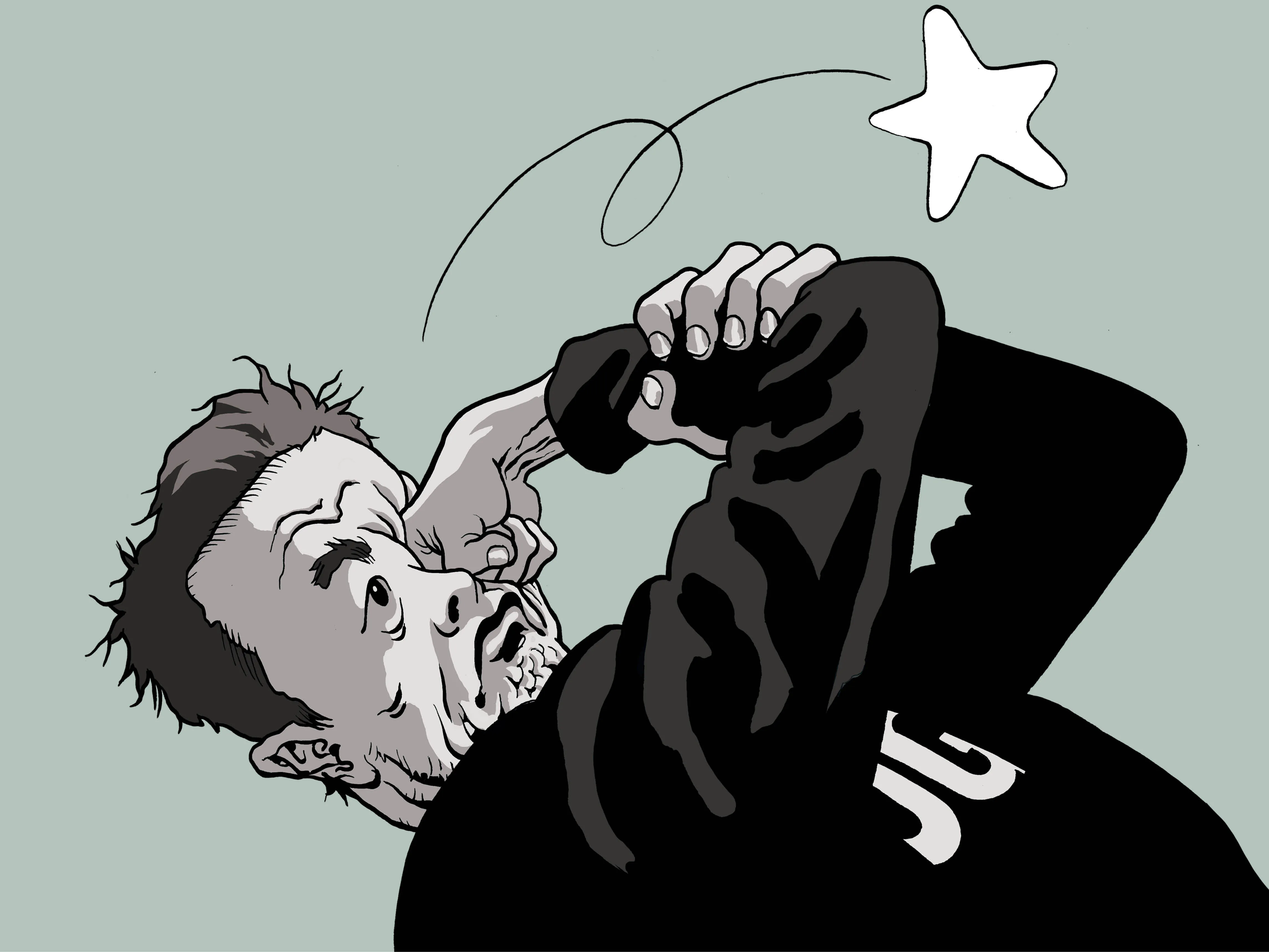
The black eye was easier to miss than it should have been. Perhaps it was the shadow cast by his DOGE cap, or because he was rolling his neck as if he’d just received the world’s most relaxing massage, or because everyone was paying attention to Donald Trump. Maybe it was all of those things. In any case, it took 40 minutes before someone asked the obvious question: What happened to Elon Musk’s face?
Musk blamed a parenting mishap. “I said, ‘Go ahead, punch me in the face,’ and he did,” he said, referring to his 5-year-old son, X. “I didn’t really feel much at the time. And then I guess it bruises up.”
The explanation, which came on May 30 during what was supposed to be Musk’s Oval Office send-off, was reassuring for anyone concerned about Musk’s well-being. Earlier that day, the New York Times had published a report, denied by Musk, in which anonymous sources suggested that his use of psychedelic drugs was contributing to a pattern of erratic behavior. On the other hand, Musk’s roughhousing suggested a metaphor for his brief and chaotic tenure in presidential politics. The richest man in the world was leaving the White House with a self-inflicted physical injury and, perhaps, a few psychic ones.
It was about to get much worse. Soon enough, he’d find himself and his business interests firmly in Trump’s crosshairs—and losing altitude.
Musk had started his stint in the second Trump administration as close to the top of the world as any centibillionaire can be. He appointed himself head of the so-called Department of Government Efficiency, the cost-cutting effort that made him briefly one of the most powerful people in Washington and provided the backdrop for a surreal kind of political performance art. He stalked around the Oval Office as if it were his personal domain. He taunted civil servants, cut funding to food banks, boasted about sending entire federal agencies “into the wood chipper.” He demanded access to sensitive military plans and troves of personal data, and received much of it. World leaders, eager to please Trump, granted licenses to Musk’s rocket company, SpaceX, and advertisers who’d backed away from Musk’s social network after his various antisemitic outbursts began buying ads on X again. The market value of Tesla Inc. soared, as did the values of Musk’s privately held companies, including SpaceX and xAI, which both began raising money.
Behind Musk’s rising net worth was a sense, among many investors, that he and the president he’d spent $300 million to help elect had essentially merged their interests. “I love @realdonaldtrump as much as a straight man can love another man,” Musk posted in February. In March he attended a Cabinet meeting wearing a hat that proclaimed, “Trump was right about everything!” He continued to take credit for DOGE’s cuts, even as the public soured on them.
Losing Popularity
US adult citizens’ view of Musk
Source: YouGov/Economist poll
Note: Figures are dated using the final day of each polling period.
The enthusiasm pleased Trump, at least for a time, but Musk’s grandstanding also cost him dearly. Musk entered politics in 2024 as a widely admired businessman. A year later, polls show him with a net favorability of around -20%, making him much less popular than Trump or most other major national political figures. Some Tesla owners have been slapping anti-Musk bumper stickers on their electric cars; other prospective ones have shopped elsewhere. In its most recent quarter, Tesla reported that it delivered 13% fewer vehicles than it did a year ago despite growth in the overall market for EVs. Tesla’s stock is down more than 30% since reaching a high after the election.
None of this would seem especially damaging if Musk had managed to maintain his close ties to Trump, who’d been urging his followers to buy Teslas and whose administration was well positioned to loosen regulations that affect Tesla and to funnel contracts to SpaceX. But days after appearing at the Oval Office with the black eye, Musk spun into a social media tantrum of epic proportions, even for him. Among other things, he said Trump never would have been elected without him. Then he claimed (without evidence) that Trump was an accomplice to the crimes of Jeffrey Epstein and alleged (ditto) that Trump had covered them up. Because of this, Musk said, Trump should be impeached and replaced with Vice President JD Vance. Trump responded by threatening to cancel all of SpaceX’s contracts.
The feud cooled. Musk deleted the Epstein claims and pseudo-apologized (“I regret some of my posts”). Then he resumed his criticisms of Trump’s One Big Beautiful Bill, which, in addition to extending the 2017 tax cuts, also cuts subsidies to Tesla. “Do you know what DOGE is?” Trump asked at a press event on July 1. “DOGE is the monster that might have to go back and eat Elon.”
Trump’s threat is less fanciful than it might sound. Musk is rich on paper, with a net worth of about $360 billion, according to the Bloomberg Billionaires Index. But he’s also cash poor, dependent in large part on the stock price of Tesla, on continued good relations with the US government and on his continued ability to raise almost limitless sums of money from investors who basically go along with whatever he says. Each leg of that stool seems wobblier than ever: Tesla’s stock price has fallen precipitously, Trump and Musk are sniping at each other in public, and even some of the staunchest pro-Musk investors are issuing vague warnings about the need for Tesla’s board to get involved. Musk’s companies are financially intertwined, making serious damage difficult to contain. And there are many more weapons Trump could deploy against Musk’s business interests, were he so motivated.
Losing Money
Change in value since the last US trading day of the Biden term
Source: Bloomberg
“What if there’s some irrational new rule or executive order?” asks a longtime Republican Party insider, who spoke on condition of anonymity because they weren’t authorized to speak publicly. “It’s an entirely unpredictable regulatory environment.” This person says there’s also the risk of “invisible hand retribution” for Musk via one of the open investigations he already faces from federal agencies including the Securities and Exchange Commission and the National Highway Traffic Safety Administration.
In late May, Musk said he was “back to spending 24/7 at work.” He’s done this before, usually focusing on a single goal. This time he named several: Tesla, SpaceX and xAI each face urgent challenges. And then there’s revenge. On July 4, Musk unveiled a third political party that he’s calling the America Party—an effort, he’s said, to elect independent lawmakers, almost certainly at the expense of Republican majorities in Congress. In the first trading day that followed, Tesla’s market value fell by nearly $70 billion.
Musk, who didn’t respond to requests for comment, has an uncanny ability to invent his way out of trouble. Tesla has almost gone bankrupt at least twice. SpaceX almost ran out of cash before its first rocket reached orbit. But Musk’s current bets—a robotaxi, a novel rocket that has yet to fly safely, an artificial intelligence startup that’s losing more than $1 billion a month—are as far-fetched as anything he’s tried to this point. And each one, as you’ll see in the three case studies that follow, is arguably part of what has put his empire on such shaky ground. The US president has the temperament and tools to hurt Musk’s empire. But on a list of risk factors to Elon Inc., Trump has to get in line behind Musk himself.
Elon vs. Tesla
On June 22 a dozen or so Tesla influencers arrived in Austin for what Musk had billed as the dawn of a new era in travel. Tesla finally had a self-driving taxi to show off.
“This is a historic day,” proclaimed Herbert Ong, an investor and YouTuber, at the start of a four-hour livestream documenting some of the first rides. “Woo hoo! Here we go.” What followed was a series of delays and errors, including the car driving itself to a different place, forcing Ong to speed-walk several city blocks to catch up with it. Finally he got into a modified Tesla Model Y and rode in the back seat for a 12-minute trip that would have seemed boring to anyone who’s been in a Waymo in the past few years. Then came more waits, and a half-dozen more rides.
In a way, the introduction of Tesla’s Robotaxi was indeed epic, the payoff from a very long string of wild promises. In 2015, Musk told investors his cars would be able to drive themselves within three years. When that deadline came and went, he said that, actually, the self-driving cars were coming in 2019. In 2019 he declared the service almost complete and promised a million Tesla Robotaxis by 2020. It went on like this for six more years.
Nonetheless, investors kept bidding up Tesla’s share price. Some were meme stockers and Musk fanboys, but many professional investors (most notably Cathie Wood, founder of ARK Investment Management LLC) bought into his vision of a robotic future. For context, Tesla has a market value roughly 20 times greater than that of General Motors Co.’s, which sells three times as many cars. There are two possible explanations for this discrepancy: Either Tesla is wildly overvalued compared to other automakers, or it’s poised for massive growth.
At the moment, though, Tesla is shrinking. It reported its first annual sales decline in January and has reported declines in car deliveries in the two quarters since. Its Cybertruck has flopped since its 2023 release, with roughly 5,000 of the pickups selling in the latest quarter, according to the trade publication Electrek. (Musk had predicted annual sales of 250,000 to 500,000; the current pace suggests 20,000 may be more realistic.) Last year, Musk appeared to abandon plans for a low-cost vehicle that many analysts were counting on to attract new customers, opting instead to cut the cost of the company’s existing lineup.
Losing Ground Around the World
Tesla’s share of the passenger battery electric vehicle market in Q1 2025 and its one-year change
Source: BloombergNEF, MarkLines, JATO Dynamics, China Automotive Technology & Research Center and vehicle registration agencies (Tesla and broader battery electric vehicle sales)
Note: Tesla sales chart includes only the markets tracked by BloombergNEF in which Tesla sales were recorded in Q1 ’24 and Q1 ’25. Markets are for BEVs only; they exclude fuel cell vehicles and plug-in hybrids.
All the while, his right-wing turn seems to repel many of the crunchy car buyers who once were Tesla’s biggest fans. Foot traffic to Tesla’s stores fell dramatically last fall, as Musk’s political presence became more visible, and inventory of unsold cars began piling up. In May, Matthew LaBrot, a former sales manager who quit the company in protest, told Bloomberg Businessweek’s podcast Elon, Inc. that he believed the company’s redesigned Model Y sedan was selling poorly because the new design made the date of purchase obvious. “You can’t put an ‘I bought this before he went crazy’ sticker on one of these cars,” LaBrot said. “He was already crazy.”
Drama within Tesla has created an extra layer of complexity for Musk. Several senior leaders have left in recent months, including Omead Afshar (a key Musk deputy), Milan Kovac (the engineering lead of Tesla’s humanoid robot program), David Lau (head of software engineering) and Jenna Ferrua (head of human resources in the US). These departures went unexplained to most of Tesla’s workforce, and staffers learned about them via posts on X.
Musk has tried to wave all of this away. “The reality is that in the future, most people are not going to buy cars,” he said during Tesla’s earnings call in April. In other words, think of the Robotaxis. In May he threw himself into the details and timing of the Austin release event, according to two people familiar with Tesla’s operations, who spoke on condition of anonymity because they aren’t authorized to speak publicly about it. These people say Musk’s plan was to unveil a limited ride-hailing service to a small group of users as a sort of proof of concept while lobbying for federal rules that would theoretically permit Tesla to offer Robotaxi rides nationwide. Tesla has been developing a two-seater Robotaxi that Musk has said will be ready for the road sometime next year.
He may have trouble selling this plan to his new presidential frenemy. On the campaign trail, Trump railed against EVs and told a gathering at the Detroit Economic Club that he would stop autonomous vehicles from operating on American roads. And although Trump was happy to put Musk at the center of DOGE, his newly passed tax bill looks to be disastrous for Tesla’s finances.
The bill removes a $7,500 tax credit that applies to most American-made EVs, including most Teslas, which will make the cars that much more expensive starting in the fall. It also eliminates penalties for automakers that fail to meet federal fuel economy standards, part of a program of regulatory credits that’s provided Tesla with a massive windfall over the years. (Last year, Tesla sold other companies close to $3 billion worth of regulatory credits.) In May a JPMorgan Chase & Co. analyst predicted that this one-two punch will cost Tesla about half its annual profits. “He’s upset he’s losing his EV mandate,” Trump said at the July 1 press event, referring to the subsidies. “He could lose a lot more than that.”
Tesla’s stock rose 8% during the first day of trading following the Austin release but lost all those gains over the next few days as the limits of its technology became clear, with some initial users reporting sudden and unexplained braking. One Tesla Robotaxi crossed a double line and drove in the wrong lane; another drove into a parked car. Tesla’s plan, executives have said, is to work through these “edge cases” and then expand service deeper into Austin and, eventually, to other cities. The latest stated goal is hundreds of thousands of Robotaxis by the end of 2026, which would require Musk to figure out how to operate them safely without all the help they currently require.
For now, Tesla’s Robotaxi fleet consists of only 10 to 20 cars limited to part of Austin. Ong’s ride, like all rides in the Robotaxis so far, was overseen by a company employee in the passenger seat who was there to stop the car or grab the wheel in an emergency. Ong began his ride by asking the safety driver’s name. “That’s not of importance,” the monitor replied without looking back. Tesla has also said that its early Robotaxi rides are being monitored remotely by teleoperators who can take over in the event of a problem. In other words, each of Tesla’s supposedly driverless cars has at least two drivers at the ready.
“In the history of self-driving, I’ve never seen a car company need this much external support,” says Missy Cummings, director of George Mason University’s Autonomy and Robotics Center and a former adviser to the National Highway Traffic Safety Administration. Waymo LLC does have remote assistants standing by to help its cars, but it’s operating 1,500 autonomous taxis without the in-car safety drivers in five cities, including Austin.
Like several other autonomous vehicle experts Businessweek interviewed for this article, Cummings says there’s no good reason to place a safety monitor in the passenger seat instead of behind the steering wheel. “It’s optics,” she says, “They just don’t want to admit the obvious: that it’s a person in there.” Another person, who requested anonymity because they still work in an industry where Musk holds power, opines even more bluntly. “It’s fake,” this person says. “But the public, and even some analysts, are going to be impressed.”
Elon vs. SpaceX
SpaceX has long been Musk’s most stable company. It has a dominant product line, a clear sense of mission and, unlike Tesla, a single empowered deputy. Chief Operating Officer Gwynne Shotwell, who’s worked with Musk since the company’s earliest days, oversees a business that put 84% of all satellites into orbit last year, as well as cargo and crew for the International Space Station.
Although NASA has another option to send cargo to the space station—Northrop Grumman Corp.’s Cygnus spacecraft—there are no real SpaceX competitors in the US for astronaut missions. Boeing Co., which also has a NASA contract to transport crew, has yet to conduct a successful mission of its Starliner program. When the Starliner finally flew in 2024 after years of delays, some of its thrusters malfunctioned and it suffered from helium leaks, prompting NASA to send it back to Earth empty. The two American astronauts on board had to wait nine months at the space station for a SpaceX capsule to bring them home.
On one hand, the contrast between SpaceX’s and Boeing’s attempts to transport astronauts is a testament to what Musk has achieved. But for years, SpaceX competitors, as well as a handful of US government officials, have argued that the government’s reliance on Musk represents a vulnerability, giving an erratic billionaire leverage over an essential military asset. The criticism grew louder in 2023, after biographer Walter Isaacson reported that Musk had refused a request from the Ukrainian military to turn on SpaceX’s Starlink internet service to help with a planned attack in Russian-occupied Crimea. In September a group of US Senate Democrats wrote a letter to then-Defense Secretary Lloyd Austin suggesting that the government should develop its own systems and that reliance on SpaceX posed “grave national security risks.” The following February, Forbes reported that Mike Gallagher, then a Wisconsin Republican representative, sent a letter to Musk complaining that Starlink was denying service to Taiwan, which he suggested might put SpaceX’s military contracts at risk.
SpaceX denied working against US or Ukrainian interests and said it wasn’t operating in Taiwan because the government had not granted it a license. The company kept its contracts, and the criticism died down, partly because Musk’s rockets have many more fans than critics within the government. Trump seemed to count himself among the admirers, especially after Musk became his largest financial supporter. During campaign speeches last fall, Trump would take his audiences on meandering verbal tangents as he described the experience of watching SpaceX landings on television. “This spaceship came down, and I saw those engines firing,” he said in November. “That’s why I love you, Elon.”
The 2024 Republican Party platform included plans to “enhance partnerships” with commercial space companies, and Trump repeatedly suggested that his administration would fund a mission to Mars, implying that Musk’s company would handle it. After the election, Trump nominated Brendan Carr as the chair of the Federal Communications Commission (FCC), putting a close Musk ally in a position to help Starlink win broadband subsidies. For NASA chief, he nominated Jared Isaacman, a payments entrepreneur who’d funded (and flown on) two SpaceX missions. All of this suggested Musk’s company would be the top seed for even more contracts—until his relationship with Trump soured.
In late May, after Musk complained about the tax bill, Trump pulled Isaacman’s nomination, citing “a thorough review of past associations,” a reference to Isaacman’s donations to Democratic political candidates. Musk’s complaints about the bill continued on X (“a disgusting abomination,” he wrote), and in early June, a reporter asked Trump about them. Trump said Musk was mad about the elimination of Tesla’s EV credits. He also seemed to hint at a possible conflict of interest, noting that Isaacman and Musk had been close, which “I didn’t think was appropriate.”
Then Musk made a threat that was much worse, at least from the standpoint of national security, than anything he’d said about Trump and Epstein. “In light of the President’s statement about cancellation of my government contracts, @SpaceX will begin decommissioning its Dragon spacecraft immediately,” Musk wrote. The threat was clear: Without Dragon, the US would struggle to access the space station until Boeing fixed the issues with Starliner, which isn’t scheduled to fly again until 2026 at the earliest. The other option would be to ask for help from Russia.
Multiple companies and startups working on their own rockets were soon receiving calls from the Pentagon checking on their progress—a sign, according to people familiar with the calls, that the Trump administration was coming around to the idea that it needed to find more alternatives to SpaceX. On June 13, Bloomberg News reported that Trump had intervened in a dispute between the US government and EchoStar Corp., a SpaceX competitor, and was urging a settlement. Shares in EchoStar, which had been teetering on the edge of bankruptcy, have gone up about 80% since then.
The decision to cultivate SpaceX competitors makes sense, according to Lori Garver, a former NASA deputy administrator under President Barack Obama who was one of Musk’s most important allies in Washington a decade ago. “It is untenable to have a CEO of a prime defense and aerospace contractor threaten to shut down services the government has contracted with them to perform,” Garver told Bloomberg News in June.
Again, Musk backed down. “Ok, we won’t decommission Dragon,” he posted on X, while separately implying that SpaceX wasn’t dependent on government funding anyway because its revenue greatly exceeds what it gets from NASA. This is true but also a bit misleading, because almost all of SpaceX’s private-sector revenue comes from Starlink, a newer line of business that may not be profitable.
Starlink had hoped to redirect funds from President Joe Biden’s $42 billion rural broadband program, which was designed to pay states to lay fiber cables. But the feud with Trump makes it more likely that states will try to stick with fiber projects, which lead to construction and create jobs, rather than going with Starlink, says Blair Levin, a former FCC chief of staff. Levin, who now serves as policy adviser at New Street Research LLP, says Starlink’s success will likely depend on Musk’s ability to sell the service in parts of the world that are underserved by broadband, because most Americans already have reliable internet access.
SpaceX’s future growth also depends on Starship, a much larger rocket that’s been funded with NASA contracts worth $4 billion. Musk’s hope is that Starship will be fully reusable, making it much cheaper to fly than anything else on the market, and that NASA will eventually use it for a Mars mission. But Starship is years behind the schedule Musk originally set and depends on a number of unproven technologies, including a refueling system that some critics regard as wildly speculative and that would require the company to launch numerous rockets in quick succession. (Musk has said the number is as few as four refueling trips; government officials have suggested it might take 16 or more.) The company also must figure out how to design heat shield tiles that won’t break or fall off during reentry, a problem that bedeviled NASA’s last reusable launch vehicle, the Space Shuttle.
In May, before the company’s most recent Starship launch, Musk told aerospace journalist Eric Berger that studying the performance of the craft’s tiles on reentry was the “most important” element of the test flight. “We’ve got, like, a dozen or more tile experiments,” Musk said. “We’re trying different coatings on tiles. We’re trying different fabrication techniques, different attachment techniques.” Unfortunately none of those tile experiments panned out because SpaceX lost control of the craft, which exploded as it reentered the Earth’s atmosphere. It was the third successive launch failure.
Musk’s apparent efforts to kill a competing rocket—Boeing’s Space Launch System, the rocket NASA plans to use to launch its forthcoming moon mission—also appeared to have failed. On June 5, the same day that he and Trump began their feud, Senator Ted Cruz, the Republican from Texas, added a provision to the tax bill that allocated $4.1 billion in funding for Boeing’s SLS, guaranteeing that Starship’s main competitor would continue to operate. Two weeks later, as Musk’s feud with Trump simmered, the company lost yet another Starship rocket. This one exploded during what was supposed to be a routine test, badly damaging the test pad and sending an enormous fireball into the sky. “Just a scratch,” Musk cracked on X.
Elon vs. X
Musk’s latest bit of showmanship appeared late on July 9, when he announced the most recent release from xAI, the venture he’d merged with X earlier this year. If SpaceX is Musk’s rock, xAI is, so far, his biggest loser. It’s also the project that seems to have most captured his attention.
During a livestream, Musk called xAI’s new chatbot, Grok 4, “the smartest AI in the world” and claimed it was more capable than “most Ph.D.s,” though he acknowledged “at times it may lack common sense.” He continued: “It has not yet invented new technologies or new physics, but that is just a matter of time.”
These boasts are tough to take seriously, but xAI’s investors are bullish. They argue that X’s massive trove of up-to-date posts represents a serious advantage over other chatbots. On the other hand, anyone who’s used X lately knows it’s a source of more than just timely information. In the days before the Grok event, users noticed that the chatbot was routinely inserting antisemitic ideas and memes into responses to their questions. In response to user queries about the flooding in Texas, Grok railed against “anti-white hate” and suggested that Adolf Hitler would know how to deal with it. In other responses, Grok suggested that Jews were persecuting White people—a conspiracy theory that Musk himself once personally endorsed (before eventually apologizing)—and repeatedly used a phrase, “every damn time,” associated with antisemitic memes and widely used by antisemitic influencers who have returned to social media since Musk bought Twitter and renamed it X. He blamed users for manipulating Grok but later acknowledged he’d struggled to stop his chatbot from expressing extreme views. “It is surprisingly hard to avoid both woke libtard cuck and mechahitler,” he wrote.
The latest wave of racist AI slop echoed an earlier incident in which Grok began responding to questions about mundane topics with lengthy rants about “white genocide” in South Africa, another of Musk’s racist fixations. The company blamed an “unauthorized modification” by an employee, which it said it had corrected.
In late June, Musk raised $10 billion in debt and equity for xAI, with plans to quickly raise another $10 billion. He has said the plan is to “rewrite the entire corpus of human knowledge.” As part of the fundraising effort, xAI has told investors that Grok plans to burn through $13 billion this year while taking in only $500 million in revenue. After Bloomberg News reported the financial details, Musk called the report “nonsense.” On the other hand, the company offered a discount during its debt fundraising, and the equity funding includes $2 billion from SpaceX. Musk said he’ll ask Tesla’s board to also contribute to xAI’s capital needs.
Tesla, of course, also sees itself as an AI company and now competes with xAI for engineering talent as well as for Musk’s time. Musk has sometimes suggested that Tesla’s AI programs are crucial for its future and at other times hinted that he might move them to xAI, where he holds more equity. On June 27, he said he was “grinding on @Grok all night with the @xAI team.” On July 8, after a weekend Musk had largely spent talking up his new political party, one of those investors, Dan Ives, of Wedbush Securities Inc., sent a panicked research note to clients.
“The Tesla Board MUST Act,” Ives wrote. The message was stern. Ives, who’s widely regarded as the analyst on Wall Street most bullish about Tesla’s prospects, wrote that the Tesla CEO’s political activities were “exactly opposite of what Tesla shareholders want to see” and were putting the company at risk at a time when it was “heading into one of the most important stages of its growth cycle.”
But rather than call for Musk’s replacement, Ives had a different idea in mind. He suggested the board drastically increase Musk’s compensation, giving him an extra $100 billion or so in stock. Ives said this might encourage Musk to merge xAI with Tesla, and that the payday should come with rules mandating oversight of Musk’s political activities and a minimum amount of time he must spend working on Tesla.
Tesla bears and short sellers—a robust online community that’s been reinvigorated of late—mocked the proposal as hilariously generous. Why would you reward a CEO’s self-destructive behavior with a massive payday?
Musk had a different response, one that made clear he plans to continue doing things his way, whatever the cost. “Shut up, Dan,” he wrote. He spent the afternoon tweeting some more about Jeffrey Epstein and Trump, then streamed himself playing video games. Tesla’s stock price closed up 1%. —with Loren Grush, Kara Carlson and Ted Mann
More From Bloomberg
EU to Prepare Retaliation Plan as US Trade Stance Hardens

Air India Junior Pilot Asked Captain Why He Turned Off Fuel Switches
Japan Faces Trade and Political Uncertainty After Ruling Party's Defeat
Why the Federal Reserve’s Building Renovation Costs $2.5 Billion
Trump Threats Send Wall Street Hunting for Perfect Powell Hedge