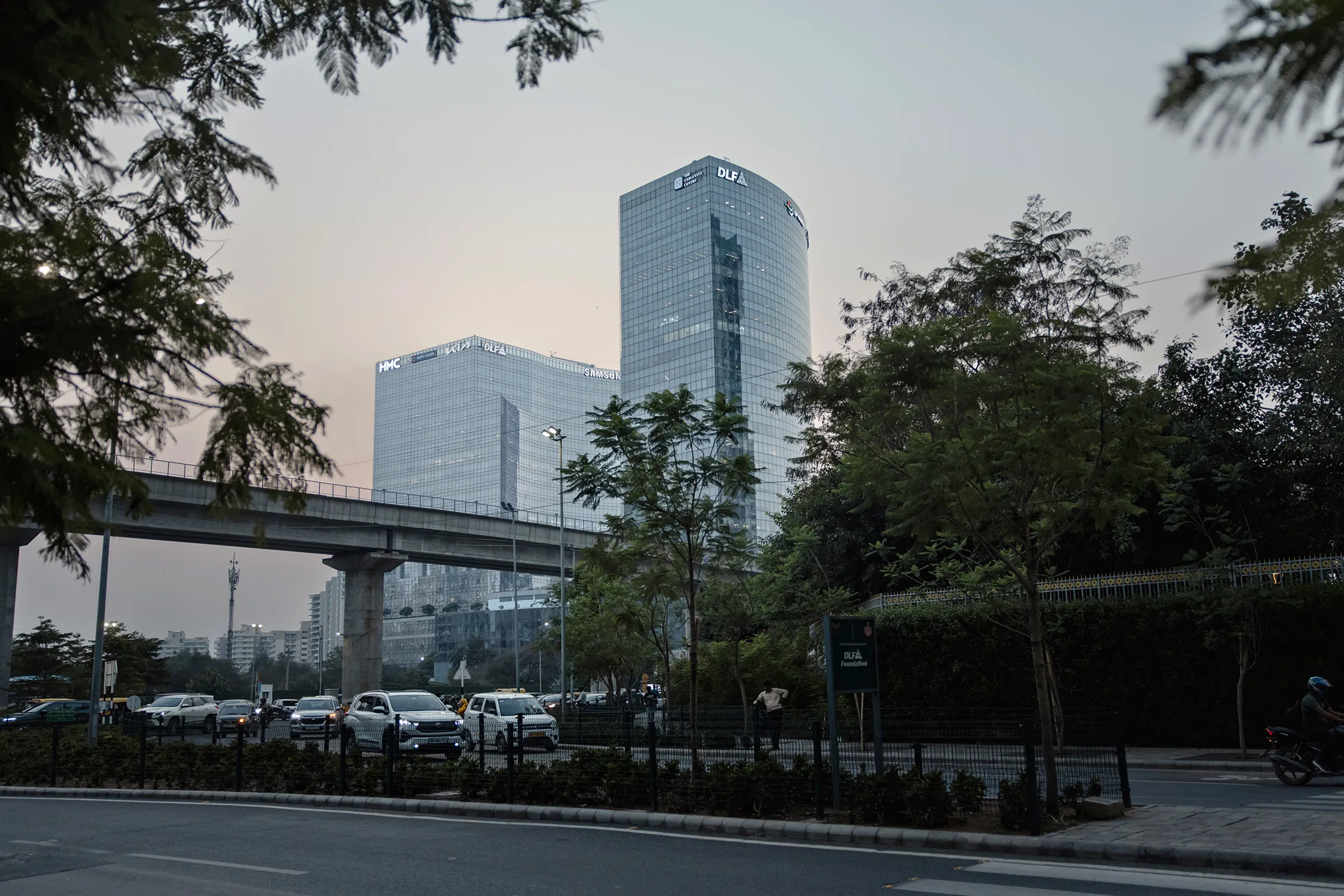
A cluster of trading giants operate out of a large curved tower called Two Horizon Center in Gurugram, India.
Photographer: Elke Scholiers/BloombergJane Street’s Cash Machine Comes to an Abrupt Halt in India
The punishment puts other high-frequency trading firms on notice.
Until late 2024, one of the most lucrative corners of global finance was a 24-story tower southwest of New Delhi.
Home to at least a half dozen high-speed trading firms, the blue-glass building with a rooftop helipad and a bronze bull sculpture in its plaza has been the center of a trading boom that made India the world’s biggest equity derivatives market by volume. Foreign funds and proprietary traders using algorithms made $7 billion in the 12 months to March 2024 alone.
That bonanza may be coming to an end. On Friday, nine months after the nation's securities regulator tightened restrictions on options trading to protect retail investors, it accused Jane Street Group — one of the market's biggest players — of manipulating prices to generate hundreds of millions of dollars in ill-gotten profits.
The Securities and Exchange Board of India imposed a temporary trading ban on Jane Street, an extraordinary move that became the talk of dealing rooms from New Delhi to Amsterdam. It also ordered the seizure of 48.4 billion rupees ($570 million) from the US trading giant, citing illegal gains from “an intentional, well-planned and sinister scheme.” Jane Street, which made more than $4 billion from India in just over two years, has disputed SEBI’s findings.
“SEBI’s action against Jane Street is a watershed moment,’’ said Sonam Srivastava, a fund manager at Wright Research. “It signals an aggressive stance against sophisticated global players potentially gaming the system.”
To be sure, high-speed trading firms often lumped together with Jane Street deploy a variety of strategies — from traditional market making and arbitrage to directional bets that can last from microseconds to days. The regulator’s punishment of Jane Street may nevertheless have a chilling effect on global trading firms that came to India with high ambitions. Jane Street, Citadel Securities, Jump Trading and Optiver had all beefed up local operations in recent years, attracted in part by the nation’s lucrative options market.
Even before SEBI’s latest announcement, several international market makers were mulling whether to proceed with planned hires and technology investments, or to put those plans on hold if their profit-making potential is severely crimped by regulatory risks. That’s according to executives at global trading firms and people familiar with their plans who asked not to be identified discussing confidential matters. The move is also expected to put a further damper on trading, which slumped 70% in the first five months of this year.
Read More: The Secret Behind Jane Street’s India Trades That Made Billions
News of the crackdown swept across global trading floors at the end of last week. Some speculated whether other foreign firms might also be in trouble, while chat groups and emails lit up at smaller trading rivals welcoming the move to rein in Jane Street. One Hong Kong trader said their phone was buzzing as soon as the headlines hit, with some people on the trading floor jumping for joy. Another trader in Amsterdam, whose phone went “haywire,” said it was a huge surprise, as they hadn’t expected SEBI to act.
Jane Street is one of the most active foreign players in India, and the punishment was far bigger than many expected, showing the regulator is serious about tamping down on questionable activity. After four years of unfettered market growth, officials have become uncomfortable with the outsized profits of international firms and sophisticated traders in the options market, especially given the massive losses suffered by retail investors on the other side of the trades.
“It's a landmark order” that puts all high-frequency traders on watch, said Anant Jatia, founder and chief investment officer of Mumbai-based Greenland Investment Management. The regulator sent a clear message, he said: “You are welcome in the market, but you’ve got to play by the rules.”
Jane Street inadvertently revealed just how lucrative the market had become during a high-profile court battle last year with hedge fund Millennium Asset Management. Jane Street’s billions in profits were a source of fascination for many market players, and prompted regulators to investigate its trades.
India is an ideal market for some popular forms of high-frequency trading, where firms make numerous rapid-fire trades each day, pocketing small amounts of money by exploiting market anomalies with little risk. These modest gains can accumulate into substantial profits.
The firms’ proponents say they play a vital role as market makers, helping price discovery by narrowing the bid-ask spread on trades, or the difference between the highest price a buyer is willing to pay and the lowest a seller is willing to accept.
Critics argue they use their technological advantages — such as having their own servers in data centers owned by stock exchanges — to front-run orders by retail and other investors. Sophisticated, computer-driven algorithms can also enable large firms to profit from small price fluctuations, or exploit erratic trading behavior among retail speculators.
India presents a unique opportunity given its market structure. The options market has high retail participation, in part because minimum trade sizes are relatively small, and bets can be made for as little as 12 cents. Options give their holders the right to buy or sell an asset — such as an individual stock or an index — at a specific price on or before a certain date. They enable traders to bet on the direction of stocks for a fraction of the cost of buying and selling the actual securities.
Speed traders currently account for about 60% of the trading volume in India’s equity derivatives market, where $3 trillion in notional value is traded daily, and close to 40% of the country’s stock trading, according to data from the National Stock Exchange of India. Their cumulative market share grew during and after the Covid-19 pandemic, when global giants including Jane Street and Citadel Securities ramped up trading.
“India is a bit of a victim of its own success,” said Theodore Morapedi, founder and CEO of Onyx Alpha Partners, a London-based recruitment firm that focuses on the quantitative finance sector. He said US and European high-frequency trading firms flocked to the country hoping to find exponential growth away from their crowded home markets.
All that success for global firms, however, has often come at the expense of small investors. Nine out of 10 individual traders have been losing money from derivatives trades, according to SEBI. The regulator released a research paper last September that said retail players lost the equivalent of $21 billion from futures and options in the three years to March 2024. It also said higher trading activity was associated with a higher percentage of loss makers.
Proprietary traders and foreign investors reliant on algorithms, on the other hand, made more than $7.3 billion in profits in just one financial year, the same study found.
Few made more than Jane Street, the secretive New York firm that was created in 2000 by several former Susquehanna International Group traders including Rob Granieri, who remains with the firm. Jane Street started by trading exchange-traded funds, but later branched out into high-frequency trading. It’s now a titan in that space, with net trading revenue of more than $20 billion last year, topping Bank of America Corp. and Citigroup Inc.
India accounted for more than 10% of revenue last year, showing how fast its business has grown. Jane Street’s position as a whale in the market came into the spotlight last year in its civil lawsuit against Millennium over the defection of two employees. The case, later settled, revealed that it earned $1 billion in 2023 from a secret and wildly successful options trading strategy. It did even better in 2024, generating more than $2.3 billion in net revenue, Bloomberg News recently reported.
Jane Street said in its suit that it had found a “tremendous potential opportunity” through its research and analysis of certain market signals and inefficiencies, which enabled it to “reliably predict future market activity.”
The regulator, though, said that Jane Street used its “immense trading, financial and technological prowess” to illegally manipulate markets. Its 105-page interim order alleged that the company, on weekly index options expiry days, used a large amount of funds to influence price action in the futures and cash market, taking advantage of relatively low volumes. That allowed it to put on significantly larger and profitable positions in the more liquid index options market by misleading a large number of individual traders, it said.
Its trades resulted in “massive profits for the manipulators, at the cost of other participants and retail investors,” SEBI said. And despite warnings from the regulator, alleged manipulative trades took place as recently as May. Jane Street “is not a good faith actor that can be, or deserves to be, trusted,’’ it said.
“The integrity of the market, and the faith of millions of small investors and traders, can no longer be held hostage to the machinations of such an untrustworthy actor,” the regulator said.
Jane Street will further engage with SEBI, a representative said. “Jane Street is committed to operating in compliance with all regulations in the regions we operate around the world,’’ it said. The company has 21 days to file a response.
Even before the order, some local traders blamed Jane Street for the regulatory clampdown, saying on social media and internet forums that it was causing too much volatility. Profits at some local trading houses and brokerages plunged in recent months. The overall share of colocation-based trading for Indian equity derivatives — a proxy for high-speed trading activity — is on track to decline this year for the first time since 2019.
“Jane Street showed that there’s a lot of money to be made in India, and has become the poster child of high-frequency trading,” said Sham Chandak, head of institutional equities at Elios Financial Services, a brokerage in Mumbai.
But Jane Street’s not the only player, and while many of its Indian traders operate out of Singapore and Hong Kong, the heartland for the rest of the high-frequency trading industry is in Gurugram, a satellite city about an hour’s drive from New Delhi.
There, a cluster of trading giants operates out of a large, curved tower called Two Horizon Center. The building is prized by multinational companies for its modern infrastructure, stable power supply and fine dining options. It sits across from a condominium complex where units can sell for north of $10 million.
Its tenants include billionaire Ken Griffin’s Citadel Securities, speed trading pioneer Tower Research Capital, and fast-growing local outfit Quadeye. Collectively, these and other trading companies have attracted more than 1,000 of India’s math whizzes, engineers and coding prodigies to this enclave.
Citadel Securities has more than 10 employees in the building who trade Indian equities and options. The Miami-headquartered firm’s India arm, which started operating in 2022, reported net income of 14.7 billion rupees for the year to March 2024. It recently hired a chief operating officer as well as a head of trading for the country, and said it was looking to expand its local team.
“We are committed to building a strong and long-lasting business in India that supports the continued growth and stability of the Indian financial markets,” said Vikesh Kotecha, head of Asia at Citadel Securities.
Tower, which opened in India in 2006, has more than 100 staff there, including a team that also does market making for cryptocurrencies, people familiar with the matter said. Homegrown Graviton Research Capital and Israeli firm Futures First also have offices in the building.
Prior to 2020, the state of Haryana, where Gurugram sits, imposed lower stamp duties on trading than in Mumbai. That made it financially advantageous for market makers and high-frequency trading firms to set up in the city.
The tax arbitrage no longer exists, but Gurugram remains a hub for local engineering and tech talent. Graduates can earn the equivalent of $50,000 in fixed pay a year at entry level, recruiters who work with the firms say. Senior staff can get as much as $3 million as well as large bonuses. Some employees at trading firms also enjoy lavish perks, such as $10,000-a-month party budgets for teams as small as four, according to people familiar with the matter.
On Friday morning, shortly after the SEBI order, a fire drill sent a crowd of employees spilling from Two Horizon Center. For some 30 minutes, several groups of traders and executives huddled outside the building debating Jane Street’s punishment — although none were willing to comment to a reporter.
High-frequency trading took off in India following the global financial crisis. The National Stock Exchange launched colocation services that enabled brokerages and trading firms to place their servers close to the bourse’s trade matching engine in Mumbai, giving them faster access to market data and enabling quicker trade execution. Firms founded by Indian engineering graduates and local market veterans dominated the automated trading landscape early on.
The latest wave of growth took place during the pandemic. Millions of retail investors swarmed into India’s options market when many people were stuck at home, and trading volumes surged. High-speed firms also expanded their trading activities in India during this period, with many doing so from offshore locations.
Options on stock indexes were especially popular. Before the rule changes last November, India’s stock exchanges had weekly options on major benchmarks like the Nifty 50 and Sensex that expired every trading day. They were preferred by retail investors who tried to make quick profits, though many also ended up losing money from them.
Now, weekly index options expire on two set days. SEBI has taken other steps, including raising minimum investment limits and curbing the availability of short-term contracts, causing trading volume to plunge. This month, it implemented a new way of calculating the value of options and futures outstanding to better gauge risk, despite backlash from several high-frequency trading firms.
The regulator isn't done yet and is looking to expand its probe to examine Jane Street's trades on other major stock indexes including NSE's flagship Nifty 50 and BSE Ltd.'s Sensex over the coming months, an official said. The question now is whether this and other measures represent the end of an era for the once-booming market.
“People were very excited because they felt the capital markets in India were conducive to creating opportunity for them, but obviously the tide has turned a bit,” said Morapedi at Onyx. “The regulatory headwinds have brought a lot of pessimism, and within some firms, there’s a view that maybe the best days are coming to an end.’’