Providing Quality Early Childhood Education and Care RESULTS FROM THE STARTING STRONG SURVEY 2018 提供优质的幼儿教育和护理 2018 年 STARTING STRONG 调查结果
TALIS 达利斯
Providing Quality Early Childhood Education and Care 提供优质的幼儿教育和护理
RESULTS FROM THE STARTING STRONG SURVEY 2018 2018 年 STARTING STRONG 调查结果
This work is published under the responsibility of the Secretary-General of the OECD. The opinions expressed and arguments employed herein do not necessarily reflect the official views of OECD member countries. 这项工作由经合组织秘书长负责出版。本文所表达的观点和采用的论点并不一定反映经合组织成员国的官方观点。
This document, as well as any data and any map included herein, are without prejudice to the status of or sovereignty over any territory, to the delimitation of international frontiers and boundaries and to the name of any territory, city or area. 本文件以及此处包含的任何数据和任何地图均不影响任何领土的地位或主权、国际边界和边界的划分以及任何领土、城市或地区的名称。
The statistical data for Israel are supplied by and under the responsibility of the relevant Israeli authorities. The use of such data by the OECD is without prejudice to the status of the Golan Heights, East Jerusalem and Israeli settlements in the West Bank under the terms of international law. 以色列的统计数据由以色列相关当局提供并由其负责。经合组织使用此类数据并不影响戈兰高地、东耶路撒冷和以色列在约旦河西岸定居点根据国际法条款的地位。
For many children, early childhood education and care (ECEC) is their first experience with other children and adults, away from their families. The promises of this experience are multiple. At this time of rapid brain development, children can play, learn new things and develop a range of skills and abilities. They can acquire a joy of learning, and they can make their first friends. Participation in ECEC also offers opportunities to detect and respond to children’s individual needs and to help all children to develop, building on their strengths. 对于许多儿童来说,幼儿教育和护理 (ECEC) 是他们第一次远离家人与其他儿童和成人相处。这种体验的前景是多方面的。在这个大脑快速发育的时期,孩子们可以玩耍、学习新事物并发展一系列技能和能力。他们可以获得学习的乐趣,他们可以结交他们的第一批朋友。参与 ECEC 还提供了发现和响应儿童个人需求的机会,并帮助所有儿童在他们的长处的基础上发展。
Thanks to extensive research and studies, we know that high-quality ECEC can turn these promises into reality. Research shows that a major contributor to children’s learning, development and well-being is the quality of the interactions children experience daily with staff and other children in ECEC centres (these interactions are known as process aspects of quality). Research also identifies several factors that can influence the quality of these interactions, from ECEC staff and the extent to which they are educated, trained and motivated to work with children, to elements of the classroom/playroom environment, such as the number of children and staff and the mechanisms for monitoring ECEC settings (these factors are known as structural aspects of quality). 得益于广泛的研究和研究,我们知道高质量的 ECEC 可以将这些承诺变为现实。研究表明,儿童学习、发展和福祉的一个主要因素是儿童每天与 ECEC 中心的工作人员和其他儿童的互动质量(这些互动被称为质量的过程方面)。研究还确定了几个可能影响这些互动质量的因素,从 ECEC 工作人员和他们接受教育、培训和激励与儿童一起工作的程度,到教室/游戏室环境的要素,例如儿童和工作人员的数量以及监控 ECEC 设置的机制(这些因素被称为质量的结构方面)。
But while research suggests that the education we receive in early childhood matters most for our lives, ECEC is the sector of education we know least about. We take it for granted that all children attend school, and school is paid for by the public purse in virtually every OECD country. But in the first years of life, enrolment varies greatly across countries, and some countries ask the youngest children to pay the highest fees, while they make university tuition-free. We have a clear picture of what children learn in school, as well as who their teachers are, what they do, how they are paid, and how they were educated. In contrast, the provision of ECEC is often fragmented, poorly regulated and patchy. 但是,虽然研究表明我们在幼儿时期接受的教育对我们的生活最重要,但 ECEC 是我们了解最少的教育部门。我们理所当然地认为所有儿童都上学,而几乎每个经合组织国家的学费都是由公共钱包支付的。但在生命的最初几年,各国的入学率差异很大,一些国家要求最小的孩子支付最高的费用,而他们却免下大学学费。我们清楚地了解孩子们在学校学习什么,以及他们的老师是谁,他们做什么,他们如何获得报酬,以及他们是如何接受教育的。相比之下,幼儿保育和教育的提供往往是分散的、监管不力的和零散的。
That is the gap the OECD Starting Strong Teaching and Learning International Survey (TALIS Starting Strong) seeks to fill. It is the first international survey that focuses on the workforce in ECEC. It reveals key characteristics of the ECEC workforce, the practices they use with children, their beliefs about children’s development and their views on the profession and on the ECEC sector. TALIS Starting Strong was designed to approximate quality through questions to staff and leaders of ECEC centres on major elements that, according to research, influence children’s learning, development and well-being. 这就是经合组织 (OECD) 的 Starting Strong 教学国际调查 (TALIS Starting Strong) 试图填补的空白。这是第一次关注 ECEC 劳动力的国际调查。它揭示了 ECEC 劳动力的主要特征、他们对儿童使用的做法、他们对儿童发展的信念以及他们对职业和 ECEC 部门的看法。TALIS Start Strong 旨在通过向 ECEC 中心的工作人员和领导提出问题来了解质量,根据研究,这些因素会影响儿童的学习、发展和福祉。
One of the most important findings is the relationship between pre-service and in-service education and training of staff, as well as their working conditions, and the practices staff use with children and parents. However, training specifically to work with children is not universal, and participation in professional development, while common, is not equal among staff. These findings point to the need for policies to better prepare and support staff in their daily activities and practices with children. 最重要的发现之一是工作人员的职前和在职教育和培训之间的关系,以及他们的工作条件,以及工作人员对儿童和父母使用的做法。然而,专门针对儿童工作的培训并不普遍,参与专业发展虽然普遍,但员工之间并不平等。这些发现表明,需要制定政策来更好地准备和支持工作人员的日常活动和与儿童相关的实践。
TALIS Starting Strong also shows great variation within countries in the factors related to the quality of interactions between staff and children. For instance, there are large variations within countries in the share of highly educated staff per centre. In centres with many children from socio-economically disadvantaged homes, enhanced services can help put all children on a level playing field, but few countries systematically provide such services. At the same time, there is little evidence that the allocation of human resources to TALIS Start Strong 还表明,各国内部在与教职员工和儿童之间的互动质量相关的因素方面存在很大差异。例如,每个中心受过高等教育的工作人员比例在国家内部存在很大差异。在有许多儿童来自社会经济弱势家庭的中心,加强服务可以帮助所有儿童处于公平的竞争环境中,但很少有国家系统地提供此类服务。与此同时,几乎没有证据表明将人力资源分配给
ECEC centres increases inequalities between centres with different geographical locations and child characteristics. 幼儿保育和教育中心加剧了具有不同地理位置和儿童特征的中心之间的不平等。
Finally, TALIS Starting Strong asks staff and leaders a number of key questions to learn about the major difficulties they face in their jobs. Staff are asked about the barriers they face to participation in professional development and their priorities for spending reallocation, and leaders are asked about the barriers to their effectiveness. Both staff and leaders are asked about their sources of stress. Answers to these questions converge to highlight a number of bottlenecks in the ECEC sector. Some of these bottlenecks are common to all participating countries. This is the case for staff absences and staff shortages, which appear as barriers to leaders’ effectiveness and to staff’s participation in professional development. According to staff, support to work with children with special needs appears as a top priority for both professional development and reallocation of spending. Reducing group size is another top priority for staff for reallocation of spending, while too many children in the group is a top source of stress. These findings point to the need for policy changes that governments are aware of, but such changes would involve trade-offs in situations of tight budget constraints. TALIS Starting Strong offers guidance that can help each participating country to identify priorities for policy change. 最后,TALIS Starting Strong 向员工和领导者提出了一些关键问题,以了解他们在工作中面临的主要困难。员工被问及他们在参与专业发展方面面临的障碍以及他们重新分配支出的优先事项,并询问领导者他们效率的障碍。员工和领导者都会被问及他们的压力来源。这些问题的答案汇集在一起,突出了 ECEC 领域的一些瓶颈。其中一些瓶颈是所有参与国共有的。员工缺勤和员工短缺就是这种情况,这似乎是领导者效率和员工参与专业发展的障碍。据工作人员称,支持与有特殊需要的儿童一起工作似乎是专业发展和重新分配支出的首要任务。减少小组规模是员工重新分配支出的另一个首要任务,而小组中太多的孩子是压力的首要来源。这些发现表明,政府需要改变政策,但这种改变将涉及在预算紧张的情况下进行权衡。“助教教育服务”提供指导,帮助每个参与国确定政策变革的重点。
In all countries, people care about children, especially young children. However, in most countries participating in the Survey, staff do not feel highly valued by society. Why do those who devote their time to do the best for children not feel more highly valued? Attracting and retaining a high-quality workforce is a challenge for all participating countries. 在所有国家,人们都关心儿童,尤其是幼儿。然而,在参与调查的大多数国家/地区,员工并不觉得自己受到社会的高度重视。为什么那些花时间为孩子做到最好的人不觉得自己更受重视呢?吸引和留住高素质劳动力是所有参与国面临的挑战。
In many countries, governments have done a lot to develop access to ECEC. But access is not enough; ECEC policies need to focus more on quality. TALIS Starting Strong reminds us that children’s early years are the foundation of their lives as students, adults and citizens. In the same way, it reminds us that ECEC policies need to be fully integrated with other policies that support economic growth and social inclusion. For children’s learning, development and well-being, every year counts. 在许多国家,政府为发展 ECEC 的普及做了大量工作。但访问是不够的;ECEC 政策需要更加注重质量。TALIS Starting Strong 提醒我们,儿童的早期生活是他们作为学生、成人和公民生活的基础。同样,它提醒我们,ECEC 政策需要与支持经济增长和社会包容的其他政策充分结合。对于儿童的学习、发展和福祉,每一年都很重要。
Andreas Schleicher, 安德烈亚斯·施莱歇尔,
Director for Education and Skills 教育和技能总监
Acknowledgements 确认
The OECD Starting Strong Teaching and Learning International Survey (TALIS Starting Strong) is the outcome of a collaboration among the participating countries, the OECD Secretariat and the International Association for the Evaluation of Educational Achievement (IEA) with its international consortium partners RAND Europe and Statistics Canada. 经合组织 Start Strong Teaching and Learning 国际调查 (TALIS Starting Strong) 是参与国、经合组织秘书处和国际教育成就评估协会 (IEA) 与其国际财团合作伙伴兰德欧洲和加拿大统计局合作的结果。
The development of this report was guided by Andreas Schleicher and Yuri Belfali and led by Stéphanie Jamet. The report built on preparatory work led by Arno Engel and was drafted by the OECD Early Childhood Education and Care team with co-ordination from Elizabeth Shuey. Stéphanie Jamet was the lead author of Chapter 1 and wrote Chapter 2 with Clara Barata (external consultant); Elizabeth Shuey was the lead author of Chapter 3; Arno Engel wrote Chapter 4 with Joana Cadima (external consultant); and Chapter 5 was co-authored by Victoria Liberatore and Théo Reybard. Statistical analyses and outputs were co-ordinated by Elisa Duarte and Francois Keslair with assistance from Luisa Kurth and Lorenz Meister. Victoria Liberatore was the lead author of Annex A. The initial survey development and implementation phase was led by Miho Taguma. 本报告的编写由 Andreas Schleicher 和 Yuri Belfali 指导,并由 Stéphanie Jamet 领导。该报告以 Arno Engel 领导的准备工作为基础,由经合组织幼儿教育和护理团队在 Elizabeth Shuey 的协调下起草。Stéphanie Jamet 是第 1 章的主要作者,并与 Clara Barata(外部顾问)一起撰写了第 2 章;Elizabeth Shuey 是第 3 章的主要作者;Arno Engel 与 Joana Cadima(外部顾问)一起撰写了第 4 章;第 5 章由 Victoria Liberatore 和 Théo Reybard 合著。统计分析和输出由 Elisa Duarte 和 Francois Keslair 协调,Luisa Kurth 和 Lorenz Meister 提供协助。Victoria Liberatore 是附录 A 的主要作者。最初的调查开发和实施阶段由 Miho Taguma 领导。
Mernie Graziotin supported report preparation, production, project co-ordination and communications with additional support from Leslie Greenhow. Cassandra Davis and Henri Pearson also provided support for report production and communications. Susan Copeland was the main editor of the report and Eleonore Morena was responsible for the layout. Additional editorial assistance was provided by Natalie Potter. The authors wish to thank members of the OECD Extended Early Childhood Education and Care Network on TALIS Starting Strong, National Project Managers, the international consortium, the Questionnaire Expert Group and Technical Advisory Group who all provided valuable feedback and input at various stages of the data and report production. Mernie Graziotin 在 Leslie Greenhow 的额外支持下支持报告准备、制作、项目协调和沟通。Cassandra Davis 和 Henri Pearson 还为报表制作和通信提供了支持。Susan Copeland 是报告的主要编辑,Eleonore Morena 负责布局。Natalie Potter 提供了额外的编辑帮助。作者要感谢经合组织 (OECD) 在 TALIS Start Strong 上扩展幼儿教育和护理网络的成员、国家项目经理、国际联盟、问卷专家组和技术咨询组,他们在数据和报告制作的各个阶段都提供了宝贵的反馈和意见。
The development of the report was steered by the OECD Extended ECEC Network, chaired by Bernhard Kalicki (Germany). 该报告的编写由经合组织 ECEC 扩展网络指导,由 Bernhard Kalicki(德国)担任主席。
The technical implementation of TALIS Starting Strong was contracted out to an international consortium of institutions and experts directed by Juliane Hencke (IEA) and co-directed by Steffen Knoll (IEA) with support from Alena Becker, Viktoria Böhm, Juliane Kobelt, Ann-Kristin Koop, Agnes Stancel-Piątak, David Ebbs and Jean Dumais (sampling referee). Design and development of the questionnaires were led by a Questionnaire Expert Group led by Julie Belanger (RAND Europe), and an independent Technical Advisory Group provided guidance on the technical aspects of the survey. We would like to gratefully acknowledge the contribution to TALIS Starting Strong of the late Fons van de Vijver, who was Chair of the Technical Advisory Group. TALIS Starting Strong 的技术实施外包给一个由机构和专家组成的国际联盟,该联盟由 Juliane Hencke (IEA) 指导,由 Steffen Knoll (IEA) 共同指导,并得到了 Alena Becker、Viktoria Böhm、Juliane Kobelt、Ann-Kristin Koop、Agnes Stancel-Piątak、David Ebbs 和 Jean Dumais(抽样裁判)的支持。问卷的设计和开发由 Julie Belanger (RAND Europe) 领导的问卷专家组领导,独立的技术咨询小组就调查的技术方面提供指导。我们衷心感谢已故技术咨询小组主席 Fons van de Vijver 对 TALIS Starting Strong 的贡献。
Annex E of this report lists the various institutions and individuals that contributed to TALIS Starting Strong. 本报告的附件 E 列出了为 TALIS Strong Start Strong 做出贡献的各种机构和个人。
Table of contents 目录
Foreword … 3 前言。。。3
Acknowledgements … 5 确认。。。5
Reader’s guide … 12 读者指南 ...12
Executive summary … 19 摘要。。。19
What is TALIS Starting Strong? … 22 什么是 TALIS Beginning Strong?…22
1 Policy implications of the 2018 Starting Strong Teaching and Learning International Survey … 26 1 2018 年“开始强大的教学与学习”国际调查的政策影响......26
Children in early childhood education and care centres … 28 幼儿教育和看护中心的儿童......28
Ensuring quality of early childhood education and care systems: Policy implications … 31 确保幼儿教育和保育系统的质量:政策影响 ...31
References … 50 引用。。。50
2 Interactions between children, staff and parents/guardians in early childhood education and care centres … 51 2 幼儿教育和看护中心的儿童、工作人员和家长/监护人之间的互动 ...51
Introduction … 53 介绍。。。53
Insights from research and policy evidence … 53 来自研究和政策证据的见解......53
Supporting children’s learning, development and well-being through practices … 56 通过实践支持儿童的学习、发展和福祉......56
Engaging with parents and guardians … 68 与父母和监护人互动......68
Process quality in TALIS Starting Strong … 72 TALIS 的流程质量 Starting Strong ...72
Professional beliefs … 75 专业信念 ...75
The organisation of activities with a group of children … 79 与一群孩子一起组织活动......79
Equity and diversity: beliefs and practices … 84 公平和多样性:信念和实践 ...84
Conclusion and policy implications … 92 结论和政策影响 ...92
References … 93 引用。。。93
3 Teachers, assistants and leaders and the quality of early childhood education and care … 98 3 教师、助理和领导以及幼儿教育和护理的质量......98
Introduction … 100 介绍。。。100
Findings from the literature on the early childhood education and care workforce and process quality … 100 关于幼儿教育和护理劳动力和过程质量的文献结果......100
Workforce composition and pre-service training … 102 员工构成和职前培训 ...102
Workforce professional development: Needs and content, barriers and support … 110 劳动力专业发展:需求和内容、障碍和支持......110
Working conditions for early childhood education and care staff … 117 幼儿教育和护理人员的工作条件......117
The relationship between process quality, professional development and working conditions … 123 过程质量、职业发展和工作条件之间的关系......123
Leaders in early childhood education and care centres … 125 幼儿教育和护理中心的领导者......125
Equity focus: Staff in target groups … 129 公平重点:目标群体中的员工 ...129
Conclusion and policy implications … 129 结论和政策影响 ...129
References … 131 引用。。。131
4 Structural features of early childhood education and care centres and quality … 135 4 幼儿教育和保育中心的结构特征和质量135
Introduction … 137 介绍。。。137
Insights from research and policy evidence … 137 来自研究和政策证据的见解......137
The place of early childhood education and care centres … 140 幼儿教育和护理中心的所在地 ...140
Characteristics and number of children in early childhood education and care centres … 145 幼儿教育和看护中心的儿童特征和数量 ...145
Equity of early childhood education and care centres … 170 幼儿教育和护理中心的公平性 ...170
Conclusion and policy implications … 174 结论和政策影响 ...174
References … 175 引用。。。175
5 Governance, funding and the quality of early childhood education and care … 181 5 幼儿教育和保育的治理、资金和质量 ...181
Introduction … 183 介绍。。。183
Insights from research and policy evidence … 184 来自研究和政策证据的见解......184
Funding of the ECEC sector … 186 为 ECEC 部门提供资金 ...186
Governance of the ECEC sector … 193 ECEC 部门的治理 ...193
Characteristics of publicly and privately managed ECEC centres … 204 公共和私人管理的幼儿保育和教育中心的特点 ...204
The relationship between aspects of governance and funding and process quality … 210 治理和资金方面与流程质量之间的关系......210
Governance and equity … 212 治理和公平 ...212
Conclusion and policy implications … 213 结论和政策影响 ...213
References … 215 引用。。。215
Annex A. Country profiles of early childhood education and care systems … 218 附件 A. 幼儿教育和保育系统的国家概况 ...218
Chile … 219 智利。。。219
Denmark … 223 丹麦。。。223
Germany … 226 德国。。。226
Iceland … 231 冰岛。。。231
Israel … 234 以色列。。。234
Japan … 237 日本。。。237
Korea … 240 韩国。。。240
Norway … 243 挪威。。。243
Turkey … 246 土耳其。。。246
References … 250 引用。。。250
Annex B. Technical notes on sampling procedures, response rates and adjudication for TALIS Starting Strong 2018 … 251 附件 B. 关于 TALIS 2018 年强劲启动的抽样程序、回复率和裁决的技术说明......251
Sampling procedures and response rates … 251 抽样程序和响应率 ...251
Sample size requirements … 252 样本量要求 ...252
Adjudication process … 252 评审过程 ...252
Notes regarding use and interpretation of the data … 254 关于数据使用和解释的说明 ...254
Reference … 256 参考。。。256
Note … 256 注意。。。256
Annex C. Technical notes on analyses in this report … 257 附件 C. 关于本报告分析的技术说明......257
Use of staff and centre weights … 257 使用杆和中心配重 ...257
Standard errors and significance tests … 257 标准误差和显著性检验 ...257
Use of complex variables … 258 使用复杂变量 ...258
Assessing process quality in TALIS Starting Strong … 259 评估 TALIS 的流程质量 Start Strong ...259
Statistics based on regressions … 261 基于回归的统计数据 ...261
Pearson correlation coefficient … 263 皮尔逊相关系数 ...263
International averages … 263 国际平均水平 ...263
Reference … 263 参考。。。263
Annex D. List of tables available on line … 264 附件 D. 网上提供的表格列表......264
Annex E. List of TALIS Starting Strong 2018 contributors … 268 附件 E. 2018 年 TALIS 强劲贡献者名单 ...268
List of National TALIS Starting Strong 2018 Contributors … 269 2018 年全国 TALIS 起步强劲贡献者名单 ...269
OECD Secretariat … 271 经合组织秘书处 ...271
TALIS Starting Strong expert groups … 272 TALIS Starting Strong 专家组 ...272
TALIS Starting Strong Consortium … 273 达利信成立强大联盟 ...273
Tables 表
Table 1.1. Data overview: Staff’s practices and working conditions … 46 表 1.1.数据概述:员工的做法和工作条件 ...46
Table 1.2. Data overview: Equity, governance and funding … 48 表 1.2.数据概述:公平、治理和融资 ...48
Table 2.1. Top three practices to support literacy, numeracy and language development … 60 表 2.1.支持识字、算术和语言发展的三大做法......60
Table 2.2. Top three practices to support socio-emotional development … 61 表 2.2.支持社会情感发展的三大做法......61
Table 2.3. Top three practices for behavioural support … 62 表 2.3.行为支持的三大做法......62
Table 2.4. Top three adaptive practices … 63 表 2.4.三大适应性实践......63
Table 2.5. Top three practices used by staff in a concrete daily work situation to support prosocial behaviour … 65 表 2.5.员工在具体的日常工作情境中用来支持亲社会行为的前三种做法......65
Table 2.6. Top three practices used by staff in a concrete daily work situation to support child-directed play … 66 表 2.6.员工在具体的日常工作情境中支持儿童导向游戏的三大做法......66
Table 2.7. Indicators of process quality developed in TALIS Starting Strong … 74 表 2.7.TALIS 开发的流程质量指标 Starting Strong ...74
Table 2.8. Relationship between and within dimensions of process quality … 75 表 2.8.过程质量维度之间和内部的关系 ...75
Table 2.9. Top three staff beliefs about skills and abilities that will prepare children for life in the future … 76 表 2.9.员工对技能和能力的三大信念将为孩子们的未来生活做好准备......76
Table 3.1. Top three professional development needs … 112 表 3.1.三大专业发展需求 ...112
Table 3.2. Top three content areas covered by professional development in the past year … 113 表 3.2.过去一年专业发展涵盖的前三个内容领域...113
Table 4.1. Context of countries’ early childhood education and care settings … 148 表 4.1.各国幼儿教育和照料环境的背景......148
Table 4.2. Relationship between process quality practices and centre characteristics … 163 表 4.2.过程质量实践与中心特征之间的关系 ...163
Table 4.3. Difference in percentage of centres with 11%11 \% of more children from socio-economically disadvantaged homes, by centre characteristics … 171 表 4.3.按中心特征划分,来自社会经济弱势家庭的儿童较多的中心 11%11 \% 百分比的差异 ...171
Table 5.1. Top three staff spending priorities … 192 表 5.1.三大员工支出优先事项 ...192
Table 5.2. Highest administrative authorities in charge of ECEC settings … 193 表 5.2.负责 ECEC 设置的最高行政机构 ...193
Table 5.3. Regulations and standards for early childhood settings … 195 表 5.3.幼儿环境的规定和标准......195
Table 5.4. Top three barriers to leaders’ effectiveness … 200 表 5.4.领导者有效性的三大障碍......200
Table 5.5. Top three sources of stress for ECEC centre leaders … 201 表 5.5.ECEC 中心领导的三大压力来源......201
Table 5.6. Summary of findings on differences between public and private ECEC centres … 205 表 5.6.公共和私营幼儿保育和教育中心差异的调查结果摘要 ...205
Table A A.1. Overview of early childhood education and care system-level indicators in Chile … 222 表 A A.1.智利幼儿教育和照料系统层面指标概述 222
Table A A.2. Overview of early childhood education and care system-level indicators in Denmark … 225 表 A A.2.丹麦幼儿教育和照料系统层面指标概述 225
Table A A.3. Overview of early childhood education and care system-level indicators in Germany … 229 表 A A.3.德国幼儿教育和照料系统层面指标概览 ...229
Table A A.4. Overview of early childhood education and care system-level indicators in Iceland … 233 表 A A.4.冰岛 幼儿教育和照料系统层面指标概述 ...233
Table A A.5. Overview of early childhood education and care system-level indicators in Israel … 236 表 A A.5.以色列幼儿教育和照料系统层面指标概述 236
Table A A.6. Overview of early childhood education and care system-level indicators in Japan … 239 表 A A.6.日本幼儿教育和照料系统层面指标概述 ...239
Table A A.7. Overview of early childhood education and care system-level indicators in Korea … 242 表 A A.7.韩国幼儿教育和照料系统层面指标概述 ...242
Table A A.8. Overview of early childhood education and care system-level indicators in Norway … 245 表 A A.8.挪威幼儿教育和照料系统层面指标概述 245
Table A A.9. Overview of early childhood education and care system-level indicators in Turkey … 249 表 A A.9.土耳其幼儿教育和照育系统层面指标概述 ...249
Table A B.1. Adjudication rules for centre or centre leader data in TALIS Starting Strong 2018 … 253 表 A B.1.TALIS 中中心或中心领导者数据的裁定规则 2018 年强劲开始 ...253
Table A B.2. Adjudication rules for staff data in TALIS Starting Strong 2018 … 253 表 A B.2.TALIS 2018 年强势起步 中员工数据的裁定规则 ...253
Table A B.3. Services for children under age 3: Centre leader participation rates and recommended ratings … 255 表 A B.3.为 3 岁以下儿童提供的服务:中心领导参与率和推荐评级 ...255
Table A B.4. Services for children under age 3: Staff participation rates and recommended ratings … 255 表 A B.4.为 3 岁以下儿童提供的服务:员工参与率和推荐评级 ...255
Table A B.5. Pre-primary education (ISCED level 02): Centre leader participation rates and recommended ratings … 256 表 A B.5.学前教育 (《国际教育标准分类法》02 级):中心领导参与率和推荐评级 ...256
Table A B.6. Pre-primary education (ISCED level 02): Staff participation rates and recommended ratings … 256 表 A B.6.学前教育 (《国际教育标准分类法》02 级):工作人员参与率和推荐评级 ...256
Figures 数字
Figure 1.1. Framework for the analysis of the quality of ECEC environments in TALIS Starting Strong 28 图 1.1.TALIS 中 ECEC 环境质量分析框架 Starting Strong 28
Figure 1.2. Enrolment in early childhood education and care, 201729 图 1.2.幼儿教育和保育入学率,201729
Figure 2.1. Framework for the analysis of practices affecting children’s learning, development and well-being in TALIS Starting Strong 图 2.1.影响 TALIS 儿童学习、发展和福祉的实践分析框架 Start Strong
Figure 2.2. Practices facilitating language, literacy, numeracy and socio-emotional development 58 图 2.2.促进语言、识字、算术和社会情感发展的实践 58
Figure 2.3. Practices for group organisation and individual support to children 59 图 2.3.为儿童提供团体组织和个人支持的做法 59
Figure 2.4. Stated goals in the curriculum framework 59 图 2.4.课程框架中的既定目标 59
Figure 2.5. Gap in the use of practices facilitating numeracy and socio-emotional development 64 图 2.5.在利用促进计算能力和社会情感发展的实践方面的差距 64
Figure 2.6. Practices used by staff to facilitate engagement of parents or guardians 68 图 2.6.工作人员为促进家长或监护人参与而采取的做法 68
Figure 2.7. Activities provided by the centre to facilitate engagement of parents or guardians 69 图 2.7.中心为促进家长或监护人的参与而举办的活动 69
Figure 2.8. Inclusion of families in the curriculum framework 70 图 2.8.将家庭纳入课程框架 70
Figure 2.9. Opportunities for children’s participation in decisions 72 图 2.9.儿童参与决策的机会 72
Figure 2.10. Dimensions of process quality covered by TALIS Starting Strong 73 图 2.10.TALIS Starting Strong 73 涵盖的流程质量维度
Figure 2.11. Beliefs of leaders and staff about skills and abilities that will prepare children for life in the future 77 图 2.11.领导和员工对为儿童未来生活做好准备的技能和能力的信念 77
Figure 2.12. Relationship between beliefs on 21st century skills and practices facilitating socio-emotional development at the centre level 图 2.12.对 21 世纪技能和实践的信念之间的关系促进了中心层面的社会情感发展
Figure 2.13. Relationship between beliefs on foundational cognitive skills and practices to facilitate literacy and numeracy development at the centre level 79 图 2.13.对基本认知技能的信念与促进中心阶段识字和算术发展的实践之间的关系 79
Figure 2.14. Number of children and staff working with the same target group on the same day 80 图 2.14.在同一天与同一目标群体一起工作的儿童和工作人员人数 80
Figure 2.15. Average number of staff per ten children working with the same target group on the same day 82 图 2.15.在同一天与同一目标群体一起工作的每 10 名儿童的平均员工人数 82
Figure 2.16. Adapting practices to differences in the size of the group of children 84 图 2.16.根据儿童群体规模的差异调整做法 84
Figure 2.17. Group concentration of children from socio-economically disadvantaged homes 85 图 2.17.来自社会经济弱势家庭的儿童群体集中 85
Figure 2.18. Group concentration of children whose first language is different from the language(s) used in the centre 87 图 2.18.第一语言与中心使用的语言不同的儿童群体集中度 87
Figure 2.19. Group concentration of children with special needs 88 图 2.19.有特殊需要儿童的群体集中度 88
Figure 2.20. Adapting activities to differences in children’s cultural background 89 图 2.20.根据儿童文化背景的差异调整活动 89
Figure 2.21. Beliefs about multicultural and diversity approaches in the centres 90 图 2.21.对中心多元文化和多样性方法的信念 90
Figure 2.22. Multicultural and diversity approaches used in daily interactions with children 91 图 2.22.在与儿童的日常互动中使用的多元文化和多样性方法 91
Figure 3.1. The relationship between the workforce and process quality in TALIS Starting Strong 102 图 3.1.TALIS Starting Strong 102 中员工与流程质量之间的关系
Figure 3.2. Characteristics of early childhood education and care staff 103 图 3.2.幼儿教育和护理人员的特点 103
Figure 3.3. Educational attainment of staff and content of pre-service training 104 图 3.3.工作人员的教育程度和职前培训内容 104
Figure 3.4. Educational attainment of teachers and assistants and content of pre-service training 105 图 3.4.教师和助理的教育程度和职前培训的内容 105
Figure 3.5. Content of pre-service training to work with children 107 图 3.5.儿童工作岗前培训内容 107
Figure 3.6. Strength of association between staff use of adaptive practices and their training specifically to work with children 109 图 3.6.工作人员使用适应性实践与其专门针对儿童工作的培训之间的关联强度 109
Figure 3.7. Participation in professional development activities by pre-service educational attainment 111 图 3.7.按职前教育程度参加专业发展活动 111
Figure 3.8. Barriers to participation in professional development 114 图 3.8.参与专业发展的障碍 114
Figure 3.9. Support for participation in professional development 116 图 3.9.支持参与专业发展 116
Figure 3.10. Participation in professional development activities by support received 116 图 3.10.获得资助的参与专业发展活动 116
Figure 3.11. Staff contractual status and working hours 117 图 3.11.员工合同状态和工作时间 117
Figure 3.12. Labour force contractual status and working hours 118 图 3.12.劳动合同工状况和工作时间 118
Figure 3.13. Strength of association between participation in professional development and contractual status 119 图 3.13.参与专业发展与合同状态之间的关联强度 119
Figure 3.14. Staff sources of work-related stress 120 图 3.14.员工与工作相关的压力来源 120
Figure 3.15. Staff feelings of being valued by children, families and society 121 图 3.15.员工被儿童、家庭和社会重视的感受 121
Figure 3.16. Most likely reasons to leave the ECEC staff role 121 图 3.16.离开 ECEC 工作人员职位的最可能原因 121
Figure 3.17. Pre-primary staff statutory salaries at different points in staff careers (2018) 122 图 3.17.学前班员工在员工职业生涯不同阶段的法定薪金(2018 年) 122
Figure 3.18. Strength of association between use of adaptive practices and working hours 124 图 3.18.使用适应性做法与工作时间之间的关联强度 124
Figure 3.19. Leaders’ characteristics 126 图 3.19.领导者特征 126
Figure 3.20. Elements included in leaders’ formal education 127 图 3.20.领导者正规教育的要素 127
Figure 3.21. Sources of work-related stress for early childhood education and care leaders 128 图 3.21.幼儿教育和护理领导者的工作相关压力来源 128
Figure 3.22. Leaders’ job satisfaction 128 图 3.22.领导者的工作满意度 128
Figure 4.1. Framework for the analysis of centre characteristics associated with practices and process quality in TALIS Starting Strong 137 图 4.1.TALIS 中与实践和流程质量相关的中心特征分析框架 Starting Strong 137
Figure 4.2. Early childhood education and care centre in rural and urban areas 141 图 4.2.农村和城市地区的幼儿教育和护理中心 141
Figure 4.3. The neighbourhood of early childhood education and care centres 142 图 4.3.幼儿教育和护理中心附近 142
Figure 4.4. Locations and buildings of early childhood education and care centres 143 图 4.4.幼儿教育和看护中心的位置和建筑 143
Figure 4.5. Size of early childhood education and care centres 146 图 4.5.幼儿教育及护理中心的规模 146
Figure 4.6. Pre-primary education centres serving younger children 147 图 4.6.为幼儿服务的学前教育中心 147
Figure 4.7. Concentration in centres of children from socio-economically disadvantaged homes 149 图 4.7.来自社会经济弱势家庭的儿童集中在中心 149
Figure 4.8. Percentage of 15-year-old students who had attended preschool for two years or more, by socioeconomic status 152 图 4.8.按社会经济地位分列,上过两年或两年学前班的 15 岁学生的百分比 152
Figure 4.9. Concentration in centres of children with different characteristics 153 图 4.9.集中于具有不同特征的儿童中心 153
Figure 4.10. Human resources in centres 154 图 4.10.中心人力资源 154
Figure 4.11. Average number of staff and children in centres 156 图 4.11.中心工作人员和儿童的平均人数 156
Figure 4.12. Number of staff per ten children in centres, by centre characteristics 158 图 4.12.中心每 10 名儿童的工作人员人数,按中心特征分列 158
Figure 4.13. Number of staff per ten children in centres, according to centre size 159 图 4.13.中心每 10 名儿童的工作人员人数,根据中心规模 159
Figure 4.14. Staff’s educational attainment, by centre characteristics 160 图 4.14.按中心特色分列的工作人员受教育程度 160
Figure 4.15. Share of staff leaving their early childhood education and care centres 161 图 4.15.离开幼儿教育和看护中心的工作人员比例 161
Figure 4.16. Communication with staff/leaders from other centres, by centre characteristics 165 图 4.16.与其他中心的工作人员/领导的沟通,按中心特点 165
Figure 4.17. Communication between pre-primary centres and primary school teachers 167 图 4.17.学前教育中心与小学教师之间的沟通 167
Figure 4.18. Transition practices by centre characteristics: Hold meetings with primary school staff 168 图 4.18.按中心特点划分的过渡做法: 与小学教职员工举行会议 168
Figure 4.19. Transition practices by centre characteristics: Provide activities for parents or guardians to understand transition issues, by centre characteristics 169 图 4.19.按中心特点划分的过渡做法: 按中心特征为家长或监护人提供了解过渡问题的活动 169
Figure 4.20. Staff use of diversity practices, by characteristics of children in the centre 173 图 4.20.按中心儿童的特点分列,工作人员采用多元化做法 173
Figure 5.1. TALIS Starting Strong framework for the analysis of aspects of governance and funding affecting children’s development 183 图 5.1.TALIS 起步 分析影响儿童发展的治理和资金方面的强大框架 183
Figure 5.2. Sources of funding for ECEC centres 186 图 5.2.幼儿保育和教育中心的资金来源 186
Figure 5.3. Distribution of public and private expenditure on ECEC settings in pre-primary education (2016) 187 图 5.3.学前教育中幼儿保育和教育机构的公共和私人支出分配情况(2016 年) 187
Figure 5.4. Exclusively government-funded centres in the public and private sectors 189 图 5.4.公共和私营部门的政府专门资助中心 189
Figure 5.5. Expenditure on early childhood educational development (ISCED 01) and pre-primary education (ISCED 02) 189 图 5.5.幼儿教育发展 (ISCED 01) 和学前教育 (ISCED 02) 的支出 189
Figure 5.6. Change in expenditure on pre-primary education (ISCED 02) as a percentage of GDP 190 图 5.6.学前教育支出(国际教育标准分类法 02)占国内生产总值的百分比变化 190
Figure 5.7. Annual expenditure on early childhood educational institutions per child (2016) 191 图 5.7.每名儿童每年在幼儿教育机构方面的支出(2016 年) 191
Figure 5.8. Responsibilities of centre leaders, governing boards and administrative authorities 198 图 5.8.中心领导、理事会和行政当局的职责 198
Figure 5.9. Share of publicly and privately managed centres in ECEC 202 图 5.9.ECEC 中公共和私人管理中心的份额 202
Figure 5.10. Responsibilities of leaders and/or other staff in publicly and privately managed pre-primary centres 206 图 5.10.公立和私立学前教育中心的领导和/或其他工作人员的责任 206
Figure 5.11. Staff educational attainment in publicly and privately managed ECEC centres 207 图 5.11.公立和私立幼儿保育和教育中心的工作人员受教育程度 207
Figure 5.12. Number of staff per ten children in publicly and privately managed ECEC centres 208 图 5.12.公立和私立幼儿保育中心每10名儿童的工作人员人数 208
Figure 5.13. Lack of support for professional development in publicly and privately managed ECEC centres 209 图 5.13.公共和私营管理的幼儿保育和教育中心缺乏对专业发展的支持 209
Figure 5.14. Geographical location of public and private centres 210 图 5.14.公共和私人中心的地理位置 210
Figure 5.15. Percentage of ECEC centres serving 11% or more of children with a different first language, by centre management 212 图 5.15.按中心管理层分列的幼儿保育和教育中心为 11% 或以上具有不同第一语言的儿童提供服务的百分比 212
Figure 5.16. Percentage of ECEC centres serving 11% or more children from socio-economically disadvantaged homes, by centre management 213 图 5.16.按中心管理层分列的为 11% 或以上来自社会经济弱势家庭的儿童提供服务的幼儿保育和教育中心的百分比 213
Figure A A.1. Organisation of the early childhood education and care system in Chile 220 图 A A.1.智利幼儿教育和照料系统的组织 220
Figure A A.2. Organisation of the early childhood education and care system in Denmark 223 图 A A.2.丹麦幼儿教育和照料系统的组织 223
Figure A A.3. Organisation of the early childhood education and care system in Germany 227 图 A A.3.德国幼儿教育和保育系统的组织 227
Figure A A.4. Organisation of the early childhood education and care system in Iceland 231 图 A A.4.冰岛幼儿教育和护理系统的组织 231
Figure A A.5. Organisation of the early childhood education and care system in Israel 234 图 A A.5.以色列幼儿教育和照料系统的组织 234
Figure A A.6. Organisation of the early childhood education and care system in Japan 238 图 A A.6.日本幼儿教育和护理系统的组织 238
Figure A A.7. Organisation of the early childhood education and care system in Korea 240 图 A A.7.韩国幼儿教育和护理系统的组织 240
Figure A A.8. Organisation of the early childhood education and care system in Norway 243 图 A A.8.挪威幼儿教育和保育系统的组织 243
Figure A A.9. Organisation of the early childhood education and care system in Turkey 247 图 A A.9.土耳其幼儿教育和照料系统的组织 247
Look for the StatLinks any at the bottom of the tables or graphs in this book. To download the matching Excel® spreadsheet, just type the link into your Internet browser, starting with the http://dx.doi.org prefix, or click on the link from the e-book edition. 在本书的表格或图表底部查找 StatLinks any。要下载匹配的 Excel® 电子表格,只需在 Internet 浏览器中键入链接,以 http://dx.doi.org 开头,或单击电子书版本中的链接。
Reader's guide 读者指南
The OECD Starting Strong Teaching and Learning International Survey (TALIS Starting Strong) is the first international survey that focuses on the workforce in early childhood education and care (ECEC). The results referred to in this volume can be found in Annex DD and through OECD StatLinks at the bottom of the tables and figures throughout the report. 经合组织 (OECD) 的 Starting Strong Teaching and Learning 国际调查 (TALIS Starting Strong) 是首个关注幼儿教育和护理 (ECEC) 劳动力的国际调查。本卷中提到的结果可以在附件 DD 中找到,也可以通过整个报告表格和数字底部的 OECD StatLinks 找到。
Country coverage 国家/地区覆盖
This publication features results from staff and leaders who provide early childhood education and care (ECEC) in pre-primary settings (ISCED level 02) in nine countries (Chile, Denmark, Germany, Iceland, Israel, Japan, Korea, Norway, and Turkey), as well as from staff and leaders who provide ECEC to children under age 3 in four countries (Denmark, Germany, Israel and Norway). 本出版物收录了 9 个国家(智利、丹麦、德国、冰岛、以色列、日本、韩国、挪威和土耳其)学前教育和照育 (ECEC) 的工作人员和领导的结果,以及 4 个国家(丹麦、德国、以色列和挪威)为 3 岁以下儿童提供 ECEC 的工作人员和领导的结果。
In the tables throughout the report, countries are ranked in alphabetical order, with one exception: countries that did not meet the standards on TALIS Starting Strong participation rates are placed at the bottom of the tables. Similarly, countries that did not meet the standards on TALIS Starting Strong participation rates are not shown in any figures presenting results of the Survey. 在整份报告的表格中,各国按字母顺序排列,但有一个例外:未达到 TALIS Start-Strong 参与率标准的国家位于表格底部。同样,未达到 TALIS Start-Strong 参与率标准的国家,也不会显示在显示调查结果的任何数字中。
One note applies to the information on data for Israel: 有一点适用于以色列的数据信息:
The statistical data for Israel are supplied by and under the responsibility of the relevant Israeli authorities. The use of such data by the OECD is without prejudice to the status of the Golan Heights, East Jerusalem and Israeli settlements in the West Bank under the terms of international law. 以色列的统计数据由以色列相关当局提供并由其负责。经合组织使用此类数据并不影响戈兰高地、东耶路撒冷和以色列在约旦河西岸定居点根据国际法条款的地位。
Classification of levels of ECEC and the TALIS Starting Strong sample ECEC 和 TALIS Starting Strong 样本水平的分类
The classification of ECEC settings as pre-primary or serving children under age 3, as well as the other levels of education described in the volume, is based on the International Standard Classification of Education (ISCED). ISCED is an instrument for compiling statistics on education internationally. ISCED2011 is the basis of the levels presented in this publication. It distinguishes the following levels of education: 将 ECEC 环境分类为学前儿童或 3 岁以下在职儿童,以及本卷中描述的其他教育水平,均基于国际教育标准分类 (ISCED)。《国际教育标准分类法》是编制国际教育统计数据的工具。ISCED2011 是本出版物中介绍的级别的基础。它区分了以下教育级别:
early childhood education (ISCED level 0) 幼儿教育 (《国际教育标准分类法》0 级)
early childhood educational development (ISCED level 01) 早期儿童教育发展 (《国际教育标准分类法》01 级)
bachelor’s or equivalent (ISCED level 6) 学士或等同 (《国际教育标准分类法》6 级)
master’s or equivalent (ISCED level 7) 硕士或等同 (《国际教育标准分类法》7 级)
doctoral or equivalent (ISCED level 8). 博士或等同物(《国际教育标准分类法》8 级)。
Within early childhood education (ISCED level 0), settings classified under ISCED-2011 have an intentional educational component and aim to develop cognitive, physical and socio-emotional skills necessary for participation in school and society. Programmes at this level are often differentiated by age, with early childhood educational development serving children under age 3 and pre-primary education serving children from age 3 until entry to primary school. Pre-primary settings in TALIS Starting Strong meet the ISCED-2011 definition for ISCED level 02. Settings serving children under age 3 in TALIS Starting Strong were not required to meet the ISCED-2011 definition for ISCED level 01. 在幼儿教育(《国际教育标准分类法》0 级)中,归类为 ISCED-2011 的设置具有有意识的教育成分,旨在发展参与学校和社会所必需的认知、身体和社会情感技能。这一级别的计划通常按年龄进行区分,幼儿教育发展服务于 3 岁以下儿童,学前教育服务于 3 岁以下儿童直至进入小学。TALIS Starting Strong 中的学前教育设置符合 ISCED-2011 对 ISCED 02 级的定义。在 TALIS Starting Strong 中为 3 岁以下儿童服务的设置不需要满足 ISCED-2011 对 ISCED 01 级的定义。
Despite the distinction made by ISCED-2011 within ISCED level 0, many countries, including several participating in TALIS Starting Strong, offer an integrated ECEC system (see Annex A). In integrated ECEC systems, a single government ministry or authority oversees ECEC programmes from birth or age 1 until entry into primary school. For countries with integrated ECEC systems that participated in data collection for both pre-primary settings and settings for children under age 3 (i.e. Denmark, Germany and Norway), the TALIS Starting Strong sampling strategy randomly split ECEC programmes that were expected to cover both age groups to be included in the sampling universe for one population of interest or the other. In this way, programmes could be sampled as part of the pre-primary sample or as part of the sample of settings for children under age 3, but the same programme would not be sampled for both levels of ECEC. 尽管 ISCED-2011 在 ISCED 0 级中进行了区分,但许多国家,包括几个参与 TALIS Start Strong 的国家,都提供综合的 ECEC 系统(见附件 A)。在幼儿保育和教育综合系统中,一个政府部委或当局负责监督从出生或 1 岁到进入小学的幼儿保育和教育计划。对于参与学前教育和 3 岁以下儿童教育 环境数据收集的具有综合 ECEC 系统的国家(即丹麦、德国和挪威),TALIS Starting Strong 抽样策略随机分配了预期涵盖两个年龄组的 ECEC 计划,以纳入一个感兴趣人群或另一个感兴趣人群的抽样范围。这样,课程可以作为学前样本的一部分或作为 3 岁以下儿童环境样本的一部分进行抽样,但不会对两个级别的 ECEC 进行相同的抽样。
Next, staff were sampled within these settings if they were serving children within the designated level of ECEC (see Annex B). As a result, the sample of pre-primary staff and leaders is representative of staff and leaders in settings providing pre-primary education across all nine participating countries, regardless of whether an integrated system exists or not. Similarly, the sample of staff and leaders in settings for children under age 3 is representative of staff and leaders in settings providing services for this age group across all four participating countries, regardless of whether an integrated system exists or not. Home-based settings were included in the samples of settings for children under age 3 in Denmark, Germany and Israel. However, to enhance comparability with pre-primary education settings, data from staff in home-based settings are excluded from this report. These exclusions represent 16% of the settings serving children under age 3 in Denmark, 16% in Germany and 60% in Israel. 接下来,如果工作人员在 ECEC 的指定级别内为儿童服务,则在这些环境中进行抽样(见附件 B)。因此,学前教育工作人员和领导的样本代表了所有 9 个参与国提供学前教育的 教育机构的工作人员和领导,无论是否存在综合系统。同样,3 岁以下儿童机构的工作人员和领导样本代表了所有四个参与国中为该年龄组提供服务的机构的工作人员和领导,无论是否存在综合系统。丹麦、德国和以色列的 3 岁以下儿童环境样本中包括了家庭环境。然而,为了提高与学前教育环境的可比性,本报告不包括来自家庭环境中工作人员的数据。这些排除在丹麦为 3 岁以下儿童提供服务的环境中占 16%,德国为 16%,以色列为 60%。
Readers should bear in mind that the age distinctions in levels of ECEC do not necessarily reflect the organisation of the ECEC system or ECEC programmes in all participating countries (see Annex A). Furthermore, programmes included in the samples for both levels of ECEC may also serve younger or older children. 读者应记住,幼儿保育和教育水平的年龄差异并不一定反映所有参与国的幼儿保育和教育系统或幼儿保育和教育项目的组织情况(见附件 A)。此外,样本中包括的两个 ECEC 级别的计划也可能适用于年龄较小或年龄较大的儿童。
The report uses the term “centres” as shorthand to describe all ECEC settings. The specific programmes or settings vary across and within countries (see Box 1 for details on the types of settings covered in each participating country). 该报告使用术语“中心”作为描述所有 ECEC 设置的简写。具体计划或设置因国家/地区而异(有关每个参与国家/地区涵盖的设置类型的详细信息,请参见方框 1)。
Box 1. ECEC settings included in TALIS Starting Strong 方框 1.TALIS Strong 中包含的 ECEC 设置
Chile 智利
kindergartens, preschools and schools that offer preschool education 幼儿园、学前班和提供学前教育的学校
Denmark 丹麦
kindergartens, integrated institutions, nurseries and day-care facilities 幼儿园、综合机构、托儿所和日托机构
Germany 德国
kindergartens, school kindergartens, pre-school classes, mixed-age ECEC centres and day nurseries 幼稚园、学校幼稚园、学前班、男女混合幼教中心及日间托儿所
Iceland 冰岛
preschools 学前班
Israel 以色列
kindergartens and day-care centres 幼稚园及日托中心
Japan 日本
kindergartens, nursery centres and integrated centres for ECEC 幼稚园、托儿所及幼儿园综合中心
Korea 韩国
kindergartens and childcare centres 幼稚园及幼儿中心
Norway 挪威
kindergartens 幼儿园
Turkey 土耳其
preschools, kindergarten classrooms and practice classrooms 学前班、幼儿园教室和练习教室
Chile kindergartens, preschools and schools that offer preschool education
Denmark kindergartens, integrated institutions, nurseries and day-care facilities
Germany kindergartens, school kindergartens, pre-school classes, mixed-age ECEC centres and day nurseries
Iceland preschools
Israel kindergartens and day-care centres
Japan kindergartens, nursery centres and integrated centres for ECEC
Korea kindergartens and childcare centres
Norway kindergartens
Turkey preschools, kindergarten classrooms and practice classrooms| Chile | kindergartens, preschools and schools that offer preschool education |
| :--- | :--- |
| Denmark | kindergartens, integrated institutions, nurseries and day-care facilities |
| Germany | kindergartens, school kindergartens, pre-school classes, mixed-age ECEC centres and day nurseries |
| Iceland | preschools |
| Israel | kindergartens and day-care centres |
| Japan | kindergartens, nursery centres and integrated centres for ECEC |
| Korea | kindergartens and childcare centres |
| Norway | kindergartens |
| Turkey | preschools, kindergarten classrooms and practice classrooms |
Notes: The settings listed here are the English translations of the setting types within each country. These translations were used for the purposes of creating the TALIS Starting Strong sampling frame. Home-based settings are also included in the TALIS Starting Strong data collection for children under age 3 in Denmark, Germany and Israel, but they are not included in this report. 注意:此处列出的设置是每个国家/地区内设置类型的英文翻译。这些翻译用于创建 TALIS Starting Strong 抽样框架。丹麦、德国和以色列的 TALIS Starting Strong 3 岁以下儿童数据收集中也包括了家庭环境,但未包含在本报告中。
Data underlying the report 报告所依据的数据
TALIS Starting Strong results are based exclusively on self-reports from ECEC staff and leaders and, therefore, represent their opinions, perceptions, beliefs and accounts of their activities. No data imputation from administrative data or other studies is conducted. As with any self-reported data, the information is subjective and may, therefore, differ from data collection through other means (e.g. administrative data or observations). The same is true of leaders’ reports about centre characteristics, sources of funding and practices, which may differ from descriptions provided by administrative data at national or local government levels. TALIS Starting Strong does not directly measure children’s learning, development and well-being and does not provide data on children and families participating in ECEC. TALIS Starting Strong 的结果完全基于 ECEC 员工和领导的自我报告,因此代表了他们对活动的看法、看法、信念和描述。不进行来自行政数据或其他研究的数据插补。与任何自我报告的数据一样,该信息是主观的,因此可能与通过其他方式(例如管理数据或观察)收集的数据不同。领导者关于中心特征、资金来源和做法的报告也是如此,这些报告可能与国家或地方政府层面的行政数据提供的描述不同。TALIS Starting Strong 不直接衡量儿童的学习、发展和福祉,也不提供参与 ECEC 的儿童和家庭的数据。
Results are presented only when estimates are based on at least 10 centres/leaders and/or 30 staff. 只有当估计基于至少 10 个中心/领导和/或 30 名工作人员时,才会提供结果。
Reporting staff and leader data 报告员工和领导数据
As part of the TALIS Starting Strong 2018 data collection, all staff who worked regularly in a pedagogical way with children in officially registered settings providing ECEC in participating countries were eligible to participate ^(1){ }^{1}. Within ECEC settings, centre co-ordinators identified staff as eligible to participate as a centre leader (the person with the most responsibility for administrative, managerial and/or pedagogical leadership) or in one of several roles working directly with children: teacher; assistant; staff for individual children; staff for special tasks; or intern. In some countries, other specific staff roles were also included, but these roles were simultaneously coded to reflect one of the overarching international categories. 作为 2018 年 TALIS Starting Strong 数据收集的一部分,所有在参与国提供 ECEC 的官方注册环境中定期以教学方式与儿童一起工作的工作人员都有资格参加 ^(1){ }^{1} 。在 ECEC 环境中,中心协调员确定工作人员有资格作为中心领导(最负责行政、管理和/或教学领导的人)或担任直接与儿童合作的几个角色之一参与:教师;助理;个别儿童的工作人员;特殊任务的工作人员;或实习生。在一些国家,还包括其他特定的工作人员角色,但这些角色同时被编码以反映一个总体国际类别。
The initial assignment of staff to these categories ensured that all staff who were eligible to participate were included in the sample selection process and, if selected, were asked to complete the relevant questionnaire (leader or staff). A combined questionnaire was used for staff in very small centres (i.e. with only one staff member or with only one main teacher and assisting staff). It included suitable questions both from the staff questionnaire and the leader questionnaire. Respondents who completed these combined questionnaires are included in the data reported for both staff and leaders. 最初将工作人员分配到这些类别可确保所有有资格参与的工作人员都被纳入样本选择过程,如果被选中,则被要求完成相关问卷(领导或工作人员)。对非常小的中心的工作人员(即只有一名工作人员或只有一名主要教师和协助人员)的工作人员使用综合问卷。它包括来自员工问卷和领导者问卷的合适问题。完成这些合并问卷的受访者将包含在为员工和领导者报告的数据中。
The staff categories used to identify staff eligible for participation were also used after data collection to group respondents according to their overall roles in the ECEC centres, focusing on teachers and assistants. Teachers are those with the most responsibility for a group of children. Assistants support the teacher in a group of children. This distinction is used in many of the tables and analyses that provide a comparison between teachers and assistants (for example, Table D.3.1). 在数据收集后,还使用用于确定符合参与条件的员工类别,根据受访者在 ECEC 中心的整体角色对受访者进行分组,重点是教师和助理。教师是对一群孩子负有最大责任的人。助理在一群孩子中为老师提供支持。这种区别在许多提供教师和助理之间比较的表格和分析中使用(例如,表 D.3.1)。
However, several countries do not make a distinction between teachers and assistants in this way. In Japan and Turkey, only teachers work in a pedagogical way with children in ECEC. In Iceland, a shortage of certified ECEC teachers means that staff without this credential (i.e. assistants) may be serving as teachers in some settings. So this overall role distinction in TALIS Starting Strong is not meaningful for Iceland. In centres serving children under age 3 in Israel, fewer than 1%1 \% of participating staff were identified as assistants, making the comparison between teachers and assistants impossible for this population as well. In the remaining countries and populations (Chile, Denmark, Germany, Israel in pre-primary education settings, Korea and Norway), the roles of teacher and assistant can, but do not necessarily, reflect differences in staff credentials. Rather, for TALIS Starting Strong the difference between teachers and assistants is defined to reflect the roles that staff members typically have within their centres. 但是,一些国家并没有以这种方式区分教师和助理。在日本和土耳其,只有教师以教学方式与 ECEC 儿童一起工作。在冰岛,经过认证的 ECEC 教师短缺意味着没有此证书的工作人员(即助理)可能在某些情况下担任教师。因此,TALIS Start Strong 中的这种整体角色区分对冰岛来说没有意义。在以色列为 3 岁以下儿童提供服务的中心中,被确定为助理的工作人员少于 1%1 \% 参与的工作人员,这使得教师和助理之间的比较也无法对这一人群进行比较。在其余国家和人口(智利、丹麦、德国、学前教育环境中的以色列、韩国和挪威),教师和助理的角色可以但不一定反映出工作人员资历的差异。相反,对于 TALIS Starting Strong 来说,教师和助理之间的区别被定义为反映工作人员在其中心内通常扮演的角色。
Reporting staff data 报告员工数据
The report uses the term “staff” as shorthand for the TALIS Starting Strong population of teachers, assistants, staff for individual children, staff for special tasks and interns. In addition, leaders who also had staff duties (e.g. those working alone or in very small centres) are included in the staff data throughout this report. 该报告使用“工作人员”一词作为 TALIS Starting Strong 人口的简写,包括教师、助理、个别儿童工作人员、特殊任务工作人员和实习生。此外,在本报告的员工数据中还包括了同样负有员工职责的领导者(例如,那些单独工作或在非常小的中心工作的领导者)。
Reporting leader data 报告领先数据
The report uses the term “leader” to identify the person who was identified as having the most responsibility for administrative, managerial and/or pedagogical leadership in their centres. Responses from leaders who also had staff duties (e.g. those working alone or in very small centres) are included in both the leader data and the staff data throughout this report. Leaders provided information on the characteristics of their centres and their own work and working conditions by completing a leader questionnaire or a combined questionnaire. Where responses from leaders are presented in this publication, they are usually weighted to be representative of leaders. In some cases, leader responses are treated as attributes of staff working conditions. In such cases, leaders’ answers are analysed at the staff level and weighted to be representative of staff (see Annex C). 该报告使用“领导者”一词来确定被确定为在其中心的行政、管理和/或教学领导方面负有最大责任的人。在整个报告中,领导者数据和员工数据中都包含了同样承担员工职责的领导者(例如,那些单独工作或在非常小的中心工作的领导者)的回答。领导者通过完成领导者问卷或综合问卷,提供有关其中心的特点以及他们自己的工作和工作条件的信息。在本出版物中介绍领导者的回应时,它们通常会被加权以代表领导者。在某些情况下,领导的回答被视为员工工作条件的属性。在这种情况下,领导的回答将在工作人员层面进行分析,并进行加权以代表工作人员(见附件 C)。
Staff reports of their own roles in the target group 员工报告自己在目标群体中的角色
In addition to the initial categories used to classify staff for participation in TALIS Starting Strong, staff who participated in the Survey had the opportunity to describe their roles within a specific group. Staff were asked to consider the first group of children that they worked with on their last working day before the Survey (the target group) and to select the category that best represented their role in that group on that day (leader, teacher, assistant, staff for individual children, staff for special tasks, intern or other). Throughout the report, those who describe themselves as “leaders” and “teachers” are grouped together to describe the staff with the most responsibility in the target group. 除了用于对参与 TALIS Start Strong 的员工进行分类的初始类别外,参与调查的员工还有机会描述他们在特定群体中的角色。工作人员被要求考虑在调查前最后一个工作日与他们一起工作的第一组儿童(目标组),并选择最能代表他们在当天在该组中的角色的类别(领导、教师、助理、个别儿童的工作人员、特殊任务的工作人员、实习生或其他)。在整个报告中,那些自称“领导者”和“老师”的人被归为一组,以描述目标群体中责任最大的员工。
These staff reports do not necessarily reflect staff members’ broader roles in the ECEC centre, but they provide contextual information for other questions that were asked about the target group. These role distinctions are used in tables and analyses that focus on the target group (see, for example, Chapter 2, Figure 2.14). 这些工作人员报告不一定反映工作人员在 ECEC 中心更广泛的作用,但它们为被问及的有关目标群体的其他问题提供了背景信息。这些角色差异用于关注目标群体的表格和分析中(例如,参见第 2 章,图 2.14)。
Leader reports of roles within their centres 领导报告其中心内的角色
Leaders provided an overview of the number of staff in each category working in their ECEC centres (leaders, teachers, assistants, staff for individual children, staff for special tasks, interns and other staff). These data cannot be linked to individual staff responses on the questionnaire, but they give a summary of the human resources available in each participating ECEC centre. These role distinctions are used in tables and analyses at the centre level (see, for example, Chapter 4, Figure 4.10). 领导们概述了在其 ECEC 中心工作的每个类别的工作人员数量(领导、教师、助理、个别儿童的工作人员、特殊任务的工作人员、实习生和其他工作人员)。这些数据无法与调查问卷中的个别工作人员回答相关联,但它们提供了每个参与的 ECEC 中心可用的人力资源摘要。这些角色区分用于中心级别的表格和分析中(例如,参见第 4 章,图 4.10)。
Reporting data on the number of children 报告儿童数量数据
For a subset of questions, staff reported on their work with the target group (the first group of children that they worked with on their last working day before the Survey). In some cases, the target group may reflect a stable group of children and adults. In other cases, the target group may reflect a staff member’s full day of work, involving many other staff (e.g. those who join the group for special activities or who come to ensure that the required group ratios are maintained while another staff member takes a break) and perhaps a changing set of children as well. 对于一部分问题,工作人员报告了他们与目标群体(他们在调查前最后一个工作日工作的第一组儿童)的工作。在某些情况下,目标群体可能反映了一个稳定的儿童和成人群体。在其他情况下,目标群体可能反映一名工作人员的全天工作,涉及许多其他工作人员(例如,那些参加特殊活动的人,或来确保在另一名工作人员休息时保持所需的小组比例的人),也可能包括一组不断变化的儿童。
To better understand the numbers of staff and children that interact together in these target groups, this report refers to the number of staff per child in the target group. In regard to target groups, the “number of staff per child” refers to the total number of staff working in the target group, regardless of their role, divided by the number of children in the target group. Because the number of staff per individual child is low, when specific examples are cited for comparative purposes, they are presented as the “number of staff per ten children” in the target group. This grouping of ten children is designed to facilitate comparisons across different staffing approaches and different countries. It does not imply that target groups include only or exactly ten children; some target groups may be larger and others smaller. The results can be interpreted as the average number of staff (i.e. leaders, teachers, assistants, staff for individual children, staff for special tasks, interns or others) with whom a group of ten children may interact at various points during their time in the target group. See Box 2.3 in Chapter 2 and Annex C for further details on the computation of this indicator. 为了更好地了解在这些目标群体中一起互动的员工和儿童的数量,本报告引用了目标群体中每个儿童的员工数量。就目标群体而言,“每名儿童的工作人员人数”是指在目标群体中工作的工作人员总数(无论其角色如何)除以目标群体中的儿童人数。由于每个儿童的教职员工人数较少,因此当出于比较目的引用具体示例时,它们在目标群体中被表示为“每 10 名儿童的教职员工人数”。这组 10 名儿童旨在促进不同人员配置方法和不同国家/地区的比较。这并不意味着目标群体仅包括或恰好包括 10 个孩子;一些目标群体可能更大,而另一些目标群体可能更小。结果可以解释为一组 10 名儿童在目标群体中的不同时间点可能与之互动的工作人员(即领导、教师、助理、个别儿童的工作人员、特殊任务的工作人员、实习生或其他人员)的平均数量。有关该指标计算的更多详细信息,请参见第 2 章的方框 2.3 和附件 C。
In addition to reporting the number of staff working in their centres, leaders also report on the number of children enrolled in their centres. To understand the numbers of staff and children that interact together in centres, this report also refers to the number of staff per child in the centre. In regard to centres, the “number of staff per child” refers to the total number of staff working in a centre, regardless of their role, divided by the total number of children enrolled. Again, because the number of staff per individual child is low, when specific examples are cited for comparative purposes, they are presented as the “number of staff per ten children” in the centre. The results can be interpreted as the average number of staff (i.e. leaders, teachers, assistants, staff for individual children, staff for special tasks, interns or others) with whom a group of ten children may interact at various points during their time in the centre. See Box 4.4 in Chapter 4 and Annex C for further details on the computation of this indicator. 除了报告在其中心工作的工作人员人数外,领导者还报告在其中心注册的儿童人数。为了了解在中心内互动的工作人员和儿童的数量,本报告还提到了中心内每个儿童的工作人员人数。就中心而言,“每名儿童的工作人员人数”是指在中心工作的工作人员总数(无论其角色如何)除以注册儿童总数。同样,由于每个儿童的工作人员人数较少,当出于比较目的引用具体例子时,它们在中心被表示为“每 10 名儿童的工作人员人数”。结果可以解释为一组 10 名儿童在中心期间在不同时间点可能与之互动的平均工作人员(即领导、教师、助理、个别儿童的工作人员、特殊任务的工作人员、实习生或其他人员)。有关该指标计算的更多详细信息,请参见第 4 章的方框 4.4 和附件 C。
These TALIS Starting Strong indicators on the “number of staff per child” differ from regulated child-to-staff ratios, as they do not take into account factors such as whether staff members are working full-time or part-time, the number of hours during which each child attends the centre, and the time staff are expected to directly interact with children (versus time when staff may be present at the centre but engaged in other types of work, such as planning or professional development). 这些关于“每名儿童的工作人员人数”的 TALIS Starting Strong 指标与规定的儿童与工作人员比率不同,因为它们没有考虑诸如工作人员是全职还是兼职工作、每个儿童在中心就读的小时数以及工作人员与儿童直接互动的时间等因素(与工作人员可能在中心但从事其他类型工作的时间相比, 例如规划或专业发展)。
International averages 国际平均值
Cross-country averages are provided for pre-primary settings throughout the report. These averages correspond to the arithmetic mean of the nine country estimates. 整个报告都提供了学前教育环境的跨国平均值。这些平均值对应于 9 个国家/地区估计值的算术平均值。
Symbols used in tables 表格中使用的符号
Five symbols are used to denote non-reported estimates: 五个符号用于表示未报告的估计值:
a: The question was not administered in the country because it was optional. 答:该问题未在该国进行管理,因为它是可选的。
c: There are too few or no observations to provide reliable estimates and/or to ensure the confidentiality of respondents (i.e. there are fewer than 10 centres/leaders and/or 30 staff with valid data and/or the item non-response rate [i.e. ratio of missing or invalid responses to the number of participants for whom the question was applicable] is above 50%50 \% ). c:观察结果太少或没有,无法提供可靠的估计和/或确保受访者的机密性(即拥有有效数据和/或项目未回复率的少于 10 个中心/领导和/或 30 名工作人员 [即缺失或无效回复与问题适用的参与者人数的比率] 高于 50%50 \% )。
m: Data were collected but subsequently removed for technical reasons (e.g. low participation rate) as part of the data adjudication process. m:作为数据评审过程的一部分,收集了数据,但随后由于技术原因(例如参与率低)而被删除。
p: Data were collected but not reported for technical reasons (e.g. low participation rate) as part of the data adjudication process. p:作为数据评审过程的一部分,由于技术原因(例如参与率低),收集了数据但未报告。
w : Data were withdrawn or were not collected at the request of the country concerned. w : 数据被撤回或未应相关国家/地区的要求收集。
Rounding figures 四舍五入数字
Because of rounding, some figures in tables may not add up exactly to the totals. Totals, differences and averages are always calculated on the basis of exact numbers and are rounded only after calculation. 由于四舍五入的原因,表格中的某些数字加起来可能不完全等于总数。总计、差额和平均值始终根据精确数字计算,并且仅在计算后四舍五入。
All standard errors in the publication have been rounded to one, two or three decimal places. Where the value 0.0,0.000.0,0.00 or 0.000 is shown, this does not imply that the standard error is zero, but that it is smaller than 0.05,0.0050.05,0.005 or .0005 , respectively. 出版物中的所有标准错误均已四舍五入到小数点后一位、两位或三位。如果显示值 0.0,0.000.0,0.00 或 0.000,这并不意味着标准误差为零,而是分别小于 0.05,0.0050.05,0.005 或 .0005 。
Statistically significant differences 统计学上显著的差异
Statistically significant differences are denoted using different colours in figures. See Annex C for further information. 在图形中使用不同的颜色表示统计上显著的差异。有关更多信息,请参见附件 C。
Additional data sources 其他数据源
Throughout the report, additional data sources are included to better understand the context of ECEC systems in participating countries. The two primary sources of additional data are OECD’s Education at a Glance publication and an OECD policy survey on Quality beyond Regulations. The Education at a Glance series provides key information on the organisation of education systems, access to different levels of education and financial resources invested in education, as well as information on the staff and teachers working in education settings. The OECD Quality beyond Regulations policy survey provides data on the policies and regulations governing aspects of quality in ECEC settings. It was completed in 2019 by ministries and governing authorities responsible for the oversight of ECEC in countries, including the countries participating in TALIS Starting Strong. This publication presents first findings of the OECD Quality beyond Regulations policy survey for countries participating in TALIS Starting Strong. 在整个报告中,包括其他数据来源,以更好地了解参与国 ECEC 系统的背景。额外数据的两个主要来源是经合组织的《教育概览》出版物和经合组织关于超越法规的质量的政策调查。“教育概览”系列提供了有关教育系统组织、获得不同层次教育的机会和投资于教育的财政资源的关键信息,以及有关在教育环境中工作的工作人员和教师的信息。经合组织 (OECD) 超越法规的质量政策调查提供了有关管理 ECEC 环境中质量方面的政策和法规的数据。该计划于 2019 年由负责监督幼儿保育教育的国家(包括参与 TALIS Start Strong 的国家)的部委和管理机构完成。本出版物介绍了经合组织 (OECD) “超越法规的质量”政策调查的初步结果,调查对象是参与 TALIS 的“强势起步”国家。
Abbreviations 缩写
ECEC early childhood education and care 幼儿教育和保育
ISCED International Standard Classification of Education 《国际教育标准分类法》国际教育标准分类法
PPP purchasing power parity (i.e. the purchasing power of staff salaries using a common currency [USD] to facilitate cross-country comparisons) 购买力平价(即使用共同货币 [USD] 的员工工资购买力,以便于进行跨国比较)
S.D. standard deviation 标准差
S.E. standard error SE 标准误差
Further technical documentation 更多技术文档
For further information on the TALIS Starting Strong instruments and the methods used, see the TALIS Starting Strong 2018 Technical Report (OECD, 2019[1]). 有关 TALIS Starting Strong 工具和所用方法的更多信息,请参阅 TALIS Starting Strong 2018 技术报告(经合组织,2019 年[1])。
This report uses the OECD StatLinks service. All tables and figures are assigned a URL leading to a corresponding Excel ^("TM "){ }^{\text {TM }} workbook containing the underlying data. These URLs are stable and will remain unchanged over time. In addition, readers of the e-books will be able to click directly on these links, and the workbook will open in a separate window if their Internet browser is open and running. 此报告使用 OECD StatLinks 服务。所有表格和插图都分配了一个 URL,该 URL 指向包含基础数据的相应 Excel ^("TM "){ }^{\text {TM }} 工作簿。这些 URL 是稳定的,并且会随着时间的推移保持不变。此外,电子书的读者将能够直接单击这些链接,如果他们的 Internet 浏览器打开并运行,工作簿将在单独的窗口中打开。
^(1){ }^{1} For detailed information on data collection procedures, please refer to the TALIS Starting Strong 2018 Technical Report (OECD, 2019[1]). ^(1){ }^{1} 有关数据收集程序的详细信息,请参阅 TALIS Starting Strong 2018 技术报告(经合组织,2019 年[1])。
Executive summary 摘要
The OECD Starting Strong Teaching and Learning International Survey (TALIS Starting Strong) asks early childhood education and care (ECEC) staff and leaders in nine participating countries (Chile, Denmark, Germany, Iceland, Israel, Japan, Korea, Norway, and Turkey) about their characteristics, the practices they use with children, their beliefs about children’s development and their views on the profession and on the ECEC sector. This first volume of findings from TALIS Starting Strong, Providing Quality Early Childhood Education and Care, examines these multiple factors that are known to determine quality and thereby influence children’s learning, development and well-being. 经合组织 Starting Strong Teaching and Learning 国际调查 (TALIS Starting Strong) 询问了九个参与国家(智利、丹麦、德国、冰岛、以色列、日本、韩国、挪威和土耳其)的幼儿教育和护理 (ECEC) 工作人员和领导者,了解他们的特点、他们对儿童使用的做法、他们对儿童发展的看法以及他们对职业和 ECEC 部门的看法。TALIS 的第一卷调查结果来自 TALIS 起点,提供优质的幼儿教育和护理,研究了这些已知决定质量并因此影响儿童学习、发展和福祉的多个因素。
What the data tell us 数据告诉我们什么
Interactions between children, staff and parents/guardians in early childhood education and care centres 幼儿教育和护理中心的儿童、工作人员和家长/监护人之间的互动
Around 70%70 \% of staff report regular use of practices facilitating children’s socio-emotional development (such as encouraging children to help each other) or practices facilitating children’s language development (such as singing songs or rhymes). Specific practices emphasising literacy and numeracy (such as playing with letters or playing number games) are used to a lesser extent. 周围的 70%70 \% 工作人员报告说,他们经常使用促进儿童社会情感发展的做法(如鼓励儿童互相帮助)或促进儿童语言发展的做法(如唱歌或押韵)。强调识字和算术的特定练习(例如玩字母或玩数字游戏)的使用程度较低。
Related to this, the ability to co-operate easily with others is at the top of the list of skills and abilities that ECEC staff regard as important for young children to develop. 与此相关,与他人轻松合作的能力是 ECEC 工作人员认为对幼儿发展很重要的技能和能力列表的首位。
Exchanging information with parents regarding daily activities and children’s development is common. Smaller percentages of staff report encouraging parents to play and carry out learning activities at home with their children. 与父母交换有关日常活动和儿童发展的信息是很常见的。较小比例的员工报告说鼓励家长在家中与孩子一起玩耍和开展学习活动。
In pre-primary education centres, the average size of the target group (defined as the first group of children staff were working with on the last working day before the day of the Survey) varies from 15 children to more than 20 . Staff working with larger groups report using more behavioural support practices (such as asking children to quieten down). 在学前教育中心,目标群体(定义为工作人员在调查前最后一个工作日与第一批儿童一起工作的儿童)的平均人数从 15 名儿童到 20 多名儿童不等。与大型团体合作的工作人员报告说,他们使用了更多的行为支持做法(例如要求孩子安静下来)。
Teachers, assistants and leaders in early childhood education and care 幼儿教育和保育的教师、助理和领导者
Staff in the ECEC field have typically completed education beyond secondary school, with Japan, Korea and Turkey having the highest rates of ECEC staff with post-secondary education. Training specifically to work with children is not universal, ranging from 64%64 \% of staff in Iceland to 97%97 \% of staff in Germany. Staff with more education and training and more responsibility report that they adapt their practices in the classroom or playroom to individual children’s development and interests. ECEC 领域的工作人员通常完成了中学以上的教育,其中日本、韩国和土耳其的 ECEC 工作人员受过高等教育的比例最高。专门针对儿童工作的培训并不普遍,从 64%64 \% 冰岛的工作人员到 97%97 \% 德国的工作人员。接受更多教育和培训并承担更多责任的员工报告说,他们根据每个孩子的发展和兴趣调整了他们在教室或游戏室的做法。
In all countries, a majority of staff (more than 75%) report having participated in professional development activities within the 12 months prior to the Survey, with particularly strong rates of participation in Korea and Norway. However, staff who are less educated tend to participate less in professional development activities. 在所有国家,大多数员工(超过 75%)报告说在调查前 12 个月内参加过专业发展活动,韩国和挪威的参与率尤其高。然而,受教育程度较低的员工往往较少参与专业发展活动。
Staff in all countries report feeling more valued by the children they serve and their parents or guardians than by society in general. Satisfaction with salaries is low. Even so, staff report high levels of overall job satisfaction. In several countries, staff who feel that ECEC staff are more valued by society report more use of practices in the classroom or playroom adapted to individual children’s development and interests. 所有国家的工作人员都表示,他们感到所服务的儿童及其父母或监护人比整个社会更受重视。对薪水的满意度很低。即便如此,员工报告的整体工作满意度很高。在一些国家,认为幼儿保育和教育 教育工作人员更受社会重视的工作人员报告说,在教室或游戏室中更多地使用适合儿童个人发展和兴趣的做法。
Lack of resources and having too many children in the classroom or playroom are major sources of work-related stress among ECEC staff. For centre leaders, a primary source of work-related stress is having too much administrative work associated with their job. Leaders also report that inadequate resources for the centre and staff shortages are the main barriers to effectiveness. 缺乏资源和教室或游戏室里有太多孩子是 ECEC 工作人员与工作相关的压力的主要来源。对于中心领导来说,与工作相关的压力的主要来源是与他们的工作相关的太多行政工作。领导们还报告说,该中心资源不足和员工短缺是影响成效的主要障碍。
Early childhood education and care centres and structural features of quality environments 幼儿教育和保育中心与优质环境的结构特征
ECEC centres are generally characterised as stand-alone buildings. In several countries, co-location with a primary school is associated with more frequent meetings and communication with primary school staff and transition-related activities for parents and guardians. 幼儿保育和教育中心通常被描述为独立的建筑。在一些国家/地区,与小学共址与更频繁的与小学工作人员的会议和沟通以及家长和监护人的过渡相关活动有关。
There is little indication that ECEC centres with larger shares of children from socio-economically disadvantaged homes benefit from enhanced structural conditions and services (e.g. higher staff qualifications or a more favourable number of staff per child). 几乎没有迹象表明,来自社会经济弱势家庭的儿童比例较高的幼儿保育和教育中心受益于更好的结构条件和服务(例如,更高的工作人员资格或每个儿童的工作人员数量更有利)。
More than a third of centres in Germany, Iceland and Norway have 11%11 \% or more children whose first language differs from the language(s) used in the centre, while this is rare in Japan and Korea. In Chile, Germany and Iceland, staff in pre-primary centres with more children who have a different first language also report greater use of activities related to children’s diversity. 在德国、冰岛和挪威,超过三分之一的幼儿园有 11%11 \% 或更多的儿童的第一语言与幼儿园使用的语言不同,而在日本和韩国这种情况很少见。在智利、德国和冰岛,拥有更多不同母语儿童的学前教育中心的工作人员也报告说,他们更多地使用与儿童多样性相关的活动。
Governance, funding and the quality of early childhood education and care 治理、资金以及幼儿教育和保育的质量
In participating countries, more than 90%90 \% of centres receive government funds. Parents are also involved in the funding of ECEC centres, with more than 60% of centres receiving funds from parents in all countries surveyed except Chile and Iceland. 在参与国,超过 90%90 \% 一个中心获得政府资金。家长也参与了幼儿保育和教育中心的资助,除智利和冰岛外,在接受调查的所有国家,超过 60% 的中心从家长那里获得资金。
Staff across countries and levels of education concur that reducing group size, improving staff salaries and receiving support for children with special needs are important spending priorities. Having opportunities for high-quality professional development also appears as a top priority for staff, particularly in centres for children under age 3. 不同国家和不同教育层次的工作人员都认为,减少小组规模、提高工作人员工资和为有特殊需要的儿童提供支持是重要的支出重点。拥有高质量专业发展的机会似乎也是工作人员的首要任务,尤其是在 3 岁以下儿童中心。
The share of privately managed centres varies from 10%10 \% in Israel to 70%70 \% in Germany. Privately managed centres benefit from more autonomy in the management of budget and human resources. Publicly managed centres are more likely to be located in more rural areas than privately managed centres in almost all countries surveyed. 私人管理的中心的份额从 10%10 \% 以色列到 70%70 \% 德国不等。私人管理中心在预算和人力资源管理方面享有更大的自主权。在几乎所有接受调查的国家中,公共管理的中心比私人管理的中心更有可能位于更多的农村地区。
Monitoring activities tend to focus more frequently on assessing the facilities and financial situation of centres than on the quality of interactions between staff and children (i.e. process quality). More than 20% of leaders in Germany and Japan report that their centres have never been evaluated on process quality. 监测活动往往更频繁地侧重于评估中心的设施和财务状况,而不是工作人员和儿童之间的互动质量(即过程质量)。在德国和日本,超过 20% 的领导者表示,他们的中心从未接受过过程质量评估。
What TALIS Starting Strong implies for policies TALIS Start Strong 对策略意味着什么
The findings presented in this report suggest four major objectives for policies to ensure high quality ECEC: 本报告提出的研究结果提出了确保高质量幼儿保育和教育的政策的四个主要目标:
Promoting practices that foster children’s learning, development and well-being: This points to pre-service and in-service education and training programmes that can support staff in their use of relevant practices, well designed curriculum frameworks, and flexible organisation of activities that ensure interactions of staff with small groups of children. 促进促进儿童学习、发展和福祉的做法:这表明职前和在职教育和培训计划可以支持员工使用相关做法、精心设计的课程框架以及灵活的活动组织,以确保员工与小团体儿童的互动。
Attracting and retaining a high-quality workforce: This points to policies that can raise the status of the profession through adequate salaries, reduced sources of instability and stress, and access to relevant and flexible professional development opportunities. 吸引和留住高素质的劳动力:这表明可以通过适当的工资、减少不稳定和压力的来源以及获得相关和灵活的专业发展机会来提高该行业地位的政策。
Giving a strong start to all children: This points to policies that ensure access to high quality ECEC for children facing greater barriers, prepare staff to adapt their practices to the needs of children with different characteristics, and allocate resources to provide additional support where required. 为所有儿童提供一个良好的开端:这表明政策应确保面临更大障碍的儿童获得高质量的 ECEC,让工作人员做好准备以适应具有不同特征的儿童的需求,并分配资源以在需要时提供额外的支持。
Ensuring smart spending in view of complex governance and service provision: This points to policies to identify and agree on the spending priorities, develop assessment and monitoring frameworks that support quality, and empower ECEC centre leaders. 鉴于复杂的治理和服务提供,确保明智的支出:这表明需要制定政策来确定和商定支出优先事项,制定支持质量的评估和监测框架,并赋予 ECEC 中心领导权力。
Policies to raise the quality of ECEC face a number of trade-offs in terms of the areas to invest in and the areas to spend less on. TALIS Starting Strong sheds light on what could be priorities for each country. This report also suggests flexible and co-ordinated approaches that can be less costly and easier to implement than radical changes. 提高幼儿保育和教育质量的政策在投资领域和减少支出的领域方面面临许多权衡取舍。TALIS Start Strong 阐明了每个国家/地区的优先事项。本报告还提出了灵活和协调的方法,与激进的变革相比,这些方法的成本更低且更容易实施。
What is TALIS Starting Strong? 什么是 TALIS Beginning Strong?
Introduction 介绍
The OECD Starting Strong Teaching and Learning International Survey (TALIS Starting Strong) is an international, large-scale survey of staff and leaders in early childhood education and care (ECEC). TALIS Starting Strong uses questionnaires administered to staff and leaders to gather data. Its main goal is to generate robust international information relevant to developing and implementing policies focused on ECEC staff and leaders and their pedagogical and professional practices, with an emphasis on those aspects that promote conditions for children’s learning, development and well-being. It gives ECEC staff and leaders an opportunity to share their insights, allowing them to provide input into policy analysis and development in key areas. It is also a collaboration between participating countries, the OECD and an international research consortium. TALIS Starting Strong builds on the OECD’s 20 years of experience in conducting ECEC policy reviews in the context of the Starting Strong series, the guidance of the OECD Network on Early Childhood Education and Care and the established TALIS programme collecting data from school principals and teachers. 经合组织 (OECD) 的 Start Strong 教学国际调查 (TALIS Starting Strong) 是一项针对幼儿教育和护理 (ECEC) 工作人员和领导者的国际性大规模调查。TALIS Starting Strong 使用对员工和领导进行的问卷调查来收集数据。其主要目标是生成与制定和实施以 ECEC 工作人员和领导者及其教学法和专业实践为重点的政策相关的强大国际信息,重点是促进儿童学习、发展和福祉条件的那些方面。它为 ECEC 工作人员和领导者提供了分享见解的机会,使他们能够为关键领域的政策分析和发展提供意见。它也是参与国、经合组织和国际研究联盟之间的合作。“助学教育计划”以经合组织 20 年来在“强势出发”系列、经合组织幼儿教育和保育网络的指导以及已建立的助教教育和教育计划收集校长和教师数据的背景下进行幼儿保育和教育政策审查的经验为基础。
TALIS Starting Strong seeks to serve the goals of its three main beneficiaries: policy makers, ECEC practitioners and researchers. First, it aims to help policy makers review and develop policies that promote high-quality ECEC, for both professionals in the field and children. Second, TALIS Starting Strong aims to help staff, leaders and ECEC stakeholders to reflect upon and discuss their practice and find ways to enhance it. Third, TALIS Starting Strong builds upon past research to inform the future work of researchers. TALIS Start Strong 旨在为其三个主要受益者的目标服务:政策制定者、ECEC 从业者和研究人员。首先,它旨在帮助政策制定者审查和制定政策,促进为该领域的专业人士和儿童提供高质量的 ECEC。其次,TALIS Starting Strong 旨在帮助员工、领导者和 ECEC 利益相关者反思和讨论他们的实践,并找到改进它的方法。第三,TALIS Starting Strong 建立在过去研究的基础上,为研究人员的未来工作提供信息。
Which countries participate in TALIS Starting Strong? 哪些国家/地区参与了 TALIS Start Strong?
TALIS Starting Strong 2018 includes nine countries: Chile, Denmark, Germany, Iceland, Israel, Japan, Korea, Norway and Turkey. All of these countries collected data from staff and leaders in pre-primary education (ISCED level 02) settings. In addition, four of the nine countries (Denmark, Germany, Israel and Norway) collected data from staff and leaders in settings serving children under age 3. TALIS 2018 年强势起步计划包括 9 个国家/地区:智利、丹麦、德国、冰岛、以色列、日本、韩国、挪威和土耳其。所有这些国家都从学前教育(《国际教育标准分类法》02 级)环境中的工作人员和领导那里收集了数据。此外,9 个国家中有 4 个国家(丹麦、德国、以色列和挪威)收集了为 3 岁以下儿童提供服务的机构的工作人员和领导的数据。
What is TALIS Starting Strong about? TALIS Start Strong 是什么?
TALIS Starting Strong has a cross-cutting focus on equity and diversity in addition to the 11 main areas covered by the Survey: 除了调查涵盖的 11 个主要领域外,TALIS Start Strong 还关注公平和多元化:
process quality (the quality of interactions between staff and children and staff and parents/guardians, as well as among children) 流程质量(员工与儿童之间、员工与家长/监护人之间以及儿童之间的互动质量)
monitoring of children’s learning, development and well-being 监测儿童的学习、发展和福祉
background and initial preparation of staff and leaders 员工和领导者的背景和初步准备
professional development for staff and leaders 员工和领导者的专业发展
staff and leader well-being 员工和领导者的福祉
professional beliefs about children’s learning, development and well-being 关于儿童学习、发展和福祉的专业信念
staff self-efficacy 员工自我效能感
structural quality (i.e. available physical, human, and material resources), pedagogical and administrative leadership 结构质量(即可用的物质、人力和物质资源)、教学和行政领导
climate 气候
stakeholder relations. 利益相关者关系。
More information on the conceptualisation of these areas is available in the Starting Strong Teaching and Learning International Survey 2018 Conceptual Framework (Sim et al., 2019[2]). 有关这些领域概念化的更多信息,请参见 2018 年 Starting Strong Teaching and Learning 国际调查概念框架(Sim et al., 2019[2])。
What are the key features of the TALIS Starting Strong design? 达丽思 Starting Strong 设计的主要特点是什么?
The key features of the TALIS Starting Strong design are as follows: TALIS Starting Strong 设计的主要特点如下:
Target sample size: Minimum of 180 ECEC settings per country and level of ECEC (pre-primary education and settings serving children under age 3). 目标样本量:每个国家和 ECEC 级别(学前教育和为 3 岁以下儿童服务的环境)至少 180 个 ECEC 环境。
Target response rate for staff: 75%75 \% of the sampled ECEC settings, together with a 75%75 \% response rate from staff within participating ECEC settings. An ECEC setting is considered to have participated if 50%50 \% of sampled staff within the setting responded to at least one question in the Survey. 工作人员的目标反应率: 75%75 \% 采样的 ECEC 设置,以及参与 ECEC 设置中工作人员 75%75 \% 的反应率。如果 ECEC 设置内的抽样员工回答了调查中的至少一个问题,则 50%50 \% 认为该设置已参与。
Target response rate for leaders: 75% of the sampled leaders in the country. 领导者的目标回复率:该国 75% 的抽样领导者。
Questionnaires: Separate questionnaires for staff and leaders, each requiring approximately 45 minutes to complete. In addition, a combined questionnaire was used for staff in very small centres (i.e. with only one staff member or with only one main teacher and assisting staff) that included suitable questions from both the staff questionnaire and the leader questionnaire. 问卷:员工和领导的单独问卷,每份问卷大约需要 45 分钟才能完成。此外,对非常小的中心(即只有一名工作人员或只有一名主要教师和协助人员)的工作人员使用了一份综合问卷,其中包括来自员工问卷和领导问卷的适当问题。
Mode of data collection: Questionnaires were completed on paper or online. 数据收集方式: 问卷以纸质或在线方式完成。
Survey windows: March to May 2018 for countries participating on a Northern Hemisphere schedule and August to October 2018 for countries participating on a Southern Hemisphere schedule (with some extensions in both cases). 调查窗口:2018 年 3 月至 5 月(北半球计划参与国家)和 2018 年 8 月至 10 月(南半球计划国家/地区)(两种情况都有一些延长)。
Further details on the sample for all target populations can be found in Annex B. 有关所有目标人群样本的更多详细信息,请参见附件 B。
What kinds of results does TALIS Starting Strong provide? TALIS Start Strong 提供什么样的结果?
TALIS Starting Strong data are based exclusively on self-reports from ECEC staff and leaders and, therefore, represent their opinions, perceptions, beliefs and accounts of their activities. No data imputation from administrative data or other studies is conducted. The views of staff and leaders provide insight into how they perceive the ECEC environments in which they work and how policies in place are carried out in practice. But, as with any self-reported data, this information is subjective and may differ from data collected through other means (e.g. administrative data or observations). The same is true of leaders’ reports about ECEC centre characteristics, sources of funding and practices, which may differ from descriptions provided by administrative data at national or local government levels. TALIS Starting Strong 数据完全基于 ECEC 员工和领导的自我报告,因此代表了他们对活动的看法、看法、信念和描述。不进行来自行政数据或其他研究的数据插补。员工和领导的观点有助于深入了解他们如何看待他们工作所在的 ECEC 环境,以及如何在实践中执行现有的政策。但是,与任何自我报告的数据一样,这些信息是主观的,可能与通过其他方式收集的数据(例如行政数据或观察)不同。领导们关于 ECEC 中心特点、资金来源和做法的报告也是如此,这些报告可能与国家或地方政府层面的行政数据提供的描述不同。
In addition, as a cross-sectional survey, TALIS Starting Strong cannot assess causality. For instance, in examining the relationship between staff education and process quality, it is possible to determine the direction (positive, negative) of the association, its strength and statistical significance. It is not possible, however, to establish whether different levels of staff education lead to different levels of process quality or whether centres with different levels of process quality attract staff with different educational profiles. 此外,作为一项横断面调查,TALIS Starting Strong 无法评估因果关系。例如,在检查员工教育与过程质量之间的关系时,可以确定协会的方向(积极、消极)、其强度和统计意义。然而,无法确定不同水平的员工教育是否会导致不同水平的过程质量,或者不同过程质量水平的中心是否吸引了具有不同教育背景的员工。
The report focuses on the quality of ECEC environments, placing children at the centre of analyses. Results from both staff and leaders are included throughout the report, to understand the different aspects of ECEC centres that matter for children’s learning, development and well-being. The analyses also aim to draw meaningful international comparisons while acknowledging the complex differences in ECEC systems across participating countries (see Annex A). Throughout the report, emphasis is put on contextualising the findings by highlighting examples of policies or practices, and also by breaking down results according to contextual variables, for instance whether centres are publicly or privately managed. 该报告侧重于幼儿保育和教育环境的质量,将儿童置于分析的中心。报告全文包括工作人员和领导的结果,以了解 ECEC 中心对儿童学习、发展和福祉至关重要的不同方面。这些分析还旨在进行有意义的国际比较,同时承认参与国之间 ECEC 系统的复杂差异(见附件 A)。在整个报告中,通过强调政策或做法的示例,以及根据背景变量(例如,中心是公共管理还是私人管理)对结果进行分解,重点放在了将调查结果置于背景中。
How is this report organised? 本报告是如何组织的?
This report presents the first results and policy recommendations emerging from TALIS Starting Strong. The chapters are organised starting with factors that are closest to child learning, development and wellbeing and progressing through factors that are more distant. 本报告介绍了 TALIS 的初步成果和政策建议。这些章节的组织从最接近儿童学习、发展和福祉的因素开始,然后通过更遥远的因素进行。
Chapter 1 gives readers an overview of the main findings and policy implications of the report. 第 1 章概述了该报告的主要发现和政策影响。
Chapter 2 presents the rich information on practices used by staff with groups of children in ECEC and examines the types of interactions between staff and children and staff and parents/guardians that comprise process quality. It also discusses how activities are organised within groups, in terms of the size of the group and the number of staff available, as well as how the workforce adapts practices to support children with different backgrounds and needs. 第 2 章介绍了 ECEC 中工作人员与儿童群体使用的做法的丰富信息,并研究了工作人员与儿童之间以及工作人员与家长/监护人之间构成过程质量的互动类型。它还讨论了如何在团体内组织活动,根据团体的规模和可用的员工数量,以及工作人员如何调整实践以支持具有不同背景和需求的儿童。
Chapter 3 describes the ECEC workforce in terms of age, gender, pre-service training and participation in ongoing professional development. It also gives a profile of the working conditions staff report, including their contractual status, working hours, sources of work stress and job satisfaction. Recognising that interactions between children and staff are crucial to the quality of early childhood settings, the chapter explores how characteristics of the workforce are associated with process quality. 第 3 章从年龄、性别、职前培训和参与持续专业发展方面描述了 ECEC 劳动力。它还提供了工作条件工作人员报告的概况,包括他们的合同状态、工作时间、工作压力的来源和工作满意度。认识到儿童和工作人员之间的互动对幼儿环境的质量至关重要,本章探讨了劳动力的特征如何与流程质量相关联。
Chapter 4 examines characteristics of ECEC centres: where the centres are located; what types of centres exist; how many staff they employ; and which children they serve. It explores how centre characteristics are associated with staff qualifications and different staff practices, including support for process quality. 第 4 章研究了幼儿保育和教育中心的特点:中心的位置;存在哪些类型的中心;他们雇用了多少员工;以及他们为哪些儿童服务。它探讨了中心特征如何与员工资格和不同的员工实践相关联,包括对流程质量的支持。
Chapter 5 presents an overview of the funding and governance structure of ECEC centres and explores centre leaders’ perceptions of effective management and sources of stress. The chapter also looks at the associations between centre governance and staff’s level of education, perceptions on spending priorities, support for professional development, process quality, and enrolment of children from different socio-economic backgrounds. 第 5 章概述了 ECEC 中心的资金和治理结构,并探讨了中心领导对有效管理的看法和压力来源。本章还研究了中心治理与员工教育水平、对支出优先事项的看法、对专业发展的支持、过程质量以及来自不同社会经济背景的儿童入学之间的关联。
Annex A contains information about the ECEC systems in each of the nine participating countries, which is drawn from sources outside of TALIS Starting Strong. 附件 A 包含有关九个参与国中每个国家的 ECEC 系统的信息,这些信息来自 TALIS Start Strong 以外的来源。
Annex B contains information about the TALIS Starting Strong target populations, the samples and a summary of the adjudication outcomes for each sample, along with cautionary notes about interpretation of the results, when necessary. 附件 B 包含有关 TALIS Starting Strong 目标人群、样本和每个样本的裁决结果摘要的信息,以及必要时关于结果解释的警告说明。
Annex C contains information about complex variables derived from the staff and leader questionnaires that are analysed in the report and statistical methods used to analyse the data. 附件 C 包含有关从报告中分析的员工和领导问卷得出的复杂变量的信息,以及用于分析数据的统计方法。
Annex D contains the full list of online results tables. 附件 D 包含在线结果表的完整列表。
Annex E lists the members of the OECD Extended ECEC Network, managers in the TALIS Starting Strong national study centres, members of the OECD Secretariat, members of the TALIS Starting Strong International Consortium and members of TALIS Starting Strong expert groups. 附件 E 列出了经合组织 (OECD) 扩展幼儿保育教育网络 (OECD Extended ECEC Network) 的成员、TALIS Starting Strong 国家学习中心的管理人员、经合组织秘书处成员、TALIS Starting Strong 国际联盟成员以及 TALIS Starting Strong 专家组的成员。
References 引用
OECD (2019), TALIS Starting Strong 2018 Technical Report, OECD Publishing, Paris. 经合组织 (2019),《TALIS Starting Strong 2018 技术报告》,经合组织出版社,巴黎。
Sim, M. et al. (2019), “Starting Strong Teaching and Learning International Survey 2018 Conceptual Framework”, OECD Education Working Papers, No. 197, OECD, Paris, https://doi.org/10.1787/19939019. Sim, M. et al. (2019),“2018 年启动强有力的教与学国际调查概念框架”,经合组织教育工作文件,第 197 期,经合组织, 巴黎,https://doi.org/10.1787/19939019。
1 Policy implications of the 2018 Starting Strong Teaching and Learning International Survey 1 2018 年 Start-Strong Teaching and Learning 国际调查的政策影响
The report on the results of the 2018 Starting Strong Teaching and Learning International Survey (TALIS Starting Strong) focuses on the quality of early childhood education and care (ECEC) environments. This first volume examines multiple factors that can affect children’s learning, development and well-being, from those that are close to children’s everyday lives to those that are more distant. This chapter provides an overview of the main findings presented in this volume and then discusses policy implications that countries can consider to raise the quality of ECEC environments. 2018 年 Start Strong Teaching and Learning 国际调查 (TALIS Starting Strong) 的结果报告侧重于幼儿教育和护理 (ECEC) 环境的质量。第一卷研究了可能影响儿童学习、发展和福祉的多种因素,从那些与儿童日常生活密切相关的因素到那些更遥远的因素。本章概述了本卷中介绍的主要发现,然后讨论了各国可以考虑提高 ECEC 环境质量的政策影响。
The OECD Starting Strong Teaching and Learning International Survey (TALIS Starting Strong) is the first international survey that focuses on the workforce in early childhood education and care (ECEC). The workforce plays a fundamental role in ensuring the quality of ECEC provision. Survey responses from ECEC staff offer timely and meaningful information, providing insight into quality within ECEC settings, particularly process quality. Process quality in ECEC refers to the quality of interactions, how staff engage with children and with parents and how children interact with one another. Without strong process quality, ECEC falls short of supporting children’s early learning, development and well-being, which are foundational for them to become lifelong learners (OECD, 2018[1]). 经合组织 (OECD) 的 Starting Strong Teaching and Learning 国际调查 (TALIS Starting Strong) 是首个关注幼儿教育和护理 (ECEC) 劳动力的国际调查。劳动力在确保 ECEC 提供的质量方面发挥着重要作用。ECEC 工作人员的调查回复提供了及时和有意义的信息,提供了对 ECEC 环境中质量的见解,尤其是过程质量。ECEC 中的流程质量是指互动的质量、工作人员如何与孩子和家长互动以及孩子如何相互互动。如果没有强大的过程质量,ECEC 就无法支持儿童的早期学习、发展和福祉,而这些都是他们成为终身学习者的基础(OECD,2018[1])。
Early childhood is a time of rapid brain development, when young children are learning constantly through their experiences and interactions. High-quality ECEC can provide a stepping stone for children to progress through their educational journey equipped with skills that will allow them to succeed, both in further education and in life. Poor-quality ECEC provision can seriously affect children’s social and emotional development and can also be detrimental to their overall well-being at an age when they are highly vulnerable. In settings with strong quality, investments made in providing ECEC lead to robust returns both for individuals throughout their life course and for economies and societies as a whole. Furthermore, with availability of high quality ECEC services, parents can decide to return to or join the workforce. This can, in turn, ensure that children from different backgrounds will participate in ECEC and help reduce inequalities between children. 幼儿期是大脑快速发育的时期,幼儿通过他们的经验和互动不断学习。高质量的 ECEC 可以为孩子们提供垫脚石,让他们在教育旅程中取得进步,掌握使他们在继续教育和生活中取得成功的技能。提供低质量的幼儿保育和教育会严重影响儿童的社交和情感发展,也可能损害他们在高度脆弱的年龄的整体福祉。在质量优良的环境中,为提供幼儿保育和教育而进行的投资,不仅能为个人的整个生命历程带来丰厚的回报,也能为整个经济和社会带来丰厚的回报。此外,随着高质量的 ECEC 服务的提供,父母可以决定重返工作岗位或加入劳动力市场。这反过来可以确保来自不同背景的儿童参与 ECEC,并有助于减少儿童之间的不平等。
TALIS Starting Strong was designed to approximate quality through questions to staff and leaders of ECEC centres on major elements that, according to research, influence children’s learning, development and well-being (Sim et al., 2019[2]). The goals of TALIS Starting Strong and of this publication are to: TALIS Starting Strong 旨在通过向 ECEC 中心的工作人员和领导提出问题来估计质量,根据研究,这些因素会影响儿童的学习、发展和福祉(Sim et al., 2019[2])。TALIS Start Strong 和本出版物的目标是:
explore the characteristics of the ECEC workforce and ECEC settings 探索 ECEC 劳动力和 ECEC 环境的特点
investigate the factors that can support quality 调查可以支持质量的因素
compare early childhood settings and staff practices within and across countries to identify policy strategies to improve ECEC provision for all children. 比较国家内部和国家之间的幼儿环境和工作人员做法,以确定改善为所有儿童提供 ECEC 的政策策略。
TALIS Starting Strong offers an opportunity to learn about the characteristics of the ECEC workforce, the practices they use with children, their beliefs about children’s development and their views on the profession and on the ECEC sector, in terms of process quality. Analyses in this publication relate to the use of practices that are known through research to influence children’s learning, development and wellbeing and to the factors that are expected to influence those practices (as informed by the workforce). TALIS Starting Strong data complement and extend existing international data on structural characteristics of ECEC and countries’ policies in this area (OECD, 2017[3]). TALIS Start Strong 提供了一个机会,可以了解 ECEC 劳动力的特点、他们对儿童的实践、他们对儿童发展的信念以及他们对职业和 ECEC 部门的看法,以及流程质量。本出版物中的分析涉及使用通过研究了解的做法来影响儿童的学习、发展和福祉,以及预期会影响这些做法的因素(根据员工提供的信息)。TALIS Starting Strong 数据补充和扩展了关于 ECEC 结构特征和各国在该领域政策的现有国际数据(经合组织,2017 年[3])。
This publication includes results from staff (those who work regularly in a pedagogical way with children) and leaders (those with the most responsibility for administrative, managerial and/or pedagogical leadership at the centre level) in pre-primary settings (ISCED level 02) in nine countries (Chile, Denmark, Germany, Iceland, Israel, Japan, Korea, Norway and Turkey). It also features results from staff and leaders in centres providing ECEC to children under age 3 in four countries (Denmark, Germany, Israel and Norway). 本出版物包括 9 个国家(智利、丹麦、德国、冰岛、以色列、日本、韩国、挪威和土耳其)学前教育环境(国际教育标准分类法 02 级)的工作人员(经常以教育方式与儿童一起工作的人)和领导(最负有中央一级行政、管理和/或教学领导责任的人)的结果。报告还介绍了四个国家(丹麦、德国、以色列和挪威)为 3 岁以下儿童提供幼儿保育和教育中心的工作人员和领导的调查结果。
After this introductory chapter setting out the main findings and policy implications, the report starts with what is closest to children’s daily experiences. Chapter 2 explains how the quality of the interactions between staff and children are captured through the Survey. The following chapters further investigate such factors and progressively move on to factors that are less closely tied to children’s daily life: the workforce (Chapter 3); characteristics of ECEC centres (Chapter 4); and governance and funding (Chapter 5). Each chapter gives information on two main aspects: 1 ) the workforce and the ECEC sector; and 2) the determinants of quality. Annex A provides a concise overview of the ECEC system in each of the participating countries. Figure 1.1 summarises the framework used to understand the quality of ECEC and the structure of this publication. 在介绍性章节阐述了主要调查结果和政策影响之后,报告首先介绍了最接近儿童日常经历的内容。第 2 章解释了如何通过调查来捕捉员工和儿童之间互动的质量。以下章节进一步研究了这些因素,并逐渐转向与儿童日常生活关系不那么密切的因素:劳动力(第 3 章);幼儿保育和教育中心的特点(第 4 章);以及治理和资金(第 5 章)。每章都提供了两个主要方面的信息: 1 ) 劳动力和 ECEC 部门;2) 质量的决定因素。附件 A 简要概述了每个参与国的 ECEC 系统。图 1.1 总结了用于理解 ECEC 质量的框架和本出版物的结构。
Figure 1.1. Framework for the analysis of the quality of ECEC environments in TALIS Starting Strong 图 1.1.TALIS Start Strong 中 ECEC 环境质量分析的框架
Children in early childhood education and care centres 幼儿教育和护理中心的儿童
Through the questions put to the ECEC workforce in TALIS Starting Strong and other sources of information, this publication gives an indirect picture of children in ECEC. The Survey does not measure children’s learning, development and well-being, but it provides rich information on the settings where children spend their time outside of the home and family and offers new insights on the perspectives of staff working with children in these settings. 通过 TALIS Starting Strong 中向 ECEC 工作人员提出的问题和其他信息来源,本出版物间接地介绍了 ECEC 中的儿童。该调查不衡量儿童的学习、发展和福祉,但它提供了有关儿童在家庭和家庭之外度过时间的丰富信息,并就在这些环境中与儿童打交道的工作人员的观点提供了新的见解。
How many children participate in ECEC? 有多少儿童参加 ECEC?
Among countries participating in TALIS Starting Strong, close to 100%100 \% of children are enrolled at age 5, with the exception of Turkey, where 73%73 \% of children were enrolled in 2017 (Figure 1.2). On average across OECD countries in 2017, around one-third of children under age 3 were enrolled in ECEC. There are large differences in these rates across the countries participating in TALIS Starting Strong, with a very small share of the youngest children being enrolled in Turkey and a large share, compared to the OECD average, in Denmark, Iceland, Israel, Korea, and Norway (OECD, 2019[4]). 在参加“助教教育计划”的 国家中,除土耳其外,近乎 100%100 \% 儿童在 5 岁时入学(图 1.2),该国 73%73 \% 的儿童在 2017 年入学(图 1.2)。2017 年,在经合组织国家中,平均约有三分之一的 3 岁以下儿童参加了幼儿保育和教育。参与 TALIS Start Strong 的国家/地区的入学率存在很大差异,土耳其最年幼儿童的入学率非常小,而与经合组织的平均水平相比,丹麦、冰岛、以色列、韩国和挪威的入学率很大(经合组织,2019 年[4])。
Which other children do they meet at their centres? 他们在他们的中心遇到了哪些其他孩子?
The size of centres (in terms of the number of children) and thus the number of peers children encounter in ECEC varies greatly both across and within countries. Large centres with 80 or more children are most common in Japan and Iceland. In Norway, for both pre-primary centres and centres for children under age 3 , the average size is closer to 40 children. In Israel, the average size of pre-primary centres is around 30 children. Within countries, the size of centres varies a lot in Korea and Turkey, with many smaller centres. 中心的规模(就儿童数量而言)以及儿童在 ECEC 中遇到的同龄人数量,在不同国家之间和国家内部都有很大差异。拥有 80 名或更多儿童的大型中心在日本和冰岛最为常见。在挪威,学前教育中心和 3 岁以下儿童中心的平均规模都接近 40 名儿童。在以色列,学前教育中心的平均规模约为 30 名儿童。在国家内部,韩国和土耳其的中心规模差异很大,其中有许多较小的中心。
Figure 1.2. Enrolment in early childhood education and care, 2017 图 1.2.2017 年幼儿教育和保育入学人数
In terms of age, children in countries with an integrated system of ECEC (where ECEC for children aged around 0-50-5 is governed by the same authority and regulatory framework) are more likely to be in contact with a large age range of children. This is the case in Chile, Denmark, Germany and Norway, where the same authority is in charge of most pre-primary education centres and also centres serving children under age 3. In Japan and Korea, although ECEC is split in terms of governance, ECEC centres also serve a large age range of children. 就年龄而言,在拥有幼儿保育和教育综合系统的国家(适龄 0-50-5 儿童的幼儿保育和教育由相同的当局和监管框架管理)的儿童更有可能与大量年龄段的儿童接触。智利、丹麦、德国和挪威就是这种情况,大多数学前教育中心和为 3 岁以下儿童服务的中心都由同一机构负责。在日本和韩国,尽管 ECEC 在治理方面存在分歧,但 ECEC 中心也为大量年龄段的儿童提供服务。
In terms of children’s socio-economic background, the composition of centres varies quite a lot across countries participating in TALIS Starting Strong. In pre-primary centres, the percentage of centres that report having 11%11 \% or more children from socio-economically disadvantaged homes varies from 4%4 \% in Japan to 65% in Chile. In centres for children under age 3, the percentage of centres with a high share of children from socio-economically disadvantaged homes varies from 11%11 \% in Norway to more than 20%20 \% in Germany and Israel. In Germany, Iceland and Norway, at least two in five leaders report that there are 11%11 \% or more children in their centre whose first language is different from the language(s) used in the centre. 就儿童的社会经济背景而言,参与 TALIS Start Strong 的国家/地区的中心构成差异很大。在学前教育中心,报告有 11%11 \% 或更多来自社会经济弱势家庭的儿童的中心百分比从日本到智利的 65% 不等 4%4 \% 。在 3 岁以下儿童中心,来自社会经济弱势家庭的儿童比例较高的中心百分比从挪威到德国 20%20 \% 和以色列不等 11%11 \% 。在德国、冰岛和挪威,至少五分之二的领 导报告说,他们所在中心有 11%11 \% 或更多的儿童的第一语言与该中心使用的语言不同。
To learn about the background of other children a child may be directly exposed to, the Survey asks staff about the composition of the first group of children they were working with on the last working day before the day of the Survey (the target group). In Germany, Iceland and Norway, at least three in ten staff report that the target group includes 11% or more children whose first language is different from the language(s) used in the centre, meaning that in a group of ten children, there will be at least one child speaking another language. 为了了解儿童可能直接接触的其他儿童的背景,调查会询问工作人员在调查前的最后一个工作日与他们一起工作的第一批儿童(目标群体)的构成。在德国、冰岛和挪威,至少十分之三的工作人员报告说,目标群体中有 11% 或更多的儿童的第一语言与中心使用的语言不同,这意味着在十名儿童的小组中,至少有一名儿童会说另一种语言。
What do children learn and do? 孩子们学什么和做什么?
TALIS Starting Strong asks staff about the practices that are used in their centres. This information helps gain a sense of what is happening in ECEC centres, although it cannot reflect children’s own perspective on their experiences in the centres. TALIS Starting Strong 向员工询问他们中心使用的做法。这些信息有助于了解幼儿保育和教育中心的情况,尽管它不能反映儿童自己对他们在中心经历的看法。
In all countries, a large majority of staff report wide use of practices facilitating children’s socio-emotional development (such as talking with children about feelings and encouraging children to help each other) or practices facilitating children’s language development (such as encouraging children to talk to each other and singing songs or rhymes). Specific practices emphasising literacy and numeracy (such as playing number games or playing with letters) are used to a lesser extent. Overall, these findings suggest that ECEC focuses on developing interpersonal and language skills. 在所有国家,绝大多数工作人员报告说,广泛使用了促进儿童社会情感发展的做法(如与儿童谈论感受和鼓励儿童互相帮助)或促进儿童语言发展的做法(如鼓励儿童相互交谈和唱歌或押韵)。强调识字和算术的特定做法(例如玩数字游戏或玩字母游戏)的使用程度较低。总体而言,这些发现表明 ECEC 侧重于发展人际交往和语言技能。
The beliefs of staff on the skills and abilities that are important for children to develop for their future are related to staff practices and thereby to the types of activities children are engaged in in the playroom/classroom. Oral language skills and the ability to inquire and explore based on one’s own curiosity and to think creatively are among the skills considered as the most important. Staff consider as less important the foundational cognitive skills that are valued in schools and further education, such as reading, writing, numeracy and science. 员工对儿童未来发展重要的技能和能力的信念与员工实践有关,因此与儿童在游戏室/教室中从事的活动类型有关。口语技能以及根据自己的好奇心进行询问和探索以及创造性思考的能力被认为是最重要的技能之一。工作人员认为学校和继续教育中重视的基本认知技能(如阅读、写作、算术和科学)不太重要。
With which staff do children interact at their centres? 儿童在他们的中心与哪些工作人员互动?
Children are mainly interacting with women in ECEC centres: 95% of pre-primary education staff and 96% of staff in centres serving children under age 3 are women, across all countries participating in TALIS Starting Strong. The majority of staff are between 30 and 49 years old. In Korea and Turkey, however, around 40%40 \% of staff are under age 30. 儿童主要在幼儿保育和教育中心与妇女互动:在参与 TALIS Start Strong 的所有国家中,95% 的学前教育工作人员和 96% 的服务 3 岁以下儿童中心的工作人员是女性。大多数工作人员的年龄在 30 至 49 岁之间。然而,在韩国和土耳其,大约 40%40 \% 有 30 岁以下的员工。
In many countries, children interact with both staff with relatively high levels of education (often teachers) and staff with less education (often assistants). Staff in the ECEC field have typically completed education beyond secondary school, but average education levels mask differences within countries between staff who work as teachers and those who work as assistants in all countries for which the distinction can be made, except Korea. In Chile, Israel at pre-primary level and Norway, there are large differences in the educational background of assistants and less so for teachers. 在许多国家,儿童既要与受教育程度相对较高的工作人员(通常是教师)打交道,也可以与受教育程度较低的工作人员(通常是助理)打交道。幼儿保育和教育领域的工作人员通常完成了中学以上的教育,但平均教育水平掩盖了国家内部教师工作人员和助理工作人员之间的差异,在所有可以区分的国家,韩国除外。在智利、以色列和挪威,助教的教育背景差异很大,而教师的教育背景差异较小。
Where are children's centres located? 儿童中心位于何处?
In all participating countries, a majority of centre leaders report that children are in centres where the neighbourhood is a good place to raise children. But there are also negative perspectives, depending on the country. For instance, more than one in ten leaders in all countries, except in Japan and Norway “agree” or “strongly agree” that there is vandalism and deliberate damage to property in the neighbourhood of the centre or litter lying around. Children are in ECEC centres that are usually in stand-alone buildings in countries participating in TALIS Starting Strong, except in Turkey, where co-location with primary schools is the most common arrangement. 在所有参与国,大多数中心领导报告说,儿童生活在附近是抚养孩子的好地方的中心。但也有消极的观点,这取决于国家/地区。例如,除日本和挪威外,所有国家的领导人中,超过十分之一的领导人“同意”或“强烈同意”中心附近存在故意破坏和故意损坏财产或周围乱扔垃圾的行为。儿童在参加 TALIS Start Strong 的国家/地区的 ECEC 中心通常位于独立建筑中,但在土耳其除外,该国最常见的安排是与小学共址。
How much is spent per child? 每个孩子消费多少?
On average in OECD countries, USD 8605 per child was spent on ECEC in 2016 (OECD, 2019[4]). This is similar to expenditure per child in primary education institutions, but it hides differences within the ECEC sector. On average in OECD countries, expenditure per child in early childhood educational development (generally for children under age 3) is in fact higher than what is spent in primary education, while expenditure per child in pre-primary education (generally for children aged 3-5) is slightly lower. On average in OECD countries, expenditure per child in 2016 was USD 12080 in early childhood educational development and USD 8349 in pre-primary education. Some countries participating in TALIS Starting Strong spend more per child on ECEC than the OECD average (Denmark, Germany, Iceland and Norway), while others spend less (Chile, Israel, Japan, Korea, and Turkey). 在经合组织国家,2016 年每名儿童的平均支出为 8605 美元(经合组织,2019 年[4])。这与初等教育机构中每名儿童的支出相似,但它掩盖了幼儿保育和教育部门内部的差异。平均而言,在经合组织国家,每名儿童在幼儿教育发展方面的支出(通常为 3 岁以下儿童)实际上高于初等教育的支出,而每名儿童在学前教育(通常为 3-5 岁儿童)的支出略低。在经合组织国家,2016 年每名儿童在幼儿教育发展方面的平均支出为 12080 美元,在学前教育方面的支出为 8349 美元。一些参与 TALIS Starting Strong 计划的国家(丹麦、德国、冰岛和挪威)每名儿童在 ECEC 上的花费高于经合组织的平均水平(丹麦、德国、冰岛和挪威),而其他国家(智利、以色列、日本、韩国和土耳其)的支出则较低。
Ensuring quality of early childhood education and care systems: Policy implications 确保幼儿教育和保育系统的质量:政策影响
The findings presented in this report suggest four broad areas where policies and practices can improve conditions to support children’s learning, development and well-being. The remainder of this chapter is structured around these objectives: 本报告提出的研究结果表明,政策和实践可以在四个广泛的领域改善条件,以支持儿童的学习、发展和福祉。本章的其余部分围绕以下目标构建:
promote practices that foster children’s learning, development and well-being 促进促进儿童学习、发展和福祉的做法
attract and retain a high-quality workforce 吸引和留住高素质的员工队伍
give a strong start to all children 让所有孩子都有一个良好的开端
ensure smart spending in view of complex governance and service provision. 鉴于复杂的治理和服务提供,确保智能支出。
For each of these broad objectives, this chapter highlights key findings, offers some examples of good performance (as shown in italics), and points out policy strategies that can be considered to enhance ECEC quality. However, as TALIS Starting Strong results vary across and within countries, the proposed policy pointers may not be relevant to all ECEC systems. 对于这些广泛的目标中的每一个,本章重点介绍了关键发现,提供了一些良好绩效的例子(如斜体所示),并指出了可以考虑提高 ECEC 质量的政策策略。然而,由于 TALIS Starting Strong 结果因国家而异,因此拟议的政策指针可能并非与所有 ECEC 系统相关。
Promote practices that foster children's learning, development and well-being 促进促进儿童学习、发展和福祉的做法
Early childhood staff use many practices to support children’s learning, development and well-being in both cognitive and socio-emotional areas. These practices can help children to reach their full potential in terms of learning and development. To approximate process quality, TALIS Starting Strong has developed a rich set of indicators that explore the variety of practices used by staff to foster children’s development in multiple dimensions. Policies can support process quality by training and supporting staff to use relevant practices. Including examples of these practices in curriculum frameworks and ensuring that the size and organisation of groups of children are conducive to optimal staff-child interaction can also facilitate the use of these practices. 幼儿工作人员使用许多实践来支持儿童在认知和社会情感领域的学习、发展和福祉。这些做法可以帮助孩子在学习和发展方面充分发挥潜力。为了接近流程质量,TALIS Starting Strong 开发了一套丰富的指标,从多个维度探索了员工用于促进儿童发展的各种做法。策略可以通过培训和支持员工使用相关实践来支持流程质量。在课程框架中纳入这些做法的例子,并确保儿童群体的规模和组织有利于员工与儿童的最佳互动,也可以促进这些做法的使用。
Country examples: For pre-primary education, Korea appears to combine a well-trained workforce on various aspects, including engaging parents and guardians, facilitating children’s transition across levels of education, ensuring that a large percentage of staff benefit from professional development and broad use of practices to support children’s learning, development and well-being in a holistic way (Table 1.1 , Indicators 1 to 18 ). Norway shares similar patterns to some extent, but with a large share of staff with relatively low levels of education combined with high participation in professional development. 国家实例:在学前教育方面,韩国似乎在各个方面都结合了训练有素的劳动力,包括让家长和监护人参与进来,促进儿童跨层次教育的过渡,确保很大一部分工作人员受益于专业发展和广泛使用实践,以全面支持儿童的学习、发展和福祉(表 1.1 , 指示器 1 到 18 )。挪威在某种程度上具有相似的模式,但大部分员工受教育程度相对较低,并且对专业发展的参与度很高。
Design high-quality pre-service and in-service training programmes to shape staff practices 设计高质量的职前和在职培训计划,以塑造员工实践
TALIS Starting Strong builds on the concept that ECEC is effective when staff use practices that help all children to learn and develop to their full potential in multiple dimensions, regardless of their socioeconomic background, native language and other specific needs. In all countries, the percentage of staff who report that practices that facilitate children’s socio-emotional development apply “a lot” in ECEC centres is larger than the percentage who report that practices specifically emphasising literacy and numeracy development apply “a lot”. For instance, for pre-primary education, the gap between the percentage of staff indicating that “encourage children to talk to each other” and “play number games” applies “a lot” to staff in the centre is large in Iceland, Japan, and Norway and relatively small in Chile, Korea and Turkey (Table 1.1, Indicator 1). In these latter three countries, the smaller gap may suggest an approach giving pre-academic and socio-emotional learning and development more equal weight. TALIS Starting Strong 建立在这样一个概念之上,即当工作人员使用帮助所有儿童在多个维度上学习和充分发挥潜力的做法时,无论他们的社会经济背景、母语和其他具体需求如何,ECEC 都是有效的。在所有国家,报告说促进儿童社会情感发展的做法在幼儿保育和教育中心“很多”适用的工作人员百分比高于报告说特别强调识字和算术发展的做法“很多”适用的百分比。例如,对于学前教育,表示“鼓励儿童互相交谈”和“玩数字游戏”的工作人员百分比 “很多 ”适用于中心的工作人员的百分比之间的差距在冰岛、日本和挪威很大,而在智利、韩国和土耳其则相对较小(表 1.1,指标 1)。在后三个国家,较小的差距可能表明一种方法赋予学前和社会情感学习和发展更同等的权重。
Education and training for staff can support their knowledge and use of effective practices with children. It can also shape their beliefs. In many countries, the ability to co-operate easily with others is at the top of the list of skills and abilities that ECEC staff regard as important for young children to develop. Staff consider the foundational cognitive skills valued in schools and further education, such as reading, writing, 对员工的教育和培训可以支持他们了解和利用有效的儿童实践。它还可以塑造他们的信仰。在许多国家,与他人轻松合作的能力是 ECEC 工作人员认为对幼儿发展很重要的技能和能力清单的首位。员工认为学校和继续教育中重视的基本认知技能,例如阅读、写作、
numeracy and science, as less important. This is in line with their less frequent use of the practices to develop these skills. 算术和科学,则不那么重要。这与他们较少使用练习来发展这些技能是一致的。
TALIS Starting Strong also looks at the practices used with the group of children staff were working with on the last working day before the day of the Survey (the target group). When reporting on practices used with the target group, on average across countries in pre-primary settings, less than 50%50 \% of staff report that they “always or almost always” use specific practices to provide individual support to children and adapt to children’s needs. This may reflect a number of barriers staff face to individualise practices for children (such as a lack of time to do so) and may also reflect a need for stronger preparation of staff to use these practices when working with a group of children. Furthermore, TALIS Starting Strong data show that staff with more education, particularly training to work with children, and more responsibility in the target group, report using more adaptive practices (see Chapter 3). These practices can facilitate children’s learning and development in a large range of areas, such as socio-emotional and cognitive. Staff who participated in professional development during the year prior to the Survey also generally report more use of adaptive practices. TALIS Starting Strong 还研究了工作人员在调查前最后一个工作日与儿童群体(目标群体)合作的做法。在报告目标群体使用的做法时,平均而言,在各国的学前教育环境中,只有不到 50%50 \% 的工作人员报告说,他们 “总是或几乎总是 ”使用特定的做法为儿童提供个人支持并适应儿童的需求。这可能反映了工作人员在为儿童提供个性化做法方面面临的许多障碍(例如缺乏时间这样做),也可能反映出需要为工作人员在与一群儿童一起工作时使用这些做法做更充分的准备。此外,TALIS Starting Strong 数据显示,受过更多教育,特别是接受过儿童工作培训,并且在目标群体中承担更多责任的员工报告使用了更多的适应性做法(见第 3 章)。这些做法可以促进儿童在社会情感和认知等广泛领域的学习和发展。在调查前一年参与专业发展的员工通常也报告说更多地使用适应性实践。
Staff in the ECEC field typically have completed education beyond secondary school, with Japan, Korea and Turkey having the highest rates of ECEC staff with post-secondary education and Iceland, Israel and Norway having the lowest rates in pre-primary education centres (Table 1.1, Indicator 2). There is also large variation within countries in staff educational background. Training specifically to work with children as part of pre-service programmes is not universal, ranging from 64% of staff in Iceland to 97% in Germany (Table 1.1, Indicator 3). In addition, if staff benefitted from training to work with children, this preparation did not necessarily include a practical component (Table 1.1, Indicator 4). Overall, a significant percentage of staff may be insufficiently prepared through their pre-service education and training programme to work in the ECEC sector in Iceland, and to some extent in Israel and Norway for pre-primary education, while staff appear globally well-prepared in Germany, Japan and Korea. 幼儿保育和教育领域的工作人员通常已经完成了中学以上的教育,其中日本、韩国和土耳其的幼儿保育和教育工作人员接受中学后教育的比例最高,冰岛、以色列和挪威的学前教育中心的比例最低(表 1.1,指标 2)。各国内部的员工教育背景也存在很大差异。作为职前计划的一部分,专门与儿童一起工作的培训并不普遍,冰岛的工作人员比例为 64%,德国的工作人员比例为 97%(表 1.1,指标 3)。此外,如果工作人员从儿童工作培训中受益,那么这种准备工作不一定包括实践部分(表 1.1,指标 4)。总体而言,很大一部分工作人员可能没有通过他们的职前教育和培训计划做好充分准备,在冰岛的幼儿保育和教育部门工作,在一定程度上,以色列和挪威的工作人员在一定程度上为学前教育工作做好准备,而德国、日本和韩国的工作人员似乎在全球范围内做好了充分的准备。
Continuous professional development is one of the most promising ways to enhance process quality in ECEC settings. It can help staff who are inadequately prepared through their pre-service training to catch up, get all staff to learn about pedagogical innovations and new skills needs and, if professional development is taken as a group, build a common approach to practices within centres. Participation in ongoing professional development is common among ECEC staff, ranging from 79%79 \% of staff in Israel indicating that they participated in a training activity in the 12 months prior to the Survey to near universal participation ( 97%97 \% ) in such activities by staff in Korea (Table 1.1, Indicator 5). 持续的专业发展是提高 ECEC 环境中过程质量的最有前途的方法之一。它可以帮助那些在职前培训中准备不足的员工迎头赶上,让所有员工了解教学创新和新技能需求,如果将专业发展作为一个群体来看待,则可以在中心内建立一种共同的实践方法。参与持续专业发展在 ECEC 工作人员中很常见,从 79%79 \% 以色列的工作人员表示他们在调查前 12 个月内参加了培训活动,到韩国工作人员几乎普遍参与 ( 97%97 \% ) 此类活动(表 1.1,指标 5)。
Leaders in ECEC settings tend to have formal education at the level of a bachelor’s degree or equivalent or above. Exceptions to this include Japan and, to some extent, Israel’s sector serving children under age 3 (Table 1.1, Indicator 6). Leaders may better support staff in the use of practices fostering children’s learning, development and well-being if they have been trained to support and guide staff in their pedagogical practices. In all participating countries except Germany, a majority of leaders received training on pedagogical leadership (Table 1.1, Indicator 7). ECEC 环境中的领导者往往接受过学士学位或同等或以上水平的正规教育。日本和以色列在某种程度上为 3 岁以下儿童提供服务的部门是个例外(表 1.1,指标 6)。如果领导者接受过支持和指导员工教学实践的培训,他们可以更好地支持员工使用促进儿童学习、发展和福祉的做法。在除德国以外的所有参与国中,大多数领导者都接受了教学领导培训(表 1.1,指标 7)。
Policy pointer 1: Ensure that pre-service and in-service education and training programmes for staff lead to a common understanding of good practices 政策指针 1:确保员工职前和在职教育与培训计划能够使员工对良好做法达成共识
Depending on the age structure of the ECEC workforce and the tradition of pre-service education and training programmes, there can be large variation within countries in how staff are prepared for their roles. Countries in which a significant part of the workforce appear to be inadequately prepared to develop quality staff-child interaction strategies should emphasise the need to develop specific in-service programmes that focus on these aspects. Countries can ensure that pre-service and in-service training programmes for staff fully recognise the need for young children to progressively develop a holistic set of skills, including socio-emotional skills, literacy and numeracy skills and interest in science and the arts. 根据 ECEC 劳动力的年龄结构以及职前教育和培训计划的传统,各国内部在员工为其角色的准备方式方面可能存在很大差异。在那些很大一部分劳动力似乎没有做好充分准备来制定高质量的员工与儿童互动战略的国家,应强调需要制定针对这些方面的具体在职计划。各国可以确保工作人员的职前和在职培训计划充分认识到幼儿需要逐步发展一套全面的技能,包括社会情感技能、识字和算术技能以及对科学和艺术的兴趣。
ECEC curriculum frameworks do not only shape what staff do with children; they also underpin education and training programmes. Policy makers can establish guidelines or curriculum frameworks that encourage high-quality practices, provide support to help implement these practices and focus on aspects of children’s holistic development (see Box 2.1 in Chapter 2). ECEC 课程框架不仅影响了工作人员如何对待儿童;它们也是教育和培训计划的基础。政策制定者可以制定指导方针或课程框架,鼓励高质量的实践,提供支持以帮助实施这些实践,并关注儿童全面发展的各个方面(见第 2 章框注 2.1)。
Policy pointer 2: Include a work-based learning component in all pre-service ECEC programmes 政策指针 2:在所有职前 ECEC 计划中包括基于工作的学习内容
Work-based learning components in pre-service training programmes can help staff to learn how to manage a group of children in the classroom/playroom setting, adjust practices to children’s changing needs and effectively foster children’s learning, development and well-being. Work-based learning can also provide a mechanism to attract new staff, ensure they are familiar with the day-to-day demands of the job and grow the ECEC workforce (see Box 3.1 in Chapter 3). Finally, participants in work-based learning can help to support ECEC staff by providing additional adults in the classroom/playroom, enabling staff to give more individualised attention to children. 职前训练计划中以工作为本的学习内容,可协助员工学习如何在课室/游戏室环境中管理一群儿童,因应儿童不断变化的需要调整学习方式,并有效促进儿童的学习、发展和福祉。基于工作的学习还可以提供一种机制来吸引新员工,确保他们熟悉工作的日常需求并发展 ECEC 劳动力(见第 3 章的方框 3.1)。最后,基于工作的学习参与者可以通过在教室/游戏室提供额外的成人来帮助支持 ECEC 工作人员,使工作人员能够对儿童给予更多个性化的关注。
Support engagement with parents 支持与家长互动
TALIS Starting Strong considers how staff and leaders engage parents/guardians as a key part of process quality in ECEC centres. These practices, including supporting parents to be their children’s first educators, have been shown in the literature to be a powerful driver of children’s learning, development and wellbeing. TALIS Starting Strong 将员工和领导者如何与家长/监护人互动视为 ECEC 中心流程质量的关键部分。这些做法,包括支持父母成为孩子的第一批教育者,已在文献中证明是儿童学习、发展和福祉的强大驱动力。
There are many benefits of consulting parents/guardians when developing strategies to support children’s learning and development in ECEC settings. Parental partnerships are critical in enhancing the knowledge of ECEC staff about the children they work with, ensuring high-quality learning for children at home and developing good communication between parents and ECEC staff. Aspects of interactions between staff and parents/guardians are also of paramount importance for the quality of ECEC provided to children and families of diverse cultural or socio-economic backgrounds and to dual/second-language learners. 在制定支持 ECEC 环境中儿童学习和发展的策略时,咨询家长/监护人有很多好处。家长伙伴关系对于增强 ECEC 工作人员对他们所接触的儿童的了解、确保儿童在家中的高质量学习以及在家长和 ECEC 工作人员之间建立良好的沟通至关重要。工作人员与家长/监护人之间的互动对于为具有不同文化或社会经济背景的儿童和家庭以及双语/第二语言学习者提供的 ECEC 质量也至关重要。
In all countries, the majority of staff are aware of the importance of engaging with parents, which they learned about during their pre-service programme (Table 1.1, Indicator 8). Parent engagement, however, is not addressed as much in professional development. During the 12 months prior to the Survey, a majority of staff received training on engaging with parents/guardians only in Chile, Japan, Korea, and in Germany for staff in centres for children under age 3 (Table 1.1, Indicator 9). 在所有国家,大多数工作人员都意识到与家长互动的重要性,他们在职前计划中了解到了这一点(表 1.1,指标 8)。然而,家长参与在专业发展中并没有得到太多的解决。在调查前的 12 个月内,大多数工作人员仅在智利、日本、韩国和德国接受了针对 3 岁以下儿童中心工作人员的与家长/监护人互动的培训(表 1.1,指标 9)。
Practices associated with exchanging information with parents regarding daily activities and children’s development are well established, but practices that specifically engage parents in children’s development are less frequent. In particular, there are large variations across countries in the percentages of staff who report encouraging parents to play and participate in learning activities at home with their children and in the percentage of leaders who report that the centre provided “workshops or courses regarding childrearing or child development” over the 12 months prior to the Survey (Table 1.1, Indicators 10 and 11). 与父母交换有关日常活动和儿童发展的信息的做法已经很成熟,但专门让父母参与儿童发展的做法不太常见。特别是,在报告鼓励父母在家中与孩子一起玩耍和参与学习活动的工作人员百分比以及报告该中心在调查前 12 个月内提供“关于育儿或儿童发展的研讨会或课程”的领导百分比存在很大差异(表 1.1, 指标 10 和 11)。
Policy pointer 3: Ensure that pre-service and in-service education and training programmes for staff lead to a common understanding of successful ways to engage parents 政策指针 3:确保员工职前和在职教育和培训计划能够对吸引家长的成功方法达成共识
Countries can ensure that engaging parents and staff in as many ways possible to support children’s development is fully integrated in both pre-service and in-service education and training programmes. Professional development, on this aspect, could be targeted to staff in centres with a large share of children from different cultural backgrounds or with special needs to build a bridge between their home-learning environment and the daily ECEC experience. The importance of engaging parents could also be emphasised in curriculum frameworks. 各国可以确保将家长和教职员工以尽可能多的方式参与支持儿童发展,并充分纳入职前和在职教育和培训计划。在这方面,专业发展可以针对中心的员工,这些中心有大量来自不同文化背景或有特殊需要的儿童,以在他们的家庭学习环境和日常 ECEC 体验之间架起一座桥梁。课程框架也可以强调让家长参与的重要性。
Facilitate children's transitions across levels of education 促进儿童跨教育阶段的过渡
Children at an early age face important transitions, such as transitioning from pre-primary education to primary education. Many young children also have to transition from programmes for children under age 3 to pre-primary education centres. 儿童在很小的时候就面临着重要的转变,例如从学前教育过渡到初等教育。许多幼儿也不得不从 3 岁以下儿童计划过渡到学前教育中心。
Interaction and engagement between early-years services and other services can support smooth transitions within ECEC and from ECEC to school. Well-prepared transitions may be critically important for children and their families from disadvantaged backgrounds, who are at greater risk of lack of support and consistency between home, ECEC and schools (OECD, 2017[5]). 早期服务与其他服务之间的互动和参与可以支持 ECEC 内部以及从 ECEC 到学校的平稳过渡。对于来自弱势背景的儿童及其家庭来说,准备充分的过渡可能至关重要,他们更有可能在家庭、幼儿保育和学校之间缺乏支持和一致性(经合组织,2017 年[5])。
TALIS Starting Strong asks leaders how often their centres engage in communication and co-operation with primary education staff. In all countries except Israel and Korea, most leaders report communicating with primary education staff (Table 1.1, Indicator 12). TALIS Starting Strong also inquires about whether centres hold meetings with primary school staff and provide activities for parents to facilitate transitions. The analysis based on TALIS Starting Strong suggests that those practices are more frequent when ECEC centres are co-located with primary schools. However, in all participating countries except Turkey, only a minority of centres are co-located with primary schools, which implies that it is even more important to encourage co-operation between staff and leaders of ECEC centres and schools (Table 1.1, Indicator 13). TALIS Starting Strong 询问领导者,他们的中心与小学教育工作人员进行沟通和合作的频率。在除以色列和韩国以外的所有国家,大多数领导者都报告说与初等教育工作人员进行了沟通(表 1.1,指标 12)。TALIS Starting Strong 还询问中心是否与小学工作人员举行会议,并为家长提供活动以促进过渡。基于 TALIS Start Strong 的分析表明,当 ECEC 中心与小学位于同一地点时,这些做法会更为频繁。然而,在除土耳其以外的所有参与国中,只有少数中心与小学位于同一地点,这意味着鼓励教职员工与幼儿保育和教育中心和学校领导之间的合作更为重要(表 1.1,指标 13)。
Pre-service and in-service education and training programmes can prepare staff to include transition practices as part of their work with children and parents. In Korea, Norway and Turkey, a large share of staff report that their pre-service programme included practices to facilitate transitions (Table 1.1, Indicator 14). In all countries except Japan, a minority of staff received training on facilitating transitions in the 12 months prior to the Survey (Table 1.1, Indicator 15). For staff working with children under age 3, a smaller number of staff in the four participating countries received training on this aspect. 职前和在职教育和培训计划可以让工作人员做好准备,将过渡实践作为他们与儿童和家长工作的一部分。在韩国、挪威和土耳其,很大一部分工作人员报告说,他们的职前计划包括促进过渡的做法(表 1.1,指标 14)。在调查前 12 个月内,除日本外,所有国家都有少数工作人员接受了关于促进过渡的培训(表 1.1,指标 15)。对于从事 3 岁以下儿童工作的员工,四个参与国中只有少数员工接受了这方面的培训。
Policy pointer 4: Ensure that pre-service and in-service education and training programmes for staff include how to prepare children (and families) for transitions across levels of education 政策指针 4:确保员工职前和在职教育与培训计划包括如何为儿童(和家庭)跨教育层次的过渡做好准备
In some countries, pre-primary education settings and primary schools are co-located, which may facilitate transitions for children. This could be one of the options to consider when building new ECEC centres, but it is important to continue ensuring age-appropriate practices. 在一些国家,学前教育环境和小学位于同一地点,这可能有助于儿童的过渡。这可能是建造新的 ECEC 中心时要考虑的选项之一,但重要的是要继续确保适合年龄的做法。
More generally, countries can make sure that staff and leaders are well-prepared to use the multiple options that can facilitate transitions, ranging from specific practices with children to co-operation with primary schools and parents. Those aspects can be better integrated in in-service training programmes. Countries can influence the use and quality of practices by staff by establishing guidelines or curriculum frameworks that encourage high-quality practices, providing assistance to implement these practices and putting the focus on children’s development and well-being. 更一般地说,各国可以确保工作人员和领导做好充分准备,使用有助于过渡的多种选择,从对儿童的具体做法到与小学和家长的合作。这些方面可以更好地整合到在职培训计划中。各国可以通过制定鼓励高质量实践的指导方针或课程框架,为实施这些实践提供帮助,并将重点放在儿童的发展和福祉上,从而影响工作人员对实践的使用和质量。
Favour interactions between staff and children as part of small groups of children 有利于员工和儿童之间的互动,作为儿童小组的一部分
Several studies indicate that smaller group sizes and a higher number of staff per child are conducive to high-quality interactions between staff and children, although the evidence is not always conclusive (Burchinal et al., 2002[6]; Cryer et al., 1999[7]). Analyses from TALIS Starting Strong find that, on average in participating countries, pre-primary education staff working with a relatively large group of children are more likely to use behavioural support practices such as “asking the children to quieten down when activities begin” or “addressing children’s disruptive behaviour that slows down other children’s learning” (see Chapter 2). Larger group size is associated with more practices for behavioural support in Chile, Israel and Korea at the pre-primary level and Denmark in centres for children under age 3 (with low response rates). Behavioural support can be positive for children’s learning and development, but staff may have less time to focus on other activities when they use those practices a lot. 几项研究表明,较小的小组规模和每个孩子更多的工作人员有利于工作人员和儿童之间的高质量互动,尽管证据并不总是决定性的(Burchinal 等人,2002 年[6];Cryer 等人,1999 年[7])。TALIS Starting Strong 的分析发现,平均而言,在参与国,与相对较大的儿童群体一起工作的学前教育工作人员更有可能使用行为支持做法,例如“要求儿童在活动开始时安静下来”或“解决儿童的破坏性行为,这些行为会减慢其他儿童的学习速度”(见第 2 章)。在智利、以色列和韩国,以及丹麦的 3 岁以下儿童中心(响应率低),较大的团体规模与更多的学前教育行为支持实践相关。行为支持对儿童的学习和发展有积极作用,但当员工大量使用这些做法时,他们可能没有时间专注于其他活动。
In pre-primary settings in Iceland and Israel, staff who report more stress from having too many children in the class or group report using fewer practices to adapt to children’s interests, needs and background. This finding may indicate that staff limit the amount they engage in more individualised practices if they feel more overwhelmed by the number of children they are working with. Staff who report more stress from having too many children in the target group also report using more behavioural support practices in preprimary settings in Germany, Japan, Korea and Turkey. In pre-primary centres in Denmark (with low response rates), Germany, Iceland, Israel, Korea and Norway, a majority of staff report that “having too many children in my classroom/playgroup/group” is “quite a bit” or “a lot” a source of stress (Table 1.1, Indicator 16). This is also the case in centres for children under age 3 in Denmark (with low response rates), Germany and Norway. 在冰岛和以色列的学前教育环境中,报告说班级或小组中有太多孩子带来更大压力的工作人员报告说,他们使用较少的做法来适应儿童的兴趣、需求和背景。这一发现可能表明,如果员工对他们所接触的儿童数量感到更加不知所措,他们会限制他们参与更个性化实践的数量。报告说,目标群体中有太多孩子会带来更多压力的员工也报告说,在德国、日本、韩国和土耳其的学前环境中,他们使用了更多的行为支持做法。在丹麦(回复率低)、德国、冰岛、以色列、韩国和挪威的学前教育中心,大多数工作人员报告说,“我的教室/游戏小组/小组中有太多孩子”是“相当多”或“很多”的压力来源(表 1.1,指标 16)。丹麦(响应率低)、德国和挪威的 3 岁以下儿童中心也是如此。
The Survey provides information on the size of the first group of children staff were working with on the last working day before the day of the Survey (the target group). The size of the target group reported by staff in pre-primary education centres varies between 16 children on average in Germany, Iceland, Korea, Norway and Turkey to more than 20 in Chile, Israel and Japan (see Chapter 2). In centres for younger children, the size of the group is slightly smaller. There are also variations within countries. In Chile, Israel (for both pre-primary centres and centres for children under age 3) and Japan, at least two-thirds of target groups have a size that is higher than the median of participating countries ( 18 children for pre-primary centres and 12 children for centres for children under age 3) (Table 1.1, Indicator 17). 该调查提供了有关工作人员在调查前最后一个工作日与第一批儿童一起工作的人数(目标群体)的信息。学前教育中心的工作人员报告的目标群体规模从德国、冰岛、韩国、挪威和土耳其的平均 16 名儿童到智利、以色列和日本的 20 多名儿童不等(见第 2 章)。在年幼儿童中心,群体规模略小。国家/地区内部也存在差异。在智利、以色列(学前教育中心和 3 岁以下儿童中心)和日本,至少三分之二的目标群体的规模高于参与国的中位数(学前教育中心有 18 名儿童,3 岁以下儿童中心有 12 名儿童)(表 1.1,指标 17)。
The Survey also provides information on the size of centres and the total number of staff in centres. The “number of staff per child” refers to the total number of staff in the centre, regardless of their role, divided by the number of children in the centre. The total number of staff per child in ECEC centres becomes less favourable as the size of the centre increases across countries. In all participating countries, the number of staff per child is bigger in smaller centres than in larger centres, but this is particularly the case in Chile, Denmark (in centres for children under age 3, with low response rates) and Korea (Table 1.1, Indicator 18, see Chapter 4). The within-country variation in the number of staff per child in ECEC centres highlights that children’s experiences in ECEC can vary greatly even within a single country. 调查亦提供各中心的规模及各中心员工总数的资料。“每个儿童的工作人员人数”是指中心的员工总数(无论他们的角色如何)除以中心的儿童人数。随着各国幼儿保育和教育中心规模的增加,每个儿童的工作人员总数变得不那么有利。在所有参与国中,小型中心每名儿童的工作人员人数都多于大型中心,但在智利、丹麦(3 岁以下儿童中心,响应率低)和韩国尤其如此(表 1.1,指标 18,见第 4 章)。幼儿保育和教育中心每名儿童的工作人员数量在国内的差异凸显出,即使在一个国家内,儿童在幼儿保育和教育中的经历也可能有很大差异。
Policy pointer 5: Investigate options to foster interactions between staff and children as part of small groups and ensure that larger groups benefit from well-trained staff 政策指针 5:研究促进员工与儿童作为小组成员之间互动的选项,并确保较大的小组从训练有素的工作人员中受益
Facilitating interactions between staff and children as part of small groups could be considered, particularly in Chile and Israel (pre-primary education level) and also potentially in Japan, where staff work with relatively large groups of children, which appears to be related to their practices. As an overall reduction of the size of groups can be financially costly and countries face competing spending priorities, flexible organisation of activities and practices over the day can ensure that staff interact with small groups of children in at least some moments during the day. Countries also have to ensure that large centres have a sufficient number of staff. Finally, well-trained staff need to be allocated to larger groups of children. 可以考虑促进工作人员和儿童之间的互动,作为小组的一部分,特别是在智利和以色列(学前教育水平),也可能在日本,那里的工作人员与相对较大的儿童群体一起工作,这似乎与他们的做法有关。由于整体缩小团体规模可能在经济上付出高昂代价,并且各国面临相互竞争的支出优先事项,因此灵活安排一天中的活动和做法可以确保工作人员至少在一天中的某些时刻与一小群儿童互动。各国还必须确保大型中心拥有足够数量的工作人员。最后,需要将训练有素的工作人员分配给更多的儿童群体。
Attract and retain a high-quality workforce 吸引和留住高素质的员工队伍
Given the importance of a qualified workforce for providing high-quality ECEC, strategies to recruit new staff with relevant pre-service training are crucial, as are strategies to keep these trained professionals in the ECEC sector. Yet, earnings quality still tends to be low for ECEC staff, which may harm process quality and staff retention (OECD, 2018[1]). Furthermore, staff well-being seems to matter for their use of specific practices with children, suggesting that staff who are less satisfied with their jobs or who experience more work stress may be less likely to engage in rich interactions, limiting the level of process quality in their classrooms/playrooms. Policies can raise the status of ECEC staff as a profession and reduce sources of instability and stress, particularly through ensuring access to relevant, ongoing professional development opportunities. 鉴于合格的劳动力对于提供高质量的 ECEC 的重要性,招聘具有相关职前培训的新员工的策略至关重要,将这些训练有素的专业人员留在 ECEC 部门的策略也至关重要。然而,ECEC 员工的盈利质量仍然往往较低,这可能会损害流程质量和员工保留率(经合组织,2018 年[1])。此外,员工福祉似乎对他们对儿童使用特定做法很重要,这表明对工作不满意或工作压力较大的员工可能不太可能进行丰富的互动,从而限制了教室/游戏室的流程质量水平。政策可以提高 ECEC 工作人员作为职业的地位,并减少不稳定和压力的来源,特别是通过确保获得相关的、持续的专业发展机会。
Country examples: For pre-primary education, staff in Norway appear to be relatively satisfied with their jobs, to generally have permanent contracts and to benefit from opportunities for professional development (Table 1.1, Indicators 19 to 25). A similar pattern holds for Israel and Turkey, but overall participation of staff in professional development is lower in the two countries (Table 1.1, Indicator 5). In Israel, less educated staff report lower participation in professional development than highly educated staff. 国家实例: 对于学前教育,挪威的教职员工似乎对自己的工作相对满意,通常签订了长期合同,并受益于专业发展的机会(表 1.1,指标 19 至 25)。以色列和土耳其的情况类似,但这两个国家员工对专业发展的总体参与度较低(表 1.1,指标 5)。在以色列,受教育程度较低的员工报告称,与受教育程度高的员工相比,他们对专业发展的参与度较低。
Raise the status of the profession 提升专业地位
A majority of staff in all countries report feeling valued by the children and parents or guardians they serve. A majority of staff also “agree” or “strongly agree” with the statement “All in all, I am satisfied with my job” (Table 1.1, Indicator 19). However, in all countries, staff reports of feeling valued by society are much lower (Table 1.1, Indicator 20): at the lower end, only 31%31 \% of staff in Japan “agree” or “strongly agree” that ECEC staff are valued in society. Among pre-primary staff in Israel, this number rises to 75%75 \%, although this is still far below their level of agreement that they are valued by the children they serve. Importantly, staff in several countries who agree that ECEC staff are valued in society report using more practices that are tailored to individual children than staff who do not agree with this statement. These countries include the pre-primary sector in Chile, Germany, Japan and Korea and the sector serving children under age 3 in Denmark (with low response rates), Israel and Norway (see Chapter 3). 所有国家/地区的大多数员工都表示,他们感到自己受到他们所服务的儿童、父母或监护人的重视。大多数工作人员还“同意”或“非常同意”“总而言之,我对自己的工作感到满意”的说法(表 1.1,指标 19)。然而,在所有国家,工作人员对感到受到社会重视的报告要低得多(表 1.1,指标 20):在较低端,只有 31%31 \% 日本工作人员“同意”或“非常同意”幼儿保育和教育工作人员在社会中受到重视。在以色列的学前教职员工中,这个数字上升到 75%75 \% ,尽管这仍然远低于他们对他们受到所服务的孩子重视的共识水平。重要的是,在一些国家,同意 ECEC 工作人员在社会中受到重视的工作人员报告说,与不同意这一说法的工作人员相比,他们使用了更多针对儿童个体的做法。这些国家包括智利、德国、日本和韩国的学前教育部门,以及丹麦(响应率低)、以色列和挪威的 3 岁以下儿童服务部门(见第 3 章)。
Staff perceptions of being valued by society are likely shaped, at least in part, by the salaries they receive. In all countries, fewer than two in five staff report being satisfied with their salary (Table 1.1, Indicator 21). Across OECD countries, pre-primary education teachers earn only 78%78 \% of the salaries of full-time, full-year workers with tertiary education (ISCED levels 5 to 8) in other fields (OECD, 2019[4]). Given the diversity of educational backgrounds among ECEC staff, as well as the number of ECEC staff who do not work fulltime, some salary differences may be due to characteristics of the workforce and their labour contracts. 员工对社会重视的看法可能至少在一定程度上是由他们收到的薪水决定的。在所有国家,只有不到 2/5 的工作人员表示对自己的薪水感到满意(表 1.1,指标 21)。在经合组织国家,学前教育教师的工资仅为 78%78 \% 其他领域受过高等教育(《国际教育标准分类法》5 至 8 级)的全职、全年工作者的工资(经合组织,2019 年[4])。鉴于 ECEC 工作人员的教育背景各不相同,以及非全职工作的 ECEC 工作人员的数量,一些工资差异可能是由于劳动力的特点及其劳动合同造成的。
Policy pointer 6: Review ECEC staff financial packages to ensure that they can attract and maintain a highquality workforce in the sector 政策指针 6:审查 ECEC 员工财务方案,以确保他们能够吸引和维持该行业的高素质劳动力
To attract and retain a high-quality workforce, ECEC systems need to offer attractive financial packages. However, most countries have limited room for increased public expenditure, and ECEC budgets compete with the budgets of both other levels of education and other public policies. In this context, a long-term objective could be to ensure that ECEC financial packages are aligned with those proposed to teachers in other levels of education, especially primary education, to recognise ECEC staff as key contributors in education systems. In parallel, policies can focus on raising the quality of pre-service education and ongoing training to ensure alignment between the quality of the workforce and wages and meet this longterm objective. Policy makers also need to engage with the profession to identify and agree on the policy priorities and on how to implement them, given the budget constraints many countries face. This may include a broad review of the cost-efficiency of education expenditure, both within and outside the ECEC sector. 为了吸引和留住高素质的劳动力,ECEC 系统需要提供有吸引力的财务方案。然而,大多数国家增加公共支出的空间有限,幼儿保育和教育预算与其他教育和其他公共政策的预算竞争。在此背景下,一个长期目标可能是确保 ECEC 财政一揽子计划与向其他教育阶段(尤其是初等教育)教师提出的一揽子计划保持一致,以承认 ECEC 工作人员是教育系统的关键贡献者。同时,政策可以侧重于提高职前教育和持续培训的质量,以确保劳动力质量和工资之间的一致性,并实现这一长期目标。鉴于许多国家面临的预算限制,政策制定者还需要与专业人士合作,以确定并就政策优先事项以及如何实施这些优先事项达成一致。这可能包括对幼儿保育和教育部门内外教育支出的成本效益进行广泛审查。
Reduce sources of instability and stress 减少不稳定和压力的来源
Staff turnover in ECEC centres matters for the stability of relations among staff and between staff and children, contributing to both staff well-being and process quality more generally. ECEC centre leaders across countries report that, on average in the previous year, between around 1 and 5 staff members permanently left their centres for every 15 current staff. In a quarter of the centres in Iceland, Israel (at both levels of ECEC), Japan and Korea, at least one in five staff members left in the previous year (see Chapter 4). Staff leaving their centres is partly due to the age of the workforce. On average across participating countries, retirement is the most likely reason to leave the profession indicated by staff. Staff leaving their centres can also reflect instability in staff contractual status, as a substantial minority of ECEC 幼儿保育中心的员工流动关系到员工之间以及员工与儿童之间关系的稳定,更普遍地有助于员工福祉和流程质量。各国幼儿保育和教育中心负责人报告说,去年平均每 15 名现有工作人员中就有大约 1 至 5 名工作人员永久离开其中心。在冰岛、以色列(幼儿保育和教育委员会的两个级别)、日本和韩国的四分之一的中心,至少有五分之一的工作人员在上一年离开了(见第 4 章)。员工离开他们的中心部分是由于劳动力的年龄。平均而言,在参与国中,退休是员工表示的最有可能离开该行业的原因。员工离开中心也可能反映出员工合同状态的不稳定,因为 ECEC 中占绝大多数
staff work on fixed-term rather than permanent contracts (Table 1.1, Indicator 22). At the same time, several countries face difficulties attracting candidates to the profession. 工作人员按照固定期限合同而不是长期合同工作(表 1.1,指标 22)。与此同时,一些国家在吸引求职者加入该行业方面面临困难。
TALIS Starting Strong gives information on the sources of work stress faced by staff. Among sources of work stress that staff rate as causing them “a lot” of stress across all countries, a lack of resources is among the top three. Another common source of work stress across countries is having too many children in the classroom/playroom. Other sources of work stress vary across countries, highlighting the importance of asking staff about their working conditions. For example, staff in Iceland report comparatively little stress related to documenting children’s development, and staff in Korea report comparatively high stress from having too much administrative work. Identifying and addressing sources of instability and of stress in the profession are important to maintain the workforce and attract new candidates. TALIS Starting Strong 提供有关员工面临的工作压力来源的信息。在所有国家/地区,员工认为给他们带来“很大”压力的工作压力来源中,缺乏资源位居前三位。各国工作压力的另一个常见来源是教室/游戏室里的孩子太多。工作压力的其他来源因国家而异,这凸显了询问员工工作条件的重要性。例如,冰岛的工作人员报告说,与记录儿童发展相关的压力相对较小,而韩国的工作人员报告说,由于有太多的行政工作,压力相对较大。识别和解决行业不稳定和压力的来源对于维持劳动力和吸引新候选人非常重要。
Policy pointer 7: Engage in dialogue with ECEC professionals to identify sources of work stress and develop strategies to alleviate them 政策指针 7:与 ECEC 专业人士进行对话,以确定工作压力的来源并制定缓解压力的策略
Among the various sources of stress, not all require the same effort to alleviate them. Governments can engage with the profession to identify sources of stress and prepare plans with both short-term and longterm actions to mitigate them. Reducing the amount of work to document children’s development could, for instance, involve identifying types of documentation that are not needed or moving to quicker and easier types of documentation better integrated in daily practice, possibly using technology. 在各种压力来源中,并非所有压力都需要相同的努力来缓解它们。政府可以与专业人士合作,确定压力的来源,并制定短期和长期行动来缓解压力的计划。例如,减少记录儿童发展的工作量可能涉及确定不需要的文档类型,或者转向更快、更容易的文档类型,更好地融入日常实践,可能使用技术。
For countries where having too many children in the group is a source of stress and where the size of groups is relatively large (e.g. pre-primary centres in Israel), reducing group size could be a policy priority. For countries where group size is an important source of stress but average group size tends to be smaller (e.g. Iceland), ensuring a good mix of highly trained staff with additional support staff for each group could be a more appropriate policy goal. 对于群体中儿童过多是压力来源且群体规模相对较大的国家(例如以色列的学前教育中心),减少群体规模可能是一项政策优先事项。对于群体规模是压力的重要来源,但平均群体规模往往较小的国家(例如冰岛),确保训练有素的工作人员与每个群体的额外支持人员的良好组合可能是一个更合适的政策目标。
Ensure equal access to relevant professional development 确保平等获得相关专业发展的机会
Professional development can support staff to enhance quality in their interactions with children (Markussen-Brown et al., 2017[8]; OECD, 2018[1]). It can also help mitigate negative associations between staff stress and their interactions with young children (Sandilos et al., 2018[9]). TALIS Starting Strong data show that staff who participated in professional development during the year prior to the Survey generally report adapting their practices more to individual children’s development and interests. To adjust to the changing landscape of ECEC provision, and given the multiple educational pathways that exist to prepare staff for a career in ECEC as well as staff shortages in many countries, providing ongoing professional development in the area of young children must be a priority for all staff. Professional development opportunities are especially important in countries in which part of the workforce has a relatively low level of educational attainment or is relatively old, for example in Iceland and Israel. 专业发展可以支持员工提高与儿童互动的质量(Markussen-Brown 等人,2017 年[8];经合组织,2018 年[1])。它还可以帮助减轻员工压力与他们与幼儿互动之间的负面关联(Sandilos 等人,2018 年[9])。TALIS Starting Strong 数据显示,在调查前一年参与专业发展的员工通常报告说,他们的做法更符合个别儿童的发展和兴趣。为了适应 ECEC 提供不断变化的环境,并考虑到存在的多种教育途径可以为员工在 ECEC 的职业生涯做好准备,以及许多国家的员工短缺,在幼儿领域提供持续的专业发展必须是所有工作人员的优先事项。在部分劳动力受教育程度相对较低或年龄相对较大的国家,例如冰岛和以色列,专业发展机会尤为重要。
In all participating countries, a majority of staff (more than three-quarters) report having participated in professional development activities within the 12 months prior to the Survey (Table 1.1, Indicator 5). Despite overall strong rates of participation in professional development, there are differences in participation related to staff background. Staff with higher levels of pre-service education (equivalent to ISCED level 6 or above) are more likely to report participation in professional development activities in the previous year than their colleagues with lower pre-service educational attainment in most countries, especially among pre-primary staff in Chile, Denmark (with low response rates) and Israel (Table 1.1, Indicator 23). To address the participation gap between more and less educated staff, policies need to act on multiple fronts. 在所有参与国中,大多数工作人员(超过四分之三)报告说在调查前 12 个月内参加过专业发展活动(表 1.1,指标 5)。尽管总体上专业发展的参与率很高,但与员工背景相关的参与率存在差异。在大多数国家,与职前教育程度较低的同事相比,职前受教育程度较高的工作人员(相当于《国际教育标准分类法》6级或以上)更有可能报告在上一年参加了专业发展活动,特别是在智利、丹麦(答复率低)和以色列的学前教育工作人员中(表1.1,指标23)。为了解决受教育程度较高和较低员工之间的参与差距,政策需要在多个方面采取行动。
The most prevalent barrier to participation in professional development reported by staff in both pre-primary education and in centres for children under age 3 is a lack of staff to compensate for absences (Table 1.1, Indicator 24). This is the number one barrier to participation in professional development in all countries 据学前教育和 3 岁以下儿童中心工作人员报告,参与专业发展的最普遍障碍是缺乏工作人员来补偿缺勤(表 1.1,指标 24)。这是所有国家参与专业发展的头号障碍
and populations, except for Chile. In Chile, staff report that their top barrier is that professional development activities are too expensive, which is also a common barrier in other participating countries (Table 1.1, Indicator 25). The lack of replacement staff to compensate for absences is often perceived as a higher barrier to professional development in publicly managed centres than in privately managed centres. Otherwise, staff in publicly and privately managed centres generally agree on the main barriers to their professional development. 和人口,智利除外。在智利,工作人员报告说,他们的最大障碍是专业发展活动太昂贵,这也是其他参与国的常见障碍(表 1.1,指标 25)。与私立管理中心相比,缺乏替代工作人员来补偿缺勤通常被认为是公共管理中心专业发展的更高障碍。否则,公共和私人管理中心的工作人员通常都同意其专业发展的主要障碍。
The content of professional development staff received in the 12 months prior to the Survey is only partially aligned with their reported needs. For example, in contrast to the strong reported need for ongoing training to work with children with special needs, only in Japan is this content area among the top three covered in recent professional development activities. However, staff reports of professional development needs may be shaped by staff beliefs and prior training experiences. 在调查前 12 个月内收到的专业开发人员的内容仅与他们报告的需求部分一致。例如,与据报道需要持续培训以与有特殊需要的儿童一起工作的强烈需求相反,只有日本的这一内容领域是最近的专业发展活动涵盖的前三个领域之一。然而,员工的专业发展需求报告可能受到员工信念和先前培训经验的影响。
Policy pointer 8: Compensate for staff absence to allow time to participate in professional development and encourage flexible forms of training 政策指针 8:补偿员工缺勤,让员工有时间参与专业发展,并鼓励灵活的培训形式
Compensating for staff absence and providing release time during regular working hours for professional development activities are necessary to encourage greater engagement in ongoing training. Staff absence is also a widely cited barrier to effectiveness among centre leaders, making it important to address this issue to ensure that leaders can be supportive of staff professional development opportunities. 补偿员工缺勤并在正常工作时间内为专业发展活动提供释放时间,对于鼓励更多人参与正在进行的培训是必要的。员工缺勤也是中心领导广泛认为的提高效率的障碍,因此解决这个问题以确保领导能够支持员工的专业发展机会非常重要。
The most frequent type of support, receiving release time from working with children for professional development activities during regular working hours, was available to only 48%48 \% of pre-primary staff who participated in professional development in the year before the Survey. This release time is particularly important for increasing the likelihood that staff will participate in in-person courses or seminars. However, it also supports participation in coaching with an external person, which is a particularly effective form of professional development for enhancing staff interactions with children (Egert, Fukkink and Eckhardt, 2018[10]). 最常见的支持类型,即在正常工作时间内从与儿童一起工作中抽出时间进行专业发展活动,只有 48%48 \% 统计调查前一年参与专业发展的学前教职员才能获得。这个释放时间对于增加员工参加面对面课程或研讨会的可能性尤为重要。然而,它也支持参与外部人员的辅导,这是加强员工与儿童互动的一种特别有效的专业发展形式(Egert、Fukkink 和 Eckhardt,2018 年[10])。
Flexible forms of training, such as learning from peers and mentoring, can help staff improve their practices with children. These informal forms of professional development do not require release time from working with children, as they can be easily combined with staff’s usual schedules. Leaders can play an important role in developing a stimulating learning environment for staff through co-operation and exchanges about their practices, but they need to be prepared for that role. 灵活的培训形式,例如向同龄人学习和指导,可以帮助工作人员改进他们对儿童的实践。这些非正式的专业发展形式不需要从与儿童一起工作中抽出时间,因为它们可以很容易地与工作人员的日常时间表相结合。领导者可以通过合作和交流他们的实践,在为员工创造一个激励性的学习环境方面发挥重要作用,但他们需要为这个角色做好准备。
Policy pointer 9: Ensure that financial cost is not a barrier to participation in professional development 政策指针 9:确保财务成本不会成为参与专业发展的障碍
Participation in professional development entails both direct and indirect costs. Staff need adequate financial returns to support their investments in ongoing training. This points to several options for policies: 1) financing part of the cost of training to limit the upfront cost for participants; 2) developing flexible training programmes that enable working and training at the same time to avoid a loss of wages; and 3) developing career progressions to ensure that the cost of training is offset by higher future wages. This latter point is particularly important for staff participation in a qualification programme (e.g. a degree programme). 参与专业发展需要直接和间接成本。员工需要足够的财务回报来支持他们对持续培训的投资。这指出了几种政策选择:1) 为部分培训成本提供资金,以限制参与者的前期成本;2) 制定灵活的培训计划,使工作和培训同时进行,以避免工资损失;3) 发展职业发展,以确保培训成本被更高的未来工资所抵消。后一点对于员工参与资格认证计划(例如学位计划)尤为重要。
Policy pointer 10: Engage in dialogue with staff and leaders to identify and agree on the needs for highquality professional development 政策指针 10:与员工和领导者进行对话,以确定并就高质量专业发展的需求达成一致
There should be alignment between in-service training programmes and staff perceptions of their training needs. A shared understanding of important directions for professional development between staff and training programmes can also help to align policy goals (e.g. improving parent engagement in learning and development activities) with staff expectations for their ongoing training. The quality of ongoing training 在职培训计划与员工对其培训需求的看法之间应保持一致。员工和培训计划之间对专业发展重要方向的共同理解也有助于使政策目标(例如提高家长对学习和发展活动的参与度)与员工对持续培训的期望保持一致。持续培训的质量
needs to be monitored to ensure that staff are benefitting from their engagement in these activities and to encourage ongoing interest in continuous professional development. 需要进行监控,以确保员工从他们参与这些活动中受益,并鼓励对持续专业发展的持续兴趣。
In addition, dialogues with staff can help ensure that the training needs for both teachers and assistants are met in countries where this distinction is reflected in both pre-service and in-service training, such as in pre-primary settings in Chile and Israel. Assistants may need or be interested in different types of ongoing training than teachers. Policies that require all staff, regardless of their roles, to participate in ongoing professional development can reduce the participation gap between teachers and assistants. 此外,与工作人员的对话有助于确保在职前和在职培训中都体现这种区别的国家,如智利和以色列的学前教育环境中,满足教师和助理的培训需求。助理可能需要或对与教师不同类型的持续培训感兴趣。要求所有员工(无论其角色如何)参与持续专业发展的政策可以缩小教师和助理之间的参与差距。
Give a strong start to all children 为所有孩子提供良好的开端
Participation in high-quality ECEC can be particularly beneficial for children from socio-economically disadvantaged homes, those with special needs or those whose first language is different from the one(s) mainly used in the country and its educational institutions. By supporting children’s socio-emotional and cognitive development, high-quality ECEC can help all children have a strong start on their educational pathways and help mitigate potential inequalities between children from different backgrounds (OECD, 2017[3]) (OECD, 2018 _([1]){ }_{[1]} ). 参加高质量的幼儿保育和教育活动对来自社会经济弱势家庭的儿童、有特殊需要的儿童或第一语言与该国及其教育机构主要使用的语言不同的儿童特别有益。通过支持儿童的社会情感和认知发展,高质量的 ECEC 可以帮助所有儿童在他们的教育道路上有一个良好的开端,并有助于减少来自不同背景的儿童之间的潜在不平等(OECD,2017[3])(OECD,2018 _([1]){ }_{[1]} )。
Harnessing the benefits of ECEC for all children requires providing access to the services for those facing greater barriers, as well as ensuring that staff are well-prepared to adapt their practices to the needs of children with different characteristics and that centres have the resources to provide additional support where required. Several participating countries have many ECEC centres in which a large share of staff work in centres with sizable groups of children with diverse characteristics, such as children from socioeconomically disadvantaged homes or children whose first language is different from the language(s) used in the centre (Table 1.2, Indicators 26, 28 and 29; see Chapter 4). 要让所有儿童都能享受幼儿保育和教育的好处,就需要为那些面临更大障碍的儿童提供服务,并确保工作人员做好充分准备,根据具有不同特征的儿童的需求调整他们的做法,并确保中心有资源在需要时提供额外的支持。一些参与国拥有许多幼儿保育和教育中心,其中很大一部分工作人员在中心工作,这些中心有相当多具有不同特征的儿童群体,例如来自社会经济弱势家庭的儿童或第一语言与中心使用的语言不同的儿童(表 1.2,指标 26、28 和 29;见第 4 章)。
Country examples: For pre-primary education, in Germany, Iceland and Norway, many centres serve large percentages of children whose first language is different from the language(s) of the centre, and large percentages of staff are educated and trained to work with these children (Table 1.2, Indicators 26 to 34). Chile and Turkey appear to have many centres with large shares of children from socio-economically disadvantaged homes and large percentages of staff who report using practices to adapt to children’s cultural background or to promote diversity. In Japan, many centres serve large percentages of children with special needs, and large percentages of staff are trained to work with these children. 国家实例: 在学前教育方面,在德国、冰岛和挪威,许多中心为很大一部分第一语言与中心语言不同的儿童提供服务,而且很大一部分工作人员接受过与这些儿童一起工作的教育和培训(表 1.2,指标 26 至 34)。智利和土耳其似乎有许多中心,其中很大一部分儿童来自社会经济弱势家庭,很大比例的工作人员报告说,他们使用做法来适应儿童的文化背景或促进多样性。在日本,许多中心为很大一部分有特殊需要的儿童提供服务,很大一部分工作人员接受过与这些儿童一起工作的培训。
Ensure equal access to high-quality ECEC for all children 确保所有儿童都能平等获得高质量的幼儿保育教育
Children from disadvantaged socio-economic backgrounds tend to attend ECEC for a shorter period of time than advantaged children. Prior data show that this difference is relatively small in countries participating in TALIS Starting Strong, except in Turkey and to some extent in Chile and Norway (OECD, 2017 _([3])_{[3]} ). Countries have taken action to facilitate access and address these disparities by introducing legal entitlements to a place in ECEC and providing services free of charge for some or all children (see Annex A). In most participating countries, more than half of children are enrolled in ECEC before they turn 3, but the share remains lower in Chile, Germany, Japan and Turkey (see Figure 1.2). 来自弱势社会经济背景的儿童参加 ECEC 的时间往往比处于优势地位的儿童短。先前的数据显示,除土耳其外,在智利和挪威(OECD,2017 年)之外,参与 TALIS Start Strong 的国家/地区的这种差异相对较小 _([3])_{[3]} (OECD,2017 年)。各国已采取行动,为幼儿保育和教育的某个地方引入法律权利,并为部分或全部儿童免费提供服务,从而促进入学并解决这些差距(见附件 A)。在大多数参与国,超过半数的儿童在 3 岁之前就参加了幼儿保育和教育,但在智利、德国、日本和土耳其,这一比例仍然较低(见图 1.2)。
To meet the growing demand for ECEC places across countries, the ECEC sector relies more on privately managed provision than higher levels of education. TALIS Starting Strong shows that the share of privately managed pre-primary centres varies from 9% in Israel to 71% in Germany. Most of these centres, however, do not report aiming to generate a profit. Privately managed centres benefit from more autonomy, which means more responsibility at the centre level in shaping budget and human resources policies than in publicly managed centres. Privately managed centres are more common in more urban areas and, except in pre-primary education centres in Germany and Japan, they tend to have fewer children from socioeconomically disadvantaged homes (Table 1.2, Indicator 27). Across countries, publicly managed centres 为了满足各国对 ECEC 名额日益增长的需求,ECEC 部门更多地依赖私人管理的教育,而不是高等教育。TALIS Start Strong 显示,私立学前教育中心的份额从以色列的 9% 到德国的 71% 不等。然而,这些中心中的大多数都没有报告以产生利润为目标。私营管理的中心受益于更多的自主权,这意味着在制定预算和人力资源政策方面,中央一级的责任比公共管理的中心更大。私立教育中心在更多的城市地区更为普遍,除了德国和日本的学前教育中心外,这些中心往往较少来自社会经济弱势家庭的儿童(表 1.2,指标 27)。各国,公共管理中心
also typically serve a larger share of children whose first language is different from the language(s) of the centre than privately managed centres. 与私立中心相比,通常为更大比例的第一语言与中心语言不同的儿童提供服务。
The type of centre management (public or private) also appears to be linked to some dimensions of process quality in several countries. In Denmark (with low response rates), Germany (pre-primary centres), Iceland and Norway, publicly managed centres tend to make less use than privately managed centres of practices facilitating children’s learning and development and parental engagement. Staff in publicly managed preprimary centres in Israel and Norway also report less support for professional development than staff in privately managed centres (see Chapter 5). Overall, these findings point towards a concentration of children with similar characteristics in the same type of centres and suggest that the dichotomy between privately and publicly managed centres may be a source of inequalities between children. 在一些国家,中心管理的类型(公共或私人)似乎也与过程质量的某些方面有关。在丹麦(回复率低)、德国(学前教育中心)、冰岛和挪威,公立 管理的中心往往比私立管理的促进儿童学习和发展以及家长参与的实践中心使用得更少。以色列和挪威公立学前教育中心的工作人员也报告说,与私立学校的工作人员相比,他们对专业发展的支持较少(见第5章)。总体而言,这些发现表明具有相似特征的儿童集中在同一类型的中心,并表明私人和公共管理中心之间的二分法可能是儿童之间不平等的根源。
Policy pointer 11: Ensure consistent quality across public and private ECEC centres and support access to both types of settings for all families 政策指针 11:确保公立和私立 ECEC 中心的质量一致,并支持所有家庭使用这两种类型的环境
Where differences persist in the participation of children from socio-economically disadvantaged homes and/or with a home language different from the majority language in ECEC, governments should explore options to lower entry barriers for them. This can involve, for instance, making places available free of charge or on more progressive fee scales, ensuring that ECEC centres are close to parents’ homes or workplaces and that opening hours align with parents’ professional commitments. Centres should also provide the quality of interactions that are particularly important for the development of children from less favourable backgrounds. Given the strong role of the state in co-financing privately managed centres, governments have leeway to ensure that all children have access to high-quality services, regardless of how centres are being managed (see Box 4.3 in Chapter 4). 如果来自社会经济弱势家庭的儿童和/或家庭语言与 ECEC 中的主流语言不同的儿童在参与方面仍然存在差异,政府应探索降低他们入学门槛的选择。例如,这可能涉及免费提供名额或以更累进的收费标准提供,确保幼儿保育和教育中心靠近父母的家或工作场所,并确保开放时间与父母的专业承诺相一致。中心还应提供高质量的互动,这对来自不利背景的儿童的发展尤为重要。鉴于国家在共同资助私人管理的中心方面发挥着重要作用,政府有余地确保所有儿童都能获得高质量的服务,无论中心是如何管理的(见第 4 章框注 4.3)。
Prepare staff and leaders to adapt practices to children's diverse backgrounds and needs 让员工和领导者做好准备,以适应儿童的不同背景和需求
While high-quality practices are important for all children, pedagogical approaches need to consider children’s different needs. TALIS Starting Strong provides evidence that staff already adapt their practices to the characteristics of children in the group they work with. The percentage of staff reporting that they “always or almost always” adapt their activities to differences in children’s cultural background is higher for staff working with a larger percentage of children whose first language is different from the language(s) used in the centre or who are from socio-economically disadvantaged homes. Large percentages of staff and leaders also report that it is important to learn about other cultures and that it is common to use books featuring a variety of cultural groups. However, concrete practices, such as getting children to sometimes play with toys from minority cultures, are less widespread in almost all countries, but particularly in Germany, Japan and Norway (Table 1.2, Indicator 30). 虽然高质量的实践对所有儿童都很重要,但教学方法需要考虑儿童的不同需求。TALIS Starting Strong 提供的证据表明,工作人员已经根据他们所工作的小组中儿童的特点调整了他们的做法。报告说他们“总是或几乎总是”根据儿童文化背景的差异调整活动的百分比更高,因为与大部分第一语言与中心使用的语言不同或来自社会经济弱势家庭的儿童一起工作的工作人员更高。很大一部分员工和领导者还报告说,了解其他文化很重要,而且使用以各种文化群体为特色的书籍是很常见的。然而,具体做法,例如让儿童有时玩少数民族文化的玩具,在几乎所有国家都不太普遍,尤其是在德国、日本和挪威(表 1.2,指标 30)。
It is crucial to prepare staff to adapt their practice to children’s diverse characteristics. In all countries except Korea, the top priority need for professional development according to staff is working with children with special needs. Working with dual/second language learners is another area where staff in multiple countries participating in TALIS Starting Strong report a strong need for ongoing training. TALIS Starting Strong also shows that working with children with special needs or with children with a different first language is not systematically covered by pre-service and in-service training programmes (Table 1.2, Indicators 31, 32, 33 and 34). Overall, it seems that there is a perceived lack of training to work with children from different backgrounds, but an interest among staff in receiving this type of training (see Chapter 3). 让工作人员做好准备以适应儿童的不同特征至关重要。在除韩国以外的所有国家/地区,工作人员认为专业发展的首要任务是与有特殊需要的儿童一起工作。与双语/第二语言学习者合作是参与 TALIS Starting Strong 的多个国家/地区的员工报告强烈需要持续培训的另一个领域。“优质教育与教育服务”的“强有力”还表明,职前和在职培训计划并未系统地涵盖与有特殊需要的儿童或母语不同的儿童一起工作(表 1.2,指标 31、32、33 和 34)。总体而言,似乎被认为缺乏与来自不同背景的儿童一起工作的培训,但工作人员对接受此类培训感兴趣(见第 3 章)。
Policy pointer 12: Ensure that practices for working with children from different cultural backgrounds and children with special needs are included in pre-service and in-service staff training 政策指针 12:确保在职前和在职员工培训中包括与来自不同文化背景的儿童和有特殊需要的儿童一起工作的做法
To ensure the quality of practice and support for staff, relevant preparation for their work with all children is crucial. Since in many countries the characteristics of children in ECEC change over the years, this preparation must take place not only as staff acquire their qualifications to work with children, but also as part of continuous professional development throughout their careers. When updating training plans and curricula, it is important to ensure coherence with the curriculum frameworks for ECEC provision itself. For example, the curriculum framework may emphasise the need to value the diversity of cultures and encourage staff to provide concrete opportunities for young children to get a better understanding of the diversity of cultures to ensure an effective integration of all children (see Box 2.5 in Chapter 2). 为了确保实践质量和对工作人员的支持,他们与所有儿童一起工作的相关准备至关重要。由于在许多国家,幼儿保育和教育中儿童的特征多年来不断变化,因此这种准备不仅必须在工作人员获得与儿童打交道的资格时进行,而且还必须作为其整个职业生涯中持续专业发展的一部分。在更新培训计划和课程时,重要的是要确保与 ECEC 提供本身的课程框架保持一致。例如,课程框架可以强调重视文化多样性的必要性,并鼓励工作人员为幼儿提供具体的机会,让他们更好地理解文化的多样性,以确保所有儿童都能有效地融入社会(见第 2 章框注 2.5)。
Allocate resources to provide additional support to those who need it most 分配资源,为最需要的人提供额外的支持
The allocation of human and financial resources to centres and groups of children can mitigate, accentuate or leave unchanged the inequalities between children stemming from the fact that children from similar socio-economic or cultural backgrounds tend to be concentrated in the same centres and sometimes in the same groups of children. In pre-primary settings in Chile, Denmark (with low response rates) and Turkey, as well as in centres in Norway serving children under age 3, staff are more likely to have higher educational attainment when working in target groups with 11%11 \% or more children from socio-economically disadvantaged homes than their colleagues working in groups with a lower proportion of disadvantaged children. However, at the same time, pre-primary staff in Turkey and those in centres in Israel serving children under age 3 who work in groups with a higher proportion of children from disadvantaged homes tend to report having less experience (see Chapter 3). 将人力和财力资源分配给儿童中心和儿童群体,可以减轻、加剧或保持儿童之间的不平等,因为具有相似社会经济或文化背景的儿童往往集中在同一个中心,有时也集中在同一个儿童群体中。在智利、丹麦(回复率低)和土耳其的学前教育机构,以及挪威为 3 岁以下儿童服务的中心,与在弱势儿童比例较低的群体中工作的同事相比,在有 11%11 \% 或更多来自社会经济弱势家庭的儿童的目标群体中工作的工作人员更有可能获得更高的教育程度。然而,与此同时,土耳其的学前工作人员和以色列为 3 岁以下儿童提供服务的中心的学前工作人员,如果他们在与来自弱势家庭的儿童比例较高的小组中工作,往往报告说经验较少(见第 3 章)。
TALIS Starting Strong suggests that there tend to be more children from socio-economically disadvantaged homes in centres where leaders report less availability of public spaces for children to play, indicating a less favourable context for learning, development and well-being outside the centre. However, apart from these cases, overall analyses do not show consistent links across countries between the allocation of human resources to ECEC centres and other aspects of the neighbourhood, geographic location or the concentration of children from disadvantaged homes (see Chapter 4). Thus, there is no indication that countries systematically provide enhanced services to centres (and therefore children) that need them most, but there is also little evidence that the allocation of human resources to ECEC centres increases inequities between centres with different geographical locations and child characteristics. TALIS Starting Strong 表明,在领导报告供儿童玩耍的公共空间较少的中心,往往有更多来自社会经济弱势家庭的儿童,这表明中心外的学习、发展和福祉环境较差。然而,除了这些案例之外,总体分析并未显示各国向幼儿保育和教育中心分配人力资源与社区其他方面、地理位置或弱势家庭儿童集中度之间存在一致的联系(见第 4 章)。因此,没有迹象表明各国系统地向最需要它们的中心(以及儿童)提供更优质的服务,但也没有证据表明,向幼儿保育和教育中心分配人力资源加剧了具有不同地理位置和儿童特征的中心之间的不平等。
Policy pointer 13: Attract staff with high levels of relevant training to centres with higher shares of children from socio-economically disadvantaged homes 政策指针 13:吸引接受过高水平相关培训的工作人员到来自社会经济弱势家庭的儿童比例较高的中心
Especially in countries where there is evidence that children starting their educational careers with some disadvantages are not benefitting from the best ECEC provision available, the incentives and rules for allocating resources across centres should be considered carefully. The overall staffing of centres with large shares of children from socio-economically disadvantaged homes can be reviewed to create favourable working environments for staff and learning environments for children. In view of persistent staff shortages in the sector, it is important to take measures to ensure that, at the centre level, such additional resources actually reach the children who require specific support, rather than being absorbed by broader capacity needs (see Box 4.3 in Chapter 4). In countries where salaries do not provide sufficient incentives for highly trained and experienced staff to work in centres with more children from socio-economically disadvantaged homes, rewards can be put in place to encourage work in these centres. 特别是在有证据表明,在开始教育生涯时处于一些不利地位的儿童没有从现有的最佳幼儿保育和教育 教育中受益的国家,应仔细考虑跨中心分配资源的激励措施和规则。可以审查大部分来自社会经济弱势家庭的儿童的中心的整体人员配备,以便为工作人员创造有利的工作环境,为儿童创造学习环境。鉴于该部门持续存在人员短缺,必须采取措施,确保在中心一级,这些额外资源能够真正到达需要具体支持的儿童手中,而不是被更广泛的能力需求所吸收(见第4章框注4.3)。在工资没有为训练有素和经验丰富的工作人员提供足够的激励措施的国家,让他们在有更多来自社会经济弱势家庭的儿童的中心工作,可以制定奖励措施来鼓励在这些中心工作。
Ensure smart spending in view of complex governance and service provision 鉴于复杂的治理和服务提供,确保明智的支出
In the last decade, countries’ expenditure on ECEC has increased in line with a surge in attention from government authorities and growing scientific evidence highlighting the long-lasting benefits of high-quality ECEC for children, parents and society at large. However TALIS Starting Strong findings point to areas for policies that would require larger budgets. 在过去十年中,随着政府当局的关注激增,以及越来越多的科学证据强调了高质量幼儿保育和教育对儿童、父母和整个社会的长期益处,各国在幼儿保育和教育方面的支出有所增加。然而,TALIS Starting Strong 的调查结果指出了需要更大预算的政策领域。
The ECEC sector differs from primary and secondary levels of education in many respects, including the multiplicity of types of providers, the higher share of private expenditure, the large number of privately managed centres in several countries and the involvement of a greater variety of ministries and levels of governance, with local authorities often playing a more important role (see Chapter 5). In addition, provisions for funding and monitoring may deviate from those in the schooling sector, as ECEC is not part of compulsory education and its accountability mechanisms in most countries. While the complexity of the sector can imply more flexibility in some respects, it also means that it may be more challenging to ensure that public and private spending is used in an effective manner. By asking questions about funding and governance aspects to staff and leaders from a representative set of diverse ECEC centres, TALIS Starting Strong sheds light on the functioning of the sector from their perspective and provides new considerations for directing funding according to the sector’s needs and putting in place effective mechanisms to govern spending. 幼儿保育和教育部门在许多方面与初等和中等教育不同,包括提供者类型的多样性、私人支出的较高份额、一些国家有大量的私人管理中心以及更多不同的部委和各级治理的参与,地方当局往往发挥着更重要的作用(见第 5 章)。此外,资金和监督的规定可能与学校教育部门的规定不同,因为 ECEC 不是大多数国家义务教育及其问责机制的一部分。虽然该行业的复杂性在某些方面可能意味着更大的灵活性,但这也意味着确保以有效方式使用公共和私人支出可能更具挑战性。通过向来自具有代表性的 ECEC 中心的工作人员和领导询问有关资金和治理方面的问题,TALIS Starting Strong 从他们的角度阐明了该行业的运作,并为根据该行业的需求指导资金和建立有效的支出管理机制提供了新的考虑因素。
Country examples: In all countries except Chile and Turkey, staff absences, staff shortages (or both) are among the top three barriers to their effectiveness reported by leaders (Chapter 5). In Germany and Norway, at both levels of ECEC, staff report staff absences as a top priority for increased spending in the sector. Shortages of staff are also a major barrier to participation in professional development. Altogether, these findings suggest that attracting and retaining staff can be a priority area for policies. It may also be possible to take action on spending for quality at the centre level. A large share of pre-primary leaders report that process quality is monitored at least once a year in Israel and Korea and that they have responsibilities for allocation of the budget. This may suggest that spending can be reallocated to raise process quality (Table 1.2, Indicators 35 to 40). 国家实例:在除智利和土耳其以外的所有国家,员工缺勤、员工短缺(或两者兼而有之)是领导者报告的其有效性的三大障碍之一(第 5 章)。在德国和挪威,在幼儿保育和教育委员会的两级 部门,工作人员都报告说,工作人员缺勤是增加该部门支出的首要任务。员工短缺也是参与专业发展的主要障碍。总而言之,这些发现表明,吸引和留住员工可以成为政策的优先领域。也可以在中央层面采取行动提高质量支出。很大一部分学龄前教育领导者报告说,以色列和韩国每年至少监控一次流程质量,并且他们负责预算分配。这可能表明可以重新分配支出以提高过程质量(表 1.2,指标 35 至 40)。
Identify the priorities for spending allocations 确定支出分配的优先级
According to TALIS Starting Strong, staff across countries in both pre-primary education settings and in centres for children under age 3 converge on their top three priorities for the items on which they would spend more if the budget of the ECEC sector as a whole were to increase by 5%5 \% (Table 1.2, Indicator 35). The reduction of group sizes by recruiting more ECEC staff appears as a clear priority, mentioned among the top three needs for pre-primary education settings in all countries surveyed except Chile and Turkey. Reduction of group sizes also appears as the top priority in centres for children under age 3 in Denmark (with low response rates), Germany and Norway, and as the second priority in Israel. 根据 TALIS Strong 的说法,各国学前教育机构和 3 岁以下儿童中心的工作人员都集中在他们的前三个优先事项上,即如果整个幼儿保育和教育部门的预算增加 5 倍 5%5 \% ,他们将在哪些项目上花费更多(表 1.2,指标 35)。通过招聘更多的幼儿保育和教育工作人员来缩小小组规模似乎是一个明显的优先事项,在除智利和土耳其外,所有接受调查的国家都列为学前教育环境的前三大需求之一。在丹麦(响应率低)、德国和挪威,减少小组规模也是 3 岁以下儿童中心的首要任务,在以色列是第二优先事项。
Improving staff salaries and receiving support for children with special needs are also mentioned among the top-three spending priorities in several countries, in both in pre-primary education settings and centres for children under age 3. Receiving high-quality professional development also appears as a top-three priority for staff in pre-primary education centres in Chile, Denmark (with low response rates), Norway and Turkey and for staff in centres for children under age 3 in all countries except Germany. 在一些国家,提高员工工资和为有特殊需要的儿童提供支持也被列为前三大支出优先事项之一,无论是在学前教育机构还是在 3 岁以下儿童中心。在智利、丹麦(回复率低)、挪威和土耳其,接受高质量的专业发展也是学前教育中心工作人员以及除德国以外的所有国家 3 岁以下儿童中心工作人员的前三项优先事项。
The Survey also shows some country-specific needs. Investing in buildings, facilities and material resources for children is the top priority for staff in Turkey. In Japan and Korea, staff’s second most important priority is the reduction of their administrative load through the recruitment of more support staff (Chapter 5). 调查还显示了一些国家/地区的具体需求。投资于儿童的建筑物、设施和物质资源是土耳其员工的首要任务。在日本和韩国,工作人员的第二重要优先事项是通过招聘更多的支持人员来减轻他们的行政负担(第 5 章)。
Across countries, staff’s spending priorities are consistent with their answers on other aspects of the Survey. For instance, in centres with a higher number of children, or with a relatively limited number of staff per child, staff are more likely to indicate reduction of group size as a spending priority. Staff also 在不同国家/地区,员工的支出优先事项与他们对调查其他方面的回答一致。例如,在儿童人数较多或每个儿童的工作人员数量相对有限的中心,工作人员更有可能将减少小组规模作为支出的优先事项。员工也
indicate that having too many children in the group is an important source of stress and that a lack of staff to compensate for the absence of staff in training is an important barrier to participating in professional development. 表明小组中有太多孩子是压力的重要来源,而缺乏工作人员来弥补培训人员的缺席是参与专业发展的一个重要障碍。
The fact that improving staff salaries is indicated as a top spending priority is no surprise, since fewer than two in five staff report being satisfied with their salary in all participating countries. Since staff salaries likely shape, at least in part, staff perceptions of being valued by society, this spending priority is consistent with the perception of the majority of staff in Chile, Germany, Iceland, Japan and Korea that their profession is not valued by society (Table 1.1, Indicator 20). 提高工作人员工资被列为首要支出优先事项这一事实并不奇怪,因为在所有参与国,只有不到五分之二的工作人员表示对自己的工资感到满意。由于工作人员的工资可能至少在一定程度上影响了工作人员对社会重视的看法,因此这一支出重点与智利、德国、冰岛、日本和韩国的大多数工作人员认为他们的职业不受社会重视的看法是一致的(表 1.1,指标 20)。
Policy pointer 14: Set clear principles to identify spending priorities and engage with the profession to ensure that spending priorities are set in careful consideration of the needs identified on the ground 政策指针 14:制定明确的原则来确定支出优先事项,并与专业人士合作,以确保在确定支出优先事项时仔细考虑实地确定的需求
Across countries, staff’s converging answers on the need to increase spending on certain areas highlight that fundamental aspects of ECEC provision, such as addressing staff shortages, remain a shared concern in the ECEC sector. This is an important reminder for policy makers to consider how to effectively recruit ECEC staff and ensure the attractiveness of the profession before embarking on more specific aspects of ECEC provision. It also shows that priorities identified by ECEC staff are consistent with key issues considered by policy makers. The establishment of consultation mechanisms at early stages can help ensure that policies adapt to the sector’s transformations and changing needs and that policy changes are understood and acknowledged by staff. Policy makers also need to set clear principles for identifying spending priorities, accounting for the whole range of trade-offs within both the ECEC sector and the education sector more generally. 在各国,工作人员对增加某些领域支出的必要性的一致回答表明,幼儿保育和教育提供的基本方面,如解决人员短缺问题,仍然是幼儿保育和教育部门共同关注的问题。这是一个重要的提醒,让政策制定者在开始 ECEC 提供的更具体方面之前,考虑如何有效地招聘 ECEC 工作人员并确保该行业的吸引力。它还表明,ECEC 工作人员确定的优先事项与政策制定者考虑的关键问题一致。在早期阶段建立磋商机制有助于确保政策适应该行业的转型和不断变化的需求,并确保工作人员理解和承认政策变化。政策制定者还需要为确定支出重点制定明确的原则,考虑 ECEC 部门和更普遍的教育部门内部的所有权衡取舍。
Ensure that monitoring meets quality improvement and accountability needs 确保监控满足质量改进和问责需求
Given the complexity of the ECEC system and the high level of autonomy devolved to local authorities and centres in some countries, monitoring can play an important role in ensuring quality across early childhood services. Monitoring structural and process quality, as well as child development, learning and well-being, can play an important role in improving staff practices and service provision and thus enhance children’s development (Sim et al., 2019[2]). Monitoring can also help policy makers steer the ECEC system to help ECEC staff improve interactions in the classroom/playroom and support children’s development. There is some evidence in the literature that positive feedback loops between monitoring systems and staff practices may be associated with gains in children’s language development (OECD, 2018[11]). 鉴于幼儿保育和教育系统的复杂性以及一些国家下放给地方当局和中心的高度自主权,监测可以在确保幼儿服务的质量方面发挥重要作用。监测结构和过程质量,以及儿童发展、学习和福祉,可以在改善员工实践和服务提供方面发挥重要作用,从而促进儿童的发展(Sim et al., 2019[2])。监测还可以帮助政策制定者指导 ECEC 系统,帮助 ECEC 工作人员改善教室/游戏室的互动并支持儿童的发展。文献中有一些证据表明,监测系统和员工实践之间的正反馈循环可能与儿童语言发展的收益有关(OECD,2018[11])。
TALIS Starting Strong shows that, although participating countries have established structures and mechanisms to assess ECEC centres, monitoring efforts are focused on a limited number of domains that do not always directly relate to quality. Aspects linked to the state of the facilities and to financial management of the settings seem to be regularly monitored in most countries. Only a few centre leaders across countries report that they have never had inspections to ensure that facilities meet the appropriate requirements (e.g. regarding the space and equipment available and health and safety standards). The same applies to audits on the financial management of centres, with the exception of pre-primary centres in Chile and Israel, where more than a quarter of leaders report that they have never experienced such audits. “助教指标 Start Strong”报告显示,尽管参与国已经建立了评估幼儿保育和教育中心的结构和机制,但监测工作集中在少数几个并不总是与质量直接相关的领域。在大多数国家,与设施状况和财务管理相关的方面似乎都受到定期监测。各国只有少数中心领导报告说,他们从未接受过检查,以确保设施符合适当的要求(例如,关于可用空间和设备以及健康和安全标准)。这同样适用于对中心财务管理的审计,但智利和以色列的学前教育中心除外,超过四分之一的学前教育中心表示他们从未经历过此类审计。
Structural features of quality (child-staff ratio, qualification levels of staff) and process quality (e.g. interaction with children, content of activities) appear to be unevenly monitored across countries. A majority of centre leaders report that they have inspections on process quality at least once a year in Chile, Denmark (with low response rates), Iceland, Israel, Japan, Korea and Turkey (Table 1.2, Indicator 36). In Norway, a large share of leaders report that these inspections occur less than once a year. In Germany (in both centres for children under age 3 and pre-primary centres), Japan and Norway (in 质量(儿童与工作人员的比例、工作人员的资格水平)和过程质量(例如与儿童的互动、活动内容)的结构特征似乎在各国的监测并不均衡。大多数中心领导报告说,他们在智利、丹麦(回复率低)、冰岛、以色列、日本、韩国和土耳其每年至少检查一次过程质量(表 1.2,指标 36)。在挪威,很大一部分领导者报告说,这些检查每年不到一次。在德国(3 岁以下儿童中心和学前教育中心)、日本和挪威(在
centres for children under age 3), more than 20% of leaders report that they have never had this type of inspection (Chapter 5). 3 岁以下儿童中心),超过 20% 的领导者报告说他们从未接受过这种类型的检查(第 5 章)。
Policy pointer 15: Ensure that quality standards and monitoring systems are guided by a clear regulatory framework that considers process quality 政策指针 15:确保质量标准和监测系统以考虑过程质量的明确监管框架为指导
Gaining an understanding of the performance of ECEC systems through monitoring is important not only for purposes of accountability, but also for informing policy design and implementation beyond questions of access, health and safety. In addition to developing minimum standards on structural aspects of quality, countries should consider to what extent their monitoring systems are able to track the implementation of such regulations and their implications for process quality. Countries can ensure they systematically collect information on the quality of interactions in ECEC centres to inform policy for quality improvements. 通过监测了解 ECEC 系统的性能不仅对问责很重要,而且对于为政策设计和实施提供信息也很重要,而不仅仅是访问、健康和安全问题。除了制定质量结构方面的最低标准外,各国还应考虑其监测系统能够在多大程度上跟踪此类法规的实施情况及其对过程质量的影响。各国可以确保系统地收集有关幼儿保育和教育中心互动质量的信息,为提高质量的政策提供信息。
Empower ECEC centre leaders 为 ECEC 中心领导者赋能
Centre leaders are often in the position of making key decisions at the centre level. At the same time, TALIS Starting Strong raises doubts about the extent to which centre leaders receive all the support they need to make a positive difference. There are large differences regarding leaders’ specific responsibilities across participating countries. In Denmark (in both centres for children under age 3 and pre-primary centres, with low response rates), Germany (in both centres for children under age 3 and pre-primary centres), Israel (in centres for children under age 3), Korea and Norway, a majority of leaders report they that they have significant responsibility in deciding on budget allocations within the ECEC centre and in appointing or hiring ECEC staff in their centre (Table 1.2, Indicators 37 and 38). Leaders appear to play a smaller role in the decision-making process in Japan and Turkey. Analyses based on TALIS Starting Strong suggest that in Germany, Japan and Norway, staff report more interactions fostering children’s learning, development and well-being when their centre leaders have influence on staff recruitment (Chapter 5). 中心领导人通常处于中心层面做出关键决策的位置。与此同时,TALIS Starting Strong 引发了人们对中心领导人在多大程度上获得他们需要的所有支持以产生积极影响的怀疑。各参与国领导人的具体责任存在很大差异。在丹麦(在 3 岁以下儿童中心和学前教育中心,响应率较低)、德国(在 3 岁以下儿童中心和学前中心)、以色列(在 3 岁以下儿童中心)、韩国和挪威,大多数领导者报告说,他们在决定幼儿保育和教育中心内的预算分配以及在其中心任命或雇用幼儿保育和教育工作人员方面负有重大责任(表 1.2, 指标 37 和 38)。在日本和土耳其,领导者在决策过程中的作用似乎较小。基于 TALIS Starting Strong 的分析表明,在德国、日本和挪威,当他们的中心领导对员工招聘产生影响时,工作人员报告说,更多的互动促进了儿童的学习、发展和福祉(第 5 章)。
Centre leaders also identify various barriers to their effectiveness (i.e. what they feel limits their ability to produce the desired outcomes in their centres). The main barriers cited by leaders as limiting their effectiveness “a lot” vary across countries, but staff absences or staff shortages appear at the top in Germany, Iceland, Israel (in centres for children under age 3), Japan and Norway (Table 1.2, Indicator 39). Indeed, in several countries, leaders report that around 20% of staff left their ECEC centre in the previous year (Table 1.2, Indicator 40). In several countries, leaders also highlight an inadequate budget, which is at the top of the barriers to effectiveness in Denmark (in both centres for children under age 3 and preprimary centres, with low response rates), Israel (pre-primary education) and Turkey. Government regulation and policies are also often quoted as important barriers (Chapter 5). 中心领导还确定了影响其有效性的各种障碍(即他们认为什么限制了他们在中心产生预期结果的能力)。领导人指出的“很大”限制其有效性的主要障碍因国家而异,但在德国、冰岛、以色列(在 3 岁以下儿童中心)、日本和挪威,工作人员缺勤或工作人员短缺位居榜首(表 1.2,指标 39)。事实上,在一些国家,领导者报告说,大约 20% 的工作人员在上一年离开了他们的幼儿保育和教育中心(表 1.2,指标 40)。在一些国家,领导人还强调了预算不足,这是丹麦(在 3 岁以下儿童中心和学前教育中心,响应率低)、以色列(学前教育)和土耳其的有效性障碍中最重要的障碍。政府监管和政策也经常被引用为重要障碍(第 5 章)。
These findings are in line with the main sources of stress reported by leaders. Having too much administrative work, a lack of resources (e.g. financial support and material resources) and a lack of staff to carry out work are the most important sources of stress for leaders (Chapter 3). The sources of stress for leaders of centres for children under age 3 generally reflect those expressed by their pre-primary counterparts. This raises questions about whether centre leaders at both levels of ECEC have too much procedural work to complete and/or whether they are sufficiently trained for this dimension of their job. 这些发现与领导者报告的主要压力来源一致。过多的行政工作、缺乏资源(例如财政支持和物质资源)以及缺乏工作人员来开展工作是领导者最重要的压力来源(第 3 章)。3 岁以下儿童中心领导的压力来源通常反映了学龄前儿童所表达的压力来源。这引发了关于 ECEC 两级中心领导是否有太多的程序性工作需要完成和/或他们是否接受过这方面工作的充分培训的问题。
Leaders generally do not indicate that a lack of opportunities for professional development can be a barrier to their effectiveness. While this could be caused by a lack of self-awareness, leaders in most countries tend to be highly educated and have extensive experience (ten years or more) in the field of ECEC, except in Turkey, where slightly less than half of leaders report this level of experience. Experience specifically as leaders is somewhat more variable but still high, with the average ranging from approximately 5 years in Turkey to over 15 years in centres serving children under age 3 in Norway (Chapter 3). 领导者通常不会表示缺乏专业发展机会会阻碍他们的效率。虽然这可能是由于缺乏自我意识造成的,但大多数国家的领导者往往受过高等教育,并且在 ECEC 领域拥有丰富的经验(十年或更长时间),但土耳其除外,该国略低于一半的领导者报告了这种水平的经验。具体而言,作为领导者的经验在某种程度上更加多变,但仍然很高,平均经验从土耳其的大约 5 年到挪威为 3 岁以下儿童提供服务的中心超过 15 年不等(第 3 章)。
Policy pointer 16: Investigate options to address the difficulties leaders face in recruiting temporary or permanent staff 政策指针 16:研究解决领导者在招聘临时或长期员工时面临的困难的选项
Policies to attract and retain staff will ensure a more stable workforce at the centre level. However, those policies may take time to achieve results, while centre leaders are often confronted with urgent and immediate needs. Authorities in charge of ECEC can engage with centre leaders to identify their needs and help overcome obstacles to recruiting staff. In some countries, those needs may reflect broader labour shortages in the education, social and health sectors. This would require consultation with labour market institutions and might require initiatives to encourage geographical and sectoral mobility of potential candidates. Policies that support leaders to identify and manage stress among their staff can also benefit staff retention and process quality in classrooms/playrooms. 吸引和留住员工的政策将确保中心层面的员工队伍更加稳定。然而,这些政策可能需要时间才能见效,而中心领导人往往面临紧急和紧迫的需求。负责 ECEC 的当局可以与中心领导接触,以确定他们的需求并帮助克服招聘员工的障碍。在一些国家,这些需求可能反映了教育、社会和卫生部门更广泛的劳动力短缺。这需要与劳动力市场机构协商,并可能需要采取措施鼓励潜在候选人的地域和部门流动。支持领导者识别和管理员工压力的政策也有利于留住员工和提高教室/游戏室的流程质量。
Policy pointer 17: Ensure that policies and regulations do not create an excessive burden to leaders that prevent them from exerting the various aspects of leadership 政策指针 17:确保政策和法规不会给领导者带来过重的负担,从而阻止他们发挥领导的各个方面
Some administrative burden is inevitable and tied to the day-to-day management and monitoring of ECEC centres that is needed to ensure quality. However, too much administrative work can prevent leaders from spending more time on pedagogical leadership or helping other staff in case of staff absences. Digitalisation provides several options to increase the efficiency of education policies while alleviating the administrative burden of leaders (Burns and Köster, 2016[11]). Countries could investigate whether such options can be better exploited in the ECEC sector, especially in small centres where leaders may need help to fully benefit from new technologies. 一些行政负担是不可避免的,并且与确保质量所需的 ECEC 中心的日常管理和监测有关。然而,过多的行政工作会阻止领导者将更多时间花在教学领导上或在员工缺勤的情况下帮助其他员工。数字化提供了多种选择,可以提高教育政策的效率,同时减轻领导者的行政负担(Burns 和 Köster,2016[11])。各国可以调查是否可以在幼儿保育和教育部门更好地利用这些选择,特别是在领导者可能需要帮助才能从新技术中充分受益的小型中心。
Table 1.1. Data overview: Staff’s practices and working conditions 表 1.1.数据概览:员工实践和工作条件
Chile 智利
Germany* 德国*
Iceland 冰岛
Israel 以色列
Japan 日本
Korea 韩国
Norway 挪威
Turkey 土耳其
Denmark** 丹麦**
Germany* 德国*
Israel 以色列
Norway 挪威
Denmark** 丹麦**
Pre-primary education (ISCED 02) 学前教育 (ISCED 02)
Children under age 3 3 岁以下儿童
Promote practices that foster children's learning, development and well-being 促进促进儿童学习、发展和福祉的做法
Design high-quality pre-service and in-service training programmes to shape staff practices 设计高质量的职前和在职培训计划,以塑造员工实践
1. Gap between the percentage of staff indicating that the two following practices apply "a lot" to staff in the centre: "Encourage children to talk to each other" and "Play number games" 1. 表示以下两种做法“很多”适用于中心员工的员工百分比之间的差距:“鼓励孩子互相交谈”和“玩数字游戏”
13
29
41
16
39
12
28
8
66
43
45
34
63
2. Percentage of staff whose highest level of education is above secondary level 2. 中等以上教育程度的员工百分比
87
77
52
61
99
96
67
92
75
81
63
68
72
3. Percentage of staff who have received training specifically to work with children 3. 接受过专门与儿童一起工作培训的员工百分比
74
97
64
77
94
79
77
72
70
95
71
74
64
4. Percentage of staff for whom practical training was included in the programme that prepared them to work with children 4. 在计划中包括实践培训以准备他们与儿童一起工作的员工百分比
45
78
71
74
92
82
74
75
39
80
81
78
32
5. Percentage of staff having participated in professional development activities over the 12 months prior to the survey 5. 在调查前 12 个月内参加过专业发展活动的员工百分比
83
82
87
79
85
97
94
83
78
83
79
94
79
6. Percentage of centre leaders with formal education equivalent to a bachelor's degree or higher 6. 受过相当于学士学位或更高学历的正规教育的中心领导百分比
94
79
77
95
44
87
99
92
97
85
65
98
100
7. Percentage of centre leaders whose training/education included pedagogical leadership 7. 培训/教育包括教学领导的中心领导百分比
84
35
83
75
83
87
96
74
71
43
85
94
77
Support engagement with parents 支持与家长互动
8. Percentage of staff whose formal education or training programme included working with parents or guardians/families 8. 接受正规教育或培训计划包括与父母或监护人/家庭合作的员工百分比
68
87
72
61
86
92
89
89
83
87
59
87
79
9. Percentage of staff whose professional development activities over the 12 months prior to the survey included working with parents or guardians/families 9. 在调查前 12 个月内,其专业发展活动包括与父母或监护人/家庭合作的员工百分比
58
45
25
48
68
71
44
35
48
50
44
44
44
10. Percentage of staff reporting that "parents or guardians are encouraged by ECEC staff to do play and learning activities with their children at home" describes "well" or "very well" how they engage with parents or guardians at their ECEC centre 10. 报告“幼儿保育和教育中心工作人员鼓励家长或监护人在家中与孩子一起进行游戏和学习活动”的工作人员百分比
90
65
51
76
53
76
44
96
74
61
65
42
72
11. Percentage of leaders reporting that the centre provided "workshops or courses regarding child-rearing or child development" over the 12 months prior to the survey 11. 报告称该中心在调查前 12 个月内提供“关于育儿或儿童发展的研讨会或课程”的领导百分比
87
59
49
55
65
90
71
62
41
58
45
64
41
Facilitate children's transitions across levels of education 促进儿童跨教育阶段的过渡
12. Percentage of leaders who report that in their centre there is communication with ISCED level 1 school teachers (all those who do not say "never") 12. 报告在其中心与《国际教育标准分类法》1级学校教师有交流的领导百分比(所有不说“从”)
69
92
93
39
85
40
89
88
82
13, Percentage of leaders who report that their centre is co-located with a primary school 13, 报告其中心与小学位于同一地点的领导者百分比
27
4
23
9
4
31
3
63
12
1
6
10
5
14. Percentage of staff whose formal education or training programme included facilitating transitions to pre-primary education (in centres for children under age 3) and to primary education (in ISCED level 02 centres) 14. 其正规教育或培训方案包括促进过渡到学前教育(在 3 岁以下儿童中心)和向初等教育(在《国际教育标准分类法》02 级中心)的工作人员百分比
68
62
50
57
61
72
72
90
48
43
60
55
54
15. Percentage of staff whose professional development activities over the 12 months prior to the survey included facilitating transitions 15. 在调查前 12 个月内,专业发展活动包括促进过渡的员工百分比
48
16
16
39
53
40
29
32
25
22
40
26
23
Chile Germany* Iceland Israel Japan Korea Norway Turkey Denmark** Germany* Israel Norway Denmark**
Pre-primary education (ISCED 02) Children under age 3
Promote practices that foster children's learning, development and well-being
Design high-quality pre-service and in-service training programmes to shape staff practices
1. Gap between the percentage of staff indicating that the two following practices apply "a lot" to staff in the centre: "Encourage children to talk to each other" and "Play number games" 13 29 41 16 39 12 28 8 66 43 45 34 63
2. Percentage of staff whose highest level of education is above secondary level 87 77 52 61 99 96 67 92 75 81 63 68 72
3. Percentage of staff who have received training specifically to work with children 74 97 64 77 94 79 77 72 70 95 71 74 64
4. Percentage of staff for whom practical training was included in the programme that prepared them to work with children 45 78 71 74 92 82 74 75 39 80 81 78 32
5. Percentage of staff having participated in professional development activities over the 12 months prior to the survey 83 82 87 79 85 97 94 83 78 83 79 94 79
6. Percentage of centre leaders with formal education equivalent to a bachelor's degree or higher 94 79 77 95 44 87 99 92 97 85 65 98 100
7. Percentage of centre leaders whose training/education included pedagogical leadership 84 35 83 75 83 87 96 74 71 43 85 94 77
Support engagement with parents
8. Percentage of staff whose formal education or training programme included working with parents or guardians/families 68 87 72 61 86 92 89 89 83 87 59 87 79
9. Percentage of staff whose professional development activities over the 12 months prior to the survey included working with parents or guardians/families 58 45 25 48 68 71 44 35 48 50 44 44 44
10. Percentage of staff reporting that "parents or guardians are encouraged by ECEC staff to do play and learning activities with their children at home" describes "well" or "very well" how they engage with parents or guardians at their ECEC centre 90 65 51 76 53 76 44 96 74 61 65 42 72
11. Percentage of leaders reporting that the centre provided "workshops or courses regarding child-rearing or child development" over the 12 months prior to the survey 87 59 49 55 65 90 71 62 41 58 45 64 41
Facilitate children's transitions across levels of education
12. Percentage of leaders who report that in their centre there is communication with ISCED level 1 school teachers (all those who do not say "never") 69 92 93 39 85 40 89 88 82
13, Percentage of leaders who report that their centre is co-located with a primary school 27 4 23 9 4 31 3 63 12 1 6 10 5
14. Percentage of staff whose formal education or training programme included facilitating transitions to pre-primary education (in centres for children under age 3) and to primary education (in ISCED level 02 centres) 68 62 50 57 61 72 72 90 48 43 60 55 54
15. Percentage of staff whose professional development activities over the 12 months prior to the survey included facilitating transitions 48 16 16 39 53 40 29 32 25 22 40 26 23| | Chile | Germany* | Iceland | Israel | Japan | Korea | Norway | Turkey | Denmark** | Germany* | Israel | Norway | Denmark** |
| :--- | :--- | :--- | :--- | :--- | :--- | :--- | :--- | :--- | :--- | :--- | :--- | :--- | :--- |
| | Pre-primary education (ISCED 02) | | | | | | | | | Children under age 3 | | | |
| Promote practices that foster children's learning, development and well-being | | | | | | | | | | | | | |
| Design high-quality pre-service and in-service training programmes to shape staff practices | | | | | | | | | | | | | |
| 1. Gap between the percentage of staff indicating that the two following practices apply "a lot" to staff in the centre: "Encourage children to talk to each other" and "Play number games" | 13 | 29 | 41 | 16 | 39 | 12 | 28 | 8 | 66 | 43 | 45 | 34 | 63 |
| 2. Percentage of staff whose highest level of education is above secondary level | 87 | 77 | 52 | 61 | 99 | 96 | 67 | 92 | 75 | 81 | 63 | 68 | 72 |
| 3. Percentage of staff who have received training specifically to work with children | 74 | 97 | 64 | 77 | 94 | 79 | 77 | 72 | 70 | 95 | 71 | 74 | 64 |
| 4. Percentage of staff for whom practical training was included in the programme that prepared them to work with children | 45 | 78 | 71 | 74 | 92 | 82 | 74 | 75 | 39 | 80 | 81 | 78 | 32 |
| 5. Percentage of staff having participated in professional development activities over the 12 months prior to the survey | 83 | 82 | 87 | 79 | 85 | 97 | 94 | 83 | 78 | 83 | 79 | 94 | 79 |
| 6. Percentage of centre leaders with formal education equivalent to a bachelor's degree or higher | 94 | 79 | 77 | 95 | 44 | 87 | 99 | 92 | 97 | 85 | 65 | 98 | 100 |
| 7. Percentage of centre leaders whose training/education included pedagogical leadership | 84 | 35 | 83 | 75 | 83 | 87 | 96 | 74 | 71 | 43 | 85 | 94 | 77 |
| Support engagement with parents | | | | | | | | | | | | | |
| 8. Percentage of staff whose formal education or training programme included working with parents or guardians/families | 68 | 87 | 72 | 61 | 86 | 92 | 89 | 89 | 83 | 87 | 59 | 87 | 79 |
| 9. Percentage of staff whose professional development activities over the 12 months prior to the survey included working with parents or guardians/families | 58 | 45 | 25 | 48 | 68 | 71 | 44 | 35 | 48 | 50 | 44 | 44 | 44 |
| 10. Percentage of staff reporting that "parents or guardians are encouraged by ECEC staff to do play and learning activities with their children at home" describes "well" or "very well" how they engage with parents or guardians at their ECEC centre | 90 | 65 | 51 | 76 | 53 | 76 | 44 | 96 | 74 | 61 | 65 | 42 | 72 |
| 11. Percentage of leaders reporting that the centre provided "workshops or courses regarding child-rearing or child development" over the 12 months prior to the survey | 87 | 59 | 49 | 55 | 65 | 90 | 71 | 62 | 41 | 58 | 45 | 64 | 41 |
| Facilitate children's transitions across levels of education | | | | | | | | | | | | | |
| 12. Percentage of leaders who report that in their centre there is communication with ISCED level 1 school teachers (all those who do not say "never") | 69 | 92 | 93 | 39 | 85 | 40 | 89 | 88 | 82 | | | | |
| 13, Percentage of leaders who report that their centre is co-located with a primary school | 27 | 4 | 23 | 9 | 4 | 31 | 3 | 63 | 12 | 1 | 6 | 10 | 5 |
| 14. Percentage of staff whose formal education or training programme included facilitating transitions to pre-primary education (in centres for children under age 3) and to primary education (in ISCED level 02 centres) | 68 | 62 | 50 | 57 | 61 | 72 | 72 | 90 | 48 | 43 | 60 | 55 | 54 |
| 15. Percentage of staff whose professional development activities over the 12 months prior to the survey included facilitating transitions | 48 | 16 | 16 | 39 | 53 | 40 | 29 | 32 | 25 | 22 | 40 | 26 | 23 |
Chile 智利
Germany* 德国*
Iceland 冰岛
Israel 以色列
Japan 日本
Korea 韩国
Norway 挪威
Turkey 土耳其
Denmark** 丹麦**
Germany* 德国*
Israel 以色列
Norway 挪威
Denmark** 丹麦**
Pre-primary education (ISCED 02) 学前教育 (ISCED 02)
Children under age 3 3 岁以下儿童
Favour interactions between staff and children as part of small groups of children 有利于员工和儿童之间的互动,作为儿童小组的一部分
16. Percentage of staff reporting that having too many children in their classroom/playgroup/group is "quite a bit" or "a lot" a source of stress 16. 报告说教室/游戏小组/小组中有太多孩子的员工百分比是“相当多”或“很多”的压力来源
37
61
61
53
23
51
63
34
52
52
40
57
65
17. Percentage of staff reporting that the number of children in the target group is higher than the median group size across participating countries ^(1){ }^{1} 17. 报告目标群体中的儿童人数高于参与国家 ^(1){ }^{1} 群体人数中位数的员工百分比
71
46
47
95
72
35
34
35
48
49
84
50
36
18. Gap in the total number of staff per ten children in centres between the bottom and top quarters of centre size 18. 中心规模最低四分之一和最高四分之一之间每 10 名儿童的员工总数的差距
6
1
1
2
1
7
2
2
3
1
2
3
18
Attract and retain a high-quality workforce 吸引和留住高素质的员工队伍
Raise the status of the profession 提升专业地位
19. Percentage of staff who "agree" or "strongly agree" with the statement: "All in all, I am satisfied with my job" 19. “同意”或“非常同意”以下陈述的员工百分比:“总而言之,我对我的工作感到满意”
97
93
96
98
81
79
97
95
96
94
96
97
95
20. Percentage of staff who "agree" or "strongly agree" that ECEC staff are valued in society 20. “同意”或“非常同意”ECEC 工作人员在社会中受到重视的员工百分比
40
36
33
75
31
47
52
50
61
37
56
58
55
21. Percentage of staff who "agree" or "strongly agree" with the statement "I am satisfied with the salary I receive for my work" 21. “同意”或“非常同意”“我对工作所得的薪水感到满意”的说法的员工百分比
31
26
10
33
23
37
30
39
36
29
16
30
32
Reduce sources of instability and stress 减少不稳定和压力的来源
22. Percentage of staff with permanent contracts 22. 持有长期合同的员工百分比
66
83
78
80
61
24
88
76
90
82
87
88
91
Ensure equal access to relevant professional development 确保平等获得相关专业发展的机会
23. Gap in the percentage of staff reporting participation in professional development activities in the 12 months prior to the survey between those who have at least a bachelor's degree or equivalent and those with lower educational attainment 23. 报告在调查前 12 个月内参与专业发展活动的工作人员与至少拥有学士学位或同等学历的人与受教育程度较低的工作人员的百分比差距
15
10
10
28
11
0
8
0
35
7
5
5
21
24. Percentage of staff who "agree" or "strongly agree" that a lack of staff to compensate for their absences is a barrier to their participation in professional development 24. “同意”或“非常同意”缺乏工作人员来补偿他们的缺勤是他们参与专业发展的障碍的工作人员百分比
60
38
57
46
61
88
55
58
46
38
55
50
51
25. Percentage of staff who "agree" or "strongly agree" that professional development being too expensive is a barrier to their participation in professional development 25. “同意”或“非常同意”专业发展成本过高是他们参与专业发展的障碍的员工百分比
79
34
42
42
54
69
47
38
47
38
59
47
51
Chile Germany* Iceland Israel Japan Korea Norway Turkey Denmark** Germany* Israel Norway Denmark**
Pre-primary education (ISCED 02) Children under age 3
Favour interactions between staff and children as part of small groups of children
16. Percentage of staff reporting that having too many children in their classroom/playgroup/group is "quite a bit" or "a lot" a source of stress 37 61 61 53 23 51 63 34 52 52 40 57 65
17. Percentage of staff reporting that the number of children in the target group is higher than the median group size across participating countries ^(1) 71 46 47 95 72 35 34 35 48 49 84 50 36
18. Gap in the total number of staff per ten children in centres between the bottom and top quarters of centre size 6 1 1 2 1 7 2 2 3 1 2 3 18
Attract and retain a high-quality workforce
Raise the status of the profession
19. Percentage of staff who "agree" or "strongly agree" with the statement: "All in all, I am satisfied with my job" 97 93 96 98 81 79 97 95 96 94 96 97 95
20. Percentage of staff who "agree" or "strongly agree" that ECEC staff are valued in society 40 36 33 75 31 47 52 50 61 37 56 58 55
21. Percentage of staff who "agree" or "strongly agree" with the statement "I am satisfied with the salary I receive for my work" 31 26 10 33 23 37 30 39 36 29 16 30 32
Reduce sources of instability and stress
22. Percentage of staff with permanent contracts 66 83 78 80 61 24 88 76 90 82 87 88 91
Ensure equal access to relevant professional development
23. Gap in the percentage of staff reporting participation in professional development activities in the 12 months prior to the survey between those who have at least a bachelor's degree or equivalent and those with lower educational attainment 15 10 10 28 11 0 8 0 35 7 5 5 21
24. Percentage of staff who "agree" or "strongly agree" that a lack of staff to compensate for their absences is a barrier to their participation in professional development 60 38 57 46 61 88 55 58 46 38 55 50 51
25. Percentage of staff who "agree" or "strongly agree" that professional development being too expensive is a barrier to their participation in professional development 79 34 42 42 54 69 47 38 47 38 59 47 51| | Chile | Germany* | Iceland | Israel | Japan | Korea | Norway | Turkey | Denmark** | Germany* | Israel | Norway | Denmark** |
| :--- | :--- | :--- | :--- | :--- | :--- | :--- | :--- | :--- | :--- | :--- | :--- | :--- | :--- |
| | Pre-primary education (ISCED 02) | | | | | | | | | Children under age 3 | | | |
| Favour interactions between staff and children as part of small groups of children | | | | | | | | | | | | | |
| 16. Percentage of staff reporting that having too many children in their classroom/playgroup/group is "quite a bit" or "a lot" a source of stress | 37 | 61 | 61 | 53 | 23 | 51 | 63 | 34 | 52 | 52 | 40 | 57 | 65 |
| 17. Percentage of staff reporting that the number of children in the target group is higher than the median group size across participating countries ${ }^{1}$ | 71 | 46 | 47 | 95 | 72 | 35 | 34 | 35 | 48 | 49 | 84 | 50 | 36 |
| 18. Gap in the total number of staff per ten children in centres between the bottom and top quarters of centre size | 6 | 1 | 1 | 2 | 1 | 7 | 2 | 2 | 3 | 1 | 2 | 3 | 18 |
| Attract and retain a high-quality workforce | | | | | | | | | | | | | |
| Raise the status of the profession | | | | | | | | | | | | | |
| 19. Percentage of staff who "agree" or "strongly agree" with the statement: "All in all, I am satisfied with my job" | 97 | 93 | 96 | 98 | 81 | 79 | 97 | 95 | 96 | 94 | 96 | 97 | 95 |
| 20. Percentage of staff who "agree" or "strongly agree" that ECEC staff are valued in society | 40 | 36 | 33 | 75 | 31 | 47 | 52 | 50 | 61 | 37 | 56 | 58 | 55 |
| 21. Percentage of staff who "agree" or "strongly agree" with the statement "I am satisfied with the salary I receive for my work" | 31 | 26 | 10 | 33 | 23 | 37 | 30 | 39 | 36 | 29 | 16 | 30 | 32 |
| Reduce sources of instability and stress | | | | | | | | | | | | | |
| 22. Percentage of staff with permanent contracts | 66 | 83 | 78 | 80 | 61 | 24 | 88 | 76 | 90 | 82 | 87 | 88 | 91 |
| Ensure equal access to relevant professional development | | | | | | | | | | | | | |
| 23. Gap in the percentage of staff reporting participation in professional development activities in the 12 months prior to the survey between those who have at least a bachelor's degree or equivalent and those with lower educational attainment | 15 | 10 | 10 | 28 | 11 | 0 | 8 | 0 | 35 | 7 | 5 | 5 | 21 |
| 24. Percentage of staff who "agree" or "strongly agree" that a lack of staff to compensate for their absences is a barrier to their participation in professional development | 60 | 38 | 57 | 46 | 61 | 88 | 55 | 58 | 46 | 38 | 55 | 50 | 51 |
| 25. Percentage of staff who "agree" or "strongly agree" that professional development being too expensive is a barrier to their participation in professional development | 79 | 34 | 42 | 42 | 54 | 69 | 47 | 38 | 47 | 38 | 59 | 47 | 51 |
The median (target) group size across participating countries is 18 for pre-primary education centres and 12 for centres for children under age 3. 参与国的学前教育中心(目标)群体规模中位数为 18 人,3 岁以下儿童中心为 12 人。
*Estimates for sub-groups and estimated differences between sub-groups in the TALIS Starting Strong 2018 data need to be interpreted with care. See Annex B for more information. *需要谨慎解释 TALIS Starting Strong 2018 数据中子组的估计值和子组之间的估计差异。有关更多信息,请参见附件 B。
** Low response rates in the survey may result in biases in the estimates reported and limit the comparability of the data. ** 调查中的低回复率可能会导致报告的估计值出现偏差,并限制数据的可比性。
Notes: The table highlights the top three countries (dark blue), the bottom three countries (light blue) and the two countries in the middle (medium blue) for the eight countries with data for pre-primary education (ISCED 02) that met the TALIS Starting Strong standard participation rates. These groupings were applied without consideration to statistically significant differences between countries or to the specific policy contexts within each country. More detailed information on each of these indicators is available throughout this report. 注:该表突出显示了符合教学指导 (TALIS Starting) 标准参与率的学前教育数据(ISCED 02)的前三个国家(深蓝色)、后三个国家(浅蓝色)和中间的两个国家(中蓝色)。这些分组的应用没有考虑国家之间的统计显着差异或每个国家/地区内的特定政策背景。本报告提供了有关这些指标的更多详细信息。
Source: TALIS Starting Strong 2018 database. 资料来源:TALIS Starting Strong 2018 数据库。
Table 1.2. Data overview: Equity, governance and funding 表 1.2.数据概览:公平、治理和资金
Chile 智利
Germany* 德国*
Iceland 冰岛
Israel 以色列
Japan 日本
Korea 韩国
Norway 挪威
Turkey 土耳其
Denmark** 丹麦**
Germany* 德国*
Israel 以色列
Norway 挪威
Denmark** 丹麦**
Pre-primary education (ISCED 02) 学前教育 (ISCED 02)
Centres for children under age 3 3 岁以下儿童中心
Give a strong start to all children 为所有孩子提供良好的开端
Ensure equal access to high-quality ECEC 确保平等获得高质量的 ECEC
26. Percentage of leaders reporting that the centre includes 11% or more children from socio-economically disadvantaged homes 26. 报告称该中心包括 11% 或更多来自社会经济弱势家庭的儿童的领导百分比
65
27
7
14
4
11
7
30
27
23
22
11
18
27. Gap between publicly and privately managed centres in the percentage of ECEC centre leaders reporting that they serve 11% or more children from socio-economically disadvantaged homes 27. 公立和私立管理中心在幼儿保育和教育中心领导报告说他们为 11% 或更多来自社会经济弱势家庭的儿童提供服务的百分比方面存在差距
33
-2
3
12
-6
18
4
27
22
6
10
5
14
Prepare staff and leaders to adapt practices to children's diverse backgrounds and needs 让员工和领导者做好准备,以适应儿童的不同背景和需求
28. Percentage of leaders reporting that their centre includes 11%11 \% or more children whose first language is different from the language(s) used in the centre 28. 报告其中心包括 11%11 \% 或更多第一语言与中心使用的语言不同的儿童的领导百分比
6
47
46
16
2
2
40
19
43
41
10
39
38
29. Percentage of leaders reporting that their centre includes 11% or more children with special needs 29. 报告其中心包括 11% 或更多有特殊需要的儿童的领导者百分比
34
9
24
10
14
2
8
3
29
10
3
4
21
30. Percentage of staff reporting that children sometimes playing with toys and artefacts from cultures other than the ethnic majority happens "to some extent" or "a lot" in their centre 30. 报告称,儿童有时玩来自非多数族裔文化的玩具和手工艺品的百分比
52
15
33
49
32
46
15
70
22
12
38
12
21
31. Percentage of staff reporting that working with dual/second language learners was included in their formal training programme 31. 报告称其正式培训计划包括与双语/第二语言学习者合作的员工百分比
19
45
52
24
a
37
64
a
55
43
26
61
55
32. Percentage of staff whose professional development activities over the 12 months prior to the survey included working with dual/second language learners 32. 在调查前 12 个月内,专业发展活动包括与双语/第二语言学习者一起工作的员工百分比
22
24
35
19
6
24
34
a
32
25
21
35
25
33. Percentage of staff reporting that working with children with special needs was included in their formal training programme 33. 报告称其正式培训计划包括与有特殊需要儿童合作的工作人员百分比
56
50
71
56
86
75
69
86
78
46
28
60
75
34. Percentage of staff whose professional development activities over the 12 months prior to the survey included working with children with special needs 34. 在调查前 12 个月内,其专业发展活动包括与有特殊需要的儿童一起工作的员工百分比
56
17
38
38
74
45
36
35
45
20
21
30
40
Chile Germany* Iceland Israel Japan Korea Norway Turkey Denmark** Germany* Israel Norway Denmark**
Pre-primary education (ISCED 02) Centres for children under age 3
Give a strong start to all children
Ensure equal access to high-quality ECEC
26. Percentage of leaders reporting that the centre includes 11% or more children from socio-economically disadvantaged homes 65 27 7 14 4 11 7 30 27 23 22 11 18
27. Gap between publicly and privately managed centres in the percentage of ECEC centre leaders reporting that they serve 11% or more children from socio-economically disadvantaged homes 33 -2 3 12 -6 18 4 27 22 6 10 5 14
Prepare staff and leaders to adapt practices to children's diverse backgrounds and needs
28. Percentage of leaders reporting that their centre includes 11% or more children whose first language is different from the language(s) used in the centre 6 47 46 16 2 2 40 19 43 41 10 39 38
29. Percentage of leaders reporting that their centre includes 11% or more children with special needs 34 9 24 10 14 2 8 3 29 10 3 4 21
30. Percentage of staff reporting that children sometimes playing with toys and artefacts from cultures other than the ethnic majority happens "to some extent" or "a lot" in their centre 52 15 33 49 32 46 15 70 22 12 38 12 21
31. Percentage of staff reporting that working with dual/second language learners was included in their formal training programme 19 45 52 24 a 37 64 a 55 43 26 61 55
32. Percentage of staff whose professional development activities over the 12 months prior to the survey included working with dual/second language learners 22 24 35 19 6 24 34 a 32 25 21 35 25
33. Percentage of staff reporting that working with children with special needs was included in their formal training programme 56 50 71 56 86 75 69 86 78 46 28 60 75
34. Percentage of staff whose professional development activities over the 12 months prior to the survey included working with children with special needs 56 17 38 38 74 45 36 35 45 20 21 30 40| | Chile | Germany* | Iceland | Israel | Japan | Korea | Norway | Turkey | Denmark** | Germany* | Israel | Norway | Denmark** |
| :--- | :--- | :--- | :--- | :--- | :--- | :--- | :--- | :--- | :--- | :--- | :--- | :--- | :--- |
| | Pre-primary education (ISCED 02) | | | | | | | | | Centres for children under age 3 | | | |
| Give a strong start to all children | | | | | | | | | | | | | |
| Ensure equal access to high-quality ECEC | | | | | | | | | | | | | |
| 26. Percentage of leaders reporting that the centre includes 11% or more children from socio-economically disadvantaged homes | 65 | 27 | 7 | 14 | 4 | 11 | 7 | 30 | 27 | 23 | 22 | 11 | 18 |
| 27. Gap between publicly and privately managed centres in the percentage of ECEC centre leaders reporting that they serve 11% or more children from socio-economically disadvantaged homes | 33 | -2 | 3 | 12 | -6 | 18 | 4 | 27 | 22 | 6 | 10 | 5 | 14 |
| Prepare staff and leaders to adapt practices to children's diverse backgrounds and needs | | | | | | | | | | | | | |
| 28. Percentage of leaders reporting that their centre includes $11 \%$ or more children whose first language is different from the language(s) used in the centre | 6 | 47 | 46 | 16 | 2 | 2 | 40 | 19 | 43 | 41 | 10 | 39 | 38 |
| 29. Percentage of leaders reporting that their centre includes 11% or more children with special needs | 34 | 9 | 24 | 10 | 14 | 2 | 8 | 3 | 29 | 10 | 3 | 4 | 21 |
| 30. Percentage of staff reporting that children sometimes playing with toys and artefacts from cultures other than the ethnic majority happens "to some extent" or "a lot" in their centre | 52 | 15 | 33 | 49 | 32 | 46 | 15 | 70 | 22 | 12 | 38 | 12 | 21 |
| 31. Percentage of staff reporting that working with dual/second language learners was included in their formal training programme | 19 | 45 | 52 | 24 | a | 37 | 64 | a | 55 | 43 | 26 | 61 | 55 |
| 32. Percentage of staff whose professional development activities over the 12 months prior to the survey included working with dual/second language learners | 22 | 24 | 35 | 19 | 6 | 24 | 34 | a | 32 | 25 | 21 | 35 | 25 |
| 33. Percentage of staff reporting that working with children with special needs was included in their formal training programme | 56 | 50 | 71 | 56 | 86 | 75 | 69 | 86 | 78 | 46 | 28 | 60 | 75 |
| 34. Percentage of staff whose professional development activities over the 12 months prior to the survey included working with children with special needs | 56 | 17 | 38 | 38 | 74 | 45 | 36 | 35 | 45 | 20 | 21 | 30 | 40 |
Chile 智利
Germany* 德国*
Iceland 冰岛
Israel 以色列
Japan 日本
Korea 韩国
Norway 挪威
Turkey 土耳其
Denmark** 丹麦**
Germany* 德国*
Israel 以色列
Norway 挪威
Denmark** 丹麦**
Pre-primary education (ISCED 02) 学前教育 (ISCED 02)
Centres for children under age 3 3 岁以下儿童中心
Ensure smart spending in view of complex governance and service provision 鉴于复杂的治理和服务提供,确保明智的支出
Identify the priorities for spending reallocations 确定支出重新分配的优先级
35. Top spending priority indicated by staff for the case of a budget increase of 5% 35. 在预算增加 5% 的情况下,工作人员表示最优先的支出
特殊需求
Special
needs
Special
needs| Special |
| :--- |
| needs |
Staff 员工
Salary 工资
Staff 员工
Salary 工资
Salary 工资
Staff 员工
Material 材料
Staff 员工
Staff 员工
Salary 工资
Staff 员工
Staff 员工
Ensure that monitoring meets quality improvement and accountability needs 确保监控满足质量改进和问责需求
36. Percentage of leaders who report receiving an inspection regarding process at least "once every year" 36. 报告至少“每年一次”接受有关流程检查的领导者百分比
74
47
64
78
54
78
37
72
65
42
83
38
17
Empower ECEC centre leaders 为 ECEC 中心领导者赋能
37. Percentage of leaders reporting that they or other centre staff have significant responsibility for deciding on budget allocations within their centres 37. 报告称他们或其他中心工作人员在决定其中心内的预算分配方面负有重大责任的领导百分比
24
81
32
66
43
61
55
27
79
81
56
66
73
38. Percentage of leaders reporting that they or other centre staff have significant responsibility for appointing or hiring ECEC staff 38. 报告他们或其他中心工作人员在任命或雇用 ECEC 工作人员方面负有重大责任的领导者百分比
53
76
100
10
45
77
85
11
92
76
79
77
97
39. Top barrier to leaders' effectiveness in their centres, according to leaders 39. 领导者认为,领导者在其中心的有效性的最大障碍
Lack of parent involvement 缺乏家长参与
Staff absence 员工缺勤
Staff absence 员工缺勤
Budget resource 预算资源
Staff shortage 员工短缺
Regulations 法规
Staff absence 员工缺勤
Budget resource 预算资源
Budget resource 预算资源
Staff absence 员工缺勤
Staff shortages 员工短缺
Staff absence 员工缺勤
Budget resource 预算资源
40. Average share of staff who left their ECEC centre in the previous year, according to leaders 40. 领导称,上一年离开 ECEC 中心的员工平均比例
8
10
19
11
22
18
7
11
9
12
31
6
11
Chile Germany* Iceland Israel Japan Korea Norway Turkey Denmark** Germany* Israel Norway Denmark**
Pre-primary education (ISCED 02) Centres for children under age 3
Ensure smart spending in view of complex governance and service provision
Identify the priorities for spending reallocations
35. Top spending priority indicated by staff for the case of a budget increase of 5% "Special
needs" Staff Salary Staff Salary Salary Staff Material Staff Staff Salary Staff Staff
Ensure that monitoring meets quality improvement and accountability needs
36. Percentage of leaders who report receiving an inspection regarding process at least "once every year" 74 47 64 78 54 78 37 72 65 42 83 38 17
Empower ECEC centre leaders
37. Percentage of leaders reporting that they or other centre staff have significant responsibility for deciding on budget allocations within their centres 24 81 32 66 43 61 55 27 79 81 56 66 73
38. Percentage of leaders reporting that they or other centre staff have significant responsibility for appointing or hiring ECEC staff 53 76 100 10 45 77 85 11 92 76 79 77 97
39. Top barrier to leaders' effectiveness in their centres, according to leaders Lack of parent involvement Staff absence Staff absence Budget resource Staff shortage Regulations Staff absence Budget resource Budget resource Staff absence Staff shortages Staff absence Budget resource
40. Average share of staff who left their ECEC centre in the previous year, according to leaders 8 10 19 11 22 18 7 11 9 12 31 6 11| | Chile | Germany* | Iceland | Israel | Japan | Korea | Norway | Turkey | Denmark** | Germany* | Israel | Norway | Denmark** |
| :--- | :--- | :--- | :--- | :--- | :--- | :--- | :--- | :--- | :--- | :--- | :--- | :--- | :--- |
| | Pre-primary education (ISCED 02) | | | | | | | | | Centres for children under age 3 | | | |
| Ensure smart spending in view of complex governance and service provision | | | | | | | | | | | | | |
| Identify the priorities for spending reallocations | | | | | | | | | | | | | |
| 35. Top spending priority indicated by staff for the case of a budget increase of 5% | Special <br> needs | Staff | Salary | Staff | Salary | Salary | Staff | Material | Staff | Staff | Salary | Staff | Staff |
| Ensure that monitoring meets quality improvement and accountability needs | | | | | | | | | | | | | |
| 36. Percentage of leaders who report receiving an inspection regarding process at least "once every year" | 74 | 47 | 64 | 78 | 54 | 78 | 37 | 72 | 65 | 42 | 83 | 38 | 17 |
| Empower ECEC centre leaders | | | | | | | | | | | | | |
| 37. Percentage of leaders reporting that they or other centre staff have significant responsibility for deciding on budget allocations within their centres | 24 | 81 | 32 | 66 | 43 | 61 | 55 | 27 | 79 | 81 | 56 | 66 | 73 |
| 38. Percentage of leaders reporting that they or other centre staff have significant responsibility for appointing or hiring ECEC staff | 53 | 76 | 100 | 10 | 45 | 77 | 85 | 11 | 92 | 76 | 79 | 77 | 97 |
| 39. Top barrier to leaders' effectiveness in their centres, according to leaders | Lack of parent involvement | Staff absence | Staff absence | Budget resource | Staff shortage | Regulations | Staff absence | Budget resource | Budget resource | Staff absence | Staff shortages | Staff absence | Budget resource |
| 40. Average share of staff who left their ECEC centre in the previous year, according to leaders | 8 | 10 | 19 | 11 | 22 | 18 | 7 | 11 | 9 | 12 | 31 | 6 | 11 |
Estimates for sub-groups and estimated differences between sub-groups in the TALIS Starting Strong 2018 data need to be interpreted with care. See Annex B for more information. 需要谨慎解释 TALIS Starting Strong 2018 数据中子组的估计值和子组之间的估计差异。有关更多信息,请参见附件 B。
** Low response rates in the survey may result in biases in the estimates reported and limit the comparability of the data. ** 调查中的低回复率可能会导致报告的估计值出现偏差,并限制数据的可比性。
Notes: The table highlights the top three countries (dark blue), the bottom three countries (light blue) and the two countries in the middle (medium blue) for the eight countries with data for pre-primary education (ISCED 02) that met the TALIS Starting Strong standard participation rates. These groupings were applied without consideration to statistically significant differences between countries or to the specific policy contexts within each country. More detailed information on each of these indicators is available throughout this report. 注:该表突出显示了符合教学指导 (TALIS Starting) 标准参与率的学前教育数据(ISCED 02)的前三个国家(深蓝色)、后三个国家(浅蓝色)和中间的两个国家(中蓝色)。这些分组的应用没有考虑国家之间的统计显着差异或每个国家/地区内的特定政策背景。本报告提供了有关这些指标的更多详细信息。
Source: TALIS Starting Strong 2018 database. 资料来源:TALIS Starting Strong 2018 数据库。
Egert, F., R. Fukkink and A. Eckhardt (2018), “Impact of in-service professional development programs for early childhood teachers on quality ratings and child outcomes: A metaanalysis”, Review of Educational Research, pp. 401-433, http://dx.doi.org/10.3102/0034654317751918. Egert, F.、R. Fukkink 和 A. Eckhardt (2018),“幼儿教师在职专业发展计划对质量评级和儿童结果的影响:荟萃分析”,《教育研究评论》,第 401-433 页,http://dx.doi.org/10.3102/0034654317751918。
Markussen-Brown, J. et al. (2017), “The effects of language- and literacy-focused professional development on early educators and children: A best-evidence meta-analysis”, Early Childhood Research Quarterly, Vol. 38, pp. 97-115, http://dx.doi.org/10.1016/j.ecresq.2016.07.002. Markussen-Brown, J. et al. (2017),“以语言和识字为重点的专业发展对早期教育工作者和儿童的影响:最佳证据荟萃分析”,《幼儿研究季刊》,第 38 卷,第 97-115 页,http://dx.doi.org/10.1016/j.ecresq.2016.07.002。
Sandilos, L. et al. (2018), “Does professional development reduce the influence of teacher stress on teacher-child interactions in pre-kindergarten classrooms?”, Early Childhood Research Quarterly, Vol. 42, pp. 280-290, http://dx.doi.org/10.1016/j.ecresq.2017.10.009. Sandilos, L. et al. (2018),“专业发展是否减少了教师压力对学前班课堂上师生互动的影响?”,《幼儿研究季刊》,第 42 卷,第 280-290 页,http://dx.doi.org/10.1016/j.ecresq.2017.10.009。
Sim, M. et al. (2019), “Starting Strong Teaching and Learning International Survey 2018 Conceptual Framework”, OECD Education Working Papers, No. 197, OECD Publishing, Paris, https://dx.doi.org/10.1787/106b1c42-en. Sim, M. et al. (2019),“2018 年启动强有力的教学国际调查概念框架”,经合组织教育工作文件,第 197 期,经合组织出版社,https://dx.doi.org/10.1787/106b1c42-en 年巴黎。
2
Interactions between children, staff and parents/guardians in early childhood education and care centres 幼儿教育和护理中心的儿童、工作人员和家长/监护人之间的互动
Building on a rich set of information on practices used by staff in early childhood education and care centres, this chapter examines the types of interactions between staff and children and staff and parents, as well as the differences across countries in the use of these practices. It also discusses how activities are organised by groups of children, in terms of the size of the group, the number of staff and the composition of the group. The chapter ends with a section on how staff work with a diversity of children and investigates how the workforce adapts their practices to children with different backgrounds and needs. 本章以幼儿教育和护理中心工作人员使用的做法的丰富信息为基础,研究了工作人员与儿童之间以及工作人员与家长之间的互动类型,以及各国在使用这些做法方面的差异。它还讨论了儿童团体如何组织活动,包括团体的规模、工作人员的数量和团体的组成。本章最后有一节介绍了工作人员如何与不同的儿童一起工作,并调查了工作人员如何根据具有不同背景和需求的儿童调整他们的做法。
Key messages 关键信息
Among the range of practices used by staff with children at the centre level, around 70%70 \% of staff report wide use of practices facilitating children’s socio-emotional development (such as talking with children about feelings and encouraging children to help each other) or practices facilitating children’s language and literacy development (such as encouraging children to talk to each other and singing songs or rhymes). Specific practices emphasising literacy and numeracy (such as playing with letters or playing number games) are used to a lesser extent. For instance, in centres for pre-primary education in Iceland, Japan, and Norway, there is a large gap between the percentages of staff who report that encouraging children to talk to each other and playing number games apply “a lot” in their centre. In Chile, Korea and Turkey, this gap is smaller, suggesting a more comprehensive approach to children’s learning, development and well-being. 在中心一级照顾儿童的工作人员使用的一系列做法中,大约 70%70 \% 一些工作人员报告说,广泛使用促进儿童社会情感发展的做法(如与儿童谈论感受和鼓励儿童互相帮助)或促进儿童语言和识字发展的做法(如鼓励儿童相互交谈和唱歌或押韵)。强调识字和算术的特定练习(例如玩字母或玩数字游戏)的使用程度较低。例如,在冰岛、日本和挪威的学前教育中心,报告说鼓励孩子相互交谈和玩数字游戏在他们的中心“非常”适用的工作人员百分比之间存在很大差距。在智利、韩国和土耳其,这一差距较小,这表明对儿童的学习、发展和福祉采取了更全面的方法。
Practices that engage families and guardians in early childhood education and care (ECEC) centres are well established. Exchanging information with parents regarding daily activities and children’s development, and well-being is even more common in centres for children under age 3 than in centres for older children. Smaller percentages of staff report encouraging parents to play and carry out learning activities at home with their children. Korea appears to combine a large use of practices to inform parents and also to engage them in children’s development, while practices to engage parents could be further developed in Israel, for both pre-primary centres and centres for children under age 3. 让家庭和监护人参与幼儿教育和护理 (ECEC) 中心的做法已经很成熟。与 3 岁以下儿童中心就日常活动、儿童发展和福祉交换信息,比在年龄较大的儿童中心更为普遍。较小比例的员工报告说鼓励家长在家中与孩子一起玩耍和开展学习活动。韩国似乎将大量使用实践来告知家长并让他们参与儿童的发展相结合,而以色列可以进一步发展让家长参与的实践,包括学前教育中心和 3 岁以下儿童中心。
In many countries, the ability to co-operate easily with others is at the top of the list of skills and abilities that ECEC staff regard as important for young children to develop. Also among the skills staff consider “of high importance” are oral language skills, the ability to inquire and explore based on children’s own curiosity and the ability to think creatively. Among skills staff consider as of lesser importance are the foundational cognitive skills valued in schools and further education, such as reading, writing, numeracy and science. Associations between beliefs in a particular skill (socio-emotional, literacy or numeracy) and practices to develop this skill are strong in all countries. 在许多国家,与他人轻松合作的能力是 ECEC 工作人员认为对幼儿发展很重要的技能和能力清单的首位。工作人员认为“非常重要”的技能还包括口语技能、根据孩子自己的好奇心进行询问和探索的能力以及创造性思考的能力。工作人员认为不太重要的技能包括学校和继续教育中重视的基本认知技能,例如阅读、写作、算术和科学。对特定技能(社会情感、识字或算术)的信念与发展这项技能的做法之间的关联在所有国家都很强。
In pre-primary education centres, the size of the target group (defined as the first group of children staff were working with on the last working day before the day of the Survey) varies from 15 children on average in Denmark (with low response rates), Germany, Iceland, Korea, Norway and Turkey to more than 20 in Chile, Israel and Japan. In centres for younger children, the size of the target group is slightly smaller. There are substantial variations within countries. Staff working with larger groups report more behavioural support practices (such as asking children to quieten down) and, to some extent, adapt their practices to children’s needs (such as explaining how a new activity relates to children’s lives). 在学前教育中心,目标群体(定义为工作人员在调查前最后一个工作日与儿童一起工作的第一批儿童)的规模从丹麦(回复率低)、德国、冰岛、韩国、挪威和土耳其的平均 15 名儿童到智利的 20 多名儿童不等。 以色列和日本。在年幼儿童中心,目标群体的规模略小。国家内部存在很大差异。与大型团体合作的工作人员报告了更多的行为支持做法(例如要求孩子安静下来),并且在某种程度上,根据孩子的需求调整他们的做法(例如解释新活动与孩子生活的关系)。
In several participating countries, large percentages of staff work with groups that include a diversity of children, such as children from socio-economically disadvantaged homes or children whose first language is different from the language(s) used in the centre. Staff report that they adapt their practices to the composition of the group of children. Large percentages of staff and leaders report that it is important to learn about other cultures and that is it common to use books featuring a variety of cultural groups. However, concrete practices, such as getting children to sometimes play with toys from minority cultures, are less widespread in almost all countries, but particularly in Germany, Japan and Norway. 在一些参与国,很大一部分工作人员与包括各种儿童的群体一起工作,例如来自社会经济弱势家庭的儿童或第一语言与中心使用的语言不同的儿童。工作人员报告说,他们根据儿童群体的构成调整了他们的做法。很大一部分员工和领导者报告说,了解其他文化很重要,而使用以各种文化群体为特色的书籍是很常见的。然而,具体的做法,例如让孩子有时玩少数民族文化的玩具,在几乎所有国家都不太普遍,尤其是在德国、日本和挪威。
Introduction 介绍
Children’s daily experiences with adults and other children matter a lot for their development and wellbeing. During their first five years, children learn at a faster rate than at any other time in their lives, developing cognitive, social and emotional skills that are fundamental to their achievements throughout childhood and as adults (Schleicher, 2019[1]). 儿童与成人和其他儿童的日常经历对他们的发展和福祉非常重要。在最初的五年中,孩子们的学习速度比他们生命中的任何时候都快,发展了认知、社交和情感技能,这些技能对他们在整个童年时期和成年后的成就至关重要(Schleicher,2019 年[1])。
For most children, ECEC provides the first experience of life in a group away from their parents and contributes to children’s joy in learning. Little is known about what is happening in these playrooms and classrooms, especially in terms of comparison across countries. The Starting Strong Teaching and Learning International Survey (TALIS Starting Strong) asks the ECEC workforce a range of questions about the practices they use to enhance children’s learning, development and well-being. The Survey also questions the workforce about their beliefs on the skills and abilities that children should develop for the future and on the importance of adopting approaches aiming to include all children, regardless of their culture and socio-economic background. Those beliefs can shape the practices used by staff with all children and, in turn, children’s development and well-being. 对于大多数孩子来说,ECEC 提供了远离父母的群体生活的第一次体验,有助于孩子们的学习乐趣。人们对这些游戏室和教室中发生的事情知之甚少,尤其是在国家之间的比较方面。“起步强大”教与学国际调查 (TALIS Starting Strong) 向 ECEC 员工询问了一系列问题,这些问题涉及他们用来促进儿童学习、发展和福祉的做法。该调查还询问了员工对儿童未来应该培养的技能和能力的看法,以及采用旨在包容所有儿童的方法的重要性,无论他们的文化和社会经济背景如何。这些信念可以塑造工作人员对所有儿童使用的做法,进而影响儿童的发展和福祉。
This chapter focuses on children and on what is happening at the centre level in general and in playrooms and classrooms more specifically. It looks at the elements that are closest to children: 本章重点介绍儿童以及一般中心层面以及更具体地说在游戏室和教室中发生的事情。它查看最接近 children 的元素:
how staff interact with children and their parents 工作人员如何与孩子及其父母互动
how daily activities are organised by groups (size of the group, number of staff and composition of the group) 按小组组织日常活动的方式(小组规模、员工人数和小组构成)
how this organisation of work with a group and the composition of the group can be linked to the practices used. 这种与小组的工作组织以及小组的组成如何与所使用的实践联系起来。
TALIS Starting Strong asks staff to report on different types of situations and also asks different types of staff, as well as leaders, to report on the same situations. These different points of view help to gain a better sense of what is happening in the playroom or classroom, although they cannot reflect children’s own experience of life in the ECEC centre. TALIS Starting Strong 要求员工报告不同类型的情况,并要求不同类型的员工和领导者报告相同的情况。这些不同的观点有助于更好地了解游戏室或教室中发生的事情,尽管它们无法反映儿童自己在 ECEC 中心的生活体验。
TALIS Starting Strong builds on a vast field of research to capture information on the practices used in ECEC centres that are known to contribute to the quality of the interactions between children, staff and parents (known as process quality) and to children’s development. It also builds on the OECD Teaching and Learning International Survey (TALIS), with a specific focus on young children (OECD, 2019[2]). TALIS Start Strong 建立在广泛的研究领域之上,以收集有关 ECEC 中心使用的实践的信息,这些实践已知有助于儿童、工作人员和家长之间的互动质量(称为流程质量)和儿童的发展。它还建立在经合组织教与学国际调查 (TALIS) 的基础上,特别关注幼儿(经合组织,2019 年[2])。
This chapter explains the construction of indicators capturing the quality of these interactions in several dimensions that can be used to examine the link between the quality of the interactions and other determinants. These indicators are discussed and used in this chapter and throughout this publication. 本章解释了在多个维度上捕获这些交互质量的指标的构建,这些指标可用于检查交互质量与其他决定因素之间的联系。这些指标在本章和本出版物中进行了讨论和使用。
After summarising the insights from research and policy evidence, the chapter starts by discussing the workforce’s practices with children and parents to derive a framework for analysing process quality with a number of indicators. It then discusses how staff beliefs about skills and abilities that will prepare children for the future shape those practices and describes how activities with a group of children are organised in terms of number of staff and number of children. It further investigates relationships between the number of children in a group and practices used by staff with children. It ends with a section on staff working with a diversity of children and investigates how the workforce adapts their practices to children with different backgrounds and needs. 在总结了来自研究和政策证据的见解之后,本章首先与儿童和家长讨论了劳动力的实践,以得出一个包含许多指标分析流程质量的框架。然后,它讨论了员工对技能和能力的信念,这些技能和能力将使儿童为未来做好准备,从而塑造这些做法,并描述了如何根据员工人数和儿童人数组织与一群儿童的活动。它进一步调查了一组儿童数量与工作人员与儿童使用的做法之间的关系。它以一个关于与不同儿童打交道的工作人员的部分结束,并调查了工作人员如何根据具有不同背景和需求的儿童调整他们的做法。
Insights from research and policy evidence 来自研究和政策证据的见解
A growing body of research suggests that the magnitude of the benefits to children of attending ECEC depends on the level of quality of services and that low-quality ECEC can be associated with no benefits 越来越多的研究表明,参加 ECEC 对儿童的好处大小取决于服务质量水平,而低质量的 ECEC 可能与没有任何好处有关
or even with detrimental effects on children’s development and learning (Britto, Yoshikawa and Boller, 2011 [3]; Howes et al., 2008[4]). However, even defining quality in ECEC remains a challenge for researchers and policy makers seeking to enhance quality (La Paro et al., 2012[5]). 甚至对儿童的发展和学习产生不利影响(Britto、Yoshikawa 和 Boller,2011 [3];Howes 等人,2008 年[4])。然而,对于寻求提高质量的研究人员和政策制定者来说,即使在 ECEC 中定义质量仍然是一个挑战(La Paro 等人,2012[5])。
Definitions of the quality of ECEC often distinguish between two aspects: structural quality and process quality (Pianta et al., 2005[6]; Slot et al., 2017[7]; Thomason and La Paro, 2009[8]; Howes et al., 2008[4]). Structural aspects of quality refer to characteristics of the ECEC environment, such as the number of children per staff member, group size, workforce education and training, staff turnover and programme monitoring. Process quality comprises children’s interactions in ECEC settings with other children, staff/teachers, space and materials, their families and the wider community. ECEC 质量的定义通常区分两个方面:结构质量和过程质量(Pianta 等人,2005 年[6];Slot et al., 2017[7];Thomason 和 La Paro,2009 年[8];Howes 等人,2008 年[4])。质量的结构性方面是指幼儿保育和教育环境的特点,例如每名工作人员的子女数量、小组规模、劳动力教育和培训、工作人员流动率和计划监测。过程质量包括儿童在 ECEC 环境中与其他儿童、工作人员/教师、空间和材料、他们的家庭和更广泛的社区的互动。
ECEC settings are considered of high quality if they encourage children in their everyday experience to engage in a variety of activities with staff and other children (peer interactions) that foster their learning, development and well-being. These activities involve social, emotional, physical and instructional aspects, while building on play and routines (Anders, 2015[9]; Barros et al., 2016[10]; Ghazvini and Mullis, 2010[11]; Howes et al., 2008[4]; Slot et al., 2015[12]). 如果 ECEC 环境鼓励儿童在日常体验中与工作人员和其他儿童一起参与各种活动(同伴互动),以促进他们的学习、发展和福祉,则被认为是高质量的。这些活动涉及社交、情感、身体和教学方面,同时建立在游戏和常规的基础上(Anders,2015[9];Barros et al., 2016[10];Ghazvini 和 Mullis,2010 年[11];Howes 等人,2008 年[4];Slot 等人,2015 [12])。
There is a growing consensus that process quality is closely related to children’s development and learning (Pianta, Downer and Hamre, 2016[13]). The evidence shows that, with more positive staff-child interactions or staff providing higher quality or more exposure to developmental and educational activities, children have higher levels of emerging literacy and numeracy skills in ECEC settings, as well as better behavioural and social skills (OECD, 2018[14]). 越来越多的共识是,过程质量与儿童的发展和学习密切相关(Pianta、Downer 和 Hamre,2016 年[13])。有证据表明,随着更积极的工作人员与儿童互动或工作人员提供更高质量或更多地参与发展和教育活动,儿童在 ECEC 环境中具有更高水平的新兴识字和算术技能,以及更好的行为和社交技能(经合组织,2018[14])。
Structural aspects of quality can affect the interactions between staff and children, although they do not guarantee the quality of these interactions. In particular, several studies indicate that smaller group sizes and child-staff ratios support staff-child interactions, both in centres for children aged 3-5 and in centres for children under age 3 (Slot, 2018[15]). Nevertheless, some studies showed mixed findings, particularly for overall group size (Pianta et al., 2005[16]). 质量的结构性方面会影响工作人员和儿童之间的互动,尽管它们并不能保证这些互动的质量。特别是,几项研究表明,较小的团体规模和儿童与工作人员的比例支持工作人员与儿童的互动,无论是在 3-5 岁儿童中心还是在 3 岁以下儿童中心(Slot,2018 年[15])。然而,一些研究显示结果喜忧参半,特别是对于整体群体规模(Pianta et al., 2005[16])。
There is empirical evidence that the beliefs of ECEC staff on what is important for children are associated with their pedagogical practices (Charlesworth et al., 1991, Pianta et al., 2005, Stipek and Byler, 1997, Stipek et al., 2001). For instance, ECEC staff beliefs regarding the value of direct instruction with young children (a teacher-directed method consisting of using explicit techniques to teach a specific skill) are likely to influence the extent to which they use direct instruction (Sim et al., 2019[17]). Some studies have found that, even after adjusting for staff experience or training and structural factors (such as staff-child ratio), ECEC staff beliefs about children were the factor most related to observed pedagogical quality (Pianta et al., 2005[6]). ECEC staff beliefs direct and constrain their pedagogical practices, which subsequently shape children’s academic and social environments. 有实证证据表明,幼儿保育和教育委员会工作人员对什么对儿童重要的看法与他们的教学实践有关(Charlesworth et al., 1991, Pianta et al., 2005, Stipek and Byler, 1997, Stipek et al., 2001)。例如,ECEC 工作人员对幼儿直接教学(一种教师指导的方法,包括使用明确的技术来教授特定技能)的价值的看法可能会影响他们使用直接教学的程度(Sim 等人,2019 年[17])。一些研究发现,即使在调整了员工经验或培训和结构因素(如员工与儿童的比例)之后,ECEC 员工对儿童的看法也是与观察到的教学质量最相关的因素(Pianta et al., 2005[6])。ECEC 工作人员的信念指导和约束他们的教学实践,这随后塑造了儿童的学术和社会环境。
There is no single measure or definition of process quality. To date, the vast majority of research studies focus on one aspect of process quality, the quality of staff-child interactions. Staff-child interactions are generally described as including several dimensions, such as teachers’ sensitivity to individual needs, support for positive behaviour (including physical and emotional care and support), stimulation of language and cognitive development (including through instructional and pedagogical support) (Hamre et al., 2014[18]; Pianta, La Paro and Hamre, 2008[19]). Some other less studied areas also seem important for the quality of the interactions between children and staff. They include the different ways in which individual children experience the same classroom, the extent to which curricula and instructional activities can shape interactions and teachers’ ability to develop their skills when interacting with children (Pianta, Downer and Hamre, 2016[13]). 过程质量没有单一的衡量标准或定义。迄今为止,绝大多数研究都集中在流程质量的一个方面,即员工与儿童互动的质量。教职员工与儿童的互动通常被描述为包括几个方面,例如教师对个人需求的敏感性、对积极行为的支持(包括身体和情感的照顾和支持)、语言和认知发展的刺激(包括通过教学和教学支持)(Hamre et al., 2014[18];Pianta、La Paro 和 Hamre,2008 年[19])。其他一些研究较少的领域似乎对儿童和教职员工之间的互动质量也很重要。它们包括每个儿童体验同一课堂的不同方式、课程和教学活动在多大程度上可以影响互动以及教师在与儿童互动时发展技能的能力(Pianta、Downer 和 Hamre,2016[13])。
ECEC learning and well-being environments do not operate in isolation. Parental partnership is critical in enhancing the knowledge of ECEC staff about the children they work with. Several examples of effective ECEC services that promote parental engagement (such as Head Start, the Perry Preschool and the Chicago Parent Centers in the United States) offer evidence that parental engagement matters (Bennett, ECEC 学习和福祉环境不是孤立运作的。家长伙伴关系对于增强 ECEC 工作人员对他们所接触的儿童的了解至关重要。促进家长参与的有效 ECEC 服务的几个例子(例如美国的 Head Start、Perry Preschool 和 Chicago Parent Centers)提供了父母参与很重要的证据(Bennett,
2008[20]). Research has shown that parental engagement, especially when it ensures high-quality learning for children at home and good communication with ECEC staff, is strongly associated with children’s later academic success, socio-emotional development and adaptation in society (OECD, 2011 [21]; Sylva et al., 2004[22]). 2008[20]).研究表明,父母的参与,特别是当它确保孩子在家中进行高质量的学习并与 ECEC 工作人员进行良好的沟通时,与儿童以后的学业成功、社会情感发展和社会适应密切相关(经合组织,2011 [21];Sylva 等人,2004 年[22])。
Aspects of the interactions between staff and parents/guardians or the community are also of paramount importance for the quality of ECEC provided to children and families of diverse cultural or socio-economic backgrounds or to dual/second-language learners. ECEC staff and leadership may have clear strategies and goals for creating a welcoming atmosphere for parents and children, but they may fail to engage parents and guardians of children from ethnic minorities (Crozier and Davies, 2007[23]). 工作人员与家长/监护人或社区之间的互动对于为具有不同文化或社会经济背景的儿童和家庭或双语/第二语言学习者提供的 ECEC 质量也至关重要。ECEC 工作人员和领导可能有明确的策略和目标来为父母和孩子创造一个温馨的氛围,但他们可能无法让少数族裔儿童的父母和监护人参与进来(Crozier 和 Davies,2007[23])。
Involving and empowering parents or guardians as caregivers and educators of their children may require collaboration with other stakeholders, such as family support, social work and health services (Sim et al., 2019 _([17])_{[17]} ). Community engagement can help connect families and ECEC services, as well as other services for children. Different services, such as formal ECEC services, daycare, health services, and other child services, can work together to create a continuum of services that is reassuring for parents and can meet the needs of young children (OECD, 2011 [21]). Many countries face challenges in promoting co-operation across different services for children and their families and proposing a holistic and continuous approach to child development. 让父母或监护人作为孩子的照顾者和教育者参与并赋予他们权力可能需要与其他利益相关者合作,例如家庭支持、社会工作和健康服务(Sim et al.,2019 _([17])_{[17]} )。社区参与可以帮助联系家庭和 ECEC 服务,以及为儿童提供的其他服务。不同的服务,如正规的 ECEC 服务、日托、健康服务和其他儿童服务,可以共同创造一个连续的服务,让父母放心,并可以满足幼儿的需求(OECD,2011 [21])。许多国家在促进儿童及其家庭不同服务之间的合作以及提出全面和持续的儿童发展方法方面都面临挑战。
TALIS Starting Strong collects information about practices and interactions at ECEC settings along four major dimensions (Sim et al., 2019[17]) (Figure 2.1): TALIS Starting Strong 从四个主要维度收集有关 ECEC 环境中的实践和互动的信息(Sim 等人,2019 年[17])(图 2.1):
practices facilitating children’s language, literacy and numeracy development 促进儿童语言、识字和算术发展的实践
practices facilitating children’s socio-emotional development 促进儿童社会情感发展的实践
practices facilitating group organisation and individual support 促进团体组织和个人支持的做法
practices facilitating engagement of parents or guardians in the development and well-being of their children and their participation in the activities of the centre. 促进父母或监护人参与其儿童的成长和福祉以及他们参与中心活动的做法。
These practices contribute to the quality of the interactions between staff and children and staff and parents, as well as among children, but they can also indirectly affect parents’ interactions with children. All of these interactions are important for children’s development. 这些做法有助于提高员工与儿童之间、员工与家长之间以及儿童之间互动的质量,但它们也会间接影响家长与儿童的互动。所有这些互动对儿童的发展都很重要。
Figure 2.1. Framework for the analysis of practices affecting children’s learning, development and well-being in TALIS Starting Strong 图 2.1.影响 TALIS 儿童学习、发展和福祉的实践分析框架 Start Strong
Supporting children's learning, development and well-being through practices 通过实践支持儿童的学习、发展和福祉
In their daily work with children, staff use many practices to support children’s development. TALIS Starting Strong builds on the concept that ECEC is effective when staff use practices that help all children to learn and develop to their full potential along multiple dimensions, regardless of their socio-economic background, native language and other specific needs. More data would be needed, in particular on children, to fully understand the type of combinations of practices or the specific practices that best foster children’s learning, development and well-being. TALIS Starting Strong has developed a rich set of indicators to learn about the practices used by staff with children. These indicators build on the OECD Teaching and Learning International Survey of teachers and leaders in primary and secondary education, and on a conceptual framework with a focus on practices specifically used with young children (ISCED level 0) (Sim et al., 2019[17]). 在与儿童的日常工作中,工作人员使用许多实践来支持儿童的发展。TALIS Starting Strong 建立在这样一个概念之上,即当工作人员使用帮助所有儿童在多个维度上学习和充分发挥潜力的做法时,无论他们的社会经济背景、母语和其他具体需求如何,ECEC 都是有效的。需要更多的数据,特别是关于儿童的数据,以充分了解最能促进儿童学习、发展和福祉的实践组合类型或具体实践。TALIS Starting Strong 开发了一套丰富的指标,以了解带儿童的工作人员使用的做法。这些指标建立在经合组织对中小学教师和领导者的教与学国际调查的基础上,并建立在侧重于专门用于幼儿的做法(《国际教育标准分类法》0 级)的概念框架之上(Sim 等人,2019 年[17])。
The quality of the interactions between children and staff is difficult to measure. There are several advantages to learning about staff practices through a staff survey. This method makes it possible to gather information on a range of behaviours that could be difficult to capture through observation in a single day. Staff perceptions of their behaviours are crucial for understanding where interventions could be well received or most needed. However, this type of self-reporting also involves a number of challenges resulting from the biases in how people tend to respond to surveys (Sim et al., 2019[17]). 儿童和工作人员之间的互动质量很难衡量。通过员工调查了解员工实践有几个好处。这种方法可以收集有关一系列行为的信息,这些信息可能很难在一天内通过观察来捕捉。工作人员对其行为的看法对于了解哪些干预措施可能受到欢迎或最需要至关重要。然而,这种类型的自我报告也涉及许多挑战,这些挑战是由于人们倾向于如何回答调查的偏见而产生的(Sim et al., 2019[17])。
Those biases are of two types. First, individuals tend to answer in a manner that will be viewed favourably by others (known as social desirability bias). For instance, when teachers self-report their practices, several studies have found that teachers tend to report practices they believe are high quality, rather than what they actually do in the classroom (Muijs, 2006[24]2006[24] ). Second, individuals interpret and judge phenomena by standards inherent to their own culture (known as cultural bias) (He and Van de Vijver, 2013[25]). 这些偏见有两种类型。首先,个人倾向于以他人看好的方式回答(称为社会期望偏差)。例如,当教师自我报告他们的做法时,一些研究发现,教师倾向于报告他们认为高质量的做法,而不是他们在课堂上实际所做的(Muijs, 2006[24]2006[24] )。其次,个人根据自身文化固有的标准(称为文化偏见)来解释和判断现象(He 和 Van de Vijver,2013[25])。
To limit social desirability and cultural biases, TALIS Starting Strong uses several approaches to learn about the interactions between staff and children: 为了限制社会期望和文化偏见,TALIS Starting Strong 使用多种方法来了解员工与儿童之间的互动:
The Survey inquires about the extent to which respondents consider that each practice is used by staff in their centre, asking respondents to mark one choice among four options: “not at all”, “very little”, “to some extent” or “a lot”. Asking staff questions about practices that are used in the centre, rather than practices that they are using themselves, can limit social desirability bias, but it can elicit less information and variation on individual practices used by staff. 调查询问受访者在多大程度上认为其中心的工作人员使用每种诊所,并要求受访者在四个选项中选择一个:“完全没有”、“非常少”、“在某种程度上”或“很多”。向工作人员询问有关中心使用的做法的问题,而不是他们自己使用的做法,可以限制社会期望偏差,但它可能会获得较少的信息和工作人员使用的个人做法的差异。
The Survey also inquires about the frequency with which staff use each practice with the first group of children they were working with on the last working day before the day of the Survey (known, for the purposes of the Survey, as the target group). Respondents are asked to mark one choice among four options: “never or almost never”, “occasionally”, “frequently” or “always or almost always”. Taking a specific example and asking staff to report on a specific situation they have experienced can also reduce social desirability bias, but it can elicit information that is not necessarily representative of the way individual staff usually work with children. 调查还询问了工作人员在调查前最后一个工作日对他们工作的第一批儿童(为调查目的而言,称为目标群体)使用每种诊所的频率。受访者被要求在四个选项中选择一个:“从不或几乎从不”、“偶尔”、“经常”或“总是或几乎总是”。举一个具体的例子,并要求工作人员报告他们所经历的具体情况,也可以减少社会期望偏差,但它可能会引出不一定代表个别工作人员通常与儿童打交道的方式的信息。
Finally, the Survey inquires about what staff would do in concrete daily work situations. These questions present respondents with real-life professional contexts and possible ways to address a specific situation, asking them to indicate how likely they would be to use each response in that particular situation. By asking respondents what they would actually do, rather than asking about their agreement with a certain way of acting, these questions can limit both cultural and social desirability biases. However, these questions cover a limited range of practices. 最后,调查询问员工在具体的日常工作情况下会做什么。这些问题向受访者展示了现实生活中的专业背景和解决特定情况的可能方法,要求他们指出在特定情况下使用每个回答的可能性有多大。通过询问受访者他们实际上会做什么,而不是询问他们对某种行为方式的同意,这些问题可以限制文化和社会期望偏差。然而,这些问题涵盖的实践范围有限。
To further limit cultural bias, this publication uses two approaches. When doing a cross-country comparison of the percentage of staff who report on a practice, it generally aggregates the top two response options (e.g. “to some extent” and “a lot”; “frequently” and “always or almost always”; or “would probably do” and “would definitely do”). Another approach used consists of looking at how, on average, staff in a country rank the importance of a practice compared to other practices, rather than their level of agreement with practices. 为了进一步限制文化偏见,本出版物使用了两种方法。在对报告诊所的员工百分比进行跨国比较时,它通常会汇总前两个回答选项(例如,“在某种程度上”和“很多”;“经常”及“总是或几乎总是”;或“would might do”和“would definitely do”)。使用的另一种方法是查看一个国家/地区的工作人员平均如何与其他做法相比对做法的重要性进行排名,而不是他们对做法的同意程度。
Effective practices 有效的做法
As there is a consensus that the quality of the interactions between staff and children is a multidimensional concept, TALIS Starting Strong asks about a range of practices that can foster children’s learning, development and well-being in a holistic way (Sim et al., 2019[17]). Indicators of practices used by staff at the centre level (according to respondents) cover the following categories: language development; literacy development; numeracy development; play; emotional development; and prosocial behaviour (behaviour which is positive, helpful, and intended to promote social acceptance and friendship). These practices aim to foster children’s development in two major and central dimensions: 1) language, literacy and numeracy development (for the first three categories); and 2) socio-emotional development (for the three last categories). 由于人们一致认为教职员工与儿童之间的互动质量是一个多维概念,因此 TALIS Starting Strong 询问了一系列可以全面促进儿童学习、发展和福祉的做法(Sim 等人,2019 年[17])。中心级工作人员使用的做法指标(根据受访者)包括以下几类:语言发展;扫盲发展;算术发展;玩;情绪发展;和亲社会行为(积极、有益且旨在促进社会接纳和友谊的行为)。这些做法旨在促进儿童在两个主要和核心维度的发展:1) 语言、识字和算术发展(前三类);2) 社会情感发展(针对最后三类)。
Indicators of practices used by staff with the target group of children to facilitate group organisation and enable individual support fall under two categories: adaptive practices and behavioural support. These practices focus on strategies and routines used with a group of children to generally foster children’s learning, development and well-being, such as by adapting practices to children’s needs or helping children with their behaviour to ensure they can benefit from other activities. 工作人员为目标儿童群体使用的促进团体组织和实现个人支持的做法指标分为两类:适应性实践和行为支持。这些做法侧重于与一群儿童一起使用的策略和例程,以通常促进儿童的学习、发展和福祉,例如根据儿童的需要调整做法或帮助儿童改变他们的行为,以确保他们能够从其他活动中受益。
Indicators of practices used by staff at the centre level give information on a range of practices used in their centre (according to staff), but not necessarily by respondents themselves. Indicators of practices used by staff with the target group of children focus on a limited number of strategies used by staff themselves in a concrete situation. 中心一级工作人员使用的做法指标提供了他们中心使用的一系列做法的信息(根据工作人员),但不一定是受访者自己。工作人员对目标儿童群体使用的做法指标侧重于工作人员自己在具体情况下使用的有限数量的策略。
The dimensions of quality of the interactions between staff and children are interrelated, and the boundaries between those dimensions are not always clear-cut. Practices that provide emotional support to children also help children learn and reduce stress associated with the time they spend in childcare settings (Sim et al., 2019[17]). In parallel, back-and-forth exchanges between staff and children in literacy and numeracy, along with sharing interesting and creative hands-on materials, may increase children’s engagement with staff, facilitate behavioural and emotional regulation and improve children’s well-being (Kluczniok et al., 2014[26]; Shuey and Kankaraš, 2018[27]). 教职员工和儿童之间互动的质量维度是相互关联的,这些维度之间的界限并不总是明确的。为儿童提供情感支持的做法还可以帮助儿童学习并减轻与他们在托儿所度过的时间相关的压力(Sim 等人,2019 年[17])。同时,工作人员和儿童在识字和算术方面的来回交流,以及分享有趣和创造性的动手材料,可能会增加儿童与工作人员的互动,促进行为和情绪调节,并改善儿童的福祉(Kluczniok 等人,2014 年[26];Shuey 和 Kankaraš,2018 年[27])。
On average in countries participating in the survey, staff in pre-primary education centres report that practices facilitating socio-emotional development are used to a large extent (Figure 2.2). More than 70%70 \% of staff report that practices such as encouraging children to help each other and talking with children about feelings are used “a lot” in the centre. A smaller share of staff report that practices more specific to the way play is organised (such as allowing children to take the lead when playing, and joining in if invited) are used “a lot”. 平均而言,在参与调查的国家中,学前教育中心的工作人员报告说,在很大程度上使用了促进社会情感发展的做法(图 2.2)。超过 70%70 \% 的工作人员报告说,鼓励孩子互相帮助和与孩子谈论感受等做法在该中心被“大量”使用。一小部分员工报告说,更具体到游戏组织方式的做法(例如让孩子在玩耍时带头,并在被邀请时加入)被“大量”使用。
Most of the staff in pre-primary education centres also report that most of the practices facilitating children’s language and literacy development apply “a lot” in their centres. Practices that are most broadly mentioned at the centre level as used “a lot” are singing songs or rhymes with the children and encouraging children to talk to each other. A majority of staff also report using books “a lot”. In contrast, a smaller share of staff indicate singing songs about numbers “a lot” or, when reading books, connecting the stories to children’s experience. Specific practices putting stronger emphasis on literacy and numeracy (e.g. playing number games or playing with letters) tend to be less broadly used. 学前教育中心的大多数工作人员还报告说,大多数促进儿童语言和识字发展的做法在他们的中心“非常”适用。在中心层面最广泛提及的“大量”使用做法是与孩子们一起唱歌或押韵,并鼓励孩子们互相交谈。大多数员工还报告说 “经常 ”使用书籍。相比之下,较小比例的员工表示 “经常 ”唱关于数字的歌曲,或者在读书时,将故事与儿童的经历联系起来。更强调识字和算术的具体做法(例如玩数字游戏或玩字母游戏)往往不太被广泛使用。
When reporting on practices used with the target group of children, more than 60% of staff report that they “always or almost always” calm children and help them to follow the rules (Figure 2.3). On average, more than 40%40 \% of the staff in pre-primary education centres report that they “always or almost always” present activities that extend children’s abilities or give different activities to suit different children’s level of development. 在报告目标儿童群体的做法时,超过 60% 的工作人员报告说,他们 “总是或几乎总是 ”让孩子平静下来,帮助他们遵守规则(图 2.3)。平均而言,超过 40%40 \% 学前教育中心的工作人员报告说,他们 “总是或几乎总是 ”提供扩展儿童能力的活动,或提供不同的活动以适应不同儿童的发展水平。
A smaller proportion of staff report that they “always or almost always” use practices such as adapting activities to differences in children’s cultural background or explaining how a new activity relates to 一小部分员工报告说,他们“总是或几乎总是”使用诸如根据儿童文化背景的差异调整活动或解释新活动与
children’s to lives. This may reflect an intention to treat all children in the same way or suggest a need for staff to be better prepared to work with a diversity of children (see Chapter 3). 儿童到生活。这可能反映了以相同的方式对待所有儿童的意图,或者表明工作人员需要更好地准备与不同的儿童一起工作(见第 3 章)。
Figure 2.2. Practices facilitating language, literacy, numeracy and socio-emotional development 图 2.2.促进语言、识字、算术和社会情感发展的实践
Percentage of pre-primary education (ISCED 02) staff indicating that the following practices apply “a lot” to staff in the centre, average of participating countries 学前教育(ISCED 02)工作人员表示以下做法“非常”适用于中心的工作人员的百分比,参与国的平均值
Countries can influence the use and quality of practices by staff by establishing guidelines or curriculum frameworks that encourage high-quality practices, raising the awareness of the multiple aspects of children’s learning, development and well-being, and providing help to implement those practices. National or sub-national authorities in charge of ECEC responded to a questionnaire on policies to ensure high quality in ECEC. Their answers shed light on how governments attempt to shape practices through the curriculum framework. In a majority of countries participating in TALIS Starting Strong and completing this policy questionnaire, the curriculum framework provides guidance on the holistic development, learning and well-being goals for children, as well as guidance to teachers on implementation of the curriculum (Figure 2.4). In a smaller number of participating countries, the curriculum provides guidance on the skills, knowledge, competencies or attitudes to be fostered or on the specific material to be used. This finding is in line with staff reporting in TALIS Starting Strong that they less broadly use practices putting stronger emphasis on literacy and numeracy. 各国可以通过建立鼓励高质量实践的指导方针或课程框架,提高对儿童学习、发展和福祉多个方面的认识,并为实施这些实践提供帮助,来影响工作人员对实践的使用和质量。负责幼儿保育和教育的国家或国家以下各级主管部门回答了一份关于确保幼儿保育和教育高质量政策的问卷。他们的回答揭示了政府如何试图通过课程框架来塑造实践。在大多数参与“助学教育 ”并完成本政策调查问卷的国家中,课程框架为儿童的全面发展、学习和福祉目标提供了指导,并为教师提供了课程实施的指导(图 2.4)。在少数参与国,该课程为要培养的技能、知识、能力或态度或要使用的特定材料提供指导。这一发现与 TALIS Starting Strong 中的工作人员报告一致,即他们不太广泛地使用更强调识字和算术的做法。
Figure 2.3. Practices for group organisation and individual support to children 图 2.3.为儿童提供小组组织和个人支持的做法
Percentage of pre-primary education (ISCED 02) staff indicating that they “always or almost always” use the following practices when working with the target group of children, average of participating countries 学前教育(ISCED 02)工作人员表示在与儿童目标群体合作时“总是或几乎总是”使用以下做法的百分比,参与国的平均水平
Source: TALIS Starting Strong 2018 database. 资料来源:TALIS Starting Strong 2018 数据库。
StatLink 케ाइ人 https://doi.org/10.1787/888934010204
Figure 2.4. Stated goals in the curriculum framework 图 2.4.课程框架中的既定目标
Percentage of countries participating in TALIS Starting Strong for which each statement applies, pre-primary education 各声明适用的 TALIS Start Strong 参与计划的国家百分比:学前教育
Note: Each curriculum framework receives a score of 1 if the statement applies and of 0 if the statement does not apply. For countries with several curriculum frameworks, the information is averaged at the country level. For Germany, the information covers the following regions: Bavaria, Berlin, Brandenburg, and North Rhine Westphalia. The figure shows the average score across the nine countries participating in TALIS Starting Strong. 注意:如果该声明适用,则每个课程框架的分数为 1,如果该声明不适用,则得分为 0。对于具有多个课程框架的国家,信息在国家层面进行平均。对于德国,信息涵盖以下区域:巴伐利亚、柏林、勃兰登堡和北莱茵-威斯特法伦州。该图显示了参与 TALIS Strong Start Ahead 的 9 个国家/地区的平均得分。
Source: OECD (2019[28]), “OECD Network on Early Childhood Education and Care: Quality beyond Regulations survey”, internal document, OECD, Paris. 资料来源:经合组织 (2019[28]),“经合组织幼儿教育和保育网络:超越法规的质量调查”,内部文件,经合组织,巴黎。
Similarities and differences in practices used by staff of different countries 不同国家工作人员使用的做法的异同
Among the practices to support literacy and numeracy development and language stimulation, in all countries except Japan, singing songs or rhymes with the children is the first or second practice for which the largest shares of staff report that the practice applies “a lot” to the centre at the pre-primary education level (Table 2.1). For other practices, there are significant differences between countries. Helping children to use numbers or to count is a top practice in Chile and Israel and staff positioning themselves at the children’s height when talking or listening appears among the top practices in Japan and Korea. In centres for children under age 3, practices for which the largest shares of staff report that the practice applies “a lot” to the centre are the same in the four participating countries: singing songs or rhymes with the children and using books/picture books with children. 在支持识字和算术发展以及语言刺激的做法中,除日本外,所有国家都 与儿童一起唱歌或押韵是第一种或第二种做法,其中大部分员工表示,这种做法 “很多 ”适用于学前教育阶段的中心(表2.1)。对于其他做法,国家之间存在显著差异。帮助孩子使用数字或数数是智利和以色列的顶级做法,在日本和韩国,工作人员在说话或倾听时将自己置于孩子的身高是顶级做法之一。在 3 岁以下儿童中心,最大比例的工作人员报告说这种做法“非常”适用于该中心,四个参与国的做法是相同的:与儿童一起唱歌或押韵,与儿童一起使用书籍/图画书。
Table 2.1. Top three practices to support literacy, numeracy and language development 表 2.1.支持识字、算术和语言发展的三大做法
Among the practices to support literacy, numeracy and language development, the three practices for which the largest percentage of staff report that the practice applies “a lot” to the ECEC centre 在支持识字、算术和语言发展的做法中,员工比例最高的三种做法表示,这种做法“非常”适用于幼儿保育和教育中心
Encourage children to talk to each other 鼓励孩子互相交谈
Position themselves at the children's height when talking or listening 说话或听时将自己置于孩子的高度
Rephrase or recite statements to make sure children have been understood 改写或背诵陈述,以确保孩子被理解
Model the correct word rather than correcting the child directly 模仿正确的单词,而不是直接纠正孩子
Use books/ picture books with children 与孩子一起使用书籍/绘本
Sing songs or rhymes with the children 与孩子们一起唱歌或押韵
Help children to use numbers or to count 帮助孩子使用数字或数数
Refer to groups of objects by the size of the group 按组的大小引用对象组
Pre-primary education (ISCED 02) 学前教育 (ISCED 02)
Chile 智利
3
2
1
Germany* 德国*
2
3
1
Iceland 冰岛
3
2
1
Israel 以色列
2
1
3
Japan 日本
3
1
2
Korea 韩国
2
3
1
Norway 挪威
2
3
1
Turkey 土耳其
2
1
3
Denmark** 丹麦**
1
3
2
Centres for children under age 3 3 岁以下儿童中心
Germany* 德国*
3
3
2
1
Israel 以色列
3
2
1
Norway 挪威
2
1
Denmark** 丹麦**
3
2
1
Encourage children to talk to each other Position themselves at the children's height when talking or listening Rephrase or recite statements to make sure children have been understood Model the correct word rather than correcting the child directly Use books/ picture books with children Sing songs or rhymes with the children Help children to use numbers or to count Refer to groups of objects by the size of the group
Pre-primary education (ISCED 02)
Chile 3 2 1
Germany* 2 3 1
Iceland 3 2 1
Israel 2 1 3
Japan 3 1 2
Korea 2 3 1
Norway 2 3 1
Turkey 2 1 3
Denmark** 1 3 2
Centres for children under age 3
Germany* 3 3 2 1
Israel 3 2 1
Norway 2 1
Denmark** 3 2 1 | | Encourage children to talk to each other | Position themselves at the children's height when talking or listening | Rephrase or recite statements to make sure children have been understood | Model the correct word rather than correcting the child directly | Use books/ picture books with children | Sing songs or rhymes with the children | Help children to use numbers or to count | Refer to groups of objects by the size of the group |
| :--- | :--- | :--- | :--- | :--- | :--- | :--- | :--- | :--- |
| Pre-primary education (ISCED 02) | | | | | | | | |
| Chile | | | | | 3 | 2 | 1 | |
| Germany* | 2 | | | | 3 | 1 | | |
| Iceland | 3 | | | | 2 | 1 | | |
| Israel | 2 | | | | | 1 | 3 | |
| Japan | 3 | 1 | 2 | | | | | |
| Korea | | 2 | | | 3 | 1 | | |
| Norway | 2 | | | 3 | | 1 | | |
| Turkey | | | | | 2 | 1 | | 3 |
| Denmark** | 1 | | | 3 | | 2 | | |
| Centres for children under age 3 | | | | | | | | |
| Germany* | 3 | | | 3 | 2 | 1 | | |
| Israel | | 3 | | | 2 | 1 | | |
| Norway | | | | | 2 | 1 | | |
| Denmark** | | | | 3 | 2 | 1 | | |
Among the practices to support emotional development and prosocial behaviour and play, which broadly aim to facilitate socio-emotional development, staff of most countries agree on the top practices that apply to their centres (Table 2.2). At the pre-primary education level, in all countries except Japan, encouraging children to help each other is the practice for which the largest share of staff report that it applies “a lot”. There is also broad agreement on the other top practices. In centres for children under age 3, similar practices are ranked at the top, with hugging children also being reported as a top practice in three participating countries. 在支持情绪发展和亲社会行为和游戏的做法中,这些做法广泛旨在促进社会情绪发展,大多数国家的工作人员都同意适用于其中心的主要做法(表 2.2)。在学前教育阶段,除日本外,所有国家都鼓励儿童互相帮助,其中大部分教职员工表示“非常”采用这种做法。对于其他主要做法,也有广泛的共识。在 3 岁以下儿童中心,类似的做法排名靠前,在三个参与国中,拥抱儿童也被报告为主要做法。
Table 2.2. Top three practices to support socio-emotional development 表 2.2.支持社会情感发展的三大做法
Among the practices to support prosocial behaviour, emotional development and play, the three practices for which the largest percentage of staff report that the practice applies “a lot” to the ECEC centre 在支持亲社会行为、情感发展和游戏的做法中,最大比例的工作人员表示该做法“非常”适用于 ECEC 中心
Show enjoyment when joining the children's play 参加儿童游戏时表现出乐趣
Encourage sharing amongst children 鼓励孩子之间分享
Encourage children to help each other 鼓励孩子互相帮助
Encourage children if they comfort each other 如果孩子互相安慰,就鼓励他们
Hug the children 拥抱孩子
Talk with children about feelings 与孩子谈论感受
Help children to talk about what makes them happy 帮助孩子谈论什么让他们快乐
Help children to talk about what makes them sad 帮助孩子谈论让他们难过的事情
Pre-primary education (ISCED 02) 学前教育 (ISCED 02)
Chile 智利
2
1
3
Germany* 德国*
1
2
3
Iceland 冰岛
1
2
3
Israel 以色列
2
1
3
Japan 日本
1
2
3
Korea 韩国
3
1
2
Norway 挪威
3
1
2
Turkey 土耳其
2
1
3
Denmark** 丹麦**
1
2
3
Centres for children under age 3 3 岁以下儿童中心
Germany* 德国*
1
2
3
Israel 以色列
3
2
1
Norway 挪威
3
2
1
Denmark** 丹麦**
1
2
3
Show enjoyment when joining the children's play Encourage sharing amongst children Encourage children to help each other Encourage children if they comfort each other Hug the children Talk with children about feelings Help children to talk about what makes them happy Help children to talk about what makes them sad
Pre-primary education (ISCED 02)
Chile 2 1 3
Germany* 1 2 3
Iceland 1 2 3
Israel 2 1 3
Japan 1 2 3
Korea 3 1 2
Norway 3 1 2
Turkey 2 1 3
Denmark** 1 2 3
Centres for children under age 3
Germany* 1 2 3
Israel 3 2 1
Norway 3 2 1
Denmark** 1 2 3 | | Show enjoyment when joining the children's play | Encourage sharing amongst children | Encourage children to help each other | Encourage children if they comfort each other | Hug the children | Talk with children about feelings | Help children to talk about what makes them happy | Help children to talk about what makes them sad |
| :--- | :--- | :--- | :--- | :--- | :--- | :--- | :--- | :--- |
| Pre-primary education (ISCED 02) | | | | | | | | |
| Chile | | 2 | 1 | | | | 3 | |
| Germany* | | | 1 | 2 | | 3 | | |
| Iceland | | | 1 | 2 | 3 | | | |
| Israel | | 2 | 1 | 3 | | | | |
| Japan | 1 | | | | | 2 | | 3 |
| Korea | | | 3 | | 1 | 2 | | |
| Norway | | 3 | 1 | 2 | | | | |
| Turkey | | 2 | 1 | | | | 3 | |
| Denmark** | | | 1 | | | 2 | | 3 |
| Centres for children under age 3 | | | | | | | | |
| Germany* | | | 1 | 2 | 3 | | | |
| Israel | | | 3 | 2 | 1 | | | |
| Norway | | 3 | 2 | 1 | | | | |
| Denmark** | | | 1 | | 2 | 3 | | |
To organise activities with the target group of children, among the practices for behavioural support, the two top practices in all countries and in both pre-primary education centres and centres for children under age 3 are calming children and helping them to follow the rules (Table 2.3). Differences across countries appear for the third practice most broadly reported as used “always or almost always” by staff in their work with the target group of children. In terms of adaptive practices to ensure individual support for learning and development, the top practice in several countries is presenting activities that extend children’s abilities, which does not necessarily entail a lot of individualisation of practices to children’s needs (Table 2.4). However, in all countries except Turkey, giving different activities to suit different children’s levels of development or interest is among the top three adaptive practices. This result holds for both pre-primary education centres and centres for children under age 3. 为了组织与目标儿童群体的活动,在行为支持实践中,所有国家以及学前教育中心和 3 岁以下儿童中心的两种主要做法是安抚儿童并帮助他们遵守规则(表 2.3)。国家间的差异似乎是第三种做法,最广泛地报告为工作人员在与目标儿童群体一起工作时“总是或几乎总是”使用。在确保个人对学习和发展的适应性实践方面,一些国家的首要做法是开展扩展儿童能力的活动,这不一定需要根据儿童的需要进行大量的个性化实践(表 2.4)。然而,在除土耳其以外的所有国家,提供不同的活动以适应不同儿童的发展或兴趣水平是前三大适应性做法之一。这一结果适用于学前教育中心和 3 岁以下儿童中心。
Table 2.3. Top three practices for behavioural support 表 2.3.行为支持的三大做法
Among the behavioural practices, the three practices for which the largest percentage of staff report that they have “always or almost always” used the practice in their work with the target group 在行为实践中,员工报告说他们 “总是或几乎总是 ”在与目标群体的工作中使用这种做法的三种做法
I help children to follow the rules 我帮助孩子遵守规则
I calm children who are upset 我安抚心烦意乱的孩子
When the activities begin, I ask children to quieten down 活动开始时,我让孩子们安静下来
I address children's disruptive behaviour that slows down other children's learning1 我解决了孩子们的破坏性行为,这些行为会减慢其他孩子的学习速度1
I help children understand the consequences if they do not follow the rules 我帮助孩子了解不遵守规则的后果
Pre-primary education (ISCED 02) 学前教育 (ISCED 02)
Chile 智利
2
1
3
Germany* 德国*
2
1
3
Iceland 冰岛
2
1
3
Israel 以色列
1
2
3
Japan 日本
2
1
3
Korea 韩国
1
2
3
Norway 挪威
2
1
3
Turkey 土耳其
1
2
3
Denmark** 丹麦**
2
1
3
Centres for children under age 3 3 岁以下儿童中心
Germany* 德国*
2
1
3
Israel 以色列
2
1
3
Norway 挪威
2
1
3
Denmark** 丹麦**
2
1
3
I help children to follow the rules I calm children who are upset When the activities begin, I ask children to quieten down I address children's disruptive behaviour that slows down other children's learning1 I help children understand the consequences if they do not follow the rules
Pre-primary education (ISCED 02)
Chile 2 1 3
Germany* 2 1 3
Iceland 2 1 3
Israel 1 2 3
Japan 2 1 3
Korea 1 2 3
Norway 2 1 3
Turkey 1 2 3
Denmark** 2 1 3
Centres for children under age 3
Germany* 2 1 3
Israel 2 1 3
Norway 2 1 3
Denmark** 2 1 3 | | I help children to follow the rules | I calm children who are upset | When the activities begin, I ask children to quieten down | I address children's disruptive behaviour that slows down other children's learning1 | I help children understand the consequences if they do not follow the rules |
| :--- | :--- | :--- | :--- | :--- | :--- |
| Pre-primary education (ISCED 02) | | | | | |
| Chile | 2 | 1 | 3 | | |
| Germany* | 2 | 1 | | 3 | |
| Iceland | 2 | 1 | | 3 | |
| Israel | 1 | 2 | | | 3 |
| Japan | 2 | 1 | 3 | | |
| Korea | 1 | 2 | | | 3 |
| Norway | 2 | 1 | | 3 | |
| Turkey | 1 | 2 | | | 3 |
| Denmark** | 2 | 1 | | 3 | |
| Centres for children under age 3 | | | | | |
| Germany* | 2 | 1 | 3 | | |
| Israel | 2 | 1 | 3 | | |
| Norway | 2 | 1 | | 3 | |
| Denmark** | 2 | 1 | 3 | | |
Table 2.4. Top three adaptive practices 表 2.4.三大适应性实践
Among adaptive practices, the three practices for which the largest percentage of staff report that they have “always or almost always” used the practice in their work with the target group 在适应性实践中,员工报告他们“总是或几乎总是”在与目标群体的工作中使用该实践的三种实践
I set daily goals for the children 我为孩子们设定了每日目标
I explain how a new activity relates to children's lives 我解释了一项新活动与儿童生活的关系
I give different activities to suit different children's interests 我提供不同的活动以适应不同孩子的兴趣
I give different activities to suit different children's level of development 我提供不同的活动以适应不同孩子的发展水平
I present activities that extend children's abilities 我介绍扩展儿童能力的活动
Pre-primary education (ISCED 02) 学前教育 (ISCED 02)
Chile 智利
2
3
1
Germany* 德国*
3
2
1
Iceland 冰岛
3
2
1
Israel 以色列
3
2
1
Japan 日本
3
1
2
Korea 韩国
3
1
2
Norway 挪威
1
2
3
Turkey 土耳其
2
3
1
Denmark** 丹麦**
3
2
1
Centres for children under age 3 3 岁以下儿童中心
Germany* 德国*
3
2
1
Israel 以色列
3
2
1
Norway 挪威
1
2
3
Denmark** 丹麦**
3
1
2
I set daily goals for the children I explain how a new activity relates to children's lives I give different activities to suit different children's interests I give different activities to suit different children's level of development I present activities that extend children's abilities
Pre-primary education (ISCED 02)
Chile 2 3 1
Germany* 3 2 1
Iceland 3 2 1
Israel 3 2 1
Japan 3 1 2
Korea 3 1 2
Norway 1 2 3
Turkey 2 3 1
Denmark** 3 2 1
Centres for children under age 3
Germany* 3 2 1
Israel 3 2 1
Norway 1 2 3
Denmark** 3 1 2| | I set daily goals for the children | I explain how a new activity relates to children's lives | I give different activities to suit different children's interests | I give different activities to suit different children's level of development | I present activities that extend children's abilities |
| :--- | :--- | :--- | :--- | :--- | :--- |
| Pre-primary education (ISCED 02) | | | | | |
| Chile | 2 | | 3 | | 1 |
| Germany* | | | 3 | 2 | 1 |
| Iceland | | | 3 | 2 | 1 |
| Israel | | | 3 | 2 | 1 |
| Japan | 3 | | 1 | 2 | |
| Korea | 3 | | 1 | 2 | |
| Norway | | | 1 | 2 | 3 |
| Turkey | 2 | 3 | | | 1 |
| Denmark** | | | 3 | 2 | 1 |
| Centres for children under age 3 | | | | | |
| Germany* | | | 3 | 2 | 1 |
| Israel | | | 3 | 2 | 1 |
| Norway | | | 1 | 2 | 3 |
| Denmark** | | | 3 | 1 | 2 |
Estimates for sub-groups and estimated differences between sub-groups need to be interpreted with care. See Annex B for more information. 需要谨慎解释亚组的估计值和子组之间的估计差异。有关更多信息,请参见附件 B。
** Low response rates in the survey may result in biases in the estimates reported and limit the comparability of the data. ** 调查中的低回复率可能会导致报告的估计值出现偏差,并限制数据的可比性。
Note: A total of six practices are considered for the ranking for pre-primary-education centres and for centres for children under age 3, corresponding to questions 41 a) to 41 f) of the staff TALIS Starting Strong questionnaire. 注:学前教育中心和 3 岁以下儿童中心的排名共考虑了六种做法,对应于员工 TALIS Starting Strong 问卷的问题 41 a) 至 41 f)。
Source: TALIS Starting Strong 2018 database (Table D.2.2). 资料来源:TALIS 2018 年 Starting Strong 数据库(表 D.2.2)。
StatLink 헤ाइ人 https://doi.org/10.1787/888934010622
Overall, when countries are compared according to the top three practices rather than by the percentages of the reports, staff appear to rank practices in the same way, and in the end countries’ answers show some similarities. A common feature across countries is that larger percentages of staff report broad use of several practices facilitating socio-emotional development rather than of several practices supporting literacy and numeracy development. However, there are variations across countries in this pattern. Considering specifically the gap between the percentages of staff in centres for pre-primary education indicating that “encourage children to talk to each other” and “play number games” apply “a lot”, staff in Iceland, Japan and Norway appear to focus on some practices rather than others, while this is less the case in Chile, Korea and Turkey (Figure 2.5). 总体而言,当根据前三大做法而不是报告的百分比对各国进行比较时,工作人员似乎以相同的方式对做法进行排名,最终各国的回答显示出一些相似之处。各国的一个共同特点是,更大比例的工作人员报告说,他们广泛使用几种促进社会情感发展的做法,而不是支持识字和算术发展的几种做法。但是,这种模式在不同国家之间存在差异。具体而言,考虑到学前教育中心工作人员表示“鼓励儿童相互交谈”和“玩数字游戏”“很多”的比例之间的差距,冰岛、日本和挪威的工作人员似乎更关注某些做法,而不是其他做法,而智利、韩国和土耳其的情况则较少(图2.5)。
To learn more about interactions between staff and children, TALIS Starting Strong includes questions on practices used by staff to address concrete daily work situations. These questions allow respondents to answer with more than one suggestion because, in a real-life professional context, staff may use multiple 为了更多地了解员工与儿童之间的互动,TALIS Start Strong 包括了员工在处理具体日常工作情况下使用的做法的问题。这些问题允许受访者使用多个建议来回答,因为在现实生活中的专业环境中,员工可能会使用多个
strategies to approach a concrete situation. In particular, the following two situations are considered that relate to different aspects of quality: 处理具体情况的策略。特别是,考虑了以下两种与质量的不同方面相关的情况:
Supporting prosocial behaviour: Two 3-year-old children are independently playing with building blocks. Child A has taken almost all the building blocks and is building things. Child B is shy, looks a bit sad and is struggling with his/her constructions. What would you do? 支持亲社会行为:两个 3 岁的孩子独立玩积木。孩子 A 几乎拿走了所有的构建块,并且正在构建东西。孩子 B 很害羞,看起来有点悲伤,并且正在为他/她的结构而苦苦挣扎。你会怎么做?
Supporting child-directed play: Suppose that five 3-year-old children are playing with different toys of their choosing. In an ideal situation, where you could choose what to do during this time, what would you do? 支持儿童导向的游戏:假设 5 个 3 岁的孩子正在玩他们选择的不同玩具。在理想情况下,您可以选择在这段时间内做什么,您会怎么做?
Figure 2.5. Gap in the use of practices facilitating numeracy and socio-emotional development 图 2.5.在利用促进计算能力和社会情感发展的实践方面存在差距
Percentage of staff indicating that the practice applies “a lot” to staff in the centre 表示这种做法“很多”适用于中心员工的员工百分比
Estimates for sub-groups and estimated differences between sub-groups need to be interpreted with care. See Annex B for more information. Note: Countries are ranked according to the percentages of staff indicating that the two following practices apply “a lot” to staff in the centre “Encourage children to talk to each other” and “Play number games”. 需要谨慎解释亚组的估计值和子组之间的估计差异。有关更多信息,请参见附件 B。注:国家/地区根据表明以下两种做法“非常”适用于中心工作人员的工作人员百分比进行排名,即“鼓励儿童相互交谈”和“玩数字游戏”。
Source: TALIS Starting Strong 2018 database (Table D.2.1). 资料来源:TALIS 2018 年强劲起步数据库(表 D.2.1)。
Among the practices to support prosocial behaviour, staff of most countries agree on the two practices that they “would probably do” or “would definitely do” in the concrete situation (Table 2.5). At the pre-primary education level, in all countries except Japan and Korea, a combination of encouraging the children to share and encouraging them to build something together are the practices which the largest share of staff report they would use. There is also broad agreement that focusing only on solutions that do not promote interaction between the children, for example by dividing the toys or addressing the emotional needs of only one child, would not be the chosen practices to address this situation. In centres for children under age 3 , similar practices are ranked at the top. This finding points to a similar approach to practices in countries, as observed from questions on practices used by staff at the centre level or by staff with the target group of children. 在支持亲社会行为的做法中,大多数国家的工作人员都同意在具体情况下他们“可能会做”或“肯定会做”的两种做法(表 2.5)。在学前教育阶段,除日本和韩国外,所有国家都认为,鼓励儿童分享和鼓励他们共同创造一些东西相结合,这是大部分员工表示他们会使用的做法。人们还普遍认为,只关注不促进儿童之间互动的解决方案,例如通过分割玩具或只解决一个孩子的情感需求,不会是解决这种情况的选择做法。在 3 岁以下儿童中心,类似的做法排名靠前。这一发现指出了各国的做法方法类似,从中心一级工作人员或目标儿童群体工作人员使用的做法问题中可以看出。
Table 2.5. Top three practices used by staff in a concrete daily work situation to support prosocial behaviour 表 2.5.员工在具体的日常工作情境中支持亲社会行为的前三种做法
Among the practices to support prosocial behaviour, the three practices for which the largest percentage of staff report that they “would probably do this” or “would definitely do this” in a concrete situation 在支持亲社会行为的做法中,员工报告说他们在具体情况下“可能会这样做”或“肯定会这样做”的三种做法
Divide blocks in equal piles 将块分成相等的堆
Help child B 帮助孩子 B
Encourage children to build together 鼓励孩子一起建造
Talk to child A about Bs feelings 与孩子 A 谈论 Bs 的感受
Encourage A to share with B 鼓励 A 与 B 分享
Pre-primary education (ISCED 02) 学前教育 (ISCED 02)
Chile 智利
2
3
1
Germany* 德国*
1
3
2
Iceland 冰岛
2
3
1
Israel 以色列
1
3
2
Japan 日本
3
1
2
Korea 韩国
3
2
1
Norway 挪威
2
3
1
Turkey 土耳其
1
3
2
Denmark** 丹麦**
1
3
2
Centres for children under age 3 3 岁以下儿童中心
Germany* 德国*
2
3
1
Israel 以色列
2
3
1
Norway 挪威
2
3
1
Denmark** 丹麦**
1
3
2
Divide blocks in equal piles Help child B Encourage children to build together Talk to child A about Bs feelings Encourage A to share with B
Pre-primary education (ISCED 02)
Chile 2 3 1
Germany* 1 3 2
Iceland 2 3 1
Israel 1 3 2
Japan 3 1 2
Korea 3 2 1
Norway 2 3 1
Turkey 1 3 2
Denmark** 1 3 2
Centres for children under age 3
Germany* 2 3 1
Israel 2 3 1
Norway 2 3 1
Denmark** 1 3 2| | Divide blocks in equal piles | Help child B | Encourage children to build together | Talk to child A about Bs feelings | Encourage A to share with B |
| :--- | :--- | :--- | :--- | :--- | :--- |
| Pre-primary education (ISCED 02) | | | | | |
| Chile | | | 2 | 3 | 1 |
| Germany* | | | 1 | 3 | 2 |
| Iceland | | | 2 | 3 | 1 |
| Israel | | | 1 | 3 | 2 |
| Japan | | 3 | | 1 | 2 |
| Korea | | | 3 | 2 | 1 |
| Norway | | | 2 | 3 | 1 |
| Turkey | | | 1 | 3 | 2 |
| Denmark** | | | 1 | 3 | 2 |
| Centres for children under age 3 | | | | | |
| Germany* | | | 2 | 3 | 1 |
| Israel | | | 2 | 3 | 1 |
| Norway | | | 2 | 3 | 1 |
| Denmark** | | | 1 | 3 | 2 |
Estimates for sub-groups and estimated differences between sub-groups need to be interpreted with care. See Annex B for more information. 需要谨慎解释亚组的估计值和子组之间的估计差异。有关更多信息,请参见附件 B。
** Low response rates in the Survey may result in biases in the rank order reported. ** 调查中的低回复率可能会导致报告的排名顺序出现偏差。
Note: The work situation is the following: “Two 3 -year-old children are independently playing with building blocks. Child A has taken almost all the building blocks and is building things. Child B is shy, looks a bit sad and is struggling with his/her constructions. What would you do?”. A total of five practices were included in the ranking for pre-primary education centres and centres for children under age 3, corresponding to question 25 of the staff TALIS Starting Strong questionnaire. 注:工作情况如下:“两个 3 岁的孩子正在独立玩积木。孩子 A 几乎拿走了所有的构建块,并且正在构建东西。孩子 B 很害羞,看起来有点悲伤,并且正在为他/她的结构而苦苦挣扎。你会怎么做?学前教育中心和 3 岁以下儿童中心的排名中共包括 5 种做法,对应于工作人员 TALIS Starting Strong 问卷的问题 25。
Source: TALIS Starting Strong 2018 database. 资料来源:TALIS Starting Strong 2018 数据库。
Among the practices to support child-directed play, the pattern of suggestions from staff is not fully clear, as staff are more likely to choose many complementary options to address this situation (Table 2.6). These complementary options vary along the continuum, from not interfering when children play to participating in the play while still allowing the children to take the lead. For example, at the pre-primary education level in Chile, Israel, Korea and Turkey, large percentages of staff choose all options for approaching this specific situation. In contrast, in Denmark (with low response rates), Germany and Iceland, large percentages of ECEC staff would choose not to interfere or just to ask questions and provide suggestions. In centres for children under age 3, staff in most countries agree that practices of minimal interference in children’s play would be their choice for this particular situation. 在支持儿童导向游戏的做法中,工作人员的建议模式并不完全清楚,因为工作人员更有可能选择许多互补的选项来解决这种情况(表 2.6)。这些互补的选择在整个连续体中各不相同,从不干涉儿童玩耍到参与游戏同时仍然让儿童带头。例如,在智利、以色列、韩国和土耳其的学前教育阶段,很大一部分工作人员选择了应对这一特定情况的所有选项。相比之下,在丹麦(回复率低)、德国和冰岛,很大一部分 ECEC 工作人员会选择不干涉或只是提出问题和提供建议。在 3 岁以下儿童中心,大多数国家的工作人员都同意,在这种特殊情况下,他们可以选择尽量减少对儿童游戏的干扰。
These findings show that most staff consider that they themselves do use most of these practices or that these practices are used “a lot” at the centre level. However, this corresponds to the staff’s view. While staff are busy all day interacting with children, the child’s perspective can be very different from the staff’s perspective and from the group average. Children’s interactions with staff on an individual basis or as part of small group can vary in quality throughout the day (Pianta, Downer and Hamre, 2016 [13]). Countries can establish guidelines or curriculum frameworks that encourage practices to foster interaction between staff and children and to put children at the centre of such interactions (Box 2.1). 这些调查结果显示,大多数员工认为他们自己确实使用了大部分这些做法,或者这些做法在中心层面被“大量”使用。然而,这与工作人员的观点相符。虽然工作人员整天忙于与孩子互动,但孩子的观点可能与工作人员的观点和群体的平均水平大不相同。儿童与工作人员单独或作为小组的一部分的互动在一天中的质量可能会有所不同(Pianta、Downer 和 Hamre,2016 [13])。各国可以制定指导方针或课程框架,鼓励促进教职员工与儿童之间互动的做法,并将儿童置于这种互动的中心(框注 2.1)。
Table 2.6. Top three practices used by staff in a concrete daily work situation to support childdirected play 表 2.6.员工在具体的日常工作情境中支持儿童导向游戏的三大做法
Among the practices to support child-directed play, the three practices for which the largest percentage of staff report that they “would probably do this” or “would definitely do this” in a concrete situation 在支持儿童导向游戏的做法中,员工报告在具体情况下“可能会这样做”或“肯定会这样做”的三种做法
Play with them following their lead 跟随他们的领导一起玩
Let them play by themselves 让他们自己玩
Contribute by asking questions 通过提出问题做出贡献
Encourage them to play together 鼓励他们一起玩
Contribute by providing new ideas 通过提供新想法做出贡献
Pre-primary education (ISCED 02) 学前教育 (ISCED 02)
Chile 智利
3
1
2
Germany* 德国*
1
3
2
Iceland 冰岛
1
2
3
Israel 以色列
3
1
2
Japan 日本
1
2
3
Korea 韩国
2
3
1
Norway 挪威
2
3
1
Turkey 土耳其
2
1
3
Denmark** 丹麦**
1
2
3
Centres for children under age 3 3 岁以下儿童中心
Germany* 德国*
3
1
2
Israel 以色列
3
1
2
Norway 挪威
1
3
2
Denmark** 丹麦**
3
2
1
Play with them following their lead Let them play by themselves Contribute by asking questions Encourage them to play together Contribute by providing new ideas
Pre-primary education (ISCED 02)
Chile 3 1 2
Germany* 1 3 2
Iceland 1 2 3
Israel 3 1 2
Japan 1 2 3
Korea 2 3 1
Norway 2 3 1
Turkey 2 1 3
Denmark** 1 2 3
Centres for children under age 3
Germany* 3 1 2
Israel 3 1 2
Norway 1 3 2
Denmark** 3 2 1| | Play with them following their lead | Let them play by themselves | Contribute by asking questions | Encourage them to play together | Contribute by providing new ideas |
| :--- | :--- | :--- | :--- | :--- | :--- |
| Pre-primary education (ISCED 02) | | | | | |
| Chile | 3 | | 1 | | 2 |
| Germany* | | 1 | | 3 | 2 |
| Iceland | | 1 | 2 | | 3 |
| Israel | | 3 | 1 | | 2 |
| Japan | 1 | | 2 | | 3 |
| Korea | 2 | 3 | | | 1 |
| Norway | 2 | | 3 | | 1 |
| Turkey | | 2 | 1 | | 3 |
| Denmark** | | 1 | 2 | | 3 |
| Centres for children under age 3 | | | | | |
| Germany* | 3 | 1 | | | 2 |
| Israel | 3 | | 1 | | 2 |
| Norway | 1 | 3 | | | 2 |
| Denmark** | | 3 | 2 | | 1 |
Estimates for sub-groups and estimated differences between sub-groups need to be interpreted with care. See Annex B for more information. 需要谨慎解释亚组的估计值和子组之间的估计差异。有关更多信息,请参见附件 B。
** Low response rates in the Survey may result in biases in the rank order reported. ** 调查中的低回复率可能会导致报告的排名顺序出现偏差。
Note: The work situation is the following: “Suppose that five 3 -year-old children are playing with different toys of their choosing. In an ideal situation where you could choose what to do during this time, what would you do?”. A total of five practices were included in the ranking for pre-primary education centres and centres for children under age 3, corresponding to question 26 of the staff TALIS Starting Strong questionnaire. 注意:工作情况如下:“假设五个 3 岁的孩子正在玩他们选择的不同玩具。在理想情况下,你可以选择在这段时间内做什么,你会怎么做?学前教育中心和 3 岁以下儿童中心的排名中共包括五种做法,对应于工作人员 TALIS Starting Strong 问卷的问题 26。
Source: TALIS Starting Strong 2018 database. 资料来源:TALIS Starting Strong 2018 数据库。
Box 2.1. Establishing guidelines for activities and practices through curriculum frameworks 框注 2.1.通过课程框架建立活动和实践指南
ECEC activities and practices or pedagogy can be shaped by a country’s curriculum framework. A highquality curriculum would contain a balanced and planned provision of different types of activities, aiming to support the development of different sets of skills (e.g. cognitive and socio-emotional skills) (Pianta et al., 2005 _([6])_{[6]}; Sim et al., 2019 _([17])_{[17]}; Sylva et al., 2004 _([22])_{[22]} ). Recent studies have shown that curriculum quality is related to child outcomes in the short term (Leseman et al., 2017[29]) and later in life (Ansari and Purtell, 2018[30]). 幼儿保育和教育活动和实践或教学法可以由一个国家的课程框架决定。高质量的课程将包含平衡和有计划的不同类型的活动,旨在支持不同技能的发展(例如认知和社会情感技能)(Pianta et al., 2005 _([6])_{[6]} ;Sim et al., 2019 _([17])_{[17]} ;Sylva et al., 2004 _([22])_{[22]} )。最近的研究表明,课程质量与儿童在短期内(Leseman et al., 2017[29])和以后的生活(Ansari and Purtell,2018[30])的结果有关。
Germany 德国
In Germany, where ECEC systems are decentralised, a national framework is in place, the Common Framework of the Länder for Early Education in ECEC Centres (Gemeinsamer Rahmen der Länder für die frühe Bildung in Kindertageseinrichtungen), which specifies that ECEC staff must respect the individual personality of each child. There are also 16 curricular frameworks at Länder level that are more specific. 在德国,幼儿保育和教育系统分散,制定了一个国家框架,即幼儿保育和教育中心早期教育各联盟共同框架 (Gemeinsamer Rahmen der Länder für die frühe Bildung in Kindertageseinrichtungen),该框架规定幼儿保育和教育工作人员必须尊重每个儿童的个性。还有 16 个 Länder 级别的课程框架,这些框架更加具体。
In Berlin, the curriculum framework embedded in the Early Years Programme (Berliner Bildungsprogramm für Kitas und Kindertagespflege) sets out quality requirements and quality criteria that must be implemented by all publicly funded early-years centres and family day-care services. This curriculum frames the 在柏林,早期教育项目 (Berliner Bildungsprogramm für Kitas und Kindertagespflege) 中的课程框架规定了所有公共资助的早期教育中心和家庭日托服务必须实施的质量要求和质量标准。该课程构成了
pedagogical tasks of practitioners in terms of strengthening the potential of all children and their families, in a manner that takes children’s rights into account. For example, in a brochure for parents, an everyday activity in an early-years centre is described as a learning environment where children are encouraged to experiment, reach their own conclusions and develop an understanding of the results that reflects their own particular stage of development. Staff help children and offer explanations, support and motivation whenever needed, while letting children engage in activities by themselves. The curriculum guidelines encourage staff to discuss ideas with children, explain what is happening, support children in expanding their linguistic knowledge and skills, speak to children about different shapes and colours and discuss various materials and preferences. 从业者的教学任务是加强所有儿童及其家庭的潜力,以考虑到儿童权利的方式。例如,在一本给家长的手册中,早教中心的日常活动被描述为一个学习环境,鼓励孩子们进行实验,得出自己的结论,并形成对反映他们自己特定发展阶段的结果的理解。工作人员帮助孩子,并在需要时提供解释、支持和激励,同时让孩子自己参与活动。课程指南鼓励工作人员与孩子们讨论想法,解释正在发生的事情,支持孩子们扩展他们的语言知识和技能,与孩子们谈论不同的形状和颜色,并讨论各种材料和偏好。
Australia 澳大利亚
In Australia, the National Quality Framework requires ECEC services to use an approved learning framework to inform their educational programme. Some material provided by the central government, such as the Educators’ Guide to the Early Years Learning Framework ( 2010_([31])2010_{[31]} ), supports ECEC centres in implementation of the framework. The Guide covers elements of process quality, including ways to have meaningful interactions with children, support their play and cultural identity, and develop partnerships with families and communities. For example, regarding play, it asks educators to talk about and reflect on the degree to which children are involved in various types of play and the conditions that extend or limit their involvement. It also suggests assessing play and proposes experimenting with different roles in play, such as directing play or becoming a co-player. 在澳大利亚,国家质量框架要求 ECEC 服务使用经批准的学习框架来为其教育计划提供信息。中央政府提供的一些材料,如《早期教育工作者学习框架教育者指南》( 2010_([31])2010_{[31]} ),支持幼儿保育和教育中心实施该框架。该指南涵盖了流程质量的要素,包括与儿童进行有意义的互动、支持他们的游戏和文化认同以及与家庭和社区建立伙伴关系的方法。例如,关于游戏,它要求教育工作者讨论和反思儿童参与各种类型游戏的程度,以及扩大或限制他们参与的条件。它还建议评估游戏,并建议尝试游戏中的不同角色,例如指导游戏或成为合作者。
Turkey 土耳其
Staff knowledge, competences and skills are shaped by their initial education, training and experience and influence their pedagogical practices, as does the monitoring of process quality (Wall, Litjens and Taguma, 2015_([32])2015_{[32]} ). As part of the Turkish Preschool Education Programme, representatives of the ministry, academics, staff and experts from different sectors participate in developing and updating the curriculum framework. Teachers are informed about the components of process quality in mandatory professional development activities before and after the educational year. Teacher training activities also include visits to schools, where school principals and supervisors guide teacher practice according to good examples. Documentation and other sources of support to improve process quality are available online. 员工的知识、能力和技能受到他们初始教育、培训和经验的影响,并影响他们的教学实践,过程质量的监测也是如此(Wall、Litjens 和 Taguma)。 2015_([32])2015_{[32]} 作为土耳其学前教育计划的一部分,教育部的代表、学者、工作人员和来自不同部门的专家参与开发和更新课程框架。教师在教育年度前后的强制性专业发展活动中被告知过程质量的组成部分。教师培训活动还包括对学校的访问,校长和主管根据良好的榜样指导教师实践。可在线获取文档和其他支持来源,以提高过程质量。
Finland 芬兰
The 2019 Finnish Guidelines and Recommendations for Evaluating the Quality of Early Childhood Education and Care (Vlasov et al., 2019[33]) present a set of quality indicators for ECEC. The indicators are divided into structural and process-related factors of quality at the national level, the local level and the level of pedagogical activities. Process-related indicators include aspects of peer interaction and group atmosphere, such as a focus on group togetherness and belonging and support for versatile friendships. 2019 年芬兰评估幼儿教育和保育质量的指南和建议(Vlasov et al., 2019[33])提出了一套 ECEC 的质量指标。这些指标分为国家层面、地方层面和教学活动层面的结构性和过程相关质量因素。与过程相关的指标包括同伴互动和群体氛围的各个方面,例如关注群体团结和归属感以及对多才多艺的友谊的支持。
Because parents play a critical role in children’s learning, development and well-being, ECEC staff can engage with parents in two major ways. First, staff can raise parents’ awareness of the importance of activities in the centre and get their support for what is happening, to ensure that children develop good feelings about early education. Second, staff can directly help parents in their interactions with their children. As the characteristics of parents (such as their level of education) are important predictors of children’s development, staff can also try to target some parents in particular, to ensure that all children benefit from the best learning and development opportunities. 由于家长在孩子的学习、发展和福祉中发挥着关键作用,因此 ECEC 工作人员可以通过两种主要方式与家长互动。首先,工作人员可以提高家长对中心活动重要性的认识,并获得他们对正在发生的事情的支持,以确保孩子对早期教育产生良好的感觉。其次,工作人员可以直接帮助家长与孩子互动。由于父母的特点(例如他们的教育水平)是儿童发展的重要预测指标,工作人员也可以尝试特别针对一些父母,以确保所有儿童都能从最好的学习和发展机会中受益。
Staff's perspective on engaging with parents and guardians 员工对与家长和监护人互动的看法
TALIS Starting Strong builds on the fact that the interactions between children and parents are at the core of children’s’ learning, development and well-being and that ECEC can play a role in these interactions. The Survey asks staff to indicate the extent to which a number of practices to engage parents/guardians are well established in their centre. These parent-engagement practices include informal options for parents to easily get in touch with staff, options to be informed on a regular basis about children’s daily activity or about their development, as well as more active forms of parental engagement, such as encouraging parents to do play and learning activities with their children. TALIS Start Strong 建立在这样一个事实之上,即儿童与父母之间的互动是儿童学习、发展和福祉的核心,而 ECEC 可以在这些互动中发挥作用。该调查要求工作人员说明他们的中心在多大程度上建立了一些与家长/监护人互动的做法。这些家长参与做法包括让家长轻松与工作人员取得联系的非正式选择,定期了解孩子的日常活动或他们的发展的选择,以及更积极的家长参与形式,例如鼓励家长与孩子一起进行游戏和学习活动。
Very high percentages of ECEC staff across all countries in pre-primary education centres report that practices to engage with parents/guardians are well established in their centre (Figure 2.6), particularly through parents getting in touch with staff easily (from 76% in Japan to 98% in Germany). Moreover, high percentages of ECEC staff report that, in their centre, parents are informed about children’s development, learning and well-being (from 83% in Japan to 96% in Chile), as well as about daily activities (from 76% in Israel to 92%92 \% in Norway) (Table D.2.3). In centres for children under age 3, practices to engage families are even more common than in centres for older children. 在所有国家的学前教育中心,有 很高比例的幼儿保育和教育工作人员报告说,与家长/监护人接触的做法在他们的中心已经很成熟(图 2.6),特别是通过家长很容易与工作人员取得联系(从日本的 76% 到德国的 98%)。此外,很大比例的幼儿保育和教育工作者报告说,在他们的中心,家长了解儿童的 发展、学习和福祉(日本的 83% 到智利的 96%),以及日常活动 (以色列的 76% 到 92%92 \% 挪威的 76%)(表 D.2.3)。在 3 岁以下儿童中心,让家庭参与的做法比大龄儿童中心更为普遍。
Figure 2.6. Practices used by staff to facilitate engagement of parents or guardians 图 2.6.工作人员为促进家长或监护人的参与而采取的做法
Percentage of staff who report that the following practice describes “well” or “very well” how they engage with parents or guardians at this ECEC centre 报告以下做法描述他们如何“良好”或“非常好”在该 ECEC 中心与父母或监护人互动的员工百分比
Estimates for sub-groups and estimated differences between sub-groups need to be interpreted with care. See Annex B for more information. Note: Countries are ranked according to the percentage of staff reporting that the practice “Parents or guardians can get in touch with ECEC staff easily” applies “very well” or “well” to the centre. 需要谨慎解释亚组的估计值和子组之间的估计差异。有关更多信息,请参见附件 B。注:根据报告“家长或监护人可以轻松与 ECEC 工作人员取得联系”的做法适用于“非常好”或“良好”的工作人员百分比,对国家进行排名。
Source: TALIS Starting Strong 2018 database (Table D.2.3). 资料来源:TALIS Starting Strong 2018 数据库(表 D.2.3)。
Leaders' perspective on engaging with parents and guardians 领导者对与家长和监护人互动的看法
A large percentage of staff (albeit smaller than for other activities) report that they encourage parenting activities, such as doing play and learning activities with their children at home. In Iceland, Germany and Norway, smaller percentages of staff consider that this type of parenting activity is “well” or “very well” established in their centre than other activities to engage parents. 很大一部分员工(尽管比其他活动少)报告说,他们鼓励育儿活动,例如在家中与孩子一起玩耍和学习活动。在冰岛、德国和挪威,与其他吸引父母参与的活动相比,较小比例的工作人员认为这种类型的育儿活动在他们的中心已经 “很好地 ”或 “非常好 ”建立起来。
TALIS Starting Strong also asks leaders to report on whether some concrete activities were offered to parents or guardians during the 12 months prior to the Survey. There is more variation in leaders’ reports of centre support for parent/guardian engagement and participation than in staff reports, both across countries and across activities (Figure 2.7). TALIS Start Strong 还要求领导者报告在调查前 12 个月内是否向家长或监护人提供了一些具体活动。无论是在国家之间还是在不同活动之间,领导关于中心对家长/监护人参与和参与的支持报告的差异都大于工作人员报告(图 2.7)。
In all participating countries, with the exception of Israel, the majority of leaders in pre-primary education centres report setting up events for families and prospective parents or guardians to visit the centre. Workshops or courses regarding child-rearing or child development, which can influence interactions between children and parents, seem to be common in Chile, Korea and Norway, but less so in other countries, and they are generally not common in centres for children under age 3. These results follow the same direction as those reported by staff. It appears that parents are frequently in contact with staff or learn about the centre, but activities aiming to help parents in their interactions with children are less widespread. This pattern is to some extent also observed in centres for children under age 3. 除以色列外,所有参与国的学前教育中心的大多数领导都报告说,他们为家庭和未来的父母或监护人组织了参观该中心的活动。有关儿童抚养或儿童发展的讲习班或课程可能影响儿童与父母之间的互动,在智利、韩国和挪威似乎很常见,但在其他国家则较少见,而且在 3 岁以下儿童中心通常不常见。这些结果与工作人员报告的结果相同。家长似乎经常与工作人员联系或了解该中心,但旨在帮助家长与孩子互动的活动却不太普遍。这种模式在某种程度上也出现在 3 岁以下儿童中心。
Figure 2.7. Activities provided by the centre to facilitate engagement of parents or guardians 图 2.7.由中心提供的活动,以促进家长或监护人的参与
Percentage of leaders who report that the centre provided the activity over the 12 months prior to the Survey 报告称该中心在调查前 12 个月内提供活动的领导者百分比
Estimates for sub-groups and estimated differences between sub-groups need to be interpreted with care. See Annex B for more information. Note: Countries are ranked according to the percentage of leaders reporting “Setting up events for families and prospective parents or guardians to visit the ECEC centre” were organised over the 12 months prior to the Survey. 需要谨慎解释亚组的估计值和子组之间的估计差异。有关更多信息,请参见附件 B。注:根据报告在调查前 12 个月内组织了“为家庭和潜在父母或监护人参观 ECEC 中心活动”的领导者百分比,对各国进行排名。
Source: TALIS Starting Strong 2018 database (Table D.2.4). 资料来源:TALIS Starting Strong 2018 数据库(表 D.2.4)。
Countries can influence the engagement of parents by incorporating this aspect in curriculum frameworks and encouraging some practices in particular. The responses of national or sub-national authorities in charge of ECEC to a questionnaire on policies to ensure high quality in ECEC sheds light on how governments attempt to lead staff or centres to engage parents through the curriculum framework. In a 各国可以通过将这方面纳入课程框架并特别鼓励一些做法来影响家长的参与。负责幼儿保育和教育的国家或国家以下各级当局对确保幼儿保育和教育高质量政策的问卷的回答揭示了政府如何试图引导工作人员或中心通过课程框架吸引家长。在
majority of countries participating in TALIS Starting Strong, the curriculum frameworks consider families as a core component of children’s ECEC experience (Figure 2.8). However, in a more limited number of countries, the curriculum suggests ways for ECEC teachers and leaders to engage parents. 大多数参与 TALIS Start Strong 的国家,课程框架将家庭视为儿童幼儿保育和教育经历的核心组成部分(图 2.8)。然而,在少数国家,该课程为幼儿保育和教育教师和领导者提供了让家长参与进来的方法。
Parents can also engage in the operation of the centre or in management decisions. This is not directly linked to children, but it can help parents become more committed to what is happening in the centre and can thereby indirectly affect children’s learning, development and well-being. Reports from TALIS Starting Strong indicate that meetings to allow parents to contribute to centre management decisions occur in Chile, Iceland, Korea, Norway and Turkey, but less so in Germany, Israel and Japan (Table D.2.4). In most participating countries, with the exception of Germany and Japan, a smaller percentage of leaders report that they engage parents in the operation of the centres. This pattern is also observed in centres for children under age 3. These findings may point to different types of centre management (see Chapter 5). 家长也可以参与中心的运营或管理决策。这与儿童没有直接关系,但它可以帮助父母更加致力于中心发生的事情,从而间接影响儿童的学习、发展和福祉。TALIS Starting Strong 的报告表明,智利、冰岛、韩国、挪威和土耳其举行了让家长为中心管理决策做出贡献的会议,但德国、以色列和日本的会议较少(表 D.2.4)。在大多数参与国中,除德国和日本外,只有一小部分领导报告说,他们让家长参与中心的运作。这种模式在 3 岁以下儿童中心也观察到。这些发现可能指向不同类型的中心管理(见第 5 章)。
Figure 2.8. Inclusion of families in the curriculum framework 图 2.8.将家庭纳入课程框架
Percentage of countries participating in TALIS Starting Strong for which the following statements apply, pre-primary education 符合以下规定且学前教育 参与“助教教育行动计划 Start Strong”的国家百分比
Note: Each curriculum framework receives a score of 1 if the statement applies and of 0 if the statement does not apply. For countries with several curriculum frameworks, the information is averaged at the country level. For Germany, the information covers the following regions: Bavaria, Berlin, Brandenburg, and North Rhine Westphalia. The figure shows the average score across the nine countries participating in TALIS Starting Strong. 注意:如果该声明适用,则每个课程框架的分数为 1,如果该声明不适用,则得分为 0。对于具有多个课程框架的国家,信息在国家层面进行平均。对于德国,信息涵盖以下区域:巴伐利亚、柏林、勃兰登堡和北莱茵-威斯特法伦州。该图显示了参与 TALIS Strong Start Ahead 的 9 个国家/地区的平均得分。
Source: OECD (2019[28]), “OECD Network on Early Childhood Education and Care: Quality beyond Regulations survey”, internal document, OECD, Paris. 资料来源:经合组织 (2019[28]),“经合组织幼儿教育和保育网络:超越法规的质量调查”,内部文件,经合组织,巴黎。
StatLink 페게 https://doi.org/10.1787/888934010299
The level of children’s commitment to aspects that matter in their life depends on the extent to which they can actively participate and contribute to decision-making (Hilppö et al., 2016[34]) (Box 2.2). TALIS Starting Strong asks leaders to state how much they believe that centres provide opportunities for children to actively participate in decisions. In all countries, except Israel for centres for children under the age of 3, a majority of leaders “agree” or “strongly agree” that the centres provide opportunities for the children to participate in decisions (Figure 2.9). 儿童对生活中重要方面的承诺水平取决于他们能够积极参与和促进决策的程度(Hilppö et al., 2016[34])(框注 2.2)。TALIS Starting Strong 要求领导者说明他们认为中心在多大程度上为儿童提供了积极参与决策的机会。在所有国家,除以色列的 3 岁以下儿童中心外,大多数领导人“同意”或“非常同意”这些中心为儿童提供参与决策的机会(图 2.9)。
Box 2.2. Approaches to engage children in ECEC settings 框注 2.2.让儿童参与 ECEC 环境的方法
Over the last decades, children’s views have been increasingly taken into account for shaping their own learning. This approach stems from the United Nations Convention on the Rights of the Child (1989), as well as from research highlighting the importance of children’s active participation in pedagogies and education (Bandura et al., 2001 [35]; Ebbeck et al., 2013 [36]; Einarsdottir, 2007[37]; Hilppö et al., 2016 [34]; Lipponen, Kumpulainen and Hilppö, 2013[38]). Research on ECEC curriculum confirms the importance of children’s perspectives, not only through their participation in activities, but also through their active input in decisionmaking (Brostöm, 2010[39]; Clark, McQuail and Moss, 2003[40]; Sommer, Pramling-Samuelsson and Hundeide, 2010 _([41])_{[41]} ). Behind these notions lies the view of children as active agents in their own lives (Lipponen, Kumpulainen and Hilppö, 2013[38]; Strandell, 2010[42]). 在过去的几十年里,儿童的观点在塑造他们自己的学习时越来越多地被考虑在内。这种方法源于联合国《儿童权利公约》(1989 年),以及强调儿童积极参与教学法和教育重要性的研究(Bandura 等人,2001 [35];Ebbeck et al., 2013 [36];Einarsdottir,2007 年[37];Hilppö et al., 2016 [34];Lipponen、Kumpulainen 和 Hilppö,2013 年[38])。对 ECEC 课程的研究证实了儿童观点的重要性,不仅通过他们参与活动,还通过他们对决策的积极投入(Brostöm,2010[39];Clark、McQuail 和 Moss,2003 年[40];Sommer、Pramling-Samuelsson 和 Hundeide,2010 _([41])_{[41]} 年)。在这些观念的背后,是儿童是自己生活中的积极推动者的观点(Lipponen、Kumpulainen 和 Hilppö,2013 年[38];Strandell,2010 年[42])。
Listening to children and their experiences helps to better understand the challenges they face, to improve the support given by parents, preschools and schools, to increase children’s self-esteem and to foster social competence (Clark, McQuail and Moss, 2003_([40])2003_{[40]} ). It can also help ECEC staff and management reflect on their own practice and aspects such as the design of indoor and outdoor spaces (Pramling Samuelsson and Asplund Carlsson, 2008[43]). To foster children’s participation, some countries have specified the right of children to participate in the design of their curriculum frameworks (Denmark, Norway, and Wales) and/or in their education acts (Finland, Norway and Sweden) (OECD, 2017[44]). 倾听孩子和他们的经历有助于更好地了解他们面临的挑战,改善父母、学前班和学校给予的支持,提高孩子的自尊心并培养社交能力(Clark、McQuail 和 Moss)。 2003_([40])2003_{[40]} 它还可以帮助 ECEC 工作人员和管理层反思他们自己的实践和方面,例如室内和室外空间的设计(Pramling Samuelsson 和 Asplund Carlsson,2008 年[43])。为了促进儿童的参与,一些国家明确规定了儿童参与其课程框架设计(丹麦、挪威和威尔士)和/或教育行为(芬兰、挪威和瑞典)(经合组织,2017 年[44])的权利。
Norway 挪威
The Norwegian kindergarten (ECEC) places itself within the Nordic social-pedagogical tradition, which sees the child as an active participant in the learning processes. Inspired by the United Nations Convention on the Rights of the Child, Norway introduced a section in the Kindergarten Act (2005) giving children in kindergarten “the right to express their views on the day-to-day activities of the kindergarten” (OECD, 2011 _([21]){ }_{[21]} ). The holistic approach is reflected in the Kindergarten Act’s purpose statement, which reflects the view that developing pupils’ knowledge, skills and attitudes is of great importance to their ability to master their own lives and participate successfully in work and social life (OECD, 2017[44]). 挪威幼儿园 (ECEC) 将自己置于北欧社会教育传统中,将孩子视为学习过程的积极参与者。受联合国《儿童权利公约》的启发,挪威在《幼儿园法》(2005 年)中引入了一个条款,赋予幼儿园儿童“对幼儿园日常活动发表看法的权利”(OECD,2011 _([21]){ }_{[21]} 年)。整体方法反映在《幼儿园法》的目的声明中,该声明反映了这样一种观点,即发展学生的知识、技能和态度对于他们掌握自己的生活以及成功参与工作和社会生活的能力非常重要(OECD,2017[44])。
Germany 德国
In the principles of elementary education in Brandenburg, (Grundsätze elementarer Bildung in Einrichtungen der Kindertagesbetreuung im Land Brandenburg), pedagogical staff are encouraged to put children’s interests and natural curiosity at the centre of their work. The educational processes of children are supported and challenged at the highest possible level, through a demanding material and spatial organisation of the day-care centre and through pedagogical interactions based on the wishes of each individual child, as well as on the educational goals of the adult. Sustainable learning is assumed to happen mostly when the learner is interested in the subject matter. In a day-care facility that works successfully with this approach, regular observation of the children, evaluation of these observations and development of individual curricula are part of everyday life for every child. 在勃兰登堡州的初等教育原则 (Grundsätze elementarer Bildung in Einrichtungen der Kindertagesbetreuung im Land Brandenburg) 鼓励教学人员将儿童的兴趣和天生的好奇心放在他们工作的中心。通过日托中心苛刻的材料和空间组织,以及基于每个孩子的愿望以及成人的教育目标的教学互动,儿童的教育过程在尽可能高的水平上得到支持和挑战。假设可持续学习主要发生在学习者对主题感兴趣时。在采用这种方法成功运作的日托机构中,定期观察儿童、评估这些观察结果和开发个人课程是每个孩子日常生活的一部分。
In the principles of education for children age 0-100-10 in day-care facilities and primary schools in North RhineWestphalia, (Bildungsgrundsätze für Kinder von 0 bis 10 Jahren in Kindertagesbetreuung und Schulen im Primarbereich in Nordrhein-Westfalen), the framework stipulates how adults can guide and support children’s self-education and self-formation in active interaction with their environment, based on their life experience. 在北莱茵-威斯特法伦州日托机构和小学适龄 0-100-10 儿童教育原则 (Bildungsgrundsätze für Kinder von 0 bis 10 Jahren in Kindertagesbetreuung und Schulen im Primarbereich in Nordrhein-Westfalen) 中,该框架规定了成人如何根据儿童的生活经验,在与环境积极互动中指导和支持儿童的自我教育和自我塑造。
Sources: Hilppö, J. et al. (2016[34]), “Children’s sense of agency in preschool: a sociocultural investigation”, http://dx.doi.org/10.1080/09669760.2016.1167676; Ebbeck, M. et al. (2013[36])(2013), “Children’s Voices: Providing Continuity in Transition Experiences in Singapore”, https://doi.org/10.1007/s10643-012-0556-3; Lipponen, L., K. Kumpulainen and J. Hilppö (2013[38]), Varhaiskasvatuksen pedagogiikka (Want, I can, I am able: Children’s sense of agency in preschool), Vastapaino, Tampere; Einarsdottir, J. (2007[37]), Children’s voices on the transition from preschool to primary school, Open University Press, McGraw Hill, Maidenhead; Bandura, A. et al. (2001[35]), “Self-efficacy beliefs as shapers of children’s aspirations and career trajectories”, https://doi.org/10.1111/1467- 资料来源:Hilppö, J. et al. (2016[34]),“儿童在学龄前的能动性感:一项社会文化调查”,http://dx.doi.org/10.1080/09669760.2016.1167676;Ebbeck, M. et al. (2013[36])(2013),“儿童的声音:在新加坡提供过渡体验的连续性”,https://doi.org/10.1007/s10643-012-0556-3;Lipponen, L., K. Kumpulainen 和 J. Hilppö (2013[38]), Varhaiskasvatuksen pedagogiikka (想要,我可以,我能:儿童在学前班的能动性),Vastapaino,坦佩雷;Einarsdottir, J. (2007[37]),《儿童从学前班过渡到小学的声音》,开放大学出版社,麦格劳希尔,梅登黑德;Bandura, A. et al. (2001[35]),“自我效能信念作为儿童抱负和职业轨迹的塑造者”,https://doi.org/10.1111/1467-
8624.00273; Brostöm, S. (2010[39]), A Voice in Decision Making young children in Denmark, Trentham Publisher, Stoke-on-Trent; Clark, A., S. McQuail and P. Moss (2003[40]), Exploring the Field of Listening to and Consulting with Young Children, Department of Education and Skills Research, Nottingham; Sommer, D., I. Pramling-Samuelsson and K. Hundeide (2010[41]), Child Perspectives and Children’s Perspectives in Theory and Practice, Springer, New York; Strandell, H. (2010[42]), “From structure-action to politics of childhood: sociological childhood research”, https://doi.org/10.1177/0011392109354240; Pramling Samuelsson, I. and M. Asplund Carlsson (2008[43]), “The playing learning child: Towards a pedagogy of early childhood”, https://doi.org/10.1080/00313830802497265; OECD (2017[44]), Starting Strong V: Transitions from Early Childhood Education and Care to Primary Education, http://dx.doi.org/10.1787/9789264276253-en; OECD (2011[21]), Starting strong III: A Quality Toolbox for Early Childhood Education and Care, http://dx.doi.org/10.1787/9789264123564-en. 8624.00273;Brostöm, S. (2010[39]),丹麦幼儿决策的声音,特伦特姆出版社,特伦特河畔斯托克;Clark, A., S. McQuail 和 P. Moss (2003[40]),探索倾听和咨询幼儿的领域,诺丁汉教育与技能研究系;Sommer, D., I. Pramling-Samuelsson 和 K. Hundeide (2010[41]),理论与实践中的儿童观点和儿童观点,施普林格,纽约;Strandell, H. (2010[42]),“从结构-行动到童年政治:童年社会学研究”,https://doi.org/10.1177/0011392109354240;Pramling Samuelsson, I. 和 M. Asplund Carlsson (2008[43]),“游戏学习儿童:迈向幼儿教育学”,https://doi.org/10.1080/00313830802497265; 经合组织 (2017[44]),强势起步 V:从幼儿教育和保育到初等教育的过渡,http://dx.doi.org/10.1787/9789264276253-en; 经合组织 (2011[21]),强势开局 III:幼儿教育和保育的质量工具箱,http://dx.doi.org/10.1787/9789264123564-en。
Figure 2.9. Opportunities for children’s participation in decisions 图 2.9.儿童参与决策的机会
Percentage of leaders who “agree” or “strongly agree” that the centre provides opportunities for children to actively participate in decisions “同意”或“非常同意”该中心为儿童提供积极参与决策的机会的领导者百分比
Estimates for sub-groups and estimated differences between sub-groups need to be interpreted with care. See Annex B for more information. Note: Countries are ranked in descending order of the percentage of leaders agreeing that their centre provides opportunities for children to actively participate in decisions. 需要谨慎解释亚组的估计值和子组之间的估计差异。有关更多信息,请参见附件 B。注:各国按同意其中心为儿童提供积极参与决策的机会的领导者百分比降序排列。
Source: TALIS Starting Strong 2018 database. 资料来源:TALIS Starting Strong 2018 数据库。
Process quality in TALIS Starting Strong TALIS 的流程质量 Starting Strong
TALIS Starting Strong gathers information from ECEC staff and centre leaders on their interactions with children and parents that are known from the research literature to enhance children’s development and well-being. The objective is to learn about the quality of these interactions or about process quality. Using a statistical approach, the information contained in answers to questions on practices used by staff with children and parents (as presented in the previous sections) can be grouped into indicators capturing the major dimensions of process quality included in TALIS Starting Strong. TALIS Starting Strong 从 ECEC 工作人员和中心领导那里收集有关他们与儿童和家长互动的信息,这些信息从研究文献中了解到,以促进儿童的发展和福祉。目标是了解这些交互的质量或过程质量。使用统计方法,对有孩子和父母的员工使用的实践问题的回答中包含的信息(如前几节所述)可以归类为指标,这些指标捕捉了 TALIS Start Strong 中包含的流程质量的主要维度。
Indicators of process quality 过程质量指标
Several indicators are built for each of the dimensions covered in TALIS Starting Strong, using part of the information on practices presented in the previous sections. Those indicators are (Figure 2.10; Table 2.7): TALIS Start Strong 中涵盖的每个维度都使用了前几节中介绍的部分实践信息,构建了几个指标。这些指标是(图 2.10;表 2.7):
Facilitating language, literacy, and numeracy development: Two indicators build on practices used at the centre level as reported by staff: facilitating literacy development; and facilitating numeracy development. These include several practices to immerse children in literacy and numeracy activities and to also offer opportunities for cognitive development. Practices to facilitate language development do not lead to an indicator reaching metric invariance (see Annex C). 促进语言、识字和算术发展:根据工作人员的报告,两项指标建立在中心一级使用的做法之上:促进识字发展;以及促进算术发展。这些包括让儿童沉浸在识字和算术活动中的几种做法,以及为认知发展提供机会。促进语言发展的做法不会导致指标达到度量不变性(见附件 C)。
Facilitating socio-emotional development: Two indicators build on practices used at the centre level as reported by staff: facilitating emotional development (which includes several practices on helping children to talk about feelings); and facilitating prosocial behaviour (which includes practices to encourage children to care about others). Practices to organise and encourage play do not lead to an indicator reaching metric invariance (see Annex C). 促进社会情感发展:根据工作人员的报告,有两项指标建立在中心一级使用的做法之上:促进情感发展(包括帮助儿童谈论感受的几种做法);以及促进亲社会行为(包括鼓励儿童关心他人的做法)。组织和鼓励游戏的做法不会导致指标达到公制不变性(见附件 C)。
Group organisation and individual support: Two indicators build on practices used by staff in their work with the target group of children: adaptive practices (which include several practices to engage children depending on their backgrounds, interests and needs); and behavioural support (which includes practices to ensure children’s behaviour is supportive to learning and development). 团体组织和个人支持:两项指标建立在工作人员与目标儿童群体合作时使用的做法之上:适应性实践(包括根据儿童的背景、兴趣和需求吸引儿童的几种做法);和行为支持(包括确保儿童的行为支持学习和发展的做法)。
Facilitating the engagement of parents/guardians: One indicator builds on practices used at the centre level as reported by staff. It covers the extent to which parents/guardians are informed about their children, but also are supported in their activities with them. 促进家长/监护人的参与:一项指标建立在工作人员报告的中心一级使用的做法之上。它涵盖了父母/监护人在多大程度上了解他们的孩子,但也在他们与他们一起的活动中得到支持。
Figure 2.10. Dimensions of process quality covered by TALIS Starting Strong 图 2.10.TALIS Starting Strong 涵盖的流程质量维度
Dimensions of process quality included in TALIS Starting Strong TALIS Starting Strong 中包含的流程质量维度
Facilitating language, literacy and numeracy, development 促进语言、识字和算术、发展
Facilitating socioemotional development 促进社会情感发展
Group organisation and individual support 团体组织和个人支持
Facilitating engagement of parents/guardians 促进家长/监护人的参与
Indicators of process quality derived from TALIS Starting Strong 源自 TALIS Start Strong 的流程质量指标
促进识字能力发展 促进算术发展 (促进语言发展)
Facilitating literacy development
Facilitating numeracy development
(Facilitating language development)
Facilitating literacy development
Facilitating numeracy development
(Facilitating language development)| Facilitating literacy development |
| :--- |
| Facilitating numeracy development |
| (Facilitating language development) |
Facilitating engagement of parents/guardians 促进家长/监护人的参与
Indicator built from staff's report on practices used by staff at the ECEC centre 根据 ECEC 中心工作人员使用做法的工作人员报告构建的指标
( ) Indicator having not reached metric invariance; not considered in this publication ( ) 指标未达到度量不变性;本出版物未考虑
Dimensions of process quality included in TALIS Starting Strong
Facilitating language, literacy and numeracy, development Facilitating socioemotional development Group organisation and individual support Facilitating engagement of parents/guardians
Indicators of process quality derived from TALIS Starting Strong
"Facilitating literacy development
Facilitating numeracy development
(Facilitating language development)" "Facilitating emotional development
Facilitating prosocial behaviour (Facilitating play)" "Adaptive practices
Behavioural support" Facilitating engagement of parents/guardians
Indicator built from staff's report on practices used by staff at the ECEC centre ( ) Indicator having not reached metric invariance; not considered in this publication| Dimensions of process quality included in TALIS Starting Strong | | | | |
| :--- | :--- | :--- | :--- | :--- |
| | | | | |
| Facilitating language, literacy and numeracy, development | | Facilitating socioemotional development | Group organisation and individual support | Facilitating engagement of parents/guardians |
| Indicators of process quality derived from TALIS Starting Strong | | | | |
| | | | | |
| Facilitating literacy development <br> Facilitating numeracy development <br> (Facilitating language development) | | Facilitating emotional development <br> Facilitating prosocial behaviour (Facilitating play) | Adaptive practices <br> Behavioural support | Facilitating engagement of parents/guardians |
| Indicator built from staff's report on practices used by staff at the ECEC centre | | | | ( ) Indicator having not reached metric invariance; not considered in this publication |
Table 2.7. Indicators of process quality developed in TALIS Starting Strong 表 2.7.在 TALIS Start Strong 中开发的流程质量指标
Dimension 尺寸
Indicator 指示器
Practices 实践
Facilitating literacy and numeracy development (Practices used at the centre level, according to staff) 促进识字和算术发展(据工作人员称,中心一级使用的做法)
Facilitating literacy development 促进扫盲发展
Play word games with the children, Play with letters with the children, Sing songs or rhymes with the children 与孩子一起玩文字游戏, 与孩子一起玩字母, 与孩子一起唱歌或押韵
Facilitating numeracy development 促进算术发展
Use sorting activities by shape or colour, Play number games, Sing songs about numbers, Help children to use numbers or to count, Refer to groups of objects by the size of the group 使用按形状或颜色排序活动, 玩数字游戏, 唱关于数字的歌曲, 帮助孩子使用数字或计数, 按组的大小引用对象组
Facilitating socio-emotional development (Practices used at the centre level, according to staff) 促进社会情感发展(据工作人员称,中心层面使用的做法)
Facilitating emotional development 促进情绪发展
Hug the children, Talk with children about feelings, Help children to talk about what makes them happy, Help children to talk about what makes them sad 拥抱孩子, 与孩子谈论感受, 帮助孩子谈论什么让他们快乐, 帮助孩子谈论什么让他们难过
Facilitating prosocial behaviour 促进亲社会行为
Encourage sharing among children, Encourage children to help each other, Encourage children playing in small groups to include other children, Encourage children if they comfort each other 鼓励孩子之间分享, 鼓励孩子互相帮助, 鼓励孩子以小组形式玩耍,让其他孩子一起玩, 鼓励孩子互相安慰
Group organisation and individual support (Practices used by staff with a target group of children) 小组组织和个人支持(员工对目标儿童群体的做法)
Behavioural support 行为支持
I help children to follow the rules, I calm children who are upset, When the activities begin, I ask children to quieten down, I address children's disruptive behaviour that slows down other children's learning ^(1){ }^{1}, I help children understand the consequences if they do not follow the rules 我帮助孩子遵守规则,我让心烦意乱的孩子平静下来,当活动开始时,我让孩子们安静下来,我解决孩子拖慢其他孩子学习 ^(1){ }^{1} 速度的破坏性行为,我帮助孩子了解如果他们不遵守规则的后果
Adaptive practices 适应性实践
I set daily goals for the children, I explain how a new activity relates to children's lives, I give different activities to suit different children's level of development, I give different activities to suit different children's interests, I adapt my activities to differences in children's cultural background 我为孩子们设定每日目标,我解释一项新活动与孩子们的生活有什么关系,我提供不同的活动以适应不同的孩子的发展水平,我提供不同的活动以适应不同的孩子的兴趣,我根据孩子的文化背景的差异调整我的活动
Facilitating engagement of parents/guardians (Practices used at the centre level, according to staff) 促进家长/监护人的参与(据工作人员称,中心层面使用的做法)
Staff engagement with parents and guardians 员工与家长和监护人的互动
Parents or guardians can get in touch with ECEC staff easily, Parents or guardians are informed about the development, well-being and learning of their children on a regular basis, Parents or guardians are informed about daily activities on a regular basis, Parents or guardians are encouraged by ECEC staff to play and do learning activities with their children at home 家长或监护人可以很容易地与幼教保育中心工作人员取得联系,家长或监护人定期了解孩子的发展、福祉和学习情况,定期告知家长或监护人的日常活动,幼教保育中心工作人员鼓励家长或监护人在家中与孩子一起玩耍和进行学习活动
Dimension Indicator Practices
Facilitating literacy and numeracy development (Practices used at the centre level, according to staff) Facilitating literacy development Play word games with the children, Play with letters with the children, Sing songs or rhymes with the children
Facilitating numeracy development Use sorting activities by shape or colour, Play number games, Sing songs about numbers, Help children to use numbers or to count, Refer to groups of objects by the size of the group
Facilitating socio-emotional development (Practices used at the centre level, according to staff) Facilitating emotional development Hug the children, Talk with children about feelings, Help children to talk about what makes them happy, Help children to talk about what makes them sad
Facilitating prosocial behaviour Encourage sharing among children, Encourage children to help each other, Encourage children playing in small groups to include other children, Encourage children if they comfort each other
Group organisation and individual support (Practices used by staff with a target group of children) Behavioural support I help children to follow the rules, I calm children who are upset, When the activities begin, I ask children to quieten down, I address children's disruptive behaviour that slows down other children's learning ^(1), I help children understand the consequences if they do not follow the rules
Adaptive practices I set daily goals for the children, I explain how a new activity relates to children's lives, I give different activities to suit different children's level of development, I give different activities to suit different children's interests, I adapt my activities to differences in children's cultural background
Facilitating engagement of parents/guardians (Practices used at the centre level, according to staff) Staff engagement with parents and guardians Parents or guardians can get in touch with ECEC staff easily, Parents or guardians are informed about the development, well-being and learning of their children on a regular basis, Parents or guardians are informed about daily activities on a regular basis, Parents or guardians are encouraged by ECEC staff to play and do learning activities with their children at home| Dimension | Indicator | Practices |
| :--- | :--- | :--- |
| Facilitating literacy and numeracy development (Practices used at the centre level, according to staff) | Facilitating literacy development | Play word games with the children, Play with letters with the children, Sing songs or rhymes with the children |
| | Facilitating numeracy development | Use sorting activities by shape or colour, Play number games, Sing songs about numbers, Help children to use numbers or to count, Refer to groups of objects by the size of the group |
| Facilitating socio-emotional development (Practices used at the centre level, according to staff) | Facilitating emotional development | Hug the children, Talk with children about feelings, Help children to talk about what makes them happy, Help children to talk about what makes them sad |
| | Facilitating prosocial behaviour | Encourage sharing among children, Encourage children to help each other, Encourage children playing in small groups to include other children, Encourage children if they comfort each other |
| Group organisation and individual support (Practices used by staff with a target group of children) | Behavioural support | I help children to follow the rules, I calm children who are upset, When the activities begin, I ask children to quieten down, I address children's disruptive behaviour that slows down other children's learning ${ }^{1}$, I help children understand the consequences if they do not follow the rules |
| | Adaptive practices | I set daily goals for the children, I explain how a new activity relates to children's lives, I give different activities to suit different children's level of development, I give different activities to suit different children's interests, I adapt my activities to differences in children's cultural background |
| Facilitating engagement of parents/guardians (Practices used at the centre level, according to staff) | Staff engagement with parents and guardians | Parents or guardians can get in touch with ECEC staff easily, Parents or guardians are informed about the development, well-being and learning of their children on a regular basis, Parents or guardians are informed about daily activities on a regular basis, Parents or guardians are encouraged by ECEC staff to play and do learning activities with their children at home |
Not considered for staff in centres for children under age 3. 不考虑 3 岁以下儿童中心的工作人员。
Note: This table shows the practices that are included in the indicators of process quality used in this publication. 注: 下表显示了本出版物中使用的过程质量指标中包含的实践。
Source: TALIS Starting Strong 2018 database. 资料来源:TALIS Starting Strong 2018 数据库。
Because of their statistical properties, the indicators of process quality cannot be compared across countries (see Annex C). However, through statistical analysis, these indicators can be related to several aspects to better understand the determinants of process quality. 由于其统计特性,无法在不同国家之间比较过程质量指标(见附件 C)。但是,通过统计分析,这些指标可以与几个方面相关联,以更好地了解过程质量的决定因素。
The relationship between various dimensions of process quality 过程质量各个维度之间的关系
The use of a variety of practices aiming to foster children’s literacy and numeracy development, children’s socio-emotional development and parents’ or guardians’ engagement can ensure children’s overall development and well-being. TALIS Starting Strong provides insight on the issue of whether staff in different countries tend to explore all the dimensions of practices or specialise in some of them. 采用各种旨在促进儿童识字和算术发展、儿童社会情感发展以及父母或监护人参与的做法,可以确保儿童的全面发展和福祉。TALIS Starting Strong 提供了关于不同国家/地区的员工是否倾向于探索实践的所有维度或专注于其中某些维度的问题的见解。
On average in participating countries at the pre-primary education level, staff who report that practices to support numeracy development are largely used in the centre also report that practices to support literacy development are largely used (Table 2.8). The correlation is smaller, but still sizeable, between practices that facilitate emotional development and those that facilitate prosocial behaviour. 平均而言,在参与学前教育阶段的国家中,报告说该中心主要采用支持算术发展的做法的工作人员也报告说,该中心大量使用了支持识字发展的做法(表2.8)。促进情绪发展的做法和促进亲社会行为的做法之间的相关性较小,但仍然很大。
The correlations are smaller between different dimensions of process quality, such as between facilitating literacy development and facilitating emotional development or between facilitating numeracy development and facilitating prosocial behaviour. These findings suggest that practices to support literacy or numeracy development are not always used in conjunction with practices to facilitate emotional development or prosocial behaviour. 过程质量的不同维度之间的相关性较小,例如促进识字发展和促进情感发展之间或促进计算能力发展和促进亲社会行为之间的相关性。这些发现表明,支持识字或算术发展的做法并不总是与促进情绪发展或亲社会行为的做法结合使用。
Table 2.8. Relationship between and within dimensions of process quality 表 2.8.过程质量维度之间和内部的关系
Correlation between indicators of process quality used at the centre level according to staff 根据员工在中心级别使用的过程质量指标之间的相关性
Note: All correlation coefficients are statistically significant. 注: 所有相关系数均具有统计意义。
Source: TALIS Starting Strong 2018 database. 资料来源:TALIS Starting Strong 2018 数据库。
StatLink 케네 https://doi.org/10.1787/888934010679
The correlations between practices facilitating parental engagement and practices facilitating literacy and numeracy development or practices facilitating socio-emotional development are even smaller in most countries. Overall, the findings suggest that, in most countries, staff could be better supported to adopt a wider diversity of practices, combining parental engagement with activities more directed to the child, which in turn would help foster children’s development in all its complex and intertwined dimensions. 在大多数国家,促进父母参与的做法与促进识字和算术发展的做法或促进社会情感发展的做法之间的相关性甚至更小。总体而言,研究结果表明,在大多数国家,可以更好地支持工作人员采用更广泛的实践,将父母的参与与更针对儿童的活动相结合,这反过来将有助于促进儿童在所有复杂和交织的维度上的发展。
Professional beliefs 专业信念
Staff and leaders’ beliefs regarding development and learning shape their practice and relationships with children. TALIS Starting Strong asks staff to indicate the extent to which they believe that certain skills or abilities are of high importance in preparing children for the future. These skills or abilities can be grouped into two major categories: 1) the foundational cognitive skills that are valued in schools and further education (such as children’s reading, writing, and numeracy skills); and 2) those referred to as 21st century skills that encompass a range of cognitive and socioemotional skills valued more broadly in societies and by the labour market (such as children’s ability to think creatively or to co-operate easily with others). 员工和领导者对发展和学习的信念塑造了他们的实践以及与儿童的关系。TALIS Starting Strong 要求工作人员说明他们认为某些技能或能力对于儿童为未来做好准备非常重要的程度。这些技能或能力可以分为两大类:1) 在学校和继续教育中受到重视的基础认知技能(例如儿童的阅读、写作和计算技能);2) 那些被称为 21 世纪的技能,包括一系列在社会和劳动力市场上更广泛重视的认知和社会情感技能(例如儿童创造性思考或与他人轻松合作的能力)。
Preparing children for the future 让孩子们为未来做好准备
Staff in pre-primary education centres consider that 21st century skills (such as children’s abilities to cooperate easily with others, to inquire and explore based on their own curiosity and to think creatively) are the skills and abilities that are the most important for young children to develop (Table 2.9). On average, 86.5%86.5 \% of staff across countries agree on the “high importance” of developing children’s ability to co-operate easily with others in order to prepare them for life in the future. With exception of Japan and Korea, the largest majority of staff also highly value children’s oral language skills (Table D.2.5), followed by creativity, curiosity and motor skills. 学前教育中心的工作人员认为,21 世纪的技能(例如儿童容易与他人合作的能力、根据自己的好奇心进行探究和探索的能力以及创造性思考的能力)是幼儿最需要培养的技能和能力(表 2.9)。平均而言, 86.5%86.5 \% 各国的工作人员都同意培养儿童与他人轻松合作的能力“非常重要”,以便为他们未来的生活做好准备。除日本和韩国外,大多数教职员工也高度重视儿童的口语技能(表 D.2.5),其次是创造力、好奇心和运动技能。
Pre-primary education staff from different countries have diverse views on the importance of foundational cognitive skills that are valued in schools and further education, such as reading, writing and numeracy skills (Table D.2.5). Large percentages of staff in Chile and Turkey, and to a lesser extent in Iceland and Israel, value numeracy and reading, while small percentages of staff in Denmark (with low response rates), Japan, Korea and Norway accord high value to those skills. Skills related to science and technology tend to be less valued by staff in pre-primary education centres across countries (Figure 2.11), reflecting limited availability of or access to adequate ICT materials, potential gaps in ECEC training on practices to develop those skills at an early age (Chapter 3) or beliefs that they are best developed at a later age. 来自不同国家的学前教育工作人员对学校和继续教育中重视的基础认知技能的重要性,如阅读、写作和计算技能,有不同的看法(表 D.2.5)。智利和土耳其的大部分员工以及冰岛和以色列的教职员工重视计算和阅读,而丹麦(回复率低)、日本、韩国和挪威的一小部分教职员工高度重视这些技能。各国学前教育中心的工作人员往往不太重视与科学技术相关的技能(图 2.11),这反映出 足够的信息通信技术材料的可用性或可及性有限,幼儿保育和教育 委员会在早期培养这些技能的实践培训方面可能存在差距(第 3 章),或者认为这些技能在较晚 的年龄得到最好的发展。
Table 2.9. Top three staff beliefs about skills and abilities that will prepare children for life in the future 表 2.9.员工对技能和能力的三大信念将为孩子的未来生活做好准备
Beliefs for which the highest percentage of staff report they are “of high importance” for the centre to develop 最高比例的员工表示他们对中心发展“高度重要”的信念
Children's oral language skills 儿童口语能力
Children's physical and motor skills (e.g. physical exercises, dancing, playing musical instruments) 儿童的身体和运动技能(例如:体育锻炼、跳舞、演奏乐器)
Children's ability to co-operate easily with others 孩子轻松与他人合作的能力
Children's ability to inquire and explore based on their own curiosity 孩子根据自己的好奇心进行探究和探索的能力
Pre-primary education (ISCED 02) 学前教育 (ISCED 02)
Chile 智利
1
3
2
Germany* 德国*
1
3
2
Iceland 冰岛
2
3
1
Israel 以色列
2
3
1
Japan 日本
3
1
2
Korea 韩国
3
1
2
Norway 挪威
2
1
3
Turkey 土耳其
2
1
3
Denmark** 丹麦**
2
1
3
Centres for children under age 3 3 岁以下儿童中心
Germany* 德国*
1
3
2
Israel 以色列
2
3
1
Norway 挪威
2
1
3
Denmark** 丹麦**
1
2
3
Children's oral language skills Children's physical and motor skills (e.g. physical exercises, dancing, playing musical instruments) Children's ability to think creatively ^(1) Children's ability to co-operate easily with others Children's ability to inquire and explore based on their own curiosity
Pre-primary education (ISCED 02)
Chile 1 3 2
Germany* 1 3 2
Iceland 2 3 1
Israel 2 3 1
Japan 3 1 2
Korea 3 1 2
Norway 2 1 3
Turkey 2 1 3
Denmark** 2 1 3
Centres for children under age 3
Germany* 1 3 2
Israel 2 3 1
Norway 2 1 3
Denmark** 1 2 3| | Children's oral language skills | Children's physical and motor skills (e.g. physical exercises, dancing, playing musical instruments) | Children's ability to think creatively ${ }^{1}$ | Children's ability to co-operate easily with others | Children's ability to inquire and explore based on their own curiosity |
| :--- | :--- | :--- | :--- | :--- | :--- |
| Pre-primary education (ISCED 02) | | | | | |
| Chile | 1 | | 3 | 2 | |
| Germany* | 1 | 3 | | | 2 |
| Iceland | 2 | | 3 | 1 | |
| Israel | 2 | | 3 | 1 | |
| Japan | 3 | | | 1 | 2 |
| Korea | | | 3 | 1 | 2 |
| Norway | 2 | | | 1 | 3 |
| Turkey | 2 | | 1 | | 3 |
| Denmark** | 2 | | | 1 | 3 |
| Centres for children under age 3 | | | | | |
| Germany* | 1 | | | 3 | 2 |
| Israel | 2 | 3 | | 1 | |
| Norway | 2 | | | 1 | 3 |
| Denmark** | 1 | | | 2 | 3 |
Not considered for staff in centres for children under age 3. 不考虑 3 岁以下儿童中心的工作人员。
Estimates for sub-groups and estimated differences between sub-groups need to be interpreted with care. See Annex B for more information. 需要谨慎解释亚组的估计值和子组之间的估计差异。有关更多信息,请参见附件 B。
** Low response rates in the survey may result in biases in the estimates reported and limit the comparability of the data. ** 调查中的低回复率可能会导致报告的估计值出现偏差,并限制数据的可比性。
Note: A total of 11 beliefs are included in the ranking for pre-primary education centres and 4 beliefs for centres for children under age 3 , corresponding to question 21 of the staff TALIS Starting Strong questionnaire. 注:学前教育中心的排名中共包括 11 种信念,3 岁以下儿童中心的排名中共包括 4 种信念,对应于员工 TALIS Starting Strong 问卷的第 21 个问题。
Source: TALIS Starting Strong 2018 database (Table D.2.5). 资料来源:TALIS Start Strong 2018 数据库(表 D.2.5)。
The Survey’s question on beliefs of staff working with children under age 3 only included four skills or abilities that are considered applicable to children of this age (oral language, motor skills, ability to cooperate and curiosity). For these four skills, staff in centres for children under age 3 tend to value most highly the same skills as staff in pre-primary education centres (Table 2.9). Moreover, in all countries where the distinction between teachers and assistants can be made, there is a shared view between teachers and assistants on the most important skills to develop for the future in ECEC centres (Table D.2.5). 该调查关于与 3 岁以下儿童一起工作的工作人员的信念问题仅包括被认为适用于该年龄段儿童的四项技能或能力(口语、运动技能、合作能力和好奇心)。对于这四项技能,3 岁以下儿童中心的工作人员往往最看重与学前教育中心工作人员相同的技能(表 2.9)。此外,在所有可以区分教师和助理的国家,教师和助理对幼儿保育和教育中心未来需要培养的最重要技能有着共同的看法(表 D.2.5)。
TALIS Starting Strong also asks leaders to indicate the extent to which they believe that these same skills or abilities are of high importance in preparing children for life in the future. In general, rates of importance for all skills or abilities tend to be somewhat higher for leaders in all countries, with the exception of Turkey. In Turkey, reading, numeracy and science are more valued by staff than by leaders (Figure 2.11). TALIS Start Strong 还要求领导者表明,他们认为这些相同的技能或能力对于为儿童的未来生活做好准备非常重要。一般来说,除土耳其外,所有国家/地区的领导者的所有技能或能力的重要性率往往略高。在土耳其,员工比领导更重视阅读、算术和科学(图 2.11)。
Figure 2.11. Beliefs of leaders and staff about skills and abilities that will prepare children for life in the future 图 2.11.领导和员工对技能和能力的信念,这些技能和能力将为儿童的未来生活做好准备
Percentage of leaders and staff reporting that it is “of high importance” for the centre to develop the ability or skill, pre-primary education (ISCED 02), average of participating countries 领导和工作人员报告说,该中心发展学前教育的能力或技能“非常重要”的百分比(ISCED 02),参与国的平均水平
Note: Leaders who routinely engage in staff duties, in addition to their work as leaders, are included in both the leader and staff categories. Source: TALIS Starting Strong 2018 database (Tables D.2.5 and D.2.6). 注意: 除了作为领导者的工作外,经常履行员工职责的领导者也包含在领导者和员工类别中。资料来源:TALIS Starting Strong 2018 数据库(表 D.2.5 和 D.2.6)。
Compared to staff, a larger share of leaders accord high value to children’s skills related to science and technology. These are the skills for which the difference between leaders’ and staff’s views is most pronounced, highlighting the potential for support, training and guidance of staff to align centre priorities. 与员工相比,更大比例的领导者高度重视儿童与科学和技术相关的技能。这些是领导者和员工观点差异最明显的技能,突出了支持、培训和指导员工以协调中心优先事项的潜力。
Professional beliefs and practices 专业信念和实践
Staff beliefs regarding development and learning can shape their practices. Pre-primary education staff reporting that it is “of high importance” to develop children’s ability to co-operate easily with others also report that their centres adopt practices facilitating prosocial behaviour and emotional development (Figure 2.12). The association is statistically significant for all countries except Iceland. 员工对发展和学习的信念可以塑造他们的实践。学前教育工作人员报告说,培养儿童与他人轻松合作的能力“非常重要”,他们还报告说,他们的中心采用的做法促进了亲社会行为和情感发展(图 2.12)。该关联对于除冰岛以外的所有国家/地区均具有统计学意义。
Figure 2.12. Relationship between beliefs on 21st century skills and practices facilitating socioemotional development at the centre level 图 2.12.对 21 世纪技能和实践的信念之间的关系促进了中心层面的社会情感发展
Strength of the association between staff-reported beliefs in the importance of children’s ability to co-operate easily with others and practices to facilitate prosocial behaviour and emotional development at the centre level, pre-primary education (ISCED 02) 工作人员报告的对儿童轻松与他人合作能力重要性的信念与促进中心级亲社会行为和情感发展的做法之间的关联强度,学前教育(ISCED 02)
Estimates for sub-groups and estimated differences between sub-groups need to be interpreted with care. See Annex B for more information. Notes: Coefficients from the OLS regressions of the indicator “Facilitating prosocial behaviour” and of the indicator “Facilitating emotional development” on the item “Importance of children’s ability to co-operate easily with others in the future”. Other variables in the regression include: staff educational attainment; training to work with children; experience; years of experience; role in the target group; working hours; contractual status; number of children in the target group (quartiles); number of staff per child working with the target group (quartiles); percentage of children from socio-economically disadvantaged homes in the target group; centre urban/rural location; and public/private management. The computation of the number of children in the target group and of the number of staff per child working with the target group, are explained in Box 2.3. See Annex C for more details on variables included in the regression model. Statistically significant results are in blue. 需要谨慎解释亚组的估计值和子组之间的估计差异。有关更多信息,请参见附件 B。注:指标“促进亲社会行为”和指标“促进情绪发展”的 OLS 回归系数,涉及“儿童未来与他人轻松合作的能力的重要性”。回归中的其他变量包括:员工教育程度;接受儿童工作培训;经验;年的经验;在目标群体中的角色;工作时间;合同状态;目标群体中的儿童人数(四分位数);与目标群体一起工作的每个孩子的员工人数(四分位数);目标群体中来自社会经济弱势家庭的儿童百分比;中心城市/农村位置;以及公共/私人管理。方框 2.3 解释了目标群体中儿童人数的计算方式,以及与目标群体一起工作的每个儿童的工作人员人数的计算方法。有关回归模型中包含的变量的更多详细信息,请参见附录 C。具有统计显著性的结果以蓝色表示。
Countries are ranked in descending order of the strength of association between the “Importance of children’s ability to co-operate easily with others for life in the future” and “Facilitating prosocial behaviour”. 各国按“儿童在未来生活中与他人轻松合作的能力的重要性”和“促进亲社会行为”之间的关联强度降序排列。
Source: TALIS Starting Strong 2018 database (Table D.2.7). 资料来源:TALIS Starting Strong 2018 数据库(表 D.2.7)。
StatLink 헤ाइ人 https://doi.org/10.1787/888934010356
Similarly, staff who believe it is important to develop reading and writing skills also report that specific practices putting stronger emphasis on literacy (e.g. playing word games or playing with letters) are used in the centre (Figure 2.13). The same is true for beliefs in the importance of developing early numeracy skills. Pre-primary staff who report that it is of high importance to develop numeracy skills also report common use in their centres of practices such as playing number games and helping children to use numbers or to count and sorting activities by shape or colour. Associations between beliefs and practices in these domains are strong for all countries and are generally found to be stronger for numeracy than literacy, with the exception of Norway. 同样,认为培养阅读和写作技能很重要的工作人员也报告说,该中心采用了更加强调识字的具体做法(如玩文字游戏或玩字母游戏)(图 2.13)。认为发展早期算术技能的重要性也是如此。报告说发展算术技能非常重要的学龄前教职员工也报告说,在他们的实践中心也普遍使用一些练习,例如玩数字游戏和帮助儿童使用数字或按形状或颜色计数和分类活动。这些领域的信仰和实践之间的关联对所有国家来说都很强,并且通常发现计算能力比识字能力更强,挪威除外。
Overall, the findings suggest that, in most countries, beliefs can shape practices. If staff believe in the importance of establishing socio-emotional and cognitive skills at an early age, they are more likely to report the use of practices that facilitate the development of these skills. Training staff on the importance of facilitating children’s learning, development and well-being in multiple dimensions is a way to ensure that staff use a well-diversified set of practices. 总体而言,研究结果表明,在大多数国家,信念可以塑造实践。如果员工相信在早期建立社会情感和认知技能的重要性,他们更有可能报告使用促进这些技能发展的做法。对员工进行培训,让他们了解从多个维度促进儿童学习、发展和福祉的重要性,是确保员工使用一套多元化的做法的一种方式。
Figure 2.13. Relationship between beliefs on foundational cognitive skills and practices to facilitate literacy and numeracy development at the centre level 图 2.13.对基本认知技能的信念与促进中心阶段识字和算术发展的实践之间的关系
Strength of the association between staff-reported beliefs in the importance of reading, writing and math skills and practices to facilitate literacy and numeracy development at the centre level, pre-primary education (ISCED 02) 工作人员报告的对阅读、写作和数学技能与实践的重要性的关联强度,以及促进学前教育中心级识字和算术发展的信念(ISCED 02)
Estimates for sub-groups and estimated differences between sub-groups need to be interpreted with care. See Annex B for more information. Notes: Coefficients from the OLS regressions of the indicator “Facilitating literacy learning” on the item “Importance of children’s reading and writing skills for life in the future” and of the indicator “Facilitating numeracy learning” on the item “Importance of children’s math skills and understanding of key concepts in math for life in the future”. Other variables in the regression include: staff educational attainment; training to work with children; experience; years of experience; role in the target group; working hours; contractual status; number of children in the target group (quartiles); number of staff per child working with the target group (quartiles); percentage of children from socio-economically disadvantaged homes in the target group; centre urban/rural location; and public/private management. The computation of the number of children in the target group and of the number of staff per child working with the target group, are explained in Box 2.3. See Annex C for more details on variables included in the regression model. Statistically significant results are in blue. 需要谨慎解释亚组的估计值和子组之间的估计差异。有关更多信息,请参见附件 B。注:“儿童阅读和写作技能对未来生活的重要性”项下的“促进识字学习”指标和“促进计算能力学习”项下“儿童数学技能和对未来数学关键概念的理解的重要性”项的 OLS 回归系数。回归中的其他变量包括:员工教育程度;接受儿童工作培训;经验;年的经验;在目标群体中的角色;工作时间;合同状态;目标群体中的儿童人数(四分位数);与目标群体一起工作的每个孩子的员工人数(四分位数);目标群体中来自社会经济弱势家庭的儿童百分比;中心城市/农村位置;以及公共/私人管理。方框 2.3 解释了目标群体中儿童人数的计算方式,以及与目标群体一起工作的每个儿童的工作人员人数的计算方法。有关回归模型中包含的变量的更多详细信息,请参见附录 C。具有统计显著性的结果以蓝色表示。
Countries are ranked in descending order of the strength of association between the “Importance of children’s reading and writing skills for life in the future” and “Facilitating literacy development”. 各国按“儿童阅读和写作技能对未来生活的重要性”和“促进识字发展”之间的关联强度降序排列。
Source: TALIS Starting Strong 2018 database (Table D.2.7). 资料来源:TALIS Starting Strong 2018 数据库(表 D.2.7)。
The organisation of activities with a group of children 与一群孩子一起组织活动
The organisation of activities in ECEC varies a lot across countries. In some countries, all children of the centre can have activities together, with several staff members involved. In other countries, activities are organised with small groups of children and a more limited number of staff. The organisation of activities also depends on the size of the ECEC centre and the age of the children. This is quite different from primary education, where most countries organise learning and development activities around classes of children. In some countries, activities for the oldest children in pre-primary education can take place with groups of children that are closer to the concept of a school class, but this is not a general pattern for this level of education. For these reasons, the notion of a group of children and its characteristics can correspond to very different realities depending on countries, centres and ages of children. ECEC 的活动组织在不同国家差异很大。在一些国家,中心的所有孩子都可以在几名工作人员的参与下一起参加活动。在其他国家,活动是由儿童小组和数量有限的工作人员组织的。活动的组织还取决于 ECEC 中心的规模和儿童的年龄。这与初等教育完全不同,在初等教育中,大多数国家都围绕儿童班级组织学习和发展活动。在一些国家,学前教育中年龄最大的儿童的活动可以与更接近学校班级概念的儿童群体进行,但这并不是这一教育阶段的一般模式。由于这些原因,一群儿童的概念及其特征可以对应于非常不同的现实,具体取决于国家、中心和儿童的年龄。
The size of the group of children that staff are working with can affect the type of practices that will be used and, in the end, the quality of interactions between children and staff (OECD, 2018[14]). TALIS Starting Strong asks staff to indicate the number of boys and girls in the target group (the first group of children 工作人员所接触的儿童群体的规模会影响将使用的做法类型,并最终影响儿童与工作人员之间互动的质量(经合组织,2018[14])。TALIS Starting Strong 要求工作人员说明目标群体(第一组儿童)中男孩和女孩的数量
they were working with on the last working day before the day of the Survey) and their age (Box 2.3). The Survey also asks about the types and frequencies of practices used by staff with the same group of children. It is, therefore, possible to relate practices to the size and composition of the group of children. 他们在调查日之前的最后一个工作日工作)和他们的年龄(框注 2.3)。该调查还询问了工作人员与同一组儿童一起使用的做法的类型和频率。因此,可以将实践与儿童群体的规模和组成联系起来。
Size of the group of children and number of staff with the group 儿童团体的人数和团体工作人员的数量
The size of the target group of children in pre-primary education centres varies between around 16 children on average in Germany, Iceland, Korea, Norway and Turkey to more than 20 in Chile, Israel and Japan (Figure 2.14). The size of the target group is slightly smaller in centres for younger children than in centres for older children, but those numbers hide the fact that most countries implement quite different regulations on the size of groups for children under age 1 and 1 -or- 2 year-olds. There are also large variations in the number of children in the target group within countries. For instance, the average number of children per target group in pre-primary centres is 16 in Iceland, Korea, Norway and Turkey, but there is more in-country variation in Iceland than in the other three countries. 学前教育中心的目标儿童群体规模 从德国、冰岛、韩国、挪威和土耳其的平均 16 名儿童到智利、以色列和日本的 20 多名不等(图 2.14)。年幼儿童中心的目标群体规模略小于年幼儿童中心,但这些数字掩盖了大多数国家对 1 岁以下儿童和 1 岁以下儿童和 1 岁或 2 岁儿童的群体规模实施完全不同的规定的事实。各国内部目标群体中的儿童数量也存在很大差异。例如,冰岛、韩国、挪威和土耳其的学前教育中心每个目标群体的平均儿童人数为 16 人,但冰岛的国内差异比其他三个国家更大。
Figure 2.14. Number of children and staff working with the same target group on the same day 图 2.14.在同一天与同一目标群体一起工作的儿童和员工人数
Staff reports on the type of staff and the number of children in the target group, average across staff reports 员工报告目标群体中的员工类型和儿童人数,以及员工报告的平均值
Estimates for sub-groups and estimated differences between sub-groups need to be interpreted with care. See Annex B for more information. Notes: The computation of the number of children and the number of staff in the target group, as well as the interpretation of these indicators, are explained in Box 2.3. “Other” includes staff for individual children, staff for special tasks, interns and others. 需要谨慎解释亚组的估计值和子组之间的估计差异。有关更多信息,请参见附件 B。注:方框 2.3 解释了目标群体中儿童人数和工作人员人数的计算,以及这些指标的解释。“其他”包括负责个别儿童的工作人员、负责特殊任务的工作人员、实习生等。
Countries are ranked according to the number of staff working with the same target group of children on the same day. 国家/地区根据同一天与同一目标儿童群体一起工作的员工人数进行排名。
Source: TALIS Starting Strong 2018 database (Tables D.2.8 and D.2.9). 资料来源:TALIS Starting Strong 2018 数据库(表 D.2.8 和 D.2.9)。
TALIS Starting Strong also asks respondents about the number of adults who were working with the same target group on that day. Those adults may not have been working with the group of children at the same time, and the group of children may have changed over the day, as some children only attend for part of the day. This information gives an indication of the number of staff a child in the target group might have seen over the day as part of activities within the group. The number of staff working with the same target group of children on the same day reflects the number of adults children may interact with and can affect the dynamics of activities proposed to children. In pre-primary education centres, it is close to six staff members in Germany, Japan, Norway and Turkey and more than eight staff members in Chile, Iceland and Korea. Staff include teachers and assistants, but also a large share of adults belonging to other TALIS Starting Strong 还询问了受访者当天与同一目标群体一起工作的成年人人数。这些成年人可能没有同时与这组儿童一起工作,并且这组儿童可能在一天中发生了变化,因为有些儿童只在一天中的部分时间上课。此信息表明目标组中的孩子在一天中可能看到的工作人员数量,这是组内活动的一部分。在同一天与同一目标儿童群体一起工作的工作人员人数反映了儿童可能与之互动的成人人数,并可能影响向儿童提议的活动的动态。在德国、日本、挪威和土耳其的学前教育中心有近 6 名员工,在智利、冰岛和韩国有超过 8 名员工。工作人员包括教师和助理,但也有很大一部分成年人属于其他人
categories, such as staff for individual children, staff for specific tasks and interns. For children under age 3, the number of staff is slightly higher than in pre-primary education centres in Germany and Israel and slightly lower in Norway. These differences across countries partly stem from differences in the organisation of groups, with some countries, such as Germany and Korea, adopting flexible types of organisation with mixed-age groups of children and multiple staff members in the same room (Box 2.4). 类别,例如单个儿童的工作人员、特定任务的工作人员和实习生。对于 3 岁以下的儿童,工作人员的数量略高于德国和以色列的学前教育中心,挪威略低。各国之间的这些差异部分源于群体组织方式的差异,一些国家,如德国和韩国,采用了灵活的组织方式,即儿童的混合年龄组和多个工作人员在同一个房间里(框注2.4)。
The information on the size of the group and the number of staff working with the same group on the same day can be combined to derive an indicator of the number of adults per child working with the same target group on the same day. This indicator reflects the extent to which children can be in contact with a small or large number of staff as part of their daily learning and development activities in a group. This concept differs from the regulatory ratio of staff to children or the number of children per staff observed at the centre level (Box 2.3). There is large variation across countries in the average number of staff per child working with the same target group on the same day, ranging from two to three staff members per ten children in Israel and Japan to almost nine staff members per ten children in Iceland in pre-primary centres (Figure 2.15). In centres for younger children, the number of staff per child working with the same target group on the same day is slightly higher. 可以将小组规模和同一天与同一小组一起工作的工作人员人数的信息结合起来,得出一个指标,即同一天与同一目标小组一起工作的每个儿童的成人人数。该指标反映了儿童在群体中的日常学习和发展活动中与少量或大量工作人员接触的程度。这一概念不同于中心一级观察到的工作人员与儿童的监管比例或每名工作人员的儿童人数(框注 2.3)。各国每名儿童在同一天与同一目标群体一起工作的平均工作人员人数存在很大差异,从以色列和日本的每十名儿童 2 到 3 名工作人员到冰岛学前教育中心的每 10 名儿童中几乎每 10 名儿童有 9 名工作人员(图 2.15)。在年幼儿童中心,每个儿童在同一天与同一目标群体一起工作的工作人员人数略高。
In pre-primary education centres, children’s age in the target group in all countries is around age 4, with the exception of Korea (around age 3.5) and Turkey (around age 5) (Table D.2.9). Like Korea, Denmark (with low response rates) has slightly younger groups compared to the other countries. In Korea, some ECEC centres serve children age 0-5 and groups of younger children are together with groups of older children with several teachers in the same space. 在学前教育中心,除韩国(约 3.5 岁)和土耳其(约 5 岁)外,所有国家目标群体的儿童年龄都在 4 岁左右(表 D.2.9)。与韩国一样,丹麦(回复率低)的群体与其他国家相比略显年轻。在韩国,一些 ECEC 中心为 0-5 岁的儿童提供服务,年幼的儿童小组与年龄较大的儿童小组在一起,有几位老师在同一个空间里。
Box 2.3. Number of children and staff in the target group 框注 2.3.目标群体中的儿童和工作人员人数
TALIS Starting Strong asks staff to take the example of the target group (the first group of children they were working with on the last working day before the day of the Survey). Respondents indicate the category that best represents their role when working with this group of children (leaders, teachers, assistants, staff for individual children, staff for special tasks, interns and other staff), as well as the number of girls and boys who made up the group. TALIS Starting Strong 要求工作人员以目标群体(他们在调查前最后一个工作日工作的第一组儿童)为例。受访者指出,在与这群儿童一起工作时,最能代表他们角色的类别(领导、教师、助理、个别儿童的工作人员、特殊任务的工作人员、实习生和其他工作人员),以及组成该群体的女孩和男孩的数量。
This information is used to derive three indicators: 1) the number of children per target group; 2) the number of staff working with the same target group on the same day; and 3) the number of staff per child working with the same target group on the same day. 此信息用于得出三个指标:1) 每个目标群体的子项数量;2) 同一天与同一目标群体一起工作的员工人数;3) 同一天与同一目标群体一起工作的每个孩子的员工人数。
The number of staff per child with the same target group on the same day refers to the number of staff working with the same target group, regardless of their role, divided by the number of children in the target group. Because the number of staff per individual child is very low, when specific examples are cited for comparative purposes, they are presented as “number of staff per ten children”, which is obtained by multiplying the number of staff per child by ten. 同一天同一目标群体中每个儿童的工作人员人数是指与同一目标群体一起工作的员工人数,无论他们的角色如何,除以目标群体中的儿童人数。由于每个儿童的工作人员数量非常少,因此当出于比较目的引用具体示例时,它们被表示为“每 10 名儿童的工作人员数”,即通过将每个儿童的工作人员数乘以 10 得到。
The number of staff per child working with the same target group on the same day reflects a specific situation and is, therefore, different from the number of staff per child at the centre level. Staff may be working with the same target group at different moments of the day and not together, or may work parttime. Children in the same group may also change over the day into different group compositions, and children’s attendance hours of children can differ. This concept also differs from the regulated maximum numbers of children per staff member, as that could include some restrictions on the staff to be included (depending on their qualifications or role) and can be specific to the age group of children. 在同一天与同一目标群体一起工作的每个儿童的工作人员人数反映了特定情况,因此与中心一级每个儿童的工作人员人数不同。员工可能在一天中的不同时间与同一个目标群体一起工作,而不是一起工作,或者可能兼职工作。同一组的孩子也可能在一天中改成不同的组组成,孩子的出勤时间可能会有所不同。这一概念也不同于规定的每名员工生育子女的最大人数,因为这可能包括对要纳入的工作人员的一些限制(取决于他们的资格或角色),并且可能特定于儿童的年龄组。
As there is no indicator clarifying which target group each staff member referred to, several staff members may have referred to the same target group. This can result in a bias, as some target groups may be over-represented in the data. 由于没有指标明确说明每位工作人员所指的目标群体,因此可能有几名工作人员提到了同一目标群体。这可能会导致偏差,因为某些目标群体在数据中的代表性可能过高。
Figure 2.15. Average number of staff per ten children working with the same target group on the same day 图 2.15.在同一天与同一目标群体一起工作的每 10 名儿童的平均员工人数
Estimates for sub-groups and estimated differences between sub-groups need to be interpreted with care. See Annex B for more information. Note: The computation of the number of staff per ten children working with the same target group, as well as the interpretation of this indicator, are explained in Box 2.3. 需要谨慎解释亚组的估计值和子组之间的估计差异。有关更多信息,请参见附件 B。注:框注 2.3 解释了与同一目标群体一起工作的每 10 名儿童中工作人员人数的计算,以及对该指标的解释。
Source: TALIS Starting Strong 2018 database. 资料来源:TALIS Starting Strong 2018 数据库。
StatLink 헤ा耂 https://doi.org/10.1787/888934010413
Box 2.4. Flexible or fixed groups of children 框注 2.4.灵活或固定的儿童组
ECEC settings can use different approaches to group organisation and activity settings to structure children’s time throughout the day, and this is likely to play a role in the type of opportunities created for interaction. In particular, the amount of time that children are expected to engage in small-group routines or free play can have a major role in the ways children interact with the teacher, relate to each other and learn (Booren, 2013[45]; Cabell, 2013[46]; Early et al., 2010[47]; Fuligni, 2012[48]; Howes et al., 2008[4]). ECEC 设置可以使用不同的方法来组织小组和活动,以安排孩子全天的时间,这可能会在为互动创造的机会类型中发挥作用。特别是,儿童参与小组活动或自由游戏的时间量可以在儿童与老师互动、相互联系和学习的方式中发挥重要作用(Booren,2013[45];Cabell, 2013[46];Early 等人,2010 年[47];Fuligni, 2012[48];Howes 等人,2008 年[4])。
ECEC settings may organise groups in a fixed approach, assigning a specific group of children to a specific group of staff, mimicking the more traditional classroom approach of later schooling. Children in the fixed group follow a common routine, which may involve more structured time, as well as open choice in different classroom corners or activities. Groups organised in this way are generally, but not always, homogenous in age. 幼儿保育和教育机构可以以固定的方式组织小组,将特定的儿童组分配给特定的工作人员组,模仿更传统的后期学校教育的课堂方法。固定小组中的孩子们遵循一个共同的作风,这可能涉及更有条理的时间,以及在不同的教室角落或活动中的开放选择。以这种方式组织的小组通常(但并非总是)在年龄上是同质的。
This is the case in Chile and Israel. In densely populated areas of Turkey, independent kindergartens (Bağımsız anaokulu) for 3-5 year-olds are organised with two groups of children in the same class, one in the morning and one in the afternoon, with two different teachers in a type of dual shift. Staff-protected time, separated from their contact time with children, builds on this dual-shift approach to ensure that teachers have enough time to plan activities for children. 智利和以色列就是这种情况。在土耳其人口稠密的地区,面向 3-5 岁儿童的独立幼儿园 (Bağımsız anaokulu) 由两组孩子在同一班级,一组在上午,一组在下午,由两名不同的教师采用双班制。员工保护的时间与他们与儿童的接触时间分开,建立在这种双班制方法之上,以确保教师有足够的时间为儿童计划活动。
Alternatively, ECEC settings may take a flexible approach to activities, balancing free play and structured activities, while accommodating children’s interests. Children in a flexible group setting may experience different groups of peers and staff throughout the day. This is sometimes described as an open-concept approach to pedagogical practices (Wall, Litjens and Taguma, 2015[32]). Children can 或者,ECEC 设置可以采取灵活的活动方法,平衡自由游戏和结构化活动,同时满足儿童的兴趣。在灵活的小组环境中,孩子们可能会在一天中体验不同的同龄人和工作人员小组。这有时被描述为一种开放概念的教学实践方法(Wall、Litjens 和 Taguma,2015 年[32])。儿童可以
choose the activities they want to participate in, which are usually offered in different rooms in the ECEC centre. 选择他们想参加的活动,这些活动通常在 ECEC 中心的不同房间提供。
This is the case in some centres in Germany, where there are no classrooms as such, but instead rooms with areas for construction play, reading, playing with dolls and creative activities. Academic learning activities, such as language learning, are typically embedded in everyday activities (Wall, Litjens and Taguma, 2015[32]). In these settings, ECEC is provided in mixed-age groups, which may cover a span from age 1 until school enrolment age. This gives children the opportunity to learn from those older than they are and for older children to take responsibility for younger children. 德国的一些中心就是这种情况,那里没有教室,而是有建筑游戏、阅读、玩娃娃和创意活动区域的房间。学术学习活动,例如语言学习,通常嵌入到日常活动中(Wall、Litjens 和 Taguma,2015 年[32])。在这些情况下,幼儿保育和教育以混合年龄组提供,其范围可能从 1 岁到入学年龄。这让孩子们有机会向比他们年长的孩子学习,并让年长的孩子承担起照顾年幼孩子的责任。
Sources: Fuligni, A. (2012[48), “Activity settings and daily routines in preschool classrooms: Diverse experiences in early learning settings for low-income children”, http://dx.doi.org/10.1016/j.ecresq.2011.10.001; Howes, C. et al. (2008(4)), “Ready to learn? Children’s preacademic achievement in pre-Kindergarten programs”, http://dx.doi.org/10.1016/j.ecresq.2007.05.002; Booren, L. (2013(45)), “Observations of children’s interactions with teachers, peers and tasks across preschool classroom activity settings”, http://dx.doi.org/10.1080/10409289.2010.548767; Cabell, S. (2013(46)), “Variation in the effectiveness of instructional interactions across preschool classroom settings and learning activities”, http://dx.doi.org/10.1016/j.ecresq.2013.07.007; Early, D. et al. (2010[47]), “How do prekindergarteners spend their time? Gender, ethnicity, and income as predictors of experiences in pre-kindergarten classrooms”, https://doi.org/10.1016/i.ecresq.2009.10.003; Wall, S., I. Litjens and M. Taguma (2015[32]), Early Childhood Education and Care Pedagogy Review: England, https://www.oecd.org/education/early-childhood-education-and-care-pedagogy-review-england.pdf. 资料来源:Fuligni, A. (2012[48),“学前班课堂的活动设置和日常生活:低收入儿童早期学习环境中的不同体验”,http://dx.doi.org/10.1016/j.ecresq.2011.10.001;Howes, C. et al. (2008(4)),“准备好学习了吗?儿童在学前班课程中的学前成绩“,http://dx.doi.org/10.1016/j.ecresq.2007.05.002;Booren, L. (2013(45)),“学前班活动环境中儿童与老师、同龄人和任务互动的观察”,http://dx.doi.org/10.1080/10409289.2010.548767;Cabell, S. (2013(46)),“学前课堂环境和学习活动中教学互动有效性的变化”,http://dx.doi.org/10.1016/j.ecresq.2013.07.007;Early, D. et al. (2010[47]),“学龄前儿童如何度过他们的时间?性别、种族和收入作为学前班体验的预测因素“,https://doi.org/10.1016/i.ecresq.2009.10.003;Wall, S., I. Litjens 和 M. Taguma (2015[32]),幼儿教育和护理教育学评论:英格兰,https://www.oecd.org/education/early-childhood-education-and-care-pedagogy-review-england.pdf。
Size of the group of children and practices 儿童群体的规模和做法
For each country, answers from staff on the number of children per group leads to a distribution that can be divided into quarters with equal frequencies of group size. It is then possible to compare answers from staff working with a relatively small group compared to the country distribution (first quarter) to those from staff working with a relatively large group of children for that country (fourth quarter). 对于每个国家/地区,工作人员对每组儿童人数的回答会导致一个分布,该分布可以划分为组规模频率相等的季度。然后,可以将与国家分布(第一季度)相比,与相对较小的群体一起工作的工作人员的回答与该国相对较大的儿童群体(第四季度)的工作人员的回答进行比较。
On average in participating countries, pre-primary education staff working with a relatively large group of children are more likely to report that they “always or almost always” ask the children to quieten down when activities begin or address children’s disruptive behaviour that slows down other children’s learning (Figure 2.16). For other practices, no statistically significant differences emerge. When the whole range of practices for behavioural support is considered and when other factors are accounted for through a regression analysis, increasing the size of the group of children from the first quarter to the fourth quarter is significantly statistically associated with more practices for behavioural support in Chile, Korea and Israel at pre-primary education level and in Denmark (with low response rate) in centres for children under age 3 (Table D.3.6). In those three countries, there is also a positive relationship between increasing the size of the group of children from the first to the fourth quarter and adaptive practices, such as explaining how a new activity relates to children’s lives or giving different activities to suit different children’s interests. 平均而言,在参与国,与相对多群儿童一起工作的学前教育工作人员更有可能报告说,他们 “总是或几乎总是 ”要求儿童在活动开始时安静下来,或者解决儿童 的破坏性行为,这些行为会减慢其他儿童的学习速度 (图 2.16)。对于其他做法,没有出现统计学上的显著差异。当考虑到行为支持的整个实践范围并通过回归分析考虑其他因素时,从第一季度到第四季度增加儿童群体的规模与智利、韩国和以色列在学前教育阶段和丹麦(响应率低)在 3 岁以下儿童中心(响应率低)的行为支持实践的增加在统计学上显著相关(表 D.3.6)。在这三个国家,从第一季度到第四季度增加儿童群体的规模与适应性做法之间也存在正相关关系,例如解释一项新活动与儿童生活的关系,或提供不同的活动以适应不同儿童的兴趣。
Behavioural support and adapting practices to individual needs can be positive for children’s learning and development. However, investing greater time in these practices may also imply that staff have less time to focus on other activities. Among the countries for which the relationship between the size of the target group and practices is statistically significant, the average number of children per target group is relatively large in Chile and Israel. In contrast, in Japan, the average number of children per target group is large, but the size of the group of children and practices for group organisation and individual support do not appear to be significantly statistically related. 行为支持和根据个人需求调整做法对儿童的学习和发展有积极作用。然而,在这些实践中投入更多时间也可能意味着员工专注于其他活动的时间更少。在目标群体规模与习俗之间关系具有统计学意义的国家中,智利和以色列每个目标群体的平均儿童人数相对较多。相比之下,在日本,每个目标群体的平均儿童人数很多,但儿童群体的规模以及群体组织和个人支持的做法似乎在统计学上没有显著的相关性。
These results are obtained after accounting for staff’s educational background and preparation to work with children. They show that staff with similar education and training more frequently use practices for behavioural support (in Chile, Denmark [with low response rates], Israel and Korea) and adapt their practices to individual needs (in Denmark [with low response rates], Germany, Israel and Turkey) when they are with bigger groups of children. However, there is also a positive relationship between staff’s education and training and the use of those practices (see Chapter 3). Having too many children in the 这些结果是在考虑了员工的教育背景和与儿童一起工作的准备之后获得的。研究显示,受过类似教育和培训的教职员工在与较多的儿童群体在一起时,会更频繁地使用行为支持实践(在智利、丹麦 [响应率低]、以色列和韩国),并根据个人需求调整实践(在丹麦 [响应率低]、德国、以色列和土耳其)。然而,员工的教育和培训与这些做法的使用之间也存在着正相关关系(见第 3 章)。孩子太多
group is also a source of stress for large percentages of staff in some countries (see Chapter 3). Pending further investigation, the policy implication seems to be that in countries with large groups of children, staff need to be particularly well educated and trained. Some countries could also investigate the need to reduce the size of groups, especially in centres where staff work with large groups of children. 在一些国家,群体也是很大一部分员工的压力来源(见第 3 章)。有待进一步调查,政策含义似乎是,在儿童群体众多的国家,工作人员需要接受特别好的教育和培训。一些国家还可以调查减少群体规模的必要性,特别是在工作人员与大量儿童一起工作的中心。
Figure 2.16. Adapting practices to differences in the size of the group of children 图 2.16.根据儿童群体规模的差异调整做法
Percentage of pre-primary education (ISCED 02) staff who “always or almost always” use the following practices, for staff working with relatively small target groups of children (first quarter) and relatively large target groups of children (fourth quarter), average across participating countries 参与国平均 “总是或几乎总是”使用以下做法的学前教育 (ISCED 02) 工作人员的百分比
Equity and diversity: beliefs and practices 公平和多样性:信念和实践
In the way they interact with children in their daily experience, staff can support children’s learning and development, building on children’s strengths and areas for growth. For children from socio-economically disadvantaged homes, those with special needs or those whose family language or cultural background is different from that of the majority of children at the ECEC centre, individualised interactions with staff can smooth the transition to ECEC and ensure children are able to benefit from rich environments for learning, development and play. The literature suggests that high-quality ECEC can be particularly advantageous for these different groups of children (Arnold and Doctoroff, 2003[49]; Gambaro, Stewart and Waldfogel, 2014[50]; Heckman, 2006[51]). 工作人员可以通过在日常体验中与儿童互动的方式,支持儿童的学习和发展,以儿童的优势和成长领域为基础。对于来自社会经济弱势家庭的儿童、有特殊需要的儿童或家庭语言或文化背景与幼儿保育中心大多数儿童不同的儿童,与工作人员的个性化互动可以顺利过渡到幼儿保育,并确保儿童能够从丰富的学习、发展和游戏环境中受益。文献表明,高质量的 ECEC 对这些不同的儿童群体特别有利(Arnold 和 Doctoroff,2003 年[49];Gambaro、Stewart 和 Waldfogel,2014 年[50];赫克曼,2006 年[51])。
TALIS Starting Strong makes it possible to learn about the characteristics of children in the group and the percentage of staff working with different group composition, depending on children’s backgrounds and needs. It also enables investigation of how staff practices may differ depending on the characteristics of the group of children. TALIS Starting Strong 可以了解小组中儿童的特点,以及根据儿童的背景和需求,与不同小组组成一起工作的工作人员的百分比。它还能够调查工作人员的做法如何根据儿童群体的特征而有所不同。
Group composition 组组成
TALIS Starting Strong identifies four groups of children who may particularly benefit from specialised attention from staff related to differences in their socio-economic or cultural background or related to special needs: TALIS Start Strong 确定了四类儿童,这些儿童可能会因其社会经济或文化背景差异或与特殊需求相关的工作人员的专门关注而受益:
Children from socio-economically disadvantaged homes: Children from homes lacking the necessities or advantages of life, such as adequate housing, nutrition or medical care. 来自社会经济弱势家庭的儿童:来自缺乏生活必需品或优势(如适足住房、营养或医疗保健)的家庭的儿童。
Children whose first language is different from the language(s) used in the ECEC centre. 第一语言与 ECEC 中心使用的语言不同的儿童。
Children with special needs: Children for whom a special learning need has been formally identified because they are cognitively, physically or emotionally disadvantaged. 有特殊需要的儿童:由于在认知、身体或情感上处于不利地位而被正式确定有特殊学习需要的儿童。
Children who are refugees: Children who, regardless of legal status, fled to another country seeking refuge from war, political oppression, religious persecution or natural disaster. However, as the Survey does not adequately capture variation across countries of the percentage of children in the target group who are refugees, this group is not discussed in this chapter. 难民儿童:无论法律地位如何,为了躲避战争、政治压迫、宗教迫害或自然灾害而逃到另一个国家寻求庇护的儿童。然而,由于调查没有充分反映目标群体中难民儿童百分比在不同国家之间的差异,因此本章不讨论这一群体。
The Survey asks staff to estimate the broad percentage (none, 1%1 \% to 10%,11%10 \%, 11 \% to 30%,31%30 \%, 31 \% to 60%60 \%, more than 60%) of these types of children in the target group. 该调查要求工作人员估计目标群体中这些类型儿童的广泛百分比(无、 1%1 \% 到 10%,11%10 \%, 11 \%30%,31%30 \%, 31 \% 到 到 60%60 \% 、 超过 60%)。
A threshold of 10%10 \% is used to identify groups of children that can be considered homogenous in terms of socio-economic background. The percentage of staff working with target groups with 11%11 \% or more children from socio-economically disadvantaged homes varies quite a lot across countries (Figure 2.17). At preprimary education level, in Iceland, Japan, Korea and Norway, fewer than 10% of staff report working with groups with a share of children from socio-economically disadvantaged homes above this threshold. This percentage amounts to 14%14 \% in Israel, from 20%20 \% to 26%26 \% in Germany and Turkey, and 48%48 \% in Chile. 阈值 用于 10%10 \% 确定在社会经济背景方面可以被视为同质的儿童群体。与有 11%11 \% 或更多来自社会经济弱势家庭的儿童的目标群体一起工作的工作人员百分比在不同国家之间差异很大(图 2.17)。在学前教育阶段,在冰岛、日本、韩国和挪威,只有不到 10% 的工作人员报告说,与来自社会经济弱势家庭的儿童比例超过这一门槛的小组合作。这个百分比在以色列、德国 20%20 \%26%26 \% 和土耳其以及 48%48 \% 智利都达到 14%14 \% 了。
Figure 2.17. Group concentration of children from socio-economically disadvantaged homes 图 2.17.来自社会经济弱势家庭的儿童群体集中
Percentage of staff reporting that the target group includes 11% or more children from socio-economically disadvantaged homes 报告目标群体包括 11% 或更多来自社会经济弱势家庭的儿童的员工百分比
Estimates for sub-groups and estimated differences between sub-groups need to be interpreted with care. See Annex B for more information. Source: TALIS Starting Strong 2018 database. 需要谨慎解释亚组的估计值和子组之间的估计差异。有关更多信息,请参见附件 B。资料来源:TALIS Starting Strong 2018 数据库。
Differences across countries in the percentage of staff working with large shares of children from socioeconomically disadvantaged homes most likely reflect different levels of poverty in participating countries. For some countries, this percentage could appear low and not fully reflect the perceived reality. TALIS Starting Strong defines children from socio-economically disadvantaged homes by using a concept of absolute poverty, according to which disadvantaged homes are homes lacking basic living standards. In many advanced economies with a range of social benefits and medical insurance, not so many households would fall into this category. These differences can also reflect differences in social protection and welfare systems across countries that determine the various forms of support for children and families and can influence children’s age of enrolment in ECEC. 各国在与大部分来自社会经济弱势家庭的儿童一起工作的工作人员百分比方面存在差异,这很可能反映了参与国的不同贫困程度。对于一些国家/地区来说,这一百分比可能看起来很低,并且不能完全反映所感知的现实。TALIS Starting Strong 使用绝对贫困的概念来定义来自社会经济弱势家庭的儿童,根据该概念,弱势家庭是指缺乏基本生活水平的家庭。在许多拥有一系列社会福利和医疗保险的发达经济体中,没有多少家庭会属于这一类。这些差异还可能反映出各国社会保护和福利制度的差异,这些制度决定了对儿童和家庭的各种形式的支持,并可能影响儿童的幼儿保育和教育入学年龄。
Finally, differences could emerge from inequalities in access to ECEC within countries depending on children’s socio-economic background. International studies show enrolment in ECEC is generally not evenly distributed across population subgroups. Specifically, children with immigrant parents, children from low-income families and children from non-native speaking families are less likely to attend ECEC than their native-born, more affluent or native-speaking counterparts (Brandon, 2004[52]; Buriel and HurtadoOrtiz, 2000[53]; Crosnoe, 2007[54]; Magnuson, Lahaie and Waldfogel, 2006[55]; Shuey and Kankaraš, 2018[27]). Features of access, such as availability of care, quality of care and convenience, explain some of these differences. However, research points to cultural preferences and values as also contributing to differences in participation in ECEC across groups (Yoshikawa, 2^(2011)_([56])2^{2011}{ }_{[56]} ). In many OECD countries, children from socio-economically disadvantaged homes attend ECEC for a shorter period of time than advantaged children (OECD, 2017[57]). However, in countries participating in TALIS Starting Strong, this gap is small, except in Turkey and, to some extent, in Chile (see Chapter 4). 最后,根据儿童的社会经济背景,各国在获得 ECEC 方面的不平等可能会产生差异。国际研究表明,幼儿保育和教育的入学率在人口亚组之间分布通常不均匀。具体来说,父母是移民的孩子、来自低收入家庭的孩子和来自非母语家庭的孩子比本地出生、更富裕或说母语的孩子更不可能参加 ECEC(Brandon,2004[52];Buriel 和 HurtadoOrtiz,2000 年[53];Crosnoe, 2007[54];Magnuson、Lahaie 和 Waldfogel,2006 年[55];Shuey 和 Kankaraš,2018 年[27])。可及性特征,例如护理的可用性、护理质量和便利性,解释了其中一些差异。然而,研究表明,文化偏好和价值观也导致了不同群体参与 ECEC 的差异(Yoshikawa, 2^(2011)_([56])2^{2011}{ }_{[56]} )。在许多经合组织国家,来自社会经济弱势家庭的儿童参加 ECEC 的时间比优势儿童短(经合组织,2017 年[57])。然而,在参与 TALIS Strong Start Ahead 的国家中,这一差距很小,除了土耳其,在某种程度上,智利除外(见第 4 章)。
The presence of children whose first language is different from the language(s) used in the centre can also affect the use of practices by staff. In Germany, Iceland and Norway, over a third of staff report working with groups at pre-primary education level that include 11% or more children with a different first language (Figure 2.18). In contrast, in Chile, Japan and Korea, a small share of staff work with groups with 11%11 \% or more children whose first language is different from the language(s) used in the centre. In the participating countries, the share of staff working with groups with 11%11 \% or more children with a different first language is slightly lower in centres for children under age 3 than in pre-primary centres, except in Norway. The differences suggest that entry into ECEC may be delayed until pre-primary level for children whose first language is different from the language(s) used in the centre. 儿童的第一语言与中心使用的语言不同,也会影响工作人员对诊所的使用。在德国、冰岛和挪威,超过三分之一的工作人员报告说,他们与学前教育阶段的小组合作,这些小组包括 11%或更多的 儿童,他们的第一语言不同(图 2.18)。相比之下,在智利、日本和韩国,只有一小部分工作人员与有 11%11 \% 或更多儿童的小组一起工作,他们的第一语言与中心使用的语言不同。在参与国中,除挪威外,3 岁以下儿童中心与有 11%11 \% 或更多儿童使用不同母语的团体一起工作的工作人员比例略低于学前教育中心。这些差异表明,对于第一语言与中心使用的语言不同的儿童,进入 ECEC 可能会推迟到学龄前阶段。
Figure 2.18. Group concentration of children whose first language is different from the language(s) used in the centre 图 2.18.第一语言与中心使用的语言不同的儿童的群体集中
Percentage of staff reporting that the target group includes 11% or more children whose first language is different from the language(s) used in the centre 报告目标群体包括 11% 或更多第一语言与中心使用的语言不同的儿童的工作人员百分比
Estimates for sub-groups and estimated differences between sub-groups need to be interpreted with care. See Annex B for more information. Source: TALIS Starting Strong 2018 database. 需要谨慎解释亚组的估计值和子组之间的估计差异。有关更多信息,请参见附件 B。资料来源:TALIS Starting Strong 2018 数据库。
The enrolment of children with special needs in ECEC can foster their development and facilitate the intervention of specialised staff. At pre-primary level, in Chile, Denmark (with low response rates) and Iceland, more than 20%20 \% of staff report working with groups with more than 11%11 \% of children with special needs, while this percentage is at 5%5 \% in Turkey (Figure 2.19). It is also lower than 10%10 \% in countries with data for children under age 3. There are several possible reasons for these variations across countries. They could reflect differences in the countries’ inclusion policies regarding children with special needs, in the number and level of training of professionals available to diagnose the needs and integrate children in ECEC or in parental perceptions of quality of practices. 有特殊需要的儿童入读幼儿保育教育中心,可以促进他们的发展,并有助专业人员介入。在学龄前教育阶段,在智利、丹麦(答复率低)和冰岛,超过 20%20 \% 的工作人员报告说,与有特殊需要的儿童多 11%11 \% 的群体合作,而土耳其则处于 5%5 \% 这一比例(图 2.19)。它也低于 10%10 \% 有 3 岁以下儿童数据的国家/地区。各国之间存在这些差异有几个可能的原因。它们可能反映出各国对有特殊需要儿童的包容政策、可用于诊断需求和将儿童纳入 ECEC 的专业人员培训的数量和水平的差异,或者反映父母对实践质量的看法的差异。
Differences in the percentages of staff indicating that they work with groups with at least 1%1 \% of children with special needs (likely much below the actual share of young children with special needs) may shed light on those aspects. At pre-primary level, 60%60 \% to 70%70 \% of staff report working with groups with 1%1 \% or more children with special needs in Chile, Denmark (with low response rates), Iceland, Japan and Norway, but the percentage is lower in Germany, Israel, Korea and Turkey. In centres for children under age 3, the percentage is much lower, suggesting a lower enrollment or lack of identification of children with special needs. In Norway, for pre-primary education centres, the percentage of staff reporting that they work with groups with at least 1%1 \% of children with special needs is high, but the percentage of staff reporting that they work with groups with at least 11%11 \% of children with special needs is relatively low. This finding may indicate that children with special needs are enrolled in ECEC and identified, but not grouped together. 表明他们与至少有 1%1 \% 特殊需要儿童的团体合作的工作人员百分比的差异(可能远低于有特殊需要的幼儿的实际比例)可能会阐明这些方面。在学龄前教育阶段, 60%60 \%70%70 \% 的工作人员报告说,在智利、丹麦(回复率低)、冰岛、日本和挪威,与有 1%1 \% 或更多有特殊需要的儿童的群体合作,但德国、以色列、韩国和土耳其的比例较低。在 3 岁以下儿童中心,这一比例要低得多,这表明入学率较低或缺乏对有特殊需要的儿童的识别。在挪威,对于学前教育中心,报告说他们与至少有 1%1 \% 特殊需要儿童的团体合作的工作人员比例很高,但报告说他们与至少有 11%11 \% 特殊需要儿童的团体合作的工作人员比例相对较低。这一发现可能表明有特殊需要的儿童被纳入 ECEC 并被识别,但没有被归为一组。
Figure 2.19.Group concentration of children with special needs 图 2.19.有特殊需要儿童的群体集中度
Percentage of staff reporting that the target group includes at least 1\%or 11\%of children with special needs 报告目标群体包括至少 1\% 或 11\% 的有特殊需要的儿童的员工百分比
*Estimates for sub-groups and estimated differences between sub-groups need to be interpreted with care.See Annex B for more information. Note:Countries are ranked according to the percentage of target groups with more than 11\%of children with special needs. *需要谨慎解释子组的估计值和子组之间的估计差异。有关更多信息,请参见附件 B。注:国家根据有特殊需要儿童超过 11\% 的目标群体的百分比进行排名。
Source:TALIS Starting Strong 2018 database. 来源:TALIS Starting Strong 2018 数据库。
Adapting practices to children's needs and diversity 根据儿童的需求和多样性调整实践
There are several ways for staff to adapt their practices to the strengths and needs of individual children. A first general approach consists of intensifying the use of practices that broadly foster children's development and well-being.A second general approach consists of adopting specific practices to ensure better inclusion of these children in the classroom or playground and to stimulate their development and well-being. 工作人员有几种方法可以根据儿童个体的优势和需求调整他们的实践。第一种通用方法包括加强使用广泛促进儿童发展和福祉的实践。第二种通用方法包括采用具体实践,以确保这些儿童更好地融入课堂或游乐场,并刺激他们的发展和福祉。
For ECEC to address children's unique needs related to their socio-economic or language and cultural background or their special needs,staff can intensify the use of practices fostering children's development with more diverse groups of children.At the same time,some of these practices can be more difficult to use with a diverse group of children,or staff may not be sure of how to appropriately adapt their practices. 为了让 ECEC 解决儿童与其社会经济或语言和文化背景或特殊需求相关的独特需求,工作人员可以同时与更多样化的 children.At 群体加强使用促进儿童发展的做法,其中一些做法可能更难与不同的儿童群体一起使用,或者工作人员可能不确定如何适当地调整他们的做法。
TALIS Starting Strong provides evidence that staff adapt their practices to the characteristics of children in the group.The percentage of staff reporting that they always or almost always adapt their activities to differences in children's cultural background is higher for staff working with a larger percentage of children whose first language is different from the language(s)used in the centre or who are from socio- economically disadvantaged homes(Figure 2.20).When other factors are accounted for,the relationship between adaptive practices and the percentage of children from socio-economically disadvantaged homes is positive for most countries,although it is not always statistically significant(Table D.3.6). TALIS Starting Strong 提供了证据表明,工作人员根据群体中儿童的特点调整了他们的实践。报告说他们总是或几乎总是根据儿童文化背景的差异调整活动的百分比更高,因为工作人员与大部分第一语言与中心使用的语言不同或来自社会经济弱势家庭的儿童一起工作(图 2.20)。当考虑其他因素时因为,适应性实践与来自社会经济弱势家庭的儿童百分比之间的关系对大多数国家来说是积极的,尽管它并不总是具有统计学意义(表 D.3.6)。
Figure 2.20.Adapting activities to differences in children's cultural background 图 2.20.根据儿童文化背景的差异调整活动
Percentage of pre-primary education(ISCED 02)staff who report that they"always or almost always"adapt their activities to differences in children's cultural background,by characteristics of children in the target group,average across participating countries 按目标群体儿童的特征、参与国的平均值,报告他们“总是或几乎总是”根据儿童文化背景的差异调整活动的百分比(ISCED 02)
Note:For children whose first language is different from the language(s)used at the centre,the reference is set to"None"as at least one child in a group of any size could make a difference in terms of practice. 注意:对于第一语言与中心使用的语言不同的孩子,参考设置为“无”,因为任何规模的小组中至少有一个孩子可能会在练习方面产生差异。
Source:TALIS Starting Strong 2018 database. 来源:TALIS Starting Strong 2018 数据库。
Attitude towards diversity at the centre level 中央层面对多元化的态度
Among the practices and activities that can be developed for better inclusion of all children,TALIS Starting Strong asks leaders about staff beliefs regarding the importance of addressing multicultural diversity in the centres and asks staff about the use of practices valuing and acknowledging diversity in the group of children.The literature suggests that practices emphasising the equality of children and not referring exclusively to the dominant culture limit discrimination and lead to better integration of children from different cultures. 在可以制定的实践和活动中,为了更好地包容所有儿童,TALIS Starting Strong 询问了员工对解决中心多元文化多样性重要性的看法,并询问了员工关于在儿童群体中重视和承认多样性的做法的使用。文献表明,强调儿童平等而不是仅指主流文化的做法可以限制歧视并带来更好的结果来自不同文化背景的孩子融合。
The attitude of staff and their beliefs in relation to diversity can shape their practices with children.However, asking staff about a sensitive issue such as their beliefs on the importance of equity can result in respondents answering in a manner that will be viewed favourably by others,because of desirability pressure.To at least partly overcome this bias in responses,TALIS Starting Strong follows TALIS(OECD, 2019[2]),asking leaders approximately how many of the staff in their centre("none or almost none","some of them","many"or"all or almost all")would agree with a series of statements.For example,leaders report on the levels of agreement among their staff on the importance of addressing multicultural diversity in the centres by getting children to learn that people from other cultures can have different values or to respect other cultures. 然而,向员工询问敏感问题(例如他们对公平重要性的信念)可能会导致受访者以其他人看好的方式回答,因为 pressure.To 希望至少部分地克服了回答中的这种偏见,TALIS Starting Strong 遵循 TALIS(OECD,2019[2]),询问领导者他们中心大约有多少工作人员(“无”或几乎没有“,”他们中的一些“,”许多“或”全部或几乎全部“)会同意一系列陈述。例如,领导们报告了他们的员工之间对解决中心多元文化多样性问题的重要性的同意程度,让孩子们了解来自其他文化的人可以有不同的价值观或尊重其他文化。
Generally,a very high percentage of leaders in pre-primary education centres and centres for children under age 3 report that"many"or"all or almost all"of their staff agree that it is important for children to learn that people from other cultures can have different values and that respecting other cultures is something that children should learn as early as possible(Figure 2.21).Japan,with lower diversity in its population than other participating countries,also shows the lowest percentages of staff agreement,as perceived by leaders. 一般来说,在学前教育中心和3岁以下儿童中心,非常高比例的领导报告说,他们的 “许多 ”或 “全部 ”工作人员都同意,让 儿童了解来自其他文化的人可以有不同的价值观是很重要的,尊重 其他文化是 儿童应该尽早学习的事情(图 2.21).日本的人口多样性低于其他参与国家,其员工协议,正如领导所感知的那样。
Figure 2.21. Beliefs about multicultural and diversity approaches in the centres 图 2.21.关于中心多元文化和多样性方法的信念
Percentage of leaders who report that “many” or “all or almost all” staff would agree with the following statements 表示“许多”或“全部或几乎所有”员工同意以下说法的领导者百分比
Estimates for sub-groups and estimated differences between sub-groups need to be interpreted with care. See Annex B for more information. Notes: The relevant questions were not administered to leaders of pre-primary education centres (ISCED 02) in Israel. Countries are ranked according to the percentage of leaders who report that “all or almost all” staff would agree with the statement that “It is important for children to learn that people from other cultures can have different values”. 需要谨慎解释亚组的估计值和子组之间的估计差异。有关更多信息,请参见附件 B。注:相关问题未向以色列学前教育中心(ISCED 02)的领导提出。国家排名的依据是,报告“所有或几乎所有”员工都同意“让孩子了解来自其他文化的人可以有不同的价值观”这一说法的领导者百分比。
Source: TALIS Starting Strong 2018 database (Table D.2.10). 资料来源:TALIS Start Strong 2018 数据库(表 D.2.10)。
StatLink 유ाज्य https://doi.org/10.1787/888934010527
TALIS Starting Strong also asks staff about the extent to which diversity activities and practices happen in their centre as part of daily interactions with children. On average, a majority of staff in pre-primary centres report that it is more common for centres to provide diverse materials (such as books, pictures or toys showing people from different ethnic/cultural groups) than to organise activities emphasising what people from different ethnic and cultural groups have in common (Figure 2.22, Table D.2.11). According to staff, it is also less common for centres to facilitate children’s play with toys and artefacts from cultures other than the ethnic majority. The same pattern holds for centres for children under age 3. TALIS Starting Strong 还询问工作人员,作为与儿童日常互动的一部分,他们的中心在多大程度上开展了多元化活动和实践。平均而言,学前教育中心的大多数工作人员表示,学前教育中心提供多元化的材料(例如展示不同种族/文化群体的书籍、图片或玩具),比组织强调不同种族和文化群体的共同点的活动更为常见(图 2.22,表 D.2.11)。据工作人员称,中心为儿童提供玩具和手工艺品的游戏也不太常见。同样的模式也适用于 3 岁以下儿童中心。
Overall, these findings suggest that there is broad recognition at the centre level of the importance of adopting a multicultural and gender-diversity approach. However, this recognition does not always translate into the use of specific approaches to emphasise the equity of ECEC. This may reflect an intention to treat all children in the same way, indicate limited availability of or access to adequate resources or suggest a need for staff to be better prepared to work with a diverse group of children (see Chapter 3). Some countries have made efforts to better integrate the topic of diversity in the curriculum (Box 2.5). 总体而言,这些发现表明,中心层面广泛认识到采用多元文化和性别多样性方法的重要性。然而,这种认识并不总是转化为使用特定的方法来强调 ECEC 的公平性。这可能反映出以相同的方式对待所有儿童的意图,表明获得或获得足够资源的机会有限,或者表明工作人员需要更好地准备与不同的儿童群体一起工作(见第 3 章)。一些国家已努力将多样性主题更好地纳入课程(框注 2.5)。
Figure 2.22. Multicultural and diversity approaches used in daily interactions with children 图 2.22.在与儿童的日常互动中使用的多元文化和多样性方法
Percentage of staff reporting that the following activity or practice happens “to some extent” or “a lot” in their centre 报告其中心发生以下活动或做法“或”或“很多”的员工百分比
Estimates for sub-groups and estimated differences between sub-groups need to be interpreted with care. See Annex B for more information. Note: Countries are ranked according to the percentage of staff who report that using books and pictures featuring people with a variety of ethnic and cultural groups happens “to some extent” or “a lot” in their centre. 需要谨慎解释亚组的估计值和子组之间的估计差异。有关更多信息,请参见附件 B。注:根据报告称在其中心“或”大量“使用以不同种族和文化群体为主角的书籍和图片的工作人员百分比,对国家进行排名。
Source: TALIS Starting Strong 2018 database (Table D.2.11). 资料来源:TALIS Starting Strong 2018 数据库(表 D.2.11)。
Box 2.5. Approaches to diversity 框注 2.5.实现多元化的方法
Cultural values and languages are a key aspect of quality ECEC. Because ECEC centres are becoming more culturally diverse, with children from different backgrounds and home environments, acknowledging the need for multicultural and multilingual curriculum approaches is important for effective programmes. Settings and activities can be designed to accommodate different approaches to young children’s learning. The wide range of cultures, communities and settings in which young children grow up makes it essential to engage different stakeholders in developing and refining curricula and other ECEC resources and to adapt these documents to local or cultural circumstances when needed (OECD, 2011[21]). 文化价值观和语言是优质 ECEC 的一个关键方面。由于幼儿保育和教育中心在文化上变得越来越多样化,儿童来自不同的背景和家庭环境,因此承认需要多元文化和多语言的课程方法对于有效的课程非常重要。可以设计设置和活动以适应幼儿的不同学习方法。幼儿成长环境广泛,因此必须让不同的利益相关者参与开发和完善课程和其他 ECEC 资源,并在需要时根据当地或文化环境调整这些文件(经合组织,2011 年[21])。
New Zealand 新西兰
New Zealand’s educational framework is exemplary in its attempt to acknowledge the importance of different cultural backgrounds, validate the role of minorities and preserve languages and cultures that might otherwise disappear (Wall, Litjens and Taguma, 2015[32]). The national curriculum, Te Whāriki, which is applicable to all ECEC settings, aims to promote holistic, continuous development from birth to school starting age. The New Zealand curriculum is written in two languages, English and Māori, whose messages complement one another. It provides both general instructions and specific instructions for distinctive contexts, including the Māori immersion and Pasefika programmes, which are targeted to specific cultural groups with the goal of cultural preservation. Each ECEC service is required to develop its own programme, following the national curriculum framework. How the 新西兰的教育框架在尝试承认不同文化背景的重要性、验证少数群体的作用以及保护可能消失的语言和文化方面堪称典范(Wall、Litjens 和 Taguma,2015 年[32])。国家课程 Te Whāriki 适用于所有 ECEC 环境,旨在促进从出生到入学年龄的全面、持续发展。新西兰的课程以英语和毛利语两种语言编写,它们的信息相辅相成。它为不同背景提供了一般说明和具体说明,包括毛利沉浸和 Pasefika 计划,这些计划针对特定文化群体,旨在保护文化。每个 ECEC 服务都需要按照国家课程框架制定自己的计划。如何
curriculum is implemented depends on teachers, parents and whānau, the extended family, which, in Māori culture, is considered to play a crucial role in a child’s life (Coalition of Child Care Advocates of BC, 2007[58]). 课程的实施取决于老师、家长和家庭,在毛利文化中,家庭被认为在儿童的生活中发挥着至关重要的作用(卑诗省儿童保育倡导者联盟,2007 年[58])。
Norway 挪威
In Norway, the revised Framework Plan emphasises diversity and mutual respect. It states that ECEC centres “shall use diversity as a resource in their pedagogical practices and support, empower and respond to the children according to their respective cultural and individual circumstances”. To support ECEC staff in their work with diversity, the Norwegian Directorate for Education and Training has provided guides, webinars and short films online on language diversity as well as on Sami culture and identity. 在挪威,修订后的框架计划强调多样性和相互尊重。它指出,幼儿保育和教育中心“应将多样性作为其教学实践的资源,并根据儿童各自的文化和个人情况支持、赋权和回应儿童”。为了支持 ECEC 工作人员的多元化工作,挪威教育和培训局在线提供了有关语言多样性以及萨米文化和身份的指南、网络研讨会和短片。
This chapter presents findings from TALIS Starting Strong on the practices staff report using with children, the organisation of activities with a group of children, the extent to which staff and leaders are exposed to a diversity of children and how they adapt practices to ensure that all children benefit from ECEC experiences. 本章介绍了 TALIS Starting Strong 的调查结果,包括工作人员报告对儿童使用的做法、与一群儿童一起组织的活动、工作人员和领导者接触各种儿童的程度以及他们如何调整做法以确保所有儿童都能从 ECEC 体验中受益。
In most countries, large percentages of staff report that most of the practices included in the survey are used to a large extent in their centre. However, staff use specific practices that emphasise literacy and numeracy to a lesser extent. With a group of children, activities for behavioural support are more commonly used than practices to adapt to children’s needs or background, while most teachers work with a diversity of children. These findings may not necessarily point to something that can or needs to be changed. Activities with young children require a lot of behavioural support, and a slow immersion in literacy and numeracy is needed at this age. However, if some factors are preventing staff from adopting a holistic approach to children’s learning, development and well-being, this needs to be addressed by policies. This chapter puts forward a number of factors related to practices. They provide indications on the main policy areas to support the use of a range of practices to foster all dimensions of learning, development and wellbeing for all children. 在大多数国家,很大一部分工作人员报告说,调查中包括的大多数做法在很大程度上在其中心得到使用。然而,工作人员使用的特定做法在较小程度上强调识字和算术。对于一群孩子,为了适应儿童的需求或背景,行为支持活动比实践更常用,而大多数教师与不同的儿童一起工作。这些发现不一定指向可以或需要改变的事情。与幼儿一起活动需要大量的行为支持,并且在这个年龄段需要慢慢沉浸在识字和算术中。然而,如果某些因素阻碍了工作人员对儿童的学习、发展和福祉采取整体方法,则需要通过政策来解决。本章提出了一些与实践相关的因素。它们为主要政策领域提供了指示,以支持使用一系列做法来促进所有儿童的学习、发展和福祉的各个方面。
Policy approaches can include: 政策方法可以包括:
Supporting staff in the use of a broad range of practices to explore all the dimensions of children’s development: The chapter shows that staff beliefs are strongly related to their practices. Pre-service and in-service education and training for staff can shape those beliefs. Policies can ensure that education and training programmes for staff lead to a common understanding of developmentally appropriate ways to support children’s learning and lay foundations for the development of future skills and abilities. 支持员工使用广泛的实践来探索儿童发展的所有维度:本章表明,员工信念与他们的行为密切相关。对员工进行职前和在职教育与培训可以塑造这些信念。政策可以确保工作人员的教育和培训计划能够使人对支持儿童学习的适宜发展的方法达成共识,并为未来技能和能力的发展奠定基础。
Preparing staff to work with large groups of children and facilitating interactions as part of small groups of children: With a larger group of children, staff bring more support to children’s behaviour and, to some extent, adapt their practices more to children’s individual needs. This finding has two policy implications. The first is to ensure that well-trained staff are allocated to larger groups of children. The second is to investigate the possibility to adopt flexible organisation 让工作人员做好准备,与一大群儿童一起工作,并作为一小群儿童的一部分促进互动:随着儿童群体的增加,工作人员为儿童的行为带来更多的支持,并在某种程度上使他们的做法更适应儿童的个人需求。这一发现具有两个政策含义。首先是确保将训练有素的工作人员分配给更多的儿童群体。二是探讨采用灵活组织的可能性
of activities and practices over the course of the day to ensure that staff interact with small groups of children in at least some moments during the day. With small groups of children, staff can to concentrate on the full range of activities that enhance children’s learning, development and wellbeing. 在一天中的活动和实践中,以确保工作人员至少在一天中的某些时刻与一小群儿童互动。对于小团体儿童,工作人员可以专注于促进儿童学习、发展和福祉的全方位活动。
Better engaging parents: There could be many benefits from engaging parents in ECEC for children’s development. In all countries, parents are engaged in several ways, but this engagement could be deepened, particularly by using contacts between the ECEC workforce and parents as a bridge to children’s development at home. Policy implications include better reflecting the importance of engaging parents in curriculum frameworks, providing guidelines to staff on how to engage with parents and, more generally, better preparing staff to make the most of their links with parents. 更好地吸引家长参与:让家长参与 ECEC 对儿童发展可能有很多好处。在所有国家,家长都以多种方式参与,但这种参与可以加深,特别是利用幼儿保育和教育工作者与家长之间的联系作为儿童在家中发展的桥梁。政策影响包括更好地反映让家长参与课程框架的重要性,为员工提供如何与家长互动的指导方针,以及更广泛地说,更好地让员工做好准备,以充分利用他们与家长的联系。
Ensuring that all children benefit from ECEC: TALIS Starting Strong shows that many staff work with diverse groups of children. Staff adapt their activities to children’s language or cultural background. Most leaders report that respecting other cultures is a shared value. However, in almost all participating countries, a majority of staff do not, for example, frequently use toys representing other cultures. Providing concrete opportunities to young children to get a better understanding of the diversity of cultures can be effective in the integration of all children. In many ways, policies can ensure better integration of all children in ECEC. This chapter points to the need to value the diversity of cultures through incorporating this issue in curriculum frameworks, guidelines to staff and material for children. Preparing staff to work with a diversity of children is also crucial (see Chapter 3). 确保所有儿童都能从 ECEC 中受益:TALIS Strong 表明,许多工作人员与不同的儿童群体一起工作。工作人员根据儿童的语言或文化背景调整他们的活动。大多数领导者表示,尊重其他文化是一种共同的价值观。然而,在几乎所有参与国,大多数员工并不经常使用代表其他文化的玩具。为幼儿提供具体的机会,让他们更好地理解文化的多样性,可以有效地促进所有儿童的融合。在许多方面,政策可以确保所有儿童更好地融入幼儿保育和教育。本章指出,需要通过将这个问题纳入课程框架、教职员工指南和儿童材料来重视文化的多样性。让工作人员准备好与不同的儿童一起工作也很重要(见第 3 章)。
Ansari, A. and K. Purtell (2018), “Absenteeism in Head Start and children’s academic learning”, Child development, Vol. 89/4, pp. 1088-1098, https://doi.org/10.1111/cdev.12800. Ansari, A. 和 K. Purtell (2018),“启蒙和儿童学术学习中的缺勤”,儿童发展,第 89/4 卷,第 1088-1098 页,https://doi.org/10.1111/cdev.12800。
Bennett, J. (2008), “Benchmarks for Early Childhood Services in OECD Countries”, Innocenti Working Papers, No. 2008-02, UNICEF Innocenti Research Centre, Florence. Bennett, J. (2008),“经合组织国家幼儿服务基准”,Innocenti 工作论文,第 2008-02 期,联合国儿童基金会 Innocenti 研究中心,佛罗伦萨。
Britto, P., H. Yoshikawa and K. Boller (2011), “Quality of early childhood development programs in global contexts: Rationale for investment, conceptual framework and implications for equity”, Social Policy Report, Vol. 25/2, pp. 1-31. Britto, P.、H. Yoshikawa 和 K. Boller (2011),“全球背景下儿童早期发展计划的质量:投资的基本原理、概念框架和对公平的影响”,社会政策报告,第 25/2 卷,第 1-31 页。
Brostöm, S. (2010), A Voice in Decision Making young children in Denmark, Trentham Publisher, Stoke-on-Trent. Brostöm, S. (2010),丹麦幼儿决策的声音,特伦特姆出版社,特伦特河畔斯托克。
Buriel, R. and M. Hurtado-Ortiz (2000), “Child care practices and preferences of native- and foreign-born latina mothers and euro-american mothers”, Hispanic Journal of Behavioral Sciences, Vol. 22/3, pp. 314-331, https://doi.org/10.1177/0739986300223003. Buriel, R. 和 M. Hurtado-Ortiz (2000),“本地和外国出生的拉丁裔母亲和欧美裔母亲的托儿做法和偏好”,西班牙裔行为科学杂志,第 22/3 卷,第 314-331 页,https://doi.org/10.1177/0739986300223003。
Clark, A., S. McQuail and P. Moss (2003), Exploring the Field of Listening to and Consulting with Young Children, Department of Education and Skills Research, Nottingham. Clark, A., S. McQuail 和 P. Moss (2003),探索倾听和咨询幼儿的领域,诺丁汉教育和技能研究系。
Coalition of Child Care Advocates of BC (2007), Good governance of child care: What does it mean? What does it look like?, Coalition of Child Care Advocates of BC, http://www.cccabc.bc.ca/cccabcdocs/governance/ggcc combined.pdf (accessed on 10 July 2019). 卑诗省儿童保育倡导者联盟 (2007),《儿童保育的良好治理:这意味着什么?What does it look like?,卑诗省儿童保育倡导者联盟,http://www.cccabc.bc.ca/cccabcdocs/governance/ggcc combined.pdf(2019 年 7 月 10 日访问)。
Crozier, G. and J. Davies (2007), “Hard to reach parents or hard to reach schools? A discussion of home-school relations, with particular reference to Bangladeshi and Pakistani parents”, British Educational Research Journal, pp. 295-313, https://doi.org/10.1080/01411920701243578. Crozier, G. 和 J. Davies (2007),“难以联系到家长还是难以联系到学校?关于家校关系的讨论,特别是孟加拉国和巴基斯坦的家长“,《英国教育研究杂志》,第 295-313 页, 第 https://doi.org/10.1080/01411920701243578。
Early, D. et al. (2010), “How do pre-kindergarteners spend their time? Gender, ethnicity, and income as predictors of experiences in pre-kindergarten classrooms”, Early Childhood Research Quaterly, Vol. 25, pp. 177-193, https://doi.org/10.1016/j.ecresq.2009.10.003. Early, D. et al. (2010),“学龄前儿童如何度过他们的时间?性别、种族和收入作为学前班课堂体验的预测因素“,《幼儿研究季刊》,第 25 卷,第 177-193 页,https://doi.org/10.1016/j.ecresq.2009.10.003。
Einarsdottir, J. (2007), Children’s voices on the transition from preschool to primary school, Open University Press, McGraw Hill, Maidenhead. Einarsdottir, J. (2007),《儿童从学前班到小学过渡的声音》,开放大学出版社,麦格劳希尔,梅登黑德。
Fuligni, A. (2012), “Activity settings and daily routines in preschool classrooms: Diverse experiences in early learning settings for low-income children”, Early Childhood Research Quarterly, Vol. 27/2, pp. 198-209, http://dx.doi.org/10.1016/j.ecresq.2011.10.001. Fuligni, A. (2012),“学前班课堂的活动设置和日常生活:低收入儿童早期学习环境中的不同经历”,《幼儿研究季刊》,第 27/2 卷,第 198-209 页,http://dx.doi.org/10.1016/j.ecresq.2011.10.001。
Gambaro, L., K. Stewart and J. Waldfogel (2014), An Equal start?: Poviding Quality Early Education and Care for Disadvantaged Children, Policy Press at the University of Bristol, Bristol, https://www.jstor.org/stable/j.ctt9ggznh (accessed on 2 February 2018). Gambaro, L., K. Stewart and J. Waldfogel (2014),An Equal start?: Poviding Quality Early Education and Care for Disadvantaged Children,布里斯托大学政策出版社,布里斯托尔,https://www.jstor.org/stable/j.ctt9ggznh(2018 年 2 月 2 日访问)。
Hamre, B. et al. (2014), Classroom Assessment Scoring System (CLASS) Manual, Infant, Paul H. Brookes Publishing Co, Baltimore, MD. Hamre, B. et al. (2014),《课堂评估评分系统 (CLASS) 手册》,婴儿,Paul H. Brookes Publishing Co,马里兰州巴尔的摩。
Heckman, J. (2006), “Skill formation and the economics of investing in disadvantaged children”, Science, Vol. 312/5782, pp. 1900-1902, http://dx.doi.org/10.1126/science. 1128898. Heckman, J. (2006),“技能形成和投资于弱势儿童的经济学”,《科学》,第 312/5782 卷,第 1900-1902 页,http://dx.doi.org/10.1126/science。1128898.
He, J. and F. Van de Vijver (2013), “Methodological issues in cross-cultural studies in educational psychology”, in Liem, G. and A. Bernardo (eds.), Advancing crosscultural perspectives on educational psychology: A festschrift for Dennis McInerney, Information Age Publishing, Charlotte, NC. He, J. 和 F. Van de Vijver (2013),“教育心理学中跨文化研究的方法论问题”,载于 Liem, G. 和 A. Bernardo(编辑),推进教育心理学的跨文化视角:Dennis McInerney 的节日,信息时代出版社,北卡罗来纳州夏洛特。
Kluczniok, K. et al. (2014), “Influences of an academically oriented preschool curriculum on the development of children - are there negative consequences for the children’s socio-emotional competencies?”, Early Child Development and Care, Vol. 4430/January 2018, http://dx.doi.org/10.1080/03004430.2014.924512. Kluczniok, K. et al. (2014),“以学术为导向的学前教育课程对儿童发展的影响 - 对儿童的社会情感能力有负面影响吗?”,儿童早期发展与护理,第 4430 卷/2018 年 1 月,http://dx.doi.org/10.1080/03004430.2014.924512。
La Paro, K. et al. (2012), “Examining the definition and measurement of quality in early childhood education: A review of studies using the ECERS-R from 2003 to 2010”, Early Childhood Research & Practice, Vol. 14/1, http://ecrp.uiuc.edu/v14n1/laparo.html. La Paro, K. et al. (2012),“检查幼儿教育质量的定义和测量:2003 年至 2010 年使用 ECERS-R 的研究回顾”,幼儿研究与实践,第 14 卷/1,http://ecrp.uiuc.edu/v14n1/laparo.html。
Leseman, P. et al. (2017), “Effectiveness of Dutch targeted preschool education policy for disadvantaged children”, in Blossfeld, H. et al. (eds.), Childcare, Early Education, and Social Inequality - An international perspective, Edward Elgar, Celtenham, UK, http://dx.doi.org/10.4337/9781786432094.00019. can, I am able: Children’s sense of agency in preschool), Vastapaino, Tampere. Leseman, P. et al. (2017),“荷兰针对弱势儿童的学前教育政策的有效性”,载于 Blossfeld, H. et al. (eds.),儿童保育、早期教育和社会不平等 - 国际视角,Edward Elgar,英国塞尔滕纳姆,http://dx.doi.org/10.4337/9781786432094.00019。可以,我能够:儿童在学前班的能动性),瓦斯塔帕诺,坦佩雷。
Pianta, R., J. Downer and B. Hamre (2016), Quality in Early Education Classrooms: Definitions, Gaps, and Systems, http://www.futureofchildren.org (accessed on 23 May 2019). Pianta, R., J. Downer 和 B. Hamre (2016),《早期教育课堂的质量:定义、差距和系统》,http://www.futureofchildren.org(于 2019 年 5 月 23 日访问)。
Pianta, R. et al. (2005), “Features of Pre-Kindergarten programs, classrooms, and teachers: Do they predict observed classroom quality and child-teacher interactions?”, Applied Developmental Science, Vol. 9/3, pp. 144-159, http://dx.doi.org/10.1207/s1532480xads0903 2. Pianta, R. et al. (2005),“学前班课程、教室和教师的特点:它们是否预测观察到的课堂质量和师生互动?”,《应用发展科学》,第 9/3 卷,第 144-159 页,http://dx.doi.org/10.1207/s1532480xads0903 2。
Pianta, R. et al. (2005), “Features of Pre-Kindergarten Programs, Classrooms, and Teachers: Do They Predict Observed Classroom Quality and Child-Teacher Interactions?”, Applied Developmental Science, Vol. 9/3, pp. 144-159, http://dx.doi.org/10.1207/s1532480xads0903. Pianta, R. et al. (2005),“学前班课程、教室和教师的特征:它们是否预测观察到的课堂质量和师生互动?”,《应用发展科学》,第 9/3 卷,第 144-159 页,http://dx.doi.org/10.1207/s1532480xads0903。
Pianta, R., K. La Paro and B. Hamre (2008), Classroom Assessment Scoring System (CLASS) manual, Pre-K, Paul H. Brookes Publishing, Baltimore, MD. Pianta, R.、K. La Paro 和 B. Hamre (2008),课堂评估评分系统 (CLASS) 手册,学前班,Paul H. Brookes Publishing,巴尔的摩,马里兰州。
Sim, M. et al. (2019), “Starting Strong Teaching and Learning International Survey 2018 Conceptual Framework”, OECD Education Working Papers, No. 197, OECD Publishing, Paris, https://dx.doi.org/10.1787/106b1c42-en. Sim, M. et al. (2019),“2018 年启动强有力的教学国际调查概念框架”,经合组织教育工作文件,第 197 期,经合组织出版社,https://dx.doi.org/10.1787/106b1c42-en 年巴黎。
Slot, P. (2018), “Structural characteristics and process quality in early childhood education and care: A literature review”, OECD Education Working Papers, No. 176, OECD Publishing, Paris, https://dx.doi.org/10.1787/edaf3793-en. Slot, P. (2018),“幼儿教育和护理的结构特征和过程质量:文献综述”,经合组织教育工作文件,第 176 期,经合组织出版社, 巴黎,https://dx.doi.org/10.1787/edaf3793-en。
Slot, P. et al. (2015), “Associations between structural quality aspects and process quality in Dutch early childhood education and care settings”, Early Childhood Research Quarterly, Vol. 33, pp. 64-76, http://dx.doi.org/10.1016/j.ecresq.2015.06.001. Slot, P. et al. (2015),“荷兰幼儿教育和护理环境中结构质量方面与过程质量之间的关联”,《幼儿研究季刊》,第 33 卷,第 64-76 页,http://dx.doi.org/10.1016/j.ecresq.2015.06.001。
Sommer, D., I. Pramling-Samuelsson and K. Hundeide (2010), Child Perspectives and Children’s Perspectives in Theory and Practice, Springer, New York. Sommer, D., I. Pramling-Samuelsson 和 K. Hundeide (2010),理论与实践中的儿童视角和儿童视角,施普林格,纽约。
Sylva, K. et al. (2004), Technical paper 12: Final report - Effective pre-school education, Institute of Education University of London. Sylva, K. et al. (2004),技术论文 12:最终报告 - 有效的学前教育,伦敦大学教育研究所。
Vlasov, J. et al. (2019), Guidelines and Recommendations for Evaluating the Quality of Early Childhood Education and Care, Finnish Education Evaluation Centre, Tampere, https://karvi.fi/app/uploads/2019/03/FINEEC Guidelines-and-recommendations web.pdf (accessed on 5 July 2019). Vlasov, J. et al. (2019),《评估幼儿教育和保育质量的指南和建议》,坦佩雷芬兰教育评估中心,https://karvi.fi/app/uploads/2019/03/FINEEC 指南和建议 web.pdf(2019 年 7 月 5 日访问)。
Yoshikawa, H. (2011), Immigrants raising citizens: Undocumented parents and their young children, Russell Sage Foundation, New York, NY. Yoshikawa, H. (2011),《抚养公民的移民:无证父母及其年幼的孩子》,罗素·塞奇基金会,纽约州纽约市。
3
Teachers, assistants and leaders and the quality of early childhood education and care 教师、助理和领导者以及幼儿教育和护理的质量
This chapter describes the early childhood education and care workforce, including both staff and leaders. It examines the age distribution and gender distribution of the workforce, as well as their pre-service training and opportunities for ongoing professional development. The chapter also gives a profile of the working conditions reported by staff, including their contractual status, working hours, sources of work-related stress and job satisfaction. Recognising that interactions between children and staff are crucial to the quality of early childhood settings, the chapter explores how characteristics of the workforce are associated with process quality. 本章介绍了幼儿教育和护理人员,包括工作人员和领导者。它研究了劳动力的年龄分布和性别分布,以及他们的职前培训和持续专业发展的机会。本章还介绍了员工报告的工作条件,包括他们的合同状态、工作时间、与工作相关的压力来源和工作满意度。认识到儿童和工作人员之间的互动对幼儿环境的质量至关重要,本章探讨了劳动力的特征如何与流程质量相关联。
Key messages 关键信息
Women dominate the early childhood education and care (ECEC) workforce. Across all countries participating in TALIS Starting Strong, 95% of pre-primary education staff and 96% of staff in centres serving children under age 3 are women. 女性在幼儿教育和护理 (ECEC) 劳动力中占主导地位。在参与“助学教育服务”“强势起步”活动的所有国家中,95% 的学前教育工作人员和 96% 的 3 岁以下儿童服务中心工作人员是女性。
Staff in the ECEC field have typically completed education beyond secondary school, with Japan, Korea and Turkey having the highest rates of ECEC staff with post-secondary education. Training specifically to work with children is not universal, ranging from 64% of staff in Iceland to 97%97 \% of staff in Germany. Overall education levels mask differences within some countries between staff who work as teachers and those who work as assistants. ECEC 领域的工作人员通常完成了中学以上的教育,其中日本、韩国和土耳其的 ECEC 工作人员受过高等教育的比例最高。专门针对儿童工作的培训并不普遍,从冰岛的 64% 的员工到 97%97 \% 德国的员工不等。总体教育水平掩盖了一些国家 教师和助理工作人员之间的差异。
Staff with more education, particularly training specifically to work with children, and more responsibility in the target group report adapting their practices in order to facilitate children’s learning, development and well-being (meaning that they tailor their approach in the classroom or playroom to individual children’s development and interests). 受过更多教育的工作人员,特别是接受过专门与儿童打交道的培训,在目标群体中承担更多责任,他们报告说,他们调整了自己的做法,以促进儿童的学习、发展和福祉(这意味着他们在课堂或游戏室中根据个别儿童的发展和兴趣调整自己的方法)。
Ongoing professional development is one of the most promising ways to promote high-quality interactions between staff and children, encourage staff to learn about pedagogical innovations and support career progression. In all countries, a majority of staff (more than 75%75 \% ) report having participated in professional development activities within the 12 months prior to the Survey, with particularly strong rates of participation in Korea and Norway. The content of this ongoing training often focuses broadly on child development and staff report a strong need for specific professional development focused on working with children with special needs. 持续的专业发展是促进员工与儿童之间高质量互动、鼓励员工学习教学创新和支持职业发展的最有前途的方式之一。在所有国家,大多数(超过 75%75 \% )员工报告在调查前 12 个月内参加过专业发展活动,韩国和挪威的参与率尤其高。这种持续培训的内容通常广泛地关注儿童发展,工作人员报告说,他们强烈需要专注于与有特殊需要的儿童合作的特定专业发展。
Online courses or seminars are an important component of professional development for pre-primary staff in several countries, including Chile, Israel, Korea and Turkey. In-person professional development activities are even more prevalent, except in Korea where these two types of training are equally common. 在线课程或研讨会是智利、以色列、韩国和土耳其等多个国家/地区学前教育人员专业发展的重要组成部分。面对面的专业发展活动更为普遍,但在韩国,这两种类型的培训同样普遍。
Staff who may need it the most tend to participate less in professional development activities. Staff with a bachelor’s degree or equivalent or higher are more likely to participate in professional development than their colleagues with lower levels of pre-service education. 可能最需要它的员工往往较少参与专业发展活动。拥有学士学位或同等学历或更高学位的员工比职前教育水平较低的同事更有可能参与专业发展。
The most common barrier to participation in professional development activities across countries is a lack of staff to compensate for absences. Other barriers to professional development are more context-specific. For example, a lack of time related to family responsibilities is among the top three barriers for staff in Japan and Norway and in Israel’s sector serving children under age 3. 各国参与专业发展活动的最常见障碍是缺乏工作人员来弥补缺勤。专业发展的其他障碍更具体。例如,在日本和挪威以及以色列为 3 岁以下儿童提供服务的部门,缺乏与家庭责任相关的时间是员工的三大障碍之一。
Staff in several countries report using more adaptive practices when they feel that ECEC staff are more valued by society. However, staff in all countries report feeling more valued by the children they serve and their parents or guardians than by society in general. Satisfaction with salaries is low. Even so, staff report high levels of overall job satisfaction, although staff in Japan and Korea report somewhat lower job satisfaction than staff in other countries. 一些国家的工作人员报告说,当他们认为 ECEC 工作人员更受社会重视时,他们使用了更多的适应性做法。然而,所有国家的工作人员都表示,他们感到自己所服务的儿童及其父母或监护人比整个社会更受重视。对薪水的满意度很低。即便如此,员工报告的总体工作满意度很高,尽管日本和韩国的员工报告的工作满意度略低于其他国家的员工。
Lack of resources is a major source of work-related stress among ECEC staff. For centre leaders, a primary source of work-related stress is having too much administrative work associated with their jobs. 缺乏资源是 ECEC 工作人员与工作相关的压力的主要来源。对于中心领导来说,与工作相关的压力的主要来源是与他们的工作相关的太多行政工作。
Leaders of ECEC centres are influential in creating positive working conditions. They tend to have high levels of education and high rates of participation in professional development activities. ECEC 中心的领导者在创造积极的工作条件方面具有影响力。他们往往受教育程度高,专业发展活动的参与率高。
Introduction 介绍
The Starting Strong Teaching and Learning International Survey (TALIS Starting Strong) 2018 offers an international comparison of the characteristics of ECEC staff and leaders across the participating countries. Both staff and leaders were asked to provide information on themselves, their education, their work experience and the kinds of training they received in the process of becoming early childhood professionals. The Survey also covered opportunities for and barriers to ongoing professional development. TALIS Starting Strong gives staff and leaders the opportunity to provide insights into their current working conditions in terms of employment status and working hours, as well as job satisfaction and sources of work-related stress. 2018 年 Starting Strong Teaching and Learning 国际调查 (TALIS Starting Strong) 对参与国的 ECEC 工作人员和领导者的特点进行了国际比较。员工和领导都被要求提供关于他们自己、他们的教育、他们的工作经验以及他们在成为幼儿专业人士的过程中接受的各种培训的信息。该调查还涵盖了持续专业发展的机会和障碍。TALIS Start Strong 让员工和领导者有机会深入了解他们目前的工作条件,包括就业状况和工作时间,以及工作满意度和工作相关压力的来源。
The ECEC workforce is at the core of the quality of ECEC. Staff and leaders can profoundly shape children’s learning, development and well-being through their everyday interactions. Preparing staff to work with children, ensuring they can adapt their knowledge and skills to new needs, and attracting and retaining a high-quality workforce, are key challenges most countries face. ECEC 劳动力是 ECEC 质量的核心。员工和领导者可以通过他们的日常互动深刻地塑造儿童的学习、发展和福祉。大多数国家/地区面临的主要挑战是让员工准备好与儿童一起工作,确保他们能够根据新的需求调整自己的知识和技能,以及吸引和留住高素质的劳动力。
The goal of this chapter is to provide a comprehensive profile of staff and leaders working in the field of ECEC, both in the pre-primary education sector (Chile, Denmark, Germany, Iceland, Israel, Japan, Korea, Norway and Turkey) and in centres serving children under age 3 (Denmark, Germany, Israel and Norway). This profile includes basic characteristics such as gender, age and education, but also participation in and need for professional development, labour market status, sources of work-related stress and job satisfaction. Recognising that interactions between children and staff are crucial to the quality of these early childhood settings and are influenced by multiple aspects of the profession, the chapter explores how staff characteristics, education and training, and working conditions are associated with staff reports of process quality. The chapter then focuses on leaders and their background and opportunities for ongoing professional development. It closes with attention to equity in the distribution of staff serving socioeconomically diverse children. 本章的目标是全面介绍在幼儿保育和教育领域工作的工作人员和领导者,包括学前教育部门(智利、丹麦、德国、冰岛、以色列、日本、韩国、挪威和土耳其)和为 3 岁以下儿童服务的中心(丹麦、德国、以色列和挪威)。该概况包括性别、年龄和教育程度等基本特征,但也包括专业发展的参与和需求、劳动力市场状况、与工作相关的压力来源和工作满意度。认识到儿童和工作人员之间的互动对于这些幼儿环境的质量至关重要,并且受到职业多个方面的影响,本章探讨了员工特征、教育和培训以及工作条件如何与员工的过程质量报告相关联。然后,本章重点介绍领导者及其背景和持续专业发展的机会。它以关注为社会经济多元化儿童服务的工作人员分配的公平性作为结尾。
Findings from the literature on the early childhood education and care workforce and process quality 关于幼儿教育和护理劳动力和过程质量的文献结果。
The demographic characteristics of the ECEC workforce are important for several reasons. First, a notable gender gap exists in the field, with far fewer males than females working in early childhood settings (Peeters, Rohrmann and Emilsen, 2015[1]). These gender differences are also evident among primaryschool educators and also, to a lesser extent, in secondary schools (OECD, 2014[2]; OECD, 2019[3]), suggesting that the teaching profession is gendered beyond the ECEC sector. Although staff gender may not have a direct influence on children’s experiences of quality in ECEC, the gender-divided workforce can reinforce traditional views of the roles of men and women, shaping young children’s perspectives and expectations for themselves and their peers (Bauchmüller, Gørtz and Rasmussen, 2014[4]; Sumsion, 2005[5]). ECEC 劳动力的人口特征很重要,原因有几个。首先,该领域存在明显的性别差距,在幼儿环境中工作的男性远少于女性(Peeters、Rohrmann 和 Emilsen,2015 年[1])。这些性别差异在小学教育工作者中也很明显,在中学中也存在较小程度的差异(经合组织,2014 年[2];经合组织,2019 年[3]),这表明教师职业的性别化超出了 ECEC 部门。尽管员工性别可能不会直接影响儿童在 ECEC 中的质量体验,但性别划分的劳动力可以强化对男性和女性角色的传统看法,塑造幼儿对自己和同龄人的看法和期望(Bauchmüller、Gørtz 和 Rasmussen,2014 年[4];Sumsion,2005 年[5])。
Second, the age distribution of the ECEC workforce is valuable to help policy makers understand the extent to which young people are attracted to the field, as well as the proportion of the workforce that is nearing retirement. Years of experience are typically closely linked with the staff age, as older staff and leaders tend to have been in the ECEC field for longer. Findings from the early childhood literature are mixed with regard to the importance of staff work experience for enhancing quality in education and care settings (OECD, 2018[6]). However, evidence from school sector literature suggests there may be a non-linear trend between years of experience and student achievement, with each additional year of teacher experience being especially important during a teacher’s first few years in the profession (Harris and Sass, 2011[7]). Although the goals of ECEC often differ from those of later schooling, the first few years of working in 其次,ECEC 劳动力的年龄分布对于帮助政策制定者了解年轻人被该领域吸引的程度以及接近退休的劳动力比例很有价值。年的经验年限通常与员工的年龄密切相关,因为年长的员工和领导者往往在 ECEC 领域的工作时间更长。关于员工工作经验对提高教育和护理环境质量的重要性,幼儿文献的发现喜忧参半(经合组织,2018 年[6])。然而,来自学校部门文献的证据表明,经验年限和学生成绩之间可能存在非线性趋势,在教师从事该行业的最初几年,每增加一年的教师经验就显得尤为重要(Harris 和 Sass,2011[7])。尽管 ECEC 的目标通常与以后的学校教育不同,但工作的最初几年是在
ECEC may also be a time of learning the profession and mastering practices to support young children’s learning, development and well-being. ECEC 也可能是学习专业和掌握实践以支持幼儿学习、发展和福祉的时期。
Higher pre-service education among staff is associated with higher quality of interactions between staff and children (known as process quality) in ECEC settings (Manning et al., 2017[8]; OECD, 2018[6]). The exact level of staff education required to enhance quality is unclear, as most studies find a positive correlation between educational attainment and process quality, rather than specific improvements in process quality from one level of staff education to another (e.g. vocational training compared to bachelor’s level training). However, increases in teacher training beyond secondary education (ISCED level 3) appear important for improvements in early childhood quality (Lin and Magnuson, 2018[9]). The focus and content of training for early childhood professionals likely also contributes to the quality of early education and care settings, for example whether the training focused on early childhood or specifically prepared staff to work in ECEC settings. The existing evidence in this area is inconclusive as there is a lack of systematic information on the type of pre-service training this workforce receives (Epstein et al., 2016[10]; OECD, 2018[6]). 在 ECEC 环境中,员工较高的职前教育与员工与儿童之间互动的高质量(称为过程质量)相关(Manning 等人,2017 年[8];经合组织,2018 年[6])。提高质量所需的员工教育的确切水平尚不清楚,因为大多数研究发现教育程度与过程质量之间存在正相关关系,而不是从一个员工教育级别到另一个级别过程质量的具体改进(例如,职业培训与学士学位培训的比较)。然而,中等教育之后教师培训的增加(《国际教育标准分类法》3 级)似乎对提高幼儿质量很重要(Lin 和 Magnuson,2018[9])。对幼儿专业人员的培训重点和内容也可能有助于提高早期教育和护理机构的质量,例如,培训是侧重于幼儿还是专门为员工在 ECEC 机构工作做好准备。该领域的现有证据尚无定论,因为缺乏关于该劳动力接受的职前培训类型的系统信息(Epstein 等人,2016 年[10];经合组织,2018 年[6])。
Professional development or in-service training for ECEC staff is related to both better process quality and stronger learning and development for children (OECD, 2018[6]). Staff who participate in ongoing professional development are especially likely to provide more support for language and literacy development among children in their classroom or playroom. This may be related to a strong focus on this content area in many in-service training programmes (Markussen-Brown et al., 2017[11]). Professional development activities that use a coaching model or offer a clear feedback component as part of training are more effective in changing staff practices than programmes that lack these individualised aspects (Egert, Fukkink and Eckhardt, 2018[12]; Eurofound, 2015[13]). However, there is variability across countries and across contexts (e.g. types of early childhood settings) in the effectiveness of professional development, requiring further research to understand how investments in professional development can be most impactful for enhancing process quality (Slot, Lerkkanen and Leseman, 2015[14]). ECEC 工作人员的专业发展或在职培训与更好的流程质量和更强的儿童学习和发展有关(经合组织,2018 年[6])。参与持续专业发展的工作人员特别有可能在教室或游戏室为儿童的语言和读写能力发展提供更多支持。这可能与许多在职培训计划对这一内容领域的高度关注有关(Markussen-Brown et al., 2017[11])。使用教练模型或提供明确反馈组件作为培训一部分的专业发展活动比缺乏这些个性化方面的项目更有效地改变员工实践(Egert、Fukkink 和 Eckhardt,2018 年[12];Eurofound,2015 年[13])。然而,专业发展的有效性因国家和背景(例如幼儿环境的类型)存在差异,需要进一步研究以了解对专业发展的投资如何对提高过程质量产生最大影响(Slot、Lerkkanen 和 Leseman,2015[14])。
Professional development can also help mitigate negative associations between staff stress and their interactions with young children (Sandilos et al., 2018[15]). Increasing public attention to the role of early education and care in building strong foundations for children’s futures and rising expectations of parents on the quality of services may put pressure on staff (Jennings and Greenberg, 2009 _("[16] ")_{\text {[16] }}; OECD, 2017[17]). This pressure, coupled with the low professional status and low salaries of ECEC staff compared to other professions, can contribute to staff burnout and diminish their capacity to engage in warm and responsive interactions with children (Madill et al., 2018[18]). 专业发展还有助于减轻员工压力与其与幼儿互动之间的负面关联(Sandilos 等人,2018 年[15])。公众越来越关注早期教育和保育在为儿童的未来奠定坚实基础方面的作用,以及父母对服务质量的期望不断提高,这可能会给工作人员带来压力(Jennings 和 Greenberg,2009 年 _("[16] ")_{\text {[16] }} ;经合组织,2017 年[17])。这种压力,再加上与其他职业相比,ECEC 工作人员的专业地位低和工资低,会导致员工倦怠,并削弱他们与儿童进行温暖和反应迅速互动的能力(Madill 等人,2018 年[18])。
Job quality is important to ensure employee well-being and can be considered to comprise three aspects: labour market security; quality of the working environment; and earnings quality (Cazes, Hijzen and SaintMartin, 2016[19]). Earnings quality tends to be low for ECEC staff, which may be detrimental for process quality (OECD, 2018[6]). The quality of the working environment for ECEC staff is only partially reflected in the research literature. Although staff stress is negatively associated with provision of high-quality education and care, very little data exist to understand how common workplace stress is in early childhood settings, how satisfied staff are with their jobs or the number of hours staff spend at work in this field. Regarding labour market security, staff turnover rates are seen as a common challenge in the ECEC sector (OECD, 2019[20]). Yet, how staff in the ECEC sector fare in terms of labour market security, including their contractual status and likelihood of permanent employment, is not well understood. 工作质量对于确保员工福祉很重要,可以认为包括三个方面:劳动力市场安全;工作环境的质量;和收益质量(Cazes、Hijzen 和 SaintMartin,2016 年[19])。ECEC 员工的收入质量往往较低,这可能对流程质量有害(经合组织,2018 年[6])。ECEC 工作人员的工作环境质量仅部分反映在研究文献中。尽管员工压力与提供高质量的教育和护理呈负相关,但很少有数据来了解工作场所压力在幼儿环境中的普遍程度、员工对工作的满意度或员工在该领域工作花费的时间。在劳动力市场安全方面,员工流动率被视为 ECEC 部门的共同挑战(经合组织,2019 年[20])。然而,ECEC 部门的工作人员在劳动力市场安全方面的表现,包括他们的合同状态和永久就业的可能性,尚不清楚。
Leaders in ECEC centres have a central role in shaping working conditions for their staff (Sim et al., 2019[21]). Leaders’ abilities to create working conditions that promote staff well-being and enhance process quality depend on the training, resources and support that leaders themselves receive. For example, leaders’ participation in ongoing mentoring is associated with increases in observed process quality in their centres (Ressler et al., 2015[22]). Yet, as with job quality in ECEC, more research is needed to better 幼儿保育和教育中心的领导者在塑造员工的工作条件方面发挥着核心作用(Sim et al., 2019[21])。领导者创造工作条件以促进员工福祉和提高流程质量的能力取决于领导者自己接受的培训、资源和支持。例如,领导者参与持续的指导与其中心观察到的过程质量的提高有关(Ressler 等人,2015[22])。然而,与 ECEC 的就业质量一样,需要更多的研究来改善
understand the characteristics and background of leaders that can best support quality and young children’s learning, development and well-being. 了解最能支持优质和幼儿学习、发展和福祉的领导者的特征和背景。
Data from TALIS Starting Strong offer insights on staff perceptions of their own practices in several areas of process quality (see Chapter 2 for an overview). This chapter focuses on aspects of the workforce that the literature suggests are important for process quality and that are captured in TALIS Starting Strong (Figure 3.1). 来自 TALIS Starting Strong 的数据提供了有关员工在流程质量的多个领域对自身实践的看法的见解(概述见第 2 章)。本章重点介绍文献表明对流程质量很重要的劳动力方面,这些方面在 TALIS Start Strong 中得到了体现(图 3.1)。
Figure 3.1. The relationship between the workforce and process quality in TALIS Starting Strong 图 3.1.TALIS Start Strong 中的劳动力与流程质量之间的关系
Workforce composition and pre-service training 员工构成和职前培训
Understanding who works in ECEC settings is a major contribution of TALIS Starting Strong. ECEC systems are diverse, serving children at a wide range of developmental stages and addressing multiple goals around child learning, development and well-being. The composition of the workforce in terms of gender, age, experience and educational background is fundamental for identifying those who are attracted to ECEC as a profession and those who are likely to stay in the field. As ECEC is a rapidly growing area for government investment, few countries have regularly updated comprehensive information on their ECEC workforce. TALIS Starting Strong provides this overview for participating countries and also enables cross-country comparisons of the characteristics of staff and leaders. 了解谁在 ECEC 环境中工作是 TALIS Start Strong 的一项重大贡献。ECEC 系统是多样化的,为处于广泛发展阶段的儿童提供服务,并解决围绕儿童学习、发展和福祉的多个目标。劳动力在性别、年龄、经验和教育背景方面的构成对于识别那些被 ECEC 作为一种职业所吸引的人以及那些可能留在该领域的人至关重要。由于 ECEC 是一个快速增长的政府投资领域,很少有国家定期更新其 ECEC 劳动力的综合信息。“挽回教育体系 Start Strong”为参与国提供了这一概览,并支持对工作人员和领导者的特征进行跨国比较。
In all participating countries, the vast majority of ECEC staff are female. The Nordic countries participating in the Survey have some of the highest rates of male participation as staff in early childhood education and care, although even in these cases fewer than 15% of staff are male. In contrast, 99% of staff in Israel are female in both pre-primary education and centres for children under age 3 (Figure 3.2). 在所有参与国,绝大多数 ECEC 工作人员是女性。参与调查的北欧国家是男性参与幼儿教育和保育的比例最高的国家之一,尽管即使在这些情况下,男性员工中也只有不到 15%。相比之下,以色列 99% 的学前教育和 3 岁以下儿童中心的员工都是女性(图 3.2)。
Across countries, the greatest share of staff is between age 30 and age 49. Korea and Turkey depart from other countries with a larger share of staff under age 30 and a smaller share of staff above age 50 . Staff age is also reflected in the years of experience they bring to the field. A majority of staff have more than five years of experience as an ECEC staff member. Yet, variation across countries is substantial, with three times more staff in centres for children under age 3 in Israel reporting less than five years of experience in the field than their colleagues in Norway, for example (Tables D.3.1 and D.3.2). 在各个国家/地区,30 至 49 岁的员工比例最大。韩国和土耳其与其他国家不同,这些国家 30 岁以下的员工比例较大,而 50 岁以上的员工比例较小。员工年龄也反映在他们为该领域带来的多年经验中。大多数工作人员都拥有超过五年的 ECEC 工作人员经验。然而,各国之间的差异很大,例如,以色列 3 岁以下儿童中心报告在该领域经验不足 5 年的工作人员是挪威同事的三倍(表 D.3.1 和 D.3.2)。
Figure 3.2. Characteristics of early childhood education and care staff 图 3.2.幼儿教育和保育人员的特点
Staff reports of their gender, age and years of experience in early childhood education and care 工作人员报告他们的性别、年龄以及幼儿教育和保育方面的经验年
Estimates for sub-groups and estimated differences between sub-groups need to be interpreted with care. See Annex B for more information. Note: Countries are ranked in ascending order of the percentage of staff under age 30. 需要谨慎解释亚组的估计值和子组之间的估计差异。有关更多信息,请参见附件 B。注:各国按 30 岁以下员工百分比的升序排列。
Source: TALIS Starting Strong 2018 Database (Tables D.3.1 and D.3.2). 资料来源:TALIS Starting Strong 2018 数据库(表 D.3.1 和 D.3.2)。
Providing education and care to young children requires specialised knowledge, skills and abilities. Pre-service training programmes can help future ECEC staff to develop competencies around understanding child development and how to support learning, development and well-being in early childhood. When pre-service training focuses specifically on preparing staff to create environments with rich, individualised interactions with children in their care, process quality can be enhanced in ECEC settings. Most countries have minimum requirements for staff to enter the ECEC profession. However, these requirements can vary depending on the staff role (e.g. teacher or assistant) and alternative pathways into the profession may be possible (see Box 3.1). TALIS Starting Strong provides a profile of the educational attainment of staff, including the different educational pathways that are possible for those working as teachers and those working as assistants, when relevant for particular countries. 为幼儿提供教育和照顾需要专业知识、技能和能力。职前培训计划可以帮助未来的 ECEC 工作人员发展了解儿童发展以及如何支持儿童早期学习、发展和福祉的能力。当职前培训特别侧重于让员工做好准备,以创造与他们照顾的儿童进行丰富、个性化互动的环境时,可以在 ECEC 环境中提高流程质量。大多数国家/地区对员工进入 ECEC 行业都有最低要求。然而,这些要求可能因工作人员的角色(如教师或助理)而异,进入该行业的替代途径可能是可能的(见框注 3.1)。TALIS Starting Strong 提供了员工受教育程度的概况,包括与特定国家相关的教师和助理教师可能的不同教育途径。
In all participating countries, a majority of staff report having at least some post-secondary education (ISCED level 4 or above). This is important, given the benefits for ECEC quality seen among staff with education beyond secondary school (Lin and Magnuson, 2018[9]) (Figure 3.3). However, the educational profiles of staff vary quite substantially across countries. In Iceland, almost half of the ECEC workforce have not completed any post-secondary education, while in Japan a majority of staff have training at the tertiary level (ISCED level 4/5), and very few have a bachelor’s degree or equivalent or higher (ISCED level 6 or above). In contrast, among all participating countries, Turkey has the highest percentage of ECEC staff with a bachelor’s degree or equivalent or higher (see Annex A for further details). 在所有参与国中,大多数工作人员报告至少受过一些中等后教育(《国际教育标准分类法》4 级或以上)。考虑到在受过中学以上教育的教职员工中看到了对幼儿保育和教育质量的好处(Lin 和 Magnuson,2018[9])(图 3.3),这一点很重要。然而,各国工作人员的教育背景差异很大。在冰岛,几乎一半的 ECEC 劳动力没有完成任何中等后教育,而在日本,大多数工作人员接受过高等教育培训(《国际教育标准分类法》4/5 级),极少数人拥有学士学位或等同或更高程度(《国际教育标准分类法》6 级或以上)。相比之下,在所有参与国中,土耳其拥有学士学位或同等学历或更高学位的幼儿保育和教育委员会工作人员比例最高(详见附件 A)。
Whether staff are trained specifically to work with children, which is also important for ECEC quality, is somewhat separate from their level of educational attainment. For example, in Japan, where vocational education and training programmes are most common for ECEC staff, nearly all staff are trained specifically to work with children. Germany, where staff often complete a vocationally-oriented bachelor’s equivalent (see Box 3.1), and Japan have the highest rates of staff with this type of targeted training. In Turkey, where education at the level of a bachelor’s degree or equivalent or higher is most typical for ECEC staff, more than a quarter of staff do not have training specifically to work with children. In Iceland, where almost half the workforce is highly educated and the other half only has secondary education, a third of staff lack specific training to work with children. 工作人员是否接受过专门培训与儿童一起工作,这对幼儿保育和教育质量也很重要,这与他们的教育程度在某种程度上是分开的。例如,在日本,职业教育和培训计划对 ECEC 工作人员来说最为普遍,几乎所有工作人员都接受过专门培训,以便与儿童一起工作。德国的教职员工通常完成以职业为导向的学士学位(见框注 3.1),而日本的教职员工接受这种有针对性的培训的比例最高。在土耳其,学士学位或同等学历或更高级别的教育对 ECEC 工作人员来说是最典型的,超过四分之一的工作人员没有接受过专门与儿童一起工作的培训。在冰岛,几乎一半的劳动力受过高等教育,另一半只受过中学教育,三分之一的员工缺乏与儿童打交道的专门培训。
Figure 3.3. Educational attainment of staff and content of pre-service training 图 3.3.员工的教育程度和职前培训内容
Staff reports of their highest level of education and whether they received training specifically to work with children 工作人员报告他们的最高教育水平以及他们是否接受过专门与儿童一起工作的培训
Estimates for sub-groups and estimated differences between sub-groups need to be interpreted with care. See Annex B for more information. Notes: Respondents in the “Below ISCED level 4” group are those whose highest education is at a secondary level or below. Respondents in the "ISCED level 4 or 5 " group are those whose highest education is beyond secondary schooling but less than a bachelor’s degree (or equivalent), including post-secondary non-tertiary education (generally vocationally oriented) and short-cycle tertiary education. Respondents in the “ISCED level 6 or above” group are those whose highest education is at the level of a bachelor’s degree or equivalent or higher. Countries are ranked in ascending order of the percentage of staff below ISCED level 4. 需要谨慎解释亚组的估计值和子组之间的估计差异。有关更多信息,请参见附件 B。注:“低于《国际教育标准分类法》4 级”组的受访者是受过中等或以下最高教育的人。“《国际教育标准分类法》4 级或 5 级”组的答复者是那些受过中等教育但低于学士学位(或等同)的人,包括中等后非高等教育(通常以职业为导向)和短线高等教育。“《国际教育标准分类法》6 级或以上”组的回答者是那些受过 学士学位或等同或更高教育水平的人。国家按低于《国际教育标准分类法》4 级的工作人员百分比升序排列。
Source: TALIS Starting Strong 2018 Database (Tables D.3.1, D.3.2 and D.3.3). 资料来源:TALIS 2018 年强劲起步数据库(表 D.3.1、D.3.2 和 D.3.3)。
In some countries, teachers and assistants differ greatly in their educational background, according to the initial distinction in staff roles made to determine participation in TALIS Starting Strong (see Reader’s Guide). For instance, in Chile, Denmark (with low response rates), Germany, Israel and Norway, it is more typical for pre-primary education teachers to have a bachelor’s degree or equivalent or higher (ISCED level 6 or above) than for assistants to reach this level of educational attainment. Similarly, teachers in centres serving children under age 3 are more likely to have a bachelor’s degree or equivalent or higher than are assistants in Denmark (with low response rates), Germany and Norway (Figure 3.4). 在一些国家,教师和助理的教育背景差异很大,这是根据决定参加 TALIS Start Strong 的员工角色的最初区别(见读者指南)。例如,在智利、丹麦(答复率低)、德国、以色列和挪威,学前教育教师拥有学士学位或等同或更高(《国际教育标准分类法》6 级或以上)比助理达到这一教育程度更为典型。同样,与丹麦(回复率低)、德国和挪威的助教相比,为 3 岁以下儿童服务的中心的教师更有可能拥有学士学位或同等学历或更高学位(图 3.4)。
Similarly, teachers are more likely than assistants to have training specifically to work with children in the pre-primary sector in Chile, Denmark (with low response rates), Israel and Norway and in centres serving children under age 3 in Denmark (with low response rates) and Norway. Notably, teachers and assistants in Germany (in both the pre-primary sector and centres serving children under age 3) do not differ in having this type of training and, despite differences in their educational attainment compared with teachers, a large proportion of assistants in Germany have the equivalent of a bachelor’s degree or above. Furthermore, in Korea, teachers and assistants do not differ in either aspect of their pre-service training. 同样,在智利、丹麦(回复率低)、以色列和挪威的学前教育部门,以及在丹麦(回复率低)和挪威的 3 岁以下儿童服务中心,教师比助理更有可能接受专门与儿童一起工作的培训。值得注意的是,德国的教师和助理(学前教育和为 3 岁以下儿童服务的中心)在接受此类培训方面没有差异,尽管他们的教育程度与教师相比存在差异,但德国很大一部分助理拥有相当于学士学位或以上的学位。此外,在韩国,教师和助理在职前培训的任何一个方面都没有区别。
Figure 3.4. Educational attainment of teachers and assistants and content of pre-service training 图 3.4.教师和助理的教育程度和职前培训的内容
Staff reports of their highest level of education and whether they received training specifically to work with children, by teachers and assistants ^(1){ }^{1} 工作人员报告他们的最高教育水平,以及他们是否接受过教师和助理 ^(1){ }^{1} 的专门与儿童一起工作的培训
Teachers and assistants are distinguished based on the initial identification of staff members who were eligible to participate in TALIS Starting Strong 2018. This distinction between teachers and assistants is not used for Iceland, Japan, Turkey and Israel’s sector serving children under age 3. See the Reader’s Guide for more information. 教师和助理的区分基于有资格参加 TALIS Starting Strong 2018 的工作人员的初步确定。教师和助理之间的这种区别不适用于冰岛、日本、土耳其和以色列为 3 岁以下儿童提供服务的部门。有关更多信息,请参阅读者指南。
*Estimates for sub-groups and estimated differences between sub-groups need to be interpreted with care. See Annex B for more information. Notes: Respondents in the “Below ISCED level 4” group are those whose highest education is at a secondary level or below. Respondents in the "ISCED level 4 or 5 " group are those whose highest education is beyond secondary schooling but less than a bachelor’s degree (or equivalent), including post-secondary non-tertiary education (generally vocationally oriented) and short-cycle tertiary education. Respondents in the “ISCED level 6 or above” group are those whose highest education is at the level of a bachelor’s degree or equivalent or higher. *需要谨慎解释亚组的估计值和亚组之间的估计差异。有关更多信息,请参见附件 B。注:“低于《国际教育标准分类法》4 级”组的受访者是受过中等或以下最高教育的人。“《国际教育标准分类法》4 级或 5 级”组的答复者是那些受过中等教育但低于学士学位(或等同)的人,包括中等后非高等教育(通常以职业为导向)和短线高等教育。“《国际教育标准分类法》6 级或以上”组的回答者是那些受过 学士学位或等同或更高教育水平的人。
Countries are ranked in ascending order of the percentage of teachers below ISCED level 4. 各国按低于《国际教育标准分类法》4 级的教师百分比升序排列。
Source: TALIS Starting Strong 2018 Database (Tables D.3.1, D.3.2 and D.3.3). 资料来源:TALIS 2018 年强劲起步数据库(表 D.3.1、D.3.2 和 D.3.3)。
Box 3.1. Pathways to a career in the early childhood education and care workforce 框注 3.1.进入幼儿教育和护理人员队伍的职业途径
In Germany, for staff to work as teachers in ECEC settings, the equivalent of a bachelor’s degree (ISCED level 6) is typically required (OECD, 2019[23]). This training is often fulfilled through a vocationally-oriented bachelor’s equivalent focused on child pedagogy. There are also some exceptions: in some Länder, ECEC staff may work as teachers if they have completed a relevant vocational education and training programme (ISCED level 4), have worked in the field for at least two years and have completed sufficient professional development hours related to pedagogy. In TALIS Starting Strong, approximately 65%65 \% of teachers report that their highest level of education is the vocationally-oriented bachelor’s degree equivalent (ISCED level 6). In contrast, only around 4% of teachers report an academically focused bachelor’s degree in pedagogy or child pedagogy. This rate has held constant over recent years, despite a growing number of universities that offer this type of academic qualification at bachelor’s level (Oberhuemer, 2^(2014)_([24])2^{2014}{ }_{[24]} ). Staff shortages in the field, as well as dissatisfaction with salaries among staff with academic bachelor’s degrees, complicate efforts to encourage greater professionalisation of the workforce through higher education (Oberhuemer and Schreyer, 2017[25]). 在德国,工作人员要在 ECEC 环境中担任教师,通常需要相当于学士学位(《国际教育标准分类法》6 级)(经合组织,2019 年[23])。这种培训通常通过以职业为导向的学士学位来实现,该学士学位侧重于儿童教育学。也有一些例外:在一些 Länder,如果 ECEC 工作人员完成了相关的职业教育和训练课程(《国际教育标准分类法》4 级),在该领域工作至少两年,并完成了足够的与教育学有关的专业发展小时数,则可以担任教师。在 TALIS Start Strong 中,大约 65%65 \% 有教师报告说,他们的最高教育水平是等同于职业导向的学士学位(《国际教育标准分类法》6 级)。相比之下,只有大约 4% 的教师报告拥有以学术为重点的教育学或儿童教育学学士学位。尽管越来越多的大学在学士学位阶段提供此类学术资格,但这一比率近年来一直保持不变(Oberhuemer, 2^(2014)_([24])2^{2014}{ }_{[24]} )。该领域的人员短缺,以及拥有学术学士学位的员工对工资的不满,使通过高等教育鼓励劳动力进一步专业化的努力变得复杂(Oberhuemer 和 Schreyer,2017[25])。
One effort to address ECEC staff shortages, the Skilled Labour Initiative for Attracting Talent and Retaining Professionals in ECEC, centres on paid practice-integrated vocational training/apprenticeships (OECD, 2019[26]). This approach to vocational training provides a stipend, which is not usually the case in educator training programmes, to encourage more young people to pursue a career in ECEC. Interest in the programme is strong throughout Germany, with more applicants than the programme can accommodate (BMFSFJ, 2019[27]). Starting in 2019, the Good Day Care Act allows Länder to apply for funding from the federal government to improve ECEC in up to ten areas, including support for ECEC staff training (BMFSFJ, 2019[28]). 解决 ECEC 人员短缺问题的一项努力是吸引人才和留住 ECEC 专业人员的熟练劳动力倡议,以带薪实践综合职业培训/学徒制为中心(经合组织,2019 年[26])。这种职业培训方法提供津贴,这在教育工作者培训计划中通常不会出现,以鼓励更多的年轻人从事幼儿保育和教育事业。整个德国对该计划的兴趣都很浓厚,申请者的数量超出了该计划的容纳能力(BMFSFJ,2019[27])。从 2019 年开始,《良好日托法案》允许 Länder 向联邦政府申请资金,以改善多达十个领域的 ECEC,包括支持 ECEC 员工培训(BMFSFJ,2019[28])。
Since 2009, Iceland has required pre-primary teachers to have training at master’s level (ISCED level 7). Furthermore, the Preschool Act of 2008 states that two-thirds of staff working with children in ECEC should be qualified teachers. Yet, teachers’ salaries do not necessarily reflect this level of educational requirement, and shortages of qualified staff contribute to municipalities appointing staff without the required training to fill roles as teachers (OECD, 2019[23]; Statistics Iceland, 2017[29]). As the demand for pre-primary education places is greater than the supply, the need for qualified staff is particularly acute (Skoglun, 2018[30]). 自 2009 年以来,冰岛要求学前教师接受硕士水平(《国际教育标准分类法》7 级)的培训。此外,2008 年的《学前教育法》规定,在 ECEC 中与儿童一起工作的工作人员中,三分之二应该是合格的教师。然而,教师的工资并不一定反映这种教育水平要求,合格员工的短缺导致市政当局任命没有必要培训的员工来担任教师职务(经合组织,2019 年[23];冰岛统计局,2017 年[29])。由于对学前教育名额的需求大于供应,因此对合格工作人员的需求尤为迫切(Skoglun,2018[30])。
To address these staff shortages, the Minister of Education, Science and Culture initiated a five-year action plan for 2019-24 (Ministry of Education Iceland, 2019[31]). This action plan includes paid internships and study grants for students in their final year of teacher training to assist them to complete their education on time and encourage them to enter the teaching profession as soon as possible after graduating. Students participating in the paid internships also receive on-site mentoring from experienced teachers. The Ministry is simultaneously providing funding to major universities to offer a three-semester course for experienced teachers to prepare them to engage in this type of mentoring. Finally, the action plan includes legislation on teacher education and recruitment (effective from the start of 2020) to adopt a competence framework and introduce a teacher licence based on competence. 为了解决这些人员短缺问题,教育、科学和文化部长启动了 2019-24 年的五年行动计划(冰岛教育部,2019 年[31])。该行动计划包括为教师培训最后一年的学生提供带薪实习和学习补助金,以帮助他们按时完成学业,并鼓励他们在毕业后尽快进入教师行业。参加带薪实习的学生还可以接受经验丰富的教师的现场指导。教育部同时向主要大学提供资金,为有经验的教师提供为期三个学期的课程,为他们参与这种类型的指导做好准备。最后,该行动计划包括关于教师教育和招聘的立法(自 2020 年初起生效),以采用能力框架并引入基于能力的教师执照。
Note: This material was supplemented by additional inputs sent by the national authorities in Germany and Iceland, respectively. 注:德国和冰岛国家当局分别提供了补充资料。
Sources: BMFSFJ (2019[27]), Specialists’ Offensive for Educators: First daycare receives a certificate from the new federal program; BMFSFJ (2019[28]), The Good KiTa Law - More quality and less fees; Ministry of Education Iceland (2019[31]), Many teachers: actions in education; Oberhuemer (2014[24]), Access and quality issues in early childhood education and care: The case of Germany; Oberhuemer and Schreyer (2017[25]), Germany - ECEC Workforce Profile; OECD (2019[23]), Education at a Glance 2019: OECD Indicators, https://doi.org/10.1787/f8d7880d-en; OECD (2019[26]), Good Practice for Good Jobs in Early Childhood Education and Care: Eight policy measures from OECD countries, https://oe.cd/pub/ecec2019; Skoglun (2018[30]), Iceland country profile 2018 Early Childhood Education and Care (ECEC); Statistics Iceland (2017[29]), Fewer children and staff in pre-primary schools. 资料来源:BMFSFJ (2019[27]),专家对教育工作者的攻势:First Daycare 获得新联邦计划的证书;BMFSFJ (2019[28]),The Good KiTa Law - 更高的质量和更少的费用;冰岛教育部 (2019[31]),许多教师:教育行动;Oberhuemer (2014[24]),幼儿教育和护理的可及性和质量问题:德国的案例;Oberhuemer 和 Schreyer (2017[25]),德国 - ECEC 劳动力概况;经合组织 (2019[23]),《2019 年教育概览:经合组织指标》,https://doi.org/10.1787/f8d7880d-en; 经合组织 (2019[26]),幼儿教育和保育良好工作的良好实践:经合组织国家的八项政策措施,https://oe.cd/pub/ecec2019;Skoglun (2018[30]),冰岛国家概况 2018 年幼儿教育和护理 (ECEC);冰岛统计局(2017 年[29]),学前学校的儿童和教职员工减少。
Content of pre-service training 岗前培训内容
Among pre-primary education staff who received training specifically to work with children,the content areas covered by this training are broad.Nearly all staff(both teachers and assistants)receive training on child development(e.g.socio-emotional,motor,cognitive or self-regulation).In contrast,slightly less than two-thirds of pre-primary education staff report receiving training to work with children from diverse backgrounds(e.g.multicultural,economically disadvantaged,religious)or training on facilitating children's transitions to primary school(Figure 3.5;Tables D.3.4 and D.3.5). 在接受专门与儿童一起工作的学前教育工作人员中,该培训涵盖的内容领域很广泛。几乎所有工作人员(包括教师和助理)都接受过儿童发展(例如社会情感、运动、认知或自我调节)的培训。相比之下,略少于三分之二的学前教育工作人员报告接受过与来自不同背景(例如多元文化、经济弱势、宗教)的儿童一起工作的培训或以下方面的培训促进儿童过渡到小学(图 3.5;表 D.3.4 和 D.3.5)。
Figure 3.5.Content of pre-service training to work with children 图 3.5.与儿童一起工作的职前培训内容
Average percentage of pre-primary education staff who received training in each of the following content areas and practical training as part of their formal education to work with children ^(1){ }^{1} 在正规教育中接受以下每个内容领域培训以及与儿童 ^(1){ }^{1} 一起工作的实践培训的学前教育工作人员的平均百分比
1.Data are available only for staff who received training specifically to work with children. 1.数据仅适用于接受过专门与儿童打交道培训的员工。
Source:TALIS Starting Strong 2018 Database. 来源:TALIS Starting Strong 2018 数据库。
There is substantial variability across countries on whether these areas are part of initial training for pre-primary staff.For instance,training on facilitating children's transitions to primary school is nearly universal among staff in Turkey(90\%),but only half of staff in Iceland report receiving pre-service training on this.Similarly,training in facilitating learning in science and technology is quite common in Norway (89\%),but less than half of staff report this type of training in Chile,Iceland and Japan.Differences in pre- service training across countries tend to be even more pronounced among staff working in centres serving children under age 3. 例如,在土耳其的工作人员中,关于促进儿童过渡到小学的培训几乎是普遍的(90%),但冰岛只有一半的工作人员报告接受过这方面的职前培训。同样,促进科学和技术学习的培训在挪威相当普遍(89%),但在智利,只有不到一半的员工报告接受过这种类型的培训。冰岛和日本 各国在职前培训方面的差异在 3 岁以下儿童服务中心工作的工作人员中往往更为明显。
Another aspect of pre-service training that may be important in preparing staff for their work with young children is practical training(i.e.hands-on experience as part of the training programme).Among staff who received training to work with children,there is considerable variation in whether practical training was also part of their training programme.Practical training is included for almost all staff in Japan,but for fewer than half of staff in Chile.Within countries that surveyed staff in both pre-primary settings and centres serving children under age 3,practical training is reported at similar rates by staff in both settings (Table D.3.3). 职前培训的另一个方面对于工作人员为幼儿工作做好准备可能很重要,即实践培训(即作为培训计划一部分的实践经验)。在接受儿童工作培训的工作人员中,实践培训是否也是其培训计划的一部分存在相当大的差异。日本几乎所有员工都包括实践培训,但智利只有不到一半的员工包括实践培训。学前教育机构和为 3 岁以下儿童提供服务的中心的工作人员报告,两种机构的工作人员报告的实践培训率相似(表 D.3.3)。
The relationship between process quality and staff characteristics and educational background 过程质量与员工特点和教育背景之间的关系
Many factors contribute to process quality in ECEC, as well as to the ways in which staff report on process quality. This section focuses on staff characteristics and their educational background, and their associations with two aspects of process quality when working with the target group. The first aspect of process quality examined is the adaptive practices staff use to facilitate children’s development, learning and well-being in a broad range of areas, including both socio-emotional and cognitive domains. The second aspect is staff use of behavioural support, encompassing practices to ensure children’s behaviour is supportive of learning, development and well-being in the classroom or playroom (see Chapter 2 for more details on these two aspects of process quality). 许多因素会影响 ECEC 的工艺质量,以及员工报告工艺质量的方式。本节重点介绍员工特征及其教育背景,以及他们在与目标群体合作时与过程质量两个方面的关联。检查过程质量的第一个方面是工作人员用于促进儿童在广泛领域的发展、学习和福祉的适应性实践,包括社会情感和认知领域。第二个方面是工作人员对行为支持的使用,包括确保儿童的行为支持课堂或游戏室的学习、发展和福祉的做法(有关过程质量这两个方面的更多详细信息,请参阅第 2 章)。
To examine the assumption that staff characteristics matter for how they report on process quality in the target group, regression analyses were conducted. Each of the two aspects of process quality is regressed on staff characteristics, while also taking into account aspects of the target group itself and aspects of the centre (see Annex C for details on the regression models and Table D.3.6). This analytic approach allows an examination of variability in process quality within countries, as well as comparisons across countries of the workforce characteristics that are associated with process quality. 为了检验员工特征对他们如何报告目标群体的流程质量很重要的假设,进行了回归分析。过程质量的两个方面都根据员工特征进行回归,同时还考虑了目标群体本身的各个方面和中心的各个方面(有关回归模型的详细信息,请参见附件 C 和表 D.3.6)。这种分析方法可以检查国家内部流程质量的可变性,以及比较与流程质量相关的劳动力特征。
In Chile and Iceland, pre-primary staff with ten years or more experience in the field of ECEC report that they more often adapt their practices in the classroom or playroom in order to meet the learning, development and well-being needs of all children, compared to staff with less experience. This is also the case among staff in centres serving children under age 3 in Germany. 在智利和冰岛,在幼儿保育和教育领域有 10 年或以上经验的学前教 工报告说,与经验较少的教 工相比,他们更经常在教室或游戏室调整自己的做法,以满足所有儿童的学习、发展和福祉 需求。在德国,为 3 岁以下儿童提供服务的中心的工作人员也是如此。
Compared to pre-primary staff with a bachelor’s degree or equivalent or higher, pre-primary staff with less education report using fewer adaptive practices in Chile, Germany and Israel. This is also the case for staff in centres serving children under age 3 in Germany. In contrast, in Turkey, pre-primary staff with less education report more frequently adapting their practices according to the needs of the children in their classroom or playroom than their peers with the equivalent of a bachelor’s degree or higher (ISCED level 6). 与拥有学士学位或同等学历或更高学位的学前教育工作者相比,智利、德国和以色列受教育程度较低的学前教育工作者报告说,他们使用的适应性做法较少。在德国,为 3 岁以下儿童提供服务的中心的工作人员也是如此。相比之下,在土耳其,受教育程度较低的学前教职员报告说,与拥有相当于学士学位或更高学位(《国际教育标准分类法》6 级)的同龄人相比,他们更频繁地根据教室或游戏室中儿童的需要调整他们的做法。
In addition, compared to their colleagues who do not have training specifically to work with children, staff who do have this type of training report adapting their practices more to support all children’s learning, development and well-being in pre-primary centres in Chile, Israel, Japan, Korea and Turkey, as well as in centres serving children under age 3 in Israel (Figure 3.6). As the percentage of staff who received training to work with children is relatively low in these countries (except for Japan), these results suggest that this type of training is one area that contributes to process quality in most countries. However, it is important to consider the self-reporting nature of the TALIS Starting Strong data. Staff who receive training specifically to work with children may also be more aware of the need to adapt their approaches and practices to learning, development and well-being requirements of the children in their classroom or playroom. 此外,与没有接受过专门与儿童打交道培训的同事相比,接受过此类培训的工作人员报告称,在智利、以色列、日本、韩国和土耳其的学前教育中心以及以色列为 3 岁以下儿童服务的中心,他们更多地调整了他们的做法,以支持所有儿童的学习、发展和福祉(图 3.6)。由于这些国家(日本除外)接受儿童工作培训的工作人员比例相对较低,因此这些结果表明,在大多数国家,这种类型的培训是有助于提高流程质量的领域之一。但是,重要的是要考虑 TALIS Starting Strong 数据的自我报告性质。接受专门与儿童一起工作的培训的工作人员也可能更清楚地意识到需要根据教室或游戏室中儿童的学习、发展和福祉要求调整他们的方法和做法。
The role staff have in the target group is associated with their reports of the adaptive practices they use. Staff who report that they act as the leader or teacher in the target group report greater use of these adaptive practices than staff who report that they act as an assistant or in a more specialised role (e.g. working with an individual child). This is the case in pre-primary centres in Chile, Israel, Japan and Korea, as well as for centres serving children under age 3 in Denmark (with low response rates) and Israel. 员工在目标群体中的角色与他们使用的适应性实践报告相关联。报告称自己在目标群体中担任领导者或教师的教职员工比报告称自己担任助手或更专业角色(例如与个别儿童一起工作)的教职员工更多地使用这些适应性做法。智利、以色列、日本和韩国的学前教育中心,以及丹麦(响应率低)和以色列为 3 岁以下儿童提供服务的中心都是这种情况。
Turning to the practices staff use to provide behavioural support in the target group, there are fewer consistent links with staff characteristics and education, compared to the findings for staff adapting their practices. Nonetheless, compared to pre-primary staff with a bachelor’s degree or higher, pre-primary staff with less education report using more behavioural supports in Germany and Iceland. In contrast, in Israel’s centres serving children under age 3 , compared to staff with the equivalent of a bachelor’s degree or higher, staff with less education report using fewer behavioural supports in their target groups. 谈到员工用来为目标群体提供行为支持的做法,与员工调整其做法的结果相比,与员工特征和教育的一致联系较少。尽管如此,与拥有学士学位或更高学位的学前教育工作者相比,德国和冰岛受教育程度较低的学前教育工作者报告说,他们使用了更多的行为支持。相比之下,在以色列为 3 岁以下儿童提供服务的中心,与拥有同等学士学位或更高学位的员工相比,受教育程度较低的员工报告称,他们在目标群体中使用的行为支持较少。
Furthermore, in both Iceland and Turkey, staff who have between five and ten years of experience in ECEC report using fewer behavioural supports than staff who have ten years’ experience or more. 此外,在冰岛和土耳其,具有 5 至 10 年 ECEC 经验的工作人员报告说,与拥有 10 年或以上经验的工作人员相比,他们使用的行为支持更少。
Together, these findings support and extend the literature on the role of staff background and training for enhancing process quality in ECEC settings. Notably, some findings reflect trends in multiple countries, while others highlight strong associations for process quality with staff characteristics and educational attainment in only a few countries. For instance, more experienced pre-primary staff in Chile, Iceland and Turkey, as well as more experienced staff in centres serving children under age 3 in Germany, report different use of practices in their target groups than their less experienced colleagues. In these countries, policies to support staff with less and more experience to work together and learn from one another may be meaningful to enhance process quality for young children. In contrast, a trend towards engaging in more practices related to process quality is seen across many countries among staff who received training specifically to work with children. 总之,这些发现支持并扩展了关于员工背景和培训对提高 ECEC 环境中过程质量的作用的文献。值得注意的是,一些调查结果反映了多个国家的趋势,而另一些调查结果则强调了只有少数国家的过程质量与员工特征和教育程度之间存在密切关联。例如,智利、冰岛和土耳其更有经验的学前教 员,以及德国为 3 岁以下儿童提供服务的 中心更有经验的教 工,报告说,与经验不足的 同仁相比,目标群体对做法的使用情况不同。在这些国家/地区,支持经验较少和较多的员工一起工作和相互学习的政策可能对提高幼儿的流程质量有意义。相比之下,在许多国家/地区,在接受专门与儿童打交道培训的员工中,可以看到更多参与与过程质量相关的实践的趋势。
Figure 3.6. Strength of association between staff use of adaptive practices and their training specifically to work with children 图 3.6.员工使用适应性实践与其专门针对儿童工作的培训之间的关联强度
Staff reports of their use of adaptive practices, staff who received training specifically to work with children compared to staff who did not receive this training 员工报告了他们使用适应性做法的情况,与未接受这种培训的员工相比,接受了专门与儿童一起工作的培训的员工
Estimates for sub-groups and estimated differences between sub-groups need to be interpreted with care. See Annex B for more information. Notes: Coefficients from the OLS regression of the indicator “Adaptive practices” on having received training to work with children. Other variables in the regression include: staff educational attainment; experience; role in the target group; working hours; contractual status; number of children in the target group (quartiles); number of staff per child in the target group (quartiles); percentage of children from socio-economically disadvantaged homes in the target group; centre urban/rural location; and public/private management. See Annex C for more details on variables included in the regression model. 需要谨慎解释亚组的估计值和子组之间的估计差异。有关更多信息,请参见附件 B。注:来自指标“适应性实践”的 OLS 回归系数,即接受儿童工作培训。回归中的其他变量包括:员工教育程度;经验;在目标群体中的角色;工作时间;合同状态;目标群体中的儿童人数(四分位数);目标群体中每个儿童的工作人员人数(四分位数);目标群体中来自社会经济弱势家庭的儿童百分比;中心城市/农村位置;以及公共/私人管理。有关回归模型中包含的变量的更多详细信息,请参见附录 C。
Statistically significant coefficients are marked in blue (see Annex C). 具有统计意义的系数用蓝色标记(见附件 C)。
Countries are ranked in descending order of the unstandardised regression coefficients. 国家/地区按非标准化回归系数的降序排列。
Source: TALIS Starting Strong 2018 Database (Table D.3.6). 资料来源:TALIS Starting Strong 2018 数据库(表 D.3.6)。
It was not possible to explore the associations between process quality and staff gender due to the small number of male staff members across countries. This situation underscores the importance of countries encouraging gender equity in ECEC, particularly given staff shortages in many places (see Box 3.1). 由于各国的男性员工人数较少,因此无法探讨流程质量与员工性别之间的关联。这种情况凸显了各国鼓励幼儿保育和教育领域性别平等的重要性,特别是考虑到许多地方存在人员短缺(见框注 3.1)。
Workforce professional development: Needs and content, barriers and support 劳动力专业发展:需求和内容、障碍和支持
Continuous professional development is one of the most promising ways to enhance process quality in ECEC settings. As an integral part of the professionalisation of the ECEC workforce, understanding the needs of ECEC staff is essential to inform policies on and provision of professional development that can best support quality. Staff participating in TALIS Starting Strong reported on their participation in professional development activities in the 12 months prior to the Survey, including the content and format of any such activities (e.g. attending courses, receiving coaching). Staff also reported on the areas in which they have the greatest need for further professional development, incentives to participate in professional development and barriers to their participation in ongoing training. 持续的专业发展是提高 ECEC 环境中过程质量的最有前途的方法之一。作为 ECEC 劳动力专业化不可或缺的一部分,了解 ECEC 工作人员的需求对于为政策提供信息和提供最能支持质量的专业发展至关重要。参与 TALIS Starting Strong 的员工报告了他们在调查前 12 个月内参与的专业发展活动的情况,包括任何此类活动的内容和形式(例如参加课程、接受辅导)。工作人员还报告了他们最需要进一步专业发展的领域、参与专业发展的激励措施以及他们参加持续培训的障碍。
Participation in professional development 参与专业发展
In all countries, a majority of staff (more than 75%) report having participated in professional development activities within the 12 months prior to the Survey. In-person attendance at a course or seminar is most typical, but participation in online courses or seminars is an important component of professional development in the pre-primary sector in several countries, including Chile, Israel, Korea and Turkey. Korea stands out with participation in in-person and online professional development activities occurring at similar rates (Table D.3.7). 在所有国家,大多数员工 (超过 75%) 报告说在调查前 12 个月内参加过专业发展活动。亲自参加课程或研讨会是最典型的,但在智利、以色列、韩国和土耳其等多个国家,参加在线课程或研讨会是学前教育专业发展的重要组成部分。韩国脱颖而出,参加面对面和在线专业发展活动的比例相似(表 D.3.7)。
Despite overall strong rates of participation in professional development, there are differences in participation related to staff background, both across and within countries. Across countries, there is variability in participation in professional development among staff with less than a bachelor’s degree or equivalent, ranging from 66% in pre-primary settings in Israel to nearly universal participation in Korea. Within countries, staff with higher levels of pre-service education (equivalent to ISCED level 6 or above) are more likely to report participation in professional development activities in the previous year than their colleagues with lower pre-service educational attainment in most countries (Figure 3.7). Thus, as in other sectors, staff who may have the greatest need for in-service training to complement their pre-service training are the least likely to access ongoing professional development (OECD, 2013[32]). This situation may be related to staff preferences (for example, more educated staff may enjoy engaging in ongoing training) or to contractual and role differences within centres (for example, staff with more education may have more responsibilities and requirements for ongoing training). In either case, policies can support more balanced access to ongoing professional development by requiring participation from staff at all levels, as well as by supporting this participation in equitable ways. 尽管总体上专业发展的参与率很高,但各国之间和国家内部的参与率与员工背景相关存在差异。在各国,拥有学士学位或同等学历的教职员工参与专业发展的比例存在差异,从以色列学前教育的 66% 到韩国几乎普遍参与的 6% 不等。在国家内部,在大多数国家,职前教育水平较高(相当于《国际教育标准分类法》6 级或以上)的工作人员比 其职前教育程度较低的同事更有可能报告上一年参加了专业发展活动(图 3.7)。因此,与其他部门一样,最需要在职培训以补充其职前培训的员工最不可能获得持续的专业发展(经合组织,2013 年[32])。这种情况可能与工作人员的偏好有关(例如,受教育程度较高的工作人员可能喜欢参加持续培训)或中心内部的合同和角色差异(例如,受教育程度较高的工作人员可能对持续培训承担更多的责任和要求)。无论哪种情况,政策都可以通过要求各级员工参与并以公平的方式支持这种参与,从而支持更平衡地获得持续的专业发展。
Professional development needs 专业发展需求
Across countries, with the exception of Korea, staff report a high level of need for professional development on working with children with special needs. Notably, this finding mirrors results for the professional development needs reported by lower secondary teachers, suggesting a growing awareness across levels of the education system of the importance of this topic (OECD, 2019[3]). 除韩国外,各国的工作人员都报告说,在与有特殊需要的儿童一起工作时,对专业发展的需求很高。值得注意的是,这一发现反映了初中教师报告的专业发展需求的结果,表明教育系统的各个层面都越来越意识到这一主题的重要性(经合组织,2019 年[3])。
Working with dual/second language learners is another area where staff in multiple countries participating in TALIS Starting Strong report a strong need for ongoing training. Other common areas of need for professional development include: working with children from diverse backgrounds (e.g. multicultural, economically disadvantaged or religious); working with parents or guardians/families; general child development (e.g. socio-emotional, motor, cognitive or self-regulation); and facilitating creativity and problem solving (Table 3.1). 与双语/第二语言学习者合作是参与 TALIS Starting Strong 的多个国家/地区的员工报告强烈需要持续培训的另一个领域。专业发展的其他常见需求领域包括:与来自不同背景的儿童一起工作(例如多元文化、经济弱势或宗教);与父母或监护人/家庭合作;一般儿童发展(例如 社会情感、运动、认知或自我调节);以及促进创造力和解决问题的能力(表 3.1)。
Figure 3.7. Participation in professional development activities by pre-service educational attainment 图 3.7.按职前教育程度参与专业发展活动
Staff reports of participation in professional development for those who have a bachelor’s degree or equivalent or higher (ISCED level 6 or above) compared to staff with lower educational attainment 与受教育程度较低的工作人员相比,拥有学士学位或等同或更高(《国际教育标准分类法》6 级或以上)的人员参与专业发展的工作人员报告
Estimates for sub-groups and estimated differences between sub-groups need to be interpreted with care. See Annex B for more information. Notes: Statistically significant differences are marked in blue (see Annex C). 需要谨慎解释亚组的估计值和子组之间的估计差异。有关更多信息,请参见附件 B。注:统计学上显著的差异用蓝色标记(见附件 C)。
Results for Korea are not displayed, due to the small number of staff who did not participate in any professional development activities in the 12 months prior to the Survey. 韩国的调查结果不显示,因为在调查前 12 个月内没有参加任何专业发展活动的员工人数较少。
Countries are ranked in descending order of the percentage of staff with educational attainment below a bachelor’s degree or equivalent (ISCED level 6) who participated in professional development in the 12 months prior to the Survey. 各国按调查前 12 个月内受教育程度低于学士学位或等同(《国际教育标准分类法 6 级》)参加专业发展的工作人员百分比降序排序。
Source: TALIS Starting Strong 2018 database. 资料来源:TALIS Starting Strong 2018 数据库。
StatLink 헤게 https://doi.org/10.1787/888934010812
In a few places (pre-primary settings in Denmark [with low response rates], Germany and Korea, and centres serving children under age 3 in Denmark [with low response rates], Germany and Norway), staff who report working with a larger proportion of children with special needs (i.e. 11% or more children in the target group) report a greater need for professional development in this area. However, in other places, there is no association between the proportion of children with special needs in the target group and staff interest in this topic for ongoing training (Table D.3.10). This finding suggests that staff may notice a need for additional training even when working with a small number of children with special needs or as preparation for the possibility of serving children with special needs throughout their careers. 在少数地方(丹麦的学前教育机构 [回复率低]、德国和韩国,以及丹麦 [回复率低]、德国和挪威的 3 岁以下儿童中心),报告与更大比例的特殊需要儿童一起工作的工作人员(即目标群体中 11% 或更多儿童)报告说,在这一领域有更大的专业发展需求。然而,在其他地方,目标群体中有特殊需要的儿童的比例与工作人员对这一主题的兴趣之间没有关联(表 D.3.10)。这一发现表明,即使在与少数有特殊需要的儿童一起工作时,工作人员也可能会注意到需要额外的培训,或者为在整个职业生涯中为有特殊需要的儿童服务的可能性做准备。
In several countries, staff who report working with more children whose first language is different from the language(s) used in the centre (i.e. 11% or more children in the target group whose first language is different from the language(s) used at the ECEC centre) also report a greater need for professional development on working with dual/second language learners. This is the case for staff in pre-primary settings in Denmark (with low response rates), Germany, Iceland, Israel, Japan and Norway, as well as for staff in centres serving children under age 3 in Denmark (with low response rates), Germany and Norway. The percentage of staff working with groups with 11%11 \% or more children whose first language is different from the language(s) used in the centre is particularly high in Germany, Iceland and Norway (Chapter 2, Figure 2.18). Notably, in a few countries, reported needs for professional development are also higher in additional areas (e.g. working with parents, working with children from diverse backgrounds) among staff working with more children whose first language is different from the language(s) used in the centre than among staff working with fewer such children (Table D.3.10). 在一些国家,报告说与更多第一语言与幼儿保育中心使用的语言不同的儿童一起工作的工作人员(即目标群体中 11% 或更多的儿童的第一语言与 ECEC 中心使用的语言不同)也报告说,在与双语/第二语言学习者合作方面,更需要专业发展。丹麦(回复率低)、德国、冰岛、以色列、日本和挪威的学前教育机构的工作人员,以及丹麦(回复率低)、德国和挪威的 3 岁以下儿童服务中心的工作人员都是这种情况。在德国、冰岛和挪威,与有 11%11 \% 或更多儿童的团体一起工作的工作人员比例特别高,他们的第一语言与中心使用的语言不同(第 2 章,图 2.18)。值得注意的是,在一些国家,与较少此类儿童一起工作的工作人员相比,与与此类儿童一起工作的工作人员相比,在其他领域(例如,与父母合作、与来自不同背景的儿童一起工作)对专业发展的需求也更高(表 D.3.10)。
Table 3.1. Top three professional development needs 表 3.1.三大专业发展需求
Professional development content categories where staff most often reported a “high level of need,” among 16 options ^(1){ }^{1} 在 16 个选项 ^(1){ }^{1} 中,员工最常报告“高度需求”的专业发展内容类别
Childdevelopment 儿童发展
Facilitating play 促进游戏
Facilitating creativity and problem solving 促进创造力和解决问题
Facilitating learning in literacy and spoken language 促进识字和口语学习
Facilitating children's transition from ECEC to primary school ^(2){ }^{2} 促进儿童从 ECEC 过渡到小学 ^(2){ }^{2}
Working with parents or guardians/ families 与父母或监护人/家庭合作
Working with children with special needs 与有特殊需要的儿童一起工作
Group management 群组管理
Working with children from diverse backgrounds 与来自不同背景的儿童一起工作
Working with dual/second language learners 与双语/第二语言学习者一起工作
Pre-primary education (ISCED 02) 学前教育 (ISCED 02)
Chile 智利
3
1
2
Germany 德国
3
1
2
Iceland 冰岛
1
3
2
Israel 以色列
3
2
1
Japan 日本
3
2
1
Korea 韩国
3
1
2
Norway 挪威
1
3
2
Turkey ^(3){ }^{3} 土耳其 ^(3){ }^{3}
3
1
2
Denmark* 丹麦*
2
1
3
Centres for children under age 3 3 岁以下儿童中心
Germany 德国
3
3
2
1
Israel 以色列
2
1
Norway 挪威
1
3
2
Denmark* 丹麦*
1
3
2
Childdevelopment Facilitating play Facilitating creativity and problem solving Facilitating learning in literacy and spoken language Facilitating children's transition from ECEC to primary school ^(2) Working with parents or guardians/ families Working with children with special needs Group management Working with children from diverse backgrounds Working with dual/second language learners
Pre-primary education (ISCED 02)
Chile 3 1 2
Germany 3 1 2
Iceland 1 3 2
Israel 3 2 1
Japan 3 2 1
Korea 3 1 2
Norway 1 3 2
Turkey ^(3) 3 1 2
Denmark* 2 1 3
Centres for children under age 3
Germany 3 3 2 1
Israel 2 1
Norway 1 3 2
Denmark* 1 3 2| | Childdevelopment | Facilitating play | Facilitating creativity and problem solving | Facilitating learning in literacy and spoken language | Facilitating children's transition from ECEC to primary school ${ }^{2}$ | Working with parents or guardians/ families | Working with children with special needs | Group management | Working with children from diverse backgrounds | Working with dual/second language learners |
| :--- | :--- | :--- | :--- | :--- | :--- | :--- | :--- | :--- | :--- | :--- |
| Pre-primary education (ISCED 02) | | | | | | | | | | |
| Chile | | | | | 3 | | 1 | | | 2 |
| Germany | | | | | | 3 | 1 | | | 2 |
| Iceland | | | | | | | 1 | 3 | | 2 |
| Israel | 3 | | 2 | | | | 1 | | | |
| Japan | 3 | | | | | 2 | 1 | | | |
| Korea | | 3 | 1 | | | 2 | | | | |
| Norway | | | | | | | 1 | | 3 | 2 |
| Turkey ${ }^{3}$ | | | 3 | | | | 1 | | 2 | |
| Denmark* | | | | 2 | | | 1 | | | 3 |
| Centres for children under age 3 | | | | | | | | | | |
| Germany | 3 | | 3 | | | 2 | 1 | | | |
| Israel | 2 | | | | | | 1 | | | |
| Norway | | | | | | | 1 | | 3 | 2 |
| Denmark* | | | | | | | 1 | | 3 | 2 |
Content categories that were not ranked among the top three professional development needs in any country are not shown. These categories include: Child health or personal care (e.g. hygiene); Facilitating learning in literacy and spoken language; Facilitating learning in science and technology; Facilitating learning in arts; Learning theories (e.g. socio-cultural, behavioural, cognitive, constructivist); and Facilitating children’s transitions from ISCED level 01 to ISCED level 02 (asked only of staff in centres serving children under age 3). 在任何国家/地区未排名前三大专业发展需求之列的内容类别不会显示。这些类别包括:儿童健康或个人护理(例如卫生);促进识字和口语学习;促进科学和技术学习;促进艺术学习;学习理论(例如社会文化、行为、认知、建构主义);和促进儿童从《国际教育标准分类法》01 级过渡到《国际教育标准分类法》02 级(仅向为 3 岁以下儿童提供服务的中心的工作人员询问)。
Only pre-primary education (ISCED level 02) staff were asked about facilitating children’s transition from ECEC to primary school. 仅询问学前教育(《国际教育标准分类法》02 级)工作人员关于促进儿童从 ECEC 过渡到小学的问题。
In Turkey only 15 options were presented. Staff were not asked about their need for professional development related to working with dual/second language learners. 在土耳其,只提出了 15 个选项。没有询问员工与双语/第二语言学习者合作所需的专业发展需求。
*Low response rates in the survey may result in bias in the estimates reported and limit comparability of the data. *调查中的低回复率可能会导致报告的估计值出现偏差,并限制数据的可比性。
Source: TALIS Starting Strong 2018 Database (Tables D.3.8 and D.3.9). 资料来源:TALIS Starting Strong 2018 数据库(表 D.3.8 和 D.3.9)。
Content of professional development and alignment with needs 专业发展内容和与需求保持一致
The content of professional development staff received in the 12 months prior to the Survey is only partially aligned with their reported needs. For example, in contrast to the strong reported need for ongoing training to work with children with special needs, only in Japan is this content area among the top three covered in recent professional development activities (Table 3.2). Instead, child development (e.g. socio-emotional, motor, cognitive or self-regulation) and facilitating play are among the most commonly covered content areas in staff professional development activities. Staff in several countries report an ongoing need for training on child development, regardless of their participation in professional development on this topic. This suggests that staff are interested in continuing to develop their knowledge and skills in this foundational area. 在调查前 12 个月内收到的专业开发人员的内容仅与他们报告的需求部分一致。例如,与据报道对持续培训以与有特殊需要的儿童合作的强烈需求相反,只有日本的这一内容领域是近期专业发展活动涵盖的前三个领域之一(表 3.2)。相反,儿童发展(例如社会情感、运动、认知或自我调节)和促进游戏是员工专业发展活动中最常涵盖的内容领域。一些国家的工作人员报告说,无论他们是否参与该主题的专业发展,都持续需要儿童发展培训。这表明员工有兴趣继续发展他们在这一基础领域的知识和技能。
Table 3.2. Top three content areas covered by professional development in the past year 表 3.2.过去一年专业发展涵盖的前三个内容领域
Staff report of content covered in professional development activities, among 16 options ^(1){ }^{1} 员工报告专业发展活动所涵盖的内容,包括 16 个选项 ^(1){ }^{1}
Child development 儿童发育
Facilitating play 促进游戏
Facilitating creativity and problem solving 促进创造力和解决问题
Facilitating learning in literacy and spoken language 促进识字和口语学习
Working with parents or guardians/ families 与父母或监护人/家庭合作
Working with children with special needs 与有特殊需要的儿童一起工作
Monitoring/ documenting child development, well-being and learning 监测/记录儿童的发展、福祉和学习
Child health or personal care (e.g. hygiene) 儿童健康或个人护理(例如卫生)
Pre-primary education (ISCED 02) 学前教育 (ISCED 02)
Chile 智利
1
2
3
3
3
Germany 德国
1
2
Iceland 冰岛
2
3
1
Israel 以色列
1
3
2
Japan 日本
1
2
Korea 韩国
2
3
1
Norway 挪威
1
2
3
Turkey ^(2){ }^{2} 土耳其 ^(2){ }^{2}
1
2
3
Denmark* 丹麦*
1
2
3
Centres for children under age 3 3 岁以下儿童中心
Germany 德国
1
2
3
Israel 以色列
1
2
3
Norway 挪威
1
3
2
Denmark* 丹麦*
1
2
3
Child development Facilitating play Facilitating creativity and problem solving Facilitating learning in literacy and spoken language Working with parents or guardians/ families Working with children with special needs Monitoring/ documenting child development, well-being and learning Child health or personal care (e.g. hygiene)
Pre-primary education (ISCED 02)
Chile 1 2 3 3 3
Germany 1 2
Iceland 2 3 1
Israel 1 3 2
Japan 1 2
Korea 2 3 1
Norway 1 2 3
Turkey ^(2) 1 2 3
Denmark* 1 2 3
Centres for children under age 3
Germany 1 2 3
Israel 1 2 3
Norway 1 3 2
Denmark* 1 2 3 | | Child development | Facilitating play | Facilitating creativity and problem solving | Facilitating learning in literacy and spoken language | Working with parents or guardians/ families | Working with children with special needs | Monitoring/ documenting child development, well-being and learning | Child health or personal care (e.g. hygiene) |
| :--- | :--- | :--- | :--- | :--- | :--- | :--- | :--- | :--- |
| Pre-primary education (ISCED 02) | | | | | | | | |
| Chile | 1 | 2 | 3 | | | 3 | 3 | |
| Germany | 1 | | | | 2 | | | |
| Iceland | 2 | 3 | | 1 | | | | |
| Israel | 1 | 3 | 2 | | | | | |
| Japan | 1 | 2 | | | | | | |
| Korea | 2 | 3 | | | | | | 1 |
| Norway | 1 | 2 | 3 | | | | | |
| Turkey ${ }^{2}$ | 1 | 2 | | | | | | 3 |
| Denmark* | 1 | 2 | | 3 | | | | |
| Centres for children under age 3 | | | | | | | | |
| Germany | 1 | | | | 2 | | 3 | |
| Israel | 1 | 2 | 3 | | | | | |
| Norway | 1 | | 3 | 2 | | | | |
| Denmark* | 1 | 2 | | 3 | | | | |
Content categories that were not ranked among top three content areas covered by professional development in the past year in any country are not shown. These categories include: Facilitating learning in mathematics/numeracy; Facilitating learning in science and technology; Facilitating learning in arts; Facilitating children transitions from ISCED level 01 to ISCED level 02 (asked only of staff in centres for children under age 3); Facilitating children’s transition from ECEC to primary school (asked only of staff in pre-primary education [ISCED level 02]); Learning theories (e.g. socio-cultural, behavioural, cognitive, constructivist); Classroom/playgroup/group management; Working with children from diverse backgrounds (e.g. multicultural, economically disadvantaged, religious); and Working with dual/second language learners. 在任何国家/地区,过去一年中未被列入专业发展所涵盖的前三个内容领域的内容类别都不会显示。这些类别包括: 促进数学/算术学习;促进科学和技术学习;促进艺术学习;促进儿童从《国际教育标准分类法》01 级过渡到《国际教育标准分类法》02 级(仅向 3 岁以下儿童中心的工作人员询问);促进儿童从幼儿保育和教育过渡到小学(仅向学前教育工作人员询问 [《国际教育标准分类法》02 级]);学习理论(例如社会文化、行为、认知、建构主义);教室/游戏小组/小组管理;与来自不同背景的儿童一起工作(例如,多元文化、经济弱势群体、宗教信仰);以及与双语/第二语言学习者合作。
In Turkey only 15 options were presented. Staff were not asked about their participation in professional development related to working with dual/second language learners. 在土耳其,只提出了 15 个选项。员工没有被问及他们是否参与了与双语/第二语言学习者合作相关的专业发展。
*Low response rates in the survey may result in bias in the estimates reported and limit comparability of the data. *调查中的低回复率可能会导致报告的估计值出现偏差,并限制数据的可比性。
Source: TALIS Starting Strong 2018 Database (Tables D.3.11 and D.3.12). 资料来源:TALIS Starting Strong 2018 数据库(表 D.3.11 和 D.3.12)。
Receiving ongoing training in a particular area may stimulate staff interest in continuing to receive related professional development opportunities. As a result, a reported need for professional development may not be the same as a lack of access to specific training opportunities. This idea is consistent with the broad participation in and ongoing need for training in child development. Similarly, findings from lower secondary teachers over a five-year period show increases in both the reported need for professional development on teaching students with special needs and the participation in training on this topic (OECD, 2019[3]). Thus, participation in professional development on a particular topic may be well aligned with staff needs, even if the reported need continues to be high. Even so, countries and professional development providers can be attentive to the needs reported by ECEC staff in order to ensure that relevant professional development opportunities are available to meet staff needs. For ECEC staff, increased provision of training opportunities on working with children with special needs must be considered. 接受特定领域的持续培训可能会激发员工继续获得相关专业发展机会的兴趣。因此,报告的职业发展需求可能与缺乏获得特定培训机会不同。这一想法与儿童发展培训的广泛参与和持续需求是一致的。同样,五年期间初中教师的调查结果显示,据报道,在教授有特殊需要的学生时对专业发展的需求和参与该主题的培训都有所增加(OECD,2019[3])。因此,参与特定主题的专业发展可能与员工的需求非常一致,即使报告的需求仍然很高。即便如此,各国和专业发展提供者可以关注 ECEC 工作人员报告的需求,以确保提供相关的专业发展机会来满足工作人员的需求。对于 ECEC 工作人员,必须考虑增加与有特殊需要的儿童一起工作的培训机会。
With the exception of professional development activities focused on facilitating learning in literacy and oral language, other traditional academic areas are not among the top three content areas where staff report ongoing training. Therefore, it is not surprising that staff report engaging in more activities related to 除了侧重于促进识字和口语学习的专业发展活动外,其他传统学术领域不在员工报告持续培训的前三个内容领域之列。因此,员工报告参与更多与
supporting children’s learning and development in the areas of language and literacy than activities related to mathematics/numeracy and that they also place a lower value on developing children’s skills or abilities in math, science and technology (see Chapter 2). 支持儿童在语言和识字领域的学习和发展,而不是与数学/算术相关的活动,而且他们也不太重视发展儿童在数学、科学和技术方面的技能或能力(见第 2 章)。
Barriers to and support for participation in professional development 参与专业发展的障碍和支持
The most prevalent barrier to participation in professional development for staff in both pre-primary education and in centres for children under age 3 is a lack of staff to compensate for absences. This is the number one barrier to participation in professional development in all countries and populations, except for Chile. In Chile, staff report that their top barrier is that professional development activities are too expensive, which is also a common barrier in other participating countries. Among pre-primary education staff, conflicts with work schedules are also among the top barriers to participation in ongoing professional development. Other common barriers across countries include professional development activities conflicting with work schedules and a lack of incentives for participation in such activities (Figure 3.8; Table D.3.13). 学前教育和 3 岁以下儿童中心工作人员参与专业发展的最普遍障碍是缺乏工作人员来补偿缺勤。这是除智利外,所有国家和人群参与专业发展的头号障碍。在智利,工作人员报告说,他们的最大障碍是专业发展活动太昂贵,这也是其他参与国的常见障碍。在学前教育工作人员中,与工作时间表的冲突也是参与持续专业发展的最大障碍之一。各国的其他常见障碍包括专业发展活动与工作时间表相冲突,以及缺乏参与此类活动的激励措施(图 3.8;表 D.3.13)。
Figure 3.8. Barriers to participation in professional development 图 3.8.参与专业发展的障碍
Average percentage of pre-primary education staff across countries who agree that the following are barriers to their participation in professional development 各国学前教育工作人员的平均百分比 他们同意以下因素是他们参与专业发展的障碍
Note: Response options are ranked in descending order of the percentage of staff who reported they “strongly agree” or “agree” that each is a barrier to their participation in professional development. 注意:回答选项按报告“强烈同意”或“同意”每个选项都是他们参与专业发展的障碍的员工百分比降序排列。
Source: TALIS Starting Strong 2018 Database. 资料来源:TALIS Starting Strong 2018 数据库。
StatLink 페느 https://doi.org/10.1787/888934010869
Lower secondary teachers report that the top three barriers to their participation in professional development activities are conflicts with their work schedules, a lack of incentives for ongoing professional development and the cost of such activities (OECD, 2019[3]). These teachers were not asked about the availability of other staff to compensate for their absences during participation in professional development, but otherwise the parallels between the barriers to participation in professional development for lower secondary teachers and ECEC staff are striking. The similarity of responses from ECEC staff and lower secondary education teachers suggests that education systems as a whole can better address barriers to support staff and teachers to engage in continuous professional development, for instance by granting release time from their work with children or students. However, the ECEC sector faces the challenge of addressing staff shortages in order to facilitate greater time for staff participation in professional 初中教师报告说,他们参与专业发展活动的前三大障碍是与工作日程冲突、缺乏持续专业发展的激励措施以及此类活动的成本(OECD,2019[3])。这些教师没有被问及是否有其他工作人员来补偿他们在参与专业发展期间的缺勤,但除此之外,初中教师和 ECEC 工作人员参与专业发展的障碍之间的相似之处是惊人的。幼儿保育和教育工作人员和初中教师的回答相似性表明,教育系统作为一个整体可以更好地解决支持工作人员和教师参与持续专业发展的障碍,例如,允许他们从与儿童或学生一起工作中解脱出来。然而,ECEC 部门面临的挑战是解决人员短缺问题,以便为员工有更多时间参与专业
development. This will require encouraging new staff to join the sector, as well as supporting ongoing learning among existing staff (see Box 3.1). 发展。这需要鼓励新员工加入该部门,并支持现有员工的持续学习(见框注 3.1)。
Additional barriers to participation in professional development tend to be more country-specific. For example, a lack of time related to family responsibilities is among the top three barriers for staff in preprimary education in Japan and Norway and in centres serving children under age 3 in Israel and Norway. A lack of relevant professional development opportunities is among the top three barriers for staff in centres serving children under age 3 in Germany (Table D.3.13). However, in Germany, staff report fewer barriers to professional development overall, compared to other countries (Table D.3.14). 参与专业发展的其他障碍往往更因国家而异。例如,在日本和挪威,在为 3 岁以下儿童提供服务的学前教育中心,缺乏与家庭责任相关的时间是工作人员面临的三大障碍之一。在德国,缺乏相关的专业发展机会是 3 岁以下儿童服务中心工作人员面临的三大障碍之一(表 D.3.13)。然而,与其他国家相比,德国的教职员工报告说,总体上专业发展的障碍较少(表 D.3.14)。
Providing adequate support for participation in professional development activities can help reduce the barriers staff face and also influence the type of professional development activities in which staff engage. Among staff who participated in some form of professional development in the 12 months prior to the Survey, TALIS Starting Strong asked about the types of support they had received. Release from working with children for activities during regular working hours is the most common support received across countries, although less than half of staff who participated in professional development in the past year benefitted from this. Direct support for participation in the professional development activity, such as providing the materials needed for the activities or payment of the costs of participation, are the next most common types of support, with less direct types of support (e.g. professional benefits or non-monetary rewards) being less common (Figure 3.9). Staff in centres serving children under age 3 report support for participation in professional development similar to that of their pre-primary colleagues, with the exception of Israel. In Israel, staff in centres serving children under age 3 generally report more support for their participation in professional development activities than staff in pre-primary settings, particularly around receiving materials needed for the activities and monetary supplements for activities outside working hours (Table D.3.15). 为参与专业发展活动提供足够的支持有助于减少员工面临的障碍,并影响员工参与的专业发展活动的类型。在调查前 12 个月内参与过某种形式的专业发展的员工中,TALIS Starting Strong 询问了他们获得的支持类型。在正常工作时间与儿童一起工作参加活动是各国最常见的支持,尽管在过去一年参与专业发展的员工中,只有不到一半的人从中受益。对参与专业发展活动的直接支持,例如提供活动所需的材料或支付参与费用,是第二常见的支持类型,而不太直接的支持类型(例如专业福利或非金钱奖励)则不太常见(图 3.9)。为 3 岁以下儿童提供服务的中心的工作人员报告说,他们支持参与与学前班同事类似的专业发展,但以色列除外。在以色列,3 岁以下儿童服务中心的工作人员通常报告说,与学前教育机构的工作人员相比,他们更支持他们参与专业发展活动,特别是在接收活动所需的材料和工作时间外活动的金钱补贴方面(表 D.3.15)。
Consistent with the lower barriers to participation in professional development reported by staff in Germany, nearly all staff in Germany who participated in professional development in the 12 months prior to the Survey also report receiving some form of support for this. In contrast, 43%43 \% of staff in Turkey who participated in a professional development activity report that they received no support to do so. The specific types of support that staff receive also vary somewhat across countries. For instance, staff in Germany and Japan are more likely to report receiving release from working with children during regular working hours and reimbursement or payment of costs associated with the activity than staff in other countries. Although monetary incentives are less common overall, staff in Korea and Israel are the most likely to report receiving a salary increase related to their participation in professional development activities (Table D.3.15). 与德国员工报告的参与专业发展的较低门槛一致,几乎所有在调查前 12 个月内参与专业发展的德国员工也都报告获得了某种形式的支持。相比之下, 43%43 \% 在土耳其参加专业发展活动的工作人员中,他们没有得到任何支持。员工获得的具体支持类型也因国家而异。例如,与其他国家/地区的员工相比,德国和日本的员工更有可能报告在正常工作时间内从童工工作中获得释放,并报销或支付与活动相关的费用。尽管金钱激励措施总体上不太常见,但韩国和以色列的工作人员最有可能报告说,他们因参与专业发展活动而获得加薪(表 D.3.15)。
Receiving release time from working with children for professional development activities during regular working hours is particularly important for increasing the likelihood that staff will participate in the most common type of professional development, attending an in-person course or seminar. Beyond this, participation in different types of professional development is associated with some differences in the types of support received. Tailoring support to specific types of professional development is important for promoting participation in activities that have clear evidence of enhancing process quality, such as coaching with an external person. The types of support that are useful for this type of professional development may be very different from those that can encourage staff to further their education by participating in a qualification programme. TALIS Starting Strong data show that staff participating in coaching with an external person report receiving more non-monetary rewards (e.g. resources, materials, book vouchers or software/apps for their classrooms or playroom) than staff who do not participate in coaching. Among staff participating in a qualification programme (e.g. a degree programme), support in the form of increased salary is most common (Figure 3.10). 在正常工作时间内从与儿童一起工作中获得专业发展活动的释放时间,对于增加员工参与最常见的专业发展类型(参加面对面课程或研讨会)的可能性尤为重要。除此之外,参与不同类型的专业发展与所获得的支持类型的一些差异有关。为特定类型的专业发展量身定制支持对于促进参与有明确证据可以提高流程质量的活动非常重要,例如与外部人员进行辅导。对此类专业发展有用的支持类型可能与那些可以鼓励员工通过参加资格认证计划继续深造的支持类型大不相同。TALIS Starting Strong 数据显示,与不参与辅导的员工相比,与外部人员一起参与辅导的员工报告说,他们获得了更多的非金钱奖励(例如资源、材料、书券或教室或游戏室的软件/应用程序)。在参加资格认证计划(如学位计划)的工作人员中,以增加工资 的形式提供支持是最常见的(图 3.10)。
Figure 3.9. Support for participation in professional development 图 3.9.支持参与专业发展
Average percentage of pre-primary staff across countries who participated in professional development in the previous year and received each of the following types of support 各国在上一年参与专业发展并获得以下每种类型支持的学前教育工作者的平均百分比
Note: Results are based on reports from staff who participated in at least one professional development activity in the 12 months prior to the Survey. 注:调查结果基于在调查前 12 个月内至少参与过一项专业发展活动的员工的报告。
Source: TALIS Starting Strong 2018 Database. 资料来源:TALIS Starting Strong 2018 数据库。
Figure 3.10. Participation in professional development activities by support received 图 3.10.通过获得的支持参与专业发展活动
Average differences in pre-primary education staff reports of their participation in three types of professional development by whether or not each of the following types of support for participation in professional development were available 学前教育工作人员参与三种专业发展类型报告的平均差异,取决于是否提供以下每种类型的参与专业发展的支持
Notes: Results are based on reports from staff who participated in at least one professional development activity in the 12 months prior to the Survey. 注:调查结果基于在调查前 12 个月内至少参与过一项专业发展活动的员工的报告。
Support types are ranked in descending order of the difference in participation in a course or seminar. 支持类型按参与课程或研讨会的差异的降序排列。
Source: TALIS Starting Strong 2018 Database 来源:TALIS Starting Strong 2018 数据库
Working conditions for early childhood education and care staff 幼儿教育和护理人员的工作条件
The OECD Job Quality Framework (Cazes, Hijzen and Saint-Martin, 2016[19]) is a useful tool for understanding the major dimensions of job quality in the ECEC sector. The Framework identifies three objective, measurable dimensions of job quality: labour market security; quality of the working environment; and earnings quality. Together, these dimensions inform labour market participation and performance within a given sector. For the field of ECEC, the stability of the labour force and the commitment and ability of staff to provide children with high-quality environments are critical. Thus, it is also critical to understand staff perceptions of job quality. TALIS Starting Strong offers ECEC staff an opportunity to share their perspectives on job satisfaction and sources of work-related stress. These reports can be understood in the context of staff employment characteristics (i.e. contractual status and working hours), as well as in relation to process quality. 经合组织工作质量框架(Cazes、Hijzen 和 Saint-Martin,2016[19])是了解 ECEC 部门工作质量主要维度的有用工具。该框架确定了工作质量的三个客观、可衡量的维度:劳动力市场安全;工作环境的质量;和收益质量。这些维度共同影响了特定行业的劳动力市场参与和表现。对于 ECEC 领域,劳动力的稳定性以及工作人员为儿童提供高质量环境的承诺和能力至关重要。因此,了解员工对工作质量的看法也很重要。TALIS Starting Strong 为 ECEC 员工提供了一个机会,让他们分享他们对工作满意度和工作相关压力来源的看法。这些报告可以在员工就业特征(即合同状态和工作时间)以及流程质量的背景下理解。
Labour market security: Contractual status and working hours 劳动力市场安全:合同状态和工作时间
TALIS Starting Strong data show that ECEC staff working hours are variable across countries, with parttime positions being most common in Denmark (with low response rates) and Germany and in centres in Israel serving children under age 3, and least common in Korea. A majority of ECEC staff in all countries have permanent contracts, with the exception of Korea, where fixed-term contracts are most common (Figure 3.11). TALIS Starting Strong 数据显示,ECEC 工作人员的工作时间因国家而异,兼职职位在丹麦(回复率低)和德国以及以色列为 3 岁以下儿童提供服务的中心最常见,在韩国最不常见。除韩国外,所有国家的大多数幼儿保育和教育工作人员都签订了长期合同(韩国除外,该国的固定期限合同最为常见)(图 3.11)。
Figure 3.11. Staff contractual status and working hours 图 3.11.员工合同状态和工作时间
Percentage of staff with permanent contracts and full-time working hours 持有长期合同和全职工作时间的员工百分比
Estimates for sub-groups and estimated differences between sub-groups in the TALIS Starting Strong 2018 data need to be interpreted with care. See Annex B for more information. 需要谨慎解释 TALIS Starting Strong 2018 数据中子组的估计值和子组之间的估计差异。有关更多信息,请参见附件 B。
Note: Countries are ranked in descending order of the percentage of full-time staff. 注:国家/地区按全职员工百分比的降序排列。
Source: TALIS Starting Strong 2018 Database (Tables D.3.1 and D.3.2). 资料来源:TALIS Starting Strong 2018 数据库(表 D.3.1 和 D.3.2)。
In several countries (Chile, Denmark [with low response rates], Germany, Iceland, Israel and Turkey), ECEC staff have somewhat lower rates of full-time employment both compared to the overall labour force and compared to women specifically. The comparison to women in the overall workforce is meaningful, given that the vast majority of ECEC staff are women (Figure 3.12). Part-time working hours may represent some degree of preference among ECEC staff, particularly if they are seeking to balance family demands with work (OECD, 2019[33]). However, the TALIS Starting Strong data cannot disentangle staff preferences for part-time or full-time working hours from the availability of these different schedules and a centre’s expectations or requirements of its staff. 在一些国家(智利、丹麦 [回复率低]、德国、冰岛、以色列和土耳其),幼儿保育和教育委员会工作人员的全职就业率略低于整体劳动力,特别是与女性相比。鉴于 ECEC 工作人员的绝大多数是女性,因此与整体劳动力中女性的比较是有意义的(图 3.12)。兼职工作时间可能代表了 ECEC 工作人员在某种程度上的偏好,特别是当他们寻求平衡家庭需求与工作时(经合组织,2019[33])。然而,TALIS Starting Strong 数据无法将员工对兼职或全职工作时间的偏好与这些不同时间表的可用性以及中心对其员工的期望或要求区分开来。
In some countries (Iceland, Korea and Turkey), ECEC staff have somewhat lower rates of permanent employment than the overall labour force. Lower labour market security can make it difficult to attract new staff or retain existing staff. Moreover, for workers who do not have permanent contracts, well-being can be compromised (Cazes, Hijzen and Saint-Martin, 2016[19]), and these employees may also have access to fewer opportunities for job advancement, such as through professional development. 在一些国家(冰岛、韩国和土耳其),幼儿保育和教育工作人员的长期就业率略低于整体劳动力。较低的劳动力市场安全可能会使吸引新员工或留住现有员工变得困难。此外,对于没有长期合同的工人来说,福祉可能会受到影响(Cazes、Hijzen 和 Saint-Martin,2016[19]),并且这些员工获得工作晋升的机会也可能较少,例如通过专业发展。
Figure 3.12. Labour force contractual status and working hours 图 3.12.劳动力合同状况和工作时间
Percentage of the overall labour force with permanent contracts and full-time working hours (2018) 拥有长期合同和全职工作时间的劳动力占总劳动力的百分比(2018 年)
Notes: Data on the percentage of permanent contracts for the overall labour force is not available for Israel or Japan. Countries are ranked in descending order of the percentage of full-time workers. Source: OECD (2019[34]), OECD Labour Force Statistics (database), https://stats.oecd.org (accessed on 11 July 2019). 注:以色列或日本没有关于长期合同占整体劳动力百分比的数据。国家/地区按全职员工百分比的降序排列。资料来源:经合组织(2019 年[34])、经合组织劳动力统计(数据库)、https://stats.oecd.org(于 2019 年 7 月 11 日访问)。
In several countries participating in TALIS Starting Strong, staff who have fixed-term contracts are less likely to have participated in professional development activities in the 12 months prior to the Survey than their colleagues who have permanent contracts (Table D.3.16). This is the case in the pre-primary sector in Germany, Iceland, Israel and Japan and the sector for children under age 3 in Germany (Figure 3.13, unadjusted coefficients). However, when staff and centre characteristics are accounted for, particularly staff education and pre-service training, only in Japan’s pre-primary sector and in centres serving children under age 3 in Germany are staff with fixed-term contracts less likely to participate in professional development than their colleagues with permanent contracts (Figure 3.13, adjusted coefficients). This pattern of findings suggests that in these countries and sectors, the type of contract staff members receive (i.e. permanent or fixed term) may determine their opportunities for ongoing professional development in 在参与“教家教育学起点”的几个国家中,与签订长期合同的同事相比,签订定期合同的工作人员在调查前 12 个月内参加专业发展活动的可能性较小(表 D.3.16)。德国、冰岛、以色列和日本的学前教育部门以及德国的 3 岁以下儿童部门就是这种情况(图 3.13,未调整的系数)。然而,如果考虑到工作人员和中心的特点,特别是工作人员的教育和职前培训,只有在日本的学前教育部门和德国为 3 岁以下儿童服务的中心,有固定期限合同的工作人员比有长期合同的同事更不可能参与专业发展(图 3.13,调整后的系数)。这种研究结果表明,在这些国家和部门,工作人员获得的合同类型(即长期或固定期限)可能决定他们在
addition to other staff characteristics (e.g. pre-service educational attainment). In these places, staff with fixed-term contracts would benefit from targetted opportunities to engage in professional development. 其他工作人员特征(例如,职前教育程度)。在这些地方,签订定期合同的员工将受益于有针对性的专业发展机会。
Figure 3.13. Strength of association between participation in professional development and contractual status 图 3.13.参与专业发展与合同状态之间的关联强度
Staff reports of their participation in professional development activities in the 12 months prior to the Survey for staff who have a permanent contract versus those who do not 员工在调查前 12 个月内参与专业发展活动的报告(包括签订长期合同的员工与没有长期合同的员工)
Estimates for sub-groups and estimated differences between sub-groups need to be interpreted with care. See Annex B for more information. 需要谨慎解释亚组的估计值和子组之间的估计差异。有关更多信息,请参见附件 B。
Notes: Results for Korea are not displayed, due to the small number of staff who did not participate in any professional development activities in the 12 months prior to the Survey. 注:由于在调查前 12 个月内没有参加任何专业发展活动的工作人员人数较少,因此不显示韩国的结果。
Coefficients from the logistic regression of the indicator “Participation in professional development” on having a permanent contract. The results from this bivariate model are displayed as the unadjusted coefficients. Other variables in the regression for the adjusted coefficients include: staff educational attainment; training to work with children; experience; role in the target group; working hours; number of children in the target group (quartiles); number of staff per child in the target group (quartiles); percentage of children from socio-economically disadvantaged homes in the target group; centre urban/rural location; and public/private management. See Annex C for more details on variables included in the regression model. 来自指标 “参与专业发展” 的 logistic 回归的系数 关于拥有永久合同。此二元模型的结果显示为未调整的系数。调整系数回归中的其他变量包括:员工教育程度;接受儿童工作培训;经验;在目标群体中的角色;工作时间;目标群体中的儿童人数(四分位数);目标群体中每个儿童的工作人员人数(四分位数);目标群体中来自社会经济弱势家庭的儿童百分比;中心城市/农村位置;以及公共/私人管理。有关回归模型中包含的变量的更多详细信息,请参见附录 C。
Statistically significant coefficients are marked in blue/black (see Annex C). 具有统计意义的系数用蓝色/黑色标记(见附件 C)。
Countries are ranked in ascending order of the unstandardised, unadjusted regression coefficients. 国家/地区按未标准化、未调整的回归系数的升序排列。
Source: TALIS Starting Strong 2018 Database (Table D.3.16). 资料来源:TALIS Starting Strong 2018 数据库(表 D.3.16)。
Quality of the working environment: Sources of work-related stress and job satisfaction 工作环境质量:与工作相关的压力和工作满意度的来源
Among sources of work-related stress that staff rate as causing them “a lot” of stress, a lack of resources is among the top three across all countries, for both pre-primary education and centres serving children under age 3. Another common source of work-related stress across countries is having too many children in the classroom/playroom. Other sources of work-related stress vary across countries. For example, staff in Iceland report comparatively little stress related to documenting children’s development, and staff in Korea report comparatively high stress from having too much administrative work (Table D.3.17). Staff generally do not perceive their workload related to preparing for activities with children or being held responsible for children’s development as key sources of work-related stress (Figure 3.14). 在员工认为给他们带来“很大”压力的与工作相关的压力来源中,缺乏资源在所有国家排名前三,无论是学前教育还是为 3 岁以下儿童提供服务的中心。各国与工作相关的压力的另一个常见来源是教室/游戏室里的孩子太多。与工作相关的压力的其他来源因国家而异。例如,冰岛的工作人员报告说,与记录儿童发展有关的压力相对较小,而韩国的工作人员报告说,由于有太多的行政工作,压力相对较大(表 D.3.17)。工作人员通常不认为他们与准备与儿童活动相关的工作量或对儿童发展负责的工作量是工作相关压力的主要来源(图 3.14)。
Figure 3.14. Staff sources of work-related stress 图 3.14.员工工作相关压力的来源
Average percentage of pre-primary education staff who report that the following are a source of stress in their work 报告说以下情况是其工作压力来源的学前教育工作人员的平均百分比
Note: Response options are ranked in descending order of the percentage of staff who rated them as “a lot” or “quite a bit” a source of stress. Source: TALIS Starting Strong 2018 Database. 注意:回答选项按将其评为“很多”或“相当多”是压力来源的员工百分比的降序排列。资料来源:TALIS Starting Strong 2018 数据库。
With regard to job satisfaction, a majority of staff in all countries report feeling valued by the children and parents or guardians they serve. However, in all countries, staff reports of feeling valued by society are much lower (Figure 3.15). Feeling valued by specific children or parents may be more concrete for ECEC staff than feeling valued by society in general, and therefore their responses to these items may not be directly comparable. Yet, the generally high levels of job satisfaction, including the fact that most staff “agree” or “strongly agree” with the statement “All in all, I am satisfied with my job” (Table D.3.18), are in contrast to the views reported for feeling valued by society. Furthermore, ECEC staff tend to agree more that they are valued in society than primary school teachers. On average across six countries, only 35%35 \% of primary teachers agreed that the teaching profession is valued by society (OECD, 2014[2]). 在工作满意度方面,所有国家的大多数工作人员都表示,他们感到自己受到他们所服务的子女和父母或监护人的重视。然而,在所有国家,工作人员报告感到被社会重视的情况要低得多(图 3.15)。对于 ECEC 工作人员来说,感觉被特定儿童或父母重视可能比感觉被一般社会重视更具体,因此他们对这些项目的反应可能无法直接比较。然而,普遍高水平的工作满意度,包括大多数员工“同意”或“非常同意”“总而言之,我对我的工作感到满意”的说法(表 D.3.18),与报告认为受到社会重视的观点形成鲜明对比。此外,ECEC 工作人员往往更同意他们在社会上比小学教师更受重视。平均而言,在六个国家中,只有 35%35 \% 小学教师同意教师职业受到社会的重视(经合组织,2014 年[2])。
The most common reason staff give for why they would leave their job is retirement (Figure 3.16). This is the also the case for staff in centres serving children under age 3. However, there is considerable crosscountry variability in staff reasons for leaving their job. For instance, in Japan the most typical reason why staff might leave their job is to attend to family responsibilities. In Germany and Korea, it is more common for staff to anticipate that they would leave their job to resolve health-related issues (e.g. physical and/or psychological burnout). In contrast, nearly a quarter of staff in Iceland report that they are likely to leave their job in ECEC to take a job in another sector (Table D.3.19). 员工给出的离职原因最常见原因是退休(图 3.16)。为 3 岁以下儿童提供服务的中心的工作人员也是如此。然而,员工离职的原因存在相当大的跨国差异。例如,在日本,员工离职的最典型原因是为了承担家庭责任。在德国和韩国,员工更普遍地预期他们会离职以解决与健康相关的问题(例如身体和/或心理倦怠)。相比之下,冰岛近四分之一的工作人员报告说,他们可能会离开幼儿保育和教育的工作,到另一个部门工作(表 D.3.19)。
Figure 3.15. Staff feelings of being valued by children, families and society 图 3.15.员工被儿童、家庭和社会重视的感受
Average percentage of staff who “agree” or “strongly agree” with each of the following statements “同意”或“非常同意”以下各项陈述的员工平均百分比
Estimates for sub-groups and estimated differences between sub-groups need to be interpreted with care. See Annex B for more information. 需要谨慎解释亚组的估计值和子组之间的估计差异。有关更多信息,请参见附件 B。
Notes: Staff in centres serving children under age 3 were not asked the extent to which they feel valued by the children they serve. 注:服务3岁以下儿童中心的工作人员没有被问及他们感到被服务的儿童重视的程度。
Countries are ranked in descending order of the percentage of staff agreeing that ECEC staff are valued in society. 各国按同意 ECEC 工作人员在社会中受到重视的工作人员百分比降序排列。
Source: TALIS Starting Strong 2018 Database (Table D.3.18). 资料来源:TALIS Starting Strong 2018 数据库(表 D.3.18)。
Figure 3.16. Most likely reasons to leave the ECEC staff role 图 3.16.离开 ECEC 工作人员角色的最可能原因
Average pre-primary education staff reports across countries of the single most likely reason to leave their job as ECEC staff and minimum and maximum percentages observed across countries 各国学前教育工作人员的平均报告称,最有可能辞去幼儿保育和教育工作人员工作的唯一原因,以及各国观察到的最低和最高百分比
Staff perceptions of being valued by society are likely shaped, at least in part, by the salaries they receive. In all countries, fewer than two in five staff members report being satisfied with their salary (Table D.3.18). Across OECD countries, pre-primary education teachers earn only 78%78 \% of the salaries of full-time, full-year workers with tertiary education (ISCED levels 5 to 8) in other fields (OECD, 2019[23]). Given the diversity of educational backgrounds among ECEC staff, as well as the number of ECEC staff who do not work fulltime, some salary differences may be due to characteristics of the workforce and their labour contracts. However, teachers in primary and secondary education also tend to earn less than workers in other fields with comparable levels of education. Given that teachers’ salaries tend to increase as they work in progressively higher levels of the education system and that teachers in lower secondary settings view improving salaries as a priority (OECD, 2019[3]), it is not surprising that ECEC staff are not satisfied with their salaries. 员工对社会重视的看法可能至少在一定程度上是由他们收到的薪水决定的。在所有国家,只有不到五分之二的工作人员表示对自己的薪金感到满意(表 D.3.18)。在经合组织国家,学前教育教师的工资仅为 78%78 \% 其他领域受过高等教育(《国际教育标准分类法》5 至 8 级)的全职、全年工作者的工资(经合组织,2019 年[23])。鉴于 ECEC 工作人员的教育背景各不相同,以及非全职工作的 ECEC 工作人员的数量,一些工资差异可能是由于劳动力的特点及其劳动合同造成的。然而,初等和中等教育教师的收入也往往低于教育水平相当的其他领域的工人。鉴于教师的工资往往会随着他们在教育系统的更高层次上工作而增加,并且初中教师将提高工资视为优先事项(经合组织,2019 年[3]),因此 ECEC 工作人员对他们的工资不满意也就不足为奇了。
Salary progression can help retain workers. If ECEC staff have opportunities to improve their earnings over the course of their careers in the field, it may encourage them to continue working in this area. In contrast, when pay scales are compressed, staff may consider whether changing jobs for another field offers better earnings potential. However, smaller differences in salaries among staff may contribute to stronger collegiality among co-workers, enhancing the quality of relationships in ECEC settings. Across countries participating in TALIS Starting Strong with available data on salary progressions, several countries have compressed wage scales for pre-primary education staff (Denmark, Iceland, Norway and Turkey), while other countries show more opportunities for salary growth across a career in pre-primary education (Chile, Israel and Korea) (Figure 3.17). 薪资增长有助于留住员工。如果 ECEC 员工有机会在该领域的职业生涯中提高他们的收入,这可能会鼓励他们继续在该领域工作。相比之下,当薪酬标准被压缩时,员工可能会考虑换工作是否能提供更好的收入潜力。然而,员工之间工资的较小差异可能有助于加强同事之间的合作,从而提高 ECEC 环境中的关系质量。在参与“助学教育信息站 强势起步”计划中的国家中,有 些国家压缩了学前教育人员的工资标准(丹麦、冰岛、挪威和土耳其),而其他国家则显示出 在学前教育职业中有更多的薪资增长机会(智利、以色列和韩国)(图 3.17)。
Figure 3.17. Pre-primary staff statutory salaries at different points in staff careers (2018) 图 3.17.学前教职员在职涯不同阶段的法定薪金 (2018)
Annual statutory salaries of staff in public institutions based on the most prevalent qualifications at different points in staff careers, in equivalent USD converted using purchasing power parity 公共机构工作人员的法定年薪,基于工作人员职业生涯不同阶段的最普遍资格,以使用购买力平价换算的美元等值
The relationship between process quality, professional development and working conditions 工艺质量、专业发展和工作条件之间的关系
This section investigates the relationship between process quality and professional development, contractual status, and working hours and working conditions. It explores the associations between these variables and the aspects of process quality that staff report when working with the target group, while also accounting for aspects of the target group itself and aspects of the centre (see Annex C for details on the regression models and Table D.3.20). The importance of continuous professional development for supporting process quality is well-documented in the research literature, and to some extent this is also the case for the importance of supporting teacher well-being. TALIS Starting Strong contributes an international perspective to understanding these associations and also brings valuable information on how ECEC labour markets support process quality. 本节调查过程质量与专业发展、合同状态以及工作时间和工作条件之间的关系。它探讨了这些变量与工作人员在与目标群体合作时报告的过程质量方面的关联,同时还考虑了目标群体本身的各个方面和中心的各个方面(有关回归模型的详细信息,请参见附件 C 和表 D.3.20)。持续专业发展对支持过程质量的重要性在研究文献中得到了充分的记录,在某种程度上,支持教师福祉的重要性也是如此。TALIS Starting Strong 为理解这些关联提供了国际视野,并带来了有关 ECEC 劳动力市场如何支持流程质量的宝贵信息。
Participation in professional development 参与专业发展
Staff who participated in professional development during the year prior to the Survey generally report more use of adaptive practices in the target group. The exact type of professional development linked to staff adapting their practices varies across countries. Participation in in-person courses or seminars is linked to staff using more adaptive practices in pre-primary settings in Chile and Iceland and in centres serving children under age 3 in Germany and Israel. Consistent with the existing research on the value of coaching, this type of professional development is associated with greater use of adaptive practices in preprimary settings in Israel and Korea and in centres serving children under age 3 in Norway. In addition, onsite coaching by an external person is associated with greater staff use of behavioural support practices in the target group in pre-primary settings in Iceland and in centres serving children under age 3 in Denmark (with low response rates) and Norway. Finally, participation in a qualification programme is associated with greater use of adaptive practices in Israel’s pre-primary sector (Table D.3.20). 在调查前一年参与专业发展的员工通常报告说,目标群体更多地使用适应性实践。与员工调整其实践相关的专业发展的确切类型因国家而异。参加面授课程或研讨会与工作人员在智利和冰岛的学前教育环境中以及德国和以色列为 3 岁以下儿童提供服务的中心采用更多的适应性做法有关。与现有的关于教练价值的研究一致,这种类型的专业发展与以色列和韩国的学前教育环境以及挪威为 3 岁以下儿童服务的中心更多地使用适应性实践有关。此外,由外部人员进行现场辅导与冰岛学前教育机构以及丹麦(响应率低)和挪威为 3 岁以下儿童提供服务的中心的目标群体中更多地使用行为支持实践相关。最后,参与资格认证计划与以色列学前教育部门更多地使用适应性实践有关(表 D.3.20)。
Overall the findings suggest that participation in professional development activities can support staff in adapting their practices in the classroom or playroom, but that these associations are not uniform either across or within countries. Some reasons for these differences may be related to the specific content and goals of the training, the availability of and participation in other types of professional development activities, as well as the frequency and duration of participation in professional development. Moreover, the TALIS Starting Strong data are cross-sectional and cannot determine whether staff who participate in professional development activities are more likely to report greater use of adaptive practices, or whether staff who engage in more of these practices are simply more likely to participate in ongoing professional development. 总体而言,研究结果表明,参与专业发展活动可以支持工作人员在课堂或游戏室中调整他们的做法,但这些关联在不同国家或国家内部并不统一。造成这些差异的一些原因可能与培训的具体内容和目标、其他类型专业发展活动的可用性和参与情况以及参与专业发展的频率和持续时间有关。此外,TALIS Starting Strong 数据是横断面的,无法确定参与专业发展活动的员工是否更有可能报告更多地使用适应性实践,或者参与更多此类实践的员工是否更有可能参与正在进行的专业发展。
Contractual status and working hours 合同状态和工作时间
In the pre-primary sector, staff who work full-time report using more adaptive practices to support the learning, development and well-being of children in the target group than staff who work part-time in many countries, including Germany, Iceland, Israel, Japan and Korea (Figure 3.18). Similarly, in the pre-primary sectors in Germany and Israel, staff who work full-time report using more behavioural support practices in the target group than their colleagues who work part-time. One potential explanation for these findings is that full-time staff have more time to engage in these behaviours than staff who work only part-time. Staff contractual status is not consistently associated with reports of either adaptive practices or behavioural support practices in the target group. These associations are not observed in centres serving children under age 3 (Table D.3.20). 在学前教育部门,与在德国、冰岛、以色列、日本和韩国等许多国家从事兼职工作的 工作人员相比,全职工作的工作人员报告说,他们 使用更多的适应性措施来支持目标群体儿童的学习、发展和福祉 (图 3.18)。同样,在德国和以色列的学前教育部门,全职工作的员工报告说,与兼职工作的同事相比,目标群体使用了更多的行为支持做法。对这些发现的一个可能解释是,全职员工比只从事兼职工作的员工有更多的时间参与这些行为。员工合同状态与目标群体的适应性实践或行为支持实践的报告并不一致。在为 3 岁以下儿童提供服务的中心没有观察到这些关联(表 D.3.20)。
Figure 3.18. Strength of association between use of adaptive practices and working hours 图 3.18.使用适应性做法与工作时间之间的关联强度
Staff reports of their use of adaptive practices for staff who work full-time compared to staff who work part-time 员工报告了他们对全职员工与兼职员工相比使用适应性做法的情况
Estimates for sub-groups and estimated differences between sub-groups in the TALIS Starting Strong 2018 data need to be interpreted with care. See Annex B for more information. 需要谨慎解释 TALIS Starting Strong 2018 数据中子组的估计值和子组之间的估计差异。有关更多信息,请参见附件 B。
Notes: Coefficients from the OLS regression of the indicator “Adaptive practices” on working full-time hours. Other variables in the regression for the adjusted coefficients include: staff educational attainment; training to work with children; experience; role in the target group; contractual status; number of children in the target group (quartiles); number of staff per child in the target group (quartiles); percentage of children from socio-economically disadvantaged homes in the target group; centre urban/rural location; and public/private management. See Annex C for more details on variables included in the regression model. 注:来自指标“适应性实践”的 OLS 回归的全职工作时间系数。调整系数回归中的其他变量包括:员工教育程度;接受儿童工作培训;经验;在目标群体中的角色;合同状态;目标群体中的儿童人数(四分位数);目标群体中每个儿童的工作人员人数(四分位数);目标群体中来自社会经济弱势家庭的儿童百分比;中心城市/农村位置;以及公共/私人管理。有关回归模型中包含的变量的更多详细信息,请参见附录 C。
Statistically significant coefficients are marked in blue (see Annex C). 具有统计意义的系数用蓝色标记(见附件 C)。
Countries are ranked in descending order of the unstandardised regression coefficients. 国家/地区按非标准化回归系数的降序排列。
Source: TALIS Starting Strong 2018 Database (Table D.3.20). 资料来源:TALIS Starting Strong 2018 数据库(表 D.3.20)。
Sources of work-related stress and job satisfaction 与工作相关的压力和工作满意度的来源
Consistent with theory and the limited body of past research, staff well-being appears to matter for their use of specific practices with children. Staff in several countries report using more adaptive practices when they feel that ECEC staff are more valued by society. These countries include the pre-primary sector in Chile, Germany, Japan and Korea and the sector serving children under age 3 in Denmark (with low response rates), Israel and Norway (Table D.3.20). 与理论和过去有限的研究一致,工作人员的福祉似乎对他们对儿童使用特定做法很重要。一些国家的工作人员报告说,当他们认为 ECEC 工作人员更受社会重视时,他们使用了更多的适应性做法。这些国家包括智利、德国、日本和韩国的学前教育部门,以及丹麦(答复率低)、以色列和挪威为 3 岁以下儿童服务的教育部门(表 D.3.20)。
In pre-primary settings in Iceland and Israel, staff who report more stress from having too many children in the classroom or playroom report using fewer adaptive practices, holding the size of their target groups equal. This finding may reflect that staff limit the amount they engage in more individualised practices when they feel more stressed by the number of children they are working with, regardless of the size of their target groups in comparison to their colleagues. 在冰岛和以色列的学前教育环境中,报告说教室或游戏室里有太多孩子带来更大压力的员工报告说,在目标群体的规模相等的情况下,他们使用的适应性做法较少。这一发现可能反映出,当员工对他们所接触的儿童数量感到压力更大时,无论与同事相比,他们的目标群体的规模如何,他们都会限制他们参与更个性化实践的数量。
Staff who report more stress from having too many children in the classroom or playroom also report using more behavioural support practices, again holding the size of their target groups equal. This is the case in pre-primary settings in Germany, Japan, Korea and Turkey, and in centres serving children under age 3 in Denmark (with low response rates). Staff who feel more stressed by the size of their groups may feel the need to provide more targeted support for children’s behavioural self-regulation (e.g. asking children to quieten down when activities begin) in order to address the learning and developmental needs of all the children in the group. 报告说教室或游戏室里有太多孩子会带来更多压力的员工也报告说,他们使用了更多的行为支持做法,再次保持目标群体的规模相等。德国、日本、韩国和土耳其的学前教育机构以及丹麦为 3 岁以下儿童提供服务的幼儿中心(响应率低)就是这种情况。员工如因小组规模而感到压力较大,则可能觉得有需要为儿童的行为自我调节提供更有针对性的支援(例如要求儿童在活动开始时安静下来),以满足小组中所有儿童的学习和发展需要。
Across all countries and levels of ECEC with the exception of pre-primary staff in Norway, staff report more stress from having too many children in the classroom or playroom when they are working in target groups with more children (Table D.3.21). Yet, this additional stress does not translate into different practices among staff in all countries, after accounting for staff characteristics and other aspects of the target group and centre (Table D.3.20). ECEC systems can consider ways to identify and manage stress among staff members to ensure high quality for all children, and particularly in those countries where staff stress is associated with their practices in the target group (i.e. pre-primary settings in Germany, Iceland, Israel, Japan, Korea and Turkey and settings serving children under age 3 in Denmark [with low response rates]). ECEC leaders can have a central role in supporting their staff and reducing overall work-related stress. 除挪威的学前教育工作者外,在所有 ECEC 国家和各级教育中,工作人员报告说,当他们在有更多儿童的目标群体中工作时,教室或游戏室里有太多儿童会带来更大的压力(表 D.3.21)。然而,在考虑了目标群体和中心的员工特点和其他方面之后,这种额外的压力并没有转化为所有国家工作人员的不同做法(表 D.3.20)。幼儿保育和教育系统可以考虑识别和管理工作人员压力的方法,以确保所有儿童的高质量,特别是在那些工作人员压力与目标群体的做法相关的国家(即德国、冰岛、以色列、日本、韩国和土耳其的学前教育机构以及丹麦为 3 岁以下儿童提供服务的环境 [反应率低])。ECEC 领导者可以在支持员工和减少整体工作相关压力方面发挥核心作用。
Leaders in early childhood education and care centres 幼儿教育和护理中心的领导者
Leaders in ECEC centres are influential in creating positive working conditions and supporting staff to engage in continuous professional development activities. Moreover, leaders’ educational background is associated with children’s learning, development and well-being (Melhuish et al., 2006[35]). Leaders in the early childhood field are often required to take on many roles in their centres, from providing pedagogical and administrative leadership to fulfilling responsibilities for staff who are on leave or attending professional development activities. In some centres, leaders also engage in regular pedagogical work with children, adding to their many responsibilities and requiring careful balancing of their time. ECEC 中心的领导者在创造积极的工作条件和支持员工参与持续的专业发展活动方面具有影响力。此外,领导者的教育背景与儿童的学习、发展和福祉有关(Melhuish et al., 2006[35])。幼儿领域的领导者通常需要在他们的中心担任许多角色,从提供教学和行政领导到履行休假或参加专业发展活动的工作人员的职责。在一些中心,领导者还定期与儿童进行教学工作,这增加了他们的许多责任,并需要仔细平衡他们的时间。
Leaders with multiple roles (i.e. those who are also directly working with children, like other staff members) represent approximately 28%28 \% of the leaders in TALIS Starting Strong. As such, they are represented in the data from both staff reports and leader reports (see the Reader’s Guide for more information). This section focuses on data from leader reports, describing the demographic and educational background of leaders in the ECEC sector, as well as their opportunities for professional development and their perceptions of the quality of their work environment. 身兼数职的领导者(即那些也直接与儿童打交道的人,就像其他工作人员一样)大约代表了 28%28 \% TALIS Start Strong 的领导者。因此,他们在员工报告和领导报告的数据中都有体现(有关更多信息,请参阅读者指南)。本节重点介绍领导者报告中的数据,描述 ECEC 部门领导者的人口和教育背景,以及他们的专业发展机会和他们对工作环境质量的看法。
Leaders' characteristics, education and professional development 领导者的特质、教育和专业发展
Across countries, the gender distribution among ECEC leaders varies slightly more than among ECEC staff. Consistent with the low representation of males among staff, in Israel 99% of leaders are female, and the percentage of female leaders is also high in Denmark (with low response rates), Germany, Iceland, Korea, and Norway. For example, leaders in Israel have staff duties and work directly with children. In contrast, leaders in Turkey are generally not former teachers and are sometimes also primary school leaders, as ECEC centres are often co-located with primary schools (see Chapter 4), and they typically do not have a pedagogical role in their centres. The gender imbalance between staff and leaders in Turkey is a trend seen in other countries at other levels of education: women tend to dominate the teaching workforce while men more often hold leadership roles (i.e. as principals). Yet, women are still more likely to hold leadership roles in ECEC than in other levels of education (OECD, 2019[3]). In countries with strong representation of men in ECEC leadership roles (Chile, Japan and Turkey), greater attention is needed to counter perceptions of caring for young children as women’s work, but leadership as men’s work. 在各国,幼儿保育和教育领导的性别分布差异略大于幼儿保育和教育 工作人员的性别分布。与男性在员工中的代表性低相一致,以色列 99% 的领导者是女性,而丹麦(回复率低)、德国、冰岛、韩国和挪威的女性领导者比例也很高。例如,以色列的领导者有员工职责,直接与儿童一起工作。相比之下,土耳其的领导者通常不是前任教师,有时也是小学领导,因为幼儿保育和教育中心通常与小学位于同一地点(见第 4 章),他们通常在其中心没有教学作用。土耳其教职员工和领导之间的性别失衡是其他国家其他教育阶段的趋势:女性往往在教师队伍中占主导地位,而男性更经常担任领导角色(即校长)。然而,与其他教育阶段相比,女性仍然更有可能在 ECEC 中担任领导角色(OECD,2019[3])。在男性担任幼儿保育和教育领导职务的国家(智利、日本和土耳其),需要更加重视反对将照顾幼儿视为女性的工作,而领导是男性的观念。
In most countries, a majority of leaders are age 50 or older, with the greatest share of leaders in this age group in Japan and the fewest in Israel’s pre-primary sector. The majority of leaders have extensive experience (ten years or more) in the field of ECEC, except in Turkey where slightly less than half of leaders report this level of experience (Table D.3.22). Experience specifically as leaders is somewhat more variable, with the average ranging from approximately 5 years in Turkey to over 15 years in centres serving children under age 3 in Norway (Figure 3.19). 在大多数国家/地区,大多数领导者年龄在 50 岁或以上,其中日本这个年龄段的领导者比例最高,而以色列学前教育部门的领导者比例最低。大多数领导者在 ECEC 领域拥有丰富的经验(十年或更长时间),但土耳其除外,该国略低于一半的领导者报告了这一水平的经验(表 D.3.22)。具体而言,作为领导者的经验则更加多变,平均年龄从土耳其的大约 5 年到挪威为 3 岁以下儿童服务的中心的 15 年以上不等(图 3.19)。
Figure 3.19.Leaders'characteristics 图 3.19.领导者的特征
Leaders'reports of their gender,age and years of experience as leaders in early childhood education and care 领导者的性别、年龄和作为幼儿教育和护理领导者的经验年限的报告
*Estimates for sub-groups and estimated differences between sub-groups need to be interpreted with care.See Annex B for more information. Note:Countries are ranked in ascending order of the percentage of leaders age 50 or older. *需要谨慎解释对子组的估计值和子组之间的估计差异。更多信息见附件 B。注:各国按 50 岁或以上领导人百分比的升序排列。
Source:TALIS Starting Strong 2018 Database(Table D.3.22). 资料来源:TALIS 2018 年强劲开局数据库(表 D.3.22)。
Leaders in ECEC settings tend to have formal education at the level of a bachelor's degree or equivalent or above.Exceptions to this include Japan and Israel's sector serving children under age 3,where a substantial minority of leaders report that their highest education level is post-secondary schooling,but less than a bachelor's degree(i.e.ISCED level 4 or 5)(Table D.3.22).In some instances,this may reflect that staff who take on leadership roles seek additional education to support them in their new responsibilities. ECEC 环境中的领导者往往接受过学士学位或同等或更高级别的正规教育。例外情况包括日本和以色列为 3 岁以下儿童服务的部门,其中相当少数的领导者报告说他们的最高教育水平是中等后教育,但低于学士学位(即《国际教育标准分类法》4 或 5 级)(表 D.3.22).在某些情况下,这可能反映出担任领导角色的工作人员寻求额外的教育以支持他们履行新的责任。
Training for leaders focused on early childhood is common across all countries,although it is not universal. In Chile and Turkey,only slightly more than half of leaders have training focused on early childhood,while in Norway's pre-primary education sector more than nine in ten leaders have this type of training.Training in pedagogical leadership is also fairly common across countries,while training in administration is least consistently reported by leaders of early childhood education and care centres,except in Korea and Turkey,where training in administration is the most common of the three types.In Germany,fewer than half of leaders report training in either pedagogical leadership or administration(Figure 3.20). 以幼儿为重点的领导者的培训在所有国家都很常见,尽管它并不普遍。在智利和土耳其,只有略多于一半的领导者接受过以幼儿为重点的培训,而在挪威的学前教育部门,超过十分之九的领导者接受过这种类型的培训。教育领导培训在各国也相当普遍,而幼儿教育和护理领导者报告的管理培训最不一致除了韩国和土耳其,这两个国家的行政管理培训是德国三个 types.In 中最常见的,只有不到一半的领导者报告说接受过教学领导或行政管理方面的培训(图 3.20)。
Nearly all leaders participated in some form of professional development in the 12 months prior to the Survey.In most countries,at least three-quarters of leaders participated in a professional development course or an in-person seminar.Exceptions to this are Germany and Japan,where participation in such courses is somewhat lower and it is more common for leaders to attend conferences where ECEC staff, leaders or researchers present their research(Table D.3.24). 在 Survey.In 大多数国家之前,几乎所有领导者在之前的 12 个月内都参加了某种形式的专业发展,至少有四分之三的领导者参加了专业发展课程或面对面的研讨会。德国和日本是例外,这些国家参加此类课程的参与度略低,领导者参加 ECEC 工作人员、领导者或研究人员介绍其研究成果的会议更为常见(表 D.3.24)。
Figure 3.20. Elements included in leaders’ formal education 图 3.20.领导者正规教育的要素
Percentage of leaders who report the following topics were included in their formal education or training 报告以下主题被纳入正规教育或培训的领导者百分比
Estimates for sub-groups and estimated differences between sub-groups need to be interpreted with care. See Annex B for more information. Notes: In Israel, leaders were not asked whether their education or training programme focused on early childhood. 需要谨慎解释亚组的估计值和子组之间的估计差异。有关更多信息,请参见附件 B。注:在以色列,没有询问领导者的教育或培训计划是否侧重于幼儿。
Countries are ranked in descending order of the percentage of leaders whose training/education programme or course focused on early childhood. 各国的培训/教育计划或课程侧重于幼儿教育的领导者百分比按降序排列。
Source: TALIS Starting Strong 2018 Database (Table D.3.23). 资料来源:TALIS Starting Strong 2018 数据库(表 D.3.23)。
Quality of the working environment for leaders 领导者的工作环境质量
Across countries, leaders are most likely to report that having too much administrative work is a source of work-related stress. High rates of work-related stress are also reported around changing requirements from authorities, a lack of resources (e.g. financial support and material resources) and a lack of staff to carry out work (Figure 3.21). In addition to these overall patterns, variation exists between countries. For example, leaders in Germany report that having extra duties due to absent staff is an important source of stress, while leaders in Japan report less stress in this area. Even within countries, sources of work-related stress can vary considerably. In Israel, too much administrative work is a greater source of stress in the pre-primary sector than in centres serving children under age 3 (Table D.3.25). (See Chapter 5 for further details on country-specific sources of work-related stress among leaders.) 在各个国家/地区,领导者最有可能报告说,过多的行政工作是工作相关压力的来源。据报道,由于当局的要求不断变化、缺乏资源(例如财政支持和物质资源)以及缺乏开展工作的员工,与工作相关的压力率很高(图 3.21)。除了这些总体模式之外,各国之间还存在差异。例如,德国的领导者报告说,由于员工缺勤而承担额外的职责是压力的一个重要来源,而日本的领导者报告说这方面的压力较小。即使在国家内部,与工作相关的压力来源也可能有很大差异。在以色列,与为 3 岁以下儿童提供服务的 幼儿中心相比,学前教育部门 的繁重行政工作是更大的压力来源(表 D.3.25)。(有关领导者中特定国家/地区与工作相关的压力来源的更多详细信息,请参阅第 5 章。
Among leaders, a similar pattern to that seen among staff emerges with regard to feeling valued by society relative to satisfaction with support from the staff with whom they work and parents or guardians (Figure 3.22). Leaders are generally satisfied with the support they receive from staff at their centres and with the support received by parents or guardians. However, fewer leaders “agree” or “strongly agree” that ECEC staff are valued in society. Leaders’ feelings of ECEC staff being valued by society tend to be similar or more positive than those of staff, with the exception of Germany (both pre-primary settings and centres serving children under age 3) and Israel’s centres for children under age 3, where staff views are somewhat more favourable. As with staff, satisfaction with salaries also tends to be low among leaders, but overall satisfaction with their jobs is high even so (Table D.3.26). 在领导者中,与员工中观察到的模式类似,相对于对与他们一起工作的员工和父母或监护人的支持感到满意,他们感到被社会重视(图 3.22)。领导者通常对他们从中心工作人员那里得到的支持以及父母或监护人得到的支持感到满意。然而,“同意”或“强烈同意”ECEC 员工在社会中受到重视的领导者较少。领导者对幼儿保育和教育中心工作人员受到社会重视的感受往往与员工相似或更积极,但德国(学前教育机构和为 3 岁以下儿童提供服务的中心)和以色列的 3 岁以下儿童中心除外,这些国家的员工看法要好一些。与员工一样,领导者对工资的满意度也往往较低,但即便如此,他们对工作的总体满意度仍然很高(表 D.3.26)。
Figure 3.21. Sources of work-related stress for early childhood education and care leaders 图 3.21.幼儿教育和护理领导者的工作相关压力来源
Average percentages of pre-primary education leaders who report that the following are a source of stress in their work 报告说以下情况是他们工作压力来源的学前教育领导者的平均百分比
This question was not administered in Israel. 这个问题在以色列没有进行。
Note: Response options are ranked in descending order of the percentage of leaders who rated them as “a lot” or “quite a bit” a source of stress. 注意:回答选项按将其评为 “很多” 或 “相当多” 是压力来源的领导者百分比的降序排列。
Source: TALIS Starting Strong 2018 Database. 资料来源:TALIS Starting Strong 2018 数据库。
Figure 3.22. Leaders’ job satisfaction 图 3.22.领导者的工作满意度
Percentage of leaders who “agree” or “strongly agree” with the following statements “同意”或“非常同意”以下陈述的领导者百分比
Equity focus: Staff in target groups 公平重点:目标群体中的员工
In the schooling sector, teachers with lower qualifications often teach in schools that serve more disadvantaged students (OECD, 2014[36]). Despite numerous differences in staff qualifications and funding and governance of ECEC compared to the schooling sector (see Chapter 5), sources of social inequality present in schooling systems may also affect ECEC systems. Inequalities at the centre level are explored in Chapter 4 and are examined here at the level of the target group. Regression analysis is used to examine multiple characteristics of staff and target groups simultaneously, to better understand the distribution of the ECEC workforce across target groups with 11%11 \% or more children from socio-economically disadvantaged homes compared to target groups with a lower proportion of socio-economically disadvantaged children (Table D.3.27). This approach is particularly useful for understanding factors that may contribute to inequities among children within countries. 在学校教育部门,资历较低的教师通常在为更多弱势学生服务的学校任教(经合组织,2014 年[36])。尽管与学校教育部门相比,幼儿保育和教育在工作人员资格、资金和治理方面存在许多差异(见第 5 章),但学校教育系统中存在的社会不平等根源也可能影响幼儿保育和教育系统。第 4 章探讨了中心层面的不平等,并在目标群体的层面进行了研究。回归分析用于同时检查员工和目标群体的多个特征,以更好地了解与社会经济弱势儿童比例较低的目标群体相比,ECEC 劳动力在有 11%11 \% 或更多来自社会经济弱势家庭的目标群体中的分布(表 D.3.27)。这种方法对于理解可能导致国家内部儿童不平等的因素特别有用。
Pre-primary staff in Chile, Denmark (with low response rates) and Turkey, as well those in centres in Norway serving children under age 3, are more likely to have higher education attainment when working in target groups with 11% or more children from socio-economically disadvantaged homes, than their colleagues working in groups with a lower proportion of socio-economically disadvantaged children. However, staff in Turkey and those in centres in Israel serving children under age 3 tend to have less experience (fewer than ten years) when working in groups with a higher proportion of disadvantaged children. 智利、丹麦(回复率低)和土耳其的学前教育工作人员,以及挪威为 3 岁以下儿童提供服务的中心的学前工作人员,在有 11% 或更多儿童来自社会经济弱势家庭的目标群体中工作时,比在社会经济弱势儿童比例较低的群体中工作的同事更有可能获得更高的教育程度。然而,土耳其的工作人员和以色列为 3 岁以下儿童提供服务的中心的工作人员在与弱势儿童比例较高的小组一起工作时,往往经验较少(不到 10 年)。
In several countries, including pre-primary settings in Iceland, Israel, Japan and Korea and settings serving younger children in Denmark (with low response rates) and Germany, the number of staff per child in the target group is higher in groups comprised of 11% or more children from socio-economically disadvantaged homes than in groups with a lower proportion of socio-economically disadvantaged children. The number of staff per child in the target group refers to the total number of staff working with the group, regardless of their role, divided by the total number of children in the target group. The finding suggests that children in target groups with more socio-economically disadvantaged children may be exposed to more adults during their time in the group. Such situations could be supportive of children’s learning and development if they lead to higher-quality interactions between staff and children or if the staff members have different roles (e.g. provide music lessons or other specialised programming) and the transitions between staff members are organised and expected. But exposure to a greater number of adults could also suggest that children’s opportunities to build strong relationships with individual staff members are more limited than in groups with fewer adults. 在一些国家,包括冰岛、以色列、日本和韩国的学前教育机构,以及丹麦(回复率低)和德国为年幼儿童提供服务的机构,目标群体中由 11% 或更多来自社会经济弱势家庭的儿童组成的群体,其工作人员人数高于社会经济弱势儿童比例较低的群体。目标群体中每个儿童的工作人员人数是指与该群体一起工作的工作人员总数(无论他们的角色如何)除以目标群体中的儿童总数。研究结果表明,在目标群体中,拥有更多社会经济弱势儿童的儿童在群体中可能会接触到更多的成年人。如果这种情况导致工作人员和儿童之间更高质量的互动,或者如果工作人员扮演不同的角色(例如提供音乐课程或其他专业节目),并且工作人员之间的过渡是有组织和预期的,那么它们可能有利于儿童的学习和发展。但接触更多成年人也可能表明,与成年人较少的群体相比,儿童与个别工作人员建立牢固关系的机会更加有限。
Conclusion and policy implications 结论和政策启示
This chapter presents findings from TALIS Starting Strong on backgrounds, educational attainment, ongoing professional development and working conditions for staff and leaders. It examines the ways in which staff characteristics are associated with their use of specific practices in the target group, as well as how staff resources are distributed across groups of children from different socio-economic backgrounds. 本章介绍了 TALIS Start Strong 的调查结果,包括背景、教育程度、持续的专业发展以及员工和领导者的工作条件。它研究了员工特征与目标群体中对特定做法的使用相关联的方式,以及员工资源如何在来自不同社会经济背景的儿童群体之间分配。
The training experiences of staff within and across countries are mixed, related to both pre-service qualifications and ongoing professional development. Pre-service training is associated with staff support for process quality in their target groups, as well as their likelihood of participation in professional development activities. Therefore, ensuring access to targeted and ongoing training opportunities for all staff is a key area where policy can enhance process quality in ECEC settings. 员工在国内和国家之间的培训经历喜忧参半,这与职前资格和持续的专业发展有关。职前培训与员工对目标群体流程质量的支持以及他们参与专业发展活动的可能性有关。因此,确保所有员工都能获得有针对性的持续培训机会是政策可以提高 ECEC 环境中流程质量的关键领域。
Policy approaches can include: 政策方法可以包括:
Supporting staff participation in training programmes focused on working with young children: Staff with training specifically to work with children adapt their practices as needed, meaning they tailor their approach in the classroom or playroom to individual children’s development and interests. Policies can encourage pre-service training programmes to provide this specialised training in order to increase the supply of ECEC staff who are prepared to address children’s individual needs and interests. For example, Turkey has a highly educated ECEC workforce with room to improve the specialised expertise of ECEC staff by providing more training specifically on working with young children. 支持员工参与以幼儿为重点的培训计划:接受过专门与儿童合作培训的工作人员会根据需要调整他们的做法,这意味着他们会根据每个儿童的发展和兴趣在教室或游戏室中调整自己的方法。政策可以鼓励职前培训计划提供这种专业培训,以增加准备好满足儿童个人需求和兴趣的 ECEC 工作人员的供应。例如,土耳其拥有受过高等教育的 ECEC 劳动力,可以通过提供更多专门针对幼儿工作的培训来提高 ECEC 工作人员的专业知识。
Given the multiple educational pathways that exist to prepare staff for a career in ECEC, as well as staff shortages in many countries, ongoing professional development in this area should be a priority and a requirement for all new staff members. Moreover, in light of the shortage of male staff in the ECEC field across countries, encouraging multiple educational pathways to become an ECEC staff member may help address the gender imbalance by creating more opportunities for men to join this workforce. Supplementing these different educational pathways with specific training for new staff members on working with young children is important to ensure both process quality and diversity among staff in ECEC. Countries like Korea, where participation in professional development is nearly universal regardless of staff educational background, can ensure that all new staff, regardless of their educational attainment, receive training on working with young children. In Japan, a large majority of staff are relatively highly educated and have received practical training to work with children, but participation in professional development could be strengthened, as it is associated with more staff support for process quality. 鉴于存在多种教育途径,为员工在 ECEC 的职业生涯做好准备,以及许多国家的员工短缺,该领域的持续专业发展应成为所有新员工的优先事项和要求。此外,鉴于各国 ECEC 领域男性工作人员短缺,鼓励多种教育途径成为 ECEC 工作人员可能有助于通过为男性创造更多加入劳动力市场的机会来解决性别失衡问题。通过对新员工进行与幼儿一起工作的专门培训来补充这些不同的教育途径,对于确保 ECEC 工作人员的流程质量和多样性非常重要。像韩国这样的国家,无论员工教育背景如何,几乎都参与专业发展,可以确保所有新员工,无论其教育程度如何,都接受与幼儿一起工作的培训。在日本,绝大多数员工都受过相对较高的教育,并接受过与儿童一起工作的实践培训,但可以加强对专业发展的参与,因为这与员工对过程质量的更多支持有关。
Providing ongoing professional development and support for participation to all staff: Participation in professional development activities is linked with better process quality. However, staff with higher levels of pre-service education are more likely to access professional development than their colleagues with lower levels of education. To address this inequity, policies can require all staff, regardless of educational background, to engage in ongoing training opportunities. In preprimary settings such as in Chile or Israel where staff education is strongly linked with their roles in the centre (i.e. teacher or assistant), this type of requirement could also help ensure that all staff members who work with children receive ongoing training. 为所有员工提供持续的专业发展和支持:参与专业发展活动与更好的流程质量有关。然而,与受教育程度较低的同事相比,职前教育水平较高的员工更有可能获得专业发展。为了解决这种不平等问题,政策可以要求所有员工,无论其教育背景如何,都参与持续的培训机会。在智利或以色列等学前教育环境中,工作人员的教育与他们在中心的角色(即教师或助理)密切相关,这种类型的要求也有助于确保所有与儿童打交道的工作人员都接受持续的培训。
Without reducing barriers and providing appropriate supports for staff to engage in professional development, a requirement to participate is not sufficient. Staff shortages are a primary barrier to participation. It is therefore necessary to address these shortages to encourage greater engagement in ongoing training, as well as offering more flexible forms of professional development, such as mentoring and collaboration among staff. These more flexible forms of professional development can encourage learning among staff with different educational backgrounds and levels of experience and can be integrated into regular centre routines, to balance the need for ongoing training with available staffing and financial resources. Creating or fostering incentives for participation in professional development can also help encourage staff to pursue these opportunities. 如果不减少障碍并为员工从事专业发展提供适当的支持,参与的要求是不够的。员工短缺是参与的主要障碍。因此,有必要解决这些短缺问题,以鼓励更多人参与持续培训,并提供更灵活的专业发展形式,例如员工之间的指导和协作。这些更灵活的专业发展形式可以鼓励具有不同教育背景和经验水平的员工之间的学习,并且可以整合到中心的常规工作中,以平衡持续培训的需求与可用的人员和财务资源。创建或培养参与专业发展的激励措施也有助于鼓励员工寻求这些机会。
Ensuring that staff have access to good working conditions, including salaries that reflect their expertise: Staff who believe that ECEC staff are valued in society report adapting their practices more often to meet the needs and interests of children in their target groups, while staff who report more stress from the number of children in their classroom or playroom report adapting their practices less often. Improving working conditions can support process quality. One way to address work-related stress for staff is to ensure manageable group sizes, so that staff have adequate time and resources to engage in high-quality interactions with every child in their care. However, this option can be costly and reducing group size is only one of the spending priorities in the sector. Another option is to ensure staff are prepared to work with the number of children they 确保员工能够获得良好的工作条件,包括反映其专业知识的工资:认为 ECEC 员工在社会上受到重视的员工报告说,他们更频繁地调整他们的做法,以满足目标群体中儿童的需求和兴趣,而报告说教室或游戏室里的儿童数量给人带来更多压力的员工报告说,他们调整做法的频率较低。改善工作条件可以支持过程质量。解决员工工作相关压力的一种方法是确保可管理的小组规模,以便员工有足够的时间和资源与他们照顾的每个孩子进行高质量的互动。然而,这种选择可能成本高昂,而且缩小集团规模只是该行业的支出重点之一。另一种选择是确保工作人员准备好处理他们
will likely engage with in their classrooms or playrooms. Furthermore, additional staff members or staff-in-training (e.g. apprentices, interns) can act as assistants to ensure that staff have opportunities to engage individually with children. Policies that support leaders to identify and manage stress among their staff can also benefit process quality, particularly in pre-primary settings in Iceland and Israel, where staff stress related to group size is not always dependent on the number of children in the target group. 可能会在他们的教室或游戏室参与。此外,额外的工作人员或受训工作人员(例如学徒、实习生)可以担任助理,以确保工作人员有机会单独与儿童互动。支持领导者识别和管理员工压力的政策也可以提高流程质量,尤其是在冰岛和以色列的学前教育环境中,与群体规模相关的员工压力并不总是取决于目标群体中的儿童数量。
ECEC staff salaries are among the lowest in the education sector while many countries struggle to attract and retain high quality candidates to work in ECEC. However, most countries have limited room for increased public expenditure. Building and retaining a high quality workforce in the ECEC sector requires a holistic and co-ordinated approach with staff salaries being only one element. Other important elements include opportunities for professional development and a review of the cost-efficiency of the expenditures in the sector to ensure that staff have opportunities to progress in their careers and achieve earnings commensurate with their education and expertise. ECEC 工作人员的工资在教育部门中是最低的,而许多国家都在努力吸引和留住高素质的候选人在 ECEC 工作。然而,大多数国家增加公共支出的空间有限。在 ECEC 部门建立和留住高素质的劳动力需要一种整体和协调的方法,而员工工资只是一个要素。其他重要因素包括专业发展机会和审查该行业支出的成本效益,以确保员工有机会在职业生涯中取得进步,并获得与其教育和专业知识相称的收入。
Cazes, S., A. Hijzen and A. Saint-Martin (2016), “Measuring and assessing job quality: The OECD Job Quality Framework”, OECD Social, Employment and Migration Working Papers, No. 174, OECD, Paris, https://doi.org/10.1787/1815199X. Cazes, S., A. Hijzen 和 A. Saint-Martin (2016),“衡量和评估工作质量:经合组织工作质量框架”,经合组织社会、就业和移民工作文件,第 174 期,经合组织,https://doi.org/10.1787/1815199X 年巴黎。
Egert, F., R. Fukkink and A. Eckhardt (2018), “Impact of in-service professional development programs for early childhood teachers on quality ratings and child outcomes: A metaanalysis”, Review of Educational Research, pp. 401-433, http://dx.doi.org/10.3102/0034654317751918. Egert, F.、R. Fukkink 和 A. Eckhardt (2018),“幼儿教师在职专业发展计划对质量评级和儿童结果的影响:荟萃分析”,《教育研究评论》,第 401-433 页,http://dx.doi.org/10.3102/0034654317751918。
Epstein, D. et al. (2016), Examining the association between infant/toddler workforce preparation, program quality and child outcomes: A review of the research evidence., Office of Planning, Research and Evaluation, Administration for Children and Families, U.S. Department of Health and Human Services, https://www.earlychildhoodworkforce.org/sites/default/files/resources/cceepra evidencerevie wreportandtables 508compliantfinalupdated.pdf (accessed on 13 August 2019). Epstein, D. et al. (2016),《检查婴幼儿劳动力准备、项目质量和儿童结果之间的关联:研究证据综述》,美国卫生与公众服务部儿童和家庭管理局规划、研究和评估办公室,https://www.earlychildhoodworkforce.org/sites/default/files/resources/cceepra evidencerevie wreportandtables 508compliantfinalupdated.pdf(2019 年 8 月 13 日访问)。
Eurofound (2015), Early Childhood Care: Working Conditions, Training and Quality of Services A Systematic Review, Publications Office of the European Union, Luxembourg, http://dx.doi.org/10.2806/69399. Eurofound (2015),《幼儿保育:工作条件、培训和服务质量系统评价》,欧盟出版物办公室,卢森堡,http://dx.doi.org/10.2806/69399。
Jennings, P. and M. Greenberg (2009), “The prosocial classroom: teacher social and emotional competence in relation to student and classroom outcomes”, Review of Educational Research, Vol. 79/1, pp. 491-525, http://dx.doi.org/10.3102/0034654308325693. Jennings, P. 和 M. Greenberg (2009),“亲社会课堂:教师社交和情感能力与学生和课堂结果的关系”,《教育研究评论》,第 79/1 卷,第 491-525 页,http://dx.doi.org/10.3102/0034654308325693。
Lin, Y. and K. Magnuson (2018), “Classroom quality and children’s academic skills in child care centers: Understanding the role of teacher qualifications”, Early Childhood Research Quarterly, Vol. 42, pp. 215-227, http://dx.doi.org/10.1016/j.ecresq.2017.10.003. Lin, Y. 和 K. Magnuson (2018),“托儿所的课堂质量和儿童学术技能:了解教师资格的作用”,《幼儿研究季刊》,第 42 卷,第 215-227 页,http://dx.doi.org/10.1016/j.ecresq.2017.10.003。
Manning, M. et al. (2017), “The relationship between teacher qualification and the quality of the early childhood care and learning environment: A systematic review”, Campbell Systematic Reviews 2017:1, http://dx.doi.org/10.4073/csr.2017.1. Manning, M. et al. (2017),“教师资格与幼儿保育和学习环境质量之间的关系:系统评价”,坎贝尔系统评价 2017:1,http://dx.doi.org/10.4073/csr.2017.1。
Markussen-Brown, J. et al. (2017), “The effects of language- and literacy-focused professional development on early educators and children: A best-evidence meta-analysis”, Early Childhood Research Quarterly, Vol. 38, pp. 97-115, http://dx.doi.org/10.1016/j.ecresq.2016.07.002. Markussen-Brown, J. et al. (2017),“以语言和识字为重点的专业发展对早期教育工作者和儿童的影响:最佳证据荟萃分析”,《幼儿研究季刊》,第 38 卷,第 97-115 页,http://dx.doi.org/10.1016/j.ecresq.2016.07.002。
Oberhuemer, P. (2014), “Access and quality issues in early childhood education and care: The case of Germany”, in Gambaro, L., K. Stewart and J. Waldfogel (eds.), An Equal Start? Providing Quality Early Education and Care for Disadvantaged Children, Policy Press University of Bristol, Bristol. Oberhuemer, P. (2014),“幼儿教育和保育中的入学和质量问题:德国的案例”,载于 Gambaro, L.、K. Stewart 和 J. Waldfogel(编辑),平等的起点?为弱势儿童提供优质的早期教育和护理,布里斯托大学政策出版社,布里斯托尔。
Oberhuemer, P. and I. Schreyer (2017), “Germany - ECEC Workforce Profile”, in Oberhuemer, P. and I. Schreyer (eds.), Workforce Profiles in Systems of Early Childhood Education and Care in Europe, http://www.seepro.eu/English/Country Reports.htm. Oberhuemer, P. 和 I. Schreyer (2017),“德国 - ECEC 劳动力概况”,载于 Oberhuemer, P. 和 I. Schreyer(编辑),欧洲幼儿教育和护理系统中的劳动力概况,http://www.seepro.eu/English/Country Reports.htm。
OECD (2019), Good Practice for Good Jobs in Early Childhood Education and Care: Eight policy measures from OECD countries, OECD Publishing, Paris, https://oe.cd/pub/ecec2019. 经合组织 (2019),《幼儿教育和保育良好工作的良好实践:经合组织国家的八项政策措施》,经合组织出版社, 巴黎,https://oe.cd/pub/ecec2019。
Peeters, J., T. Rohrmann and K. Emilsen (2015), “Gender balance in ECEC: why is there so little progress?”, European Early Childhood Education Research Journal, Vol. 23/3, pp. 302-314, http://dx.doi.org/10.1080/1350293X.2015.1043805. Peeters, J.、T. Rohrmann 和 K. Emilsen (2015),“ECEC 中的性别平衡:为什么进展如此之少?”,欧洲幼儿教育研究杂志,第 23/3 卷,第 302-314 页,http://dx.doi.org/10.1080/1350293X.2015.1043805。
Sandilos, L. et al. (2018), “Does professional development reduce the influence of teacher stress on teacher-child interactions in pre-kindergarten classrooms?”, Early Childhood Research Quarterly, Vol. 42, pp. 280-290, http://dx.doi.org/10.1016/j.ecresq.2017.10.009. Sandilos, L. et al. (2018),“专业发展是否减少了教师压力对学前班课堂上师生互动的影响?”,《幼儿研究季刊》,第 42 卷,第 280-290 页,http://dx.doi.org/10.1016/j.ecresq.2017.10.009。
Sim, M. et al. (2019), “Starting Strong Teaching and Learning International Survey 2018 Conceptual Framework”, OECD Education Working Papers, No. 197, OECD Publishing, Paris, https://dx.doi.org/10.1787/106b1c42-en. Sim, M. et al. (2019),“2018 年启动强有力的教学国际调查概念框架”,经合组织教育工作文件,第 197 期,经合组织出版社,https://dx.doi.org/10.1787/106b1c42-en 年巴黎。
Skoglun, H. (2018), Iceland country profile 2018 Early Childhood Education and Care (ECEC), https://mms.is/sites/mms.is/files/country profile iceland - ecec juni 2018.pdf (accessed on 13 August 2019). Skoglun, H. (2018),冰岛国家概况 2018 年幼儿教育和护理 (ECEC),https://mms.is/sites/mms.is/files/country 冰岛概况 - ECEC juni 2018.pdf(于 2019 年 8 月 13 日访问)。
Slot, P., M. Lerkkanen and P. Leseman (2015), “The relations between structural quality and process quality in European early childhood education and care provisions: Secondary analyses of large scale studies in five countries”, pp. 1-61, http://www.ecec-care.org (accessed on 13 August 2019). Slot, P., M. Lerkkanen 和 P. Leseman (2015),“欧洲幼儿教育和护理服务中结构质量与过程质量之间的关系:五个国家大规模研究的二次分析”,第 1-61 页,http://www.ecec-care.org(于 2019 年 8 月 13 日访问)。
4 Structural features of early childhood education and care 4 幼儿教育和保育的结构特征
centres and quality 中心和质量
This chapter presents findings from the Starting Strong Teaching and Learning International Survey (TALIS Starting Strong) 2018 on the characteristics of early childhood education and care centres: where the centres are located, what types of centres exist, how many staff they employ and which children they serve. It explores how centre characteristics are associated with characteristics of staff, such as their qualifications, as well as practices in the centre. These practices include support for children’s development across different domains, as well as activities in response to children’s diverse cultural backgrounds. Since the transition from pre-primary education to primary school is a key milestone in a child’s educational path, the chapter also explores practices in support of smooth transitions and how they relate to centre characteristics. 本章介绍了 2018 年 Start Strong Teaching and Learning 国际调查 (TALIS Starting Strong) 关于幼儿教育和护理中心特征的结果:中心位于何处、存在哪些类型的中心、雇用多少员工以及他们为哪些儿童提供服务。它探讨了中心特征如何与工作人员的特征相关联,例如他们的资格以及中心的实践。这些实践包括在不同领域对儿童发展的支持,以及针对儿童不同文化背景的活动。由于从学前教育到小学的过渡是儿童教育道路上的一个重要里程碑,本章还探讨了支持平稳过渡的做法以及它们与中心特征的关系。
Key messages 关键信息
Centre leaders have an overall positive view on the neighbourhood where their centres are located, but there are also negative perspectives, depending on the country. For instance, except in Japan and Norway, more than one in eight centre leaders per country report that there is litter lying around in the neighbourhood of their pre-primary education centre. 中心领导对其中心所在的社区总体上持积极态度,但也存在消极观点,具体取决于国家/地区。例如,除日本和挪威外,每个国家超过八分之一的学前教育中心领导报告说,他们的学前教育中心附近有垃圾。
Across the countries participating in TALIS Starting Strong, early childhood education and care (ECEC) centres are most commonly characterised as stand-alone buildings, except in Turkey where co-location with primary schools is the most common arrangement. In several countries, co-location with primary schools is associated with more frequent meetings and communication with primary school staff and transition-related activities for parents and guardians. 在参与 TALIS Start Strong 的国家/地区,幼儿教育和护理 (ECEC) 中心最常见的特征是独立建筑,但在土耳其,与小学共址是最常见的安排。在一些国家/地区,与小学共址与更频繁的会议和沟通以及与家长和监护人相关的过渡相关活动有关。
Across the participating countries, large pre-primary education centres with 80 or more children are most common in Germany, Japan and Iceland (more than 25% of centres). The size of centres varies a lot within countries, especially in Korea and Turkey. But in Israel’s pre-primary system, centre size is equivalent to group size and very homogenous. Most pre-primary education centres also serve children under age 3, indicating age-integrated services in many countries. 在参与国中,拥有 80 名或更多儿童的大型学前教育中心在德国、日本和冰岛最为常见(占中心的 25% 以上)。中心的大小在国家内部差异很大,尤其是在韩国和土耳其。但在以色列的学前教育系统中,中心规模相当于群体规模,而且非常同质化。大多数学前教育中心也为 3 岁以下的儿童提供服务,这表明许多国家都提供年龄综合服务。
The number of ECEC staff per child (defined as the total number of staff working in a centre, regardless of their role, divided by the total number of children enrolled) in pre-primary centres shows major differences across participating countries. The average number of staff per ten children is around two in pre-primary centres in Germany, Israel, Japan and Turkey, while it is above four in Chile and Norway. The number of staff per child is slightly higher in centres for children under age 3. 学前教育中心每名儿童的幼儿保育和教育工作人员人数(定义为在中心工作的工作人员总数,无论其角色如何,除以入学儿童总数)显示了参与国家之间的重大差异。在德国、以色列、日本和土耳其,学前教育中心每十名儿童的平均工作人员人数约为 2 名,而智利和挪威的这一比例超过 4 名。在 3 岁以下儿童中心,每个孩子的工作人员人数略高。
Across countries, the number of staff per child tends to become less favourable as the size of the centres increases, indicating that having more children is not proportionally matched with a greater number of staff. This difference in the number of staff per child between larger and smaller pre-primary centres is particularly big in Chile and Korea, while it is comparatively small in Germany, Iceland and Japan. 在各国,随着中心规模的增加,每个儿童的工作人员数量往往变得不那么有利,这表明有更多的孩子与更多的工作人员数量不成比例地匹配。在智利和韩国,大型和小型学前教育中心之间每名儿童的工作人员人数差异尤其大,而在德国、冰岛和日本则相对较小。
In addition to variations within countries in the number of staff per child, the share of highly qualified staff also varies across centres. There is little indication that the structural conditions of ECEC centres exacerbate inequities for children from socio-economically disadvantaged homes, but the data suggest that countries do not systematically provide enhanced structural conditions (e.g. higher staff qualifications or a more favourable number of staff per child) in centres with more children from such homes. 除了各国每名儿童的工作人员数量存在差异外,高素质工作人员的比例也因中心而异。几乎没有迹象表明,幼儿保育和教育中心的结构性条件加剧了来自社会经济弱势家庭的儿童的不平等,但数据表明,各国并没有系统地在拥有更多来自此类家庭的儿童的中心提供更强的结构性条件(例如,更高的工作人员资格或每个儿童更有利的工作人员数量)。
More than a third of centres in Germany, Iceland and Norway have 11%11 \% or more children whose first language differs from of the language(s) used in the centre, while this is rare in Japan and Korea. In Chile, Germany and Iceland, staff in pre-primary centres with more children who have a different first language also report a greater use of activities related to children’s diversity. 在德国、冰岛和挪威,超过三分之一的幼儿中心有 11%11 \% 或更多的儿童的第一语言与幼儿园使用的语言不同,而在日本和韩国这种情况很少见。在智利、德国和冰岛,拥有更多不同母语儿童的学前教育中心的工作人员也报告说,他们更多地使用与儿童多样性相关的活动。
On average, in all participating countries, leaders of ECEC centres indicate that for every around 15 staff members working in the centre at least 1 has permanently left the pre-primary centre in the previous year. This share increases to around 1 out of 5 staff members in pre-primary centres in Japan, Iceland and Korea and almost 1 out of 3 in Israel’s centres for children under age 3. 平均而言,在所有参与国,幼儿保育和教育中心的领导都表示,在该中心工作的每 15 名工作人员中,至少有 1 人在上一年永久离开了学前教育中心。在日本、冰岛和韩国的学前教育中心,这一比例增加到大约五分之一,在以色列的 3 岁以下儿童中心,这一比例几乎增加到三分之一。
Introduction 介绍
The Starting Strong Teaching and Learning International Survey (TALIS Starting Strong) 2018 offers an internationally comparative picture of ECEC centres across the participating countries. Leaders are asked to report information on the characteristics of their centres and, along with staff, they give insights on the work with children. 2018 年 Starting Strong Teaching and Learning 国际调查 (TALIS Starting Strong) 提供了参与国幼儿保育和教育中心的国际比较图景。领导们被要求报告有关他们中心的特点的信息,并与工作人员一起提供关于儿童工作的见解。
This chapter seeks to provide an overview of the different types of ECEC centres across pre-primary education (Chile, Denmark, Germany, Iceland, Israel, Japan, Korea, Norway and Turkey) and for children under age 3 (Denmark, Germany, Israel and Norway) and of how the different characteristics of centres relate to policy and practice. It first describes the characteristics of ECEC centres that tend to be beyond the reach of policy makers responsible for ECEC (e.g. the size of the surrounding city and the features of the neighbourhood). It then considers aspects that can be more directly influenced by ECEC policy, namely which children are attending what centres and where certain types of staff work. Next, it explores the association between these structural aspects and the reports on practices in the centres (see Figure 4.1). The chapter then takes stock of the extent to which these different aspects interact and create equitable learning and well-being environments for all children. It closes with conclusions and policy implications of the analysis. 本章概述了学前教育(智利、丹麦、德国、冰岛、以色列、日本、韩国、挪威和土耳其)和 3 岁以下儿童(丹麦、德国、以色列和挪威)不同类型的幼儿保育和教育中心,以及中心的不同特点与政策和实践的关系。它首先描述了负责 ECEC 的政策制定者往往无法触及的 ECEC 中心的特征(例如,周围城市的规模和社区的特征)。然后,它考虑了可能更直接地受到 ECEC 政策影响的方面,即哪些儿童在哪些中心上学以及某些类型的工作人员在哪里工作。接下来,它探讨了这些结构性方面与中心实践报告之间的关联(见图 4.1)。然后,本章评估了这些不同方面相互作用的程度,并为所有儿童创造了公平的学习和福祉环境。它以分析的结论和政策影响结束。
Figure 4.1. Framework for the analysis of centre characteristics associated with practices and process quality in TALIS Starting Strong 图 4.1.TALIS Start Strong 中与实践和流程质量相关的中心特征分析框架
Insights from research and policy evidence 来自研究和政策证据的见解
Centre characteristics, such as the number of staff per child, the level of staff qualifications, the features of the centre location and working conditions for staff are important preconditions for fostering child development in ECEC settings. The literature suggests that these structural features of centres may have indirect links to children’s development and learning by affecting the quality of the interactions between staff and children in a dynamic reciprocal process (Sim et al., 2019[1]). 中心的特点,如每个孩子的工作人员数量、工作人员的资格水平、中心位置的特点和工作人员的工作条件,是在幼儿保育环境中促进儿童发展的重要前提。文献表明,中心的这些结构特征可能通过影响工作人员和儿童之间在动态互惠过程中的互动质量,与儿童的发展和学习有间接联系(Sim et al., 2019[1])。
Aspects such as the ratio of children to adults, group size and staff pre-service qualifications have been used as key components of strategies for improving ECEC quality (OECD, 2018[2]), with many countries raising the standards and extending regulations. These structural aspects have also received considerable attention from researchers. Despite strict regulations and accumulated knowledge, there is still variation 儿童与成人的比例、群体规模和工作人员职前资格等方面已被用作提高 ECEC 质量战略的关键组成部分(经合组织,2018 年[2]),许多国家提高了标准并扩大了法规。这些结构方面也受到了研究人员的极大关注。尽管有严格的规定和积累的知识,但仍然存在差异
across centres in these characteristics, which may be a function of regional and local policies, overpopulation in certain regions or fluxes of migration. Other features, such as the composition of the centre (e.g. the proportion of children from disadvantaged backgrounds) and the location of the centre (e.g. urban or rural, in a school or a stand-alone building) or the quality of the neighbourhood are underexplored in international comparative research, but they do frame policy efforts to regulate and improve equity and quality. 这些特征在各中心之间,这可能是区域和地方政策、某些地区的人口过剩或移民流动的函数。其他特征,如中心的组成(如来自弱势背景的儿童的比例)和中心的位置(如城市或农村,在学校或独立建筑中)或社区的质量,在国际比较研究中没有得到充分探讨,但它们确实构成了监管和提高公平和质量的政策努力。
To enhance the understanding of how structural features influence process quality, it is important to contextualise process quality by examining features beyond the classroom or playroom, at centre or community levels (Slot, 2018[3]). TALIS Starting Strong 2018 therefore considers a wide range of structural characteristics in ECEC settings, including proxies for the most familiar indicators, namely the number of staff per child and staff pre-service qualifications, as well as centre and community characteristics that may also influence the quality of learning and well-being environment (Sim et al., 2019[1]). 为了加强对结构特征如何影响过程质量的理解,重要的是通过检查教室或游戏室之外、中心或社区层面的特征来将过程质量置于情境中(Slot,2018[3])。因此,2018 年教家教育学 (TALIS) 考虑了幼儿保育和教育环境中的广泛结构特征,包括最熟悉的指标的代理,即每个儿童的工作人员数量和工作人员的职前资格,以及也可能影响学习质量和福祉环境的中心和社区特征(Sim et al.,2019[1])。
Centre location 中心位置
Centres located in urban settings have been found to differ in many aspects from centres in rural areas. For example, higher child-to-staff ratios were found for infant groups in rural areas in the United States (Anderson and Mikesell, 2017[4]; Maher, Frestedt and Grace, 2008[5]). Urban centres in China have been found to receive more funding and attract more qualified staff (Hu et al., 2016[6]; Hu et al., 2014 [7]). In some countries, there is less availability of ECEC in rural areas (OECD, 2017[8]). These limitations of staffing and access in rural areas may in, turn, lead to lower-quality interactions between staff and children (Hu et al., 2016[6]; Maher, Frestedt and Grace, 2008[5]). Conversely, in one observational study, higher-quality interactions between staff and children have been found in rural or suburban areas of Portugal, possibly because staff working in rural areas experience lower levels of stress than staff in urban areas (Barros et al., 2016[9]). 研究发现,位于城市地区的中心在许多方面与农村地区的中心不同。例如,在美国农村地区的婴儿群体中发现较高的儿童与工作人员的比率(Anderson 和 Mikesell,2017 年[4];Maher、Frestedt 和 Grace,2008 年[5])。研究发现,中国的城市中心获得更多资金并吸引了更多合格的员工(胡 et al., 2016[6];胡 et al., 2014 [7])。在一些国家,农村地区 ECEC 的可用性较低(经合组织,2017 年[8])。农村地区人员配备和访问的这些限制反过来可能导致工作人员与儿童之间的互动质量降低(胡 等人,2016 年[6];Maher、Frestedt 和 Grace,2008 年[5])。相反,在一项观察性研究中,发现葡萄牙农村或郊区的员工与儿童之间的互动质量更高,这可能是因为在农村地区工作的工作人员比在城市地区工作的员工承受的压力水平更低(Barros 等人,2016 年[9])。
Neighbourhoods are considered an important social context for children, as they provide access to resources and opportunities that contribute to child development and well-being (Anderson, Leventhal and Dupéré, 2014[10]; Shuey and Kankaraš, 2018[11]). The physical location of the centre may affect the relationships children develop with the people, neighbourhood and institutions surrounding them. Children’s experience is enriched when the ECEC centre fosters and supports real-life interactions with the outside world (i.e. parks, museums, swimming pools, greeting in the neighbourhood). A recent review suggests that social, economic and cultural characteristics of children’s neighbourhoods are related to child developmental outcomes (Minh et al., 2017[12]). Features such as how parents perceive safety, the density of social networks, the economic characteristics of the neighbourhood or the quality of neighbourhood outdoor areas (e.g. parks and playgrounds) have been shown to exert unique effects on children and families (Christian et al., 2015[13]; Minh et al., 2017[12]). Correlational and experimental studies have also found that the effects of the neighbourhood socio-economic conditions on child development are particularly important during early childhood (Anderson, Leventhal and Dupéré, 2014[10]; Chetty, Hendren and Katz, 2016[14]; Webb et al., 2017[15]). 社区被认为是儿童的重要社会环境,因为它们提供了有助于儿童发展和福祉的资源和机会(Anderson、Leventhal 和 Dupéré,2014 年[10];Shuey 和 Kankaraš,2018 年[11])。中心的物理位置可能会影响儿童与周围的人、邻里和机构的关系。当 ECEC 中心促进和支持与外界(即公园、博物馆、游泳池、邻里问候)的现实互动时,孩子们的体验会得到丰富。最近的一项审查表明,儿童社区的社会、经济和文化特征与儿童发展结果有关(Minh 等人,2017 年[12])。诸如父母如何看待安全、社交网络的密度、社区的经济特征或社区户外区域(例如公园和游乐场)的质量等特征已被证明对儿童和家庭产生独特的影响(Christian 等人,2015 年[13];Minh et al., 2017[12])。相关和实验研究还发现,社区社会经济条件对儿童发展的影响在儿童早期尤为重要(Anderson、Leventhal 和 Dupéré,2014 年[10];Chetty、Hendren 和 Katz,2016 年[14];Webb et al., 2017[15])。
The neighbourhood context is also associated with aspects of ECEC. Neighbourhood characteristics have been shown to vary together with the supply and availability of centre-based ECEC, as well as with families’ likelihood of using it (Dupere et al., 2010[16]; Shuey, E. A. and Leventhal, T., 2018[17]). The neighbourhood environment has also been linked to the observed quality of ECEC. Several correlational studies have found that ECEC process quality is lower in economically disadvantaged neighbourhoods (Burchinal, M. et al., 2008[18]; Hatfield, B. E. et al., 2015[19]; McCoy, D. C., et al., 2015[20]). Thus, the neighbourhood context is likely to shape families’ access to high-quality ECEC. 邻里环境也与 ECEC 的各个方面有关。社区特征已被证明与以中心为基础的 ECEC 的供应和可用性以及家庭使用它的可能性一起变化(Dupere 等人,2010 年[16];Shuey, EA 和 Leventhal, T.,2018[17])。邻里环境也与观察到的 ECEC 质量有关。几项相关研究发现,在经济落后社区,ECEC 过程质量较低(Burchinal, M. et al., 2008[18];Hatfield, BE 等人,2015 年[19];McCoy, DC 等人,2015 年[20])。因此,邻里环境可能会影响家庭获得高质量 ECEC 的机会。
ECEC centres play a key role in creating connections between children and communities and in strengthening their relationships (OECD, 2011[21]; Sanders, 2003[22]). Research suggests that a strong connection between ECEC centres, families and communities may be particularly important for children in 幼儿保育和教育中心在儿童和社区之间建立联系以及加强他们之间的关系方面发挥着关键作用(经合组织,2011 年[21];Sanders,2003 年[22])。研究表明,幼儿保育中心、家庭和社区之间的紧密联系对
disadvantaged circumstances or facing vulnerable moments, such as transitions (OECD, 2017_([23])2017_{[23]} ). Co-operation between ECEC centres and wider social services can contribute to more adequately respond to what children actually need in terms of their overall development and to address the multiple needs of families (Van Tuijl and Leseman, 2013[24]; Weiss, Caspe and Lopez, 2008[25]). 处于不利地位或面临脆弱时刻,例如过渡期(经合组织, 2017_([23])2017_{[23]} )。幼儿保育中心与更广泛的社会服务之间的合作有助于更充分地满足儿童在整体发展方面的实际需求,并满足家庭的多种需求(Van Tuijl 和 Leseman,2013 年[24];Weiss、Caspe 和 Lopez,2008 年[25])。
Co-operation among early-years services and other services can also support smooth transitions from ECEC to school (OECD, 2017[23]). In many societies, transitions involve changes in the expectations, rules and types of activities in which children are engaged, and many children may not easily adjust to those changes (OECD, 2017[23]). Well-prepared transitions may be critically important for children from disadvantaged backgrounds, who are at greater risk of lack of consistency between home, ECEC and schools. Co-operation among services can be crucial to ensure smooth transitions and to enhance the likelihood of positive outcomes for all young children (OECD, 2017[23]). 早期服务和其他服务之间的合作也可以支持从 ECEC 到学校的平稳过渡(OECD,2017[23])。在许多社会中,过渡涉及儿童参与的期望、规则和活动类型的变化,许多儿童可能不容易适应这些变化(经合组织,2017 年[23])。对于来自弱势背景的儿童来说,准备充分的过渡可能至关重要,他们更有可能在家庭、幼儿保育和学校之间缺乏一致性。服务之间的合作对于确保平稳过渡和提高所有幼儿取得积极成果的可能性至关重要(经合组织,2017 年[23])。
Although there has not been extensive study of the issue, there is some correlational evidence suggesting that centres located in schools provide higher process quality than independently functioning centres (Pianta et al., 2005[26]; Slot, Lerkkanen and Leseman, 2015[27]). It is possible that staff from the ECEC centre and the elementary school collaborate more and that curriculum, methods and culture are more aligned (OECD, 2018[2]). At the same time, research indicates that when pre-primary education and primary school practices and curricula become too integrated, there is a risk of “schoolification” (Moss, 2013[28]; OECD, 2017[23]). This can blur the boundaries between early childhood education and more formal primary education (Dahlberg and Lenz-Taguchi, 1994[29]; Moss, 2013[28]). But staff conditions in ECEC centres located in schools may differ in other aspects, such as qualification levels or salaries, that need to be considered (OECD, 2018[2]). 尽管尚未对这个问题进行广泛的研究,但有一些相关证据表明,位于学校的中心比独立运作的中心提供更高的过程质量(Pianta et al., 2005[26];Slot、Lerkkanen 和 Leseman,2015 年[27])。ECEC 中心和小学的工作人员可能会更多地合作,并且课程、方法和文化更加一致(经合组织,2018 年[2])。与此同时,研究表明,当学前教育与小学实践和课程过于融合时,就存在“学校化”的风险(Moss,2013[28];经合组织,2017 年[23])。这可能会模糊幼儿教育和更正规的初等教育之间的界限(Dahlberg 和 Lenz-Taguchi,1994 年[29];Moss,2013 年[28])。但是,位于学校的幼儿保育和教育中心的工作人员条件可能在其他方面有所不同,例如资格水平或工资,需要考虑 (OECD,2018[2])。
Enrolling young children from disadvantaged backgrounds in high-quality ECEC is a key policy lever to mitigate social inequalities (OECD, 2017[8]). However, in many countries, there are cultural and social barriers in availability or accessibility for disadvantaged families (OECD, 2018[2]), and the participation of children from disadvantaged backgrounds in ECEC is considerably lower than for other children. In addition, studies investigating relations between ethnic classroom composition and process quality showed that observed process quality is lower in classrooms with higher proportions of ethnic minority or multilingual children (Kuger et al., 2015[30]; Leu and Schelle, 2009[31]; LoCassale-Crouch et al., 2007[32]; Slot, Lerkkanen and Leseman, 2015[27]; Slot, 2018[3]; Tonyan and Howes, 2003[33]). Still, other correlational studies found no associations (Cadima, Aguiar and Barata, 2018[34]; Justice et al., 2008[35]) or even positive associations between observed process quality and a higher share of disadvantaged children (Slot et al., 2017_([36])2017_{[36]} ), possibly reflecting the targeted policies in place in those particular countries. 让来自弱势背景的幼儿参加高质量的 ECEC 是减轻社会不平等的关键政策杠杆(OECD,2017[8])。然而,在许多国家,弱势家庭在获得或可及性方面存在文化和社会障碍(经合组织,2018 年[2]),并且来自弱势背景的儿童对 ECEC 的参与率远低于其他儿童。此外,调查少数民族课堂构成与过程质量之间关系的研究表明,在少数民族或多语种儿童比例较高的课堂中,观察到的过程质量较低(Kuger 等人,2015 年[30];Leu 和 Schelle,2009 年[31];LoCassale-Crouch 等人,2007 年[32];Slot、Lerkkanen 和 Leseman,2015 年[27];Slot,2018 年[3];Tonyan 和 Howes,2003 年[33])。尽管如此,其他相关研究没有发现任何关联(Cadima、Aguiar 和 Barata,2018 年[34];Justice et al., 2008[35]),甚至观察到的过程质量与更高比例的弱势儿童之间存在正相关(Slot et al., 2017_([36])2017_{[36]} ),这可能反映了这些特定国家/地区实施的针对性政策。
Centre staff and stability 中心工作人员和稳定性
Regarding the number of staff per child, the size of the centre and its relation to process quality, evidence at the centre level is scarcer than at the classroom/playroom level. The limited evidence at the centre level tends to favour smaller centres (OECD, 2018[2]). In one study, the authors found an association between smaller centres and organisational support, in terms of educators’ perceived autonomy and opportunities to participate in decision-making (Ho, Lee and Teng, 2016[37]). In the schooling sector, the ideal school size has been a topic of debate. Although there is research suggesting economic benefits from increased size (Ready, Lee and Welner, 2004[38]), other studies favour smaller schools in several dimensions (Leithwood and Jantzi, 2009[39]). Research suggests that, in smaller schools, teachers tend to have more positive attitudes about their responsibility for students’ learning (Lee and Loeb, 2000[40]), interpersonal relationships among students and teachers are fostered, and the sense of community is higher (Ahn and Brewer, 2009 _([41]){ }_{[41]} ). Smaller schools also appear to foster a culture of teacher collaboration (Leithwood and Jantzi, 2009[39]2009[39] ). Smaller schools have been also linked with higher levels of observed emotional, organisational and instructional quality in first-grade classrooms (Cadima, Peixoto and Leal, 2014 _([42]){ }_{[42]} ). Regarding staff training, it is widely accepted that a well-trained and knowledgeable workforce is critical 关于每个儿童的工作人员数量、中心的规模及其与过程质量的关系,中心层面的证据比教室/游戏室层面的证据更稀缺。中心层面的有限证据往往有利于较小的中心(经合组织,2018 年[2])。在一项研究中,作者发现,就教育工作者感知的自主性和参与决策的机会而言,较小的中心与组织支持之间存在关联(Ho、Lee 和 Teng,2016 年[37])。在学校教育领域,理想的学校规模一直是一个争论的话题。尽管有研究表明扩大规模会带来经济利益(Ready、Lee 和 Welner,2004[38]),但其他研究在几个方面都倾向于规模较小的学校(Leithwood 和 Jantzi,2009[39])。研究表明,在规模较小的学校中,教师往往对他们对学生学习的责任持更积极的态度(Lee 和 Loeb,2000[40]),学生和教师之间的人际关系得到培养,社区意识更高(Ahn 和 Brewer,2009 _([41]){ }_{[41]} 年)。较小的学校似乎也培养了一种教师合作的文化(Leithwood 和 Jantzi, 2009[39]2009[39] )。较小的学校也与一年级课堂上观察到的更高水平的情感、组织和教学质量有关(Cadima、Peixoto 和 Leal,2014 _([42]){ }_{[42]} 年)。在员工培训方面,人们普遍认为,训练有素、知识渊博的员工队伍至关重要
for a high-quality ECEC programme (Sim et al., 2019[1]) and is likely to be an important factor in determining child development and learning (Sheridan, 2009[43]) (see Chapter 3). 对于高质量的 ECEC 计划(Sim et al., 2019[1]),并且可能成为决定儿童发展和学习的重要因素(Sheridan,2009[43])(见第 3 章)。
Importantly, highly qualified staff may not be equally distributed across centres (Guarino, Santibanez and Daley, 2006[44]). Research also points out that highly qualified staff can positively influence the staff working with them who do not have the same high qualifications. Some studies have found that the observed process quality of lower-qualified staff is higher when they are working alongside highly trained staff (Barros et al., 2018[45]; Sammons, 2010[46]). This highlights the importance of staff composition at the centre. 重要的是,高素质的员工在各个中心之间分布不均(Guarino、Santibanez 和 Daley,2006 年[44])。研究还指出,高素质的员工可以对与他们一起工作但没有相同高素质的员工产生积极影响。一些研究发现,当低素质员工与训练有素的员工一起工作时,观察到的流程质量更高(Barros 等人,2018 年[45];Sammons,2010 年[46])。这凸显了中心员工构成的重要性。
Stability in care has also been found to be strongly and consistently positively related to child outcomes (Loeb et al., 2004_([47]))2004_{[47])}. High turnover rates disrupt the continuity of care, and hinder staff’s abilities to provide safe, healthy and good learning environments for children, which in turn leads to poorer child outcomes. Centres with low staff turnover rates have staff that engage in more appropriate and attentive interactions with children, while children in centres with high turnover rates spend less time engaged in meaningful activities (Moon and Burbank, 2004 [48]; Whitebook, Howes and Phillips, 1990 _([49]){ }_{[49]} ). When staff members regularly change within a group of children, staff and children are less able to develop stable relationships, and nurturing, stimulating interactions take place less often (Canadian Council on Learning, 2006[50]). Unfortunately, other studies find that ECEC centres often experience turnover rates exceeding 40%40 \% annually, undermining the quality of care (Huntsman, 2008[51]; Moon and Burbank, 2004[48]). 还发现护理稳定性与儿童结果密切相关且始终如一地呈正相关(Loeb 等人。 2004_([47]))2004_{[47])} 高流动率破坏了护理的连续性,阻碍了工作人员为儿童提供安全、健康和良好的学习环境的能力,这反过来又导致儿童成绩不佳。员工流动率低的中心工作人员与儿童进行更适当和细心的互动,而流动率高的中心儿童花在有意义的活动上的时间较少(Moon 和 Burbank,2004 [48];Whitebook, Howes 和 Phillips, 1990 _([49]){ }_{[49]} )。当工作人员在一组儿童中定期更换时,工作人员和儿童就不太能够建立稳定的关系,并且培养、刺激的互动发生的频率会降低(加拿大学习委员会,2006 年[50])。不幸的是,其他研究发现,ECEC 中心的流动率经常超过 40%40 \% 每年,从而破坏了护理质量(Huntsman,2008 年[51];Moon 和 Burbank,2004 年[48])。
The place of early childhood education and care centres 幼儿教育和看护中心的所在地
The diversity of participating countries is reflected in where ECEC centres are located and how they differ in size. These aspects, as reported by centre leaders, contextualise the working environment for staff and the learning and well-being environment for children. 参与国的多样性反映在 ECEC 中心的位置以及它们的规模差异上。正如中心领导所报告的那样,这些方面将员工的工作环境和儿童的学习和福祉环境置于背景中。
Box 4.1. Understanding ECEC centre characteristics through TALIS Starting Strong 框注 4.1.通过 TALIS 了解 ECEC 中心的特点 Start Strong
TALIS Starting Strong provides a unique perspective on the structural characteristics of ECEC centres, based on the reports of ECEC centre leaders (defined as the individuals with the most responsibility for administrative, managerial or pedagogical leadership of the centre). This means that the information is a first-hand account of what centres look like, where they are and to what extent their characteristics are seen as favourable for working with and bringing up young children. At the same time, this information provides only an approximation of the actual characteristics in the field. For instance, centre leaders may have limited knowledge of the precise demographics of their location or may not be familiar with all the characteristics of certain groups of staff and children. Depending on the country, they may or may not have access to precise administrative records to inform their responses to the questionnaires. While only one person per centre (the centre leader, as defined above) was invited to respond to the TALIS Starting Strong Leader Questionnaire, there may in practice be multiple individuals in leadership roles in the centre, as suggested by the data on centres’ human resources for some countries. For all of these reasons, the information provided by the Survey should be seen as complementary to administrative data. TALIS Start Strong 根据 ECEC 中心领导(定义为对中心的行政、管理或教学领导负有最大责任的个人)的报告,为 ECEC 中心的结构特征提供了独特的视角。这意味着这些信息是关于中心是什么样子、它们在哪里以及它们的特点在多大程度上被认为有利于与幼儿一起工作和抚养的第一手资料。同时,此信息仅提供现场实际特征的近似值。例如,中心领导可能对其所在地的确切人口统计数据了解有限,或者可能不熟悉某些工作人员和儿童群体的所有特征。根据国家/地区的不同,他们可能会也可能无法访问精确的行政记录,以告知他们对问卷的回答。虽然每个中心只有一人(如上定义的中心领导)被邀请回答 TALIS 起步强势领导者问卷,但实际上该中心可能有多个人担任领导职务,正如一些国家中心人力资源数据所表明的那样。基于所有这些原因,调查提供的信息应被视为对行政数据的补充。
Note: For further information, please refer to the TALIS Starting Strong 2018 Technical Report (OECD, 2019[52]). 注:有关更多信息,请参阅《2018 年 TALIS 强劲起步技术报告》(经合组织,2019 年[52])。
Centres in rural and urban areas 农村和城市地区的中心
TALIS Starting Strong data show that ECEC centres are spread across rural and urban areas (see Figure 4.2 for more information on the data). In Chile, Japan, and Korea, the majority of pre-primary education centres for children are located in towns (more than 15000 people), or cities (more than TALIS Starting Strong 数据显示,幼儿保育和教育中心分布在农村和城市地区(有关数据的更多信息,请参见图 4.2)。在智利、日本和韩国,大多数儿童学前教育中心位于城镇(超过 15000 人)或城市(超过
100000 people). In Iceland and Norway, the largest share of centres are located in villages, hamlets, rural areas or small towns (up to 15000 people) (Figure 4.2). This trend largely reflects the regional distribution of countries’ populations more generally. Countries with the largest share of ECEC centres in smaller locations (up to 3000 people) in TALIS Starting Strong, for instance, are also among those with the highest share of population living in rural regions in general (OECD, 2019[53]). 100000 人)。在冰岛和挪威,最大份额的中心位于村庄、小村庄、农村地区或小城镇(最多 15000 人)(图 4.2)。这一趋势在很大程度上反映了更普遍的国家人口的区域分布。例如,在 TALIS Starting Strong 中,较小地点(最多 3000 人)的 ECEC 中心份额最大的国家,也是农村地区总体人口比例最高的国家之一(经合组织,2019 年[53])。
Figure 4.2. Early childhood education and care centre in rural and urban areas 图 4.2.农村和城市地区的幼儿教育和护理中心
Percentage of ECEC centres situated in the following locations, according to leaders, and share of national population in rural regions according to administrative data 根据领导人的说法,位于以下地点的幼儿保育和教育中心的百分比,以及根据行政数据,农村地区的全国人口比例
Across countries, the vast majority of leaders of pre-primary education centres “agree” or “strongly agree” that their centre is in a neighbourhood that is a good place to bring up children. In Chile, although there is also a high percentage of centre leaders who consider their neighbourhood a good place to bring up children, more than one-third of leaders do not consider that there are public spaces where children can play safely. In the countries with data for both levels of education, a positive view by leaders of the neighbourhood environment is generally consistent across pre-primary centres and centres for children under age 3 (Figure 4.3). 在各国,绝大多数学前教育中心的领导 “同意 ”或 “非常同意 ”他们的中心所在的社区是养育儿童的好地方。在智利,尽管也有很高比例的中心领导认为他们的社区是养育孩子的好地方,但超过三分之一的领导认为没有儿童可以安全玩耍的公共场所。在拥有两级教育数据的国家中,学前教育中心和 3 岁以下儿童中心对邻里环境领导的积极看法 总体上是一致的(图 4.3)。
Figure 4.3. The neighbourhood of early childhood education and care centres 图 4.3.幼儿教育和护理中心附近
Percentage of ECEC leaders who “agree” or “strongly agree” with the following statements “同意”或“非常同意”以下陈述的 ECEC 领导者百分比
Estimates for sub-groups and estimated differences between sub-groups need to be interpreted with care. See Annex B for more information. Note: Countries are ranked in descending order of the average share of leaders who “agree” or “strongly agree” that the neighbourhood of the centre is good to bring up children. 需要谨慎解释亚组的估计值和子组之间的估计差异。有关更多信息,请参见附件 B。注:各国按“同意”或“强烈同意”市中心附近适合抚养儿童的领导人的平均比例降序排列。
Source: TALIS Starting Strong 2018 database (Table D.4.2). 资料来源:TALIS Starting Strong 2018 数据库(表 D.4.2)。
StatLink 헤게 https://doi.org/10.1787/888934011173
There are also neighbourhood characteristics that may pose a challenge to the efforts of ECEC centres and parents to provide a favourable learning and well-being environment for children. Countries differ in the extent to which centres may be exposed to environments unfavourable to children. Except in Japan and Norway, more than one in ten centre leaders per country “agree” or “strongly agree” that there is litter lying around in the neighbourhood of their pre-primary education centre. Looking at the prevalence of vandalism and deliberate damage to property, a similar pattern can be found, with this issue being reported by more than one in ten leaders in all countries and across levels, except in Japan, Korea and Norway (Figure 4.3; Table D.4.2). Leaders’ perceptions of the neighbourhood can vary depending on whether their centres are in more rural areas or more urban locations. For instance, leaders in pre-primary centres in villages, hamlets, rural areas or small towns of 15000 people or less in Korea show a higher share of agreement with the statement that there are places in the neighbourhood where children can play safely than leaders in cities with a bigger population, while in Israel and Norway, pre-primary leaders in cities are more likely to report that there are places in the neighbourhood where children can play safely than leaders in rural areas or small towns (Table D.4.3). 此外,还有一些邻里特征可能会对幼儿保育中心和家长为儿童提供良好的学习和福祉环境的努力构成挑战。各国在中心可能暴露在对儿童不利的环境中的程度上存在差异。除日本和挪威外,每个国家超过十分之一的学前教育中心领导 “同意 ”或 “非常同意 ”其学前教育中心附近有垃圾。看看故意破坏和蓄意破坏财产的普遍性,可以发现类似的模式,除日本、韩国和挪威外,所有国家和各个级别中超过十分之一的领导人报告了这个问题(图 4.3;表 D.4.2)。领导者对社区的看法可能会有所不同,具体取决于他们的中心是位于更多的农村地区还是更多的城市位置。例如,在韩国,村庄、小村庄、农村地区或 15000 人或以下小镇的学前教育中心的领导对社区中有儿童可以安全玩耍的说法的同意率高于人口较多城市的领导,而在以色列和挪威,城市的学前教育领导更有可能报告社区有儿童可以玩耍的地方比农村地区或小城镇的领导者安全(表 D.4.3)。
Centre buildings 中心建筑
TALIS Starting Strong also asks centre leaders about other characteristics of their centre’s location, for instance whether it is a stand-alone building (i.e. the building contains the ECEC centre only), whether it is co-located with a primary school and/or co-located with another ECEC centre. In all countries except Turkey, the majority of pre-primary education centres are in stand-alone buildings (see Table D.4.1; Figure 4.4). In Turkey, almost two-thirds of centres are co-located with primary schools. Co-location with primary schools also applies to more than 20%20 \% of pre-primary centres in Chile, Iceland and Korea. Co-location with another ECEC centre is rare in most countries. However, in Israel, half of all pre-primary education centres are co-located with another ECEC centre, which should be seen in the context of each centre being relatively small and consisting of a single group of children. Co-location with another ECEC centre is uncommon for centres for children under age 3 in Israel. In Denmark (with low response rates), Germany, and Norway, the physical location of the centres is similar across centres for children under age 3 and in pre-primary education (see Table D.4.1; Figure 4.4). TALIS Starting Strong 还向中心领导询问其中心位置的其他特征,例如它是否是独立建筑(即该建筑仅包含 ECEC 中心),它是否与小学位于同一地点和/或与其他 ECEC 中心位于同一地点。在除土耳其以外的所有国家,大多数学前教育中心都位于独立建筑中(见表 D.4.1;图 4.4)。在土耳其,近三分之二的中心与小学位于同一地点。与小学共址也适用于智利、冰岛和韩国的多个 20%20 \% 学前教育中心。在大多数国家/地区,与其他 ECEC 中心共用办公的情况很少见。然而,在以色列,一半的学前教育中心与另一个幼儿保育和教育中心位于同一地点,这应该在每个中心相对较小且由一组儿童组成的背景下看待。在以色列,与另一个 ECEC 中心位于同一地点对于 3 岁以下儿童中心并不常见。在丹麦(回复率低)、德国和挪威,3 岁以下儿童中心和学前教育中心的实际位置相似(见表 D.4.1;图 4.4)。
Figure 4.4. Locations and buildings of early childhood education and care centres 图 4.4.幼儿教育及护理中心的位置和建筑
Share of ECEC centres situated in the following locations or buildings, according to leaders 领导者表示,位于以下地点或建筑物的 ECEC 中心的份额
Estimates for sub-groups and estimated differences between sub-groups need to be interpreted with care. See Annex B for more information. Note: Countries are ranked in descending order of the percentage of centres that are stand-alone buildings. Categories are not mutually exclusive. 需要谨慎解释亚组的估计值和子组之间的估计差异。有关更多信息,请参见附件 B。注意: 国家/地区按独立建筑中心的百分比降序排列。类别不是互斥的。
Source: TALIS Starting Strong 2018 database (Table D.4.1). 资料来源:TALIS 2018 年强劲起步数据库(表 D.4.1)。
In some cases, co-location reflects how countries’ ECEC systems are designed and governed more broadly (see also Annex A). In countries with so-called integrated systems, ECEC for children aged around 0-50-5 is governed by the same authority and regulatory framework, while in countries with so-called split systems, different authorities are in charge for different age groups, such as 0-2 and 3-5 (OECD, 2015[54]; OECD, 2017[8]). For instance, Israel’s pre-primary education centres consist of single classrooms or playrooms, which explains why there could be an interest in locating multiple settings in the same place (see Box 4.2). In Turkey, the pre-primary education system is very much aligned with primary education provision, which is reflected by the fact that the two levels are commonly in the same location. 在某些情况下,共址反映了各国的幼儿保育和教育系统是如何更广泛地设计和管理的(另见附件 A)。在拥有所谓综合系统的国家,针对周围 0-50-5 儿童的 ECEC 由相同的权威和监管框架管理,而在采用所谓拆分系统的国家,不同的权威机构负责不同的年龄组,例如 0-2 岁和 3-5 岁(OECD,2015[54];经合组织,2017 年[8])。例如,以色列的学前教育中心由单间教室或游戏室组成,这就解释了为什么人们可能有兴趣将多个环境放在同一个地方(见框注 4.2)。在土耳其,学前教育系统与初等教育非常一致,这反映在这两个级别通常位于同一地点这一事实中。
In a few countries, there are statistically significant differences in the prevalence of stand-alone buildings in small towns and other locations with no more than 15000 people, compared to towns and cities with a larger population. In Germany, stand-alone buildings are more common in such smaller places, both for pre-primary education and for centres for children under age 3. This is also the case for Israel’s centres for children under age 3. In Iceland, stand-alone pre-primary education centres are more common in bigger towns and cities (Table D.4.4). 在一些国家/地区,与人口较多的城镇相比,小城镇和其他人口不超过 15000 人的地方独立建筑的普及率存在统计学上的显著差异。在德国,独立建筑在这种较小的地方更为常见,无论是用于学前教育还是用于 3 岁以下儿童中心。以色列的 3 岁以下儿童中心也是如此。在冰岛,独立的学前教育中心在大城镇更为常见(表 D.4.4)。
Box 4.2. Policy and governance context for the characteristics of early childhood education and care centres 框注 4.2.幼儿教育和保育中心特征的政策和治理背景
Centre characteristics are closely linked to the overall organisation of ECEC systems and the sector’s workforce (Chapter 5). For example, Israel, Japan and Norway take very different approaches to how ECEC is provided, which are reflected in leader and staff responses to TALIS Starting Strong (see Annex A of this report for an overview of the systems of all countries participating in TALIS Starting Strong). 中心特征与 ECEC 系统的整体组织和该部门的劳动力密切相关(第 5 章)。例如,以色列、日本和挪威对如何提供幼儿保育和教育采取了截然不同的方法,这反映在领导和工作人员对 TALIS Start Strong 的回应中(参见本报告附件 A,了解参与 TALIS Start Strong 的所有国家的系统概述)。
Israel 以色列
In Israel, pre-primary education centres for children aged 3-5 are very small in international comparison. This is because each classroom or playroom with a regulated maximum of 35 children, who may have different ages within the pre-primary age bracket, is organised as a separate centre. As a result, the main pedagogical staff member in the room is also the leader of the centre (as defined for TALIS Starting Strong), and the number of staff of each centre is very small. However, these pre-primary centres tend to cluster together in the same location more than in other countries. They may also be co-located with primary schools. The provision for this age group is under the responsibility of the Ministry of Education, while centres for children under age 3 are under the responsibility of the Ministry of Labour, Welfare and Social Affairs. 在以色列,与国际相比,面向 3-5 岁儿童的学前教育中心非常小。这是因为每个教室或游戏室最多可容纳 35 名儿童,这些儿童在学龄前年龄段中可能不同,被组织为一个单独的中心。因此,房间里的主要教学人员也是中心的领导(如 TALIS Starting Strong 所定义),每个中心的工作人员数量非常少。然而,与其他国家相比,这些学前教育中心往往更聚集在同一地点。它们也可能与小学位于同一地点。这个年龄段的教育由教育部负责,而 3 岁以下儿童中心则由劳动、福利和社会事务部负责。
For the youngest children, centres tend to be larger in terms of the number of both children and staff. This is related to the fact that those centres include several groups or classes at three levels: 1) infant class; 2) young toddler class; and 3) toddler class. The total size of each centre varies depending on the number of classes. Contrary to the practice in some other countries participating in TALIS Starting Strong, there are many children under age 1 in Israel’s ECEC centres, which implies different demands on centres and staff. 对于最年幼的孩子,中心在儿童和工作人员的数量方面往往都更大。这与这些中心包括三个级别的几个小组或班级有关:1) 婴儿班;2) 幼儿班;3) 幼儿班。每个中心的总规模根据班级的数量而变化。与其他一些参与 TALIS Start Strong 的国家/地区的做法相反,以色列的 ECEC 中心有许多 1 岁以下的儿童,这意味着对中心和工作人员的要求不同。
Norway 挪威
In Norway, ECEC centres differ greatly in size. In line with the integrated governance under the Ministry of Education and Research, centres often encompass both pre-primary provision and services for children under age 3. It is possible, but rare that centres are co-located with primary schools or other ECEC centres. Given that one-year parental leave is common, there are few children under age 1 , but participation is high from then onwards. There are three distinct main staff categories: centre leaders, pedagogical leaders (teachers) and assistants. While staff in the first two categories are required to complete a three-year bachelor degree for ECEC teachers, there are no qualification requirements for assistants. While regulations concerning staff-child and teacher-child ratios depend on children’s age (over or under 3 years), the types of staff working with children under and above age 3 are the same, also in terms of training requirements and pay. 在挪威,幼儿保育和教育中心的规模差异很大。根据教育和研究部下属的综合治理,中心通常包括学前教育和为 3 岁以下儿童提供的服务。中心与小学或其他 ECEC 中心位于同一地点是可能的,但很少见。鉴于一年的育儿假很常见,1 岁以下的儿童很少,但从那时起参与度很高。主要员工分为三类:中心领导、教学领导(教师)和助理。虽然前两类工作人员需要完成 ECEC 教师的三年制学士学位,但对助理没有资格要求。虽然有关员工与学生和师生比例的规定取决于儿童的年龄(3 岁以上或未满 3 岁),但与 3 岁以下和 3 岁以上儿童一起工作的工作人员类型是相同的,在培训要求和薪酬方面也是如此。
Japan 日本
In Japan, pre-primary education is provided by kindergartens for children aged 3-5, serving 40% of the child population (under the responsibility of the Ministry of Education, Culture, Sports, Science and Technology), but also by daycare centres for children aged 0-50-5, serving 36%36 \% of this age group (under the responsibility of the Ministry of Health, Labour and Welfare), as well as integrated centres for ECEC for the same age group, for 10%10 \% of children (under the responsibility of the Cabinet Office). The less common municipal-level childcare services for fewer than 20 children mainly target children aged 0-2 and are not covered by TALIS Starting Strong. Co-location with primary schools or other ECEC centres is rare. However, the introduction of settings for ECEC as a combination of daycare centres and kindergarten was a step towards more integrated provision of ECEC. In principle, staff working in kindergartens are required to hold a license to work as kindergarten teachers, while staff in integrated centres for ECEC have to hold this license and the qualification as nursery teachers required for daycare centres. 在日本,学前教育由为 3-5 岁儿童服务的幼儿园提供,为 40% 的儿童人口提供服务(由文部科学省负责),但也由为该年龄段儿童服务的 36%36 \% 日托中心 0-50-5 (由厚生劳动省负责),以及为同一年龄段的 ECEC 综合中心提供。 儿童 10%10 \% (由内阁办公室负责)。不太常见的市级托儿服务主要针对 0-2 岁的儿童,不在 TALIS Starting Strong 的承保范围内。与小学或其他 ECEC 中心共址的情况很少见。然而,将 ECEC 设置为日托中心和幼儿园相结合的环境是朝着更加综合地提供 ECEC 迈出的一步。原则上,在幼儿园工作的工作人员必须持有幼儿园教师资格,而幼儿园综合中心的工作人员必须持有该执照和日托中心所需的托儿所教师资格。
Note: This material was supplemented by additional inputs sent by the national authorities in Israel, Japan and Norway, respectively. Source: OECD (2019[55]), “OECD Network on Early Childhood Education and Care: Quality beyond Regulations Survey”, Internal document, OECD, Paris. 注:以色列、日本和挪威的国家当局分别提供了补充材料。资料来源:经合组织 (2019[55]),“经合组织幼儿教育和护理网络:超越法规的质量调查”,内部文件,经合组织,巴黎。
Characteristics and number of children in early childhood education and care centres 幼儿教育和护理中心的特点和儿童人数
With increasing rates of participation in ECEC, the composition of the children served in those centres also increasingly reflects the diversity of the population in each country. The different needs of children of different backgrounds and different ages imply different requirements for policies and practices. In TALIS Starting Strong, centre leaders provide estimates of the share of children from different (albeit not mutually exclusive) groups in their centres. 随着幼儿保育和教育参与率的提高,这些中心所服务的儿童构成也越来越反映出每个国家人口的多样性。不同背景、不同年龄的孩子的不同需求意味着对政策和实践的不同要求。在“TALIS Starting Strong”中,中心领导提供了来自不同群体(尽管并非相互排斥)的儿童在他们的中心所占比例的估计值。
The number of children in centres 中心的儿童人数
The size of ECEC centres shapes both the working environment and professional contacts for staff, as well as children’s everyday experience. The average size of pre-primary education centres, measured as the number of all children enrolled in the centre, varies greatly across countries. For instance, the average pre-primary education centre in Japan is around four times larger than the average centre in Israel. This should be seen in the context of more centres in Japan covering a wider age span and centres in Israel being strictly limited in terms of size (see Box 4.2). The number of children in pre-primary education centres also varies greatly within countries. For instance, the biggest 25%25 \% of pre-primary centres in Korea and Turkey are four times larger than the smallest 25%. In other countries the top 25% are still around twice as big as the bottom 25%25 \%, except in Israel where there is little variation (Figure 4.5). These variations also imply that demands on leaders and the physical infrastructure of centres differ. 幼儿保育中心的规模决定了工作人员的工作环境和专业联系,以及儿童的日常生活。学前教育中心的平均规模(以该中心入学的所有儿童人数来衡量)在不同国家之间差异很大。例如,日本的平均学前教育中心大约是以色列平均中心的四倍。这应该在日本有更多的中心覆盖更广泛的年龄跨度,而以色列的中心在规模上受到严格限制(见框注 4.2)。各国学前教育中心的儿童人数也有很大差异。例如,韩国和土耳其最大的 25%25 \% 学前教育中心比最小的 25 倍大 4 倍。在其他国家,前 25% 的人口仍然是 底层 25%25 \% 人口的两倍左右,但以色列除外,那里的变化很小(图 4.5)。这些差异还意味着对领导者的要求和中心的物理基础设施不同。
In Denmark (with low response rates), Germany and Norway, which have integrated ECEC systems, the average number of children is similar across centres for children under age 3 and pre-primary education centres. In Israel, with a split system, the average number of children in centres for children under age 3 is roughly double that of centres for older children (see Box 4.2). 在丹麦(回复率低)、德国和挪威,这些国家已经整合了幼儿保育和教育系统,3 岁以下儿童中心和学前教育中心的平均儿童人数相似。在以色列,采用分体制,3岁以下儿童中心的平均儿童人数大约是年龄较大的儿童中心的两倍(见框注4.2)。
Figure 4.5.Size of early childhood education and care centres 图 4.5.幼儿教育和护理中心的规模
Average number of children per centre,according to leaders 根据领导的说法,每个中心的平均儿童人数
*Estimates for sub-groups and estimated differences between sub-groups need to be interpreted with care.See Annex B for more information. Note:Countries are ranked in ascending order of the average number of children per centre. *需要谨慎解释子组的估计值和子组之间的估计差异。更多信息见附件 B。注:各国按每个中心平均儿童人数的升序排列。
Source:TALIS Starting Strong 2018 database(Table D.4.5). 资料来源:TALIS 2018 年强劲起步数据库(表 D.4.5)。
StatLink ה⿱一𫝀口. 1 https://doi.org/10.1787/888934011211 StatLink ה⿱一𫝀口. 1 https://doi.org/10.1787/888934011211
Centres can generally serve children of a large age span,in particular in countries with integrated systems. TALIS Starting Strong provides information on centres with different age compositions(Figure 4.6).Most pre-primary education centres in the majority of participating countries also serve children under age 3, indicating age-integrated services in many countries.But this integration of different age groups within centres does not necessarily imply age-integrated groups.Groups of children within centres may be organised by children's age,but mixed-age groups are also common in some countries(see also Box 4.2 and Chapter 2). 中心通常可以为大年龄段的儿童提供服务,特别是在具有综合系统的国家。TALIS Starting Strong 提供了不同年龄构成的中心的信息(图 4.6).大多数参与国的大多数学前教育中心也为 3 岁以下的儿童提供服务,这表明许多国家都提供年龄综合服务。但是,中心内不同年龄组的整合并不一定意味着年龄融合的群体。儿童群体中心内可能按儿童的年龄组织,但在一些国家,混合年龄组也很常见(另见框注 4.2 和第 2 章)。
In Norway,the majority of centres for pre-primary education report having at least 30\%of children under age 3,reflecting the countries'integrated system.Similarly,in Japan and Korea,such a high share of younger children can also be found in more than four out of ten centres,but there is also a relatively high percentage of centres with few children under age 3 in these countries.In Japan,this can be explained by the parallel presence of age-integrated and split settings.Korea also has a split system,with overlapping age coverage in different types of settings.In Germany,which has an integrated system,and Iceland, which provides integrated centre-based ECEC,more than half of pre-primary education centres include some children who are under age 3 (between 11%11 \% and 30%30 \% ).In contrast,in Chile and Israel,the majority of pre-primary centres include few children under age 3,which also reflects the structure of their ECEC system in general(Figure 4.6;Box 4.2;see Annex A). 同样,在日本和韩国,超过十分之四的幼儿中心也发现了如此高比例的幼儿,但在 countries.In 日本这些地区,3 岁以下儿童较少的中心比例也相对较高,这可以通过同时存在年龄融合和分离环境来解释。韩国也采用分割系统,不同类型的 settings.In 具有综合系统的德国和冰岛提供以综合中心为基础的幼儿保育和教育中心,超过一半的学前教育中心包括一些 3 岁以下(介于 和 30%30 \% 之间 11%11 \% )的儿童。相比之下,在智利和以色列,大多数学前教育中心很少包括 3 岁以下的儿童,这也反映了其 ECEC 系统的总体结构(图 4.6;插文 4.2;见附件 A)。
Figure 4.6. Pre-primary education centres serving younger children 图 4.6.为年幼儿童服务的学前教育中心
Percentage of pre-primary centres that serve children under age 3 , by share of children under age 3 , according to leaders 据领导称,为 3 岁以下儿童提供服务的学前教育中心占 3 岁以下儿童的百分比
Estimates for sub-groups and estimated differences between sub-groups need to be interpreted with care. See Annex B for more information. Note: Countries are ranked in descending order of the share of pre-primary education centres that have 10% or less of children under age 3. Source: TALIS Starting Strong 2018 database. 需要谨慎解释亚组的估计值和子组之间的估计差异。有关更多信息,请参见附件 B。注:各国的 3 岁以下儿童比例不超过 10% 的学前教育中心比例按降序排列。资料来源:TALIS Starting Strong 2018 数据库。
Table 4.1.Context of countries'early childhood education and care settings 表 4.1.各国幼儿教育和照料环境的背景
◻\square
Age coverage of settings that were included in the TALIS Starting Strong data analysed for this report Age coverage of settings that were not included in the TALIS Starting Strong data analysed for this report 本报告分析的 TALIS Starting Strong 数据中包含的设置的年龄覆盖率本报告分析的 TALIS Starting Strong 数据中未包含的设置的年龄覆盖率
ECEC 设置的名称 ECEC 设置的名称
Name of ECEC settings
Name of ECEC settings
Name of ECEC settings
Name of ECEC settings| Name of ECEC settings |
| :--- |
| Name of ECEC settings |
<1 <1
1
4
6
.
辣 智利
辣
Chile
辣
Chile| 辣 |
| :--- |
| Chile |
Children from 60\%most vulnerable homes 来自 60\% 最脆弱家庭的儿童
◻\square
agogical curriculum quad{:[" Decree 373:transition "],[" to primary school "]:}\quad \begin{gathered}\text { Decree 373:transition } \\ \text { to primary school }\end{gathered} Agogical 课程
:
agogical curriculum quad{:[" Decree 373:transition "],[" to primary school "]:}
https://cdn.mathpix.com/cropped/2025_07_09_853b6bd9fe602b5c1674g-150.jpg?height=304&width=95&top_left_y=749&top_left_x=730| agogical curriculum $\quad \begin{gathered}\text { Decree 373:transition } \\ \text { to primary school }\end{gathered}$ |
| :--- |
|  |
Integra Kindergarten Integra 幼儿园
◻\square
◻\square
◻\square
Co-financed preschool and school 共同资助的学前班和学校
◻\square
Denmark 丹麦
◻\square
Integrated day care 综合日托
Germany ^(1){ }^{1} 德国 ^(1){ }^{1}
◻\square◻\square
◻\square
ECEC centre for children over 3 to 6/school entry 3 至 6 岁以上儿童/入学儿童的 ECEC 中心
Early Childhood Education and Care
Early Childhood Education and Care| Early Childhood Education and Care |
| :--- |
| Early Childhood Education and Care |
iculum Standards for Day-Care Centre arten iculum arten 日托中心 标准
National Curriculum Standards for Kindergarten
National Curriculum Standards for Kindergarten National Curriculum Standards for Day-Care Centre National Curriculum Standards for Integrated Centre for Early Childhood Education and Care
Educal Cum Care
Eduction Stand Care Child
Educal Cum Care
Eduction Stand Care Child| Educal Cum Care |
| :--- |
| Eduction Stand Care Child |
National Curriculum Standards for
National Curriculum Standards for Kindergarten National Curriculum Standards for Day-Care Centre Curriculum Standards for Integrated Centre for Early Childhood Education and Care
iculum Standards for Day-Care Centre arten https://cdn.mathpix.com/cropped/2025_07_09_853b6bd9fe602b5c1674g-150.jpg?height=80&width=77&top_left_y=1559&top_left_x=1290
National Curriculum Standards for Kindergarten
National Curriculum Standards for Kindergarten National Curriculum Standards for Day-Care Centre National Curriculum Standards for Integrated Centre for Early Childhood Education and Care
Educal Cum Care,Eduction Stand Care Child
National Curriculum Standards for
National Curriculum Standards for Kindergarten National Curriculum Standards for Day-Care Centre Curriculum Standards for Integrated Centre for Early Childhood Education and Care| iculum Standards for Day-Care Centre arten  |
| :--- |
| National Curriculum Standards for Kindergarten |
| National Curriculum Standards for Kindergarten National Curriculum Standards for Day-Care Centre National Curriculum Standards for Integrated Centre for Early Childhood Education and Care |
| Educal Cum Care <br> Eduction Stand Care Child |
| National Curriculum Standards for |
| National Curriculum Standards for Kindergarten National Curriculum Standards for Day-Care Centre Curriculum Standards for Integrated Centre for Early Childhood Education and Care |
Day-care centre 托儿所
Integrated centre for early childhood education and care 幼儿教育和护理综合中心
Special early childhood education 37-78 months programme for 0-36 months
Education programme for 0-36 months
Special pre-school education programme for
Special early childhood education 37-78 months programme for 0-36 months| Education programme for 0-36 months |
| :--- |
| Special pre-school education programme for |
| Special early childhood education 37-78 months programme for 0-36 months |
Nursery classroom 托儿所教室
Practice classroom 练习教室
Early childhood care and education 幼儿保育和教育
Crèche,day care centre 托儿所、日托中心
Special education preschool 特殊教育学前班
Children with special needs 有特殊需要的儿童
Special early childhood education 特殊幼儿教育
◻ Age coverage of settings that were included in the TALIS Starting Strong data analysed for this report Age coverage of settings that were not included in the TALIS Starting Strong data analysed for this report
"Name of ECEC settings
Name of ECEC settings"
<1 1 4 6 .
"辣
Chile" https://cdn.mathpix.com/cropped/2025_07_09_853b6bd9fe602b5c1674g-150.jpg?height=94&width=551&top_left_y=520&top_left_x=222 https://cdn.mathpix.com/cropped/2025_07_09_853b6bd9fe602b5c1674g-150.jpg?height=95&width=58&top_left_y=502&top_left_x=826 Children from 60\%most vulnerable homes
◻ "agogical curriculum quad{:[" Decree 373:transition "],[" to primary school "]:}
https://cdn.mathpix.com/cropped/2025_07_09_853b6bd9fe602b5c1674g-150.jpg?height=304&width=95&top_left_y=749&top_left_x=730"
Integra Kindergarten
◻
https://cdn.mathpix.com/cropped/2025_07_09_853b6bd9fe602b5c1674g-150.jpg?height=305&width=437&top_left_y=521&top_left_x=331
◻ ◻
Co-financed preschool and school
◻
Denmark https://cdn.mathpix.com/cropped/2025_07_09_853b6bd9fe602b5c1674g-150.jpg?height=38&width=423&top_left_y=836&top_left_x=334
https://cdn.mathpix.com/cropped/2025_07_09_853b6bd9fe602b5c1674g-150.jpg?height=39&width=421&top_left_y=877&top_left_x=342
◻
Integrated day care
Germany ^(1) ◻ ◻ https://cdn.mathpix.com/cropped/2025_07_09_853b6bd9fe602b5c1674g-150.jpg?height=311&width=241&top_left_y=962&top_left_x=1535
◻
ECEC centre for children over 3 to 6/school entry
qquad
Preschool
Iceland W
"Home-based childcare
Home-based childcare
Home-based childcare"
|srae|^(2) "Publicly managed(formal)kindergartens
Publicly managed(formal)kindergartens" "Early Childhood Education and Care
Early Childhood Education and Care" ◻
"- ◻
Privately managed(unofficial)kindergartens" https://cdn.mathpix.com/cropped/2025_07_09_853b6bd9fe602b5c1674g-150.jpg?height=143&width=354&top_left_y=1282&top_left_x=1485
◻ 1
Family day-care centre
Japan "Kindergarten
Kindergarten" "iculum Standards for Day-Care Centre arten https://cdn.mathpix.com/cropped/2025_07_09_853b6bd9fe602b5c1674g-150.jpg?height=80&width=77&top_left_y=1559&top_left_x=1290
National Curriculum Standards for Kindergarten
National Curriculum Standards for Kindergarten National Curriculum Standards for Day-Care Centre National Curriculum Standards for Integrated Centre for Early Childhood Education and Care
Educal Cum Care,Eduction Stand Care Child
National Curriculum Standards for
National Curriculum Standards for Kindergarten National Curriculum Standards for Day-Care Centre Curriculum Standards for Integrated Centre for Early Childhood Education and Care"
Day-care centre
Integrated centre for early childhood education and care
Korea "Kindergarten
Childcare centres" Nuri curriculum
Norway Kindergarten https://cdn.mathpix.com/cropped/2025_07_09_853b6bd9fe602b5c1674g-150.jpg?height=56&width=525&top_left_y=1790&top_left_x=860
◻
Turkey Independent kindergarten "Education programme for 0-36 months
Special pre-school education programme for
Special early childhood education 37-78 months programme for 0-36 months"
Nursery classroom
Practice classroom
Early childhood care and education
Crèche,day care centre
Special education preschool Children with special needs
Special early childhood education | | | $\square$ | Age coverage of settings that were included in the TALIS Starting Strong data analysed for this report Age coverage of settings that were not included in the TALIS Starting Strong data analysed for this report | | | |
| :--- | :--- | :--- | :--- | :--- | :--- | :--- |
| | Name of ECEC settings <br> Name of ECEC settings | | | | | |
| | | <1 | 1 | 4 | 6 | . |
| 辣 <br> Chile |  |  | | | | Children from 60\%most vulnerable homes |
| | $\square$ | agogical curriculum $\quad \begin{gathered}\text { Decree 373:transition } \\ \text { to primary school }\end{gathered}$ <br>  | | | | |
| | Integra Kindergarten | | | | | |
| | $\square$ | | | | | |
| | 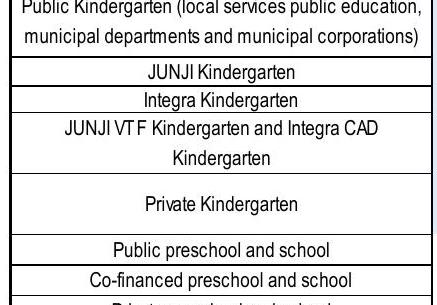 | | | | | |
| | $\square$ | | | | | $\square$ |
| | Co-financed preschool and school | | | | | |
| | $\square$ | | | | | |
| Denmark |  | | | | | |
| |  | | | | | |
| | $\square$ | | | | | |
| | Integrated day care | | | | | |
| Germany ${ }^{1}$ | $\square$ $\square$ | | | | |  |
| | $\square$ | | | | | |
| | ECEC centre for children over 3 to 6/school entry | | | | | |
| | $\qquad$ | | | | | |
| | Preschool | | | | | |
| Iceland | | | | | | W |
| | Home-based childcare <br> Home-based childcare <br> Home-based childcare | | | | | | |
| |srae|${ }^{2}$ | Publicly managed(formal)kindergartens <br> Publicly managed(formal)kindergartens | | Early Childhood Education and Care <br> Early Childhood Education and Care | | | | $\square$ |
| | - $\square$ <br> Privately managed(unofficial)kindergartens | | | | 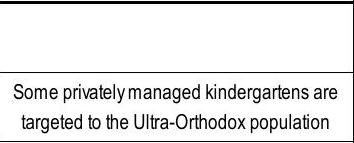 | |
| | $\square$ | | | | | 1 |
| | Family day-care centre | | | | | | |
| Japan | Kindergarten <br> Kindergarten | iculum Standards for Day-Care Centre arten  <br> National Curriculum Standards for Kindergarten <br> National Curriculum Standards for Kindergarten National Curriculum Standards for Day-Care Centre National Curriculum Standards for Integrated Centre for Early Childhood Education and Care <br> Educal Cum Care <br> Eduction Stand Care Child <br> National Curriculum Standards for <br> National Curriculum Standards for Kindergarten National Curriculum Standards for Day-Care Centre Curriculum Standards for Integrated Centre for Early Childhood Education and Care | | | | |
| | Day-care centre | | | | | | | | | |
| | Integrated centre for early childhood education and care | | | | | | | | | |
| Korea | Kindergarten <br> Childcare centres | Nuri curriculum | | | | |
| | | | | | | | | | | |
| | | | | | | | | | | |
| Norway | Kindergarten |  | | | | |
| | $\square$ | | | | | | | | | |
| Turkey | Independent kindergarten | Education programme for 0-36 months <br> Special pre-school education programme for <br> Special early childhood education 37-78 months programme for 0-36 months | | | | |
| | Nursery classroom | | | | | | | | | |
| | Practice classroom | | | | | | | | | |
| | Early childhood care and education | | | | | | | | | |
| | Crèche,day care centre | | | | | | | | | |
| | Special education preschool | | | | | Children with special needs |
| | Special early childhood education | | | | | | | | | |
1.In Germany,curricula are under the responsibility of the Länder and have hence been omitted from this table.There is a Common Framework for Early Education in ECEC Settings adopted by the education and youth affairs ministers of the Länder which summarises the core statements of the 16 curricula of the Länder. 1.In 德国,课程由各邦负责,因此在本表中被省略。各邦教育部长和青年事务部长通过了 Epec 环境中的早期教育通用框架,该框架总结了各邦 16 个课程的核心声明。
2.Ultra-orthodox kindergartens are part of privately-managed kindergartens,but their data is also not analysed for this report. 2.极端正统幼儿园是私立幼儿园的一部分,但本报告也不对其数据进行分析。
Note:Settings and age groups with lighter colours are either not included in the TALIS Starting Strong data analysed for this report or the data collection did not focus on the age group concerned.See Annex A for further information on curriculum coverage and ECEC settings in participating countries. 注:本报告分析的 TALIS Starting Strong 数据中未包括背景和较浅颜色的年龄组,或者数据收集未关注相关年龄组。
Source:OECD(2019 _([55]){ }_{[55]} ),"OECD Network on Early Childhood Education and Care:Quality beyond Regulations Survey",Internal document,OECD, Paris. 资料来源:经合组织(2019 _([55]){ }_{[55]} ),“经合组织幼儿教育和护理网络:超越法规的质量调查”,内部文件,经合组织,巴黎。
Characteristics of children in ECEC centres 幼儿保育中心儿童的特点
The share of children with different characteristics and backgrounds in ECEC centres matters for staff’s everyday practices. For instance, some children may have special educational needs, may have a first language that differs from the language(s) used in the centre, may be refugees and may come from socioeconomically disadvantaged homes (see also Chapter 2). 幼儿保育中心不同特征和背景的儿童比例对工作人员的日常实践很重要。例如,一些儿童可能有特殊的教育需求,他们的第一语言可能与中心使用的语言不同,可能是难民,可能来自社会经济弱势家庭(另见第2章)。
In all countries except Chile, the majority of leaders in pre-primary centres consider that their centres have 10% or less of children from socio-economically disadvantaged homes (i.e. children from homes lacking the necessities or advantages of life, such as adequate housing, nutrition or medical care). In Iceland, Japan and Norway, fewer than one centre in ten report a higher share (11% or more) of children from socio-economically disadvantaged homes, but this is the case in more than a quarter of centres in Germany and Turkey. In Chile, more than half of centres report having above 30%30 \% of children from such homes (Figure 4.7). In centres for children under age 3, the percentage of centres with a high share of children from socio-economically disadvantaged homes is low in the four countries covered. As noted in Chapter 2, differences across countries in the percentage of children from socio-economically disadvantaged homes are related to cross-country differences in the socio-economic composition of the population and different rates of enrolment of those children, although there may be discrepancies between leaders’ perceptions and administrative data. 在除智利以外的所有国家,大多数学前教育中心的领导者认为,他们的中心有 10% 或更少的儿童来自社会经济弱势家庭(即来自缺乏生活必需品或优势的家庭的儿童,如适当的住房、营养或医疗保健)。在冰岛、日本和挪威,只有不到十分之一的教育中心报告称,来自社会经济弱势家庭的儿童比例更高(11%或更多),但在德国和土耳其,超过四分之一的教育中心是这种情况。在智利,超过一半的托 育中心报告说,有来自此类家庭的儿童以上 30%30 \% (图 4.7)。在 3 岁以下儿童中心,在所涵盖的四个国家中,来自社会经济弱势家庭的儿童比例较高的中心比例较低。如第 2 章所述,各国在来自社会经济弱势家庭的儿童百分比方面的差异与人口社会经济构成的跨国差异和这些儿童的不同入学率有关,尽管领导者的看法和行政数据之间可能存在差异。
Figure 4.7. Concentration in centres of children from socio-economically disadvantaged homes 图 4.7.集中在来自社会经济弱势家庭的儿童中心
Percentage of centres who serve the following shares of children from disadvantaged homes, according to leaders 据领导称,为以下来自弱势家庭的儿童提供服务的中心百分比
Box 4.3. Policies for providing access to minority and disadvantaged children and supporting them 框注 4.3.为少数族裔和弱势儿童提供入学机会并支持他们的政策
The potential for high-quality ECEC provision to level the ground for children who may come from socioeconomically disadvantaged homes or are yet to learn the main language spoken in the country has been a key rationale for expanding access to ECEC in many countries. The increased participation of children from such backgrounds also means that centres need to respond to their needs. Among other countries, Chile, Germany and Denmark have taken various measures in this respect. 高质量的幼儿保育和教育教育有可能为可能来自社会经济弱势家庭或尚未学习该国主要语言的儿童平整土壤,这是许多国家扩大幼儿保育和教育机会的关键理由。来自这些背景的儿童越来越多地参与其中,这也意味着中心需要满足他们的需求。在其他国家中,智利、德国和丹麦在这方面采取了各种措施。
Chile 智利
Chile has seen a considerable expansion of ECEC over the past decades (OECD, 2017[56]). From 2005 to 2013, participation in ECEC more than doubled for 3-year-olds (from 23% to 51%) and almost doubled for 4-year-olds (from 42%42 \% to 83%83 \% ). However, coverage of ECEC continues to be highly uneven in Chile, with lower participation rates in rural and lower income areas (OECD, 2015[57]; MINEDUC, 2017[58]). Efforts to increase coverage of ECEC include a national strategy focusing on rural, urban or low-income neighbourhoods (OECD, 2015[57]). The Chile Grows with You programme (Chile Crece Contigo) was designed to provide personalised support to families from disadvantaged backgrounds and offer comprehensive services for socially vulnerable children from birth to school entry (Peralta, 2011 _([59]){ }_{[59]}; Vegas and Santibañez, 2010 [60]). The programme refers at-risk children to ECEC centres, refers parents to services to enhance parenting skills and offers targeted grants for children from the 60% most socio-economically disadvantaged households in Chile, in collaboration with Chile’s social protection system (Chile Solidario) (Government of Chile, 2017[61]). To maximise ECEC access for families from disadvantaged backgrounds, Chile has extended opening hours in some ECEC centres funded by some providers. Chile is also encouraging year-round availability of services (Bertram and Pascal, 2016[62]). 在过去的几十年里,智利的 ECEC 有了相当大的扩张(经合组织,2017 年[56])。从 2005 年到 2013 年,3 岁儿童的 ECEC 参与率增加了一倍多(从 23% 增加到 51%),4 岁儿童的参与率几乎翻了一番(从 42%42 \% 到 83%83 \% )。然而,智利的幼儿保育和教育覆盖率仍然非常不均衡,农村和低收入地区的参与率较低(经合组织,2015 年[57];MINEDUC,2017 年[58])。增加 ECEC 覆盖率的努力包括一项专注于农村、城市或低收入社区的国家战略(经合组织,2015 年[57])。Chile Grows with You 计划(Chile Crece Contigo)旨在为来自弱势背景的家庭提供个性化支持,并为社会弱势儿童提供从出生到入学的全面服务(Peralta,2011 年 _([59]){ }_{[59]} ;Vegas 和 Santibañez,2010 [60])。该计划与智利的社会保障系统(智利团结会)合作,将高危儿童转介给 ECEC 中心,将父母转介到提高育儿技能的服务,并为智利 60% 社会经济最弱势家庭的儿童提供有针对性的补助金(智利政府,2017 年[61])。为了最大限度地为弱势家庭提供 ECEC 服务,智利延长了一些由一些提供者资助的 ECEC 中心的开放时间。智利还鼓励全年提供服务(Bertram 和 Pascal,2016 年[62])。
Germany 德国
In Germany, the enrolment of children with an immigrant background in ECEC is lower than for other children, especially among 0-3 year-olds (Statistisches Bundesamt, 2017[63]). Inclusion and diversity practices towards children from minority backgrounds are decided by ECEC providers. To better serve the needs of those children, the Federal Ministry of Family Affairs, Senior Citizens, Women and Youth has launched several initiatives. For instance, since 2016 the federal programme Language-Day-Care (Bundesprogramm Sprach-Kitas), targets ECEC centres with high shares of children who require additional support for their language development. Building on the experience of a previous programme on language development, this programme seeks to further implement the concept of language education in daily routines as well as promote inclusive pedagogy and collaboration between families and ECEC centres. In addition, it provides funds for staff of so-called expert services (Fachberatung) who mentor ECEC teams in the area of language promotion in ECEC settings so that in the period from 2017 to 2020 about 7000 additional part-time positions are expected to be created (Federal Ministry of Family Affairs, Senior Citizens, Women and Youth, n.d.[64]). Another programme, the Access to Day-Care Programme (Bundesprogramm Kita-Einstieg) is providing co-ordination, staff and additional financial supplements to support about 1000 different offers across around 150 locations between 2017 and 2019. This could, for instance, enable the organisation of a family hiking day, where families and day care staff get to know each other while exploring the neighbourhood by foot, learn about local institutions and ECEC options. This offer targets families who have recently arrived in the neighbourhood or are socio-economically disadvantaged (Federal Ministry of Family Affairs, Senior Citizens, Women and Youth, n.d.[65]). 在德国,具有移民背景的儿童参加 ECEC 的入学率低于其他儿童,尤其是 0-3 岁的儿童(Statistisches Bundesamt,2017[63])。对来自少数族裔背景的儿童的包容性和多样性做法由 ECEC 提供者决定。为了更好地满足这些儿童的需求,联邦家庭事务、老年人、妇女和青年部发起了多项倡议。例如,自 2016 年以来,联邦语言日托计划 (Bundesprogramm Sprach-Kitas) 针对儿童比例高的 ECEC 中心,这些儿童需要额外的语言发展支持。该计划以先前的语言发展计划的经验为基础,旨在进一步在日常生活中实施语言教育的概念,并促进包容性教学法和家庭与 ECEC 中心之间的合作。此外,它还为所谓的专家服务 (Fachberatung) 的工作人员提供资金,他们在 ECEC 环境中指导 ECEC 团队的语言推广,因此在 2017 年至 2020 年期间,预计将增加约 7000 个兼职职位(联邦家庭事务部,老年人、妇女和青年部,日期不详[64])。另一个项目,即 Bundesprogramm Kita-Einstieg (Bundesprogramm Kita-Einstieg) 正在提供协调、工作人员和额外的财政补贴,以支持 2017 年至 2019 年期间在 150 个地点提供约 1000 种不同的服务。例如,这可以组织一个家庭远足日,让家庭和日托工作人员在步行探索社区的同时相互了解,了解当地机构和 ECEC 选项。 此优惠对象为刚到附近地区或处于社会经济弱势地位的家庭(联邦家庭事务部,老年人、妇女和青年,日期不详[65])。
Denmark 丹麦
Since 2001, Denmark’s Act on Day Care requires municipalities to ensure ECEC provision for all children between the age of 26 weeks and the start of primary school. Low-income families and/or families who are experiencing social disadvantage, are entitled to up to 100%100 \% fee subsidy. A legislative amendment was introduced in July 2019, 自 2001 年以来,丹麦的《日托法》要求市政当局确保为所有 26 周至小学开始的儿童提供 ECEC。低收入家庭和/或处于社会弱势地位的家庭有权获得 100%100 \% 最高学费补贴。2019 年 7 月提出了一项立法修正案,
to ensure children from disadvantaged residential areas attend ECEC settings where the Danish language is spoken and that practices are focused on children’s well-being, learning, education and development. The Mandatory Learning Programme was established as a new ECEC service to ensure that all children who meet the criteria for the Programme are enrolled in an ECEC setting from age 1. Eligible children are required to take up a place in an ECEC offering the programme for 25 hours a week. Enrolment and attendance in the Programme is a precondition for parents to receive child welfare benefits unless they can prove their ability to support their children’s Danish language skills and development at home. 确保来自弱势住宅区的儿童参加讲丹麦语的 ECEC 机构,并确保实践侧重于儿童的福祉、学习、教育和发展。义务学习计划是作为一项新的 ECEC 服务而建立的,旨在确保所有符合该计划标准的儿童从 1 岁起就进入 ECEC 环境。符合条件的儿童必须在提供该计划的 ECEC 中占有一席之地,每周 25 小时。注册和参加该计划是父母获得儿童福利的前提条件,除非他们能够证明他们有能力支持孩子的丹麦语技能和在家中的发展。
TALIS Starting Strong data does not allow identification of differences in participation in ECEC among different population groups, but such differences may persist in the countries analysed. Data from the OECD’s Programme for International Student Assessment (PISA) shows that the share of 15 -year-old students reporting that they attended ECEC for two years or more differs between students from disadvantaged and advantaged backgrounds (Figure 4.8). Among the countries participating in TALIS Starting Strong, PISA 2015 suggests that this difference was largest in Chile, Germany, Israel, Norway and Turkey. These different data sources underline the continued importance of measures to ensure equal access to ECEC for all children (Box 4.3). TALIS Starting Strong 数据无法确定不同人群之间参与 ECEC 的差异,但这种差异可能在所分析的国家中持续存在。经合组织国际学生评估计划(PISA)的数据显示,在 15 岁学生中,报告说他们参加幼儿保育和教育两年或更长时间的比例在弱势和优势背景的学生之间有所不同(图 4.8)。2015 年国际学生评估评估报告显示,在参与“教�教育学起点”计划的国家中,智利、德国、以色列、挪威和土耳其的差异最大。这些不同的数据来源强调了确保所有儿童平等获得幼儿保育和教育的措施的持续重要性(框注 4.3)。
Figure 4.8. Percentage of 15-year-old students who had attended preschool for two years or more, by socio-economic status 图 4.8.按社会经济地位分列,上过两年或两年学前班的 15 岁学生的百分比
Early childhood education (ISCED 0), 2015 幼儿教育 (ISCED 0), 2015
Notes: Disadvantaged and advantaged students are defined according to the index of economic, social and cultural status of the OECD’s Programme for International Student Assessment (PISA). 注:弱势和优势学生是根据经合组织国际学生评估计划 (PISA) 的经济、社会和文化地位指数定义的。
Countries and economies are ranked in descending order of the differences between the percentage of socio-economically advantaged and disadvantaged students who had attended preschool for two years or more. 国家和经济体按上过两年或两年以上学前班的社会经济优势学生和弱势学生百分比之间的差异降序排列。
Sources: OECD (2017[8]), Starting Strong 2017, Key OECD Indicators on Early Childhood Education and Care, https://doi.org/10.1787/9789264276116-en; OECD (2019[67]), PISA Online Education Database, http://www.oecd.org/pisa/data/ (accessed on 24 January 2019). 资料来源:经合组织 (2017[8]),2017 年强劲开局,经合组织幼儿教育和保育关键指标,https://doi.org/10.1787/9789264276116-en; 经合组织 (2019[67]),PISA 在线教育数据库,http://www.oecd.org/pisa/data/(于 2019 年 1 月 24 日访问)。
There are important differences between countries with regard to the shares of children in ECEC centres whose first language is different from the language(s) used in the centre. In Denmark (with low response rates), Germany, Iceland and Norway, more than a third of the pre-primary centres have 11%11 \% or more of children with a different first language. In contrast, in Japan and Korea, the share of centres with large proportions of such children is small. 在幼儿保育和教育中心儿童的比例方面,各国之间存在重大差异,这些儿童的第一语言与中心使用的语言不同。在丹麦(回复率低)、德国、冰岛和挪威,超过三分之一的学前教育中心有 11%11 \% 或更多的儿童使用不同的第一语言。相比之下,在日本和韩国,此类儿童比例较高的中心所占比例很小。
Centres reporting a sizable share of refugees are rare in participating countries. Only in pre-primary settings in Denmark (with low response rates), Germany and Norway do more than 5%5 \% of centres report that they serve 11% or more of children who are refugees. Differences are small between pre-primary education centres and centres for children under age 3 for both the share of children whose first language is different from the language(s) used in the ECEC centre and the share of refugees (Figure 4.9). 报告有相当大比例难民的中心在参与国中很少见。仅在丹麦的学前教育环境中(回复率低),德国和挪威做得更多,超过 5%5 \% 报告称它们为 11% 或更多难民儿童提供服务的中心。学前教育中心和 3 岁以下儿童中心在第一语言与幼儿保育和教育中心使用的语言不同的儿童比例和难民比例方面差异很小(图 4.9)。
In all participating countries, leaders in the majority of centres report that they have 10% or less of children with special needs (those for whom a special learning need has been formally identified). However, in Chile, Denmark (with low response rates) and Iceland, more than a fifth of pre-primary centres report a higher share of children with special needs. The share of centres with many such children is also small in centres for children under age 3. As noted in Chapter 2, there may be a number of reasons for these variations, such as differences in countries’ policies concerning the inclusion of those children and the identification and definition of special needs (see e.g. Cullen (2003[68])). 在所有参与国中,大多数中心的领导报告说,他们有 10% 或更少的有特殊需要的儿童(已正式确定有特殊学习需要的儿童)。然而,在智利、丹麦(回复率低)和冰岛,超过五分之一的学前教育中心报告说有特殊需要的儿童比例更高。在 3 岁以下儿童中心,拥有许多此类儿童的中心所占比例也很小。如第 2 章所述,造成这些变化的原因可能有很多,例如各国在接纳这些儿童以及特殊需求的识别和定义方面的政策不同(参见 Cullen (2003[68]))。
Figure 4.9. Concentration in centres of children with different characteristics 图 4.9.集中于具有不同特征的儿童中心
Percentage of ECEC centres that serve 11% or more of children with the following characteristics, according to leaders 领导表示,为 11% 或更多具有以下特征的儿童提供服务的 ECEC 中心的百分比
Estimates for sub-groups and estimated differences between sub-groups need to be interpreted with care. See Annex B for more information. Notes: Centre leaders may not always be familiar with the precise national or international definition of refugees and/or special needs. This may lead to discrepancies between leader reports and administrative data. 需要谨慎解释亚组的估计值和子组之间的估计差异。有关更多信息,请参见附件 B。注:中心领导可能并不总是熟悉难民和/或特殊需求的确切国家或国际定义。这可能会导致领导报告和管理数据之间存在差异。
Countries are ranked in descending order of the share of 11% or more of children whose first language is different from the language(s) used in the centre. 国家按第一语言与中心使用的语言不同的 11% 或更多儿童的比例降序排列。
Source: TALIS Starting Strong 2018 Database (Table D.4.6). 资料来源:TALIS Starting Strong 2018 数据库(表 D.4.6)。
The ability of staff to meet the needs of children can be influenced not only by their level of education and training but also by the availability and the stability of staff human resources at the centre. TALIS Starting Strong provides an opportunity to explore the indicators concerning the composition and roles of staff at the centre, the number of staff per child, and staff attrition across participating countries. 工作人员满足儿童需求的能力不仅受到他们的教育和培训水平的影响,还受到中心工作人员人力资源的可用性和稳定性的影响。TALIS Start Strong 提供了一个机会,可以探索有关中心工作人员的构成和作用、每个儿童的工作人员数量以及参与国家/地区的工作人员流失等指标。
Composition of staff in centres 各中心工作人员的构成
The roles and composition of staff in centres can create different working environments. TALIS Starting Strong asked leaders to report on the number of leaders, teachers, assistants and other staff in their centres. Participating countries vary with regard to the different staff roles common in their centres (Figure 4.10). Although variations in working time of individual staff cannot be captured, TALIS Starting Strong provides an indication of the types of staff with whom children interact in their centres. 中心工作人员的角色和构成可以创造不同的工作环境。TALIS Starting Strong 要求领导者报告其中心的领导、教师、助理和其他工作人员的数量。参与国在其中心常见的不同工作人员角色方面有所不同(图 4.10)。虽然无法捕捉到个别工作人员工作时间的变化,但 TALIS Starting Strong 提供了儿童在其中心与之互动的工作人员类型的指标。
Although national terms vary and more fine-grained divisions of responsibilities may be in place on the ground, the internationally defined roles of teachers and assistants are relatively clearly reflected in leaders’ reports on their centre’s staff in Chile, Denmark (with low response rates), Germany, Israel’s preprimary sector, Korea and Norway. Teachers are defined as having the most responsibility for the group of children in the classroom or playroom, while assistants have a more supporting role. However, in Iceland, national staff roles cannot be clearly distinguished according to those two international staff role divisions, and in Japan, Turkey and centres for children under age 3 in Israel, there are no (or too few) assistants (corresponding to the international definition used during the identification of staff members) eligible for participation in TALIS Starting Strong (see Reader’s Guide). In those countries, leaders’ reports on the breakdown of those roles should, therefore, be treated with caution. Teachers in Israel’s pre-primary 尽管各国的术语各不相同,而且实地可能有更细致的职责划分,但国际上定义的教师和助理角色相对清楚地反映在智利、丹麦(回复率低)、德国、以色列学前教育部门、韩国和挪威的领导对其中心工作人员的报告中。教师被定义为对教室或游戏室中的一群孩子负有最大的责任,而助理则扮演更多的支持角色。然而,在冰岛,无法根据这两个国际工作人员角色划分来明确区分国家工作人员的角色,而在日本、土耳其和以色列的 3 岁以下儿童中心,没有(或太少)有资格参加 TALIS Start Strong 的助理(对应于确定工作人员时使用的国际定义)(见读者指南)。因此,在这些国家,应谨慎对待领导人关于这些角色分解的报告。以色列学前班的教师
education centres are, due to the small and uniform size of their centres, simultaneously the leaders of their settings (see Box 4.2). 由于教育中心规模小且规模统一,教育中心同时是其环境的领导者(见框注 4.2)。
When comparing leaders’ reports of the share of assistants to the share of staff identified as either leaders or teachers, (i.e. the individuals who have the most responsibility for the centre or a group of children), Chile, Germany, Israel and Norway, for example, report a roughly similar size of the two groups in preprimary centres (Figure 4.10). The reported share of assistants is considerably lower in pre-primary centres in Japan, Korea and Turkey and Israel’s centres for children under age 3. Chile and Turkey stand out, with centre leaders reporting more than one leader on average per centre (3 in Chile and 1.6 in Turkey); Denmark (with low response rates) also follows this pattern. This indicates that leadership functions might be explicitly shared by multiple individuals, some of whom may also be taking on duties as staff working directly with children. 例如,在比较领导报告关于助理人数比例与被确定为领导或教师的工作人员比例(即对中心或一群儿童负有最大责任的个人)时,智利、德国、以色列和挪威报告说,学前教育中心这两个群体的规模大致相似(图4.10)。据报道,日本、韩国和土耳其的学前教育中心以及以色列的 3 岁以下儿童中心所配备的助理比例要低得多。智利和土耳其表现突出,中心领导报告平均每个中心有不止一名领导(智利 3 名,土耳其 1.6 名);丹麦(回复率低)也遵循这种模式。这表明领导职能可能由多个人明确共享,其中一些人也可能作为直接与儿童打交道的工作人员承担职责。
There is also great variation across countries in the distribution of other staff roles. In Chile, there is a relatively high number of staff other than leaders, teachers and assistants, such as staff working with individual children, staff for special tasks (such as leading special activities like physical education or music) or interns. In Denmark (with low response rates), Germany and Norway, the total number and distribution of staff does not vary across pre-primary centres and centres for children under age 3, which is consistent with the integration of these two levels of education in their ECEC systems. In contrast, Israel has the smallest total number of staff in pre-primary centres, while there are considerably more staff per centre in centres for children under age 3 (Figure 4.10; Table D.4.7). This difference aligns with the fact that those centres are part of the same system in Germany and Norway, while Israel’s provision is marked by different governance depending on the level concerned and a unique system of pre-primary education centres (see Box 4.2) 各国其他工作人员职位的分配也存在很大差异。在智利,除了领导、教师和助理之外,还有相对较多的工作人员,例如与个别儿童一起工作的工作人员、执行特殊任务的工作人员(例如领导体育或音乐等特殊活动)的工作人员或实习生。在丹麦(答复率低)、德国和挪威,学前教育中心和 3 岁以下儿童中心的工作人员总数和分布没有变化,这与将这两个教育层次纳入其幼儿保育和教育系统是一致的。相比之下,以色列的学前教育中心工作人员总数最少,而 3 岁以下儿童中心每个中心的工作人员要多得多(图 4.10;表 D.4.7)。这种差异与以下事实是一致的:德国和挪威的这些中心属于同一系统,而以色列的办学特点是 根据相关级别和独特的学前教育中心系统进行不同的治理 (见框注 4.2)
Figure 4.10. Human resources in centres 图 4.10.中心的人力资源
Share of teachers, leaders, assistants and other staff in ECEC centres, according to leaders 领导表示,ECEC 中心的教师、领导、助理和其他工作人员的比例
Box 4.4. Number of staff and children in the centre 框注 4.4.中心员工和儿童人数
TALIS Starting Strong asks leaders to indicate the number of staff in different categories working in their ECEC centres (leaders, teachers, assistants, staff for individual children, staff for special tasks, interns and other staff) and the number of girls and boys enrolled in the centre. TALIS Starting Strong 要求领导者说明在其 ECEC 中心工作的不同类别的工作人员的数量(领导者、教师、助理、个别儿童的工作人员、特殊任务的工作人员、实习生和其他工作人员)以及在该中心注册的女孩和男孩的数量。
This information is used to derive several indicators describing the staff and children in the centre: 1) the share of different types of staff working at the centre (i.e. leaders, teachers, assistants and other staff); 2) the number of teachers and leaders compared to the total number of staff at the centre; 3) the number of children at the centre; 4) the number of staff per child at the centre. 这些信息用于得出描述中心工作人员和儿童的几个指标: 1) 在中心工作的不同类型的工作人员(即领导、教师、助理和其他工作人员)的比例;2) 教师和领导人数与中心工作人员总数的比较;3) 中心的儿童人数;4) 中心每个孩子的工作人员人数。
The number of staff per child at the centre refers to the total number of staff working in a centre, regardless of their role, divided by the total number of children enrolled. Because the number of staff per individual child is very low, when specific examples are cited for comparative purposes, they are presented as “number of staff per ten children”. If the centre covers ISCED level 02 and provision for children under the age of 3 , children and staff at both levels are considering in those numbers. 中心每名儿童的工作人员人数是指在中心工作的工作人员总数(无论其角色如何)除以注册儿童总数。由于每个儿童的工作人员数量非常少,因此当出于比较目的引用具体示例时,它们被表示为“每 10 名儿童的工作人员数”。如果中心涵盖《国际教育标准分类法》02 级和为 3 岁以下儿童提供 ,那么两个级别的儿童和工作人员都在考虑这些数字。
These indicators differ from administrative data capturing similar constructs, for instance because TALIS Starting Strong data does not allow differentiation between part-time and full-time employment at the centre level. Furthermore, regulations often refer to staffing requirements at the group or classroom/playroom level, rather than for the centre as a whole. Additional details on the computation of these indicators can be found in the Reader’s Guide and Annex C. 这些指标与捕捉类似结构的行政数据不同,例如,因为 TALIS Starting Strong 数据不允许区分中央一级的兼职和全职就业。此外,法规通常涉及团体或教室/游戏室级别的人员配备要求,而不是整个中心。有关这些指标计算的更多详细信息,请参阅《读者指南》和附件 C。
Number of staff in centres 中心员工人数
The average number of leaders, teachers, assistants and other staff working in ECEC centres reported by centre leaders varies greatly across countries. Iceland stands out as having the largest average number of staff per centre (Figure 4.11). The average number of staff per centre is also comparatively high in Chile, Japan and Norway. The differences in the average number of staff per centre across countries only loosely parallel the differences in the average number of children per centre. Iceland tends to have large centres on average and a relatively high number of staff, while the average size of centres is even larger in Japan, but the average number of staff is not higher. 中心领导报告的在 ECEC 中心工作的领导者、教师、助理和其他工作人员的平均人数因国家而异。冰岛是每个中心平均员工人数最多的国家(图 4.11)。在智利、日本和挪威,每个中心的平均员工人数也相对较高。各国每个中心的平均工作人员人数的差异与每个中心的平均儿童人数的差异只是松散地平行。冰岛的平均中心规模较大,员工人数相对较多,而日本的平均中心规模甚至更大,但平均员工人数并不高。
Figure 4.11. Average number of staff and children in centres 图 4.11.中心工作人员和儿童的平均人数
Average number of staff and children in pre-primary centres and centres for children under age 3, according to leaders 领导称,学前教育中心和 3 岁以下儿童中心的平均工作人员和儿童人数
Note: In Iceland, national staff roles cannot be clearly distinguished according to the international staff role divisions of “teacher” and “assistant”. In Japan, Turkey and centres for children under age 3 in Israel, there are no (or too few) assistants (corresponding to the international definition used during the identification of staff members) eligible for participation in TALIS Starting Strong (see Reader’s Guide). The breakdown of those roles reported by leaders should therefore be treated with caution. There are no leaders reported for Israel’s pre-primary education centres, as centres correspond to individual classrooms or playrooms, for which the roles of “leader” and “teacher” cannot be separated. 注意:在冰岛,无法根据“教师”和“助理”的国际工作人员角色划分来明确区分国家工作人员的角色。在日本、土耳其和以色列的 3 岁以下儿童中心,没有(或太少)有资格参加 TALIS Starting Strong 的助理(对应于识别工作人员时使用的国际定义)(见读者指南)。因此,应谨慎对待领导者报告的那些角色的分解。以色列的学前教育中心没有报告领导者,因为中心对应于单独的教室或游戏室,因此“领导者”和“教师”的角色不能分开。
Source: TALIS Starting Strong 2018 database (Tables D.4.5 and D.4.7). 资料来源:TALIS Starting Strong 2018 数据库(表 D.4.5 和 D.4.7)。
Using leader reports to compute the number of staff per child in the centre (see Box 4.4), TALIS Starting Strong shows major differences across participating countries. “Number of staff per child” refers to the total number of staff working in a centre, regardless of their role, divided by the total number of children enrolled. Because the number of staff per individual child is very low, for comparative purposes, data are presented as “number of staff per ten children”. The average number of staff per ten children is around two in preprimary centres in Germany, Israel, Japan and Turkey, while it is above four in Chile and Norway. Germany and Norway have a similar but slightly more favourable number of staff per child in their centres for children under age 3. In Israel, there are more staff per child in centres for children under age 3 than in pre-primary centres (Figure 4.12). Although these statistics do not consider differences in part-time and full-time employment, they do suggest major differences in how many staff shape children’s daily ECEC experience and provide an indication of the average level of human resources available to support each child’s learning, development and well-being. 使用领导者报告来计算中心每名儿童的工作人员数量(见框注 4.4),TALIS Start Strong 显示了参与国家之间的主要差异。“每名儿童的工作人员人数”是指在中心工作的工作人员总数(无论其角色如何)除以登记的儿童总数。由于每个儿童的工作人员数量非常少,因此为了进行比较,数据以“每 10 名儿童的工作人员数量”表示。在德国、以色列、日本和土耳其,学前教育中心每十名儿童的平均工作人员人数约为 2 人,而智利和挪威的这一比例超过 4 人。德国和挪威的 3 岁以下儿童中心每名儿童的工作人员人数相似,但略高。在以色列,3 岁以下儿童中心每名儿童的工作人员比学前教育中心多(图 4.12)。尽管这些统计数据没有考虑兼职和全职就业的差异,但它们确实表明了影响儿童日常 ECEC 体验的工作人员数量存在重大差异,并表明可用于支持每个儿童的学习、发展和福祉的人力资源的平均水平。
By computing differences, it is possible to examine whether the variation within countries of the number of staff per child can be explained by a number of factors: 1) rural location versus urban location; 2) the extent to which leaders report that there are public spaces available for children to play safely; 3) the size of centres; 4) whether or not the centres are located in the same place as primary schools; and 5) whether or not there is 11% or more of children from socio-economically disadvantaged homes in the centre. 通过计算差异,可以检查国家内部每个儿童的工作人员人数的差异是否可以用几个因素来解释:1) 农村位置与城市位置;2) 领导者报告说有公共空间可供儿童安全玩耍的程度;3) 中心的大小;4) 这些中心是否与小学位于同一地点;5) 该中心是否有 11% 或更多的儿童来自社会经济弱势家庭。
Across countries, TALIS Starting Strong results show that the number of staff per child is significantly different between pre-primary centres in the largest quarter of centre size as compared to the lowest quarter of centre size in all countries except Denmark (low response rates) and in centres for children under age 3 in Israel (Figure 4.13). These findings suggest that having more children at the centre is not proportionally compensated by increased numbers of staff. Yet, regardless of centre size, one staff member may assume a key role for the entire centre, for example in the case of leaders, contributing to having a smaller number of staff per child in bigger centres. 在各国之间,“助学教育系统起步强劲”的结果表明,与除丹麦(响应率低)和以色列 3 岁以下儿童中心外,所有国家中心规模最小四分之一的学前教育中心与中心规模最低的四分之一相比,每个儿童的工作人员数量存在显著差异(图 4.13)。这些发现表明,在中心有更多的孩子并不能通过增加工作人员的数量来补偿。然而,无论中心规模如何,一名工作人员都可以在整个中心发挥关键作用,例如在领导的情况下,这有助于在较大的中心减少每个孩子的工作人员数量。
In Chile and Iceland, the number of staff per child is lower in centres located in towns or cities of more than 15000 people than in centres in more rural locations. In contrast, in Turkey, the number of staff per child is higher in centres located in towns or cities of more than 15000 people (Figure 4.12). However, in most countries, this number tends to be similar across centres. 在智利和冰岛,位于人口超过 15000 人的城镇的中心每名儿童的工作人员人数低于位于农村地区的中心。相比之下,在土耳其,位于人口超过 15000 人的城镇的中心,每名儿童的工作人员数量更高(图 4.12)。然而,在大多数国家/地区,这个数字在各个中心之间往往相似。
Other factors do not appear to be linked to the number of staff per child across countries. In particular, centres with a large percentage of children from disadvantaged homes do not, on average, have a different number of staff per child than centres with a smaller percentage of these children. 其他因素似乎与各国每个儿童的工作人员数量无关。特别是,平均而言,拥有大量来自弱势家庭的儿童的中心与这些儿童比例较小的中心每个儿童的工作人员数量并不一致。
Figure 4.12. Number of staff per ten children in centres, by centre characteristics 图 4.12.中心每 10 名儿童的工作人员数量,按中心特征分列
Statistically significant differences in the average number of staff per ten children in centres related to centres characteristics, results based on leader reports 与中心特征相关的中心每 10 名儿童的平均工作人员人数的统计学显着差异,结果基于领导者报告
“City” refers to locations with more than 15000 people, and “rural area” refers to locations with up to 15000 people. “城市”是指人口超过 15000 人的地方,“农村地区”是指人口不超过 15000 人的地方。
Refers to centres for which leaders either “agree/strongly agree” or “disagree/strongly disagree” that there are public places for children to play safely in the neighbourhood. 指领导“同意/非常同意”或“不同意/非常不同意”附近有供儿童安全玩耍的公共场所的中心。
Quarters refer to 25%25 \% of ECEC centres inside a country. The lowest quarter refers to the 25%25 \% of ECEC centres for which the statistics obtained are the lowest (i.e. the 25%25 \% of centres within a country that register the lowest number of children), while the top quarter refers to the 25%25 \% of centres for which the statistics are the highest (i.e. the 25%25 \% of centres within a country that register the highest number of children). 宿舍是指 25%25 \% 一个国家/地区的 ECEC 中心。最低的季度是指 25%25 \% 获得的统计数据最低的幼儿保育和教育中心(即 25%25 \% 一个国家内登记的儿童人数最少的中心),而最高四分之一是指 25%25 \% 统计数据最高的中心(即 25%25 \% 一个国家内登记儿童人数最多的中心)。
“Co-located with school” refers to centres that share their location with a primary school. “与学校位于同一地点”是指与小学共享位置的中心。
“Socio-economically disadvantaged homes” refers to homes lacking the basic necessities or advantages of life, such as adequate housing, nutrition or medical care. A “high” share is considered to be 11%11 \% or more, a “low” share less than or equal to 10%10 \%. “社会经济弱势家庭”是指缺乏基本生活必需品或优势的家庭,例如适当的住房、营养或医疗保健。“高”份额被视为 11%11 \% 或大于,“低”份额小于或等于 10%10 \% 。
*Estimates for sub-groups and estimated differences between sub-groups need to be interpreted with care. See Annex B for more information. *需要谨慎解释亚组的估计值和亚组之间的估计差异。有关更多信息,请参见附件 B。
** Low response rates in the survey may result in bias in the estimates reported and limit comparability of the data. ** 调查中的低回复率可能会导致报告的估计值出现偏差,并限制数据的可比性。
Note: Missing data are due to small sample sizes for the analysis. 注意:缺失数据是由于分析的样本量较小。
Source: TALIS Starting Strong 2018 Database (Table D.4.8). 资料来源:TALIS Starting Strong 2018 数据库(表 D.4.8)。
Figure 4.13. Number of staff per ten children in centres, according to centre size 图 4.13.根据中心规模,中心每 10 名儿童的工作人员人数
Average number of staff per ten children in ECEC centres, by centre size quartiles, according to leaders 领导表示,幼儿保育和教育中心每十名儿童的平均工作人员人数,按中心规模的四分位数计算
Estimates for sub-groups and estimated differences between sub-groups need to be interpreted with care. See Annex B for more information. Notes: Statistically significant differences are marked in blue. 需要谨慎解释亚组的估计值和子组之间的估计差异。有关更多信息,请参见附件 B。注:统计上显著的差异以蓝色标记。
Countries are ranked in ascending order of the number of staff per ten children in the top quarter in terms of centre size. 就中心规模而言,各国按每10名儿童的工作人员数量升序排列。
Source: TALIS Starting Strong 2018 database. 资料来源:TALIS Starting Strong 2018 数据库。
Qualified staff can offer educational and organisational strategies that help centres provide better learning and working environments and, in turn, attract other qualified staff (Barros et al., 2018[45]; Sammons, 2010 _("[46] ")_{\text {[46] }} ). Understanding the distribution of staff resources across centres is informative for ensuring equity and quality in the ECEC system. This section puts staff resources (discussed in more detail in Chapter 3) in context by exploring differences across varying characteristics of centres. 合格的员工可以提供教育和组织策略,帮助中心提供更好的学习和工作环境,进而吸引其他合格的员工(Barros 等人,2018 年[45];Sammons,2010 _("[46] ")_{\text {[46] }} 年)。了解各中心的员工资源分配对于确保 ECEC 系统的公平和质量非常有用。本节通过探讨中心不同特征的差异,将员工资源(在第 3 章中更详细地讨论)放在上下文中。
Staff qualifications at the centre level can be described in TALIS Starting Strong through the share of staff reporting that they have high education levels (at least ISCED level 6, a bachelor’s degree or equivalent) compared to those with lower levels of educational attainment. By computing the differences, it is possible to examine whether the variation in the percentage of highly educated staff across centres can be related to the following characteristics of centres: 1) rural location versus urban location; 2) the extent to which leaders report that there are public spaces available for children to play safely; 3) the size of centres; and 4) whether or not the centres are located in the same place as primary schools. 中心层的工作人员资格证书可以在 TALIS Starting Strong 中描述,即报告他们受教育程度较高的工作人员比例(至少是 ISCED 6 级,学士学位或等同),与受教育程度较低的人相比。通过计算差异,可以检查各中心受过高等教育的员工百分比的变化是否与中心的以下特征有关:1) 农村位置与城市位置;2) 领导者报告说有公共空间可供儿童安全玩耍的程度;3) 中心的大小;4) 这些中心是否与小学位于同一地点。
In Chile and Israel, the percentage of staff with high qualifications (i.e. equivalent to or above a bachelor’s degree) is higher in pre-primary centres co-located with primary schools, compared to centres that are not, although this co-location is less common in Israel than in Chile (Figure 4.14). Also in Chile, the share of highly qualified staff is higher in centres with fewer staff per child, suggesting that in centres in which there are more staff per child, the qualifications of the additional staff tend to be lower, compared to centres with fewer staff per child. This may indicate a potential trade-off or compensation between employing more staff and employing highly qualified staff. Similarly, in Israel for both levels of ECEC, larger centres tend to have a smaller share of highly qualified staff. Other than these differences, the distribution of qualified staff does not vary consistently with centre’s geographical location or neighbourhood (Figure 4.14). 在智利和以色列,与小学位于同一地点的学前教育中心相比,与非小学位于同一地点的学前教育中心相比,具有高学历(即相当于或高于学士学位)的教职员工比例更高,尽管这种同地办公在以色列的情况不如智利常见(图 4.14)。同样在智利,每名儿童工作人员较少的中心的高素质工作人员的比例更高,这表明,与每名儿童工作人员较少的中心相比,在每名儿童工作人员较多的中心,额外工作人员的资格往往较低。这可能表明在雇用更多员工和雇用高素质员工之间存在潜在的权衡或补偿。同样,在以色列,对于这两个级别的幼儿保育和教育,较大的中心往往拥有较小比例的高素质工作人员。除了这些差异之外,合格员工的分布并不随中心的地理位置或社区而变化(图 4.14)。
Figure 4.14. Staff’s educational attainment, by centre characteristics 图 4.14.按中心特征分列的工作人员受教育程度
Statistically significant differences in the average percentage of highly qualified staff in centres related to centres characteristics, results based on staff reports 与中心特征相关的中心高素质员工平均百分比的统计学显著差异,结果基于员工报告
Education categories are based on the International Standard Classification of Education (ISCED 2011). 教育类别基于国际教育标准分类法 (ISCED 2011)。
“City” refers to locations with more than 15000 people, and “rural area” refers to locations with up to 15000 people. “城市”是指人口超过 15000 人的地方,“农村地区”是指人口不超过 15000 人的地方。
Refers to centres for which leaders either “agree/strongly agree” or “disagree/strongly disagree” that there are public places for children to play safely in the neighbourhood. 指领导“同意/非常同意”或“不同意/非常不同意”附近有供儿童安全玩耍的公共场所的中心。
Quarters refer to 25%25 \% of ECEC centres inside a country. The lowest quarter refers to the 25%25 \% of ECEC centres for which the statistics obtained are the lowest (i.e. the 25%25 \% of centres within a country that register the lowest number of children), while the top quarter refers to the 25%25 \% of centres for which the statistics are the highest (i.e. the 25%25 \% of centres within a country that register the highest number of children). 宿舍是指 25%25 \% 一个国家/地区的 ECEC 中心。最低的季度是指 25%25 \% 获得的统计数据最低的幼儿保育和教育中心(即 25%25 \% 一个国家内登记的儿童人数最少的中心),而最高四分之一是指 25%25 \% 统计数据最高的中心(即 25%25 \% 一个国家内登记儿童人数最多的中心)。
Quarters refer to 25%25 \% of ECEC centres inside a country. The lowest quarter refers to the 25%25 \% of ECEC centres for which the statistics obtained are the lowest (i.e. the 25%25 \% of centres within a country that register the lowest number of staff per child while the top quarter refers to the 25%25 \% of centres for which the statistics are the highest (i.e. the 25%25 \% of centres within a country who register the highest number of staff per child). 宿舍是指 25%25 \% 一个国家/地区的 ECEC 中心。最低的季度是指 25%25 \% 获得的统计数据最低的幼儿保育和教育中心(即 25%25 \% 一个国家内每名儿童工作人员人数最少的中心),而最高四分之一是指 25%25 \% 统计数据最高的中心(即 25%25 \% 一个国家内每名儿童工作人员人数最多的中心)。
“Co-located with school” refers to centres that share their location with a primary school. “与学校位于同一地点”是指与小学共享位置的中心。
“Socio-economically disadvantaged homes” refers to homes lacking the basic necessities or advantages of life, such as adequate housing, nutrition or medical care. A “high” share is considered to be 11%11 \% or more, a “low” share less than or equal to 10%10 \%. “社会经济弱势家庭”是指缺乏基本生活必需品或优势的家庭,例如适当的住房、营养或医疗保健。“高”份额被视为 11%11 \% 或大于,“低”份额小于或等于 10%10 \% 。
*Estimates for sub-groups and estimated differences between sub-groups need to be interpreted with care. See Annex B for more information. *需要谨慎解释亚组的估计值和亚组之间的估计差异。有关更多信息,请参见附件 B。
** Low response rates in the survey may result in bias in the estimates reported and limit comparability of the data. ** 调查中的低回复率可能会导致报告的估计值出现偏差,并限制数据的可比性。
Note: Missing data are due to small sample sizes for the analysis. 注意:缺失数据是由于分析的样本量较小。
Source: TALIS Starting Strong 2018 Database (Table D.4.9). 资料来源:TALIS Starting Strong 2018 数据库(表 D.4.9)。
Staff leaving their centres 员工离开他们的中心
The share of staff leaving their ECEC centres matters for the stability of relations among staff and between staff and children. Leaders participating in TALIS Starting Strong reported on the number of staff who left the ECEC centre in the year prior to the Survey, which can be related to the total number of staff at the centre at the time leaders responded to the Survey (see also Annex C). 工作人员离开幼儿保育和教育中心的比例关系到工作人员之间以及工作人员与儿童之间关系的稳定。参与 TALIS Starting Strong 的领导者报告了在调查前一年离开 ECEC 中心的工作人员人数,这可能与领导者回答调查时该中心的工作人员总数有关(另见附件 C)。
In Iceland, Japan and Korea, leaders reported that approximately one staff per every five staff members at the time of the Survey left the ECEC centre in the previous year. In Israel’s centres for children under age 3, the proportion is almost one-third. However, in the rest of the countries, in both pre-primary centres and centres for children under age 3, only around one staff member per ten current staff left their centre in the previous year (Figure 4.15). 在冰岛、日本和韩国,领导报告说,在调查时,大约每 5 名工作人员中就有 1 名工作人员在前一年离开了 ECEC 中心。在以色列的 3 岁以下儿童中心,这一比例几乎是三分之一。然而,在其他国家,无论是学前教育中心还是 3 岁以下儿童中心,上一年每十名现有工作人员中只有大约一名工作人员离开了他们的中心(图 4.15)。
Looking beyond averages, in many countries, there are also a sizable number of centres with either very high shares of staff leaving or no staff leaving at all. In Chile, Denmark (with low response rates), Germany, Israel, Norway and Turkey, no staff left in the previous year in at least a quarter of pre-primary centres. This is also true across all countries for centres for children under age 3. At the same time, in a quarter of the centres in Iceland, Israel (at both levels of ECEC), Japan and Korea, at least one in five staff members left in the previous year (Figure 4.15). 除了平均水平之外,在许多国家,还有相当多的中心员工离职比例非常高,或者根本没有员工离职。在智利、丹麦(回复率低)、德国、以色列、挪威和土耳其,至少有四分之一的学前教育中心在去年没有工作人员离开。所有国家的 3 岁以下儿童中心也是如此。与此同时,在冰岛、以色列(幼儿保育和教育委员会的两级)、日本和韩国的四分之一的教 育中心中,至少有五分之一的工作人员在上一年离职(图 4.15)。
There are few rural-urban variations with regard to staff leaving their centres. In Germany, centres for children under age 3 in towns and cities (over 15000 people) show higher proportions of staff having left in the previous year than centres in more rural areas (see Table D.4.11). Opposite associations appear in Turkey, where centres in rural areas or small towns (15 000 people or less) have higher proportions of staff who left the centre in the previous year. 在员工离开中心方面,城乡之间几乎没有差异。在德国,城镇(超过 15000 人)的 3 岁以下儿童中心显示,与农村地区的中心相比,前一年离职的工作人员比例更高(见表 D.4.11)。土耳其则出现了相反的协会,农村地区或小城镇(15 000 人或更少)的中心在上一年离开中心的工作人员比例较高。
Figure 4.15. Share of staff leaving their early childhood education and care centres 图 4.15.离开幼儿教育和看护中心的工作人员比例
Average share of staff who left their ECEC centre in the previous year, according to leaders 领导表示,上一年离开 ECEC 中心的员工平均比例
Staff practices in ECEC centres can foster children’s learning, development and well-being when they are of high quality (Anders, 2015[69]; Barros et al., 2016[9]; Howes et al., 2008[70]). TALIS Starting Strong uses a rich set of indicators of process quality, including practices used by staff at the centre level that are at the core of children’s’ development and well-being: facilitating emotional development; prosocial behaviour; literacy development; and numeracy development (see Chapter 2 for a discussion of indicators of process quality). TALIS Starting Strong also gathers information on ECEC staff practices to facilitate parent/guardian engagement that are known from the research literature to enhance children’s development and well-being. 幼儿保育和教育中心的工作人员实践可以促进儿童的学习、发展和福祉(Anders,2015 年[69];Barros et al., 2016[9];Howes 等人,2008 年[70])。TALIS Start Strong 使用一套丰富的流程质量指标,包括中心级工作人员使用的实践,这些实践是儿童发展和福祉的核心:促进情感发展;亲社会行为;扫盲发展;和算术发展(有关过程质量指标的讨论,请参见第 2 章)。TALIS Starting Strong 还收集有关 ECEC 工作人员实践的信息,以促进家长/监护人的参与,这些信息从研究文献中得知,以促进儿童的发展和福祉。
Staff practices, and overall equity and quality in the ECEC system, can be affected by contextual features, such as centre location in urban or rural areas (Anderson and Mikesell, 2017[4]; Maher, Frestedt and Grace, 2008[5]; Hu et al., 2016[6]; Hu et al., 2014[7]), co-location with primary schools (Pianta et al., 2005[26]; Slot, Lerkkanen and Leseman, 2015[27]) or centre size (OECD, 2018[2]). Staff practices with children and their parents are framed by social, cultural and organisational aspects that influence their interpretation, occurrence and effectiveness (McCoy et al., 2016_([71])2016_{[71]} ). TALIS Starting Strong provides an opportunity to contextualise process-quality practices at centres by examining the associations between staff practices and a set of centre characteristics. Understanding specific contextual influences of staff practices helps to identify whether there is a need for targeted approaches or (re)allocation of resources to optimise equity. 员工实践以及 ECEC 系统的整体公平和质量可能会受到环境特征的影响,例如城市或农村地区的中心位置(Anderson 和 Mikesell,2017 年[4];Maher, Frestedt 和 Grace, 2008[5];胡 et al., 2016[6];胡 et al., 2014[7]),与小学共址(Pianta et al., 2005[26];Slot, Lerkkanen 和 Leseman, 2015[27])或中心尺寸(经合组织, 2018[2])。员工对儿童及其父母的实践受到社会、文化和组织方面的框架,这些方面会影响他们的解释、发生和有效性(McCoy 等人, 2016_([71])2016_{[71]} )。TALIS Starting Strong 提供了一个机会,通过检查员工实践与一系列中心特征之间的关联,将中心的流程质量实践置于情境中。了解员工实践的特定背景影响有助于确定是否需要有针对性的方法或(重新)分配资源以优化公平。
Regression analyses were performed to see how the different dimensions of process quality vary according to centre characteristics, namely the urban and physical location of the centre and centre size. The centre characteristics of interest can relate to one another and to other staff characteristics. Thus, the analyses were performed through an estimation of the associations of interest, holding all other characteristics constant (see Annex C). This way, it is possible to understand whether a specific centre feature is important for process quality, even after accounting for the effects of other centre or staff characteristics. 进行回归分析,以了解过程质量的不同维度如何根据中心特征而变化,即中心的城市和物理位置以及中心规模。感兴趣的中心特征可以相互关联,也可以与其他工作人员特征相关联。因此,在所有其他特征不变的情况下,通过估计感兴趣的关联来进行分析(见附件 C)。这样,即使在考虑了其他中心或员工特征的影响之后,也可以了解特定中心特征是否对过程质量很重要。
Centre characteristics and process quality 中心特征和过程质量
The literature suggests that several centre characteristics can be linked to process quality. TALIS Starting Strong makes it possible to isolate the effect of different centre characteristics (e.g. geographical location, co-location with a primary school and centre size) from effects of other factors (e.g. the role of staff in the target group, the number of staff per child in the centre and the percentage of children from socioeconomically disadvantaged homes) to explore their link to process quality. As summarised in Table 4.2, associations between centre characteristics and process quality are often specific to individual countries. 文献表明,几个中心特征可能与过程质量有关。TALIS Start Strong 能够将不同中心特征(例如地理位置、与小学和中心规模的共同位置)的影响与其他因素(例如,工作人员在目标群体中的角色、中心每个儿童的工作人员数量以及来自社会经济弱势家庭的儿童的百分比)的影响区分开来,以探索它们与流程质量的联系。如表 4.2 所示,中心特性与工艺质量之间的关联往往因国家而异。
Location of the centre and dimensions of process quality 过程质量的中心位置和维度
Staff practices in centres located in urban environments can differ from those in centres in rural areas. TALIS Starting Strong results show that there are differences in process quality according to geographic location only in Norway in centres for children under age 3. In Norway, in centres at this level, staff in urban areas report more use of practices to facilitate children’s prosocial behaviour than staff in rural areas. In other countries, practices related to process quality do not differ by centre geographic location. 位于城市环境中的中心的员工做法可能与农村地区的中心不同。TALIS Starting Strong 结果表明,仅在挪威的 3 岁以下儿童中心,根据地理位置的不同,流程质量存在差异。在挪威,在这一级别的中心,城市地区的工作人员报告说,与农村地区的工作人员相比,更多地使用做法来促进儿童的亲社会行为。在其他国家/地区,与过程质量相关的实践因中心地理位置而异。
The literature suggests that centres located in schools can provide higher process quality than independently functioning centres, possibly because of greater alignment on curriculum, pedagogical practices or culture between the ECEC centres and primary schools (Pianta et al., 2005[26]; Slot, Lerkkanen and Leseman, 2015_([27])2015_{[27]} ). However, TALIS Starting Strong results show that overall, when other factors are accounted for, there is no consistent link across countries between co-location with a primary school and staff practices. In pre-primary education centres, co-location is associated with more support for literacy development in Iceland, but with less support for parent/guardian engagement in Korea (see Table 4.2). 文献表明,位于学校的中心比独立运作的中心可以提供更高的过程质量,这可能是因为 ECEC 中心和小学在课程、教学实践或文化方面更加一致(Pianta et al., 2005[26];Slot、Lerkkanen 和 Leseman, 2015_([27])2015_{[27]} )。然而,TALIS Starting Strong 结果表明,总体而言,如果考虑到其他因素,与小学共址与教职员工实践之间在各国之间没有一致的联系。在学前教育中心,共址与冰岛对识字发展的更多支持有关,但在韩国对家长/监护人参与的支持较少(见表 4.2)。
Table 4.2. Relationship between process quality practices and centre characteristics 表 4.2.过程质量实践与中心特征之间的关系
Results based on staff reports 基于员工报告的结果
Estimates for sub-groups and estimated differences between sub-groups need to be interpreted with care. See Annex B for more information. ** Low response rates in the survey may result in bias in the estimates reported and limit comparability of the data. 需要谨慎解释亚组的估计值和子组之间的估计差异。有关更多信息,请参见附件 B。** 调查中的低回复率可能会导致报告的估计值出现偏差,并限制数据的可比性。
Notes: Results from the OLS regression of each process quality indicator on centres’ urban/rural and physical location and centre size (quartiles). Other variables in the regression include: staff educational attainment; experience; role in the target group; working hours; contractual status; number of staff per child in the centre (quartiles); percentage of children from socio-economically disadvantaged homes in the centre; and public/private management. See Annex C for more details on variables included in the regression model. 注:每个过程质量指标对中心的城市/农村和物理位置以及中心规模(四分位数)的 OLS 回归的结果。回归中的其他变量包括:员工教育程度;经验;在目标群体中的角色;工作时间;合同状态;中心每名儿童的工作人员人数(四分位数);来自中心社会经济弱势家庭的儿童百分比;以及公共/私人管理。有关回归模型中包含的变量的更多详细信息,请参见附录 C。
Statistically significant coefficients are marked in light blue (negative coefficient) or dark blue (positive coefficient) (see Annex C). It is not possible to compare results for literacy development and emotional development across countries for centres serving children under age 3, due to the statistical properties of these indicators (see Annex C). Missing data are due to small sample sizes for the analysis. 具有统计意义的系数用浅蓝色(负系数)或深蓝色(正系数)标记(见附件 C)。由于这些指标的统计特性,无法比较各国为 3 岁以下儿童提供服务的中心在识字发展和情感发展方面的结果(见附件 C)。缺失数据是由于分析的样本量较小。
Source: TALIS Starting Strong 2018 database (Table D.4.12). 资料来源:TALIS 2018 年 Starting Strong 数据库(表 D.4.12)。
Centre size and dimensions of process quality 中心尺寸和过程质量尺寸
Centre size (in terms of number of children) can affect the working conditions of staff, which can in turn affect their practices (Ho, Lee and Teng, 2016[37]). TALIS Starting Strong results show that, in pre-primary centres in Iceland and in centres for children under age 3 in Germany, staff working in smaller centres (25th percentile) report using more practices to facilitate children’s prosocial behaviour. In centres for children under age 3 in Denmark (with low response rates) staff in smaller centres report more practices to facilitate engagement of parents/guardians and numeracy development than staff working in larger centres (75th percentile). In contrast, in Israel, both in centres for children under age 3 and at pre-primary levels, staff in larger centres report more use of practices to facilitate children’s numeracy development, although the centre size in Israel’s pre-primary settings does not vary as much as in the other countries or in centres serving children under age 3. No other statistically significant associations between centre size and process quality emerged (see Table 4.2). 中心规模(就儿童数量而言)会影响工作人员的工作条件,进而影响他们的实践(Ho、Lee 和 Teng,2016 [37])。TALIS Starting Strong 结果显示,在冰岛的学前教育中心和德国的 3 岁以下儿童中心,在较小中心工作的工作人员(第 25 个百分位)报告说,他们使用了更多的实践来促进儿童的亲社会行为。在丹麦的 3 岁以下儿童中心(回复率低),与在大型中心工作的工作人员(第 75 个百分位)相比,较小中心的工作人员报告了更多的做法来促进父母/监护人的参与和计算能力的发展。相比之下,在以色列,无论是在 3 岁以下儿童中心还是学前教育中心,大型中心的工作人员都报告说更多地使用实践来促进儿童的算术发展,尽管以色列学前教育环境中的中心规模变化不 大,不如其他国家或为 3 岁以下儿童服务的中心。中心大小和过程质量之间没有出现其他具有统计学意义的关联(见表 4.2)。
Centre characteristics and co-operation and transitions between pre-primary and primary education 中心特色与学前教育与小学教育的合作与过渡
In addition to process-quality practices in the centre, a strong connection between ECEC centres and communities is central to high-quality provision. Co-operation between ECEC centres, families and the broader community contributes to enhancing the consistency and coherence of practices to support children’s development. Co-operation between ECEC centres and other community services can also be fundamental for smooth transitions to primary school, which can influence children’s school trajectories and future positive outcomes (OECD, 2017[23]). 除了中心的流程质量实践外,ECEC 中心和社区之间的紧密联系也是高质量提供的核心。幼儿保育中心、家庭和更广泛的社区之间的合作有助于加强支持儿童发展的实践的一致性和连贯性。幼儿保育和教育中心与其他社区服务之间的合作也是顺利过渡到小学的基础,这可以影响儿童的学校发展轨迹和未来的积极成果(经合组织,2017[23])。
Communication with other centres in the local community 与当地社区的其他中心沟通
Co-operation with other centre leaders can promote innovation and allow broader professional development opportunities for staff. TALIS Starting Strong asks leaders how often they engage in communication and co-operation with other ECEC services in the local community. Across countries, communication with staff and leaders from other centres occurs at least monthly for the majority of participating centres. This is true for pre-primary centres and centres for younger children (Figure 4.16). 与其他中心领导的合作可以促进创新,并为员工提供更广泛的专业发展机会。TALIS Starting Strong 询问领导者他们与当地社区的其他 ECEC 服务机构进行沟通和合作的频率。在各个国家/地区,大多数参与中心至少每月与其他中心的工作人员和领导进行一次沟通。学前教育中心和幼儿中心就是如此(图 4.16)。
Communication of ECEC centres with staff/leaders from other centres is positively related to being in a city rather than in a rural area (Iceland), the quality of the neighbourhood environment (Israel for pre-primary centres) and a larger number of staff per child (Japan) (Figure 4.16). Being a large rather than a small centre is positively associated with communication practices in Iceland and in centres for children under age 3 in Germany; however, in Japan these communication practices are more common in smaller centres compared with larger centres. Co-location with a primary school appears to be associated with more communication practices in Japan, but less of these practices in Chile. In centres serving children under age 3 in Israel, a greater concentration of children from disadvantaged homes is associated with fewer of these communication practices. 幼儿保育和教育中心与其他中心的工作人员/领导的沟通与位于城市而不是农村地区(冰岛)、邻里环境的质量(以色列的学前教育中心)和每个儿童的工作人员数量更多(日本)呈正相关(图 4.16)。在冰岛和德国的 3 岁以下儿童中心,成为一个大型而不是小型中心与交流实践呈正相关;然而,在日本,与较大的中心相比,这些沟通做法在较小的中心更为常见。在日本,与小学共址似乎与更多的沟通实践有关,但在智利,这种做法较少。在以色列为 3 岁以下儿童提供服务的中心,来自弱势家庭的儿童更加集中,这些通信做法较少。
Centre characteristics and practices to facilitate transitions to primary education 促进过渡到初等教育的中心特色和做法
Ensuring a smooth transition for children to primary schools is an important task for ECEC centres and primary schools (OECD, 2017[23]; Sim et al., 2019[1]). Well-prepared transitions can help ensure that the benefits of ECEC endure and can improve equity in educational success. This implies that ECEC centres and schools should work together, but it is also linked to strong co-operation between stakeholders, such as families, boards of education, government offices and local authorities (Rimm-Kaufman and Pianta, 2000 _("[72] ")_{\text {[72] }} ). In TALIS Starting Strong, centre leaders report on the transition practices that ECEC centres put in place. Overall, a number of transition practices are organised with the co-operation of ECEC centres, although there is variation across countries in the share of centres that provide them. 确保儿童顺利过渡到小学是幼儿保育和教育中心和小学的一项重要任务(经合组织,2017 年[23];Sim et al., 2019[1])。准备充分的过渡有助于确保 ECEC 的好处持续存在,并可以提高教育成功的公平性。这意味着幼儿保育和教育中心和学校应该 合作,但这也与利益相关者之间的密切合作有关,如家庭、教育委员会、政府办公室和地方当局 (Rimm-Kaufman 和 Pianta,2000 _("[72] ")_{\text {[72] }} 年)。在“TALIS Start Strong”中,中心领导报告了 ECEC 中心实施的过渡做法。总体而言,在 ECEC 中心的合作下组织了许多过渡实践,尽管各国提供这些实践的中心份额存在差异。
Figure 4.16. Communication with staff/leaders from other centres, by centre characteristics 图 4.16.按中心特点与其他中心的工作人员/领导进行沟通
Results based on leader reports 基于领先报告的结果
“City” refers to locations with more than 15000 people, and “rural area” refers to locations with up to 15000 people. “城市”是指人口超过 15000 人的地方,“农村地区”是指人口不超过 15000 人的地方。
Refers to centres for which leaders either “agree/strongly agree” or “disagree/strongly disagree” that there are public places for children to play safely in the neighbourhood. 指领导“同意/非常同意”或“不同意/非常不同意”附近有供儿童安全玩耍的公共场所的中心。
Quarters refer to 25%25 \% of ECEC centres inside a country. The lowest quarter refers to the 25%25 \% of ECEC centres for which the statistics obtained are the lowest (i.e. the 25%25 \% of centres within a country that register the lowest number of children), while the top quarter refers to the 25%25 \% of centres for which the statistics are the highest (i.e. the 25%25 \% of centres within a country that register the highest number of children). 宿舍是指 25%25 \% 一个国家/地区的 ECEC 中心。最低的季度是指 25%25 \% 获得的统计数据最低的幼儿保育和教育中心(即 25%25 \% 一个国家内登记的儿童人数最少的中心),而最高四分之一是指 25%25 \% 统计数据最高的中心(即 25%25 \% 一个国家内登记儿童人数最多的中心)。
Quarters refer to 25%25 \% of ECEC centres inside a country. The lowest quarter refers to the 25%25 \% of ECEC centres for which the statistics obtained are the lowest (i.e. the 25%25 \% of centres within a country that register the lowest number of staff per child) while the top quarter refers to the 25%25 \% of centres for which the statistics are the highest (i.e. the 25%25 \% of centres within a country that register the highest number of staff per child). 宿舍是指 25%25 \% 一个国家/地区的 ECEC 中心。最低的季度是指 25%25 \% 获得的统计数据最低的幼儿保育和教育中心(即 25%25 \% 一个国家内每名儿童工作人员人数最少的中心),而最高四分之一是指 25%25 \% 统计数据最高的中心(即 25%25 \% 一个国家内每名儿童工作人员人数最多的中心)。
“Co-located with school” refers to centres that share their location with a primary school. “与学校位于同一地点”是指与小学共享位置的中心。
“Socio-economically disadvantaged homes” refers to homes lacking the basic necessities or advantages of life, such as adequate housing, nutrition or medical care. A “high” share is considered to be 11%11 \% or more, a “low” share less than or equal to 10%10 \%. “社会经济弱势家庭”是指缺乏基本生活必需品或优势的家庭,例如适当的住房、营养或医疗保健。“高”份额被视为 11%11 \% 或大于,“低”份额小于或等于 10%10 \% 。
Estimates for sub-groups and estimated differences between sub-groups need to be interpreted with care. See Annex B for more information. 需要谨慎解释亚组的估计值和子组之间的估计差异。有关更多信息,请参见附件 B。
** Low response rates in the survey may result in bias in the estimates reported and limit comparability of the data. ** 调查中的低回复率可能会导致报告的估计值出现偏差,并限制数据的可比性。
Note: Missing data are due to small sample sizes for the analysis. 注意:缺失数据是由于分析的样本量较小。
Source: TALIS Starting Strong 2018 Database (Table D.4.13). 资料来源:TALIS Starting Strong 2018 数据库(表 D.4.13)。
Regarding communication with primary school teachers, in all countries with sufficient data, more leaders of pre-primary centres report that this practice is taking place in their centre at least monthly when their centres are co-located with schools, compared to centres that are not co-located with primary schools (Figure 4.17). For these countries, it seems that co-location with primary schools facilitates communication across levels. In Chile, Iceland and Turkey, the percentage of leaders who report that in their centre there is at least monthly communication with primary school teachers is higher in rural areas (locations with up to 15000 people) than in urban areas (with more than 15000 people). The percentage of leaders reporting that they frequently use these practices is larger in small centres than in larger ones in Iceland, Korea and Turkey, while in Chile, these practices are more broadly used in large centres than in smaller centres. In Iceland and Norway, these practices are used more when there are more staff per child in the centre. In Chile, Iceland, Israel and Turkey, a larger percentage of leaders report that they communicate at least monthly with primary school teachers when centres have a larger share of children from socioeconomically disadvantaged homes. 关于与小学教师的沟通,在所有有足够数据的国家中,更多的学前教育中心领导报告说,与不与小学位于同一地点的中心相比,当他们的中心与学校位于同一地点时,至少每月都会在他们的中心进行这种做法(图4.17)。对于这些国家来说,与小学共址似乎有助于跨层次的沟通。在智利、冰岛和土耳其,报告说在其中心至少每月与小学教师进行交流的领导者比例高于城市地区(超过 15000 人)。在冰岛、韩国和土耳其,小型中心的领导者报告他们经常使用这些做法的百分比高于大型中心,而在智利,这些做法在大型中心比在较小中心更广泛地使用。在冰岛和挪威,当中心每个儿童的工作人员更多时,这些做法会得到更多使用。在智利、冰岛、以色列和土耳其,更大比例的领导者报告说,当学校有较大比例的儿童来自社会经济弱势家庭时,他们至少每月与小学教师进行沟通。
Regarding meetings with primary school staff, in Chile, Denmark (with low response rates), Germany, Iceland, Japan, Norway and Turkey, the majority of pre-primary centres hold such meetings (Figure 4.18). Regarding the provision of activities for parents or guardians to understand the transition issues their children may face (e.g. sessions about primary education, joint meetings with parents or guardians of primary school children), in six countries (Chile, Denmark [with low response rates], Germany, Korea, Norway and Turkey), more than half of pre-primary centres provide such activities, suggesting that parents are usually involved in practices that prepare children for the transition to primary school (Figure 4.19). 关于与小学教职员工的会议,在智利、丹麦(回复率低)、德国、冰岛、日本、挪威和土耳其,大多数学前教育中心都举行了此类会议(图 4.18)。关于为家长或监护人提供活动,让他们了解孩子可能面临的过渡问题(例如,关于小学教育的课程、与小学生的父母或监护人的联合会议),在 6 个国家(智利、丹麦 [回复率低]、德国、韩国、挪威和土耳其),超过一半的学前教育中心提供此类活动, 这表明父母通常参与为儿童过渡到小学做准备的做法(图 4.19)。
For holding meetings with primary school staff and activities for parents or guardians related to transitions, TALIS Starting Strong also shows associations between co-location with primary school. In Chile, Israel, Japan, Korea and Turkey, the percentages of centres that hold meetings with primary school staff are higher in centres co-located with a primary school (Figure 4.18). In Chile, Israel, Japan and Turkey, colocation is also positively associated with the provision of activities for parents or guardians (Figure 4.19), indicating a broader difference in practices. Co-location is relatively common in Chile, Korea and Turkey (see Figure 4.4). Factors other than co-location show fewer consistent linkages to transition practices across countries. 对于与小学教职员工举行会议以及为家长或监护人举办与过渡相关的活动,TALIS Starting Strong 还显示了与小学共址之间的关联。在智利、以色列、日本、韩国和土耳其,与小学位于同一地点的中心与小学教职员工举行会议的中心比例更高(图 4.18)。在智利、以色列、日本和土耳其,托管也与为父母或监护人提供活动呈正相关(图 4.19),这表明做法存在更广泛的差异。共址在智利、韩国和土耳其相对普遍(见图 4.4)。除共址外,其他因素显示与各国过渡实践的一致联系较少。
The co-location of ECEC centres with a primary school can facilitate the process of co-operation between ECEC centres and primary school staff, by making co-ordination less time-consuming. But ECEC centres and schools that do not share the same building may develop other strategies, such as initiatives to share child development information, organising joint training or creating collaborative professional learning groups (OECD, 2017[23]). 幼儿保育中心与小学位于同一地点,可以减少协调的时间,从而促进幼儿保育中心与小学教职员工之间的合作过程。但是,不共用同一栋建筑的幼儿保育和教育中心和学校可能会制定其他策略,例如分享儿童发展信息的倡议、组织联合培训或创建协作专业学习小组(OECD,2017[23])。
With regard to other specific transition practices, in Denmark (with low response rates), Germany, Iceland, Japan and Turkey, it is also very common to invite primary school teachers to observe the centre practices, reported by at least half of pre-primary leaders across those countries (Table D.4.16). Only a small proportion of centres work with local authorities to develop district-wide transition programmes across participating countries. However, this is a common practice in Denmark (with low response rates) and Norway, where it is used by almost nine in ten pre-primary centres, and also widespread in Turkey, where it is used by almost half of centres. 关于其他具体的过渡做法,在丹麦(回复率低)、德国、冰岛、日本和土耳其,邀请小学教师观察中心的做法也是非常普遍的,这些国家至少有一半的学前班领导报告了这种做法(表 D.4.16)。只有一小部分中心与地方当局合作,在参与国制定全区过渡计划。然而,这在丹麦(回复率低)和挪威是一种常见的做法,那里几乎十分之九的学前教育中心都在使用它,在土耳其也很普遍,那里有近一半的中心使用它。
Figure 4.17. Communication between pre-primary centres and primary school teachers 图 4.17.学前中心与小学教师之间的沟通
Results based on pre-primary education leader reports 结果基于学前教育领导者报告
◻\square
Negative difference Difference is not significant Missing values 负差值 差值不显著 缺失值
-
Difference by centre characteristics 不同中心特征的差异
报告说,其中心至少每月与小学教师进行交流的领导百分比 % 100 80 60 40 20 0
Percentage of leaders who report that in their centre there is at least monthly communication with primary school teachers
% 100
80
60
40
20
0
Percentage of leaders who report that in their centre there is at least monthly communication with primary school teachers
% 100
80
60
40
20
0| Percentage of leaders who report that in their centre there is at least monthly communication with primary school teachers |
| :--- |
| % 100 |
| 80 |
| 60 |
| 40 |
| 20 |
| 0 |
City-rural area ^(1){ }^{1} 城乡 ^(1){ }^{1}
There are public n places where children can play safely in the neighbourhood: agree - disagree ^(2){ }^{2} 附近有儿童可以安全玩耍的公共场所:同意 - 不同意 ^(2){ }^{2}
Centre size: top er - bottom quarter - bottom部 qu quarter ^(3){ }^{3} rter ^(3){ }^{3} 中心尺寸: top er - bottomquarter - bottom 部 qu quarter ^(3){ }^{3} rter ^(3){ }^{3}
Number of staff per child in the centre: child in the centre: top quarter - bottom top quarter - bottom quarter ^(4){ }^{4} 4
Number of staff per
Number of staff per child in the centre: child in the centre: top quarter - bottom top quarter - bottom quarter ^(4) 4| Number of staff per |
| :--- |
| Number of staff per child in the centre: child in the centre: top quarter - bottom top quarter - bottom quarter ${ }^{4}$ 4 |
Centre co-located with school - Centre not co-located with school ^(5){ }^{5} 中心与学校位于同一地点 - 中心不与学校 ^(5){ }^{5} 位于同一地点
Concentration of children from socioeconomically disadvantaged homes: high - low ^(6){ }^{6} 来自社会经济弱势家庭的儿童集中度:高 - 低 ^(6){ }^{6}
Turkey Chile Iceland Germany* Korea Israel* Japan Norway Denmark** 土耳其 智利 冰岛 德国 韩国 以色列 日本 挪威 丹麦**
-
-
+
+
-
+
+
+
-
-
+
+
+
+
-
+
+
+
+
+
+
◻ Negative difference Difference is not significant Missing values
-
Difference by centre characteristics
"Percentage of leaders who report that in their centre there is at least monthly communication with primary school teachers
% 100
80
60
40
20
0" City-rural area ^(1) There are public n places where children can play safely in the neighbourhood: agree - disagree ^(2) Centre size: top er - bottom quarter - bottom部 qu quarter ^(3) rter ^(3) "Number of staff per
Number of staff per child in the centre: child in the centre: top quarter - bottom top quarter - bottom quarter ^(4) 4" Centre co-located with school - Centre not co-located with school ^(5) Concentration of children from socioeconomically disadvantaged homes: high - low ^(6)
Turkey Chile Iceland Germany* Korea Israel* Japan Norway Denmark** - - + +
- + + +
- - + + +
+
- +
+ +
+
+
+ | | | | | | | | | $\square$ | Negative difference Difference is not significant Missing values | | | | |
| :--- | :--- | :--- | :--- | :--- | :--- | :--- | :--- | :--- | :--- | :--- | :--- | :--- | :--- |
| | | | | | | | | - | | | | | |
| | | | | | | | | | | | | | |
| | | | | | | | | | | | | | |
| | | | | | | | | Difference by centre characteristics | | | | | |
| Percentage of leaders who report that in their centre there is at least monthly communication with primary school teachers <br> % 100 <br> 80 <br> 60 <br> 40 <br> 20 <br> 0 | | | | | | | | City-rural area ${ }^{1}$ | There are public n places where children can play safely in the neighbourhood: agree - disagree ${ }^{2}$ | Centre size: top er - bottom quarter - bottom部 qu quarter ${ }^{3}$ rter ${ }^{3}$ | Number of staff per <br> Number of staff per child in the centre: child in the centre: top quarter - bottom top quarter - bottom quarter ${ }^{4}$ 4 | Centre co-located with school - Centre not co-located with school ${ }^{5}$ | Concentration of children from socioeconomically disadvantaged homes: high - low ${ }^{6}$ |
| | | | | | | | Turkey Chile Iceland Germany* Korea Israel* Japan Norway Denmark** | - | | - | | + | + |
| | | | - | | + | | + | + | | | | | |
| | | | - | | - | + | + | + | | | | | |
| | | | | | | | + | | | | | | |
| | | | | | - | | + | | | | | | |
| | | | | | | | + | + | | | | | |
| | | | | | | | + | | | | | | |
| | | | | | | + | | | | | | | |
| | | | | | | | + | | | | | | |
“City” refers to locations with more than 15000 people, and “rural area” refers to locations with up to 15000 people. “城市”是指人口超过 15000 人的地方,“农村地区”是指人口不超过 15000 人的地方。
Refers to centres for which leaders either “agree/strongly agree” or “disagree/strongly disagree” that there are public places for children to play safely in the neighbourhood. 指领导“同意/非常同意”或“不同意/非常不同意”附近有供儿童安全玩耍的公共场所的中心。
Quarters refer to 25%25 \% of ECEC centres inside a country. The lowest quarter refers to the 25%25 \% of ECEC centres for which the statistics obtained are the lowest (i.e. the 25%25 \% of centres within a country that register the lowest number of children), while the top quarter refers to the 25%25 \% of centres for which the statistics are the highest (i.e. the 25%25 \% of centres within a country that register the highest number of children). 宿舍是指 25%25 \% 一个国家/地区的 ECEC 中心。最低的季度是指 25%25 \% 获得的统计数据最低的幼儿保育和教育中心(即 25%25 \% 一个国家内登记的儿童人数最少的中心),而最高四分之一是指 25%25 \% 统计数据最高的中心(即 25%25 \% 一个国家内登记儿童人数最多的中心)。
Quarters refer to 25%25 \% of ECEC centres inside a country. The lowest quarter refers to the 25%25 \% of ECEC centres for which the statistics obtained are the lowest (i.e. the 25%25 \% of centres within a country that register the lowest number of staff per child) while the top quarter refers to the 25%25 \% of centres for which the statistics are the highest (i.e. the 25%25 \% of centres within a country that register the highest number of staff per child). 宿舍是指 25%25 \% 一个国家/地区的 ECEC 中心。最低的季度是指 25%25 \% 获得的统计数据最低的幼儿保育和教育中心(即 25%25 \% 一个国家内每名儿童工作人员人数最少的中心),而最高四分之一是指 25%25 \% 统计数据最高的中心(即 25%25 \% 一个国家内每名儿童工作人员人数最多的中心)。
“Co-located with school” refers to centres that share their location with a primary school. “与学校位于同一地点”是指与小学共享位置的中心。
“Socio-economically disadvantaged homes” refers to homes lacking the basic necessities or advantages of life, such as adequate housing, nutrition or medical care. A “high” share is considered to be 11%11 \% or more, a “low” share less than or equal to 10%10 \%. “社会经济弱势家庭”是指缺乏基本生活必需品或优势的家庭,例如适当的住房、营养或医疗保健。“高”份额被视为 11%11 \% 或大于,“低”份额小于或等于 10%10 \% 。
*Estimates for sub-groups and estimated differences between sub-groups need to be interpreted with care. See Annex B for more information. *需要谨慎解释亚组的估计值和亚组之间的估计差异。有关更多信息,请参见附件 B。
** Low response rates in the survey may result in bias in the estimates reported and limit comparability of the data. ** 调查中的低回复率可能会导致报告的估计值出现偏差,并限制数据的可比性。
Note: Missing data are due to small sample sizes for the analysis. 注意:缺失数据是由于分析的样本量较小。
Source: TALIS Starting Strong 2018 Database (Table D.4.14). 资料来源:TALIS Starting Strong 2018 数据库(表 D.4.14)。
Figure 4.18. Transition practices by centre characteristics: Hold meetings with primary school staff 图 4.18.按中心特点划分的过渡做法:与小学教职员工举行会议
Results based on pre-primary education leader reports 结果基于学前教育领导者报告
“City” refers to locations with more than 15000 people, and “rural area” refers to locations with up to 15000 people. “城市”是指人口超过 15000 人的地方,“农村地区”是指人口不超过 15000 人的地方。
Refers to centres for which leaders either “agree/strongly agree” or “disagree/strongly disagree” that there are public places for children to play safely in the neighbourhood. 指领导“同意/非常同意”或“不同意/非常不同意”附近有供儿童安全玩耍的公共场所的中心。
Quarters refer to 25%25 \% of ECEC centres inside a country. The lowest quarter refers to the 25%25 \% of ECEC centres for which the statistics obtained are the lowest (i.e. the 25%25 \% of centres within a country that register the lowest number of children), while the top quarter refers to the 25%25 \% of centres for which the statistics are the highest (i.e. the 25%25 \% of centres within a country that register the highest number of children). 宿舍是指 25%25 \% 一个国家/地区的 ECEC 中心。最低的季度是指 25%25 \% 获得的统计数据最低的幼儿保育和教育中心(即 25%25 \% 一个国家内登记的儿童人数最少的中心),而最高四分之一是指 25%25 \% 统计数据最高的中心(即 25%25 \% 一个国家内登记儿童人数最多的中心)。
Quarters refer to 25%25 \% of ECEC centres inside a country. The lowest quarter refers to the 25%25 \% of ECEC centres for which the statistics obtained are the lowest (i.e. the 25%25 \% of centres within a country that register the lowest number of staff per child) while the top quarter refers to the 25%25 \% of centres for which the statistics are the highest (i.e. the 25%25 \% of centres within a country that register the highest number of staff per child). 宿舍是指 25%25 \% 一个国家/地区的 ECEC 中心。最低的季度是指 25%25 \% 获得的统计数据最低的幼儿保育和教育中心(即 25%25 \% 一个国家内每名儿童工作人员人数最少的中心),而最高四分之一是指 25%25 \% 统计数据最高的中心(即 25%25 \% 一个国家内每名儿童工作人员人数最多的中心)。
“Co-located with school” refers to centres that share their location with a primary school. “与学校位于同一地点”是指与小学共享位置的中心。
“Socio-economically disadvantaged homes” refers to homes lacking the basic necessities or advantages of life, such as adequate housing, nutrition or medical care. A “high” share is considered to be 11%11 \% or more, a “low” share less than or equal to 10%10 \%. “社会经济弱势家庭”是指缺乏基本生活必需品或优势的家庭,例如适当的住房、营养或医疗保健。“高”份额被视为 11%11 \% 或大于,“低”份额小于或等于 10%10 \% 。
*Estimates for sub-groups and estimated differences between sub-groups need to be interpreted with care. See Annex B for more information. ** Low response rates in the survey may result in bias in the estimates reported and limit comparability of the data. Note: Missing data are due to small sample sizes for the analysis. *需要谨慎解释亚组的估计值和亚组之间的估计差异。有关更多信息,请参见附件 B。** 调查中的低回复率可能会导致报告的估计值出现偏差,并限制数据的可比性。注意:缺失数据是由于分析的样本量较小。
Source: TALIS Starting Strong 2018 Database (Table D.4.15). 资料来源:TALIS Starting Strong 2018 数据库(表 D.4.15)。
Figure 4.19. Transition practices by centre characteristics: Provide activities for parents or guardians to understand transition issues, by centre characteristics 图 4.19.按中心特征划分的过渡做法:根据中心特征为家长或监护人提供了解过渡问题的活动
Results based on leader reports 基于领先报告的结果
“City” refers to locations with more than 15000 people, and “rural area” refers to locations with up to 15000 people. “城市”是指人口超过 15000 人的地方,“农村地区”是指人口不超过 15000 人的地方。
Refers to centres for which leaders either “agree/strongly agree” or “disagree/strongly disagree” that there are public places for children to play safely in the neighbourhood. 指领导“同意/非常同意”或“不同意/非常不同意”附近有供儿童安全玩耍的公共场所的中心。
Quarters refer to 25%25 \% of ECEC centres inside a country. The lowest quarter refers to the 25%25 \% of ECEC centres for which the statistics obtained are the lowest (i.e. the 25%25 \% of centres within a country that register the lowest number of children), while the top quarter refers to the 25%25 \% of centres for which the statistics are the highest (i.e. the 25%25 \% of centres within a country that register the highest number of children). 宿舍是指 25%25 \% 一个国家/地区的 ECEC 中心。最低的季度是指 25%25 \% 获得的统计数据最低的幼儿保育和教育中心(即 25%25 \% 一个国家内登记的儿童人数最少的中心),而最高四分之一是指 25%25 \% 统计数据最高的中心(即 25%25 \% 一个国家内登记儿童人数最多的中心)。
Quarters refer to 25%25 \% of ECEC centres inside a country. The lowest quarter refers to the 25%25 \% of ECEC centres for which the statistics obtained are the lowest (i.e. the 25%25 \% of centres within a country that register the lowest number of staff per child) while the top quarter refers to the 25%25 \% of centres for which the statistics are the highest (i.e. the 25%25 \% of centres within a country that register the highest number of staff per child). 宿舍是指 25%25 \% 一个国家/地区的 ECEC 中心。最低的季度是指 25%25 \% 获得的统计数据最低的幼儿保育和教育中心(即 25%25 \% 一个国家内每名儿童工作人员人数最少的中心),而最高四分之一是指 25%25 \% 统计数据最高的中心(即 25%25 \% 一个国家内每名儿童工作人员人数最多的中心)。
“Co-located with school” refers to centres that share their location with a primary school. “与学校位于同一地点”是指与小学共享位置的中心。
“Socio-economically disadvantaged homes” refers to homes lacking the basic necessities or advantages of life, such as adequate housing, nutrition or medical care. A “high” share is considered to be 11%11 \% or more, a “low” share less than or equal to 10%10 \%. “社会经济弱势家庭”是指缺乏基本生活必需品或优势的家庭,例如适当的住房、营养或医疗保健。“高”份额被视为 11%11 \% 或大于,“低”份额小于或等于 10%10 \% 。
Estimates for sub-groups and estimated differences between sub-groups need to be interpreted with care. See Annex B for more information. 需要谨慎解释亚组的估计值和子组之间的估计差异。有关更多信息,请参见附件 B。
** Low response rates in the survey may result in bias in the estimates reported and limit comparability of the data. ** 调查中的低回复率可能会导致报告的估计值出现偏差,并限制数据的可比性。
Note: Missing data are due to small sample sizes for the analysis. 注意:缺失数据是由于分析的样本量较小。
Source: TALIS Starting Strong 2018 Database (Table D.4.17). 资料来源:TALIS Starting Strong 2018 数据库(表 D.4.17)。
Equity of early childhood education and care centres 幼儿教育和护理中心的公平性
Several countries participating in TALIS Starting Strong have many ECEC centres with sizable groups of children from socio-economically disadvantaged homes, with a first language different from the language(s) used in the centre and/or with special needs. This means that ECEC can be a stepping stone for giving a strong start to all children. But to fulfil this promise, centres need to be able to build on the strengths of all children and meet their needs. When looking at the extent to which the structural environment is facilitating or hampering this task, a mixed picture emerges. 一些参与 TALIS Start Strong 的国家拥有许多幼儿保育和教育中心,其中有相当多的儿童群体来自社会经济弱势家庭,他们的第一语言与中心使用的语言不同和/或有特殊需要。这意味着 ECEC 可以成为为所有儿童提供良好开端的垫脚石。但为了实现这一承诺,中心需要能够利用所有儿童的优势并满足他们的需求。当观察结构性环境在多大程度上促进或阻碍这项任务时,会出现一幅喜忧参半的画面。
Socio-economic equity: Relationship between centre characteristics and characteristics of the children at the centre 社会经济公平:中心特征与中心儿童特征之间的关系
TALIS Starting Strong data provide an opportunity to investigate whether there are differences in contextual indicators in centres depending on the concentration of children from socio-economically disadvantaged homes. In most countries, the proportion of centres with a large share of children from socio-economically disadvantaged homes is similar across rural and urban areas. But there are some exceptions. In Germany, larger urban areas have more pre-primary education centres with high rates of children from socio-economically disadvantaged homes compared to more rural areas. This is also the case in centres for children under age 3 in Germany, Israel and Norway (Table 4.3). TALIS Starting Strong 数据提供了一个机会,可以调查中心的背景指标是否存在差异,具体取决于来自社会经济弱势家庭的儿童的集中程度。在大多数国家,农村和城市地区儿童来自社会经济弱势家庭的 中心比例相似。但也有一些例外。在德国,较大的城市地区拥有更多的学前教育中心,与更多的农村地区相比,来自社会经济弱势家庭的儿童比例很高。德国、以色列和挪威的 3 岁以下儿童中心也是如此(表 4.3)。
In pre-primary centres in Israel, children from socio-economically disadvantaged homes tend to be concentrated in centres in neighbourhoods where leaders report less availability of public spaces for children to play safely. This suggests a less favourable context for learning and development. However, in Norway centre leaders at both levels of ECEC more often agree that there is availability of public spaces for children to play safely in the neighbourhood when they serve more children from socio-economically disadvantaged homes (Table 4.3). 在以色列的学前教育中心,来自社会经济弱势家庭的儿童往往集中在社区的中心,领导们报告说,供儿童安全玩耍的公共空间较少。这表明学习和发展的环境不太有利。然而,在挪威,幼儿保育和教育 两级中心领导更经常同意,当儿童为更多来自社会经济弱势家庭的儿童提供服务时,就有公共空间可以在附近安全地玩耍(表 4.3)。
For ECEC to facilitate the development of all children regardless of their socio-economic background, one approach could be to raise structural quality standards for the centres serving large proportions of children from less privileged homes. In practice, structural indicators like the number of staff per child at the centre level do not systematically vary with the share of children from socio-economically disadvantaged homes. However, in pre-primary education settings in Germany and centres serving children under age 3 in Israel and Norway, larger centres tend to serve more children from socio-economically disadvantaged homes than smaller centres (Table 4.3). 为了让 ECEC 促进所有儿童的发展,无论他们的社会经济背景如何,一种方法是提高为大部分来自弱势家庭的儿童提供服务的中心的结构质量标准。在实践中,中心一级每名儿童的工作人员数量等结构性指标不会随着来自社会经济弱势家庭的儿童比例而系统地变化。然而,在德国的学前教育环境中,以及以色列和挪威的 3 岁以下儿童中心,较大的中心往往比较小的中心为更多来自社会经济弱势家庭的儿童提供服务(表 4.3)。
TALIS Starting Strong results also suggest that there is a similar distribution of staff with higher qualification levels (i.e. a bachelor’s degree or equivalent or higher) across centres with low and high rates of children from socio-economically disadvantaged homes (see Figure 4.14). With regard to links to staff working conditions, the Survey finds that the share of staff leaving their positions is similar across centres with low and high shares of children from socio-economically disadvantaged homes across countries. However, in Iceland, the number of staff who permanently left the centre within the previous year is significantly lower in centres where the share of children from socio-economically disadvantaged homes is 11%11 \% or higher (compared to 10%10 \% or less). The opposite relation is found for pre-primary centres in Turkey. Thus, the Survey data does not suggest systematically greater levels of instability of staff contacts in centres with more children from socio-economically disadvantaged homes (Table D.4.11). TALIS Starting Strong 结果还表明,在社会经济弱势家庭儿童比例低或高的教育中心,具有较高资格水平(即学士学位或同等学历或更高学历)的教职员工分布相似(见图 4.14)。关于与员工工作条件的联系,调查发现,在各国来自社会经济弱势家庭的儿童比例较低和高比例的中心,工作人员离职比例相似。然而,在冰岛,在来自社会经济弱势家庭的儿童比例达到 11%11 \% 或更高(与 10%10 \% 或更少相比)的中心,在前一年内永久离开中心的工作人员人数明显较低。土耳其的学前教育中心则存在相反的关系。因此,调查数据并未表明,在有更多来自社会经济弱势家庭的儿童的中心,工作人员联系的不稳定性会系统地增加(表 D.4.11)。
Overall, there is little indication that the structural conditions of ECEC centres exacerbate inequities, but there is also no indication that countries systematically provide enhanced structural conditions for children who may need them most. 总体而言,几乎没有迹象表明幼儿保育和教育中心的结构性条件加剧了不平等,但也没有迹象表明各国系统性地为可能最需要的儿童提供更好的结构性条件。
Table 4.3. Difference in percentage of centres with 11%11 \% of more children from socio-economically disadvantaged homes, by centre characteristics 表 4.3.按中心特征划分,来自社会经济弱势家庭的儿童较多的中心 11%11 \% 百分比的差异
Results based on leader reports 基于领先报告的结果
Positive difference 正差
Negative difference 负差
Difference is not significant 差异不显著
Missing values 缺失值
Difference by centre characteristics 不同中心特征的差异
City-rural area ^(2){ }^{2} 城乡 ^(2){ }^{2}
There are public places where children can play safely in the neighbourhood: agree disagree ^(3){ }^{3} 附近有儿童可以安全玩耍的公共场所:同意 不同意 ^(3){ }^{3}
Centre size: top quarter bottom quarter ^(4){ }^{4} 中心尺寸:上四分之一下四分之一 ^(4){ }^{4}
Difference by centre characteristics
City-rural area ^(2) There are public places where children can play safely in the neighbourhood: agree disagree ^(3) Centre size: top quarter bottom quarter ^(4)| Difference by centre characteristics | | |
| :--- | :--- | :--- |
| City-rural area ${ }^{2}$ | There are public places where children can play safely in the neighbourhood: agree disagree ${ }^{3}$ | Centre size: top quarter bottom quarter ${ }^{4}$ |
“Socio-economically disadvantaged homes” refers to homes lacking the basic necessities or advantages of life, such as adequate housing, nutrition or medical care. A “high” share is considered to be 11%11 \% or more, a “low” share less than or equal to 10%10 \%. “社会经济弱势家庭”是指缺乏基本生活必需品或优势的家庭,例如适当的住房、营养或医疗保健。“高”份额被视为 11%11 \% 或大于,“低”份额小于或等于 10%10 \% 。
“City” refers to locations with more than 15000 people, and “rural area” refers to locations with up to 15000 people. “城市”是指人口超过 15000 人的地方,“农村地区”是指人口不超过 15000 人的地方。
Refers to centres for which leaders either “agree/strongly agree” or “disagree/strongly disagree” that there are public places for children to play safely in the neighbourhood. 指领导“同意/非常同意”或“不同意/非常不同意”附近有供儿童安全玩耍的公共场所的中心。
Quarters refer to 25%25 \% of ECEC centres inside a country. The lowest quarter refers to the 25%25 \% of ECEC centres for which the statistics obtained are the lowest (i.e. the 25%25 \% of centres within a country that register the lowest number of children), while the top quarter refers to the 25%25 \% of centres for which the statistics are the highest (i.e. the 25%25 \% of centres within a country that register the highest number of children). 宿舍是指 25%25 \% 一个国家/地区的 ECEC 中心。最低的季度是指 25%25 \% 获得的统计数据最低的幼儿保育和教育中心(即 25%25 \% 一个国家内登记的儿童人数最少的中心),而最高四分之一是指 25%25 \% 统计数据最高的中心(即 25%25 \% 一个国家内登记儿童人数最多的中心)。
*Estimates for sub-groups and estimated differences between sub-groups need to be interpreted with care. See Annex B for more information. *需要谨慎解释亚组的估计值和亚组之间的估计差异。有关更多信息,请参见附件 B。
** Low response rates in the survey may result in bias in the estimates reported and limit comparability of the data. ** 调查中的低回复率可能会导致报告的估计值出现偏差,并限制数据的可比性。
Note: Missing data are due to small sample sizes for the analysis. 注意:缺失数据是由于分析的样本量较小。
Source: TALIS Starting Strong 2018 database. 资料来源:TALIS Starting Strong 2018 数据库。
Share of children from socio-economically disadvantaged homes and dimensions of process quality, co-operation and transition practices 来自社会经济弱势家庭的儿童比例以及流程质量、合作和过渡实践的维度
Providing high-quality ECEC practices is a key policy lever to mitigate social inequalities (OECD, 2017[8]). There is research evidence that staff can effectively support children’s learning and development through the use of high-quality practices (OECD, 2011 _([21]){ }_{[21]}; Sylva et al., 2004 _([73])_{[73]} ). But the literature has also found cultural and social barriers that make access to high-quality provision difficult for disadvantaged families (Kuger et al., 2015[30]; Leu and Schelle, 2009[31]; LoCassale-Crouch et al., 2007[32]; Slot, Lerkkanen and Leseman, 2015[27]; Slot, 2018[3]; Tonyan and Howes, 2003[33]). Co-operation between the ECEC centre and the wider community can be particularly important for children in socio-economically disadvantaged circumstances, contributing to addressing the multiple needs of families (Van Tuijl and Leseman, 2013[24]; Weiss, Caspe and Lopez, 2008[25]) and facilitating transitions from ECEC to school (OECD, 2017[23]). TALIS Starting Strong provides an opportunity to compare staff practices and centre practices that facilitate co-operation and transitions, according to the rates of children from socio-economically disadvantaged homes, using regression analysis (see Annex C). 提供高质量的 ECEC 实践是减轻社会不平等的关键政策杠杆(经合组织,2017 年[8])。有研究证据表明,工作人员可以通过使用高质量的实践来有效地支持儿童的学习和发展 (OECD,2011 _([21]){ }_{[21]} ;Sylva et al., 2004 _([73])_{[73]} )。但文献也发现,文化和社会障碍使弱势家庭难以获得高质量的服务(Kuger 等人,2015 年[30];Leu 和 Schelle,2009 年[31];LoCassale-Crouch 等人,2007 年[32];Slot、Lerkkanen 和 Leseman,2015 年[27];Slot,2018 年[3];Tonyan 和 Howes,2003 年[33])。ECEC 中心与更广泛社区之间的合作对于处于社会经济弱势环境中的儿童尤为重要,有助于满足家庭的多种需求(Van Tuijl 和 Leseman,2013 年[24];Weiss、Caspe 和 Lopez,2008 年[25])并促进从 ECEC 到学校的过渡(经合组织,2017 年[23])。TALIS Start Strong 提供了一个机会,可以根据来自社会经济弱势家庭的儿童的比率,使用回归分析(见附件 C),比较员工实践和促进合作和过渡的中心实践。
Accounting for other factors, in pre-primary centres in Chile and Germany, staff report fewer practices to facilitate emotional development in their centres when there are higher shares of children from socioeconomically disadvantaged homes, compared to centres with lower shares of such children (see Table D.4.12). In Chile and Japan, this is also the case for staff reports of practices to facilitate prosocial behaviour and, only in Chile, for practices to support the engagement of parents/guardians. In Denmark (with low response rates), staff report more practices to facilitate literacy development when there are higher shares of children from socio-economically disadvantaged homes, compared to centres with lower shares of such children. However, in most countries, staff report that process-quality practices are similar across centres with low and high shares of children from socio-economically disadvantaged homes. 考虑到其他因素,在智利和德国的学前教育中心,工作人员报告说,与来自社会经济弱势家庭的儿童比例较高的中心相比,当来自社会经济弱势家庭的儿童比例较高时,其中心促进情感发展的做法较少(见表 D.4.12)。在智利和日本,工作人员报告促进亲社会行为的做法也是如此,只有在智利,支持家长/监护人参与的做法也是如此。在丹麦(回复率低),工作人员报告说,与来自社会经济弱势家庭的儿童比例较高时,与此类儿童比例较低的中心相比,促进识字发展的做法更多。然而,在大多数国家,工作人员报告说,来自社会经济弱势家庭的儿童比例低和高的中心之间的流程质量实践是相似的。
Leaders of pre-primary centres in Chile, Iceland, Israel, and Turkey with higher rates of children from socioeconomically disadvantaged homes report more communication with primary school teachers, compared to centres with lower shares of such children. Furthermore, a higher share of centres in Chile and Israel with high rates of children from socio-economically disadvantaged homes hold meetings with primary school staff (Figure 4.17; Figure 4.18). 智利、冰岛、以色列和土耳其的学前教育中心表示,与小学教师比例较低的学前教育中心相比,这些学前教育中心与小学教师的交流更多。此外,在智利和以色列,来自社会经济弱势家庭的儿童比例较高的中心与小学教职员工举行会议的比例更高(图 4.17;图 4.18)。
Diversity activities, practices and beliefs in ECEC centres 幼儿保育中心的多元化活动、实践和信仰
Staff practices adapted to children’s diversity can contribute to more favourable opportunities for children’s growth and well-being (Melhuish et al., 2015[74]; Sammons et al., 2002[75]). But within the context of ECEC, several aspects can affect how professionals deal with diversity and inclusiveness. TALIS Starting Strong provides an opportunity to examine whether reported staff diversity practices differ depending on the characteristics of the centre. Two indicators introduced in Chapter 2 are considered: 1) staff reports on the extent to which they use books and pictures featuring people from a variety of ethnic and cultural groups; and 2) the extent to which children play with toys and artefacts from cultures other than the ethnic majority. 适应儿童多样性的员工实践可以为儿童的成长和福祉提供更有利的机会(Melhuish 等人,2015 年[74];Sammons 等人,2002 年[75])。但在 ECEC 的背景下,有几个方面会影响专业人士如何处理多样性和包容性。TALIS Starting Strong 提供了一个机会,可以检查所报告的员工多元化做法是否因中心的特点而异。考虑了第 2 章中介绍的两个指标: 1) 工作人员报告他们使用以不同种族和文化群体为特色的书籍和图片的程度;2) 儿童玩来自多数族裔以外文化的玩具和手工艺品的程度。
In Denmark (with low response rates), Germany and Iceland, staff report more use of practices related to diversity in pre-primary centres located in towns and cities (more than 15000 people), compared to centres in rural areas ( 15000 people or less) (Tables D.4.18 and D.4.19). Also in Germany, where centres in towns are more likely to serve a large percentage of children from disadvantaged homes (Table 4.3), in centres for younger children located in towns and cities, staff report more frequently using books and pictures featuring people from a variety of ethnic and cultural groups than staff in centres in rural areas (Table D.4.18). In contrast, in Israel, staff in centres for children under age 3 report more frequent use of books and pictures featuring people from a variety of ethnic and cultural groups in rural areas than in towns and cities. In other countries, the use of diversity practices is similar across geographic locations. 在丹麦(回复率低)、德国和冰岛,工作人员报告说,与农村地区的中心(15000 人或更少)相比,位于城镇的学前中心(超过 15000 人)更多地使用了与多样性相关的做法(表 D.4.18 和 D.4.19)。同样在德国,城镇中心更有可能为大部分来自弱势家庭的儿童提供服务(表 4.3),而位于城镇的幼儿中心,工作人员报告说,与农村地区的 工作人员相比,他们更频繁地使用以不同种族和文化群体为主角的书籍和图片(表 D.4.18)。相比之下,在以色列,3 岁以下儿童中心的工作人员报告说,与城镇相比,农村地区更频繁地使用以不同种族和文化群体为主角的书籍和图片。在其他国家/地区,不同地理位置对多元化做法的使用相似。
Figure 4.20. Staff use of diversity practices, by characteristics of children in the centre 图 4.20.工作人员使用多元化做法,按中心儿童的特点
Results based on staff reports 基于员工报告的结果
Percentage of staff reporting that the following diversity practices take place to “some extent” or “a lot” in their centre 报告称其中心“或”大量“开展以下多元化做法的员工百分比 ◻\square Use of books and pictures featuring people from a variety of ethnic and cultural groups ◻\square 使用以来自不同种族和文化群体的人物为主角的书籍和图片 ◻\square Children sometimes play with toys and artefacts from cultures other than the ethnic majority ◻\square 孩子们有时会玩来自多数族裔以外的文化的玩具和手工艺品
Difference by centre characteristics 不同中心特征的差异
Use of books and pictures featuring people from a variety of ethnic and cultural groups 使用以来自不同种族和文化群体的人物为主角的书籍和图片
Children sometimes play with toys and artefacts from cultures other than the ethnic majority 孩子们有时会玩来自多数族裔以外的文化的玩具和手工艺品
High - low concentration of children from socioeconomically disadvantaged homes ^(1){ }^{1} 来自社会经济弱势家庭 ^(1){ }^{1} 的儿童高度集中度 - 低集中度
High - low concentration of children whose home language is different from the centre language ^(2){ }^{2} 家庭语言与中心语言 ^(2){ }^{2} 不同的儿童集中度高 - 低
High - low concentration of children from socioeconomically disadvantaged homes¹ 来自社会经济弱势家庭的儿童高度集中度 - 低集中度¹
High - low concentration of children whose home language is different from the centre language ^(2){ }^{2} 家庭语言与中心语言 ^(2){ }^{2} 不同的儿童集中度高 - 低
cation (ISCED 02) 阳离子 (ISCED 02)
+
+
-
+
+
+
+
+
dren under age 3 3 岁以下的 DREN
-
+
+
+
+
+
Difference by centre characteristics
Use of books and pictures featuring people from a variety of ethnic and cultural groups Children sometimes play with toys and artefacts from cultures other than the ethnic majority
High - low concentration of children from socioeconomically disadvantaged homes ^(1) High - low concentration of children whose home language is different from the centre language ^(2) High - low concentration of children from socioeconomically disadvantaged homes¹ High - low concentration of children whose home language is different from the centre language ^(2)
cation (ISCED 02)
+ +
-
+ +
+ +
+
dren under age 3
-
+ +
+ +
+| Difference by centre characteristics | | | |
| :--- | :--- | :--- | :--- |
| Use of books and pictures featuring people from a variety of ethnic and cultural groups | | Children sometimes play with toys and artefacts from cultures other than the ethnic majority | |
| High - low concentration of children from socioeconomically disadvantaged homes ${ }^{1}$ | High - low concentration of children whose home language is different from the centre language ${ }^{2}$ | High - low concentration of children from socioeconomically disadvantaged homes¹ | High - low concentration of children whose home language is different from the centre language ${ }^{2}$ |
| cation (ISCED 02) | | | |
| | | | |
| | + | | + |
| | | | |
| | | | - |
| | + | | + |
| | | | |
| | + | | + |
| | | | |
| + | | | |
| dren under age 3 | | | |
| - | | | |
| | + | | + |
| | + | + | |
| | | | + |
“Socio-economically disadvantaged homes” refers to homes lacking the basic necessities or advantages of life, such as adequate housing, nutrition or medical care. A “high” share is considered to be 11%11 \% or more, a “low” share less than or equal to 10%10 \%. “社会经济弱势家庭”是指缺乏基本生活必需品或优势的家庭,例如适当的住房、营养或医疗保健。“高”份额被视为 11%11 \% 或大于,“低”份额小于或等于 10%10 \% 。
A “high” share of children whose first language is different from the language(s) used at the ECEC centre is considered to be 11%11 \% or more, a “low” share less than or equal to 10%10 \%. 第一语言与 ECEC 中心使用的语言不同的儿童比例为“高”,被视为 11%11 \% 或以上,“低”比例小于或等于 10%10 \% 。
*Estimates for sub-groups and estimated differences between sub-groups need to be interpreted with care. See Annex B for more information. *需要谨慎解释亚组的估计值和亚组之间的估计差异。有关更多信息,请参见附件 B。
** Low response rates in the survey may result in bias in the estimates reported and limit comparability of the data. ** 调查中的低回复率可能会导致报告的估计值出现偏差,并限制数据的可比性。
Note: Differences are reported if statistically significant for at least one of the two practices. There are no cases in which differences for both practices are statistically significant for a country and go in different directions. 注: 如果两种做法中的至少一种具有统计显著性,则会报告差异。不存在两种做法的差异对一个国家具有统计学意义并朝着不同方向发展的情况。
Source: TALIS Starting Strong 2018 database (Tables D.4.18 and D.4.19). 资料来源:TALIS Starting Strong 2018 数据库(表 D.4.18 和 D.4.19)。
StatLink 헤게다 https://doi.org/10.1787/888934011553
TALIS Starting Strong suggests that practices in support of diversity tend to be found in centres that also show a greater share of children from diverse backgrounds (i.e. responding to the differences in the groups of children they serve). In pre-primary centres in Chile, Germany and Iceland, and in centres for children under age 3 in Germany, the percentage of staff reporting use of books/pictures and toys/artefacts from a variety of ethnic and cultural groups is higher for staff working with a larger percentage of children whose first language is different from the language(s) used in the centre. Similar patterns are observed at both levels of ECEC in Denmark (with low response rates) and in centres for children under age 3 in Norway, with more use of such materials occurring in centres serving a larger percentage of children from socio-economically disadvantaged homes as well (Figure 4.20). Yet, in pre-primary centres in Israel, the percentage of staff using such practices is higher in centres with low percentages of children whose first language is different from the language(s) used in the centre. In centres for children under age 3 in Israel, TALIS Starting Strong 建议,支持多样性的做法往往出现在中心,这些中心也显示出来自不同背景的儿童比例更高(即对他们所服务的儿童群体的差异做出反应)。在智利、德国和冰岛的学前教育中心,以及德国的 3 岁以下儿童中心,报告使用各种种族和文化群体的书籍/图片和玩具/手工艺品的工作人员百分比较高,而与第一语言与中心使用的语言不同的儿童比例较高的工作人员则更高。在丹麦的幼儿保育和教育水平(反应率低)和挪威的 3 岁以下儿童中心都观察到了类似的模式,在为来自社会经济弱势家庭的较大比例儿童提供服务的中心也更多地使用此类材料(图 4.20)。然而,在以色列的学前教育中心,使用这种做法的工作人员比例较高,而儿童的第一语言与中心使用的语言不同的儿童比例较低。在以色列的 3 岁以下儿童中心,
the percentage of staff using such practices is higher in centres with low percentages of children from socio-economically disadvantaged homes. 在来自社会经济弱势家庭的儿童比例较低的中心,使用这种做法的工作人员比例更高。
Conclusion and policy implications 结论和政策启示
This chapter presents findings from TALIS Starting Strong on centre characteristics (i.e. where they are, what staff they employ and what children they serve). It explores ways in which centre characteristics are associated with staff characteristics and practices in the centre. 本章介绍了 TALIS Start Strong 对中心特征(即他们在哪里、他们雇用的工作人员以及他们服务的儿童)的调查结果。它探讨了中心特征与中心员工特征和实践之间的关联方式。
The data suggest that larger centres tend to have less favourable numbers of staff per child. However in most countries, such structural characteristics of centres vary little, for instance, between centres in rural locations and those in cities or between centres with more or fewer children from socio-economically disadvantaged homes. Centres with larger groups of children from socio-economically disadvantaged homes do not seem to receive more human resources, but there is evidence that, in many countries, children whose first language is different from the language(s) used in the centre are in centres with practices that take the diversity of children’s backgrounds into consideration. 数据表明,较大的中心往往每个孩子的工作人员数量较差。然而,在大多数国家,中心的这种结构特征差异很小,例如,农村地区的中心与城市的中心之间,或者来自社会经济弱势家庭的儿童或多或少的中心之间。来自社会经济弱势家庭的儿童群体较多的 中心似乎没有获得更多的人力资源,但有证据表明,在许多国家,第一语言与中心 使用的语言不同的儿童所处的中心 的做法考虑到了儿童背景的多样性。
In several countries, co-location with primary schools is associated with more transition-related practices, such as co-operation with primary education staff and organisation of activities to help parents understand the transition issues, and there are also some instances where such pre-primary education centres tend to have more highly educated staff. 在一些国家,与小学同址与更多与过渡相关的做法有关,例如与小学教育工作人员合作和组织活动以帮助家长了解过渡问题,在某些情况下,此类学前教育中心往往拥有受过高等教育的教职员工。
These insights provide food for thought for further policy development. Policy approaches can include: 这些见解为进一步的政策制定提供了思考的食物。政策方法可以包括:
Ensuring that centres serving children from less favourable socio-economic backgrounds have the human resources to provide the best possible support to their development: Those children tend to be in centres where leaders report less availability of public spaces where it is safe for children to play, indicating a less favourable context for learning and development. The Survey does not suggest that centres with a higher concentration of children from socio-economically disadvantaged homes consistently have less qualified staff or are otherwise of poorer structural quality. However, there is also no evidence of systematic measures to ensure that such centres receive additional or better qualified staff to support equal opportunities for children against the backdrop of potentially less favourable home and neighbourhood environments. As discussed in Chapter 3, ECEC staff qualifications matter, for instance, for their use of adaptive practices. Policy makers can consider whether structural conditions can be more sensitive to centres’ specific contexts. 确保为社会经济背景较差的儿童提供服务的中心拥有人力资源,为他们的发展提供最好的支持:这些儿童往往生活在领导报告较少的公共场所的教育中心,这些公共场所对儿童来说是安全的,这表明学习和发展的环境不太有利。调查并未表明,来自社会经济弱势家庭的儿童集中度较高的中心始终具有较低的合格工作人员或结构质量较差。然而,也没有证据表明有系统性的措施来确保这些中心获得更多或更合格的工作人员,以支持儿童在可能不太有利的家庭和邻里环境背景下获得平等的机会。如第 3 章所述,例如,ECEC 工作人员的资格对于他们使用适应性实践很重要。政策制定者可以考虑结构性条件是否可以对中心的特定环境更加敏感。
Ensuring that larger centres have sufficient staff to support children’s development across all domains: The number of staff per child in ECEC centres becomes less favourable as the size of the centre increases across countries. There are certainly economies of scale to be had without jeopardising quality, and in both levels of ECEC in Israel, staff in larger centres even provide more support for numeracy development. However, in pre-primary centres in Iceland and centres for children under age 3 in Germany, TALIS Starting Strong data also suggests that there is less support for prosocial behaviour as centres get bigger. Children’s daily experiences depend greatly on the number of staff available to engage with them. As many countries are under pressure to create more places in ECEC than ever, caution is warranted to ensure that quality is not being watered down in this process. 确保较大的中心有足够的工作人员来支持儿童在所有领域的发展:随着各国中心规模的增加,幼儿保育和教育中心每名儿童的工作人员数量变得不那么有利。在不影响质量的情况下,肯定存在规模经济,在以色列的 ECEC 的两个级别中,大型中心的工作人员甚至为算术发展提供了更多支持。然而,在冰岛的学前教育中心和德国的 3 岁以下儿童中心,TALIS Starting Strong 数据也表明,随着中心规模的扩大,对亲社会行为的支持越来越少。儿童的日常体验在很大程度上取决于与他们互动的工作人员数量。由于许多国家都面临着在 ECEC 中创造比以往任何时候都多名额的压力,因此需要谨慎确保在此过程中不会降低质量。
Encouraging co-operation between staff and leaders of ECEC centres and schools to facilitate children’s transitions from pre-primary to primary education: Transitions are particularly important for children who have less support outside of their educational settings as they take the important step from ECEC to the different learning environment of primary schooling. Across several countries, there is evidence that co-location of ECEC centres with primary school 鼓励幼儿保育中心和学校的工作人员与领导合作,以促进儿童从学前教育过渡到小学教育:对于在教育环境之外获得较少支持的儿童来说,过渡尤为重要,因为他们从幼儿保育中心迈出了重要的一步,进入了不同的小学学习环境。在一些国家,有证据表明,幼儿保育和教育中心与小学位于同一地点
is linked with greater collaboration between staff at both levels and with further engagement of parents and guardians. However, in all countries except Turkey, only a minority of centres is colocated with primary schools. This implies that it is even more important to encourage co-operation between staff and leaders of ECEC centres and schools through a variety of approaches and to train staff to engage with parents to prepare children for those transitions. When building new ECEC centres, co-location with a primary school can be one of the options to consider for facilitating children’s transition from ECEC to primary school, while ensuring age-appropriate practice across levels. 与两级工作人员之间加强合作以及家长和监护人的进一步参与有关。然而,在除土耳其以外的所有国家,只有少数中心与小学位于同一地点。这意味着,通过各种方法鼓励教职员工与幼儿保育中心和学校的领导之间的合作,并培训教职员工与家长互动,为孩子为这些过渡做好准备,这一点更为重要。在建设新的 ECEC 中心时,与小学合址可以是考虑的选项之一,以促进儿童从 ECEC 过渡到小学,同时确保跨年级的适龄实践。
References 引用
Ahn, J. and D. Brewer (2009), “What do we know about reducing class and school size?”, in Sykes, G., B. Schneider and D. Plank (eds.), AERA Handbook of Education Policy Research, Routledge, New York, NY. Ahn, J. 和 D. Brewer (2009),“我们对减少班级和学校规模了解多少?”,载于 Sykes, G.、B. Schneider 和 D. Plank(编辑),AERA 教育政策研究手册,劳特利奇,纽约,纽约。
Anderson, S., T. Leventhal and V. Dupéré (2014), “Exposure to neighborhood affluence and poverty in childhood and adolescence and academic achievement and behavior”, Applied Developmental Science, Vol. 18/3, pp. 123-138, http://dx.doi.org/10.1080/10888691.2014.924355. Anderson, S.、T. Leventhal 和 V. Dupéré (2014),“童年和青少年时期接触社区富裕和贫困以及学术成就和行为”,应用发展科学,第 18/3 卷,第 123-138 页,http://dx.doi.org/10.1080/10888691.2014.924355。
Bertram, T. and C. Pascal (2016), Early childhood policies and systems in eight countries: Findings from IEA’s early childhood education study, International Association for the Evaluation of Educational Achievement (IEA), Hamburg. Bertram, T. 和 C. Pascal (2016),《八个国家的幼儿政策和系统:国际教育署幼儿教育研究的结果》,国际教育成就评估协会 (IEA),汉堡。
Cadima, J., C. Aguiar and M. Barata (2018), “Process quality in Portuguese preschool classrooms serving children at-risk of poverty and social exclusion and children with disabilities.”, Early Childhood Research Quarterly, Vol. 45, pp. 93-105, https://doi.org/10.1016/j.ecresq.2018.06.007. Cadima, J., C. Aguiar 和 M. Barata (2018),“为面临贫困和社会排斥风险的儿童和残疾儿童服务的葡萄牙学前班课堂的过程质量”,《幼儿研究季刊》,第 45 卷,第 93-105 页,https://doi.org/10.1016/j.ecresq.2018.06.007。
Cadima, J., C. Peixoto and T. Leal (2014), “Observed classroom quality in first grade: Associations with teacher, classroom, and school characteristics”, European Journal of Psychology of Education, Vol. 29, pp. 139-158, http://dx.doi.org/10.1007/s10212-013-0191-4. Cadima, J.、C. Peixoto 和 T. Leal (2014),“一年级观察到的课堂质量:与教师、课堂和学校特征的关联”,欧洲教育心理学杂志,第 29 卷,第 139-158 页,http://dx.doi.org/10.1007/s10212-013-0191-4。
Canadian Council on Learning (2006), “Why is High-Quality Child Care Essential? The link between Quality Child Care and Early Learning”, Lessons in Learning, CCL, Ottawa. 加拿大学习委员会 (2006),“为什么高质量的托儿服务是必不可少的?优质儿童保育与早期学习之间的联系“,学习课程,CCL,渥太华。
Chetty, R., N. Hendren and L. Katz (2016), “The effects of exposure to better neighborhoods on children: New evidence from the moving to opportunity experiment”, American Economic Review, Vol. 106/4, pp. 855-902, http://dx.doi.org/10.1257/aer.20150572. Chetty, R.、N. Hendren 和 L. Katz (2016),“接触更好的社区对儿童的影响:来自转向机会实验的新证据”,美国经济评论,第 106/4 卷,第 855-902 页,http://dx.doi.org/10.1257/aer.20150572。
Christian, H. et al. (2015), “The influence of the neighborhood physical environment on early child health and development: A review and call for research”, Health & place, Vol. 33, pp. 2536, http://dx.doi.org/10.1016/j.healthplace.2015.01.005. Christian, H. et al. (2015), “The influence of the neighborhood physical environment on early child health and development: A review and call for research”, Health & place, Vol. 33, pp. 2536, http://dx.doi.org/10.1016/j.healthplace.2015.01.005.
Dahlberg, G. and H. Lenz-Taguchi (1994), Förskola och skola - om två skilda traditioner och om visionen omen mötesplats [Preschool and school - two different traditions and the vision of a meeting place], HLS Förlag. Dahlberg, G. and H. Lenz-Taguchi (1994), Förskola och skola - om två skilda traditioner och om visionen omen mötesplats [学前班和学校 - 两种不同的传统和聚会场所的愿景],HLS Förlag.
Dupere, V. et al. (2010), “Understanding the positive role of neighborhood socioeconomic advantage in achievement: The contribution of the home, child care, and school environments”, Developmental Psychology, Vol. 46/5, pp. 1227-1244, http://dx.doi.org/10.1037/a0020211. Dupere, V. et al. (2010),“了解社区社会经济优势对成就的积极作用:家庭、儿童保育和学校环境的贡献”,《发展心理学》,第 46/5 卷,第 1227-1244 页,http://dx.doi.org/10.1037/a0020211。
European Commission/EACEA/Eurydice (2019), Key Data on Early Childhood Education and Care in Europe - 2019 Edition. Eurydice Report, Publications Office of the European Union, http://dx.doi.org/10.2797/966808. 欧盟委员会/EACEA/Eurydice (2019),欧洲幼儿教育和保育关键数据 - 2019 年版。Eurydice Report,欧盟出版物办公室,http://dx.doi.org/10.2797/966808。
Federal Ministry of Family Affairs, Senior Citizens, Women and Youth (n.d.), Bundesprogramm ‘Sprach-Kitas: Weil Sprache der Schlüssel zur Welt ist’, [Federal Programme ‘Language Daycare’: Because Language is the Key to the World], https://kita-einstieg.fruehechancen.de/ (accessed on 30 July 2019). 联邦家庭事务部,老年人、妇女和青年部(日期不详),Bundesprogramm 'Sprach-Kitas: Weil Sprache der Schlüssel zur Welt ist',[联邦项目'语言日托':因为语言是通往世界的钥匙],https://kita-einstieg.fruehechancen.de/(2019 年 7 月 30 日访问)。
Guarino, C., L. Santibanez and G. Daley (2006), “Teacher recruitment and retention: A review of the recent empirical literature”, Review of Educational Research, Vol. 76/2, pp. 173-208, https://doi.org/10.3102/00346543076002173. Guarino, C., L. Santibanez 和 G. Daley (2006),“教师招聘和保留:近期实证文献综述”,《教育研究评论》,第 76/2 卷,第 173-208 页,https://doi.org/10.3102/00346543076002173。
Hatfield, B. E. et al. (2015), “Inequities in access to quality early care and education: Associations with funding and community context”, Early Childhood Research Quarterly, Vol. 30, pp. 316-326, https://doi.org/10.1016/j.ecresq.2014.01.001. Hatfield, B. E. et al. (2015),“获得优质早期护理和教育方面的不平等:与资金和社区环境的关联”,《幼儿研究季刊》,第 30 卷,第 316-326 页,https://doi.org/10.1016/j.ecresq.2014.01.001。
Ho, D., M. Lee and Y. Teng (2016), “Size matters: The link between staff size and perceived organizational support in early childhood education”, International Journal of Educational Management, Vol. 30/6, pp. 1104-1122, http://dx.doi.org/10.1108/IJEM-09-2015-0125. Ho, D., M. Lee 和 Y. Teng (2016),“规模很重要:幼儿教育中员工规模与感知组织支持之间的联系”,《国际教育管理杂志》,第 30/6 卷,第 1104-1122 页,http://dx.doi.org/10.1108/IJEM-09-2015-0125。
Hu, B. et al. (2014), “Examining program quality disparities between urban and rural kindergartens in China: Evidence from Zhejiang”, Journal of Research in Childhood Education, Vol. 28/4, pp. 461-483, http://dx.doi.org/10.1080/02568543.2014.944720. 胡, B. et al. (2014),“检查中国城乡幼儿园之间的项目质量差异:来自浙江的证据”,《儿童教育研究杂志》,第 28/4 卷,第 461-483 页,http://dx.doi.org/10.1080/02568543.2014.944720。
Huntsman, L. (2008), Determinants of Quality in Child Care: A review of the research evidence, Centre for Parenting and Research, NSW Department of Community Services, Ashfield, NSW, http://www.community.nsw.gov.au/ data/assets/pdf file/0020/321617/research qualitychildc are.pdf (accessed on 2 June 2019). Huntsman, L. (2008),《儿童保育质量的决定因素:研究证据回顾》,新南威尔士州阿什菲尔德市新南威尔士州社区服务部育儿与研究中心,http://www.community.nsw.gov.au/ data/assets/pdf file/0020/321617/research qualitychildc are.pdf(于 2019 年 6 月 2 日访问)。
Lee, V. and S. Loeb (2000), “School size in Chicago elementary schools: Effects on teachers’ attitudes and students’ achievement”, American Educational Research Journal, Vol. 37/1, pp. 3-31, http://dx.doi.org/10.3102/00028312037001003. Lee, V. 和 S. Loeb (2000),“芝加哥小学的学校规模:对教师态度和学生成绩的影响”,美国教育研究杂志,第 37/1 卷,第 3-31 页,http://dx.doi.org/10.3102/00028312037001003。
LoCassale-Crouch, J. et al. (2007), “Observed classroom quality profiles in state-funded prekindergarten programs and associations with teacher, program, and classroom characteristics”, Early Childhood Research Quarterly, Vol. 22/1, pp. 3-17, http://dx.doi.org/10.1016/j.ecresq.2006.05.001. LoCassale-Crouch, J. et al. (2007),“在国家资助的学前教育项目中观察到的课堂质量概况以及与教师、计划和课堂特征的关联”,《幼儿研究季刊》,第 22/1 卷,第 3-17 页, 第 http://dx.doi.org/10.1016/j.ecresq.2006.05.001。
Maher, E., B. Frestedt and C. Grace (2008), “Differences in child care quality in rural and nonrural areas”, Journal of Research in Rural Education, Vol. 23/4, pp. 1-3. Maher, E., B. Frestedt 和 C. Grace (2008),“农村和非农村地区儿童保育质量的差异”,《农村教育研究杂志》,第 23/4 卷,第 1-3 页。
McCoy, D. C., et al. (2015), “Neighborhood economic disadvantage and children’s cognitive and social-emotional development: Exploring Head Start classroom quality as a mediating mechanism”, Early Childhood Research Quarterly, Vol. 32, pp. 150-159, http://dx.doi.org/10.1016/j.ecresq.2015.04.003. McCoy, D. C. 等人 (2015),“邻里经济劣势与儿童的认知和社会情感发展:探索启蒙课堂质量作为中介机制”,《幼儿研究季刊》,第 32 卷,第 150-159 页,http://dx.doi.org/10.1016/j.ecresq.2015.04.003。
Melhuish, E. et al. (2015), “A review of research on the effects of early childhood education and care (ECEC) upon child development”, WP4.1 Curriculum and quality analysis impact review, CARE. Scientific report submitted to European Commission., http://ececcare.org/fileadmin/careproject/Publications/reports/new version CARE WP4 D4 1 Review on the effects of ECEC.pdf. Melhuish, E. et al. (2015),“幼儿教育和保育 (ECEC) 对儿童发展影响的研究回顾”,WP4.1 课程和质量分析影响审查,CARE。提交给欧盟委员会的科学报告,http://ececcare.org/fileadmin/careproject/Publications/reports/new 版 CARE WP4 D4 1 关于 ECEC.pdf 影响的审查。
MINEDUC (2017), Revisión de las políticas educativas en Chile desde 2004 a 2016, [Review of Educational Policies in Chile from 2004 to 2016: Chile National Report], Research Centre, Ministry of Education of Chile, Santiago. MINEDUC (2017),《2004 年至 2016 年智利教育政策回顾:智利国家报告》,智利教育部研究中心,圣地亚哥。
Moss, P. (2013), “The relationship between early childhood and compulsory education: a properly political question”, in Early Childhood and Compulsory Education: Reconceptualising the Relationship, Routledge. Moss, P. (2013),“幼儿与义务教育之间的关系:一个适当的政治问题”,载于《幼儿与义务教育:重新概念化关系》,劳特利奇出版社。
OECD (2019), National Area Distribution for Data on Share of National Population in Rural Regions (Year of Reference: 2014) (indicator), https://dx.doi.org/10.1787/34f4ec4a-en (accessed on 7 May 2019). 经合组织(2019 年),农村地区全国人口份额数据的国家区域分布(参考年:2014 年)(指标),https://dx.doi.org/10.1787/34f4ec4a-en(2019 年 5 月 7 日访问)。
OECD (2019), “OECD Network on Early Childhood Education and Care: Quality beyond Regulations Survey”, internal document, OECD, Paris. 经合组织 (2019),“经合组织幼儿教育和保育网络:超越法规的质量调查”,内部文件,经合组织,巴黎。
Peralta, M. (2011), “Early childhood education and public care policies in Chile: A historical perspective to analyze the present”, International Journal of Child Care and Education Policy, Vol. 5/1, pp. 17-27, https://doi.org/10.1007/2288-6729-5-1-17. Peralta, M. (2011),“智利的幼儿教育和公共保育政策:分析现在的历史视角”,《国际儿童保育与教育政策杂志》,第 5/1 卷,第 17-27 页, 第 https://doi.org/10.1007/2288-6729-5-1-17 页。
Pianta, R. et al. (2005), “Features of Pre-Kindergarten programs, classrooms, and teachers: Do they predict observed classroom quality and child-teacher interactions?”, Applied Developmental Science, Vol. 9/3, pp. 144-159, http://dx.doi.org/10.1207/s1532480xads0903 2. Pianta, R. et al. (2005),“学前班课程、教室和教师的特点:它们是否预测观察到的课堂质量和师生互动?”,《应用发展科学》,第 9/3 卷,第 144-159 页,http://dx.doi.org/10.1207/s1532480xads0903 2。
Ready, D., V. Lee and K. Welner (2004), “Educational equity and school structure: School size, overcrowding, and schools within-schools”, Teachers College Record, Vol. 106, pp. 19892014. Ready, D., V. Lee 和 K. Welner (2004),“教育公平和学校结构:学校规模、过度拥挤和校内学校”,《师范学院记录》,第 106 卷,第 19892014 页。
Rimm-Kaufman, S. and R. Pianta (2000), “An ecological perspective on the transition to kindergarten: A theoretical framework to guide empirical research”, Journal of Applied Developmental Psychology, Vol. 21/5, pp. 491-511, http://dx.doi.org/10.1016/S0193-3973(00)00051-4. Rimm-Kaufman, S. 和 R. Pianta (2000),“过渡到幼儿园的生态学观点:指导实证研究的理论框架”,《应用发展心理学杂志》,第 21/5 卷,第 491-511 页,http://dx.doi.org/10.1016/S0193-3973(00)00051-4。
Sammons, P. et al. (2002), The Effective Provision of Pre-School Education (EPPE) Project: Technical Paper 8a - Measuring the impact of pre-school on children’s cognitive progress over the pre-school period, DfES / Institute of Education, University of London, London. Sammons, P. et al. (2002),有效提供学前教育 (EPPE) 项目:技术论文 8a - 衡量学前教育对学前儿童认知进步的影响,DfES / 伦敦大学教育研究所,伦敦。
Shuey, E. A. and Leventhal, T. (2018), “Neighborhood context and center-based child care use: Does immigrant status matter?”, Early Childhood Research Quarterly, Vol. 44, pp. 124-135, https://doi.org/10.1016/j.ecresq.2018.03.009. Shuey, E. A. 和 Leventhal, T. (2018),“邻里环境和基于中心的托儿服务使用:移民身份重要吗?”,《幼儿研究季刊》,第 44 卷,第 124-135 页,https://doi.org/10.1016/j.ecresq.2018.03.009。
Sim, M. et al. (2019), “Starting Strong Teaching and Learning International Survey 2018 Conceptual Framework”, OECD Education Working Papers, No. 197, OECD Publishing, Paris, https://dx.doi.org/10.1787/106b1c42-en. Sim, M. et al. (2019),“2018 年启动强有力的教学国际调查概念框架”,经合组织教育工作文件,第 197 期,经合组织出版社,https://dx.doi.org/10.1787/106b1c42-en 年巴黎。
Slot, P. (2018), “Structural characteristics and process quality in early childhood education and care: A literature review”, OECD Education Working Papers, No. 176, OECD Publishing, Paris, https://dx.doi.org/10.1787/edaf3793-en. Slot, P. (2018),“幼儿教育和护理的结构特征和过程质量:文献综述”,经合组织教育工作文件,第 176 期,经合组织出版社, 巴黎,https://dx.doi.org/10.1787/edaf3793-en。
Sylva, K. et al. (2004), Technical paper 12: Final report - Effective pre-school education, Institute of Education University of London. Sylva, K. et al. (2004),技术论文 12:最终报告 - 有效的学前教育,伦敦大学教育研究所。
Tonyan, H. and C. Howes (2003), “Exploring patterns in time children spend in a variety of child care activities: Associations with environmental quality, ethnicity, and gender”, Early Childhood Research Quarterly, Vol. 18/1, pp. 121-142, http://dx.doi.org/10.1016/S0885-2006(03)00006-1. Tonyan, H. 和 C. Howes (2003),“探索儿童在各种儿童保育活动中花费的时间模式:与环境质量、种族和性别的关联”,幼儿研究季刊,第 18/1 卷,第 121-142 页,http://dx.doi.org/10.1016/S0885-2006(03)00006-1。
Van Tuijl, C. and P. Leseman (2013), “School or Home? Where early education of young immigrant children work best”, Handbook of US Immigration and Education. Van Tuijl, C. 和 P. Leseman (2013),“学校还是家?年轻移民儿童的早期教育效果最好的地方“,美国移民和教育手册。
Vegas, E. and L. Santibañez (2010), The promise of early childhood development in Latin America, World Bank, Washington, DC. Vegas, E. 和 L. Santibañez (2010),《拉丁美洲儿童早期发展的承诺》,世界银行,华盛顿特区。
Weiss, H., M. Caspe and M. Lopez (2008), “Family involvement promotes success for young children: A review of recent research”, in Cornish, M. (ed.), Promising Practices for Partnering with Families in the Early Years, Information Age Publishing, Plymouth. Weiss, H., M. Caspe 和 M. Lopez (2008),“家庭参与促进幼儿的成功:近期研究回顾”,载于 Cornish, M. (ed.),《早期与家庭合作的有前途的做法》,信息时代出版社,普利茅斯。
Whitebook, M., C. Howes and D. Phillips (1990), Who Cares? Child Care Teachers and Quality of Care in America. Final Report of the National Staffing Study, Child Care Employee Project, Oakland, CA. Whitebook, M., C. Howes 和 D. Phillips (1990),《谁在乎?美国的儿童保育教师和护理质量。全国人员配备研究的最终报告,托儿所员工项目,加利福尼亚州奥克兰。
5 Governance, funding and the quality of early childhood education and care 5 幼儿教育和保育的治理、资金和质量
This chapter presents an overview of the funding and governance structure of early childhood education and care centres in countries participating in the Starting Strong Teaching and Learning International Survey (TALIS Starting Strong), using answers to the Survey and additional system-level data. TALIS Starting Strong explores centre leaders’ perceptions on effective management and sources of work-related stress. The chapter also looks into the relationship between centre governance and staff’s level of education, perceptions on spending priorities and support for professional development. It further examines the relationship between centre governance, funding and various dimensions of process quality, as well as how access to early childhood education and care for children with different socio-economic backgrounds relates to different centre governance and funding structures. 本章使用调查的答案和其他系统级数据,概述了参与 Starting Strong Teaching and Learning 国际调查 (TALIS Starting Strong) 的国家的幼儿教育和护理中心的资金和治理结构。TALIS Starting Strong 探讨了中心领导对有效管理的看法以及与工作相关的压力来源。本章还探讨了中心治理与员工教育水平、对支出优先事项的看法以及对专业发展的支持之间的关系。它进一步研究了中心治理、资金和流程质量各个方面之间的关系,以及不同社会经济背景的儿童获得幼儿教育和照顾的机会与不同的中心治理和资金结构有何关系。
Key messages 关键信息
In countries participating in TALIS Starting Strong, the majority of funding for early childhood education and care (ECEC) comes from the public sector (except in Japan and Turkey), and more than 90%90 \% of centres receive government funds. Parents are also involved in the funding of ECEC centres, with more than 60% of centres receiving funds from parents in all countries surveyed except Chile and Iceland. 在参与 TALIS Start Strong 的国家,幼儿教育和保育 (ECEC) 的大部分资金来自公共部门(日本和土耳其除外),而且超过 90%90 \% 的 TELIS 中心接受政府资金。家长也参与了幼儿保育和教育中心的资助,除智利和冰岛外,在接受调查的所有国家,超过 60% 的中心从家长那里获得资金。
Staff across countries and levels of education concur that reducing group size, improving staff salaries and receiving support for children with special needs are highly important spending priorities. Staff in centres with a smaller number of staff per child (the total number of staff working in a centre, regardless of their role, divided by the total number of children enrolled) are more likely to see the reduction of group size as a highly important spending priority. Opportunities for high-quality professional development also appears as a top-three priority for staff, particularly in centres for children under age 3. Country-specific spending priorities include a need for investments in toys, material, outdoor facilities and centre buildings in Turkey and reducing ECEC staff administrative burden in Japan and Korea. 不同国家和各级教育的工作人员都认为,缩小小组规模、提高工作人员工资和为有特殊需要的儿童提供支持是非常重要的支出优先事项。每个儿童的工作人员人数较少的中心工作人员(在中心工作的工作人员总数,无论他们的角色如何,除以注册的儿童总数)更有可能将减少小组规模视为一个非常重要的支出优先事项。高质量专业发展的机会似乎也是工作人员的三大优先事项,尤其是在 3 岁以下儿童中心。针对特定国家的支出重点包括:在土耳其投资玩具、材料、户外设施和中心建筑,以及减轻日本和韩国的 ECEC 工作人员的行政负担。
The governance of ECEC centres is very diverse across countries and is sometimes split between different ministries or decentralised to regional and municipal administrative authorities. Most countries have developed minimum standards and monitoring practices to ensure a certain level of homogeneity in the provision of ECEC. However, monitoring efforts are uneven, despite widespread regulations. Monitoring activities tend to focus more on assessing the facilities and financial situation of centres than on process quality. Some leaders report that their centres are never evaluated on process quality, from less than 10% of leaders (in Israel for centres for children under age 3, Korea and Turkey) to more than 20% (in Germany, Japan and Norway in centres for children under age 3). 各国幼儿保育和教育中心的治理非常多样化,有时在不同的部委之间分裂,或者下放给地区和市级行政当局。大多数国家都制定了最低标准和监测做法,以确保幼儿保育和教育的提供具有一定程度的同质性。然而,尽管有广泛的法规,但监测工作并不均衡。监测活动往往更侧重于评估中心的设施和财务状况,而不是流程质量。一些领导者报告说,他们的中心从未接受过流程质量评估,从不到 10% 的领导者(以色列的 3 岁以下儿童中心、韩国和土耳其)到超过 20%(德国、日本和挪威的 3 岁以下儿童中心)。
In the majority of countries surveyed, most centre leaders and/or members of staff play a key role in shaping the centre’s budget and human resources. They often report more involvement in these matters than other ECEC stakeholders, such as centre governing boards and higher administrative authorities. However, leaders often struggle to comply with regulations. Their main sources of stress are administrative workload and changing requirements from administrative authorities. Leaders also report that inadequate resources for the centre, staff absences and staff shortages are their main barriers to effectiveness. 在接受调查的大多数国家中,大多数中心领导和/或工作人员在制定中心的预算和人力资源方面发挥着关键作用。他们通常报告说,与其他 ECEC 利益相关者(如中心管理委员会和更高行政当局)相比,他们更多地参与这些事务。然而,领导者往往难以遵守法规。他们的主要压力来源是行政工作量和行政当局不断变化的要求。领导们还报告说,该中心资源不足、员工缺勤和员工短缺是他们提高工作效率的主要障碍。
The ECEC sector relies more on private management than higher levels of education. The share of privately managed centres varies from 10% in Israel to 70% in Germany. Most of these centres, however, do not report aiming to generate a profit. Privately managed centres benefit from more autonomy, which means more responsibility for centre leaders and/or members of staff and centre governing boards in shaping the centre budget and human resources policies than in publicly managed centres. 幼儿保育和教育部门更多地依赖私人管理,而不是高等教育。私营中心的份额从以色列的 10% 到德国的 70% 不等。然而,这些中心中的大多数都没有报告以产生利润为目标。与公共管理的中心相比,私营管理的中心享有更多的自主权,这意味着中心领导和/或工作人员和中心管理委员会成员在制定中心预算和人力资源政策方面承担更多责任。
Staff and leaders in publicly and privately managed centres across countries do not show consistent variations in their levels of education. However, in several countries, including Chile and centres serving children under age 3 in Norway, staff in publicly managed centres report less diversified forms of support for professional development than those in privately managed centres. 各国公立和私立管理中心的工作人员和领导的教育水平没有表现出一致的差异。然而,在一些国家,包括智利和挪威 3 岁以下儿童服务中心,公立 管理中心的工作人员报告说,与私立管理中心的工作人员相比,对专业发展 的支持形式较少。
Publicly managed centres are significantly more likely to be located in more rural areas than privately managed centres in almost all countries surveyed, underlining the role of the public sector in ensuring equal access to ECEC settings throughout the national territory. 在几乎所有接受调查的国家中,公共管理的中心比私人管理的中心更有可能位于更多的农村地区,这凸显了公共部门在确保全国范围内平等获得幼儿保育和教育环境方面的作用。
The type of centre management (public or private) appears to be linked to some dimensions of process quality in four countries (Denmark [with low response rates], Germany, Iceland and Norway). Staff in publicly managed centres in these countries tend to make less use than staff in privately managed centres of practices facilitating children’s learning and development and engagement of parents/guardians. 在四个国家(丹麦 [回复率低]、德国、冰岛和挪威),中心管理的类型(公共或私人)似乎与流程质量的某些维度有关。在这些国家,公共管理中心的工作人员往往比私人管理的诊所的工作人员使用较少,这些诊所促进了儿童的学习和发展以及父母/监护人的参与。
In some countries, publicly managed pre-primary centres enrol larger percentages of children from socio-economically disadvantaged homes (Chile, Israel and Turkey) and children whose first language is different from the language(s) used in the centre (Norway and Turkey) than privately managed centres. These findings point towards a concentration of children with similar characteristics in the same type of centres. 在一些国家,与私立管理的中心相比,公立 管理的学前教育中心招收的来自社会经济弱势家庭 (智利、以色列和土耳其) 的儿童比例更高,以及 第一语言与中心使用的语言不同的儿童 (挪威 和 土耳其)。这些发现表明,具有相似特征的儿童集中在同一类型的中心。
Introduction 介绍
TALIS Starting Strong offers an international comparison of early childhood education and care (ECEC) systems. Centre leaders were asked to provide information about the funding, governance and ownership of ECEC centres, as well as their perceptions regarding issues in centre management and potential ways to address them. Centre staff provided information about themselves, such as their level of education and the support received for their professional development, which allows for comparison across centres relative to governance. TALIS Starting Strong 提供幼儿教育和护理 (ECEC) 系统的国际比较。要求中心领导提供有关 ECEC 中心的资金、治理和所有权的信息,以及他们对中心管理问题的看法和解决这些问题的潜在方法。中心工作人员提供了有关他们自己的信息,例如他们的教育水平和为他们的专业发展所获得的支持,这允许相对于治理的不同中心进行比较。
The goal of this chapter is to provide an overview of centre funding, governance and ownership in ECEC, both for pre-primary education (Chile, Denmark, Germany, Iceland, Israel, Japan, Korea, Norway and Turkey) and for centres serving children under age 3 (Denmark, Germany, Israel and Norway). The chapter first explores the issue of funding and governance in ECEC centres and then looks at the organisation of ECEC systems across participating countries. It contains insights from both national regulations and respondents’ perceptions at the centre level. The chapter then discusses the relationship between centre governance and funding, as well as the relationship between governance and funding and the various dimensions of process quality. It ends by discussing the extent to which children who have different home environments, learning and development requirements are enrolled in centres with different governance and funding structures. 本章的目标是概述幼儿保育和教育中心的资金、治理和所有权,包括学前教育(智利、丹麦、德国、冰岛、以色列、日本、韩国、挪威和土耳其)和为 3 岁以下儿童服务的中心(丹麦、德国、以色列和挪威)。本章首先探讨了 ECEC 中心的资金和治理问题,然后研究了参与国的 ECEC 系统组织。它包含来自国家法规和受访者在中心层面的看法的见解。然后,本章讨论了中心治理与资金之间的关系,以及治理和资金之间的关系以及流程质量的各个维度。最后讨论了具有不同家庭环境、学习和发展要求的儿童在多大程度上被录取到具有不同治理和资助结构的中心。
Figure 5.1. TALIS Starting Strong framework for the analysis of aspects of governance and funding affecting children’s development 图 5.1.TALIS 启动 用于分析影响儿童发展的治理和资金方面的强大框架
Insights from research and policy evidence 来自研究和政策证据的见解
Aspects of governance and standards are among the most commonly used regulations for improving ECEC quality. Several studies have highlighted the decisive contribution of positive centre governance to process quality, while the structure and volume of ECEC funding are crucial in determining who can access early childhood education and under what conditions. Similarly, describing the regulatory environment of ECEC centres makes it possible to understand the division of responsibilities inside and outside ECEC settings, for instance regarding the definition of minimum standards. 治理和标准方面是提高 ECEC 质量最常用的法规之一。几项研究强调了积极的中心治理对流程质量的决定性贡献,而 ECEC 资金的结构和数量对于决定谁可以在什么条件下获得幼儿教育至关重要。同样,描述 ECEC 中心的监管环境可以了解 ECEC 环境内外的责任划分,例如关于最低标准的定义。
Expenditure and sources of funding 支出和资金来源
In recent years, expenditure on ECEC has increased in line with studies highlighting its long-lasting benefits and a surge in attention from authorities (OECD, 2018[1]; OECD, 2018[2]). The high returns on investment for both individuals and society are demonstrated in longitudinal research in the United States (Heckman et al., 2010[3]; Campbell et al., 2008[4]). This body of studies makes a case for strong government investments as early as possible in children’s lives to give them access to such services. However, government expenditure needs to be measured not only against progress in the number of places in ECEC, but also in light of how it affects quality. 近年来,随着研究强调其长期益处和当局的关注激增,ECEC 的支出有所增加(经合组织,2018 年[1];经合组织,2018 年[2])。美国的纵向研究证明了个人和社会的高投资回报(Heckman 等人,2010 年[3];Campbell 等人,2008 年[4])。这组研究报告指出,政府应尽早对儿童的生活进行强有力的投资,使他们能够获得此类服务。然而,政府支出不仅需要根据幼儿保育和教育名额的进展来衡量,还需要根据它对质量的影响来衡量。
Since the ECEC sector also relies more on local authorities than any other level of education, public funding often originates from diverse sources. In OECD countries, central governments account for about 40% of total public funding for ECEC centres after transfers, while the rest is administered at regional and local levels, with large variations in their respective roles across countries (OECD, 2017[5]). In comparison, central governments account, on average, for 56%56 \% of spending in primary, secondary and post-secondary non-tertiary levels of education (OECD, 2018[2]). 由于幼儿保育和教育部门也比任何其他教育层次都更依赖地方当局,因此公共资金通常来自不同的来源。在经合组织国家,中央政府在转移支付后约占幼儿保育和教育中心公共资金总额的 40%,而其余部分则在区域和地方层面进行管理,各国各自的角色差异很大(经合组织,2017 年[5])。相比之下,中央政府平均 56%56 \% 占初等、中等和中等后非高等教育支出的比例(经合组织,2018 年[2])。
The type of public funding can also lead to different forms of delivery of ECEC. In Scotland, for example, the use of tax credits to help lower-income parents finance pre-primary education favoured the development of private settings, while direct financing meant that settings for children under age 3 developed mainly in the public sector (Cohen et al., 2018[6]). 公共资金的类型也可能导致不同形式的 ECEC 交付。例如,在苏格兰,利用税收抵免帮助低收入父母资助学前教育有利于私立教育的发展,而直接融资意味着 3 岁以下儿童的环境主要在公共部门发展(Cohen 等人,2018 年[6])。
The sharing of funding between public and private sources matters, both for ensuring equal access for all children and for determining the responsibilities of providing and assessing quality in provision of early childhood education. 公共和私人来源之间的资金共享很重要,这既是确保所有儿童的平等机会,也是确定提供和评估幼儿教育质量的责任。
Governance and management 治理和管理
The governance of ECEC systems designates the way ECEC is managed within the country and the bodies in charge of regulating it. Countries differ in the organisation of their institutions governing ECEC. Some rely on integrated ECEC systems, meaning that pre-primary education and centres for children under age 3 work under the supervision of the same ministry, while others have split systems with these two levels of education governed by different authorities (OECD, 2017[5]). Specific country cases show that the way these institutions are organised can matter for quality of ECEC, as they may facilitate providing a continuum of high-quality services across age groups. For instance, the transition from a split system to an integrated system in England, Scotland and Sweden led to beneficial effects in Sweden but had little influence in the other two countries (Cohen et al., 2018[6]). In addition, pre-primary education and education and care for children under age 3 are regularly subject to different regulations within countries, whether the system is integrated or not, most notably regarding the conditions of access to ECEC centres or the number of hours of entitlement (OECD, 2018[2]). ECEC 系统的治理指定了 ECEC 在国内的管理方式以及负责监管它的机构。各国的幼儿保育和教育机构组织结构不同。一些机构依赖于综合的幼儿保育和教育系统,这意味着学前教育和 3 岁以下儿童中心在同一部委的监督下工作,而另一些机构则采用分体系统,这两个教育层次由不同的当局管理(OECD,2017[5])。具体国家案例表明,这些机构的组织方式对幼儿保育和教育的质量至关重要,因为它们可能有助于为各个年龄组提供连续的高质量服务。例如,英格兰、苏格兰和瑞典从分裂系统过渡到综合系统,在瑞典产生了有益的影响,但对其他两个国家的影响很小(Cohen 等人,2018 年[6])。此外,学前教育以及 3 岁以下儿童的教育和照料在国家内部经常受到不同的法规的约束,无论该系统是否整合,最明显的是关于进入 ECEC 中心的条件或权利小时数(经合组织,2018 年[2])。
Hence, several levels of governance are generally involved in the provision, operation and supervision of ECEC centres at both national and local levels. This makes it key to clearly and consistently allocate responsibilities at the system level. These governance structures often mean that centres have to comply 因此,国家和地方层面的 ECEC 中心的提供、运营和监督通常涉及多个级别的治理。这使得在系统级别清晰一致地分配责任变得至关重要。这些治理结构通常意味着中心必须遵守
with regulations from both national and local levels of government. However, collaboration with multiple stakeholders also allows for better tailoring of ECEC services to specific needs, for instance at the local level (Britto et al., 2014[7]; OECD, 2015[8]). 遵守国家和地方各级政府的规定。然而,与多个利益相关者的合作也允许更好地根据特定需求定制 ECEC 服务,例如在地方层面(Britto 等人,2014 年[7];经合组织,2015 年[8])。
At the centre level, governance can be defined as management by the centre leader, including dimensions of administrative leadership (e.g. clear structure of governance, human resources and financial management). In South Africa, a study found quality of administrative leadership to be one of the main predictors of quality in ECEC, before factors such as child-staff ratio or staff qualifications (Biersteker et al., 2016[9]). Centre leaders may also influence the opportunities for professional development proposed to staff or encourage collegial decision-making, fair rewards and a supportive physical environment. In the United States, a study found that pedagogical and administrative leadership are significantly correlated with the level of quality attained in ECEC centres (Dennis and O’Connor, 2013[10]). These results make it crucial to understand the main determinants of positive leadership at the centre level. Leader training, for instance, is an important factor, as research highlights a link between a leader’s qualifications and quality of the work environment (Sylva et al., 2004[11]). 在中心层面,治理可以定义为中心领导的管理,包括行政领导的维度(例如,明确的治理结构、人力资源和财务管理)。在南非,一项研究发现,行政领导质量是 ECEC 质量的主要预测因素之一,仅次于儿童与工作人员的比例或工作人员资格等因素(Biersteker 等人,2016 年[9])。中心领导还可能影响向员工提出的专业发展机会,或鼓励集体决策、公平奖励和支持性的物理环境。在美国,一项研究发现,教学和行政领导与幼儿保育和教育中心所达到的质量水平显著相关(Dennis 和 O'Connor,2013[10])。这些结果使得理解中央层面积极领导的主要决定因素变得至关重要。例如,领导者培训是一个重要因素,因为研究强调了领导者的资格与工作环境质量之间的联系(Sylva 等人,2004[11])。
Ownership and profit status 所有权和利润状况
Between countries, there is a strong variation in the share of public and private provision in the ECEC sector. While some countries rely mostly on state-run provision, others favour networks of private settings more or less strictly framed by state regulations (OECD, 2017[5]). In some countries, many privately managed settings are mostly publicly funded, while in other countries, privately managed settings rely mostly on fees from parents/guardians. 各国之间,幼儿保育和教育部门公共和私人服务所占的份额存在很大差异。虽然一些国家主要依赖国家运营的供应,但其他国家或多或少地偏爱由国家法规严格规定的私人环境网络(经合组织,2017 年[5])。在一些国家/地区,许多私人管理的环境大多由公共资金资助,而在其他国家/地区,私人管理的环境主要依赖于父母/监护人的费用。
Evidence shows mixed results of the type of centre management on process quality. Public pre-primary centres seemed to score better on process quality than their private counterparts in countries such as China, Portugal and the United States (Coley et al., 2016[12]; Hu et al., 2016[13]; Slot, Lerkkanen and Leseman, 2015[14]2015[14] ). But this difference was not found in Spanish ECEC centres, where private schools subsidised by public funds scored lower than public centres on infrastructure, but better on dimensions of care for children’s needs (Sandstrom, 2012[15]). These gaps in quality scores between public and private settings can also be explained by divergent investment choices in the centres or different regulations applying to each type of setting, with public settings in China and the United States hiring more qualified staff (Coley et al., 2016[12]; Coley et al., 2016[12]). 有证据表明,中心管理类型对过程质量的结果喜忧参半。公立学前教育中心在流程质量方面的得分似乎高于中国、葡萄牙和美国等国家的私立幼儿园(Coley 等人,2016 年[12];胡 et al., 2016[13];Slot、Lerkkanen 和 Leseman, 2015[14]2015[14] )。但是,这种差异在西班牙的幼儿保育和教育中心没有发现,那里由公共资金资助的私立学校在基础设施方面的得分低于公立中心,但在照顾儿童需求方面得分更高(Sandstrom,2012[15])。公共和私人环境之间的质量得分差距也可以解释为中心投资选择不同或适用于每种类型环境的不同法规,中国和美国的公共环境雇用了更多合格的员工(Coley 等人,2016 年[12];Coley 等人,2016 年[12])。
Private centres, especially when they require fees from parents/guardians, may concentrate children from similar socio-economic backgrounds in the same settings. In the United States, a study of selection in ECEC centres found that children who are from minority and low socio-economic backgrounds and rural families were less likely to enrol in private settings (Coley et al., 2014[16]). Studies led in the Netherlands and the United States showed that children from disadvantaged backgrounds who attended preschool with a larger proportion of children from similar backgrounds displayed lower progress in language and literacy skills than similarly disadvantaged children in socio-economically mixed classrooms or playrooms (de Haan et al., 2013_([17])2013_{[17]}; Schechter and Bye, 2007_([18])2007_{[18]} ). Some evidence demonstrates that lower observed levels of staff emotional support and classroom/playroom organisation could explain this association (Slot et al., 2017[19]). 私立中心,特别是当它们需要父母/监护人收费时,可能会将具有相似社会经济背景的儿童集中在相同的环境中。在美国,一项关于 ECEC 中心选择的研究发现,来自少数族裔和低社会经济背景以及农村家庭的儿童不太可能参加私立环境(Coley 等人,2014 年[16])。在荷兰和美国领导的研究表明,与社会经济混合教室或游戏室中类似弱势儿童相比,来自弱势背景的儿童与来自相似背景的儿童比例较高的学前班相比,在语言和识字技能方面的进步较低(de Haan 等人; 2013_([17])2013_{[17]} Schechter 和 Bye, 2007_([18])2007_{[18]} )。一些证据表明,观察到的员工情感支持和教室/游戏室组织水平较低可以解释这种关联(Slot 等人,2017 年[19])。
Some ECEC centres may also aim to generate a profit. For-profit education settings raise controversial questions over their incentives and the quality of the service their offer. While proponents of for-profit ECEC argue that increased competition could foster quality in the field, critics underline that profits may not be invested in the improvement of the service, generating a deadweight loss (Boeskens, 2016[20]). In Canada and the United States, a study found that for-profit centres exhibited consistently lower quality due to differences in input choices (salaries, professional development, etc.), as compared to non-profit centres (Cleveland, 2008[21]; King et al., 2016[22]). However, these structural differences did not impact staff-child 一些 ECEC 中心也可能旨在产生利润。营利性教育机构对其激励措施和提供的服务质量提出了有争议的问题。虽然营利性 ECEC 的支持者认为,竞争加剧可以提高该领域的质量,但批评者强调,利润可能不会投资于改善服务,从而产生无谓的损失(Boeskens,2016[20])。在加拿大和美国,一项研究发现,与非营利中心相比,由于投入选择(工资、专业发展等)的差异,营利性中心的质量始终较低(克利夫兰,2008 年[21];King 等人,2016 年[22])。然而,这些结构性差异并未影响员工与儿童
interactions in centres for children under age 3 in Portugal and the United States, contrary to what was found for children in pre-primary settings (Barros and Aguiar, 2010[23]; King et al., 2016[22]). 葡萄牙和美国 3 岁以下儿童中心的互动,与学前儿童的互动相反(Barros 和 Aguiar,2010 年[23];King 等人,2016 年[22])。
Funding of the ECEC sector 幼儿保育和教育部门的资金
TALIS Starting Strong 2018 provides information on ECEC funding systems from the perspective of centre leaders, including their views on spending priorities. In addition to this information, system-level data make it possible to determine the main features of ECEC systems, to better understand how countries finance early childhood education, for instance regarding the variety of stakeholders involved in funding ECEC provision and the importance of their respective contributions. TALIS Start Strong 2018 从中心领导的角度提供了有关 ECEC 资助系统的信息,包括他们对支出优先事项的看法。除了这些信息之外,系统级数据还可以确定幼儿保育和教育系统的主要特点,以更好地了解各国如何资助幼儿教育,例如,关于参与资助幼儿保育和教育的利益相关者的各种情况以及他们各自贡献的重要性。
Public and private sources of funding for ECEC centres 幼儿保育和教育中心的公共和私人资金来源
Centre leaders’ responses to TALIS Starting Strong provide information on the share of centres that receive public funding. Results show that, in eight countries surveyed, nearly 90% or more of pre-primary education centres receive government funding (Figure 5.2). The exception at the pre-primary level is Turkey, with only 71%71 \% of centres declaring that they have received government funding over the previous 12 months. Centres for children under age 3 also appear widely supported by government funds in Denmark (with low response rates), Germany and Norway. In Israel, where responsibilities for the ECEC system are split between two ministries, only 70%70 \% of centres for children under age 3 report receiving public funds, while pre-primary centres widely benefit from government funding. 中心领导对 TALIS Starting Strong 的回应提供了有关接受公共资金的中心份额的信息。结果显示,在接受调查的 8 个国家中,近 90%或更多的学前教育中心接受政府资助(图 5.2)。学前教育的例外是土耳其,只有 71%71 \% 一些中心宣布在过去 12 个月中获得了政府资助。丹麦(响应率低)、德国和挪威的 3 岁以下儿童中心似乎也得到了政府资金的广泛支持。在以色列,幼儿保育和教育系统的责任由两个部委分担,只有 70%70 \% 3 岁以下儿童中心报告接受公共资金,而学前教育中心则广泛受益于政府资助。
Figure 5.2. Sources of funding for ECEC centres 图 5.2.幼儿保育和教育中心的资金来源
Percentage of ECEC centre leaders who responded that their centre received funding from the following sources over the past 12 months 回答称其中心在过去 12 个月中从以下来源获得资金的幼儿保育和教育中心领导百分比
Although the large majority of ECEC settings benefit from public funding in participating countries, there are important variations across countries regarding the reliance of centres on fees paid directly or indirectly by parents/guardians. At the lower end of the distribution, only one in five centre leaders in Chile report that their centre relies on parent/guardian fees. At the higher end, almost all centres in Norway rely on fees from parents/guardians, which are fixed at the same maximum limit across publicly- and privately-managed centres (see Box 5.2). 尽管绝大多数幼儿保育和教育机构都受益于参与国的公共资金,但各国在依赖家长/监护人直接或间接支付的费用方面存在重大差异。在分布的低端,智利只有五分之一的教育中心领导表示,他们的教育中心依赖家长/监护人收费。在高端,挪威几乎所有的中心都依赖家长/监护人的费用,在公共和私人管理的中心,这些费用的最高限额是固定的(见框注5.2)。
Only a limited share of leaders report that their centres receive funding from non-governmental organisations (including religious institutions and employers) in most participating countries, with the exceptions of Germany and Japan, where around a third or more of centres rely on this source of income. A small share of leaders report that their centres receive funding from benefactors, donations, bequests, sponsorships and parents/guardians fundraising (including subsidies through non-profit ECEC providers), across participating countries. In Germany and Turkey, this type of funding is more common. 只有有限比例的领导人报告说,在大多数参与国,他们的中心从非政府组织(包括宗教机构和雇主)那里获得资金,但德国和日本除外,这两个国家约有三分之一或更多的中心依赖这一收入来源。一小部分领导者报告说,他们的中心从参与国的捐助者、捐赠、遗赠、赞助和家长/监护人筹款(包括通过非营利性 ECEC 提供者提供的补贴)获得资金。在德国和土耳其,这种类型的资金更为常见。
While TALIS Starting Strong provides information on the source of funds received by ECEC centres, additional system-level data is necessary to grasp the size of the contribution of each contributor to ECEC funding. The OECD education database shows that more than 80%80 \% of total expenditures on pre-primary education are publically funded across OECD countries (Figure 5.3). The share of public funding in total expenditure in pre-primary education is similar to the OECD average in Chile, Germany, Iceland and Norway. This share is higher than the OECD average in Israel. In Denmark, Japan and Turkey the share of public expenditure is below the OECD average. In Japan, public funding represents half of total expenditures for pre-primary education. 虽然 TALIS Starting Strong 提供了有关 ECEC 中心收到的资金来源的信息,但还需要额外的系统级数据来掌握每个捐助者对 ECEC 资金的贡献大小。经合组织教育数据库显示,经合组织国家学前教育总支出中,超过 80%80 \% 3 美元是由公共资助的(图 5.3)。公共资金在学前教育总支出中的份额与智利、德国、冰岛和挪威的经合组织平均水平相似。这一份额高于以色列经合组织的平均水平。在丹麦、日本和土耳其,公共支出的份额低于经合组织的平均水平。在日本,公共资金占学前教育总支出的一半。
Figure 5.3. Distribution of public and private expenditure on ECEC settings in pre-primary education (2016) 图 5.3.学前教育中幼儿保育和教育环境的公共和私人支出分配(2016 年)
In addition to the sources of funding, TALIS Starting Strong asks centre leaders whether their centre is publicly or privately managed (Box 5.1). The Survey shows that in most countries, there is no simple link between the type of management (public or private) and the sources of funding (public or private). 除了资金来源外,TALIS Starting Strong 还询问中心领导他们的中心是公共管理还是私人管理(框注 5.1)。调查显示,在大多数国家,管理类型(公共或私人)与资金来源(公共或私人)之间没有简单的联系。
Box 5.1. Public and private centres in TALIS Starting Strong 框注 5.1.TALIS 的公共和私人中心起步强劲
A publicly-managed ECEC centre refers to an ECEC centre managed by a public education authority, government agency or municipality. A private setting is administered/owned directly or indirectly by a non-governmental organisation, private person or institution (e.g. church, synagogue or mosque, trade union, business). Private settings may be publicly subsidised or not. 公立幼儿保育中心是指由公共教育机构、政府机构或市政当局管理的幼儿保育和幼儿保育中心。私人场所由非政府组织、个人或机构(例如教堂、犹太教堂或清真寺、工会、企业)直接或间接管理/拥有。私人环境可能有或没有公共补贴。
Private publicly-subsidised settings operate completely privately but receive some or all of their funding from public authorities. If more than 50% of their core funding comes from government agencies, they can be considered government-dependent private ECEC settings. 私人公共补贴机构完全以私人方式运营,但部分或全部资金来自公共机构。如果其核心资金的 50% 以上来自政府机构,则可以将其视为依赖政府的私人 ECEC 机构。
Private non-publicly subsidised settings receive no funding from public authorities. They are financially independent and do not depend on national or local governments to finance their operations. Instead, they are funded by private sources, which can include tuition charges/enrolment fees, gifts and sponsoring. 私人非公共补贴机构不从公共机构获得任何资金。他们在财务上独立,不依赖国家或地方政府为其运营提供资金。相反,它们是由私人来源资助的,其中可能包括学费/注册费、礼物和赞助。
Across participating countries, an important share of publicly managed centres report exclusively public funding (Figure 5.4 and Table D.5.1). This is the case for the majority of publicly managed centres in Chile, Denmark (with low response rates), Iceland and Korea, while ECEC centres in Germany, Israel, Norway and Turkey mostly benefit from at least one other source of revenue. 在参与国中,很大一部分公共管理中心报告完全由公共资助(图 5.4 和表 D.5.1)。智利、丹麦(回复率低)、冰岛和韩国的大多数公共管理中心都是这种情况,而德国、以色列、挪威和土耳其的幼儿保育和教育中心大多受益于至少一种其他收入来源。
In the majority of countries participating in TALIS Starting Strong, there are privately managed ECEC centres exclusively funded by the public sector. In Chile, for example, more than 40%40 \% of leaders in privately managed centres report this situation. On the other hand, this percentage is at or below 4%4 \% in Germany, Norway and Turkey for pre-primary education and in most countries where centres for children under age 3 were surveyed (with the exception of Denmark, with low response rates). In Israel, 19% of privately managed centres in pre-primary education are exclusively funded by government sources, but the proportion of pre-primary education centres that are privately managed is small. In Germany and Norway, almost all private centres receive funding from both government and private sources for both pre-primary education (ISCED 02) and settings for children under age 3. 在大多数参与“助学教育计划”的 RESILIENCE Start Strong 国家中,都有完全由公共部门资助的私人管理的幼儿保育和教育中心。例如,在智利,超过 40%40 \% 私立管理中心的领导报告了这种情况。另一方面,在德国、挪威和土耳其的学前教育中,以及在对 3 岁以下儿童中心进行调查的大多数国家(丹麦除外,其回复率较低)的这一比例持平或低于 4%4 \% 3 岁以下儿童。在以色列,19% 的私立学前教育中心完全由政府资助,但私立学前教育中心的比例很小。在德国和挪威,几乎所有私立中心都从政府和私人来源获得资金,用于学前教育(ISCED 02)和 3 岁以下儿童的环境。
Chile is the only country surveyed where almost no publicly managed ECEC centres receive fees from parents/guardians, in line with the fact that almost three-quarters of publicly managed centres rely on public funding only (Table D.5.2). In all the other countries surveyed, between 22%22 \% (in Iceland) and 95%95 \% (in Norway for centres for children under age 3) of publicly managed centres declare receiving fees from parents/guardians. This share is higher in privately managed centres for all countries surveyed, with the exception of Israel. 智利是唯一一个几乎没有公立办学、保育和幼儿保育中心从家长/监护人那里收取费用的国家,这与近四分之三的公立办学中心仅依赖公共资金的事实相吻合(表 D.5.2)。在接受调查的所有其他国家/地区,(冰岛)和 95%95 \% (挪威的 3 岁以下儿童中心)之间 22%22 \% 公共管理的中心声明从家长/监护人那里收取费用。除以色列外,所有受访国家的私营中心都较高。
Countries' expenditure on ECEC 各国在幼儿保育和教育方面的支出
In 2016, expenditures on pre-primary education (ISCED 02) amounted on average to 0.6%0.6 \% of Gross Domestic Product (GDP) in OECD countries, while expenditures on centres for children under age 3 (ISCED 01) represented 0.3%0.3 \% of GDP (Figure 5.5). Several countries participating in TALIS Starting Strong differ from this trend. For instance, Norway spends 2%2 \% of its GDP on both levels of ECEC, while Iceland spends 1.7%1.7 \% and Denmark 1.3%1.3 \%. On the other hand, Germany, Korea, Japan and Turkey are below the OECD average, although Japan and Korea only have data for pre-primary education. 2016 年,经合组织国家的学前教育支出(ISCED 02)平均 0.6%0.6 \% 占国内生产总值 (GDP) 的比重,而 3 岁以下儿童中心的支出(ISCED 01)占 0.3%0.3 \% GDP(图 5.5)。参与 TALIS Start Strong 的几个国家与这一趋势不同。例如,挪威将其 GDP 2%2 \% 的支出用于 ECEC 的两个级别,而冰岛和丹麦都 1.7%1.7 \% 支出 1.3%1.3 \% 。另一方面,德国、韩国、日本和土耳其低于经合组织的平均水平,尽管日本和韩国只有学前教育的数据。
Figure 5.4. Exclusively government-funded centres in the public and private sectors 图 5.4.公共和私营部门的政府专门资助中心
Percentage of ECEC centre leaders who reported that their centre is exclusively funded by the government in public and private ECEC centres 报告称其中心完全由政府资助的公立和私立幼儿保育和教育中心主任的百分比
Estimates for sub-groups and estimated differences between sub-groups need to be interpreted with care. See Annex B for more information. Note: Countries are ranked in descending order of the share of exclusively government funded centres that are publicly managed. 需要谨慎解释亚组的估计值和子组之间的估计差异。有关更多信息,请参见附件 B。注:各国按完全由政府资助的公共管理中心所占比例降序排列。
Source: TALIS Starting Strong 2018 database (Table.D.5.2). 资料来源:TALIS Starting Strong 2018 数据库(表 D.5.2)。
StatLink 헤게 https://doi.org/10.1787/888934011610
Figure 5.5. Expenditure on early childhood educational development (ISCED 01) and pre-primary education (ISCED 02) 图 5.5.幼儿教育发展(ISCED 01)和学前教育(ISCED 02)的支出
Public and private institutions, as a percentage of GDP, 2016 2016 年公共和私营机构占 GDP 的百分比
Notes: Data on early childhood educational development are missing for Korea and Japan. For Chile, the year of reference is 2017. For Denmark, the year of reference is 2014. 注:韩国和日本缺少儿童早期教育发展数据。智利的参考年份是 2017 年。对于丹麦来说,参考年份是 2014 年。
Countries are ranked in descending order of total expenditure on early childhood education and care (ISCED 0) as a percentage of GDP. 各国按幼儿教育和保育总支出(ISCED 0)占 GDP 的百分比降序排列。
Source: OECD (2019[25]), Education at a Glance 2019: OECD Indicators, Table B2.4, https://doi.org/10.1787/f8d7880d-en; OECD (2017[26]), Education at a Glance 2017: OECD Indicators, Table C2.3, http://dx.doi.org/10.1787/eag-2017-en. 资料来源:经合组织 (2019[25]),2019 年教育概览:经合组织指标,表 B2.4,https://doi.org/10.1787/f8d7880d-en; 经合组织 (2017[26]),2017 年教育概览:经合组织指标,表 C2.3,http://dx.doi.org/10.1787/eag-2017-en。
Investments in ECEC have been rather stable over the past few years among the countries surveyed, and almost all countries invest more per child in centres for children under age 3 than in pre-primary centres. From 2012 to 2016, the percentage of GDP invested in ECEC did not vary across OECD countries ( 0.6%0.6 \% ). In participating countries, it has increased in Chile Israel, Korea, and Turkey. In Korea, investments in ECEC doubled over the span of four years. In other countries covered by the Survey, there were often no major changes in investments in ECEC as a percentage of GDP (Figure 5.6). 在过去几年中,在接受调查的国家中,对幼儿保育和教育的投资相当稳定,几乎所有国家对 3 岁以下儿童中心的每名儿童投资都高于学前教育中心。从 2012 年到 2016 年,经合组织国家投资于 ECEC 的 GDP 百分比没有变化 ( 0.6%0.6 \% )。在参与国中,智利、以色列、韩国和土耳其的发病率有所增加。在韩国,对 ECEC 的投资在四年内翻了一番。在调查涵盖的其他国家,幼儿保育和教育投资占国内生产总值的百分比通常没有重大变化(图 5.6)。
Figure 5.6. Change in expenditure on pre-primary education (ISCED 02) as a percentage of GDP 图 5.6.学前教育支出(ISCED 02)占国内生产总值的百分比变化
All public and private institutions 所有公共和私人机构
Notes: For Denmark, the reference years are 2012 and 2014. For Korea, the reference years are 2011 and 2016. For Denmark and Turkey, data are for ISCED 0. 注:丹麦的参考年份为 2012 年和 2014 年。对于韩国,参考年份为 2011 年和 2016 年。对于丹麦和土耳其,数据为 ISCED 0。
Countries are ranked in descending order of expenditure as a percentage of GDP in 2016. 2016 年各国的支出占 GDP 的百分比按降序排列。
Source: OECD Online education database, http://www.oecd.org/education/database.htm. 资料来源:经合组织在线教育数据库,http://www.oecd.org/education/database.htm。
In terms of ECEC annual expenditure per child, several countries participating in TALIS Starting Strong invest more than the OECD average (Figure 5.7). This is the case of Germany, Iceland, and Norway, where investment per child in centres for children under age 3 is above the OECD average of USD 12 080, and investment per child in pre-primary education is above the OECD average of USD 8 349. Other countries, such as Chile and Israel, invest less per child in pre-primary education than the OECD average. 就每名儿童的幼儿保育和教育年支出而言,参与 TALIS Starting Strong 的几个国家的投资超过了经合组织的平均水平(图 5.7)。德国、冰岛和挪威就是这种情况,这些国家每名儿童对 3 岁以下儿童中心的投资高于经合组织平均水平 12 080 美元,每名儿童对学前教育的投资高于经合组织平均水平 8 349 美元。其他国家,如智利和以色列,每名儿童在学前教育方面的投资低于经合组织的平均水平。
In terms of differences between levels of education, expenditure per child is higher in centres for children under age 3 than for children in pre-primary education (ISCED 02) in Chile, Germany, Iceland and Norway, which can be explained by the higher costs of ECEC provision for very young children. This is also the case for OECD countries as a whole, where countries spend on average 45%45 \% more per child in centres for children under age 3 than in centres for children in pre-primary education. The only exception among TALIS Starting Strong countries with available data is Israel, where spending per child under age 3 is about half of the amount invested for each child in pre-primary settings. 就教育层次之间的差异而言,在智利、德国、冰岛和挪威,3 岁以下儿童中心每名儿童的支出高于学前教育儿童(ISCED 02),这可以用为非常年幼的儿童提供幼儿保育和教育的成本较高来解释。经合组织国家作为一个整体也是如此,各国在 3 岁以下儿童中心的平均 45%45 \% 每名儿童支出高于在学前教育儿童中心的支出。在有可用数据的 TALIS Starting Strong 国家中,唯一的例外是以色列,该国每 3 岁以下儿童的支出约为学前教育机构为每个儿童投资金额的一半。
Figure 5.7. Annual expenditure on early childhood educational institutions per child (2016) 图 5.7.每名儿童的幼儿教育机构年度支出(2016 年)
In equivalent USD converted using purchasing power parities 以使用购买力平价换算的等值美元
Notes: Data on early childhood educational development are missing for Korea and Japan. For Chile, the year of reference is 2017. For Denmark, the year of reference is 2014. 注:韩国和日本缺少儿童早期教育发展数据。智利的参考年份是 2017 年。对于丹麦来说,参考年份是 2014 年。
Countries are ranked in descending order of annual expenditure per student by educational institutions for pre-primary education. Sources: OECD (2019[25]), Education at a Glance 2019: OECD Indicators, Table B2.4, https://doi.org/10.1787/f8d7880d-en; OECD (2017[26]), Education at a Glance 2017: OECD Indicators, Table C2.3, http://dx.doi.org/10.1787/eag-2017-en. 各国按教育机构对学前教育的年支出进行降序排列。资料来源:经合组织(2019 年[25]),2019 年教育概览:经合组织指标,表 B2.4,https://doi.org/10.1787/f8d7880d-en; 经合组织 (2017[26]),2017 年教育概览:经合组织指标,表 C2.3,http://dx.doi.org/10.1787/eag-2017-en。
Spending priorities in ECEC centres 幼儿保育和教育中心的支出重点
TALIS Starting Strong asks staff to indicate their investment preferences if the budget of the ECEC sector as a whole were to increase by 5%5 \%. Staff across countries and levels of education converge on the fact that reducing group size, improving staff salaries and receiving support for children with special needs are highly important spending priorities. For staff in centres for children under age 3, benefitting from high-quality professional development also appears as a top-three priority (Table 5.1). TALIS Starting Strong 要求员工表明他们的投资偏好,如果整个 ECEC 部门的预算要增加 5%5 \% 。不同国家和不同教育层次的工作人员都认为,缩小小组规模、提高工作人员工资和为有特殊需要的儿童提供支持是非常重要的支出优先事项。对于 3 岁以下儿童中心的工作人员来说,从高质量的专业发展中受益似乎也是前三项优先事项(表 5.1)。
Table 5.1 shows the three spending priorities which the largest shares of staff indicate are “of high importance”. The reduction of group sizes appears as a clear priority, mentioned among the top three for pre-primary education settings in every country surveyed except Chile and Turkey. Reducing group sizes also appears as the top priority in centres for children under age 3 in Denmark (with low response rates), Germany and Norway, and as the second priority in Israel. A regression analysis at the country level shows that staff working in centres where the number of staff per child is more favourable place less importance on reducing group size compared to staff in centres where the number of staff per child is less favourable. This is the case in Chile, Germany (for both levels of education), Iceland, Israel (for both levels of education) and Japan (Table D.5.3). This finding highlights the fact that staff reports on higher needs for the reduction of group sizes match with a reality corresponding to a less favourable number of staff per child at the centre level. 表 5.1 显示了 “高度重要” 的三个支出优先事项,其中最大比例的员工表示 “非常重要”。减少群体规模似乎是一个明显的优先事项,在除智利和土耳其以外的每个接受调查的国家中,它都位列学前教育环境的前三名。在丹麦(响应率低)、德国和挪威,减少小组规模也是 3 岁以下儿童中心的首要任务,在以色列是第二优先事项。国家层面的回归分析表明,与每名儿童工作人员人数较差的中心的工作人员相比,在每名儿童工作人员人数较有利的中心工作的工作人员对减少小组规模的重要性较低。智利、德国(两级教育)、冰岛、以色列(两级教育)和日本都是这种情况(表 D.5.3)。这一发现突出了这样一个事实,即工作人员报告说,减少小组规模的需求更高,这与中心一级每个儿童的工作人员数量不太有利的现实相吻合。
Staff salaries are also a topspending priority (appearing as a top-three priority in six countries at the pre-primary education level and in two countries for centres for children under age 3), as well as support for children with special needs (appearing as a top-three priority in six countries at the pre-primary education level and in three countries for centres for children under age 3). ECEC staff also report wishing to benefit from high-quality professional development, especially in centres for children under age 3 , where 员工工资也是支出的首要优先事项(在 6 个国家的学前教育阶段是前三名,在 2 个国家的 3 岁以下儿童中心是前三名),以及对有特殊需要的儿童的支持(在 6 个国家的学前教育阶段是前三名,在 3 个国家的 3 岁以下儿童中心是前三名)。ECEC 工作人员还报告说,他们希望从高质量的专业发展中受益,尤其是在 3 岁以下儿童中心,其中
three of the four countries surveyed reported this item among their top three spending priorities. Supporting children from disadvantaged or migrant backgrounds is not among the top priorities in any of the participating countries. 在接受调查的 4 个国家中,有 3 个国家表示,该项目是其前三大支出优先事项之一。支持来自弱势或移民背景的儿童并不是任何参与国的首要任务。
Some country-specific patterns also appear, for instance in Turkey, where the importance of investing in buildings, facilities and material resources for children is emphasised. In Japan and Korea, staff also mention as their second main priority the reduction of staff’s administrative load through the recruitment of more support staff, while this item is less of a priority in other countries. 也出现了一些特定国家的模式,例如在土耳其,强调了投资于儿童建筑、设施和物质资源的重要性。在日本和韩国,工作人员还提到,通过招聘更多的支持人员来减轻工作人员的行政负担是他们的第二个主要优先事项,而在其他国家,这一项的优先事项较少。
Table 5.1. Top three staff spending priorities 表 5.1.三大员工支出优先事项
Priorities ranked by the percentage of staff who responded that the following items were “of high importance” if, thinking about the ECEC sector as a whole, the budget were to increase by 5% 优先事项按回答说,如果考虑到整个幼儿保育和教育部门,预算增加 5% 则以下项目“非常重要”的工作人员百分比排序
Investing in toys, material, and outdoor facilities 投资玩具、材料和户外设施
Supporting children from disadvantage d or migrant backgrounds 支持来自弱势群体或移民背景的儿童
Reducing group size by recruiting more ECEC staff 通过招聘更多的 ECEC 工作人员来缩小小组规模
Improving ECEC buildings and facilities 改善 ECEC 建筑和设施
Supporting children with special needs 支持有特殊需要的儿童
Offering high quality professional development for ECEC staff 为 ECEC 员工提供高质量的专业发展
Improving ECEC staff salaries 提高 ECEC 员工的工资
Reducing ECEC staff's administrative load by recruiting more support staff 通过招聘更多支持人员来减轻 ECEC 工作人员的行政负担
Investing in toys, material, and outdoor facilities Supporting children from disadvantage d or migrant backgrounds Reducing group size by recruiting more ECEC staff Improving ECEC buildings and facilities Supporting children with special needs Offering high quality professional development for ECEC staff Improving ECEC staff salaries Reducing ECEC staff's administrative load by recruiting more support staff| Investing in toys, material, and outdoor facilities | Supporting children from disadvantage d or migrant backgrounds | Reducing group size by recruiting more ECEC staff | Improving ECEC buildings and facilities | Supporting children with special needs | Offering high quality professional development for ECEC staff | Improving ECEC staff salaries | Reducing ECEC staff's administrative load by recruiting more support staff |
| :--- | :--- | :--- | :--- | :--- | :--- | :--- | :--- |
Estimates for sub-groups and estimated differences between sub-groups need to be interpreted with care. See Annex B for more information. 需要谨慎解释亚组的估计值和子组之间的估计差异。有关更多信息,请参见附件 B。
** Low response rates in the survey may result in bias in the estimates reported and limit comparability of the data. ** 调查中的低回复率可能会导致报告的估计值出现偏差,并限制数据的可比性。
Source: TALIS Starting Strong 2018 database (Table.D.5.4). 资料来源:TALIS Starting Strong 2018 数据库(表 D.5.4)。
StatLink 헤게 https://doi.org/10.1787/888934011857
Teachers and assistants agree on some spending priorities. Across all countries surveyed for which the assistant category can be reported (Chile, Denmark [with low response rates], Germany, Korea, Norway and pre-primary education centres in Israel), they are similarly likely to report the improvement of staff salaries and the reduction of group size as highly important spending priorities, and the reduction of administrative load also appears as a top priority for both staff categories in Korea (Table D.5.4). 教师和助理就一些支出优先事项达成一致。在所有可以报告助理职类的受访国家(智利、丹麦 [答复率低]、德国、韩国、挪威和以色列的学前教育中心)中,他们同样可能报告说,提高工作人员工资和缩小群体规模是非常重要的支出优先事项,减少行政负担似乎也是韩国这两个职 工类别的首要优先事项(表 D.5.4)。
Governance of the ECEC sector ECEC 部门的治理
This section looks at how ECEC systems are governed, regulated and monitored across participating countries. TALIS Starting Strong asks centre leaders about the extent of their responsibilities in the setting, the frequency of the monitoring and evaluation they receive, as well as causes of work-related stress and barriers to effectiveness in their job. Additional system-level data makes it possible to draw a comprehensive picture of governance in ECEC settings at both national and centre levels. This overview of governance provides crucial contextual insights in understanding the important levels of governance for ECEC centres in each country, the impact of regulations and potential areas for improvement. 本节着眼于参与国如何治理、监管和监测 ECEC 系统。TALIS Starting Strong 询问中心领导他们在环境中的责任范围、他们接受的监测和评估的频率,以及与工作相关的压力和工作效率障碍的原因。额外的系统级数据使得在国家和中心层面全面描绘 ECEC 环境中的治理情况成为可能。这种治理概述为理解每个国家/地区 ECEC 中心的重要治理水平、法规的影响和潜在的改进领域提供了重要的背景见解。
Organisation of national ECEC systems 组织国家幼儿保育和教育系统
The organisation of national ECEC systems is diverse across surveyed countries, primarily regarding the highest administrative authorities in charge in each of the countries surveyed and whether the system is split or integrated at the national level. In Chile, Denmark, Germany and Norway, ECEC settings are all organised under the governance of a single supervising ministry (an integrated system), which provides opportunities for continuity and synchronisation across services (Table 5.2). However, there are still noticeable differences between integrated systems. At the time of data collection and until July 2019 ECEC settings for Denmark were under the supervision of the Ministry for Children and Social Affairs. In Germany, the Ministry for Family Affairs, Senior Citizens, Women and Youth manages ECEC, and the Ministry of Education is responsible for ECEC in Chile and Norway. Germany is also distinguished by the fact that, although it has an integrated system, the governance of ECEC settings is mainly managed by the federal states (Länder), which have autonomy in setting their own policies and curricula for early childhood settings (OECD, 2019[27]). 受访国家/地区的国家幼儿保育和教育系统组织结构各不相同,主要涉及每个受访国家的最高主管行政机构,以及该系统在国家层面是拆分还是整合。在智利、丹麦、德国和挪威,幼儿保育和教育机构都是在一个单一的监督部门(一个综合系统)的管理下组织的,这为各部门之间的连续性和同步性提供了机会(表 5.2)。但是,集成系统之间仍然存在明显差异。在数据收集时至 2019 年 7 月,丹麦的 ECEC 设置由儿童和社会事务部监督。在德国,家庭事务、老年人、妇女和青年部负责管理 ECEC,智利和挪威的 ECEC 由教育部负责。德国的另一个特点是,尽管德国拥有综合系统,但 ECEC 环境的治理主要由联邦州 (Länder) 管理,这些州可以自主制定自己的幼儿政策和课程(OECD,2019[27])。
Iceland, Israel, Japan, Korea and Turkey, however, rely on a split organisation for their ECEC systems. In countries with a split system, the governance of ECEC centres is often shared between the Ministry of Social Affairs for younger children and the Ministry of Education for children aged 3-5. This is the case in both Israel and Turkey. Japan represents a specific case, with three authorities sharing the governance of ECEC settings and overlaps in age groups between different types of settings. While kindergarten for children age 3-53-5 is operated by the Ministry of Education, children age 0-50-5 may also enrol in day-care centres run by the Ministry of Health, Labour and Welfare or in integrated centres for early childhood education and care supervised by the Cabinet Office. 然而,冰岛、以色列、日本、韩国和土耳其的 ECEC 系统依赖于一个分裂的组织。在实行分体制的国家,幼儿保育和教育中心的管理通常由社会事务部(针对年幼儿童)和教育部(针对 3-5 岁儿童)共同承担。以色列和土耳其都是这种情况。日本是一个具体案例,有三个机构共享 ECEC 环境的治理,并且不同类型环境之间的年龄组重叠。虽然适 3-53-5 龄儿童幼儿园由教育部运营,但适龄 0-50-5 儿童也可以入住厚生劳动省运营的日托中心或由内阁府监督的幼儿教育和护理综合中心。
Table 5.2. Highest administrative authorities in charge of ECEC settings 表 5.2.负责 ECEC 设置的最高行政机构
Country 国家
Name of the ECEC setting ECEC 设置的名称
Age range covered 涵盖的年龄范围
Name of the highest authority in charge 最高主管机构的名称
Integrated or split ECEC system 集成或分体式 ECEC 系统
Chile 智利
All ECEC settings 所有 ECEC 设置
0-6
Ministry of Education 教育部
Integrated 综合
Denmark 丹麦
All ECEC settings 所有 ECEC 设置
0-5
Ministry for Children and Education 儿童和教育部
Integrated, mainly decentralised 集成式,主要是分散式
Germany 德国
All ECEC settings 所有 ECEC 设置
0-6
Federal Ministry for Family Affairs, Senior Citizens, Women and Youth 联邦家庭事务、老年人、妇女和青年部
Integrated, mainly decentralised 集成式,主要是分散式
Iceland 冰岛
Preschool 幼稚园
0-6
Ministry of Education, Science and Culture 文部科学省
Integrated 综合
Israel 以色列
All settings for children aged 3 to 5 适合 3 至 5 岁儿童的所有设置
3-5
Ministry of Education 教育部
Split 分裂
All centres for children under the age of three 所有面向 3 岁以下儿童的医疗中心
0-2
Ministry of Labour, Welfare and Social Affairs 劳动、福利和社会事务部
Country Name of the ECEC setting Age range covered Name of the highest authority in charge Integrated or split ECEC system
Chile All ECEC settings 0-6 Ministry of Education Integrated
Denmark All ECEC settings 0-5 Ministry for Children and Education Integrated, mainly decentralised
Germany All ECEC settings 0-6 Federal Ministry for Family Affairs, Senior Citizens, Women and Youth Integrated, mainly decentralised
Iceland Preschool 0-6 Ministry of Education, Science and Culture Integrated
Israel All settings for children aged 3 to 5 3-5 Ministry of Education Split
All centres for children under the age of three 0-2 Ministry of Labour, Welfare and Social Affairs | Country | Name of the ECEC setting | Age range covered | Name of the highest authority in charge | Integrated or split ECEC system |
| :--- | :--- | :--- | :--- | :--- |
| Chile | All ECEC settings | 0-6 | Ministry of Education | Integrated |
| Denmark | All ECEC settings | 0-5 | Ministry for Children and Education | Integrated, mainly decentralised |
| Germany | All ECEC settings | 0-6 | Federal Ministry for Family Affairs, Senior Citizens, Women and Youth | Integrated, mainly decentralised |
| Iceland | Preschool | 0-6 | Ministry of Education, Science and Culture | Integrated |
| Israel | All settings for children aged 3 to 5 | 3-5 | Ministry of Education | Split |
| | All centres for children under the age of three | 0-2 | Ministry of Labour, Welfare and Social Affairs | |
Country 国家
Name of the ECEC setting ECEC 设置的名称
Age range covered 涵盖的年龄范围
Name of the highest authority in charge 最高主管机构的名称
Integrated or split ECEC system 集成或分体式 ECEC 系统
Japan 日本
Kindergarten 幼儿园
3-5
Ministry of Education, Culture, Sports, Science and Technology 文部科学省
Split 分裂
Day-care centre 托儿所
0-5
Ministry of Health, Labour and Welfare 厚生劳动省
Integrated centre for early childhood education and care 幼儿教育和护理综合中心
0-5
Cabinet Office 内阁府
Korea 韩国
Kindergarten 幼儿园
3-5
Ministry of Education 教育部
Split 分裂
Childcare centres 托儿所
0-5
Ministry of Health and Welfare 保健福祉部
Norway 挪威
All ECEC settings 所有 ECEC 设置
0-5
Ministry of Education and Research 教育与研究部
Integrated 综合
Turkey 土耳其
Independent kindergarten Practice classroom Special education preschool 独立幼儿园 实习教室 特殊教育幼儿园
3-5
Ministry of National Education 国家教育部
Split 分裂
Nursery classroom 托儿所教室
4-5
Early childhood care and education Special early childhood education Crèche, day-care centre 幼儿保育和教育 特殊幼儿教育 托儿所、托儿所
0-4
Ministry of Social Affairs 社会事务部
Country Name of the ECEC setting Age range covered Name of the highest authority in charge Integrated or split ECEC system
Japan Kindergarten 3-5 Ministry of Education, Culture, Sports, Science and Technology Split
Day-care centre 0-5 Ministry of Health, Labour and Welfare
Integrated centre for early childhood education and care 0-5 Cabinet Office
Korea Kindergarten 3-5 Ministry of Education Split
Childcare centres 0-5 Ministry of Health and Welfare
Norway All ECEC settings 0-5 Ministry of Education and Research Integrated
Turkey Independent kindergarten Practice classroom Special education preschool 3-5 Ministry of National Education Split
Nursery classroom 4-5
Early childhood care and education Special early childhood education Crèche, day-care centre 0-4 Ministry of Social Affairs | Country | Name of the ECEC setting | Age range covered | Name of the highest authority in charge | Integrated or split ECEC system |
| :--- | :--- | :--- | :--- | :--- |
| Japan | Kindergarten | 3-5 | Ministry of Education, Culture, Sports, Science and Technology | Split |
| | Day-care centre | 0-5 | Ministry of Health, Labour and Welfare | |
| | Integrated centre for early childhood education and care | 0-5 | Cabinet Office | |
| Korea | Kindergarten | 3-5 | Ministry of Education | Split |
| | Childcare centres | 0-5 | Ministry of Health and Welfare | |
| Norway | All ECEC settings | 0-5 | Ministry of Education and Research | Integrated |
| Turkey | Independent kindergarten Practice classroom Special education preschool | 3-5 | Ministry of National Education | Split |
| | Nursery classroom | 4-5 | | |
| | Early childhood care and education Special early childhood education Crèche, day-care centre | 0-4 | Ministry of Social Affairs | |
Source: OECD (2019[27]), “OECD Network on Early Childhood Education and Care: Quality beyond Regulations survey”, internal document, OECD, Paris. 资料来源:经合组织 (2019[27]),“经合组织幼儿教育和护理网络:超越法规的质量调查”,内部文件,经合组织,巴黎。
Legal minimum standards and monitoring policies 法定最低标准和监控政策
Given the high level of autonomy devolved to local authorities and centres in some countries, the definition of monitoring practices and minimum standards represents an efficient way of ensuring a certain level of homogeneity in the provision of early childhood services. For this reason, several countries have developed minimum requirements for ECEC centres, for example, regarding the number of square metres that each child should benefit from, and monitoring practices, such as regular inspections. 鉴于一些国家的地方当局和中心享有高度的自主权,监测做法和最低标准的定义是确保幼儿服务提供一定程度的同质性的有效方法。出于这个原因,一些国家已经为幼儿保育和教育中心制定了最低要求,例如,关于每个儿童应受益于的平方米数量,以及定期检查等监督做法。
Answers to an OECD questionnaire for national or sub-national authorities in charge of ECEC show that the majority of countries participating in TALIS Starting Strong have implemented minimum standards on at least some dimensions of structural quality in ECEC (Table 5.3 and Annex A). The most common legal requirements concern child-staff ratios (regulated in all countries surveyed except Iceland), the level of staff qualifications and the available space that children should have indoors and sometimes outdoors. However, legal requirements differ widely across countries. On ratios for instance, the Norwegian legislation (as of 2018) requires the presence of at least one staff member for every six children between 3 and 5 years old. In addition there is a child-teacher ratio requiring a qualified ECEC teacher for every 14 children between 3 and 5 years old. The Japanese law, however, sets a minimum of one teacher for every 30 children between 4 and 5 years old for day care centres, while in Israel, one teacher and one assistant can have a classroom or playroom of up to 35 children. Requirements for minimum available space for children also differ widely, ranging from no requirements in Iceland to 2.4m^(2)2.4 \mathrm{~m}^{2} in Turkey and a guiding norm of 4.0m^(2)4.0 \mathrm{~m}^{2} for children between 3 and 5 years old in Norway. These differences show that, although minimum standards are a good way of regulating centres, they may be more or less demanding. 经合组织对负责幼儿保育和教育的国家或国家以下当局的问卷调查问卷的回答显示,大多数参与 TALIS Start Strong 的国家至少在幼儿保育和教育 中结构质量的某些方面实施了最低标准(表 5.3 和附件 A)。最常见的法律要求涉及儿童与工作人员的比例(除冰岛外,所有接受调查的国家都对此进行了监管)、工作人员资格水平以及儿童在室内(有时是室外)应有的可用空间。但是,各国的法律要求差异很大。例如,在比率方面,挪威立法(截至 2018 年)要求每 6 名 3 至 5 岁的儿童至少有一名工作人员在场。此外,还有一个师幼比要求每 14 名 3 至 5 岁的儿童配备一名合格的 ECEC 教师。然而,日本法律规定,日托中心每 30 名 4 至 5 岁的儿童至少配备一名教师,而在以色列,一名教师和一名助理可以拥有最多可容纳 35 名儿童的教室或游戏室。对儿童最小可用空间的要求也有很大差异,从冰岛的无要求到 2.4m^(2)2.4 \mathrm{~m}^{2} 土耳其的无要求,以及挪威对 3 至 5 岁儿童的指导规范 4.0m^(2)4.0 \mathrm{~m}^{2} 。这些差异表明,尽管最低标准是监管中心的好方法,但它们可能或多或少要求更高。
Table 5.3. Regulations and standards for early childhood settings 表 5.3.幼儿环境的法规和标准
Country 国家
Age range 年龄范围
Name of ECEC settings ECEC 设置的名称
Regulations on staff-child ratio and group size 关于职工与子女比例和团体人数的规定
Regulations on minimum space available per children 每名儿童最低可用空间的规定
Regulations on workforce composition 劳动力构成法规
Regulations on children's group composition 儿童组团规定
Denmark 丹麦
0-5
Kindergarten, Nursery, Home-based day care, Integrated day care 幼儿园, 托儿所, 家庭日托, 综合日托
In home-based centres only: up to 5 children per staff member, 10 if the day care only has 1 staff member 仅限家庭中心:每位工作人员最多 5 名儿童,如果日托中心只有 1 名工作人员,则为 10 名儿童
Yes 是的
No 不
Rules to ensure that children from vulnerable areas are well distributed and can attend a Danish-speaking centre with a positive environment, focused on child well-being, development, learning, education and development. 确保来自弱势地区的儿童得到良好的分配,并能够在具有积极环境的丹麦语中心就读,专注于儿童的福祉、发展、学习、教育和发展。
Germany 德国
0-6
All ECEC settings 所有 ECEC 设置
Differs across Länder 各州不同
Differs across Länder 各州不同
Differs across Länder 各州不同
Differs across Länder 各州不同
Iceland 冰岛
1-5
Preschool (centre-based settings) 学前班(以中心为基础的环境)
No 不
No 不
At least 1 preschool leader with teacher education, preschool teachers and staff for children with special needs. At least two-thirds of staff should have the preschool teacher qualification. 至少 1 名受过教师教育的学前班领导、学前教师和特殊需要儿童的工作人员。至少 2/3 的员工应具有幼儿教师资格。
No 不
Israel 以色列
0-3
Day care centre 日托中心
3-15 months: up to 6 children with one staff member. For children aged 2, 1 staff member for every 9 children. For children aged 3, one staff member for 11 children. 3-15 个月:最多 6 名儿童和 1 名工作人员。对于 2 岁的儿童,每 9 名儿童配备 1 名工作人员。对于 3 岁的儿童,一名工作人员可携带 11 名儿童。
Yes 是的
1 leader is required as well as 1 cook, carers according to required ratios as well as assistants for children who have special needs. 需要 1 名领队和 1 名厨师、按所需比例的照顾者以及有特殊需要的儿童的助手。
No 不
0-3
Family day care 家庭日托
4 months - 3 years: maximum of 5 children per carer. 4 个月 - 3 岁:每位看护人最多 5 名儿童。
Yes 是的
1 coordinator to manage up to 28 families and 1 carer for up to 5 children. 1 名协调员管理多达 28 个家庭,1 名照顾者管理多达 5 名儿童。
No 不
3-5
Public kindergarten 公立幼儿园
Age 3-5: up to 35 children with 1 kindergarten teacher and assistant. For children aged 3, one additional assistant if there are more than 30 children in the group. 3-5 岁:最多 35 名儿童,包括 1 名幼儿园老师和助理。对于 3 岁的儿童,如果团体中有超过 30 名儿童,则可增加一名助手。
95m^(2)95 \mathrm{~m}^{2}. for kindergarten of up to 35 children 95m^(2)95 \mathrm{~m}^{2} 。最多可容纳 35 名儿童的幼儿园
At least 1 qualified kindergarten teacher and 1 assistant per group of 35 children 每组 35 名儿童至少 1 名合格的幼儿园教师和 1 名助理
No 不
3-5
Private kindergarten 私立幼儿园
No 不
No 不
No 不
No 不
Japan 日本
3-5
Kindergarten 幼儿园
Less than 35 children per group 每组少于 35 名儿童
At least 400m^(2)400 \mathrm{~m}^{2} for a centre of three classes, and 80m^(2)80 \mathrm{~m}^{2} of increase per class 至少 400m^(2)400 \mathrm{~m}^{2} 对于一个有三个等级的中心,并且 80m^(2)80 \mathrm{~m}^{2} 每个等级增加
At least 1 leader in the centre and 1 teacher per class 中心至少有 1 名领导和每班 1 名教师
No 不
Country Age range Name of ECEC settings Regulations on staff-child ratio and group size Regulations on minimum space available per children Regulations on workforce composition Regulations on children's group composition
Denmark 0-5 Kindergarten, Nursery, Home-based day care, Integrated day care In home-based centres only: up to 5 children per staff member, 10 if the day care only has 1 staff member Yes No Rules to ensure that children from vulnerable areas are well distributed and can attend a Danish-speaking centre with a positive environment, focused on child well-being, development, learning, education and development.
Germany 0-6 All ECEC settings Differs across Länder Differs across Länder Differs across Länder Differs across Länder
Iceland 1-5 Preschool (centre-based settings) No No At least 1 preschool leader with teacher education, preschool teachers and staff for children with special needs. At least two-thirds of staff should have the preschool teacher qualification. No
Israel 0-3 Day care centre 3-15 months: up to 6 children with one staff member. For children aged 2, 1 staff member for every 9 children. For children aged 3, one staff member for 11 children. Yes 1 leader is required as well as 1 cook, carers according to required ratios as well as assistants for children who have special needs. No
0-3 Family day care 4 months - 3 years: maximum of 5 children per carer. Yes 1 coordinator to manage up to 28 families and 1 carer for up to 5 children. No
3-5 Public kindergarten Age 3-5: up to 35 children with 1 kindergarten teacher and assistant. For children aged 3, one additional assistant if there are more than 30 children in the group. 95m^(2). for kindergarten of up to 35 children At least 1 qualified kindergarten teacher and 1 assistant per group of 35 children No
3-5 Private kindergarten No No No No
Japan 3-5 Kindergarten Less than 35 children per group At least 400m^(2) for a centre of three classes, and 80m^(2) of increase per class At least 1 leader in the centre and 1 teacher per class No| Country | Age range | Name of ECEC settings | Regulations on staff-child ratio and group size | Regulations on minimum space available per children | Regulations on workforce composition | Regulations on children's group composition |
| :--- | :--- | :--- | :--- | :--- | :--- | :--- |
| Denmark | 0-5 | Kindergarten, Nursery, Home-based day care, Integrated day care | In home-based centres only: up to 5 children per staff member, 10 if the day care only has 1 staff member | Yes | No | Rules to ensure that children from vulnerable areas are well distributed and can attend a Danish-speaking centre with a positive environment, focused on child well-being, development, learning, education and development. |
| Germany | 0-6 | All ECEC settings | Differs across Länder | Differs across Länder | Differs across Länder | Differs across Länder |
| Iceland | 1-5 | Preschool (centre-based settings) | No | No | At least 1 preschool leader with teacher education, preschool teachers and staff for children with special needs. At least two-thirds of staff should have the preschool teacher qualification. | No |
| Israel | 0-3 | Day care centre | 3-15 months: up to 6 children with one staff member. For children aged 2, 1 staff member for every 9 children. For children aged 3, one staff member for 11 children. | Yes | 1 leader is required as well as 1 cook, carers according to required ratios as well as assistants for children who have special needs. | No |
| | 0-3 | Family day care | 4 months - 3 years: maximum of 5 children per carer. | Yes | 1 coordinator to manage up to 28 families and 1 carer for up to 5 children. | No |
| | 3-5 | Public kindergarten | Age 3-5: up to 35 children with 1 kindergarten teacher and assistant. For children aged 3, one additional assistant if there are more than 30 children in the group. | $95 \mathrm{~m}^{2}$. for kindergarten of up to 35 children | At least 1 qualified kindergarten teacher and 1 assistant per group of 35 children | No |
| | 3-5 | Private kindergarten | No | No | No | No |
| Japan | 3-5 | Kindergarten | Less than 35 children per group | At least $400 \mathrm{~m}^{2}$ for a centre of three classes, and $80 \mathrm{~m}^{2}$ of increase per class | At least 1 leader in the centre and 1 teacher per class | No |
Country 国家
Age range 年龄范围
Name of ECEC settings ECEC 设置的名称
Regulations on staff-child ratio and group size 关于职工与子女比例和团体人数的规定
Regulations on minimum space available per children 每名儿童最低可用空间的规定
Regulations on workforce composition 劳动力构成法规
Regulations on children's group composition 儿童组团规定
Age 0: 1 day care centre teacher per 3 children
Age 1-2: 1 teacher per 6 children
Age 3: 1 teacher per 20 children
Age 4-5: 1 teacher per 30 children| Age 0: 1 day care centre teacher per 3 children |
| :--- |
| Age 1-2: 1 teacher per 6 children |
| Age 3: 1 teacher per 20 children |
| Age 4-5: 1 teacher per 30 children |
Age 0-2:1.65m^(2)0-2: 1.65 \mathrm{~m}^{2} per child who cannot crawl, 3.3m^(2)3.3 \mathrm{~m}^{2}. per child who can crawl
Age 3-5: 1.98m^(2)1.98 \mathrm{~m}^{2} indoor space and 3.3 m^(2)\mathrm{m}^{2} outdoor playing space per child
Age 0-2:1.65m^(2) per child who cannot crawl, 3.3m^(2). per child who can crawl
Age 3-5: 1.98m^(2) indoor space and 3.3 m^(2) outdoor playing space per child| Age $0-2: 1.65 \mathrm{~m}^{2}$ per child who cannot crawl, $3.3 \mathrm{~m}^{2}$. per child who can crawl |
| :--- |
| Age 3-5: $1.98 \mathrm{~m}^{2}$ indoor space and 3.3 $\mathrm{m}^{2}$ outdoor playing space per child |
Less than 35 children
Age 0: 1 day care centre teacher per 3 children
Age 1-2: 1 teacher per 6 children
Age 3: 1 teacher per 20 children
Age 4-5: 1 teacher per 30 children| Less than 35 children |
| :--- |
| Age 0: 1 day care centre teacher per 3 children |
| Age 1-2: 1 teacher per 6 children |
| Age 3: 1 teacher per 20 children |
| Age 4-5: 1 teacher per 30 children |
Age 0-2:1.65m^(2)0-2: 1.65 \mathrm{~m}^{2} per child who cannot crawl, 3.3m^(2)3.3 \mathrm{~m}^{2} per child who can crawl
Age 2: 3.3m^(2)3.3 \mathrm{~m}^{2} outdoor playing space per child
Age 3-5: The larger standard between kindergarten standard ( 400m^(2)400 \mathrm{~m}^{2}, increase of 80m^(2)80 \mathrm{~m}^{2} per class) and daycare standard ( 3.3m^(2)3.3 \mathrm{~m}^{2} per child)
Age 0-2:1.65m^(2) per child who cannot crawl, 3.3m^(2) per child who can crawl
Age 2: 3.3m^(2) outdoor playing space per child
Age 3-5: The larger standard between kindergarten standard ( 400m^(2), increase of 80m^(2) per class) and daycare standard ( 3.3m^(2) per child)| Age $0-2: 1.65 \mathrm{~m}^{2}$ per child who cannot crawl, $3.3 \mathrm{~m}^{2}$ per child who can crawl |
| :--- |
| Age 2: $3.3 \mathrm{~m}^{2}$ outdoor playing space per child |
| Age 3-5: The larger standard between kindergarten standard ( $400 \mathrm{~m}^{2}$, increase of $80 \mathrm{~m}^{2}$ per class) and daycare standard ( $3.3 \mathrm{~m}^{2}$ per child) |
At least 1 leader in the centre and 1 teacher per class 中心至少有 1 名领导和每班 1 名教师
No 不
Norway 挪威
0-5
Kindergarten, Family kindergarten 幼儿园, 家庭幼儿园
0-2 岁:每 3 名儿童 1 名工作人员 3-5 岁:每 6 名儿童 1 名工作人员
Age 0-2: 1 staff member per 3 children
Age 3-5: 1 staff member per 6 children
Age 0-2: 1 staff member per 3 children
Age 3-5: 1 staff member per 6 children| Age 0-2: 1 staff member per 3 children |
| :--- |
| Age 3-5: 1 staff member per 6 children |
Age 0-2:5.3m^(2)0-2: 5.3 \mathrm{~m}^{2} indoors per child
Age 3-5:4.0m^(2)3-5: 4.0 \mathrm{~m}^{2} indoors per child Outdoor space should be 6 times bigger than indoor space
Age 0-2:5.3m^(2) indoors per child
Age 3-5:4.0m^(2) indoors per child Outdoor space should be 6 times bigger than indoor space| Age $0-2: 5.3 \mathrm{~m}^{2}$ indoors per child |
| :--- |
| Age $3-5: 4.0 \mathrm{~m}^{2}$ indoors per child Outdoor space should be 6 times bigger than indoor space |
Age 0-2: At least 1 qualified pedagogical leader/teacher per 7 children
Age 3-5: At least 1 qualified pedagogical leader/teacher per 14 children
For kindergarten settings:
Age 0-2: At least 1 qualified pedagogical leader/teacher per 7 children
Age 3-5: At least 1 qualified pedagogical leader/teacher per 14 children| For kindergarten settings: |
| :--- |
| Age 0-2: At least 1 qualified pedagogical leader/teacher per 7 children |
| Age 3-5: At least 1 qualified pedagogical leader/teacher per 14 children |
No 不
Turkey 土耳其
3-5
Independent kindergarten, Practice classroom, Special education preschool 独立幼儿园、实习教室、特殊教育幼儿园
Public schools: 2.4m^(2)2.4 \mathrm{~m}^{2} indoor space per child
Private schools: 1.5m^(2)1.5 \mathrm{~m}^{2} indoor space per child, 1.5m^(2)1.5 \mathrm{~m}^{2} outdoor space, 15m^(2)15 \mathrm{~m}^{2} per classroom
Public schools: 2.4m^(2) indoor space per child
Private schools: 1.5m^(2) indoor space per child, 1.5m^(2) outdoor space, 15m^(2) per classroom| Public schools: $2.4 \mathrm{~m}^{2}$ indoor space per child |
| :--- |
| Private schools: $1.5 \mathrm{~m}^{2}$ indoor space per child, $1.5 \mathrm{~m}^{2}$ outdoor space, $15 \mathrm{~m}^{2}$ per classroom |
School principals, vice-principals, school counsellor and teachers should have at least a Bachelor's degree. Preschool teachers working in public institutions should complete preschool education programme which lasts for 4 years and is given in universities. In addition to preschool teachers, private preschool institutions may employ master trainers who complete child development programmes in vocational high schools and have an experience of internship which lasts for one year. 校长、副校长、学校辅导员和教师应至少具有学士学位。在公共机构工作的学前教师应完成为期 4 年的学前教育课程,该课程在大学进行。除学前教师外,私立学前机构还可以聘请高级培训师,他们在职业高中完成儿童发展课程,并有为期一年的实习经验。
No 不
Country Age range Name of ECEC settings Regulations on staff-child ratio and group size Regulations on minimum space available per children Regulations on workforce composition Regulations on children's group composition
0-5 Day care centre "Age 0: 1 day care centre teacher per 3 children
Age 1-2: 1 teacher per 6 children
Age 3: 1 teacher per 20 children
Age 4-5: 1 teacher per 30 children" "Age 0-2:1.65m^(2) per child who cannot crawl, 3.3m^(2). per child who can crawl
Age 3-5: 1.98m^(2) indoor space and 3.3 m^(2) outdoor playing space per child" Day care centre teacher No
0-5 Centre for ECEC "Less than 35 children
Age 0: 1 day care centre teacher per 3 children
Age 1-2: 1 teacher per 6 children
Age 3: 1 teacher per 20 children
Age 4-5: 1 teacher per 30 children" "Age 0-2:1.65m^(2) per child who cannot crawl, 3.3m^(2) per child who can crawl
Age 2: 3.3m^(2) outdoor playing space per child
Age 3-5: The larger standard between kindergarten standard ( 400m^(2), increase of 80m^(2) per class) and daycare standard ( 3.3m^(2) per child)" At least 1 leader in the centre and 1 teacher per class No
Norway 0-5 Kindergarten, Family kindergarten "Age 0-2: 1 staff member per 3 children
Age 3-5: 1 staff member per 6 children" "Age 0-2:5.3m^(2) indoors per child
Age 3-5:4.0m^(2) indoors per child Outdoor space should be 6 times bigger than indoor space" "For kindergarten settings:
Age 0-2: At least 1 qualified pedagogical leader/teacher per 7 children
Age 3-5: At least 1 qualified pedagogical leader/teacher per 14 children" No
Turkey 3-5 Independent kindergarten, Practice classroom, Special education preschool 1 teacher per 20 children "Public schools: 2.4m^(2) indoor space per child
Private schools: 1.5m^(2) indoor space per child, 1.5m^(2) outdoor space, 15m^(2) per classroom" School principals, vice-principals, school counsellor and teachers should have at least a Bachelor's degree. Preschool teachers working in public institutions should complete preschool education programme which lasts for 4 years and is given in universities. In addition to preschool teachers, private preschool institutions may employ master trainers who complete child development programmes in vocational high schools and have an experience of internship which lasts for one year. No| Country | Age range | Name of ECEC settings | Regulations on staff-child ratio and group size | Regulations on minimum space available per children | Regulations on workforce composition | Regulations on children's group composition |
| :--- | :--- | :--- | :--- | :--- | :--- | :--- |
| | 0-5 | Day care centre | Age 0: 1 day care centre teacher per 3 children <br> Age 1-2: 1 teacher per 6 children <br> Age 3: 1 teacher per 20 children <br> Age 4-5: 1 teacher per 30 children | Age $0-2: 1.65 \mathrm{~m}^{2}$ per child who cannot crawl, $3.3 \mathrm{~m}^{2}$. per child who can crawl <br> Age 3-5: $1.98 \mathrm{~m}^{2}$ indoor space and 3.3 $\mathrm{m}^{2}$ outdoor playing space per child | Day care centre teacher | No |
| | 0-5 | Centre for ECEC | Less than 35 children <br> Age 0: 1 day care centre teacher per 3 children <br> Age 1-2: 1 teacher per 6 children <br> Age 3: 1 teacher per 20 children <br> Age 4-5: 1 teacher per 30 children | Age $0-2: 1.65 \mathrm{~m}^{2}$ per child who cannot crawl, $3.3 \mathrm{~m}^{2}$ per child who can crawl <br> Age 2: $3.3 \mathrm{~m}^{2}$ outdoor playing space per child <br> Age 3-5: The larger standard between kindergarten standard ( $400 \mathrm{~m}^{2}$, increase of $80 \mathrm{~m}^{2}$ per class) and daycare standard ( $3.3 \mathrm{~m}^{2}$ per child) | At least 1 leader in the centre and 1 teacher per class | No |
| Norway | 0-5 | Kindergarten, Family kindergarten | Age 0-2: 1 staff member per 3 children <br> Age 3-5: 1 staff member per 6 children | Age $0-2: 5.3 \mathrm{~m}^{2}$ indoors per child <br> Age $3-5: 4.0 \mathrm{~m}^{2}$ indoors per child Outdoor space should be 6 times bigger than indoor space | For kindergarten settings: <br> Age 0-2: At least 1 qualified pedagogical leader/teacher per 7 children <br> Age 3-5: At least 1 qualified pedagogical leader/teacher per 14 children | No |
| Turkey | 3-5 | Independent kindergarten, Practice classroom, Special education preschool | 1 teacher per 20 children | Public schools: $2.4 \mathrm{~m}^{2}$ indoor space per child <br> Private schools: $1.5 \mathrm{~m}^{2}$ indoor space per child, $1.5 \mathrm{~m}^{2}$ outdoor space, $15 \mathrm{~m}^{2}$ per classroom | School principals, vice-principals, school counsellor and teachers should have at least a Bachelor's degree. Preschool teachers working in public institutions should complete preschool education programme which lasts for 4 years and is given in universities. In addition to preschool teachers, private preschool institutions may employ master trainers who complete child development programmes in vocational high schools and have an experience of internship which lasts for one year. | No |
Source: OECD (2019[27]), “OECD Network on Early Childhood Education and Care: Quality beyond Regulations survey”, internal document, OECD, Paris. 资料来源:经合组织 (2019[27]),“经合组织幼儿教育和护理网络:超越法规的质量调查”,内部文件,经合组织,巴黎。
Although the majority of participating countries also have regulations on the qualifications that staff in ECEC centres should have, most TALIS Starting Strong countries do not have regulations in place on classroom or playroom composition. In Denmark, however, a recent legislative amendment aims to ensure that all children from vulnerable residential areas enter ECEC settings in which the Danish language is spoken. Such regulation does not exist in the other countries surveyed, although several countries have implemented policies aiming at allowing children from vulnerable backgrounds to access ECEC. This is the case in Norway for instance, where centre fees for parents cannot exceed 6%6 \% of the family income, as a way to ensure that ECEC is accessible and affordable to families from all socio-economic backgrounds. There are also national regulations in Norway on free core time of 20 hours per week for families with income below a certain threshold. In Germany, several federal states (Länder) have implemented similar policies aiming at reducing or suppressing parental fees altogether to ensure more equitable access to ECEC settings (OECD, 2019[27]). 尽管大多数参与国也对 ECEC 中心的工作人员应具备的资格有规定,但大多数 TALIS Starting Strong 国家没有关于教室或游戏室构成的规定。然而,在丹麦,最近的一项立法修正案旨在确保所有来自弱势住宅区的儿童都能进入讲丹麦语的幼儿保育和教育环境。尽管一些国家已经实施了旨在允许来自弱势背景的儿童获得 ECEC 的政策,但其他接受调查的国家并不存在此类法规。例如,挪威就是这种情况,父母的中心费用不能超过 6%6 \% 家庭收入,以确保所有社会经济背景的家庭都能获得和负担得起 ECEC。挪威也有国家规定,对于收入低于一定阈值的家庭,每周免费核心时间为 20 小时。在德国,几个联邦州 (Länder) 实施了类似的政策,旨在减少或完全抑制父母费用,以确保更公平地获得 ECEC 环境(经合组织,2019[27])。
Based on the responses of centre leaders to the TALIS Starting Strong questionnaire, process aspects of quality (interaction with children, content of activities) appears unevenly monitored across countries (Table D.5.5). When asked about the external evaluations they receive, about 90%90 \% or more of centre leaders in Chile, Korea and Turkey (at pre-primary level) and Denmark (with low response rates) and Israel (both at pre-primary centres and centres for children under age 3) report that they have inspections on process quality. In Germany at both levels of education, Japan and Norway (in centres for children under age 3), more than 20%20 \% of leaders report that they never have such inspections. When inspections on process quality take place, they generally occur at least once a year. A majority of centre leaders report that they have inspections on process quality at least once a year in Chile, Denmark (with low response rates), Iceland, Israel, Japan, Korea and Turkey. In Norway, a large share of leaders report that these inspections occur less than once a year. Evaluation modalities may vary a lot across countries, for instance when it comes to the duration of the evaluation period or the training of staff dedicated to assessing process quality in the ECEC centre, which is not reflected in the Survey. 根据中心领导对 TALIS Starting Strong 问卷的回答,各国对质量过程方面(与儿童的互动、活动内容)的监测似乎参差不齐(表 D.5.5)。当被问及他们收到的外部评估时,智利、韩国和土耳其(学前教育)和丹麦(回复率低)和以色列(学前教育中心和 3 岁以下儿童中心)的大约 90%90 \% 或更多中心领导报告说,他们对过程质量进行了检查。在德国,日本和挪威这两个教育层次(在 3 岁以下儿童中心),超过 20%20 \% 的领导报告说他们从未接受过此类检查。在进行过程质量检查时,通常每年至少进行一次。大多数中心领导报告说,他们在智利、丹麦(回复率低)、冰岛、以色列、日本、韩国和土耳其每年至少检查一次过程质量。在挪威,很大一部分领导者报告说,这些检查每年不到一次。各国的评估方式可能有很大差异,例如,在评估期的持续时间或专门评估 ECEC 中心流程质量的工作人员的培训方面,这些都没有反映在调查中。
Structural features of quality (child-staff ratio, qualification levels of staff) also appear to be unevenly monitored across countries. More than 20%20 \% of leaders report that they never have these inspections in Germany (centres for children under age 3), Israel (pre-primary centres) and Japan, while more than 90%90 \% of centre leaders report having these inspections in Denmark (at both levels of ECEC, with low response rates), Israel (centres for children under age 3), Korea and Norway (at both levels of ECEC). 质量的结构特征(儿童与工作人员的比率、工作人员的资格水平)在各国的监测似乎也不均衡。超过 20%20 \% 的领导报告说,他们从未在德国(3 岁以下儿童中心)、以色列(学前教育中心)和日本进行过这些检查,而超过 90%90 \% 超过的中心领导报告说,他们在丹麦(幼儿保育和教育的两个级别,响应率低)、以色列(3 岁以下儿童中心)、韩国和挪威(幼儿保育和教育中心的两个级别)都进行了这些检查。
In other domains for monitoring, there is less variation across countries. Only a few centre leaders across countries report that they never have inspections to ensure that facilities meet the appropriate requirements (e.g. regarding the space and equipment available and health and safety standards). The same applies to audits on the financial management of centres, with the exception of Chile and pre-primary centres in Israel, where more than a quarter of leaders report that they never experience these audits. These numbers show that although structures exist to assess ECEC centres, these monitoring efforts aim to assess financial and material aspects of the centre more frequently than process quality and other aspects of structural quality (Table D.5.5). 在其他监测领域,各国之间的差异较小。各国只有少数中心领导报告说,他们从未进行过检查以确保设施满足适当的要求(例如,关于可用空间和设备以及健康和安全标准)。这同样适用于对中心财务管理的审计,但智利和以色列的学前教育中心除外,超过四分之一的领导者表示他们从未经历过这些审计。这些数字表明,尽管存在评估幼儿保育和教育中心的结构,但这些监测工作旨在更频繁地评估中心的财务和物质方面,而不是过程质量和结构质量的其他方面(表 D.5.5)。
Centre autonomy and leader/staff responsibilities 中心自主权和领导/员工职责
Centre leaders and/or members of staff across countries can be in the position of making key decisions at the centre level. Across all countries surveyed at the pre-primary level, more than six out of ten leaders report that they and/or other members of staff have significant responsibility in appointing or hiring ECEC staff in their centre, meaning that they play an active role in decision-making (Figure 5.8). Similarly, half of the leaders across countries report that they and/or other members of staff have a significant role in deciding on budget allocations within the ECEC centre, and in dismissing or suspending staff from employment. For these three managerial tasks, pre-primary centre leaders and/or other members of staff across countries report that they play a more active role in decision-making than the ECEC centre 各国的中心领导和/或工作人员可以在中心层面做出关键决策。在接受学前教育调查的所有国家中,超过十分之六的领导报告说,他们和/或其他工作人员在任命或雇用其中心的幼儿保育和教育工作人员方面负有重大责任,这意味着他们在决策中发挥着积极作用(图5.8)。同样,各国一半的领导人报告说,他们和/或其他工作人员在决定幼儿保育和教育中心内的预算分配以及解雇或暂停工作人员的工作方面发挥着重要作用。对于这三项管理任务,各国的学前教育中心领导和/或其他工作人员报告说,他们在决策中的作用比幼儿保育和教育中心更积极
governing board or higher administrative authorities. This highlights the key role of centre leaders and/or members of staff have in shaping centre human resources and spending and underlines a certain level of centre autonomy for some key managerial tasks. The exception concerns the establishment of staff salaries, as less than 20% of all pre-primary centre leaders report that they and/or other members of staff play an active role in this matter, and more than 60% designate higher administrative authorities as the main decision-maker. 管理委员会或更高的行政当局。这突出了中心领导和/或工作人员在塑造中心人力资源和支出方面的关键作用,并强调了中心在一些关键管理任务中的一定程度的自主权。例外情况涉及员工工资的确定,因为在所有学前教育中心领导中,只有不到 20% 的人报告说他们和/或其他工作人员在这 件事上发挥了积极作用,超过 60% 的人指定上级行政当局作为主要决策者。
Figure 5.8. Responsibilities of centre leaders, governing boards and administrative authorities 图 5.8.中心领导、理事会和行政当局的职责
Percentage of pre-primary centre leaders across countries who reported that the following stakeholders have significant responsibility for the following tasks 各国学前教育中心领导报告称以下利益攸关方对以下任务负有重大责任的百分比
Note: Tasks are ranked in descending order of the percentage of leaders who report that they and/or other members of staff have significant responsibility. 注意:任务按报告他们和/或其他员工承担重大责任的领导者百分比的降序排列。
Source: TALIS Starting Strong 2018 database (Table.D.5.6). 资料来源:TALIS Starting Strong 2018 数据库(表 D.5.6)。
This broad picture hides a diversity of situations regarding the autonomy of pre-primary ECEC centres across countries. In Iceland, for example, almost all ECEC leaders and/or members of staff have a significant role in hiring and suspending staff in their centre, while the role of the governing board and other administrative authorities is marginal in this regard (Table D.5.6). In pre-primary settings in Israel and Turkey, however, leaders do not report that they and/or other members of staff play an important role in the hiring or suspension of staff or in establishing staff salaries. For these two countries, higher administrative units are the main actor for the definition of human resources policies and staff salaries in pre-primary centres. However, two-thirds of centre leaders in pre-primary settings in Israel and a quarter of leaders in Turkey report that they and/or other members of staff have significant responsibility for deciding on budget allocations within the ECEC centre. Extensive reliance on higher administrative authorities can be found to some extent in Chile and Iceland, where more than half of centre leaders report that state authorities play a significant part in deciding on budget allocations within ECEC centres. 这一广泛的情况掩盖了各国学前教育 ECEC 中心自主性的各种情况。例如,在冰岛,几乎所有幼儿保育和教育委员会的领导和/或工作人员在雇用和停职其中心的工作人员方面都发挥着重要作用,而理事会和其他行政当局在这方面的作用微乎其微(表 D.5.6)。然而,在以色列和土耳其的学前教育环境中,领导者没有报告他们和/或其他工作人员在雇用或停职员工或确定员工工资方面发挥着重要作用。对于这两个国家,上级行政单位是定义学前教育中心人力资源政策和员工工资的主要参与者。然而,以色列三分之二的学前教育中心领导和土耳其四分之一的领导报告说,他们和/或其他工作人员在决定 ECEC 中心内的预算分配方面负有重大责任。智利和冰岛在一定程度上广泛依赖上级行政当局,超过一半的中心领导报告说,国家当局在决定幼儿保育和教育中心内的预算分配方面发挥着重要作用。
Centres for children under age 3 display a comparable level of centre autonomy as pre-primary centres in Denmark, Germany and Norway. In Israel, however, leaders in centres for children under age 3 report that they and/or other members of staff have more responsibilities in managing human resources in the ECEC centre, compared to pre-primary centres. This higher autonomy of centre leaders and/or other members of staff is, however, limited to human resources responsibilities, as leaders and/or members of staff across 3 岁以下儿童中心与丹麦、德国和挪威的学前中心具有相当的中心自主性。然而,在以色列,3 岁以下儿童中心的领导报告说,与学前教育中心相比,他们和/或其他工作人员在管理 ECEC 中心的人力资源方面承担了更多的责任。然而,中心领导和/或其他工作人员的这种更高的自主权仅限于人力资源责任,作为领导和/或工作人员
levels of education display a comparable level of responsibility in deciding on budget allocations within the centre. 各级教育在决定中心内的预算分配方面表现出相当的责任水平。
In contrast, central importance is given to governing boards in both pre-primary settings and centres for children under age 3 in Germany. At both levels of education, at least 90%90 \% of centre leaders report that governing boards have a significant role in dismissing or suspending staff, 76%76 \% say that they make active decisions in the appointment or hiring of ECEC staff, and more than 60% declare that governing boards also have a significant say on the establishment of staff salaries and budget allocations within the centre. This widespread reliance on governing boards can also be observed to a lesser extent in centres for children under age 3 in Israel. 相比之下,德国的学前教育机构和 3 岁以下儿童中心都非常重视管理委员会。在这两个教育阶段,至少有 90%90 \% 中心领导报告说,理事会在解雇或停职工作人员方面发挥着重要作用, 76%76 \% 表示他们在任命或雇用 ECEC 工作人员方面做出积极决定,超过 60% 的人宣称理事会在中心内确定员工工资和预算分配方面也有重要发言权。这种对管理委员会的广泛依赖在以色列的 3 岁以下儿童中心也可以观察到。
Barriers to effective leadership and leader stress 有效领导力的障碍和领导者压力
TALIS Starting Strong asks centre leaders about the main barriers to their effectiveness, meaning limitations that may keep leaders from achieving desired outcomes. Centre leaders in several countries highlight the fact that inadequate budget and resources, government regulations and policies, as well as staff absences and shortages are important barriers to their effectiveness (Table 5.4). In all countries except for Germany (for both pre-primary centres and centres for children under age 3) leaders consider inadequate centre budget and resources among the top three barriers to their effectiveness. In all countries except for Chile and Turkey (and Israel where these items were included in the questionnaire), staff absences, staff shortages or both are among the top three barriers to their effectiveness that leaders report. Government regulations and policies are among the top three barriers to effectiveness mentioned by leaders in pre-primary settings in Denmark (with low response rates), Germany, Israel and Korea and in centres for children under age 3 in Germany and Norway. TALIS Starting Strong 询问中心领导者其有效性的主要障碍,即可能阻碍领导者实现预期结果的限制。一些国家的中心领导强调,预算和资源不足、政府法规和政策不足以及工作人员缺勤和短缺是其有效性的重要障碍(表 5.4)。在除德国以外的所有国家(学前教育中心和 3 岁以下儿童中心),领导者都认为中心预算和资源不足是其有效性的三大障碍之一。在除智利和土耳其(以及以色列,这些项目包含在问卷中)以外的所有国家/地区,员工缺勤、员工短缺或两者兼而有之是领导者报告的其有效性的三大障碍。在丹麦(响应率低)、德国、以色列和韩国的学前教育环境中,以及在德国和挪威的 3 岁以下儿童中心,政府法规和政策是领导者提到的三大有效性障碍之一。
In pre-primary centres in Chile, Israel and Turkey, leaders consider a lack of parent/guardian involvement and support to be strong barriers to their effectiveness. Furthermore, in Chile and Turkey, leaders rank a lack of opportunities and support for professional development for ECEC staff as a strong barrier to their effectiveness. However, in none of the countries surveyed did leaders report lack of opportunities for their own professional development as being a top source of concern, consistent with their high levels of participation in ongoing professional development (see Chapter 3). 在智利、以色列和土耳其的学前教育中心,领导者认为缺乏家长/监护人的参与和支持是其有效性的巨大障碍。此外,在智利和土耳其,领导者将 ECEC 工作人员缺乏专业发展机会和支持视为其效率的强大障碍。然而,在接受调查的国家中,没有一个领导者表示缺乏自己的专业发展机会是首要问题,这与他们对正在进行的专业发展的高度参与一致(见第 3 章)。
Too much administrative work (e.g. filling out forms) and keeping up with changing requirements from authorities are overall the most important sources of work-related stress for leaders (see Chapter 3). Examining leader rankings of their sources of work-related stress within countries confirms this overall pattern and underscores that staff absences are also a major source of leaders’ work-related stress (Table 5.5). Some differences are evident with regard to the top three sources of work-related stress for leaders. These findings raise questions about whether centre leaders at both levels of ECEC have too much procedural work to complete and/or whether they are sufficiently trained for this dimension of their job. The concern that centre leaders express about changing requirements from administrative authorities also suggests that the process for deciding and implementing new regulations could be improved. Within countries, additional sources of work-related stress for leaders vary to some extent. For example, managing ECEC staff is the top source of work-related stress for leaders in Iceland, but not among the top three sources of work-related stress in any other country. Stress related to addressing parent/guardian concerns is ranked high among leaders in Korea and Turkey, and being held responsible for children’s development, well-being and learning is a predominant source of stress for leaders in Israel, both in centres for children under age 3 and pre-primary settings. 总的来说,过多的行政工作(例如填写表格)和跟上当局不断变化的要求是领导者与工作相关的压力的最重要来源(见第 3 章)。考察各国领导对工作相关压力来源的排名,证实了这一总体模式,并强调员工缺勤也是领导工作相关压力的主要来源(表 5.5)。对于领导者来说,与工作相关的前三大压力来源存在一些差异。这些发现提出了一个问题,即 ECEC 两个级别的中心领导是否有太多的程序工作需要完成和/或他们是否接受过足够的培训来应对其工作的这一方面。中心领导对行政当局不断变化的要求表示担忧,这也表明决定和实施新法规的过程可以改进。在国家内部,领导者与工作相关的其他压力来源在某种程度上有所不同。例如,管理 ECEC 员工是冰岛领导者工作相关压力的首要来源,但在任何其他国家/地区都不是工作相关压力的三大来源。在韩国和土耳其的领导者中,与解决父母/监护人问题相关的压力排名靠前,而对儿童的发展、福祉和学习负责是以色列领导者的主要压力来源,无论是在 3 岁以下儿童中心还是学前教育机构。
Table 5.4. Top three barriers to leaders' effectiveness 表 5.4.领导者效能的三大障碍
Barriers to effectiveness ranked according to the percentage of leaders who declared that the following limit their effectiveness “quite a bit” or “a lot” 有效性障碍根据宣布以下因素“相当多”或“很多”限制其有效性的领导者百分比进行排名
Inadequate ECEC centre budget and resources 幼儿保育和教育中心预算和资源不足
Government regulation and policy 政府法规和政策
ECEC staff absences ECEC 工作人员缺勤
ECEC staff shortages ECEC 员工短缺
Lack of parent or guardian involvement and support 缺乏父母或监护人的参与和支持
Lack of opportunities and support for my own professional development 缺乏对我自己的职业发展的机会和支持
Lack of opportunities and support for ECEC staff's professional development 缺乏对 ECEC 员工专业发展的机会和支持
Pre-primary centres 学前教育中心
Chile 智利
3
1
2
Germany* 德国*
3
1
2
Iceland 冰岛
3
1
2
Israel ^(1){ }^{1} 以色列 ^(1){ }^{1}
1
2
3
Japan 日本
2
3
1
Korea 韩国
3
1
2
Norway 挪威
2
1
3
Turkey 土耳其
1
2
3
Denmark** 丹麦**
1
3
2
Centres for children under age 3 3 岁以下儿童中心
Germany* 德国*
3
1
2
Israel 以色列
3
2
1
Norway 挪威
2
3
1
Denmark** 丹麦**
1
3
2
Inadequate ECEC centre budget and resources Government regulation and policy ECEC staff absences ECEC staff shortages Lack of parent or guardian involvement and support Lack of opportunities and support for my own professional development Lack of opportunities and support for ECEC staff's professional development
Pre-primary centres
Chile 3 1 2
Germany* 3 1 2
Iceland 3 1 2
Israel ^(1) 1 2 3
Japan 2 3 1
Korea 3 1 2
Norway 2 1 3
Turkey 1 2 3
Denmark** 1 3 2
Centres for children under age 3
Germany* 3 1 2
Israel 3 2 1
Norway 2 3 1
Denmark** 1 3 2 | | Inadequate ECEC centre budget and resources | Government regulation and policy | ECEC staff absences | ECEC staff shortages | Lack of parent or guardian involvement and support | Lack of opportunities and support for my own professional development | Lack of opportunities and support for ECEC staff's professional development |
| :--- | :--- | :--- | :--- | :--- | :--- | :--- | :--- |
| Pre-primary centres | | | | | | | |
| Chile | 3 | | | | 1 | | 2 |
| Germany* | | 3 | 1 | 2 | | | |
| Iceland | 3 | | 1 | 2 | | | |
| Israel ${ }^{1}$ | 1 | 2 | | | 3 | | |
| Japan | 2 | | 3 | 1 | | | |
| Korea | 3 | 1 | | 2 | | | |
| Norway | 2 | | 1 | 3 | | | |
| Turkey | 1 | | | | 2 | | 3 |
| Denmark** | 1 | 3 | 2 | | | | |
| Centres for children under age 3 | | | | | | | |
| Germany* | | 3 | 1 | 2 | | | |
| Israel | 3 | | 2 | 1 | | | |
| Norway | 2 | 3 | 1 | | | | |
| Denmark** | 1 | | 3 | 2 | | | |
In pre-primary settings in Israel, leaders were not asked about staff absences, staff shortages or a lack of opportunities and support for ECEC staff’s professional development as barriers to their effectiveness. 在以色列的学前教育环境中,领导者没有被问及员工缺勤、员工短缺或缺乏机会和支持 ECEC 员工的专业发展是他们效率的障碍。
Estimates for sub-groups and estimated differences between sub-groups need to be interpreted with care. See Annex B for more information. 需要谨慎解释亚组的估计值和子组之间的估计差异。有关更多信息,请参见附件 B。
** Low response rates in the Survey may result in bias in the estimates reported and limit comparability of the data. ** 调查中的低回复率可能会导致报告的估计值出现偏差,并限制数据的可比性。
Source: TALIS Starting Strong 2018 database. 资料来源:TALIS Starting Strong 2018 数据库。
Table 5.5. Top three sources of stress for ECEC centre leaders 表 5.5.ECEC 中心领导的三大压力来源
Main sources of stress for ECEC centres leaders ranked according to the percentage of leaders who declared that the following issues cause them “quite a bit” or “a lot” of stress ECEC 中心领导的主要压力来源根据宣布以下问题给他们带来“相当多”或“很多”压力的领导者百分比进行排名
Public and private management of ECEC centres 幼儿保育和教育中心的公共和私人管理
The countries surveyed rely on different forms of centre management. At the pre-primary level, Iceland, Israel and Turkey have the highest share of publicly managed centres (more than 80%) (Figure 5.9). Data suggest that Denmark (with low response rates) displays a similar pattern. In contrast, the private sector manages the majority of ECEC centres in Germany, Japan and Korea. Chile and Norway do not have a clearly predominant form of centre management. Overall, data from countries surveyed suggest that privately managed centres are more common in ECEC than in other levels of education (OECD, 2014[28]). 受访国家依赖不同形式的中心管理。在学前教育阶段,冰岛、以色列和土耳其的公立教育中心所占比例最高(超过 80%)(图 5.9)。数据表明,丹麦(回复率低)也显示出类似的模式。相比之下,德国、日本和韩国的大多数幼儿保育和教育中心由私营部门管理。智利和挪威没有明显占主导地位的中心管理形式。总体而言,来自受访国家的数据表明,私立管理的中心在 ECEC 中比其他教育层次更常见(OECD,2014[28])。
Among the countries that surveyed centres for children under age 3, only Israel has different shares of public and private management compared to the pre-primary level, reflecting its system of split governance. While the public sector largely manages pre-primary education in Israel, almost half of the centres for children under age 3 are privately managed. 在对 3 岁以下儿童中心进行调查的国家中,只有以色列的公共和私立管理份额与学前教育不同,这反映了其分批治理体系。虽然以色列的公共部门主要管理学前教育,但近一半的 3 岁以下儿童中心由私人管理。
Figure 5.9. Share of publicly and privately managed centres in ECEC 图 5.9.ECEC 中公共和私人管理中心的份额
Percentage of centre leaders who answered that their centre was publicly or privately managed 回答其中心由公共或私人管理的中心领导百分比
Box 5.2. Approaches to public and private provision 框注 5.2.公共和私人提供的方法
In Norway, two types of settings are in place in ECEC: kindergartens (barnehage) and family child care (familiebarnehage), which can be managed publicly or privately. Of children enrolled in ECEC, more than 98% attend kindergartens and less than 2% are in family child care. Kindergartens in Norway are integrated pedagogical settings providing ECEC for children aged 0-5. Both publicly and privately managed ECEC settings in Norway are funded mostly by public sources. Of the total expenditure on ECEC in Norway, 15% comes from private sources, including fees paid by parents/guardians. 在挪威,幼儿保育和幼儿园有两种类型的环境:幼儿园 (barnehage) 和家庭托儿所 (familiebarnehage),它们可以公开或私人管理。在参加 ECEC 的儿童中,超过 98% 上幼儿园,不到 2% 在家庭托儿所。挪威的幼儿园是为 0-5 岁儿童提供 ECEC 的综合教学环境。挪威公共和私人管理的 ECEC 机构主要由公共来源资助。在挪威的 ECEC 总支出中,15% 来自私人来源,包括父母/监护人支付的费用。
Both national and municipal governments in Norway have made efforts to expand access and support equality of participation, particularly for low-income and minority-language families through fee reductions and legal entitlements, as part of the kindergarten reform 2004-09. This was achieved through increased public funding, which reduced the parental contribution to operating costs. 作为 2004-09 年幼儿园改革的一部分,挪威的国家和市政府都努力扩大入学机会并支持参与平等,特别是通过减费和合法权利来支持低收入和少数语言家庭。这是通过增加公共资金来实现的,这减少了父母对运营成本的贡献。
Nationally, there is a maximum price (for all children) at NOK 3040 (EUR 304) monthly (adjusted in August 2019). To better target low-income families, a regulation was introduced in 2015 stating that the maximum annual fee shall not exceed 6%6 \% of the family income. If the fee exceeds 6%6 \% of household income, the excess amount is covered by the state rather than by municipalities (as used to be the case). The national regulations also stipulate moderation of fees for siblings and reductions of 30%30 \% of the annual fee for the second child and 50%50 \% for the third child. Municipalities are responsible for ensuring that these regulations are applied by all kindergartens (both public and private) and for compensating private providers for the reduced fees. Although participation among minority-language children continues to be lower than for all children, the gap is closing. In 2018, according to national authorities, 83% of minority-language children aged 1-5 attended ECEC, an increase of 2.5 percentage points compared to 2017. For all children, the participation rate was 92% (Statistics Norway, 2018[29]). 在全国范围内,最高价格(适用于所有儿童)为每月 3040 挪威克朗(304 欧元)(2019 年 8 月调整)。为了更好地针对低收入家庭,2015 年出台了一项法规,规定最高年费不得超过 6%6 \% 家庭收入。如果费用超过 6%6 \% 家庭收入,超出部分由国家承担,而不是由市政当局承担(过去是这样)。国家法规还规定,对兄弟姐妹的年费适度,对第二个孩子和 50%50 \% 第三个孩子的年费进行减免 30%30 \% 。市政当局有责任确保所有幼儿园(公立和私立)都适用这些规定,并补偿私立幼儿园的减免费用。尽管少数语言儿童的参与率仍然低于所有儿童,但差距正在缩小。根据国家当局的数据,2018 年,83% 的 1-5 岁少数民族语言儿童参加了 ECEC,与 2017 年相比增加了 2.5 个百分点。对于所有儿童,参与率为 92%(挪威统计局,2018 年[29])。
In Germany, four types of ECEC settings are in place: ECEC centres for all age groups (0-6), ECEC centres for children under age 3 , ECEC centres for children 3 to 6 and family day care (0-6). Additionally, there is a fifth type of setting in some states: pre-primary classes, covering a very small proportion of children around primary school entry age (typically around age 6). All types of settings in Germany can be managed publicly or privately (OECD, 2019[27]). TALIS Starting Strong shows that the private sector manages the majority of ECEC centres. However, almost the totality of ECEC centres are non-profit. Both publicly and privately managed centres are mostly funded by public sources. 在德国,有四种类型的 ECEC 设置:适合所有年龄段(0-6 岁)的 ECEC 中心、适合 3 岁以下儿童的 ECEC 中心、适合 3 至 6 岁儿童的 ECEC 中心和家庭日托 (0-6)。此外,一些州还有第五种类型的设置:学前班,覆盖了小学入学年龄(通常在 6 岁左右)的极小比例儿童。德国的所有类型的设置都可以公开或私下管理(OECD,2019[27])。TALIS Start Strong 表明,大多数幼儿保育和教育中心由私营部门管理。然而,几乎所有的 ECEC 中心都是非营利性的。公共和私人管理的中心主要由公共来源资助。
Of the total expenditure on ECEC in Germany, 19% comes from private sources (OECD, 2019[25]) . Encouraging private actors and community engagement to support ECEC centres is increasingly seen as an important policy lever and a potential source of additional resources. In Germany, more than 9% of all private funding comes from private entities other than households (OECD, 2017[5]). Private nonprofit providers and foundations are important contributors to private expenditure on ECEC in Germany. For example, the Haus der kleinen Forscher (Little Scientists’ House) foundation promotes nationwide early childhood education in natural sciences and technology. The foundation develops workshops and teaching materials for educators, hosts annual promotion days and provides comprehensive background information and experiments on the internet (OECD, 2017[5]). 在德国 ECEC 的总支出中,19% 来自私人来源(经合组织,2019 年[25])。鼓励私人行为者和社区参与支持 ECEC 中心越来越被视为一种重要的政策杠杆和额外资源的潜在来源。在德国,超过 9% 的私人资金来自家庭以外的私人实体(经合组织,2017 年[5])。在德国,私人非营利组织和基金会是 ECEC 私人支出的重要贡献者。例如,Haus der kleinen Forscher(小科学家之家)基金会在全国范围内推广自然科学和技术方面的幼儿教育。该基金会为教育工作者开发研讨会和教材,举办年度推广日,并在互联网上提供全面的背景信息和实验(经合组织,2017 年[5])。
Note: This material was supplemented by additional inputs sent by the national authorities in Germany and Iceland, respectively. Sources: Statistics Norway (2018[29]), Minoritetsspråklige barn i barnehage 1-5 år (K) 2015-2018, https://www.ssb.no/statbank/table/12272/; OECD (2019[27]), “OECD Network on Early Childhood Education and Care: Quality beyond Regulations survey”, internal document, OECD, Paris; OECD (2019[25]), Education at a Glance 2019: OECD Indicators, https://doi.org/10.1787/f8d7880d-en; OECD (2017[5]), Starting Strong 2017: Key OECD Indicators on Early Childhood Education and Care, https://dx.doi.org/10.1787/9789264276116-en. 注:德国和冰岛国家当局分别提供了补充资料。资料来源:挪威统计局 (2018[29]), Minoritetsspråklige barn i barnehage 1-5 år (K) 2015-2018, https://www.ssb.no/statbank/table/12272/; 经合组织 (2019[27]),“经合组织幼儿教育和保育网络:超越法规的质量调查”,内部文件,经合组织,巴黎;经合组织 (2019[25]),2019 年教育概览:经合组织指标,https://doi.org/10.1787/f8d7880d-en; 经合组织 (2017[5]),《2017 年强劲开局:经合组织幼儿教育和保育关键指标》,https://dx.doi.org/10.1787/9789264276116-en。
ECEC centres are mostly non-profit settings. Across countries where leaders were asked about the profit status of their centres (the question was not part of the survey in Chile, Denmark, Israel and Turkey), the large majority of centres indicate that they do not aim to generate a profit. However, in Norway for-profit centres represent 16% of centres surveyed at the pre-primary level and 11% among centres for children under age 3. These percentages are higher than in all other countries (Table D.5.7). ECEC 中心大多是非营利性机构。在被问及其中心利润状况的国家/地区(智利、丹麦、以色列和土耳其的调查中没有这个问题),绝大多数中心表示他们不以产生利润为目标。然而,在挪威,营利性中心占受访学前教育中心的 16%,占 3 岁以下儿童中心的 11%。这些百分比高于所有其他国家(表 D.5.7)。
Characteristics of publicly and privately managed ECEC centres 公立和私立幼儿保育和教育中心的特点
This section discusses the various types of differences between publicly and privately managed centres, such as differences in centre autonomy, staff education level and access to training, and centre location. Some of these aspects are closely linked to process quality (OECD, 2018[1]). The literature points out that gaps in process quality between public and private settings are often due to different choices in investment and human resources management across these centres (Coley et al., 2016[12]; Hu et al., 2016[13]). However, research also shows that these differences are country-specific and do not represent a global trend. 本节讨论了公共和私人管理的中心之间的各种类型的差异,例如中心自主性、员工教育水平和接受培训的机会以及中心位置的差异。其中一些方面与过程质量密切相关(经合组织,2018 年[1])。文献指出,公共和私人环境之间的流程质量差距通常是由于这些中心在投资和人力资源管理方面的选择不同(Coley 等人,2016 年[12];胡 et al., 2016[13])。然而,研究还表明,这些差异是特定于国家的,并不代表全球趋势。
Table 5.6 summarises this section by presenting a comparison of characteristics of publicly managed settings compared to privately managed settings. It shows, for instance, that publicly managed centres tend to be significantly more likely to be located in rural areas than privately managed centres. 表 5.6 通过比较公共管理设置与私有管理设置的特征来总结本节。例如,它表明,与私人管理的中心相比,公共管理的中心往往更有可能位于农村地区。
Table 5.6. Summary of findings on differences between public and private ECEC centres 表 5.6.公私营幼儿保育和教育中心差异调查结果摘要
Statistically significant differences in characteristics of publicly managed centres compared to privately managed settings 与私人管理的环境相比,公共管理中心在特征上的显著差异
More leader/staff autonomy in recruitment policies 在招聘政策方面有更多的领导/员工自主权
More leader/staff autonomy in budget planning 在预算规划方面有更多的领导/员工自主权
Higher staff educational attainment 员工受教育程度较高
Higher leader educational attainment 更高的领导者教育程度
Higher number of staff per child 每个孩子的员工人数更多
Higher staff participation in professional development 提高员工对专业发展的参与度
Higher support for staff professional development 为员工专业发展提供更高支持
Location in more rural areas 位于更多农村地区
Higher percentage of children whose first language is different from that of the centre 第一语言与中心语言不同的儿童百分比较高
Higher percentage of children from disadvantaged backgrounds 来自弱势背景的儿童比例较高
Pre-primary centres 学前教育中心
Chile 智利
Private 私人
Private 私人
Private 私人
Public 公共
Public 公共
Germany* 德国*
Private 私人
Public 公共
Iceland 冰岛
Private 私人
Israel 以色列
Private 私人
Public 公共
Public 公共
Public 公共
Private 私人
Public 公共
Japan 日本
Private 私人
Private 私人
Private 私人
Public 公共
Korea 韩国
Private 私人
Private 私人
Public 公共
Public 公共
Private 私人
Norway 挪威
Private 私人
Private 私人
Public 公共
Public 公共
Turkey 土耳其
Private 私人
Private 私人
Public 公共
Public 公共
Public 公共
Denmark** 丹麦**
Public 公共
Public 公共
Centres for children under age 3 3 岁以下儿童中心
Germany* Israel Norway 德国* 以色列 挪威
Public 公共
Private 私人
Private 私人
Public 公共
Denmark** 丹麦**
Private 私人
Public 公共
More leader/staff autonomy in recruitment policies More leader/staff autonomy in budget planning Higher staff educational attainment Higher leader educational attainment Higher number of staff per child Higher staff participation in professional development Higher support for staff professional development Location in more rural areas Higher percentage of children whose first language is different from that of the centre Higher percentage of children from disadvantaged backgrounds
Pre-primary centres
Chile Private Private Private Public Public
Germany* Private Public
Iceland Private
Israel Private Public Public Public Private Public
Japan Private Private Private Public
Korea Private Private Public Public Private
Norway Private Private Public Public
Turkey Private Private Public Public Public
Denmark** Public Public
Centres for children under age 3
Germany* Israel Norway Public Private
Private Public
Denmark** Private Public | | More leader/staff autonomy in recruitment policies | More leader/staff autonomy in budget planning | Higher staff educational attainment | Higher leader educational attainment | Higher number of staff per child | Higher staff participation in professional development | Higher support for staff professional development | Location in more rural areas | Higher percentage of children whose first language is different from that of the centre | Higher percentage of children from disadvantaged backgrounds |
| :--- | :--- | :--- | :--- | :--- | :--- | :--- | :--- | :--- | :--- | :--- |
| Pre-primary centres | | | | | | | | | | |
| Chile | Private | Private | Private | | | | | Public | | Public |
| Germany* | Private | | | | | Public | | | |
| Iceland | | Private | | | | | | | |
| Israel | Private | Public | | | Public | | Public | Private | | Public |
| Japan | Private | Private | | Private | Public | | | | | |
| Korea | Private | Private | Public | Public | Private | | | | | |
| Norway | Private | | | | | Private | | Public | Public | |
| Turkey | Private | Private | | | | | | Public | Public | Public |
| Denmark** | | | | | | | | | Public | Public |
| Centres for children under age 3 | | | | | | | | | | |
| Germany* Israel Norway | | Public | | | Private | | | | | |
| | | | | | | | | | | |
| | Private | | | | | | | Public | | |
| Denmark** | | | | | | | | Private | Public | |
Leader responsibilities and centre autonomy 领导职责和中心自主权
The main difference between publicly and privately managed ECEC centres lies in the extent of the centres’ autonomy. Unsurprisingly, leaders in privately managed pre-primary centres across countries are more likely to report that they and/or other members of staff have a significant role in key managerial tasks in the centre (Figure 5.10). Most notably, leaders and/or other members of staff in privately managed preprimary centres have wider responsibilities in shaping the ECEC centre’s human resources. Threequarters of leaders of privately managed centres report that they and/or other members of staff play a decisive role in appointing or hiring ECEC staff, while less than half of leaders in publicly managed centres see their responsibility and/or the responsibility of other staff members as significant in this regard. Similar differences appear regarding dismissing or suspending ECEC staff from employment and establishing staff salaries. Although the difference is less striking than for other managerial tasks, leaders in privately managed pre-primary centres are also significantly more likely to report that they and/or other members of staff have an important impact on budget allocation decisions within the ECEC centre ( 59%59 \% ) than their counterparts in publicly managed centres (45%). 公立和私立 ECEC 中心之间的主要区别在于中心的自主程度。不出所料,各国私立学前教育中心的领导更有可能报告说,他们和/或其他工作人员在中心的关键管理任务中发挥着重要作用(图 5.10)。最值得注意的是,私立学前教育中心的领导和/或其他工作人员在塑造 ECEC 中心的人力资源方面承担着更广泛的责任。四分之三的私营中心领导报告说,他们和/或其他工作人员在任命或雇用幼儿保育和教育中心工作人员方面发挥着决定性作用,而只有不到一半的公共管理中心的领导认为他们和/或其他工作人员的责任在这方面很重要。在解雇或暂停 ECEC 员工的工作以及确定员工工资方面也出现了类似的差异。尽管这种差异不如其他管理任务那么明显,但与公立管理中心的领导 (45%) 相比,私立学前教育中心的领导也更有可能报告他们和/或其他工作人员对 ECEC 中心的预算分配决策产生重要影响 ( 59%59 \% )。
Figure 5.10. Responsibilities of leaders and/or other staff in publicly and privately managed preprimary centres 图 5.10.公立和私立学前教育中心的领导和/或其他工作人员的责任
Average percentage of centre leaders in pre-primary centres who report that they and/or other members of staff have a significant responsibility for the following tasks 报告他们和/或其他工作人员对以下任务负有重大责任的学前教育中心领导的平均百分比
Note: Countries are ranked by descending order of the percentage of leaders in publicly managed centres who report that they and/or other members of staff have a significant responsibility in these tasks. 注:国家按公共管理中心领导的百分比降序排列,这些领导报告称他们和/或其他工作人员在这些任务中负有重大责任。
Source: TALIS Starting Strong 2018 database (Table.D.5.8). 资料来源:TALIS Starting Strong 2018 数据库(表 D.5.8)。
These greater responsibilities of leaders and/or other members of staff point to the broader autonomy of privately managed centres compared to publicly managed settings, especially in pre-primary centres. In almost all the countries surveyed, this is also complemented by a greater involvement of centre governing boards and lesser involvement of state authorities in the governance of privately managed centres compared to publicly managed settings (Table D.5.8). The wider autonomy of privately managed centres compared to publicly managed centres could therefore lead to different approaches regarding recruitment or other aspects of centre governance. 领导和/或其他工作人员的这些更大责任表明,与公共管理的环境相比,私立管理的中心具有更广泛的自主权,尤其是在学前教育中心。在几乎所有接受调查的国家中,与公共管理机构相比,中心管理委员会的参与程度更高,而国家当局对私营管理中心的治理参与较少(表 D.5.8)。因此,与公共管理中心相比,私营管理中心拥有更广泛的自主权,这可能导致在招聘或中心治理的其他方面采取不同的方法。
Staff initial education and centre composition 员工初始教育和中心组成
Korea and Chile are the only countries reporting a statistically significant gap in educational attainment among staff depending on centre management. Korea is the most salient example, with 41%41 \% of staff in privately managed centres reaching the level of bachelor’s degree, compared to 69% in publicly managed centres (Figure 5.11). The relation between centre management and staff educational attainment is reversed in Chile, where 57%57 \% of staff in privately managed centres have reached a bachelor’s level, compared to 49%49 \% of staff in publicly managed centres. In the remaining participating countries, there are no consistent differences in staff educational attainment between publicly and privately managed centres. 韩国和智利是仅有的几个国家,报告了依赖中心管理的员工在受教育程度方面存在统计学上的显著差距。韩国是最突出的例子, 41%41 \% 私立管理中心的工作人员达到了学士学位,而公立管理中心的这一比例为 69%(图 5.11)。在智利,中心管理与员工受教育程度之间的关系是相反的, 57%57 \% 与公共管理中心的工作人员相比 49%49 \% ,私营管理中心的工作人员已经达到了学士学位。在其余参与国,公立和私立管理中心在员工受教育程度方面没有一致的差异。
Leaders’ levels of educational attainment are generally very similar in publicly and privately managed centres. Japan and Korea are the only two countries where large differences in centre leaders’ educational attainment are visible, with more centre leaders who obtained at least a bachelor’s degree in privately managed centres in Japan and in publicly managed centres in Korea (Table D.5.9). 在公立和私立管理的中心,领导者的受教育程度通常非常相似。日本和韩国是仅有的两个在中心领导的教育程度上存在巨大差异的国家,在日本的私立中心和韩国的公立中心至少获得学士学位的 中心更多(表 D.5.9)。
Figure 5.11. Staff educational attainment in publicly and privately managed ECEC centres 图 5.11.在公共和私营管理的 ECEC 中心的员工教育程度
Percentage of ECEC staff who reported having graduated from a bachelor’s degree level or equivalent (ISCED 6) or above 报告从学士学位或同等水平(ISCED 6)或以上毕业的 ECEC 工作人员百分比
Estimates for sub-groups and estimated differences between sub-groups need to be interpreted with care. See Annex B for more information. Notes: Statistically significant differences are marked in blue (see Annex C). 需要谨慎解释亚组的估计值和子组之间的估计差异。有关更多信息,请参见附件 B。注:统计学上显著的差异用蓝色标记(见附件 C)。
Countries are ranked in descending order of percentage of staff in publicly managed centres who reported having graduated from a bachelor’s level or equivalent or above. 各国按报告毕业于学士或同等水平或以上的公共管理中心的工作人员百分比降序排列。
Source: TALIS Starting Strong 2018 database (Table.D.5.9). 资料来源:TALIS Starting Strong 2018 数据库(表 D.5.9)。
Some noticeable differences are visible in public and private centres regarding the number of staff per child (the total number of staff working in the centre, regardless of their role, divided by the total number of children enrolled, see Box 4.5 in Chapter 4). In pre-primary settings in Israel and Japan, leaders in publicly managed pre-primary centres report more staff per child. For every ten children, leaders report 2.3 staff members in Israel and 2.1 staff members in Japan in publicly managed centres, compared to 1.8 staff members in Israel and 1.7 staff members in Japan in privately managed centres (Figure 5.12). In preprimary centres in Korea, however, privately managed centres report more staff per child for every ten children, as they have 4.5 staff members for every ten children in privately managed centres compared to 在公立和私立中心,每名儿童的工作人员人数存在一些明显的差异(在中心工作的工作人员总数,无论他们的角色如何,除以登记的儿童总数,见第4章的方框4.5)。在以色列和日本的学前教育环境中,公立学前教育中心的领导报告说,每个孩子有更多的工作人员。每10名儿童中,领导报告说,以色列有2.3名工作人员,日本有2.1名工作人员在公共管理的中心工作,而以色列有1.8名工作人员,日本有1.7名工作人员在私立管理的中心工作(图5.12)。然而,在韩国的学前教育中心,私立管理的中心报告说,每十个孩子每个孩子有更多工作人员,因为与私立管理中心相比,每十个孩子有 4.5 名工作人员
2.8 staff members for every ten children in publicly managed centres. Privately managed centres for children under age 3 in Germany also report more staff per child than publicly managed centres. As a result, staff in publicly managed centres for children under age 3 in Germany and in pre-primary centres in Korea have to handle interactions with a larger number of children than their counterparts in privately managed centres. In the rest of the participating countries, there are no significant differences in the number of staff per child depending on the type of centre management. 在公共管理的中心,每 10 名儿童就有 2.8 名工作人员。在德国,私立 3 岁以下儿童中心也报告称,每名儿童的工作人员也比公立中心多。因此,与私立儿童中心的工作人员相比,德国公立 3 岁以下儿童中心和韩国学前教育中心的工作人员必须处理与更多儿童的互动。在其他参与国,根据中心管理类型,每个儿童的工作人员数量没有显著差异。
Figure 5.12. Number of staff per ten children in publicly and privately managed ECEC centres 图 5.12.公立和私立幼儿保育中心每十名儿童的工作人员人数
Estimates for sub-groups and estimated differences between sub-groups need to be interpreted with care. See Annex B for more information. Notes: Statistically significant differences are marked in blue (see Annex C). 需要谨慎解释亚组的估计值和子组之间的估计差异。有关更多信息,请参见附件 B。注:统计学上显著的差异用蓝色标记(见附件 C)。
Countries are ranked in the descending order of the number of staff per child in publicly managed centres. 各国按公共管理中心每名儿童的工作人员人数降序排列。
Source: TALIS Starting Strong 2018 database. 资料来源:TALIS Starting Strong 2018 数据库。
Opportunities for and barriers to staff professional development 员工专业发展的机遇和障碍
Professional development plays a key role in fostering process quality in ECEC centres, as examined in Chapter 3. This makes it important to understand how support for professional development relates to centre management. In the majority of countries surveyed, there is no difference in take-up of professional development depending on centre management. Pre-primary settings in Israel are an exception, as staff of privately managed centres are significantly less likely to participate in professional development than staff in publicly managed settings (Table D.5.10). 正如第 3 章所述,专业发展在提高 ECEC 中心的过程质量方面起着关键作用。因此,了解对专业发展的支持与中心管理的关系非常重要。在接受调查的大多数国家中,根据中心管理的不同,专业发展的接受程度没有差异。以色列的学前教育是一个例外,因为私立教育中心的教 工参与专业发展的可能性明显低于公营教 育教育的教工(表 D.5.10)。
Take-up of professional development is influenced by the support that staff receive. Support for professional development consists of different incentives to encourage staff to participate in professional development, for instance through a reduction of working hours, or monetary and non-monetary rewards (see Chapter 3). In pre-primary settings in Israel and Norway, among those who participated in professional development over the previous 12 months, a larger share of staff in publicly managed centres report that they did not receive any support to do so compared to staff in privately managed centres (Figure 5.13). The case of Israel is of particular interest. Staff in publicly managed centres are more likely to take up professional development activities, but less likely to report receiving support for their participation than their counterparts in privately managed centres. This finding could suggest that other factors aside from explicit supports, such as a culture of participation in professional development within centres or leader 专业发展的接受程度受到员工所获得支持的影响。对专业发展的支持包括鼓励员工参与专业发展的不同激励措施,例如通过减少工作时间,或提供金钱和非金钱奖励(见第 3 章)。在以色列和挪威的学前教育环境中,在过去 12 个月参与专业发展的 人中,与私营管理中心的 工作人员相比,公立 管理中心的工作人员中有更大比例表示,他们没有得到任何支持(图 5.13)。以色列的情况特别令人感兴趣。与私营管理中心的工作人员相比,公立中心的工作人员更有可能参加专业发展活动,但不太可能报告说他们的参与得到了支持。这一发现可能表明,除了明确的支持之外,还有其他因素,例如在中心或领导者内部参与专业发展的文化
support for ongoing training, can encourage staff participation in such activities, at least in pre-primary settings in Israel. 支持持续培训,可以鼓励员工参与此类活动,至少在以色列的学前教育环境中是这样。
Figure 5.13. Lack of support for professional development in publicly and privately managed ECEC centres 图 5.13.公立和私立 ECEC 中心缺乏对专业发展的支持
Percentage of ECEC staff who participated in professional development in the 12 months prior to the Survey but reported no support for this participation 在调查前 12 个月内参与专业发展但表示不支持这种参与的 ECEC 工作人员的百分比
Estimates for sub-groups and estimated differences between sub-groups need to be interpreted with care. See Annex B for more information. Notes: Statistically significant differences are marked in blue (see Annex C). 需要谨慎解释亚组的估计值和子组之间的估计差异。有关更多信息,请参见附件 B。注:统计学上显著的差异用蓝色标记(见附件 C)。
Countries are ranked in ascending order of percentage of staff in publicly managed centres who report that they did not benefit from any support for participating in professional development activities over the previous 12 months. 各国按公共管理中心的工作人员百分比升序排列,这些工作人员报告说,在过去 12 个月中,他们没有从参与专业发展活动的任何支持中受益。
Source: TALIS Starting Strong 2018 database (Table.D.5.10 and Table.D.5.11). 资料来源:TALIS Starting Strong 2018 数据库(表 D.5.10 和 Table.D.5.11)。
StatLink 페게 https://doi.org/10.1787/888934011781
Variations exist in the variety of support for professional development offered for staff in public and private centres in several countries. In Chile, Denmark (in pre-primary centres, with low response rates) and Norway (in centres for children under age 3), staff in privately managed centres are, for example, more likely to be reimbursed for professional development activities. In Chile, Israel (both pre-primary and centres for children under age 3) and Norway (in centres for children under age 3), they also are more often supplied with the materials needed for professional development activities. In Korea, on the other hand, staff in publicly managed centres receive more forms of support for professional development than their colleagues in privately managed centres (Table D.5.11). 在一些国家,为公立和私立中心工作人员提供的各种专业发展支持存在差异。例如,在智利、丹麦(在学前教育中心,响应率较低)和挪威(在 3 岁以下儿童中心),私营管理中心的工作人员更有可能获得专业发展活动的报销。在智利、以色列(学前班和 3 岁以下儿童中心)和挪威(3 岁以下儿童中心),他们也更经常获得专业发展活动所需的材料。另一方面,在韩国,公立 管理中心的工作人员比私立管理中心的 同事获得更多形式的专业发展支持(表 D.5.11)。
Staff in publicly and privately managed centres generally agree on the main barriers to their professional development. The only exception is the lack of replacement staff to accommodate for an absence, which is perceived as a barrier to professional development by a significantly larger percentage of staff in publicly managed centres than in privately managed centres in four of the nine participating countries at the preprimary level. This item also ranks as the main barrier to professional development in public centres in all countries and levels surveyed, except in Chile, highlighting the high prevalence of this issue (see Chapter 3 and Table D.5.12). 公立和私立管理中心的工作人员通常同意其专业发展的主要障碍。唯一的例外是缺乏替代工作人员来适应缺勤,在 9 个参与国中,有 4 个参与国的学前教育 国家中,公立管理中心的工作人员比例明显高于私立管理中心的工作人员,这 是专业发展的障碍。在除智利外,所有接受调查的国家和级别中,该项目也被列为公共中心专业发展的主要障碍,突出了这个问题的高度普遍性(见第 3 章和表 D.5.12)。
In Korea, larger percentages of staff in privately managed centres than in publically managed centres report facing barriers to professional development, notably regarding a lack of incentives to participate in in-service training and the existence of conflicts between professional development and work schedules. 在韩国,与公营中心相比,私营管理中心的工作人员比例更高,他们报告说在专业发展方面面临障碍,特别是缺乏参加在职培训的激励措施,以及专业发展与工作时间表之间存在冲突。
Urban location of publicly and privately managed centres 公共和私人管理中心的城市位置
At the pre-primary education level in all countries surveyed, the share of publicly managed centres is higher than the share of privately managed centres in towns of 15000 people or less. Privately managed centres are mostly concentrated in more urban areas (Figure 5.14). This is particularly striking in Turkey, where only 8%8 \% of privately managed ECEC centres are located in urban units of less than 15000 people, while 44%44 \% of all publicly managed centres are in these smaller towns. Centres for children under age 3 in Denmark (with low response rates) and Israel are the only exceptions, as privately managed centres are, on average, located in smaller urban areas than publicly managed centres. For all other countries and levels of ECEC, this reflects the important role of the public sector in ensuring that coverage of ECEC extends to municipalities with fewer people. 在所有接受调查的国家中,在学前教育阶段,公立管理中心的份额高于 15000 人或以下城镇的私立管理中心的份额。私营管理中心大多集中在更多的城市地区(图 5.14)。这在土耳其尤其引人注目,那里只有 8%8 \% 私人管理的幼儿保育和教育中心位于人口不到 15000 人的城市单位,而 44%44 \% 所有公共管理的中心都位于这些小城镇。丹麦(响应率低)和以色列的 3 岁以下儿童中心是唯一的例外,因为私人管理的中心平均位于比公共管理中心更小的城市地区。对于所有其他国家和幼儿保育和教育水平,这反映了公共部门在确保幼儿保育和教育覆盖面扩大到人口较少的城市方面的重要作用。
Figure 5.14. Geographical location of public and private centres 图 5.14.公共和私人中心的地理位置
Percentage of ECEC centre leaders who reported that their centre was located in a town of 15000 people or less 报告其中心位于 15000 人或以下城镇的 ECEC 中心领导的百分比
Estimates for sub-groups and estimated differences between sub-groups need to be interpreted with care. See Annex B for more information. Notes: Statistically significant differences are marked in blue (see Annex C). 需要谨慎解释亚组的估计值和子组之间的估计差异。有关更多信息,请参见附件 B。注:统计学上显著的差异用蓝色标记(见附件 C)。
Countries are ranked by descending order of percentage of publicly managed centres located in towns of 15000 people or less. 国家按位于 15000 人或更少城镇的公共管理中心的百分比降序排序。
Source: TALIS Starting Strong 2018 database. 资料来源:TALIS Starting Strong 2018 数据库。
The relationship between aspects of governance and funding and process quality 治理和资金方面与流程质量之间的关系
Several aspects of governance, from the type of centre management to the quality of leadership, can influence the quality of the interactions between children and staff or between staff and parents/guardians. TALIS Starting Strong allows for the exploration of some of these linkages by investigating the association between indicators of process quality built from the Survey (see Chapter 2) and the aspects of governance and funding discussed in this chapter. Staff responses indicate the commonality of practices that favour children’s development and well-being at the centre level, including staff support for literacy and numeracy development, for social and emotional development, and for engagement of parents/guardians. 治理的几个方面,从中心管理的类型到领导质量,都会影响儿童与工作人员之间或工作人员与家长/监护人之间互动的质量。TALIS Starting Strong 允许通过调查建立的流程质量指标(见第 2 章)与本章讨论的治理和资金方面之间的关联来探索其中的一些联系。工作人员的回答表明,在中心层面,有利于儿童发展和福祉的做法是共性的,包括工作人员对识字和算术发展、社交和情感发展以及家长/监护人参与的支持。
Centre management and funding and process quality 中心管理和资金以及流程质量
Regression analysis is used to simultaneously examine multiple characteristics of centres (e.g. the percentage of children from socio-economically disadvantaged homes) and of staff within the centres (e.g. the level of education of staff in the centre), to better understand the associations of centre management, centre funding and leaders’ responsibilities with process quality. 回归分析用于同时检查中心的多个特征(例如,来自社会经济弱势家庭的儿童的百分比)和中心内工作人员的多个特征(例如,中心工作人员的教育水平),以更好地了解中心管理、中心资金和领导者责任与过程质量的关联。
With regard to centre management, staff in several countries working in publicly managed centres report lower support for some aspects of process quality, compared to staff working in privately managed centres, although the specific dimensions of process quality vary across these countries (Table D.5.13). In pre-primary centres in Germany, staff in publicly managed centres report lower support for prosocial behaviour among children and less facilitation of emotional development, compared to their colleagues in privately managed centres. Staff in centres for children under age 3 in Norway similarly report less facilitation of emotional development in publicly managed settings. In centres for children under age 3 in Denmark (with low response rates), staff in publicly managed settings report less facilitation of literacy and numeracy development, compared to staff in privately managed settings. In Iceland, staff also report less facilitation of numeracy development in public versus private centres. Finally, staff in pre-primary settings in Norway and centres for children under age 3 in Denmark (with low response rates) report less support for facilitating engagement of parents/guardians in their centres, compared to colleagues in privately managed settings. An exception to this overall trend is Chile, where staff in publicly managed centres report more support for facilitating engagement of parents/guardians. 在中心管理方面,在一些国家,在公共管理中心工作的工作人员报告说,与在私营管理中心工作的工作人员相比,对过程质量某些方面的支持较低,尽管这些国家的过程质量的具体维度各不相同(表 D.5.13)。在德国的学前教育中心,公立教育中心的工作人员报告说,与私立教育中心的同事相比,他们对儿童亲社会行为的支持较低,对情感发展的促进也较少。挪威 3 岁以下儿童中心的工作人员同样报告说,在公共管理的环境中,对情绪发展的促进较少。在丹麦的 3 岁以下儿童中心(回复率低),与私人管理环境中的工作人员相比,公共管理环境中的工作人员报告说,对识字和算术发展的促进程度较低。在冰岛,工作人员还报告说,与私立中心相比,公立中心对算术发展的促进程度较低。最后,挪威学前教育机构的工作人员和丹麦 3 岁以下儿童中心(回复率低)报告说,与私人管理机构的同事相比,对促进家长/监护人在其中心参与的支持较少。智利是一个例外,该国公共管理中心的工作人员报告说,该国在促进家长/监护人的参与方面得到了更多支持。
With regard to centre funding, in centres for children under age 3 in Israel, staff in centres that receive funds exclusively from the government (and not from private sources) report more support for literacy and numeracy development, compared to their colleagues in centres that receive mixed public and private funds (Table D.5.14). Similarly, in pre-primary settings in Norway staff in centres that receive funds exclusively from the government report more support for facilitating children’s emotional development and facilitating engagement of parents/guardians than staff in centres with mixed funding sources. In contrast, in centres for children under age 3 in Denmark (with low response rates), staff in centres that receive funds exclusively from the government report less support for facilitating engagement of parents/guardians compared to their colleagues in centres with mixed funding sources. 在中心资金方面,在以色列的 3 岁以下儿童中心,与接受公共和私人混合资金的中心的同事相比,完全接受政府(而不是私人来源)的 中心的工作人员报告说,对识字和算术发展的支持更多(表 D.5.14)。同样,在挪威的学前教育环境中,与资金来源混合的中心的工作人员相比,在促进儿童情感发展和促进家长/监护人参与方面的支持更多。相比之下,在丹麦的 3 岁以下儿童中心(响应率低),与资金来源混合的中心的同事相比,完全由政府资助的中心的工作人员报告说,在促进父母/监护人参与方面的支持较少。
Leaders responsibilities and process quality 领导者职责和流程质量
The extent of leaders’ responsibilities in their centres may also be relevant for process quality. In particular, the opportunity for leaders and/or members of staff to make decisions about the centre’s budget and recruitment allows them to shape the human resources and spending priorities of the centre, both of which matter for process quality. TALIS Starting Strong allows investigation of links between leaders’ responsibilities in the centre and process quality. 领导者在其中心的责任范围也可能与流程质量有关。特别是,领导和/或工作人员有机会就中心的预算和招聘做出决定,这使他们能够塑造中心的人力资源和支出优先事项,这两者都对流程质量很重要。TALIS Starting Strong 允许调查领导者在中心的责任与流程质量之间的联系。
Results show that the fact that leaders and/or members of staff have influence on recruitment at their centres is associated with process quality in Germany, Japan and Norway (Table D.5.15). In pre-primary centres in Norway, staff in centres where leaders have a significant responsibility for recruitment policies report greater support for all dimensions of process quality, except support for facilitating engagement of parents/guardians, compared to staff in centres where leaders do not have this type of responsibility. Similar associations are seen in Japan, where staff in centres where leaders are responsible for recruitment report greater use of practices facilitating emotional development and the prosocial behaviour of children, compared to staff in centres where leaders are not in charge of the recruitment process. In centres for children under age 3 in Germany, staff also report more practices facilitating emotional development when leaders and/or members of staff have a significant influence on recruitment policies than when leaders do not have this influence. 结果表明,在德国、日本和挪威,领导和/或员工对其中心的招聘有影响的事实与流程质量有关(表 D.5.15)。在挪威的学前教育中心,与领导不承担此类责任的中心的工作人员相比,领导对招聘政策负有重要责任的中心的工作人员报告说,除了支持促进家长/监护人的参与外,他们对流程质量的所有方面都给予了更大的支持。在日本也出现了类似的关联,与领导不负责招聘过程的中心的工作人员相比,领导负责招聘的中心的工作人员更多地使用促进儿童情感发展和亲社会行为的做法。在德国的 3 岁以下儿童中心,工作人员还报告说,当领导者和/或工作人员对招聘政策有重大影响时,比领导没有这种影响力时,更多地促进了情感发展。
Governance and equity 治理和公平
In countries covered by TALIS Starting Strong, publicly managed centres typically serve a larger share of children whose first language is different from the language(s) of the centre than privately managed centres, although those differences are not always statistically significant (Figure 5.15). In Turkey and Norway, the difference is particularly notable: only 1%1 \% of private centres in Turkey and 30%30 \% in Norway serve 11%11 \% or more children whose first language is not a language used in the centre, compared to 20%20 \% of public centres in Turkey and 51% in Norway. This pattern is also visible in both levels of ECEC in Denmark (with low response rates). The same conclusion applies for children with special needs in Denmark (in both levels of ECEC, with low response rates), Israel (in both levels of ECEC) and Japan. This further indicates a tendency in these countries to concentrate children from similar backgrounds in the same centres (Table D.5.16). 在“助学教育体系 Start Strong”所覆盖的国家,与私立 管理的儿童相比,公立 管理的儿童中心通常为母语与中心语言不同的儿童提供服务,尽管 这些差异并不总是具有统计学意义(图 5.15)。在土耳其和挪威,差异尤其明显:只有 1%1 \% 土耳其和 30%30 \% 挪威的私立中心为第一语言不是中心使用的语言的儿童提供服务或更多,而 20%20 \% 土耳其的公立中心则为 11%11 \% 51%,挪威为 51%。这种模式在丹麦的两个 ECEC 级别中也可见(反应率低)。同样的结论也适用于丹麦(两个级别的 ECEC,反应率低)、以色列(两个级别的 ECEC)和日本的有特殊需要的儿童。这进一步表明,这些国家倾向于将来自相似背景的儿童集中在同一中心(表 D.5.16)。
Figure 5.15. Percentage of ECEC centres serving 11% or more of children with a different first language, by centre management 图 5.15.中心管理层为 11% 或更多具有不同第一语言的儿童提供服务的 ECEC 中心百分比
Percentage of ECEC centre leaders who reported serving 11% or more of children whose first language is different from the language(s) used in the centre in publicly and privately managed centres 在公立和私立管理的中心,报告为 11% 或更多母语与中心使用的语言不同的儿童提供服务的 ECEC 中心领导百分比
Estimates for sub-groups and estimated differences between sub-groups need to be interpreted with care. See Annex B for more information. Notes: Statistically significant differences are marked in blue (see Annex C). 需要谨慎解释亚组的估计值和子组之间的估计差异。有关更多信息,请参见附件 B。注:统计学上显著的差异用蓝色标记(见附件 C)。
Countries are ranked in descending order of percentage of private centres that serve 11%11 \% or more children whose first language is different from the language(s) of the centre. 国家/地区按服务私立 11%11 \% 中心的百分比或更多第一语言与中心语言不同的儿童的百分比进行排名。
Source: TALIS Starting Strong 2018 database (Table.D.5.16). 资料来源:TALIS Starting Strong 2018 数据库(表 D.5.16)。
In privately managed ECEC centres, percentages of children from socio-economically disadvantaged homes are also smaller than in publicly managed centres (Figure 5.16). These results point towards inequalities in access for children from socio-economically disadvantaged homes and, therefore, to the concentration of children from low socio-economic backgrounds in the same types of centres. Depending on national or local regulations, private centres may implement more selective access (e.g. due to higher fees) and hence enrol children from wealthier family backgrounds. 在私立 管理的幼儿保育和教育中心,来自社会经济 弱势家庭的儿童比例也低于 公 营中心(图5.16)。这些结果表明,来自社会经济弱势家庭的儿童在入学机会方面存在不平等,因此,来自低社会经济背景的儿童集中在相同类型的中心。根据国家或地方法规,私立中心可能会实施更具选择性的访问(例如,由于更高的费用),从而招收来自较富裕家庭背景的儿童。
Figure 5.16. Percentage of ECEC centres serving 11% or more children from socio-economically disadvantaged homes, by centre management 图 5.16.按中心管理层划分,为 11% 或更多来自社会经济弱势家庭的儿童提供服务的 ECEC 中心百分比
Percentage of ECEC centre leaders who reported serving 11% or more children from socio-economically disadvantaged homes in publicly and privately managed centres 报告在公共和私人管理的中心为 11% 或更多来自社会经济弱势家庭的儿童提供服务的 ECEC 中心领导者的百分比
Estimates for sub-groups and estimated differences between sub-groups need to be interpreted with care. See Annex B for more information. Notes: Statistically significant differences are marked in blue (see Annex C). 需要谨慎解释亚组的估计值和子组之间的估计差异。有关更多信息,请参见附件 B。注:统计学上显著的差异用蓝色标记(见附件 C)。
Countries are ranked in descending order of percentage of private centres that serve 11% or more children from disadvantaged backgrounds. Source: TALIS Starting Strong 2018 database. 国家按为 11% 或更多来自弱势背景的儿童提供服务的私立中心百分比降序排列。资料来源:TALIS Starting Strong 2018 数据库。
Differences between public and private centres are the strongest in Chile, Turkey and Israel. In Chile, 79% of public ECEC centres serve 11%11 \% or more children from socio-economically disadvantaged homes, compared to the 45%45 \% of private ECEC centres. In Turkey, the percentages are 34%34 \% of public centres and 7%7 \% of private centres that serve 11%11 \% of more children from socio-economically disadvantaged homes. In pre-primary settings in Israel, the comparable percentages are 15%15 \% of public centres and 3%3 \% in private centres. The situation in pre-primary centres in Denmark (with low response rates) appears to be similar. In Chile and Turkey, similar differences are visible for publicly and privately managed centres serving more than 30%30 \% of children from socio-economically disadvantaged homes. This reveals a tendency for private centres to attract families from wealthier backgrounds in some countries. The concentration of children from low socio-economic backgrounds in ECEC centres can affect children’s development, learning and well-being, in particular through peer effects (OECD, 2018[1]). 智利、土耳其和以色列的公立和私立中心之间的差异最大。在智利,与私立幼儿保育和教育中心相比 45%45 \% ,79% 的公立幼儿保育和教育中心为来自社会经济弱势家庭的儿童提供服务 11%11 \% 或更多。在土耳其,公共中心和 7%7 \% 私立中心的百分比为 34%34 \% 来自社会经济弱势家庭的更多儿童提供服务 11%11 \% 。在以色列的学前教育环境中,公立中心和 3%3 \% 私立中心的比例 15%15 \% 相当。丹麦学前教育中心的情况(反应率低)似乎相似。在智利和土耳其,公共和私人管理的中心也存在类似的差异,这些中心为来自社会经济弱势家庭的儿童提供服务的人数更多 30%30 \% 。这揭示了一些国家/地区私人中心吸引较富裕家庭的趋势。来自低社会经济背景的儿童集中在 ECEC 中心会影响儿童的发展、学习和福祉,特别是通过同伴效应(OECD,2018[1])。
Likewise, in participating countries, the percentages of children from socio-economically disadvantaged homes are often larger in pre-primary centres funded exclusively by public sources than in centres that also receive private funding from various sources. However, the difference is only statistically significant in Chile (Table D.5.17). 同样,在参与国,完全由公共来源资助的学前教育中心,来自社会经济弱势家庭的儿童比例往往高于同样接受各种来源私人资助的学前教育中心。然而,这种差异仅在智利具有统计学意义(表 D.5.17)。
Conclusion and policy implications 结论和政策启示
This chapter presents an overview of the funding and governance structure of ECEC centres in countries participating in TALIS Starting Strong, using both answers from the survey and additional system-level data. TALIS Starting Strong explores centre leaders’ perceptions on effective management and sources of work-related stress. The chapter also looks into the relationship between centre governance and staff’s 本章使用调查中的答案和其他系统级数据,概述了 TALIS Behind Strong 参与国的幼儿保育和教育中心资金和治理结构。TALIS Starting Strong 探讨了中心领导对有效管理的看法以及与工作相关的压力来源。本章还探讨了中心治理与员工治理之间的关系
level of education, perceptions on spending priorities and support for professional development. The relationship between centre governance, funding and various dimensions of process quality is also examined, as well as how access for groups of children from different socio-economic backgrounds relates to different centre governance and funding structures. 教育水平、对支出优先事项的看法和对专业发展的支持。还研究了中心治理、资金和流程质量各个维度之间的关系,以及来自不同社会经济背景的儿童群体的访问与不同的中心治理和资金结构有何关系。
Policy approaches can include: 政策方法可以包括:
Ensuring that monitoring is guided by a clear regulatory framework that considers both structural and process aspects of quality: In countries participating in TALIS Starting Strong, the organisation of governance of ECEC centres is very diverse, and centres are often supervised by different administrative entities. The ECEC sector also relies more on privately managed centres than higher levels of education. Monitoring tends to focus more on assessing the facilities and the financial situation of centres rather than on process quality. A clear monitoring framework that is aligned with minimum standards would provide guidance and help ensure that strong process quality is available for children across different types of settings. The Survey suggests that Germany and Japan, in particular, could better incorporate structural and process aspects of quality into the monitoring framework. 确保监测以明确的监管框架为指导,该框架考虑了质量的结构性和流程方面:在参与 TALIS Start Strong 的国家,幼儿保育和教育中心的治理组织非常多样化,中心通常由不同的行政实体监督。幼儿保育和教育部门也更多地依赖私立管理的中心,而不是高等教育。监测往往更侧重于评估中心的设施和财务状况,而不是流程质量。与最低标准一致的清晰监测框架将提供指导,并有助于确保在不同类型的环境中为儿童提供强大的过程质量。调查表明,德国和日本尤其可以更好地将质量的结构和过程方面纳入监控框架。
Increasing the efficiency of governance, while streamlining regulations, to ensure leaders can fully exert the various aspects of leadership: Leaders report that the main barriers to their effectiveness are inadequate resources for their centres, staff absences and staff shortages. They also report that their main sources of stress are administrative workload and changing requirements from administrative authorities. At the same time, staff across countries and levels of education converge on spending priorities: reducing group sizes; improving staff salaries; and receiving support for children with special needs. These findings highlight the importance of providing solutions to the issue of staff shortages through policies at the national level, but also ensuring that leaders have sufficient leeway to recruit more staff and to exert all aspects of leadership. They also point to the need to ensure that regulations do not create an excessive burden to leaders. 提高治理效率,同时简化法规,以确保领导者能够充分发挥领导的各个方面:领导者报告说,其有效性的主要障碍是其中心资源不足、员工缺勤和员工短缺。他们还报告说,他们的主要压力来源是行政工作量和行政当局不断变化的要求。与此同时,不同国家和不同教育层次的工作人员在支出优先事项上趋同:减少团体规模;提高员工工资;以及接受对有特殊需要的儿童的支持。这些发现强调了通过国家层面的政策为员工短缺问题提供解决方案的重要性,但也要确保领导者有足够的余地来招聘更多员工并发挥领导的各个方面。他们还指出,需要确保法规不会给领导者带来过重的负担。
Ensuring equal professional development opportunities for staff: In several countries, staff in publicly managed centres report less diversified forms of support for professional development than staff in privately managed centres. Furthermore, staff in publicly managed centres report somewhat less support for facilitating children’s learning and development and engaging parents/guardians. An efficient policy would be to ensure that all staff in publicly and privately managed centres are supported to participate in professional development to promote process quality in centres. Supports for participation in professional development can be formal, such as reimbursement of associated costs or provisions of materials, as well as less formal, such as encouragement from centre leaders for staff to engage in ongoing training, collaboration and peerlearning. 确保工作人员享有平等的专业发展机会:在一些国家,与私营管理中心的工作人员相比,公共管理中心的工作人员报告说,对专业发展的支持形式较少。此外,公共管理中心的工作人员报告说,在促进儿童学习和发展以及吸引家长/监护人方面的支持较少。一个有效的政策是确保支持公共和私人管理中心的所有工作人员参与专业发展,以提高中心的流程质量。对参与专业发展的支持可以是正式的,例如报销相关费用或材料供应,也可以是非正式的,例如中心领导鼓励工作人员参与持续的培训、协作和同行学习。
Strengthening the role of the public sector in ensuring equal availability of ECEC settings within countries and across different groups of children of children: Publicly managed centres are significantly more likely than privately managed centres to be located in more rural areas, highlighting the importance of publicly managed settings in ensuring the provision of ECEC services across the national territory. Across countries, publicly managed centres enrol larger percentages of children whose first language is different from the language(s) used in the centre and children from socio-economically disadvantaged homes. This further indicates the importance of the public sector in ensuring access to ECEC to all populations of children. National and local regulations can help ensure equal opportunities for all children to access ECEC. Authorities have to make sure that publicly managed centres have the capacity and support necessary to guarantee access to equal quality ECEC to children from all backgrounds, living in both urban and rural settings. This is particularly the case for Chile (with a large share of privately managed centres) 加强公共部门在确保国家内部和不同儿童群体之间平等提供幼儿保育和教育环境方面的作用:公共管理的中心比私人管理的中心更有可能位于更多的农村地区,这凸显了公共管理环境在确保在全国范围内提供 ECEC 服务的重要性。在各国,公立管理中心招收的第一语言与中心使用的语言不同的儿童比例较高,而来自社会经济弱势家庭的儿童则更大比例。这进一步表明了公共部门在确保所有儿童群体都能获得 ECEC 方面的重要性。国家和地方法规有助于确保所有儿童都有平等的机会获得 ECEC。当局必须确保公共管理中心具备必要的能力和支持,以保证生活在城市和农村环境中的各种背景的儿童都能获得同等质量的幼儿保育和教育。智利尤其如此(拥有很大一部分私人管理的中心)
and for Turkey (with a smaller share), where TALIS Starting Strong suggests inequality in access for different groups of children. 而土耳其(比例较小),“TALIS Starting Strong”表明不同儿童群体在入学机会方面存在不平等。
Coley, R. et al. (2014), “Selection into ealy education and care settings: Differences by developmenta period”, Early Chilhood Research Quarterly, Vol. 29, pp. 319-332, http://dx.doi.org/10.1016/j.ecresq.2014.03.006. Coley, R. et al. (2014),“选择早期教育和护理环境:发展时期的差异”,早期儿童研究季刊,第 29 卷,第 319-332 页,http://dx.doi.org/10.1016/j.ecresq.2014.03.006。
de Haan, A. et al. (2013), “Targeted versus mixed preschools and kindergartens: Effects of class composition and teacher-managed activities on disadvanged children’s emergent academic skills”, School Effectiveness and School Improvement: An International Journal of Research, Policy and Practice, Vol. 24/2, pp. 177-194, http://dx.doi.org/10.1080/09243453.2012.749792. de Haan, A. et al. (2013),“目标学前班和幼儿园与混合学前班与混合:班级构成和教师管理的活动对发展不良儿童新兴学术技能的影响”,《学校效能与学校改进:研究、政策和实践国际期刊》,第 24/2 卷,第 177-194 页,http://dx.doi.org/10.1080/09243453.2012.749792。
Dennis, S. and E. O’Connor (2013), “Reexamining quality in early childhood education: Exploring the relationship between the organizational climate and the classroom process quality”, Journal of Research in Childhood Education, Vol. 27/1, pp. 74-92, http://dx.doi.org/10.1080/02568543.2012.739589. Dennis, S. 和 E. O'Connor (2013),“重新审视幼儿教育的质量:探索组织氛围与课堂过程质量之间的关系”,《儿童教育研究杂志》,第 27/1 卷,第 74-92 页,http://dx.doi.org/10.1080/02568543.2012.739589。
Schechter, C. and B. Bye (2007), “Preliminary evidence for the impact of mixed-income preschools on low-income children’s language growth”, Early Childhood Research Quarterly, Vol. 22/1, pp. 137-146, https://doi.org/10.1016/j.ecresq.2006.11.005. Schechter, C. 和 B. Bye (2007),“混合收入学前班对低收入儿童语言增长影响的初步证据”,《幼儿研究季刊》,第 22/1 卷,第 137-146 页,https://doi.org/10.1016/j.ecresq.2006.11.005。
Slot, P. et al. (2017), Structural and Process Quality of Danish Preschools: Direct and Indirect Associations with Children’s Growth in Language and Pre-Literacy Skills, Revision submitted for publication. Slot, P. et al. (2017),丹麦学前班的结构和过程质量:与儿童语言和识字前技能成长的直接和间接关联,修订版已提交出版。
Statistics Norway (2018), Minoritetsspråklige barn i barnehage 1-5 år (K) 2015-2018, https://www.ssb.no/statbank/table/12272/. 挪威统计局 (2018),1-5 岁幼儿园中的少数民族语言儿童 (M) 2015-2018,https://www.ssb.no/statbank/table/12272/。
Sylva, K. et al. (2004), Technical paper 5: Characteristics of the Centres in the EPPE Sample: Interviews, Institute of Education University of London. Sylva, K. et al. (2004),技术论文 5:EPPE 样本中中心的特征:访谈,伦敦大学教育学院。
Annex A. Country profiles of early childhood education and care systems 附件 A. 幼儿教育和保育系统的国家概况
Country profiles provide a summary of relevant system-level data on early childhood education and care (ECEC) in participating countries in order to contextualise Starting Strong Teaching and Learning International Survey (TALIS Starting Strong) 2018 findings. The profiles draw on data from various sources, including results from a policy questionnaire implemented in the context of the OECD Quality beyond Regulation policy review in 2019 (OECD, 2019[1]), which collects information on ECEC policies from the authorities in charge of those policies. Other sources include Education at a Glance 2019: OECD Indicators (OECD, 2019[2]), the Starting Strong series (OECD, 2017[3]; 2017[4]) and additional information provided by national authorities. Country profiles examine the following five dimensions: 国家概况提供了参与国幼儿教育和保育 (ECEC) 的相关系统级数据摘要,以便将 2018 年“开始强大的教学”国际调查 (TALIS Starting Strong) 的结果置于背景中。这些概况利用了来自各种来源的数据,包括在 2019 年经合组织超越监管的质量政策审查(经合组织,2019 年[1])背景下实施的政策问卷的结果,该调查从负责这些政策的当局收集有关 ECEC 政策的信息。其他来源包括 2019 年教育概览:经合组织指标(经合组织,2019 年[2])、“起点强劲”系列(经合组织,2017 年[3];2017 年[4])以及国家当局提供的其他信息。国家概况考察以下五个维度:
access to early childhood education and care 获得幼儿教育和护理
governance and settings 治理和设置
expenditure and funding 支出和资金
curriculum and quality standards 课程和质量标准
workforce development. 劳动力发展。
The statistical data for Israel are supplied by and under the responsibility of the relevant Israeli authorities. The use of such data by the OECD is without prejudice to the status of the Golan Heights, East Jerusalem and Israeli settlements in the West Bank under the terms of international law. 以色列的统计数据由以色列相关当局提供并由其负责。经合组织使用此类数据并不影响戈兰高地、东耶路撒冷和以色列在约旦河西岸定居点根据国际法条款的地位。
Chile 智利
Access to early childhood education and care 获得幼儿教育和护理
In Chile, a legal entitlement grants unconditional access to a place in ECEC to all children aged 3 to 5 . In practice, children have access to at least 22 hours of free ECEC per week. In 2017, 79% of children aged 3 to 5 were enrolled in ECEC (below the OECD average of 87%87 \% ). In addition, 22%22 \% of children under age 3 participate in ECEC in Chile, which is 14 percentage points lower than the average enrolment rate across OECD countries (OECD, 2019[2]). 在智利,法律权利允许所有 3 至 5 岁的儿童无条件地进入 ECEC 的名额。在实践中,儿童每周至少可以获得 22 小时的免费 ECEC。2017 年,79% 的 3 至 5 岁儿童参加了 ECEC(低于经合组织的平均水平 87%87 \% )。此外, 22%22 \% 智利的 3 岁以下儿童参加了 ECEC,这比经合组织国家的平均入学率低 14 个百分点(OECD,2019[2])。
Governance and settings 治理和设置
The ECEC system in Chile is integrated, as it is the Ministry of Education who is responsible for ECEC programmes for children aged 0-6 (Figure A A.1). The starting age for compulsory primary school is 6 (OECD, 2019[2]). 智利的幼儿保育和教育系统是一体化的,因为教育部负责 0-6 岁儿童的幼儿保育和教育计划(图 A A.1)。义务小学的起始年龄为 6 岁(经合组织,2019 年[2])。
For children under age 4, five types of settings are in place: public kindergartens of local service public education; municipal departments and municipal corporations (publicly funded and managed by local governments); Junta Nacional de Jardines Infantiles (JUNJI) kindergartens (publicly managed and funded) and JUNJI VTF; Integra kindergartens (privately managed but receive public funding) and Integra CAD. For children aged 4-6, the five types of existing settings are: public preschools and schools (publicly funded and managed by local governments); co-financed preschools and schools (privately managed and at least partly funded by public sources) and private preschools and schools (privately managed and funded). There is also a setting that serves children aged 0-6: private kindergartens, which are privately managed and funded (Figure A A.1). 对于 4 岁以下的儿童,有五种类型的设置:地方服务公共教育的公立幼儿园;市政部门和市政公司(由地方政府公共资助和管理);Junta Nacional de Jardines Infantiles (JUNJI) 幼儿园(公共管理和资助)和 JUNJI VTF;Integra 幼儿园(私人管理,但接受公共资助)和 Integra CAD。对于 4-6 岁的儿童,现有的五种设置类型是:公立幼儿园和学校(公共资助和地方政府管理);共同资助的学前班和学校(私人管理,至少部分由公共来源资助)和私立学前班和学校(私人管理和资助)。还有一个为 0-6 岁儿童服务的环境:私立幼儿园,由私人管理和资助(图 A A.1)。
The national/federal authority is responsible for setting minimum standards and for regulating class composition for all children at both publicly and privately managed settings (Table A A.1). 国家/联邦当局负责制定最低标准并规范所有儿童在公共和私人管理环境中的班级构成(表 A A.1)。
Figure A A.1. Organisation of the early childhood education and care system in Chile 图 A A.1.智利幼儿教育和护理系统的组织
Settings with lighter colours are either not included in the TALIS Starting Strong data analysed for this report or data collection did not focus on the age group concerned. Source: OECD (2019[1]), “OECD Network on Early Childhood Education and Care: Quality beyond Regulations Survey”, Internal document, OECD, Paris. 本报告分析的 TALIS Starting Strong 数据中未包含较浅颜色的设置,或者数据收集未关注相关年龄组。资料来源:经合组织 (2019[1]),“经合组织幼儿教育和护理网络:超越法规的质量调查”,内部文件,经合组织,巴黎。
Expenditure and funding 支出和资金
In Chile, total expenditure on ECEC services (ISCED 0) was equal to 1.2%1.2 \% of GDP in 2016 (Table A A.1), higher than the average of 0.8%0.8 \% of GDP in OECD countries. Investment in early childhood educational development (ISCED 01) amounted to 0.3%0.3 \% of GDP and pre-primary education (ISCED 02) amounted to 0.9%0.9 \%. Both levels are funded mostly by public sources. Of the total expenditure on ECEC in Chile, 18%18 \% comes from private sources (OECD, 2019[2]). 在智利,幼儿保育和教育服务总支出(《国际教育标准分类法》0)等于 1.2%1.2 \% 2016 年的 GDP(表 A A.1),高于经合组织国家的 GDP 平均水平 0.8%0.8 \% 。对幼儿教育发展的投资(ISCED 01)相当于 0.3%0.3 \% GDP,学前教育(ISCED 02)相当于 0.9%0.9 \% 。这两个级别都主要由公共来源资助。在智利 ECEC 的总支出中, 18%18 \% 来自私人来源(经合组织,2019 年[2])。
Annual expenditure in 2016 on ECEC per child in pre-primary education in Chile was lower than the OECD average (USD 6599 compared to USD 8 349). In addition, annual expenditure per child on early childhood educational development (ISCED 01) in the same year was lower than in all other OECD countries with available data (USD 8018 compared to an OECD average of USD 12 080) (OECD, 2019[2]). 2016 年智利每名儿童在学前教育中用于幼儿保育和教育的年支出低于经合组织的平均水平(6599 美元,去年同期为 8349 美元)。此外,同年每名儿童在幼儿教育发展方面的年支出(ISCED 01)低于有数据可查的所有其他经合组织国家(8018 美元,而经合组织平均水平为 12 080 美元)(经合组织,2019 年[2])。
Curriculum and quality standards 课程和质量标准
There are five curriculum frameworks in place in Chile. The main framework is the Curricular Bases of Early Childhood Education, which covers the 0-6 age range with specific learning goals for different age groups: children under age 2, children aged 2-3 and children aged 4-6. The Framework for Good Teaching at Early Childhood Education specifies ECEC practices for these three age groups in Chile. The Decree 53 and Decree 315 frameworks specify the minimum educational elements and teaching materials, as well as the necessary infrastructure to obtain and maintain the official state recognition in these three levels. Finally, the Decree 373 framework establishes the definitions for the transition between pre-primary and primary school levels (Figure A A.1). These curriculum frameworks are mandatory for all settings. 智利有五个课程框架。主要框架是幼儿教育课程基础,它涵盖了 0-6 岁年龄段,并为不同年龄段的学生制定了具体的学习目标:2 岁以下的儿童、2-3 岁的儿童和 4-6 岁的儿童。幼儿教育良好教学框架规定了智利这三个年龄组的 ECEC 实践。第 53 号法令和第 315 号法令框架规定了最低限度的教育要素和教材,以及获得和维持这三个级别的官方国家认可的必要基础设施。最后,373 号法令框架确定了学前教育和小学阶段之间过渡的定义(图 A A.1)。这些课程框架对于所有设置都是强制性的。
Chile has established regulations on child-staff ratios and group sizes for each age group. For children under age 2, ECEC centres are required to have one assistant per seven children, one teacher per 42 children and one food operator per 40 children. For this age group, the maximum group size is 21 children. For children aged 2, the requirements are one assistant per 25 children and one teacher per 32 children. For children aged 3, one assistant and one teacher are required per 32 children. The maximum group size for children aged 2 and 3 is 32 children. For children aged 4 and 5, ECEC centres need to have one assistant and one teacher per 35 children. The maximum group size is 35 children for children aged 4 and 45 children for children aged 5 (if the sizes are respectively equal to or below 10 and 15 children, only one teacher is required for the group) (Table A A.1). 智利已经制定了关于每个年龄组的儿童与工作人员比例和团体规模的规定。对于 2 岁以下的儿童,ECEC 中心必须每 7 名儿童配备一名助理,每 42 名儿童配备一名教师,每 40 名儿童配备一名食品作员。对于这个年龄段,最大小组人数为 21 名儿童。对于 2 岁的儿童,要求是每 25 名儿童有一名助理,每 32 名儿童有一名教师。对于 3 岁的儿童,每 32 名儿童需要一名助理和一名教师。2 岁和 3 岁儿童的最大团体人数为 32 名儿童。对于 4 岁和 5 岁的儿童,ECEC 中心需要每 35 名儿童配备一名助理和一名教师。4 岁儿童的最大小组人数为 35 名儿童,5 岁儿童为 45 名儿童(如果人数分别等于或低于 10 名和 15 名儿童,则该小组只需要一名教师)(表 A A.1)。
Workforce development and working conditions 劳动力发展和工作条件
The minimum educational attainment required for teachers in ECEC (as well as in primary school) is a bachelor’s degree (ISCED level 6) (OECD, 2019[2]). ECEC(以及小学)教师要求的最低教育程度是学士学位(《国际教育标准分类法》6 级)(经合组织,2019 年[2])。
In 2018, the annual statutory salary of pre-primary teachers in Chile after 10 years of experience was USD 29318 (converted using PPPs for private consumption), lower than the OECD average, and the same as the annual statutory salary of primary teachers at the same point of their careers. In 2018, the total statutory working time per school year in pre-primary was 1962 hours (the same as in primary school), and the statutory net teaching time (actual time spent in direct contact with children) per school year was 1063 hours (the same as in primary school). This means that pre-primary and primary teachers in have equal non-contact time (e.g. for administrative work, preparing, professional development) as primary teachers. On average in OECD countries, total statutory working time per school year in pre-primary was 1613 hours, and statutory net teaching time was 1024 hours (OECD, 2019[2]). 2018 年,智利学前教师在拥有 10 年经验后的法定年薪为 29318 美元(使用 PPP 转换供私人消费),低于经合组织的平均水平,与小学教师在其职业生涯同一阶段的法定年薪相同。2018 年,学前儿童每学年的法定总工作时间为 1962 小时(与小学相同),而每学年的法定净教学时间(与儿童直接接触的实际时间)为 1063 小时(与小学相同)。这意味着学前班教师和小学教师与小学教师具有相同的非接触时间(例如用于行政工作、准备、专业发展)。在经合组织国家,学前教育每学年的法定总工作时间为 1613 小时,法定净教学时间为 1024 小时(经合组织,2019 年[2])。
Table A A.1. Overview of early childhood education and care system-level indicators in Chile 表 A A.1.智利幼儿教育和照料系统层面指标概览
Access to ECEC 访问 ECEC
Enrolment rates (2017) 入学率 (2017)
22% (age 0-2) 22% (0-2 岁)
79 % (age 3-5) 79 % (3-5 岁)
Legal entitlements to free ECEC (2019) 免费 ECEC 的合法权利 (2019)
Unconditional access for all children aged 3-5 所有 3-5 岁儿童均可无条件使用
Expenditure and funding 支出和资金
ISCED 01 国际教育标准分类法 01
ISCED 02 国际教育标准分类法 02
Average expenditure on ECEC as percentage of GDP (2016) 幼儿园教育平均支出占国内生产总值的百分比(2016 年)
0.3%
0.9%
Annual expenditure on ECEC per child in USD, converted using PPPs (2016) 每名儿童的幼儿保育和教育年支出(以美元计),使用购买力平价换算(2016 年)
USD 8017 8017 美元
USD 6599 6599 美元
Relative proportions of private expenditure on ECEC (2016) 幼儿园和教育、幼儿园和教育的私人支出的相对比例(2016 年)
18%
Governance 统辖
For children 0-3: National/federal authority for both publicly managed and privately managed settings 对于 0-3 岁的儿童:公共管理和私人管理设置的国家/联邦机构
Responsibility for setting minimum standards (2019) 制定最低标准的责任 (2019)
For children 4-6: National authority for publicly managed settings; National/federal and regional authorities for privately managed settings 对于 4-6 岁儿童:公共管理环境的国家当局;用于私有管理设置的国家/联邦和区域机构
Responsibility for regulating group/classroom composition (2019) 规范小组/班级构成的责任 (2019)
For children 0-3: National authority for both publicly managed and privately managed settings
For children 4-6: National authority for both publicly managed and privately managed settings
For children 0-3: National authority for both publicly managed and privately managed settings
For children 4-6: National authority for both publicly managed and privately managed settings| For children 0-3: National authority for both publicly managed and privately managed settings |
| :--- |
| For children 4-6: National authority for both publicly managed and privately managed settings |
Quality standards 质量标准
Group size and child-staff ratios (2019) 团体规模和儿童与工作人员的比率(2019 年)
For children under age 2: one assistant per 7 children; one teacher per 42 children and one food operator per 40 children. Maximum group size is 21 2 岁以下儿童:每 7 名儿童配备一名助手;每 42 名儿童配备一名教师,每 40 名儿童配备一名食品经营者。最大群组人数为 21 人
For children aged 2: one assistant per 25 children and one teacher per 32 children. Maximum group size is 32 2 岁儿童:每 25 名儿童配备一名助理,每 32 名儿童配备一名教师。最大组大小为 32
For children aged 3: one assistant and one teacher per 32 children. Maximum group size is 32 对于 3 岁儿童:每 32 名儿童有 1 名助理和 1 名教师。最大组大小为 32
For children aged 4: one assistant and one teacher per 35 children. If the group size is 10 or less, only one teacher is required. Maximum group size is 35 4 岁儿童:每 35 名儿童配备一名助理和一名教师。如果小组人数为 10 人或更少,则只需要一名教师。最大群组人数为 35 人
For children aged 5-6: one assistant and one teacher per 35 children. If the group size is 15 or less, only one teacher is required. Maximum group size is 45 对于 5-6 岁的儿童:每 35 名儿童有 1 名助理和 1 名教师。如果小组人数为 15 人或更少,则只需要一名教师。最大群组人数为 45 人
Participation in professional development (2019) 参与专业发展 (2019)
Not minimum participation required 不要求最低参与人数
Working conditions 工作条件
ISCED 01 国际教育标准分类法 01
ISCED 02 国际教育标准分类法 02
Statutory salary after ten years of experience in USD, converted using PPPs (2018) 使用购买力平价换算的美元十年后法定工资(2018 年)
Data not available 数据不可用
USD 29318 29318 美元
Gap in statutory salary between teachers in primary and pre-primary after ten years of experience (2018) 小学和学前教师在十年工作经验后法定工资的差距(2018 年)
Data not available 数据不可用
ECEC teachers earn the same as primary teachers ECEC 教师的收入与小学教师相同
Total statutory working time per school year (2018) 每学年法定工作时间总额 (2018)
Data not available 数据不可用
1962 hours 1962 小时
Statutory net teaching time per school year (2018) 每学年的法定净教学时间 (2018)
Data not available 数据不可用
1063 hours 1063 小时
Access to ECEC
Enrolment rates (2017) 22% (age 0-2) 79 % (age 3-5)
Legal entitlements to free ECEC (2019) Unconditional access for all children aged 3-5
Expenditure and funding
ISCED 01 ISCED 02
Average expenditure on ECEC as percentage of GDP (2016) 0.3% 0.9%
Annual expenditure on ECEC per child in USD, converted using PPPs (2016) USD 8017 USD 6599
Relative proportions of private expenditure on ECEC (2016) 18%
Governance
For children 0-3: National/federal authority for both publicly managed and privately managed settings
Responsibility for setting minimum standards (2019) For children 4-6: National authority for publicly managed settings; National/federal and regional authorities for privately managed settings
Responsibility for regulating group/classroom composition (2019) "For children 0-3: National authority for both publicly managed and privately managed settings
For children 4-6: National authority for both publicly managed and privately managed settings"
Quality standards
Group size and child-staff ratios (2019) For children under age 2: one assistant per 7 children; one teacher per 42 children and one food operator per 40 children. Maximum group size is 21
For children aged 2: one assistant per 25 children and one teacher per 32 children. Maximum group size is 32
For children aged 3: one assistant and one teacher per 32 children. Maximum group size is 32
For children aged 4: one assistant and one teacher per 35 children. If the group size is 10 or less, only one teacher is required. Maximum group size is 35
For children aged 5-6: one assistant and one teacher per 35 children. If the group size is 15 or less, only one teacher is required. Maximum group size is 45
Group/classroom composition (2019) No policy or regulation
Workforce development
Minimum initial educational attainment required for ECEC teachers (2017) ISCED 6 (bachelor's degree)
Participation in professional development (2019) Not minimum participation required
Working conditions
ISCED 01 ISCED 02
Statutory salary after ten years of experience in USD, converted using PPPs (2018) Data not available USD 29318
Gap in statutory salary between teachers in primary and pre-primary after ten years of experience (2018) Data not available ECEC teachers earn the same as primary teachers
Total statutory working time per school year (2018) Data not available 1962 hours
Statutory net teaching time per school year (2018) Data not available 1063 hours| Access to ECEC | | |
| :--- | :--- | :--- |
| Enrolment rates (2017) | 22% (age 0-2) | 79 % (age 3-5) |
| Legal entitlements to free ECEC (2019) | Unconditional access for all children aged 3-5 | |
| Expenditure and funding | | |
| | ISCED 01 | ISCED 02 |
| Average expenditure on ECEC as percentage of GDP (2016) | 0.3% | 0.9% |
| Annual expenditure on ECEC per child in USD, converted using PPPs (2016) | USD 8017 | USD 6599 |
| Relative proportions of private expenditure on ECEC (2016) | 18% | |
| Governance | | |
| | For children 0-3: National/federal authority for both publicly managed and privately managed settings | |
| Responsibility for setting minimum standards (2019) | For children 4-6: National authority for publicly managed settings; National/federal and regional authorities for privately managed settings | |
| Responsibility for regulating group/classroom composition (2019) | For children 0-3: National authority for both publicly managed and privately managed settings <br> For children 4-6: National authority for both publicly managed and privately managed settings | |
| | | |
| Quality standards | | |
| Group size and child-staff ratios (2019) | For children under age 2: one assistant per 7 children; one teacher per 42 children and one food operator per 40 children. Maximum group size is 21 | |
| | For children aged 2: one assistant per 25 children and one teacher per 32 children. Maximum group size is 32 | |
| | For children aged 3: one assistant and one teacher per 32 children. Maximum group size is 32 | |
| | For children aged 4: one assistant and one teacher per 35 children. If the group size is 10 or less, only one teacher is required. Maximum group size is 35 | |
| | For children aged 5-6: one assistant and one teacher per 35 children. If the group size is 15 or less, only one teacher is required. Maximum group size is 45 | |
| Group/classroom composition (2019) | No policy or regulation | |
| Workforce development | | |
| Minimum initial educational attainment required for ECEC teachers (2017) | ISCED 6 (bachelor's degree) | |
| Participation in professional development (2019) | Not minimum participation required | |
| Working conditions | | |
| | ISCED 01 | ISCED 02 |
| Statutory salary after ten years of experience in USD, converted using PPPs (2018) | Data not available | USD 29318 |
| Gap in statutory salary between teachers in primary and pre-primary after ten years of experience (2018) | Data not available | ECEC teachers earn the same as primary teachers |
| Total statutory working time per school year (2018) | Data not available | 1962 hours |
| Statutory net teaching time per school year (2018) | Data not available | 1063 hours |
Note: Refer to the Reader’s Guide for information concerning abbreviations. 注: 有关缩写的信息,请参阅《读者指南》。
Sources: OECD (2019[1]), “OECD Network on Early Childhood Education and Care: Quality beyond Regulations Survey”, Internal document, OECD, Paris; OECD (2019[2]), Education at a Glance 2019: OECD Indicators, https://doi.org/10.1787/f8d7880d-en. 资料来源:经合组织 (2019[1]),“经合组织幼儿教育和保育网络:超越法规的质量调查”,内部文件,经合组织,巴黎;经合组织 (2019[2]),2019 年教育概览:经合组织指标,https://doi.org/10.1787/f8d7880d-en.
Denmark 丹麦
Access to early childhood education and care 获得幼儿教育和护理
In Denmark, a legal entitlement to a place in ECEC grants universal access to ECEC to all children aged 26 weeks until school entry age. Parents with an income below a certain limit can receive a subsidy from the municipality in addition to the regular subsidy for a place in ECEC. In 2017, almost all children aged 3 to 5 were enrolled in ECEC, as well as an important percentage of 3 -year-olds ( 96%96 \% ). In addition, 55%55 \% of the children under the age of 3 participate in ECEC in Denmark, which is 19 percentage points higher than the average enrolment rate for the same age group across OECD countries (OECD, 2019[2]). 在丹麦,在 ECEC 中就职的合法权利允许所有 26 周至 入学年龄 的儿童普遍接受 ECEC。收入低于一定限额的父母,除了 ECEC 入学名额的常规补贴外,还可以从市政府获得补贴。2017 年,几乎所有 3 至 5 岁的儿童都参加了 ECEC,以及很大一部分 3 岁儿童 ( 96%96 \% )。此外, 55%55 \% 丹麦的 3 岁以下儿童参加了 ECEC,这比经合组织国家同年龄组的平均入学率高出 19 个百分点(OECD,2019[2])。
Governance and settings 治理和设置
The ECEC system in Denmark is integrated, as it is the Ministry for Children and Education (until July 2019, Ministry for Children and Social Affairs) who is responsible for administering ECEC programmes for children aged 0-50-5 year-olds (Figure A A.2). The starting age for compulsory primary school is 6 (OECD, 2019[2]). 丹麦的幼儿保育和教育系统是一体化的,因为儿童和教育部(直到 2019 年 7 月为儿童和社会事务部)负责管理针对 0-50-5 1 岁儿童的幼儿保育和教育计划(图 A A.2)。义务小学的起始年龄为 6 岁(经合组织,2019 年[2])。
Different types of settings are in place in Denmark. Children under the age of 3 who participate in ECEC may be enrolled in nursery or in home-based day care (Figure A A.2). Children aged between 3 and 5 years-old attend kindergarten. Alternatively, children may enrol in integrated day care centres that serve the whole age range from 0 to 5 years. The national authority is responsible for legislation regarding all ECEC settings but municipalities also participate in the regulation of ECEC centres, for instance, through the definition of minimum standards (e.g. space requirements and staff qualifications). 丹麦有不同类型的设置。参加 ECEC 的 3 岁以下儿童可以进入托儿所或家庭日托(图 A A.2)。3 至 5 岁的儿童上幼儿园。或者,儿童可以参加为 0 至 5 岁整个年龄段提供服务的综合日托中心。国家当局负责有关所有幼儿保育和教育机构的立法,但市政府也参与幼儿保育和教育中心的监管,例如,通过定义最低标准(例如空间要求和员工资格)。
Figure A A.2. Organisation of the early childhood education and care system in Denmark 图 A A.2.丹麦幼儿教育和护理系统的组织
Expenditure and funding 支出和资金
In Denmark, total expenditure on ECEC services (ISCED 0) was equal to 1.3%1.3 \% of GDP in 2014 (Table A A.2), higher than the average of 0.8%0.8 \% of GDP in OECD countries for the same year of reference. Of the total expenditure on ECEC in Denmark in 2014, 19% came from private sources, which is around the OECD average of 18%18 \% for the same year. Annual expenditure on ECEC per child (ISCED 0 ) in 2014 in Denmark was higher than the OECD average (USD 16298 compared to USD 8 858) (OECD, 2017[5]). 在丹麦,幼儿保育和教育服务的总支出(《国际教育标准分类法》0)等于 1.3%1.3 \% 2014 年的 GDP(表 A A.2),高于经合组织国家同年国内生产总值的平均水平 0.8%0.8 \% 。在 2014 年丹麦幼儿保育和教育的总支出中,19% 来自私人来源,这大约是经合组织 18%18 \% 同年的平均水平。2014 年丹麦每名儿童的幼儿保育和教育年支出(国际教育标准分类法 0 )高于经合组织平均水平(16298 美元,而去年同期为 8 858 美元)(经合组织,2017 年[5])。
Curriculum and quality standards 课程和质量标准
A single curriculum framework covers ECEC provision for children aged 0 to 5 in nurseries, kindergartens, home-based day care and integrated day care (Figure A A.2). This integrated curriculum framework is compulsory for both ISCED 01 and ISCED 02 levels. 单一的课程框架涵盖了托儿所、幼儿园、家庭日托和综合日托所为 0 至 5 岁儿童提供的幼儿保育和教育(图 A A.2)。该综合课程框架对 ISCED 01 和 ISCED 02 级别都是必修的。
Denmark has established regulations regarding group composition and child-staff ratios only for homebased day care. These regulations limit the number of children per staff in home-based day care to five, a ratio that municipalities can raise up to ten children per staff in case the home-based day care setting is handled by more than one staff member. Denmark also has regulations on minimum standards of space per child. 丹麦已制定有关家庭日托的团体构成和儿童与工作人员比例的规定。这些规定将家庭日托机构中每名员工的孩子人数限制为 5 人,如果家庭日托机构由多名工作人员处理,市政当局可以为每位员工抚养最多 10 个孩子。丹麦还规定了每个儿童的最低空间标准。
Workforce development and working conditions 劳动力发展和工作条件
There is no minimum educational attainment required for ECEC teachers in Denmark but a large part of the staff has a bachelor’s degree or equivalent. In 2018, the annual statutory salary of pre-primary teachers in centre-based ECEC settings in Denmark after ten years of experience was USD 49675 (converted using PPPs for private consumption), higher than the OECD average, but lower than the annual statutory salary of primary teachers at the same point in their careers (OECD, 2019[2]). 丹麦的 ECEC 教师没有最低教育程度要求,但大部分工作人员拥有学士学位或同等学历。2018 年,丹麦以中心为基础的幼儿保育和教育机构学前教师在拥有十年经验后的法定年薪为 49675 美元(使用 PPP 换算后供私人消费),高于经合组织的平均水平,但低于小学教师在其职业生涯同一阶段的法定年薪(经合组织,2019 年[2])。
In 2018, the total statutory working time per school year for pre-primary teachers was 1680 hours, slightly over the OECD average and the same than teachers in primary schools and higher levels of education (OECD, 2019[2]). Data from 2015 indicates that the statutory net teaching time (actual time spent in direct contact with children) per school year was 1417 hours, compared to 748 hours for primary teachers (OECD, 2017[5]). This means that teachers in ECEC in Denmark have less non-contact time (e.g. for administrative work, preparing, professional development) than primary teachers. On average in OECD countries in 2018, total statutory working time per school year in ISCED 02 was 1613 hours, and statutory net teaching time was 1024 hours (OECD, 2019[2]). 2018 年,学前教师每学年的法定总工作时间为 1680 小时,略高于经合组织的平均水平,与小学和高等教育水平的教师相同(经合组织,2019 年[2])。2015 年的数据表明,每学年的法定净教学时间(与儿童直接接触的实际时间)为 1417 小时,而小学教师为 748 小时(经合组织,2017 年[5])。这意味着丹麦 ECEC 教师的非接触时间(例如用于行政工作、准备、专业发展)的时间比小学教师少。2018 年,经合组织国家平均每学年《国际教育标准分类法》02 年法定总工作时间为 1613 小时,法定净教学时间为 1024 小时(经合组织,2019 年[2])。
Table A A.2. Overview of early childhood education and care system-level indicators in Denmark 表 A A.2.丹麦的幼儿教育和照料系统层面指标概述
Access to ECEC 访问 ECEC
Enrolment rates (2017) 入学率 (2017)
55% (age 0-2) 55% (0-2 岁)
98% (age 3-5) 98% (3-5 岁)
Legal entitlements to free ECEC (2014) 免费幼儿保育和教育的合法权利 (2014)
Legal entitlement to a place in ECEC to all children aged 26 weeks until school entry age. Parents with an income below a certain limit can receive a subsidy from the municipality in addition to the regular subsidy for a place in ECEC. 所有 26 周至 入学年龄 26 周的儿童都有合法的入学资格。收入低于一定限额的父母,除了 ECEC 入学名额的常规补贴外,还可以从市政府获得补贴。
Expenditure and funding 支出和资金
ISCED 0 国际教育标准分类法 0
Average expenditure on ECEC as percentage of GDP (2014) 幼儿教育平均支出占国内生产总值的百分比(2014 年)
1.3%
Annual expenditure on ECEC per child in USD, converted using PPPs (2014) 每名儿童的幼儿保育和教育年支出(以美元计),使用购买力平价换算(2014 年)
USD 16298 16298 美元
Relative proportions of private expenditure on ECEC (2014) 幼儿保育和教育私人支出的相对比例(2014 年)
19%
Governance 统辖
Responsibility for setting minimum standards (2019) 制定最低标准的责任 (2019)
Local and national authorities (for both public and private centres) 地方和国家当局(公共和私人中心)
Responsibility for regulating group/classroom composition (2019) 规范小组/班级构成的责任 (2019)
Data not available 数据不可用
Quality standards 质量标准
Group size and child-staff ratios (2019) 团体规模和儿童与工作人员的比率(2019 年)
仅适用于家庭日托: - 每 5 名儿童 1 名工作人员 - 每 10 名儿童 2 名工作人员
For home-based day care only:
- one staff for every five children
- two staff for every ten children
For home-based day care only:
- one staff for every five children
- two staff for every ten children| For home-based day care only: |
| :--- |
| - one staff for every five children |
| - two staff for every ten children |
No regulations on group size and staff-child ratios for other settings. 其他环境对团体规模和员工与儿童比例没有规定。
Group/classroom composition (2019) 小组/课堂作文 (2019)
No policy or regulation. 没有政策或法规。
Workforce development 劳动力发展
Minimum initial educational attainment for ECEC teachers (2017) 幼儿教育教师的最低初始教育程度(2017 年)
ISCED 6 国际教育标准分类法 6
Participation in professional development (2019) 参与专业发展 (2019)
Data not available 数据不可用
Working conditions 工作条件
ISCED 01 国际教育标准分类法 01
ISCED 02 国际教育标准分类法 02
Statutory salary after ten years of experience in USD, converted using PPPs (2018) 使用购买力平价换算的美元十年后法定工资(2018 年)
Data not available 数据不可用
USD 49675 49675 美元
Gap in statutory salary between teachers in primary and pre-primary after 10 years of experience (2018) 小学和学前班教师在工作 10 年后法定工资的差距(2018 年)
Data not available 数据不可用
Pre-primary teachers earn 8% less than primary teachers 学前教师的收入比小学教师低 8%
Total statutory working time per school year (2018) 每学年法定工作时间总额 (2018)
Data not available 数据不可用
1680 hours 1680 小时
Statutory net teaching time per school year (2015) 每学年的法定净教学时间 (2015)
Data not available 数据不可用
1417 hours 1417 小时
Access to ECEC
Enrolment rates (2017) 55% (age 0-2) 98% (age 3-5)
Legal entitlements to free ECEC (2014) Legal entitlement to a place in ECEC to all children aged 26 weeks until school entry age. Parents with an income below a certain limit can receive a subsidy from the municipality in addition to the regular subsidy for a place in ECEC.
Expenditure and funding
ISCED 0
Average expenditure on ECEC as percentage of GDP (2014) 1.3%
Annual expenditure on ECEC per child in USD, converted using PPPs (2014) USD 16298
Relative proportions of private expenditure on ECEC (2014) 19%
Governance
Responsibility for setting minimum standards (2019) Local and national authorities (for both public and private centres)
Responsibility for regulating group/classroom composition (2019) Data not available
Quality standards
Group size and child-staff ratios (2019) "For home-based day care only:
- one staff for every five children
- two staff for every ten children"
No regulations on group size and staff-child ratios for other settings.
Group/classroom composition (2019) No policy or regulation.
Workforce development
Minimum initial educational attainment for ECEC teachers (2017) ISCED 6
Participation in professional development (2019) Data not available
Working conditions
ISCED 01 ISCED 02
Statutory salary after ten years of experience in USD, converted using PPPs (2018) Data not available USD 49675
Gap in statutory salary between teachers in primary and pre-primary after 10 years of experience (2018) Data not available Pre-primary teachers earn 8% less than primary teachers
Total statutory working time per school year (2018) Data not available 1680 hours
Statutory net teaching time per school year (2015) Data not available 1417 hours| Access to ECEC | | |
| :--- | :--- | :--- |
| Enrolment rates (2017) | 55% (age 0-2) | 98% (age 3-5) |
| Legal entitlements to free ECEC (2014) | Legal entitlement to a place in ECEC to all children aged 26 weeks until school entry age. Parents with an income below a certain limit can receive a subsidy from the municipality in addition to the regular subsidy for a place in ECEC. | |
| Expenditure and funding | | |
| | ISCED 0 | |
| Average expenditure on ECEC as percentage of GDP (2014) | 1.3% | |
| Annual expenditure on ECEC per child in USD, converted using PPPs (2014) | USD 16298 | |
| Relative proportions of private expenditure on ECEC (2014) | 19% | |
| Governance | | |
| Responsibility for setting minimum standards (2019) | Local and national authorities (for both public and private centres) | |
| Responsibility for regulating group/classroom composition (2019) | Data not available | |
| Quality standards | | |
| Group size and child-staff ratios (2019) | For home-based day care only: <br> - one staff for every five children <br> - two staff for every ten children | |
| | No regulations on group size and staff-child ratios for other settings. | |
| Group/classroom composition (2019) | No policy or regulation. | |
| Workforce development | | |
| Minimum initial educational attainment for ECEC teachers (2017) | ISCED 6 | |
| Participation in professional development (2019) | Data not available | |
| Working conditions | | |
| | ISCED 01 | ISCED 02 |
| Statutory salary after ten years of experience in USD, converted using PPPs (2018) | Data not available | USD 49675 |
| Gap in statutory salary between teachers in primary and pre-primary after 10 years of experience (2018) | Data not available | Pre-primary teachers earn 8% less than primary teachers |
| Total statutory working time per school year (2018) | Data not available | 1680 hours |
| Statutory net teaching time per school year (2015) | Data not available | 1417 hours |
Note: Refer to the Reader’s Guide for information concerning abbreviations. 注: 有关缩写的信息,请参阅《读者指南》。
Sources: OECD (2017[5]), Education at a Glance 2017: OECD Indicators, https://doi.org/10.1787/eag-2017-en; OECD (2019[1]), “OECD Network on Early Childhood Education and Care: Quality beyond Regulations Survey”, Internal document, OECD, Paris; OECD (2019[2]), Education at a Glance 2019: OECD Indicators, https://doi.org/10.1787/f8d7880d-en. 资料来源:经合组织 (2017[5]),2017 年教育概览:经合组织指标,https://doi.org/10.1787/eag-2017-en; 经合组织 (2019[1]),“经合组织幼儿教育和保育网络:超越法规的质量调查”,内部文件,经合组织,巴黎;经合组织 (2019[2]),2019 年教育概览:经合组织指标,https://doi.org/10.1787/f8d7880d-en。
Germany 德国
Access to early childhood education and care 获得幼儿教育和护理
In Germany, a legal entitlement grants universal access to a place in an ECEC centre for children from the age of 1 , though, the conditions for access and fees depend on the state (Land), the municipality and/or the providers. In 2017, 95%95 \% of children aged 3 to 5 were enrolled in ECEC, which is higher than the OECD average of 87%87 \%. In addition, a 37%37 \% of children under age 3 participate in ECEC in Germany, which is around the average enrolment rate across OECD countries for this age group (OECD, 2019[2]). 在德国,法律权利允许 1 岁以上的儿童普遍进入 ECEC 中心,但访问和费用的条件取决于国家(土地)、市和/或提供者。2017 年, 95%95 \% 3 至 5 岁儿童参加了 ECEC,高于经合组织的平均水平 87%87 \% 。此外, 37%37 \% 德国有 3 岁以下儿童参加 ECEC,这大约是经合组织国家该年龄段的平均入学率(OECD,2019 年[2])。
Governance and settings 治理和设置
The ECEC system in Germany is integrated at the federal level. The Federal Ministry for Family Affairs, Senior Citizens, Women and Youth is responsible for administering ECEC programmes for children aged 0 to school entry age (typically at age 6) (Figure A A.3). However, core competences are devolved to the states, which regulate ECEC within the framework set out by national legislation (e.g. the Social Code Book and the Child and Youth Act). In most states, the education department is in charge of ECEC, but in some states it is the social affairs department (OECD, 2019[2]). 德国的 ECEC 系统在联邦层面被整合。联邦家庭事务、老年人、妇女和青年部负责管理 0 至 入学年龄(通常为 6 岁)儿童的 ECEC 计划(图 A A.3)。然而,核心权限下放给各州,各州在国家立法(例如《社会密码簿》和《儿童和青年法》)规定的框架内监管 ECEC。在大多数州,教育部门负责 ECEC,但在一些州,它是社会事务部门(OECD,2019[2])。
For Germany, the policy questionnaire implemented in the context of the OECD Quality beyond Regulations policy review collects information on ECEC policies at the national as well as the state level. To ensure the feasibility of the policy data collection in the federal context, 4 out of 16 states were selected by Germany for the policy questionnaire, covering states in the former East and West of the country, as well as states of different types (territorial and city states) and with different numbers of inhabitants: Bavaria, Berlin, Brandenburg and North-Rhine-Westphalia. 对于德国,在经合组织 (OECD) 质量超越法规政策审查的背景下实施的政策问卷收集了国家和州一级的 ECEC 政策信息。为了确保在联邦背景下收集政策数据的可行性,德国从 16 个州中选择了 4 个州进行政策调查,涵盖该国前东部和西部的州,以及不同类型的州(领土和城邦)和不同居民数量的州:巴伐利亚州、柏林、 勃兰登堡州和北莱茵-威斯特法伦州。
Four types of settings are in place: ECEC centres for all age groups (0-6), ECEC centres for children under age 3, ECEC centres for children aged 3-6, and family day care (for all age groups). Some states additionally comprise a fifth type of setting: pre-primary classes, covering a very small proportion of children around the school-entry age. All these types of settings can be managed publicly or privately (Figure A A.3). 有四种类型的设置:适合所有年龄组(0-6 岁)的 ECEC 中心、适合 3 岁以下儿童的 ECEC 中心、适合 3-6 岁儿童的 ECEC 中心和家庭日托(适合所有年龄段)。一些州还包括第五种类型的环境:学前班,覆盖了入学年龄左右儿童的极小比例。所有这些类型的设置都可以公开或私下管理(图 A A.3)。
In the four states for which data has been collected as part of the policy questionnaire, the national authority (which provides the overarching legislative framework: the Social Code Book and the Child and Youth Act) and the regional authority (which specify standards through their respective implementation laws for ECEC) are responsible for setting minimum standards (e.g. space requirements, staff qualifications, ratios) for both publicly and privately managed settings. The ECEC providers are in charge of the regulations regarding group/classroom composition for both publicly and privately managed settings in all states, whereas the regional authority is also responsible for this in the states of Bavaria and North-Rhine-Westphalia. (Table A A.3). 在作为政策调查问卷的一部分收集数据的四个州中,国家当局(提供总体立法框架:《社会法典》和《儿童和青年法》)和区域当局(通过各自的幼儿保育和教育实施法规定标准)负责制定最低标准(例如空间要求、 员工资格、比率)适用于公共和私人管理的环境。ECEC 提供者负责所有州公共和私人管理环境中的小组/课堂组成规定,而巴伐利亚州和北莱茵-威斯特法伦州的地区当局也负责此事。(表 A A.3)。
Figure A A.3. Organisation of the early childhood education and care system in Germany 图 A A.3.德国幼儿教育和护理系统的组织
Expenditure and funding 支出和资金
In Germany, total expenditure on ECEC services (ISCED 0) was equal to 0.9%0.9 \% of GDP in 2016 (Table A A.3), higher than the average of 0.8%0.8 \% of GDP in OECD countries. Investment in early childhood educational development (ISCED 01) and pre-primary education (ISCED 02) amounted to 0.3%0.3 \% and 0.6%0.6 \% of GDP, respectively. Of the total expenditure on ECEC in Germany, 19%19 \% comes from private sources (OECD, 2019[2]), 在德国,ECEC 服务总支出(ISCED 0)等于 0.9%0.9 \% 2016 年的 GDP(表 A A.3),高于经合组织国家的 GDP 平均水平 0.8%0.8 \% 。对幼儿教育发展(ISCED 01)和学前教育(ISCED 02)的投资分别占 GDP 0.3%0.3 \% 的 0.6%0.6 \% 比重。在德国 ECEC 的总支出中, 19%19 \% 来自私人来源(经合组织,2019 年[2]),
Annual expenditure in 2016 on ECEC per child in pre-primary education in Germany was higher than the OECD average (USD 10101 compared to USD 8 349). In addition, annual expenditure per child in 2016 on early childhood educational development (ISCED 01) in the same year was higher than in all other OECD countries with available data (USD 16169 compared to an OECD average of USD 12 080) (OECD, 2019[2]), 2016 年,德国每名儿童在学前教育中用于幼儿保育和教育的年支出高于经合组织的平均水平(10101 美元,而去年同期为 8 349 美元)。此外,2016 年同年每名儿童在幼儿教育发展方面的年支出(ISCED 01)高于有数据可查的所有其他经合组织国家(16169 美元,而经合组织平均水平为 12 080 美元)(经合组织,2019 年[2]),
Curriculum and quality standards 课程和质量标准
Each state defines their curriculum framework based on the federal Common Framework. For example, in Berlin, the “Bridging Diversity - an Early Years Programme” (Berliner Bildungsprogramm für Kitas und Kindertagespflege) covers ages 0-6 and in Brandenburg the “Principles of Elementary Education” (Grundsätze elementarer Bildung in Einrichtungen der Kindertagesbetreuung im Land Brandenburg) cover children from 1-6 years old. The curriculum framework “Principles of education for children aged 0-10 in child day-care facilities and primary schools in North Rhine-Westphalia” (Bildungsgrundsätze für Kinder von 0 bis 10 Jahren in Kindertagesbetreuung und Schulen im Primarbereich in Nordrhein-Westfalen) addresses a wider age range from 0-10. In Bavaria, there are three binding curriculum frameworks in place. The main curriculum is the Bavarian Framework for Early Education (Der Bayerische Bildungs- und Erziehungsplan für Kinder) for children aged 0-10. For the same age group, this state also provides the Bavarian Guidelines for Education (Bayerische Leitlinien für die Bildung und Erziehung von Kindern bis zum Ende der Grundschulzeit - BayBL). Bavaria also specifically adapted the Bavarian Framework for children aged 0-3 and provided specific guidelines to work with this age group in the curriculum framework. In Germany the regulations on child-staff ratios both at ISCED 01 and 02 levels vary across states. There are regulations on group sizes in place in the states of Berlin and North Rhine-Westphalia. There are no regulations on group composition, except for the state of Brandenburg, where legislation indicates that a group should offer children the possibility of experiences with other age groups (although there are no quotas) (Table A A.3). 每个州都根据联邦通用框架定义其课程框架。例如,在柏林,“弥合多样性 - 早期教育计划”(Berliner Bildungsprogramm für Kitas und Kindertagespflege) 涵盖 0-6 岁儿童,在勃兰登堡州,“初等教育原则”(Grundsätze elementarer Bildung in Einrichtungen der Kindertagesbetreuung im Land Brandenburg)涵盖 1-6 岁的儿童。课程框架“北莱茵-威斯特法伦州儿童日托机构和小学 0-10 岁儿童的教育原则”(Bildungsgrundsätze für Kinder von 0 bis 10 Jahren in Kindertagesbetreuung und Schulen im Primarbereich in Nordrhein-Westfalen)涉及 0-10 岁的更广泛年龄范围。在巴伐利亚州,有三个具有约束力的课程框架。主要课程是面向 0-10 岁儿童的巴伐利亚早期教育框架 (Der Bayerische Bildungs- und Erziehungsplan für Kinder)。对于同一年龄组,该州还提供巴伐利亚教育指南 (Bayerische Leitlinien für die Bildung und Erziehung von Kindern bis zum Ende der Grundschulzeit - BayBL)。巴伐利亚州还专门为 0-3 岁儿童调整了巴伐利亚框架,并在课程框架中为该年龄段提供了具体的指导方针。在德国,《国际教育标准分类法》01 级和 02 级的儿童与工作人员比率的规定因州而异。柏林州和北莱茵-威斯特法伦州对团体规模有规定。除了勃兰登堡州外,没有关于群体构成的规定,该州的立法表明,一个群体应该为儿童提供与其他年龄组 一起体验的可能性(尽管没有配额)(表 A A.3)。
Workforce development and working conditions 劳动力发展和工作条件
The minimum educational attainment typically required for teachers in ECEC is a vocationally-oriented bachelor’s degree or equivalent (ISCED level 6) (see Box 3.1) (OECD, 2019[2]). In the ECEC sector professional development for teachers depends on the state and what is defined in the employment contracts, e.g. in Mecklenburg-Pomerania staff are required by law to attend five days of continued professional development annually and in Thuringia it is two days per year (Table A A.3). 幼儿保育和教育 委员会教师通常要求的最低教育程度是职业导向的学士学位或同等学历(《国际教育标准分类法》6 级)(见框注 3.1)(经合组织,2019[2])。在 ECEC 部门,教师的专业发展取决于国家和雇佣合同中规定的内容,例如,在梅克伦堡-波美拉尼亚州,法律要求工作人员每年参加 5 天的持续专业发展,在图林根州,每年 2 天(表 A A.3)。
In 2018, the total statutory working time per school year in pre-primary and primary education was 1769 hours, and the statutory net teaching time (actual time spent in direct contact with children) per school year was 1755 hours for pre-primary teachers, compared to 800 hours for primary teachers. This means that teachers in ECEC have less non-contact time (e.g. for administrative work, preparing, professional development) than primary teachers. On average in OECD countries in 2018, total statutory working time per school year in ISCED 02 was 1613 hours, and statutory net teaching time was 1024 hours (OECD, 2019[2]). 2018 年,学前和小学教育每学年的法定总工作时间为 1769 小时,学前教师每学年的法定净教学时间(与儿童直接接触的实际时间)为 1755 小时,而小学教师为 800 小时。这意味着 ECEC 教师的非接触时间(例如用于行政工作、准备、专业发展)少于小学教师。2018 年,经合组织国家平均每学年《国际教育标准分类法》02 年法定总工作时间为 1613 小时,法定净教学时间为 1024 小时(经合组织,2019 年[2])。
Table A A.3. Overview of early childhood education and care system-level indicators in Germany 表 A A.3.德国幼儿教育和照育系统层面指标概览
Access to ECEC 访问 ECEC
Enrolment rates (2017) 入学率 (2017)
37% (age 0-2) 37% (0-2 岁)
95% (age 3-5) 95% (3-5 岁)
Legal entitlements to ECEC (2019) ECEC 的合法权利 (2019)
Universal access to a place in an ECEC centres for children aged 1-5. Conditions for access and fees depend on the state, the municipality and/or the providers. 1-5 岁儿童普遍使用 ECEC 中心的名额。访问条件和费用取决于州、市和/或提供者。
Expenditure and funding 支出和资金
ISCED 01 国际教育标准分类法 01
ISCED 02 国际教育标准分类法 02
Average expenditure on ECEC as percentage of GDP (2016) 幼儿园教育平均支出占国内生产总值的百分比(2016 年)
0.3%
0.6%
Annual expenditure on ECEC per child in USD, converted using PPPs (2016) 每名儿童的幼儿保育和教育年支出(以美元计),使用购买力平价换算(2016 年)
USD 16169 16169 美元
USD 10101 10101 美元
Relative proportions of private expenditure on ECEC (2016) 幼儿园和教育、幼儿园和教育的私人支出的相对比例(2016 年)
Regional authorities, within the framework established by national legislation (for both publicly and privately managed settings in all participating states). 在国家立法建立的框架内(适用于所有参与国的公共和私人管理的环境)的区域当局。
ECEC provider (for both publically managed and privately managed settings) for all participating states. In addition, in North-Rhine-Westphalia and in Bavaria the regional authority is also responsible 所有参与州的 ECEC 提供商(适用于公共管理和私人管理的设置)。此外,在北莱茵-威斯特法伦州和巴伐利亚州,地区当局也负责
Quality standards 质量标准
Group size and child-staff ratios ^(12){ }^{\mathbf{1 2}} (2019) 团体规模和儿童与工作人员的比率 ^(12){ }^{\mathbf{1 2}} (2019 年)
Berlin: 柏林:
Child-staff ratio: 儿童与工作人员的比例:
- for children under the age of 3 , one staff member for 4.8 children - 3 岁以下儿童 : 4.8 名儿童需 1 名工作人员
- for children age 3-5, one staff member for 8.7 children - 对于 3-5 岁的儿童,一名工作人员为 8.7 名儿童提供服务
No regulation on group sizes. 对团体规模没有规定。
Brandenburg: 勃兰登堡:
Child-staff ratio: 儿童与工作人员的比例:
- for children under the age of 3 , one staff member for 7.6 children - 3 岁以下儿童 , 1 名工作人员 7.6 名儿童
- for children age 3-5, one staff member for 11.5 children - 3 - 5 岁儿童,1 名工作人员可为 11.5 名儿童提供 1 名工作人员
- for children age 6 and older, 1 staff member for 12.5 children - 6 岁及以上儿童:1 名工作人员可对应 12.5 名儿童
No regulation on group sizes. 对团体规模没有规定。
North Rhine-Westphalia: 北莱茵-威斯特法伦州:
Child-staff ratio: 儿童与工作人员的比例:
- for children under the age of 3 , one staff member for 3.5 children - 对于 3 岁以下的儿童,一名工作人员为 3.5 名儿童
- for children age 3-5, one staff member for 9.4 children - 对于 3-5 岁的儿童,一名工作人员为 9.4 名儿童提供服务
Regulations on group size are in place. 关于团体规模的规定已经到位。
Bavaria: 巴伐利亚:
Child-staff ratio: 儿童与工作人员的比例:
- for children under the age of 3, at least one staff member for 5.8 children - 对于 3 岁以下的儿童,至少 1 名工作人员为 5.8 名儿童
- for children age 3-5, at least one staff member for 11.5 children - 对于 3-5 岁的儿童,至少 1 名工作人员为 11.5 名儿童提供服务
- for children age 6 and older, at least 1 staff member for 9.6 children Regulations on group size are in place. - 对于 6 岁及以上的儿童,9.6 名儿童至少有 1 名工作人员 已制定团体人数规定。
Brandenburg: There are no quotas but a group should offer children the possibility of experiences with other age groups 勃兰登堡州:没有配额,但团体应该为儿童提供与其他年龄组一起体验的机会
Access to ECEC
Enrolment rates (2017) 37% (age 0-2) 95% (age 3-5)
Legal entitlements to ECEC (2019) Universal access to a place in an ECEC centres for children aged 1-5. Conditions for access and fees depend on the state, the municipality and/or the providers.
Expenditure and funding
ISCED 01 ISCED 02
Average expenditure on ECEC as percentage of GDP (2016) 0.3% 0.6%
Annual expenditure on ECEC per child in USD, converted using PPPs (2016) USD 16169 USD 10101
Relative proportions of private expenditure on ECEC (2016) 22%
Governance
Responsibility for setting minimum standards ^(1) (2019) Regional authorities, within the framework established by national legislation (for both publicly and privately managed settings in all participating states).
Responsibility for regulating group/classroom composition ^(1) (2019) ECEC provider (for both publically managed and privately managed settings) for all participating states. In addition, in North-Rhine-Westphalia and in Bavaria the regional authority is also responsible
Quality standards
Group size and child-staff ratios ^(12) (2019) Berlin:
Child-staff ratio:
- for children under the age of 3 , one staff member for 4.8 children
- for children age 3-5, one staff member for 8.7 children
No regulation on group sizes.
Brandenburg:
Child-staff ratio:
- for children under the age of 3 , one staff member for 7.6 children
- for children age 3-5, one staff member for 11.5 children
- for children age 6 and older, 1 staff member for 12.5 children
No regulation on group sizes.
North Rhine-Westphalia:
Child-staff ratio:
- for children under the age of 3 , one staff member for 3.5 children
- for children age 3-5, one staff member for 9.4 children
Regulations on group size are in place.
Bavaria:
Child-staff ratio:
- for children under the age of 3, at least one staff member for 5.8 children
- for children age 3-5, at least one staff member for 11.5 children
- for children age 6 and older, at least 1 staff member for 9.6 children Regulations on group size are in place.
Group/classroom composition ^(1) (2019) Brandenburg: There are no quotas but a group should offer children the possibility of experiences with other age groups | Access to ECEC | | |
| :--- | :--- | :--- |
| Enrolment rates (2017) | 37% (age 0-2) | 95% (age 3-5) |
| Legal entitlements to ECEC (2019) | Universal access to a place in an ECEC centres for children aged 1-5. Conditions for access and fees depend on the state, the municipality and/or the providers. | |
| Expenditure and funding | | |
| | ISCED 01 | ISCED 02 |
| Average expenditure on ECEC as percentage of GDP (2016) | 0.3% | 0.6% |
| Annual expenditure on ECEC per child in USD, converted using PPPs (2016) | USD 16169 | USD 10101 |
| Relative proportions of private expenditure on ECEC (2016) | 22% | |
| Governance | | |
| Responsibility for setting minimum standards ${ }^{1}$ (2019) | Regional authorities, within the framework established by national legislation (for both publicly and privately managed settings in all participating states). | |
| Responsibility for regulating group/classroom composition ${ }^{1}$ (2019) | ECEC provider (for both publically managed and privately managed settings) for all participating states. In addition, in North-Rhine-Westphalia and in Bavaria the regional authority is also responsible | |
| Quality standards | | |
| Group size and child-staff ratios ${ }^{\mathbf{1 2}}$ (2019) | Berlin: | |
| | Child-staff ratio: | |
| | - for children under the age of 3 , one staff member for 4.8 children | |
| | - for children age 3-5, one staff member for 8.7 children | |
| | No regulation on group sizes. | |
| | Brandenburg: | |
| | Child-staff ratio: | |
| | - for children under the age of 3 , one staff member for 7.6 children | |
| | - for children age 3-5, one staff member for 11.5 children | |
| | - for children age 6 and older, 1 staff member for 12.5 children | |
| | No regulation on group sizes. | |
| | North Rhine-Westphalia: | |
| | Child-staff ratio: | |
| | - for children under the age of 3 , one staff member for 3.5 children | |
| | - for children age 3-5, one staff member for 9.4 children | |
| | Regulations on group size are in place. | |
| | Bavaria: | |
| | Child-staff ratio: | |
| | - for children under the age of 3, at least one staff member for 5.8 children | |
| | - for children age 3-5, at least one staff member for 11.5 children | |
| | - for children age 6 and older, at least 1 staff member for 9.6 children Regulations on group size are in place. | |
| Group/classroom composition ${ }^{1}$ (2019) | Brandenburg: There are no quotas but a group should offer children the possibility of experiences with other age groups | |
Yearly participation in professional development ^(1){ }^{1} (2019) 每年参与专业发展 ^(1){ }^{1} (2019)
It depends on the state and what is defined in the contracts 这取决于状态和合同中定义的内容
Working conditions 工作条件
ISCED 01 国际教育标准分类法 01
ISCED 02 国际教育标准分类法 02
Statutory salary after ten years of experience in USD, converted using PPPs 十年美元经验后的法定工资,使用 PPP 转换
Data not available 数据不可用
Gap in statutory salary between teachers in primary and pre-primary after ten years of experience 小学和学前班教师在工作 10 年后法定工资的差距
Data not available 数据不可用
Total statutory working time per school year (2018) 每学年法定工作时间总额 (2018)
1769 hours 1769 小时
Statutory net teaching time per school year (2018) 每学年的法定净教学时间 (2018)
1755 hours 1755 小时
Workforce development
Minimum initial educational attainment required for ECEC teachers (2019) Typically ISCED 6, vocational
Yearly participation in professional development ^(1) (2019) It depends on the state and what is defined in the contracts
Working conditions
ISCED 01 ISCED 02
Statutory salary after ten years of experience in USD, converted using PPPs Data not available
Gap in statutory salary between teachers in primary and pre-primary after ten years of experience Data not available
Total statutory working time per school year (2018) 1769 hours
Statutory net teaching time per school year (2018) 1755 hours| Workforce development | | |
| :--- | :--- | :--- |
| Minimum initial educational attainment required for ECEC teachers (2019) | Typically ISCED 6, vocational | |
| Yearly participation in professional development ${ }^{1}$ (2019) | It depends on the state and what is defined in the contracts | |
| Working conditions | | |
| | ISCED 01 | ISCED 02 |
| Statutory salary after ten years of experience in USD, converted using PPPs | | Data not available |
| Gap in statutory salary between teachers in primary and pre-primary after ten years of experience | | Data not available |
| Total statutory working time per school year (2018) | | 1769 hours |
| Statutory net teaching time per school year (2018) | | 1755 hours |
Data includes information for 4 out of 16 states in Germany: Bavaria, Berlin, Brandenburg and North-Rhine-Westphalia. For an overview over all states see Viernickel and Fuchs-Rechlin (2015[6]). 数据包括德国 16 个州中 4 个州的信息:巴伐利亚州、柏林、勃兰登堡州和北莱茵-威斯特法伦州。有关所有州的概述,请参阅 Viernickel 和 Fuchs-Rechlin (2015[6])。
Staff ratios were provided by Germany according to a standardised calculation by Viernickel and Fuchs-Rechlin (2015[6]), on the basis of the regulations of the 16 states. 员工比例由德国根据 Viernickel 和 Fuchs-Rechlin (2015[6])根据 16 个州的法规进行标准化计算提供。
Note: Refer to the Reader’s Guide for information concerning abbreviations. 注: 有关缩写的信息,请参阅《读者指南》。
Sources: OECD (2019[1]), “OECD Network on Early Childhood Education and Care: Quality beyond Regulations Survey”, Internal document, OECD, Paris; OECD (2019[2]), Education at a Glance 2019: OECD Indicators, https://doi.org/10.1787/f8d7880d-en. 资料来源:经合组织 (2019[1]),“经合组织幼儿教育和保育网络:超越法规的质量调查”,内部文件,经合组织,巴黎;经合组织 (2019[2]),2019 年教育概览:经合组织指标,https://doi.org/10.1787/f8d7880d-en.
Iceland 冰岛
Access to early childhood education and care 获得幼儿教育和护理
In 2017, 60% of children under age 3 were enrolled in an ECEC programme in Iceland, which is well above the average enrolment rate for this age group across OECD countries ( 36%36 \% ). In addition, 95%95 \% of children aged 2 participate in ECEC. A 97% of children aged 3-5 were enrolled in an ECEC programme, which is also above the OECD average by 10 percentage points (OECD, 2019[2]). 2017 年,冰岛 60% 的 3 岁以下儿童参加了 ECEC 计划,远高于经合组织国家该年龄段的平均入学率 ( 36%36 \% )。此外, 95%95 \% 的 2 岁儿童参加了 ECEC。97% 的 3-5 岁儿童参加了 ECEC 计划,这也比经合组织的平均水平高出 10 个百分点(OECD,2019 年[2])。
Governance and settings 治理和设置
The ECEC system in Iceland is split. The Ministry of Education and Research is responsible for ECEC centre-based settings for children aged 1-5, while the Ministry of Social Affairs is responsible for administering home-based provisions for children under the age of 3 (Figure A A.4). The starting age for compulsory primary school is 6 (OECD, 2019[2]). 冰岛的 ECEC 系统是分裂的。教育和研究部负责为 1-5 岁儿童提供以幼儿保育和教育为中心的环境,而社会事务部负责为 3 岁以下儿童管理以家庭为基础的教育(图 A A.4)。义务小学的起始年龄为 6 岁(经合组织,2019 年[2])。
Preschools in Iceland can be managed publicly or privately. These settings target all children aged 1-5 providing integrated early childhood education and care. In publicly managed preschools, the national and local authorities are responsible for setting minimum standards (e.g. staff qualifications). In privately managed preschools, the national authority and the ECEC providers set the minimum standards. Regulations on classroom composition are the responsibility of the local authorities in publicly managed settings, and of the ECEC provider in privately managed settings (Table A A.4). 冰岛的学前班可以公开或私人管理。这些机构面向所有 1-5 岁的儿童,提供综合的幼儿教育和护理。在公立幼儿园,国家和地方当局负责制定最低标准(例如教职员工资格)。在私立幼儿园中,国家当局和 ECEC 提供者设定了最低标准。在公共管理的环境中,教室构成的规定由地方当局负责,在私人管理的环境中由 ECEC 提供者负责(表 A A.4)。
Figure A A.4. Organisation of the early childhood education and care system in Iceland 图 A A.4.冰岛幼儿教育和护理系统的组织
Settings with lighter colours are either not included in the TALIS Starting Strong data analysed for this report or data collection did not focus on the age group concerned. 本报告分析的 TALIS Starting Strong 数据中未包含较浅颜色的设置,或者数据收集未关注相关年龄组。
Source: OECD (2019[1]), “OECD Network on Early Childhood Education and Care: Quality beyond Regulations Survey”, Internal document, OECD, Paris. 资料来源:经合组织 (2019[1]),“经合组织幼儿教育和护理网络:超越法规的质量调查”,内部文件,经合组织,巴黎。
Expenditure and funding 支出和资金
In Iceland, total expenditure on ECEC services (ISCED 0) was equal to 1.7%1.7 \% of GDP in 2016 (Table A A.4), higher than the average of 0.8%0.8 \% of GDP in OECD countries. Investment in early childhood educational development (ISCED 01) was somewhat lower than for pre-primary education (ISCED 02), amounting to 0.7%0.7 \% of GDP and 1.0%1.0 \% of GDP, respectively. Both levels are funded mostly by public sources. Of the total expenditure on ECEC in Iceland, 13% comes from private sources (OECD, 2019[2]). 在冰岛,幼儿保育和教育服务总支出(国际教育标准分类法 0)等于 1.7%1.7 \% 2016 年的 GDP(表 A A.4),高于经合组织国家的 GDP 平均水平 0.8%0.8 \% 。对幼儿教育发展的投资(ISCED 01)略低于学前教育(ISCED 02),分别占 0.7%0.7 \% GDP 和 1.0%1.0 \% GDP 的比重。这两个级别都主要由公共来源资助。在冰岛的幼儿保育和教育总支出中,13% 来自私人来源(经合组织,2019 年[2])。
Annual expenditure in 2016 on ECEC per child in pre-primary education in Iceland was higher than the OECD average (USD 13230 compared to USD 8 349). In addition, annual expenditure per child on early childhood educational development (ISCED 01) in the same year was higher than the OECD average (USD 18934 compared to an OECD average of USD 12 080) (OECD, 2019[2]). 2016 年,冰岛学前教育中每名儿童的幼儿保育和教育年支出高于经合组织的平均水平(13230 美元,去年同期为 8 349 美元)。此外,同年每名儿童在幼儿教育发展方面的年支出(ISCED 01)高于经合组织平均水平(18934 美元,而经合组织平均水平为 12 080 美元)(经合组织,2019 年[2])。
Curriculum and quality standards 课程和质量标准
A single curriculum framework covers ECEC provision (both ISCED 01 and ISCED 02) for children in preschools in Iceland (Figure A A.4). This integrated curriculum framework is compulsory. Iceland does not have formal regulations regarding child-staff ratios, group sizes or group composition (Table A A.4). 单一课程框架涵盖冰岛学前儿童的 ECEC 规定(ISCED 01 和 ISCED 02)(图 A A.4)。这个综合课程框架是强制性的。冰岛没有关于儿童与工作人员比例、群体规模或群体构成的正式规定(表 A A.4)。
Workforce development and working conditions 劳动力发展和工作条件
The minimum educational attainment required for teachers in ECEC (as well as in primary school) is a Master’s degree (ISCED level 7) (OECD, 2019[2]). Professional development for teachers is not mandatory, but participation each year is common practice (Table A A.4). 幼儿保育和教育(以及小学)教师的最低教育程度要求是硕士学位(《国际教育标准分类法》7 级)(经合组织,2019 年[2])。教师的专业发展不是强制性的,但每年参与是常见的做法(表 A A.4)。
In 2018, the annual statutory salary of pre-primary teachers in Iceland after ten years of experience was USD 39324 (converted using PPPs for private consumption), slightly above the OECD average, but slightly lower than the annual statutory salary of primary teachers at the same point of their careers (OECD, 2019[2]). 2018 年,冰岛学前教师在拥有十年经验后的法定年薪为 39324 美元(使用 PPP 转换供私人消费),略高于经合组织的平均水平,但略低于小学教师在其职业生涯同一阶段的法定年薪(OECD,2019[2])。
In 2018, the total statutory working time per school year in ISCED 02 was 1760 hours, the same as for ISCED 1. However, the statutory net teaching time (actual time spent in direct contact with children) per school year was 1620 hours in ISCED 02 as compared to 624 hours in ISCED 1. This means that teachers in ECEC have less non-contact time (e.g. for administrative work, preparing, professional development) than primary teachers. On average in OECD countries in 2018, total statutory working time per school year in ISCED 02 was 1613 hours, and statutory net teaching time was 1024 hours (OECD, 2019[2]). 2018 年,《国际教育标准分类法》每学年的总法定工作时间为 1760 小时,与《国际教育标准分类法 1》相同。然而,《国际教育标准分类法》每学年的法定净教学时间(与儿童直接接触的实际时间)为 1620 小时,而《国际教育标准分类法》1 为 624 小时。这意味着 ECEC 教师的非接触时间(例如用于行政工作、准备、专业发展)少于小学教师。2018 年,经合组织国家平均每学年《国际教育标准分类法》02 年法定总工作时间为 1613 小时,法定净教学时间为 1024 小时(经合组织,2019 年[2])。
Table A A.4. Overview of early childhood education and care system-level indicators in Iceland 表 A A.4.冰岛幼儿教育和照料系统层面指标概述
Access to ECEC 访问 ECEC
Enrolment rates (2017) 入学率 (2017)
60% (age 0-2) 60% (0-2 岁)
97% (age 3-5) 97% (3-5 岁)
Legal entitlements to free ECEC (2014) 免费幼儿保育和教育的合法权利 (2014)
None 没有
Expenditure and funding 支出和资金
ISCED 01 国际教育标准分类法 01
ISCED 02 国际教育标准分类法 02
Average expenditure on ECEC as percentage of GDP (2016) 幼儿园教育平均支出占国内生产总值的百分比(2016 年)
0.7 %
1.0%
Annual expenditure on ECEC per child in USD, converted using PPPs (2016) 每名儿童的幼儿保育和教育年支出(以美元计),使用购买力平价换算(2016 年)
USD 18934 18934 美元
USD 13230 13230 美元
Relative proportions of private expenditure on ECEC (2016) 幼儿园和教育、幼儿园和教育的私人支出的相对比例(2016 年)
13%
Governance 统辖
Responsibility for setting minimum standards (2019) 制定最低标准的责任 (2019)
National and local authorities for publicly managed settings National authority and ECEC providers for privately managed settings 公共管理环境的国家和地方机构私人管理环境的国家机构和 ECEC 提供商
Responsibility for regulating classroom composition (2019) 规范课堂构成的责任 (2019)
Local authority for publicly managed settings ECEC providers for privately managed settings 公共管理设置的本地颁发机构私人管理设置的 ECEC 提供商
Quality standards 质量标准
Group size and child-staff ratios (2019) 团体规模和儿童与工作人员的比率(2019 年)
Yearly participation in professional development (2019) 每年参与专业发展 (2019)
Not mandatory, but participation each year is common practice 不是强制性的,但每年参加是常见的做法
Working conditions 工作条件
ISCED 01 国际教育标准分类法 01
ISCED 02 国际教育标准分类法 02
Statutory salary after ten years of experience in USD, converted using PPPs (2018) 使用购买力平价换算的美元十年后法定工资(2018 年)
Data not available 数据不可用
USD 39324 39324 美元
Gap in statutory salary between teachers in primary and pre-primary after 10 years of experience (2018) 小学和学前班教师在工作 10 年后法定工资的差距(2018 年)
Data not available 数据不可用
Primary teachers earn 1% more than preprimary teachers 小学教师的收入比学前教师高 1%
Total statutory working time per school year (2018) 每学年法定工作时间总额 (2018)
Data not available 数据不可用
1800 hours 1800 小时
Statutory net teaching time per school year (2018) 每学年的法定净教学时间 (2018)
Data not available 数据不可用
1620 hours 1620 小时
Access to ECEC
Enrolment rates (2017) 60% (age 0-2) 97% (age 3-5)
Legal entitlements to free ECEC (2014) None
Expenditure and funding
ISCED 01 ISCED 02
Average expenditure on ECEC as percentage of GDP (2016) 0.7 % 1.0%
Annual expenditure on ECEC per child in USD, converted using PPPs (2016) USD 18934 USD 13230
Relative proportions of private expenditure on ECEC (2016) 13%
Governance
Responsibility for setting minimum standards (2019) National and local authorities for publicly managed settings National authority and ECEC providers for privately managed settings
Responsibility for regulating classroom composition (2019) Local authority for publicly managed settings ECEC providers for privately managed settings
Quality standards
Group size and child-staff ratios (2019) No regulations
Group/classroom composition (2019) No regulations
Workforce development
Minimum initial educational attainment required for ECEC teachers (2019) ISCED 7 (Master's degree)
Yearly participation in professional development (2019) Not mandatory, but participation each year is common practice
Working conditions
ISCED 01 ISCED 02
Statutory salary after ten years of experience in USD, converted using PPPs (2018) Data not available USD 39324
Gap in statutory salary between teachers in primary and pre-primary after 10 years of experience (2018) Data not available Primary teachers earn 1% more than preprimary teachers
Total statutory working time per school year (2018) Data not available 1800 hours
Statutory net teaching time per school year (2018) Data not available 1620 hours| Access to ECEC | | |
| :--- | :--- | :--- |
| Enrolment rates (2017) | 60% (age 0-2) | 97% (age 3-5) |
| Legal entitlements to free ECEC (2014) | None | |
| Expenditure and funding | | |
| | ISCED 01 | ISCED 02 |
| Average expenditure on ECEC as percentage of GDP (2016) | 0.7 % | 1.0% |
| Annual expenditure on ECEC per child in USD, converted using PPPs (2016) | USD 18934 | USD 13230 |
| Relative proportions of private expenditure on ECEC (2016) | 13% | |
| Governance | | |
| Responsibility for setting minimum standards (2019) | National and local authorities for publicly managed settings National authority and ECEC providers for privately managed settings | |
| Responsibility for regulating classroom composition (2019) | Local authority for publicly managed settings ECEC providers for privately managed settings | |
| Quality standards | | |
| Group size and child-staff ratios (2019) | No regulations | |
| Group/classroom composition (2019) | No regulations | |
| Workforce development | | |
| Minimum initial educational attainment required for ECEC teachers (2019) | ISCED 7 (Master's degree) | |
| Yearly participation in professional development (2019) | Not mandatory, but participation each year is common practice | |
| Working conditions | | |
| | ISCED 01 | ISCED 02 |
| Statutory salary after ten years of experience in USD, converted using PPPs (2018) | Data not available | USD 39324 |
| Gap in statutory salary between teachers in primary and pre-primary after 10 years of experience (2018) | Data not available | Primary teachers earn 1% more than preprimary teachers |
| Total statutory working time per school year (2018) | Data not available | 1800 hours |
| Statutory net teaching time per school year (2018) | Data not available | 1620 hours |
Notes: Data for Iceland does not include home-based care settings. 注:冰岛的数据不包括家庭护理机构。
Refer to the Reader’s Guide for information concerning abbreviations. 有关缩写的信息,请参阅《读者指南》。
Sources: OECD (2019[1]), “OECD Network on Early Childhood Education and Care: Quality beyond Regulations Survey”, Internal document, OECD, Paris; OECD (2019[2]), Education at a Glance 2019: OECD Indicators, https://doi.org/10.1787/f8d7880d-en. 资料来源:经合组织 (2019[1]),“经合组织幼儿教育和保育网络:超越法规的质量调查”,内部文件,经合组织,巴黎;经合组织 (2019[2]),2019 年教育概览:经合组织指标,https://doi.org/10.1787/f8d7880d-en.
Israel 以色列
Access to early childhood education and care 获得幼儿教育和护理
In Israel, all children aged 3-5 are legally entitled to a place in ECEC (kindergarten) for a minimum of 35 hours per week. Attendance is required by law and free of charge. For children aged 3 months to 3 years access to ECEC (day care) is a legal entitlement, too. If there are more children than there are places available for this age group, an admission committee will assess children’s needs against priority criteria. ECEC for children in this age group is free for up to 50 hours per week. In 2017, almost all children aged 3-5 years were enrolled in ECEC (99%), more than the average in OECD countries (87%). OECD data suggests that 56%56 \% of children under age 3 participate in ECEC in Israel, which is 20 percentage points higher than the average enrolment rate across OECD countries (OECD, 2019[2]). 在以色列,所有 3-5 岁的儿童在法律上都有权在 ECEC(幼儿园)获得每周至少 35 小时的名额。根据法律要求,客人可免费参加。对于 3 个月至 3 岁的儿童来说,获得 ECEC(日托)也是一项合法权利。如果儿童人数超过该年龄段的名额,招生委员会将根据优先标准评估儿童的需求。这个年龄段儿童的 ECEC 每周免费长达 50 小时。2017 年,几乎所有 3-5 岁的儿童都参加了幼儿保育和教育 (99%),高于经合组织国家的平均水平 (87%)。经合组织的数据表明, 56%56 \% 以色列 3 岁以下儿童参加 ECEC,这比经合组织国家的平均入学率高出 20 个百分点(经合组织,2019 年[2])。
Governance and settings 治理和设置
The ECEC system in Israel is split. The Ministry of Education is responsible for administering kindergarten programmes for children aged 3-5, while the Ministry of Labour, Welfare and Social Affairs is responsible for ECEC settings, including childcare and family day-care, for children predominantly aged 3 months to 3 years old (Figure A A.5). Kindergartens accept all children regardless of their family background, with the exception of privately managed ultra-orthodox kindergartens, which are usually separated by gender and are located in areas where the ultra-orthodox communities are concentrated. The starting age for compulsory primary school is 6 and compulsory education starts at age 3 (OECD, 2019[2]). 以色列的 ECEC 系统是分裂的。教育部负责管理 3-5 岁儿童的幼儿园课程,而劳动、福利和社会事务部负责幼儿保育和教育环境,包括为 3 个月至 3 岁儿童提供托儿所和家庭日托(图 A A.5)。幼儿园接受所有儿童,无论其家庭背景如何,但私立管理的极端正统派幼儿园除外,这些幼儿园通常按性别分开,位于极端正统派社区集中的地区。义务小学的起始年龄为 6 岁,义务教育从 3 岁开始(经合组织,2019 年[2])。
The national authorities are responsible for setting minimum standards for publicly and semi-privately managed settings. The Ministry of Labour, Welfare and Social Affairs is responsible for regulating classroom composition in publicly and privately managed day-care centres. For public kindergartens, both the national and local authorities are responsible for regulating classroom composition. For day-care centres, the operational body in charge of each setting decides on the composition of the classes or groups of children. 国家当局负责为公共和半私人管理的环境设定最低标准。劳动、福利和社会事务部负责规范公共和私人管理的日托中心的班级构成。对于公立幼儿园,国家和地方当局都负责规范班级构成。对于日托中心,负责每个机构的运营机构决定儿童班级或组的组成。
Figure A A.5. Organisation of the early childhood education and care system in Israel 图 A A.5.以色列幼儿教育和护理系统的组织
Settings with lighter colours are either not included in the TALIS Starting Strong data analysed for this report or data collection did not focus on the age group concerned. Data from ultra-orthodox kindergartens (ISCED 02 level) are not analysed for this report. 本报告分析的 TALIS Starting Strong 数据中未包含较浅颜色的设置,或者数据收集未关注相关年龄组。本报告不分析来自极端正统幼儿园(ISCED 02 级别)的数据。
Source: OECD (2019[1]), “OECD Network on Early Childhood Education and Care: Quality beyond Regulations Survey”, Internal document, OECD, Paris. 资料来源:经合组织 (2019[1]),“经合组织幼儿教育和护理网络:超越法规的质量调查”,内部文件,经合组织,巴黎。
Expenditure and funding 支出和资金
In Israel, total expenditure on ECEC services (ISCED 0) was equal to 1.2%1.2 \% of GDP in 2016 (Table A A.5), higher than the average of 0.8%0.8 \% of GDP in OECD countries. Investment in early childhood educational development (ISCED 01) is at 0.3%0.3 \% of GDP, below the investment in pre-primary education (ISCED 02) amounting to 0.9%0.9 \% of GDP. Whereas, in pre-primary education only a small share of expenditure is covered by private sources ( 9%9 \% ). In early childhood educational development most of the funding comes from private sources (84% private expenditure) (OECD, 2019[2]). 在以色列,ECEC 服务总支出(ISCED 0)等于 1.2%1.2 \% 2016 年的 GDP(表 A A.5),高于经合组织国家的 GDP 平均水平 0.8%0.8 \% 。对幼儿教育发展的投资(ISCED 01)占 0.3%0.3 \% GDP,低于对学前教育的投资(ISCED 02) 0.9%0.9 \% 占 GDP 的比重。而在学前教育中,私人来源只支付了一小部分支出 ( 9%9 \% )。在幼儿教育发展方面,大部分资金来自私人来源(84% 的私人支出)(经合组织,2019 年[2])。
Annual expenditure in 2016 on ECEC per child in pre-primary education (USD 5 466) and early childhood educational development (USD 2 971) in Israel was lower than the OECD average (USD 8349 and USD 12080 respectively (OECD, 2019[2]). 2016 年,以色列在学前教育(5 466 美元)和幼儿教育发展(2 971 美元)中每名儿童的幼儿保育和教育支出(2 971 美元)低于经合组织的平均水平(分别为 8349 美元和 12080 美元)(经合组织,2019 年[2])。
Curriculum and quality standards 课程和质量标准
A single, compulsory curriculum framework covers ECEC provision for children aged 0 to 2 in childcare and family day-care centres. For pre-primary education, five complementary, subject-specific curricula are in place, covering language and literacy basics; mathematics; physical training; science and technology; life skills (Figure A A.5). 单一的必修课程框架涵盖了托儿所和家庭日托中心为 0 至 2 岁儿童提供的 ECEC。对于学前教育,有 5 个互补的、针对特定学科的课程,涵盖语言和识字基础知识;数学;体能训练;科学和技术;生活技能(图 A A.5)。
Israel has established regulations on child-staff ratios both at ISCED 01 and at 02 levels. In childcare centres, at least 1 staff per 6 children is required for infants under the age of 15 months, for children under the age of 2 it is 1 staff per 9 children and for children between 2 and 3 years old it is 1 to 11 . In family daycare centres the required ratio is 1 staff per 5 children. In both publicly and privately managed kindergartens, for children aged 3-53-5, the group size is limited to 35 children and one teacher and one assistant are required. For children aged 3, two assistants are required if the group has more than 30 children (Table A A.5). 以色列已在 ISCED 01 和 02 级别制定了关于儿童与工作人员比率的规定。在托儿所,15 个月以下的婴儿每 6 名儿童至少需要 1 名工作人员,2 岁以下的儿童每 9 名儿童需要 1 名工作人员,2 至 3 岁的儿童每 9 名儿童需要 1 名工作人员。在家庭日托中心,要求的比例是每 5 名儿童配备 1 名工作人员。在公立和私立幼儿园中,对于年满 1 周岁的儿童,每组 3-53-5 人数限制为 35 名儿童,需要一名教师和一名助理。对于 3 岁的儿童,如果小组中有 30 名以上的儿童,则需要两名助手(表 A A.5)。
Workforce development and working conditions 劳动力发展和工作条件
The minimum educational attainment required for teachers in ECEC (as well as in primary school) is a bachelor’s degree or equivalent (ISCED level 6). Participation in professional development activities each year is common practice for teachers in childcare centres and in public kindergartens (Table A A.5). ECEC (以及小学) 教师要求的最低教育程度是学士学位或同等学历(《国际教育标准分类法》6 级)。每年参加专业发展活动是托儿所和公立幼儿园教师的常见做法(表 A A.5)。
In 2018, the annual statutory salary of pre-primary teachers in Israel after 10 years of experience was USD 31149 (converted using PPPs for private consumption), higher than the OECD average and 10%10 \% higher than the annual statutory salary of primary teachers at the same point of their careers (OECD, 2019[2]). 2018 年,以色列学前教师 10 年工作经验后的法定年薪为 31149 美元(使用 PPP 转换供私人消费),高于经合组织的平均水平,也 10%10 \% 高于小学教师在其职业生涯同一阶段的法定年薪(经合组织,2019 年[2])。
The total statutory working time per school year in ISCED 02 was 1066 hours in 2018 (which compares to 1235 hours in ISCED 1), and the statutory net teaching time (actual time spent in direct contact with children) per school year was 1029 hours. In ISCED 1, statutory net teaching time per school year was 843 hours. This means that teachers in ECEC have less non-contact time (e.g. for administrative work, preparing, professional development) than primary teachers. On average in OECD countries, total statutory working time per school year in ISCED 02 was 1613 hours, and statutory net teaching time was 1024 hours (OECD, 2019[2]). 2018 年《国际教育标准分类法》每学年每学年的总法定工作时间为 1066 小时(相比之下,《国际教育标准分类法 1》为 1235 小时),每学年的法定净教学时间(与儿童直接接触的实际时间)为 1029 小时。在《国际教育标准分类法》1 中,每学年的法定净教学时间为 843 小时。这意味着 ECEC 教师的非接触时间(例如用于行政工作、准备、专业发展)少于小学教师。在经合组织国家,《国际教育标准分类法》每学年的平均法定总工作时间为 1613 小时,法定净教学时间为 1024 小时(经合组织,2019 年[2])。
Table A A.5. Overview of early childhood education and care system-level indicators in Israel 表 A A.5.以色列幼儿教育和照料系统层面指标概述
ISCED 01 国际教育标准分类法 01
ISCED 02 国际教育标准分类法 02
Access to ECEC 访问 ECEC
Enrolment rates (2017) 入学率 (2017)
56% (age 0-2) 56% (0-2 岁)
99% (age 3-5) 99% (3-5 岁)
Legal entitlements to free ECEC 免费 ECEC 的合法权利
Access to free ECEC for up to 50 hours per week. If there are more children than there are places available, an admission committee will assess children's needs against priority criteria. 每周获得长达 50 小时的免费 ECEC。如果儿童人数超过可用名额,招生委员会将根据优先标准评估儿童的需求。
Access to free ECEC for at least 35 hours per week 每周至少 35 小时免费 ECEC
Expenditure and funding 支出和资金
Average expenditure on ECEC as percentage of GDP (2016) 幼儿园教育平均支出占国内生产总值的百分比(2016 年)
0.3%
0.9%
Annual expenditure on ECEC per child in USD, converted using PPPs (2016) 每名儿童的幼儿保育和教育年支出(以美元计),使用购买力平价换算(2016 年)
USD 2971 2971 美元
USD 5466 5466 美元
Relative proportions of private expenditure on ECEC (2016) 幼儿园和教育、幼儿园和教育的私人支出的相对比例(2016 年)
84%
9%
Responsibility for setting minimum standards (2019) 制定最低标准的责任 (2019)
National authority 国家权威
National authority 国家权威
Responsibility for regulating classroom composition (2019) 规范课堂构成的责任 (2019)
National authority 国家权威
National/local authorities 国家/地方当局
Quality standards 质量标准
Group size and child-staff ratios (2019) 团体规模和儿童与工作人员的比率(2019 年)
1 staff per 6 children under the age of 15 months;
1 staff per 9 children under the age of 2; 1 staff per 9 children between 2 and 3 years;
Family day-care centres
1 staff per 5 children
Day-care centres
1 staff per 6 children under the age of 15 months;
1 staff per 9 children under the age of 2; 1 staff per 9 children between 2 and 3 years;
Family day-care centres
1 staff per 5 children| Day-care centres |
| :--- |
| 1 staff per 6 children under the age of 15 months; |
| 1 staff per 9 children under the age of 2; 1 staff per 9 children between 2 and 3 years; |
| Family day-care centres |
| 1 staff per 5 children |
Formal (publicly managed) and unofficial (privately managed) kindergartens Group size is limited to 35 children. 1 teacher and 1 assistant for groups of up to 30
1 teacher and 2 assistants for 30-35 children
Formal (publicly managed) and unofficial (privately managed) kindergartens Group size is limited to 35 children. 1 teacher and 1 assistant for groups of up to 30
1 teacher and 2 assistants for 30-35 children| Formal (publicly managed) and unofficial (privately managed) kindergartens Group size is limited to 35 children. 1 teacher and 1 assistant for groups of up to 30 |
| :--- |
| 1 teacher and 2 assistants for 30-35 children |
Classroom composition 课堂构成
No regulations 无规定
No regulations 无规定
Workforce development 劳动力发展
Minimum initial educational attainment required for teachers (2017) 教师所需的最低初始教育程度(2017 年)
ISCED 5 (vocational training) ISCED 5 (职业培训)
ISCED 5 (vocational training) ISCED 5 (职业培训)
Yearly participation in professional development (2019) 每年参与专业发展 (2019)
Common practice for teachers in day-care centres 托儿所教师的常见做法
Common practice for teachers in public kindergartens 公立幼稚园教师的常见做法
Working conditions 工作条件
Statutory salary after 10 years of experience in USD, converted using PPPs (2018) 使用 PPP 转换的 10 年美元经验后的法定工资(2018 年)
Data not available 数据不可用
USD 31149 31149 美元
Gap in statutory salary between teachers in primary and pre-primary after 10 years of experience (2018) 小学和学前班教师在工作 10 年后法定工资的差距(2018 年)
Data not available 数据不可用
Primary teachers earn 10% less than pre-primary teachers 小学教师的收入比学前教师低 10%
Total statutory working time per school year (2018) 每学年法定工作时间总额 (2018)
Data not available 数据不可用
1066 hours 1066 小时
Statutory net teaching time per school year (2018) 每学年的法定净教学时间 (2018)
Data not available 数据不可用
1029 hours 1029 小时
ISCED 01 ISCED 02
Access to ECEC
Enrolment rates (2017) 56% (age 0-2) 99% (age 3-5)
Legal entitlements to free ECEC Access to free ECEC for up to 50 hours per week. If there are more children than there are places available, an admission committee will assess children's needs against priority criteria. Access to free ECEC for at least 35 hours per week
Expenditure and funding
Average expenditure on ECEC as percentage of GDP (2016) 0.3% 0.9%
Annual expenditure on ECEC per child in USD, converted using PPPs (2016) USD 2971 USD 5466
Relative proportions of private expenditure on ECEC (2016) 84% 9%
Responsibility for setting minimum standards (2019) National authority National authority
Responsibility for regulating classroom composition (2019) National authority National/local authorities
Quality standards
Group size and child-staff ratios (2019) "Day-care centres
1 staff per 6 children under the age of 15 months;
1 staff per 9 children under the age of 2; 1 staff per 9 children between 2 and 3 years;
Family day-care centres
1 staff per 5 children" "Formal (publicly managed) and unofficial (privately managed) kindergartens Group size is limited to 35 children. 1 teacher and 1 assistant for groups of up to 30
1 teacher and 2 assistants for 30-35 children"
Classroom composition No regulations No regulations
Workforce development
Minimum initial educational attainment required for teachers (2017) ISCED 5 (vocational training) ISCED 5 (vocational training)
Yearly participation in professional development (2019) Common practice for teachers in day-care centres Common practice for teachers in public kindergartens
Working conditions
Statutory salary after 10 years of experience in USD, converted using PPPs (2018) Data not available USD 31149
Gap in statutory salary between teachers in primary and pre-primary after 10 years of experience (2018) Data not available Primary teachers earn 10% less than pre-primary teachers
Total statutory working time per school year (2018) Data not available 1066 hours
Statutory net teaching time per school year (2018) Data not available 1029 hours| | ISCED 01 | ISCED 02 |
| :--- | :--- | :--- |
| Access to ECEC | | |
| Enrolment rates (2017) | 56% (age 0-2) | 99% (age 3-5) |
| Legal entitlements to free ECEC | Access to free ECEC for up to 50 hours per week. If there are more children than there are places available, an admission committee will assess children's needs against priority criteria. | Access to free ECEC for at least 35 hours per week |
| Expenditure and funding | | |
| Average expenditure on ECEC as percentage of GDP (2016) | 0.3% | 0.9% |
| Annual expenditure on ECEC per child in USD, converted using PPPs (2016) | USD 2971 | USD 5466 |
| Relative proportions of private expenditure on ECEC (2016) | 84% | 9% |
| | | |
| Responsibility for setting minimum standards (2019) | National authority | National authority |
| Responsibility for regulating classroom composition (2019) | National authority | National/local authorities |
| Quality standards | | |
| Group size and child-staff ratios (2019) | Day-care centres <br> 1 staff per 6 children under the age of 15 months; <br> 1 staff per 9 children under the age of 2; 1 staff per 9 children between 2 and 3 years; <br> Family day-care centres <br> 1 staff per 5 children | Formal (publicly managed) and unofficial (privately managed) kindergartens Group size is limited to 35 children. 1 teacher and 1 assistant for groups of up to 30 <br> 1 teacher and 2 assistants for 30-35 children |
| Classroom composition | No regulations | No regulations |
| Workforce development | | |
| Minimum initial educational attainment required for teachers (2017) | ISCED 5 (vocational training) | ISCED 5 (vocational training) |
| Yearly participation in professional development (2019) | Common practice for teachers in day-care centres | Common practice for teachers in public kindergartens |
| Working conditions | | |
| Statutory salary after 10 years of experience in USD, converted using PPPs (2018) | Data not available | USD 31149 |
| Gap in statutory salary between teachers in primary and pre-primary after 10 years of experience (2018) | Data not available | Primary teachers earn 10% less than pre-primary teachers |
| Total statutory working time per school year (2018) | Data not available | 1066 hours |
| Statutory net teaching time per school year (2018) | Data not available | 1029 hours |
Note: Refer to the Reader’s Guide for information concerning abbreviations. 注: 有关缩写的信息,请参阅《读者指南》。
Sources: OECD (2019[1]), “OECD Network on Early Childhood Education and Care: Quality beyond Regulations Survey”, Internal document, OECD, Paris; OECD (2019[2]), Education at a Glance 2019: OECD Indicators, https://doi.org/10.1787/f8d7880d-en. 资料来源:经合组织 (2019[1]),“经合组织幼儿教育和保育网络:超越法规的质量调查”,内部文件,经合组织,巴黎;经合组织 (2019[2]),2019 年教育概览:经合组织指标,https://doi.org/10.1787/f8d7880d-en.
Japan 日本
Access to early childhood education and care 获得幼儿教育和护理
In 2017, 30% of children under age 3 were enrolled in an ECEC programme, which is 6 percentage points lower than the average enrolment rate for this age group across OECD countries. In contrast, 91%91 \% of children aged 3-5 were enrolled in an ECEC programme, which is above the OECD average of 87%87 \% (OECD, 2019 _([2]){ }_{[2]} ). From 1 October 2019, free early childhood education and care is a universal legal entitlement for children age 3-5 years in Japan. Families can access kindergarten, day-care centres and centres for early childhood education and care at no cost. For children aged 0-2 coming from households exempt from municipal resident tax, access to ECEC is free of charge. For children who are recognised as “needing childcare”, free extended access to ECEC is granted for all age groups up to an established monetary limit. 2017 年,30% 的 3 岁以下儿童参加了 ECEC 计划,这比经合组织国家该年龄组的平均入学率低 6 个百分点。相比之下, 91%91 \% 的 3-5 岁儿童参加了 ECEC 计划,高于经合组织的平均水平 87%87 \% (经合组织,2019 _([2]){ }_{[2]} 年)。从 2019 年 10 月 1 日起,免费幼儿教育和保育是日本 3-5 岁儿童的普遍法律权利。家庭可以免费进入幼儿园、日托中心和幼儿教育和护理中心。对于来自市居民税免除家庭的 0-2 岁儿童,可免费进入 ECEC。对于被认定为“需要托儿服务”的儿童,所有年龄段的人都可以免费延长参加 ECEC,但不得超过既定的金额限额。
Governance and settings 治理和设置
The ECEC system in Japan is split. The Ministry of Education, Culture, Sports, Science and Technology is responsible for kindergarten settings for children aged 3-53-5, while the Ministry of Health, Labour and Welfare is responsible for day-care centres for children aged 0-50-5 and the Cabinet Office administers integrated early childhood education and care settings for children aged 0-50-5 (Figure A A.6). The starting age for compulsory primary school is 6 (OECD, 2019[2]). 日本的 ECEC 系统是分裂的。文部科学省负责 年龄儿童的幼儿园环境 3-53-5 ,而厚生劳动省负责 年龄儿童的日托中心 0-50-5 ,内阁府负责管理 年龄儿童的综合幼儿教育和护理机构 0-50-5 (图 A A.6)。义务小学的起始年龄为 6 岁(经合组织,2019 年[2])。
The national authority is responsible for setting minimum standards for kindergarten, and each centre decides on classroom composition. For day-care centres, the national and regional authorities are responsible for setting minimum standards, and individual centres are responsible for regulating classroom composition. Integrated centres for ECEC have minimum standards that are set by the national/federal and regional authorities; and individual centres decide what the classroom composition will be. 国家当局负责制定幼儿园的最低标准,每个中心决定班级的组成。对于日托中心,国家和地区当局负责制定最低标准,各个中心负责规范班级组成。幼儿保育和教育综合中心的最低标准由国家/联邦和地区当局制定;各个中心决定课堂构成。
Expenditure and funding 支出和资金
In Japan, total expenditure on ECEC services (ISCED 0) was equal to 0.2%0.2 \% of GDP in 2016, lower than the average of 0.8%0.8 \% of GDP in OECD countries (Table A A.6). Of the total expenditure on ECEC in Japan, 51%51 \% comes from private sources. Annual expenditure in 2016 on ECEC per child in pre-primary education in Japan was USD 7 473, lower than the OECD average of USD 8349 (OECD, 2019[2]). (OECD, 2019[1]) 在日本,ECEC 服务总支出(ISCED 0)等于 0.2%0.2 \% 2016 年的 GDP,低于经合组织国家的 GDP 平均水平 0.8%0.8 \% (表 A A.6)。在日本,ECEC 的总支出 51%51 \% 来自私人来源。2016 年,日本学前教育中每名儿童的幼儿保育和教育年支出为 7 473 美元,低于经合组织平均水平 8349 美元(经合组织,2019 年[2])。(经合组织,2019 年[1])
Curriculum and quality standards 课程和质量标准
In line with its split governance system, there are three sets of curriculum frameworks in Japan. The National Curriculum Standards for Kindergartens is the curriculum used for children aged 3-5 attending kindergarten. The National Curriculum Standards for Day-Care Centres covers children aged 0-50-5 in day-care centres. The National Curriculum Standards for Integrated Centres for Early Childhood Education and Care covers children aged 0-5 in integrated early childhood and care centres (Figure A A.6). 根据其分批治理体系,日本有三套课程框架。国家幼儿园课程标准是用于 3-5 岁幼儿园儿童的课程。国家日托中心课程标准涵盖 0-50-5 日托中心的儿童。《幼儿教育和保育综合中心国家课程标准》涵盖 0-5 岁综合幼儿和保育中心的儿童(图 A A.6)。
Figure A A.6. Organisation of the early childhood education and care system in Japan 图 A A.6.日本幼儿教育和护理系统的组织 {:[" Age range "],[" of children "],[" (in years) "]quad[" ISCED "],[" level "]}quad\left.\begin{array}{c}\text { Age range } \\ \text { of children } \\ \text { (in years) }\end{array} \quad \begin{array}{c}\text { ISCED } \\ \text { level }\end{array}\right\} \quad ECEC setting ^(1){ }^{1}, curriculum title and highest authority in charge {:[" Age range "],[" of children "],[" (in years) "]quad[" ISCED "],[" level "]}quad\left.\begin{array}{c}\text { Age range } \\ \text { of children } \\ \text { (in years) }\end{array} \quad \begin{array}{c}\text { ISCED } \\ \text { level }\end{array}\right\} \quad 幼儿园设置 ^(1){ }^{1} 、课程名称 和最高主管机构
National Curriculum Standards for Kindergarten (Youchien Kyoiku Youryo)
ECEC setting
Kindergarten
(Youchien)
Curriculum title
National Curriculum Standards for Kindergarten (Youchien Kyoiku Youryo)| ECEC setting |
| :--- |
| Kindergarten |
| (Youchien) |
| Curriculum title |
| National Curriculum Standards for Kindergarten (Youchien Kyoiku Youryo) |
幼儿园设置 日托中心 (Hoikusho)
ECEC setting
Day-care Centre (Hoikusho)
ECEC setting
Day-care Centre (Hoikusho)| ECEC setting |
| :--- |
| Day-care Centre (Hoikusho) |
幼儿教育及保育中心 Integrated Centre for Early Childhood Education and Care (Youhorenkeigata Nintei Kodomoen)
ECEC setting
Integrated Centre for Early Childhood Education and Care
(Youhorenkeigata Nintei Kodomoen)
ECEC setting
Integrated Centre for Early Childhood Education and Care
(Youhorenkeigata Nintei Kodomoen)| ECEC setting |
| :--- |
| Integrated Centre for Early Childhood Education and Care |
| (Youhorenkeigata Nintei Kodomoen) |
5
4
最高主管机构 文部科学省 (Monbukagakusho)
Highest authority in charge
Ministry of Education, Culture Sports, Science and Technology (Monbukagakusho)
Highest authority in charge
Ministry of Education, Culture Sports, Science and Technology (Monbukagakusho)| Highest authority in charge |
| :--- |
| Ministry of Education, Culture Sports, Science and Technology (Monbukagakusho) |
课程名称 日托中心国家课程标准
Curriculum title
National Curriculum Standards for Day
Care Centre
Curriculum title
National Curriculum Standards for Day
Care Centre| Curriculum title |
| :--- |
| National Curriculum Standards for Day |
| Care Centre |
National Curriculum Standards for Integrated Centres for Early Childhood Education and Care
(Youhorenkeigata Nintei Kodomoen
Kyoiku
Curriculum title
National Curriculum Standards for Integrated Centres for Early Childhood Education and Care
(Youhorenkeigata Nintei Kodomoen
Kyoiku| Curriculum title |
| :--- |
| National Curriculum Standards for Integrated Centres for Early Childhood Education and Care |
| (Youhorenkeigata Nintei Kodomoen |
| Kyoiku |
Ministry of Health, Labour and Welfare (Kouseiroudoushou)
(Hoikusho Hoiku Shishin)
Highest authority in charge
Ministry of Health, Labour and Welfare (Kouseiroudoushou)| (Hoikusho Hoiku Shishin) |
| :--- |
| Highest authority in charge |
| Ministry of Health, Labour and Welfare (Kouseiroudoushou) |
Hoiku Youryo) 内阁办公室 (Naikakuhu) 最高主管机构
Hoiku Youryo)
Highest authority in charge Cabinet Office (Naikakuhu)
6 02 "ECEC setting
Kindergarten
(Youchien)
Curriculum title
National Curriculum Standards for Kindergarten (Youchien Kyoiku Youryo)" "ECEC setting
Day-care Centre (Hoikusho)" "ECEC setting
Integrated Centre for Early Childhood Education and Care
(Youhorenkeigata Nintei Kodomoen)"
5
4
"Highest authority in charge
Ministry of Education, Culture Sports, Science and Technology (Monbukagakusho)" "Curriculum title
National Curriculum Standards for Day
Care Centre" "Curriculum title
National Curriculum Standards for Integrated Centres for Early Childhood Education and Care
(Youhorenkeigata Nintei Kodomoen
Kyoiku"
"2
1
https://cdn.mathpix.com/cropped/2025_07_09_853b6bd9fe602b5c1674g-240.jpg?height=124&width=22&top_left_y=1077&top_left_x=329" 01 "(Hoikusho Hoiku Shishin)
Highest authority in charge
Ministry of Health, Labour and Welfare (Kouseiroudoushou)" "Hoiku Youryo)
Highest authority in charge Cabinet Office (Naikakuhu)"
| 6 | 02 | ECEC setting <br> Kindergarten <br> (Youchien) <br> Curriculum title <br> National Curriculum Standards for Kindergarten (Youchien Kyoiku Youryo) | ECEC setting <br> Day-care Centre (Hoikusho) | ECEC setting <br> Integrated Centre for Early Childhood Education and Care <br> (Youhorenkeigata Nintei Kodomoen) |
| :--- | :--- | :--- | :--- | :--- |
| 5 | | | | |
| 4 | | | | |
| | | Highest authority in charge <br> Ministry of Education, Culture Sports, Science and Technology (Monbukagakusho) | Curriculum title <br> National Curriculum Standards for Day <br> Care Centre | Curriculum title <br> National Curriculum Standards for Integrated Centres for Early Childhood Education and Care <br> (Youhorenkeigata Nintei Kodomoen <br> Kyoiku |
| 2 <br> 1 <br>  | 01 | | (Hoikusho Hoiku Shishin) <br> Highest authority in charge <br> Ministry of Health, Labour and Welfare (Kouseiroudoushou) | Hoiku Youryo) <br> Highest authority in charge Cabinet Office (Naikakuhu) |
| | | | | |
| | | | | |
| | | | | |
Settings with lighter colours are either not included in the TALIS Starting Strong data analysed for this report or data collection did not focus on the age group concerned. 本报告分析的 TALIS Starting Strong 数据中未包含较浅颜色的设置,或者数据收集未关注相关年龄组。
Source: OECD (2019[11]), “OECD Network on Early Childhood Education and Care: Quality beyond Regulations Survey”, Internal document, OECD, Paris. 资料来源:经合组织 (2019[11]),“经合组织幼儿教育和护理网络:超越法规的质量调查”,内部文件,经合组织,巴黎。
Japan has established regulations on child-staff ratios in day-care centres and in integrated centres for early childhood education and care. In both settings, for children under age 1, at least one staff member per three children is required. For children aged 1-2, one teacher per six children is required. For children aged 3-4 one teacher is required for every 20 children. For children between the ages of 4 and 5, one teacher is required for every 30 children. Integrated centres for early childhood education and care are permitted to have a maximum of 35 children per teacher. There are also regulations in place concerning kindergartens, which are permitted to have no more than 35 children per teacher (Table A A.6). 日本已经制定了关于日托中心和幼儿教育和护理综合中心儿童与工作人员比例的规定。在这两种情况下,对于 1 岁以下的儿童,每 3 名儿童至少需要一名工作人员。对于 1-2 岁的儿童,每 6 名儿童需要一名教师。对于 3-4 岁的儿童,每 20 名儿童需要一名教师。对于 4 至 5 岁的儿童,每 30 名儿童需要一名教师。幼儿教育和护理综合中心允许每位教师最多带 35 名儿童。还有关于幼儿园的规定,允许每位教师生育不超过 35 名儿童(表 A A.6)。
Workforce development and working conditions 劳动力发展和工作条件
In order to enter the teaching profession in ECEC in Japan, an ISCED 5 level certification (short cycle tertiary education) or an ISCED 6 level diploma (bachelor’s degree or equivalent) are required in all types of settings (OECD, 2019[2]). 为了进入日本 ECEC 的教师职业,所有类型的设置都需要 ISCED 5 级认证(短周期高等教育)或 ISCED 6 级文凭(学士学位或同等学历)(经合组织,2019[2])。
In 2018, the total statutory working time per school year in ISCED 02 was 1891 hours, the same as in ISCED level 1. On average in OECD countries, the total statutory working time per school year in ISCED 02 was 1613 hours (OECD, 2019[2]). 2018 年,《国际教育标准分类法》02 每学年法定总工作时间为 1891 小时,与《国际教育标准分类法》1 级相同。在经合组织国家,《国际教育标准分类法》每学年的平均法定总工作时间为 1613 小时(经合组织,2019[2])。
Table A A.6. Overview of early childhood education and care system-level indicators in Japan 表 A A.6.日本幼儿教育和照育系统层面的指标概述
Access to ECEC 访问 ECEC
Enrolment rates (2017) 入学率 (2017)
30% (age 0-2) 30% (0-2 岁)
91 % (age 3-5) 91 % (3-5 岁)
Legal entitlements to free ECEC (2019) 免费 ECEC 的合法权利 (2019)
2019 年 10 月起:0-2 岁:低收入家庭免费 3-5 岁:原则上所有儿童免费
From October 2019:
Age 0-2: free for the households with low income
Age 3-5: free-of-charge for all children in principle
From October 2019:
Age 0-2: free for the households with low income
Age 3-5: free-of-charge for all children in principle| From October 2019: |
| :--- |
| Age 0-2: free for the households with low income |
| Age 3-5: free-of-charge for all children in principle |
Expenditure and funding 支出和资金
ISCED 01 国际教育标准分类法 01
ISCED 02 国际教育标准分类法 02
Average expenditure on ECEC as percentage of GDP (2016) 幼儿园教育平均支出占国内生产总值的百分比(2016 年)
Data not available 数据不可用
0.2%
Annual expenditure on ECEC per child in USD, converted using PPPs (2016) 每名儿童的幼儿保育和教育年支出(以美元计),使用购买力平价换算(2016 年)
Data not available 数据不可用
USD 7473 7473 美元
Relative proportions of private expenditure on ECEC (2016) 幼儿园和教育、幼儿园和教育的私人支出的相对比例(2016 年)
51%
Governance 统辖
Responsibility for setting minimum standards (2019) 制定最低标准的责任 (2019)
National/federal authority (for both publicly managed and privately managed settings) 国家/联邦机构(适用于公共管理和私有管理的设置)
Responsibility for regulating group/classroom composition (2019) 规范小组/班级构成的责任 (2019)
ECEC providers (for both publicly and privately managed settings) ECEC 提供商(适用于公共和私有管理的环境)
Quality standards 质量标准
Group size and child-staff ratios (2019) 团体规模和儿童与工作人员的比率(2019 年)
Age 3-4: 1 day-care centre teacher per 20 children
Age 4-5: 1 day-care centre teacher per 30 children
Day-care centre
Group size: data not available
Child-staff ratios:
Age 0: 1 day-care centre teacher per 3 children
Age 1-2: 1 day-care centre teacher per 6 children
Age 3-4: 1 day-care centre teacher per 20 children
Age 4-5: 1 day-care centre teacher per 30 children| Day-care centre |
| :--- |
| Group size: data not available |
| Child-staff ratios: |
| Age 0: 1 day-care centre teacher per 3 children |
| Age 1-2: 1 day-care centre teacher per 6 children |
| Age 3-4: 1 day-care centre teacher per 20 children |
| Age 4-5: 1 day-care centre teacher per 30 children |
Integrated centre for early childhood education and care
Group size: maximum 35 children for ages 3-5
Child-staff ratios:
Age 0: 1 ECEC teacher per 3 children
Age 1-2: 1 ECEC teacher per 6 children
Age 3: 1 ECEC teacher per 20 children
Age 4-5: 1 ECEC teacher per 30 children
(For children over age 3: 1 ECEC teacher per class)
Integrated centre for early childhood education and care
Group size: maximum 35 children for ages 3-5
Child-staff ratios:
Age 0: 1 ECEC teacher per 3 children
Age 1-2: 1 ECEC teacher per 6 children
Age 3: 1 ECEC teacher per 20 children
Age 4-5: 1 ECEC teacher per 30 children
(For children over age 3: 1 ECEC teacher per class)| Integrated centre for early childhood education and care |
| :--- |
| Group size: maximum 35 children for ages 3-5 |
| Child-staff ratios: |
| Age 0: 1 ECEC teacher per 3 children |
| Age 1-2: 1 ECEC teacher per 6 children |
| Age 3: 1 ECEC teacher per 20 children |
| Age 4-5: 1 ECEC teacher per 30 children |
| (For children over age 3: 1 ECEC teacher per class) |
幼儿园 班级人数:不超过 35 名儿童 育儿比例:每班 1 名教师
Kindergarten
Group size: no more than 35 children
Child-staff ratios: 1 teacher per class
Kindergarten
Group size: no more than 35 children
Child-staff ratios: 1 teacher per class| Kindergarten |
| :--- |
| Group size: no more than 35 children |
| Child-staff ratios: 1 teacher per class |
Participation in professional development (2019) 参与专业发展 (2019)
Data not available 数据不可用
Working conditions 工作条件
ISCED 01 国际教育标准分类法 01
ISCED 02 国际教育标准分类法 02
Statutory salary after ten years of experience in USD, converted using PPPs (2018) 使用购买力平价换算的美元十年后法定工资(2018 年)
Data not available 数据不可用
Data not available 数据不可用
Gap in statutory salary between teachers in primary and pre-primary after ten years of experience (2018) 小学和学前教师在十年工作经验后法定工资的差距(2018 年)
Data not available 数据不可用
Data not available 数据不可用
Total statutory working time per school year (2018) 每学年法定工作时间总额 (2018)
Data not available 数据不可用
1891 hours 1891 小时
Statutory net teaching time per school year (2018) 每学年的法定净教学时间 (2018)
Data not available 数据不可用
Data not available 数据不可用
Access to ECEC
Enrolment rates (2017) 30% (age 0-2) 91 % (age 3-5)
Legal entitlements to free ECEC (2019) "From October 2019:
Age 0-2: free for the households with low income
Age 3-5: free-of-charge for all children in principle"
Expenditure and funding
ISCED 01 ISCED 02
Average expenditure on ECEC as percentage of GDP (2016) Data not available 0.2%
Annual expenditure on ECEC per child in USD, converted using PPPs (2016) Data not available USD 7473
Relative proportions of private expenditure on ECEC (2016) 51%
Governance
Responsibility for setting minimum standards (2019) National/federal authority (for both publicly managed and privately managed settings)
Responsibility for regulating group/classroom composition (2019) ECEC providers (for both publicly and privately managed settings)
Quality standards
Group size and child-staff ratios (2019) "Day-care centre
Group size: data not available
Child-staff ratios:
Age 0: 1 day-care centre teacher per 3 children
Age 1-2: 1 day-care centre teacher per 6 children
Age 3-4: 1 day-care centre teacher per 20 children
Age 4-5: 1 day-care centre teacher per 30 children"
"Integrated centre for early childhood education and care
Group size: maximum 35 children for ages 3-5
Child-staff ratios:
Age 0: 1 ECEC teacher per 3 children
Age 1-2: 1 ECEC teacher per 6 children
Age 3: 1 ECEC teacher per 20 children
Age 4-5: 1 ECEC teacher per 30 children
(For children over age 3: 1 ECEC teacher per class)"
"Kindergarten
Group size: no more than 35 children
Child-staff ratios: 1 teacher per class"
Group/classroom composition (2019) No regulations
Workforce development
Minimum initial educational attainment required for ECEC teachers (2017) ISCED 5 or 6
Participation in professional development (2019) Data not available
Working conditions
ISCED 01 ISCED 02
Statutory salary after ten years of experience in USD, converted using PPPs (2018) Data not available Data not available
Gap in statutory salary between teachers in primary and pre-primary after ten years of experience (2018) Data not available Data not available
Total statutory working time per school year (2018) Data not available 1891 hours
Statutory net teaching time per school year (2018) Data not available Data not available| Access to ECEC | | |
| :--- | :--- | :--- |
| Enrolment rates (2017) | 30% (age 0-2) | 91 % (age 3-5) |
| Legal entitlements to free ECEC (2019) | From October 2019: <br> Age 0-2: free for the households with low income <br> Age 3-5: free-of-charge for all children in principle | |
| Expenditure and funding | | |
| | ISCED 01 | ISCED 02 |
| Average expenditure on ECEC as percentage of GDP (2016) | Data not available | 0.2% |
| Annual expenditure on ECEC per child in USD, converted using PPPs (2016) | Data not available | USD 7473 |
| Relative proportions of private expenditure on ECEC (2016) | 51% | |
| Governance | | |
| Responsibility for setting minimum standards (2019) | National/federal authority (for both publicly managed and privately managed settings) | |
| Responsibility for regulating group/classroom composition (2019) | ECEC providers (for both publicly and privately managed settings) | |
| Quality standards | | |
| Group size and child-staff ratios (2019) | Day-care centre <br> Group size: data not available <br> Child-staff ratios: <br> Age 0: 1 day-care centre teacher per 3 children <br> Age 1-2: 1 day-care centre teacher per 6 children <br> Age 3-4: 1 day-care centre teacher per 20 children <br> Age 4-5: 1 day-care centre teacher per 30 children | |
| | Integrated centre for early childhood education and care <br> Group size: maximum 35 children for ages 3-5 <br> Child-staff ratios: <br> Age 0: 1 ECEC teacher per 3 children <br> Age 1-2: 1 ECEC teacher per 6 children <br> Age 3: 1 ECEC teacher per 20 children <br> Age 4-5: 1 ECEC teacher per 30 children <br> (For children over age 3: 1 ECEC teacher per class) | |
| | Kindergarten <br> Group size: no more than 35 children <br> Child-staff ratios: 1 teacher per class | |
| Group/classroom composition (2019) | No regulations | |
| | Workforce development | |
| Minimum initial educational attainment required for ECEC teachers (2017) | ISCED 5 or 6 | |
| Participation in professional development (2019) | Data not available | |
| Working conditions | | |
| | ISCED 01 | ISCED 02 |
| Statutory salary after ten years of experience in USD, converted using PPPs (2018) | Data not available | Data not available |
| Gap in statutory salary between teachers in primary and pre-primary after ten years of experience (2018) | Data not available | Data not available |
| Total statutory working time per school year (2018) | Data not available | 1891 hours |
| Statutory net teaching time per school year (2018) | Data not available | Data not available |
Note: Refer to the Reader’s Guide for information concerning abbreviations. 注: 有关缩写的信息,请参阅《读者指南》。
Sources: OECD (2019[11), “OECD Network on Early Childhood Education and Care: Quality beyond Regulations Survey”, Internal document, OECD, Paris; OECD (2019[2]), Education at a Glance 2019: OECD Indicators, https://doi.org/10.1787/f8d7880d-en. 资料来源:经合组织 (2019[11),“经合组织幼儿教育和保育网络:超越法规的质量调查”,内部文件,经合组织,巴黎;经合组织 (2019[2]),2019 年教育概览:经合组织指标,https://doi.org/10.1787/f8d7880d-en.
Korea 韩国
Access to early childhood education and care 获得幼儿教育和护理
In Korea, a legal entitlement to a place in kindergarten (ISCED level 02) grants unconditional access to 20-25 hours of free ECEC per week to all children aged 3-5. Furthermore, a legal entitlement to a place in childcare centres grants unconditional access to 30-6030-60 hours of free ECEC per week to all children aged 0-5 (OECD, 2017[3]). In 2017, almost all children aged 3-5 years-old in Korea were enrolled in ECEC (95%), above the OECD average. The percentage of children aged 3 enrolled in ECEC was 94%94 \%. In addition, a 56%56 \% of children under the age of 3 attend ECEC in Korea (as compared to an OECD average of 36%36 \% ), as well as an important share of 2-year-olds (88% compared to an OECD average of 62%) (OECD, 2019[2]). 在韩国,幼儿园入学资格的法定权利(《国际教育标准分类法》02 级)允许所有 3-5 岁儿童每周无条件获得 20-25 小时的免费 ECEC。此外,在托儿中心获得名额的合法权利允许所有 0-5 岁的儿童每周无条件地获得 30-6030-60 数小时的免费 ECEC(经合组织,2017 年[3])。2017 年,韩国几乎所有 3-5 岁的儿童都参加了 ECEC (95%),高于经合组织的平均水平。参加 ECEC 的 3 岁儿童的百分比为 94%94 \% 。此外, 56%56 \% 韩国的 3 岁以下儿童参加 ECEC(与经合组织的平均水平相比 36%36 \% ),以及 2 岁儿童的重要份额(88%,而经合组织平均水平为 62%)(经合组织,2019 年[2])。
Governance and settings 治理和设置
The ECEC system in Korea is split. The Ministry of Education is responsible for kindergarten settings for children aged 3-5, while the Ministry of Health and Welfare is responsible for childcare settings for children aged 0-5 (Figure A A.7). The starting age for compulsory primary school is 6 (OECD, 2019[2]). 韩国的 ECEC 系统是分裂的。教育部负责 3-5 岁儿童的幼儿园环境,而卫生和福利部负责 0-5 岁儿童的托儿所(图 A A.7)。义务小学的起始年龄为 6 岁(经合组织,2019 年[2])。
The national/federal and local authorities are responsible for setting minimum standards for kindergarten settings. For childcare settings, minimum standards are set by the national/federal authority. There are no regulations on classroom composition in Korea. 国家/联邦和地方当局负责制定幼儿园设置的最低标准。对于托儿机构,最低标准由国家/联邦当局设定。韩国没有关于课堂构成的规定。
Figure A A.7. Organisation of the early childhood education and care system in Korea 图 A A.7.韩国幼儿教育和护理系统的组织
Age range of 年龄范围
children 孩子
(in years) quad\quad (以年为单位) quad\quad
ISCED
level 水平
ISCED
level| ISCED |
| :---: |
| level |
quad\quad Curriculum title quad\quad ECEC setting ^(1)^{1} and highest authority in charge quad\quad 课程名称 quad\quad ECEC 设置 ^(1)^{1} 和最高主管机构
Settings with lighter colours are either not included in the TALIS Starting Strong data analysed for this report or data collection did not focus on the age group concerned. 本报告分析的 TALIS Starting Strong 数据中未包含较浅颜色的设置,或者数据收集未关注相关年龄组。
Source: OECD (2019[1]), “OECD Network on Early Childhood Education and Care: Quality beyond Regulations Survey”, Internal document, OECD, Paris. 资料来源:经合组织 (2019[1]),“经合组织幼儿教育和护理网络:超越法规的质量调查”,内部文件,经合组织,巴黎。
Expenditure and funding 支出和资金
In Korea, total expenditure on pre-primary education (ISCED 02) was equal to 0.5%0.5 \% of GDP in 2016 (Table A A.7), slightly lower than the average of 0.6%0.6 \% of GDP in OECD countries. Of the total expenditure on ECEC in Korea, 18%18 \% came from private sources, the same as the average in OECD countries. Annual expenditure on ECEC per child (ISCED 02) in 2016 in Korea was USD 7 358, converted using PPPs (lower than the OECD average of USD 8 349) (OECD, 2019[2]). 在韩国,学前教育总支出(ISCED 02)等于 0.5%0.5 \% 2016 年的 GDP(表 A A.7),略低于经合组织国家的 GDP 平均水平 0.6%0.6 \% 。在韩国幼儿保育和教育的总支出中, 18%18 \% 来自私人来源,与经合组织国家的平均水平相同。2016 年,韩国每名儿童的幼儿保育和教育年支出(ISCED 02)为 7 358 美元,使用购买力平价换算(低于经合组织平均水平 8 349 美元)(经合组织,2019 年[2])。
Curriculum and quality standards 课程和质量标准
There are two sets of curriculum frameworks in Korea: the Standard Childcare Curriculum covers children aged 0-20-2 and the Nuri Curriculum covers children aged 3-53-5. Korea has established regulations on child-staff ratios in childcare centres. For children under age 1, at least one staff member per three children is required. For children aged 1 , one teacher per five children is required. For children aged 2 , one teacher is required for every 7 children. For children aged 3 , one teacher is required for every 15 children. For children between the ages of 4 and 5, one teacher is required for every 20 children. There are also regulations in place concerning child-staff ratios and group size in kindergartens, but these vary across different regions (with generally a maximum of 20 children per group) (Table A A.7). 韩国有两套课程框架:标准托儿课程涵盖 10 岁以上儿童,Nuri 课程涵盖 10 岁以上 0-20-23-53-5 儿童。韩国已经制定了关于托儿所儿童与工作人员比例的规定。对于 1 岁以下的儿童,每 3 名儿童至少需要一名工作人员。对于 1 岁的儿童,每 5 名儿童需要一名教师。对于 2 岁的儿童,每 7 名儿童需要一名教师。对于 3 岁的儿童,每 15 名儿童需要一名教师。对于 4 至 5 岁的儿童,每 20 名儿童需要一名教师。也有关于幼儿园儿童与工作人员比例和小组规模的规定,但这些规定因地区而异(通常每组最多 20 名儿童)(表 A A.7)。
Workforce development and working conditions 劳动力发展和工作条件
The minimum educational attainment required for teachers in ECEC in Korea is an ISCED 5 level certification (short cycle tertiary education) (OECD, 2019[2]). Participation in professional development each year is common practice for ECEC teachers in Korea. 韩国 ECEC 教师要求的最低教育程度是 ISCED 5 级认证(短周期高等教育)(经合组织,2019 年[2])。每年参加专业发展是韩国 ECEC 教师的常见做法。
In 2018, the annual statutory salary of pre-primary teachers in public kindergarten settings in Korea after 10 years of experience was USD 48958 (converted using PPPs for private consumption), higher than the OECD average of USD 39 264, and the same as the annual statutory salary of public primary school teachers at the same point in their careers (OECD, 2019[2]). 2018 年,韩国公立幼儿园学前教师在工作 10 年后的法定年薪为 48958 美元(使用 PPP 转换供私人消费),高于经合组织平均水平 39 264 美元,与公立小学教师在其职业生涯同一阶段的法定年薪相同(经合组织, 2019[2]).
In 2018, the total statutory working time per school year for pre-primary teachers in Korea was 1520 hours, slightly lower than the OECD average and the same than teachers in primary schools. However, the statutory net teaching time of preschool teachers in Korea (actual time spent in direct contact with children) per school year was 789 hours, compared to 675 hours for primary teachers. This means that teachers in ECEC in Korea have less non-contact time (e.g. for administrative work, preparing, professional development) than primary teachers. On average in OECD countries in 2018, total statutory working time per school year in ISCED 02 was 1613 hours, and statutory net teaching time was 1024 hours (OECD, 2019[2]). 2018 年,韩国学前教师每学年的总法定工作时间为 1520 小时,略低于经合组织的平均水平,与小学教师相同。然而,韩国学前教师每学年的法定净教学时间(与儿童直接接触的实际时间)为 789 小时,而小学教师为 675 小时。这意味着韩国 ECEC 教师的非接触时间(例如用于行政工作、准备、专业发展)的时间比小学教师少。2018 年,经合组织国家平均每学年《国际教育标准分类法》02 年法定总工作时间为 1613 小时,法定净教学时间为 1024 小时(经合组织,2019 年[2])。
Table A A.7. Overview of early childhood education and care system-level indicators in Korea 表 A A.7.韩国幼儿教育和照料系统层面指标概述
Access to ECEC 访问 ECEC
Enrolment rates (2017) 入学率 (2017)
56% (age 0-2) 56% (0-2 岁)
95% (age 3-5) 95% (3-5 岁)
Legal entitlements to free ECEC (2014) 免费幼儿保育和教育的合法权利 (2014)
For children 3 to 5; unconditional access to 20-25 hours per week in kindergartens 适合 3 至 5 岁的儿童;在幼儿园无条件地获得每周 20-25 小时的服务
For children 0 to 5: unconditional access to 30-60 hours per week in infant care and day care settings 对于 0 至 5 岁的儿童:在婴儿护理和日托机构中每周无条件获得 30-60 小时
Expenditure and funding 支出和资金
ISCED 01 国际教育标准分类法 01
ISCED 02 国际教育标准分类法 02
Average expenditure on ECEC as percentage of GDP (2016) 幼儿园教育平均支出占国内生产总值的百分比(2016 年)
Data not available 数据不可用
0.5%
Annual expenditure on ECEC per child in USD, converted using PPPs (2016) 每名儿童的幼儿保育和教育年支出(以美元计),使用购买力平价换算(2016 年)
Data not available 数据不可用
USD 7358 7358 美元
Relative proportions of private expenditure on ECEC (2016) 幼儿园和教育、幼儿园和教育的私人支出的相对比例(2016 年)
Data not available 数据不可用
18%
Governance 统辖
Responsibility for setting minimum standards (2019) 制定最低标准的责任 (2019)
National/federal and local authorities (for public and private kindergarten settings) National/federal authority (for public and private childcare settings) 国家/联邦和地方当局(适用于公立和私立幼儿园)国家/联邦当局(适用于公立和私立托儿所)
Responsibility for regulating group/classroom composition (2019) 规范小组/班级构成的责任 (2019)
Not applicable 不適用
Quality standards 质量标准
Group size and child-staff ratios (2019) 团体规模和儿童与工作人员的比率(2019 年)
Group size: varies across different regions (generally between 20-25 children)
Child-staff ratios: varies across different regions (generally 1 teacher per 20 children)
Childcare
Group size and child-staff ratios:
Age 0:10: 1 teacher per 3 children (no more than 6 children per group)
Age 1: 1 teacher per 5 children (no more than 10 children per group)
Age 2: 1 teacher per 7 children (no more than 14 children per group)
Age 3: 1 teacher per group of 15 children
Age 4-5: 1 teacher per group of 20 children
Kindergarten
Group size: varies across different regions (generally between 20-25 children)
Child-staff ratios: varies across different regions (generally 1 teacher per 20 children)
Childcare
Group size and child-staff ratios:
Age 0:1 teacher per 3 children (no more than 6 children per group)
Age 1: 1 teacher per 5 children (no more than 10 children per group)
Age 2: 1 teacher per 7 children (no more than 14 children per group)
Age 3: 1 teacher per group of 15 children
Age 4-5: 1 teacher per group of 20 children| Kindergarten |
| :--- |
| Group size: varies across different regions (generally between 20-25 children) |
| Child-staff ratios: varies across different regions (generally 1 teacher per 20 children) |
| Childcare |
| Group size and child-staff ratios: |
| Age $0: 1$ teacher per 3 children (no more than 6 children per group) |
| Age 1: 1 teacher per 5 children (no more than 10 children per group) |
| Age 2: 1 teacher per 7 children (no more than 14 children per group) |
| Age 3: 1 teacher per group of 15 children |
| Age 4-5: 1 teacher per group of 20 children |
Group/classroom composition 小组/课堂作文
No regulation 无监管
Workforce development 劳动力发展
Minimum initial educational attainment required for teachers (2017) 教师所需的最低初始教育程度(2017 年)
Yearly participation in professional development (2019) 每年参与专业发展 (2019)
Common practice 常例
Working conditions 工作条件
ISCED 01 国际教育标准分类法 01
ISCED 02 国际教育标准分类法 02
Statutory salary after ten years of experience in USD, converted using PPPs (2018) 使用购买力平价换算的美元十年后法定工资(2018 年)
Data not available 数据不可用
USD 48958 48958 美元
Gap in statutory salary between teachers in primary and pre-primary after ten years of experience (2018) 小学和学前教师在十年工作经验后法定工资的差距(2018 年)
Data not available 数据不可用
Pre-primary teachers earn the same as primary teachers 学前教师的收入与小学教师相同
Total statutory working time per school year (2018) 每学年法定工作时间总额 (2018)
Data not available 数据不可用
1520 hours 1520 小时
Statutory net teaching time per school year (2018) 每学年的法定净教学时间 (2018)
Data not available 数据不可用
789 hours 789 小时
Access to ECEC
Enrolment rates (2017) 56% (age 0-2) 95% (age 3-5)
Legal entitlements to free ECEC (2014) For children 3 to 5; unconditional access to 20-25 hours per week in kindergartens
For children 0 to 5: unconditional access to 30-60 hours per week in infant care and day care settings
Expenditure and funding
ISCED 01 ISCED 02
Average expenditure on ECEC as percentage of GDP (2016) Data not available 0.5%
Annual expenditure on ECEC per child in USD, converted using PPPs (2016) Data not available USD 7358
Relative proportions of private expenditure on ECEC (2016) Data not available 18%
Governance
Responsibility for setting minimum standards (2019) National/federal and local authorities (for public and private kindergarten settings) National/federal authority (for public and private childcare settings)
Responsibility for regulating group/classroom composition (2019) Not applicable
Quality standards
Group size and child-staff ratios (2019) "Kindergarten
Group size: varies across different regions (generally between 20-25 children)
Child-staff ratios: varies across different regions (generally 1 teacher per 20 children)
Childcare
Group size and child-staff ratios:
Age 0:1 teacher per 3 children (no more than 6 children per group)
Age 1: 1 teacher per 5 children (no more than 10 children per group)
Age 2: 1 teacher per 7 children (no more than 14 children per group)
Age 3: 1 teacher per group of 15 children
Age 4-5: 1 teacher per group of 20 children"
Group/classroom composition No regulation
Workforce development
Minimum initial educational attainment required for teachers (2017) Short-cycle tertiary education (ISCED level 5)
Yearly participation in professional development (2019) Common practice
Working conditions
ISCED 01 ISCED 02
Statutory salary after ten years of experience in USD, converted using PPPs (2018) Data not available USD 48958
Gap in statutory salary between teachers in primary and pre-primary after ten years of experience (2018) Data not available Pre-primary teachers earn the same as primary teachers
Total statutory working time per school year (2018) Data not available 1520 hours
Statutory net teaching time per school year (2018) Data not available 789 hours| Access to ECEC | | |
| :--- | :--- | :--- |
| Enrolment rates (2017) | 56% (age 0-2) | 95% (age 3-5) |
| Legal entitlements to free ECEC (2014) | For children 3 to 5; unconditional access to 20-25 hours per week in kindergartens | |
| | For children 0 to 5: unconditional access to 30-60 hours per week in infant care and day care settings | |
| Expenditure and funding | | |
| | ISCED 01 | ISCED 02 |
| Average expenditure on ECEC as percentage of GDP (2016) | Data not available | 0.5% |
| Annual expenditure on ECEC per child in USD, converted using PPPs (2016) | Data not available | USD 7358 |
| Relative proportions of private expenditure on ECEC (2016) | Data not available | 18% |
| Governance | | |
| Responsibility for setting minimum standards (2019) | National/federal and local authorities (for public and private kindergarten settings) National/federal authority (for public and private childcare settings) | |
| Responsibility for regulating group/classroom composition (2019) | Not applicable | |
| Quality standards | | |
| Group size and child-staff ratios (2019) | Kindergarten <br> Group size: varies across different regions (generally between 20-25 children) <br> Child-staff ratios: varies across different regions (generally 1 teacher per 20 children) <br> Childcare <br> Group size and child-staff ratios: <br> Age $0: 1$ teacher per 3 children (no more than 6 children per group) <br> Age 1: 1 teacher per 5 children (no more than 10 children per group) <br> Age 2: 1 teacher per 7 children (no more than 14 children per group) <br> Age 3: 1 teacher per group of 15 children <br> Age 4-5: 1 teacher per group of 20 children | |
| Group/classroom composition | No regulation | |
| Workforce development | | |
| Minimum initial educational attainment required for teachers (2017) | Short-cycle tertiary education (ISCED level 5) | |
| Yearly participation in professional development (2019) | Common practice | |
| Working conditions | | |
| | ISCED 01 | ISCED 02 |
| Statutory salary after ten years of experience in USD, converted using PPPs (2018) | Data not available | USD 48958 |
| Gap in statutory salary between teachers in primary and pre-primary after ten years of experience (2018) | Data not available | Pre-primary teachers earn the same as primary teachers |
| Total statutory working time per school year (2018) | Data not available | 1520 hours |
| Statutory net teaching time per school year (2018) | Data not available | 789 hours |
Note: Refer to the Reader’s Guide for information concerning abbreviations. 注: 有关缩写的信息,请参阅《读者指南》。
Sources: OECD (2017[5]), Education at a Glance 2017: OECD Indicators, https://doi.org/10.1787/eag-2017-en; OECD (2019[1]), “OECD Network on Early Childhood Education and Care: Quality beyond Regulations Survey”, Internal document, OECD, Paris; OECD (2019[2]), Education at a Glance 2019: OECD Indicators, https://doi.org/10.1787/f8d7880d-en. 资料来源:经合组织 (2017[5]),2017 年教育概览:经合组织指标,https://doi.org/10.1787/eag-2017-en; 经合组织 (2019[1]),“经合组织幼儿教育和保育网络:超越法规的质量调查”,内部文件,经合组织,巴黎;经合组织 (2019[2]),2019 年教育概览:经合组织指标,https://doi.org/10.1787/f8d7880d-en。
Norway 挪威
Access to early childhood education and care 获得幼儿教育和护理
In Norway, a legal entitlement to a place in ECEC grants universal access to 41 hours of ECEC per week to all children aged 1-5 (Box 5.3). Children aged 2-5 from low-income families are eligible for up to 20 hours free of charge per week. In 2017, almost all children aged 3-53-5 were enrolled in ECEC, as well as an important percentage of children aged 3 ( 96%96 \% ). In addition, 56%56 \% of the children under age 3 participate in ECEC in Norway, which is 20 percentage points higher than the average enrolment rate for this age group across OECD countries (OECD, 2019[2]). 在挪威,获得幼儿保育和教育的合法权利使所有 1-5 岁的儿童都能获得每周 41 小时的幼儿保育和教育(框注 5.3)。来自低收入家庭的 2-5 岁儿童有资格每周免费使用 20 小时。2017 年,几乎所有年龄 3-53-5 的儿童都参加了 ECEC,以及很大一部分 3 岁儿童 ( 96%96 \% )。此外, 56%56 \% 挪威的 3 岁以下儿童参加了 ECEC,这比经合组织国家该年龄段的平均入学率高出 20 个百分点(OECD,2019[2])。
Governance and settings 治理和设置
The ECEC system in Norway is integrated, as it is the Ministry of Education and Research who is responsible for administering ECEC programmes for children aged 0-5 (Figure A A.8). The starting age for compulsory primary school is 6 (OECD, 2019[2]). 挪威的幼儿保育和教育系统是一体化的,因为它是教育和研究部负责管理 0-5 岁儿童的幼儿保育和教育计划(图 A A.8)。义务小学的起始年龄为 6 岁(经合组织,2019 年[2])。
Two types of settings are in place: kindergartens and family kindergartens, which can be managed publicly or privately. More than 98 % of children enrolled in ECEC attend kindergartens and less than 2 % are in family kindergartens. These settings target all children, providing early childhood education and care defined as early childhood educational development programmes (ISCED 01) for children under the age of 3 and pre-primary education programmes (ISCED 02) for children aged 3 to 5 years old. The national authority is responsible for legislation and regulation setting minimum standards for both publicly and privately managed settings. 有两种类型的设置:幼儿园和家庭幼儿园,可以公开或私人管理。超过 98% 的 ECEC 入学儿童上幼儿园,不到 2% 的儿童在家庭幼儿园上学。这些设置以所有儿童为目标,提供早期儿童教育和照料,定义为 3 岁以下儿童的幼儿教育发展计划 (ISCED 01),以及 3 至 5 岁儿童的学前教育计划 (ISCED 02)。国家当局负责制定立法和法规,为公共和私人管理的环境设定最低标准。
Figure A A.8. Organisation of the early childhood education and care system in Norway 图 A A.8.挪威幼儿教育和护理系统的组织
Settings with lighter colours are either not included in the TALIS Starting Strong data analysed for this report or data collection did not focus on the age group concerned. 本报告分析的 TALIS Starting Strong 数据中未包含较浅颜色的设置,或者数据收集未关注相关年龄组。
Source: OECD (2019[1]), “OECD Network on Early Childhood Education and Care: Quality beyond Regulations Survey”, Internal document, OECD, Paris. 资料来源:经合组织 (2019[1]),“经合组织幼儿教育和护理网络:超越法规的质量调查”,内部文件,经合组织,巴黎。
Expenditure and funding 支出和资金
In Norway, total expenditure on ECEC services (ISCED 0) was equal to 2%2 \% of GDP in 2016 (Table A A.8), higher than the average of 0.8%0.8 \% of GDP in OECD countries. Investment in early childhood educational 在挪威,幼儿保育和教育服务总支出(《国际教育标准分类法》0)等于 2%2 \% 2016 年的 GDP(表 A A.8),高于经合组织国家的 GDP 平均水平 0.8%0.8 \% 。投资幼儿教育
development (ISCED 01) and pre-primary education (ISCED 02) amounted to 1%1 \% of GDP each. ECEC services in Norway are funded mostly by public sources. Of the total expenditure on ECEC in Norway 14% comes from private sources, including fees paid by parents (which are set at a maximum of 6%6 \% of a household’s income) (OECD, 2019[1]; 2019[2]). 发展 (ISCED 01) 和学前教育 (ISCED 02) 各占 1%1 \% GDP 的比重。挪威的 ECEC 服务主要由公共来源资助。在挪威的幼儿保育和教育总支出中,14% 来自私人来源,包括父母支付的费用(设定为家庭收入的最高 6%6 \% 限额)(经合组织,2019 年[1];2019 年[2])。
Annual expenditure in 2016 on ECEC per child in pre-primary education in Norway was USD 14344 (higher than the OECD average of USD 8 349). In addition, annual expenditure per child on early childhood educational development (ISCED 01) in the same year was higher than in all other OECD countries with available data (USD 25365 compared to an OECD average of USD 12 080) (OECD, 2019[2]). 2016 年,挪威每名儿童在学前教育中幼儿保育和教育方面的年支出为 14344 美元(高于经合组织 8 349 美元的平均水平)。此外,同年每名儿童在幼儿教育发展方面的年支出(ISCED 01)高于有可用数据的所有其他经合组织国家(25365 美元,而经合组织平均水平为 12 080 美元)(经合组织,2019 年[2])。
Curriculum and quality standards 课程和质量标准
A single curriculum framework covers ECEC provision for children aged 0-50-5 in kindergartens and family day care (Figure A A.8). This integrated curriculum framework is compulsory for both ISCED 01 and ISCED 02 levels. The curriculum framework for ECEC is aligned with the curriculum for education for children aged 6 to 18 years old, as they both share purposes and values. The learning areas in the ECEC curriculum framework also reflect the subjects that children will encounter in school (Shuey et al., 2019_([7])2019_{[7]} ). 单一的课程框架涵盖了为幼儿园和家庭日托所 0-50-5 儿童提供的幼儿保育和教育(图 A A.8)。该综合课程框架对 ISCED 01 和 ISCED 02 级别都是必修的。ECEC 的课程框架与 6 至 18 岁儿童的教育课程一致,因为它们都有共同的目标和价值观。ECEC 课程框架中的学习领域也反映了儿童在学校会遇到的科目(Shuey 等人)。 2019_([7])2019_{[7]}
Norway has established regulations on child-staff ratios as well as child-teacher ratios both at ISCED 01 and 02 levels. For children under the age of 3 , at least one staff per three children is required. For children aged 3 to 5 , the required ratio is one staff per six children. For children under age 3 at least one teacher per 7 children is required. For children aged 3 to 5 , the required ratio is one teacher per 14 children. There are no regulations on group sizes or composition in place (OECD, 2019[1]). 挪威已经制定了关于《国际教育标准分类法》01 和 02 级儿童与工作人员比以及儿童与教师比的规定。对于 3 岁以下的儿童,每 3 名儿童至少需要一名工作人员。对于 3 至 5 岁的儿童,要求的比例是每 6 名儿童配备一名工作人员。对于 3 岁以下的儿童,每 7 名儿童至少需要一名教师。对于 3 至 5 岁的儿童,要求的比例是每 14 名儿童一名教师。没有关于群体规模或构成的规定(OECD,2019[1])。
Workforce development and working conditions 劳动力发展和工作条件
The minimum educational attainment required for teachers in ECEC is a bachelor’s degree or equivalent level (ISCED level 6) (OECD, 2019[2]). Professional development for teachers is not mandatory, but participation each year is common practice (Table A A.8). ECEC 教师要求的最低教育程度是学士学位或同等水平(《国际教育标准分类法》6 级)(经合组织,2019[2])。教师的专业发展不是强制性的,但每年参与是常见的做法(表 A A.8)。
While national regulations of working conditions do not differ across early childhood development and preprimary education, Education at a Glance 2019 only provides data on salaries and working time of preprimary teachers. In 2018, the annual statutory salary of pre-primary teachers in Norway after 10 years of experience was USD 40645 (converted using PPPs for private consumption), higher than the OECD average, but lower than the annual statutory salary of primary teachers at the same point of their careers (OECD, 2019[2]). 虽然国家对儿童早期发展和学前教育的工作条件规定没有差异,但 2019 年教育概览仅提供学前教师的工资和工作时间数据。2018 年,挪威学前教师在 10 年工作经验后的法定年薪为 40645 美元(使用 PPP 转换供私人消费),高于经合组织的平均水平,但低于小学教师在其职业生涯同一阶段的法定年薪(OECD,2019[2])。
In 2015, the total statutory working time per school year in ISCED 02 was 1688 hours (the same as in ISCED 1), and data from 2014 indicate that the statutory net teaching time (actual time spent in direct contact with children) per school year was 1508 hours (OECD, 2016[8]). 2015 年,《国际教育标准分类法》每学年的总法定工作时间为 1688 小时(与《国际教育标准分类法 1》相同),2014 年的数据表明,每学年的法定净教学时间(与儿童直接接触的实际时间)为 1508 小时(经合组织,2016[8])。
In ISCED 1, statutory net teaching time per school year in Norway was 741 hours. (OECD, 2016[8]). This means that teachers in ECEC have less non-contact time (e.g. for administrative work, preparing, professional development) than primary teachers. On average in OECD countries in 2018, the total statutory working time per school year in ISCED 02 was 1613 hours, and statutory net teaching time was 1024 hours (OECD, 2019[2]). 在《国际教育标准分类法 1》中,挪威每学年的法定净教学时间为 741 小时。(经合组织,2016 年[8])。这意味着 ECEC 教师的非接触时间(例如用于行政工作、准备、专业发展)少于小学教师。2018 年,经合组织国家平均每学年《国际教育标准分类法》02 级法定总工作时间为 1613 小时,法定净教学时间为 1024 小时(经合组织,2019 年[2])。
Table A A.8. Overview of early childhood education and care system-level indicators in Norway 表 A A.8.挪威幼儿教育和照料系统层面指标概览
Access to ECEC 访问 ECEC
Enrolment rates (2017) 入学率 (2017)
56% (age 0-2) 56% (0-2 岁)
97% (age 3-5) 97% (3-5 岁)
Legal entitlements to free ECEC (2019) 免费 ECEC 的合法权利 (2019)
Universal access to 41 hours of ECEC per week to all children aged 1-5. Children aged 2-5 from low-income families are eligible for up to 20 hours free of charge per week 所有 1-5 岁的儿童每周普遍获得 41 小时的 ECEC。来自低收入家庭的 2-5 岁儿童有资格每周免费享受长达 20 小时
Expenditure and funding 支出和资金
ISCED 01 国际教育标准分类法 01
ISCED 02 国际教育标准分类法 02
Average expenditure on ECEC as percentage of GDP (2016) 幼儿园教育平均支出占国内生产总值的百分比(2016 年)
1%
1%
Annual expenditure on ECEC per child in USD, converted using PPPs (2016) 每名儿童的幼儿保育和教育年支出(以美元计),使用购买力平价换算(2016 年)
USD 25365 25365 美元
USD 14344 14344 美元
Relative proportions of private expenditure on ECEC (2016) 幼儿园和教育、幼儿园和教育的私人支出的相对比例(2016 年)
14%
14%
Governance 统辖
Responsibility for setting minimum standards (2019) 制定最低标准的责任 (2019)
National authority (for both publically managed and privately managed settings) 国家/地区权限(适用于公共管理和私人管理的设置)
Responsibility for regulating group/classroom composition (2019) 规范小组/班级构成的责任 (2019)
Not applicable 不適用
Quality standards 质量标准
No regulation on group size 对团体人数没有规定
Group size and child-staff ratios (2019) 团体规模和儿童与工作人员的比率(2019 年)
- for children below the age of 3 , at least 1 staff per 3 children;
- for children 3 years and above, at least 1 staff per 6 children
Child-teacher ratio
- for children below age 3, at least 1 teacher per 7 children;
- for children aged 3 and above, at least 1 teacher per 14 children
Child-staff ratio:
- for children below the age of 3 , at least 1 staff per 3 children;
- for children 3 years and above, at least 1 staff per 6 children
Child-teacher ratio
- for children below age 3, at least 1 teacher per 7 children;
- for children aged 3 and above, at least 1 teacher per 14 children| Child-staff ratio: |
| :--- |
| - for children below the age of 3 , at least 1 staff per 3 children; |
| - for children 3 years and above, at least 1 staff per 6 children |
| Child-teacher ratio |
| - for children below age 3, at least 1 teacher per 7 children; |
| - for children aged 3 and above, at least 1 teacher per 14 children |
Yearly participation in professional development (2019) 每年参与专业发展 (2019)
Not mandatory, but participation each year is common practice 不是强制性的,但每年参加是常见的做法
Working conditions 工作条件
ISCED 01 国际教育标准分类法 01
ISCED 02 国际教育标准分类法 02
Statutory salary after ten years of experience in USD, converted using PPPs (2018) 使用购买力平价换算的美元十年后法定工资(2018 年)
Data not available 数据不可用
USD 40645 40645 美元
Gap in statutory salary between teachers in primary and pre-primary after ten years of experience (2018) 小学和学前教师在十年工作经验后法定工资的差距(2018 年)
Data not available 数据不可用
Primary teachers earn 15% more than preprimary teachers 小学教师的收入比学前教师高 15%
Total statutory working time per school year (2015) 每学年法定总工作时间 (2015)
Data not available 数据不可用
1688 hours 1688 小时
Statutory net teaching time per school year (2014) 每学年的法定净教学时间 (2014)
Data not available 数据不可用
1508 hours 1508 小时
Access to ECEC
Enrolment rates (2017) 56% (age 0-2) 97% (age 3-5)
Legal entitlements to free ECEC (2019) Universal access to 41 hours of ECEC per week to all children aged 1-5. Children aged 2-5 from low-income families are eligible for up to 20 hours free of charge per week
Expenditure and funding
ISCED 01 ISCED 02
Average expenditure on ECEC as percentage of GDP (2016) 1% 1%
Annual expenditure on ECEC per child in USD, converted using PPPs (2016) USD 25365 USD 14344
Relative proportions of private expenditure on ECEC (2016) 14% 14%
Governance
Responsibility for setting minimum standards (2019) National authority (for both publically managed and privately managed settings)
Responsibility for regulating group/classroom composition (2019) Not applicable
Quality standards
No regulation on group size
Group size and child-staff ratios (2019) "Child-staff ratio:
- for children below the age of 3 , at least 1 staff per 3 children;
- for children 3 years and above, at least 1 staff per 6 children
Child-teacher ratio
- for children below age 3, at least 1 teacher per 7 children;
- for children aged 3 and above, at least 1 teacher per 14 children"
Group/classroom composition (2019) No policy or regulation
Workforce development
Minimum initial educational attainment required for ECEC teachers (2017) ISCED 6
Yearly participation in professional development (2019) Not mandatory, but participation each year is common practice
Working conditions
ISCED 01 ISCED 02
Statutory salary after ten years of experience in USD, converted using PPPs (2018) Data not available USD 40645
Gap in statutory salary between teachers in primary and pre-primary after ten years of experience (2018) Data not available Primary teachers earn 15% more than preprimary teachers
Total statutory working time per school year (2015) Data not available 1688 hours
Statutory net teaching time per school year (2014) Data not available 1508 hours| Access to ECEC | | |
| :--- | :--- | :--- |
| Enrolment rates (2017) | 56% (age 0-2) | 97% (age 3-5) |
| Legal entitlements to free ECEC (2019) | Universal access to 41 hours of ECEC per week to all children aged 1-5. Children aged 2-5 from low-income families are eligible for up to 20 hours free of charge per week | |
| Expenditure and funding | | |
| | ISCED 01 | ISCED 02 |
| Average expenditure on ECEC as percentage of GDP (2016) | 1% | 1% |
| Annual expenditure on ECEC per child in USD, converted using PPPs (2016) | USD 25365 | USD 14344 |
| Relative proportions of private expenditure on ECEC (2016) | 14% | 14% |
| Governance | | |
| Responsibility for setting minimum standards (2019) | National authority (for both publically managed and privately managed settings) | |
| Responsibility for regulating group/classroom composition (2019) | Not applicable | |
| Quality standards | | |
| | No regulation on group size | |
| Group size and child-staff ratios (2019) | Child-staff ratio: <br> - for children below the age of 3 , at least 1 staff per 3 children; <br> - for children 3 years and above, at least 1 staff per 6 children <br> Child-teacher ratio <br> - for children below age 3, at least 1 teacher per 7 children; <br> - for children aged 3 and above, at least 1 teacher per 14 children | |
| Group/classroom composition (2019) | No policy or regulation | |
| Workforce development | | |
| Minimum initial educational attainment required for ECEC teachers (2017) | ISCED 6 | |
| Yearly participation in professional development (2019) | Not mandatory, but participation each year is common practice | |
| Working conditions | | |
| | ISCED 01 | ISCED 02 |
| Statutory salary after ten years of experience in USD, converted using PPPs (2018) | Data not available | USD 40645 |
| Gap in statutory salary between teachers in primary and pre-primary after ten years of experience (2018) | Data not available | Primary teachers earn 15% more than preprimary teachers |
| Total statutory working time per school year (2015) | Data not available | 1688 hours |
| Statutory net teaching time per school year (2014) | Data not available | 1508 hours |
Turkey 土耳其
Access to early childhood education and care 获得幼儿教育和护理
In 2017, 40% of children aged 3 to 5 in Turkey were enrolled in ECEC, below the OECD average (87%). The percentage of 3 year-olds enrolled in ECEC was 10%, and close to 0% of children under age 3 attend ECEC in Turkey (as compared to an OECD average of 36%36 \% ) (OECD, 2019[2]). There are no legal entitlements to free ECEC in Turkey. However, the constitution stipulates that all children have the right to education and preschool education is defined by law as free of charge in public settings (Table A A.9). 2017 年,土耳其 40% 的 3 至 5 岁儿童参加了 ECEC,低于经合组织的平均水平 (87%)。在土耳其,参加 ECEC 的 3 岁儿童百分比为 10%,接近 0% 的 3 岁以下儿童参加 ECEC(与经合组织的平均水平相比 36%36 \% )(经合组织,2019 年[2])。在土耳其没有免费 ECEC 的合法权利。然而,宪法规定所有儿童都有受教育的权利,法律将学前教育定义为在公共场所免费(表 A A.9)。
Governance and settings 治理和设置
The ECEC system in Turkey is split. The Ministry of National Education is responsible for settings for children aged 3-5. Four types of settings are in place for ISCED level 02: independent kindergarten, practice classroom, nursery classrooms and special education preschools, which can all be managed publicly or privately (Figure A A.9). The national authority is responsible for setting minimum standards and regulating group/classroom composition for both publicly and privately managed settings. The Ministry of Family, Labour and Social Services is responsible for three recently introduced settings for children aged 0-5 (Figure A A.9): early childhood care and education; crèche/day care centre; and special early childhood education. The starting age for compulsory primary school is 5-6 (OECD, 2019[2]). 土耳其的 ECEC 系统是分裂的。国家教育部负责 3-5 岁儿童的安置。《国际教育标准分类法》02 级有四种类型的设置:独立幼儿园、实践教室、托儿所教室和特殊教育学前班,它们都可以公开或私下管理(图 A A.9)。国家当局负责为公共和私人管理的环境设定最低标准并规范小组/课堂组成。家庭、劳动和社会服务部负责最近为 0-5 岁儿童引入的三种环境(图 A A.9):幼儿保育和教育;托儿所/日托中心;以及特殊幼儿教育。义务小学的起始年龄为 5-6 岁(经合组织,2019 年[2])。
Figure A A.9. Organisation of the early childhood education and care system in Turkey 图 A A.9.在土耳其组织幼儿教育和护理系统
Settings with lighter colours are either not included in the TALIS Starting Strong data analysed for this report or data collection did not focus on the age group concerned. 本报告分析的 TALIS Starting Strong 数据中未包含较浅颜色的设置,或者数据收集未关注相关年龄组。
Note: The Ministry of National Education is responsible for developing and supervising implementation of curricula for both ISCED 01 and 02 levels, while the Ministry of Family, Labour and Social Services is the responsible authority for implementing curricula in ISCED 01. 注:国家教育部负责开发和监督 ISCED 01 和 02 级别课程的实施,而家庭、劳动和社会服务部是实施 ISCED 01 课程的负责机构。
Source: OECD (2019[1]), “OECD Network on Early Childhood Education and Care: Quality beyond Regulations Survey”, Internal document, OECD, Paris. 资料来源:经合组织 (2019[1]),“经合组织幼儿教育和护理网络:超越法规的质量调查”,内部文件,经合组织,巴黎。
Expenditure and funding 支出和资金
In Turkey, total expenditure on ECEC services (ISCED 0) was equal to 0.3%0.3 \% of GDP in 2016 (Table A A.9), lower than the average of 0.8%0.8 \% of GDP in OECD countries. Of the total expenditure on ECEC in Turkey, 28%28 \% came from private sources, which is 11 percentage points higher than the OECD average. Annual expenditure on ECEC per child in 2016 in Turkey was lower than the OECD average (USD 5568 compared to USD 8 605) (OECD, 2019[2]). 在土耳其,幼儿保育和教育服务总支出(国际教育标准分类法 0)等于 0.3%0.3 \% 2016 年的 GDP(表 A A.9),低于经合组织国家的 GDP 平均水平 0.8%0.8 \% 。在土耳其的幼儿保育和教育总支出中, 28%28 \% 来自私人来源,比经合组织的平均水平高出 11 个百分点。2016 年,土耳其每名儿童的幼儿保育和教育年支出低于经合组织的平均水平(5568 美元,去年同期为 8605 美元)(经合组织,2019 年[2])。
Curriculum and quality standards 课程和质量标准
In Turkey, there are two curriculum frameworks that are compulsory for settings enrolling children aged 3 to 5: the Preschool education programme for 37-78 months and the Special preschool education programme for 37-78 months (the latter implemented in special education preschool settings only). At ISCED level 01, there are also two compulsory curriculum frameworks in place: the Education programme for 0-36 months and the Special early childhood education programme for 0-36 months, which is implemented in special early childhood education settings. The Ministry of National Education is the responsible authority for developing and supervising implementation of curricula for both ISCED 01 and 02 levels, while the Ministry of Family, Labour and Social Services is the responsible authority for implementing the curricula in ISCED 01 (Figure A A.9). 在土耳其,招收 3 至 5 岁儿童的环境有两个必修课程框架:37-78 个月的学前教育计划和 37-78 个月的特殊学前教育计划(后者仅在特殊教育学前环境中实施)。在《国际教育标准分类法》01 级,还有两个必修课程框架:0-36 个月的教育方案和 0-36 个月的特殊幼儿教育方案,在特殊幼儿教育环境中实施。国家教育部是制定和监督 ISCED 01 和 02 级别课程实施的负责机构,而家庭、劳动和社会服务部是实施 ISCED 01 课程的负责机构(图 A A.9)。
Turkey has established regulations on group size at the ISCED 02 level for both publicly and privately managed settings. The maximum group size is 20 children, however this number can be higher if the indoor space is bigger. The regulated child-staff ratio is 18 children per teacher. Regulation on classroom composition are also in place and determine that special education children aged 36-68 months are enrolled into independent kindergartens, practice classrooms and special education preschools. Special education children aged 45-68 months are enrolled into nursery classrooms. There is a quota of 2 children with special education needs for each group regardless of group size. All children regardless of their socioeconomic background are enrolled in the same settings and groups (Table A A.9). 土耳其已经为公共和私人管理的环境制定了 ISCED 02 级别的团体规模规定。最大小组人数为 20 名儿童,但如果室内空间较大,这个数字可能会更高。规定的儿童与工作人员比例为每名教师 18 名儿童。对课堂构成的规定也已到位,并确定 36-68 个月大的特殊教育儿童被录取到独立幼儿园、实习班和特殊教育学前班。45-68 个月大的特殊教育儿童被录取到托儿所教室。不论每组人数,每组名额为 2 名有特殊教育需要的儿童。所有儿童,无论其社会经济背景如何,都被纳入相同的环境和群体(表 A A.9)。
Workforce development and working conditions 劳动力发展和工作条件
In order to enter the teaching profession in ECEC in Turkey, an ISCED 6 level certification (bachelor’s degree or equivalent) is required in all types of settings. Yearly participation in professional development is mandatory for ISCED level 02 teachers in Turkey (Table A A.9). In 2018, the annual statutory salary of pre-primary teachers in ECEC settings in Turkey after 10 years of experience was USD 26955 (converted using PPPs for private consumption), lower than the OECD average of USD 39 264, but the same as the annual statutory salary of primary teachers at the same point in their careers (OECD, 2019[2]). 为了进入土耳其 ECEC 的教师职业,所有类型的设置都需要 ISCED 6 级证书(学士学位或同等学历)。在土耳其,《国际教育标准分类法》02 级教师必须每年参加专业发展(表 A A.9)。2018 年,土耳其幼儿保育和教育机构学前教师在 10 年工作经验后的法定年薪为 26955 美元(使用 PPP 转换为私人消费),低于经合组织平均水平 39 264 美元,但与小学教师在其职业生涯同一阶段的法定年薪相同(经合组织, 2019[2]).
In 2018, the total statutory working time per school year for pre-primary teachers in Turkey was 1592 hours, slightly lower than the OECD average of 1613 hours per year, and the same as teachers in primary schools and higher levels of education. However, the statutory net teaching time of preschool teachers in Turkey (actual time spent in direct contact with children) per school year was 1080 hours, compared to 720 hours for primary teachers. This means that teachers in ECEC in Turkey have less non-contact time (e.g. for administrative work, preparing, professional development) than primary teachers. On average in OECD countries in 2018, total statutory working time per school year in ISCED 02 was 1613 hours, and statutory net teaching time was 1024 hours (OECD, 2019[2]). 2018 年,土耳其学前教师每学年的法定总工作时间为 1592 小时,略低于经合组织每年 1613 小时的平均水平,与小学和更高教育水平的教师相同。然而,土耳其学前教师每学年的法定净教学时间(与儿童直接接触的实际时间)为 1080 小时,而小学教师为 720 小时。这意味着土耳其 ECEC 教师的非接触时间(例如用于行政工作、准备、专业发展)的时间比小学教师少。2018 年,经合组织国家平均每学年《国际教育标准分类法》02 年法定总工作时间为 1613 小时,法定净教学时间为 1024 小时(经合组织,2019 年[2])。
Table A A.9. Overview of early childhood education and care system-level indicators in Turkey 表 A A.9.土耳其的幼儿教育和照育系统级指标概述
Access to ECEC 访问 ECEC
ISCED 01 国际教育标准分类法 01
ISCED 02 国际教育标准分类法 02
Enrolment rates (2017) 入学率 (2017)
0% (age 0-2) 0% (0-2 岁)
40 % (age 3-5) 40 % (3-5 岁)
Legal entitlements to free ECEC 免费 ECEC 的合法权利
None 没有
No legal entitlement, but free provision 没有法律权利,但免费提供
Expenditure and funding (ISCED 0) 支出和供资 (ISCED 0)
Average expenditure on ECEC as percentage of GDP (2016) 幼儿园教育平均支出占国内生产总值的百分比(2016 年)
0.3%
Annual expenditure on ECEC per child in USD, converted using PPPs (2016) 每名儿童的幼儿保育和教育年支出(以美元计),使用购买力平价换算(2016 年)
USD 5568 5568 美元
Relative proportions of private expenditure on ECEC (2016) 幼儿园和教育、幼儿园和教育的私人支出的相对比例(2016 年)
28%
Governance 统辖
ISCED 01 国际教育标准分类法 01
ISCED 02 国际教育标准分类法 02
Responsibility for setting minimum standards (2019) 制定最低标准的责任 (2019)
Data not available 数据不可用
National authority for both publicly and privately managed settings 公共和私人管理设置的国家机构
Responsibility for regulating group/classroom composition (2019) 规范小组/班级构成的责任 (2019)
Data not available 数据不可用
National authority for both publicly and privately managed settings 公共和私人管理设置的国家机构
Quality standards 质量标准
ISCED 01 国际教育标准分类法 01
ISCED 02 国际教育标准分类法 02
Group size and child-staff ratios (2019) 团体规模和儿童与工作人员的比率(2019 年)
Data not available 数据不可用
Group size: 20 children (can vary depending on indoor space) 团体人数:20 名儿童(可能因室内空间而异)
Child-staff ratio: 18 children per teacher 儿童与工作人员的比例:每名教师 18 名儿童
Group/classroom composition (2019) 小组/课堂作文 (2019)
Data not available 数据不可用
Two special education children for all groups regardless of group size. All children regardless of their socioeconomic background are enrolled in the same settings and groups 所有组别均配备两名特殊教育儿童,无论班级人数如何。所有儿童,无论其社会经济背景如何,都被纳入相同的环境和群体
Workforce development 劳动力发展
ISCED 01 国际教育标准分类法 01
ISCED 02 国际教育标准分类法 02
Minimum initial educational attainment required for teachers (2019) 教师所需的最低初始教育程度(2019 年)
Data not available 数据不可用
ISCED level 6 (bachelor's degree or equivalent) 《国际教育标准分类法》6 级(学士学位或等同)
Yearly participation in professional development (2019) 每年参与专业发展 (2019)
Data not available 数据不可用
Participation in two seminars per year is mandatory 每年必须参加两次研讨会
Working conditions 工作条件
ISCED 01 国际教育标准分类法 01
ISCED 02 国际教育标准分类法 02
Statutory salary after ten years of experience in USD, converted using PPPs (2018) 使用购买力平价换算的美元十年后法定工资(2018 年)
Data not available 数据不可用
USD 26955 26955 美元
Gap in statutory salary between teachers in primary and pre-primary after ten years of experience (2018) 小学和学前教师在十年工作经验后法定工资的差距(2018 年)
Data not available 数据不可用
Pre-primary teachers earn the same as primary teachers 学前教师的收入与小学教师相同
Total statutory working time per school year (2018) 每学年法定工作时间总额 (2018)
Data not available 数据不可用
1592 hours 1592 小时
Statutory net teaching time per school year (2018) 每学年的法定净教学时间 (2018)
Data not available 数据不可用
1080 hours 1080 小时
Access to ECEC
ISCED 01 ISCED 02
Enrolment rates (2017) 0% (age 0-2) 40 % (age 3-5)
Legal entitlements to free ECEC None No legal entitlement, but free provision
Expenditure and funding (ISCED 0)
Average expenditure on ECEC as percentage of GDP (2016) 0.3%
Annual expenditure on ECEC per child in USD, converted using PPPs (2016) USD 5568
Relative proportions of private expenditure on ECEC (2016) 28%
Governance
ISCED 01 ISCED 02
Responsibility for setting minimum standards (2019) Data not available National authority for both publicly and privately managed settings
Responsibility for regulating group/classroom composition (2019) Data not available National authority for both publicly and privately managed settings
Quality standards
ISCED 01 ISCED 02
Group size and child-staff ratios (2019) Data not available Group size: 20 children (can vary depending on indoor space)
Child-staff ratio: 18 children per teacher
Group/classroom composition (2019) Data not available Two special education children for all groups regardless of group size. All children regardless of their socioeconomic background are enrolled in the same settings and groups
Workforce development
ISCED 01 ISCED 02
Minimum initial educational attainment required for teachers (2019) Data not available ISCED level 6 (bachelor's degree or equivalent)
Yearly participation in professional development (2019) Data not available Participation in two seminars per year is mandatory
Working conditions
ISCED 01 ISCED 02
Statutory salary after ten years of experience in USD, converted using PPPs (2018) Data not available USD 26955
Gap in statutory salary between teachers in primary and pre-primary after ten years of experience (2018) Data not available Pre-primary teachers earn the same as primary teachers
Total statutory working time per school year (2018) Data not available 1592 hours
Statutory net teaching time per school year (2018) Data not available 1080 hours| Access to ECEC | | |
| :--- | :--- | :--- |
| | ISCED 01 | ISCED 02 |
| Enrolment rates (2017) | 0% (age 0-2) | 40 % (age 3-5) |
| Legal entitlements to free ECEC | None | No legal entitlement, but free provision |
| Expenditure and funding (ISCED 0) | | |
| Average expenditure on ECEC as percentage of GDP (2016) | 0.3% | |
| Annual expenditure on ECEC per child in USD, converted using PPPs (2016) | USD 5568 | |
| Relative proportions of private expenditure on ECEC (2016) | 28% | |
| Governance | | |
| | ISCED 01 | ISCED 02 |
| Responsibility for setting minimum standards (2019) | Data not available | National authority for both publicly and privately managed settings |
| Responsibility for regulating group/classroom composition (2019) | Data not available | National authority for both publicly and privately managed settings |
| Quality standards | | |
| | ISCED 01 | ISCED 02 |
| Group size and child-staff ratios (2019) | Data not available | Group size: 20 children (can vary depending on indoor space) |
| | | Child-staff ratio: 18 children per teacher |
| Group/classroom composition (2019) | Data not available | Two special education children for all groups regardless of group size. All children regardless of their socioeconomic background are enrolled in the same settings and groups |
| Workforce development | | |
| | ISCED 01 | ISCED 02 |
| Minimum initial educational attainment required for teachers (2019) | Data not available | ISCED level 6 (bachelor's degree or equivalent) |
| Yearly participation in professional development (2019) | Data not available | Participation in two seminars per year is mandatory |
| Working conditions | | |
| | ISCED 01 | ISCED 02 |
| Statutory salary after ten years of experience in USD, converted using PPPs (2018) | Data not available | USD 26955 |
| Gap in statutory salary between teachers in primary and pre-primary after ten years of experience (2018) | Data not available | Pre-primary teachers earn the same as primary teachers |
| Total statutory working time per school year (2018) | Data not available | 1592 hours |
| Statutory net teaching time per school year (2018) | Data not available | 1080 hours |
Note: Refer to the Reader’s Guide for information concerning abbreviations. 注: 有关缩写的信息,请参阅《读者指南》。
Sources: OECD (2019[1]), “OECD Network on Early Childhood Education and Care: Quality beyond Regulations Survey”, Internal document, OECD, Paris; OECD (2019[2]), Education at a Glance 2019: OECD Indicators, https://doi.org/10.1787/f8d7880d-en. 资料来源:经合组织 (2019[1]),“经合组织幼儿教育和保育网络:超越法规的质量调查”,内部文件,经合组织,巴黎;经合组织 (2019[2]),2019 年教育概览:经合组织指标,https://doi.org/10.1787/f8d7880d-en.
Shuey, E. et al. (2019), “Curriculum alignment and progression between early childhood education and care and primary school : A brief review and case studies”, OECD Education Working Papers, No. 193, OECD Publishing, Paris, https://dx.doi.org/10.1787/d2821a65-en. Shuey, E. et al. (2019),“幼儿教育和保育与小学之间的课程一致性和进展:简要回顾和案例研究”,经合组织教育工作文件,第 193 期,经合组织出版社, 巴黎,https://dx.doi.org/10.1787/d2821a65-en。
Annex B. Technical notes on sampling procedures, response rates and adjudication for TALIS Starting Strong 2018 附件 B. 2018 年 TALIS 启动强劲的抽样程序、回复率和裁定的技术说明
Sampling procedures and response rates 抽样程序和反应率
The objective of the Starting Strong Teaching and Learning International Survey (TALIS Starting Strong) 2018 was to obtain a representative sample in each participating country of staff and leaders providing early childhood education and care (ECEC) for each level of ECEC in which the country participated. The international sampling plan for TALIS Starting Strong used a stratified two-stage probability sampling design. This means that staff (second stage units, or secondary sampling units) were randomly selected from the list of in-scope staff in each of the randomly selected ECEC centres (first stage units, or primary sampling units). The leader at each centre (i.e. the person with the most responsibility for administrative, managerial and/or pedagogical leadership) was automatically selected for participation as well. For countries with integrated ECEC systems that participated in data collection for both pre-primary education and settings for children under age 3, programmes serving both age groups were split between the two samples so that each programme could be selected for participation in only one level of ECEC. A more detailed description of the survey design and its implementation can be found in the TALIS Starting Strong 2018 Technical Report (OECD, 2019[10]). 2018 年 Starting Strong Teaching and Learning 国际调查 (TALIS Starting Strong) 的目标是在每个参与国获得具有代表性的样本,即为该国参与的每个 ECEC 级别提供幼儿教育和护理 (ECEC) 的工作人员和领导者。TALIS Starting Strong 的国际抽样计划使用分层两阶段概率抽样设计。这意味着工作人员(第二阶段单位或二级采样单位)是从每个随机选择的 ECEC 中心(第一阶段单位或主要采样单位)的范围内工作人员名单中随机选择的。每个中心的负责人(即对行政、管理和/或教学领导负有最大责任的人)也被自动选中参加。对于具有综合幼儿保育和教育系统的国家,这些国家参与了学前教育和 3 岁以下儿童环境的数据收集,服务于两个年龄组的计划被分成两个样本,以便每个计划只能选择参加一个级别的 ECEC。有关调查设计及其实施的更详细描述,请参见 TALIS Starting Strong 2018 技术报告(经合组织,2019 年[10])。
Staff in pre-primary education settings (ISCED level 02) are those who, as part of their regular duties in their centre, provide learning opportunities in programmes at ISCED level 02. Staff for children under age 3 are those who, as part of their regular duties in their centre, provide learning opportunities for children in this age group. Staff who provide learning opportunities for both target populations in their centres are included in the TALIS Starting Strong universe. There is no minimum cut-off for how much time staff need to be engaged at either level of ECEC. 学前教育环境(《国际教育标准分类法》02 级)的工作人员是那些在其中心作为其日常职责的一部分,在《国际教育标准分类法》02 级课程中提供学习机会的人。3 岁以下儿童的工作人员是那些在中心日常工作的一部分,为这个年龄段的儿童提供学习机会的人。在其中心为两个目标人群提供学习机会的员工都被纳入 TALIS Starting Strong 宇宙。员工在 ECEC 的任一级别需要参与多少时间都没有最低界限。
The international target population of TALIS Starting Strong restricts the survey to those staff and leaders who work in officially registered settings providing ECEC. Centres exclusively for children with special educational needs are deemed out of scope. Also considered out of scope are: short-term substitute educators (to replace staff on sick leave); nannies and other people involved in informal arrangements; volunteers who occasionally came in to provide a special activity; auxiliary staff (e.g. cleaners, cooking staff) who did not interact regularly in a pedagogical manner with the children; and medical and therapeutic staff (e.g. speech therapists, occupational therapists) whose work was primarily non-pedagogical. TALIS Starting Strong 的国际目标人群将调查范围限制在提供 ECEC 的官方注册环境中工作的工作人员和领导。专门为有特殊教育需求的儿童开设的中心被视为不在范围内。还被认为不在范围内的还有:短期替代教育者(取代休病假的工作人员);保姆和其他参与非正式安排的人;偶尔进来提供特殊活动的志愿者;没有定期以教学方式与儿童互动的辅助人员(例如清洁工、烹饪人员);以及工作主要为非教学的医疗和治疗人员(例如言语治疗师、职业治疗师)。
For national reasons, participating countries could choose to restrict the coverage of their national implementation of TALIS Starting Strong. For example, all participating countries decided to exclude homebased settings (within the homes of the respective staff) from the pre-primary education universe, while some countries included these settings in the universe of settings providing services for children under age 3. This report excludes home-based programmes for children under age 3, focusing only on centre-based ECEC to enhance comparability across the two levels of ECEC provision. Participating countries were invited to keep sample exclusions to a minimum by keeping the national survey population to at least 95%95 \% of ECEC staff. The national project manager for each country was required to document the reasons for any exclusions. 出于国家原因,参与国可以选择限制其 TALIS Start Strong 的国家实施范围。例如,所有参与国都决定将家庭环境(在各自工作人员的家中)排除在学前教育领域之外,而一些国家将这些环境纳入为 3 岁以下儿童提供服务的环境范围。本报告不包括针对 3 岁以下儿童的家庭计划,仅关注以中心为基础的 ECEC,以提高 ECEC 提供的两个级别的可比性。邀请参与国通过将国家调查人口至少保持在 ECEC 工作人员 95%95 \% 中,将样本排除降至最低。每个国家/地区的国家项目经理都需要记录任何排除的原因。
Sample size requirements 样本量要求
For both levels of ECEC, the same requirements for sample size and precision of estimates were established. To allow for reliable estimation and modelling while permitting some amount of non-response, TALIS Starting Strong 2018 set the minimum number of centres per country for each population of interest (pre-primary education and services for children under age of 3 ) at 180 . Within each centre, the minimum number of staff members selected was eight. If there were fewer than eight staff members in a centre, then all staff members were selected. Participating countries could choose to augment their national sample by selecting more centres, or by selecting more staff within each selected centre, or by increasing both. In some cases, because the average number of staff in the centres was lower than the number expected in the international plan, the number of centres sampled was increased. 对于两个级别的 ECEC,对样本量和估计精度建立了相同的要求。为了在允许一定程度的未响应的情况下进行可靠的估计和建模,TALIS Starting Strong 2018 将每个国家每个相关人群(学前教育和 3 岁以下儿童服务)的最低中心数量设定为 180 个。在每个中心内,选定的工作人员最少人数为 8 人。如果一个中心的工作人员少于 8 人,则选择所有工作人员。参与国可以选择通过选择更多中心,或在每个选定的中心内选择更多工作人员,或两者兼而有之,来增加其国家样本。在某些情况下,由于中心的平均工作人员人数低于国际计划中的预期人数,因此抽样的中心数量有所增加。
Adjudication process 评审过程
The basic principle that guided the adjudication was to determine, for each participating country and for each level of ECEC, whether the data released to the countries are fit to provide policy-relevant, robust international indicators and analysis on staff and leaders. To establish fitness for use, a number of qualityassurance processes were designed and activated throughout the survey process. Some processes relied on expert advice and opinion, some on qualitative information and learned judgement, some on quantitative information. More detailed information is available in the TALIS Starting Strong 2018 Technical Report (OECD, 2019[10]). 指导裁决的基本原则是确定每个参与国和每个级别的 ECEC 数据是否适合提供与政策相关、强有力的国际指标以及对工作人员和领导者的分析。为了确定适用性,在整个调查过程中设计并激活了许多质量保证流程。一些过程依赖于专家的建议和意见,一些依赖于定性信息和习得的判断,一些依赖于定量信息。更详细的信息,请参见 TALIS 2018 年强劲起步技术报告(经合组织,2019 年[10])。
During the adjudication session, each individual dataset (i.e. the combination of participating countries and levels of ECEC) was submitted to the same examination. In addition, both staff participation and leader participation were adjudicated for each combination of participating countries and levels of ECEC. 在评审会议期间,每个单独的数据集(即参与国家和 ECEC 级别的组合)都被提交给同一审查。此外,还针对参与国和 ECEC 级别的每个组合对工作人员参与和领导参与进行了裁决。
The issues evaluated concerned the questionnaire’s adaptation to national context, translation and verification, quality of the sampling frame, handling of out-of-scope and refusal units (i.e. staff and/or centres), within-centre sampling, data collection, data cleaning, the reports of quality observers, participation rates and overall compliance with the technical standards (see the TALIS Starting Strong 2018 Technical Report (OECD, 2019[10])). Once each survey process was assessed, a recommended rating was formulated, accounting for the participation rates and for any unresolved issues. The adjudication rules, based on participation rates for leaders and staff, are shown in Table A B. 1 and 评估的问题涉及问卷对国情的适应、翻译和验证、抽样框架的质量、范围外和拒绝单位(即工作人员和/或中心)的处理、中心内抽样、数据收集、数据清理、质量观察员的报告、参与率和对技术标准的总体遵守情况(见 2018 年教�教育学指导 (TALIS Start-Strong 2018 年技术报告(经合组织, 2019[10])).评估每个调查过程后,将制定建议的评级,并考虑参与率和任何未解决的问题。根据领导和员工的参与率,裁决规则如表 A B. 1 和
Table A B.2. 表 A B.2.
Table A B.1. Adjudication rules for centre or centre leader data in TALIS Starting Strong 2018 表 A B.1.2018 年达利教育体系 (TALIS) 中中心或中心领导者数据的裁定规则
Centre participation (returned leader questionnaires) 中心参与(返回的领导者问卷)
Centre participation (minimum of 50% staff participation) Staff participation after centre replacement Risk of staff non-response bias Rating
Before replacement After replacement
>= 75% >= 75% >= 75% Good
>= 50% but < 75% Fair (A)
>= 50% but < 75% >= 75% >= 75% Fair (B)
>= 50% but < 75% Low Fair (C)
High Poor (D)
>= 50% but < 75% >= 50% but < 75% Poor (E)
< 50% >= 75% Poor (F)
< 50% < 75% Insufficient| Centre participation (minimum of 50% staff participation) | | Staff participation after centre replacement | Risk of staff non-response bias | Rating |
| :--- | :--- | :--- | :--- | :--- |
| Before replacement | After replacement | | | |
| $\geq 75 \%$ | $\geq 75 \%$ | $\geq 75 \%$ | | Good |
| | | $\geq$ 50% but < 75% | | Fair (A) |
| $\geq 50 \%$ but < 75% | $\geq 75 \%$ | $\geq 75 \%$ | | Fair (B) |
| | | $\geq 50 \%$ but < 75% | Low | Fair (C) |
| | | | High | Poor (D) |
| $\geq 50 \%$ but < 75% | $\geq 50 \%$ but < 75% | | | Poor (E) |
| < 50% | $\geq 75 \%$ | | | Poor (F) |
| < 50% | < 75% | | | Insufficient |
The following is a guide to help data users appreciate the limitations on use or quality: 以下是帮助数据用户了解使用或质量限制的指南:
Good: The participating country’s data can be used for all reporting and analytical purposes and should be included in international comparisons. 良好: 参与国家/地区的数据可用于所有报告和分析目的,并应包含在国际比较中。
Fair (A): National and subnational estimates can be produced. Some staff characteristics may suffer from larger standard errors (s.e.), hence the warning “Fair”. No additional warnings to users appear necessary. 公平 (A):可以生成国家和国家以下的估计数。某些员工特征可能会出现更大的标准误差 (s.e.),因此会出现警告“一般”。似乎不需要向用户发送其他警告。
Fair (B, only for staff data adjudication): National and subnational estimates can be produced. Some subnational estimates may be of lower precision (larger s.e.) if sample size is locally low, hence the warning “Fair”. No additional warnings to users appear necessary. 一般(B,仅用于工作人员数据裁决):可以生成国家和国家以下的估计值。如果样本量局部较低,则一些次国家级估计的精度可能较低(标准误差较大),因此会发出“一般”警告。似乎不需要向用户发送其他警告。
National and subnational estimates can be produced. 可以进行国家和国家以下各级的估计。
Some subnational estimates may be of lower precision (larger s.e.) if sample size is locally low, hence the warning “Fair”. But a note on data quality could appear pointing to the outcome of the non-response bias analysis. 如果样本量局部较低,则一些次国家级估计的精度可能较低(标准误差较大),因此会发出“一般”警告。但是,关于数据质量的说明可能会出现,指向无响应偏倚分析的结果。
Since centre participation is somewhat lower than under (B), comparing subnational estimates should be done with care, as some of those results are based on few centres. 由于中心参与率略低于 (B) 项下,因此应谨慎比较次国家级估计值,因为其中一些结果基于少数中心。
Comparing small subnational estimates with similar groups from other participating countries is unlikely to uncover any statistically meaningful differences, as s.e. are likely too large. 将小的次国家级估计值与其他参与国的类似群体进行比较,不太可能发现任何具有统计意义的差异,因为 s.e. 可能太大了。
Poor (D): 差 (D):
In addition to the warnings issued for the previous category, a note should warn users of indications of non-response biases in some estimates. 除了针对前一类别发布的警告外,还应提醒用户注意某些估计中存在未响应偏差的迹象。
Comparisons of subnational estimates should be limited to groups with larger sample sizes. 次国家级估计数的比较应限于样本量较大的群体。
At this point, the sample represents between 37%37 \% and 56%56 \% of the workforce, from a rather small sample of centres. 在这一点上,样本代表了劳动力之间 37%37 \% 和 56%56 \% 劳动力,来自相当小的中心样本。
Comparisons with similar groups in other participating countries would not be encouraged. 不鼓励与其他参与国的类似组进行比较。
Poor (E, only for staff data adjudication): Subnational estimates would not be recommended. There should be a note pointing out the difficulty of obtaining a representative sample of centres. 差(E,仅用于工作人员数据裁决):不建议进行次国家级估计。应该有一个说明,指出获得具有代表性的中心样本的困难。
Poor (F, only for staff data adjudication): Limitations similar to those of line E, but there should be a note pointing out the difficulty of obtaining at least 50%50 \% participation of the selected sample of centres. There are risks of having a non-representative sample of centres. 差(F,仅用于工作人员数据裁决):局限性与 E 行相似,但应有注释指出至少 50%50 \% 获得选定样本中心参与的困难。存在中心样本不具代表性的风险。
Insufficient: Weights should not be calculated for any official tabulations. Hence, data should not be incorporated in international tables, models, averages, etc. ^(1){ }^{1} 不足:不应计算任何官方表格的权重。因此,数据不应包含在国际表格、模型、平均值等中。 ^(1){ }^{1}
The participation rates and the adjudication rating per participating country and level of ECEC are presented in Table A B. 3 to Table A B.6. These tables display the participation rate estimates that were the most favourable for the adjudication rating. The most favourable estimates could have been weighted or unweighted depending on the characteristics of the country, the staff and leader population and the level of ECEC. 每个参与国和幼儿保育和教育水平的参与率和裁决评级见表 A B. 3 至表 A B.6。这些表格显示了对评审评级最有利的参与率估计值。最有利的估计数可以是加权的或未加权的,这取决于国家的特点、工作人员和领导人口以及幼儿保育和教育的水平。
Notes regarding use and interpretation of the data 关于数据使用和解释的说明
This section lists issues to be noted regarding the sampling or field operations that should be considered when interpreting the data reported for the following countries: 本节列出了在解释以下国家/地区报告的数据时应考虑的有关采样或现场作的注意事项:
Denmark 丹麦
Low response rates during the survey may have resulted in bias in the estimates reported, thus limiting comparability of the data. 调查期间的低回复率可能导致报告的估计值存在偏差,从而限制了数据的可比性。
The data collection period was extended due to a public strike. 由于公开罢工,数据收集期被延长。
Germany 德国
The data collection period was re-opened for a few weeks to encourage additional centres and staff to participate. 数据收集期重新开放了几周,以鼓励更多的中心和工作人员参与。
Non-response bias analysis failed to show that there is not a high risk of centre and staff nonresponse bias. 无反应偏倚分析未能显示中心和工作人员无反应偏倚的风险不高。
In two centres serving children under age 3, staff listings were found to be incorrect; these centres were considered as “non-participant”. 在两个为 3 岁以下儿童提供服务的中心,发现工作人员名单不正确;这些中心被视为“非参与者”。
Iceland 冰岛
In Iceland, a shortage of certified ECEC teachers means that staff without this credential (i.e. assistants) may be serving as teachers in some settings. Although data were collected on these role divisions, the distinction was unclear in many instances. Therefore, this overall role distinction is not used in TALIS Starting Strong because it is not meaningful for Iceland. 在冰岛,经过认证的 ECEC 教师短缺意味着没有此证书的工作人员(即助理)可能在某些情况下担任教师。尽管收集了有关这些角色划分的数据,但在许多情况下,区别并不清楚。因此,TALIS Start Strong 中没有使用这种整体角色区分,因为它对冰岛没有意义。
Israel 以色列
For pre-primary education settings (ISCED level 02), ultra-orthodox centres were excluded after the survey because of the low participation rates in this sector. The exclusion rate therefore exceeded 5%5 \%. 对于学前教育环境(《国际教育标准分类法》02 级),由于该部门的参与率低,极端正统派中心在调查后被排除在外。因此,排除率超过 5%5 \% 。
The data collection period was extended for centres serving children under age 3 to accommodate the split system in Israel. 为以色列的 3 岁以下儿童提供服务的中心延长了数据收集期,以适应分体式系统。
Korea 韩国
The data collection period was extended to encourage additional centres and staff to participate. 延长了数据收集期,以鼓励更多的中心和工作人员参与。
Norway 挪威
Home-based ECEC settings were excluded. The exclusion rate therefore exceeded 5%5 \%. 基于家庭的 ECEC 设置被排除在外。因此,排除率超过 5%5 \% 。
Turkey 土耳其
Centres under the responsibility of the Ministry of Family, Labour and Social Services were excluded. The exclusion rate therefore exceeded 5%5 \%. 由家庭、劳动和社会服务部负责的中心被排除在外。因此,排除率超过 5%5 \% 。
Table A B.3. Services for children under age 3: Centre leader participation rates and recommended ratings 表 A B.3.3 岁以下儿童服务:中心领导参与率和推荐评级
Participating country 参与国家
Number of participating leaders 参与领导人数
Estimated size of leader population 领导者群体的估计规模
Leader participation before replacement (%) 更换前领导参与率 (%)
Leader participation after replacement (%) 更换后领先者参与度 (%)
Recommended rating 推荐评分
Germany 德国
273
48699
50.7
57.2
Poor 穷
Israel 以色列
226
5042
93.3
97.4
Good 好
Norway 挪威
163
4916
66.8
92.6
Fair 公平
Denmark** 丹麦**
93
2852
35.4
47.5
Insufficient 不足
Participating country Number of participating leaders Estimated size of leader population Leader participation before replacement (%) Leader participation after replacement (%) Recommended rating
Germany 273 48699 50.7 57.2 Poor
Israel 226 5042 93.3 97.4 Good
Norway 163 4916 66.8 92.6 Fair
Denmark** 93 2852 35.4 47.5 Insufficient| Participating country | Number of participating leaders | Estimated size of leader population | Leader participation before replacement (%) | Leader participation after replacement (%) | Recommended rating |
| :--- | :--- | :--- | :--- | :--- | :--- |
| Germany | 273 | 48699 | 50.7 | 57.2 | Poor |
| Israel | 226 | 5042 | 93.3 | 97.4 | Good |
| Norway | 163 | 4916 | 66.8 | 92.6 | Fair |
| Denmark** | 93 | 2852 | 35.4 | 47.5 | Insufficient |
** Low response rates in the survey may result in bias in the estimates reported and limit comparability of the data. ** 调查中的低回复率可能会导致报告的估计值出现偏差,并限制数据的可比性。
Table A B.4. Services for children under age 3: Staff participation rates and recommended ratings 表 A B.4.3 岁以下儿童服务:员工参与率和推荐评级
Participating country 参与国家
Number of participating centres 参与中心数量
Number of participating staff in participating centres 参与中心的参与员工人数
Estimated size of staff population 预计员工人数
Centre participation before replacement (%) 更换前中心参与率 (%)
Centre participation after replacement (%) 更换后中心参与度 (%)
Staff participation in participating centres (%) 员工参与中心的参与度 (%)
Overall staff participation (%) 员工整体参与度 (%)
Recommended rating 推荐评分
Germany 德国
272
1171
268310
50.3
57.0
89.7
51.1
Poor 穷
Israel 以色列
225
1113
23201
90.7
95.3
97.4
92.8
Good 好
Norway 挪威
161
938
35514
67.1
91.1
86.5
78.8
Fair 公平
Denmark** 丹麦**
87
563
28303
31.7
43.7
86.1
37.6
Insufficient 不足
Participating country Number of participating centres Number of participating staff in participating centres Estimated size of staff population Centre participation before replacement (%) Centre participation after replacement (%) Staff participation in participating centres (%) Overall staff participation (%) Recommended rating
Germany 272 1171 268310 50.3 57.0 89.7 51.1 Poor
Israel 225 1113 23201 90.7 95.3 97.4 92.8 Good
Norway 161 938 35514 67.1 91.1 86.5 78.8 Fair
Denmark** 87 563 28303 31.7 43.7 86.1 37.6 Insufficient| Participating country | Number of participating centres | Number of participating staff in participating centres | Estimated size of staff population | Centre participation before replacement (%) | Centre participation after replacement (%) | Staff participation in participating centres (%) | Overall staff participation (%) | Recommended rating |
| :--- | :--- | :--- | :--- | :--- | :--- | :--- | :--- | :--- |
| Germany | 272 | 1171 | 268310 | 50.3 | 57.0 | 89.7 | 51.1 | Poor |
| Israel | 225 | 1113 | 23201 | 90.7 | 95.3 | 97.4 | 92.8 | Good |
| Norway | 161 | 938 | 35514 | 67.1 | 91.1 | 86.5 | 78.8 | Fair |
| Denmark** | 87 | 563 | 28303 | 31.7 | 43.7 | 86.1 | 37.6 | Insufficient |
Table A B.5. Pre-primary education (ISCED level 02): Centre leader participation rates and recommended ratings 表 A B.5.学前教育(《国际教育标准分类法》02 级):中心领导参与率和推荐评级
Participating country 参与国家
Number of participating leaders 参与领导人数
Estimated size of leader population 领导者群体的估计规模
Leader participation before replacement (%) 更换前领导参与率 (%)
Leader participation after replacement (%) 更换后领先者参与度 (%)
Recommended rating 推荐评分
Chile 智利
228
9426
94.8
98.6
Good 好
Germany 德国
247
51942
52.8
69.0
Poor 穷
Iceland 冰岛
178
236
75.4
75.4
Good 好
Israel 以色列
416
12175
97.4
98.3
Good 好
Japan 日本
216
35577
87.2
98.6
Good 好
Korea 韩国
188
22722
61.5
76.1
Fair 公平
Norway 挪威
152
4877
64.6
83.8
Fair 公平
Turkey 土耳其
340
22380
99.8
99.8
Good 好
Denmark** 丹麦**
102
3034
40.9
55.3
Insufficient 不足
Participating country Number of participating leaders Estimated size of leader population Leader participation before replacement (%) Leader participation after replacement (%) Recommended rating
Chile 228 9426 94.8 98.6 Good
Germany 247 51942 52.8 69.0 Poor
Iceland 178 236 75.4 75.4 Good
Israel 416 12175 97.4 98.3 Good
Japan 216 35577 87.2 98.6 Good
Korea 188 22722 61.5 76.1 Fair
Norway 152 4877 64.6 83.8 Fair
Turkey 340 22380 99.8 99.8 Good
Denmark** 102 3034 40.9 55.3 Insufficient| Participating country | Number of participating leaders | Estimated size of leader population | Leader participation before replacement (%) | Leader participation after replacement (%) | Recommended rating |
| :--- | :--- | :--- | :--- | :--- | :--- |
| Chile | 228 | 9426 | 94.8 | 98.6 | Good |
| Germany | 247 | 51942 | 52.8 | 69.0 | Poor |
| Iceland | 178 | 236 | 75.4 | 75.4 | Good |
| Israel | 416 | 12175 | 97.4 | 98.3 | Good |
| Japan | 216 | 35577 | 87.2 | 98.6 | Good |
| Korea | 188 | 22722 | 61.5 | 76.1 | Fair |
| Norway | 152 | 4877 | 64.6 | 83.8 | Fair |
| Turkey | 340 | 22380 | 99.8 | 99.8 | Good |
| Denmark** | 102 | 3034 | 40.9 | 55.3 | Insufficient |
** Low response rates in the survey may result in bias in the estimates reported and limit comparability of the data. ** 调查中的低回复率可能会导致报告的估计值出现偏差,并限制数据的可比性。
Table A B.6. Pre-primary education (ISCED level 02): Staff participation rates and recommended ratings 表 A B.6.学前教育(《国际教育标准分类法》02 级):工作人员参与率和推荐评级
Participating country 参与国家
Number of participating centres 参与中心数量
Number of participating staff in participating centres 参与中心的参与员工人数
Estimated size of staff population 预计员工人数
Centre participation before replacement (%) 更换前中心参与率 (%)
Centre participation after replacement (%) 更换后中心参与度 (%)
Staff participation in participating centres (%) 员工参与中心的参与度 (%)
Overall staff participation (%) 员工整体参与度 (%)
Recommended rating 推荐评分
Chile 智利
228
1349
58060
94.0
98.3
98.8
97.1
Good 好
Germany 德国
250
1401
404202
50.3
57.0
89.7
51.1
Poor 穷
Iceland 冰岛
204
1378
3624
87.0
87.0
84.8
73.8
Good 好
Israel 以色列
409
1987
43478
95.7
96.7
97.4
94.1
Good 好
Japan 日本
216
1616
307070
87.2
98.6
99.6
98.2
Good 好
Korea 韩国
182
927
91586
59.7
75.4
96.8
72.9
Fair 公平
Norway 挪威
144
815
39107
60.7
78.7
83.8
65.9
Fair 公平
Turkey 土耳其
340
1605
65191
99.7
99.7
99.6
99.2
Good 好
Denmark** 丹麦**
85
544
28831
32.8
45.7
84.3
38.5
Insufficient 不足
Participating country Number of participating centres Number of participating staff in participating centres Estimated size of staff population Centre participation before replacement (%) Centre participation after replacement (%) Staff participation in participating centres (%) Overall staff participation (%) Recommended rating
Chile 228 1349 58060 94.0 98.3 98.8 97.1 Good
Germany 250 1401 404202 50.3 57.0 89.7 51.1 Poor
Iceland 204 1378 3624 87.0 87.0 84.8 73.8 Good
Israel 409 1987 43478 95.7 96.7 97.4 94.1 Good
Japan 216 1616 307070 87.2 98.6 99.6 98.2 Good
Korea 182 927 91586 59.7 75.4 96.8 72.9 Fair
Norway 144 815 39107 60.7 78.7 83.8 65.9 Fair
Turkey 340 1605 65191 99.7 99.7 99.6 99.2 Good
Denmark** 85 544 28831 32.8 45.7 84.3 38.5 Insufficient| Participating country | Number of participating centres | Number of participating staff in participating centres | Estimated size of staff population | Centre participation before replacement (%) | Centre participation after replacement (%) | Staff participation in participating centres (%) | Overall staff participation (%) | Recommended rating |
| :--- | :--- | :--- | :--- | :--- | :--- | :--- | :--- | :--- |
| Chile | 228 | 1349 | 58060 | 94.0 | 98.3 | 98.8 | 97.1 | Good |
| Germany | 250 | 1401 | 404202 | 50.3 | 57.0 | 89.7 | 51.1 | Poor |
| Iceland | 204 | 1378 | 3624 | 87.0 | 87.0 | 84.8 | 73.8 | Good |
| Israel | 409 | 1987 | 43478 | 95.7 | 96.7 | 97.4 | 94.1 | Good |
| Japan | 216 | 1616 | 307070 | 87.2 | 98.6 | 99.6 | 98.2 | Good |
| Korea | 182 | 927 | 91586 | 59.7 | 75.4 | 96.8 | 72.9 | Fair |
| Norway | 144 | 815 | 39107 | 60.7 | 78.7 | 83.8 | 65.9 | Fair |
| Turkey | 340 | 1605 | 65191 | 99.7 | 99.7 | 99.6 | 99.2 | Good |
| Denmark** | 85 | 544 | 28831 | 32.8 | 45.7 | 84.3 | 38.5 | Insufficient |
** Low response rates in the survey may result in bias in the estimates reported and limit comparability of the data. ** 调查中的低回复率可能会导致报告的估计值出现偏差,并限制数据的可比性。
^(1){ }^{1} At their November 2018 meeting in Paris, the TALIS Starting Strong 2018 Technical Advisory Group recommended that data from participating countries that had not reached 50%50 \% participation should nonetheless be weighted and displayed in tables. ^(1){ }^{1} 在 2018 年 11 月于巴黎举行的会议上,TALIS Start Strong 2018 技术咨询小组建议,仍应对未参与 50%50 \% 参与的参与国的数据进行加权并以表格形式显示。
Annex C. Technical notes on analyses in this report 附件 C. 关于本报告分析的技术说明
Use of staff and centre weights 使用五线谱和中心配重
The statistics presented in this report were derived from data obtained through samples of centres, centre leaders and staff (Annex B). For these statistics to be meaningful for a country, they need to reflect the whole population from which they were drawn and not merely the sample used to collect them. Thus, survey weights must be used in order to obtain design-unbiased estimates of population or model parameters. 本报告中提供的统计数据来自通过中心、中心领导和工作人员的样本获得的数据(附件 B)。要使这些统计数据对一个国家有意义,它们需要反映它们所来自的整个人口,而不仅仅是用于收集它们的样本。因此,必须使用调查权重才能获得总体或模型参数的设计无偏估计。
Final weights allow the production of country-level estimates from the observed sample data. The estimation weight indicates how many population units are represented by a sampled unit. The final weight is the combination of many factors reflecting the probabilities of selection at the various stages of sampling and the response obtained at each stage. Other factors may also come into play as dictated by special conditions to maintain the unbiasedness of the estimates (e.g. adjustment for staff working in more than one centre). A detailed description of the sampling and weighting procedures can be found in the TALIS Starting Strong 2018 Technical Report (OECD, 2019[10]). 最终权重允许根据观察到的样本数据生成国家级估计值。估计权重表示采样单元表示多少个人口单位。最终权重是许多因素的组合,这些因素反映了抽样各个阶段的选择概率和每个阶段获得的响应。为保持估计的公正性,特殊条件也可能决定其他因素(例如,对在多个中心工作的工作人员进行调整)。有关抽样和加权程序的详细说明,请参阅 TALIS Starting Strong 2018 技术报告(经合组织,2019 年[10])。
Statistics presented in this report that are based on the responses of centre leaders and that contribute to estimates related to centre leaders were estimated using centre weights (CNTRWGT). Results based only on responses of staff or on responses of staff and leaders (i.e. responses from centre leaders were merged with staff responses) were weighted by staff weights (STAFFWGT). 本报告中提供的统计数据基于中心领导的回答,并有助于与中心领导相关的估计,是使用中心权重 (CNTRWGT) 估计的。仅基于工作人员的回答或工作人员和领导的回答(即中心领导的回答与工作人员的回答合并)的结果按员工权重 (STAFFWGT) 加权。
Standard errors and significance tests 标准误差和显著性检验
Standard errors 标准误差
The statistics in this report represent estimates based on samples of staff and centres, rather than values that could be calculated if every staff member and leader in every country had answered every question. Consequently, it is important to measure the degree of uncertainty of the estimates. In TALIS Starting Strong, each estimate has an associated degree of uncertainty that is expressed through a standard error. The use of confidence intervals provides a way to make inferences about the population statistics in a manner that reflects the uncertainty associated with the sample estimates. From an observed sample statistic and assuming a normal distribution, it can be inferred that the corresponding population result would lie within the confidence interval in 95 out of 100 replications of the measurement on different samples drawn from the same population. The reported standard errors were computed with a balanced repeated replication (BRR) methodology. 本报告中的统计数据是基于工作人员和中心样本的估计值,而不是如果每个国家的每位工作人员和领导人都回答了所有问题就可以计算的值。因此,衡量估计的不确定性程度非常重要。在 TALIS Start Strong 中,每个估计值都有相关的不确定性程度,该程度通过标准误差表示。使用置信区间提供了一种方法,可以反映与样本估计相关的不确定性,从而对总体统计进行推断。根据观察到的样本统计量并假设呈正态分布,可以推断出相应的总体结果将位于对来自同一总体的不同样本的 100 次测量重复中的 95 次重复的置信区间内。报告的标准误差采用平衡重复重复 (BRR) 方法计算。
Differences between sub-groups 子组之间的差异
Differences between sub-groups along staff (e.g. teachers and assistants) and centre characteristics (e.g. centres with a high concentration of children from socio-economically disadvantaged homes and centres with a low concentration of children from socio-economically disadvantaged homes) were tested 测试了员工(例如教师和助理)和中心特征(例如,来自社会经济弱势家庭的儿童高度集中的中心和来自社会经济弱势家庭的儿童高度集中的中心)之间的差异
for statistical significance. All differences marked in bold in the data tables of this report are statistically significantly different from 0 at the 95%95 \% level. In the case of differences between sub-groups, the standard error is calculated by taking into account that the two sub-samples are not independent. 的统计显著性。此报表的数据表中以粗体标记的所有差异在统计上与 95%95 \% 该级别的 0 存在显著差异。在子组之间存在差异的情况下,通过考虑两个子样本不独立来计算标准误差。
Use of complex variables 使用复杂变量
Number of staff and children in the centre 中心员工和儿童人数
TALIS Starting Strong asks leaders to indicate the number of staff in different categories working in their ECEC centres (leaders, teachers, assistants, staff for individual children, staff for special tasks, interns and other staff) and the number of girls and boys enrolled in the centre. TALIS Starting Strong 要求领导者说明在其 ECEC 中心工作的不同类别的工作人员的数量(领导者、教师、助理、个别儿童的工作人员、特殊任务的工作人员、实习生和其他工作人员)以及在该中心注册的女孩和男孩的数量。
This information is used to derive several indicators describing the staff and children in the centre: 1) the share of different types of staff working at the centre (i.e. leaders, teachers, assistants and other staff); 2) the number of teachers and leaders compared to the total number of staff at the centre; 3) the number of children at the centre; 4) the number of staff per child at the centre. If the centre covers pre-primary education (ISCED level 02) and provision for children under age 3, children and staff at both levels are considered in those numbers. 这些信息用于得出描述中心工作人员和儿童的几个指标: 1) 在中心工作的不同类型的工作人员(即领导、教师、助理和其他工作人员)的比例;2) 教师和领导人数与中心工作人员总数的比较;3) 中心的儿童人数;4) 中心每个孩子的工作人员人数。如果中心涵盖学前教育(《国际教育标准分类法》02 级)和为 3 岁以下儿童提供服务,则两个级别的儿童和工作人员都计入这些数字。
The number of staff per child at the centre refers to the total number of staff working in a centre, regardless of their role, divided by the total number of children enrolled. Because the number of staff per individual child is very low, when specific examples are cited for comparative purposes, they are presented as “number of staff per ten children”, which is obtained by multiplying the number of staff per child by ten. 中心每名儿童的工作人员人数是指在中心工作的工作人员总数(无论其角色如何)除以注册儿童总数。由于每个儿童的工作人员数量非常少,因此当出于比较目的引用具体示例时,它们被表示为“每 10 名儿童的工作人员数”,即通过将每个儿童的工作人员数乘以 10 得到。
These indicators differ from administrative data capturing similar constructs, for instance because TALIS Starting Strong data does not allow differentiation between part-time and full-time employment at the centre level. Furthermore, regulations often refer to staffing requirements at the group or classroom/playroom level, rather than for the centre as a whole. 这些指标与捕捉类似结构的行政数据不同,例如,因为 TALIS Starting Strong 数据不允许区分中央一级的兼职和全职就业。此外,法规通常涉及团体或教室/游戏室级别的人员配备要求,而不是整个中心。
Number of staff and children in the target group 目标群体中的员工和儿童人数
A similar set of variables is also built at the level of the target group. TALIS Starting Strong asks staff to take the example of the target group (the first group of children they were working with on the last working day before the day of the Survey). Respondents indicate the category that best represents their role when working with this group of children (leader, teacher, assistant, staff for individual children, staff for special tasks, interns and other staff), as well as the number of girls and boys who made up the group. 在目标组级别也构建了一组类似的变量。TALIS Starting Strong 要求工作人员以目标群体(他们在调查前最后一个工作日工作的第一组儿童)为例。受访者表示,在与这群孩子一起工作时,最能代表他们角色的类别(领导、老师、助理、个别儿童的工作人员、特殊任务的工作人员、实习生和其他工作人员),以及组成该小组的女孩和男孩的数量。
This information is used to derive three indicators: 1) the number of children per target group; 2) the number of staff working with the same target group on the same day; and 3) the number of staff per child working with the same target group on the same day. 此信息用于得出三个指标:1) 每个目标群体的子项数量;2) 同一天与同一目标群体一起工作的员工人数;3) 同一天与同一目标群体一起工作的每个孩子的员工人数。
The number of staff per child with the same target group on the same day refers to the number of staff working with the same target group, regardless of their role, divided by the number of children in the target group. Because the number of staff per individual child is very low, when specific examples are cited for comparative purposes, they are presented as “number of staff per ten children”, which is obtained by multiplying the number of staff per child by ten. 同一天同一目标群体中每个儿童的工作人员人数是指与同一目标群体一起工作的员工人数,无论他们的角色如何,除以目标群体中的儿童人数。由于每个儿童的工作人员数量非常少,因此当出于比较目的引用具体示例时,它们被表示为“每 10 名儿童的工作人员数”,即通过将每个儿童的工作人员数乘以 10 得到。
The number of staff per child working with the same target group on the same day reflects a specific situation and is, therefore, different from the number of staff per child at the centre level. Staff may be working with the same target group at different moments of the day and not together, or may work parttime. Children in the same group may also change over the day into different group compositions, and children’s attendance hours of children can differ. This concept also differs from the regulated maximum 在同一天与同一目标群体一起工作的每个儿童的工作人员人数反映了特定情况,因此与中心一级每个儿童的工作人员人数不同。员工可能在一天中的不同时间与同一个目标群体一起工作,而不是一起工作,或者可能兼职工作。同一组的孩子也可能在一天中改成不同的组组成,孩子的出勤时间可能会有所不同。这个概念也不同于规定的最大值
numbers of children per staff member, as that could include some restrictions on the staff to be included (depending on their qualifications or role) and can be specific to the age group of children. 每位工作人员的子女人数,因为这可能包括对要纳入的工作人员的一些限制(取决于他们的资格或角色),并且可能特定于儿童的年龄组。
As there is no indicator clarifying which target group each staff member referred to, several staff members may have referred to the same target group. This can result in a bias, as some target groups may be overrepresented in the data. 由于没有指标明确说明每位工作人员所指的目标群体,因此可能有几名工作人员提到了同一目标群体。这可能会导致偏差,因为某些目标群体在数据中的代表性可能过高。
National quarters 国家区
Some analysis using the number of children or the number of staff per child (at the centre or target group level) require these continuous variables to be transformed into interval categories. To accommodate for this need, the report makes use of national quarters. In each country, the weighted distribution of the continuous variable is split into equally sized categories, following the rank order. For instance, the cut-off point between the first quarter and the second quarter of the number of children per centre is the 25^("th ")25^{\text {th }} percentile of the distribution of the number of children per centre in a specific country. As a result, the range of these intervals will differ across countries and vary with the properties of the distribution in each country. 一些使用儿童数量或每个儿童的工作人员数量(在中心或目标群体层面)的分析需要将这些连续变量转换为区间类别。为了满足这一需求,该报告使用了 25 美分硬币。在每个国家/地区,连续变量的加权分布将按照排名顺序划分为大小相等的类别。例如,每个中心儿童人数的第一季度和第二季度之间的分界点是特定国家每个中心儿童人数分布的 25^("th ")25^{\text {th }} 百分位数。因此,这些区间的范围因国家/地区而异,并且随每个国家/地区的分布属性而变化。
Share of staff who left their ECEC centre in the previous year 上一年离开 ECEC 中心的员工比例
Leaders participating in TALIS Starting Strong reported on the number of staff who left the ECEC centre in the previous year. The share of staff who left their ECEC centre in the previous year is obtained by dividing this variable by the total number of staff at the centre at the time leaders responded to the Survey. 参加 TALIS Start Strong 的领导者报告了上一年离开 ECEC 中心的工作人员人数。上一年离开 ECEC 中心的工作人员比例是通过将该变量除以领导回答调查时该中心的员工总数得出的。
Assessing process quality in TALIS Starting Strong 评估 TALIS Starting Strong 中的流程质量
The quality of the various interactions between the ECEC workforce, children and parents involves several dimensions, corresponding to major domains of children’s learning, development and well-being. Given its multidimensional nature, process quality can be conceptualised as a set of indicators. In TALIS Starting Strong, these indicators are built from questions on practices reported by staff as being used by staff at the ECEC centre or by themselves with the target group (the first group of children that they worked with on their last working day before the Survey). 幼儿保育和教育工作者、儿童和家长之间的各种互动质量涉及几个维度,对应于儿童学习、发展和福祉的主要领域。鉴于其多维性质,过程质量可以概念化为一组指标。在“助学教育体系 Start Strong”中,这些指标建立在工作人员报告的实践问题之上,这些问题被 ECEC 中心的工作人员或他们自己与目标群体(他们在调查前最后一个工作日接触的第一批儿童)一起使用。
The indicators of process quality used in this report are the result of extensive scale evaluation using guidelines and experience from TALIS 2018 and prior cycles. Through the scaling evaluation process, items included in the survey on interactions between children and staff and between parents/guardians and staff or children are grouped into indicators summarising responses from multiple questions into indicators of several practices. These include five indicators at the centre level (facilitating literacy development, facilitating numeracy development, facilitating prosocial behaviour, facilitating engagement of parents/guardians) and two indicators at the target group level (behavioural support and adaptive practices). However, because TALIS Starting Strong measures the self-reported practices of staff from countries with different cultural backgrounds and in different settings (i.e. pre-primary education and centres for children under age 3), building these indicators entails a number of methodological issues. In particular, individual and cultural factors affect the interpretation of questions. This may produce differences in levels of endorsement or frequency in survey responses and it may also affect the item correlation structure used to summarise the information and thus limit the comparability of the resulting indicators. In order to effectively use these indicators for further analysis, it is important to consider the specific scale properties, such as their reliability and validity in cross-cultural context. 本报告中使用的流程质量指标是使用 TALIS 2018 和之前周期的指南和经验进行广泛规模评估的结果。通过量表评估过程,儿童与工作人员之间以及父母/监护人与工作人员或儿童之间互动的调查中包含的项目被归类为指标,将多个问题的回答总结为多个实践的指标。其中包括中心层面的五项指标(促进识字能力发展、促进算术发展、促进亲社会行为、促进家长/监护人的参与)和目标群体层面的两项指标(行为支持和适应性实践)。然而,由于“TALIS Starting Strong”衡量的是来自不同文化背景和不同环境(即学前教育和 3 岁以下儿童中心)的工作人员自我报告的做法,因此建立这些指标需要注意一些方法问题。特别是,个人和文化因素会影响问题的解释。这可能会导致调查回复的认可水平或频率存在差异,还可能影响用于总结信息的项目相关性结构,从而限制所得指标的可比性。为了有效地使用这些指标进行进一步分析,重要的是要考虑特定的量表属性,例如它们在跨文化背景下的可靠性和效度。
To understand whether the process quality indicators in TALIS Starting Strong could be considered comparable across countries and levels of ECEC, measurement invariance was tested. The most 为了了解 TALIS Starting Strong 中的过程质量指标是否可以被认为在国家和 ECEC 级别之间具有可比性,测试了测量不变性。最
restrictive level of measurement invariance, scalar invariance, is reached once the indicator satisfies three properties: 一旦指标满足三个属性,就会达到测量不变性的限制级别,即标量不变性:
The structure of the indicator is the same across groups, meaning that the indicator is built using the same set of items across groups. 指标的结构在各组中是相同的,这意味着该指标是在跨组中使用相同的项目集构建的。
The strength of the associations between the indicator and the items (factor loadings) are equivalent. This property makes it possible to claim that one unit of change in the indicator will lead to the same amount of average change in the items that constitute the construct across different groups. 指标和项目 (因子载荷) 之间的关联强度是等效的。此属性使得可以声称指标中的一个变化单位将导致构成不同组结构的项目的平均变化量相同。
The intercepts/thresholds for all items across groups are equivalent. If the intercepts of the items for all groups are equivalent, then the expected value of the items becomes the same across groups when the value of the indicator is zero and means can be compared across groups. 跨组的所有项目的截距/阈值是等效的。如果所有组的项目截距相等,则当指标的值为零并且可以跨组比较平均值时,项目的预期值在组之间变得相同。
If only properties (1) and (2) are satisfied, then the indicator reaches metric invariance. If only property (1) is satisfied, the indicator reaches configural invariance. 如果仅满足属性 (1) 和 (2),则指示符达到度量不变性。如果仅满足属性 (1),则指示符达到配置不变性。
Indicators of process quality built for this publication did not reach scalar invariance. As a result, the means of process-quality indicators cannot be compared across countries. However, all process quality indicators for pre-primary education (ISCED level 02) used in this publication reached metric invariance (Table A C.1). This means these indicators can be used for comparison within countries and comparisons across countries of the strength of the association between process-quality indicators and other factors. With metric invariant scales the same items from the Survey are relevant for each dimension of process quality across countries. Therefore, these indicators of process quality are used to describe practices within each country and to examine how characteristics of the specific group of children, the centre and the responding staff member explain variation in practices across countries. 为本出版物构建的过程质量指标未达到标量不变性。因此,无法在不同国家之间比较过程质量指标的平均值。然而,本出版物中使用的学前教育(《国际教育标准分类法》02 级)的所有过程质量指标都达到了度量不变性(表 A C.1)。这意味着这些指标可用于国家内部的比较,以及国家之间过程质量指标与其他因素之间关联强度的比较。使用度量不变量表,调查中的相同项目与各国过程质量的每个维度相关。因此,这些过程质量指标用于描述每个国家内的做法,并研究特定儿童群体、中心和受访工作人员的特征如何解释不同国家做法的差异。
Some indicators of process quality used in this report only reached configural invariance for centres for children under age 3 (facilitating literacy development, facilitating emotional development and behavioural support; Table A C.1). Results using these indicators are meaningful within countries, but cannot be compared across countries. 本报告中使用的一些过程质量指标仅达到 3 岁以下儿童中心的配置不变性(促进识字发展、促进情感发展和行为支持;表 A C.1)。使用这些指标的结果在国家内部是有意义的,但不能在国家之间进行比较。
By design, all indicators and dimensions have a midpoint of 10 and a standard deviation of 2. This means that indicators and dimensions with values above 12 can be considered high. The fact that all indicators and dimensions have the same midpoint helps interpret the level of implementation of a specific practice, regardless of whether the practice is expected to occur quite often in the target group (or centre) or not. Additional information on the construction and validation of the scales included in this report can be found in Chapter 11 of the TALIS Starting Strong 2018 Technical Report (OECD, 2019). 根据设计,所有指标和维度的中点为 10,标准差为 2。这意味着值大于 12 的指标和维度可以被视为高。所有指标和维度都具有相同的中点这一事实有助于解释特定实践的实施水平,无论该实践是否预期在目标群体(或中心)中经常发生。有关本报告所含秤的构建和验证的更多信息,请参见 TALIS Starting Strong 2018 技术报告(经合组织,2019 年)的第 11 章。
Table A C.1. Indicators of process quality in TALIS Starting Strong: levels of measurement invariance 表 A C.1.TALIS 中的过程质量指标 Starting Strong:测量不变性水平
Play word games with the children, Play with letters with the children, Sing songs or rhymes with the children 与孩子一起玩文字游戏, 与孩子一起玩字母, 与孩子一起唱歌或押韵
Configural 配置
Metric 度量
Facilitating literacy and numeracy development (Practices used at the centre level, according to staff) 促进识字和算术发展(据工作人员称,中心一级使用的做法)
Facilitating numeracy development 促进算术发展
Use sorting activities by shape or colour, Play number games, Sing songs about numbers, Help children to use numbers or to count, Refer to groups of objects by the size of the group 使用按形状或颜色排序活动, 玩数字游戏, 唱关于数字的歌曲, 帮助孩子使用数字或计数, 按组的大小引用对象组
Metric 度量
Metric 度量
Dimension Indicator Practices (items from the Survey) Level of measurement invariance
Centres for children under age 3 Pre-primary education (ISCED level 02)
Facilitating literacy development Play word games with the children, Play with letters with the children, Sing songs or rhymes with the children Configural Metric
Facilitating literacy and numeracy development (Practices used at the centre level, according to staff) Facilitating numeracy development Use sorting activities by shape or colour, Play number games, Sing songs about numbers, Help children to use numbers or to count, Refer to groups of objects by the size of the group Metric Metric| Dimension | Indicator | Practices (items from the Survey) | Level of measurement invariance | |
| :--- | :--- | :--- | :--- | :--- |
| | | | Centres for children under age 3 | Pre-primary education (ISCED level 02) |
| | Facilitating literacy development | Play word games with the children, Play with letters with the children, Sing songs or rhymes with the children | Configural | Metric |
| Facilitating literacy and numeracy development (Practices used at the centre level, according to staff) | Facilitating numeracy development | Use sorting activities by shape or colour, Play number games, Sing songs about numbers, Help children to use numbers or to count, Refer to groups of objects by the size of the group | Metric | Metric |
Hug the children, Talk with children about feelings, Help children to talk about what makes them happy, Help children to talk about what makes them sad 拥抱孩子, 与孩子谈论感受, 帮助孩子谈论什么让他们快乐, 帮助孩子谈论什么让他们难过
Configural 配置
Metric 度量
Facilitating socioemotional development (Practices used at the centre level, according to staff) 促进社会情感发展(据工作人员称,中心层面使用的做法)
Facilitating prosocial behaviour 促进亲社会行为
Encourage sharing among children, Encourage children to help each other, Encourage children playing in small groups to include other children, Encourage children if they comfort each other 鼓励孩子之间分享, 鼓励孩子互相帮助, 鼓励孩子以小组形式玩耍,让其他孩子一起玩, 鼓励孩子互相安慰
Metric 度量
Metric 度量
Group organisation and individual support (Practices used by staff with the target group) 小组组织和个人支持(员工对目标群体的做法)
Behavioural support 行为支持
I help children to follow the rules, I calm children who are upset, When the activities begin, I ask children to quieten down, I address children's disruptive behaviour that slows down other children's learning, I help children understand the consequences if they do not follow the rules 我帮助孩子遵守规则,我让心烦意乱的孩子平静下来,当活动开始时,我让孩子安静下来,我解决孩子拖慢其他孩子学习速度的破坏性行为,我帮助孩子了解不遵守规则的后果
Configural 配置
Metric 度量
Adaptive practices 适应性实践
I set daily goals for the children, I explain how a new activity relates to children's lives, I give different activities to suit different children's level of development, I give different activities to suit different children's interests, I adapt my activities to differences in children's cultural background 我为孩子们设定每日目标,我解释一项新活动与孩子们的生活有什么关系,我提供不同的活动以适应不同的孩子的发展水平,我提供不同的活动以适应不同的孩子的兴趣,我根据孩子的文化背景的差异调整我的活动
Metric 度量
Metric 度量
Facilitating engagement of parents/guardians (Practices used at the centre level, according to staff) 促进家长/监护人的参与(据工作人员称,中心层面使用的做法)
Staff engagement with parents and guardians 员工与家长和监护人的互动
Parents or guardians can get in touch with ECEC staff easily, Parents or guardians are informed about the development, well-being and learning of their children on a regular basis, Parents or guardians are informed about daily activities on a regular basis, Parents or guardians are encouraged by ECEC staff to play and do learning activities with their children at home 家长或监护人可以很容易地与幼教保育中心工作人员取得联系,家长或监护人定期了解孩子的发展、福祉和学习情况,定期告知家长或监护人的日常活动,幼教保育中心工作人员鼓励家长或监护人在家中与孩子一起玩耍和进行学习活动
Metric 度量
Metric 度量
Dimension Indicator Practices (items from the Survey) Level of measurement invariance
Centres for children under age 3 Pre-primary education (ISCED level 02)
Facilitating emotional development Hug the children, Talk with children about feelings, Help children to talk about what makes them happy, Help children to talk about what makes them sad Configural Metric
Facilitating socioemotional development (Practices used at the centre level, according to staff) Facilitating prosocial behaviour Encourage sharing among children, Encourage children to help each other, Encourage children playing in small groups to include other children, Encourage children if they comfort each other Metric Metric
Group organisation and individual support (Practices used by staff with the target group) Behavioural support I help children to follow the rules, I calm children who are upset, When the activities begin, I ask children to quieten down, I address children's disruptive behaviour that slows down other children's learning, I help children understand the consequences if they do not follow the rules Configural Metric
Adaptive practices I set daily goals for the children, I explain how a new activity relates to children's lives, I give different activities to suit different children's level of development, I give different activities to suit different children's interests, I adapt my activities to differences in children's cultural background Metric Metric
Facilitating engagement of parents/guardians (Practices used at the centre level, according to staff) Staff engagement with parents and guardians Parents or guardians can get in touch with ECEC staff easily, Parents or guardians are informed about the development, well-being and learning of their children on a regular basis, Parents or guardians are informed about daily activities on a regular basis, Parents or guardians are encouraged by ECEC staff to play and do learning activities with their children at home Metric Metric| Dimension | Indicator | Practices (items from the Survey) | Level of measurement invariance | |
| :--- | :--- | :--- | :--- | :--- |
| | | | Centres for children under age 3 | Pre-primary education (ISCED level 02) |
| | Facilitating emotional development | Hug the children, Talk with children about feelings, Help children to talk about what makes them happy, Help children to talk about what makes them sad | Configural | Metric |
| Facilitating socioemotional development (Practices used at the centre level, according to staff) | Facilitating prosocial behaviour | Encourage sharing among children, Encourage children to help each other, Encourage children playing in small groups to include other children, Encourage children if they comfort each other | Metric | Metric |
| Group organisation and individual support (Practices used by staff with the target group) | Behavioural support | I help children to follow the rules, I calm children who are upset, When the activities begin, I ask children to quieten down, I address children's disruptive behaviour that slows down other children's learning, I help children understand the consequences if they do not follow the rules | Configural | Metric |
| | Adaptive practices | I set daily goals for the children, I explain how a new activity relates to children's lives, I give different activities to suit different children's level of development, I give different activities to suit different children's interests, I adapt my activities to differences in children's cultural background | Metric | Metric |
| Facilitating engagement of parents/guardians (Practices used at the centre level, according to staff) | Staff engagement with parents and guardians | Parents or guardians can get in touch with ECEC staff easily, Parents or guardians are informed about the development, well-being and learning of their children on a regular basis, Parents or guardians are informed about daily activities on a regular basis, Parents or guardians are encouraged by ECEC staff to play and do learning activities with their children at home | Metric | Metric |
Note: This table shows the practices that are included in the indicators of process quality used in this publication. 注: 下表显示了本出版物中使用的过程质量指标中包含的实践。
Statistics based on regressions 基于回归的统计量
Country-specific regression analyses were performed to examine the associations between different variables. Multiple linear regression was used in those cases where the dependent (or outcome) variable was considered continuous, for example with the process quality indicators. Binary logistic regression was employed when the dependent (or outcome) variable was a binary categorical variable, for example a high versus low share of children from socio-economically disadvantaged homes. Outcome variables used in the report refer either to the centre or to the target group; the predictor and control variables are adjusted accordingly. 进行国家特定回归分析以检查不同变量之间的关联。在因(或结果)变量被视为连续的情况下,例如对于过程质量指标,使用多元线性回归。当因(或结果)变量是二元分类变量时,采用二元 logistic 回归,例如来自社会经济弱势家庭的儿童比例高与低。报告中使用的结果变量是指中心或目标群体;预测变量和控制变量会相应地进行调整。
The centre (or target group) characteristics of interest can relate to one another and with other characteristics of the staff member who is reporting. Thus, the regression analyses were performed through an estimation of the associations of interest, holding all other characteristics constant. In the models, the associations between a specific centre (or target group) feature and the outcome variable were examined after accounting for a set of centre and staff characteristics, described below. Control variables included in the regression models were selected based on theoretical reasoning and to ensure comparability of the model across countries. For some countries, the number of staff or centres in a particular category was too low to draw conclusions. Results are presented only when they are based on a minimum of 30 staff or ten centres. 感兴趣的中心(或目标群体)特征可以相互关联,也可以与报告工作人员的其他特征相关。因此,在所有其他特征保持不变的情况下,通过估计感兴趣的关联来进行回归分析。在模型中,在考虑了一组中心和工作人员特征后,检查了特定中心(或目标群体)特征与结果变量之间的关联,如下所述。回归模型中包含的控制变量是根据理论推理选择的,以确保模型在不同国家之间的可比性。对于一些国家,特定类别的工作人员或中心数量太少,无法得出结论。只有当结果基于至少 30 名员工或 10 个中心时,才会显示结果。
Staff and centre characteristics used in the models 模型中使用的工作人员和中心特征
The typical regression model used in this report includes the following set of variables as independent variables. In some cases additional variables of interest are added depending on the analysis purpose while in other cases only a single predictor is used in the models. Tables providing complete regression results for all models presented in the report provide specific information on the variables included in respective models (see Annex D). 此报表中使用的典型回归模型包括以下一组变量作为自变量。在某些情况下,根据分析目的添加了其他感兴趣的变量,而在其他情况下,模型中只使用单个预测变量。提供报告中所有模型完整回归结果的表格提供了有关各个模型中包含的变量的具体信息(见附录 D)。
Staff education level is aggregated into three categories: secondary education or below (ISCED level 3 or below); post-secondary non-tertiary education or short-cycle tertiary education (ISCED level 4 or 5); and bachelor’s degree or equivalent or more (ISCED level 6 or more), which is set as reference. 工作人员教育水平归计分为三类:中等教育或以下(《国际教育标准分类法》3 级或以下);中等后非高等教育或短线高等教育(《国际教育标准分类法》4 级或 5 级);以及学士学位或等同物或更高(《国际教育标准分类法》6 级或以上),作为参考。
Staff specifically trained to work with children versus staff without specific training (without specific training as the reference). 受过专门培训的工作人员与未接受过专门培训的工作人员(没有专门培训作为参考)的工作人员的比较。
Staff experience refers to the number of years of experience in any ECEC centres, in three categories: less than 5 years; between 5 and 9 years; and more than 9 years, which is set as the reference. 员工经验是指在任何 ECEC 中心工作的经验年数,分为三类:少于 5 年;5 至 9 岁;和 9 年以上,这是作为参考的。
Permanent employment versus fixed-term contracts/self-employment (two categories with fixedterm contracts as the reference). 长期就业与固定期限合同/自雇(以固定期限合同为参考的两类)。
Working full-time versus part-time (part-time as the reference). 全职工作与兼职工作(以兼职为参考)。
Leader/Teacher: the respondent is either a leader or a teacher in the target group. All other categories, including assistants, are grouped and taken as the reference. 领导/教师:受访者是目标群体中的领导或教师。所有其他类别 (包括助手) 都将被分组并作为参考。
Centre in city: the centre is in a municipality with more than 15000 people, with a location with fewer people taken as the reference. centre in city:中心位于人口超过 15000 人的直辖市,以人口较少的位置为参考。
Public management versus private management (private management as the reference). 公共管理与私人管理(私人管理作为参考)。
Number of children in the centre (or target group), in quarters. In each country, the distribution of answers from leaders on the number of children can be divided into four equal quarters with increasing numbers of children per centre. 中心(或目标群体)的儿童人数(以季度为单位)。在每个国家,领导人对儿童人数的回答可以分为四个相等的季度,每个中心的儿童人数不断增加。
The first quarter is set as the reference: the respondent works in a centre (or target group) with a number of children among the 25%25 \% lowest of the country distribution. 第一季度被设置为参考:受访者在一个中心(或目标群体)工作,其中儿童数量处于该国分布 25%25 \% 最低的位置。
Number of staff per child, in quarters: the total number of staff working in the centre (or target group), regardless of their role, divided by the number of children in the centre (or target group). 每名儿童的工作人员人数,以季度为单位:在中心(或目标群体)工作的工作人员总数,无论其角色如何,除以中心(或目标群体)的儿童人数。
The first quarter is set as the reference: the respondent works in a centre (or target group) with a number of staff per child among the 25%25 \% lowest of the country distribution. 第一季度被设定为参考:受访者在一个中心(或目标群体)工作,每个儿童的工作人员数量在该国分布 25%25 \% 中最低。
Concentration of children from socially disadvantaged homes: the proportion of children from socioeconomically disadvantaged homes in the centre (target group) is greater than or equal to 11%11 \% with a proportion of 10%10 \% or less as the reference. 来自社会弱势家庭的儿童集中度:来自社会经济弱势家庭的儿童在中心(目标群体)的比例大于或等于 11%11 \% ,以比例为 10%10 \% 参考。
Strength of association 关联强度
The strength of association between two variables (indicator, staff or centre characteristic) relates to the magnitude of the corresponding unstandardised coefficient of a regression in which one of the variables is the dependent variable and the other is among the independent variables. 两个变量(指标、工作人员或中心特征)之间的关联强度与回归的相应非标准化系数的大小有关,其中一个变量是因变量,另一个变量是自变量。
Pearson correlation coefficient Pearson 相关系数
Correlation coefficients measure the strength and direction of the statistical association between two variables. Correlation coefficients vary between -1 and 1 ; values around 0 indicate a weak association, while the extreme values indicate the strongest possible negative or positive association. The Pearson correlation coefficient measures the strength and direction of the linear relationship between two variables. 相关系数衡量两个变量之间统计关联的强度和方向。相关系数在 -1 和 1 之间变化;接近 0 的值表示较弱的关联,而极值表示最强的负关联或正关联。Pearson 相关系数衡量两个变量之间线性关系的强度和方向。
International averages 国际平均值
Cross-country averages are provided for pre-primary (ISCED level 02) settings throughout the report. These averages correspond to the arithmetic mean of the nine country estimates. Comparisons between a single country and the international average are not used because the averages reflect only nine countries. Each country makes a substantial contribution to the overall average and therefore a comparison between the averages and a single country may overestimate the similarity of that country’s results with those from the other countries. 整个报告提供了学前教育(ISCED 02 级)设置的跨国平均值。这些平均值对应于 9 个国家/地区估计值的算术平均值。没有使用单个国家与国际平均水平之间的比较,因为平均值仅反映了九个国家。每个国家对总体平均值的贡献很大,因此,将平均值与单个国家进行比较可能会高估该国结果与其他国家结果的相似性。
Annex D. List of tables available on line 附件 D. 网上表格一览表
The following tables are available in electronic form only: 以下表格仅以电子形式提供:
Chapter 2 Interactions between children, staff and parents/guardians in early childhood education and care centres 第 2 章 幼儿教育及照顾中心的儿童、工作人员和家长/监护人之间的互动
https://doi.org/10.1787/888934011933
Table D.2.1 表 D.2.1
Practices staff use to facilitate socio-emotional, literacy, numeracy and language development 工作人员用来促进社会情感、识字、算术和语言发展的做法
Table D.2.2 表 D.2.2
Practices staff use for group organisation and individual support to children 工作人员用于小组组织和个人支持儿童的做法
Table D.2.3 表 D.2.3
Practices staff use to facilitate engagement of parents/guardians 工作人员为促进家长/监护人的参与而采取的措施
Table D.2.4 表 D.2.4
Practices used in the centre to facilitate engagement of parents/guardians 中心为促进家长/监护人的参与而采取的措施
Table D.2.5 表 D.2.5
Beliefs about skills and abilities that will prepare children for life in the future, by staff role 按员工角色划分的关于为儿童未来生活做好准备的技能和能力的信念
Table D.2.6 表 D.2.6
Leaders' beliefs about skills and abilities that will prepare children for life in the future 领导者对技能和能力的信念,这些技能和能力将为儿童的未来生活做好准备
Table D.2.7 表 D.2.7
Relationship between process quality and staff beliefs 过程质量与员工信念之间的关系
Table D.2.8 表 D.2.8
Number of staff in the target group 目标组的员工人数
Table D.2.9 表 D.2.9
Number and characteristics of children in the target group 目标群体中儿童的数量和特征
Table D.2.10 表 D.2.10
Leader diversity beliefs 领导者多元化信念
Table D.2.11 表 D.2.11
Diversity activities and practices used by staff 员工使用的多元化活动和做法
https://doi.org/10.1787/888934011933
Table D.2.1 Practices staff use to facilitate socio-emotional, literacy, numeracy and language development
Table D.2.2 Practices staff use for group organisation and individual support to children
Table D.2.3 Practices staff use to facilitate engagement of parents/guardians
Table D.2.4 Practices used in the centre to facilitate engagement of parents/guardians
Table D.2.5 Beliefs about skills and abilities that will prepare children for life in the future, by staff role
Table D.2.6 Leaders' beliefs about skills and abilities that will prepare children for life in the future
Table D.2.7 Relationship between process quality and staff beliefs
Table D.2.8 Number of staff in the target group
Table D.2.9 Number and characteristics of children in the target group
Table D.2.10 Leader diversity beliefs
Table D.2.11 Diversity activities and practices used by staff| https://doi.org/10.1787/888934011933 | |
| :--- | :--- |
| Table D.2.1 | Practices staff use to facilitate socio-emotional, literacy, numeracy and language development |
| Table D.2.2 | Practices staff use for group organisation and individual support to children |
| Table D.2.3 | Practices staff use to facilitate engagement of parents/guardians |
| Table D.2.4 | Practices used in the centre to facilitate engagement of parents/guardians |
| Table D.2.5 | Beliefs about skills and abilities that will prepare children for life in the future, by staff role |
| Table D.2.6 | Leaders' beliefs about skills and abilities that will prepare children for life in the future |
| Table D.2.7 | Relationship between process quality and staff beliefs |
| Table D.2.8 | Number of staff in the target group |
| Table D.2.9 | Number and characteristics of children in the target group |
| Table D.2.10 | Leader diversity beliefs |
| Table D.2.11 | Diversity activities and practices used by staff |
Chapter 3 Teachers, assistants and leaders and the quality of early childhood education and care 第 3 章 教师、助理和领导者以及幼儿教育和护理的质量
https://doi.org/10.1787/888934011952
Table D.3.1 表 D.3.1
Staff characteristics in pre-primary education centres, by staff role 按员工角色划分的学前教育中心的员工特征
Table D.3.2 表 D.3.2
Staff characteristics in centres for children under age 3, by staff role 按 3 岁以下儿童中心的员工特征(按员工角色分列)
Table D.3.3 表 D.3.3
Staff type of education or training programme, by staff role 员工教育或培训计划的类型(按员工角色)
Table D.3.4 表 D.3.4
Content of staff pre-service training, by staff role 按员工角色分列的员工职前培训内容
Table D.3.5 表 D.3.5
Content of staff pre-service training focused on child development areas, by staff role 按员工角色划分的以儿童发展领域为重点的员工职前培训内容
Table D.3.6 表 D.3.6
Relationship between process quality and staff characteristics and educational background 过程质量与员工特征和教育背景的关系
Table D.3.7 表 D.3.7
Type of professional development received, by staff role 按员工角色划分的专业发展类型
Table D.3.8 表 D.3.8
Need for professional development focused on child development areas 需要以儿童发展领域为重点的专业发展
Table D.3.9 表 D.3.9
Need for professional development 专业发展的需求
Table D.3.10 表 D.3.10
Professional development needs and characteristics of children in the target group 目标群体儿童的专业发展需求和特征
Table D.3.11 表 D.3.11
Professional development content focused on child development areas, by staff role 按员工角色划分,侧重于儿童发展领域的专业发展内容
Table D.3.12 表 D.3.12
Professional development content, by staff role 专业发展内容,按员工角色
Table D.3.13 表 D.3.13
Barriers to participation in professional development, by staff role 按员工角色划分的参与专业发展的障碍
Table D.3.14 表 D.3.14
Disagreement on barriers to participation in professional development 对参与专业发展的障碍存在分歧
Table D.3.15 表 D.3.15
Support received for professional development, by staff role 按员工角色获得的专业发展支持
Table D.3.16 表 D.3.16
Relationship between participation in professional development and contractual status 参与专业发展与合同状态之间的关系
Table D.3.17 表 D.3.17
Sources of work-related stress for staff 员工与工作相关的压力来源
https://doi.org/10.1787/888934011952
Table D.3.1 Staff characteristics in pre-primary education centres, by staff role
Table D.3.2 Staff characteristics in centres for children under age 3, by staff role
Table D.3.3 Staff type of education or training programme, by staff role
Table D.3.4 Content of staff pre-service training, by staff role
Table D.3.5 Content of staff pre-service training focused on child development areas, by staff role
Table D.3.6 Relationship between process quality and staff characteristics and educational background
Table D.3.7 Type of professional development received, by staff role
Table D.3.8 Need for professional development focused on child development areas
Table D.3.9 Need for professional development
Table D.3.10 Professional development needs and characteristics of children in the target group
Table D.3.11 Professional development content focused on child development areas, by staff role
Table D.3.12 Professional development content, by staff role
Table D.3.13 Barriers to participation in professional development, by staff role
Table D.3.14 Disagreement on barriers to participation in professional development
Table D.3.15 Support received for professional development, by staff role
Table D.3.16 Relationship between participation in professional development and contractual status
Table D.3.17 Sources of work-related stress for staff| https://doi.org/10.1787/888934011952 | |
| :--- | :--- |
| Table D.3.1 | Staff characteristics in pre-primary education centres, by staff role |
| Table D.3.2 | Staff characteristics in centres for children under age 3, by staff role |
| Table D.3.3 | Staff type of education or training programme, by staff role |
| Table D.3.4 | Content of staff pre-service training, by staff role |
| Table D.3.5 | Content of staff pre-service training focused on child development areas, by staff role |
| Table D.3.6 | Relationship between process quality and staff characteristics and educational background |
| Table D.3.7 | Type of professional development received, by staff role |
| Table D.3.8 | Need for professional development focused on child development areas |
| Table D.3.9 | Need for professional development |
| Table D.3.10 | Professional development needs and characteristics of children in the target group |
| Table D.3.11 | Professional development content focused on child development areas, by staff role |
| Table D.3.12 | Professional development content, by staff role |
| Table D.3.13 | Barriers to participation in professional development, by staff role |
| Table D.3.14 | Disagreement on barriers to participation in professional development |
| Table D.3.15 | Support received for professional development, by staff role |
| Table D.3.16 | Relationship between participation in professional development and contractual status |
| Table D.3.17 | Sources of work-related stress for staff |
https://doi.org/10.1787/888934011952
Table D.3.18 表 D.3.18
Staff job satisfaction 员工工作满意度
Table D.3.19 表 D.3.19
Reasons for leaving ECEC staff role 离开 ECEC 工作人员角色的原因
Table D.3.20 表 D.3.20
Relationship between process quality, professional development and working conditions 工艺质量、专业发展和工作条件之间的关系
Table D.3.21 表 D.3.21
Relationship between staff stress from too many children in the classroom/playroom and target group size 教室/游戏室中儿童过多导致员工压力与目标群体规模之间的关系
Table D.3.22 表 D.3.22
Leader characteristics 领导者特征
Table D.3.23 表 D.3.23
Topics included in leader education or training programme 领导者教育或培训计划的主题
Table D.3.24 表 D.3.24
Type of professional development received by leaders 领导者接受的专业发展类型
Table D.3.25 表 D.3.25
Sources of work-related stress for leaders 领导者与工作相关的压力来源
Table D.3.26 表 D.3.26
Leaders' job satisfaction 领导者的工作满意度
Table D.3.27 表 D.3.27
Relationship between target group socio-economic composition and staff and target group characteristics 目标群体社会经济构成与员工和目标群体特征之间的关系
https://doi.org/10.1787/888934011952
Table D.3.18 Staff job satisfaction
Table D.3.19 Reasons for leaving ECEC staff role
Table D.3.20 Relationship between process quality, professional development and working conditions
Table D.3.21 Relationship between staff stress from too many children in the classroom/playroom and target group size
Table D.3.22 Leader characteristics
Table D.3.23 Topics included in leader education or training programme
Table D.3.24 Type of professional development received by leaders
Table D.3.25 Sources of work-related stress for leaders
Table D.3.26 Leaders' job satisfaction
Table D.3.27 Relationship between target group socio-economic composition and staff and target group characteristics| https://doi.org/10.1787/888934011952 | |
| :--- | :--- |
| Table D.3.18 | Staff job satisfaction |
| Table D.3.19 | Reasons for leaving ECEC staff role |
| Table D.3.20 | Relationship between process quality, professional development and working conditions |
| Table D.3.21 | Relationship between staff stress from too many children in the classroom/playroom and target group size |
| Table D.3.22 | Leader characteristics |
| Table D.3.23 | Topics included in leader education or training programme |
| Table D.3.24 | Type of professional development received by leaders |
| Table D.3.25 | Sources of work-related stress for leaders |
| Table D.3.26 | Leaders' job satisfaction |
| Table D.3.27 | Relationship between target group socio-economic composition and staff and target group characteristics |
Chapter 4 Structural features of early childhood education and care centres and quality 第 4 章 幼儿教育和托儿所的结构特征和质量
https://doi.org/10.1787/888934011971
Table D. 4.1 表 D. 4.1
Centre location 中心位置
Table D.4.2 表 D.4.2
Centre neighbourhood environment 中心邻里环境
Table D.4.3 表 D.4.3
Leaders' perception of the availability of safe places for play in neighbourhood, by centre location 领导者对社区安全游戏场所可用性的看法(按中心位置划分)
Table D.4.4 表 D.4.4
Stand-alone centres, by centre location 独立中心,按中心位置
Table D.4.5 表 D.4.5
Number of children in centres 中心的儿童人数
Table D.4.6 表 D.4.6
Characteristics of children in centres 中心儿童的特点
Table D.4.7 表 D.4.7
Number of staff in centres 中心员工人数
Table D.4.8 表 D.4.8
Number of staff per child in centres, by centre characteristics 中心每名儿童的工作人员数量,按中心特征分列
Table D.4.9 表 D.4.9
Staff educational attainment, by center characteristics 员工受教育程度,按中心特征
Table D.4.10 表 D.4.10
Staff turnover in centres 中心员工流动
Table D.4.11 表 D.4.11
Staff leaving their centres, by centre characteristics 按中心特征划分的离开中心
Table D.4.12 表 D.4.12
Relationship between process quality and centre characteristics 工艺质量与中心特性之间的关系
Table D.4.13 表 D.4.13
Communication with staffleaders from other centres, by centre characteristics 按中心特点与其他中心的工作人员进行沟通
Table D.4.14 表 D.4.14
Communication with primary school teachers, by centre characteristics 与小学教师的沟通(按中心特点)
Table D.4.15 表 D.4.15
Transition practices by centre characteristics: Hold meetings with primary school staff 按中心特点划分的过渡做法:与小学教职员工举行会议
Table D.4.16 表 D.4.16
Transition practices 过渡实践
Table D.4.17 表 D.4.17
Transition practices by centre characteristics: Provide activities for parents/guardians 按中心特点划分的过渡做法:为家长/监护人提供活动
Table D.4.18 表 D.4.18
Use of books and pictures featuring people from a variety of ethnic and cultural groups, by centre characteristics 按中心特点使用以来自不同种族和文化群体的人物为主角的书籍和图片
Table D.4.19 表 D.4.19
Children sometimes play with toys and artefacts from cultures other than the ethnic majority, by centre characteristics 根据中心特点,孩子们有时会玩来自多数民族以外的文化的玩具和手工艺品
https://doi.org/10.1787/888934011971
Table D. 4.1 Centre location
Table D.4.2 Centre neighbourhood environment
Table D.4.3 Leaders' perception of the availability of safe places for play in neighbourhood, by centre location
Table D.4.4 Stand-alone centres, by centre location
Table D.4.5 Number of children in centres
Table D.4.6 Characteristics of children in centres
Table D.4.7 Number of staff in centres
Table D.4.8 Number of staff per child in centres, by centre characteristics
Table D.4.9 Staff educational attainment, by center characteristics
Table D.4.10 Staff turnover in centres
Table D.4.11 Staff leaving their centres, by centre characteristics
Table D.4.12 Relationship between process quality and centre characteristics
Table D.4.13 Communication with staffleaders from other centres, by centre characteristics
Table D.4.14 Communication with primary school teachers, by centre characteristics
Table D.4.15 Transition practices by centre characteristics: Hold meetings with primary school staff
Table D.4.16 Transition practices
Table D.4.17 Transition practices by centre characteristics: Provide activities for parents/guardians
Table D.4.18 Use of books and pictures featuring people from a variety of ethnic and cultural groups, by centre characteristics
Table D.4.19 Children sometimes play with toys and artefacts from cultures other than the ethnic majority, by centre characteristics| https://doi.org/10.1787/888934011971 | |
| :--- | :--- |
| Table D. 4.1 | Centre location |
| Table D.4.2 | Centre neighbourhood environment |
| Table D.4.3 | Leaders' perception of the availability of safe places for play in neighbourhood, by centre location |
| Table D.4.4 | Stand-alone centres, by centre location |
| Table D.4.5 | Number of children in centres |
| Table D.4.6 | Characteristics of children in centres |
| Table D.4.7 | Number of staff in centres |
| Table D.4.8 | Number of staff per child in centres, by centre characteristics |
| Table D.4.9 | Staff educational attainment, by center characteristics |
| Table D.4.10 | Staff turnover in centres |
| Table D.4.11 | Staff leaving their centres, by centre characteristics |
| Table D.4.12 | Relationship between process quality and centre characteristics |
| Table D.4.13 | Communication with staffleaders from other centres, by centre characteristics |
| Table D.4.14 | Communication with primary school teachers, by centre characteristics |
| Table D.4.15 | Transition practices by centre characteristics: Hold meetings with primary school staff |
| Table D.4.16 | Transition practices |
| Table D.4.17 | Transition practices by centre characteristics: Provide activities for parents/guardians |
| Table D.4.18 | Use of books and pictures featuring people from a variety of ethnic and cultural groups, by centre characteristics |
| Table D.4.19 | Children sometimes play with toys and artefacts from cultures other than the ethnic majority, by centre characteristics |
Chapter 5 Governance, funding and the quality of early childhood education and care 第 5 章 幼儿教育和保育的治理、资金和质量
https://doi.org/10.1787/888934011990
Table D.5.1 表 D.5.1
Centre funding sources 中心资金来源
Table D.5.2 表 D.5.2
Centre funding sources, by centre management 中心资金来源,按中心管理层提供
Table D.5.3 表 D.5.3
Relationship between staff spending priority on reducing group size and number of staff per child in the centre 减少小组规模的员工支出优先权与中心每个儿童的员工数量之间的关系
Table D.5.4 表 D.5.4
Spending priorities, by staff role 按员工角色划分的支出优先级
Table D.5.5 表 D.5.5
Frequency of external evaluations in centres 中心外部评估的频率
Table D.5.6 表 D.5.6
Responsibilities for governance tasks in centres 负责中心的治理任务
https://doi.org/10.1787/888934011990
Table D.5.1 Centre funding sources
Table D.5.2 Centre funding sources, by centre management
Table D.5.3 Relationship between staff spending priority on reducing group size and number of staff per child in the centre
Table D.5.4 Spending priorities, by staff role
Table D.5.5 Frequency of external evaluations in centres
Table D.5.6 Responsibilities for governance tasks in centres| https://doi.org/10.1787/888934011990 | |
| :--- | :--- |
| Table D.5.1 | Centre funding sources |
| Table D.5.2 | Centre funding sources, by centre management |
| Table D.5.3 | Relationship between staff spending priority on reducing group size and number of staff per child in the centre |
| Table D.5.4 | Spending priorities, by staff role |
| Table D.5.5 | Frequency of external evaluations in centres |
| Table D.5.6 | Responsibilities for governance tasks in centres |
https://doi.org/10.1787/888934011990
Table D.5.7 表 D.5.7
Centre management and profit status 中心管理和利润状况
Table D.5.8 表 D.5.8
Responsibilities for governance tasks in centres, by centre management 中心管理层负责中心的治理任务
Table D.5.9 表 D.5.9
Leader and staff educational attainment, by centre management and profit status 领导和员工教育程度,按中心管理层和利润状况划分
Table D.5.10 表 D.5.10
Lack of professional development, by centre management 中心管理层缺乏专业发展
Table D.5.11 表 D.5.11
Support received for professional development, by centre management 中心管理层对专业发展的支持
Table D.5.12 表 D.5.12
Barriers to participation in professional development, by centre management 中心管理层参与专业发展的障碍
Table D.5.13 表 D.5.13
Relationship between process quality and centre governance 过程质量与中心治理之间的关系
Table D.5.14 表 D.5.14
Relationship between process quality and centre funding 流程质量与中心资金之间的关系
Table D.5.15 表 D.5.15
Relationship between process quality and hiring responsibility 流程质量与招聘责任之间的关系
Table D.5.16 表 D.5.16
Characteristics of children in centres, by centre management 中心管理机构中儿童的特点
Table D.5.17 表 D.5.17
Characteristics of children in centres, by centre funding 按中心资助划分的 Center in centers children of children of children in centre
https://doi.org/10.1787/888934011990
Table D.5.7 Centre management and profit status
Table D.5.8 Responsibilities for governance tasks in centres, by centre management
Table D.5.9 Leader and staff educational attainment, by centre management and profit status
Table D.5.10 Lack of professional development, by centre management
Table D.5.11 Support received for professional development, by centre management
Table D.5.12 Barriers to participation in professional development, by centre management
Table D.5.13 Relationship between process quality and centre governance
Table D.5.14 Relationship between process quality and centre funding
Table D.5.15 Relationship between process quality and hiring responsibility
Table D.5.16 Characteristics of children in centres, by centre management
Table D.5.17 Characteristics of children in centres, by centre funding| https://doi.org/10.1787/888934011990 | |
| :--- | :--- |
| Table D.5.7 | Centre management and profit status |
| Table D.5.8 | Responsibilities for governance tasks in centres, by centre management |
| Table D.5.9 | Leader and staff educational attainment, by centre management and profit status |
| Table D.5.10 | Lack of professional development, by centre management |
| Table D.5.11 | Support received for professional development, by centre management |
| Table D.5.12 | Barriers to participation in professional development, by centre management |
| Table D.5.13 | Relationship between process quality and centre governance |
| Table D.5.14 | Relationship between process quality and centre funding |
| Table D.5.15 | Relationship between process quality and hiring responsibility |
| Table D.5.16 | Characteristics of children in centres, by centre management |
| Table D.5.17 | Characteristics of children in centres, by centre funding |
Supplementary tables 补充表
https://doi.org/10.1787/888934012009
Table D.S. 1 表 D.S. 1
Support received for professional development, by centre management 中心管理层对专业发展的支持
Table D.S. 2 表 D.S. 2
Type of professional development received, by types of support for professional development 接受的专业发展类型,按专业发展支持类型
Table D.S. 3 表 D.S. 3
Need for professional development in child development areas, by staff role 按员工角色划分的儿童发展领域专业发展需求
Table D.S. 4 表 D.S. 4
Need for professional development, by staff role 按员工角色划分的专业发展需求
Table D.S. 5 表 D.S. 5
Professional development needs and target group socio-economic composition 专业发展需求和目标群体的社会经济构成
Table D.S. 6 表 D.S. 6
Distribution of staff in centres 中心工作人员分布
Table D.S. 7 表 D.S. 7
Spending priorities 支出优先级
Table D.S. 8 表 D.S. 8
Headcount of assistants per-teacher in centres 中心每位教师的助理人数
Table D.S. 9 表 D.S. 9
Staff and leaders' beliefs about skills and abilities that will prepare children for life in the future 员工和领导对技能和能力的信念,这些技能和能力将为儿童的未来生活做好准备
Table D.S. 10 表 D.S. 10
Spending priorities and target group socio-economic composition 支出重点和目标群体的社会经济构成
Table D.S. 11 表 D.S. 11
Staff educational attainment in pre-primary education centres, by centre characteristics 学前教育中心的员工受教育程度 (按中心特色)
Table D.S. 12 表 D.S. 12
Staff educational attainment in centres for children under age 3, by centre characteristics 按中心特点划分的 3 岁以下儿童中心工作人员受教育程度
Table D.S. 13 表 D.S. 13
Leaders' educational attainment, by centre characteristics 领导者的教育程度,按中心特征
Table D.S. 14 表 D.S. 14
Staff training, by centre characteristics 按中心特点划分的员工培训
Table D.S. 15 表 D.S. 15
Leaders' training, by centre characteristics 领导者培训,按中心特征
Table D.S. 16 表 D.S. 16
Number of teachers and assistants in pre-primary education centres, by centre characteristics 按学前教育中心特色分列的教师和助理人数
Table D.S. 17 表 D.S. 17
Centre diversity practices, by centre characteristics 按中心特征划分的中心多元化实践
Table D.S. 18 表 D.S. 18
Staff type of education or training programme, by centre management 按中心管理层分类的工作人员教育或培训计划类型
Table D.S. 19 表 D.S. 19
Topics included in leader education or training programme, by centre management 由中心管理层提供的领导者教育或培训计划的主题
Table D.S. 20 表 D.S. 20
Type of professional development received, by centre management 中心管理层接受的专业发展类型
Table D.S. 21 表 D.S. 21
Barriers to leader effectiveness, by centre management 中心管理层对领导者效能的障碍
Table D.S. 22 表 D.S. 22
Centre location, by centre management 中心位置,由中心管理层提供
Table D.S. 23 表 D.S. 23
Number of teachers and assistants, by centre management and profit status 教师和助理人数,按中心管理和利润状况分列
Table D.S. 24 表 D.S. 24
Group organisation and individual support practices 小组组织和个人支持实践
Table D.S. 25 表 D.S. 25
Behavioural support practices, by characteristics of children in the target group 按目标群体中儿童的特征划分的行为支持实践
Table D.S. 26 表 D.S. 26
Adaptive practices, by characteristics of children in the target group 适应性实践,按目标群体中儿童的特征
Table D.S. 27 表 D.S. 27
Group organisation and individual support practices, by characteristics of children 按儿童特征划分的小组组织和个人支持实践
Table D.S. 28 表 D.S. 28
Dimensions of process quality, by staff role 按员工角色划分的过程质量维度
https://doi.org/10.1787/888934012009
Table D.S. 1 Support received for professional development, by centre management
Table D.S. 2 Type of professional development received, by types of support for professional development
Table D.S. 3 Need for professional development in child development areas, by staff role
Table D.S. 4 Need for professional development, by staff role
Table D.S. 5 Professional development needs and target group socio-economic composition
Table D.S. 6 Distribution of staff in centres
Table D.S. 7 Spending priorities
Table D.S. 8 Headcount of assistants per-teacher in centres
Table D.S. 9 Staff and leaders' beliefs about skills and abilities that will prepare children for life in the future
Table D.S. 10 Spending priorities and target group socio-economic composition
Table D.S. 11 Staff educational attainment in pre-primary education centres, by centre characteristics
Table D.S. 12 Staff educational attainment in centres for children under age 3, by centre characteristics
Table D.S. 13 Leaders' educational attainment, by centre characteristics
Table D.S. 14 Staff training, by centre characteristics
Table D.S. 15 Leaders' training, by centre characteristics
Table D.S. 16 Number of teachers and assistants in pre-primary education centres, by centre characteristics
Table D.S. 17 Centre diversity practices, by centre characteristics
Table D.S. 18 Staff type of education or training programme, by centre management
Table D.S. 19 Topics included in leader education or training programme, by centre management
Table D.S. 20 Type of professional development received, by centre management
Table D.S. 21 Barriers to leader effectiveness, by centre management
Table D.S. 22 Centre location, by centre management
Table D.S. 23 Number of teachers and assistants, by centre management and profit status
Table D.S. 24 Group organisation and individual support practices
Table D.S. 25 Behavioural support practices, by characteristics of children in the target group
Table D.S. 26 Adaptive practices, by characteristics of children in the target group
Table D.S. 27 Group organisation and individual support practices, by characteristics of children
Table D.S. 28 Dimensions of process quality, by staff role| https://doi.org/10.1787/888934012009 | |
| :--- | :--- |
| Table D.S. 1 | Support received for professional development, by centre management |
| Table D.S. 2 | Type of professional development received, by types of support for professional development |
| Table D.S. 3 | Need for professional development in child development areas, by staff role |
| Table D.S. 4 | Need for professional development, by staff role |
| Table D.S. 5 | Professional development needs and target group socio-economic composition |
| Table D.S. 6 | Distribution of staff in centres |
| Table D.S. 7 | Spending priorities |
| Table D.S. 8 | Headcount of assistants per-teacher in centres |
| Table D.S. 9 | Staff and leaders' beliefs about skills and abilities that will prepare children for life in the future |
| Table D.S. 10 | Spending priorities and target group socio-economic composition |
| Table D.S. 11 | Staff educational attainment in pre-primary education centres, by centre characteristics |
| Table D.S. 12 | Staff educational attainment in centres for children under age 3, by centre characteristics |
| Table D.S. 13 | Leaders' educational attainment, by centre characteristics |
| Table D.S. 14 | Staff training, by centre characteristics |
| Table D.S. 15 | Leaders' training, by centre characteristics |
| Table D.S. 16 | Number of teachers and assistants in pre-primary education centres, by centre characteristics |
| Table D.S. 17 | Centre diversity practices, by centre characteristics |
| Table D.S. 18 | Staff type of education or training programme, by centre management |
| Table D.S. 19 | Topics included in leader education or training programme, by centre management |
| Table D.S. 20 | Type of professional development received, by centre management |
| Table D.S. 21 | Barriers to leader effectiveness, by centre management |
| Table D.S. 22 | Centre location, by centre management |
| Table D.S. 23 | Number of teachers and assistants, by centre management and profit status |
| Table D.S. 24 | Group organisation and individual support practices |
| Table D.S. 25 | Behavioural support practices, by characteristics of children in the target group |
| Table D.S. 26 | Adaptive practices, by characteristics of children in the target group |
| Table D.S. 27 | Group organisation and individual support practices, by characteristics of children |
| Table D.S. 28 | Dimensions of process quality, by staff role |
https://doi.org/10.1787/888934012009
Table D.S. 29 表 D.S. 29
Indicators of process quality, by staff role 按员工角色划分的流程质量指标
Table D.S. 30 表 D.S. 30
Satisfaction with working conditions, by staff role 按员工角色划分的工作条件满意度
Table D.S. 31 表 D.S. 31
Centre engagement with the community, by centre characteristics 按中心特征划分的中心与社区的互动
Table D.S. 32 表 D.S. 32
Leader diversity beliefs, by centre characteristics 领导者多元化信念,按中心特征
Table D.S. 33 表 D.S. 33
Centre support for facilitating engagement of parents/guardians, by centre characteristics 中心支持促进家长/监护人的参与,按中心特点
Table D.S. 34 表 D.S. 34
Staff support for facilitating learning and development, by centre characteristics 员工支持促进学习和发展,按中心特点
Table D.S. 35 表 D.S. 35
Staff support for facilitating socio-emotional development, by centre characteristics 员工对促进社会情感发展的支持(按中心特点)
Table D.S. 36 表 D.S. 36
Staff support for facilitating engagement of parents/guardians, by centre characteristics 根据中心特点为促进家长/监护人参与的员工提供支持
Table D.S. 37 表 D.S. 37
Staff support for facilitating learning and development, by centre location 员工为促进学习和发展提供支持(按中心位置划分)
Table D.S. 38 表 D.S. 38
Staff support for facilitating socio-emotional development, by centre location 员工对促进社会情感发展的支持(按中心位置)
Table D.S. 39 表 D.S. 39
Staff support for facilitating engagement of parents/guardians, by centre location 按中心位置提供员工支持,以促进家长/监护人的参与
Table D.S. 40 表 D.S. 40
Centre support for facilitating engagement of parents/guardians, by centre management and profit status 中心支持促进家长/监护人的参与,按中心管理层和盈利状况
Table D.S. 41 表 D.S. 41
Dimensions of process quality, by centre management and profit status 按中心管理和利润状况划分的流程质量维度
Table D.S. 42 表 D.S. 42
Leaders' support for pedagogical learning, by centre management and profit status 领导者对教学法学习的支持,按中心管理和利润状况划分
Table D.S. 43 表 D.S. 43
Centre diversity practices, by staff characteristics 按员工特征划分的中心多元化做法
Table D.S. 44 表 D.S. 44
Staff support for facilitating learning and development, by staff characteristics 根据员工特点为促进学习和发展提供员工支持
Table D.S. 45 表 D.S. 45
Staff support for facilitating socio-emotional development, by staff characteristics 员工支持促进社会情感发展,根据员工特点
Table D.S. 46 表 D.S. 46
Staff support for facilitating engagement of parents/guardians, by staff characteristics 根据员工特点,为促进家长/监护人的参与提供员工支持
Table D.S. 47 表 D.S. 47
Staff support for facilitating learning and development, by staff training 通过员工培训为员工提供促进学习和发展的员工支持
Table D.S. 48 表 D.S. 48
Staff support for facilitating socio-emotional development, by staff training 通过员工培训,为员工支持促进社会情感发展
Table D.S. 49 表 D.S. 49
Staff support for facilitating engagement of parents/guardians, by staff training 通过员工培训为促进家长/监护人的参与提供员工支持
Table D.S. 50 表 D.S. 50
Staff support for facilitating learning and socio-emotional development, by support for facilitating engagement of parents/guardians 员工支持促进学习和社会情感发展,支持促进家长/监护人的参与
Table D.S. 51 表 D.S. 51
Work-related stress, by staff role 与工作相关的压力,按员工角色
https://doi.org/10.1787/888934012009
Table D.S. 29 Indicators of process quality, by staff role
Table D.S. 30 Satisfaction with working conditions, by staff role
Table D.S. 31 Centre engagement with the community, by centre characteristics
Table D.S. 32 Leader diversity beliefs, by centre characteristics
Table D.S. 33 Centre support for facilitating engagement of parents/guardians, by centre characteristics
Table D.S. 34 Staff support for facilitating learning and development, by centre characteristics
Table D.S. 35 Staff support for facilitating socio-emotional development, by centre characteristics
Table D.S. 36 Staff support for facilitating engagement of parents/guardians, by centre characteristics
Table D.S. 37 Staff support for facilitating learning and development, by centre location
Table D.S. 38 Staff support for facilitating socio-emotional development, by centre location
Table D.S. 39 Staff support for facilitating engagement of parents/guardians, by centre location
Table D.S. 40 Centre support for facilitating engagement of parents/guardians, by centre management and profit status
Table D.S. 41 Dimensions of process quality, by centre management and profit status
Table D.S. 42 Leaders' support for pedagogical learning, by centre management and profit status
Table D.S. 43 Centre diversity practices, by staff characteristics
Table D.S. 44 Staff support for facilitating learning and development, by staff characteristics
Table D.S. 45 Staff support for facilitating socio-emotional development, by staff characteristics
Table D.S. 46 Staff support for facilitating engagement of parents/guardians, by staff characteristics
Table D.S. 47 Staff support for facilitating learning and development, by staff training
Table D.S. 48 Staff support for facilitating socio-emotional development, by staff training
Table D.S. 49 Staff support for facilitating engagement of parents/guardians, by staff training
Table D.S. 50 Staff support for facilitating learning and socio-emotional development, by support for facilitating engagement of parents/guardians
Table D.S. 51 Work-related stress, by staff role| https://doi.org/10.1787/888934012009 | |
| :--- | :--- |
| Table D.S. 29 | Indicators of process quality, by staff role |
| Table D.S. 30 | Satisfaction with working conditions, by staff role |
| Table D.S. 31 | Centre engagement with the community, by centre characteristics |
| Table D.S. 32 | Leader diversity beliefs, by centre characteristics |
| Table D.S. 33 | Centre support for facilitating engagement of parents/guardians, by centre characteristics |
| Table D.S. 34 | Staff support for facilitating learning and development, by centre characteristics |
| Table D.S. 35 | Staff support for facilitating socio-emotional development, by centre characteristics |
| Table D.S. 36 | Staff support for facilitating engagement of parents/guardians, by centre characteristics |
| Table D.S. 37 | Staff support for facilitating learning and development, by centre location |
| Table D.S. 38 | Staff support for facilitating socio-emotional development, by centre location |
| Table D.S. 39 | Staff support for facilitating engagement of parents/guardians, by centre location |
| Table D.S. 40 | Centre support for facilitating engagement of parents/guardians, by centre management and profit status |
| Table D.S. 41 | Dimensions of process quality, by centre management and profit status |
| Table D.S. 42 | Leaders' support for pedagogical learning, by centre management and profit status |
| Table D.S. 43 | Centre diversity practices, by staff characteristics |
| Table D.S. 44 | Staff support for facilitating learning and development, by staff characteristics |
| Table D.S. 45 | Staff support for facilitating socio-emotional development, by staff characteristics |
| Table D.S. 46 | Staff support for facilitating engagement of parents/guardians, by staff characteristics |
| Table D.S. 47 | Staff support for facilitating learning and development, by staff training |
| Table D.S. 48 | Staff support for facilitating socio-emotional development, by staff training |
| Table D.S. 49 | Staff support for facilitating engagement of parents/guardians, by staff training |
| Table D.S. 50 | Staff support for facilitating learning and socio-emotional development, by support for facilitating engagement of parents/guardians |
| Table D.S. 51 | Work-related stress, by staff role |
Annex E. List of TALIS Starting Strong 2018 contributors 附件 E. 2018 年 TALIS 强势出征者名单
TALIS Starting Strong is a collaborative effort, bringing together expertise from participating countries that share an interest in developing a survey project to inform their policies about the early childhood education and care (ECEC) workforce and quality of provision. This report is the product of collaboration and cooperation among the member countries of the OECD participating in the first round of TALIS Starting Strong. Engagement with bodies representing teachers (Education International) and regular briefings and exchanges with the Trade Union Advisory Council (TUAC) at the OECD have been very important in the development and implementation of TALIS Starting Strong. In particular, the co-operation of staff and leaders in the participating centres has been crucial in ensuring the success of TALIS Starting Strong. TALIS Start Strong 是一项协作努力,汇集了参与国的专业知识,这些国家对开发调查项目有共同兴趣,以告知其有关幼儿教育和护理 (ECEC) 劳动力和教育质量的政策。本报告是参与第一轮 TALIS Strong Start Ahead 的经合组织成员国之间协作的产物。与教师代表机构 (Education International) 的接触以及与经合组织工会咨询委员会 (TUAC) 的定期简报和交流,对于制定和实施 TALIS Start Strong 非常重要。特别是,参与中心的工作人员和领导的合作对于确保 TALIS Start Strong 的成功至关重要。
In the context of OECD objectives and the programme of work and budget of the OECD Education Policy Committee, the Extended ECEC Network on TALIS Starting Strong, a sub-group of the OECD Network on Early Childhood Education and Care, has driven the development of the project and its policy objectives. This includes the objectives of the analysis and reports produced, the conceptual framework and the development of the TALIS Starting Strong questionnaires. The Extended ECEC Network has also overseen the implementation of the survey and the preparation of this report. 在经合组织目标以及经合组织教育政策委员会的工作计划和预算的背景下,经合组织幼儿教育和保育网络的一个子团体 TALIS 扩展幼儿保育和教育网络 Start Strong 推动了该项目及其政策目标的发展。这包括分析和报告的目标、概念框架以及 TALIS Starting Strong 问卷的开发。扩展的 ECEC 网络还监督了调查的实施和本报告的准备。
Participating countries implemented TALIS Starting Strong at the national level at national project centres through, among others, national project managers (NPMs), national data managers (NDMs) and national sampling managers (NSMs), who were subject to rigorous technical and operational procedures. The NPMs played a crucial role in helping to secure the co-operation of ECEC centres, to oversee the national adaptation, translation and validation of the questionnaires, to manage the national data collection and processing and to verify the results from TALIS Starting Strong. The NDMs co-ordinated data processing at the national level and liaised in the cleaning of the data. The NSMs were responsible for implementing TALIS, respecting sampling procedures and other rigorous technical and operational procedures. In addition to the nine participating countries, the United States, United Arab Emirates and Kazakhstan have contributed to the development of the questionnaires. 参与国在国家项目中心实施了 TALIS Start Strong,其中包括国家项目经理 (NPM)、国家数据经理 (NDM) 和国家抽样经理 (NSM),他们受到严格的技术和作程序的约束。国家教育管理机构在帮助确保 ECEC 中心的合作、监督调查问卷的全国改编、翻译和验证、管理国家数据收集和处理以及验证 TALIS Start Strong 的结果方面发挥了至关重要的作用。NDM 协调国家层面的数据处理,并联络数据清理工作。NSM 负责实施 TALIS,遵守采样程序和其他严格的技术和作程序。除了 9 个参与国外,美国、阿拉伯联合酋长国和哈萨克斯坦也为调查问卷的编写做出了贡献。
A Questionnaire Expert Group (QEG) was established to translate the policy priorities into questionnaires to address the policy and analytical questions that had been agreed by the Extended ECEC Network. A Technical Advisory Group (TAG) was assembled to advise during the decision-making process for technical or analytical issues. A group of subject-matter experts and analysts were also critical in the analytical phase and drafting of the initial reports. 成立了问卷专家组 (QEG),将政策优先事项转化为问卷,以解决扩展 ECEC 网络商定的政策和分析问题。成立了一个技术咨询小组 (TAG),在决策过程中就技术或分析问题提供建议。一组主题专家和分析师在分析阶段和初步报告的起草中也发挥了关键作用。
The co-ordination and management of implementation at the international level was the responsibility of the appointed contractors, the International Association for the Evaluation of Educational Achievement (IEA), its consortium member Statistics Canada (Ottawa, Canada), and Rand Europe (Cambridge, United Kingdom). The TALIS Starting Strong Consortium included staff from the IEA offices in Amsterdam and Hamburg, Statistics Canada and Rand Europe. The IEA Hamburg was responsible for the overall survey planning, sampling, survey administration and the international data management. The IEA Amsterdam was responsible for overseeing the verification of the translation and for quality control in general. Rand Europe managed the development of the survey instruments and conceptual framework. Statistics Canada, as a subcontractor of the IEA Hamburg, served as the sampling referee. 国际层面实施的协调和管理由指定的承包商负责,即国际教育成就评估协会 (IEA)、其财团成员加拿大统计局(加拿大渥太华)和 Rand Europe(英国剑桥)。TALIS Starting Strong Consortium 包括来自 IEA 阿姆斯特丹和汉堡办事处、加拿大统计局和 Rand Europe 的工作人员。IEA Hamburg 负责整体调查规划、采样、调查管理和国际数据管理。IEA Amsterdam 负责监督翻译的验证和一般质量控制。Rand Europe 管理了调查工具和概念框架的开发。加拿大统计局作为 IEA Hamburg 的分包商,担任抽样裁判。
The OECD Secretariat had overall responsibility for managing the project, monitoring its implementation on a day-to-day basis and serving as the secretariat of the Extended ECEC Network on TALIS Starting Strong. 经合组织秘书处全面负责管理该项目,监督其日常实施情况,并担任 TALIS 扩展 ECEC 网络的秘书处。
List of National TALIS Starting Strong 2018 Contributors 2018 年全国 TALIS 起步强劲贡献者名单
Chair of the OECD Extended ECEC Network on TALIS Starting Strong: Bernhard Kalicki; Mary Coleman (former) 经合组织 (OECD) 幼儿保育和教育教育 (ECEC) 网络扩展网络主席 TALIS 开端强劲:Bernhard Kalicki;玛丽·科尔曼(Mary Coleman)(前)
Chile 智利
Anita Díaz (project manager and Extended ECEC Network member) Anita Díaz(项目经理兼 ECEC 扩展网络成员)
Bárbara Marchant (sampling manager) Bárbara Marchant (采样经理)
María Verónica Mas (data manager) María Verónica Mas (data manager)
Exequiel Rauld (Extended ECEC Network member) Exequiel Rauld(ECEC 扩展网络成员)
Francisco Tagle (data manager) Francisco Tagle (数据经理)
Denmark 丹麦
Martin Dueholm Bech (Extended ECEC Network member) Martin Dueholm Bech (ECEC 网络扩展成员)
Mikkel Bergqvist (project management support) Mikkel Bergqvist(项目管理支持)
Alberta Hansen (sampling manager) Alberta Hansen(抽样经理)
Monika Klingsbjerg-Besrechel (sampling and data manager) Monika Klingsbjerg-Besrechel (抽样和数据经理)
Lise Bendix Lanng (Extended ECEC Network member) Lise Bendix Lanng (ECEC 网络扩展成员)
Alva Albæk Nielsen (project manager) Alva Albæk Nielsen (项目经理)
Søren Trolborg (former project manager) Søren Trolborg (前项目经理)
Germany 德国
Samuel Bader (project management support) Samuel Bader (项目管理支持)
Simone Bloem (former project manager and Extended ECEC Network member) Simone Bloem(前项目经理和 ECEC 扩展网络成员)
Nora Damme (Extended ECEC Network member, Member of Federal Ministry for Family Affairs, Senior Citizens, Women and Youth) Nora Damme (ECEC 网络扩展成员,联邦家庭事务、老年人、妇女和青年部成员)
Bernhard Kalicki (chair of the Extended ECEC Network) Bernhard Kalicki(扩展 ECEC 网络主席)
Jasmin Parsaei (Extended ECEC Network member, Federal Ministry for Family Affairs, Senior Citizens, Women and Youth) Jasmin Parsaei (联邦家庭事务、老年人、妇女和青年部 ECEC 网络扩展成员)
Carolyn Seybel (project manager and Extended ECEC Network member) Carolyn Seybel(项目经理和 ECEC 扩展网络成员)
Daniel Turani (data manager, sampling manager and Extended ECEC Network member) Daniel Turani(数据管理员、采样管理员和 ECEC 扩展网络成员)
Iceland 冰岛
Ragnar Ólafsson (project, data and sampling manager) Ragnar Ólafsson(项目、数据和抽样经理)
Björk Óttarsdóttir (Extended ECEC Network member) Björk Óttarsdóttir (扩展 ECEC 网络成员)
Israel 以色列
Michal Carmel (project manager) Michal Carmel (项目经理)
Noa Ben-David Gerassi (project manager) Noa Ben-David Gerassi (项目经理)
Hagit Glickman (member of the TALIS Governing Board) Hagit Glickman(TALIS 管理委员会成员)
Inbal Ron-Kaplan (project, data and sampling manager) Inbal Ron-Kaplan (项目、数据和抽样经理)
Shira Sharabi (data manager) Shira Sharabi (数据经理)
Japan 日本
Kiyomi Akita (Extended ECEC Network member, University of Tokyo) Kiyomi Akita(东京大学 ECEC 扩展网络成员)
Yamada Akiko (former project manager, NIER) Yamada Akiko (前 NIER 项目经理)
Horoiwa Akira (data and sampling manager, NIER) Horoiwa Akira(NIER 数据和抽样经理)
Satoshi Aritaki (Extended ECEC Network member, Ministry of Health, Labour and Welfare) Satoshi Aritaki(厚生劳动省 ECEC 网络扩展成员)
Fumiko Honda (Extended ECEC Network member, Cabinet Office) 本田文子(内阁府 ECEC 网络扩展成员)
Takuro Horikawa (Extended ECEC Network member, Ministry of Education, Culture, Sports, Science and Technology) 堀川 拓郎 (文部科学省 ECEC 网络扩展成员)
Chie Takatsuji (Extended ECEC Network member, Ministry of Health, Labour and Welfare) Chie Takatsuji(厚生劳动省 ECEC 网络扩展成员)
Korea 韩国
Yoon Kyung Choi (former project manager) Yoon Kyung Choi (前项目经理)
Eunseol Kim (project manager) Eunseol Kim (项目经理)
Mijin Kim (educational supervisor, Ministry of Education) Mijin Kim (教育部教育主管)
Sol Me Lee (researcher, Korea TALIS Starting Strong research team) Sol Me Lee (韩国 TALIS Starting Strong 研究团队 研究员)
Mugyeong Moon (Extended ECEC Network member) Mugyeong Moon (ECEC 网络扩展成员)
Jinah Park (data manager) Jinah Park (数据经理)
Arno Engel (project management, strategic development and analysis) Arno Engel (项目管理、战略发展和分析)
Stéphanie Jamet (project management and analysis) Stéphanie Jamet (项目管理和分析)
Victoria Liberatore (analysis) Victoria Liberatore(分析)
Théo Reybard (analysis) Théo Reybard(分析)
Elizabeth Shuey (report co-ordinator and analysis) Elizabeth Shuey(报告协调员和分析)
Clara Barata (analysis and co-ordination, former/external) Clara Barata (分析和协调,前任/外部)
Joana Cadima (analysis, external) Joana Cadima (分析,外部)
Miho Taguma (project management and strategic development, former) Miho Taguma(项目管理和战略发展,前)
Statistical analysis and support team 统计分析和支持团队
Elisa Duarte 艾丽莎·杜阿尔特
François Keslair 弗朗索瓦·凯斯莱尔
Luisa Kurth 路易莎·库尔特
Lorenz Meister (former) 洛伦茨·迈斯特(Lorenz Meister)(前)
Natalie Potter (former) 娜塔莉·波特(Natalie Potter)(前)
Henri Pearson 亨利·皮尔逊
Susan Copeland (external) Susan Copeland (外部)
Eleonore Morena (external) Eleonore Morena (外部)
Other secretariat support 其他秘书处支持
Strategic development 战略发展
Yuri Belfali (head of Early Childhood and Schools division) Yuri Belfali(幼儿和学校部门负责人)
Andreas Schleicher (OECD director for Education and Skills) Andreas Schleicher(经合组织教育和技能主任)
Editorial and communications support 编辑和通信支持
Cassandra Davis (communications manager) Cassandra Davis(传播经理)
Rose Bolognini 罗斯·博洛尼尼
Sophie Limoges 索菲·利摩日
Analytic and statistical services 分析和统计服务
Éric Charbonnier 埃里克·沙邦尼尔
Noémie Le Donné
Pablo Fraser 巴勃罗·弗雷泽
Gabor Fülop
Simon Normandeau 西蒙·诺曼多
Karine Tremblay 卡琳·特伦布莱
Katja Anger (former) Katja Anger (前)
Maria Huerta (former) 玛丽亚·韦尔塔(Maria Huerta)(前)
Ineke Litjens (former) Ineke Litjens (前)
Anaïs Loizillon (external) Anaïs Loizillon (外部)
TALIS Starting Strong expert groups TALIS Starting Strong 专家组
Questionnaire Expert Group 问卷专家组
Chair: Julie Belanger (RAND Europe, United Kingdom) 主持人:Julie Belanger(RAND Europe,英国)
Alejandra Cortazar (Centro de Estudios Primera Infancia, Chile) Alejandra Cortazar (智利幼儿研究中心)
Edward Melhuish (University of Oxford, United Kingdom) Edward Melhuish (英国牛津大学)
Henrik Daae Zachrisson (University of Oslo, Norway) Henrik Daae Zachrisson(挪威奥斯陆大学)
Masatoshi Suzuki (Hyogo University of Teacher Education, Japan) assisted by Yumi Yodogawa (University of Tokyo, Japan) and Sakiko Sagawa (Nara University of Education, Japan) Masatoshi Suzuki(日本兵库县教师教育大学)由 Yumi Yodogawa(日本东京大学)和 Sakiko Sagawa(日本奈良教育大学)协助
Clara Barata (OECD, France, ex-officio) Clara Barata (经合组织,法国,当然成员)
Ralph Carstens (IEA Hamburg, Germany) Ralph Carstens(国际能源署,德国汉堡)
Jean Dumais (Statistics Canada, Canada, ex-officio) Jean Dumais(加拿大统计局,加拿大,当然成员)
Arno Engel (OECD, France, ex-officio) Arno Engel (经合组织,法国,当然成员)
Lynn Karoly (RAND Corporation, ex-officio) Lynn Karoly(兰德公司,当然成员)
Agnes Stancel-Piątak (IEA Hamburg, Germany) Agnes Stancel-Piątak (IEA 汉堡,德国)
Miho Taguma (OECD, France, ex-officio) Miho Taguma(经合组织,法国,当然成员)
Fons van de Vijver (University of Tilburg, the Netherlands, ex-officio) Fons van de Vijver (荷兰蒂尔堡大学,当然成员)
Extended Questionnaire Expert Group 扩展问卷专家组
Sharon Lynn Kagan (Teachers College, Columbia University, United States) Sharon Lynn Kagan (美国哥伦比亚大学师范学院)
Trude Nilsen (University of Oslo, Norway) Trude Nilsen(挪威奥斯陆大学)
Nirmala Rao (Hong Kong University, People’s Republic of China) Nirmala Rao (香港大学,中华人民共和国)
Pauline Slot (Utrecht University, the Netherlands) Pauline Slot(荷兰乌得勒支大学)
Susanne Viernickel (University of Leipzig, Germany) Susanne Viernickel (德国莱比锡大学)
Technical Advisory Group 技术顾问小组
Chair: Fons van de Vijver (University of Tilburg, the Netherlands) 主持人:Fons van de Vijver(荷兰蒂尔堡大学)
Pascal Bressoux (Université Grenoble Alpes, France) Pascal Bressoux (法国格勒诺布尔阿尔卑斯大学)
Timothy L. Kennel (US Census Bureau, United States) Timothy L. Kennel(美国人口普查局,美国)
Paul Leseman (Utrecht University, the Netherlands) Paul Leseman (荷兰乌得勒支大学)
Bart Meulemann (University of Leuven, Belgium) Bart Meulemann (比利时鲁汶大学)
Christian Monseur (University of Liège, Belgium) Christian Monseur (比利时列日大学)
Core management team 核心管理团队
Juliane Hencke (International Study Director) Juliane Hencke (国际研究主任)
Steffen Knoll (Deputy International Study Director) Steffen Knoll (国际研究副主任)
Ralph Carstens (International Study Director TALIS) Ralph Carstens(TALIS 国际研究主任)
Viktoria Gabriele Böhm (International Study Co-ordinator) Viktoria Gabriele Böhm (国际研究协调员)
Juliane Kobelt (International Study Co-ordinator) Juliane Kobelt (国际学习协调员)
Marta Kostek (International Study Co-ordinator) Marta Kostek (国际学习协调员)
Malgorzata Petersen (International Study Co-ordinator Assistant) Malgorzata Petersen (国际学习协调员助理)
Data management team 数据管理团队
Alena Becker (International Data Manager) Alena Becker (国际数据经理)
Christine Busch (Deputy International Data Manager) Regina Borchardt (Research Analyst) Christine Busch(国际数据副经理)Regina Borchardt(研究分析师)
Olesya Drozd (Research Analyst) Olesya Drozd (研究分析师)
Wolfram Jarchow (Research Analyst) Wolfram Jarchow (研究分析师)
Hannah Kowolik (Research Analyst) Hannah Kowolik (研究分析师)
Kamil Kowolik (Research Analyst) Adeoye Babatunde Oyekan (Research Analyst) Kamil Kowolik (研究分析师) Adeoye Babatunde Oyekan (研究分析师)
Oriana Mora (Research Analyst) Oriana Mora (研究分析师)
Xiao Sui (Research Analyst) Xiao Sui (研究分析师)
Svenja Kalmbach (Student Assistant) Svenja Kalmbach (学生助理)
Lena Talihmanidis (Student Assistant) Lena Talihmanidis (学生助理)
Sampling and weighting team 取样和称重团队
Sabine Meinck (International Sampling Advisor) Sabine Meinck (国际抽样顾问)
Karsten Penon (International Sampling Manager) Karsten Penon (国际抽样经理)
Sabine Weber (Deputy International Sampling Manager) Sabine Weber (国际抽样副经理)
Duygu Savaşcı (Research Analyst, Sampling) Duygu Savaşcı (Research Analyst, Sampling)
Sabine Tieck (Research Analyst, Sampling) Sabine Tieck (研究分析师,采样)
Scaling, analysis and table production team 扩展、分析和表制作团队
Agnes Stancel-Piątak (Senior Research Analyst, Team Leader Scaling and Analysis) Agnes Stancel-Piątak(高级研究分析师、缩放和分析团队负责人)
Umut Atasever (Research Analyst) Umut Atasever (研究分析师)
Falk Brese (Senior Research Analyst) Falk Brese (高级研究分析师)
Minge Chen (Research Analyst) Minge Chen (研究分析师)
Diego Cortes (Research Analyst) Diego Cortes (研究分析师)
Deana Desa (Research Analyst) Deana Desa (研究分析师)
Ann-Kristin Koop (Research Analyst) Ann-Kristin Koop (研究分析师)
Mojca Rozman (Research Analyst) Mojca Rozman (研究分析师)
Justin Wild (Research Analyst) Justin Wild (研究分析师)
Conrad Baumgart (Student Assistant) Conrad Baumgart (学生助理)
Isbat Hasnat (Student Assistant) Isbat Hasnat (学生助理)
Software development and testing 软件开发和测试
Meng Xue (Head of Software Development Unit) 薛猛 (软件开发部负责人)
Limiao Duan (Programmer) 段丽淼 (程序员)
Anne Guttmann (Project Manager eAssessment) Anne Guttmann(电子评估项目经理)
Christian Harries (Programmer) Christian Harries (程序员)
Majid Iqbal (Software Tester) Majid Iqbal (软件测试员)
Maike Junod (Programmer) Maike Junod (程序员)
Deepti Kalamadi (Programmer) Deepti Kalamadi (程序员)
levgen Kosievtsov (Programmer) levgen Kosievtsov (程序员)
Kevin Mo (Programmer) Kevin Mo (程序员)
Suma Padala (Software Tester) Suma Padala (软件测试员)
Devi Potham Rajendra Prasath (Programmer) Devi Potham Rajendra Prasath (程序员)
Svetoslav Velkov (Software Tester) Svetoslav Velkov (软件测试员)
Juan Vilas (Programmer) Juan Vilas (程序员)
Samin AI-Areqi (Requirements Engineer and Software Tester) Samin AI-Areqi (需求工程师和软件测试员)
Rea Car (Requirements Engineer and Software Tester) Rea Car(需求工程师和软件测试员)
Elma Cela (Requirements Engineer and Software Tester) Elma Cela (需求工程师和软件测试员)
Michael Jung (Requirements Engineer and Software Tester) Michael Jung(需求工程师和软件测试员)
Lorelia Lerps (Requirements Engineer and Software Tester) Lorelia Lerps(需求工程师和软件测试员)
Ekaterina Mikheeva (Requirements Engineer and Software Tester) Ekaterina Mikheeva (需求工程师和软件测试员)
Yasin Afana (Research Analyst) Yasin Afana (研究分析师)
Clara Beyer (Research Analyst) Clara Beyer (研究分析师)
Tim Daniel (Research Analyst) 蒂姆·丹尼尔 (研究分析师)
Dirk Oehler (Research Analyst) Dirk Oehler (研究分析师)
Darrell Gwaltney (Student Assistant) Darrell Gwaltney (学生助理)
IEA Amsterdam (Amsterdam, the Netherlands) IEA Amsterdam (荷兰阿姆斯特丹)
Andrea Netten (Director, IEA Amsterdam) Andrea Netten (国际能源署阿姆斯特丹分会主任)
David Ebbs (Senior Research Officer) David Ebbs (高级研究官)
Michelle Djekić (Research and Liaison Officer) Michelle Djekić (研究和联络官)
Sandra Dohr (Junior Research Officer) Sandra Dohr (初级研究官)
Jan-Philipp Wagner (Junior Research Officer) Jan-Philipp Wagner (初级研究官)
Roel Burgers (Financial Director) Roel Burgers (财务总监)
Isabelle Gémin (Senior Financial Officer) Isabelle Gémin (高级财务官)
Translation verification was performed in cooperation with cApStAn Linguistic Quality Control, an independent linguistic quality control agency located in Brussels, Belgium. The IEA Amsterdam appointed, contracted and trained independent quality observers to monitor survey implementation in each participating country. 与 cApStAn Linguistic Quality Control 合作进行翻译验证,这是一家位于比利时布鲁塞尔的独立语言质量控制机构。国际能源署阿姆斯特丹任命、签约和培训了独立的质量观察员,以监督每个参与国的调查实施情况。
RAND Europe (Cambridge, United Kingdom) RAND Europe(英国剑桥)
Hynek Cigler (Masaryk University, Czech Republic) Hynek Cigler (捷克共和国马萨里克大学)
Eugenio J. Gonzalez (Educational Testing Service, United States) Eugenio J. Gonzalez(美国教育考试服务中心)
Plamen Mirazchiyski (International Educational Plamen Mirazchiyski (国际教育
ORGANISATION FOR ECONOMIC CO-OPERATION AND DEVELOPMENT 经济合作与发展组织
The OECD is a unique forum where governments work together to address the economic, social and environmental challenges of globalisation. The OECD is also at the forefront of efforts to understand and to help governments respond to new developments and concerns, such as corporate governance, the information economy and the challenges of an ageing population. The Organisation provides a setting where governments can compare policy experiences, seek answers to common problems, identify good practice and work to co-ordinate domestic and international policies. 经合组织是一个独特的论坛,各国政府在这里共同努力应对全球化的经济、社会和环境挑战。经合组织还站在努力了解和帮助政府应对新发展和担忧的最前沿,例如公司治理、信息经济和人口老龄化的挑战。该组织为政府提供了一个环境,让政府可以比较政策经验,寻求常见问题的答案,确定良好做法,并努力协调国内和国际政策。
The OECD member countries are: Australia, Austria, Belgium, Canada, Chile, the Czech Republic, Denmark, Estonia, Finland, France, Germany, Greece, Hungary, Iceland, Ireland, Israel, Italy, Japan, Korea, Latvia, Lithuania, Luxembourg, Mexico, the Netherlands, New Zealand, Norway, Poland, Portugal, the Slovak Republic, Slovenia, Spain, Sweden, Switzerland, Turkey, the United Kingdom and the United States. The European Union takes part in the work of the OECD. 经合组织成员国包括:澳大利亚、奥地利、比利时、加拿大、智利、捷克共和国、丹麦、爱沙尼亚、芬兰、法国、德国、希腊、匈牙利、冰岛、爱尔兰、以色列、意大利、日本、韩国、拉脱维亚、立陶宛、卢森堡、墨西哥、荷兰、新西兰、挪威、波兰、葡萄牙、斯洛伐克共和国、斯洛文尼亚、西班牙、瑞典、瑞士、土耳其、英国和美国。欧洲联盟参与经合组织的工作。
OECD Publishing disseminates widely the results of the Organisation’s statistics gathering and research on economic, social and environmental issues, as well as the conventions, guidelines and standards agreed by its members. 经合组织出版公司广泛传播本组织关于经济、社会和环境问题的统计数据收集和研究成果,以及其成员商定的公约、准则和标准。
Providing Quality Early Childhood Education and Care 提供优质的幼儿教育和护理
RESULTS FROM THE STARTING STRONG SURVEY 2018 2018 年 STARTING STRONG 调查结果
For most children, early childhood education and care (ECEC) provides the first experience of life in a group away from their families. This experience plays a crucial role in children’s learning, development and well-being. The benefits of high-quality ECEC are not restricted to children’s first years of life. However, little is known about this first experience. What do children learn and do in ECEC settings? With which staff do children interact at their centres? Do all children face the same opportunities to enrol in high-quality settings? What are the main spending priorities to raise the quality of ECEC? These are key questions for parents, staff and policy makers. 对于大多数儿童来说,幼儿教育和护理 (ECEC) 提供了远离家人的群体生活的第一次体验。这种经历对儿童的学习、发展和福祉起着至关重要的作用。高质量 ECEC 的好处不仅限于儿童出生后的最初几年。然而,人们对这第一次体验知之甚少。孩子们在 ECEC 环境中学习和做什么?儿童在他们的中心与哪些工作人员互动?所有儿童都面临相同的机会进入高质量的环境吗?提高幼儿保育和教育质量的主要支出重点是什么?这些是家长、教职员工和政策制定者的关键问题。
The OECD Starting Strong Teaching and Learning International Survey (TALIS Starting Strong) is the first international survey that focuses on the ECEC workforce. It offers an opportunity to learn about the characteristics of the workforce, the practices they use with children, their beliefs about children’s development and their views on the profession and on the sector. This first volume of findings, Providing Quality Early Childhood Education and Care, examines multiple factors that can affect the quality of ECEC and thereby can influence children’s learning, development and well-being. 经合组织 Start Strong Teaching and Learning 国际调查 (TALIS Starting Strong) 是首个关注 ECEC 劳动力的国际调查。它提供了一个机会来了解劳动力的特点、他们对儿童使用的做法、他们对儿童发展的信念以及他们对职业和行业的看法。第一卷调查结果,提供优质的幼儿教育和护理,研究了可能影响 ECEC 质量的多种因素,从而影响儿童的学习、发展和福祉。
You can copy, download or print OECD content for your own use, and you can include excerpts from OECD publications, databases and multimedia products in your own documents, presentations, blogs, websites and teaching materials, provided that suitable acknowledgement of OECD as source and copyright owner is given. All requests for public or commercial use and translation rights should be submitted to rights@oecd.org. Requests for permission to photocopy portions of this material for public or commercial use shall be addressed directly to the Copyright Clearance Center (CCC) at info@copyright.com or the Centre français d’exploitation du droit de copie (CFC) at contact@cfcopies.com. 您可以复制、下载或打印经合组织的内容供自己使用,并且可以在您自己的文档、演示文稿、博客、网站和教材中包含经合组织出版物、数据库和多媒体产品的摘录,前提是适当地注明经合组织是来源和版权所有者。所有公共或商业用途和翻译权的请求均应提交给 rights@oecd.org。如需允许影印本材料的一部分用于公共或商业用途,应直接向版权结算中心 (CCC) 提出,地址为 info@copyright.com 或法国版权开发中心 (CFC),电话为 contact@cfcopies.com。
The statistical data for Israel are supplied by and under the responsibility of the relevant Israeli authorities. The use of such data by the OECD is without prejudice to the status of the Golan Heights, East Jerusalem and Israeli settlements in the West Bank under the terms of international law. 以色列的统计数据由以色列相关当局提供并由其负责。经合组织使用此类数据并不影响戈兰高地、东耶路撒冷和以色列在约旦河西岸定居点根据国际法条款的地位。
The statistical data for Israel are supplied by and under the responsibility of the relevant Israeli authorities. The use of such data by the OECD is without prejudice to the status of the Golan Heights, East Jerusalem and Israeli settlements in the West Bank under the terms of international law. 以色列的统计数据由以色列相关当局提供并由其负责。经合组织使用此类数据并不影响戈兰高地、东耶路撒冷和以色列在约旦河西岸定居点根据国际法条款的地位。
Estimates for sub-groups and estimated differences between sub-groups need to be interpreted with care. See Annex B for more information. 需要谨慎解释亚组的估计值和子组之间的估计差异。有关更多信息,请参见附件 B。
** Low response rates in the survey may result in biases in the estimates reported and limit the comparability of the data. ** 调查中的低回复率可能会导致报告的估计值出现偏差,并限制数据的可比性。
Note: A total of 16 practices are considered for the ranking for pre-primary-education centres and 14 practices for centres for children under age 3, corresponding to questions 31, 32 and 33 of the staff TALIS Starting Strong questionnaire. 注:学前教育中心的排名考虑了 16 种做法,3 岁以下儿童中心的排名考虑了 14 种做法,对应于员工 TALIS Starting Strong 问卷的问题 31、32 和 33。
Source: TALIS Starting Strong 2018 database (Table D.2.1). 资料来源:TALIS 2018 年强劲起步数据库(表 D.2.1)。
Estimates for sub-groups and estimated differences between sub-groups need to be interpreted with care. See Annex B for more information. 需要谨慎解释亚组的估计值和子组之间的估计差异。有关更多信息,请参见附件 B。
** Low response rates in the survey may result in biases in the estimates reported and limit the comparability of the data. ** 调查中的低回复率可能会导致报告的估计值出现偏差,并限制数据的可比性。
Note: A total of 12 practices are considered for the ranking for pre-primary-education centres and 10 practices for centres for children under age 3, corresponding to questions 29 and 30 of the staff TALIS Starting Strong questionnaire. 注:学前教育中心的排名考虑了 12 种做法,3 岁以下儿童中心的排名考虑了 10 种做法,对应于员工 TALIS Starting Strong 问卷的问题 29 和 30。
Source: TALIS Starting Strong 2018 database (Table D.2.1). 资料来源:TALIS 2018 年强劲起步数据库(表 D.2.1)。
For staff in centres for children under age 3 , the item is “I have to cope with children’s disruptive behaviour that interferes with other children’s experiences”. 对于 3 岁以下儿童中心的工作人员,项目是“我必须应对儿童的破坏性行为,这些行为会干扰其他儿童的经历”。
*Estimates for sub-groups and estimated differences between sub-groups need to be interpreted with care. See Annex B for more information. *需要谨慎解释亚组的估计值和亚组之间的估计差异。有关更多信息,请参见附件 B。
** Low response rates in the survey may result in biases in the estimates reported and limit the comparability of the data. ** 调查中的低回复率可能会导致报告的估计值出现偏差,并限制数据的可比性。
Note: A total of five practices are considered for the ranking for pre-primary-education centres and for centres for children under age 3, corresponding to questions 41 g ) to 41 k ) of the staff TALIS Starting Strong questionnaire. 注:学前教育中心和 3 岁以下儿童中心的排名考虑了总共五种做法,对应于员工 TALIS Starting Strong 问卷的问题 41 g ) 至 41 k )。
Source: TALIS Starting Strong 2018 database (Table D.2.2). 资料来源:TALIS 2018 年 Starting Strong 数据库(表 D.2.2)。
The statistical data for Israel are supplied by and under the responsibility of the relevant Israeli authorities. The use of such data by the OECD is without prejudice to the status of the Golan Heights, East Jerusalem and Israeli settlements in the West Bank under the terms of international law. 以色列的统计数据由以色列相关当局提供并由其负责。经合组织使用此类数据并不影响戈兰高地、东耶路撒冷和以色列在约旦河西岸定居点根据国际法条款的地位。
Estimates for sub-groups and estimated differences between sub-groups need to be interpreted with care. See Annex B for more information. Note: Countries are ranked in descending order of the percentage of leaders agreeing that ECEC staff are valued in society. 需要谨慎解释亚组的估计值和子组之间的估计差异。有关更多信息,请参见附件 B。注:各国按同意 ECEC 工作人员在社会中受到重视的领导人百分比降序排列。
Source: TALIS Starting Strong 2018 Database (Table D.3.26). 资料来源:TALIS Starting Strong 2018 数据库(表 D.3.26)。
The statistical data for Israel are supplied by and under the responsibility of the relevant Israeli authorities. The use of such data by the OECD is without prejudice to the status of the Golan Heights, East Jerusalem and Israeli settlements in the West Bank under the terms of international law. 以色列的统计数据由以色列相关当局提供并由其负责。经合组织使用此类数据并不影响戈兰高地、东耶路撒冷和以色列在约旦河西岸定居点根据国际法条款的地位。
Estimates for sub-groups and estimated differences between sub-groups need to be interpreted with care. See Annex B for more information. Notes: The OECD regional typology used to identify the share of national population in rural regions is primarily based on a criterion which identifies rural communities according to population density. A community is defined as rural if its population density is below 150 inhabitants per km^(2)\mathrm{km}^{2} ( 500 inhabitants for Japan and Korea to account for the fact that the national population density exceeds 300 inhabitants per km^(2)\mathrm{km}^{2} ). For Israel, data on the share of the national population in rural regions are not available. 需要谨慎解释亚组的估计值和子组之间的估计差异。有关更多信息,请参见附件 B。注:经合组织用于确定农村地区全国人口份额的区域类型学主要基于根据人口密度确定农村社区的标准。如果一个社区的人口密度低于每 km^(2)\mathrm{km}^{2} 150 名居民(日本和韩国为 500 名居民,考虑到全国人口密度超过 300 名居民的事实 km^(2)\mathrm{km}^{2} ),则该社区被定义为农村。对于以色列,没有关于农村地区全国人口份额的数据。
Countries are ranked in descending order of the percentage of centres that are located in a village, hamlet or rural area (up to 3000 people). 国家/地区按位于村庄、小村庄或农村地区(最多 3000 人)的中心百分比降序排列。
Sources: TALIS Starting Strong 2018 Database (Table D.4.1) and OECD (2019[53]), National Area Distribution for Data on Share of National Population in Rural Regions (Year of Reference: 2014), https://dx.doi.org/10.1787/34f4ec4a-en (accessed on 7 May 2019). 资料来源:TALIS Starting Strong 2018 数据库(表 D.4.1)和经合组织(2019 年[53]),农村地区全国人口份额数据的国家区域分布(参考年份:2014 年),https://dx.doi.org/10.1787/34f4ec4a-en(2019 年 5 月 7 日访问)。
Estimates for sub-groups and estimated differences between sub-groups need to be interpreted with care. See Annex B for more information. Note: Countries are ranked in ascending order of the share of centres with 10% or less of children from socio-economically disadvantaged homes. 需要谨慎解释亚组的估计值和子组之间的估计差异。有关更多信息,请参见附件 B。注:各国按来自社会经济弱势家庭的儿童比例不超过 10% 的中心比例升序排列。
Source: TALIS Starting Strong 2018 Database (Table D.4.6). 资料来源:TALIS Starting Strong 2018 数据库(表 D.4.6)。
Estimates for sub-groups and estimated differences between sub-groups need to be interpreted with care. See Annex B for more information. Notes: In Iceland, national staff roles cannot be clearly distinguished according to the international staff role divisions of “teacher” and “assistant”. In Japan, Turkey and centres for children under age 3 in Israel, there are no (or too few) assistants (corresponding to the international definition used during the identification of staff members) eligible for participation in TALIS Starting Strong (see Reader’s Guide). The breakdown of those roles reported by leaders should therefore be treated with caution. There are no leaders reported for Israel’s pre-primary education centres, as centres correspond to individual classrooms or playrooms, for which the roles of “leader” and “teacher” cannot be separated. 需要谨慎解释亚组的估计值和子组之间的估计差异。有关更多信息,请参见附件 B。注:在冰岛,无法根据“教师”和“助理”的国际工作人员角色划分来明确区分国家工作人员的角色。在日本、土耳其和以色列的 3 岁以下儿童中心,没有(或太少)有资格参加 TALIS Starting Strong 的助理(对应于识别工作人员时使用的国际定义)(见读者指南)。因此,应谨慎对待领导者报告的那些角色的分解。以色列的学前教育中心没有报告领导者,因为中心对应于单独的教室或游戏室,因此“领导者”和“教师”的角色不能分开。
Countries are ranked in the average number of teachers and leaders per centre. 各国根据每个中心的平均教师和领导者人数进行排名。
Source: TALIS Starting Strong 2018 database (Table D.4.7). 资料来源:TALIS Starting Strong 2018 数据库(表 D.4.7)。
Estimates for sub-groups and estimated differences between sub-groups need to be interpreted with care. See Annex B for more information. Notes: The percentage of staff who left the ECEC centre in the past year is calculated as the number of staff who permanently left the centre in the previous year divided by the total number of staff at the centre at the time of data collection. See Annex C for more information. Countries are ranked in descending order of the percentage of staff who left the ECEC centre in the previous year. 需要谨慎解释亚组的估计值和子组之间的估计差异。有关更多信息,请参见附件 B。注:过去一年离开 ECEC 中心的工作人员百分比的计算方法是:上一年永久离开中心的工作人员人数除以数据收集时该中心的工作人员总数。有关更多信息,请参见附件 C。各国按上一年离开幼儿保育和教育中心工作人员的百分比降序排列。
Source: TALIS Starting Strong 2018 database (Table D.4.10). 资料来源:TALIS 2018 年 Starting Strong 数据库(表 D.4.10)。
The statistical data for Israel are supplied by and under the responsibility of the relevant Israeli authorities. The use of such data by the OECD is without prejudice to the status of the Golan Heights, East Jerusalem and Israeli settlements in the West Bank under the terms of international law. 以色列的统计数据由以色列相关当局提供并由其负责。经合组织使用此类数据并不影响戈兰高地、东耶路撒冷和以色列在约旦河西岸定居点根据国际法条款的地位。
Estimates for sub-groups and estimated differences between sub-groups need to be interpreted with care. See Annex B for more information. Note: Countries are ranked in descending order of the share of centres that reported receiving government funding. 需要谨慎解释亚组的估计值和子组之间的估计差异。有关更多信息,请参见附件 B。注:各国按报告获得政府资助的中心份额降序排列。
Source: TALIS Starting Strong 2018 database (Table.D.5.1). 资料来源:TALIS Starting Strong 2018 数据库(表 D.5.1)。
Including subsidies attributable to payments to educational institutions received from public sources. 包括从公共来源收到的对教育机构的付款的补贴。
Notes: For Chile, the year of reference is 2017. For Denmark, the year of reference is 2015. 注:智利的参考年份为 2017 年。对于丹麦,参考年份是 2015 年。
Countries are ranked in descending order of the proportion of public expenditures on educational institutions in pre-primary education. 各国在学前教育中对教育机构的公共支出比例按降序排列。
Source: OECD (2019[24]), OECD Online Education Database, http://www.oecd.org/education/database.htm. 资料来源:经合组织 (2019[24]),经合组织在线教育数据库,http://www.oecd.org/education/database.htm。
In pre-primary settings in Israel, leaders were not asked about a lack of ECEC staff to carry out work as a source of stress. 在以色列的学前教育环境中,领导者没有被问及缺乏 ECEC 工作人员来开展工作是压力的来源。
Estimates for sub-groups and estimated differences between sub-groups need to be interpreted with care. See Annex B for more information. 需要谨慎解释亚组的估计值和子组之间的估计差异。有关更多信息,请参见附件 B。
** Low response rates in the Survey may result in biases in the estimates reported and limit comparability of the data. ** 调查中的低回复率可能会导致报告的估计值出现偏差,并限制数据的可比性。
Source: TALIS Starting Strong 2018 database. 资料来源:TALIS Starting Strong 2018 数据库。
Estimates for sub-groups and estimated differences between sub-groups need to be interpreted with care. See Annex B for more information. Notes: A publicly managed centre is a centre whose leader reported that it is managed by a public education authority, government agency or municipality. A privately managed centre is a centre whose leader reported that it is managed by a non-governmental institution (e.g. a church, synagogue or mosque, a trade union, a business, or any other private institution or person). Privately managed centres may be publicly subsidised or not. 需要谨慎解释亚组的估计值和子组之间的估计差异。有关更多信息,请参见附件 B。注:公立管理中心是指其领导报告称由公共教育机构、政府机构或市政当局管理的中心。私人管理中心是指其领导报告称由非政府组织(例如教堂、犹太教堂或清真寺、工会、企业或任何其他私人机构或个人)管理的中心。私人管理中心可能有公共补贴,也可能没有。
Countries are ranked in the ascending order of the percentage of public centres in the country. 国家/地区按该国公共中心百分比的升序排列。
Source: TALIS Starting Strong 2018 database (Table.D.5.7). 资料来源:TALIS Starting Strong 2018 数据库(表 D.5.7)。
Estimates for sub-groups and estimated differences between sub-groups need to be interpreted with care. See Annex B for more information. 需要谨慎解释亚组的估计值和子组之间的估计差异。有关更多信息,请参见附件 B。
** Low response rates in the Survey may result in bias in the estimates reported and limit comparability of the data. ** 调查中的低回复率可能会导致报告的估计值出现偏差,并限制数据的可比性。
Note: “Public” means that publicly managed centres are significantly more likely to possess a certain characteristic than privately managed settings (e.g. staff in publicly managed centres in Korea have, on average, a higher level of educational attainment than staff in privately managed centres). “Private” means that privately managed centres are significantly less likely to have a certain characteristic than publicly managed centres (e.g. centre leaders in privately managed centres in Chile have, on average, more autonomy in leading recruitment policies). Blank cells indicate that no statistically significant difference was found for this characteristic. 注意:“公立”是指公共管理中心比私人管理中心更有可能具有某种特征(例如,韩国公共管理中心的员工平均而言,其教育程度高于私人管理中心的员工)。“私立”是指私立管理的中心比公立管理的中心具有某种特征的可能性要小得多(例如,智利私营管理中心的中心领导平均而言在领导招聘政策方面拥有更多的自主权)。空白单元格表示未发现此特征的统计显著性差异。
Source: TALIS Starting Strong 2018 database. 资料来源:TALIS Starting Strong 2018 数据库。
Settings with lighter colours are either not included in the TALIS Starting Strong data analysed for this report or data collection did not focus on the age group concerned. 本报告分析的 TALIS Starting Strong 数据中未包含较浅颜色的设置,或者数据收集未关注相关年龄组。
Until July 2019 Ministry for Children and Social Affairs. 直到 2019 年 7 月儿童和社会事务部。
Source: OECD (2019[11]), “OECD Network on Early Childhood Education and Care: Quality beyond Regulations Survey”, Internal document, OECD, Paris. 资料来源:经合组织 (2019[11]),“经合组织幼儿教育和护理网络:超越法规的质量调查”,内部文件,经合组织,巴黎。
Settings with lighter colours are either not included in the TALIS Starting Strong data analysed for this report or data collection did not focus on the age group concerned. 本报告分析的 TALIS Starting Strong 数据中未包含较浅颜色的设置,或者数据收集未关注相关年龄组。
Source: OECD (2019[1]), “OECD Network on Early Childhood Education and Care: Quality beyond Regulations Survey”, Internal document, OECD, Paris. 资料来源:经合组织 (2019[1]),“经合组织幼儿教育和护理网络:超越法规的质量调查”,内部文件,经合组织,巴黎。
The statistical data for Israel are supplied by and under the responsibility of the relevant Israeli authorities. The use of such data by the OECD is without prejudice to the status of the Golan Heights, East Jerusalem and Israeli settlements in the West Bank under the terms of international law. 以色列的统计数据由以色列相关当局提供并由其负责。经合组织使用此类数据并不影响戈兰高地、东耶路撒冷和以色列在约旦河西岸定居点根据国际法条款的地位。
** Low response rates in the survey may result in bias in the estimates reported and limit comparability of the data. ** 调查中的低回复率可能会导致报告的估计值出现偏差,并限制数据的可比性。
导出提示
谨慎下载超过 50 页以上 PDF,容易内存溢出。
PDF Pro 下载需借用浏览器的打印功能,出现打印界面后,在【打印机】处选择【另存为 PDF】,最后点击【保存】即可。
















