
这是用户在 2025-7-7 19:53 为 https://www.mdpi.com/2076-3417/14/22/10147 保存的双语快照页面,由 沉浸式翻译 提供双语支持。了解如何保存?
 
 
Article  开放获取文章

Comparison of the Sensitivity of Various Fibers in Distributed Acoustic Sensing
分布式声传感中各种光纤的灵敏度比较

by 1,2,*,
作者 Artem T. Turov
1,
1,2,* , 尤里·康斯坦丁诺夫
1,
1 , D. 克劳德
2,
1 , 维塔利 A. 马克西缅科
2,
2 、Victor V. Krishtop
3 and
2 , Dmitry A. Korobko
3,4,*
3 和 Andrei A. Fotiadi
1
Perm Federal Research Center, Ural Branch, Russian Academy of Sciences, 13a Lenin Street, 614000 Perm, Russia
彼尔姆联邦研究中心,俄罗斯科学院乌拉尔分院,13a Lenin Street, 614000 Perm, Russia
2
General Physics Department, Perm National Research Polytechnic University, Komsomolsky Avenue 29, 614990 Perm, Russia
彼尔姆国立研究理工大学普通物理系,共青团大道 29 号,614990 彼尔姆,俄罗斯
3
S.P. Kapitsa Research Institute of Technology, Ulyanovsk State University, 42 Leo Tolstoy Street, 432970 Ulyanovsk, Russia
乌里扬诺夫斯克国立大学 S.P. Kapitsa 技术研究所,42 Leo Tolstoy Street, 432970 乌里扬诺夫斯克, 俄罗斯
4
Electromagnetism and Telecommunication Department, University of Mons, 7000 Mons, Belgium
蒙斯大学电磁学和电信系, 7000 Mons, 比利时
*
Authors to whom correspondence should be addressed.
应向其发送信件的作者。
Appl. Sci. 2024, 14(22), 10147; https://doi.org/10.3390/app142210147
应用科学 2024, 14(22), 10147;https://doi.org/10.3390/app142210147
Submission received: 13 September 2024 / Revised: 12 October 2024 / Accepted: 15 October 2024 / Published: 6 November 2024
收到意见书:2024 年 9 月 13 日 / 修订日期:2024 年 10 月 12 日 / 接受日期:2024 年 10 月 15 日 / 发布时间:2024 年 11 月 6 日
(This article belongs to the Special Issue Spatial Audio and Sound Design)
(本文属于 Spatial Audio and Sound Design 特刊)

Abstract  抽象

Standard single-mode telecommunication optical fiber is still one of the most popular in distributed acoustic sensing. Understanding the acoustic, mechanical and optical features of various fibers available currently can lead to a better optimization of distributed acoustic sensors, cost reduction and adaptation for specific needs. In this paper, a study of the performances of seven fibers with different coatings and production methods in a distributed acoustic sensor setup is presented. The main results include the amplitude–frequency characteristic for each of the investigated fibers in the range of acoustic frequencies from 100 to 7000 Hz. A single-mode fiber fabricated using the modified chemical vapor deposition technique together with a polyimide coating has shown the best sensitivity to acoustic events in the investigated range of frequencies. All of this allows us to both compare the studied specialty fibers with the standard single-mode fiber and choose the most suitable fiber for a specific application, providing an enhancement for the performance of distributed acoustic sensors and better adaptation for the newly aroused potential applications.
标准单模电信光纤仍然是分布式声学传感中最受欢迎的光纤之一。了解目前可用的各种光纤的声学、机械和光学特性可以更好地优化分布式声学传感器、降低成本并适应特定需求。在本文中,研究了具有不同涂层和生产方法的七种光纤在分布式声学传感器设置中的性能。主要结果包括在 100 至 7000 Hz 的声频率范围内的每根研究纤维的振幅-频率特性。使用改进的化学气相沉积技术与聚酰亚胺涂层一起制造的单模光纤已显示出对所研究频率范围内的声学事件的最佳灵敏度。所有这些都使我们能够将研究的特种光纤与标准单模光纤进行比较,并为特定应用选择最合适的光纤,从而增强分布式声学传感器的性能,并更好地适应新出现的潜在应用。
Keywords:
sensing fiber; distributed acoustic sensor; signal-to-noise ratio; specialty fibers
关键词:传感光纤;分布式声学传感器;信噪比;特种纤维

1. Introduction  1. 引言

Fiber optic distributed acoustic sensors (DASs) were introduced more than 40 years ago [1]. Nevertheless, these systems are still relatively expensive. The optical and optoelectronic industry offer numerous devices with either enhanced or cost-optimized characteristics every year [2,3,4,5], including specialty optical fibers. The standard single-mode telecommunication optical fiber is one of the most popular sensing elements for DASs. A lot of specialty fibers were invented recently and are commercially available. They may vary in their methods of production, the material and structure of their core, their cladding and coating, and so on [6]. A limited number of them have undergone performance tests in DAS setups and for acoustic event sensitivity [7]. On the contrary, there are many studies devoted to DAS interrogation system and data processing software modification [8,9,10,11].
光纤分布式声学传感器 (DAS) 于 40 多年前推出 [ 1]。尽管如此,这些系统仍然相对昂贵。光学和光电行业每年都会提供许多具有增强或成本优化特性的设备 [ 2, 3, 4, 5],包括特种光纤。标准单模电信光纤是 DAS 最流行的传感元件之一。许多特种纤维是最近发明的,并且可以在市场上买到。它们的生产方法、核心的材料和结构、包层和涂层等可能有所不同 [ 6]。其中有限数量的 CAN 在 DAS 设置中进行了性能测试,并进行了声学事件敏感性测试 [ 7]。相反,有许多研究致力于 DAS 询问系统和数据处理软件修改 [ 8, 9, 10, 11]。
Since 1977, DASs have become a well-known, efficient instrument in oil, gas and other fossils fuels’ exploration, transportation and processing industries [12,13,14], as well as in structural health monitoring [15] and perimeter security [16]. Along with DASs, common customers and manufacturers in other industries have continued to develop uses for DASs. This resulted in a rise in new potential applications for DASs. For instance, DASs are believed to be highly perceptive in performing nondestructive testing of details and structures as an inherently distributed sensor [17,18,19] that is also immune to electromagnetic interference, corrosive and explosive environments. DASs are reported to be indispensable for red palm weevil monitoring [20], as no trained dogs, x-ray setups or means of visual control can provide such efficiency. DASs seem to be perfectly suitable for the health monitoring of each individual plant in a large plantation [21], the tracking of animals and their groups [22] and environmental event monitoring [23,24]. Moreover, such sensors can be successfully applied for voice commands and acoustic signal recognition in smart homes and manufacturing concepts [25,26] and even in sound design to record music and concerts, which is especially convenient when the fiber covers all of the concert hall perimeter, as it allows us to focus on one or another acoustic feature by choosing a certain spatial point along the fiber at the stage of the recording or postprocessing [27]. A common feature of these industries—biology, ecology, agriculture, flaw detection, voice recognition and sound design—is having a budget that is usually smaller than that in oil, gas, defense and engineering areas. Moreover, the specifications of DASs commonly used by the latter can be slightly or even drastically different from the ones required by new potential applications, for example, the acceptable acoustic frequency range of the events to be detected, the sensitivity, the sensing element length, etc. This is where a need for DAS optimization arises. By improving the software and choosing the most suitable combination of hardware for a certain perspective application, we can make this sensor system more affordable and increase the number of its users.
自 1977 年以来,DAS 已成为石油、天然气和其他化石燃料勘探、运输和加工业 [ 12, 13, 14] 以及结构健康监测 [ 15] 和周界安全 [ 16] 中众所周知的高效工具。除了 DAS,其他行业的共同客户和制造商也在继续开发 DAS 的用途。这导致 DAS 的新潜在应用增加。例如,DAS 作为一种固有的分布式传感器 [ 17, 18, 19] 被认为在对细节和结构进行无损检测方面具有高度的洞察力,并且不受电磁干扰、腐蚀性和爆炸性环境的影响。据报道,DAS 对于红棕象鼻虫监测是必不可少的 [ 20],因为没有训练有素的狗、X 射线装置或视觉控制手段可以提供这样的效率。DAS 似乎非常适合于大型种植园中每株植物的健康监测 [ 21]、动物及其群体的跟踪 [ 22] 和环境事件监测 [ 23, 24]。此外,这种传感器可以成功地应用于智能家居和制造概念中的语音命令和声学信号识别 [ 25, 26] ,甚至用于录制音乐和音乐会的声音设计,这在光纤覆盖所有音乐厅周边时特别方便,因为它允许我们在录音或后处理阶段通过沿光纤选择某个空间点来专注于一个或另一个声学特征 [27]. 这些行业(生物学、生态学、农业、缺陷检测、语音识别和声音设计)的一个共同特点是预算通常比石油、天然气、国防和工程领域的预算少。 此外,后者常用的 DAS 规格可能与新的潜在应用所需的规格略有不同甚至截然不同,例如,待检测事件的可接受声频范围、灵敏度、传感元件长度等。这就是需要 DAS 优化的地方。通过改进软件并为特定透视应用选择最合适的硬件组合,我们可以使该传感器系统更实惠并增加其用户数量。
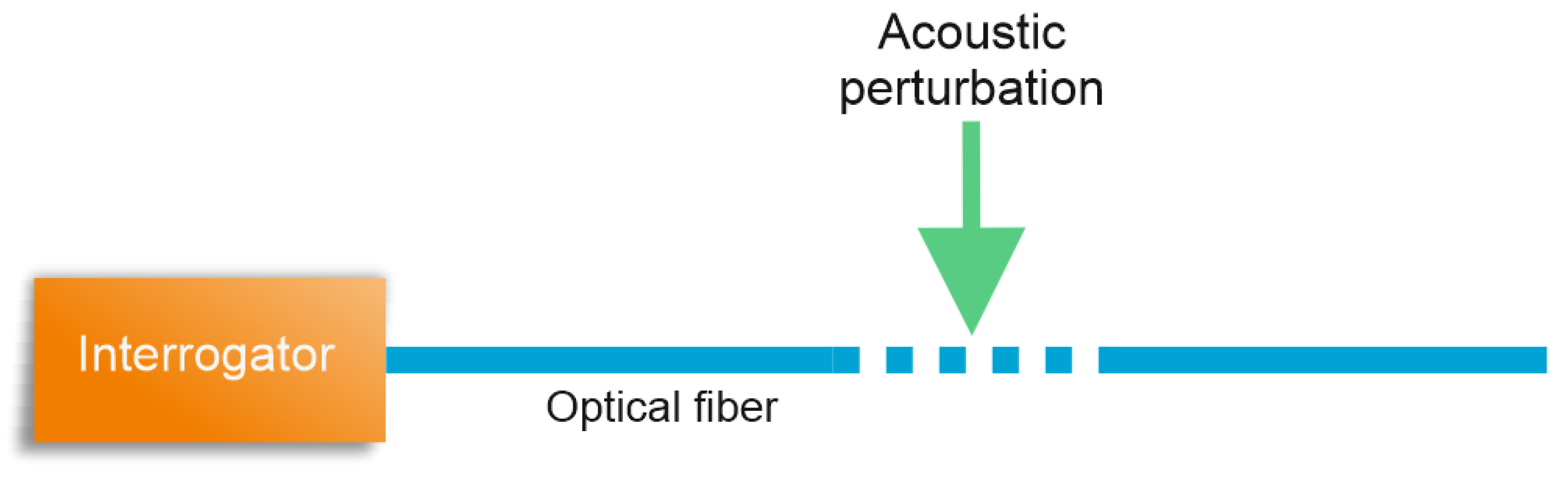
An extremely simple DAS model consists of a sensing fiber (cable) and interrogator (Figure 1).
一个极其简单的 DAS 模型由传感光纤(电缆)和解调仪组成(图 1)。
Figure 1. Simplified schematic of a DAS setup.
图 1.DAS 设置的简化示意图。
The latter includes a radiation source, one or more optical amplifiers (if required), an optical circulator or splitter, a photodetector and a data acquisition device. It is no surprise that lots of scientists have devoted their research to the improvement of interrogators and data processing [28,29,30,31], because light generating and amplifying devices along with analog-to-digital converters are usually the most expensive parts of DAS setups. Nevertheless, a study of the sensing element optimization possibilities seems to be quite interesting and a perspective that is insufficiently explored. The cable’s efficiency in detecting certain acoustic frequencies varies with the strain, winding, twist and bend of the fiber inside the cable, as well as the contact type between the cable and the environment. A number of works study the influence of this parameter [7,32,33,34]. However, the main element of a sensing cable is still the optical fiber. As DASs usually utilize Rayleigh backscattering in their optical fiber [35], a common way to increase their efficiency is to enhance this scattering. We can achieve this, for example, by increasing the number of Rayleigh scatterers in the fiber [36]. However, the more optical power is scattered back to its source, the higher the transmission losses will be. Another method is to make fiber Bragg gratings (FBGs) inside the fiber [37]. Along with increased transmission losses, such fibers can cost significantly higher amounts, and result in quasi-distributed sensing.
后者包括一个辐射源、一个或多个光放大器(如果需要)、一个光环行器或分路器、一个光电探测器和一个数据采集设备。毫不奇怪,许多科学家将他们的研究致力于改进解调仪和数据处理 [ 28, 29, 30, 31],因为光发生和放大设备以及模数转换器通常是 DAS 设置中最昂贵的部分。尽管如此,对传感元件优化可能性的研究似乎非常有趣,而且这一观点尚未得到充分探索。光缆检测某些声频率的效率取决于光缆内部光纤的应变、缠绕、扭曲和弯曲,以及光缆与环境之间的接触类型。许多工作研究了该参数的影响 [ 7, 32, 33, 34]。然而,传感电缆的主要元件仍然是光纤。由于 DAS 通常在其光纤中使用瑞利反向散射 [ 35],因此提高其效率的一种常见方法是增强这种散射。例如,我们可以通过增加光纤中瑞利散射体的数量来实现这一目标 [ 36]。然而,散射回其源的光功率越多,传输损耗就越高。另一种方法是在光纤内部制造光纤布拉格光栅 (FBG) [ 37]。随着传输损耗的增加,这种光纤的成本会明显更高,并导致准分布式传感。
That is why the influence of a standard single-mode fiber coating type on DAS efficiency should be considered. For example, Tao Xie et al. compare a bare fiber to loose-tube, thermoplastic, polyurethane, tight-buffered and polyethylene, tight-buffered fibers. Fiber outer diameters vary from 2 to 7.2 mm. Their results show that a simply tight-buffered fiber (with no reinforcement) has the highest acoustic sensitivity. And, the difference in the fibers’ sensitivity decreases with an increase in the acoustic frequency. The range of the acoustic impact frequencies the authors used for their tests laid between 0 and 500 Hz [38].
这就是为什么要考虑标准单模光纤涂层类型对 DAS 效率的影响。例如,Tao Xie 等人将裸纤维与松套管、热塑性塑料、聚氨酯、紧密缓冲和聚乙烯、紧密缓冲纤维进行了比较。纤维外径从 2 到 7.2 mm 不等。他们的结果表明,简单的紧密缓冲光纤(无增强)具有最高的声学灵敏度。而且,纤维灵敏度的差异随着声频率的增加而减小。作者用于测试的声学冲击频率范围在 0 到 500 Hz 之间 [ 38]。
However, the fiber optic industry can also offer standard single-mode and anisotropic fibers of different diameters, produced by MCVD, VAD or OVD technology, which are coated in acrylate, imide, fluorocarbon, propylene, vinyl polymer silicone, carbon, metal and many other coatings. Moreover, the range of acoustic frequencies to be detected by DASs in different applications includes both infra- and ultra-sound frequencies. Being closer to practical research than to theoretical research, the aim of this work was to study the performance of a DAS setup with seven different fiber types available.
然而,光纤行业也可以提供不同直径的标准单模和各向异性光纤,这些光纤由 MCVD、VAD 或 OVD 技术生产,涂有丙烯酸酯、酰亚胺、碳氟化合物、丙烯、乙烯基聚合物硅橡胶、碳、金属和许多其他涂层。此外,DAS 在不同应用中要检测的声学频率范围包括次声频率和超声频率。与理论研究相比,这项工作更接近于实践研究,其目的是研究具有七种不同光纤类型的 DAS 设置的性能。

2. Approach  2. 方法

2.1. Theory  2.1. 理论

A DAS detects acoustic waves by measuring phase shifts in the light propagating through an optical fiber. For a fiber with length L, the effective refractive index neff and the light wavelength λ of the phase is given by:
DAS 通过测量通过光纤传播的光的相移来检测声波。对于长度为 L 的光纤,有效折射率 n eff 和相位的光波长 λ 由下式给出:
ϕ=2πneffλL.
Acoustic events induce a periodic change in pressure ΔP on the fiber, leading to a corresponding periodic change in the optical path length and a shift in the positions of Rayleigh scatterers. The optical phase pressure sensitivity Sϕ is then defined as:
声学事件引起光纤上压力 ΔP 的周期性变化,导致光程长度的相应周期性变化和瑞利散射体位置的变化。然后,光相压力敏感度 S ϕ 定义为:
Sϕ=ΔϕϕΔP          (Pa1)
Thus, for a given acoustic event with a constant ΔP, a larger phase shift Δϕ means a higher sensitivity Sϕ. When the acoustic wavefront is isotropic and aligned parallel to the fiber’s axial direction, the phase shift is given by:
因此,对于具有恒定 ΔP 的给定声学事件,较大的相移 Δφ 意味着较高的灵敏度 S ϕ 。当声波前是各向同性的并且平行于光纤的轴向对齐时,相移由下式给出:
Δϕ=εLβneff22β1μP12+μP11
where β is the propagation constant, μ is Poisson’s ratio, P12 and P11 are the strain-optic coefficients of the fiber core material and ε represents the core strain. As shown in Equations (2) and (3), for a constant ΔP, greater strain ε yields higher sensitivity. Under these conditions, the fiber deformation inversely depends on its stiffness coefficient k.
其中 β 是传播常数,μ 是泊松比,P 12 和 P 11 是光纤纤芯材料的应变-光学系数,ε 表示纤芯应变。如公式 (2) 和 (3) 所示,对于恒定的 ΔP,应变ε越大,灵敏度越高。在这些条件下,纤维变形与其刚度系数 k 成反比。
k=πD2E4L,
where D denotes the fiber diameter and E is its Young’s modulus. Therefore, theoretically, reducing E, D or both increases the strain ε and sensitivity for the same acoustic event [39].
其中 D 表示纤维直径,E 是其杨氏模量。因此,从理论上讲,减少 E、D 或两者兼而有之会增加同一声学事件的应变ε和敏感性 [ 39]。

2.2. Samples  2.2. 样本

Six different types of non-standard optical fibers and a standard single-mode fiber were available for this study (Table 1).
本研究提供了六种不同类型的非标准光纤和一种标准单模光纤(表 1)。
Table 1. Main characteristics of the fibers under testing (FUTs).
表 1.被测纤维 (FUT) 的主要特性。
Corning SMF-28 Ultra was used as a reference due to its widespread use in telecommunications and DAS applications. Generally, fibers produced by MCVD exhibit a slightly higher attenuation coefficient than those produced by OVD. So, “Fiber 6” was selected to investigate whether it has a higher acoustic sensitivity than “Fiber 1”, as the primary difference between them is the production method. “Fiber 2” is represented by Corning SMF-28 with a multilayer coating [40], where the Young’s modulus E of the inner layer is slightly higher than that of the outer layer, with both being lower than the modulus of acrylates. This fiber is more than three times larger in diameter than “Fiber 1”, making it important to study which parameter—diameter or modulus—has a greater impact on acoustic sensitivity. The effect of multilayer coating was also a subject of interest.
康宁 SMF-28 Ultra 因其在电信和 DAS 应用中的广泛应用而被用作参考。通常,MCVD 生产的光纤的衰减系数略高于 OVD 生产的光纤。因此,选择“Fiber 6”来研究它是否比“Fiber 1”具有更高的声学灵敏度,因为它们之间的主要区别在于生产方法。“纤维 2”以具有多层涂层 [ 40] 的康宁 SMF-28 为代表,其中内层的杨氏模量 E 略高于外层的杨氏模量,两者均低于丙烯酸酯的模量。这种光纤的直径是“光纤 1”的三倍多,因此研究哪个参数(直径或模量)对声学灵敏度的影响更大非常重要。多层涂层的效果也是一个有趣的主题。
In contrast, “Fiber 3” has a smaller outer diameter but higher E values for each coating layer. Additionally, the speed of sound in metals is relatively high, so this fiber was chosen to explore how these characteristics influence its acoustic sensitivity compared to “Fiber 1”. Polyimide coatings provide higher tensile strength, have similar E values to acrylate and are known to induce bend losses. However, if an acoustic wave modulates the fiber’s micro- and macro-bends, polyimide-coated fibers may exhibit enhanced acoustic sensitivity. Two types of polyimide-coated fibers were available in this study; one of these had coating defects, including inhomogeneities, caverns and embedded bubbles. These minor coating imperfections could potentially resonate with specific acoustic frequencies, increasing the fiber’s acoustic sensitivity.
相比之下,“纤维 3”的外径较小,但每个涂层的 E 值较高。此外,金属中的声速相对较高,因此选择这种光纤来探索与“光纤 1”相比,这些特性如何影响其声学灵敏度。聚酰亚胺涂层具有更高的拉伸强度,具有与丙烯酸酯相似的 E 值,并且已知会引起弯曲损失。但是,如果声波调制了光纤的微弯曲和宏观弯曲,则聚酰亚胺涂层的光纤可能会表现出增强的声灵敏度。本研究提供了两种类型的聚酰亚胺涂层纤维;其中一种存在涂层缺陷,包括不均匀性、腔室和嵌入的气泡。这些微小的涂层缺陷可能会与特定的声学频率产生共振,从而增加光纤的声学灵敏度。
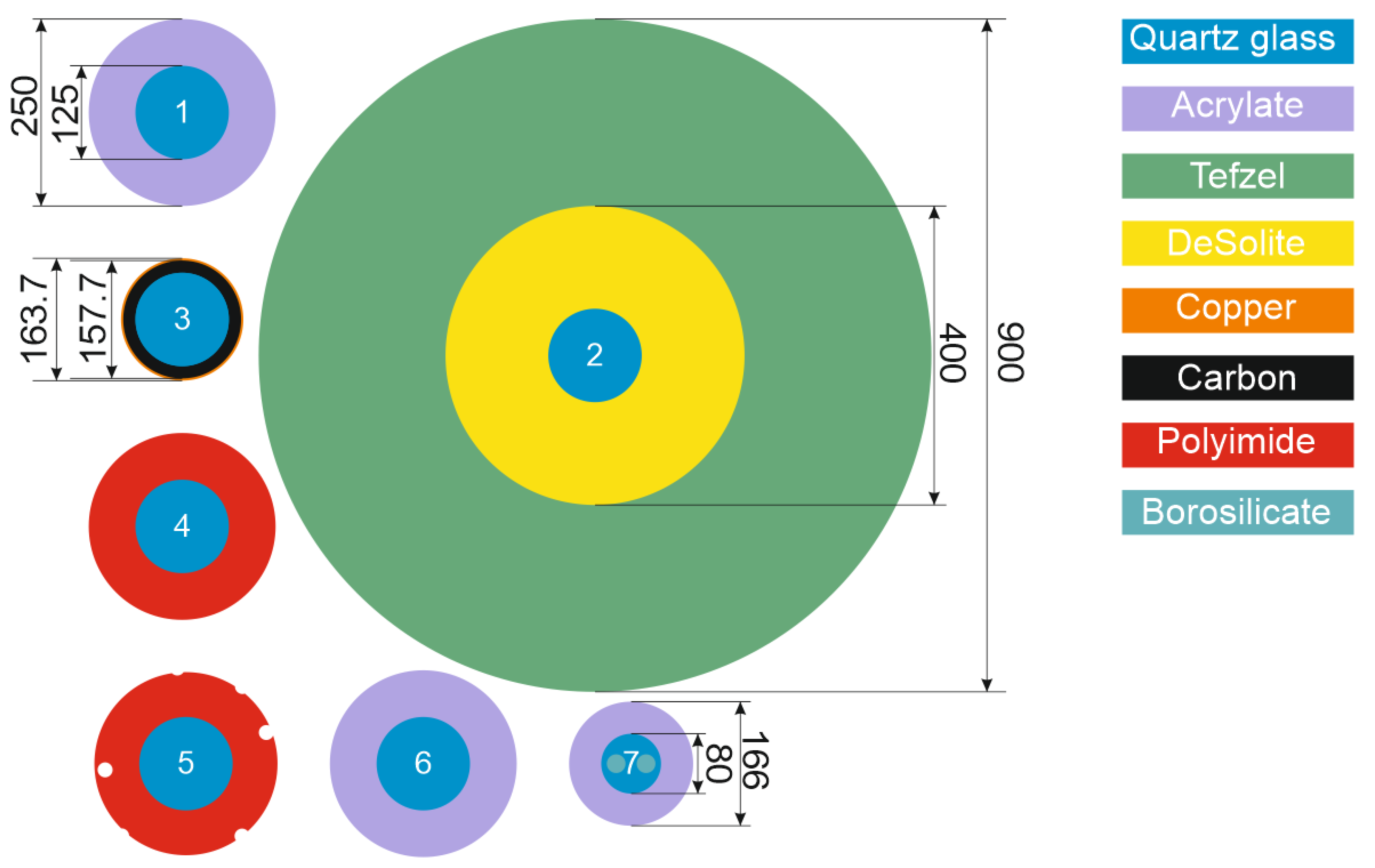
It was also decided to include the anisotropic “Fiber 7” in the study because of its smaller outer diameter and reduced glass cladding diameter (see Figure 2). An acoustic disturbance induces mechanical waves in the fiber core and could lead to polarization mode coupling, resulting in the transfer of light between modes. This phenomenon could enhance the fiber’s acoustic sensitivity. However, fibers like “Fiber 7” are inherently anisotropic, exhibiting intrinsic strain that provides additional resistance to bend losses, which may offset the sensitivity benefits provided by its other features, potentially resulting in lower acoustic sensitivity compared to “Fiber 1”. During testing, “Fiber 7” was probed with a fiber optic polarizer to direct all the probing light to the fiber’s “fast” polarizing mode.
还决定将各向异性的“Fiber 7”纳入研究,因为它的外径较小,玻璃包层直径减小(见图 2)。声学干扰会在光纤纤芯中感应出机械波,并可能导致极化模式耦合,从而导致光在模式之间转移。这种现象可以提高光纤的声学灵敏度。然而,像“Fiber 7”这样的光纤本质上是各向异性的,表现出固有的应变,为弯曲损耗提供了额外的抵抗力,这可能会抵消其其他功能提供的灵敏度优势,与“Fiber 1”相比,可能导致较低的声学灵敏度。在测试过程中,使用光纤偏振器探测“Fiber 7”,以将所有探测光引导至光纤的“快速”偏振模式。
Figure 2. FUTs’ cross-sections, showing dimensions in μm. White numbers indicate fiber designations for easy reference.
图 2.FUT 的横截面,以 μm 为单位显示尺寸。白色数字表示光纤名称,以便于参考。
To evaluate the estimated acoustic sensitivities of the FUTs, the kL parameter was used, assuming known Young’s moduli E for the coating materials, along with known diameters of fiber claddings and coatings. Here, L is consistent across all fibers, as is the stiffness coefficient k of the uncoated fibers (Table 2):
为了评估 FUT 的估计声学灵敏度,使用了 kL 参数,假设涂层材料的已知杨氏模量 E,以及已知的纤维包层和涂层直径。在这里,L 在所有纤维上都是一致的,未涂层纤维的刚度系数 k 也是如此(表 2):
kL=0.25πE(Do2Di2),
where Do is the outer coating diameter and Di is the inner coating diameter. Lower values of kL indicate higher sensitivity. For fibers with multilayer coatings, kL was calculated as follows:
其中 D o 是外涂层直径,D 是内涂层直径。kL 值越低表示灵敏度越高。对于具有多层涂层的纤维,kL 的计算方法如下:
kL=kL1S1S1+S2+kL2S2S1+S2,
where (kL)1 and (kL)2 represent the kL parameters of the first and second coating layers, S1 and S2 are their cross-sectional areas. The final kL value for the multilayer-coated fiber was determined by weighting each layer’s kL value according to its cross-sectional area relative to the total cross-sectional area of the coating.
其中 (kL) 1 和 (kL) 2 代表第一层和第二涂层的 kL 参数,S 1 和 S 2 是它们的横截面积。多层涂层纤维的最终 kL 值是通过根据其相对于涂层总横截面积的横截面积对每层的 kL 值进行加权来确定的。
Table 2. Mechanical parameters and the estimated acoustic sensitivity of the FUTs.
表 2.机械参数和 FUT 的估计声学灵敏度。
As almost all the FUTs are made from the same type of glass and have similar glass cladding diameters, coating differences are the primary distinguishing factor. So, the influence of the glass core and cladding on the Young’s modulus was not considered in the study, since it was the same for all FUTs except “Fiber 7”. In summary, this approach to glass cladding and multilayer coatings has significantly simplified theoretical estimations. Its influence on the results was considered to be acceptable and is discussed in Section 4.
由于几乎所有的 FUT 都是由相同类型的玻璃制成的,并且具有相似的玻璃覆层直径,因此涂层差异是主要的区别因素。因此,研究中没有考虑玻璃芯和包层对杨氏模量的影响,因为除“纤维 7”之外的所有 FUT 都是相同的。总之,这种玻璃覆层和多层涂层的方法大大简化了理论估计。它对结果的影响被认为是可以接受的,并在第 4 节中进行了讨论。
According to Table 2, “Fiber 2” is expected to exhibit the lowest acoustic sensitivity, while “Fiber 7” is anticipated to have the highest sensitivity.
根据表 2,预计“光纤 2”将表现出最低的声学灵敏度,而“光纤 7”预计具有最高的灵敏度。

2.3. Setup  2.3. 设置

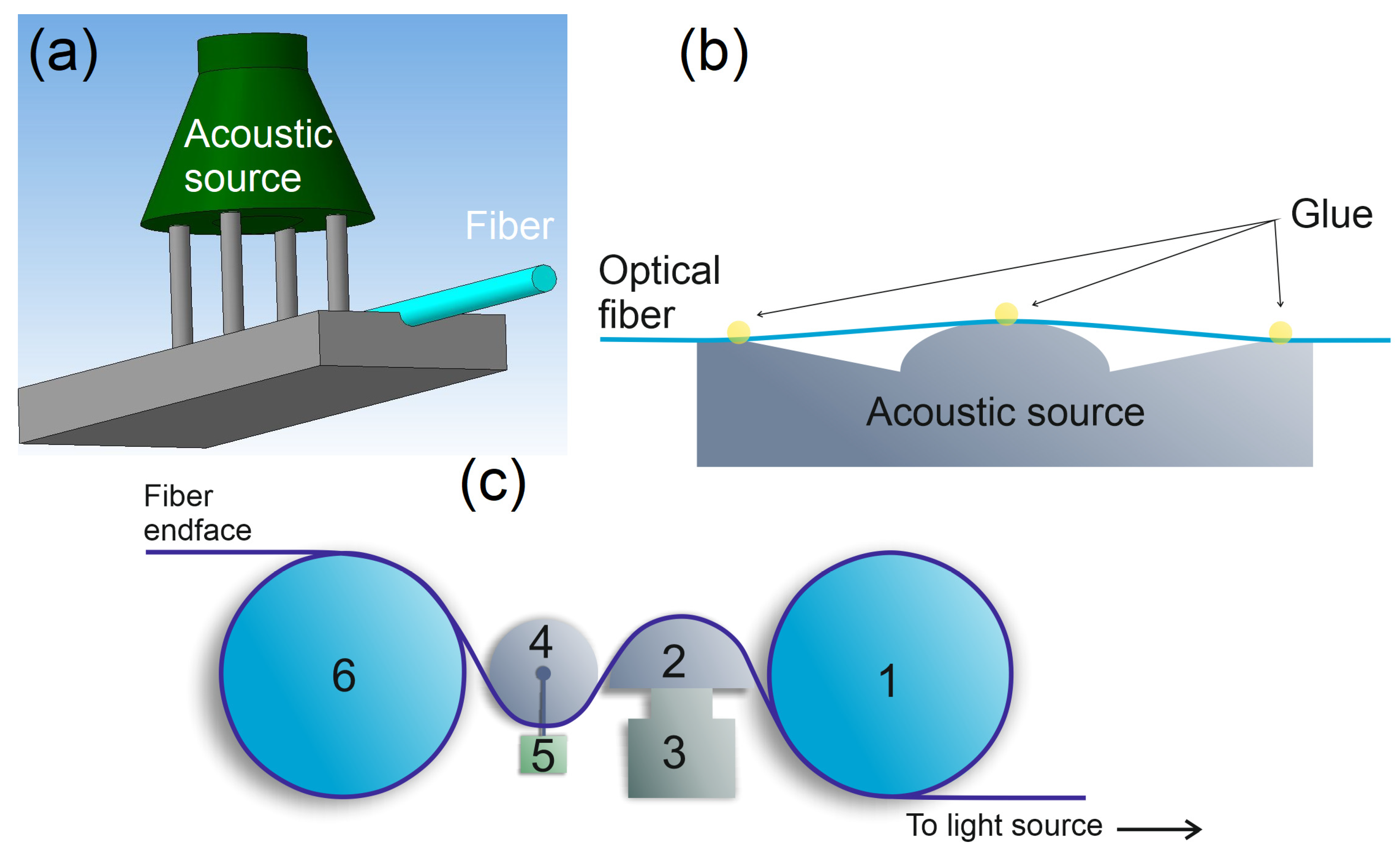
Testing conditions are crucial when studying the acoustic sensitivity of various fibers. To enable a fair comparison, the testing parameters must be as consistent as possible across all FUTs, with fiber tension and distance to the sound source being the main considerations. Initial methods, such as laying the fiber in a groove beneath the acoustic source (Figure 3a) or attaching the fiber directly to it (Figure 3b), were deemed unreliable. Therefore, a setup with two pulleys, two fiber spools and a load (Figure 3c) was selected to transmit sound waves reproducibly from the source to the fiber.
在研究各种光纤的声学灵敏度时,测试条件至关重要。为了实现公平的比较,所有 FUT 的测试参数必须尽可能一致,其中纤维张力和与声源的距离是主要考虑因素。最初的方法,例如将光纤铺设在声源下方的凹槽中(图 3a)或将光纤直接连接到其上(图 3b),被认为不可靠。因此,选择了具有两个滑轮、两个光纤线轴和一个负载(图 3c)的设置,以可重复地将声波从源传输到光纤。
Figure 3. Variants of test setups considered for the DAS experiment. (a) Fiber laid in a groove beneath the acoustic source; (b) fiber directly attached to the acoustic source; (c) a complex setup with the fiber loaded using pulleys and weights to ensure consistent tension and sound transmission.
图 3.DAS 实验考虑的测试设置的变体。(a) 铺设在声源下方凹槽中的光纤;(b) 直接连接到声源的光纤;(c) 使用滑轮和砝码加载纤维的复杂设置,以确保一致的张力和声音传输。
A 2 m segment of the FUT was fusion-spliced to a 440 m coil 1 of Corning SMF-28 fiber to ensure that acoustic perturbations occurred far from any reflective distortions at the input face. This configuration also ensured minimal transmission losses, enabling equal probing for all FUTs. The segment was then passed through half-pulley 2, with a flat face firmly attached to sound source 3, ensuring a uniform distance between the FUT and the sound source across samples, and minimizing acoustic wave losses by using a solid medium rather than air. Next, the FUT segment was placed under pulley 4 with a 60 g load 5. The load was selected to apply sufficient tension to the FUT without introducing additional probing light losses, thereby providing consistent and reproducible tension across all FUTs. Finally, the segment was fusion-spliced to another coil 6 of 412 m of Corning SMF-28, ensuring a sufficient distance between the end-face reflection disturbance and the acoustic event.
将 FUT 的 2 m 段熔接到康宁 SMF-28 光纤的 440 m 线圈 1 上,以确保在远离输入面的任何反射失真的地方发生声学扰动。这种配置还确保了最小的传输损耗,从而实现了所有 FUT 的相等探测。然后将该段穿过半滑轮 2,其平面牢固地连接到声源 3,确保 FUT 和样本中的声源之间的距离均匀,并通过使用固体介质而不是空气来最大限度地减少声波损失。接下来,将 FUT 段放置在滚筒 4 下方,负载为 60 g 5。选择载荷以对 FUT 施加足够的张力,而不会引入额外的探测光损失,从而在所有 FUT 上提供一致且可重复的张力。最后,将该段熔接到康宁 SMF-28 的另一个 6 m 412 线圈上,确保端面反射干扰和声学事件之间有足够的距离。
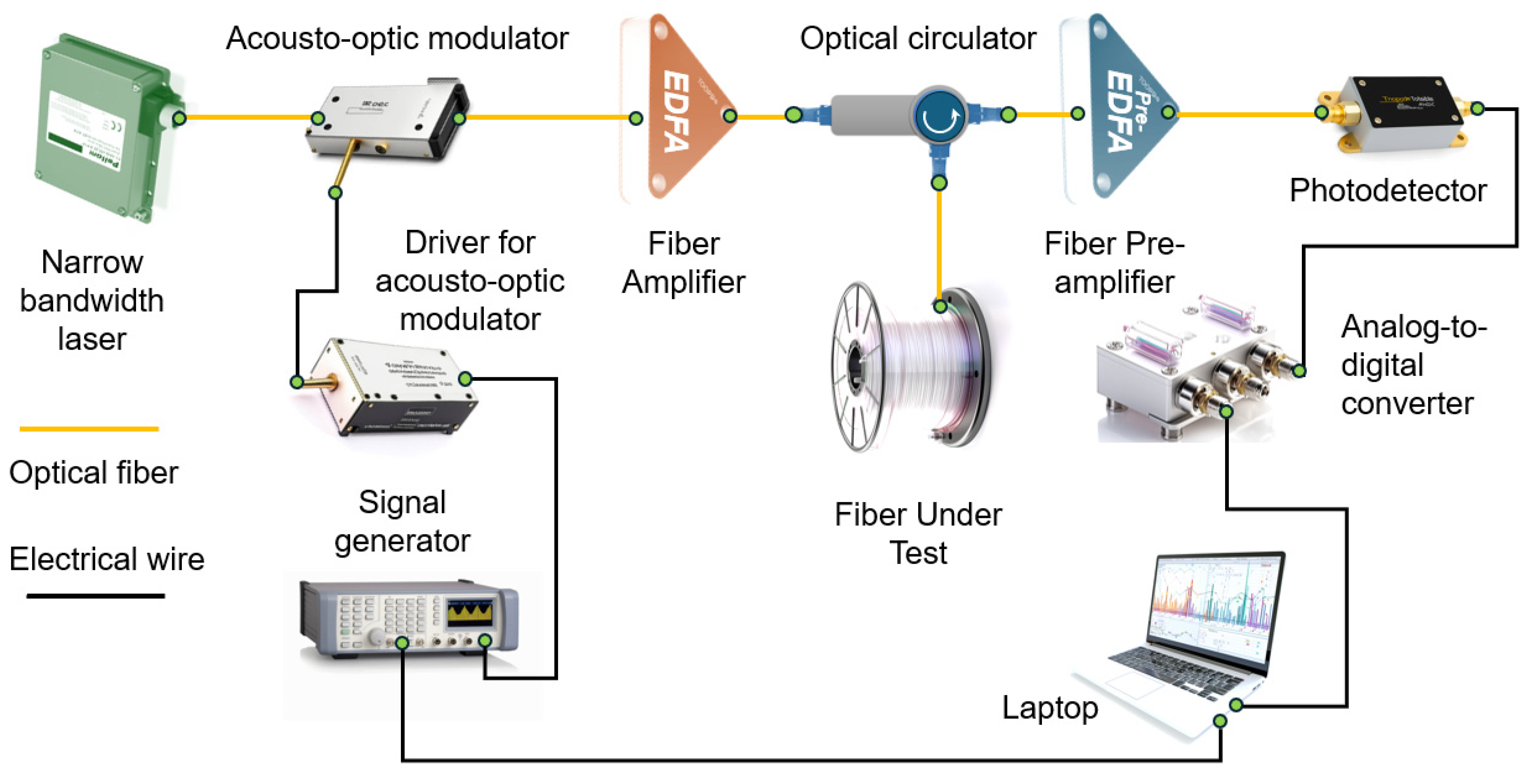
The interrogation system used Rayleigh scattering and phase-sensitive OTDR technology [14] to detect acoustic events, utilizing a φ-DAS variant with direct detection (no phase demodulation). The setup included a Connet CoSF-D-ER-M (Connet Laser Technology Co., Ltd., Shanghai, China) laser source with 15 mW of output power, a 1550 nm wavelength and 1 kHz of linewidth; an SSP-1550-200-PM-FC (Special Systems. Photonics, LLC, Saint-Petersburg, Russia) acousto-optical modulator (AOM); an Amonics AEDFA-23-M-FA Erbium-doped fiber optic amplifier (Amonics Ltd., Hong Kong, China); an optical circulator (Advanced Fiber Resources, Ltd., Zhuhai, China); an Amonics (Amonics Ltd., Hong Kong, China) AEDFA-PA-35-M-FA Erbium-doped fiber optic booster (pre-amplifier); a Thorlabs PDA 10D-EC photodetector (Thorlabs Inc., Newton, NJ, USA) and a La-n1usb (Rudnev-Shilyaev, LLC, Moscow, Russia) analog-to-digital converter (Figure 4). Probing light pulses had a duration of 40 ns and a repetition time of 10 μs. The amplifier output light power was 30.5 mW, while the preamplifier increased the power of the backscattered signal to 1.99 mW. The ADC had the sampling frequency of 500 MHz, yielding a spatial resolution of approximately 0.2 m, and a buffer capacity allowing for acquisition of up to 838 DAS traces in series. The sound source was a 30 mm, 8 Ohm resonant speaker.
解调系统使用瑞利散射和相位敏感 OTDR 技术 [ 14] 来检测声学事件,利用具有直接检测(无相位解调)的 φ-DAS 变体。该装置包括一个 Connet CoSF-D-ER-M(Connet 激光技术有限公司,中国上海)激光源,输出功率为 15 mW,波长为 1550 nm,线宽为 1 kHz;SSP-1550-200-PM-FC(特殊系统。Photonics, LLC, Saint-Petersburg, Russia)声光调制器 (AOM);安力诺斯 AEDFA-23-M-FA 掺铒光纤放大器(安力诺斯有限公司,中国香港);光环行器(Advanced Fiber Resources, Ltd.,中国珠海);安力诺斯(安力诺斯有限公司,中国香港)AEDFA-PA-35-M-FA 掺铒光纤升压器(前置放大器);一个 Thorlabs PDA 10D-EC 光电探测器(Thorlabs Inc.,美国新泽西州牛顿)和一个 La-n1usb(Rudnev-Shilyaev,LLC,俄罗斯莫斯科)模数转换器(图 4)。探测光脉冲的持续时间为 40 ns,重复时间为 10 μs。放大器输出功率为 30.5 mW,而前置放大器将背向散射信号的功率增加到 1.99 mW。该 ADC 的采样频率为 500 MHz,空间分辨率约为 0.2 m,缓冲容量允许串联采集多达 838 条 DAS 走线。声源是一个 30 毫米、8 欧姆的谐振扬声器。
Figure 4. Schematic of the DAS setup interrogator used in the study.
图 4.研究中使用的 DAS 设置解调仪示意图。
As the acoustic sensitivity of optical fibers can vary with the frequency of the incident acoustic wave, the continuous laser radiation was converted into light pulses with the AOM and amplified by the EDFA. The light was then sent through the circulator to the FUT, where it underwent Rayleigh scattering due to small inhomogeneities within the fiber that cause intrinsic light loss. A narrow laser linewidth enabled interference within the pulse, as scattering components interacted. The resulting light intensity depended on the spacing between scattering centers and the refractive index of the medium between them. An acoustic signal modulated these parameters, so the scattered light from that position was modulated at the same frequency. This backscattered signal, directed to the photodetector, conveyed information about the acoustic event’s frequency, amplitude and location along the fiber.
由于光纤的声学灵敏度会随入射声波的频率而变化,因此连续的激光辐射通过 AOM 转换为光脉冲并被 EDFA 放大。然后,光通过环行器发送到 FUT,由于光纤内的小不均匀性导致固有光损失,它在那里发生瑞利散射。由于散射分量相互作用,较窄的激光线宽使脉冲内的干涉成为可能。由此产生的光强度取决于散射中心之间的间距和它们之间介质的折射率。声信号调制了这些参数,因此来自该位置的散射光以相同的频率进行调制。这个反向散射信号直接发送到光电探测器,传达了有关声学事件的频率、振幅和沿光纤位置的信息。
To assess the FUT sensitivities across a range of acoustic frequencies, a composite signal was transmitted to the speaker. This signal included frequencies from 100 to 2000 Hz in 100 Hz increments and from 2000 Hz to 7000 Hz in 500 Hz increments. The system could not reproduce frequencies above 7000 Hz without distorting lower frequencies, as the required volume levels caused the entire setup to detect vibrations beyond the FUT segment. Additionally, data acquisition limitations prevented the resolution of frequencies below 119 Hz.
为了评估 FUT 在一定声学频率范围内的灵敏度,将复合信号传输到扬声器。该信号包括从 100 到 2000 Hz(以 100 Hz 为增量)的频率,以及从 2000 Hz 到 7000 Hz(以 500 Hz 为增量)的频率。该系统无法在不扭曲较低频率的情况下再现 7000 Hz 以上的频率,因为所需的音量水平会导致整个装置检测到 FUT 段以外的振动。此外,数据采集限制阻碍了低于 119 Hz 的频率分辨率。

2.4. Data Processing  2.4. 数据处理

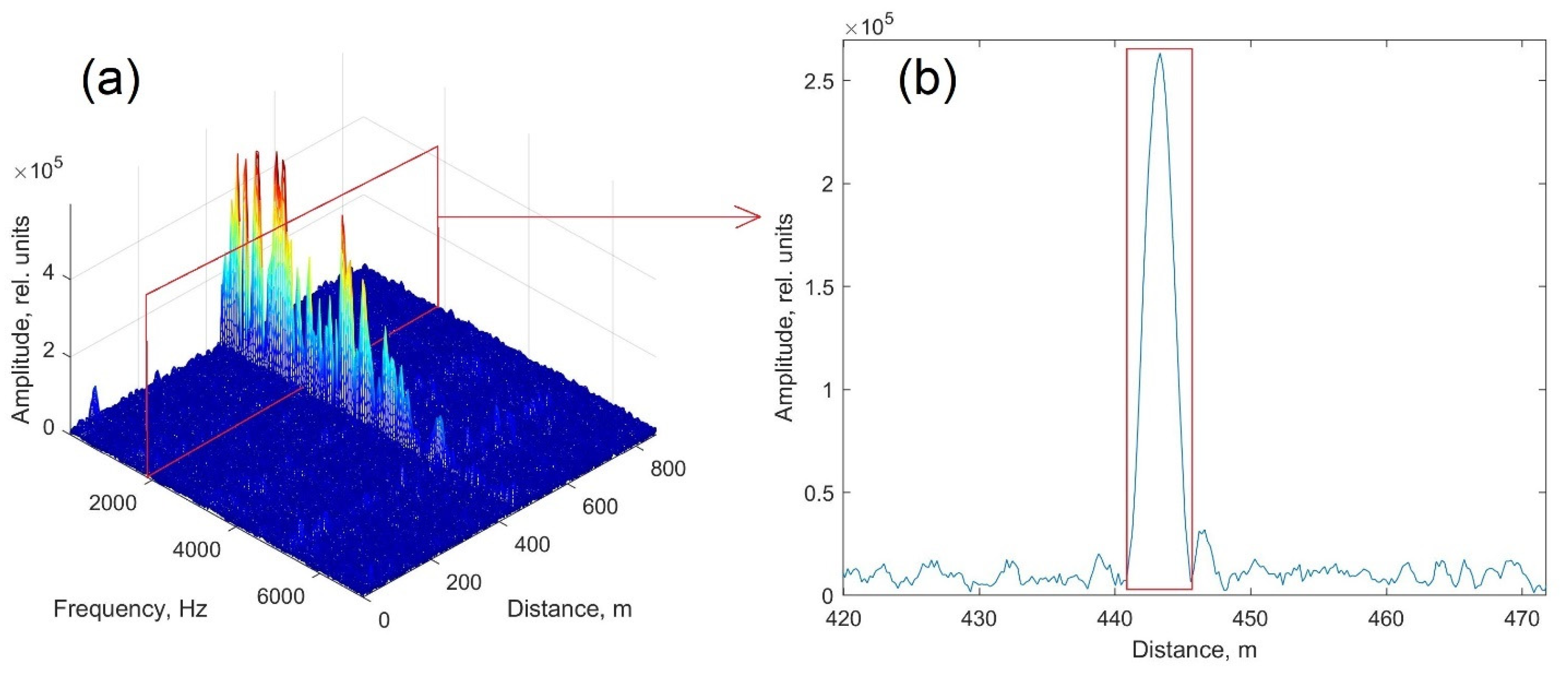
Each data acquisition attempt produced 838 traces, with each trace sampled into 4183 points, corresponding to specific positions along the fiber. This setup provided 838 time-domain points for each position along the fiber. The time-series data for each position was then subjected to fast Fourier transform (FFT), generating a 3D plot showing the amplitude of the signal across available frequencies and distances along the fiber (Figure 5a).
每次数据采集尝试都会产生 838 条轨迹,每条轨迹采样为 4183 个点,对应于沿光纤的特定位置。这种设置为光纤上的每个位置提供了 838 个时域点。然后对每个位置的时间序列数据进行快速傅里叶变换 (FFT),生成一个 3D 图,显示沿光纤的可用频率和距离上的信号幅度(图 5a)。
Figure 5. (a) Data obtained from the FFT of the test signal acquired with the Corning SMF-28 fiber in the DAS setup, with a red square highlighting one of the cross-sections; (b) a cross-section view at the 2000 Hz signal frequency, where the red square indicates the points selected for averaging.
图 5.(a) 在 DAS 设置中使用康宁 SMF-28 光纤采集的测试信号的 FFT 获得的数据,其中红色方块突出显示了其中一个横截面;(b) 2000 Hz 信号频率下的横截面图,其中红色方块表示选择进行平均的点。
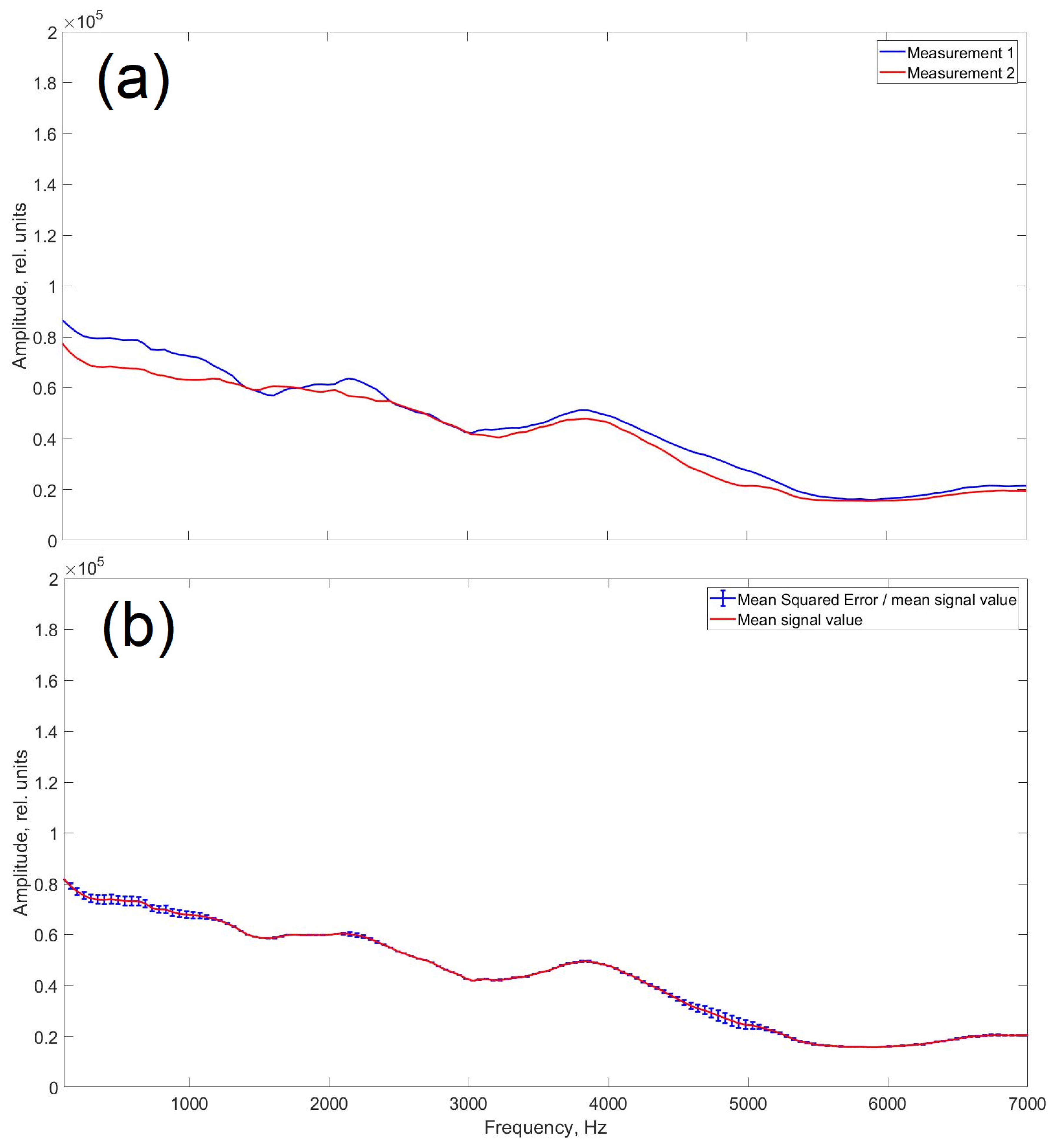
Due to the setup configuration, the amplitude and position of the detected acoustic event showed slight fluctuations between data acquisition attempts. To minimize the impact of these variations on the results, the signal values were averaged in the spatial domain within the region where the acoustic event occurred (Figure 5b) for each frequency. Subsequently, an average value of the acoustic perturbation signal at each frequency was obtained across 100 data acquisition attempts. This data processing approach will hereafter be referred to as a “measurement”.
由于设置配置,检测到的声学事件的幅度和位置在数据采集尝试之间显示出轻微的波动。为了最大限度地减少这些变化对结果的影响,在每个频率的声学事件发生区域(图 5b)的空间域中对信号值进行平均。随后,在 100 次数据采集尝试中获得每个频率的声学扰动信号的平均值。这种数据处理方法在下文中称为“测量”。
The error σ for this technique was calculated as:
该技术的误差σ计算如下:
σ=MSEA¯,
where MSE is the mean squared error between the two consecutive measurements of the same FUT segment and A¯ is the mean signal value (Figure 6). The average σ value for these measurements was found to be 492 rel. units, which is approximately five times lower than that for the most similar FUTs in the study—“Fiber 6” and “Fiber 1”—making the technique’s error level acceptable.
其中 MSE 是同一 FUT 段的两次连续测量之间的均方误差, A¯ 是平均信号值(图 6)。发现这些测量的平均σ值为 492 个相对单位,这大约是研究中最相似的 FUT(“纤维 6”和“纤维 1”)的五倍,这使得该技术的误差水平可以接受。
Figure 6. (a) Results of two consecutive measurements for the same FUT, showing consistency in the detected signal; (b) error bars for these curves, indicating measurement variability and reliability.
图 6.(a) 同一 FUT 的两次连续测量结果,显示检测到的信号的一致性;(b) 这些曲线的误差线,表示测量的可变性和可靠性。

3. Results  3. 结果

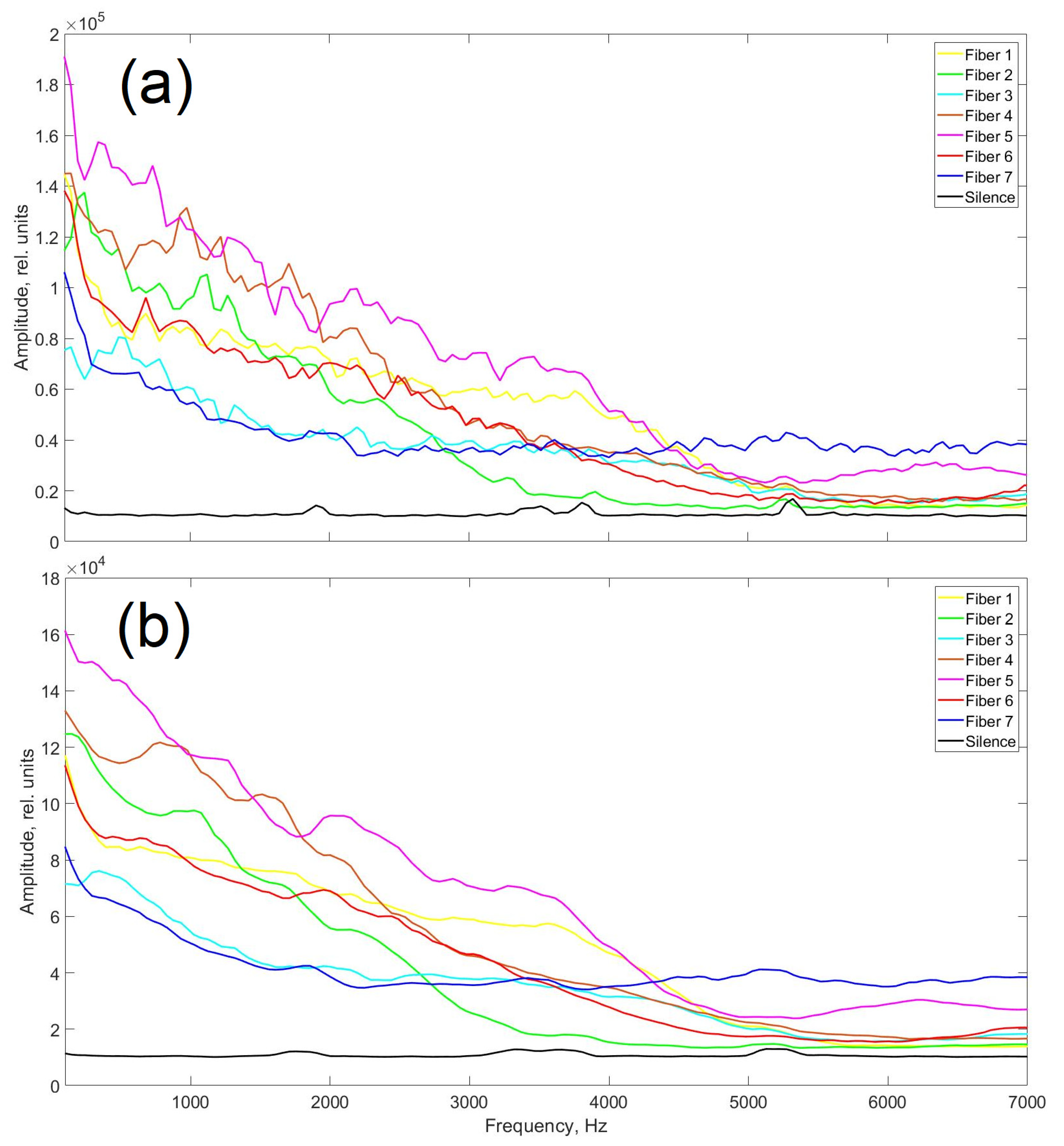
Testing began with “Fiber 1”, which was installed in the setup, and measurements were conducted with the speaker emitting the wideband signal described earlier, followed by a “silence” measurement with the speaker off to capture background noise. Each subsequent fiber segment was installed and measured with the speaker on. The results are presented in Figure 7. To enhance clarity, moving averaging with a 5-point window was applied to the curves in Figure 7b. Thus, the averaging window was being translated along the frequency domain of the obtained frequency-dependent acoustic sensitivity for each FUT.
测试从安装在设置中的“Fiber 1”开始,使用扬声器发射前面描述的宽带信号进行测量,然后在扬声器关闭的情况下进行“静音”测量,以捕获背景噪声。在扬声器打开的情况下安装和测量每个后续光纤段。结果如图 7 所示。为了提高清晰度,将具有 5 点窗口的移动平均应用于图 7b 中的曲线。因此,平均窗口沿着每个 FUT 获得的频率相关声学灵敏度的频域平移。
Figure 7. Acoustic sensitivity test results for all fiber samples. (a) Raw data showing initial sensitivity measurements across samples; (b) smoothed data with a 5-point moving average applied, highlighting trends in frequency-dependent sensitivity for each fiber.
图 7.所有光纤样品的声学灵敏度测试结果。(a) 显示样品初始灵敏度测量值的原始数据;(b) 应用 5 点移动平均值的平滑数据,突出每根纤维的频率相关灵敏度趋势。
The results indicate that “Fiber 5” demonstrates the highest acoustic sensitivity across signal frequencies between 100 and 4500 Hz, after which it is surpassed by “Fiber 7”. Although “Fiber 7” shows average sensitivity below 4500 Hz—lower than that of “Fiber 1” and nearly equivalent to “Fiber 3”—it exhibits relatively stable, frequency-independent sensitivity across the entire range, a trait unique among the tested fibers. For most fibers, sensitivity differences become negligible at acoustic frequencies above 5000 Hz, with “Fiber 7” and “Fiber 5” being exceptions. “Fiber 4” displays good sensitivity below 2500 Hz, but then decreases to match “Fiber 1”.
结果表明,“Fiber 5” 在 100 到 4500 Hz 之间的信号频率上表现出最高的声学灵敏度,之后被 “Fiber 7” 超越。尽管“Fiber 7”的平均灵敏度低于 4500 Hz(低于“Fiber 1”),几乎与“Fiber 3”相当,但它在整个范围内表现出相对稳定、与频率无关的灵敏度,这是测试光纤中独一无二的特性。对于大多数光纤,在高于 5000 Hz 的声学频率下,灵敏度差异可以忽略不计,“光纤 7”和“光纤 5”是例外。“Fiber 4” 在 2500 Hz 以下显示出良好的灵敏度,但随后会降低以匹配 “Fiber 1”。
“Fiber 2” demonstrates notable sensitivity within the 100 to 1500 Hz range but experiences a rapid decline afterward, becoming the least sensitive and the first to reach background noise levels. “Fiber 6” exhibited sensitivity comparable to that of “Fiber 1”, though this was slightly lower below 3000 Hz. “Fiber 3” displayed sensitivity similar to “Fiber 7” but showed a decrease below 4000 Hz.
“Fiber 2”在 100 至 1500 Hz 范围内表现出显著的灵敏度,但之后迅速下降,成为最不敏感的,并且最先达到背景噪声水平。“光纤 6”表现出与“光纤 1”相当的灵敏度,尽管低于 3000 Hz 略低。“光纤 3”表现出与“光纤 7”相似的灵敏度,但在 4000 Hz 以下有所下降。

4. Discussion  4. 讨论

To compare theoretical estimates with experimental data, the integral sensitivity Si of the tested fibers was calculated as follows:
为了将理论估计值与实验数据进行比较,测试纤维的积分灵敏度 S 计算如下:
Si=fminfmaxA(f)df
where fmin is the lowest frequency in the range under consideration, fmax is the highest frequency, A(f) represents the frequency-dependent amplitude of the detected signal for a given FUT (Figure 7), df is the sampling interval in the frequency domain. In this study, based on the FFT sampling rate, df was 48.8 Hz. The integral acoustic sensitivity of the FUTs across the entire range of test signal frequencies, as well as for the range from 4500 to 7000 Hz, is presented in Table 3.
其中 min 是所考虑范围内的最低频率, max 是最高频率,A() 表示给定 FUT 的检测到的信号的频率相关幅度(图 7),df 是频域中的采样间隔。在本研究中,基于 FFT 采样率,df 为 48.8 Hz。表 3 显示了 FUT 在整个测试信号频率范围内以及 4500 至 7000 Hz 范围内的整体声学灵敏度。
Table 3. Integral sensitivity of the FUTs.
表 3.FUT 的积分灵敏度。
From Table 2 and Table 3, theoretical and experimental rankings of the FUTs based on their acoustic sensitivity value can be made (Table 4).
从表 2 和表 3 中,可以根据 FUT 的声学灵敏度值对 FUT 进行理论和实验排名(表 4)。
Table 4. FUTs’ rankings based on their estimated and experimental sensitivities (from highest to lowest).
表 4.FUT 的排名基于其估计和实验敏感性(从最高到最低)。
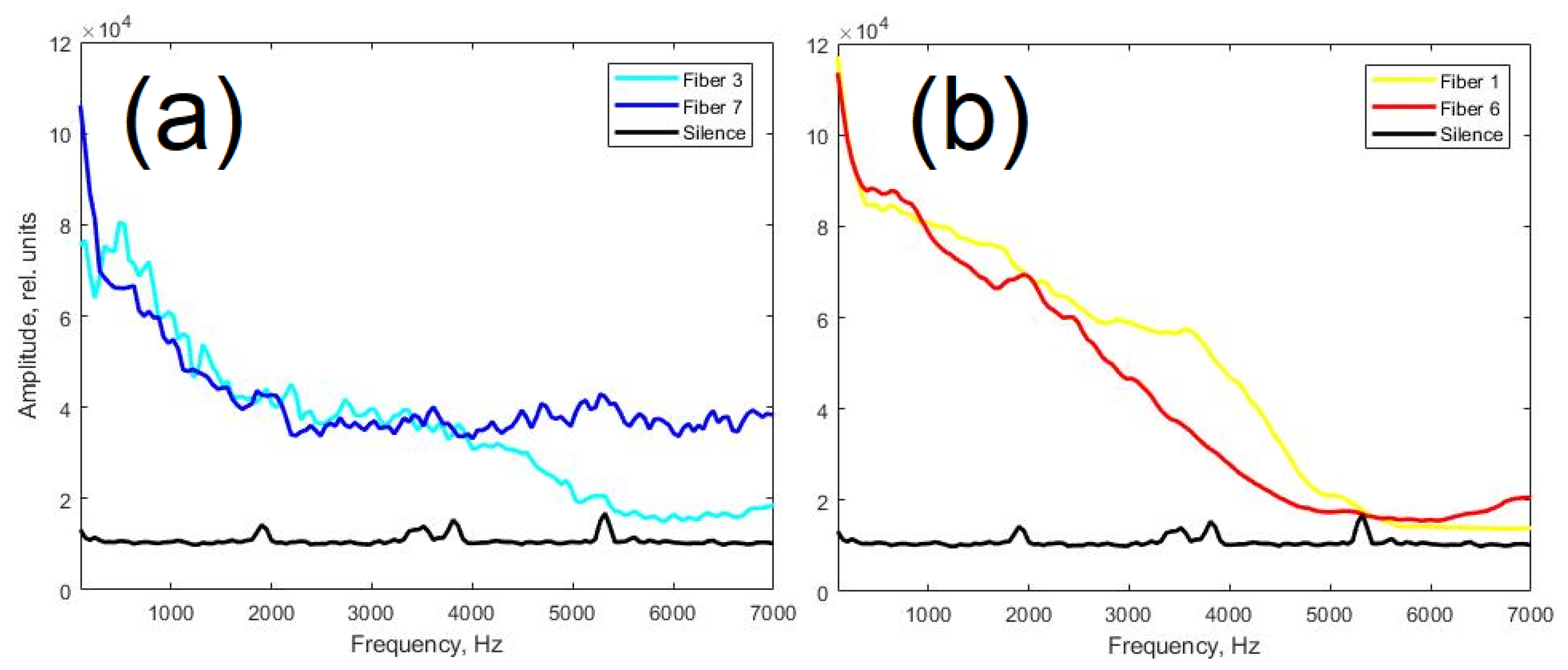
Overall, the estimated and experimental results align closely, with some exceptions. “Fiber 7” and “Fiber 3” displayed lower-than-expected sensitivities across the entire frequency range, whereas “Fiber 3” showed higher sensitivity than estimated in the 4500 to 7000 Hz range. Notably, “Fiber 3” and “Fiber 7” produced very similar response curves (Figure 8a), especially below 4500 Hz. This similarity is likely due to inner strain: “Fiber 3” may experience uncontrolled strain during coating, as copper has a higher coefficient of linear thermal expansion than optical fiber glass. “Fiber 7” inherently contains controlled strain due to its borosilicate rods, giving it an anisotropic, polarization-maintaining core. This anisotropy may explain the relatively low sensitivity of “Fiber 7” at frequencies below 4500 Hz, as these are the primary features distinguishing it from the other fibers. While one might expect “Fiber 7” to show higher sensitivity than “Fiber 1” (since both have the same coating type and “Fiber 7” has a smaller diameter), the experimental data suggest that the internal strain exerts a greater influence on acoustic sensitivity, potentially contributing to the fiber’s frequency-independent sensitivity. This characteristic could be advantageous in DAS applications that require accurate signal frequency spectrum reconstruction, such as sound source identification or distinguishing multiple sound sources, based on “frequency patterns” specific to particular sounds—whether they are from wind, vehicles, animals, birds, or intruders. Relevant applications include early pest detection [46], bee monitoring [47], perimeter security [48], pipeline [49], crop [21], and railway [50,51,52] monitoring, nondestructive testing [53] and sound design [54].
总体而言,估计结果和实验结果密切相关,但有一些例外。“Fiber 7”和“Fiber 3”在整个频率范围内表现出的灵敏度低于预期,而“Fiber 3”在 4500 至 7000 Hz 范围内表现出高于估计的灵敏度。值得注意的是,“Fiber 3” 和 “Fiber 7” 产生了非常相似的响应曲线(图 8a),尤其是在 4500 Hz 以下。这种相似性可能是由于内部应变造成的:“光纤 3”在涂层过程中可能会受到不受控制的应变,因为铜的线性热膨胀系数高于光纤玻璃。“Fiber 7”由于其硼硅酸盐棒,本身就包含受控应变,使其具有各向异性、保持极化的核心。这种各向异性可以解释“Fiber 7”在低于 4500 Hz 的频率下灵敏度相对较低的原因,因为这些是它与其他纤维区分开来的主要特征。虽然人们可能期望“Fiber 7”比“Fiber 1”表现出更高的灵敏度(因为两者具有相同的涂层类型,而“Fiber 7”的直径更小),但实验数据表明,内部应变对声灵敏度的影响更大,可能有助于光纤的灵敏度与频率无关。在需要精确信号频谱重建的 DAS 应用中,例如声源识别或根据特定声音的“频率模式”区分多个声源,无论这些声音是来自风、车辆、动物、鸟类还是入侵者。相关应用包括早期害虫检测 [ 46]、蜜蜂监测 [ 47]、周边安全 [ 48]、管道 [ 49]、作物 [ 21] 和铁路 [ 50, 51, 52] 监测、无损检测 [ 53] 和声音设计 [ 54]。
Figure 8. Acoustic sensitivity test results comparing selected fiber samples. (a) Sensitivity results for “Fiber 3” and “Fiber 7”, highlighting similarities in frequency response. (b) Sensitivity results for “Fiber 1” and “Fiber 6”, showing comparable performance across the tested frequency range.
图 8.比较选定光纤样品的声学灵敏度测试结果。(a) “Fiber 3” 和 “Fiber 7” 的灵敏度结果,突出了频率响应的相似性。(b) “Fiber 1” 和 “Fiber 6” 的灵敏度结果,在测试的频率范围内显示出相当的性能。
The exceptional performance of “Fiber 5” likely results from two factors. First, coating inhomogeneities appear to resonate with multiple acoustic frequencies in the test signal. Second, variation in coating thickness—though they are a defect—may enhance acoustic sensitivity due to the reduction in the sample’s outer diameter. Consistent with theoretical estimates, “Fiber 4” should rank just below “Fiber 5” in sensitivity, slightly outperforming acrylate-coated fibers. Experimental data support this, with “Fiber 1” and “Fiber 6” displaying comparable curves (Figure 8b), likely due to their similar coating type, thickness and diameter.
“Fiber 5” 的卓越性能可能由两个因素产生。首先,涂层不均匀性似乎与测试信号中的多个声学频率产生共振。其次,涂层厚度的变化(尽管它们是一种缺陷)可能会由于样品外径的减小而增强声学灵敏度。与理论估计一致,“纤维 4”的灵敏度应略低于“纤维 5”,略高于丙烯酸酯涂层纤维。实验数据支持这一点,“纤维 1”和“纤维 6”显示出相似的曲线(图 8b),这可能是由于它们的涂层类型、厚度和直径相似。
The slightly lower Si of “Fiber 6” relative to “Fiber 1” suggests that the MCVD production method’s higher inherent losses compared to those of OVD do not significantly enhance Rayleigh backscattering. The reduced sensitivity of “Fiber 2” aligns with the purpose of its design: it was intended to minimize sensitivity to external disturbances, which it achieves for acoustic frequencies above 2500 Hz. It demonstrates notable sensitivity below 1500 Hz, exceeding that of “Fiber 1” within this range. “Fiber 2” may be advantageous in DAS applications focused on low-frequency acoustic detection, such as early pest detection [55], pipeline monitoring [56], sound design [57] and voice recognition [58].
相对于“光纤 6”,“光纤 6”的 S 略低,这表明与 OVD 相比,MCVD 生产方法更高的固有损耗不会显着增强瑞利背散射。“Fiber 2”的灵敏度降低与其设计目的一致:它旨在最大限度地降低对外部干扰的敏感性,这对于 2500 Hz 以上的声频率来说是可以实现的。它在 1500 Hz 以下表现出显着的灵敏度,超过了此范围内的“光纤 1”。“Fiber 2”在专注于低频声学检测的 DAS 应用中可能具有优势,例如早期害虫检测 [ 55]、管道监测 [ 56]、声音设计 [ 57] 和语音识别 [ 58]。
In summary, the obtained results largely align with theoretical predictions of the FUTs’ acoustic sensitivity, confirming that a lower kL parameter corresponds to higher sensitivity.
综上所述,所得结果与对 FUTs 声学灵敏度的理论预测基本一致,证实了较低的 kL 参数对应于较高的灵敏度。

5. Conclusions  5. 结论

In this study, the acoustic sensitivity of six types of specialty optical fibers was tested using a DAS setup and compared to that of the widely used standard telecommunications fiber, Corning SMF-28. The results showed that some fibers exhibited higher acoustic sensitivity than “Fiber 1”, while others demonstrated lower sensitivity. The experimental data align closely with theoretical estimations of the fibers’ acoustic sensitivities. Some samples displayed frequency-independent acoustic sensitivity relative to “Fiber 1”, while others showed sensitivity focused within specific frequency ranges. The most notable result was observed in the polyimide-coated fiber with coating defects, while the copper-coated single-mode fiber exhibited the lowest total acoustic sensitivity. Explanations for the performance of each FUT have been provided.
在这项研究中,使用 DAS 装置测试了六种特种光纤的声学灵敏度,并与广泛使用的标准电信光纤 Corning SMF-28 的声学灵敏度进行了比较。结果表明,一些光纤表现出比“光纤 1”更高的声学灵敏度,而另一些光纤则表现出较低的灵敏度。实验数据与纤维声学灵敏度的理论估计密切相关。一些样本相对于“光纤 1”表现出与频率无关的声学灵敏度,而另一些样本则表现出集中在特定频率范围内的灵敏度。最显著的结果是在具有涂层缺陷的聚酰亚胺涂层光纤中观察到的,而铜涂层单模光纤表现出最低的总声灵敏度。已经提供了对每个 FUT 性能的解释。
Based on these results, recommendations for optimizing DASs for new applications have been outlined. For instance, the Tefzel–DeSolite coated fiber is suitable for detecting acoustic frequencies below 2500 Hz, functioning as an intrinsic low-pass filter within DAS systems. Anisotropic Panda fiber can enhance the accurate reconstruction of the acoustic signal frequency spectrum compared to “Fiber 1”. A single-mode fiber with a polyimide coating and inhomogeneities in that coating offers higher acoustic sensitivity than “Fiber 1” across frequencies from 100 to 7000 Hz, even without coating defects, although its sensitivity is slightly lower than that of “Fiber 5”.
基于这些结果,概述了针对新应用程序优化 DAS 的建议。例如,Tefzel-DeSolite 涂层光纤适用于检测低于 2500 Hz 的声频率,在 DAS 系统中用作本征低通滤波器。与“Fiber 1”相比,各向异性 Panda 光纤可以增强对声信号频谱的准确重建。具有聚酰亚胺涂层且涂层不均匀性的单模光纤在 100 至 7000 Hz 的频率范围内提供比“光纤 1”更高的声学灵敏度,即使没有涂层缺陷,尽管其灵敏度略低于“光纤 5”。
For applications requiring protection from external acoustic perturbations, the Tefzel–DeSolite coated fiber with a 900 μm outer diameter is recommended if disturbances occur predominantly above 2500 Hz, while a Copper–Carbon coating is preferable if disturbances span the 100 to 7000 Hz range.
对于需要防止外部声学扰动的应用,如果干扰主要发生在 2500 Hz 以上,建议使用外径为 900 μm 的 Tefzel-DeSolite 涂层光纤,而如果干扰跨越 100 至 7000 Hz 范围,则最好使用铜碳涂层。
In summary, this study advances the understanding of the acoustic properties of various fibers and fiber coatings, supporting the adaptation of DAS technology to meet new industry monitoring needs, ultimately contributing to broader affordability and adoption.
总之,这项研究促进了对各种纤维和纤维涂层声学特性的理解,支持 DAS 技术的适应以满足新的行业监测需求,最终有助于更广泛的可负担性和采用。

Author Contributions  作者贡献

Conceptualization and project administration, Y.A.K.; supervision and project administration, D.A.K., V.V.K. and V.A.M.; writing—review and editing, and validation, A.A.F.; software, formal analysis, investigation, writing—original draft preparation, A.T.T.; methodology and data curation, D.C. All authors have read and agreed to the published version of the manuscript.
概念化和项目管理,Y.A.K.;D.A.K.、V.V.K. 和 V.A.M. 的监督和项目管理;写作 — 审查和编辑以及验证,A.A.F.;软件、形式分析、调查、写作——原始草稿准备、ATT;方法和数据管理,华盛顿特区所有作者均已阅读并同意手稿的已发表版本。

Funding  资金

Section 3 and Section 4 were performed as a part of State Assignment No. 122031100058-3; Section 2.2 and Section 2.3 were carried out under agreement No. 13GUES18/90781 dated 18 December 2023 with the Foundation for Assistance to Small Innovative Enterprises. Section 2.1 and Section 2.4 were supported by the Russian Science Foundation (Grant No. 23-79-30017); Section 1 and Section 5 were carried out within the framework of State Assignment No. 124020600009-2.
第 3 部分和第 4 部分作为国家任务编号 122031100058-3 的一部分执行;第 2.2 节和第 2.3 节是根据 2023 年 12 月 18 日与援助小型创新企业基金会签订的第 13GUES18/90781 号协议进行的。第 2.1 节和第 2.4 节由俄罗斯科学基金会支持(拨款号 23-79-30017);第 1 部分和第 5 部分是在第 124020600009-2 号国家任务的框架内进行的。

Institutional Review Board Statement
机构审查委员会声明

Not applicable.  不適用。

Informed Consent Statement
知情同意书

Not applicable.  不適用。

Data Availability Statement
数据可用性声明

The data reported in this manuscript are available on request from the corresponding author.
本手稿中报告的数据可应通讯作者的要求提供。

Conflicts of Interest  利益冲突

The authors declare no conflicts of interest. The funders had no role in the design of the study; in the collection, analyses, or interpretation of data; in the writing of the manuscript; or in the decision to publish the results.
作者声明没有利益冲突。资助者在研究的设计中没有作用;在数据收集、分析或解释数据时;在手稿的写作中;或在决定公布结果时。

Abbreviations  缩写

The following abbreviations are used in this manuscript:
本手稿中使用了以下缩写:
ADCAnalog-to-digital converter
模数转换器
AOMAcousto-optic modulator  声光调制器
DASDistributed acoustic sensor
分布式声学传感器
φ-DASPhase-sensitive distributed acoustic sensor
相敏分布式声学传感器
EDFAErbium-doped fiber amplifier
掺铒光纤放大器
FBGFiber Bragg grating  光纤布拉格光栅
FFTFast Fourier transform  快速傅里叶变换
FUTFiber under test  被测光纤
MCVDModified chemical vapor deposition
改性化学气相沉积
MSEMean squared error  均方误差
OTDROptical time-domain reflectometer
光学时域反射仪
OVDOutside vapor deposition  外部气相沉积
SMFSingle mode fiber  单模光纤
VADVapor axial deposition  气相轴向沉积

References  引用

  1. Bucaro, J.A.; Dardy, H.D.; Carome, E.F. Optical fiber acoustic sensor. Appl. Opt. 1977, 16, 1761–1762. [Google Scholar] [CrossRef] [PubMed]
    布卡罗,J.A.;达迪,H.D.;Carome, EF 光纤声学传感器。Appl. Opt. 1977, 16, 1761–1762.[ 谷歌学术搜索][ 交叉引用][ 公共医学]
  2. Wang, Z.; Lu, B.; Ye, Q.; Cai, H. Recent progress in distributed fiber acoustic sensing with F-OTDR. Sensors 2020, 20, 6594. [Google Scholar] [CrossRef] [PubMed]
    王 Z.;卢,B.;叶,Q.;蔡 H.使用 F-OTDR 进行分布式光纤声学传感的最新进展。传感器 2020, 20, 6594。[ 谷歌学术搜索][ 交叉引用][ 公共医学]
  3. Gorshkov, B.G.; Alekseev, A.E.; Simikin, D.E.; Taranov, M.A.; Zhukov, K.M.; Potapov, V.T. A Cost-Effective Distributed Acoustic Sensor for Engineering Geology. Sensors 2022, 22, 9482. [Google Scholar] [CrossRef] [PubMed]
    戈尔什科夫,BG;阿列克谢耶夫,A.E.;Simikin, D.E.;马萨诸塞州塔拉诺夫;朱可夫,KM;波塔波夫用于工程地质的高性价比分布式声学传感器。传感器 2022, 22, 9482。[ 谷歌学术搜索][ 交叉引用][ 公共医学]
  4. Krivosheina, D.A.; Tkachenko, A.Y.; Lobach, I.A.; Kablukov, S.I. Coherent Optical Frequency Reflectometer Based on a Self-sweeping Fiber Laser for Distributed Measurements. Bull. Lebedev Phys. Inst. 2023, 50 (Suppl. S3), S305–S313. [Google Scholar] [CrossRef]
    Krivosheina,DA;特卡琴科,A.Y.;洛巴赫,I.A.;Kablukov, S.I. 基于自扫频光纤激光器的相干光频率反射仪,用于分布式测量。牛。列别杰夫物理研究所 2023, 50 (增刊 S3), S305–S313。[ 谷歌学术搜索][ 交叉引用]
  5. Wang, Y.; Ding, K.; Wu, H.; Zhao, T.; Wu, Y.; Cui, Q.; Chen, Y.; Lei, Y.; Qin, L. Tunable Narrow Linewidth External Cavity Diode Laser Employing Wide Interference Filter and Diffraction Grating. Appl. Sci. 2023, 13, 10790. [Google Scholar] [CrossRef]
    王 Y.;丁 K.;吴 H.;赵 T.;吴 Y.;崔 Q.;陈 Y.;雷,Y.;Qin, L. 采用宽干涉滤光片和衍射光栅的可调谐窄线宽外腔二极管激光器。应用科学 2023, 13, 10790。[ 谷歌学术搜索][ 交叉引用]
  6. Liu, H.; Hu, D.J.J.; Sun, Q.; Wei, L.; Li, K.; Liao, C.; Li, B.; Zhao, C.; Dong, X.; Tang, Y.; et al. Specialty optical fibers for advanced sensing applications. Opto-Electron. Sci. 2023, 2, 220025-1–220025-26. [Google Scholar] [CrossRef]
    刘 H.;胡,D.J.J.;孙,Q.;魏 L.;李 K.;廖 C.;李,B.;赵 C.;董 X.;唐 Y.;等。用于高级传感应用的特种光纤。光电子。科学 2023, 2, 220025-1–220025-26。[ 谷歌学术搜索][ 交叉引用]
  7. Ogawa, N.; Suzuki, H.; Sakurai, K.; Konishi, C.; Fujiwara, H.; Nakamura, H.; Naito, S. Comparison of DAS Data Obtained by Controlled Experiments Using Several Interrogators and Fiber Cables. In Proceedings of the 6th Asia Pacific Meeting on Near Surface Geoscience and Engineering, Tsukuba, Japan, 13 May 2024; pp. 1–5. [Google Scholar]
    小川,N.;铃木,H.;樱井,K.;小西,C.;藤原,H.;中村,H.;Naito, S. 使用多个解调仪和光缆进行对照实验获得的 DAS 数据比较。第 6 届亚太近地表地球科学与工程会议论文集,日本筑波,2024 年 5 月 13 日;第 1-5 页。[ 谷歌学术搜索]
  8. Turov, A.T.; Konstantinov, Y.A.; Barkov, F.L.; Korobko, D.A.; Zolotovskii, I.O.; Lopez-Mercado, C.A.; Fotiadi, A.A. Enhancing the Distributed Acoustic Sensors’(DAS) Performance by the Simple Noise Reduction Algorithms Sequential Application. Algorithms 2023, 16, 217. [Google Scholar] [CrossRef]
    图罗夫,A.T.;康斯坦丁诺夫,YA;巴尔科夫,FL;科罗布科,DA;Zolotovskii,IO;加利福尼亚州洛佩兹-梅尔卡多;Fotiadi, A.A. 通过简单的降噪算法顺序应用程序增强分布式声学传感器 (DAS) 的性能。算法 2023, 16, 217.[ 谷歌学术搜索][ 交叉引用]
  9. Turov, A.T.; Barkov, F.L.; Konstantinov, Y.A.; Korobko, D.A.; Lopez-Mercado, C.A.; Fotiadi, A.A. Activation function dynamic averaging as a technique for nonlinear 2D data denoising in distributed acoustic sensors. Algorithms 2023, 16, 440. [Google Scholar] [CrossRef]
    图罗夫,A.T.;巴尔科夫,FL;康斯坦丁诺夫,YA;科罗布科,DA;加利福尼亚州洛佩兹-梅尔卡多;Fotiadi, A.A. 激活函数动态平均作为分布式声学传感器中非线性 2D 数据去噪的一种技术。算法 2023, 16, 440。[ 谷歌学术搜索][ 交叉引用]
  10. Zhirnov, A.A.; Choban, T.V.; Stepanov, K.V.; Koshelev, K.I.; Chernutsky, A.O.; Pnev, A.B.; Karasik, V.E. Distributed acoustic sensor using a double sagnac interferometer based on wavelength division multiplexing. Sensors 2022, 22, 2772. [Google Scholar] [CrossRef]
    日尔诺夫,AA;乔班,电视;斯捷潘诺夫,KV;科舍列夫,K.I.;Chernutsky, AO;Pnev,AB;Karasik, V.E. 使用基于波分复用的双萨格纳克干涉仪的分布式声学传感器。传感器 2022, 22, 2772。[ 谷歌学术搜索][ 交叉引用]
  11. Liang, Y.; Wang, Z.; Lin, S.; Wang, Y.; Jiang, J.; Qiu, Z.; Liu, C.; Rao, Y. Optical-pulse-coding phase-sensitive OTDR with mismatched filtering. Sci. China Inf. Sci. 2022, 65, 192303. [Google Scholar] [CrossRef]
  12. Ashry, I.; Mao, Y.; Wang, B.; Hveding, F.; Bukhamsin, A.Y.; Ng, T.K.; Ooi, B.S. A Review of Distributed Fiber–Optic Sensing in the Oil and Gas Industry. J. Light Technol. 2022, 40, 1407–1431. [Google Scholar] [CrossRef]
  13. Ellmauthaler, A.; LeBlanc, M.; Bush, J.; Willis, M.E.; Maida, J.L.; Wilson, G.A. Real-time DAS VSP acquisition and processing on single-and multi-mode fibers. IEEE Sens. J. 2020, 21, 14847–14852. [Google Scholar] [CrossRef]
  14. Sun, Y.; Li, H.; Fan, C.; Yan, B.; Chen, J.; Yan, Z.; Sun, Q. Review of a specialty fiber for distributed acoustic sensing technology. Photonics 2022, 9, 277. [Google Scholar] [CrossRef]
  15. Liang, S.; Zhang, C.; Lin, W.; Li, L.; Li, C.; Feng, X.; Lin, B. Fiber-optic intrinsic distributed acoustic emission sensor for large structure health monitoring. Opt. Lett. 2009, 34, 1858–1860. [Google Scholar] [CrossRef]
  16. Juarez, J.C.; Taylor, H.F. Field test of a distributed fiber-optic intrusion sensor system for long perimeters. Appl. Opt. 2007, 46, 1968–1971. [Google Scholar] [CrossRef] [PubMed]
  17. Mendoza, E.; Prohaska, J.; Kempen, C.; Esterkin, Y.; Sun, S.; Krishnaswamy, S. Distributed fiber optic acoustic emission sensor (FAESense™) system for condition based maintenance of advanced structures. In Proceedings of the Optical Sensors, Rio Grande, PR, USA, 14–17 July 2013; p. SM4C-4. [Google Scholar]
  18. Nordon, A.; Waddell, R.J.; Bellamy, L.J.; Gachagan, A.; McNab, D.; Littlejohn, D.; Hayward, G. Monitoring of a heterogeneous reaction by acoustic emission. Analyst 2004, 129, 463–467. [Google Scholar] [CrossRef] [PubMed]
  19. Bakhoum, E.G.; Zhang, C.; Cheng, M.H. Real time measurement of airplane flutter via distributed acoustic sensing. Aerospace 2020, 7, 125. [Google Scholar] [CrossRef]
  20. Ashry, I.; Mao, Y.; Al-Fehaid, Y.; Al-Shawaf, A.; Al-Bagshi, M.; Al-Brahim, S.; Ng, T.K.; Ooi, B.S. Early detection of red palm weevil using distributed optical sensor. Sci. Rep. 2020, 10, 3155. [Google Scholar] [CrossRef] [PubMed]
  21. Khait, I.; Lewin-Epstein, O.; Sharon, R.; Saban, K.; Goldstein, R.; Anikster, Y.; Zeron, Y.; Agassy, C.; Nizan, S.; Sharabi, G.; et al. Sounds emitted by plants under stress are airborne and informative. Cell 2023, 186, 1328–1336. [Google Scholar] [CrossRef]
  22. Glaser, D.R.; Costley, R.D.; Hathaway, K.; Boitnott, G.; Weale, J. Snow coupled distributed acoustic sensing for intrusion detection of polar bears in arctic camps. In Symposium on the Application of Geophysics to Engineering and Environmental Problems 2021; Society of Exploration Geophysicists: Houston, TX, USA, 2021; p. 262. [Google Scholar]
  23. Zhu, T.; Stensrud, D.J. Characterizing thunder-induced ground motions using fiber-optic distributed acoustic sensing array. J. Geophys. Res. Atmos. 2019, 124, 12810–12823. [Google Scholar] [CrossRef]
  24. Ding, Y.; Tian, Y.; Ozharar, S.; Jiang, Z.; Wang, T. Rain Intensity Detection and Classification with Pre-existing Telecom Fiber Cables. In Optical Sensors and Sensing Congress 2022 (AIS, LACSEA, Sensors, ES); Optica Publishing Group: Washington, DC, USA, 2022; p. SM2C-7. [Google Scholar]
  25. Gritsenko, T.V.; Orlova, M.V.; Zhirnov, A.A.; Konstantinov, Y.A.; Turov, A.T.; Barkov, F.L.; Khan, R.I.; Koshelev, K.I.; Svelto, C.; Pnev, A.B. Detection and Recognition of Voice Commands by a Distributed Acoustic Sensor Based on Phase-Sensitive OTDR in the Smart Home Concept. Sensors 2024, 24, 2281. [Google Scholar] [CrossRef] [PubMed]
  26. Zhang, L.; Ji, H.; Liu, L.; Zhao, J. Time–frequency domain characteristics of acoustic emission signals and critical fracture precursor signals in the deep granite deformation process. Appl. Sci. 2021, 11, 8236. [Google Scholar] [CrossRef]
  27. Avino, S.; Barnes, J.A.; Gagliardi, G.; Gu, X.; Gutstein, D.; Mester, J.R.; Nicholaou, C.; Loock, H.-P. Musical instrument pickup based on a laser locked to an optical fiber resonator. Opt. Express 2011, 19, 25057–25065. [Google Scholar] [CrossRef] [PubMed]
  28. Escobedo, J.B.; Jason, J.; López-Mercado, C.A.; Spirin, V.V.; Wuilpart, M.; Mégret, P.; Korobko, D.A.; Zolotovskiy, I.O.; Fotiadi, A.A. Distributed measurements of vibration frequency using phase-OTDR with a DFB laser self-stabilized through PM fiber ring cavity. Results Phys. 2019, 12, 1840–1842. [Google Scholar] [CrossRef]
  29. Xu, R.; Sun, J.; Wang, Y.; Zhang, S.; Zhong, W.; Wang, Z. Speech Enhancement Based on Array-processing-assisted Distributed Fiber Acoustic Sensing. IEEE Sens. J. 2023, 23, 11656–11661. [Google Scholar] [CrossRef]
  30. Dong, X.; Li, Y. Denoising the optical fiber seismic data by using convolutional adversarial network based on loss balance. IEEE Trans. Geosci. Remote Sens. 2020, 59, 10544–10554. [Google Scholar] [CrossRef]
  31. Lu, Y.; Zhu, T.; Chen, L.; Bao, X. Distributed vibration sensor based on coherent detection of phase-OTDR. J. Light. Technol. 2010, 28, 3243–3249. [Google Scholar]
  32. Didraga, C. DAS VSP recorded simultaneously in cemented and tubing installed fiber optic cables. In Proceedings of the 77th EAGE Conference and Exhibition 2015, Madrid, Spain, 1 June 2015; pp. 1–5. [Google Scholar]
  33. Hofmann, J.; Facchini, M.; Lowell, M. Analysis of the acoustic response in water and sand of different fiber optic sensing cables. In Proceedings of the SPIE Sensing Technology + Applications, Baltimore, MD, USA, 20–24 April 2015; 9491; pp. 36–48. [Google Scholar]
  34. Freeland, R.S.; Chow, B.; Williams, J.; Godfrey, A. Relative acoustic sensitivity of standard telecom and specialty optical fiber cables for distributed sensing. In Proceedings of the SPIE Commercial + Scientific Sensing and Imaging, Anaheim, CA, USA, 9–13 April 2017; Volume 10208, pp. 139–148. [Google Scholar]
  35. He, Z.; Liu, Q. Optical fiber distributed acoustic sensors: A review. J. Light. Technol. 2021, 39, 3671–3686. [Google Scholar] [CrossRef]
  36. Peng, Z.; Wen, H.; Jian, J.; Gribok, A.; Wang, M.; Huang, S.; Liu, H.; Mao, Z.-H.; Chen, K.P. Identifications and classifications of human locomotion using Rayleigh-enhanced distributed fiber acoustic sensors with deep neural networks. Sci. Rep. 2020, 10, 21014. [Google Scholar] [CrossRef]
  37. Kharasov, D.R.; Bengalskii, D.M.; Vyatkin, M.Y.; Nanii, O.E.E.; Fomiryakov, E.A.; Nikitin, S.P.; Popov, S.M.; Chamorovsky, Y.K.; Treshchikov, V.N. Extending the operation range of a phase-sensitive optical time-domain reflectometer by using fibre with chirped Bragg gratings. Quantum Electron. 2020, 50, 510. [Google Scholar] [CrossRef]
  38. Xie, T.; Zhang, C.C.; Chen, J.S.; Fu, Y.P.; Dai, L.; Yin, J.; Shi, B. Influence of fiber-optic cable structure, sand density, and acoustic frequency on DAS amplitude response: Preliminary results. In Proceedings of the China Rock 2020, Beijing, China, 23–26 October 2020; Volume 570, p. 062031. [Google Scholar]
  39. Han, B.; Guan, H.; Yao, J.; Rao, Y.J.; Ran, Z.; Gong, Y.; Li, Q.; Li, M.; Zhang, R.; An, S.; et al. Distributed acoustic sensing with sensitivity-enhanced optical cable. IEEE Sens. J. 2020, 21, 4644–4651. [Google Scholar] [CrossRef]
  40. Cao, W.; Cheng, G. Modeling and experimental research on receiving signal of multi-layer distributed acoustic sensing optical fiber in shallow water. Opt. Fiber Technol. 2021, 67, 102692. [Google Scholar] [CrossRef]
  41. Material Property Data. Available online: https://www.matweb.com/search/datasheet.aspx?MatGUID=3a8afcddac864d4b8f58d40570d2e5aa (accessed on 8 October 2024).
  42. Teflon. Available online: https://www.teflon.com/en/-/media/files/teflon/tefzel-750-appliance-wire-product-info.pdf (accessed on 8 October 2024).
  43. Fiber Optic Center. Available online: https://focenter.com/covestro-desolite-r-cov-df-0009-single-coat-optical-fiber-coating-uv-cure-1-kg-40471 (accessed on 8 October 2024).
  44. Bestech. Sensors & Teaching Equipment. Available online: https://www.bestech.com.au/wp-content/uploads/Modulus-of-Elasticity.pdf (accessed on 8 October 2024).
  45. AZO Materials. Available online: https://www.azom.com/properties.aspx?ArticleID=516 (accessed on 8 October 2024).
  46. Wang, B.; Mao, Y.; Ashry, I.; Al-Fehaid, Y.; Al-Shawaf, A.; Ng, T.; Yu, C.; Ooi, B. Towards Detecting Red Palm Weevil Using Machine Learning and Fiber Optic Distributed Acoustic Sensing. Sensors 2021, 21, 1592. [Google Scholar] [CrossRef] [PubMed]
  47. Abdollahi, M.; Giovenazzo, P.; Falk, T.H. Automated beehive acoustics monitoring: A comprehensive review of the literature and recommendations for future work. Appl. Sci. 2022, 12, 3920. [Google Scholar] [CrossRef]
  48. Yan, S.; Shang, Y.; Wang, C.; Zhao, W.; Ni, J. Mixed intrusion events recognition based on group convolutional neural networks in DAS system. IEEE Sens. J. 2021, 22, 678–684. [Google Scholar] [CrossRef]
  49. Peng, Z.; Jian, J.; Wen, H.; Gribok, A.; Wang, M.; Liu, H.; Huang, S.; Mao, Z.-H.; Chen, K.P. Distributed fiber sensor and machine learning data analytics for pipeline protection against extrinsic intrusions and intrinsic corrosions. Opt. Express 2020, 28, 27277–27292. [Google Scholar] [CrossRef] [PubMed]
  50. Wang, S.; Liu, F.; Liu, B. Semi-supervised deep learning in high-speed railway track detection based on distributed fiber acoustic sensing. Sensors 2022, 22, 413. [Google Scholar] [CrossRef]
  51. Vidovic, I.; Marschnig, S. Optical Fibres for Condition Monitoring of Railway Infrastructure—Encouraging Data Source or Errant Effort? Appl. Sci. 2020, 10, 6016. [Google Scholar] [CrossRef]
  52. Wiesmeyr, C.; Litzenberger, M.; Waser, M.; Papp, A.; Garn, H.; Neunteufel, G.; Döller, H. Real-Time Train Tracking from Distributed Acoustic Sensing Data. Appl. Sci. 2020, 10, 448. [Google Scholar] [CrossRef]
  53. Haile, M.A.; Bordick, N.E.; Riddick, J.C. Distributed acoustic emission sensing for large complex air structures. Struct. Health Monit. 2018, 17, 624–634. [Google Scholar] [CrossRef]
  54. Franciscangelis, C.; Margulis, W.; Kjellberg, L.; Soderquist, I.; Fruett, F. Real-time distributed fiber microphone based on phase-OTDR. Opt. Express 2016, 24, 29597. [Google Scholar] [CrossRef] [PubMed]
  55. Ashry, I.; Wang, B.; Mao, Y.; Sait, M.; Guo, Y.; Al-Fehaid, Y.; Al-Shawaf, A.; Ng, T.K.; Ooi, B.S. CNN–Aided Optical Fiber Distributed Acoustic Sensing for Early Detection of Red PalmWeevil: A Field Experiment. Sensors 2022, 22, 6491. [Google Scholar] [CrossRef] [PubMed]
  56. Tejedor, J.; Macias-Guarasa, J.; Martins, H.F.; Pastor-Graells, J.; Corredera, P.; Martin-Lopez, S. Machine Learning Methods for Pipeline Surveillance Systems Based on Distributed Acoustic Sensing: A Review. Appl. Sci. 2017, 7, 841. [Google Scholar] [CrossRef]
  57. Golacki, P.; Masoudi, A.; Holland, K.; Newson, T. Distributed optical fibre acoustic sensors–future applications in audio and acoustics engineering. In Proceedings of the ACOUSTICS 2016, Kenilworth, UK, 4–7 September 2016. [Google Scholar]
  58. Tomboza, W.; Guerrier, S.; Awwad, E.; Dorize, C. High Sensitivity Differential Phase OTDR for Acoustic Signals Detection. IEEE Photonics Technol. Lett. 2021, 33, 645–648. [Google Scholar] [CrossRef]
Figure 1. Simplified schematic of a DAS setup.
Applsci 14 10147 g001
Figure 2. FUTs’ cross-sections, showing dimensions in μm. White numbers indicate fiber designations for easy reference.
Applsci 14 10147 g002
Figure 3. Variants of test setups considered for the DAS experiment. (a) Fiber laid in a groove beneath the acoustic source; (b) fiber directly attached to the acoustic source; (c) a complex setup with the fiber loaded using pulleys and weights to ensure consistent tension and sound transmission.
Applsci 14 10147 g003
Figure 4. Schematic of the DAS setup interrogator used in the study.
Applsci 14 10147 g004
Figure 5. (a) Data obtained from the FFT of the test signal acquired with the Corning SMF-28 fiber in the DAS setup, with a red square highlighting one of the cross-sections; (b) a cross-section view at the 2000 Hz signal frequency, where the red square indicates the points selected for averaging.
Applsci 14 10147 g005
Figure 6. (a) Results of two consecutive measurements for the same FUT, showing consistency in the detected signal; (b) error bars for these curves, indicating measurement variability and reliability.
Applsci 14 10147 g006
Figure 7. Acoustic sensitivity test results for all fiber samples. (a) Raw data showing initial sensitivity measurements across samples; (b) smoothed data with a 5-point moving average applied, highlighting trends in frequency-dependent sensitivity for each fiber.
Applsci 14 10147 g007
Figure 8. Acoustic sensitivity test results comparing selected fiber samples. (a) Sensitivity results for “Fiber 3” and “Fiber 7”, highlighting similarities in frequency response. (b) Sensitivity results for “Fiber 1” and “Fiber 6”, showing comparable performance across the tested frequency range.
Applsci 14 10147 g008
Table 1. Main characteristics of the fibers under testing (FUTs).
Fiber TypeProduction MethodAttenuation Coefficient, 1550 nm, dB/km1st Layer Coating Type1st Layer Coating Diameter, μm2nd Layer Coating TypeOuter Diameter, μmFurther Designation, Comment
Corning SMF-28 ultraOVD0.18Acrylate250250 “Fiber 1”
SMFOVD0.19Covestro DeSolite DSM DF-0009400DuPont Tefzel 750900“Fiber 2”
SMFMCVD5.4Carbon157.7Copper, 99.999%163.7“Fiber 3”
SMFMCVD0.58Polyimide250 250“Fiber 4”
SMFMCVD0.58Polyimide245–260245–260“Fiber 5”, defective coating
SMFMCVD0.4Acrylate250250“Fiber 6”
Anisotropic, Panda typeMCVD1.5Acrylate166166“Fiber 7”
Table 2. Mechanical parameters and the estimated acoustic sensitivity of the FUTs.
Fiber DesignationCoating MaterialDo, μmDi, μmE, GPakL, N
“Fiber 1”Acrylate250 1252.65 [41]98
“Fiber 2”DuPont Tefzel 7509004000.64 [42]282
Covestro DeSolite DSM DF-00094001250.70 [43]
“Fiber 3”Copper163.7157.7117 [44]146
Carbon157.712515.85 [45]
“Fiber 4”Polyimide2501252.5 [44]92
“Fiber 5”Polyimide245–2601252.587–102
“Fiber 6”Acrylate2501252.6598
“Fiber 7”Acrylate166802.6544
Table 3. Integral sensitivity of the FUTs.
FUT DesignationIntegral Sensitivity Si, rel. UnitsIntegral Sensitivity Si (4.5–7 kHz), rel. Units
“Fiber 1”7,350,248903,327
“Fiber 2”6,084,077708,699
“Fiber 3”5,215,782948,519
“Fiber 4”8,118,668999,861
“Fiber 5”10,066,3021,387,439
“Fiber 6”6,596,713889,326
“Fiber 7”6,143,9621,926,941
Table 4. FUTs’ rankings based on their estimated and experimental sensitivities (from highest to lowest).
No. pos.EstimatedExperimental (Full f Range)Experimental
(4.5 kHz < f < 7 kHz)
1“Fiber 7”“Fiber 5”“Fiber 7”
2“Fiber 5”“Fiber 4”“Fiber 5”
3“Fiber 4”“Fiber 1”“Fiber 4”
4“Fiber 1”“Fiber 6”“Fiber 3”
5“Fiber 6”“Fiber 7”“Fiber 1”
6“Fiber 3”“Fiber 2”“Fiber 6”
7“Fiber 2”“Fiber 3”“Fiber 2”
Disclaimer/Publisher’s Note: The statements, opinions and data contained in all publications are solely those of the individual author(s) and contributor(s) and not of MDPI and/or the editor(s). MDPI and/or the editor(s) disclaim responsibility for any injury to people or property resulting from any ideas, methods, instructions or products referred to in the content.

Share and Cite

MDPI and ACS Style

Turov, A.T.; Konstantinov, Y.A.; Claude, D.; Maximenko, V.A.; Krishtop, V.V.; Korobko, D.A.; Fotiadi, A.A. Comparison of the Sensitivity of Various Fibers in Distributed Acoustic Sensing. Appl. Sci. 2024, 14, 10147. https://doi.org/10.3390/app142210147

AMA Style

Turov AT, Konstantinov YA, Claude D, Maximenko VA, Krishtop VV, Korobko DA, Fotiadi AA. Comparison of the Sensitivity of Various Fibers in Distributed Acoustic Sensing. Applied Sciences. 2024; 14(22):10147. https://doi.org/10.3390/app142210147

Chicago/Turabian Style

Turov, Artem T., Yuri A. Konstantinov, D. Claude, Vitaliy A. Maximenko, Victor V. Krishtop, Dmitry A. Korobko, and Andrei A. Fotiadi. 2024. "Comparison of the Sensitivity of Various Fibers in Distributed Acoustic Sensing" Applied Sciences 14, no. 22: 10147. https://doi.org/10.3390/app142210147

APA Style

Turov, A. T., Konstantinov, Y. A., Claude, D., Maximenko, V. A., Krishtop, V. V., Korobko, D. A., & Fotiadi, A. A. (2024). Comparison of the Sensitivity of Various Fibers in Distributed Acoustic Sensing. Applied Sciences, 14(22), 10147. https://doi.org/10.3390/app142210147

Note that from the first issue of 2016, this journal uses article numbers instead of page numbers. See further details here.

Article Metrics

Citations

No citations were found for this article, but you may check on Google Scholar

Article Access Statistics

Created with Highcharts 4.0.4Chart context menuArticle access statisticsArticle Views9. Apr10. Apr11. Apr12. Apr13. Apr14. Apr15. Apr16. Apr17. Apr18. Apr19. Apr20. Apr21. Apr22. Apr23. Apr24. Apr25. Apr26. Apr27. Apr28. Apr29. Apr30. Apr1. May2. May3. May4. May5. May6. May7. May8. May9. May10. May11. May12. May13. May14. May15. May16. May17. May18. May19. May20. May21. May22. May23. May24. May25. May26. May27. May28. May29. May30. May31. May1. Jun2. Jun3. Jun4. Jun5. Jun6. Jun7. Jun8. Jun9. Jun10. Jun11. Jun12. Jun13. Jun14. Jun15. Jun16. Jun17. Jun18. Jun19. Jun20. Jun21. Jun22. Jun23. Jun24. Jun25. Jun26. Jun27. Jun28. Jun29. Jun30. Jun1. Jul2. Jul3. Jul4. Jul5. Jul6. Jul7. Jul050010001500200025003000
For more information on the journal statistics, click here.
Multiple requests from the same IP address are counted as one view.
Back to Top  返回页首Top