


Frequency modulation 调频
| Passband modulation 带通调制 |
|---|
 |
| Analog modulation 模拟调制 |
| Digital modulation 数字调制 |
| Hierarchical modulation 分层调制 |
| Spread spectrum 扩频技术 |
| See also 参见 |

信号可以通过调幅(AM)或调频(FM)无线电波传输。

如图所示,在 1940 年通用电气公司于纽约进行的这场引人注目的公开演示中,FM 调频比 AM 调幅具有更强的抗噪声(射频干扰)能力。该收音机同时装有 AM 和 FM 接收器。当背后存在百万伏特电弧作为干扰源时,AM 接收器仅产生静电噪音的轰鸣,而 FM 接收器却能清晰地播放来自新泽西州阿姆斯特朗实验性 FM 发射站 W2XMN 的音乐节目。
Frequency modulation (FM) is a signal modulation technique used in electronic communication, originally for transmitting messages with a radio wave. In frequency modulation a carrier wave is varied in its instantaneous frequency in proportion to a property, primarily the instantaneous amplitude, of a message signal, such as an audio signal.[1] The technology is used in telecommunications, radio broadcasting, signal processing, and computing.
调频(FM)是一种用于电子通信的信号调制技术,最初用于通过无线电波传输信息。在调频过程中,载波的瞬时频率会根据信息信号(如音频信号)的某种特性(主要是瞬时振幅)成比例地变化。 [1] 该技术广泛应用于电信、无线电广播、信号处理和计算领域。
In analog frequency modulation, such as radio broadcasting of voice and music, the instantaneous frequency deviation, i.e. the difference between the frequency of the carrier and its center frequency, has a functional relation to the modulating signal amplitude.
在模拟调频(如语音和音乐的无线电广播)中,瞬时频偏(即载波频率与其中心频率的差值)与调制信号的振幅存在函数关系。
Digital data can be encoded and transmitted with a type of frequency modulation known as frequency-shift keying (FSK), in which the instantaneous frequency of the carrier is shifted among a set of frequencies. The frequencies may represent digits, such as 0 and 1. FSK is widely used in computer modems such as fax modems, telephone caller ID systems, garage door openers, and other low-frequency transmissions.[2] Radioteletype also uses FSK.[3]
数字数据可以通过一种称为频移键控(FSK)的调频方式进行编码和传输,这种技术会使载波的瞬时频率在一组预设频率之间切换。这些频率可以代表数字信号,例如 0 和 1。FSK 技术广泛应用于计算机调制解调器(如传真调制解调器)、电话来电显示系统、车库门遥控器及其他低频传输设备。 [2] 无线电传打字机同样采用 FSK 技术。 [3]
Frequency modulation is widely used for FM radio broadcasting. It is also used in telemetry, radar, seismic prospecting, and monitoring newborns for seizures via EEG,[4] two-way radio systems, sound synthesis, magnetic tape-recording systems and some video-transmission systems. In radio transmission, an advantage of frequency modulation is that it has a larger signal-to-noise ratio and therefore rejects radio frequency interference better than an equal power amplitude modulation (AM) signal. For this reason, most music is broadcast over FM radio.
调频技术广泛应用于 FM 无线电广播。该技术还应用于遥测、雷达、地震勘探、通过脑电图监测新生儿癫痫发作、双向无线电通信系统、声音合成、磁带录音系统以及部分视频传输系统。在无线电传输中,调频技术的优势在于具有更高的信噪比,因此相比同等功率的调幅(AM)信号能更有效抑制射频干扰。正因如此,大多数音乐节目都通过调频广播进行传输。
Frequency modulation and phase modulation are the two complementary principal methods of angle modulation; phase modulation is often used as an intermediate step to achieve frequency modulation. These methods contrast with amplitude modulation, in which the amplitude of the carrier wave varies, while the frequency and phase remain constant.
调频与调相是角度调制的两种互补基本方法;调相常作为实现调频的中间步骤。这两种调制方式与调幅形成鲜明对比——在调幅过程中载波的振幅发生变化,而频率和相位保持恒定。
Theory 理论原理
[edit] | This section needs additional citations for verification. (November 2017) 查找来源:"频率调制"——新闻·报纸·书籍·学术(JSTOR,2017 年 11 月)(了解如何及何时移除此消息) |
If the information to be transmitted (i.e., the baseband signal) is and the sinusoidal carrier is , where fc is the carrier's base frequency, and Ac is the carrier's amplitude, the modulator combines the carrier with the baseband data signal to get the transmitted signal:[5] [citation needed]
若待传输信息(即基带信号)为 ,正弦载波为 (其中 f c 为载波基频,A c 为载波振幅),调制器会将载波与基带数据信号结合生成传输信号: [5] [citation needed]


![{\displaystyle {\begin{aligned}y(t)&=A_{c}\cos \left(2\pi \int _{0}^{t}f(\tau )d\tau \right)\\&=A_{c}\cos \left(2\pi \int _{0}^{t}\left[f_{c}+f_{\Delta }x_{m}(\tau )\right]d\tau \right)\\&=A_{c}\cos \left(2\pi f_{c}t+2\pi f_{\Delta }\int _{0}^{t}x_{m}(\tau )d\tau \right)\\\end{aligned}}}](https://wikimedia.org/api/rest_v1/media/math/render/svg/5a85546c0eab3462755f52bf3808a8b9f5083b38)
where , being the sensitivity of the frequency modulator and being the amplitude of the modulating signal or baseband signal.
此处 表示频率调制器的灵敏度, 为调制信号或基带信号的振幅, 为调制信号或基带信号的振幅。


In this equation, is the instantaneous frequency of the oscillator and is the frequency deviation, which represents the maximum shift away from fc in one direction, assuming xm(t) is limited to the range ±1.
该方程中, 代表振荡器的瞬时频率, 为频偏(表示在 x m (t)限制于±1 范围内时,相对 f c 单侧的最大偏移量)。


This process of integrating the instantaneous frequency to create an instantaneous phase is different from adding the modulating signal to the carrier frequency
这种通过积分瞬时频率来生成瞬时相位的过程,与将调制信号叠加到载波频率上的方式有本质区别
![{\displaystyle {\begin{aligned}y(t)&=A_{c}\cos \left(2\pi \left[f_{c}+f_{\Delta }x_{m}(t)\right]t\right)\end{aligned}}}](https://wikimedia.org/api/rest_v1/media/math/render/svg/33e21e0bf408a5afae4268fde1d3ec3d0ca150c3)
which would result in a modulated signal that has spurious local minima and maxima that do not correspond to those of the carrier.
这将导致调制信号出现虚假的局部极小值和极大值,这些极值点与载波信号的极值并不对应。
While most of the energy of the signal is contained within fc ± fΔ, it can be shown by Fourier analysis that a wider range of frequencies is required to precisely represent an FM signal. The frequency spectrum of an actual FM signal has components extending infinitely, although their amplitude decreases and higher-order components are often neglected in practical design problems.[6]
虽然信号的大部分能量都集中在 f c ±f Δ 范围内,但通过傅里叶分析可以证明:要精确表示一个调频信号需要更宽的频率范围。实际调频信号的频谱成分会无限延伸,尽管其振幅会逐渐衰减,在实际设计问题中高阶成分通常被忽略。 [6]
Sinusoidal baseband signal
正弦基带信号
[edit]Mathematically, a baseband modulating signal may be approximated by a sinusoidal continuous wave signal with a frequency fm. This method is also named as single-tone modulation. The integral of such a signal is:
从数学角度,基带调制信号可以近似为一个频率为 f m 的连续正弦波信号。这种方法也被称为单音调制。此类信号 的积分表达式为:

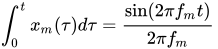
In this case, the expression for y(t) above simplifies to:
此时,上述 y(t)的表达式可简化为:

where the amplitude of the modulating sinusoid is represented in the peak deviation (see frequency deviation).
其中调制正弦波的振幅 以峰值频偏 表示(参见频偏)。

The harmonic distribution of a sine wave carrier modulated by such a sinusoidal signal can be represented with Bessel functions; this provides the basis for a mathematical understanding of frequency modulation in the frequency domain.
这种正弦信号调制的正弦载波的谐波分布可以用贝塞尔函数表示;这为从频域数学理解频率调制提供了基础。
Modulation index 调制指数
[edit]As in other modulation systems, the modulation index indicates by how much the modulated variable varies around its unmodulated level. It relates to variations in the carrier frequency:
与其他调制系统一样,调制指数表示被调制变量在其未调制水平附近的变动程度。它与载波频率的变化相关:
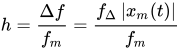
where is the highest frequency component present in the modulating signal xm(t), and is the peak frequency-deviation – i.e. the maximum deviation of the instantaneous frequency from the carrier frequency. For a sine wave modulation, the modulation index is seen to be the ratio of the peak frequency deviation of the carrier wave to the frequency of the modulating sine wave.
其中 是调制信号 x m (t)中存在的最高频率分量, 是峰值频偏——即瞬时频率与载波频率的最大偏差。对于正弦波调制,调制指数可视作载波峰值频偏与调制正弦波频率之比。


If , the modulation is called narrowband FM (NFM), and its bandwidth is approximately . Sometimes modulation index is considered NFM and other modulation indices are considered wideband FM (WFM or FM).
若调制指数 ,则称为窄带调频(NFM),其带宽约为 。有时调制指数 被视为窄带调频,其他调制指数则被视为宽带调频(WFM 或 FM)。


For digital modulation systems, for example, binary frequency shift keying (BFSK), where a binary signal modulates the carrier, the modulation index is given by:
对于数字调制系统,例如二进制频移键控(BFSK)——用二进制信号调制载波时,调制指数的计算公式为:
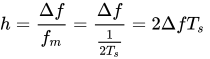
where is the symbol period, and is used as the highest frequency of the modulating binary waveform by convention, even though it would be more accurate to say it is the highest fundamental of the modulating binary waveform. In the case of digital modulation, the carrier is never transmitted. Rather, one of two frequencies is transmitted, either or , depending on the binary state 0 or 1 of the modulation signal.
其中 为符号周期,按惯例将 作为调制二进制波形的最高频率,尽管更准确的说法应是调制二进制波形的最高基频。在数字调制中,载波 实际上从不传输,而是根据调制信号的二进制状态 0 或 1,选择传输两个频率中的一个: 或 。


If , the modulation is called wideband FM and its bandwidth is approximately . While wideband FM uses more bandwidth, it can improve the signal-to-noise ratio significantly; for example, doubling the value of , while keeping constant, results in an eight-fold improvement in the signal-to-noise ratio.[7] (Compare this with chirp spread spectrum, which uses extremely wide frequency deviations to achieve processing gains comparable to traditional, better-known spread-spectrum modes).
若 ,则称为宽带调频,其带宽约为 。虽然宽带调频占用更多带宽,但能显著提升信噪比;例如在保持 不变的情况下,将 数值翻倍可使信噪比提升八倍。 [7] (可与线性调频扩频技术对比,后者通过极大频偏实现与传统知名扩频模式相当的处理增益)。


With a tone-modulated FM wave, if the modulation frequency is held constant and the modulation index is increased, the (non-negligible) bandwidth of the FM signal increases but the spacing between spectra remains the same; some spectral components decrease in strength as others increase. If the frequency deviation is held constant and the modulation frequency increased, the spacing between spectra increases.
对于采用音频调制的调频波,若保持调制频率不变而增大调制指数,则调频信号的(不可忽略的)带宽会随之增加,但频谱间距保持不变;部分频谱分量强度减弱的同时其他分量会增强。若保持频偏恒定而提高调制频率,则频谱间距会随之增大。
Frequency modulation can be classified as narrowband if the change in the carrier frequency is about the same as the signal frequency, or as wideband if the change in the carrier frequency is much higher (modulation index > 1) than the signal frequency.[8] For example, narrowband FM (NFM) is used for two-way radio systems such as Family Radio Service, in which the carrier is allowed to deviate only 2.5 kHz above and below the center frequency with speech signals of no more than 3.5 kHz bandwidth. Wideband FM is used for FM broadcasting, in which music and speech are transmitted with up to 75 kHz deviation from the center frequency and carry audio with up to a 20 kHz bandwidth and subcarriers up to 92 kHz.
若载波频率的变化与信号频率大致相同,则称为窄带调频;若载波频率变化远高于信号频率(调制指数>1),则称为宽带调频。例如,窄带调频(NFM)应用于家庭无线电服务等双向无线电系统,其载波仅允许在中心频率上下偏移 2.5 千赫,语音信号带宽不超过 3.5 千赫。而宽带调频用于调频广播,音乐和语音信号可在中心频率基础上偏移高达 75 千赫,音频带宽可达 20 千赫,副载波频率更可高达 92 千赫。
Bessel functions 贝塞尔函数
[edit]
这是 146.52 MHz 载波受 1,000 Hz 正弦波调频后的频谱图和瀑布图。调制指数设定为约 2.4,因此载波频率处振幅较小。图中可见多个明显强边带——理论上调频会产生无限多个边带,但高阶边带的幅度可忽略不计。
For the case of a carrier modulated by a single sine wave, the resulting frequency spectrum can be calculated using Bessel functions of the first kind, as a function of the sideband number and the modulation index. The carrier and sideband amplitudes are illustrated for different modulation indices of FM signals. For particular values of the modulation index, the carrier amplitude becomes zero and all the signal power is in the sidebands.[6]
当载波被单一正弦波调制时,其产生的频谱可通过第一类贝塞尔函数计算得出,该函数以边带数和调制指数为变量。图中展示了不同调制指数下 FM 信号的载波与边带幅度变化。当调制指数为特定值时,载波幅度会降为零,此时所有信号功率都分布在边带中。 [6]
Since the sidebands are on both sides of the carrier, their count is doubled, and then multiplied by the modulating frequency to find the bandwidth. For example, 3 kHz deviation modulated by a 2.2 kHz audio tone produces a modulation index of 1.36. Suppose that we limit ourselves to only those sidebands that have a relative amplitude of at least 0.01. Then, examining the chart shows this modulation index will produce three sidebands. These three sidebands, when doubled, gives us (6 × 2.2 kHz) or a 13.2 kHz required bandwidth.
由于边带位于载波两侧,其数量需乘以二,再与调制频率相乘得出带宽。例如,3 千赫兹的频偏被 2.2 千赫兹的音频调制时,会产生 1.36 的调制指数。假设我们仅考虑相对振幅不低于 0.01 的边带,查阅图表可知该调制指数将产生三个边带。这三个边带数量翻倍后得到(6×2.2 千赫兹),即所需带宽为 13.2 千赫兹。
| Modulation 调制 index 指数 |
Sideband amplitude 边带振幅 | ||||||||||||||||
|---|---|---|---|---|---|---|---|---|---|---|---|---|---|---|---|---|---|
| Carrier 载波 | 1 | 2 | 3 | 4 | 5 | 6 | 7 | 8 | 9 | 10 | 11 | 12 | 13 | 14 | 15 | 16 | |
| 0.00 | 1.00 | ||||||||||||||||
| 0.25 | 0.98 | 0.12 | |||||||||||||||
| 0.5 | 0.94 | 0.24 | 0.03 | ||||||||||||||
| 1.0 | 0.77 | 0.44 | 0.11 | 0.02 | |||||||||||||
| 1.5 | 0.51 | 0.56 | 0.23 | 0.06 | 0.01 | ||||||||||||
| 2.0 | 0.22 | 0.58 | 0.35 | 0.13 | 0.03 | ||||||||||||
| 2.40483 | 0.00 | 0.52 | 0.43 | 0.20 | 0.06 | 0.02 | |||||||||||
| 2.5 | −0.05 | 0.50 | 0.45 | 0.22 | 0.07 | 0.02 | 0.01 | ||||||||||
| 3.0 | −0.26 -0.26 | 0.34 | 0.49 | 0.31 | 0.13 | 0.04 | 0.01 | ||||||||||
| 4.0 | −0.40 -0.40 | −0.07 -0.07 | 0.36 | 0.43 | 0.28 | 0.13 | 0.05 | 0.02 | |||||||||
| 5.0 | −0.18 -0.18 | −0.33 -0.33 | 0.05 | 0.36 | 0.39 | 0.26 | 0.13 | 0.05 | 0.02 | ||||||||
| 5.52008 | 0.00 | −0.34 -0.34 | −0.13 -0.13 | 0.25 | 0.40 | 0.32 | 0.19 | 0.09 | 0.03 | 0.01 | |||||||
| 6.0 | 0.15 | −0.28 -0.28 | −0.24 -0.24 | 0.11 | 0.36 | 0.36 | 0.25 | 0.13 | 0.06 | 0.02 | |||||||
| 7.0 | 0.30 | 0.00 | −0.30 -0.30 | −0.17 -0.17 | 0.16 | 0.35 | 0.34 | 0.23 | 0.13 | 0.06 | 0.02 | ||||||
| 8.0 | 0.17 | 0.23 | −0.11 -0.11 | −0.29 -0.29 | −0.10 -0.10 | 0.19 | 0.34 | 0.32 | 0.22 | 0.13 | 0.06 | 0.03 | |||||
| 8.65373 | 0.00 | 0.27 | 0.06 | −0.24 -0.24 | −0.23 -0.23 | 0.03 | 0.26 | 0.34 | 0.28 | 0.18 | 0.10 | 0.05 | 0.02 | ||||
| 9.0 | −0.09 -0.09 | 0.25 | 0.14 | −0.18 -0.18 | −0.27 -0.27 | −0.06 -0.06 | 0.20 | 0.33 | 0.31 | 0.21 | 0.12 | 0.06 | 0.03 | 0.01 | |||
| 10.0 | −0.25 -0.25 | 0.04 | 0.25 | 0.06 | −0.22 -0.22 | −0.23 -0.23 | −0.01 -0.01 | 0.22 | 0.32 | 0.29 | 0.21 | 0.12 | 0.06 | 0.03 | 0.01 | ||
| 12.0 | 0.05 | −0.22 -0.22 | −0.08 -0.08 | 0.20 | 0.18 | −0.07 -0.07 | −0.24 -0.24 | −0.17 -0.17 | 0.05 | 0.23 | 0.30 | 0.27 | 0.20 | 0.12 | 0.07 | 0.03 | 0.01 |
Carson's rule 卡森法则
[edit]A rule of thumb, Carson's rule states that nearly all (≈98 percent) of the power of a frequency-modulated signal lies within a bandwidth of:
根据经验法则,卡森法则指出几乎所有(约 98%)调频信号的功率都集中在以下带宽 内:


where , as defined above, is the peak deviation of the instantaneous frequency from the center carrier frequency , is the modulation index which is the ratio of frequency deviation to highest frequency in the modulating signal, and is the highest frequency in the modulating signal.
Carson's rule can only be applied to sinusoidal signals. For non-sinusoidal signals:
其中 如前所述是瞬时频率 相对于中心载波频率 的峰值偏移, 是调制指数(即频率偏移与调制信号最高频率之比), 是调制信号中的最高频率。卡森法则仅适用于正弦信号。对于非正弦信号:



where W is the highest frequency in the modulating signal but non-sinusoidal in nature and D is the Deviation ratio which is the ratio of frequency deviation to highest frequency of modulating non-sinusoidal signal.
其中 W 是调制信号中的最高频率(但本质为非正弦波),D 为偏移率(即频率偏移与非正弦调制信号最高频率之比)。
Noise reduction 降噪处理
[edit]FM provides improved signal-to-noise ratio (SNR), as compared for example with AM. Compared with an optimum AM scheme, FM typically has poorer SNR below a certain signal level called the noise threshold, but above a higher level – the full improvement or full quieting threshold – the SNR is much improved over AM. The improvement depends on modulation level and deviation. For typical voice communications channels, improvements are typically 5–15 dB. FM broadcasting using wider deviation can achieve even greater improvements. Additional techniques, such as pre-emphasis of higher audio frequencies with corresponding de-emphasis in the receiver, are generally used to improve overall SNR in FM circuits. Since FM signals have constant amplitude, FM receivers normally have limiters that remove AM noise, further improving SNR.[9][10]
调频(FM)相较于调幅(AM)能提供更优的信噪比(SNR)。与最佳调幅方案相比,调频在低于特定信号电平(称为噪声门限)时通常信噪比较差,但当信号超过更高电平(即完全改善门限或静噪门限)后,其信噪比将显著优于调幅。改善程度取决于调制电平和频偏量,典型语音通信信道通常可提升 5 至 15 分贝。采用更大频偏的调频广播甚至能实现更显著的提升。调频系统通常还会采用预加重(在发射端提升高频分量)与去加重(在接收端对应衰减)等附加技术来优化整体信噪比。由于调频信号具有恒定振幅,调频接收机通常配备限幅器来消除调幅噪声,从而进一步提升信噪比。 [9] [10]
Implementation 实现
[edit]Modulation 调制
[edit]FM signals can be generated using either direct or indirect frequency modulation:
调频信号可以通过直接或间接的频率调制方式生成:
- Direct FM modulation can be achieved by directly feeding the message into the input of a voltage-controlled oscillator.
直接调频调制可以通过将信息信号直接输入压控振荡器来实现。 - For indirect FM modulation, the message signal is integrated to generate a phase-modulated signal. This is used to modulate a crystal-controlled oscillator, and the result is passed through a frequency multiplier to produce an FM signal. In this modulation, narrowband FM is generated leading to wideband FM later and hence the modulation is known as indirect FM modulation.[11]
间接调频调制时,需先对信息信号进行积分以生成相位调制信号。该信号用于调制晶体控制振荡器,产生的信号再通过倍频器处理,最终形成调频信号。这种调制方式首先生成窄带调频信号,随后扩展为宽带调频信号,因此被称为间接调频调制。 [11]
Demodulation 解调
[edit]
Many FM detector circuits exist. A common method for recovering the information signal is through a Foster–Seeley discriminator or ratio detector. A phase-locked loop can be used as an FM demodulator. Slope detection demodulates an FM signal by using a tuned circuit which has its resonant frequency slightly offset from the carrier. As the frequency rises and falls the tuned circuit provides a changing amplitude of response, converting FM to AM. AM receivers may detect some FM transmissions by this means, although it does not provide an efficient means of detection for FM broadcasts.
存在多种调频检波电路。恢复信息信号的常用方法是通过福斯特-西利鉴频器或比例鉴频器。锁相环可用作调频解调器。斜率鉴频通过使用谐振频率略微偏离载波的调谐电路来解调调频信号。当频率升降时,调谐电路会产生变化的响应幅度,从而将调频转换为调幅。调幅接收机可通过这种方式检测某些调频传输,尽管这对调频广播并非高效的检测方式。
In software-defined radio implementations, the demodulation may be carried out by using the Hilbert transform (implemented as a filter) to recover the instantaneous phase, and thereafter differentiating this phase (using another filter) to recover the instantaneous frequency. Alternatively, a complex mixer followed by a bandpass filter may be used to translate the signal to baseband, and then proceeding as before. For sampled signals, phase detection, and therefore frequency modulation detection, can be approximated by taking the IQ (complex) sample and multiplying it with the complex conjugate of the previous IQ sample, .[12] If the demodulated signal is sampled at or above Nyquist, this allows for recovery of near-instantaneous phase changes.
在软件定义无线电的实现中,解调可通过希尔伯特变换(以滤波器形式实现)来恢复瞬时相位,随后对该相位进行微分(使用另一滤波器)以恢复瞬时频率。另一种方法是采用复数混频器配合带通滤波器将信号转换至基带,再按前述方法处理。对于采样信号,相位检测(进而实现调频检测)可通过获取 IQ(复数)采样值并与前一 IQ 采样值的复共轭相乘来近似实现。若解调信号的采样率达到或超过奈奎斯特频率,这种方法能近乎实时地恢复相位变化。
![{\displaystyle x[n]\cdot {\overline {x[n-1]}}}](https://wikimedia.org/api/rest_v1/media/math/render/svg/8c02d0f694209d31ac9b9330e2b942318578fa50)
Applications 应用领域
[edit]Doppler effect 多普勒效应
[edit]When an echolocating bat approaches a target, its outgoing sounds return as echoes, which are Doppler-shifted upward in frequency. In certain species of bats, which produce constant frequency (CF) echolocation calls, the bats compensate for the Doppler shift by lowering their call frequency as they approach a target. This keeps the returning echo in the same frequency range of the normal echolocation call. This dynamic frequency modulation is called the Doppler Shift Compensation (DSC), and was discovered by Hans Schnitzler in 1968.
当回声定位蝙蝠接近目标时,其发出的声波会以回声形式返回,这些回声的频率会因多普勒效应而上移。某些种类的蝙蝠会发出恒定频率(CF)的回声定位叫声,它们通过降低叫声频率来补偿接近目标时产生的多普勒频移。这使得返回的回声始终保持在正常回声定位叫声的相同频率范围内。这种动态频率调制被称为多普勒频移补偿(DSC),由汉斯·施尼茨勒于 1968 年发现。
Magnetic tape storage 磁带存储
[edit]FM is also used at intermediate frequencies by analog VCR systems (including VHS) to record the luminance (black and white) portions of the video signal. Commonly, the chrominance component is recorded as a conventional AM signal, using the higher-frequency FM signal as bias. FM is the only feasible method of recording the luminance ("black-and-white") component of video to (and retrieving video from) magnetic tape without distortion; video signals have a large range of frequency components – from a few hertz to several megahertz, too wide for equalizers to work with due to electronic noise below −60 dB. FM also keeps the tape at saturation level, acting as a form of noise reduction; a limiter can mask variations in playback output, and the FM capture effect removes print-through and pre-echo. A continuous pilot-tone, if added to the signal – as was done on V2000 and many Hi-band formats – can keep mechanical jitter under control and assist timebase correction.
调频技术还被模拟录像机系统(包括 VHS 制式)用于中频段记录视频信号中的亮度(黑白)部分。通常色度信号会作为常规调幅信号进行记录,并以高频调频信号作为偏置。调频是唯一可行的无失真记录(及回放)磁带视频亮度(黑白)信号的方法,因为视频信号具有极宽的频率范围——从几赫兹到数兆赫兹,均衡器受限于-60 分贝以下的电子噪声难以处理如此宽的频带。调频还能使磁带保持饱和状态,起到降噪作用;限幅器可消除回放输出的波动,而调频的俘获效应能消除复印效应和前回声干扰。若在信号中加入连续导频音(如 V2000 和众多高带格式所采用),可有效控制机械抖动并辅助时基校正。
These FM systems are unusual, in that they have a ratio of carrier to maximum modulation frequency of less than two; contrast this with FM audio broadcasting, where the ratio is around 10,000. Consider, for example, a 6-MHz carrier modulated at a 3.5-MHz rate; by Bessel analysis, the first sidebands are on 9.5 and 2.5 MHz and the second sidebands are on 13 MHz and −1 MHz. The result is a reversed-phase sideband on +1 MHz; on demodulation, this results in unwanted output at 6 – 1 = 5 MHz. The system must be designed so that this unwanted output is reduced to an acceptable level.[13]
这些调频系统非常特殊,其载波频率与最大调制频率之比小于二;相比之下,调频音频广播中的这一比例约为 10,000。举例来说,一个 6 兆赫的载波以 3.5 兆赫的速率进行调制时,根据贝塞尔分析,第一边带位于 9.5 和 2.5 兆赫,第二边带则位于 13 兆赫和-1 兆赫。这会导致在+1 兆赫处出现一个反相边带;解调时会产生 6-1=5 兆赫的不必要输出。系统设计时必须确保这种无用输出被降低至可接受水平。
Sound 声音
[edit]FM is also used at audio frequencies to synthesize sound. This technique, known as FM synthesis, was popularized by early digital synthesizers and became a standard feature in several generations of personal computer sound cards.
调频技术同样被应用于音频领域来合成声音。这种被称为调频合成的技术,由早期的数字合成器推广开来,并成为数代个人电脑声卡的标准功能。
Radio 无线电
[edit]
美国纽约州布法罗市 WEDG 电台的调频广播发射机
Edwin Howard Armstrong (1890–1954) was an American electrical engineer who invented wideband frequency modulation (FM) radio.[14]
He patented the regenerative circuit in 1914, the superheterodyne receiver in 1918 and the super-regenerative circuit in 1922.[15] Armstrong presented his paper, "A Method of Reducing Disturbances in Radio Signaling by a System of Frequency Modulation", (which first described FM radio) before the New York section of the Institute of Radio Engineers on November 6, 1935. The paper was published in 1936.[16]
埃德温·霍华德·阿姆斯特朗(1890–1954)是美国电气工程师,他发明了宽带调频(FM)无线电技术。 [14] 他于 1914 年获得了再生式电路的专利,1918 年发明了超外差接收机,1922 年又研发了超再生电路。 [15] 1935 年 11 月 6 日,阿姆斯特朗在无线电工程师学会纽约分会面前发表了题为《通过调频系统减少无线电信号干扰的方法》的论文(该论文首次描述了调频广播技术),该论文于 1936 年正式发表。 [16]
As the name implies, wideband FM (WFM) requires a wider signal bandwidth than amplitude modulation by an equivalent modulating signal; this also makes the signal more robust against noise and interference. Frequency modulation is also more robust against signal-amplitude-fading phenomena. As a result, FM was chosen as the modulation standard for high frequency, high fidelity radio transmission, hence the term "FM radio" (although for many years the BBC called it "VHF radio" because commercial FM broadcasting uses part of the VHF band – the FM broadcast band). FM receivers employ a special detector for FM signals and exhibit a phenomenon known as the capture effect, in which the tuner "captures" the stronger of two stations on the same frequency while rejecting the other (compare this with a similar situation on an AM receiver, where both stations can be heard simultaneously). Frequency drift or a lack of selectivity may cause one station to be overtaken by another on an adjacent channel. Frequency drift was a problem in early (or inexpensive) receivers; inadequate selectivity may affect any tuner.
顾名思义,宽带调频(WFM)比等效调制信号的调幅需要更宽的信号带宽;这也使得信号对噪声和干扰更具鲁棒性。调频技术对信号幅度衰落现象也更具抵抗力。因此,调频被选作高频、高保真无线电传输的调制标准,由此产生了"调频广播"这一术语(尽管英国广播公司多年来称其为"甚高频广播",因为商业调频广播使用甚高频波段的一部分——即调频广播波段)。调频接收机采用特殊的调频信号检波器,并表现出一种称为"俘获效应"的现象:当两个同频电台信号同时存在时,调谐器会"俘获"较强信号而抑制较弱信号(与此对比,调幅接收机在类似情况下会同时听到两个电台)。频率漂移或选择性不足可能导致相邻频道的电台信号相互侵扰。早期(或廉价)接收机常受频率漂移问题困扰;而选择性不足则可能影响任何调谐器的性能。
A wideband FM signal can also be used to carry a stereo signal; this is done with multiplexing and demultiplexing before and after the FM process. The FM modulation and demodulation process is identical in stereo and monaural processes.
宽带调频信号也可用于传输立体声信号,这一过程通过在调频处理前后进行多路复用与解复用实现。无论是立体声还是单声道,调频的调制与解调过程完全相同。
FM is commonly used at VHF radio frequencies for high-fidelity broadcasts of music and speech. In broadcast services, where audio fidelity is important, wideband FM is generally used. Analog TV sound is also broadcast using FM. Narrowband FM is used for voice communications in commercial and amateur radio settings. In two-way radio, narrowband FM (NBFM) is used to conserve bandwidth for land mobile, marine mobile and other radio services.
调频技术普遍应用于甚高频(VHF)无线电频段的音乐与语音高保真广播。在注重音频保真度的广播服务中,通常采用宽带调频技术。模拟电视的伴音信号同样采用调频方式传输。窄带调频则用于商业无线电和业余无线电场景下的语音通信。双向无线电通信中,窄带调频(NBFM)被用于节约陆地移动通信、海上移动通信及其他无线电服务的带宽资源。
A high-efficiency radio-frequency switching amplifier can be used to transmit FM signals (and other constant-amplitude signals). For a given signal strength (measured at the receiver antenna), switching amplifiers use less battery power and typically cost less than a linear amplifier. This gives FM another advantage over other modulation methods requiring linear amplifiers, such as AM and QAM.
高效率射频开关放大器可用于传输调频信号(及其他恒幅信号)。在接收天线端信号强度相同的情况下,开关放大器比线性放大器更省电且成本更低。这使得调频技术相比需要线性放大器的其他调制方式(如调幅和正交幅度调制)更具优势。
There are reports that on October 5, 1924, Professor Mikhail A. Bonch-Bruevich, during a scientific and technical conversation in the Nizhny Novgorod Radio Laboratory, reported about his new method of telephony, based on a change in the period of oscillations. Demonstration of frequency modulation was carried out on the laboratory model.[17]
有报道称,1924 年 10 月 5 日,米哈伊尔·A·邦奇-布鲁耶维奇教授在下诺夫哥罗德无线电实验室的一次科技谈话中,报告了他基于振荡周期变化的新型电话技术。该实验室模型成功演示了频率调制技术。 [17]
Hearing assistive technology
助听技术
[edit]Frequency modulated systems are a widespread and commercially available assistive technology that make speech more understandable by improving the signal-to-noise ratio in the user's ear. They are also called auditory trainers, a term which refers to any sound amplification system not classified as a hearing aid. They intensify signal levels from the source by 15 to 20 decibels.[18] FM systems are used by hearing-impaired people as well as children whose listening is affected by disorders such as auditory processing disorder or ADHD.[19] For people with sensorineural hearing loss, FM systems result in better speech perception than hearing aids. They can be coupled with behind-the-ear hearing aids to allow the user to alternate the setting.[20] FM systems are more convenient and cost-effective than alternatives such as cochlear implants, but many users use FM systems infrequently due to their conspicuousness and need for recharging.[21]
调频系统是一种广泛普及且商业化的辅助技术,通过提高使用者耳内的信噪比来增强语音清晰度。这类设备也被称为听觉训练器,该术语泛指所有未被归类为助听器的声音放大系统。它们能将声源信号强度提升 15 至 20 分贝。 [18] 调频系统不仅服务于听障人士,也适用于因听觉处理障碍或注意力缺陷多动障碍等疾病影响听力功能的儿童。 [19] 对于感音神经性耳聋患者,调频系统比传统助听器能带来更优越的言语识别效果。这类设备可与耳背式助听器配合使用,让使用者能自由切换工作模式。 [20] 与人工耳蜗等替代方案相比,调频系统更具便利性和成本效益,但由于设备显眼的外观特征和需定期充电的特性,许多使用者实际使用频率较低。 [21]
See also 参见
[edit]
维基共享资源中有关频率调制的媒体文件
- Continuous-wave frequency-modulated radar
连续波调频雷达 - Chirp 线性调频信号
- FM stereo 调频立体声
- FM-UWB (FM and Ultra Wideband)
调频超宽带技术(FM 与超宽带结合) - History of radio 无线电发展史
- Modulation, for a list of other modulation techniques
调频 - 维基百科 调频(FM)是通过改变载波频率来编码信息的调制技术。这与幅度调制(AM)形成对比,后者通过改变载波幅度来传输信息。在模拟应用中,载波频率会随着输入信号的瞬时幅度成比例变化。数字应用中则采用离散载波频率变化(频移键控)来传输数字数据。 调频技术广泛应用于广播(FM 广播)、磁记录系统、地震勘探、遥测、雷达、新生儿癫痫发作监测以及合成器音乐中。在无线电传输中,频率偏差是载波频率与中心频率之间的最大差异。 参见:调制技术列表(了解其他调制技术)
References 参考文献
[edit]- ^ Smith, Robert H. (1993). Machines and Inventions. Alexandria, VA: Time Life. p. 85. ISBN 0-8094-9704-2.
史密斯,罗伯特·H.(1993 年)。《机器与发明》。弗吉尼亚州亚历山大市:时代生活出版社。第 85 页。ISBN 0-8094-9704-2。 - ^ Gibilisco, Stan (2002). Teach yourself electricity and electronics. McGraw-Hill Professional. p. 477. ISBN 978-0-07-137730-0.
morse-code frequency-shift-keying sent-using-fsk.
吉比利斯科,斯坦(2002 年)。《自学电力与电子学》。麦格劳-希尔专业出版社。第 477 页。ISBN 978-0-07-137730-0。莫尔斯电码频移键控采用 FSK 技术发送。 - ^ Rutledge, David B. (1999). The Electronics of Radio. Cambridge University Press. p. 310. ISBN 978-0-521-64645-1.
拉特利奇, 大卫·B. (1999). 《无线电电子学》. 剑桥大学出版社. 第 310 页. ISBN 978-0-521-64645-1. - ^ B. Boashash, editor, Time-Frequency Signal Analysis and Processing – A Comprehensive Reference, Elsevier Science, Oxford, 2003; ISBN 0-08-044335-4
B. 博阿沙什 主编,《时频信号分析与处理——综合参考》,爱思唯尔科学出版社,牛津,2003 年;ISBN 0-08-044335-4 - ^ Faruque, Saleh (2017). Radio Frequency Modulation Made Easy (PDF). Springer Cham. pp. 33–37. ISBN 978-3-319-41200-9.
法鲁克,萨利赫(2017)。《轻松掌握射频调制技术》(PDF)。施普林格出版社。第 37 页。ISBN 978-3-319-41200-9。 - ^ Jump up to: a b T.G. Thomas, S. C. Sekhar Communication Theory, Tata-McGraw Hill 2005, ISBN 0-07-059091-5 p. 136
T.G.托马斯,S.C.塞卡《通信理论》,塔塔-麦格劳希尔出版社 2005 年,ISBN 0-07-059091-5 第 136 页 - ^ Der, Lawrence. "Frequency Modulation (FM) Tutorial" (PDF). Silicon Laboratories. S2CID 48672999. Archived from the original (PDF) on 2014-10-21. Retrieved 17 October 2019.
劳伦斯·德尔。《调频技术教程》(PDF)。硅实验室公司。S2CID 48672999。原始文件(PDF)存档于 2014-10-21。2019 年查阅。 - ^ Lathi, B. P. (1968). Communication Systems, pp. 214–17. New York: John Wiley and Sons, ISBN 0-471-51832-8.
拉西,B.P.(1968 年)。《通信系统》,第 214-17 页。纽约:约翰·威利父子出版社,ISBN 0-471-51832-8。 - ^ H. P. Westman, ed. (1970). Reference Data for Radio Engineers (Fifth ed.). Howard W. Sams & Co. pp. 21–11.
H·P·韦斯特曼 编 (1970). 《无线电工程师参考数据》(第五版). 霍华德·W·萨姆斯公司. 第 21– 11 页. - ^ Alan Bloom (2010). "Chapter 8. Modulation". In H. Ward Silver; Mark J. Wilson (eds.). The ARRL Handbook for Radio Communications. American Radio Relay League. p. 8.7. ISBN 978-0-87259-146-2.
艾伦·布鲁姆(2010 年)。"第八章 调制技术"。载于 H·沃德·西尔弗与马克·J·威尔逊(编)。《业余无线电通信手册》。美国无线电中继联盟。第 8.7 页。ISBN 978-0-87259-146-2。 - ^ Haykin, Simon [Ed]. (2001). Communication Systems, 4th ed.
西蒙·赫金 [编](2001 年)。《通信系统(第四版)》。 - ^ Shima, James Michael (1995). FM Demodulation Using a Digital Radio and Digital Signal Processing. University of Florida.
岛·詹姆斯·迈克尔(1995 年)。《基于数字无线电与数字信号处理的调频解调技术》。佛罗里达大学。 - ^ "FM Systems Of Exceptional Bandwidth" Proc. IEEE vol. 112, no. 9, p. 1664, September 1965
《超宽带调频系统》IEEE 会议录第 112 卷第 9 期第 1664 页,1965 年 9 月 - ^ A. Michael Noll (2001). Principles of modern communications technology. Artech House. p. 104. ISBN 978-1580532846.
A·迈克尔·诺尔(2001 年)。《现代通信技术原理》。阿泰克出版社。第 104 页。ISBN 978-1580532846。 - ^ US 1342885 美国专利 1342885 号
- ^ Armstrong, E. H. (May 1936). "A Method of Reducing Disturbances in Radio Signaling by a System of Frequency Modulation". Proceedings of the IRE. 24 (5). IRE: 689–740. doi:10.1109/JRPROC.1936.227383. S2CID 43628076.
阿姆斯特朗, E. H. (1936 年 5 月). "通过频率调制系统减少无线电信号干扰的方法". 《IRE 会刊》. 24(5). IRE: 第 740 页. doi: 10.1109/JRPROC.1936.227383. S2CID 43628076. - ^ Ф. Лбов. Новая система радиофона «Радиолюбитель». – 1924. – № 6. – С. 86.
Ф. 勒博夫。《无线电爱好者》新型无线电话系统。1924 年第 6 期。第 86 页。 - ^ ASHA Ad Hoc Committee on FM Systems (2002) [Original March 1994]. Guidelines for Fitting and Monitoring FM Systems (Technical report) (Revised ed.). American Speech–Language–Hearing Association. doi:10.1044/policy.GL2002-00010.
美国言语语言听力协会 FM 系统特设委员会(2002 年)[原版 1994 年 3 月]。《FM 系统适配与监测指南》(技术报告)(修订版)。doi:10.1044/policy.GL2002-00010。 - ^ Schafer, Erin C.; Bryant, Danielle; Sanders, Katie; Baldus, Nicole; Algier, Katherine; Lewis, Audrey; Traber, Jordan; Layden, Paige; Amin, Aneeqa (June 1, 2014). "Fitting and Verification of Frequency Modulation on Children with Normal Hearing". Journal of the American Academy of Audiology. 25 (6): 529–540. doi:10.3766/jaaa.25.6.3. ISSN 1050-0545. PMID 25313543. EBSCOhost 107832936 – via EBSCOhost.
谢弗,艾琳·C;布莱恩特,丹妮尔;桑德斯,凯蒂;鲍尔杜斯,妮可;阿尔吉尔,凯瑟琳;刘易斯,奥黛丽;特拉伯,乔丹;莱登,佩奇;阿明,阿尼卡(2014 年 6 月 1 日)。"正常听力儿童频率调制适配与验证"。《美国听力学学会杂志》。25(6): 529– 540。doi:10.3766/jaaa.25.6.3。ISSN 1050-0545。PMID 25313543。EBSCOhost 107832936——通过 EBSCOhost。 - ^ Lewis, M. Samantha; Crandall, Carl C.; Valente, Michael; Enrietto Horn, Jane (2004). "Speech perception in noise: directional microphones versus frequency modulation (FM) systems". Journal of the American Academy of Audiology. 15 (6): 426–439. doi:10.3766/jaaa.15.6.4. PMID 15341224.
刘易斯·M·萨曼莎;克兰德尔·卡尔·C;瓦伦特·迈克尔;恩里托·霍恩·简(2004 年)。"噪声环境下的言语感知:指向性麦克风与调频(FM)系统对比研究"。《美国听力学学会杂志》。15(6): 426– 439。doi:10.3766/jaaa.15.6.4。PMID 15341224。 - ^ McArdle, Rachel; Abrams, Harvey B.; Hnath Chisholm, Theresa (2005). "When Hearing Aids Go Bad: An FM Success Story". Journal of the American Academy of Audiology. 16 (10): 809–821. doi:10.3766/jaaa.16.10.5. EBSCOhost 106441304 – via EBSCOhost.
麦卡德尔·瑞秋;艾布拉姆斯·哈维·B;纳思·奇泽姆·特蕾莎(2005 年)。"当助听器失效时:一个调频系统的成功案例"。《美国听力学学会杂志》。16(10): 809– 821。doi:10.3766/jaaa.16.10.5。EBSCOhost 106441304 ——通过 EBSCOhost 平台检索。
Further reading 延伸阅读
[edit]- Carlson, A. Bruce (2001). Communication Systems. Science/Engineering/Math (4th ed.). McGraw-Hill. ISBN 978-0-07-011127-1.
卡尔森,A·布鲁斯(2001 年)。《通信系统》。科学/工程/数学(第 4 版)。麦格劳-希尔出版社。ISBN 978-0-07-011127-1。 - Frost, Gary L. (2010). Early FM Radio: Incremental technology in twentieth-century America. Baltimore, MD: Johns Hopkins University Press. ISBN 978-0-8018-9440-4.
弗罗斯特,加里·L(2010 年)。《早期调频广播:二十世纪美国的渐进式技术》。马里兰州巴尔的摩:约翰斯·霍普金斯大学出版社。ISBN 978-0-8018-9440-4。 - Seymour, Ken (2005) [1996]. "Frequency Modulation". The Electronics Handbook (2nd ed.). CRC Press. pp. 1188–1200. ISBN 0-8493-8345-5.
西摩,肯(2005 年)[1996 年]。《频率调制》。《电子学手册》(第 2 版)。CRC 出版社。第 1188– 1200 页。ISBN 0-8493-8345-5。
External links 外部链接
[edit]- Analog Modulation online interactive demonstration using Python in Google Colab Platform, by C Foh.


| Terrestrial |
| ||||||||||||
|---|---|---|---|---|---|---|---|---|---|---|---|---|---|
| Satellite |
| ||||||||||||
| Codecs | |||||||||||||
| Subcarrier signals | |||||||||||||
| |||||||||||||

