


Abstract 抽象的
Hundreds of microbiota gene expressions are significantly different between healthy and diseased humans. The “bottleneck” preventing a mechanistic dissection of how they affect host biology/disease is that many genes are encoded by nonmodel gut commensals and not genetically manipulatable. Approaches to efficiently identify their gene transfer methodologies and build their gene manipulation tools would enable mechanistic dissections of their impact on host physiology. This paper will introduce a step‐by‐step protocol to identify gene transfer conditions and build the gene manipulation tools for nonmodel gut microbes, focusing on Gram‐negative Bacteroidia and Gram‐positive Clostridia organisms. This protocol enables us to identify gene transfer methods and develop gene manipulation tools without prior knowledge of their genome sequences, by targeting bacterial 16s ribosomal RNAs or expanding their compatible replication origins combined with clustered regularly interspaced short palindromic repeats machinery. Such an efficient and generalizable approach will facilitate functional studies that causally connect gut microbiota genes to host diseases.
数百种微生物基因的表达在健康人和患病人群之间存在显著差异。阻碍我们对其如何影响宿主生物学/疾病进行机制解析的“瓶颈”在于,许多基因是由非模式肠道共生菌编码的,且无法进行基因操作。高效识别其基因转移方法并构建其基因操作工具的方法,将有助于我们对其对宿主生理学的影响进行机制解析。本文将介绍一种分步方案,用于识别基因转移条件并构建针对非模式肠道微生物的基因操作工具,重点关注革兰氏阴性拟杆菌和革兰氏阳性梭菌 。该方案使我们能够在不了解其基因组序列的情况下,通过靶向细菌 16s 核糖体 RNA 或扩展其相容的复制起点,并结合成簇的规律间隔短回文重复序列机制,来识别基因转移方法并开发基因操作工具。这种高效且可推广的方法将促进肠道微生物基因与宿主疾病因果关系的功能研究。
Keywords: genetic manipulation strategies, human gut microbiota, nonmodel gut Bacteroidia
, nonmodel gut Clostridia
关键词: 基因操作策略、人类肠道微生物群、非模型肠道拟杆菌
,非模型肠道梭菌
A protocol introducing a step‐by‐step genetic manipulation method would facilitate the investigation of those functional genes encoded by nonmodel gut commensals. The gene‐editing tools could be established in nonmodel gut Bacteroidia and Clostridia without prior knowledge of their genome information. The genetic manipulation pipeline may serve as a high‐throughput genetics screening and manipulating platform for human gut microbes.
引入分步遗传操作方法的方案将有助于研究非模式肠道共生菌编码的功能基因。该基因编辑工具可在非模式肠道拟杆菌和梭菌中建立,而无需事先了解其基因组信息。该遗传操作流程可作为人类肠道微生物的高通量遗传学筛选和操作平台。

Highlights 亮点
A protocol introducing a step‐by‐step genetic manipulation method would facilitate the investigation of those functional genes encoded by nonmodel gut commensals.
引入逐步基因操作方法的协议将有助于研究非模型肠道共生体编码的功能基因。The gene‐editing tools could be established in nonmodel gut Bacteroidia and Clostridia without prior knowledge of their genome information.
可以在非模型肠道拟杆菌和梭菌中建立基因编辑工具,而无需事先了解它们的基因组信息。The genetic manipulation pipeline may serve as a high‐throughput genetics screening and manipulating platform for human gut microbes.
基因操作流程可作为人类肠道微生物的高通量遗传学筛选和操作平台。
INTRODUCTION 介绍
The gut microbiota impacts human biology in many ways. Multiomics studies revealed many microbiota genes whose expressions significantly differ between healthy and diseased humans [1, 2, 3, 4, 5, 6]. However, unraveling the causal molecular mechanisms underlying microbiota gene–host biology interactions remains challenging, mainly due to limited approaches to precisely manipulating these disease/biology‐associated microbes and their metabolic genes.
肠道菌群以多种方式影响着人体生物学。多组学研究揭示,许多菌群基因的表达在健康人和患病人群中存在显著差异 [ 1 , 2 , 3 , 4 , 5 , 6 ]。然而,揭示菌群基因与宿主生物学相互作用背后的分子机制仍然充满挑战,这主要是因为目前精准操控这些疾病/生物学相关微生物及其代谢基因的方法有限。
Developing genetic manipulation tools for nonmodel gut microbes is necessary because: (1) Previous studies have revealed that host diseases are significantly associated with microbiota genes [1, 2, 3, 4, 5, 6]. Those genes are mostly expressed in nonmodel gut microbes that are not genetically tractable. Establishing genetic tools will be the first step to manipulating their gene expression within the host, and further to study their impact on human diseases. (2) Human biology is profoundly regulated by gut microbiota, yet the knowledge about which gut microbes and genes play an essential role remains largely unstudied. Genetic manipulation tools will facilitate the functional studies of physiology interactions between gut microbiota and host.
开发非模型肠道微生物的遗传操作工具十分必要,因为:(1) 先前的研究表明,宿主疾病与微生物基因密切相关 [ 1 , 2 , 3 , 4 , 5 , 6 ]。这些基因大多在非模型肠道微生物中表达,且不易被遗传调控。建立遗传工具将是操纵这些基因在宿主体内表达的第一步,并进一步研究它们对人类疾病的影响。(2) 人体生物学深受肠道微生物的调控,但关于哪些肠道微生物和基因发挥重要作用的知识仍未被深入研究。遗传操作工具将有助于肠道微生物与宿主之间生理相互作用的功能研究。
Here, we reported a step‐by‐step protocol to build the genetic manipulation strategies for nonmodel gut Bacteroidia and Clostridia microbes, whose abundances dominate healthy human guts [7, 8]. By targeting bacterial 16s ribosomal RNAs (rRNAs) or expanding their compatible replication origins combined with clustered regularly interspaced short palindromic repeats (CRISPR) machinery, this pipeline enables us to identify exogenous genomic DNA transfer methodologies and develop genetic tools without prior knowledge of the genome sequence of those nonmodel gut microbes.
在此,我们报告了一种分步方案,用于构建针对非模型肠道拟杆菌和梭菌的遗传操作策略,这些微生物的丰度在健康人类肠道中占主导地位 [ 7 , 8 ]。通过靶向细菌 16s 核糖体 RNA (rRNA) 或扩展其相容的复制起点,并结合成簇的规律间隔短回文重复序列 (CRISPR) 机制,该流程使我们能够识别外源基因组 DNA 转移方法并开发遗传工具,而无需事先了解这些非模型肠道微生物的基因组序列。
GENETIC MANIPULATION STRATEGIES
基因操作策略
Identifying gene transfer methods for Bacteroidia microbes and building their gene insertion tools
识别拟杆菌微生物的基因转移方法并构建其基因插入工具
Escherichia coli (E. coli) conjugation was used to introduce the exogenous DNA into the recipient microbes, as the method has been proven effective in some Bacteroides and Clostridium [9, 10, 11, 12, 13, 14, 15, 16, 17, 18, 19, 20]. Culture conditions of strains on agar plates and in liquid broth were first screened and then these microbes were tested against a collection of antibiotics to (1) find an antibiotic they are susceptible to, so its resistance gene will be used as a universal selective marker, and (2) identify an antibiotic the recipient microbe is resistant to but not the donor E. coli, so it can be used as an additive to suppress E. coli growth after conjugation.
大肠杆菌 ( E. coli ) 接合技术用于将外源 DNA 引入受体微生物,因为该方法已被证明在某些拟杆菌和梭菌中有效 [ 9 , 10 , 11 , 12 , 13 , 14 , 15 , 16 , 17 , 18 , 19 , 20 ]。首先筛选菌株在琼脂平板和液体肉汤中的培养条件,然后针对一系列抗生素对这些微生物进行测试,以 (1) 找到它们对其敏感的抗生素,因此其抗性基因将用作通用选择标记,以及 (2) 识别受体微生物具有抗性但供体大肠杆菌无抗性的抗生素,因此可将其用作接合后抑制大肠杆菌生长的添加剂。
The Bacteroidia are Gram‐negative obligate anaerobes that uptake exogenous DNA and have efficient homologous recombination (HR) [16]. To establish a generalizable approach for the genetic manipulation of Bacteroidia (Bacteroides and Prevotella) microbes, conserved bacterial 16s rRNA gene, whose sequence has been widely used to assess microbiome diversity and construct bacterial phylogeny, was selected as a universal target. To do this, a synthesized chimeric 16s (chi‐16s) sequence, with high homology to the Bacteroidia 16s rRNA genes, was assembled with a suicide conjugation vector, and transported into recipient Bacteroidia microbes. Those transconjugants whose 16s rRNA loci have been inserted by the suicide vector will be genetically tractable.
拟杆菌是革兰氏阴性专性厌氧菌,可吸收外源 DNA 并进行高效的同源重组 (HR) [ 16 ]。为了建立一种可普遍应用的拟杆菌 ( 拟杆菌属和普雷沃氏菌)微生物遗传操作方法,我们选取保守的细菌 16s rRNA 基因作为通用靶标,该基因序列已广泛用于评估微生物组多样性和构建细菌系统发育。为此,我们利用自杀接合载体组装一个与拟杆菌 16s rRNA 基因同源性较高的合成嵌合 16s (chi-16s) 序列,并将其转入受体拟杆菌微生物体内。通过自杀载体插入 16s rRNA 基因位点的接合子将具有遗传可驯化性。
Materials and devices 材料与设备
Primer star DNA polymerase (Takara, Cat# R045), Blue sapphire DNA polymerase (Takara, Cat# RR350), Plasmid Midiprep Kit (Zymo Research, Cat# D4201), DNA Clean and Concentrator (Zymo Research, Cat# D4003), Tryptic Soy Agar (BD, Cat# 236950), Brain Heart Infusion Agar (BD, Cat# 241830), Columbia Blood Agar (CBA) (BD, Cat# 279240), Horse blood (Hemostat Laboratories, Cat# 637291), Luria–Bertani (LB) broth (BD, Cat# BP1426), glycerol (Fisher Bioreagents, Cat# BP229), the vacuum‐pumping system, phosphate‐buffered saline (PBS) (Gibco, Cat# 10010‐031), centrifuge, polymerase chain reaction (PCR) amplifier, d‐cycloserine (D) (TCI, Cat# C1189), gentamicin (G) (GoldBio, Cat# G‐400‐25), kanamycin (K) (GoldBio, Cat# K‐120‐25), carbenicillin (GoldBio, Cat# C‐103‐25), thiamphenicol (Thiam) (Acros Organics, Cat# 455450250), anaerobic chamber, aerobic incubator, electroporation system, Thermo Scientific Nanodrop 2000, Gibson Assembly Cloning Kit (NEB, Cat# E5510S), Quick DNA fungal/bacterial kit (Zymo Research, Cat# D6005), 50 mL Tube Top Vacuum Filter System (0.22 mm) (Corning Life Sciences, Cat. #430320), and ultralow temperature freezer.
Primer star DNA 聚合酶(Takara,Cat# R045)、Blue sapphire DNA 聚合酶(Takara,Cat# RR350)、质粒中量提取试剂盒(Zymo Research,Cat# D4201)、DNA 净化浓缩液(Zymo Research,Cat# D4003)、胰蛋白酶大豆琼脂(BD,Cat# 236950)、脑心浸液琼脂(BD,Cat# 241830)、哥伦比亚血琼脂 (CBA) (BD,Cat# 279240)、马血(Hemostat Laboratories,Cat# 637291)、Luria–Bertani (LB) 肉汤(BD,Cat# BP1426)、甘油(Fisher Bioreagents,Cat# BP229)、真空抽吸系统、磷酸盐缓冲液 (PBS)(Gibco,Cat# 10010-031)。离心机、聚合酶链式反应 (PCR) 放大器、 d-环丝氨酸 (D) (TCI, Cat# C1189)、庆大霉素 (G) (GoldBio, Cat# G-400-25)、卡那霉素 (K) (GoldBio, Cat# K-120-25)、羧苄西林 (GoldBio, Cat# C-103-25)、甲砜霉素 (Thiam) (Acros Organics, Cat# 455450250)、厌氧室、好氧培养箱、电穿孔系统、Thermo Scientific Nanodrop 2000、Gibson Assembly Cloning Kit (NEB, Cat# E5510S)、Quick DNA 真菌/细菌试剂盒 (Zymo Research, Cat# D6005)、50 mL Tube Top Vacuum Filter System (0.22 mm) (Corning Life Sciences, Cat. #430320) 和超低低温冷冻机。
Screening of culture conditions
培养条件的筛选
The culture of Gram‐negative Bacteroidia strains was incubated in an anaerobic chamber at 37°C under an atmosphere of 5% carbon dioxide (CO2), 7.5% hydrogen (H2), and 87.5% nitrogen (N2). The agar plates were left in the anaerobic chamber for at least one overnight before use. The liquid medium was left in the chamber with a loosened cap for at least 48 h before inoculation.
将革兰氏阴性拟杆菌菌株培养物置于厌氧箱中,在 37°C、5%二氧化碳( CO2 )、7.5%氢气( H2 )和 87.5%氮气( N2 )的环境下培养。琼脂平板在使用前至少在厌氧箱中放置一夜。液体培养基在接种前,将盖子打开的培养箱中放置至少 48 小时。
Strains were restreaked (from original glycerol stock) onto pre‐reduced agar plates (such as Tryptic Soy Agar + 5% blood [TSAB] plates, Brain Heart Infusion Agar + 5% blood [BHIB] plates, or CBA plates). Then, those that can grow on agar plates were subcultured into pre‐reduced liquid medium: Mega, Chopped Meat Medium (CMM), and Reinforced Clostridial Medium (RCM, BD, Cat# 218081). Strains that can grow in any of the four liquid cultures were subjected to the antibiotics test (Figure 1A).
将菌株(从原始甘油原液中)重新划线接种到预还原的琼脂平板上(例如胰蛋白酶大豆琼脂+5%血液[TSAB]平板、脑心浸液琼脂+5%血液[BHIB]平板或 CBA 平板)。然后,将能够在琼脂平板上生长的菌株传代培养到预还原的液体培养基中:Mega 培养基、碎肉培养基(CMM)和强化梭菌培养基(RCM, BD, Cat# 218081)。对能够在四种液体培养基中生长的菌株进行抗生素测试(图 1A )。
Figure 1. 图 1.

Workflow for identifying gene transfer methods for Bacteroidia microbes and developing genetic manipulation tools for Bacteroidia microbes via single crossover insertion and double crossover deletion. (A) Workflow for identifying gene transfer methods for Bacteroidia microbes. (B, C) Genetic manipulation of asparaginase gene (ansB) in Prevotella bivia DSM 20514 via single crossover integration. (B) Diagnostic polymerase chain reaction (PCR) showed that the mutant strain (ΔansB) had the PCR product of ~2 kb, while the wide type (WT) strain had no band. (C) Liquid chromatography–mass spectrometry trace showed that the mutant strain (ΔansB) lost the ability to convert substrate asparagine to aspartic acid. (D, E) Genetic manipulation of thymidine kinase gene (tdk) in Bacteroides sp. 1_1_30 via double crossover deletion. (D) Schematic view of knocking out gene tdk in gut bacteria Bacteroides sp. 1_1_30 using a double crossover recyclable marker system. (E) Diagnostic PCR showed that the mutant strain (Δtdk) had the expected shorter PCR product compared with the WT strain. BHIB, Brain Heart Infusion Agar + Horse blood; CBA, Columbia Blood Agar; chi‐16s, chimeric 16s; CMM, Chopped Meat Medium; D, d‐cycloserine; diagF, diagnostic forward primer; diagR, diagnostic reverse primer; E. coli, Escherichia coli; G, gentamicin; LB, Luria–Bertani; RCM, Reinforced Clostridial Medium; rRNA, ribosomal RNA; seqR, sequencing primer (reverse); Thiam, thiamphenicol; TSAB, Tryptic Soy Agar + Horse blood.
通过单交换插入和双交换缺失,鉴定拟杆菌微生物基因转移方法和开发拟杆菌微生物遗传操作工具的工作流程。 (A) 鉴定拟杆菌微生物基因转移方法的工作流程。 (B, C) 通过单交换整合对双维普氏菌 DSM 20514 中的天冬酰胺酶基因 ( ansB ) 进行遗传操作。 (B) 诊断性聚合酶链式反应 (PCR) 显示突变菌株 (Δ ansB ) 的 PCR 产物约为 2 kb,而野生型 (WT) 菌株没有条带。 (C) 液相色谱-质谱追踪显示突变菌株 (Δ ansB ) 失去了将底物天冬酰胺转化为天冬氨酸的能力。 (D, E) 通过双交换缺失对拟杆菌属 1_1_30 中的胸苷激酶基因 ( tdk ) 进行遗传操作。 (D) 使用双交换可回收标记系统敲除肠道细菌拟杆菌属 1_1_30 中的 tdk 基因的示意图。 (E) 诊断性 PCR 表明,与 WT 菌株相比,突变菌株 ( Δtdk ) 具有预期的更短的 PCR 产物。BHIB,脑心浸液琼脂 + 马血;CBA,哥伦比亚血琼脂;chi‐16s,嵌合 16s;CMM,碎肉培养基;D, d‐ 环丝氨酸;diagF,诊断性正向引物;diagR,诊断性反向引物; E.coli , 大肠杆菌 ;G,庆大霉素;LB,Luria–Bertani;RCM,强化梭菌培养基;rRNA,核糖体 RNA;seqR,测序引物(反向);Thiam,甲砜霉素;TSAB,胰蛋白酶大豆琼脂 + 马血。
Keynotes: For the screening of the culture conditions of liquid medium, Bacteroidia strains need to be first recovered on agar plates to ensure Bacteroidia strains are activated, instead of inoculating Bacteroidia strains into liquid medium from the frozen glycerol stock directly.
要点 :液体培养基培养条件的筛选,需要先将拟杆菌菌株在琼脂平板上回收,以确保拟杆菌菌株被激活,而不是直接从冷冻的甘油原液中将拟杆菌菌株接种到液体培养基中。
Potential issues and solutions: If the Bacteroidia strains of interest cannot grow on the common agar plates or in the liquid medium listed above, other specific plates or liquid mediums that favor the growth of the target strains need to be used to screen the culture conditions.
潜在问题和解决方案 :如果目标拟杆菌菌株不能在普通琼脂平板或上述液体培养基中生长,则需要使用有利于目标菌株生长的其他特定平板或液体培养基来筛选培养条件。
Antibiotic test 抗生素测试
To find the antibiotic that suppresses the growth of conjugation donor E. coli S17, the Bacteroidia (Bacteroides and Prevotella) microbes were restreaked on agar plates supplemented with 200 µg/mL gentamicin (G) or 250 µg/mL d‐cycloserine (D). The tested Bacteroidia microbes are expected to grow on plates with either gentamicin or d‐cycloserine. Most of the Bacteroidia strains we tested so far are sensitive to thiamphenicol (Thiam), so the thiamphenicol‐resistant gene (catP) can be used as a universal marker to select transconjugants whose genome was integrated by the suicide vector. The minimum inhibitory concentrations (MICs) of thiamphenicol of the Bacteroidia microbes were tested on agar plates containing thiamphenicol at different concentrations (Figure 1A).
为了找到抑制结合供体大肠杆菌 S17 生长的抗生素,将拟杆菌属 ( 拟杆菌属和普雷沃氏菌属 )微生物重新划线接种在添加了 200 µg/mL 庆大霉素 (G) 或 250 µg/mL d- 环丝氨酸 (D) 的琼脂平板上。测试的拟杆菌属微生物预计会在含有庆大霉素或 d- 环丝氨酸的平板上生长。到目前为止,我们测试的大多数拟杆菌属菌株对甲砜霉素 (Thiam) 敏感,因此甲砜霉素抗性基因 ( catP ) 可用作通用标记,以选择基因组由自杀载体整合的转接合子。在含有不同浓度甲砜霉素的琼脂平板上测试了拟杆菌属微生物对甲砜霉素的最低抑菌浓度 (MIC)(图 1A )。
Keynotes: Antibiotics need to be added into the agar medium before the agar plates are poured and solidified; agar plates supplemented with antibiotics only on the surface of the plates may cause misleading antibiotic test results.
要点 :琼脂培养基需要在琼脂平板灌注固化前添加抗生素;仅在平板表面添加抗生素的琼脂平板可能会造成抗生素检测结果的误导。
Potential issues and solutions: If the Bacteroidia strains of interest are not resistant against gentamicin or d‐cycloserine, other specific antibiotics that can suppress the growth of E. coli S17 can be used for the test. Likewise, if the Bacteroidia strains of interest are resistant against thiamphenicol, the antibiotic marker on the suicide vector can be replaced by other markers, whose corresponding antibiotics can suppress the growth of the Bacteroidia strains.
潜在问题及解决方案 :如果目标拟杆菌菌株对庆大霉素或 d- 环丝氨酸不耐药,则可以使用其他能够抑制大肠杆菌 S17 生长的特异性抗生素进行测试。同样,如果目标拟杆菌菌株对甲砜霉素耐药,则自杀载体上的抗生素标记可以用其他标记替换,这些标记对应的抗生素可以抑制拟杆菌菌株的生长。
Vector assembly 向量组装
By assembling the synthesized conserved ~1 kb chi‐16s rRNA sequence (chi‐16s) for Bacteroidia with the suicide vector pExchange [21], plasmids pGM‐NACB (targeting 16s rRNA gene of Bacteroides, GM: genetic manipulation, N: no gram‐positive replication origin, A: R6K gram‐negative replication origin, C: catP antibiotic marker, B: Bacteroides) and pGM‐NACP (targeting 16s rRNA gene of Prevotella, P: Prevotella) were generated [2] (Figure 1A). Likewise, to target other specific genes in Bacteroidia strains, an ~1 kb fragment of the target gene could be amplified by PCR and assembled with the backbone amplified from the suicide vector pGM‐NACB/P to get the plasmid for mutating the target gene via insertion–deletion (Figure 1A).
通过将合成的保守的约 1 kb chi‐16s rRNA 序列 (chi‐16s) 与自杀载体 pExchange [ 21 ] 进行组装, 生成质粒 pGM‐NACB(靶向拟杆菌 16s rRNA 基因,GM:基因操作,N:无革兰氏阳性菌复制起点,A:R6K 革兰氏阴性菌复制起点,C: catP 抗生素标记,B: 拟杆菌 )和 pGM‐NACP(靶向普雷沃氏菌 16s rRNA 基因,P: 普雷沃氏菌 )[ 2 ](图 1A )。同样,为了针对拟杆菌菌株中的其他特定基因,可以通过 PCR 扩增目标基因的约 1 kb 片段,并将其与从自杀载体 pGM‐NACB/P 扩增的骨架组装在一起,以获得通过插入-缺失来突变目标基因的质粒(图 1A )。
Keynotes: In the case the size of the target gene is smaller than 1 kb, a ~0.5 kb fragment of the target gene is also functional for the single crossover, the key is that the fragment has to be an incomplete fraction (both upstream and downstream) of the target gene.
重点 :在目标基因小于 1 kb 的情况下,目标基因的~0.5 kb 片段对于单交换也具有功能,关键是该片段必须是目标基因的不完整部分(上游和下游)。
Introduction of suicide vectors into the Bacteroidia microbes
将自杀载体引入拟杆菌微生物
The suicide vectors pGM‐NACB/P were introduced into the target Bacteroides/Prevotella using E. coli conjugation following the previously published protocol [21]. A single colony of the target Bacteroidia microbe was inoculated in 3 mL liquid broth and cultured in an anaerobic chamber at 37°C. The E. coli S17 harboring the pGM‐NACB/P vector was inoculated in the LB broth supplemented with carbenicillin (100 µg/mL) and grown at 37°C with aerobic shaking at 220 rpm. After ~12–16 h, when the OD600 of E. coli S17 reached 0.8–1.0, 6 mL of E. coli S17 culture was centrifuged at 1500g for 2 min. The supernatant was discarded, and the cell pellet was washed twice with 3 mL PBS buffer (pH = 7.4). The washed E. coli S17 cell pellet was resuspended in a 3 mL overnight culture of the target Bacteroidia strain and gently mixed by pipetting. The mixture was filtered through a 0.2 µm filter. The filtered liquid was discarded. The filter with the mixture of donor and recipient cells was placed onto the surface of a pre‐reduced agar plate (cell surface facing down). The plate was incubated aerobically in a 37°C incubator.
按照先前发表的方案 [ 21 ],将自杀载体 pGM-NACB/P 通过大肠杆菌接合法引入目标拟杆菌 / 普雷沃菌 。将目标拟杆菌单菌落接种于 3 mL 液体肉汤中,并在 37°C 的厌氧培养箱中培养。将携带 pGM-NACB/P 载体的大肠杆菌 S17 接种于添加了羧苄青霉素 (100 µg/mL) 的 LB 肉汤中,并在 37°C 的有氧摇床上以 220 rpm 的转速培养。约 12-16 小时后,当大肠杆菌 S17 的 OD 600 达到 0.8-1.0 时,取 6 mL 大肠杆菌 S17 培养物,以 1500 g 的转速离心 2 分钟。弃去上清液,用 3 mL PBS 缓冲液(pH = 7.4)洗涤细胞沉淀两次。将洗涤后的大肠杆菌 S17 细胞沉淀重悬于 3 mL 目标拟杆菌菌株的过夜培养液中,并用移液器轻轻吹打混匀。混合物经 0.2 µm 滤膜过滤。弃去滤液。将装有供体细胞和受体细胞混合物的滤膜置于预还原琼脂平板表面(细胞表面朝下)。将平板置于 37°C 培养箱中需氧培养。
After incubation aerobically at 37°C for 24 h, the filter was soaked in 2 mL pre‐reduced liquid broth. The cell on the filter was resuspended into the broth by gentle vortexing. The mixture was then transferred into the anaerobic chamber, and 100 µL (or serial diluted suspension) was plated onto a pre‐reduced agar plate with 200 µg/mL gentamicin + 15 µg/mL thiamphenicol (or MICs). Colonies of the target strain typically appeared after 36–48 h. Four colonies were picked and restreaked on a pre‐reduced agar plate with 200 µg/mL gentamicin + 15 µg/mL thiamphenicol (or MICs) to isolate single colonies.
在 37°C 下需氧培养 24 小时后,将滤膜浸泡在 2 毫升预还原液体肉汤中。轻轻涡旋使滤膜上的细胞重悬于肉汤中。然后将混合物转移至厌氧培养箱,取 100 µL(或连续稀释的悬浮液)接种于预还原琼脂平板上,平板上含有 200 µg/mL 庆大霉素+15 µg/mL 甲砜霉素(或 MIC)。目标菌株菌落通常在 36-48 小时后出现。挑取四个菌落,在预还原琼脂平板上划线接种,平板上含有 200 µg/mL 庆大霉素+15 µg/mL 甲砜霉素(或 MIC),以分离单个菌落。
Keynotes: The target Bacteroidia microbes are cultured in the anaerobic chamber overnight (~12 h). Do not culture the Bacteroidia strains for too long before conjugation, it will lead to the lysis of the strains.
要点 :将目标拟杆菌菌株在厌氧培养箱中培养过夜(约 12 小时)。在接合前,请勿将拟杆菌菌株培养过久,否则会导致菌株裂解。
Potential issues and solutions: For some Bacteroidia strains that are pretty sensitive to oxygen, the aerobic conjugation will lead to the death of the majority of bacteria, in this case, there are two solutions: (1) expend the Bacteroidia strains by recovering the bacteria on the filter in liquid medium (supplemented with antibiotics to suppress the growth of E. coli) in the anaerobic chamber, then plate the growth in the liquid medium onto plates with antibiotics to isolate transconjugants; and (2) perform the conjugation on the filter in the anaerobic chamber.
可能出现的问题及解决办法 :对于一些对氧气比较敏感的拟杆菌菌株,有氧结合将导致大部分细菌死亡,对于这种情况,解决办法有两种:(1)在厌氧室的液体培养基(添加抗生素以抑制大肠杆菌的生长)中,在滤膜上回收细菌,然后将液体培养基中的生长物接种到添加抗生素的平板上,分离转化子;(2)在厌氧室的滤膜上进行结合。
Diagnostic PCR and sequencing to verify the single crossover integration
诊断 PCR 和测序以验证单交叉整合
The isolated single colony was inoculated in a 3 mL liquid broth supplemented with 200 µg/mL gentamicin + 15 µg/mL thiamphenicol (or MICs). After 12 h, genomic DNA was extracted using a Quick DNA fungal/bacterial kit (Zymo Research). Diagnostic PCR was performed using primers 16s_27F and R6K_R to verify the single crossover integration of pGM‐NACB/P at their 16s rRNA loci. An ~2.5 kb PCR band would be seen in the transconjugants, whose chromosomal 16s rRNA loci were integrated by pGM‐NACB/P. The 2.5 kb PCR product was purified using a DNA Clean & Concentrator kit (Zymo Research) and sent for sequencing using primer R6K_F_RC. The sequencing results would show that a partial sequence of the 2.5 kb fragment came from the synthetic chi‐16s in pGM‐NACB/P and a partial sequence of the original 16s rRNA gene of the target strain, suggesting a single crossover of pGM‐NACB/P into one of its 16s rRNA loci (Figure 1A).
将分离出的单菌落接种于 3 mL 液体培养基中,培养基中添加 200 µg/mL 庆大霉素+15 µg/mL 甲砜霉素(或 MIC)。12 小时后,使用 Quick DNA 真菌/细菌试剂盒(Zymo Research)提取基因组 DNA。使用引物 16s_27F 和 R6K_R 进行诊断性 PCR,以验证 pGM‐NACB/P 在其 16s rRNA 基因位点的单交换整合。在已通过 pGM‐NACB/P 整合 16s rRNA 基因位点的转化接合子中可见约 2.5 kb 的 PCR 条带。使用 DNA 清洁浓缩试剂盒(Zymo Research)纯化 2.5 kb 的 PCR 产物,并使用引物 R6K_F_RC 送去测序。测序结果显示,2.5 kb 片段的部分序列来自 pGM‐NACB/P 中的合成 chi‐16s,以及目标菌株原始 16s rRNA 基因的部分序列,这表明 pGM‐NACB/P 与其 16s rRNA 基因位点之一发生了单次交叉(图 1A )。
This single crossover integration strategy readily applies to other genes of interest in Bacteroidia microbes. To inactive a target gene in Bacteroidia strains, ~1 kb fragment of the target gene is amplified and the purified PCR product is then Gibson‐assembled, with the backbone amplified from the suicide vector pGM‐NACB, to get the plasmid for the target gene (Figure 1A). The plasmid is transferred into the conjugation donor E. coli S17 and introduced into the recipient microbe via conjugation. The transconjugants that undergo the expected single crossover integration are identified by diagnostic PCR and sequencing.
这种单交换整合策略可轻松应用于拟杆菌属微生物中的其他目标基因。为了使拟杆菌属菌株中的目标基因失活,需要扩增约 1 kb 的目标基因片段,然后将纯化的 PCR 产物与从自杀载体 pGM-NACB 扩增的骨架进行 Gibson 组装,以获得目标基因的质粒(图 1A )。将该质粒转移到接合供体大肠杆菌 S17 中,并通过接合引入受体微生物。通过诊断性 PCR 和测序鉴定出发生预期单交换整合的转接合子。
Leveraging this protocol, after using the 16s rRNA‐targeting strategy to identify the gene transfer method for a nonmodel gut microbe Prevotella bivia DSM 20514, we were able to inactivate the asparaginase gene (ansB, which catalyzes the conversion of asparagine to aspartic acid) via single crossover insertion, as shown in Figure 1B,C. In diagnostic PCR, the mutant strain (ΔansB) had the PCR product of ~2 kb, while the wide type (WT) strain had no band (Figure 1B), and we also demonstrated that the mutant strain lost the ability to convert substrate asparagine to aspartic acid by liquid chromatography–mass spectrometry (LC‐MS) (Figure 1C).
利用该方案,在使用 16s rRNA 靶向策略确定非模型肠道微生物 Prevotella bivia DSM 20514 的基因转移方法后,我们能够通过单交换插入使天冬酰胺酶基因( ansB ,该基因催化天冬酰胺转化为天冬氨酸)失活,如图 1B,C 所示。在诊断 PCR 中,突变菌株 ( ΔansB ) 的 PCR 产物约为 2 kb,而野生型 (WT) 菌株没有条带(图 1B ),我们还通过液相色谱-质谱法 (LC-MS) 证明突变菌株失去了将底物天冬酰胺转化为天冬氨酸的能力(图 1C )。
On the basis of the essential first step that assesses the tractability of nonmodel Bacteroidia microbes, including Prevotella, our approach also paves the way for developing more advanced genetic tools, such as the double crossover recyclable marker system. As a proof of concept, after the establishment of the 16s rRNA‐targeting strategy in gut bacteria Bacteroides sp. 1_1_30, we further developed the double crossover recyclable marker system to knock out the thymidine kinase gene (tdk, which phosphorylates both thymidine and deoxyuridine). As shown in Figure 1D,E, following the integration of the suicide plasmid guided by the left arm and right arm of the targeted gene via HR, the antibiotic marker catP will be removed in the second step (double crossover) to get the markerless mutant strain (Figure 1D), in diagnostic PCR, the mutant strain (Δtdk) had the expected shorter PCR product compared with the WT strain (Figure 1E).
在评估非模型拟杆菌属 (包括普雷沃氏菌) 微生物的可处理性这一关键的第一步的基础上,我们的方法也为开发更先进的遗传工具(例如双交换可回收标记系统)铺平了道路。作为概念验证,在肠道细菌拟杆菌属 1_1_30 中建立 16s rRNA 靶向策略后,我们进一步开发了双交换可回收标记系统,以敲除胸苷激酶基因( tdk ,该基因可同时磷酸化胸苷和脱氧尿苷)。如图 1D,E 所示,自杀质粒在目的基因左臂和右臂的引导下,通过 HR 整合后,抗生素标记 catP 在第二步(双交换)中被去除,得到无标记的突变菌株(图 1D ),在诊断 PCR 中,突变菌株( Δtdk )与野生菌株相比,具有预期的更短的 PCR 产物(图 1E )。
Potential issues and solutions: If there is no correct transconjugant out of the four restreaked colonies upon diagnostic PCR, suggesting that the integration efficiency is low, in this case, solution 1 is to pick more colonies (like 24 colonies) to restreak and then do diagnostic PCR, solution 2 is to amplify another version of a fragment from the target gene.
可能出现的问题及解决方案 :如果在诊断性 PCR 中,4 个重新划线的菌落没有出现正确的转化子,说明整合效率低,这种情况下,解决方案 1 是挑取更多的菌落(比如 24 个菌落)重新划线,然后进行诊断性 PCR,解决方案 2 是从目标基因中扩增另一个版本的片段。
Experimental results interpretation: For the result of diagnostic PCR of the transconjugants, as shown in Figure 1A,B, because the forward diagnostic primer binds the sequence on the genome and the reverse diagnostic primer binds the sequence on the plasmid, only transconjugants that undergo the expected integration would have the 2.5 kb PCR product; WT strain or transconjugants that undergo the unexpected insertion would not have the 2.5 kb PCR product.
实验结果解释 :对于图 1A,B 所示的接合子诊断 PCR 结果,由于正向诊断引物与基因组上的序列结合,反向诊断引物与质粒上的序列结合,因此只有发生预期插入的接合子才会有 2.5 kb 的 PCR 产物;WT 菌株或发生意外插入的接合子不会有 2.5 kb 的 PCR 产物。
Identifying methods for Clostridia microbes to uptake and stably maintain exogenous genomic DNA
确定梭菌微生物吸收和稳定维持外源基因组 DNA 的方法
For nonmodel Clostridia microbes, culture conditions on agar plates and in liquid broth were screened and identified. For antibiotic resistance, a collection of antibiotics was also screened using a method similar to that used in Bacteroidia strains. Likewise, E. coli conjugation was used to transport exogenous DNA into the recipient Clostridia microbes.
对于非模式梭菌 ,筛选并鉴定了琼脂平板和液体肉汤的培养条件。对于抗生素耐药性,还采用类似于拟杆菌菌株的方法筛选了一组抗生素。同样,采用大肠杆菌接合技术将外源 DNA 转运到受体梭菌中。
Compared with the Bacteroidia strains, the Gram‐positive Clostridia gut microbes are more resistant to genetic manipulations for two reasons: (1) It is challenging to deliver exogenous DNA to Clostridia strains. E. coli conjugation is commonly used to transfer a plasmid with a compatible replication origin (rep ori) to a recipient Clostridia microbe. The rep ori allows the recipient to stably maintain exogenous DNA within the bacteria. (2) Clostridia microbes have very inefficient HR.
与拟杆菌菌株相比,革兰氏阳性梭菌肠道微生物对基因操作的抵抗力更强,原因有二:(1) 将外源 DNA 导入梭菌菌株颇具挑战性。 大肠杆菌接合技术通常用于将具有兼容复制起点 ( rep ori ) 的质粒转移到受体梭菌微生物体内。rep ori 使受体能够稳定地在细菌内维持外源 DNA。(2) 梭菌微生物的同源复制 (HR) 效率非常低。
Previous studies have used the Group II intron (ClosTron) to introduce genome insertion [15] or the CRISPR‐Cas9 to induce chromosomal double‐strand break to promote the selection of HR [10, 11]. Both genetic components need to be assembled with a compatible rep ori to be maintained stably in the recipient strain. Therefore, identifying a Clostridia‐compatible rep ori will be the first step toward developing the genetic tools for Clostridia microbes. Their rep oris were expanded (from 4 to 9) to identify a compatible rep ori for nonmodel gut Clostridia strains [22, 23, 24]. A mixed‐conjugation strategy was developed to identify exogenous gene transfer methods for Clostridia strains on a large scale.
先前的研究已利用 II 组内含子 (ClosTron) 引入基因组插入 [ 15 ] 或利用 CRISPR-Cas9 诱导染色体双链断裂以促进 HR 的选择 [ 10 , 11 ]。这两种遗传成分都需要与相容的 rep ori 组装才能在受体菌株中稳定维持。因此,鉴定与梭菌相容的 rep ori 将是开发梭菌微生物遗传工具的第一步。已将其 rep ori 扩增(从 4 个增加到 9 个),以鉴定与非模型肠道梭菌菌株相容的 rep ori [ 22 , 23 , 24 ]。已开发出一种混合结合策略,用于鉴定梭菌菌株大规模外源基因转移方法。
Materials and devices 材料与设备
Primer star DNA polymerase (Takara, Cat# R045), Blue sapphire DNA polymerase (Takara, Cat# RR350), Plasmid Midiprep Kit (Zymo Research, Cat# D4201), DNA Clean and Concentrator (Zymo Research, Cat# D4003), Tryptic Soy Agar (BD, Cat# 236950), Brain Heart Infusion Agar (BD, Cat# 241830), CBA (BD, Cat# 279240), Horse blood (Hemostat Laboratories, Cat# 637291), LB broth (BD, Cat# BP1426), glycerol (Fisher Bioreagents, Cat# BP229), PBS (Gibco, Cat# 10010‐031), centrifuge, PCR amplifier, tetracycline (GoldBio, Cat# T‐101‐25), chloramphenicol (VWR, Cat# 0230), d‐cycloserine (D) (TCI, Cat# C1189), gentamicin (G) (GoldBio, Cat# G‐400‐25), kanamycin (K) (GoldBio, Cat# K‐120‐25), carbenicillin (GoldBio, Cat# C‐103‐25), thiamphenicol (Thiam) (Acros Organics, Cat# 455450250), anaerobic chamber, aerobic incubator, electroporation system, Thermo Scientific Nanodrop 2000, Gibson Assembly Cloning Kit (NEB, Cat# E5510S), Quick DNA fungal/bacterial kit (Zymo Research, Cat# D6005), and ultralow temperature freezer.
Primer star DNA 聚合酶(Takara,Cat# R045)、Blue sapphire DNA 聚合酶(Takara,Cat# RR350)、质粒中量提取试剂盒(Zymo Research,Cat# D4201)、DNA 净化浓缩液(Zymo Research,Cat# D4003)、胰蛋白酶大豆琼脂(BD,Cat# 236950)、脑心浸液琼脂(BD,Cat# 241830)、CBA(BD,Cat# 279240)、马血(Hemostat Laboratories,Cat# 637291)、LB 肉汤(BD,Cat# BP1426)、甘油(Fisher Bioreagents,Cat# BP229)、PBS(Gibco,Cat# 10010-031)、离心机、PCR 扩增子、四环素(GoldBio,Cat# T-101-25)。氯霉素 (VWR,Cat# 0230)、 d- 环丝氨酸 (D) (TCI,Cat# C1189)、庆大霉素 (G) (GoldBio,Cat# G-400-25)、卡那霉素 (K) (GoldBio,Cat# K-120-25)、羧苄西林 (GoldBio,Cat# C-103-25)、甲砜霉素 (Thiam) (Acros Organics,Cat# 455450250)、厌氧室、好氧培养箱、电穿孔系统、Thermo Scientific Nanodrop 2000、Gibson Assembly Cloning Kit (NEB,Cat# E5510S)、Quick DNA 真菌/细菌试剂盒 (Zymo Research,Cat# D6005) 和超低温冰箱。
Screening of culture conditions
培养条件的筛选
The culture conditions for the Gram‐positive Clostridia microbes were screened. Strains were restreaked (from the original glycerol stock) onto pre‐reduced agar plates (such as TSAB, BHIB, or CBA plates). Then, microbes that can grow on these agar plates were subcultured into 1 mL pre‐reduced liquid medium: Mega, CMM, and RCM. Strains that can grow in any one of the four liquid cultures were subject to the antibiotics test (Figure 2).
筛选了革兰氏阳性梭菌的培养条件。将菌株(从原始甘油原液中)重新划线接种到预还原琼脂平板(例如 TSAB、BHIB 或 CBA 平板)上。然后将能够在这些琼脂平板上生长的微生物传代培养到 1 mL 预还原液体培养基:Mega、CMM 和 RCM。在四种液体培养基中均能生长的菌株需进行抗生素测试(图 2 )。
Figure 2. 图 2.
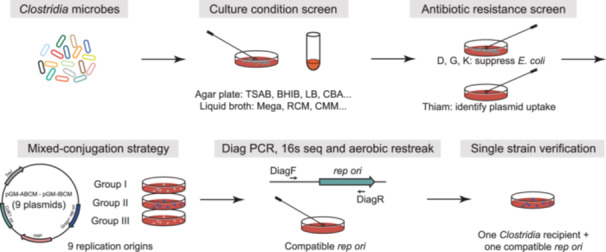
Workflow for the identification of methods for Clostridia microbes to uptake and stably maintain exogenous genomic DNA. BHIB, Brain Heart Infusion Agar + Horse blood; CBA, Columbia Blood Agar; CMM, Chopped Meat Medium; D, d‐cycloserine; E. coli, Escherichia coli; G, gentamicin; K, kanamycin; LB, Luria–Bertani; PCR, polymerase chain reaction; RCM, Reinforced Clostridial Medium; rep ori, replication origin; TSAB, Tryptic Soy Agar + Horse blood.
用于鉴定梭菌微生物吸收和稳定维持外源基因组 DNA 的方法的工作流程。BHIB,脑心浸液琼脂 + 马血;CBA,哥伦比亚血琼脂;CMM,碎肉培养基;D, d- 环丝氨酸; E. coli , 大肠杆菌 ;G,庆大霉素;K,卡那霉素;LB,Luria–Bertani;PCR,聚合酶链式反应;RCM,强化梭菌培养基; rep ori ,复制起点;TSAB,胰蛋白酶大豆琼脂 + 马血。
Keynotes: For the screening of the culture conditions of liquid medium, Clostridia strains need to be first recovered on agar plates to ensure that Clostridia strains are activated, instead of inoculating Clostridia strains into the liquid medium from the frozen glycerol stock directly.
要点 :液体培养基培养条件的筛选,需要先在琼脂平板上回收梭菌菌株,以确保梭菌菌株被激活,而不是直接从冷冻的甘油原液中将梭菌菌株接种到液体培养基中。
Potential issues and solutions: If the Clostridia strains of interest cannot grow on the common agar plates or in the liquid medium listed above, other specific plates or liquid mediums that favor the growth of the target strains need to be used to screen the culture conditions.
潜在问题和解决方案 :如果目标梭菌菌株不能在普通琼脂平板或上述液体培养基中生长,则需要使用有利于目标菌株生长的其他特定平板或液体培养基来筛选培养条件。
Antibiotic test 抗生素测试
The Clostridia strains were restreaked on agar plates supplemented with 250 µg/mL d‐cycloserine (D), 200 µg/mL gentamicin (G), or 200 µg/mL kanamycin (K). d‐cycloserine or gentamicin will be used to inhibit the growth of conjugation donor E. coli CA434 after conjugation, and kanamycin will be used to inhibit the growth of conjugation donor E. coli HB101/pRK24. Both E. coli CA434 and HB101/pRK24 have been shown to successfully conjugate exogenous genomic DNA into Clostridium bacteria like Clostridium sporogenes or Clostridium acetobutylicum in previous studies [10, 11, 15].
将梭菌菌株重新划线接种于添加了 250 µg/mL d- 环丝氨酸(D)、200 µg/mL 庆大霉素(G)或 200 µg/mL 卡那霉素(K)的琼脂平板上。d- 环丝氨酸或庆大霉素用于抑制结合供体大肠杆菌 CA434 在结合后的生长,卡那霉素用于抑制结合供体大肠杆菌 HB101/pRK24 的生长。先前的研究表明, 大肠杆菌 CA434 和 HB101/pRK24 均能成功地将外源基因组 DNA 结合到梭菌属细菌(如产孢梭菌或丙酮丁醇梭菌) 中[ 10 , 11 , 15 ]。
The majority of the Clostridia strains we tested so far are sensitive to thiamphenicol, so the thiamphenicol‐resistant gene (catP) can be exploited as a universal marker to select transconjugants that can uptake and maintain exogenous genomic DNA. The MICs of thiamphenicol of the Clostridia microbes were tested on agar plates containing thiamphenicol at different concentrations (Figure 2).
到目前为止,我们测试的大多数梭菌菌株对甲砜霉素敏感,因此可以利用甲砜霉素抗性基因 ( catP ) 作为通用标记,筛选能够摄取并维持外源基因组 DNA 的转化接合子。在含有不同浓度甲砜霉素的琼脂平板上,我们测试了梭菌微生物对甲砜霉素的最低抑菌浓度 (MIC)(图 2 )。
Keynotes: Antibiotics need to be added into the agar medium before the agar plates are poured and solidified; agar plates supplemented with antibiotics only on the surface of the plates may cause misleading antibiotic test results.
要点 :琼脂培养基需要在琼脂平板灌注固化前添加抗生素;仅在平板表面添加抗生素的琼脂平板可能会造成抗生素检测结果的误导。
Potential issues and solutions: If the Clostridia strains of interest are not resistant against d‐cycloserine, gentamicin, or kanamycin, other specific antibiotics that can suppress the growth of E. coli CA434 or HB101/pRK24 can be used for the test. Likewise, if the Clostridia strains of interest are resistant against thiamphenicol, the antibiotic marker on the conjugation vector can be replaced by other markers, whose corresponding antibiotics can suppress the growth of the Clostridia strains.
潜在问题及解决方案 :如果目标梭菌菌株对 d- 环丝氨酸、庆大霉素或卡那霉素不耐药,则可以使用其他能够抑制大肠杆菌 CA434 或 HB101/pRK24 生长的特异性抗生素进行检测。同样,如果目标梭菌菌株对甲砜霉素耐药,则可将结合载体上的抗生素标记替换为其他标记,其对应的抗生素可以抑制梭菌菌株的生长。
Vector assembly 向量组装
A series of vectors pGM‐xBCM (pGM‐ABCM, BBCM, CBCM, DBCM, EBCM, FBCM, GBCM, HBCM, and IBCM) harboring different rep oris for Clostridia microbes were generated to screen the compatible rep oris for the recipient Clostridia strains [2]. To include more rep oris for screening, the rep ori sequences could be amplified by PCR and assembled with the backbone amplified from pGM‐xBCM.
构建了一系列携带不同梭菌属细菌 rep oris 的载体 pGM‐xBCM(pGM‐ABCM、BBCM、CBCM、DBCM、EBCM、FBCM、GBCM、HBCM 和 IBCM),用于筛选与受体梭菌菌株相容的 rep oris [ 2 ]。为了纳入更多 rep oris 进行筛选,可以通过 PCR 扩增 rep oris 序列,并将其与从 pGM‐xBCM 扩增出的骨架序列进行组装。
Mixed‐conjugation strategy to identify Clostridia microbes that uptake and maintain exogenous plasmid DNA
混合结合策略鉴定吸收和维持外源质粒 DNA 的梭菌微生物
The series of vectors pGM‐ABCM, BBCM, CBCM, DBCM, EBCM, FBCM, GBCM, HBCM, and IBCM harboring different rep oris, but the same antibiotic marker catP (against thiamphenicol) were transformed into chemical competent E. coli CA434 or E. coli HB101/pRK24. Mixed‐conjugation strategies separating these E. coli donors into three groups (Group I: pGM‐ABCM, BBCM, and CBCM; Group II: pGM‐DBCM, EBCM, and FBCM; and Group III: pGM‐GBCM, HBCM, IBCM) were established to identify the compatible rep ori for each Clostridia microbe of interest. For the Clostridia microbes resistant to d‐cycloserine (250 μg/mL) or gentamicin (200 µg/mL), E. coli CA434 would be used as the conjugation donor. For the microbes that are not resistant to d‐cycloserine (250 μg/mL) or gentamicin (200 µg/mL) but resistant to kanamycin (200 μg/mL), E. coli HB101/pRK24 would be used as their conjugation donors.
将一系列载体 pGM-ABCM、BBCM、CBCM、DBCM、EBCM、FBCM、GBCM、HBCM 和 IBCM(它们携带不同的 rep ori ,但具有相同的抗生素标记 catP (针对甲砜霉素))转化到化学感受态大肠杆菌 CA434 或大肠杆菌 HB101/pRK24 中。建立了混合结合策略,将这些大肠杆菌供体分为三组(第 I 组:pGM-ABCM、BBCM 和 CBCM;第 II 组:pGM-DBCM、EBCM 和 FBCM;第 III 组:pGM-GBCM、HBCM、IBCM),以确定与每种目标梭菌微生物相容的 rep ori 。对于对 d- 环丝氨酸(250 μg/mL)或庆大霉素(200 μg/mL)具有抗性的梭菌 ,可使用大肠杆菌 CA434 作为结合供体。对于对 d- 环丝氨酸(250 μg/mL)或庆大霉素(200 μg/mL)不具有抗性但对卡那霉素(200 μg/mL)具有抗性的梭菌,可使用大肠杆菌 HB101/pRK24 作为结合供体。
The Clostridia microbe was restreaked on a pre‐reduced agar plate. After 24–48 h, a single colony was inoculated in 1 mL of liquid broth that supported its growth in an anaerobic chamber. On the same day, E. coli containing plasmids with different rep oris were inoculated into 6 mL of LB supplemented with tetracycline (15 µg/mL) and chloramphenicol (25 µg/mL) and shaken aerobically at 37°C for 12–18 h (overnight). The next day, these E. coli donors were separated into three groups, as mentioned above. For conjugating one Clostridia microbe, a 1.0 mL culture of each E. coli within the same group was mixed and centrifuged at 1500g for 2 min. The culture supernatant was discarded, and the cell pellet was gently washed with 500 µL PBS buffer (pH = 7.4). The PBS supernatant was then removed after centrifugation at 1500g for 2 min, and the cell pellet was transferred on ice into the anaerobic chamber. Next, the cell pellet (a total of three cell pellets) was mixed gently with 300 μL overnight culture of the targeting Clostridia microbe, and a 35 μL cell mixture was dotted on pre‐reduced agar plates. After 48 h, the cell dots were scraped using a sterile inoculation loop and resuspended in 300 μL pre‐reduced PBS (pH = 7.4) buffer. The cell suspension (100 µL) was plated on agar plates supplemented with 15 µg/mL thiamphenicol (or MICs) and 250 µg/mL d‐cycloserine or 200 µg/mL gentamicin (if E. coli CA434 is the conjugation donor), or 200 µg/mL kanamycin (if E. coli HB101/pRK24 is the conjugation donor). Colonies typically appeared after 36–48 h. Four colonies were picked and restreaked onto agar plates with the same antibiotics to isolate single colonies (Figure 2).
将梭菌微生物重新划线接种于预还原琼脂平板上。24-48 小时后,将单菌落接种于 1 mL 液体肉汤中,该液体肉汤可在厌氧培养箱中生长。同一天,将含有不同复制位点质粒的大肠杆菌接种于 6 mL 添加四环素(15 µg/mL)和氯霉素(25 µg/mL)的 LB 培养基中,并在 37°C 下有氧振荡培养 12-18 小时(过夜)。第二天,将这些大肠杆菌供体按上述方法分成三组。为了接合一株梭菌微生物,将同一组内每种大肠杆菌的 1.0 mL 培养物混合,并以 1500 g 离心 2 分钟。弃去培养上清液,用 500 μL PBS 缓冲液(pH = 7.4)轻轻洗涤细胞沉淀。然后以 1500 g 离心 2 分钟后去除 PBS 上清液,并将细胞沉淀在冰上转移至厌氧培养箱。接下来,将细胞沉淀(共三个细胞沉淀)与 300 μL 目标梭菌过夜培养物轻轻混合,并将 35 μL 细胞混合物点在预还原的琼脂平板上。48 小时后,用无菌接种环刮下细胞点,并将其重新悬浮于 300 μL 预还原的 PBS(pH = 7.4)缓冲液中。将 100 µL 细胞悬液接种于添加 15 µg/mL 甲砜霉素(或 MIC)和 250 µg/mL d- 环丝氨酸或 200 µg/mL 庆大霉素(若大肠杆菌 CA434 为结合供体)或 200 µg/mL 卡那霉素(若大肠杆菌 HB101/pRK24 为结合供体)的琼脂平板上。菌落通常在 36-48 小时后出现。 挑取四个菌落,重新划线接种到含有相同抗生素的琼脂平板上,以分离单个菌落(图 2 )。
Keynotes: (1) The target Clostridia microbes are cultured in the anaerobic chamber overnight (~12 h), do not culture the Clostridia strains for too long before conjugation, which will lead to the lysis of the strains; (2) air dry the agar plates for conjugation a little bit is good for conjugation, if the plates are wet, the cell mixture dot will spread all over the plate, in this case, the cell mixture is diluted on the plate, which will reduce the conjugation efficiency.
要点 :(1)将目标梭菌微生物在厌氧箱中培养过夜(~12 h),在进行结合前不要将梭菌菌株培养太长时间,这会导致菌株裂解;(2)将用于结合的琼脂平板稍微风干以利于结合,如果平板潮湿,细胞混合物点会遍布整个平板,在这种情况下,细胞混合物在平板上被稀释,这会降低结合效率。
Potential issues and solutions: In our experience, conjugation donor E. coli CA434 works better than E. coli HB101/pRK24. For specific strains of interest, if the two E. coli donors cannot transfer plasmids into the recipient strains, other E. coli donors could be utilized.
潜在问题及解决方案 :根据我们的经验,接合供体大肠杆菌 CA434 的效果优于大肠杆菌 HB101/pRK24。对于特定目标菌株,如果两种大肠杆菌供体无法将质粒转移至受体菌株,则可以使用其他大肠杆菌供体。
Diagnostic PCR and sequencing to verify the plasmid uptake
诊断性 PCR 和测序以验证质粒的摄取
The isolated single colony was cultivated in 3 mL liquid broth supplemented with the corresponding antibiotics 250 µg/mL d‐cycloserine (or 200 µg/mL gentamicin/kanamycin) + 15 µg/mL thiamphenicol (or MICs). The genomic DNA was isolated from the resulting cell material using the Quick DNA fungal/bacterial kit (Zymo Research). Then multiplex diagnostic PCRs were performed to assess which plasmid was uptaken by the conjugation recipient Clostridia microbe. For the mixed‐conjugation with Group I (Groups II and III are performed likewise), primers pMTL_laz_diag_F (universal forward primer) + pGM‐ABCM_rep_R_1500bp + pGM‐BBCM_rep_R_1000bp + pGM‐CBCM_rep_R_2000bp (for 15 µL PCR reaction, the amount of the four primers is 0.75, 0.3, 0.3, and 0.3 µL [10 µM]) were used for diagnostic PCR. A PCR band of 1.5 kb (or 1.0 or 2.0 kb) would be seen if pGM‐ABCM (or BBCM or CBCM) is uptaken by the Clostridia microbe. In the meantime, to confirm that the picked and restreaked colonies are the target Clostridia strain but not the E. coli conjugation donor, the 16s rRNA region of the colony was amplified using primers 16s_27F + 16s_1391R. The PCR product was purified and sent for Sanger sequencing using primer 16s_1391R, and the colonies were further restreaked aerobically to confirm not to be E. coli (if the colonies cannot grow aerobically, they will be considered not to be E. coli) (Figure 2).
将分离出的单菌落置于 3 mL 液体肉汤中培养,并添加相应的抗生素:250 µg/mL d- 环丝氨酸(或 200 µg/mL 庆大霉素/卡那霉素)+ 15 µg/mL 甲砜霉素(或 MIC)。使用 Quick DNA 真菌/细菌试剂盒(Zymo Research)从所得细胞材料中分离基因组 DNA。然后进行多重诊断 PCR,以评估接合受体梭菌微生物摄取了哪种质粒。对于与 I 组(II 组和 III 组类似)的混合结合,使用引物 pMTL_ laz _diag_F(通用正向引物)+ pGM‐ABCM_rep_R_1500bp + pGM‐BBCM_rep_R_1000bp + pGM‐CBCM_rep_R_2000bp(对于 15 µL PCR 反应,四个引物的用量分别为 0.75、0.3、0.3 和 0.3 µL [10 µM])进行诊断 PCR。如果梭菌微生物摄取了 pGM‐ABCM(或 BBCM 或 CBCM),则会看到 1.5 kb(或 1.0 或 2.0 kb)的 PCR 带。同时,为了确认挑取并重新划线的菌落为目标梭菌菌株而非大肠杆菌接合供体,使用引物 16s_27F + 16s_1391R 扩增菌落的 16s rRNA 区。PCR 产物纯化后,使用引物 16s_1391R 进行桑格测序,并进一步在有氧条件下重新划线,以确认菌落并非大肠杆菌 (如果菌落无法在有氧条件下生长,则视为非大肠杆菌 )(图 2 )。
Keynotes: When performing the diagnostic PCR to figure out which plasmid in a group was transferred into the recipient strain, to avoid a false‐positive conclusion, it is necessary to include the genome of the recipient strain to serve as the negative control.
重点 :在进行诊断性 PCR 以确定某一组中的哪个质粒转移到受体菌株中时,为避免假阳性结论,有必要加入受体菌株的基因组作为阴性对照。
Experimental results interpretation: For the diagnostic PCR of each group (I, II, and III), when different plasmids are transferred into recipient strains, there will be PCR products of different sizes (1, 1.5, and 2 kb), the corresponding size of each plasmid in each group is annotated at the end of the “Name of primers” in Table S1.
实验结果解释 :对于各组(I、II、III)的诊断性 PCR,当不同的质粒转移到受体菌株中时,会有不同大小(1、1.5、2kb)的 PCR 产物,各组各质粒对应的大小在表 S1 中“引物名称”末尾标注。
Single E. coli donor‐conjugation validation
单个大肠杆菌供体结合验证
Next, single E. coli donor‐conjugation (one E. coli donor to one Clostridia recipient) was performed to validate that the PCR‐identified plasmid(s) can be conjugated into the targeted Clostridia microbe. A single colony of the targeted Clostridia strain was inoculated in a 1 mL liquid broth in an anaerobic chamber. The conjugation donor E. coli (CA434 or HB101/pRK24) harboring the PCR‐identified plasmid was inoculated into 6 mL of LB supplemented with tetracycline (15 µg/mL) and chloramphenicol (25 µg/mL) and shaken aerobically at 37°C for 12–18 h (overnight). After 12–18 h, 1.5 mL of the E. coli culture was centrifuged at 1500g for 2 min. The supernatant was discarded and the cell pellet was washed with 500 µL PBS buffer (pH = 7.4). The PBS supernatant was then removed after centrifugation at 1500g for 2 min, and the cell pellet was transferred on ice into the anaerobic chamber. Next, the cell pellet was mixed gently with a 300 μL overnight culture of the targeting Clostridia microbe, and a 35 μL cell mixture was dotted on pre‐reduced agar plates. After 48 h, the cell dots were scraped using a sterile inoculation loop and resuspended in 300 μL pre‐reduced PBS (pH = 7.4) buffer. The cell suspension (100 µL) was plated on agar plates supplemented with 15 µg/mL thiamphenicol (or MICs) and 250 µg/mL d‐cycloserine or 200 µg/mL gentamicin (if E. coli CA434 is the conjugation donor), or 200 µg/mL kanamycin (if E. coli HB101/pRK24 is the conjugation donor). Colonies typically appeared after 36–48 h. Four colonies were picked and restreaked onto agar plates with the same antibiotics to isolate single colonies. The isolated single colonies will be cultured in 1 mL of pre‐reduced liquid broth with the same antibiotics, and the glycerol stock will be prepared using the culture (Figure 2).
接下来,进行单大肠杆菌供体-受体接合实验(一个大肠杆菌供体与一个梭菌受体),以验证 PCR 鉴定的质粒能否与目标梭菌微生物接合。将目标梭菌菌株的单菌落接种于厌氧培养箱中的 1 mL 液体肉汤中。将携带 PCR 鉴定质粒的接合供体大肠杆菌 (CA434 或 HB101/pRK24)接种于 6 mL 添加了四环素(15 µg/mL)和氯霉素(25 µg/mL)的 LB 培养基中,在 37°C 下有氧振荡培养 12-18 小时(过夜)。12-18 小时后,取 1.5 mL 大肠杆菌培养物,以 1500 g 离心 2 分钟。弃去上清液,用 500 μL PBS 缓冲液(pH = 7.4)洗涤细胞沉淀。然后以 1500 g 离心 2 分钟后,除去 PBS 上清液,并将细胞沉淀在冰上转移至厌氧培养箱。接下来,将细胞沉淀与 300 μL 目标梭菌过夜培养物轻轻混合,并将 35 μL 细胞混合物点在预还原的琼脂平板上。48 小时后,用无菌接种环刮下细胞点,并将其重新悬浮于 300 μL 预还原的 PBS(pH = 7.4)缓冲液中。将 100 µL 细胞悬液接种于添加 15 µg/mL 甲砜霉素(或 MIC)和 250 µg/mL d- 环丝氨酸或 200 µg/mL 庆大霉素(如果大肠杆菌 CA434 为结合供体)或 200 µg/mL 卡那霉素(如果大肠杆菌 HB101/pRK24 为结合供体)的琼脂平板上。菌落通常在 36-48 小时后出现。挑取四个菌落,重新划线接种于添加相同抗生素的琼脂平板上,以分离单个菌落。 将分离的单菌落培养在 1 mL 预先还原的含有相同抗生素的液体肉汤中,并使用该培养物制备甘油原液(图 2 )。
Keynotes: For the step of scraping cell dots and suspending cells in PBS to be plated onto agar plates with selective antibiotics, in the case that a lot of conjugations plates need to be scraped, it is better to scrap at most three plates and suspend in PBS at one time, keeping cells in PBS for too long will reduce the conjugation efficiency.
要点 :对于刮取细胞点并将细胞悬浮在 PBS 中以接种到含有选择性抗生素的琼脂平板上的步骤,如果需要刮取大量结合板,则最好一次刮取最多三块板并悬浮在 PBS 中,细胞在 PBS 中停留时间过长会降低结合效率。
Potential issues and solutions: In the step of plating conjugation cells onto agar plates with d‐cycloserine (or gentamicin, kanamycin) + thiamphenicol (MICs), some recipient strains may overgrow because the MICs of thiamphenicol are not enough to suppress the growth of the plated cells that contain a high concentration of recipient strains; in this case, plates with a higher concentration of thiamphenicol need to be used (e.g., if the MICs of thiamphenicol are 7.5 µg/mL, 10 µg/mL thiamphenicol can be added into the agar plate).
潜在问题和解决方案 :在将接合细胞接种到含有 d- 环丝氨酸(或庆大霉素、卡那霉素)+甲砜霉素(MIC)的琼脂平板上时,一些受体菌株可能会过度生长,因为甲砜霉素的 MIC 不足以抑制含有高浓度受体菌株的接种细胞的生长;在这种情况下,需要使用具有更高浓度甲砜霉素的平板(例如,如果甲砜霉素的 MIC 为 7.5 µg/mL,则可以将 10 µg/mL 甲砜霉素添加到琼脂平板中)。
Developing a CRISPRi‐dCpf1 lacZα system for Clostridia microbes
开发用于梭菌微生物的 CRISPRi‐dCpf1 lacZ α 系统
After identifying exogenous plasmid transfer methods for Clostridia strains, the next step is developing a tractable genetic tool that would function in those Clostridia commensals. Like Cas9‐mediated cutting and dCas9‐induced interference, CRISPR‐based genome editing systems have been recently used to manipulate C. sporogenes [10, 11] and Clostridium difficile [25]. In general, Clostridia has very inefficient HR, and the DNA double‐stranded break initiated by Cas9 or the like is mostly lethal. While much effort was spent finetuning a spectrum of conjugation parameters to identify the optimal condition for the Cas9 machinery in C. sporogenes, this condition is usually not readily applicable to other Clostridia commensals.
在确定了梭菌菌株的外源质粒转移方法后,下一步是开发一种易于操控的遗传工具,使其能够在这些梭菌共生菌中发挥作用。与 Cas9 介导的切割和 dCas9 诱导的干扰一样,基于 CRISPR 的基因组编辑系统最近已用于操控产孢梭菌 [ 10 , 11 ]和艰难梭菌 [ 25 ]。一般而言, 梭菌的同源重组效率非常低,由 Cas9 或类似物引发的 DNA 双链断裂大多是致命的。虽然人们花费了大量精力来微调一系列结合参数,以确定 Cas9 机制在产孢梭菌中的最佳条件,但该条件通常不易应用于其他梭菌共生菌。
CRISPR interference deactivated Cpf1 (CRISPRi‐dCpf1) [26, 27, 28, 29, 30, 31] system was prioritized for Clostridia microbes because the dCpf1 does not initiate the DNA double‐strand break and is supposedly less toxic and applicable to a broader range of Clostridia compared with the Cas9/Cpf1. Indeed, plasmids carrying dCpf1 showed less toxicity and relatively higher conjugation efficiency than those with Cas9 or Cpf1. Combined with the CRISPRi‐dCpf1 machinery, lacZα was used as a transcription reporter to develop CRISPRi‐dCpf1 gene repression tools for nonmodel Clostridia microbes without prior knowledge of the genome sequence.
CRISPR 干扰失活 Cpf1 (CRISPRi‐dCpf1) [ 26 , 27 , 28 , 29 , 30 , 31 ] 系统优先用于梭菌微生物,因为 dCpf1 不会引发 DNA 双链断裂,与 Cas9/Cpf1 相比,毒性更小,适用梭菌范围更广。事实上,携带 dCpf1 的质粒比携带 Cas9 或 Cpf1 的质粒毒性更小,结合效率相对较高。结合 CRISPRi‐dCpf1 机制, lacZα 被用作转录报告基因,以开发针对非模型梭菌微生物的 CRISPRi‐dCpf1 基因抑制工具,而无需事先了解基因组序列。
Materials and devices 材料与设备
Primer star DNA polymerase (Takara, Cat# R045), Blue sapphire DNA polymerase (Takara, Cat# RR350), Plasmid Midiprep Kit (Zymo Research, Cat# D4201), DNA Clean and Concentrator (Zymo Research, Cat# D4003), Tryptic Soy Agar (BD, Cat# 236950), Brain Heart Infusion Agar (BD, Cat# 241830), CBA (BD, Cat# 279240), Horse blood (Hemostat Laboratories, Cat# 637291), LB broth (BD, Cat# BP1426), glycerol (Fisher Bioreagents, Cat# BP229), PBS (Gibco, Cat# 10010‐031), centrifuge, PCR amplifier, tetracycline (GoldBio, Cat# T‐101‐25), chloramphenicol (VWR, Cat# 0230), d‐cycloserine (D) (TCI, Cat# C1189), gentamicin (G) (GoldBio, Cat# G‐400‐25), kanamycin (K) (GoldBio, Cat# K‐120‐25), thiamphenicol (Thiam) (Acros Organics, Cat# 455450250), anaerobic chamber, aerobic incubator, electroporation system, Thermo Scientific Nanodrop 2000, Gibson Assembly Cloning Kit (NEB, Cat# E5510S), Quick DNA fungal/bacterial kit (Zymo Research, Cat# D6005), ultralow temperature freezer, Direct‐zol RNA Microprep kit (Zymo Research, Cat# R2062), PrimeScript RT Reagent Kit (Takara, Cat# RR047A), real‐time quantitative PCR system (Applied Biosystems, ABI 7500).
Primer star DNA 聚合酶(Takara,Cat# R045)、Blue sapphire DNA 聚合酶(Takara,Cat# RR350)、质粒中量提取试剂盒(Zymo Research,Cat# D4201)、DNA 净化浓缩液(Zymo Research,Cat# D4003)、胰蛋白酶大豆琼脂(BD,Cat# 236950)、脑心浸液琼脂(BD,Cat# 241830)、CBA(BD,Cat# 279240)、马血(Hemostat Laboratories,Cat# 637291)、LB 肉汤(BD,Cat# BP1426)、甘油(Fisher Bioreagents,Cat# BP229)、PBS(Gibco,Cat# 10010-031)、离心机、PCR 扩增子、四环素(GoldBio,Cat# T-101-25)。氯霉素 (VWR, Cat# 0230)、 d- 环丝氨酸 (D) (TCI, Cat# C1189)、庆大霉素 (G) (GoldBio, Cat# G-400-25)、卡那霉素 (K) (GoldBio, Cat# K-120-25)、甲砜霉素 (Thiam) (Acros Organics, Cat# 455450250)、厌氧箱、好氧培养箱、电穿孔系统、Thermo Scientific Nanodrop 2000、Gibson Assembly Cloning Kit (NEB, Cat# E5510S)、Quick DNA 真菌/细菌试剂盒 (Zymo Research, Cat# D6005)、超低温冰箱、Direct-zol RNA Microprep 试剂盒 (Zymo Research, Cat# R2062)、PrimeScript RT 试剂盒 (Takara, Cat# RR047A)、实时定量 PCR 系统(Applied Biosystems,ABI 7500)。
Vector assembly 向量组装
Three sets of plasmids pGM‐xBCD (pGM‐ABCD, BBCD, pGM‐CBCD, DBCD, EBCD, FBCD, GBCD, HBCD, and IBCD) carrying the CRISPRi‐dCpf1 machinery, plasmids pGM‐xBCL (pGM‐ABCL, BBCL, pGM‐CBCL, DBCL, EBCL, FBCL, GBCL, HBCL, and IBCL) carrying CRISPRi‐dCpf1 and the lacZα reporter gene, and plasmids pGM‐xBCF (pGM‐ABCF, BBCF, pGM‐CBCF, DBCF, EBCF, FBCF, GBCF, HBCF, and IBCF) carrying CRISPRi‐dCpf1, lacZα, and the lacZα targeting guide RNA (gRNA) were generated to test the CRISPRi‐dCpf1 lacZα system for Clostridia microbes [2] (Figure 3A–D). To target other specific genes in Clostridia strains, the gRNA locus targeting the promoter region and coding sequence (CDS) of the target gene (as in Figure 3D) could be amplified by PCR and assembled with the backbone amplified from pGM‐xBCD to get the plasmid carrying CRISPRi‐dCpf1 and the gRNA for the target gene.
生成了三组携带 CRISPRi‐dCpf1 机制的质粒 pGM‐xBCD(pGM‐ABCD、BBCD、pGM‐CBCD、DBCD、EBCD、FBCD、GBCD、HBCD 和 IBCD)、携带 CRISPRi‐dCpf1 和 lacZα 报告基因的质粒 pGM‐xBCL(pGM‐ABCL、BBCL、pGM‐CBCL、DBCL、EBCL、FBCL、GBCL、HBCL 和 IBCL)以及携带 CRISPRi‐dCpf1、 lacZα 和 lacZα 靶向引导 RNA(gRNA)的质粒 pGM‐xBCF(pGM‐ABCF、BBCF、pGM-CBCF、DBCF、EBCF、FBCF、GBCF、HBCF 和 IBCF)来测试 CRISPRi‐dCpf1 lacZα 系统对梭菌的作用微生物 [ 2 ](图 3A–D )。为了靶向梭菌菌株中的其他特定基因,可以通过 PCR 扩增针对目标基因启动子区和编码序列(CDS)的 gRNA 基因座(如图 3D 所示),并将其与从 pGM‐xBCD 扩增的骨架组装在一起,以获得携带 CRISPRi‐dCpf1 和目标基因 gRNA 的质粒。
Figure 3. 图 3.
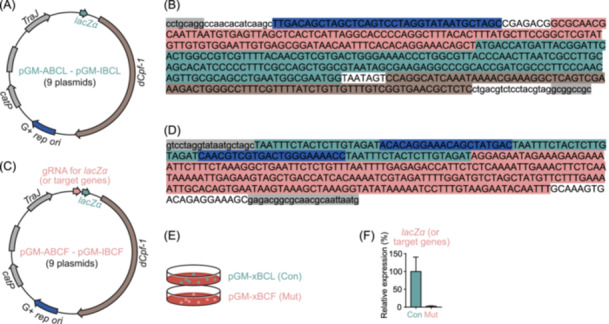
Development of a CRISPRi‐dCpf1 lacZα genetic manipulation system for Clostridia microbes. (A) Schematics of the set of plasmids pGM‐ABCL–pGM‐IBCL that carry the clustered regularly interspaced short palindromic repeats interference deactivated Cpf1 (CRISPRi‐dCpf1) machinery and the lacZα reporter gene. G+ rep ori, Gram‐positive replication origin. (B) The sequence of the lacZα locus consisting of guide RNA (gRNA) promoter PJ23119 (highlighted in blue), the lacZα promoter (in red), the lacZα coding sequence (in green), and lacZα terminator (in brown). The sequences highlighted in gray are restriction sites of SbfI and NotI, respectively. (C) Schematics of the set of plasmids pGM‐ABCF–pGM‐IBCF that carry the CRISPRi‐dCpf1 machinery, the lacZα reporter gene, and gRNA locus targeting the promoter region and coding sequence (CDS) of lacZα. (D) The sequence of the gRNA locus consisting of three dCpf1 direct repeat sequences (highlighted in green), two gRNA targeting both the promoter region and the template strand of lacZα (in blue), and terminator region obtained from the 16s rRNA gene of Clostridium sporogenes ATCC 15579 (CLOSPO_00916) (in red). The sequences highlighted in gray are homologous to the sequence in pGM‐ABCL. (E, F) Plasmids with compatible replication origins in the set of plasmids pGM‐ABCL–pGM‐IBCL (pGM‐xBCL, Control group, Con) and pGM‐ABCF–pGM‐IBCF (pGM‐xBCF, Mutant group, Mut) were introduced into the recipient Clostridia microbes, and the expression levels of lacZα were quantified by quantitative polymerase chain reaction (qPCR).
针对梭菌微生物的 CRISPRi‐dCpf1 lacZα 基因操作系统的开发。(A)携带成簇的规律间隔短回文重复序列干扰失活 Cpf1 (CRISPRi‐dCpf1) 机制和 lacZα 报告基因的质粒 pGM‐ABCL–pGM‐IBCL 组示意图。G+ 复制起点 ,革兰氏阳性菌复制起点。(B) lacZα 基因座序列,由向导 RNA (gRNA) 启动子 P J23119 (蓝色突出显示)、 lacZα 启动子(红色突出显示)、 lacZα 编码序列(绿色)和 lacZα 终止子(棕色突出显示)组成。灰色突出显示的序列分别是 SbfI 和 NotI 的限制性位点。 (C) 携带 CRISPRi‐dCpf1 机制、 lacZα 报告基因以及靶向 lacZα 启动子区和编码序列 (CDS) 的 gRNA 基因座的质粒 pGM‐ABCF–pGM‐IBCF 示意图。(D) gRNA 基因座序列包含三个 dCpf1 正向重复序列(绿色突出显示)、两个靶向 lacZα 启动子区和模板链的 gRNA(蓝色突出显示)以及从产孢梭菌 ATCC 15579 ( CLOSPO_00916 ) 的 16s rRNA 基因获得的终止子区(红色突出显示)。灰色突出显示的序列与 pGM‐ABCL 中的序列同源。 (E、F) 将质粒组 pGM‐ABCL–pGM‐IBCL(pGM‐xBCL,对照组,Con)和 pGM‐ABCF–pGM‐IBCF(pGM‐xBCF,突变组,Mut)中具有兼容复制起点的质粒引入受体梭菌微生物中,并通过定量聚合酶链式反应(qPCR)对 lacZα 的表达水平进行量化。
Utilization of dCpf1 to suppress the lacZα transcription in Clostridia strains
利用 dCpf1 抑制梭菌菌株中的 lacZα 转录
Using a Gram‐positive strain Clostridium bolteae DSM 29485 as an example, pGM‐ABCL and pGM‐ABCF were transformed into chemically competent E. coli CA434, respectively. E. coli CA434 harboring pGM‐ABCL and pGM‐ABCF were conjugated to Clostridium bolteae DSM 29485 (Figure 3E). The transconjugants were picked and restreaked onto a TSAB agar plate supplemented with d‐cycloserine (250 µg/mL) + thiamphenicol (15 µg/mL). Then, three isolated single colonies were cultivated in 5 mL Mega liquid broth supplemented with 15 µg/mL thiamphenicol for 36 h. The bacterial RNA was extracted using a Direct‐zol RNA Microprep kit (Zymo Research) and quantitative polymerase chain reaction (qPCR) was performed to quantify the relative expression of lacZα after normalizing to 16s rRNA gene, using primers dCpf1‐lacZα_qPCR_F and dCpf1‐lacZα_qPCR_R for lacZα gene and S74_16 s_qPCR_F and S74_16s_qPCR_R for the control 16s rRNA (Figure 3F).
以革兰氏阳性菌株 Clostridium bolteae DSM 29485 为例,将 pGM-ABCL 和 pGM-ABCF 分别转化至化学感受态大肠杆菌 CA434 中。将携带 pGM-ABCL 和 pGM-ABCF 的大肠杆菌 CA434 与 Clostridium bolteae DSM 29485 偶联(图 3E )。挑取转接合子,重新划线接种于添加了 d- 环丝氨酸(250 µg/mL)+甲砜霉素(15 µg/mL)的 TSAB 琼脂平板上。然后,将分离出的三个单菌落置于添加了 15 µg/mL 甲砜霉素的 5 mL Mega 液体肉汤中培养 36 小时。使用 Direct‐zol RNA Microprep 试剂盒 (Zymo Research) 提取细菌 RNA,并进行定量聚合酶链式反应 (qPCR) 以量化 lacZα 的相对表达,在标准化为 16s rRNA 基因后,使用引物 dCpf1‐ lacZα _qPCR_F 和 dCpf1‐ lacZα _qPCR_R 作为 lacZα 基因,使用 S74_16 s_qPCR_F 和 S74_16s_qPCR_R 作为对照 16s rRNA(图 3F )。
This CRISPRi‐dCpf1 gene repression tool is readily applicable to other genes of interest in Clostridia microbes. To knock down a target gene in Clostridia strains, the gRNA locus targeting the promoter region and CDS of the target gene is introduced into the plasmid harboring dCpf‐1 and the corresponding compatible rep ori (the set of vectors pGM‐xBCD). As in targeting lacZα, the synthetic fragment containing the terminator region (Figure 3D, in red) was amplified to get a PCR product that has one direct repeat sequence (Figure 3D, in green) and gRNA (Figure 3D, in blue) fused with the terminator. Then, this PCR product was purified and used as the template for the second PCR to get the gRNA locus with two gRNAs for the target gene. This gRNA locus was then assembled with the backbone amplified from pGM‐xBCD to get the plasmid for the target gene. The plasmid was transformed into donor E. coli CA434 (or HB101/pRK24) and introduced into the recipient microbe via conjugation. The transconjugants harboring the CRISPRi‐dCpf1 plasmid are identified by antibiotic selection, and the gene knockdown is validated by qPCR of the target gene or other readout like LC‐MS measurement of metabolites.
CRISPRi‐dCpf1 基因抑制工具可轻松应用于梭菌属微生物中的其他目标基因。为了敲低梭菌属菌株中的目标基因,将靶向目标基因启动子区域和 CDS 的 gRNA 基因座引入含有 dCpf‐1 和相应兼容 rep ori 的质粒(载体组 pGM‐xBCD)。与靶向 lacZα 一样,扩增含有终止子区域的合成片段(图 3D ,红色)以获得具有一个直接重复序列(图 3D ,绿色)和与终止子融合的 gRNA(图 3D ,蓝色)的 PCR 产物。然后,纯化该 PCR 产物并用作第二次 PCR 的模板,以获得具有两个针对目标基因的 gRNA 的 gRNA 基因座。然后将该 gRNA 基因座与从 pGM‐xBCD 扩增的骨架组装以获得目标基因的质粒。将质粒转化至供体大肠杆菌 CA434(或 HB101/pRK24)中,并通过接合导入受体菌。通过抗生素筛选鉴定出携带 CRISPRi‐dCpf1 质粒的接合子,并通过靶基因的 qPCR 或其他方法(例如 LC-MS 代谢物测定)验证基因敲减效果。
Keynotes: To transfer plasmids containing the CRISPRi‐dCpf1 machinery into the target strains, in the step of plating conjugation cells onto agar plates with selective antibiotics, it is recommended to plate all 300 µL scraped‐cell suspension in PBS onto three plates, because the conjugation efficiency will decrease when the CRISPRi‐dCpf1 machinery is introduced into plasmids to make these plasmids bigger.
要点 :为了将含有 CRISPRi-dCpf1 机制的质粒转移到目标菌株中,在将接合细胞接种到含有选择性抗生素的琼脂平板上的步骤中,建议将 PBS 中 300µL 刮下的细胞悬浮液全部接种到三个平板上,因为当 CRISPRi-dCpf1 机制引入质粒并使这些质粒变大时,接合效率会降低。
Potential issues and solutions: In some cases, the knockdown efficiency is low because the CRISPRi‐dCpf1 system has off‐target effects. To address this problem, one option is to test several different gRNA designs (construct different plasmids containing different gRNAs); the other option is to construct multiple gRNAs containing plasmids, an extended version of our current duplex gRNA design, introducing multiple gRNAs, like four gRNAs, would reduce the off‐target effects and enhance the suppressive efficiency of the CRISPRi‐dCpf1 system.
潜在问题及解决方案 :在某些情况下,由于 CRISPRi‐dCpf1 系统存在脱靶效应,导致敲减效率较低。为了解决这个问题,一种方案是测试几种不同的 gRNA 设计(构建包含不同 gRNA 的不同质粒);另一种方案是构建包含多个 gRNA 的质粒,这是我们目前双链 gRNA 设计的扩展版本,引入多个 gRNA(例如四个 gRNA),可以降低脱靶效应并增强 CRISPRi‐dCpf1 系统的抑制效率。
Experimental results interpretation: To determine the suppressive efficiency of target genes by the CRISPRi‐dCpf1 system, the expression of target genes is quantified by qPCR and normalized to reference 16s rRNA gene of the strain. In the case the introduced lacZα gene is the target gene, the strain harboring plasmid pGM‐xBCL (carrying CRISPRi‐dCpf1 + lacZα) serves as the control, and expression of the lacZα gene in the strain harboring plasmid pGM‐xBCF (carrying CRISPRi‐dCpf1 + lacZα + lacZα targeting gRNAs) is normalized to the expression of lacZα gene in control (as shown in Figure 3F). In the case, where a specific gene on the genome of the strain of interest is the target gene, the strain harboring plasmid pGM‐xBCD (carrying CRISPRi‐dCpf1) serves as the control, and expression of the target gene in the strain harboring plasmids that carry CRISPRi‐dCpf1 + gene targeting gRNAs is normalized to the expression of the target gene in control.
实验结果解读 :为确定 CRISPRi‐dCpf1 系统对靶基因的抑制效率,通过 qPCR 定量检测靶基因的表达量,并以菌株的参考 16s rRNA 基因为标准进行标准化。以导入的 lacZα 基因为靶基因的情况为例,以质粒 pGM‐xBCL(携带 CRISPRi‐dCpf1 + lacZα )的菌株为对照,以质粒 pGM‐xBCF(携带 CRISPRi‐dCpf1 + lacZα + lacZα 靶向 gRNA)的菌株中 lacZα 基因的表达量为标准进行标准化(如图 3F 所示)。当目标菌株基因组上的特定基因为目标基因时,以含有质粒 pGM‐xBCD(携带 CRISPRi‐dCpf1)的菌株为对照,将含有携带 CRISPRi‐dCpf1 + 基因靶向 gRNA 的质粒的菌株中目标基因的表达标准化为对照中目标基因的表达。
Developing a 16s‐tron strategy for Clostridia microbes
开发针对梭菌微生物的 16s‐tron 策略
Group II intron‐based genetic tools were also developed for nonmodel gut Clostridia microbes. Group II intron was selected because it facilitates the insertion of retrotransposition‐activated markers (RAMs) into the targeted genome sites [15]. This targeted insertion does not induce lethal chromosomal double‐strand breaks (as initiated by Cas9) that need to be repaired by HR.
基于 II 组内含子的遗传工具也已开发用于非模式肠道梭菌微生物。之所以选择 II 组内含子,是因为它有助于将逆转录激活标记 (RAM) 插入目标基因组位点 [ 15 ]。这种靶向插入不会诱导致命的染色体双链断裂(由 Cas9 引发),而这种断裂需要通过同源重组 (HR) 进行修复。
As in Bacteroidia microbes, conserved bacterial 16s rRNA genes of Clostridia strains were selected as a target gene to develop genetic manipulation tools without prior knowledge of their genome sequences. Multiple sequence alignment using 16s rRNAs of Clostridia that can uptake plasmids was performed to identify a highly conserved sequence that can be targeted by Group II intron. Then, the intron targeting and design tool on the ClosTron website (https://clostron.com/intron-design-tool) was used to design the Group II introns targeting the conserved 16s sequence. For each recipient Clostridia microbe, the designed 16s‐targeting Group II intron (16s‐tron) was assembled with their compatible rep oris and antibiotic RAM and transported into the recipient Clostridia microbes; the RAM provides antibiotic resistance only upon integration into the Clostridia chromosome.
与拟杆菌属微生物一样,选择梭菌属菌株保守的细菌 16s rRNA 基因作为目标基因,在不知道其基因组序列的情况下开发遗传操作工具。使用可以摄取质粒的梭菌属 16s rRNA 进行多序列比对,以确定可被 II 组内含子靶向的高度保守序列。然后,使用 ClosTron 网站 ( https://clostron.com/intron-design-tool ) 上的内含子靶向和设计工具设计靶向保守 16s 序列的 II 组内含子。对于每个受体梭菌属微生物,设计的 16s 靶向 II 组内含子 (16s-tron) 与其兼容的复制子和抗生素 RAM 一起组装并运输到受体梭菌属微生物中;RAM 仅在整合到梭菌属染色体中后才提供抗生素抗性。
Materials and devices 材料与设备
Primer star DNA polymerase (Takara, Cat# R045), Blue sapphire DNA polymerase (Takara, Cat# RR350), Plasmid Midiprep Kit (Zymo Research, Cat# D4201), DNA Clean and Concentrator (Zymo Research, Cat# D4003), Tryptic Soy Agar (BD, Cat# 236950), Brain Heart Infusion Agar (BD, Cat# 241830), CBA (BD, Cat# 279240), Horse blood (Hemostat Laboratories, Cat# 637291), LB broth (BD, Cat# BP1426), glycerol (Fisher Bioreagents, Cat# BP229), PBS (Gibco, Cat# 10010‐031), centrifuge, PCR amplifier, tetracycline (GoldBio, Cat# T‐101‐25), chloramphenicol (VWR, Cat# 0230), d‐cycloserine (D) (TCI, Cat# C1189), gentamicin (G) (GoldBio, Cat# G‐400‐25), kanamycin (K) (GoldBio, Cat# K‐120‐25), thiamphenicol (Thiam) (Acros Organics, Cat# 455450250), erythromycin (VWR, Cat# 0219), spectinomycin (Cat# BML‐A281‐0010), anaerobic chamber, aerobic incubator, electroporation system, Thermo Scientific Nanodrop 2000, Gibson Assembly Cloning Kit (NEB, Cat# E5510S), Quick DNA fungal/bacterial kit (Zymo Research, Cat# D6005), and ultralow temperature freezer.
Primer star DNA 聚合酶(Takara,Cat# R045)、Blue sapphire DNA 聚合酶(Takara,Cat# RR350)、质粒中量提取试剂盒(Zymo Research,Cat# D4201)、DNA 净化浓缩液(Zymo Research,Cat# D4003)、胰蛋白酶大豆琼脂(BD,Cat# 236950)、脑心浸液琼脂(BD,Cat# 241830)、CBA(BD,Cat# 279240)、马血(Hemostat Laboratories,Cat# 637291)、LB 肉汤(BD,Cat# BP1426)、甘油(Fisher Bioreagents,Cat# BP229)、PBS(Gibco,Cat# 10010-031)、离心机、PCR 扩增子、四环素(GoldBio,Cat# T-101-25)。氯霉素 (VWR,Cat# 0230)、 d- 环丝氨酸 (D) (TCI,Cat# C1189)、庆大霉素 (G) (GoldBio,Cat# G-400-25)、卡那霉素 (K) (GoldBio,Cat# K-120-25)、甲砜霉素 (Thiam) (Acros Organics,Cat# 455450250)、红霉素 (VWR,Cat# 0219)、壮观霉素 (Cat# BML-A281-0010)、厌氧室、好氧培养箱、电穿孔系统、Thermo Scientific Nanodrop 2000、Gibson Assembly Cloning Kit (NEB,Cat# E5510S)、Quick DNA 真菌/细菌试剂盒 (Zymo Research,Cat# D6005) 和超低温冰箱。
Vector assembly 向量组装
Two sets of plasmids (1) pGM‐xCAQ (pGM‐ACAQ, BCAQ, CCAQ, DCAQ, ECAQ, FCAQ, GCAQ, HCAQ, and ICAQ) whose conjugation‐selection marker is catP, and RAM is ermB, and (2) plasmids pGM‐xCBQ (pGM‐ACBQ, DCBQ, ECBQ, FCBQ, HCBQ, and ICBQ) whose conjugation‐selection marker is catP, and RAM is aad9, were generated to test the 16s‐tron strategy for Clostridia microbes [2] (Figure 4A–C). To target other specific genes in Clostridia strains, the introns for the target gene (~300 bp, Figure 4D) could be designed using the ClosTron website and synthesized and assembled with the backbone amplified from pGM‐xCAQ to get the plasmid for the target gene.
生成了两组质粒 (1) pGM‐xCAQ (pGM‐ACAQ、BCAQ、CCAQ、DCAQ、ECAQ、FCAQ、GCAQ、HCAQ 和 ICAQ),其结合选择标记为 catP ,RAM 为 ermB ,以及 (2) 质粒 pGM‐xCBQ (pGM‐ACBQ、DCBQ、ECBQ、FCBQ、HCBQ 和 ICBQ),其结合选择标记为 catP ,RAM 为 aad9 ,以测试梭菌微生物的 16s-tron 策略 [ 2 ](图 4A–C )。为了针对梭菌菌株中的其他特定基因,可以使用 ClosTron 网站设计目标基因的内含子(~300 bp,图 4D ),并与从 pGM‐xCAQ 扩增的骨架进行合成和组装,以获得目标基因的质粒。
Figure 4. 图 4.

Development of a 16s‐tron genetic manipulation strategy for Clostridia microbes. (A) Schematics of the starting Group II intron plasmid pGM‐BCAR‐001, which was previously assembled for the insertion of one target gene in the genome of Clostridium sporogenes ATCC 15579 (shown as “target intron”), with catP as the conjugation‐selection marker and ermB as the retrotransposition‐activated marker (RAM). G+ rep ori, Gram‐positive replication origin. (B, C) Schematics of the set of plasmids pGM‐ACAQ–pGM‐ICAQ and pGM‐ACBQ–pGM‐ICBQ carrying the 16s‐targeting Group II intron (16s‐tron), which mediate integration of the RAM into the targeted 16s rRNA genes, with catP as the conjugation‐selection marker, ermB (B) and aad9 (C) as the RAM. (D) Diagnostic PCR strategy to validate the 16s‐tron RAM integration into the 16s rRNA genes of targeted Clostridia microbes. The DiagF is the sequence on the RAM, which will not bind to the genome. The DiagR binds to the genome and will not bind to the Group II intron plasmid. There will be a PCR product of 2.0–2.5 kb as designed for colonies that have integrated the RAM, whereas no PCR product will be found for control colonies. PCR, polymerase chain reaction; rRNA, ribosomal RNA.
梭菌属微生物 16s-tron 基因操作策略的开发。(A)起始 II 组内含子质粒 pGM-BCAR-001 的示意图,该质粒先前组装用于将一个靶基因插入产孢梭菌 ATCC 15579 基因组中(显示为“靶内含子”),其中 catP 为结合选择标记, ermB 为逆转录激活标记(RAM)。G+ rep ori ,革兰氏阳性复制起点。 (B、C) 携带 16s 靶向 II 组内含子 (16s-tron) 的质粒 pGM‐ACAQ–pGM‐ICAQ 和 pGM‐ACBQ–pGM-ICBQ 的示意图,它们介导 RAM 整合到目标 16s rRNA 基因中,其中 catP 作为结合选择标记, ermB (B) 和 aad9 (C) 作为 RAM。 (D) 诊断 PCR 策略用于验证 16s-tron RAM 是否整合到目标梭菌微生物的 16s rRNA 基因中。 DiagF 是 RAM 上的序列,它不会与基因组结合。 DiagR 与基因组结合,不会与 II 组内含子质粒结合。整合了 RAM 的菌落将产生 2.0–2.5 kb 的 PCR 产物,如设计的那样,而对照菌落则不会产生 PCR 产物。 PCR,聚合酶链式反应; rRNA,核糖体 RNA。
Keynotes: Different combinations of conjugation‐selection markers and RAM could be selected and used to replace the antibiotic markers in those established plasmids.
主题 :可以选择不同组合的结合选择标记和 RAM 来替换已建立的质粒中的抗生素标记。
Introduction of the assembled 16s‐tron vectors and selection of the RAM‐integrated mutants
组装的 16s-tron 载体的引入和 RAM 整合突变体的选择
Using the strain Blautia luti DSM 14534 (S54) as an example, the plasmid pGM‐FCAQ was transformed into chemically competent E. coli CA434. Then E. coli CA434 harboring plasmid pGM‐FCAQ was conjugated to S54. The transconjugants were picked and restreaked onto a TSAB agar plate supplemented with d‐cycloserine (250 µg/mL) + thiamphenicol (15 µg/mL). Then, three single colonies were cultivated into 1 mL Mega liquid broth supplied with 15 µg/mL thiamphenicol and 250 µg/mL d‐cycloserine. After 24–36 h, 50 µL of cultures were spread onto TSAB agar plates supplemented with 250 µg/mL d‐cycloserine and 10 µg/mL erythromycin. The transconjugants typically appeared after 36–48 h. Eight colonies were picked to inoculate 3 mL Mega liquid broth supplemented with 250 µg/mL d‐cycloserine and 10 µg/mL erythromycin. After 24–36 h, genomic DNA was extracted using Quick DNA fungal/bacterial kit (Zymo Research) and diagnostic PCR was performed using primers 16s_tron_diagR_v4 + 16s_1391R + 16s_1391R_3to5 (with 16s_tron_diagR_v4 binding the integrated intron part and 16s_1391R + 16s_1391R_3to5 binding the target 16s site, only colonies that undergo RAM integration will have the band of ~2.5 kb) (Figure 4D).
以菌株 Blautia luti DSM 14534 (S54) 为例,将质粒 pGM-FCAQ 转化至化学感受态大肠杆菌 CA434 中。然后将携带质粒 pGM-FCAQ 的大肠杆菌 CA434 与 S54 连接。挑取连接子,重新划线接种于添加了 d- 环丝氨酸 (250 µg/mL) + 甲砜霉素 (15 µg/mL) 的 TSAB 琼脂平板上。然后,将三个单菌落培养至 1 mL 含有 15 µg/mL 甲砜霉素和 250 µg/mL d- 环丝氨酸的 Mega 液体肉汤中。24-36 小时后,取 50 µL 培养物涂布于添加了 250 µg/mL d- 环丝氨酸和 10 µg/mL 红霉素的 TSAB 琼脂平板上。转接合子通常在 36-48 小时后出现。挑取 8 个菌落接种于 3 mL Mega 液体肉汤中,并添加 250 µg/mL d- 环丝氨酸和 10 µg/mL 红霉素。24-36 小时后,使用 Quick DNA 真菌/细菌试剂盒(Zymo Research)提取基因组 DNA,并使用引物 16s_tron_diagR_v4 + 16s_1391R + 16s_1391R_3to5 进行诊断性 PCR(其中 16s_tron_diagR_v4 与整合的内含子部分结合,16s_1391R + 16s_1391R_3to5 与目标 16s 位点结合,只有进行 RAM 整合的菌落才会出现约 2.5 kb 的条带)(图 4D )。
This Group II intron strategy also readily applies to other genes of interest in Clostridia microbes. To mutate a target gene in Clostridia strains, the introns for the target gene (~300 bp, Figure 4D) are designed using the design tool on the ClosTron website and synthesized. The synthesized fragment was assembled with the backbone amplified from the set of plasmids pGM‐xCAQ with a compatible rep ori and antibiotic marker to get the plasmid for mutating the target gene. The plasmid was transferred into donor E. coli CA434 (or HB101/pRK24) and introduced into the recipient microbe via conjugation. The transconjugants harboring the plasmid are identified by antibiotic selection with d‐cycloserine and thiamphenicol. Then, colonies are cultivated into liquid broth with d‐cycloserine and thiamphenicol, and 50 µL of cultures are spread onto agar plates supplemented with d‐cycloserine and erythromycin (or other antibiotic markers to select for RAM insertion). The insertion mutants are validated by diagnostic PCR and sequencing as with 16s rRNA.
这种 II 组内含子策略也适用于梭菌属微生物中其他感兴趣的基因。为了突变梭菌属菌株中的目标基因,需要使用 ClosTron 网站上的设计工具设计并合成目标基因的内含子(约 300 bp,图 4D )。将合成的片段与从质粒 pGM‐xCAQ 中扩增出的骨架(该骨架带有兼容的复制位点和抗生素标记)组装在一起,得到用于突变目标基因的质粒。将该质粒转移到供体大肠杆菌 CA434(或 HB101/pRK24)中,并通过接合引入受体微生物。通过 d‐ 环丝氨酸和甲砜霉素进行抗生素筛选,鉴定出携带该质粒的接合子。然后,将菌落培养至含有 d- 环丝氨酸和甲砜霉素的液体肉汤中,取 50 µL 培养物涂布于添加了 d- 环丝氨酸和红霉素(或其他用于筛选 RAM 插入的抗生素标记物)的琼脂平板上。插入突变体通过诊断性 PCR 和测序进行验证,验证方法与 16s rRNA 类似。
Keynotes: The Group II intron‐based plasmids are about 10 kb, which is much bigger than the plasmids used for the screening of plasmid uptake and will reduce the conjugation efficiency, in the step of plating conjugation cells onto agar plates with selective antibiotics, it is better to plate all 300 µL scraped‐cell suspension in PBS onto three different plates (100 µL onto each plate).
重点 :II 组内含子的质粒约为 10 kb,比用于筛选质粒摄取的质粒大得多,并且会降低结合效率,在将结合细胞接种到含有选择性抗生素的琼脂平板上的步骤中,最好将 PBS 中刮下的 300 µL 细胞悬浮液全部接种到三个不同的平板上(每个平板上 100 µL)。
Potential issues and solutions: For some strains, the efficiency of the RAM selection step is low, and the above‐mentioned plating volume (50 µL) is not enough, in this case, more liquid could be plated onto the RAM selection plates, and is recommended to plate several plates.
潜在问题和解决方案 :对于某些菌株,RAM 选择步骤的效率较低,并且上述接种体积(50 µL)不够,在这种情况下,可以在 RAM 选择平板上接种更多的液体,并建议接种多个平板。
Experimental results interpretation: For the result of diagnostic PCR of the transconjugants up on RAM selection, as shown in Figure 4D, because the forward diagnostic primer binds the sequence on the plasmid and the reverse diagnostic primer binds the sequence on the genome, only transconjugants that undergo the expected integration would have the 2.5 kb PCR product; WT strain or transconjugants that undergo the unexpected insertion would not have the 2.5 kb PCR product.
实验结果解释 :对于图 4D 所示的基于 RAM 选择的转接合子诊断 PCR 结果,由于正向诊断引物与质粒上的序列结合,反向诊断引物与基因组上的序列结合,因此只有发生预期整合的转接合子才会有 2.5kb 的 PCR 产物;而 WT 菌株或发生意外插入的转接合子则不会有 2.5kb 的 PCR 产物。
METHODS 方法
Configuration methods and formulas for key solution reagents and medium is available in the Supporting Information.
关键溶液试剂及培养基的配置方法及公式可在 Supporting Information 中找到。
SUMMARY 概括
Many gut microbiota genes are associated with diseases like inflammatory bowel disease and colon cancer [1, 2, 3, 4, 5, 6], yet it is challenging to causally dissect their contributions at the molecular level because most gut commensals are nonmodel and genetically intractable. The genetic manipulation methods we introduce here provide an efficient and potentially generalizable microbiota genetic tool screening pipeline to screen nonmodel gut commensals and establish their tractable genetic systems on a large scale.
许多肠道菌群基因与炎症性肠病和结肠癌等疾病相关[ 1 , 2 , 3 , 4 , 5 , 6 ],然而,由于大多数肠道共生菌为非典型菌群,且遗传学上难以调控,因此在分子水平上解析其因果关系颇具挑战性。我们在此介绍的遗传操作方法提供了一种高效且具有潜在推广价值的菌群遗传工具筛选流程,可用于筛选非典型肠道共生菌,并大规模建立其可调控的遗传系统。
The bacterial 16s rRNA genes have long been used to reconstruct phylogenies and assess microbiome diversity. Since the Bacteroidia has relatively higher efficiency in HR, their highly conserved 16s rRNA gene could instead serve as an “archery target” to be inserted by the introduced suicide vector through a single crossover. Likewise, the 16s rRNA genes could also serve as a universal target in Clostridia microbes to be integrated by the 16s‐targeting Group II intron (16s‐tron) plasmid containing compatible rep oris and antibiotic RAM. Furthermore, CRISPR machinery targeting lacZα transcription in the introduced plasmid (CRISPRi‐lacZα system) could also be applied to establish the genetic tools in nonmodel Clostridia strains.
细菌的 16s rRNA 基因长期以来一直被用于重建系统发育和评估微生物组多样性。由于拟杆菌在同源重组(HR)方面效率相对较高,其高度保守的 16s rRNA 基因可以作为“弓箭靶”,通过单次交换被引入的自杀载体插入。同样,16s rRNA 基因也可以作为梭菌微生物的通用靶标,被含有兼容复制子(reproris) 和抗生素随机存取存储器(RAM)的靶向 16s 的 II 组内含子(16s-tron)质粒整合。此外,靶向引入质粒中 lacZα 转录的 CRISPR 机制(CRISPRi- lacZα 系统)也可用于在非模式梭菌菌株中建立遗传工具。
The pipeline we provide has three notable features. First, by targeting the 16s rRNA gene or assembling a CRISPRi‐dCpf1 lacZα system, the genetic systems could be built in gut bacteria without prior knowledge of their genome information. Second, without the “tune and test” process, the pipeline builds tractable genetic toolsets for multiple nonmodel Bacteroidia and Clostridia within weeks. Third, the pGM vectors are modular, and different genetic components, such as chimeric‐16s, rep oris, tagging markers like green fluorescent protein, or other nonnative genes of interesting biological function, can be switched/combined and introduced into these nonmodel gut commensals. All three features suggest the potential of the pipeline as a high‐throughput genetics screening and manipulating platform for the human gut microbiome.
我们提供的流程具有三个显著特点。首先,通过靶向 16s rRNA 基因或组装 CRISPRi‐dCpf1 lacZα 系统,可以在肠道细菌中构建遗传系统,而无需事先了解其基因组信息。其次,无需“调整和测试”过程,该流程可在数周内为多种非模型拟杆菌和梭菌构建易于处理的遗传工具集。第三,pGM 载体是模块化的,不同的遗传成分(例如嵌合 16s、 reproris 、绿色荧光蛋白等标记或其他具有有趣生物学功能的非天然基因)可以切换/组合并引入这些非模型肠道共生体中。所有这三个特点都表明该流程具有作为人类肠道微生物组高通量遗传学筛选和操作平台的潜力。
Despite these advanced features, our strategies have limitations. First, the Bacteroidia genes are mutated via single crossover integration which sometimes leads to only partial dysfunction of their proteins, and this single crossover integration strategy would not work well when the size of the target gene is too small. In these cases, double crossover design could serve as a backup plan, with the left and right flanks of the target gene used for the single crossover, and double crossover comes later to get the expected knockout, our single crossover integration screening protocol can help pave the way for developing marker recycling system via double crossover in Bacteroides. Second, the CRISPRi‐dCpf1 system has off‐target effects; several gRNAs in the dCpf1 system might need to be tested to efficiently repress the target gene. Multiple gRNA design, an extended version of our current duplex gRNA design, may help overcome this limitation. Introducing multiple gRNAs, like four gRNAs, would reduce the off‐target effects and enhance the suppressive efficiency of the CRISPRi‐dCpf1 system [32, 33].
尽管有这些先进的特性,我们的策略也有局限性。首先, 拟杆菌基因通过单交叉整合发生突变,这有时只会导致其蛋白质部分功能障碍,而当目标基因太小时,这种单交叉整合策略效果不佳。在这种情况下,双交叉设计可以作为备用计划,用目标基因的左右两侧进行单交叉,然后再进行双交叉以获得预期的敲除,我们的单交叉整合筛选方案有助于通过拟杆菌中的双交叉开发标记回收系统。其次,CRISPRi-dCpf1 系统有脱靶效应;可能需要测试 dCpf1 系统中的几个 gRNA 才能有效抑制目标基因。多 gRNA 设计是我们当前双链 gRNA 设计的扩展版本,可能有助于克服这一限制。引入多个 gRNA(例如四个 gRNA)将减少脱靶效应并增强 CRISPRi-dCpf1 系统的抑制效率 [ 32 , 33 ]。
Although all the strategies described above are developed to screen and establish genetic manipulation systems in Bacteroidia and Clostridia strains on a relatively large scale, our protocol is applicable to microbes from other Phyla except Bacteroidia and Clostridia. For example, the single crossover integration strategy for Bacteroidia microbes using suicide plasmid works well in other Gram‐negative gut microbes. We have proved that suicide plasmid targeting strain‐specific 16s rRNA genes can be integrated into the targeted site of the genome of other Gram‐negative gut microbes, such as Fusobacterium gastrosuis DSM 101753, Fusobacterium nucleatum ATCC 25751, ATCC 10953, ATCC 23726, Klebsiella oxytoca DSM 29614, DSM 5175, DSM 7342, Proteus mirabilis ATCC 35659, and Proteus vulgaris DSM 3265. Also, the strategy of screening compatible rep ori‐harboring plasmids works in other Gram‐positive gut microbes. In Gram‐positive gut microbes like Bifidobacterium catenulatum DSM 16992 and several Enterococcus faecalis strains, we screened the compatible rep ori‐harboring plasmids and showed that the CRISPRi‐dCpf1 lacZα system worked well in those strains [34]. Furthermore, these strategies are readily applicable to other genes of interest (instead of 16s rRNA or lacZα, shown as “target genes” in Figures 1, 3, and 4) in other microbes, and the feasibility and reliability of the genetic manipulation strategies described here have been verified by multiple studies [34, 35]. This high‐throughput and generalizable protocol will greatly facilitate the molecular mechanism investigation of gut microbiota‐host interaction from the following aspects: (1) development of genetic tools in nonmodel bacteria that may be physiologically important, (2) precise manipulation of microbiota genes to assess their effect on host metabolism and biology, (3) disclosure of biosynthesis of microbiota‐derived metabolites like deoxycholic acid, and (4) stimulation of new strategies to engineer microbiota at the single gene level.
虽然上述所有策略都是为了在拟杆菌和梭菌菌株中相对大规模地筛选和建立遗传操作系统而开发的,但我们的方案也适用于除拟杆菌和梭菌以外的其他门的微生物。例如,针对拟杆菌微生物使用自杀质粒的单交叉整合策略在其他革兰氏阴性肠道微生物中也同样有效。我们已经证明,针对菌株特异性 16S rRNA 基因的自杀质粒可以整合到其他革兰氏阴性肠道微生物基因组的靶位点中,例如猪胃梭杆菌 DSM 101753、 具核梭杆菌 ATCC 25751、ATCC 10953、ATCC 23726、 产酸克雷伯菌 DSM 29614、DSM 5175、DSM 7342、 奇异变形杆菌 ATCC 35659 和普通变形杆菌 DSM 3265。此外,筛选兼容的含有 rep ori 的质粒的策略也适用于其他革兰氏阳性肠道微生物。在革兰氏阳性肠道微生物(例如链状双歧杆菌 DSM 16992 和几种粪肠球菌菌株)中,我们筛选了兼容的携带 rep ori 的质粒,并表明 CRISPRi‐dCpf1 lacZα 系统在这些菌株中效果良好 [ 34 ]。此外,这些策略也可轻松应用于其他微生物中的其他目标基因(而不是 16s rRNA 或 lacZα ,在图 1 、 3 和 4 中显示为“靶基因”)。本文所述的基因操作策略的可行性和可靠性已得到多项研究的验证 [ 34 、 35 ]。 这种高通量和可推广的方案将从以下方面极大地促进肠道微生物群与宿主相互作用的分子机制研究:(1)开发可能具有生理重要性的非模型细菌的遗传工具,(2)精确操作微生物群基因以评估其对宿主代谢和生物学的影响,(3)揭示脱氧胆酸等微生物群衍生代谢物的生物合成,(4)刺激在单基因水平上设计微生物群的新策略。
AUTHOR CONTRIBUTIONS 作者贡献
Chun‐Jun Guo and Wen‐Bing Jin conceived the protocol and designed the experiments. Wen‐Bing Jin performed the experiments and analyzed the data. Wen‐Bing Jin wrote the manuscript. Chun‐Jun Guo revised the manuscript and supervised this project. All authors have read the final manuscript and approved it for publication.
郭春君和金文兵构思了方案并设计了实验。金文兵进行了实验并分析了数据。金文兵撰写了论文稿。郭春君修改了论文稿并指导了本项目。所有作者均已阅读最终稿并同意发表。
CONFLICT OF INTEREST STATEMENT
利益冲突声明
The authors declare no conflict of interest.
作者声明没有利益冲突。
Supporting information 支持信息
Table S1. Primers used in this protocol.
表 S1. 本方案中使用的引物。
Supporting information. 支持信息。
ACKNOWLEDGMENTS 致谢
We thank Dr. Michael Fischbach, Dr. Justin Sonnenburg, and an anonymous healthy human fecal donor for their contribution to some bacterial strains we have used in this protocol. We also thank members of the Guo Group for helpful suggestions and comments on the manuscript. DNA sequencing was performed by Genewiz. The graphical abstract was created using BioRender.
我们感谢 Michael Fischbach 博士、Justin Sonnenburg 博士以及一位匿名健康人类粪便捐献者对我们在本方案中使用的一些细菌菌株的贡献。我们也感谢 Guo 团队的成员对本文提出的宝贵建议和意见。DNA 测序由 Genewiz 完成。图文摘要使用 BioRender 制作。
Jin, Wen‐Bing
, and Guo Chun‐Jun. 2024. “Genetic Manipulations of Nonmodel Gut Microbes.” iMeta
3, e216. 10.1002/imt2.216IF: 33.2 Q1
Jin, Wen-Bing 和 Guo Chun-Jun。2024. “非模型肠道微生物的遗传操作。” iMeta 3, e216。10.1002/imt2.216 影响因子:33.2 Q1
Contributor Information 贡献者信息
Wen‐Bing Jin, Email: wej4002@med.cornell.edu.
金文兵,电子邮件:wej4002@med.cornell.edu。
Chun‐Jun Guo, Email: cj@guo-group.org.
郭春俊,电子邮件:cj@guo-group.org。
DATA AVAILABILITY STATEMENT
数据可用性声明
Data sharing is not applicable to this article as no new data were created or analyzed in this study. Supplementary materials (figures, tables, graphical abstract, slides, videos, Chinese translated version, and update materials) may be found in the online DOI or iMeta Science http://www.imeta.science/.
由于本研究未创建或分析任何新数据,因此数据共享不适用于本文。补充材料(图表、表格、图文摘要、幻灯片、视频、中文翻译版和更新材料)可在在线 DOI 或 iMeta Science http://www.imeta.science/ 中找到。
REFERENCES 参考
-
1.
Yachida, Shinichi
, Mizutani Sayaka, Shiroma Hirotsugu, Shiba Satoshi, Nakajima Takeshi, Sakamoto Taku, Watanabe Hikaru, et al. 2019. “Metagenomic and Metabolomic Analyses Reveal Distinct Stage‐Specific Phenotypes of the Gut Microbiota in Colorectal Cancer.” Nature Medicine
25: 968–976. 10.1038/s41591-019-0458-7IF: 50.0 Q1
[DOI] [PubMed] [Google Scholar]
1. 矢千田、真一、水谷沙耶香、城间弘次、柴智、中岛武、坂本拓、渡边光等。 2019。“宏基因组和代谢组学分析揭示了结直肠癌肠道微生物群的不同阶段特异性表型。”自然医学 25:968–976。 10.1038/s41591-019-0458-7 如果:50.0 Q1 [ DOI ] [ PubMed ] [ Google Scholar ] -
2.
Lloyd‐Price, Jason
, Arze Cesar, Ananthakrishnan Ashwin N., Schirmer Melanie, Avila‐Pacheco Julian, Poon Tiffany W., Andrews Elizabeth, et al. 2019. “Multi‐Omics of the Gut Microbial Ecosystem in Inflammatory Bowel Diseases.” Nature
569: 655–662. 10.1038/s41586-019-1237-9IF: 48.5 Q1
[DOI] [PMC free article] [PubMed] [Google Scholar]
2. Lloyd‐Price, Jason、Arze Cesar、Ananthakrishnan Ashwin N.、Schirmer Melanie、Avila‐Pacheco Julian、Poon Tiffany W. 和 Andrews Elizabeth 等人,2019 年。“炎症性肠病中肠道微生物生态系统的多组学研究。”《自然》569: 655–662。10.1038/s41586-019-1237-9 如果:48.5 Q1 [ DOI ] [ PMC free article ] [ PubMed ] [ Google Scholar ] -
3.
Thomas, Andrew Maltez
, Manghi Paolo, Asnicar Francesco, Pasolli Edoardo, Armanini Federica, Zolfo Moreno, Beghini Francesco, et al. 2019. “Metagenomic Analysis of Colorectal Cancer Datasets Identifies Cross‐Cohort Microbial Diagnostic Signatures and a Link with Choline Degradation.” Nature Medicine
25: 667–678. 10.1038/s41591-019-0405-7IF: 50.0 Q1
[DOI] [PMC free article] [PubMed] [Google Scholar]
3. Thomas、Andrew Maltez、Manghi Paolo、Asnicar Francesco、Pasolli Edoardo、Armanini Federica、Zolfo Moreno、Beghini Francesco 等。 2019。“结直肠癌数据集的宏基因组分析确定了跨队列微生物诊断特征以及与胆碱降解的联系。”自然医学 25:667–678。 10.1038/s41591-019-0405-7 如果:50.0 Q1 [ DOI ] [ PMC free article ] [ PubMed ] [ Google Scholar ] -
4.
Wirbel, Jakob
, Pyl Paul Theodor, Kartal Ece, Zych Konrad, Kashani Alireza, Milanese Alessio, Fleck Jonas S., et al. 2019. “Meta‐Analysis of Fecal Metagenomes Reveals Global Microbial Signatures That Are Specific for Colorectal Cancer.” Nature Medicine
25: 679–689. 10.1038/s41591-019-0406-6IF: 50.0 Q1
[DOI] [PMC free article] [PubMed] [Google Scholar]
4. Wirbel, Jakob, Pyl Paul Theodor, Kartal Ece, Zych Konrad, Kashani Alireza, Milanese Alessio, Fleck Jonas S. 等,2019. “粪便宏基因组的荟萃分析揭示了结直肠癌特异性的全球微生物特征。”《自然医学》25: 679–689. 10.1038/s41591-019-0406-6 如果:50.0 Q1 [ DOI ] [ PMC free article ] [ PubMed ] [ Google Scholar ] -
5.
Zhou, Wenyu
, Sailani M. Reza, Contrepois Kévin, Zhou Yanjiao, Ahadi Sara, Leopold Shana R., Zhang Martin J., et al. 2019. “Longitudinal Multi‐Omics of Host–Microbe Dynamics in Prediabetes.” Nature
569: 663–671. 10.1038/s41586-019-1236-xIF: 48.5 Q1
[DOI] [PMC free article] [PubMed] [Google Scholar]
5. 周文宇、Sailani M. Reza、Contrepois Kévin、周燕娇、Ahadi Sara、Leopold Shana R. 和 Zhang Martin J. 等人,2019 年。“糖尿病前期宿主-微生物动态的纵向多组学研究。”《自然》569: 663–671。10.1038/s41586-019-1236-x 如果:48.5 Q1 [ DOI ] [ PMC free article ] [ PubMed ] [ Google Scholar ] -
6.
Qin, Junjie
, Li Yingrui, Cai Zhiming, Li Shenghui, Zhu Jianfeng, Zhang Fan, Liang Suisha, et al. 2012. “A Metagenome‐Wide Association Study of Gut Microbiota in Type 2 Diabetes.” Nature
490: 55–60. 10.1038/nature11450IF: 48.5 Q1
[DOI] [PubMed] [Google Scholar]
6. 秦俊杰,李英锐,蔡志明,李生辉,朱剑锋,张帆,梁穗莎,等。 2012.“2 型糖尿病肠道微生物群的宏基因组范围关联研究”。自然 490:55–60。 10.1038/自然 11450 如果:48.5 Q1 [ DOI ] [ PubMed ] [ Google Scholar ] -
7.
Cho, Ilseung
, and Blaser Martin J.. 2012. “The Human Microbiome: At the Interface of Health and Disease.” Nature Reviews Genetics
13(4): 260–270. 10.1038/nrg3182IF: 52.0 Q1
[DOI] [PMC free article] [PubMed] [Google Scholar]
7. Cho, Ilseung 和 Blaser Martin J.。2012 年。“人类微生物组:健康与疾病的交汇点。”《自然评论:遗传学》13(4): 260–270。10.1038/nrg3182 如果:52.0 Q1 [ DOI ] [ PMC free article ] [ PubMed ] [ Google Scholar ] -
8.
Lloyd‐Price, Jason
, Abu‐Ali Galeb, and Huttenhower Curtis. 2016. “The Healthy Human Microbiome.” Genome Medicine
8(1): 51. 10.1186/s13073-016-0307-yIF: 11.2 Q1
[DOI] [PMC free article] [PubMed] [Google Scholar]
8. Lloyd‐Price, Jason, Abu‐Ali Galeb 和 Huttenhower Curtis。2016.“健康的人类微生物组。”基因组医学 8(1): 51。10.1186/s13073-016-0307-y 如果:11.2 Q1 [ DOI ] [ PMC free article ] [ PubMed ] [ Google Scholar ] -
9.
Taketani, Mao
, Zhang Jianbo, Zhang Shuyi, Triassi Alexander J., Huang Yu‐Ja, Griffith Linda G., and Voigt Christopher A.. 2020. “Genetic Circuit Design Automation for the Gut Resident Species Bacteroides thetaiotaomicron
.” Nature Biotechnology
38(8): 962–969. 10.1038/s41587-020-0468-5IF: 41.7 Q1
[DOI] [PMC free article] [PubMed] [Google Scholar]
9. Taketani, Mao, Zhang Jianbo, Zhang Shuyi, Triassi Alexander J., Huang Yu‐Ja, Griffith Linda G., 和 Voigt Christopher A.. 2020. “肠道常驻菌种多形拟杆菌的遗传电路设计自动化。”《自然生物技术》38(8): 962–969. 10.1038/s41587-020-0468-5 如果:41.7 Q1 [ DOI ] [ PMC free article ] [ PubMed ] [ Google Scholar ] -
10.
Cañadas, Inés C.
, Groothuis Daphne, Zygouropoulou Maria, Rodrigues Raquel, and Minton Nigel P.. 2019. “RiboCas: A Universal CRISPR‐based Editing Tool for Clostridium
.” ACS Synthetic Biology
8: 1379–1390. 10.1021/acssynbio.9b00075IF: 3.9 Q1
[DOI] [PubMed] [Google Scholar]
10. Canadas、Inés C.、Groothuis Daphne、Zygouropoulou Maria、Rodrigues Raquel 和 Minton Nigel P.. 2019。“RiboCas:基于 CRISPR 的通用梭状芽胞杆菌编辑工具”。美国化学学会合成生物学 8:1379–1390。 10.1021/acssynbio.9b00075 如果:3.9 Q1 [ DOI ] [ PubMed ] [ Google Scholar ] -
11.
Guo, Chun‐Jun
, Allen Breanna M., Hiam Kamir J., Dodd Dylan, Van Treuren Will, Higginbottom Steven, Nagashima Kazuki, et al. 2019. “Depletion of Microbiome‐Derived Molecules in the Host Using Clostridium Genetics.” Science
366: eaav1282. 10.1126/science.aav1282IF: 45.8 Q1
[DOI] [PMC free article] [PubMed] [Google Scholar]
11.Guo 、Chun‐Jun、Allen Breanna M.、Hiam Kamir J.、Dodd Dylan、Van Treuren Will、Higginbottom Steven、Nagashima Kazuki 等。 2019.“利用梭状芽胞杆菌遗传学消除宿主中微生物组衍生的分子。”科学 366:eaav1282。 10.1126/science.aav1282 如果:45.8 Q1 [ DOI ] [ PMC free article ] [ PubMed ] [ Google Scholar ] -
12.
Wu, Meng
, McNulty Nathan P., Rodionov Dmitry A., Khoroshkin Matvei S., Griffin Nicholas W., Cheng Jiye, Latreille Phil, et al. 2015. “Genetic Determinants of In Vivo Fitness and Diet Responsiveness in Multiple Human Gut Bacteroides
.” Science
350(6256): aac5992. 10.1126/science.aac5992IF: 45.8 Q1
[DOI] [PMC free article] [PubMed] [Google Scholar]
12. Wu, Meng 、McNulty Nathan P.、Rodionov Dmitry A.、Khoroshkin Matvei S.、Griffin Nicholas W.、Cheng Jiye、Latreille Phil 等人,2015 年。“多种人类肠道拟杆菌体内适应性和饮食反应性的遗传决定因素。”Science 350(6256): aac5992。10.1126/science.aac5992 如果:45.8 Q1 [ DOI ] [ PMC free article ] [ PubMed ] [ Google Scholar ] -
13.
Mimee, Mark
, Tucker Alex C., Voigt Christopher A., and Lu Timothy K.. 2015. “Programming a Human Commensal Bacterium, Bacteroides thetaiotaomicron, to Sense and Respond to Stimuli In the Murine Gut Microbiota.” Cell Systems
1: 62–71. 10.1016/j.cels.2015.06.001IF: 7.7 Q1
[DOI] [PMC free article] [PubMed] [Google Scholar]
13. Mimee, Mark、Tucker Alex C.、Voigt Christopher A. 和 Lu Timothy K.,2015. “对人类共生菌 Bacteroides thetaiotaomicron 进行编程,使其感知并响应小鼠肠道菌群中的刺激。” Cell Systems 1: 62–71. 10.1016/j.cels.2015.06.001 如果:7.7 Q1 [ DOI ] [ PMC free article ] [ PubMed ] [ Google Scholar ] -
14.
Goodman, Andrew L.
, McNulty Nathan P., Zhao Yue, Leip Douglas, Mitra Robi D., Lozupone Catherine A., Knight Rob, and Gordon Jeffrey I.. 2009. “Identifying Genetic Determinants Needed to Establish a Human Gut Symbiont in Its Habitat.” Cell Host & Microbe
6: 279–289. 10.1016/j.chom.2009.08.003IF: 18.7 Q1
[DOI] [PMC free article] [PubMed] [Google Scholar]
14. Goodman, Andrew L.、McNulty Nathan P.、Zhao Yue、Leip Douglas、Mitra Robi D.、Lozupone Catherine A.、Knight Rob 和 Gordon Jeffrey I.,2009 年。“确定在人体肠道共生体栖息地建立所需的遗传决定因素。”《细胞宿主与微生物》6: 279–289。10.1016/j.chom.2009.08.003 如果:18.7 Q1 [ DOI ] [ PMC free article ] [ PubMed ] [ Google Scholar ] -
15.
Heap, John T.
, Pennington Oliver J., Cartman Stephen T., Carter Glen P., and Minton Nigel P.. 2007. “The ClosTron: A Universal Gene Knock‐Out System for the Genus Clostridium
.” Journal of Microbiological Methods
70: 452–464. 10.1016/j.mimet.2007.05.021IF: 1.9 Q3
[DOI] [PubMed] [Google Scholar]
15. Heap, John T.、Pennington Oliver J.、Cartman Stephen T.、Carter Glen P. 和 Minton Nigel P.,2007. “ClosTron: 梭菌属的通用基因敲除系统。”《微生物方法杂志》70: 452–464。10.1016/j.mimet.2007.05.021 如果:1.9 Q3 [ DOI ] [ PubMed ] [ Google Scholar ] -
16.
Salyers, Abigail A.
, Shoemaker Nadja, Cooper Andrew, D'Elia John, and Shipman Joseph A.. 1999. “8 Genetic Methods for Bacteroides Species.” Methods in Microbiology
29: 229–249. 10.1016/S0580-9517(08)70119-3
[DOI] [Google Scholar]
16. Salyers, Abigail A.、Shoemaker Nadja、Cooper Andrew、D'Elia John 和 Shipman Joseph A.。1999 年。“8 种拟杆菌属的遗传方法。”《微生物学方法》29: 229–249。10.1016/S0580-9517(08)70119-3 [ DOI ] [ Google Scholar ] -
17.
Whitaker, Weston R.
, Shepherd Elizabeth Stanley, and Sonnenburg Justin L.. 2017. “Tunable Expression Tools Enable Single‐Cell Strain Distinction in the Gut Microbiome.” Cell
169: 538–546.e12. 10.1016/j.cell.2017.03.041IF: 42.5 Q1
[DOI] [PMC free article] [PubMed] [Google Scholar]
17. Whitaker, Weston R.、Shepherd Elizabeth Stanley 和 Sonnenburg Justin L.,2017 年。“可调表达工具可区分肠道微生物组中的单细胞菌株。”Cell 169: 538–546.e12。10.1016/j.cell.2017.03.041 如果:42.5 Q1 [ DOI ] [ PMC free article ] [ PubMed ] [ Google Scholar ] -
18.
Lim, Bentley
, Zimmermann Michael, Barry Natasha A., and Goodman Andrew L.. 2017. “Engineered Regulatory Systems Modulate Gene Expression of Human Commensals in the Gut.” Cell
169: 547–558.e15. 10.1016/j.cell.2017.03.045IF: 42.5 Q1
[DOI] [PMC free article] [PubMed] [Google Scholar]
18. Lim, Bentley、Zimmermann Michael、Barry Natasha A. 和 Goodman Andrew L.,2017 年。“工程调控系统调节人类肠道共生菌的基因表达。”Cell 169: 547–558.e15。10.1016/j.cell.2017.03.045 如果:42.5 Q1 [ DOI ] [ PMC free article ] [ PubMed ] [ Google Scholar ] -
19.
García‐Bayona, Leonor
, and Comstock Laurie E.. 2019. “Streamlined Genetic Manipulation of Diverse Bacteroides and Parabacteroides Isolates from the Human Gut Microbiota.” mBio
10(4): e01762–19. 10.1128/mbio.01762-19IF: 4.7 Q1
[DOI] [PMC free article] [PubMed] [Google Scholar]
19. García-Bayona、Leonor 和 Comstock Laurie E.. 2019。“从人类肠道微生物群中分离出多种拟杆菌和副拟杆菌的简化遗传操作。” mBio 10(4):e01762–19。 10.1128/mbio.01762-19 如果:4.7 Q1 [ DOI ] [ PMC free article ] [ PubMed ] [ Google Scholar ] -
20.
Bencivenga‐Barry, Natasha A.
, Lim Bentley, Herrera Carmen M., Trent M. Stephen, and Goodman Andrew L.. 2020. “Genetic Manipulation of Wild Human Gut Bacteroides
.” Journal of Bacteriology
202(3): e00544–19. 10.1128/jb.00544-19IF: 3.0 Q3
[DOI] [PMC free article] [PubMed] [Google Scholar]
20. Bencivenga‐Barry, Natasha A., Lim Bentley, Herrera Carmen M., Trent M. Stephen 和 Goodman Andrew L. . 2020. “野生人类肠道拟杆菌的遗传操作。”《细菌学杂志》202(3): e00544–19. 10.1128/jb.00544-19 如果:3.0 Q3 [ DOI ] [ PMC free article ] [ PubMed ] [ Google Scholar ] -
21.
Martens, Eric C.
, Chiang Herbert C., and Gordon Jeffrey I.. 2008. “Mucosal Glycan Foraging Enhances Fitness and Transmission of a Saccharolytic Human Gut Bacterial Symbiont.” Cell Host & Microbe
4: 447–457. 10.1016/j.chom.2008.09.007IF: 18.7 Q1
[DOI] [PMC free article] [PubMed] [Google Scholar]
21. Martens, Eric C.、Chiang Herbert C. 和 Gordon Jeffrey I.,2008. “粘膜聚糖觅食增强糖分解人类肠道细菌共生体的适应性和传播。”《细胞宿主与微生物》4: 447–457。10.1016/j.chom.2008.09.007 如果:18.7 Q1 [ DOI ] [ PMC free article ] [ PubMed ] [ Google Scholar ] -
22.
Garnier, Thierry
, and Cole Stewart T.. 1988. “Identification and Molecular Genetic Analysis of Replication Functions of the Bacteriocinogenic Plasmid pIP404 From Clostridium perfringens
.” Plasmid
19: 151–160. 10.1016/0147-619X(88)90053-4IF: 2.2 Q3
[DOI] [PubMed] [Google Scholar]
22. Garnier, Thierry 和 Cole Stewart T.,1988 年。“ 产气荚膜梭菌产细菌素质粒 pIP404 的鉴定及其复制功能的分子遗传学分析。”质粒 19: 151–160。10.1016/0147-619X(88)90053-4 如果:2.2 Q3 [ DOI ] [ PubMed ] [ Google Scholar ] -
23.
Trieu‐Cuot, Patrick
, Carlier Cécile, Poyart‐Salmeron Claire, and Courvalin Patrice. 1991. “Shuttle Vectors Containing a Multiple Cloning Site and a La &Amp; a Escherichia coli to Gram‐Positive Bacteria Gene for Conjugal Transfer of DNA from Escherichia coli to Gram‐Positive Bacteria.” Gene
102: 99–104. 10.1016/0378-1119(91)90546-NIF: 2.4 Q3
[DOI] [PubMed] [Google Scholar]
23. Trieu-Cuot, Patrick, Carlier Cécile, Poyart-Salmeron Claire 和 Courvalin Patrice。1991. “含有多克隆位点和 La 和大肠杆菌至革兰氏阳性菌基因的穿梭载体,用于将 DNA 从大肠杆菌接合转移到革兰氏阳性菌。” 基因 102: 99–104。10.1016/0378-1119(91)90546-N 如果:2.4 Q3 [ DOI ] [ PubMed ] [ Google Scholar ] -
24.
Tardif, C.
, Maamar H., Balfin M., and Belaich J. P.. 2001. “Electrotransformation Studies in Clostridium cellulolyticum
.” Journal of Industrial Microbiology and Biotechnology
27: 271–274. 10.1038/sj.jim.7000081IF: 3.2 Q2
[DOI] [PubMed] [Google Scholar]
24. Tardif, C.、Maamar H.、Balfin M. 和 Belaich JP。2001. “ Clostridium cellulolyticum 的电转化研究。”《工业微生物与生物技术杂志》27: 271–274。10.1038/sj.jim.7000081 如果:3.2 Q2 [ DOI ] [ PubMed ] [ Google Scholar ] -
25.
McAllister, Kathleen N.
, Bouillaut Laurent, Kahn Jennifer N., Self William T., and Sorg Joseph A.. 2017. “Using CRISPR‐Cas9‐mediated Genome Editing to Generate C. difficile Mutants Defective in Selenoproteins Synthesis.” Scientific Reports
7: 14672. 10.1038/s41598-017-15236-5IF: 3.9 Q1
[DOI] [PMC free article] [PubMed] [Google Scholar]
25. McAllister, Kathleen N.、Bouillaut Laurent、Kahn Jennifer N.、Self William T. 和 Sorg Joseph A.,2017 年。“利用 CRISPR-Cas9 介导的基因组编辑生成硒蛋白合成缺陷的艰难梭菌突变体。”《科学报告》7: 14672。10.1038/s41598-017-15236-5 如果:3.9 Q1 [ DOI ] [ PMC free article ] [ PubMed ] [ Google Scholar ] -
26.
Zetsche, Bernd
, Gootenberg Jonathan S., Abudayyeh Omar O., Slaymaker Ian M., Makarova Kira S., Essletzbichler Patrick, Volz Sara E., et al. 2015. “Cpf1 Is a Single RNA‐guided Endonuclease of a Class 2 CRISPR‐Cas System.” Cell
163: 759–771. 10.1016/j.cell.2015.09.038IF: 42.5 Q1
[DOI] [PMC free article] [PubMed] [Google Scholar]
26. Zetsche, Bernd、Gootenberg Jonathan S.、Abudayyeh Omar O.、Slaymaker Ian M.、Makarova Kira S.、Essletzbichler Patrick 和 Volz Sara E. 等人,2015. “Cpf1 是一种 2 类 CRISPR-Cas 系统的单 RNA 引导内切酶。” Cell 163: 759–771。10.1016/j.cell.2015.09.038 如果:42.5 Q1 [ DOI ] [ PMC free article ] [ PubMed ] [ Google Scholar ] -
27.
Kim, Seong Keun
, Kim Haseong, Ahn Woo‐Chan, Park Kwang‐Hyun, Woo Eui‐Jeon, Lee Dae‐Hee, and Lee Seung‐Goo. 2017. “Efficient Transcriptional Gene Repression by Type V‐A CRISPR‐Cpf1 from Eubacterium eligens
.” ACS Synthetic Biology
6: 1273–1282. 10.1021/acssynbio.6b00368IF: 3.9 Q1
[DOI] [PubMed] [Google Scholar]
27. Kim, Seong Keun、Kim Haseong、Ahn Woo-Chan、Park Kwang-Hyun、Woo Eui-Jeon、Lee Dae-Hee 和 Lee Seung-Goo。2017. “ 真杆菌中 V-A 型 CRISPR-Cpf1 基因高效转录抑制。”ACS 合成生物学 6: 1273–1282。10.1021/acssynbio.6b00368 如果:3.9 Q1 [ DOI ] [ PubMed ] [ Google Scholar ] - 28. Tang, Xu , Lowder Levi G., Zhang Tao, Malzahn Aimee A., Zheng Xuelian, Voytas Daniel F., Zhong Zhaohui, et al. 2017. “Correction: A CRISPR–Cpf1 System for Efficient Genome Editing and Transcriptional Repression in Plants.” Nature Plants 3(3): 17103. 10.1038/nplants.2017.103IF: 13.6 Q1 [DOI] [PubMed] [Google Scholar]
- 29. Hong, Wei , Zhang Jie, Cui Guzhen, Wang Luxin, and Wang Yi. 2018. “Multiplexed CRISPR‐Cpf1‐mediated Genome Editing in Clostridium difficile Toward the Understanding of Pathogenesis of C. difficile Infection.” ACS Synthetic Biology 7: 1588–1600. 10.1021/acssynbio.8b00087IF: 3.9 Q1 [DOI] [PubMed] [Google Scholar]
- 30. Hur, Junho K. , Kim Kyoungmi, Been Kyung Wook, Baek Gayoung, Ye Sunghyeok, Hur Junseok W., Ryu Seuk‐Min, Lee Youn Su, and Kim Jin‐Soo. 2016. “Targeted Mutagenesis in Mice by Electroporation of Cpf1 Ribonucleoproteins.” Nature Biotechnology 34(8): 807–808. 10.1038/nbt.3596IF: 41.7 Q1 [DOI] [PubMed] [Google Scholar]
- 31. Zhang, Xiaochun , Wang Jingman, Cheng Qiuxiang, Zheng Xuan, Zhao Guoping, and Wang Jin. 2017. “Multiplex Gene Regulation by CRISPR‐ddCpf1.” Cell Discov 3: 17018. 10.1038/celldisc.2017.18IF: 12.5 Q1 [DOI] [PMC free article] [PubMed] [Google Scholar]
- 32. Breunig, Christopher T. , Durovic Tamara, Neuner Andrea M., Baumann Valentin, Wiesbeck Maximilian F., Köferle Anna, Götz Magdalena, Ninkovic Jovica, and Stricker Stefan H.. 2018. “One Step Generation of Customizable gRNA Vectors for Multiplex CRISPR Approaches Through String Assembly gRNA Cloning (STAgR).” PLoS ONE 13: e0196015. 10.1371/journal.pone.0196015IF: 2.6 Q2 [DOI] [PMC free article] [PubMed] [Google Scholar]
- 33. Kim, Won‐Nyeong , Kim Hye‐Jeong, Chung Young‐Soo, and Kim Hyun‐Uk. 2021. “Construction of Multiple Guide RNAs in CRISPR/Cas9 Vector Using Stepwise or Simultaneous Golden Gate Cloning: Case Study for Targeting the FAD2 and FATB Multigene in Soybean.” Plants 10: 2542. 10.3390/plants10112542IF: 4.1 Q1 [DOI] [PMC free article] [PubMed] [Google Scholar]
- 34. Jin, Wen‐Bing , Li Ting‐Ting, Huo Da, Qu Sophia, Li Xin V., Arifuzzaman Mohammad, Lima Svetlana F., et al. 2022. “Genetic Manipulation of Gut Microbes Enables Single‐Gene Interrogation in a Complex Microbiome.” Cell 185: 547–562.e22. 10.1016/j.cell.2021.12.035IF: 42.5 Q1 [DOI] [PMC free article] [PubMed] [Google Scholar]
- 35. Yang, Pengjie , Tian Jinzhong, Zhang Lu, Zhang Hui, Yang Gaohua, Ren Yimeng, Fang Jingyuan, Gu Yang, and Jiang Weihong. 2024. “A Toolbox for Genetic Manipulation in Intestinal Clostridium Symbiosum.” Synthetic and Systems Biotechnology 9: 43–54. 10.1016/j.synbio.2023.12.005IF: 4.4 Q1 [DOI] [PMC free article] [PubMed] [Google Scholar]
Associated Data
This section collects any data citations, data availability statements, or supplementary materials included in this article.
Supplementary Materials
Table S1. Primers used in this protocol.
Supporting information.
Data Availability Statement
Data sharing is not applicable to this article as no new data were created or analyzed in this study. Supplementary materials (figures, tables, graphical abstract, slides, videos, Chinese translated version, and update materials) may be found in the online DOI or iMeta Science http://www.imeta.science/.