.png)
AI reporting tools are transforming the analytics workflow, accelerating decision-making across complex, multi-channel environments. Unlike traditional BI platforms that rely on manual queries and static dashboards, AI-driven tools enable natural language interaction, anomaly detection, predictive analysis, and contextual recommendations.
AI 报告工具正在改变分析工作流程,加快在复杂的多渠道环境中做出决策的速度。与依赖手动查询和静态控制面板的传统 BI 平台不同,AI 驱动的工具支持自然语言交互、异常检测、预测分析和上下文推荐。
This article breaks down the top AI reporting tools that combine machine learning, data integration, and usability at scale. Whether you're optimizing paid media, tracking attribution, or managing pipeline efficiency, these platforms are the next generation of reporting infrastructure built for speed, accuracy, and strategic insight.
本文分解了将机器学习、数据集成和大规模可用性相结合的顶级 AI 报告工具。无论您是优化付费媒体、跟踪归因还是管理管道效率,这些平台都是为提高速度、准确性和战略洞察力而构建的下一代报告基础设施。
What Are AI Reporting Tools?
什么是 AI 报告工具?
AI in Reporting vs Traditional Analytics
报告中的 AI 与传统分析
Traditional analytics platforms require teams to define what to look for: setting filters, writing SQL queries, or building dashboards around fixed KPIs. While powerful, this model is reactive and relies heavily on manual input and ongoing maintenance.
传统的分析平台要求团队定义要查找的内容:设置过滤器、编写 SQL 查询或围绕固定 KPI 构建仪表板。虽然功能强大,但此模型是被动的,并且严重依赖手动输入和持续维护。
In contrast, AI-powered reporting is dynamic and proactive. It reveals what matters, even if no one is actively searching for it. This shift from static to intelligent reporting is changing how organizations detect risk, find opportunities, and scale decision-making.
相比之下,AI 驱动的报告是动态和主动的。它揭示了什么重要,即使没有人积极寻找它。这种从静态报告到智能报告的转变正在改变组织检测风险、寻找机会和扩展决策的方式。
But that’s not the only difference.
但这并不是唯一的区别。
As the table shows, AI reporting fundamentally changes the reporting workflow.
如图所示,AI 报告从根本上改变了报告工作流程。
Traditional analytics requires someone to know what question to ask and to manually drill into data for answers.
传统分析需要有人知道要问什么问题,并手动深入研究数据以获得答案。
In contrast, AI-driven tools can discover insights independently without predefined queries. This shift enables marketing teams to be far more agile and forward-looking with their data.
相比之下,AI 驱动的工具可以独立发现见解,而无需预定义的查询。这种转变使营销团队能够更加敏捷和前瞻性地处理他们的数据。
Benefits of Using AI Reporting Tools
使用 AI 报告工具的好处
Here are key advantages of AI reporting tools supported by recent findings.
以下是最新调查结果支持的 AI 报告工具的主要优势。
1. Dramatic efficiency and time savings
1. 显着提高效率并节省时间
Traditional reporting workflows often require days or weeks to collect, normalize, and analyze data across platforms. AI reporting tools collapse this timeline. With real-time ingestion and automated analysis, insights are available as soon as data lands, whether it's identifying a drop in ROI or a spike in cost-per-click.
传统的报告工作流程通常需要数天或数周的时间来跨平台收集、规范化和分析数据。AI 报告工具折叠此时间线。通过实时摄取和自动分析,可以在数据到达后立即获得见解,无论是识别 ROI 下降还是每次点击成本飙升。
This accelerated feedback loop enables teams to respond while campaigns are still in flight rather than after results are finalized. The ability to course-correct quickly reduces wasted spend and improves overall campaign efficiency.
这种加速的反馈循环使团队能够在营销活动仍在进行时做出响应,而不是在结果最终确定后做出响应。快速纠正路线的能力减少了浪费的支出,并提高了整体活动效率。
Improvado AI-powered reports helped Function Growth reach a 30% increase in the productivity of their marketing team. Improvado's automation reduced the need for manual data handling, allowing the team to focus on strategic initiatives and creative tasks.
Improvado AI 驱动的报告帮助 Function Growth 将其营销团队的生产力提高了 30%。Improvado 的自动化减少了对手动数据处理的需求,使团队能够专注于战略计划和创意任务。
Improvado transformed our approach to marketing analytics. Its automation capabilities and AI-driven insights allowed us to focus on optimization and strategy, without the need for manual data management.
Improvado 改变了我们的营销分析方法。它的自动化功能和 AI 驱动的洞察使我们能够专注于优化和策略,而无需手动数据管理。

2. Reduced dependence on technical resources
2. 减少对技术资源的依赖
In many organizations, marketing teams rely heavily on analysts or BI developers to access and interpret performance data.
在许多组织中,营销团队严重依赖分析师或 BI 开发人员来访问和解释性能数据。
AI reporting tools change this dynamic by enabling non-technical users to explore and understand complex datasets through natural language queries, chat interfaces, and pre-built insights.
AI 报告工具使非技术用户能够通过自然语言查询、聊天界面和预构建的见解来探索和理解复杂的数据集,从而改变了这种动态。
This shift gives marketers direct access to the data they need to make timely, informed decisions. It also reduces bottlenecks and improves operational agility across departments.
这种转变使营销人员能够直接访问他们所需的数据,从而做出及时、明智的决策。它还减少了瓶颈,提高了跨部门的运营敏捷性。
3. Higher marketing ROI and campaign performance
3. 更高的营销投资回报率和活动效果
Using AI in analytics has a direct impact on the bottom line.
在分析中使用 AI 会直接影响利润。
With continuous performance monitoring, anomaly detection, and predictive analytics, teams can reallocate spend, refine targeting, and adjust creative based on real-time signals, not lagging reports.
通过持续的性能监控、异常检测和预测分析,团队可以根据实时信号而不是滞后报告重新分配支出、优化定位和调整创意。
This level of responsiveness minimizes inefficiencies and amplifies the impact of high-performing tactics. Over time, the compound effect of faster adjustments and data-driven interventions leads to sustained improvements in both cost efficiency and campaign outcomes.
这种响应能力可以最大限度地减少效率低下的情况,并放大高性能策略的影响。随着时间的推移,更快的调整和数据驱动的干预的复合效应导致成本效率和活动结果的持续改进。
All these benefits combined provide a significant competitive edge.
所有这些优势结合在一起,提供了显著的竞争优势。

掌握 UTM 跟踪,以准确归因跨活动和渠道的收入。
使用 Improvado 实现从提取到洞察交付的端到端数据管道。

构建可扩展、可靠且可洞察的营销管道的 12 项关键原则。
Key Features of AI Reporting Tools
AI 报告工具的主要特点
AI reporting tools are not just enhanced dashboards.
AI 报告工具不仅仅是增强的仪表板。
These tools blend data engineering, machine learning, and natural language interfaces into a single operational layer, replacing static reports with intelligent, adaptive analysis.
这些工具将数据工程、机器学习和自然语言界面整合到一个作层中,用智能的自适应分析取代静态报告。
Below are the key features that define the most advanced AI reporting platforms and how they directly address current marketing challenges.
以下是定义最先进的 AI 报告平台的主要功能以及它们如何直接应对当前的营销挑战。
1. Data integration and real-time reporting
1. 数据集成和实时报告
AI reporting tools are only as powerful as the data they can access. That’s why seamless data integration is foundational.
AI 报告工具的强大之处在于它们可以访问的数据。这就是为什么无缝数据集成是基础。
In a modern marketing stack, data comes from dozens of sources: ad platforms, CRMs, web analytics tools, marketing automation platforms, and more.
在现代营销堆栈中,数据来自数十个来源:广告平台、CRM、Web 分析工具、营销自动化平台等。
These sources all have different structures, naming conventions, and update cycles. Building and maintaining pipelines to extract, transform, and load (ETL) that data is a major operational challenge.
这些源都具有不同的结构、命名约定和更新周期。构建和维护管道以提取、转换和加载 (ETL) 该数据是一项重大的运营挑战。
AI itself does not solve data integration. It sits as a layer on top of a properly structured and normalized dataset. If the underlying data is fragmented or inconsistent, the AI layer cannot deliver accurate recommendations or insights.
AI 本身并不能解决数据集成问题。它作为结构正确且规范化的数据集之上的一层。如果底层数据碎片化或不一致,AI 层将无法提供准确的建议或见解。
Platforms like Improvado address this by handling marketing data integration.
像 Improvado 这样的平台通过处理营销数据集成来解决这个问题。
Improvado connects to hundreds of data sources, centralizes that data into a warehouse or storage layer, and applies normalization and quality checks. Once the data is structured and reliable, it becomes usable for AI reporting tools.
Improvado 连接到数百个数据源,将这些数据集中到仓库或存储层中,并应用规范化和质量检查。一旦数据结构化且可靠,它就可以用于 AI 报告工具。
“Once the data's flowing and our recipes are good to go—it's just set it and forget it. We never have issues with data timing out or not populating in GBQ. We only go into the platform now to handle a backend refresh if naming conventions change or something. That's it.”
“一旦数据流动并且我们的配方可以正常使用,只需设置它并忘记它。我们从来没有遇到过数据超时或未在 GBQ 中填充的问题。我们现在只在命名约定发生变化或其他情况时进入平台来处理后端刷新。就是这样。

2. Natural language query (NLQ)
2. 自然语言查询 (NLQ)
One of the most impactful features of the top AI reporting tools is the ability to query data using natural language.
顶级 AI 报告工具最具影响力的功能之一是能够使用自然语言查询数据。
Instead of relying on SQL or rigid filter configurations, users can type or speak questions like “What is the ad set that delivered the most impressions of all time?”
用户无需依赖 SQL 或严格的筛选条件配置,而是可以输入或说出诸如“有史以来展示次数最多的广告组是什么”之类的问题。
The system interprets the query and returns contextualized answers, often accompanied by relevant visualizations.
系统解释查询并返回上下文化答案,通常伴随着相关的可视化效果。
This lowers the barrier to analytics for non-technical users.
这降低了非技术用户进行分析的门槛。
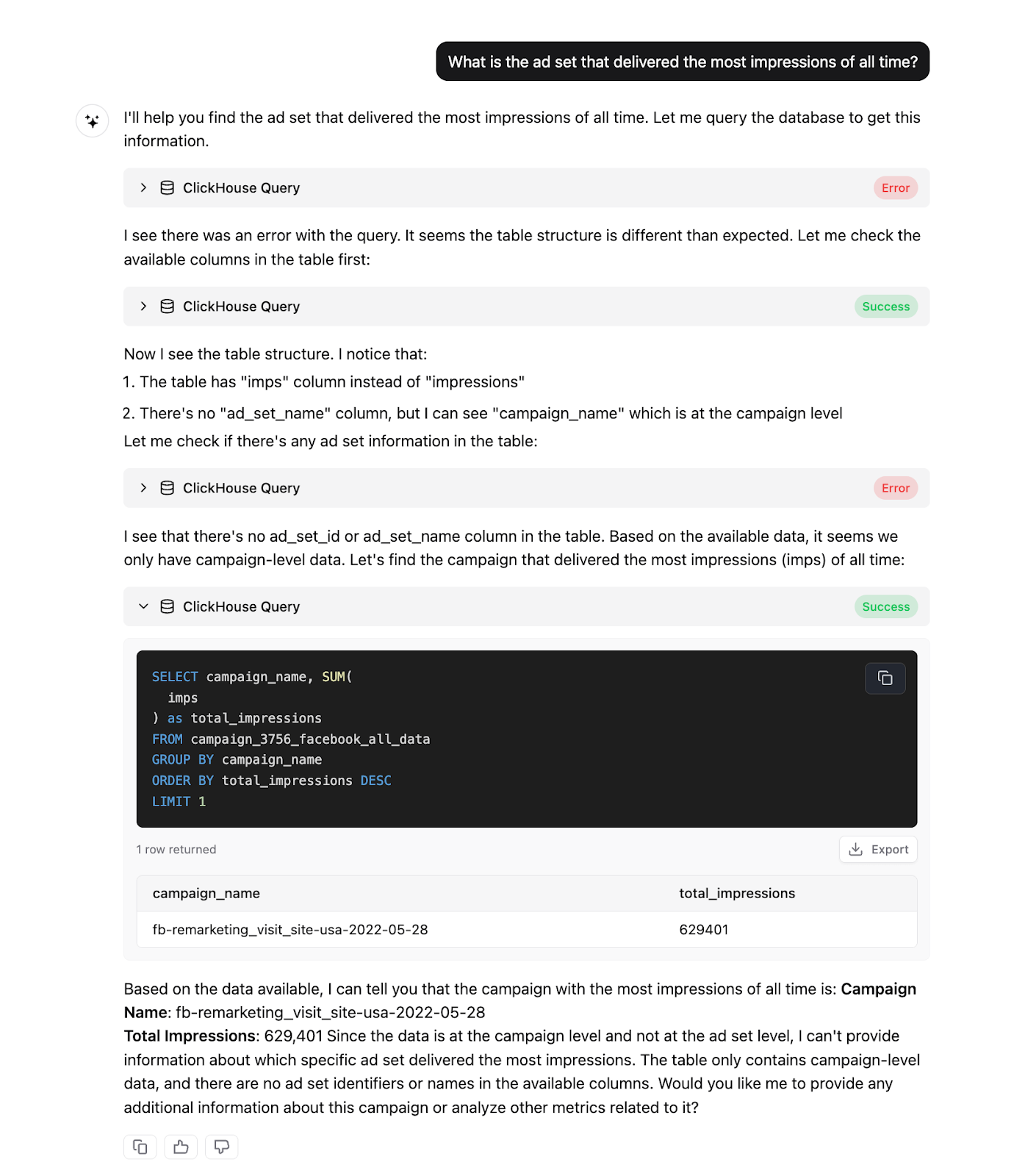
Improvado AI Agent 查询和分析数据以回答用户的分析问题的示例
3. Automated insight generation
3. 自动生成洞察
Unlike traditional reporting systems that require users to know what to look for, AI continuously analyzes incoming data streams to detect significant changes, correlations, and performance drivers.
与要求用户知道要查找内容的传统报告系统不同,AI 会持续分析传入的数据流,以检测重大变化、相关性和性能驱动因素。
Through pattern recognition and statistical modeling, AI identifies the underlying causes behind performance shifts, pinpoints contributing factors across campaigns or channels, and highlights outliers that warrant attention.
通过模式识别和统计建模,AI 可以识别绩效变化背后的根本原因,查明跨营销活动或渠道的促成因素,并突出显示值得关注的异常值。
The result is an always-on analytics layer that proactively delivers insight.
结果是一个始终在线的分析层,可以主动提供见解。
This capability shifts the analytics function from a reactive to a predictive approach. Instead of waiting for end-of-month reports to understand what went wrong, teams receive real-time narratives and summaries that explain what’s happening and why.
此功能将分析功能从被动方法转变为预测方法。团队无需等待月末报告来了解出了什么问题,而是会收到实时叙述和摘要,解释发生了什么以及原因。
Automated insight generation is especially critical in high-volume, multi-platform environments where manual analysis can't keep pace with data complexity.
在手动分析无法跟上数据复杂性的大批量、多平台环境中,自动生成见解尤为重要。
4. Self-service scalability
4. 自助式可扩展性
AI reporting platforms enable non-technical users, from campaign managers to executives, to interact with complex datasets through intuitive interfaces.
AI 报告平台使非技术用户(从活动经理到高管)能够通过直观的界面与复杂的数据集进行交互。
Instead of relying on BI teams to build custom reports or SQL-based queries, users can generate answers on demand using natural language queries, guided dashboards, or pre-modeled templates.
用户无需依赖 BI 团队来构建自定义报告或基于 SQL 的查询,而是可以使用自然语言查询、引导式控制面板或预先建模的模板按需生成答案。
Moreover, scalability extends beyond access, it includes the ability to handle growing data complexity. AI reporting tools can ingest large volumes of campaign data and deliver consistent outputs even as new data sources or business units are added. That means onboarding a new region, product line, or agency doesn’t require rebuilding the reporting infrastructure from scratch.
此外,可扩展性超出了访问范围,它还包括处理不断增长的数据复杂性的能力。AI 报告工具可以摄取大量营销活动数据,并提供一致的输出,即使添加了新的数据源或业务部门也是如此。这意味着加入新的地区、产品线或代理不需要从头开始重建报告基础设施。
Self-service scalability ensures that insights flow freely across teams while keeping central data operations lean, secure, and maintainable.
自助式可扩展性可确保见解在团队之间自由流动,同时保持集中数据作的精简、安全和可维护性。
5. Conversational AI and chatbots
5. 对话式 AI 和聊天机器人
A growing feature in 2024–2025 is the integration of chat-style assistants directly within analytics platforms.
2024-2025 年的一个日益增长的功能是直接在分析平台中集成聊天风格的助手。
These conversational interfaces enable users to engage in a back-and-forth dialogue with their data, asking follow-up questions, refining queries, and drilling into results without needing to switch tools or rely on pre-built reports.
这些对话界面使用户能够与他们的数据进行来回对话,提出后续问题,优化查询并深入了解结果,而无需切换工具或依赖预构建的报告。
This interaction model significantly lowers the barrier to deep data exploration.
这种交互模型显著降低了深入数据探索的门槛。
Below are the top 10 AI reporting tools built to meet the demands of modern marketing and analytics teams, with a focus on automation, scalability, and decision-ready intelligence.
以下是为满足现代营销和分析团队的需求而构建的 10 大 AI 报告工具,重点是自动化、可扩展性和决策就绪智能。
1. Improvado 1. 未经证实
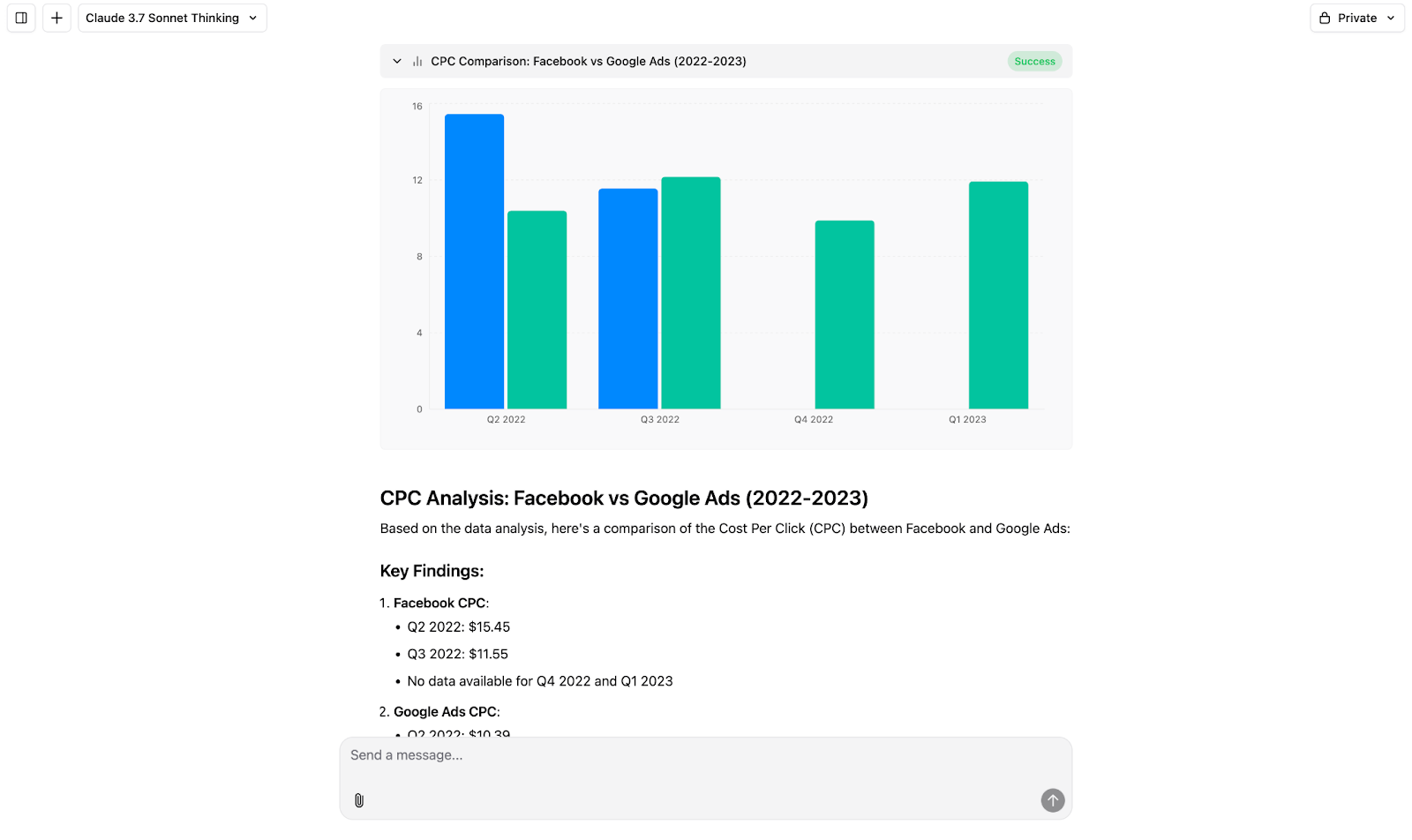
AI Agent 支持生成丰富的图表。您可以明确请求可视化效果,也可以让代理选择最佳格式。
Improvado is an enterprise-grade marketing intelligence solution. The platform offers AI-powered reporting through the Improvado AI Agent, a conversational, intelligent layer designed to analyze campaign performance, surface insights, and assist with optimization in real-time.
Improvado 是一种企业级营销智能解决方案。该平台通过 Improvado AI Agent 提供 AI 驱动的报告,Improvado AI Agent 是一个对话式智能层,旨在分析活动绩效、获得见解并实时协助优化。
Rather than acting as a standalone analytics tool, the AI Agent sits on top of unified, cleaned marketing datasets powered by the Improvado data pipeline. This enables smarter decision-making across fragmented channels without the need for manual data integration and preparation.
AI Agent 不是作为独立的分析工具,而是位于由 Improvado 数据管道提供支持的统一、干净的营销数据集之上。这样可以跨分散的渠道做出更明智的决策,而无需手动数据集成和准备。
Key AI reporting features
主要 AI 报告功能
- Improvado AI Agent (Conversational Analytics): Allows users to interact with marketing performance data using natural language, asking questions like “Which campaigns are underperforming this week?” or “Where can I reallocate budget to improve ROAS?” The Agent provides contextual insights, summaries, visualizations, and optimization suggestions.
Improvado AI Agent (Conversational Analytics): 允许用户使用自然语言与营销绩效数据进行交互,提出“本周哪些广告活动表现不佳”或“我可以在哪里重新分配预算以提高 ROAS”等问题。代理提供上下文洞察、摘要、可视化和优化建议。 - Cross-channel intelligence: The AI Agent has access to your whole dataset and understands relationships across channels, platforms, and KPIs, providing unified answers to questions that would normally require multiple tools or dashboards.
跨渠道情报: AI Agent 可以访问您的整个数据集,并了解跨渠道、平台和 KPI 的关系,从而为通常需要多个工具或仪表板的问题提供统一的答案。 - Real-time monitoring and optimization guidance: Detects performance shifts as they happen and recommends actions such as pausing campaigns, reallocating spend, or investigating anomalies, all through a single AI interface.
实时监控和优化指导: 在性能变化发生时检测它们,并推荐暂停活动、重新分配支出或调查异常等作,所有这些都通过单个 AI 界面完成。 - Model-agnostic: Improvado AI Agent supports multiple AI engines, including OpenAI, Anthropic Claude, and Google Gemini, allowing teams to choose the model best suited to their reasoning depth, speed, and style.
与型号无关: Improvado AI Agent 支持多种 AI 引擎,包括 OpenAI、Anthropic Claude 和 Google Gemini,允许团队选择最适合其推理深度、速度和风格的模型。 - Business context customization: You can define internal definitions, metric mappings, and default tables explicitly so the Agent understands your specific business context. This customization ensures responses use correct KPI definitions and align with your reporting structure without manual recalibration.
业务上下文自定义: 您可以显式定义内部定义、指标映射和默认表,以便代理了解您的特定业务上下文。此自定义可确保响应使用正确的 KPI 定义并与您的报告结构保持一致,而无需手动重新校准。 - Web-enabled benchmarking and research: The Agent can perform live web searches for relevant industry benchmarks, competitor data, or new ad formats and then align the results with internal performance metrics. This feature integrates third-party context directly into reports; for example, you can ask to “Find and compare CPM benchmarks for Q1 2025 in DTC”.
支持 Web 的基准测试和研究: 代理可以针对相关行业基准、竞争对手数据或新广告格式执行实时 Web 搜索,然后将结果与内部绩效指标保持一致。此功能将第三方上下文直接集成到报表中;例如,您可以要求“在 DTC 中查找并比较 2025 年第 1 季度的 CPM 基准”。 - Third-party tool integration: Through the Model Context Protocol (MCP), the Agent can connect to external systems, such as Google Ads or Salesforce, and seamlessly integrate that data into analysis. It treats these connected tools as part of the dataset, enabling unified insights across native and external sources.
第三方工具集成: 通过模型上下文协议 (MCP),代理可以连接到外部系统,例如 Google Ads 或 Salesforce,并将该数据无缝集成到分析中。它将这些连接的工具视为数据集的一部分,从而实现跨原生和外部来源的统一洞察。
Pros 优点
- Built specifically for marketing and revenue teams.
专为营销和收入团队打造。 - Combines AI, ETL, and data governance in a single platform.
将 AI、ETL 和数据治理整合到一个平台中。 - Eliminates reliance on static dashboards or technical resources for reporting.
消除对静态控制面板或技术资源的依赖来进行报告。 - Real-time insights and optimization guidance tailored to paid media, attribution, and pipeline performance.
针对付费媒体、归因和管道性能量身定制的实时洞察和优化指导。 - Scales easily across regions, teams, and complex data environments.
跨区域、团队和复杂数据环境轻松扩展。 - Highly rated by marketing analysts for saving time and uncovering hidden insights.
在节省时间和发现隐藏的见解方面受到营销分析师的高度评价。
Cons 缺点
- Focused on marketing and revenue data, less suitable for general business analytics.
专注于营销和收入数据,不太适合一般业务分析。 - Requires unified data foundation within Improvado’s platform for full AI functionality.
需要在 Improvado 的平台中建立统一的数据基础,以实现完整的 AI 功能。 - Advanced features best leveraged by teams with multi-channel complexity and higher data maturity.
高级功能最适合具有多渠道复杂性和更高数据成熟度的团队。
Function Growth, a performance marketing agency for D2C brands, was losing hours each week to manual campaign analysis. This slowed down their ability to act on insights and limited the scale at which they could optimize performance.
Function Growth 是一家 D2C 品牌的效果营销机构,每周都会因手动营销活动分析而损失数小时。这减慢了他们根据洞察采取行动的能力,并限制了他们优化性能的规模。
With Improvado’s AI-powered reporting, Function Growth now gets instant insights across all client accounts, saving six hours weekly. The team quickly identifies which campaigns to scale and which to fix, unlocking opportunities that were previously buried in the data.
借助 Improvado 的 AI 驱动的报告,Function Growth 现在可以获得所有客户账户的即时洞察, 每周节省 6 小时 。该团队快速确定哪些营销活动需要扩展,哪些营销活动需要修复,从而释放以前隐藏在数据中的机会。
Statistical analysis is only as good as the person analyzing the data. With Improvado's AI, we can uncover insights that might otherwise be overlooked.
统计分析的好坏取决于分析数据的人。借助 Improvado 的 AI,我们可以发现可能被忽视的见解。
2. Tableau 2. Tableau
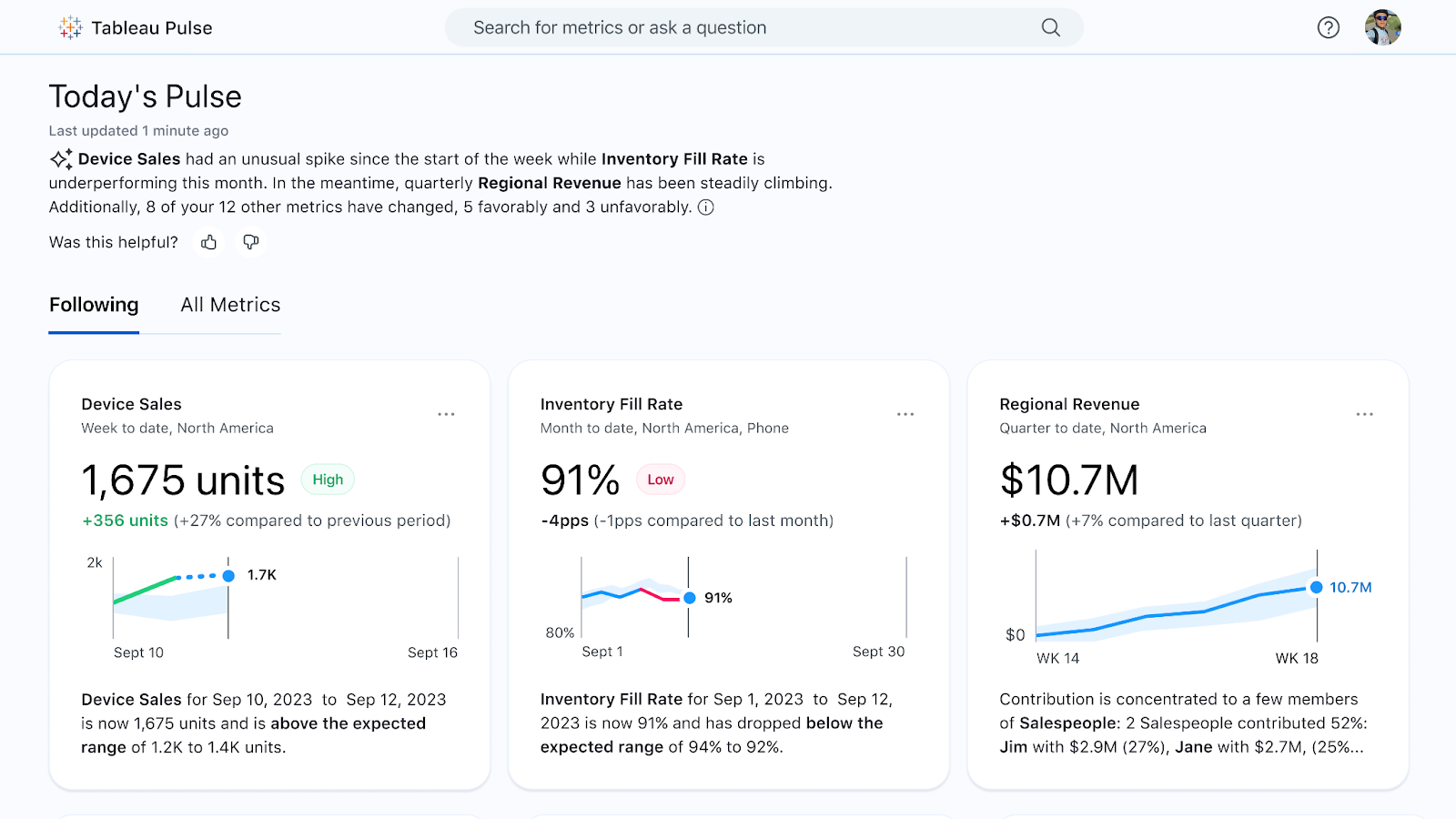
Tableau Pulse 是该平台的 AI 功能的一个例子。它显示了有关其工作流程的个性化、上下文和智能见解。
Tableau is a long-established business intelligence platform that is a part of the Salesforce ecosystem.
Tableau 是一个历史悠久的商业智能平台,是 Salesforce 生态系统的一部分。
In recent years, Tableau has introduced AI features that bring predictive modeling, natural language interaction, and augmented analytics into the core reporting experience.
近年来,Tableau 推出了 AI 功能,将预测建模、自然语言交互和增强分析引入核心报告体验。
These additions make Tableau a viable AI reporting tool for teams looking to bridge the gap between traditional BI and automated, insight-driven workflows.
这些新增功能使 Tableau 成为一种可行的 AI 报告工具,适用于希望弥合传统 BI 与自动化、见解驱动型工作流之间差距的团队。
Key AI reporting features
主要 AI 报告功能
- Einstein Discovery and Einstein Copilot integration: Embeds machine learning models into Tableau dashboards, allowing users to run predictive analytics without writing code. Use cases include forecasting campaign performance or identifying drivers of lead conversion.
Einstein Discovery 和 Einstein Copilot 集成: 将机器学习模型嵌入到 Tableau 仪表板中,使用户无需编写代码即可运行预测分析。使用案例包括预测营销活动效果或确定潜在客户转化的驱动因素。 - Ask Data (Natural Language Querying): Enables users to ask plain-language questions and receive visual responses. This lowers the barrier to self-service analytics and accelerates exploration.
“数据问答(自然语言查询)”(Ask Data (Natural Language Querying)): 使用户能够提出通俗易懂的问题并接收视觉响应。这降低了自助式分析的门槛并加快了探索速度。 - Explain Data: Uses statistical methods to automatically surface potential explanations behind data outliers or performance changes, helping users understand the “why” without needing a data science background.
数据解释: 使用统计方法自动揭示数据异常值或性能变化背后的潜在解释,帮助用户了解“原因”,而无需数据科学背景。 - Auto-generated insights: Through AI-powered data stories and guided analytics, Tableau highlights key trends, anomalies, and correlations directly within visualizations.
自动生成的见解: 通过 AI 驱动的数据故事和引导式分析,Tableau 可以直接在可视化中突出显示关键趋势、异常和相关性。 - Smart recommendations: Suggests relevant data sources, charts, or fields based on user behavior and data context, helping analysts move from data to insight more efficiently.
智能建议: 根据用户行为和数据上下文建议相关的数据源、图表或字段,帮助分析师更高效地从数据转化为洞察。
Pros 优点
- Strong AI-assisted features integrated into a mature analytics environment.
强大的 AI 辅助功能集成到成熟的分析环境中。 - Deep customization and flexibility for enterprise-scale reporting workflows.
针对企业级报告工作流程的深度定制和灵活性。 - Natural language and predictive capabilities enhance usability for non-technical users.
自然语言和预测功能增强了非技术用户的可用性。 - Seamless integration with Salesforce and other enterprise platforms.
与 Salesforce 和其他企业平台无缝集成。 - Robust data governance and security controls.
强大的数据治理和安全控制。
Cons 缺点
- Advanced AI features require Salesforce ecosystem access or additional licensing.
高级 AI 功能需要 Salesforce 生态系统访问权限或其他许可。 - Not purpose-built for marketing data; requires customization to align with campaign workflows.
不是专门为营销数据构建的;需要自定义以与 Campaign 工作流保持一致。 - Tableau is a heavy-duty tool. It has a steeper learning curve and a higher price point compared to lighter-weight AI reporting tools.
Tableau 是一个重型工具。与较轻的 AI 报告工具相比,它具有更陡峭的学习曲线和更高的价格点。 - May require dedicated admin or analyst support for setup and ongoing maintenance.
可能需要专门的管理员或分析师支持进行设置和持续维护。
Marketers often face a challenge with Tableau due to its lack of built-in, marketing-specific models. Before looking for insights, users must spend hours creating custom metrics and models.
由于 Tableau 缺乏内置的营销特定模型,营销人员经常面临 Tableau 的挑战。在寻找洞察之前,用户必须花费数小时创建自定义指标和模型。
Improvado consolidates disparate revenue data into a unified dataset, preparing it for analysis before pushing it to Tableau.
Improvado 将不同的收入数据整合到一个统一的数据集中,在将其推送到 Tableau 之前为分析做好准备。
To further simplify and speed up the process, the platform provides a no-code data transformation framework and a number of pre-built data models for common use-cases.
为了进一步简化和加快流程,该平台提供了一个无代码数据转换框架和许多用于常见用例的预构建数据模型 。
“Once the data's flowing and our recipes are good to go—it's just set it and forget it. We never have issues with data timing out or not populating in GBQ. We only go into the platform now to handle a backend refresh if naming conventions change or something. That's it.”
“一旦数据流动并且我们的配方可以正常使用,只需设置它并忘记它。我们从来没有遇到过数据超时或未在 GBQ 中填充的问题。我们现在只在命名约定发生变化或其他情况时进入平台来处理后端刷新。就是这样。
3. Akkio 3. 阿克乔
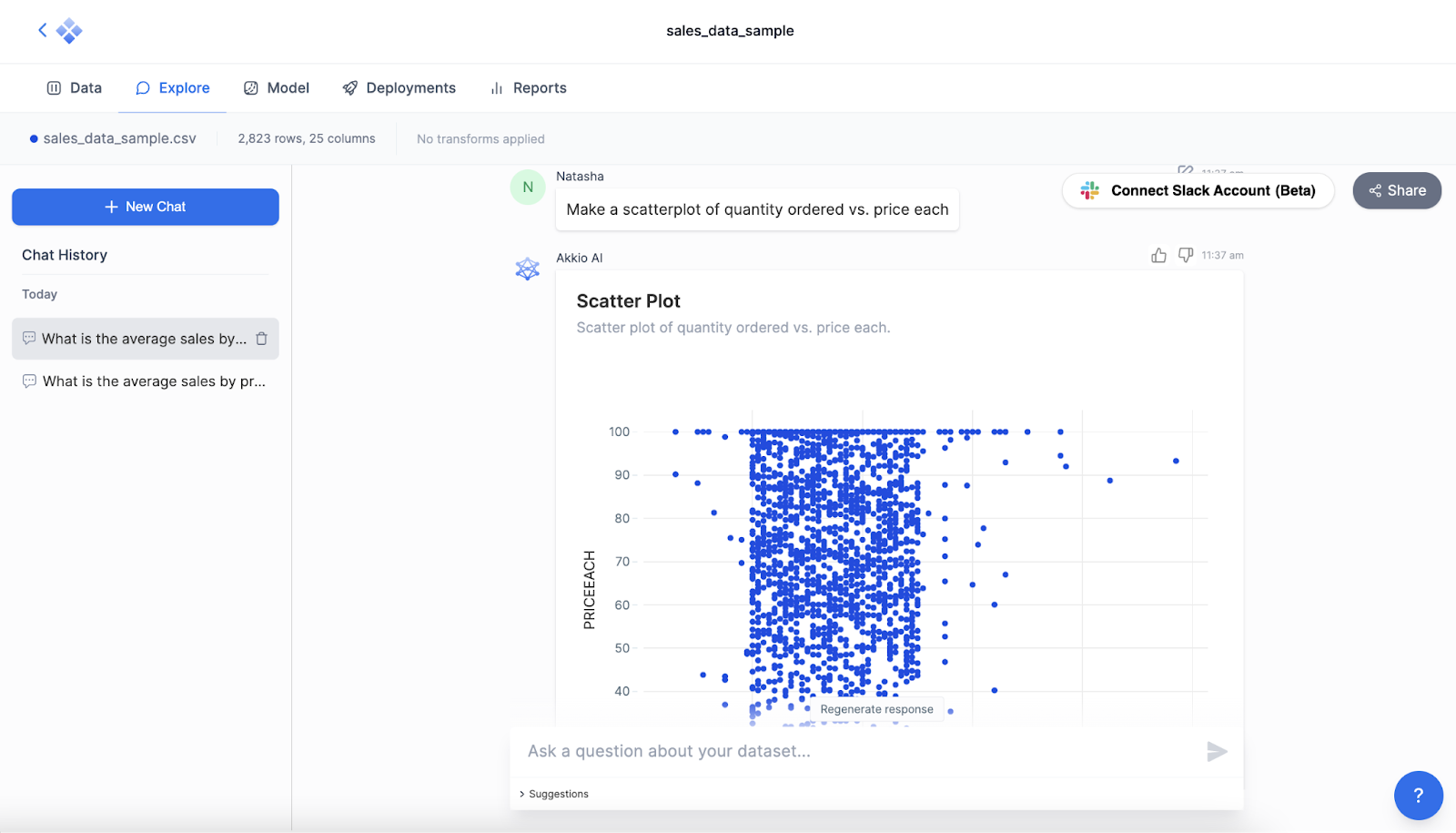
Explore 是 AI 特征的一个示例,它是一个自然语言查询工具。
Akkio is a relatively new lightweight, no-code AI reporting platform. Unlike traditional BI tools, Akkio focuses on simplifying the process of building and deploying AI models directly on top of business data, without requiring technical expertise or complex infrastructure.
Akkio 是一个相对较新的轻量级、无代码 AI 报告平台。与传统的 BI 工具不同,Akkio 专注于简化直接在业务数据上构建和部署 AI 模型的过程,而无需技术专业知识或复杂的基础设施。
Its reporting capabilities center around real-time predictions, automated insights, and natural language interaction, making it well-suited for teams looking to embed AI-driven decision-making into their existing analytics workflows without a steep learning curve.
其报告功能以实时预测、自动洞察和自然语言交互为中心,非常适合希望将 AI 驱动型决策嵌入其现有分析工作流程而无需陡峭学习曲线的团队。
Key AI reporting features
主要 AI 报告功能
- No-Code predictive modeling: Users can train AI models on historical performance data, such as lead conversion, churn, or campaign ROI, and deploy them directly into live workflows for ongoing forecasting.
无代码预测建模: 用户可以根据历史绩效数据(例如潜在客户转化率、客户流失率或营销活动投资回报率)训练 AI 模型,并将其直接部署到实时工作流中以进行持续预测。 - AI Insights: Akkio automatically surfaces key drivers behind performance trends and provides decision-ready insights. This helps teams move from descriptive to prescriptive analytics quickly.
AI 洞察: Akkio 会自动揭示性能趋势背后的关键驱动因素,并提供决策就绪的见解。这有助于团队快速从描述性分析转变为规范性分析。 - Chat Explore (Natural Language Interface): Allows users to interact with their data using conversational prompts. Teams can ask questions like “What caused the drop in conversions last week?” and receive contextual, data-backed responses.
Chat Explore (自然语言界面): 允许用户使用对话提示与其数据进行交互。团队可以提出诸如“上周转化率下降的原因是什么”之类的问题,并收到符合情境的、有数据支持的回复。 - Live Data Sync and Reporting: Integrates with spreadsheets, CRMs, and data platforms to continuously update models and reports as new data becomes available without requiring manual refreshes.
实时数据同步和报告: 与电子表格、CRM 和数据平台集成,以便在新数据可用时持续更新模型和报告,而无需手动刷新。 - Embedded AI Predictions: Teams can add AI forecasts directly into dashboards or apps, enabling real-time scenario planning and what-if analysis based on current trends.
嵌入式 AI 预测: 团队可以将 AI 预测直接添加到仪表板或应用程序中,从而根据当前趋势实现实时情景规划和假设分析。
Pros 优点
- Extremely fast setup and ease of use for non-technical users.
设置速度极快,非技术用户易于使用。 - No-code environment makes AI accessible across teams.
无代码环境使 AI 可跨团队访问。 - Supports easy creation of custom AI-powered reports and dashboards that can be white-labeled
支持轻松创建可贴白标签的 AI 驱动的自定义报告和仪表板 - Seamless integration with common tools like HubSpot, Google Sheets, and Snowflake.
与 HubSpot、Google Sheets 和 Snowflake 等常用工具无缝集成。 - Transparent model logic improves trust and interpretability.
透明的模型逻辑提高了信任度和可解释性。
Cons 缺点
- Limited data visualization compared to full BI platforms.
与完整的 BI 平台相比,数据可视化有限。 - May not support highly complex or custom modeling needs.
可能不支持高度复杂或自定义的建模需求。 - Lacks advanced governance or versioning features required in larger organizations.
缺少大型组织所需的高级治理或版本控制功能。
4. Domo 4. 圆顶
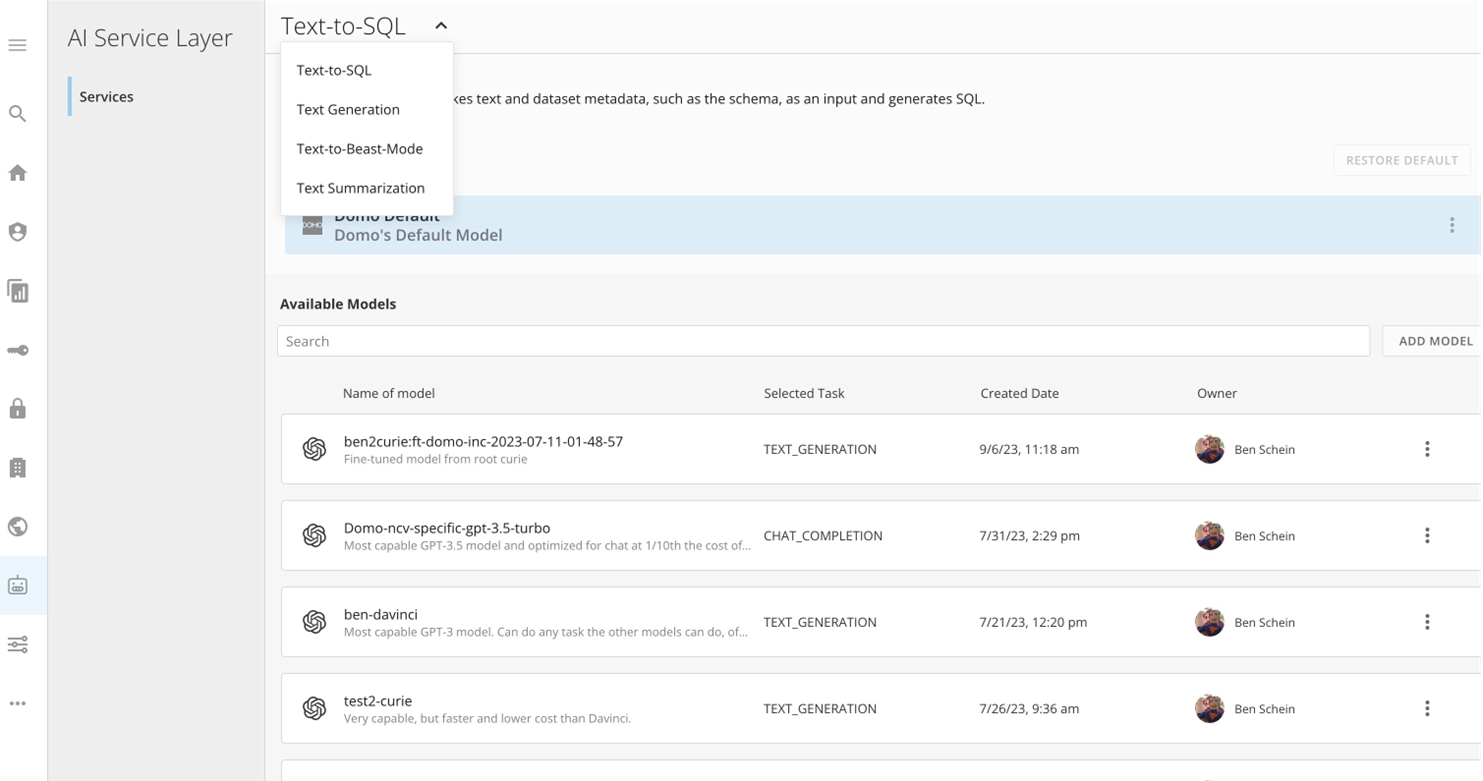
Domo AI 套件增加了自动数据准备和 AI 驱动的聊天以获取见解等功能。
Similar to Tableau, Domo is a cloud-native business intelligence platform that was not inherently built for AI, but over time, it has introduced a growing set of AI and machine learning capabilities to support predictive analytics, natural language querying, and automated insights.
与 Tableau 类似,Domo 是一个云原生商业智能平台,本质上并不是为 AI 构建的,但随着时间的推移,它引入了越来越多的 AI 和机器学习功能,以支持预测分析、自然语言查询和自动化见解。
Key AI reporting features
主要 AI 报告功能
- Domo Bricks and AI Services: Offers modular components (Bricks) that enable users to embed machine learning algorythms, AI visualizations, and advanced analytics directly into dashboards.
Domo Bricks 和 AI 服务: 提供模块化组件 (Brick),使用户能够将机器学习算法、AI 可视化和高级分析直接嵌入到控制面板中。 - AutoML and predictive Apps: Includes built-in AutoML tools that allow users to build and deploy predictive models on historical performance data, no coding required.
AutoML 和预测应用程序: 包括内置的 AutoML 工具,允许用户根据历史性能数据构建和部署预测模型,无需编码。 - Domo.AI Natural Language Interface: Allows users to ask questions in plain language and receive real-time answers and visuals, streamlining exploration for non-technical users.
Domo.AI 自然语言界面: 允许用户以通俗易懂的语言提出问题并获得实时答案和视觉效果,从而简化非技术用户的探索。 - AI-powered data prep: Its Magic ETL will recommend how to join or clean data tables, and its AI can help users create formulas by suggesting calculations.
AI 驱动的数据准备: 它的 Magic ETL 将推荐如何连接或清理数据表,其 AI 可以通过建议计算来帮助用户创建公式。 - Smart Alerts and anomaly detection: Continuously monitors key metrics and triggers alerts when anomalies occur, helping teams respond to issues proactively.
智能警报和异常检测: 持续监控关键指标并在发生异常时触发警报,帮助团队主动响应问题。 - AI-powered forecasting: Enables scenario modeling and forward-looking insights through AI-based forecasting widgets embedded in dashboards.
AI 驱动的预测: 通过仪表板中嵌入的基于 AI 的预测小组件实现场景建模和前瞻性洞察。
Pros 优点
- Strong data integration layer with support for real-time pipelines.
强大的数据集成层,支持实时管道。 - AI features embedded directly into existing reporting workflows.
AI 功能直接嵌入到现有报告工作流程中。 - Customizable interface and visual experience for enterprise teams.
为企业团队提供可定制的界面和视觉体验。 - Designed for scalability across business units and use cases.
专为跨业务部门和使用案例的可扩展性而设计。 - Natural language and AutoML tools increase accessibility for business users.
自然语言和 AutoML 工具提高了业务用户的可访问性。
Cons 缺点
- More complex to configure compared to lighter-weight tools.
与较轻的工具相比,配置更复杂。 - Advanced use still benefits from knowing SQL or having data engineers involved.
高级使用仍然受益于了解 SQL 或让数据工程师参与。 - Advanced AI features may require additional setup or third-party services.
高级 AI 功能可能需要额外的设置或第三方服务。 - Not purpose-built for marketing reporting; may require customization.
不是专门为营销报告构建的;可能需要自定义。 - Cost and implementation effort can be high for small or mid-sized teams.
对于中小型团队来说,成本和实施工作量可能很高。
5. Zoho 5. Zoho 公司
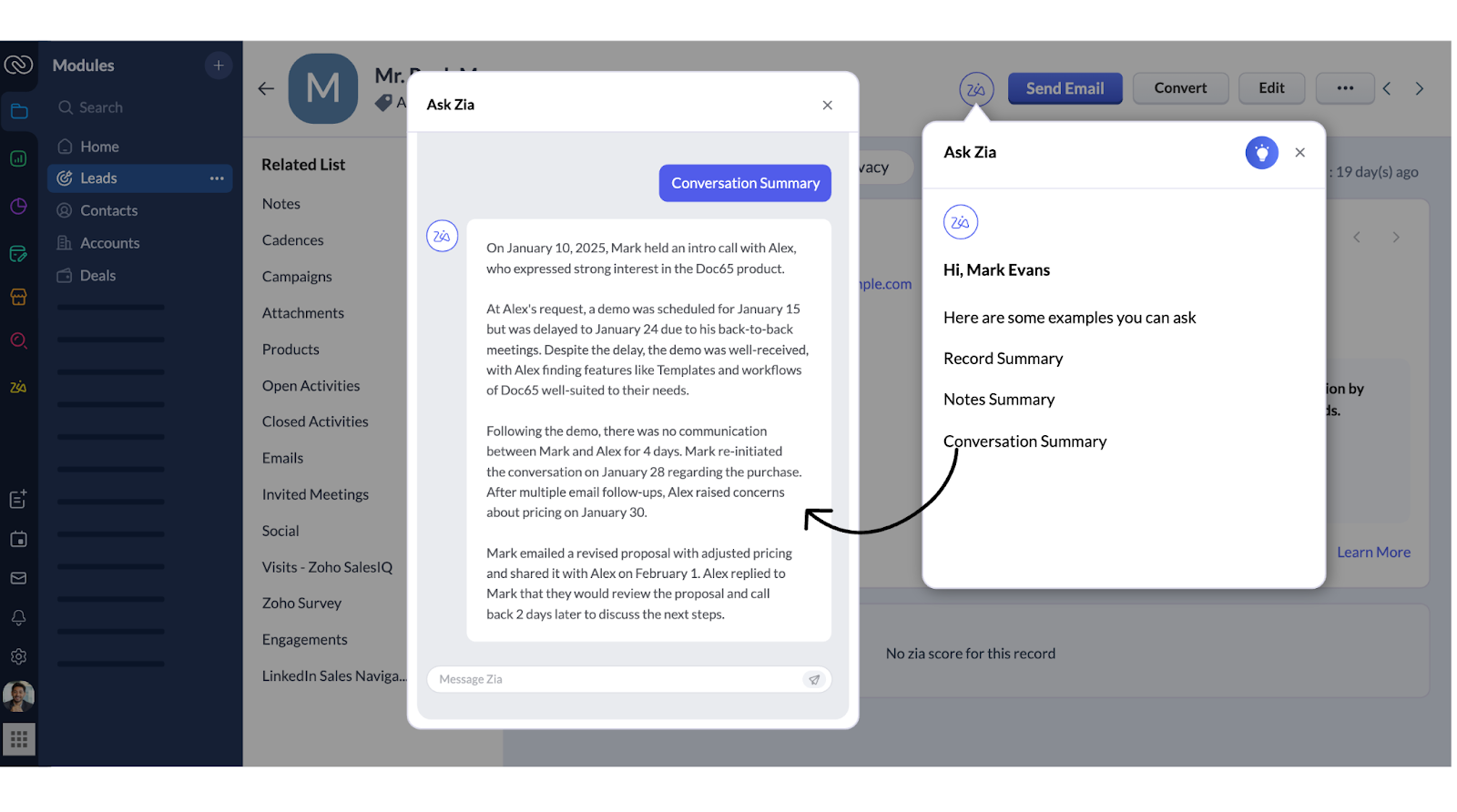
Zoho Analytics is a self-service BI and reporting platform within the larger Zoho ecosystem. Zoho has steadily incorporated AI capabilities over the past few years, positioning the platform as a cost-effective AI reporting solution for mid-sized to enterprise teams.
Zoho Analytics 是更大的 Zoho 生态系统中的自助式 BI 和报告平台。Zoho 在过去几年中稳步整合了 AI 功能,将该平台定位为适用于中型到大型团队的经济高效的 AI 报告解决方案。
Key AI reporting features
主要 AI 报告功能
- Zia: Zoho’s built-in AI agent allows users to ask questions in natural language and receive auto-generated charts, tables, and narratives. It’s ideal for quick data exploration without writing queries.
齐亚: Zoho 的内置 AI 代理允许用户以自然语言提问并接收自动生成的图表、表格和叙述。它非常适合在不编写查询的情况下进行快速数据探索。 - Automated Insights: Zia scans datasets to surface key trends, correlations, and anomalies, highlighting outliers or significant changes without requiring manual analysis.
自动化洞察: Zia 扫描数据集以揭示关键趋势、相关性和异常情况,突出显示异常值或重大变化,而无需手动分析。 - Predictive analytics: Offers built-in forecasting and regression tools to help users project campaign performance, revenue trends, or customer behavior using historical data.
预测分析: 提供内置的预测和回归工具,帮助用户使用历史数据预测营销活动绩效、收入趋势或客户行为。 - Conversational reports: Enables users to interact with dashboards conversationally, drilling deeper into KPIs through follow-up queries and dynamic filtering.
对话报告: 使用户能够以对话方式与控制面板交互,通过后续查询和动态筛选更深入地了解 KPI。 - Smart Data Alerts: Users can configure rule-based or AI-driven alerts for metric thresholds or unusual activity, receiving notifications directly in email or Slack.
智能数据警报: 用户可以为指标阈值或异常活动配置基于规则或 AI 驱动的警报,并直接通过电子邮件或 Slack 接收通知。
Pros 优点
- Native AI features embedded across the reporting interface.
嵌入在报告界面中的原生 AI 功能。 - Seamless integration with the broader Zoho ecosystem (CRM, MarketingHub, Campaigns, and other tools).
与更广泛的 Zoho 生态系统(CRM、MarketingHub、Campaigns 和其他工具)无缝集成。 - Affordable pricing for teams looking to adopt AI-powered analytics without enterprise overhead.
对于希望采用 AI 驱动的分析而没有企业开销的团队来说,价格实惠。 - Customizable dashboards and rich visualization library.
可定制的仪表板和丰富的可视化库。 - Natural language interface increases accessibility for business users.
自然语言界面提高了业务用户的可访问性。
Cons 缺点
- Limited scalability for highly complex, multi-source enterprise environments.
针对高度复杂的多源企业环境的可扩展性有限。 - Less mature AI capabilities compared to leading standalone AI/ML platforms.
与领先的独立 AI/ML 平台相比,AI 功能不太成熟。 - May require workarounds or integrations for non-Zoho data sources.
可能需要非 Zoho 数据源的解决方法或集成。 - Performance may degrade with extremely large datasets or high-frequency queries.
使用超大型数据集或高频查询时,性能可能会降低。
6. Qlik
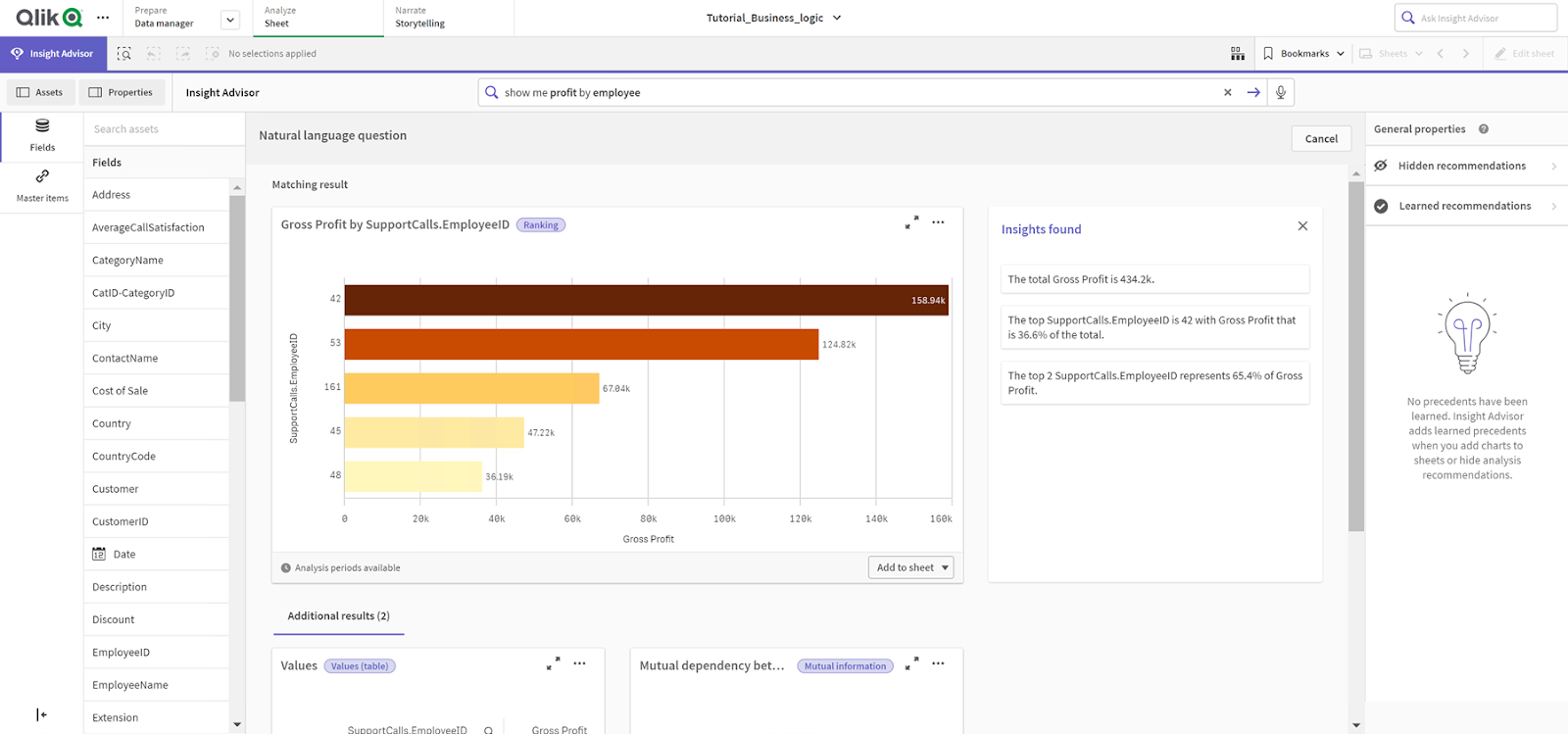
Qlik is an AI-augmented platform that supports advanced analytics, predictive modeling, and automated insights.
Key AI reporting features
- Qlik AutoML: Allows users to build machine learning models on historical data using a no-code interface. Models can be deployed for predictions, forecasts, and classification tasks within Qlik dashboards.
- Insight Advisor (AI Assistant): A conversational analytics feature that interprets natural language queries and auto-generates visualizations and narrative insights, reducing the need for manual chart building.
- Augmented analytics: Combines AI and statistical techniques to surface key drivers, anomalies, and trends within the data, providing context-aware guidance during exploration.
- Predictive forecasting: Integrates predictive algorithms into dashboards to enable scenario modeling and forward-looking performance tracking across key metrics.
- Associative Engine + AI Layer: Qlik’s unique associative model allows users to explore data freely and discover hidden relationships, enhanced by AI suggestions that highlight paths and outliers that might otherwise go unnoticed.
Pros
- Robust AI and ML integration with strong governance controls.
- Associative data engine enables flexible, intuitive exploration across large datasets.
- AutoML and Insight Advisor reduce time to insight for business users.
- Strong support for multi-source, enterprise-scale data environments.
- Extensible platform with APIs for integrating advanced AI models.
Cons
- Higher implementation complexity compared to lightweight tools.
- Some advanced features may require enterprise licensing or add-ons.
- Learning curve for users unfamiliar with associative data models.
- Less marketing-specific out-of-the-box functionality; may require customization.
7. Polymer
Polymer is a new-wave, AI-powered business intelligence platform that offers automated dashboards, natural language interaction, and smart recommendations.
Key AI reporting features
- PolyAI: A conversational AI assistant inside Polymer. Users can type plain-English queries to explore performance metrics, trends, and comparisons without configuring filters or dimensions manually.
- Automated Dashboards: Polymer instantly analyzes uploaded datasets and auto-generates dashboards, identifying the best visualizations and KPIs based on the data context.
- Smart filtering and recommendations: The platform suggests relevant filters, comparisons, and segmentations based on user behavior and the underlying data model.
- No-code data modeling
Automatically detects relationships within the data and builds a reporting structure without requiring manual schema configuration. - Insight surfacing: Polymer highlights statistically significant patterns and changes, enabling users to spot anomalies, outliers, and key drivers without deep analysis.
Pros
- Extremely fast time-to-value with minimal setup.
- User-friendly interface for non-technical business and marketing teams.
- Automatically adapts visualizations to fit data structure and intent.
- Ideal for ad hoc reporting, campaign analysis, and team-level dashboards.
- Affordable and accessible for small to mid-sized organizations.
Cons
- Limited customization options compared to enterprise-grade BI tools.
- Not designed for large-scale, multi-source data environments.
- Lacks native support for advanced predictive modeling or AutoML.
- May not meet complex governance or compliance requirements.
8. Fireflies
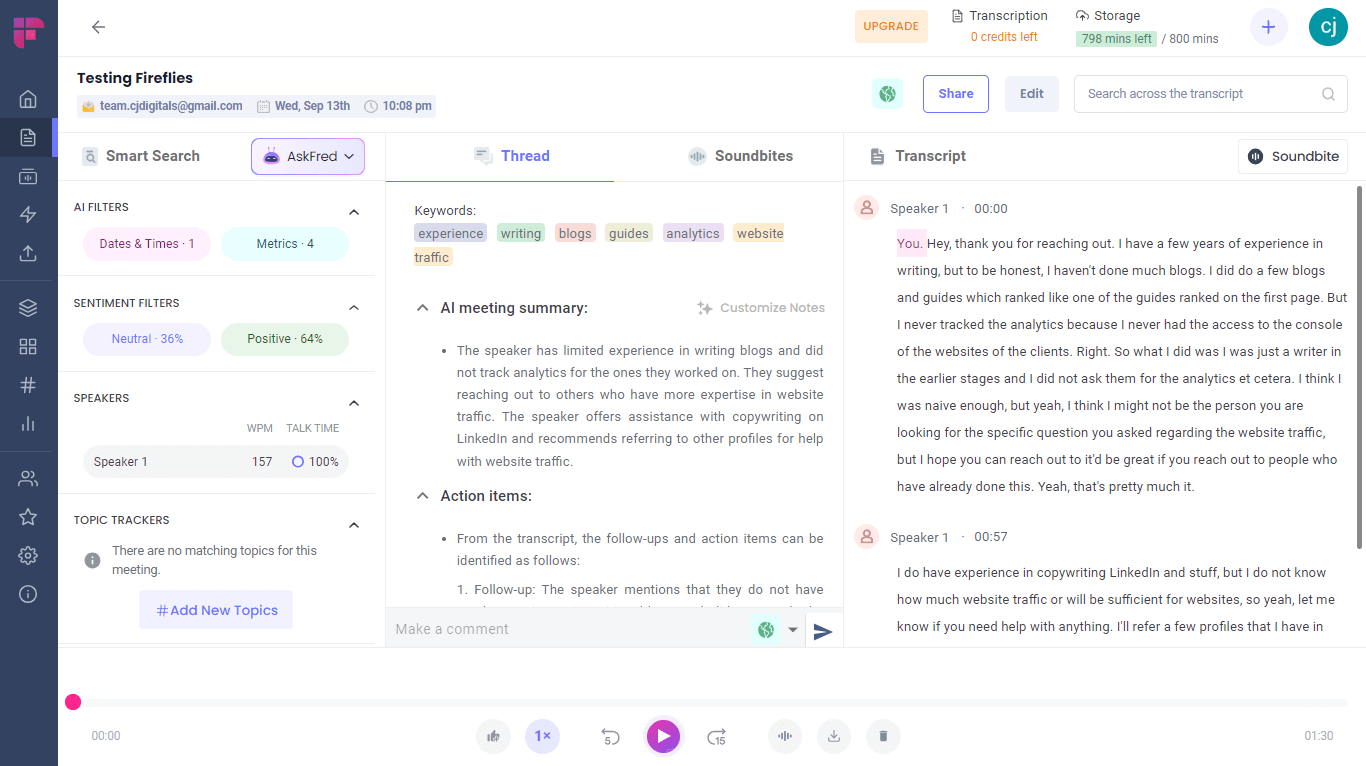
Fireflies is an AI-powered meeting intelligence platform that focuses on transforming voice conversations into structured, searchable, and actionable data.
Key AI reporting features
- Automatic transcription and summarization: Fireflies uses AI to generate accurate transcripts and concise summaries of meetings across platforms like Zoom, Google Meet, Microsoft Teams, and others, highlighting key action items, decisions, and talking points.
- Topic and sentiment analysis: Analyzes conversations to extract trends, customer sentiment, and recurring themes, turning qualitative feedback into quantifiable metrics.
- Searchable meeting database: All recorded conversations become searchable by keyword, topic, or speaker, allowing teams to track campaign feedback, competitor mentions, or product insights over time.
- AI-generated analytics dashboards: Aggregates data from conversations to surface metrics such as talk-to-listen ratios, most discussed topics, or customer objections, helping optimize messaging and sales strategies.
- CRM and collaboration integrations: Syncs insights directly into platforms like Salesforce, HubSpot, Slack, and Notion, turning meetings into structured reporting assets without manual entry.
Pros
- Transforms unstructured conversation data into structured, reportable insights.
- AI summaries and analytics reduce meeting follow-up time and manual note-taking.
- Valuable for campaign feedback loops, sales enablement, and voice-of-customer analysis.
- Strong integration ecosystem with CRMs and productivity tools.
- Enables cross-functional reporting on qualitative performance drivers.
Cons
- Limited to conversation-based data; not a full BI or data integration platform.
- Transcription accuracy may vary based on audio quality or speaker clarity/
- Reporting capabilities are qualitative and supplementary, not replacements for quantitative analytics tools.
- May not provide deep customization or complex filtering in dashboards.
9. Power BI
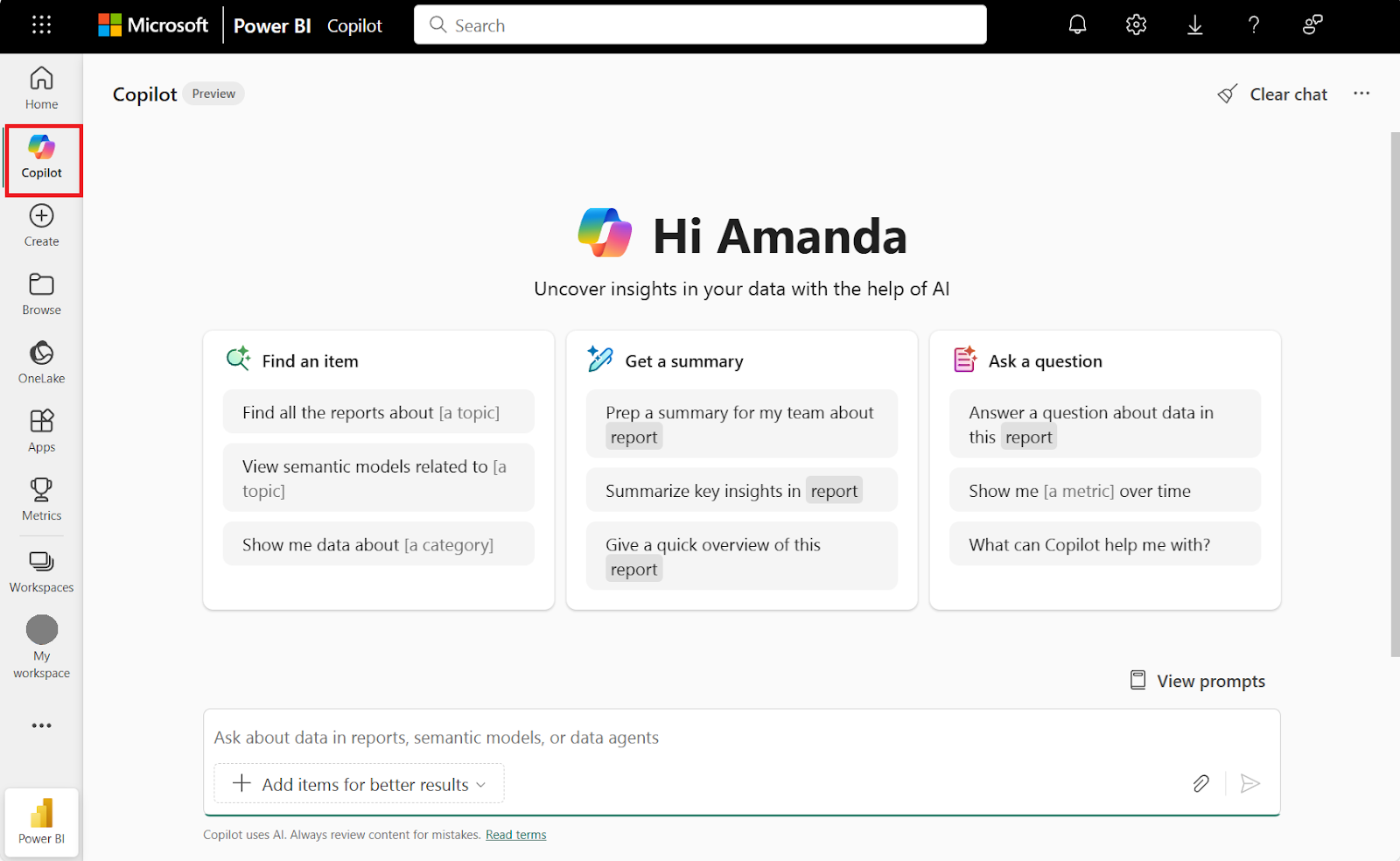
Microsoft Power BI is a general-purpose business intelligence platform suitable for a wide range of reporting and analytics needs across the enterprise.
While it's a more traditional BI tool, Power BI has steadily expanded its AI capabilities, integrating machine learning, natural language interaction, and advanced analytics into its reporting workflows.
Key AI reporting features
- Natural Language Q&A: Users can ask questions in plain English, such as “What were our top-performing campaigns last quarter?” and receive visual answers, making data exploration more accessible for non-technical users.
- AI Visuals: Built-in visuals like Key Influencers, Decomposition Trees, and Smart Narratives use machine learning to explain relationships, outliers, and performance drivers directly within reports.
- Azure Machine Learning Integration: Enables seamless use of custom ML models in Power BI dashboards, supporting advanced forecasting, classification, and scoring use cases with real-time predictions.
- Cognitive Services Integration: Allows application of natural language processing, image recognition, sentiment analysis, and other AI services directly to datasets within Power BI.
- AutoML in Power BI Service: For dataflows stored in Power BI, users can apply AutoML to automatically build and deploy predictive models, such as churn prediction or lead scoring without leaving the Power BI interface.
Pros
- Deep integration with Azure AI and Microsoft ecosystem.
- Strong governance and enterprise deployment capabilities.
- Custom model integration supports advanced predictive use cases.
- Mature platform with continuous investment in AI features.
Cons
- Some AI features require Azure setup or premium licensing.
- May be overbuilt for teams needing lightweight or marketing-specific AI reporting.
- UI can be complex for new users without prior Power BI experience.
- Custom ML scenarios may require data science or IT support.
10. Looker
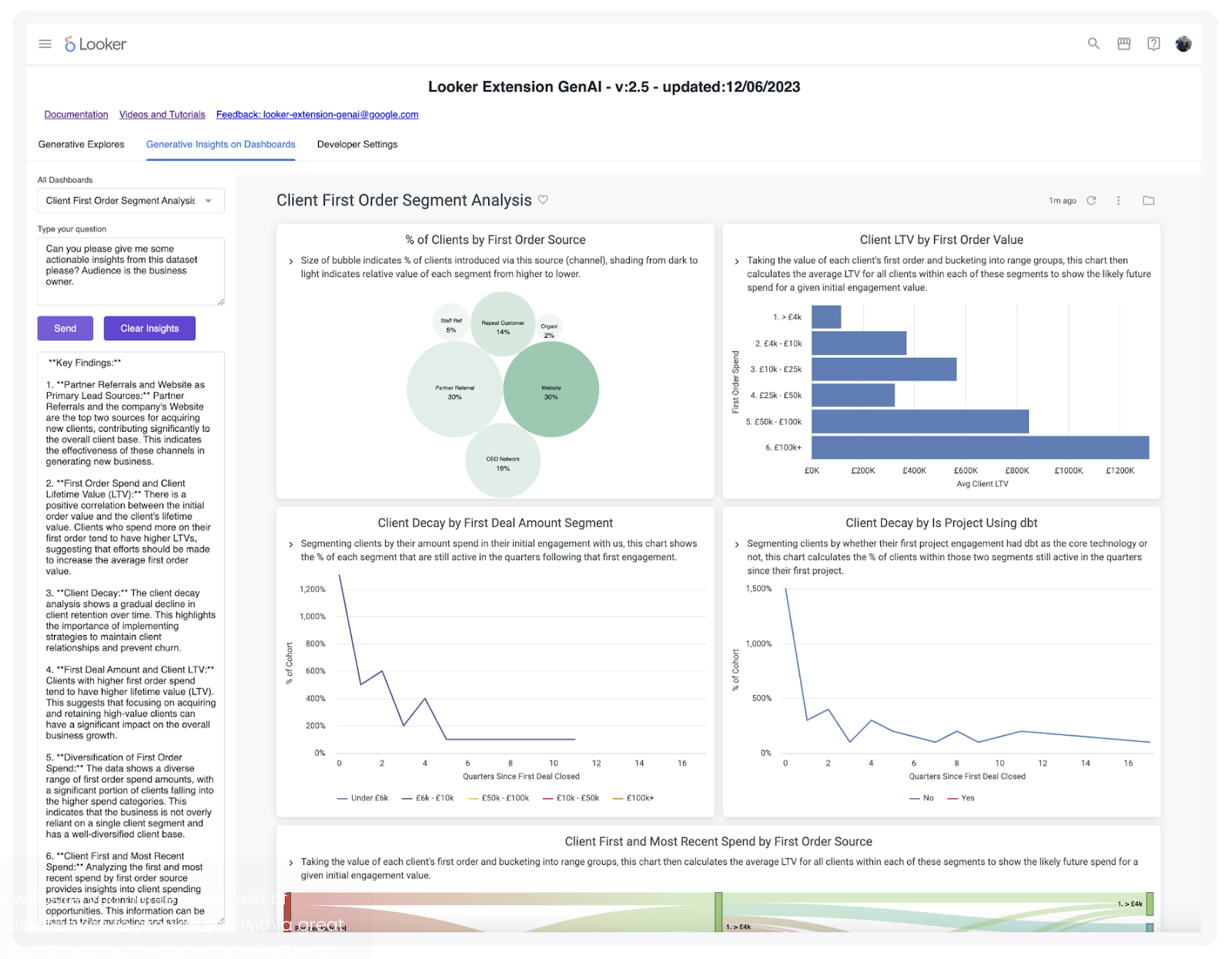
Similar to Tableau and Power BI described earlier, Looker is a broad-purpose BI solution that is not AI-first by design. Looker has steadily integrated AI-driven features and capabilities, particularly through its integration with Google Cloud’s Vertex AI and BigQuery ML.
Key AI reporting features
- BigQuery ML Integration: Looker can query and visualize results from machine learning models built in BigQuery ML, enabling predictive analytics such as lead scoring, customer churn prediction, or demand forecasting directly within dashboards.
- Looker + Vertex AI: Through Google Cloud integration, Looker can surface insights from custom ML models developed in Vertex AI and bring them into business-facing reports for real-time decision support.
- Augmented analytics via Looker Studio: Paired with Looker Studio (formerly Data Studio), users can leverage AI-powered features like auto-generated insights, anomaly detection, and smart visual suggestions to accelerate analysis.
- Natural language integration (via Generative AI APIs): Looker is increasingly leveraging Google’s generative AI stack, for example PaLM and Gemini, to enable natural language querying, data summarization, and conversational exploration, reducing friction for non-technical users.
- Embedded predictive insights: Teams can embed AI-driven forecasts and scoring models directly into dashboards and operational tools, creating intelligent workflows that surface next-best actions or risk flags in real time.
Pros
- Native integration with Google Cloud’s AI and ML ecosystem.
- Strong modeling layer supports scalable and governed AI reporting.
- Flexibility to embed custom model outputs into live dashboards.
- Extensible for advanced use cases across marketing, sales, and product analytics.
- Rapid evolution of AI features through Google’s generative AI stack.
Cons
- Requires Google Cloud infrastructure and technical setup for full AI capabilities.
- Steeper learning curve due to LookML modeling language.
- Not AI-native: relies on external services for advanced ML functionality.
- Some features may require collaboration between data engineering and analytics teams.
How to Choose the Best AI Reporting Tool
Selecting the right AI reporting tool isn’t just about feature comparison. You need to align capabilities with the complexity, scale, and operational goals of your organization.
Below is a practical framework to guide your evaluation process.
- Define your core use case: Start by identifying the specific problems you want the tool to solve. Are you looking for faster performance analysis, campaign anomaly detection, or automated reporting for stakeholders? The more precise your use cases are, the easier it will be to assess which tool best matches your needs.
- Audit your data stack: Evaluate where your data lives and how clean or accessible it is. Tools vary in their ability to integrate with data warehouses, marketing platforms, and CRMs. Make sure the reporting tool can ingest, normalize, and process your existing datasets without requiring major restructuring.
- Evaluate the AI layer: Look beyond generic AI claims. Does the platform support natural language querying? Can it surface insights proactively? Does it provide optimization recommendations or just display metrics?
- Check for model flexibility and context awareness: Prioritize tools that are model-agnostic. Additionally, consider whether the tool can incorporate business contexts, such as campaign goals or naming conventions, into its analysis.
- Test usability: Ensure the tool empowers non-technical users to ask questions and access insights without BI or engineering support. Look for features like conversational interfaces, smart visualizations, and prebuilt prompts that shorten the learning curve.
- Run a POC with real data: Before committing, test the platform using real datasets and workflows. This helps validate not just performance but also relevance and how well the tool surfaces insights that align with your goals, KPIs, and decision cadence.
Maximizing Insights with AI Reporting
As data complexity and campaign velocity increase, traditional BI tools often fall short of delivering timely, actionable insights. AI reporting tools bridge this gap, providing diagnostic intelligence, predictive context, and self-service analysis at scale.
Improvado’s AI Agent is purpose-built for this shift. It connects directly to normalized marketing datasets, enabling instant performance diagnostics and cross-channel insights without manual prep.
For marketing teams under pressure to act fast and scale efficiently, it's a strategic layer worth evaluating. Get a demo to explore how it fits into your workflow.
FAQ
How can AI be used in reporting?
Here’s how AI is used in reporting:
- Automated insights: Surfaces trends, anomalies, and performance shifts without manual queries.
- Natural language querying: Allows users to ask questions like “Which campaigns are losing efficiency?” and get immediate answers.
- Predictive analytics: Forecasts outcomes such as spend efficiency or lead volume based on historical data.
- Cross-channel attribution: Reconciles fragmented data to clarify which touchpoints drive performance.
- Proactive alerts: Flags underperformance or budget risks as they happen.
AI shifts reporting from reactive to real-time, helping teams optimize faster and make data-driven decisions with less friction.
What are the top 5 generative AI tools?
Here are five top generative AI tools for reporting and analytics:
- Improvado AI Agent: A model-agnostic, marketing-focused AI assistant that delivers real-time performance insights, campaign diagnostics, and optimization recommendations.
- Tableau: Integrates with Einstein Discovery to embed predictive models and explain performance shifts within interactive dashboards.
- Akkio: A no-code platform for building and deploying AI models, ideal for forecasting and lead scoring in marketing and sales.
- Qlik: Combines AutoML with an associative engine to deliver contextual insights, predictive analytics, and anomaly detection.
- Zoho Analytics: Uses its AI assistant Zia to power natural language queries, automated insights, and smart forecasting across business data.
What AI tool summarizes documents effectively?
Claude (Anthropic) and ChatGPT (OpenAI, with GPT-4-turbo) are two of the most effective AI tools for summarizing documents. Both handle long context windows, preserve structure, and generate concise, accurate summaries with minimal prompt tuning.
For enterprise use, Microsoft Copilot is also strong, summarizing Word, Excel, and PowerPoint files directly within Microsoft 365 apps.
Is there an AI tool specifically for creating reports?
Yes, several tools are purpose-built AI report generators. One of the most specialized is Improvado AI Agent, which is designed specifically for marketing and revenue teams. It automates campaign analysis, summarizes performance, and provides real-time optimization insights, eliminating the need for manual reporting.
Other AI tools for report generation, such as Power BI with Copilot and Tableau with Einstein Discovery, also offer advanced features.
What are the 4 types of AI tools?
The four main types of AI tools are typically categorized by function:
- Generative AI tools: Create new content, text, images, code, or audio, based on input prompts using large language or diffusion models. These tools support tasks like content creation, design mockups, and creative ideation. Example: ChatGPT, Midjourney.
- Predictive AI: Analyze historical data to forecast future outcomes or trends using machine learning models. Common applications include churn prediction, lead scoring, and budget forecasting. Example: Akkio, BigQuery ML.
- Conversational AI: Enable natural language interactions through chat interfaces or voice assistants. These tools allow users to ask questions, generate reports, or access insights without technical skills. Example: Improvado AI Agent, Zoho Analytics.
- Analytical AI tools: Automate data analysis, detect anomalies, and surface trends and insights from large datasets. Often integrated into BI platforms, they support faster, insight-driven decision-making. Example: Power BI with Copilot, Improvado AI Agent.
.jpeg)
500+ data sources under one roof to drive business growth. 👇
在 10 秒内将 AI 营销数据转化为战略洞察
Join teams achieving 30% productivity gains with AI-powered analytics
加入团队,通过 AI 驱动的分析实现 30% 的生产力提升

.png)



.png)