-
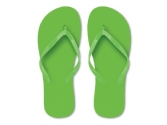
1. Is it advisable to drive a car with flip-flops?
a) No, because they could fall off and make it difficult to operate the pedals.
b) Yes, because by not holding the foot, it is easier to exert the correct pressure on the pedals.
(c) Yes, because they allow faster and safer handling of the pedals.
-
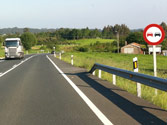
2. Can you make a U-turn in a place where overtaking is prohibited?
a) Yes, except between sunset and sunrise, because visibility decreases.
b) No, unless the change of direction is expressly authorized.
(c) Yes, when oncoming traffic allows it.
-
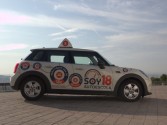
3. In a driving school vehicle carrying out practical classes, who is considered the driver?
a) Both the student and the teacher.
b) The student, as he handles the steering wheel.
(c) The teacher, as he or she is responsible for additional commands.
-
4. Where is a child allowed to travel who does not reach 135 centimeters in height?
a) In any of the rear seats using the adult belt.
b) In a front or back seat, always wearing an adult seat belt.
(c) In the rear seat, always using a restraint device approved according to their size and weight.
-
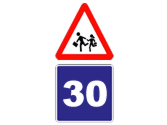
5. With this signage, at what speed should it circulate?
a) Mandatory at 30 km/h.
b) At least at 30 km/h.
(c) At 30 km/h, as recommended, during the section where the danger persists.
-
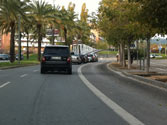
6. A continuous white line on the road, noticeably wider than in the general case...
a) indicates the existence of a special lane.
b) It serves to delimit, only, the bus lanes.
(c) indicates the edge of the road.
-
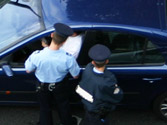
7. What is the penalty for not having compulsory vehicle insurance?
a) A fine, but without immobilization of the vehicle.
b) A fine, and the vehicle can also be immobilized.
(c) The immobilization of the vehicle, but it does not imply a financial penalty.
-
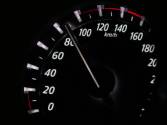
8. Does increasing speed increase the probability of death in the event of a pedestrian being run over?
a) No, vehicle speed has no significant impact on the likelihood of death for a pedestrian hit.
b) Yes, increasing the speed of a vehicle increases the probability of fatality in the event of a pedestrian being run over.
(c) The probability is the same, it will depend exclusively on the state of health of the petaón.
-
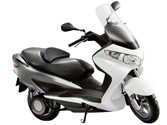
9. How many rearview mirrors do motorcycles have to be installed?
a) One on the right side is mandatory, but they can carry two.
b) They should always carry two mirrors, one on each side.
(c) One left exterior mirror if they do not exceed 100 km/h and two, one on each side, if the speed is higher.
-
10. Is the circulation of animals allowed on a conventional road?
a) Yes, only when there is no livestock route.
b) No.
(c) Yes, except when they are riding in herds.
-
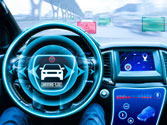
11. What do advanced driver assistance systems, also known as ADAS, contribute to road safety?
a) They decrease the driver's reaction time.
b) They allow the driver to reduce their level of alertness.
b) 它们可以降低驾驶员的警觉程度。(c) They significantly improve the active safety of the vehicle.
(c) 可大大提高车辆的主动安全性。 -
12. What is the maximum alcohol level allowed for a novice driver?
12.新手司机允许的最高酒精含量是多少?a) 0.25 milligrams of alcohol per liter of exhaled air.
a) 每升呼出的空气中含有 0.25 毫克酒精。b) 0.3 milligrams of alcohol per liter of exhaled air.
b) 每升呼出的空气中含有 0.3 毫克酒精。(c) 0.15 milligrams of alcohol per liter of exhaled air.
(c) 每升呼出的空气中含有 0.15 毫克酒精。 -
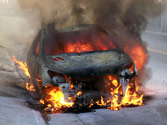
13. When an accident vehicle starts to burn, what should be done first?
13.当事故车辆开始燃烧时,首先应该做什么?a) Turn off the heat.
a) 关火。b) Quickly remove the wounded.
b) 迅速移走伤员。(c) Go get help.
(c) 去寻求帮助。 -
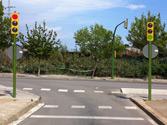
14. In this situation, what should you do if you are going to turn left?
14.在这种情况下,如果您要左转,应该怎么做?a) Continue, obeying the traffic light on the right.
a) 继续行驶,遵守右侧的交通信号灯。b) Stop, obeying the traffic light on the left.
b) 停车,遵守左侧的交通信号灯。(c) Only stop if there are pedestrians crossing.
(c) 只有在有行人过马路时才停车。 -
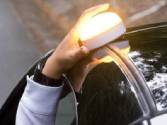
15. Is it allowed to place the V-16 hazard warning light away from the damaged vehicle?
15.是否允许将 V-16 危险警告灯置于远离受损车辆的位置?a) Yes, from a distance you can appreciate it better.
a) 是的,从远处看,你能更好地欣赏它。b) Yes, it must be at least 100 meters away.
b) 是的,必须至少距离 100 米。(c) No, it must be placed in the highest possible part of the immobilized vehicle.
(c) 不,必须放置在被固定车辆的最高处。 -
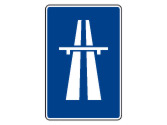
16. To enter a motorway, how fast should you go?
16.进入高速公路时,您应该以多快的速度行驶?a) At the maximum speed allowed on the motorway.
a) 以高速公路允许的最高速度行驶。b) Always very slow to enter safely.
b) 总是非常缓慢地安全进入。(c) At the right speed that allows you to get up safely.
(c) 以适当的速度让你安全地站起来。 -
17. What is an arrest?
a) The immobilization of the vehicle due to traffic needs.
b) A stop for any reason.
(c) A parking lot without getting out of the vehicle.
-
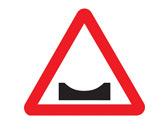
18. This sign indicates danger due to the proximity of...
a) a road in poor condition.
b) a speed bump on the road.
(c) a bump on the road.
-
19. Under normal conditions, the right speed is always...
a) below minimum speed.
b) above the maximum speed and below the minimum.
(c) above the minimum speed and below the maximum speed.
-
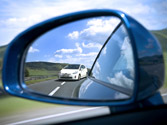
20. Do you have any obligations when your vehicle is going to be overtaken?
a) Yes, signal with the right turn signal to indicate that you can perform the manoeuvre safely.
b) No, the responsibility lies with the vehicle that overtakes.
(c) Yes, stick to the right edge of the road to facilitate manoeuvring.
-
21. What distance from the vehicle in front of it must be maintained by a vehicle of more than 3,500 kg of MMA, circulating on a motorway?
a) 50 meters minimum.
b) 50 meters if you do not intend to overtake.
(c) The one that allows it to stop without colliding with it.
-
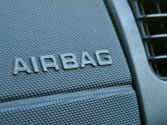
22. Can the operation of the airbag be dangerous in an accident?
a) Yes, always.
b) Yes, if you are not wearing a seat belt.
c) No.
-
23. What should be your behavior when yielding the right-of-way?
a) Stop at intersections if another vehicle is approaching.
b) Stop and check if another road user has priority.
(c) Do not force the vehicle that has priority to abruptly change its trajectory or speed.
-
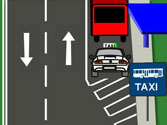
24. On this village road, at what maximum speed can we circulate in the absence of specific signage?
(a) At 30 km/h.
(b) At 20 km/h.
(c) At 50 km/h.
-
25. Does fatigue cause slowness and lack of precision in movements?
a) No, fatigue only causes cramps.
b) No.
(c) Yes, which makes driving more dangerous.
-
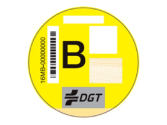
26. If the variable message panels indicate that cars with environmental badge B can circulate in a HOV lane, what minimum occupancy must the vehicle have?
a) Two occupants, including the driver.
b) One occupant.
(c) Two occupants, not including the driver.
-
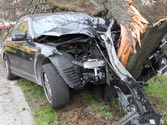
27. Road traffic accidents generate...
a) a huge economic impact, only.
b) material damage and health, administrative and human costs.
(c) material damage and human costs, only.
-
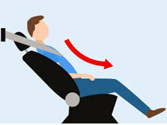
28. The submarine effect, which in a traffic accident can cause serious injury to the driver, is related to...
a) Incorrect tyre pressure.
b) A misuse of the seat belt.
(c) Excessive consumption of alcohol, medications or drugs of abuse.
-
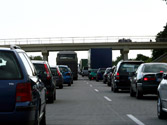
29. If you are stopped in a traffic jam, what distance is it advisable to keep from the vehicle in front?
a) One meter maximum.
b) Minimal space to take up less space.
(c) Two or three meters so as not to hit the vehicle in front in case of a rear rear-end.
-
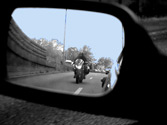
30. Outside of towns, what lateral separation should a motorcycle leave when overtaking a truck?
a) A distance proportional to the speed at which it is travelling.
b) A space of no less than 1.50 metres.
(c) A separation that you consider safe depending on the circumstances of the moment.