
这是用户在 2025-7-21 20:54 为 https://www.mdpi.com/1424-8220/23/7/3698 保存的双语快照页面,由 沉浸式翻译 提供双语支持。了解如何保存?
 
 
Article  开放存取文章

DV-Hop Algorithm Based on Multi-Objective Salp Swarm Algorithm Optimization
基于多目标瓶藻群算法优化的 DV-Hop 算法

by 1,   作者:刘伟民 1,    1 ,李金航 2,*,    1 ,郑爱云 1,2,
2,* ,志正
1 and
1,2 ,姜新宇
1   1 和张少宁
1
College of Mechanical Engineering, North China University of Science and Technology, Tangshan 063210, China
华北理工大学机械工程学院,河北唐山 063210
2
HUIDA Sanitary Ware Co., Ltd., Tangshan 063000, China
河北省唐山市汇达卫浴有限公司 063000
*
Author to whom correspondence should be addressed.
应联系的作者。
Sensors 2023, 23(7), 3698; https://doi.org/10.3390/s23073698
传感器 2023, 23(7), 3698;https://doi.org/10.3390/s23073698
Submission received: 1 March 2023 / Revised: 30 March 2023 / Accepted: 31 March 2023 / Published: 3 April 2023
提交日期:2023 年 3 月 1 日 / 修订日期:2023 年 3 月 30 日 / 接受日期:2023 年 3 月 31 日 / 发布日期:2023 年 4 月 3 日
(This article belongs to the Section Sensor Networks)
(本文属于传感器网络部分)

Abstract  抽象的

The localization of sensor nodes is an important problem in wireless sensor networks. The DV-Hop algorithm is a typical range-free algorithm, but the localization accuracy is not high. To further improve the localization accuracy, this paper designs a DV-Hop algorithm based on multi-objective salp swarm optimization. Firstly, hop counts in the DV-Hop algorithm are subdivided, and the average hop distance is corrected based on the minimum mean-square error criterion and weighting. Secondly, the traditional single-objective optimization model is transformed into a multi-objective optimization model. Then, in the third stage of DV-Hop, the improved multi-objective salp swarm algorithm is used to estimate the node coordinates. Finally, the proposed algorithm is compared with three improved DV-Hop algorithms in two topologies. Compared with DV-Hop, The localization errors of the proposed algorithm are reduced by 50.79% and 56.79% in the two topology environments with different communication radii. The localization errors of different node numbers are decreased by 38.27% and 56.79%. The maximum reductions in localization errors are 38.44% and 56.79% for different anchor node numbers. Based on different regions, the maximum reductions in localization errors are 56.75% and 56.79%. The simulation results show that the accuracy of the proposed algorithm is better than that of DV-Hop, GWO-DV-Hop, SSA-DV-Hop, and ISSA-DV-Hop algorithms.
传感器节点定位是无线传感器网络中的一个重要问题。DV-Hop 算法是一种典型的非测距算法,但定位精度不高。为了进一步提高定位精度,本文设计了一种基于多目标瓶藻群优化的 DV-Hop 算法。首先,对 DV-Hop 算法中的跳数进行细分,并基于最小均方误差准则和权重对平均跳数进行修正。其次,将传统的单目标优化模型转化为多目标优化模型。然后在 DV-Hop 的第三阶段,采用改进的多目标瓶藻群算法对节点坐标进行估计。最后,在两种拓扑环境下,将所提算法与三种改进的 DV-Hop 算法进行比较。与 DV-Hop 相比,在不同通信半径的两种拓扑环境下,所提算法的定位误差分别降低了 50.79%和 56.79%。不同节点数的定位误差分别降低了 38.27%和 56.79%,不同锚节点数的最大定位误差降幅分别为 38.44%和 56.79%;基于不同区域,最大定位误差降幅分别为 56.75%和 56.79%。仿真结果表明,所提算法的定位精度优于 DV-Hop、GWO-DV-Hop、SSA-DV-Hop 和 ISSA-DV-Hop 算法。
Keywords:
wireless sensor network; node localization; DV-Hop; multi-objective salp swarm algorithm
关键词:无线传感器网络;节点定位;DV-Hop;多目标瓶鞘群算法

1. Introduction  1. 简介

A wireless sensor network (WSN) is a wireless multi-hop communication network system composed of low-cost, low-power, and self-reconfigurable sensor nodes [1]. A WSN is a sensing network based on the self-organization structure. It is formed in a certain monitoring area with multiple sensor nodes through wireless communication technology, which has less computing, storage, and transmission capacity. Wireless sensor network technology has many advantages, such as low cost, scalability, reliability, and flexibility [2]. It is widely used in smart homes, target tracking, military security, underwater detection, and many other technical fields [3,4]. In these scenarios, the data collected and transmitted by sensors are often meaningless if they do not contain location information. Therefore, the problem of wireless sensor node location has become one of the important research topics in wireless sensor networks [5]. The detection of location becomes difficult due to the fluctuation of signals and noise in the environment. Many difficulties have been faced in location analysis [6].
无线传感器网络 (WSN) 是由低成本、低功耗、可自重构的传感器节点组成的无线多跳通信网络系统 [1]。WSN 是一种基于自组织结构的传感网络,它通过无线通信技术在一定的监测区域内由多个传感器节点组成,具有计算、存储和传输容量较小的特点。无线传感器网络技术具有成本低、可扩展、可靠、灵活等优点 [2],广泛应用于智能家居、目标跟踪、军事安全、水下探测等许多技术领域 [3,4]。在这些场景中,传感器收集和传输的数据如果不包含位置信息往往毫无意义。因此,无线传感器节点定位问题成为无线传感器网络中的重要研究课题之一 [5]。由于信号的波动和环境中的噪声,位置检测变得困难。位置分析面临许多困难 [6]。
In wireless sensor networks, sensor nodes are usually deployed randomly. GPS is the most accurate and perfect localization technology to solve this problem. The exact position coordinates of all nodes can be obtained directly. However, there are significant limitations to equipping each sensor node with GPS [7]. Firstly, the cost and power consumption of installing GPS modules on all sensors increases dramatically in large networks. Then, it is susceptible to interference in an environment with many obstacles, and the localization accuracy is not satisfactory. Finally, the energy consumption of sensor nodes is also a main challenge with more GPS modules [8,9]. One solution is to use several sensor nodes equipped with localization modules, combined with known information in the network, to calculate the location of unknown nodes, which is node localization technology [10,11,12,13]. Nodes equipped with localization modules are called beacon nodes. Other nodes whose location information is unknown are called unknown nodes.
在无线传感器网络中,传感器节点通常是随机部署的。GPS 是解决该问题最准确、最完善的定位技术,可以直接获取所有节点的精确位置坐标。然而,为每个传感器节点配备 GPS 存在很大的局限性[7]。首先,在大型网络中,在所有传感器上安装 GPS 模块的成本和功耗会急剧增加;其次,在障碍物较多的环境中,GPS 模块容易受到干扰,定位精度不理想;最后,传感器节点的能耗也是 GPS 模块部署较多时面临的主要挑战[8,9]。一种解决方案是利用多个配备定位模块的传感器节点,结合网络中的已知信息,计算未知节点的位置,这就是节点定位技术[10,11,12,13]。配备定位模块的节点称为信标节点,其他位置信息未知的节点称为未知节点。
Node localization can be divided into range-based and range-free according to different methods [14]. The range-based algorithm requires distance or angle information of nodes. Its localization accuracy is high, but it has high requirements for nodes and is susceptible to environmental interference [15,16]. This method requires additional ranging equipment, which inevitably increases the overall cost. Range-based algorithms are mainly based on angle of arrival (AOA), time of arrival (TOA), time difference of arrival (TDOA), and receive signal strength (RSSI) [17,18,19,20]. The range-free algorithm requires connectivity information between the unknown node and the beacon node. It has the features of low cost, low energy consumption, and simple implementation [21]. The localization accuracy of range-free algorithms is usually lower than that of range-based algorithms due to the lack of ranging [22]. There are mainly centroid algorithms, Approximate PIT (APIT), DV-Hop [23,24,25], etc.
节点定位根据方法不同可分为基于测距和非测距两种方式[14]。基于测距的算法需要节点的距离或角度信息,其定位精度较高,但对节点要求较高,且易受环境干扰[15,16]。该方法需要额外的测距设备,必然会增加整体成本。基于测距的算法主要基于到达角(AOA)、到达时间(TOA)、到达时间差(TDOA)和接收信号强度(RSSI)[17–20]。非测距算法需要未知节点与信标节点之间的连通性信息,具有成本低、能耗低、实现简单等特点[21]。由于缺乏测距,非测距算法的定位精度通常低于基于测距的算法[22]。主要有质心算法、近似 PIT(APIT)、DV-Hop[23–25]等。
The multi-objective salp swarm algorithm (MSSA) is a heuristic algorithm, and its model can search for both fixed and moving food sources. The MSSA can well approximate the Pareto frontier with high coverage and convergence. The DV-Hop localization algorithm was proposed by Dragos et al. [26]. It is a non-range distributed location algorithm, because its simple principle is widely used. However, the DV-Hop localization accuracy and stability are poor. Cui et al. believe that the DV-Hop algorithm cannot meet the requirements of high sensor localization accuracy in some scenarios [27]. Messous et al. believe that the accuracy of existing solutions is still unsatisfactory [28].
多目标瓶藻群算法(MSSA)是一种启发式算法,其模型可以搜索固定和移动的食物源。MSSA 可以很好地逼近帕累托前沿,具有很高的覆盖率和收敛性。DV-Hop 定位算法由 Dragos 等人提出[26]。它是一种非距离分布式定位算法,因为其原理简单而被广泛应用。然而,DV-Hop 定位精度和稳定性较差。Cui 等人认为 DV-Hop 算法在某些情况下无法满足高传感器定位精度的要求[27]。Messous 等人认为现有解决方案的精度仍然不令人满意[28]。
To solve this problem, this paper designs a DV-Hop algorithm based on an improved multi-objective salp swarm algorithm. Firstly, the four communication radii are used to refine the hop count. Secondly, the average hop distance introduces a weighting factor on the basis of the minimum mean-square error to reduce the error. Finally, the improved multi-objective salp swarm algorithm is used to optimize the third stage of DV-Hop. The rest of the paper is structured as follows. In Section 2, we introduce the DV-Hop algorithm and describe the principles of the single-objective and multi-objective salp swarm algorithm algorithms. Our proposed improved localization scheme is given in Section 3. Section 4 is a performance analysis comparing the proposed algorithm with the three algorithms. Finally, the paper is summarized in Section 5.
针对该问题,本文设计了一种基于改进的多目标瓶鞘群算法的 DV-Hop 算法。首先,利用四个通信半径对跳数进行细化。其次,在平均跳距最小均方误差的基础上引入加权因子,以减小误差。最后,采用改进的多目标瓶鞘群算法对 DV-Hop 的第三阶段进行优化。本文其余部分结构如下。在第二部分中,我们介绍了 DV-Hop 算法,并描述了单目标和多目标瓶鞘群算法的原理。我们提出的改进定位方案在第 3 部分中给出。第 4 部分是对所提算法与三种算法进行性能分析比较的分析。最后,在第 5 部分对全文进行总结。

Related Work  相关工作

The DV-Hop algorithm has been improved by some scholars. It mainly locates nodes based on network connectivity and topology. Node localization consists of two steps: one is distance estimation, and the other is coordinate estimation. Some scholars adopt the weighting strategy in the distance estimation stage. For example, Zhang et al. proposed that the unknown node would normalize the hop distance of all the beacon nodes received so as to obtain its own hop distance [29]. Hou et al. introduced differential knowledge in the hop distance calculation, and the average hop distance of each node was calculated based on its own difference error [30]. Wang et al. used the inverse distance weighting method in the calculation of the average hop distance, and the beacon node that is far away from the unknown node was assigned a small weight, thus reducing the error of the average hop distance [31]. Chen et al. used the minimum mean-square error criterion to calculate the distance error between beacon nodes, and at the same time used the minimum mean-square error criterion to calculate the average hop distance of unknown nodes to form a double-weighted average hop distance [32]. Gui et al. believed that the estimated distance of the original DV-Hop is one of the important reasons affecting the error, so the checkout step was introduced in the DV-Hop algorithm to improve the localization accuracy. Based on this, a three-beacon node estimation distance algorithm was proposed to further improve the localization accuracy [33].
DV-Hop 算法已经被一些学者改进,它主要根据网络连通性和拓扑结构来定位节点,节点定位包含两个步骤:一是距离估计,二是坐标估计。一些学者在距离估计阶段采用了加权策略,例如张等提出未知节点对接收到的所有信标节点的跳距离进行归一化,从而得到自身的跳距离[29]。侯等在跳距离计算中引入差分知识,根据自身的差分误差计算各个节点的平均跳距离[30]。王等在平均跳距离的计算中采用了反距离加权法,给距离未知节点较远的信标节点分配较小的权重,从而减小了平均跳距离的误差[31]。陈等采用最小均方误差准则计算信标节点间的距离误差,同时采用最小均方误差准则计算未知节点的平均跳距,形成双加权平均跳距[32]。桂志强等认为原 DV-Hop 的距离估计是影响误差的重要原因之一,因此在 DV-Hop 算法中引入了校验步骤,以提高定位精度。基于此,提出了一种三信标节点估计距离算法,进一步提高定位精度[33]。
However, some scholars use intelligent algorithms to optimize DV-Hop, such as Bo et al., who applied GA to solve the localization problem of wireless sensor networks and proposed a population constraint strategy based on three beacon nodes to solve the feasible domain of the population [34]. Singh et al. used the 2D hyperbolic method to determine the unknown node location, and after that, PSO was used to correct the node location [35]. Kaur et al. replaced the original computation with the GWO algorithm in the calculation of average hop distance so that all beacon nodes could obtain the exact average hop distance [36]. Chai et al. designed a parallel WOA algorithm and introduced the tribal annexation communication strategy and the group psychological communication strategy in the parallel algorithm to enhance the population diversity of WOA and avoid local optimal solutions [37]. Li et al. proposed three parallel cat colony algorithms and applied them to solve the localization problem of wireless sensor networks, which greatly reduced the running memory and computationally optimized variables [38]. Sabahat et al. used the average position of beetles in the BAS algorithm and also introduced inertia coefficients to update the position. The application of the improved BAS to the localization problem of wireless sensor networks greatly improved the accuracy and stability of localization [39]. With the application of intelligent algorithms in wireless sensor network localization, some researchers use multi-objective optimization to solve the localization problem. For example, Wang et al. proposed a multi-objective DV-Hop algorithm based on NSGA-II, which changed the population constraint strategy based on three beacon nodes to a population constraint strategy based on all beacon nodes. The localization accuracy was improved [40]. Kanwar et al. combined six single-objective functions with three multi-objective functions and considered the effect of noise on the communication radius. The solution was performed using the multi-objective PSO algorithm and obtained good localization accuracy [41]. Huang et al. proposed to combine Manhattan and Euclidean to obtain new frequency hopping and hop distance, and used the NSGA-II algorithm for iterative optimization to improve localization accuracy and localization adaptability [42].
但也有学者利用智能算法对 DV-Hop 进行优化,如 Bo 等应用 GA 解决无线传感器网络定位问题,并提出一种基于三个信标节点的种群约束策略来求解种群的可行域[34];Singh 等采用二维双曲线法确定未知节点位置,之后利用 PSO 对节点位置进行修正[35];Kaur 等在平均跳距的计算中用 GWO 算法代替原来的计算,使得所有信标节点都能获得精确的平均跳距[36];Chai 等设计了一种并行 WOA 算法,并在并行算法中引入部落兼并通信策略和群体心理通信策略,增强 WOA 的种群多样性,避免陷入局部最优解[37];Li 等提出了三种并行猫群算法并将其应用于解决无线传感器网络定位问题,大大减少了运行内存并计算优化了变量[38];Sabahat 等在 BAS 算法中利用了甲虫的平均位置,并引入了惯性系数来更新位置。将改进的 BAS 应用于无线传感器网络定位问题,大大提高了定位的准确性和稳定性[39]。随着智能算法在无线传感器网络定位中的应用,一些研究者采用多目标优化来解决定位问题。例如,Wang 等。 提出了一种基于 NSGA-II 的多目标 DV-Hop 算法,将基于三个信标节点的种群约束策略改为基于所有信标节点的种群约束策略,提高了定位精度[40]。Kanwar 等将 6 个单目标函数与 3 个多目标函数组合,并考虑噪声对通信半径的影响,采用多目标 PSO 算法进行求解,获得了良好的定位精度[41]。Huang 等提出将曼哈顿与欧氏结合起来得到新的跳频和跳距,并利用 NSGA-II 算法进行迭代优化,提高了定位精度和定位自适应性[42]。

2. Methods  2. 方法

2.1. DV-Hop

In this section, we specifically introduce the implementation process of the DV-Hop algorithm. The traditional DV-Hop consists of three stages.
本节我们具体介绍 DV-Hop 算法的实现过程,传统的 DV-Hop 主要包括三个阶段。
Phase 1: Connectivity detection and calculation of hop counts between each unknown node and beacon node.
第一阶段:检测每个未知节点与信标节点之间的连通性并计算跳数。
Connectivity detection is performed to ensure that the nodes can be communicated. In the first stage, the initialization value of node hop count information is 0. Each beacon node broadcasts packets into the network with a radius R around itself. The hop counts increase by 1 for each packet forwarded. The node stores the minimum hops between itself and the beacon node.
进行连通性检测以确保节点之间能够通信。在第一阶段,节点跳数信息的初始值为 0。每个信标节点向以自身为半径 R 的网络广播数据包。每转发一个数据包,跳数加 1。节点存储自身与信标节点之间的最小跳数。
Phase 2: Estimating the distance between the unknown node and the beacon node.
第二阶段:估计未知节点和信标节点之间的距离。
The minimum hop count obtained in the first stage is estimated using Equation (1) to estimate the average hop distance Hopsizei.
利用公式(1)估计第一阶段获得的最小跳数,从而估计平均跳距 Hopsize。
Hopsizei=jiN(xi-xj)2(yi-yj)2/jiNhij
where (xi, yi) and (xj, yj) are the coordinates of beacon nodes i and j, hij is the minimum hop count between i and j (ij), and Hopsizei is the average hop distance from beacon node i to beacon node j. The unknown node takes the Hopsize received first as its average hop distance, and estimates the distance di with each beacon node based on it. The calculation formula is shown in Equation (2).
其中,(x, y)和(x, y)分别为信标节点和的坐标,h ij 为和(≠)之间的最小跳数,Hopsize 为信标节点到信标节点的平均跳数。未知节点将首次接收到的 Hopsize 作为自身的平均跳数,并据此估算与各个信标节点的距离 d。计算公式如式(2)所示。
di = Hopsizei × h
d = 啤酒花大小 × h
i
where hi is the minimum hop count from unknown node to beacon i.
其中 h 是从未知节点到信标的最小跳数。
Phase 3: Calculation of unknown nodes coordinates.
阶段 3:计算未知节点坐标。
Since the distance between an unknown node and each beacon node is estimated from Equation (2), the relationship between the beacon node and the unknown node is shown in Equation (3).
由于未知节点与各信标节点之间的距离是通过公式(2)估计的,因此信标节点与未知节点之间的关系如公式(3)所示。
{(x1x)2+(y1y)2=d12(x2x)2+(y2-y)2=d22(xn-x)2+(yn-y)2=dn2
where (x, y) are the coordinates of the unknown nodes. Equation (3) can be transformed into Equation (4) by matrix.
其中,(x, y)为未知节点的坐标。公式(3)可以通过矩阵转化为公式(4)。
{x12xn2+y12yn22x(x1xn)2y(y1yn)=d12dn2x22xn2+y22yn22x(x2xn)2y(y2yn)=d22dn2xn12xn2+yn12yn22x(xn1xn)2y(yn1yn)=dn12dn2
Equation (4) can be written as AX = B, where A, X, and B are shown in Equations (5)–(7).
方程(4)可以写成 AX = B,其中 A、X 和 B 如方程(5)-(7)所示。
A=2[(x1xn)(y1yn)(x2xn)(xn1xn)(y2yn)(yn1yn)]
X=[xy]
B=[x12xn2+y12yn2+dn2d12x22xn2+y22yn2+dn2d22xn12xn2+yn12yn2+dn2dn12]
Let F(X) = ||AX-B||2 and let F′(X) = 0. As shown in Equations (8) and (9),
令 F(X) = ||AX-B|| 2 且令 F′(X) = 0。如公式 (8) 和 (9) 所示,
f(x)x=xAXB2=2AT(AXB)=2(ATAXATB)
ATAX=ATB
The location of unknown nodes is estimated by Equation (10):
未知节点的位置估计采用公式(10):
X = (ATA)−1ATB

2.2. Multi-Objective Salp Swarm Algorithm
2.2 多目标瓶藻群算法

2.2.1. Single-Objective Salp Swarm Algorithm
2.2.1 单目标瓶藻群算法

In the salp swarm algorithm (SSA), F(x) is denoted as the objective function, and {ul} is the optimal solution found by the algorithm that matches the objective function.
在瓶藻群算法(SSA)中,F(x)表示目标函数,{ul}是算法找到的与目标函数相匹配的最优解。
Minisize/Maxisize:F(x)={f1(x)}
Subject to: gi(x)0,hk(x)=0
lbjxjubj
where i and k are the number of constraints on the inequality and equation, respectively; lbj represents the lower bound on the jth variable; and ubj represents the upper bound on the jth variable.
其中和 k 分别是不等式和方程的约束个数;lb 表示第个变量的下限;ub 表示第个变量的上限。
In SSA, the salp chain is composed of leaders and followers. The leader is at the front of the salp chain, while other individuals are followers [43]. The random initialization population formula is shown in Equation (14):
在 SSA 中,瓶瓶藻链由领导者和追随者组成。领导者位于瓶瓶藻链的最前端,其他个体为追随者[43]。随机初始化种群公式如公式(14)所示:
XN×d = rand (N, d) × (ublb) + lb
where N is the population number and d is the dimension, ub is the upper bound, lb is the lower bound, and rand (N, d) is a random array of N rows and d columns between [0, 1].
其中 N 为人口数量,d 为维度,ub 为上限,lb 为下限,rand (N, d) 为 [0, 1] 之间的 N 行 d 列的随机数组。
In SSA, the location of the food source is the target location of all salps. It is the global optimal solution in the exploration process and affects the leader position update. The leader position update formula is as follows:
在 SSA 中,食物源的位置是所有瓶藻的目标位置,它是探索过程中的全局最优解,影响领导者位置的更新。领导者位置更新公式如下:
xji={Fj+c1((ubjlbj)c2+lbj),c30.5Fjc1((ubjlbj)c2+lbj),c30.5
where xji is the position of the ith leader in the jth dimension, Fj is the location of the food source in the jth dimension; ubj is the upper bound in the jth dimension; lbj is the lower limit in the jth dimension; and c1, c2, with c3 are random numbers.
其中 xji 是第 t 维中第 t 个领导者的位置,F 是第 t 维中食物源的位置;ub 是第 t 维的上限;lb 是第 t 维的下限;c 1 、c 2 和 c 3 是随机数。
In terms of Equation (15), it can be seen that the leader position update is mainly influenced by the food source position. Parameter c1 is defined as follows.
由公式(15)可知,领导者位置的更新主要受食物源位置的影响。参数 c 1 定义如下。
c1=2×exp((4t/Tmax)m)
where t is the current number of iterations, the power factor m = 2, and Tmax is the maximum number of iterations. The parameter c1 decreases adaptively during the iterations. It contributes to the exploration ability when the value is relatively large, and it helps with specific development capabilities when the value is small. c1 can make the exploration and exploitation ability of the SSA in a good state. Thus, c1 is the most important parameter in the SSA.
其中,为当前迭代次数,功率因子 m = 2,Tmax 为最大迭代次数。参数 c 1 在迭代过程中自适应减小。当其值较大时,有助于提高探索能力;当其值较小时,有助于提高具体的开发能力。c 1 可以使 SSA 的探索和开发能力处于良好的状态。因此,c 1 是 SSA 中最重要的参数。
To update the position of followers, the following formula is used.
为了更新关注者的位置,使用以下公式。
xji=at2/2+v0Δt
where i ≥ 2, xij is the position of the ith follower in the jth dimension, Δt is time, v0 is the initial velocity, a = (vtv0)/Δt, vt = (xijxji−1)/Δt, and xji−1 is the position of the (i − 1)st salp in the jth dimension. Since time is the difference between the number of iterations, Δt = 1, and the initial velocity v0 = 0. Equation (18) can be expressed as:
其中 ≥ 2,x 是第 t 个跟随者在第 t 维的位置,Δ 是时间,v 0 是初速度,a = (v − v 0 )/Δ,v = (x − x −1 )/Δ,x −1 是第 ( − 1) 个藻类在第 t 维的位置。由于时间是迭代次数Δ = 1 与初速度 v 0 = 0 之间的差值,因此方程(18)可以表示为:
xji=(xji+xji1)/2
With Equations (15) and (18), the salp chains can be simulated.
利用方程 (15) 和 (18) 可以模拟瓶鞘链。

2.2.2. Multi-Objective Salp Swarm Algorithm
2.2.2 多目标瓶藻群算法

A multi-objective optimization problem deals with multiple objectives simultaneously, and all objectives are to be optimized. It can be expressed as:
多目标优化问题同时处理多个目标,并且所有目标都需要优化。它可以表示为:
Minisize/Maxisize:F(x)={f1(x),f2(x), ,fn(x)}
Subject to: gi(x)0,hk(x)=0
lbjxjubj
where n is the number of objectives; i and k are the number of constraints on the inequality and equation, respectively; lbj represents the lower bound on the jth variable; and ubj represents the upper bound on the jth variable.
其中 n 是目标的数量;k 分别是不等式和方程的约束数量;lb 表示第个变量的下限;ub 表示第个变量的上限。
The multi-objective problem cannot be solved by the SSA. The main reason is that the solution to the multi-objective problem is a group of solutions called the Pareto-optimal set. The SSA can drive salps close to the food source and update it in the iterative process. However, the multi-objective problem cannot be addressed by this algorithm. The main reason is that the SSA only saves one solution as the optimal solution.
SSA 无法解决多目标问题。主要原因是多目标问题的解是一组称为帕累托最优集的解。SSA 可以驱动瓶藻靠近食物源,并在迭代过程中更新它。然而,该算法无法解决多目标问题。主要原因是 SSA 只保存一个解作为最优解。
In the MSSA, a food repository is equipped to solve the problem. This repository stores the best solutions obtained during the optimization process. The capacity of the repository storing optimal solutions is limited. Each salp is compared with all repository original solutions using the Pareto dominance operator in the optimization process. The comparison rules are as follows.
在 MSSA 中,配备了一个食物库来解决这个问题。该库存储了优化过程中获得的最佳解。存储最优解的库容量是有限的。在优化过程中,使用 Pareto 优势算子将每个藻类与所有库中的原始解进行比较。比较规则如下。
(1)
If a salp is superior in the repository, then that salp should be put into the repository, and the original solution should be taken out. If a salp is superior to a group of solutions in the repository, then that group of solutions should be removed from the repository, and the salp should be added to the repository.
如果某个瓶瓶罐罐在存储库中更优,则应将该瓶瓶罐罐放入存储库,并取出原始解决方案。如果某个瓶瓶罐罐比存储库中的一组解决方案更优,则应从存储库中移除该组解决方案,并将该瓶瓶罐罐添加到存储库。
(2)
If there is at least one original solution in the repository that is superior to that salp, then that salp should be discarded and not added to the repository.
如果存储库中至少有一个原始解决方案优于该瓶鞘,则应丢弃该瓶鞘,而不要将其添加到存储库中。
(3)
If the salp is not superior to all repository residents, the salp is the optimal solution and must be added to the repository.
如果该瓶蚤并不优于所有存储库中的驻留物,则该瓶蚤蚤蚤蚤泽蚤蚤泽蚤是最佳解决方案,必须添加到存储库中。
(4)
If the repository is full and salp is not superior to the repository’s original solution, a distance d for calculating the neighboring solution numbers is introduced at this time. As shown in Equation (22). The number of neighboring solutions is calculated, and the roulette wheel selection strategy is used to select the solution with a high number of neighboring solutions for deletion.
如果存储库已满,且 salp 不优于存储库的原始解,则此时引入一个用于计算邻近解数量的距离 d。如公式(22)所示。计算邻近解的数量,并使用轮盘赌选择策略,选择邻近解数量较多的解进行删除。
d=(maxmin)/repositorysize
where min and max are the minimum and maximum fitness values in the population, respectively; and repository size is the number of current repositories.
其中 minmax 分别是种群中的最小和最大适应度值;存储库大小是当前存储库的数量。
In the food selection stage, there is more than one optimal solution in the multi-objective search space. The appropriate approach is to select the least crowded region from a set of optimal solutions. This can be achieved using the same sorting procedure used in the repository maintenance operator and roulette wheel selection. The main difference is the probability of selecting the optimal solution. The higher the rank of the solution in the repository maintenance deletion, the more likely it is to be selected. In contrast, the lower the rank for the optimal solution in the repository, the more likely it is to be selected as a food source.
在食物选择阶段,多目标搜索空间中存在多个最优解。合适的方法是从一组最优解中选择最不拥挤的区域。这可以使用与存储库维护运算符和轮盘赌选择相同的排序程序来实现。主要区别在于选择最优解的概率。存储库维护删除中的解的排名越高,被选中的可能性就越大。相反,存储库中最优解的排名越低,被选为食物源的可能性就越大。

3. Our Proposed IMSSA-DV-Hop Scheme
3. 我们提出的 IMSSA-DV-Hop 方案

3.1. Error Analysis  3.1. 误差分析

Node location is the problem of obtaining the absolute coordinates of nodes in wireless sensor networks. In the DV-Hop algorithm, the distance between nodes is obtained by multiplying hop counts by the average hop distance. During the hop count calculation, all nodes within the node communication radius are recorded as 1. However, the distances between nodes are different, which leads to a large error. The unknown node receives the average hop distance of the nearest beacon node to it and takes that average hop distance as its own, which leads to an increase in the localization error. These methods are inherently inaccurate and sensitive to bias when solving for unknown node coordinates by least squares or maximum likelihood estimation.
节点定位是获取无线传感器网络中节点绝对坐标的问题。在 DV-Hop 算法中,节点间的距离是通过将跳数乘以平均跳数得到的。在跳数计算过程中,节点通信半径内的所有节点均记为 1。然而,节点间的距离各不相同,导致误差较大。未知节点会接收距离其最近的信标节点的平均跳数,并将该平均跳数作为自己的平均跳数,这会导致定位误差增大。这些方法在通过最小二乘或最大似然估计求解未知节点坐标时,本质上存在不准确性,且易受偏差影响。
Based on the above analysis, we have made a series of improvements to the DV-Hop algorithm, and the improved multi-objective salp swarm DV-Hop algorithm (IMSSA-DV-Hop) is proposed.
基于以上分析,我们对 DV-Hop 算法进行了一系列改进,提出了改进的多目标瓶藻群 DV-Hop 算法(IMSSA-DV-Hop)。

3.2. Subdivision Hop Count
3.2. 细分跳数

Nodes within the node communication radius are noted as 1, but the distance between nodes is not the same, which leads to a large error. Thus, the minimum hop count is subdivided again. As shown in Equation (23).
节点通信半径内的节点记为 1,但节点间的距离并不相同,导致误差较大。因此,对最小跳数再次进行细分。如式(23)所示。
Hopsizemin={1/m,0<dis<R/m2/m,R/m<dis<2×R/mk/m,(k1)×R/m<dis<k×R/m,k=1,2,,m
Obviously, the division of the hop count becomes more accurate as m becomes large, and the calculation error becomes smaller. However, the larger the value of m taken, the higher the requirement for sensor nodes, and the cost rises. With this in mind, m = 4 is used in this paper.
显然,m 越大,跳数的划分越精确,计算误差越小。但 m 取值越大,对传感器节点的要求越高,成本也随之上升。因此,本文取 m=4。

3.3. Beacon Node Average Hop Distance Correction
3.3. 信标节点平均跳距修正

In the DV-Hop algorithm, the unknown node takes the average hop distance from the nearest beacon node as its own average hop distance to calculate the distance. However, the network structure is random, and the hop distance from the unknown node to each beacon node is not the same, so the error is large.
在 DV-Hop 算法中,未知节点以与最近信标节点的平均跳距作为自身的平均跳距来计算距离,但网络结构随机,未知节点到各个信标节点的跳距并不相同,因此误差较大。
First, the average hop distance of the beacon nodes is improved. In the DV-Hop algorithm, the calculation of the average hop distance is based on the unbiased estimation criterion. That is, it is obtained by Equation (24).
首先,改进信标节点的平均跳距。在 DV-Hop 算法中,平均跳距的计算基于无偏估计准则,即由公式(24)得到。
fi=(1/N1)ji(dijHopsizei×hopi,j)
where N is the number of beacon nodes, Hopsizei is the average hop distance of beacon node i, and hopi,j is the minimum number of hops between beacon nodes i and j, and fi is the cost function of the ith node.
其中,N 为信标节点数,Hopsize 为信标节点的平均跳数,hop i,j 为信标节点与之间的最小跳数,f 为第个节点的成本函数。
The measurement error follows the Gaussian distribution. According to the parameter estimation theory, it is more reasonable to use the mean-square error than the variance only. Therefore, the mean-square error is used to calculate the average hop distance of the beacon node. Equation (25) can be obtained by transforming Equation (24):
测量误差服从高斯分布。根据参数估计理论,采用均方误差比仅采用方差更合理。因此,采用均方误差计算信标节点的平均跳距。将公式(24)变形可得公式(25):
fi=ji(dijHopsizei×hopi,j)2
According to the calculation rule of unbiased estimation, take the first-order derivative of Equation (25) and set it as 0 to obtain the average hop distance conforming to the minimum mean-square error, as shown in Equation (26):
按照无偏估计的计算规则,对公式(25)取一阶导数并设为 0,即可得到符合均方误差最小的平均跳数距离,如公式(26)所示:
Hopsizei=jihopi,j×di,j/jihopi,j2
Beacon nodes with different distances from the unknown nodes reflect the local network state differently. The close beacon nodes can reflect the actual average hop distance of the nodes more accurately. Therefore, a large weight is assigned to the close beacon nodes. It is required to consider the average hop distance of multiple beacon nodes to estimate the average hop distance more accurately. The weight value formula is shown in Equation (27).
与未知节点距离不同的信标节点反映局部网络状态不同。较近的信标节点能够更准确地反映节点的实际平均跳距,因此赋予较近的信标节点较大的权重。为了更准确地估计平均跳距,需要考虑多个信标节点的平均跳距。权重值公式如式(27)所示。
wi=1/hopij/i=1N1/hopij
where hopij is the hop count from the unknown node to the beacon node, and wi is the weighted correction factor of the hop distance of the unknown node. The average hop distance of the unknown node can be solved according to Equation (28).
式中,hop ij 为未知节点到信标节点的跳数,w 为未知节点跳数的加权校正因子。未知节点的平均跳数可根据公式(28)求解。
Hopsizeu=i=1Nwi×Hopsizei

3.4. Multi-Objective Model
3.4. 多目标模型

In the DV-Hop algorithm, the initial objective function is shown in Equation (29).
在 DV-Hop 算法中,初始目标函数如式(29)所示。
fitness1=min(i=1m|(xix)2+(yiy)2di|)
where di is the estimated distance between beacon node i and the unknown node, (xi, yi) are the coordinates of beacon node I, and (x, y) are the coordinates of the unknown node.
其中 d 是信标节点与未知节点之间的估计距离,(x,y)是信标节点的坐标,(x,y)是未知节点的坐标。
However, because di is a constant obtained in the second stage of the algorithm, the position calculated with di is not the actual position, but it is close to the estimated position. Therefore, another objective function needs to be added to enhance the search constraint. The estimated distance di in the original objective function is replaced with the theoretical distance. This results in a new objective function, as shown in Equation (30).
然而,由于 d 是算法第二阶段获得的常数,用 d 计算出的位置并非实际位置,但与估计位置较为接近。因此,需要添加另一个目标函数来增强搜索约束。将原目标函数中的估计距离 d 替换为理论距离,得到一个新的目标函数,如公式(30)所示。
fitness2=min(i=1m|(xix)2+(yiy)2dit|)
where dit is the theoretical distance from the unknown node t to the beacon node i. As shown in Equation (31).
其中,d it 是未知节点到信标节点的理论距离。如公式(31)所示。
dit = divas × hit
where hit is the minimum hop count between the unknown node t and the beacon node i, and disav is the theoretical value of the average per hop distance from the unknown node to the beacon node. Variable disav as shown in Equation (32).
其中,h it 为未知节点与信标节点之间的最小跳数,dis av 为未知节点到信标节点的平均每跳距离的理论值。变量 dis av 如公式(32)所示。
disav=0R2πr2dr/0R2πrdr=2R/3

3.5. Improved Multi-Objective Salp Swarm Algorithm
3.5 改进的多目标瓶藻群算法

3.5.1. Initialization  3.5.1. 初始化

In this paper, a good point-set initialization strategy is used to optimize the multi-objective salp swarm algorithm, which is based on the following principle [44]. GS is the unit cube in s-dimensional Euclidean space; if rGS, then:
本文提出了一种良好的点集初始化策略来优化多目标瓶藻群算法,该策略基于以下原则[44]。G S 是 s 维欧氏空间中的单位立方体;若 r∈G S ,则:
Pn(k)={({r1(n)k},{r2(n)k},{r3(n)k}),1kn}
Deviation Φ (n) satisfies Φ (n) = C (r, ε) n−1+ε, where C (r, ε) n−1+ε is a constant related to r and ε only (ε is an arbitrary positive number). Then, Pn (k) is said to be a good point-set, r is a good point, and {rs(n)·k} represents the fractional part and n denotes the number of points, r = {2cos(2πk/p), 1 ≤ kn} (p is the smallest prime number satisfying(p − 3)/2 ≥ s). Map it to a search space as:
偏差 Φ (n) 满足 Φ (n) = C (r, ε) n −1+ε ,其中 C (r, ε) n −1+ε 为仅与 r 和 ε 相关的常数(ε 为任意正数)。则称 P n (k) 为好点集,r 为好点,{r s (n) ·k} 表示小数部分,n 表示点数,r = {2cos(2πk/p), 1 ≤ k ≤ n} (p 为满足 (p − 3)/2 ≥ s 的最小素数)。将其映射到搜索空间为:
xi (j) = (ubjlbj) · {rji · k} + lbj
x() = (ub − lb) · {r · k} + lb
where ubj and lbj denote the upper and lower bounds of the jth dimension.
其中 ub 和 lb 表示第 th 维的上限和下限。

3.5.2. Fuzzy Selection  3.5.2. 模糊选择

After obtaining the Pareto-optimal solution set, the best solution and the solution to be deleted are selected in the repository by a fuzzy selection mechanism. ui is denoted as the membership of the ith objective function of the solution. As shown in Equation (35).
在获得 Pareto 最优解集后,通过模糊选择机制在存储库中选出最优解和待删除的解,u 表示该解的第个目标函数的隶属度,如公式(35)所示。
μi={1,FiFimin(FimaxFi)/(FimaxFimin),FiminFiFimax0,FiFimax
uk=i=1Nobjμik/k=1Mi=1Nobjμik
where M is the number of non-dominated solutions, Nobj is the number of objective functions, and μik is denoted as the membership of the ith objective function of the kth solution. The solution is judged according to the size of uk.
其中,M 为非支配解个数,Nob 为目标函数个数, μik 表示第 k 个解对第 k 个目标函数的隶属度。该解的判断依据是 u k 的大小。

3.5.3. Leader Position Updates Strategy

(1)
Parameter adjustment
In the MSSA, c1 affects the search capability of the algorithm, and its Equation (37) is as follows.
c1=2e(4l/L)m
In the original algorithm, m = 2. However, we found that c1 in the [0.05, 0.95] provides good results in initial phase exploration and in final phase development. Therefore, the lower cmin and upper cmax of the control parameter c1 are in the [0.05, 0.95], and the adaptive equation is shown in Equation (38).
c1=cmax+(cmincmax)×log10(a+10t/tmax)
where c is the inertia weight parameter and a is a random number between [0, 1], and t and tmax are the current and maximum number of iterations.
(2)
Adaptive weight
The weight factor is added for food, and the influence of food source on the leader gradually decreases with the increase of iterations. Local extremes are avoided in the early stages of convergence. Convergence late approximates the optimal value and achieves high solution accuracy. The weight factor of food addition is shown in Equation (39):
w=(wmaxwmin)×(l/L)2
where wmax is the maximum inertia weight, wmin is the minimum inertia weight, l is the number of current iterations, and L is the total number of iterations. wmax = 0.9 and wmin = 0.4 have the best performance. As the iterations proceed, the inertia weight decreases linearly from 0.9 to 0.4.
(3)
Levy flight strategy
Lévy flight obeys the Lévy distribution, which is a movement between the short-distance search followed by an occasional longer-distance walk [45]. The position update equation for the Levy flight is shown in Equation (40).
L(s)~|s|1β,        0<β2
where s is the random step size. Since the Lévy flight is very complex, the algorithm proposed by Mantegna is used in this paper to calculate the random step size, as shown in Equation (41)
s=μ/|ν|1/β
In the equation, μ and υ obey normal distribution.
{μN(0,σμ2)vN(0,σv2)
{σμ={Γ(1+β)sin(πβ/2)/Γ[(1+β)2]×β×2(β1)/2}1βσν=1
The parameter β is 0 < β < 2, and generally β = 1.5.
In summary, the leader’s position update formula is shown in Equation (44):
xji={w×Fj+c1((ubjlbj)c2+lbj)×s,       c30.5w×Fjc1((ubjlbj)c2+lbj)×s,       c3<0.5
(4)
Follower location update strategy
This section introduces the mayfly mating process formula in the mayfly algorithm to improve the follower position update formula [46]. Based on this, a follower update strategy with an adaptive mayfly search mechanism is proposed. The fitness values of the two individuals are compared and the fitness value that meets the multi-objective requirements of this paper is selected. The update position is biased to the side with good fitness, so the follower position update formula is as follows.
xji={ηxji+(1η)xji1,f(xji)>f(xji1)ηxji1+(1η)xji,f(xji)f(xji1)
where η is the dynamic adaptive factor, as shown in Equation (46).
η=0.80.2×1/(1+et)
t is the current number of iterations.

3.6. IMSSA-DV-Hop Algorithm Flow Chart

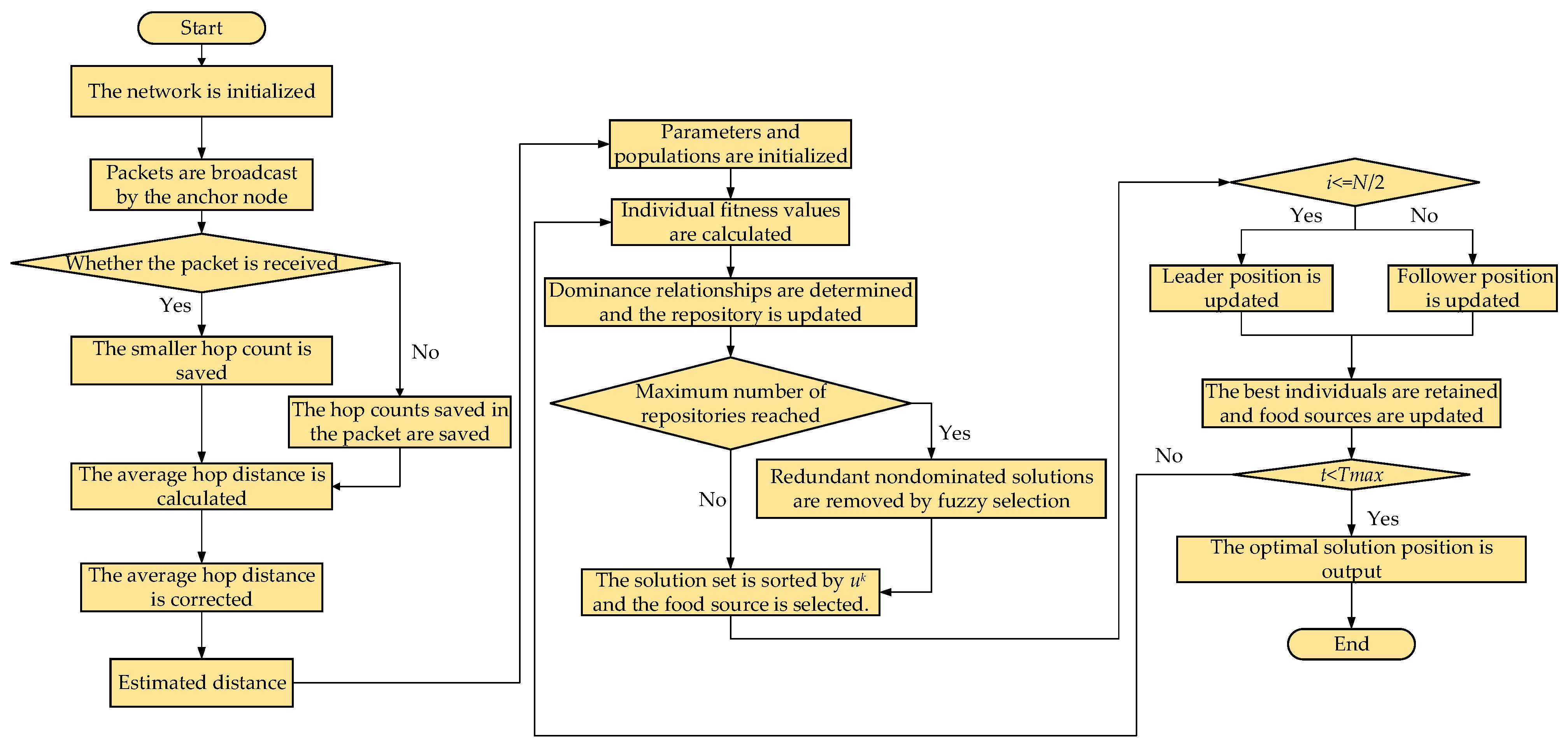
According to the proposed algorithm improvement strategy, the IMSSA-DV-Hop algorithm is proposed, and the flow chart is shown in Figure 1.
Figure 1. Flow chart of IMSSA-DV-Hop algorithm.

4. Experimental Results and Analysis

4.1. Experimental Environment and Evaluation Criteria

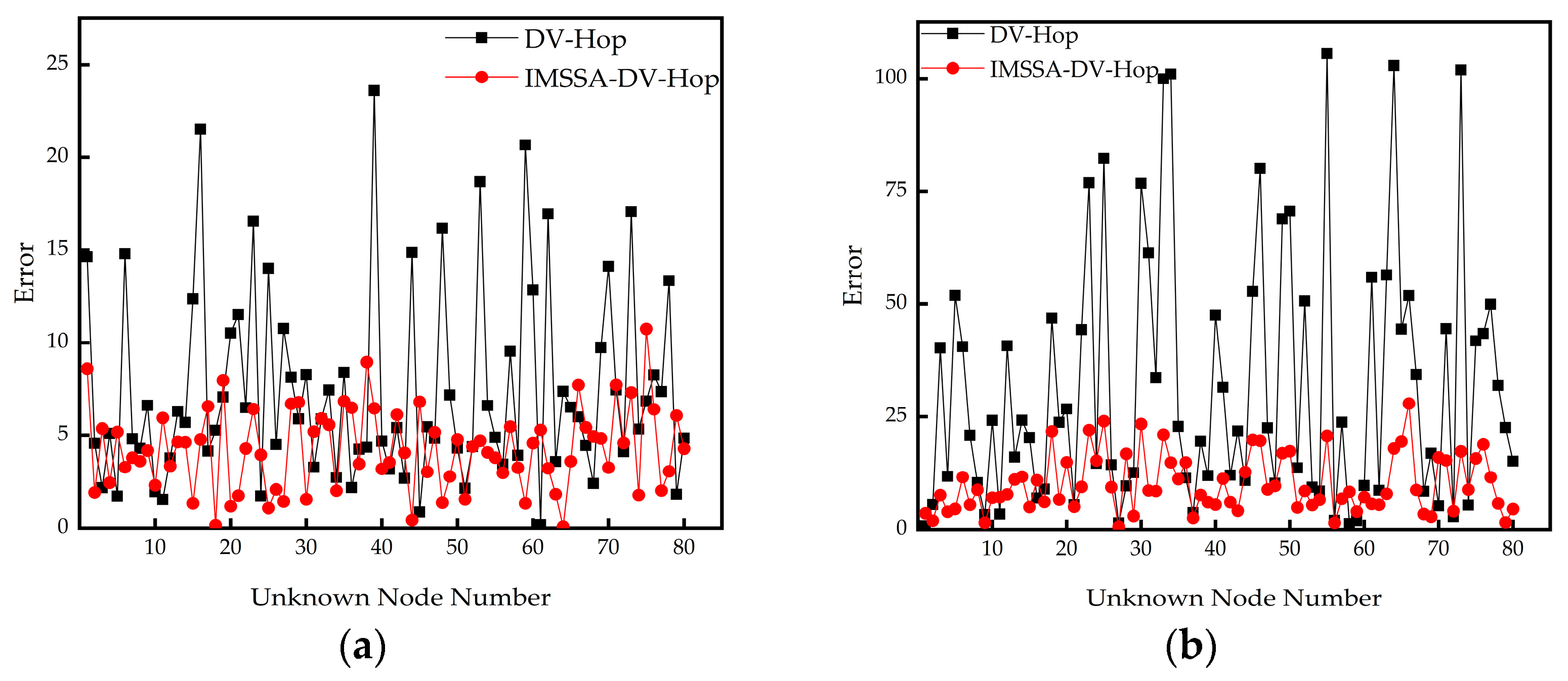
To verify the effectiveness of the IMSSA-DV-Hop algorithm, this algorithm is tested and simulated on MATLAB 2016b on a computer configured with Intel (R) Core (TM) i7-7700HQ CPU @ 2.80 GHz processor (Intel, Santa Clara, CA, USA), 16 GB RAM and Windows 10 operating system. The proposed algorithm is firstly compared with the DV-Hop algorithm in square random topology and C-shaped random topology. The range error line diagram is shown in Figure 2.
Figure 2. Ranging error diagrams: (a) square random topology; (b) C-shaped random topology.
As can be seen from Figure 2a,b, the IMSSA-DV-Hop algorithm is significantly improved compared with DV-Hop. Second, to verify the effectiveness of the proposed algorithm, a large number of simulation experiments are conducted with different communication radii, node numbers, beacon node numbers, and areas as constraints. The proposed algorithm is compared with the original DV-Hop algorithm, SSA-DV-Hop algorithm, GWO-DV-Hop algorithm, and ISSA-DV-Hop algorithm. To consider the cost of practical application, specific experimental parameters are shown in Table 1.
Table 1. Experimental parameter settings.
The normalized relative error equation is used as the index for comparison. The relative error equation after normalization is shown in Equation (47):
error=i=1N(x0-x^0)2(y0-y^0)2/(N×R)
where (x0,y0) and (x^0,y^0) are the real and estimated coordinates of the unknown node, and N indicates the number of unknown nodes.
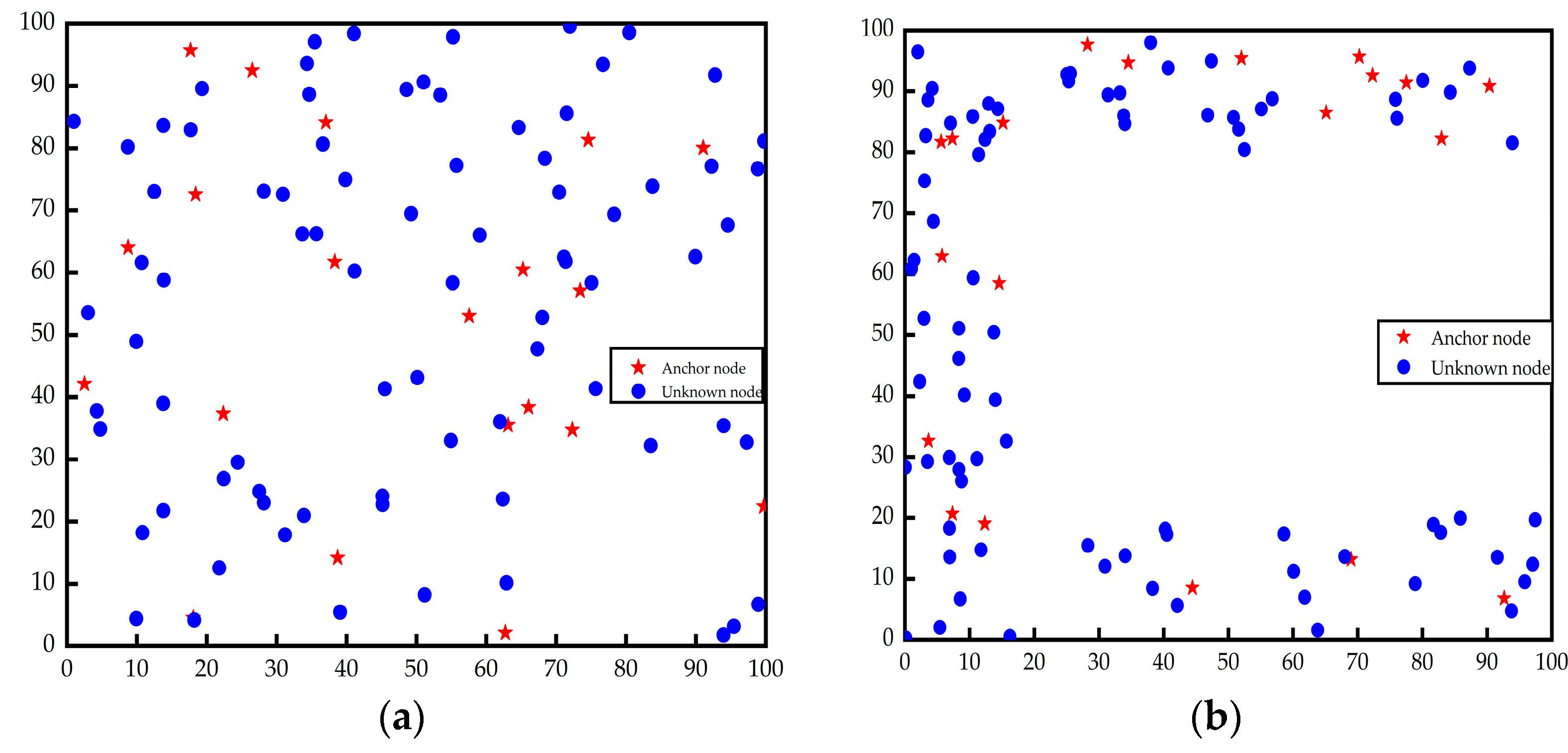
The distribution of nodes in the square random topology and C-shaped random topology is shown in Figure 3a,b.
Figure 3. Node distribution diagrams: (a) square random topology; (b) C-shaped random topology.

4.2. The Influence of Communication Radius on Localization Error

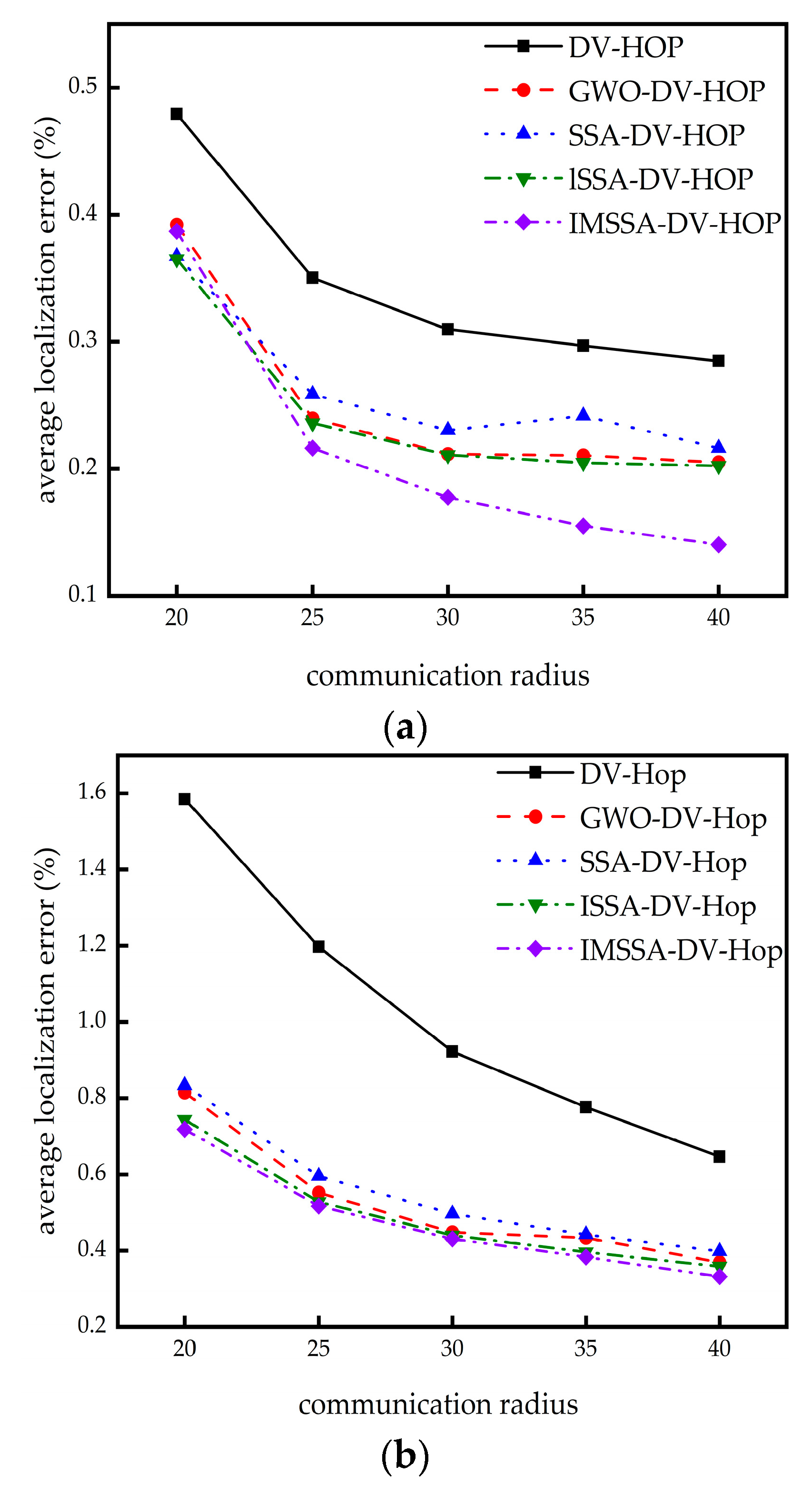
In this section, we research the influence of different communication radii on localization error. The node numbers and the beacon node numbers remain the same. At the same time, the communication radius is increased from 20 m to 40 m. The comparison results are shown in Figure 4.
Figure 4. Localization error diagrams for different communication radius: (a) square random topology; (b) C-shaped random topology.
As can be seen from Figure 4a, in the square random topology, the errors of the IMSSA-DV-Hop algorithm are close to those of the GWO-DV-Hop algorithm, when R is small and slightly higher than that of the SSA-DV-Hop algorithm and the ISSA-DV-Hop algorithm. However, with the increase in R, the localization errors decrease significantly. In the C-shaped random topology network, as shown in Figure 4b, the IMSSA-DV-Hop algorithm always has the minimum localization error regardless of the size of R.
The specific experimental data are shown in Table 2 and Table 3. The bolded data in Table are the optimal localization error values.
Table 2. Localization error in different communication radius in square random topology.
Table 3. Localization error in different communication radius in C-shaped random topology.
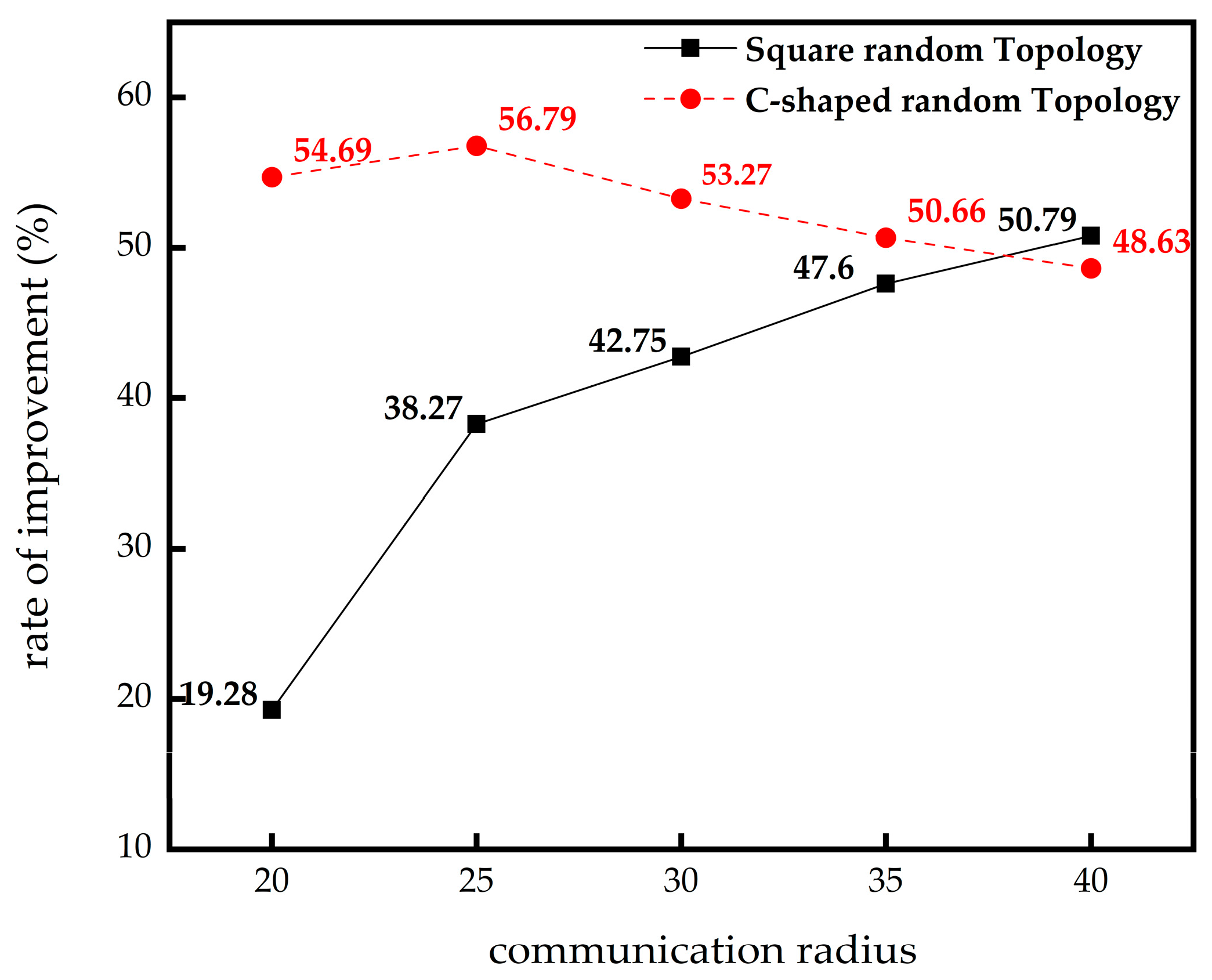
It can be seen from Table 2 that in square random topology, compared with the DV-Hop algorithm, the IMSSA-DV-Hop algorithm reduces the localization errors by 19.28%, 38.27%, 42.75%, 47.60%, and 50.79%. It can be seen from Table 3 that in the C-shaped random topology, the errors are reduced by 54.69%, 56.79%, 53.27%, 50.66%, and 48.63%. The comparison of localization errors improvement is shown in Figure 5. Compared with the GWO-DV-Hop algorithm, the localization errors of the IMSSA-DV-Hop algorithm in the two topologies are increased by 31.64% and 11.88%.
Figure 5. Comparison of localization error improvement in different communication radius.

4.3. The Influence of Node Numbers on Localization Error

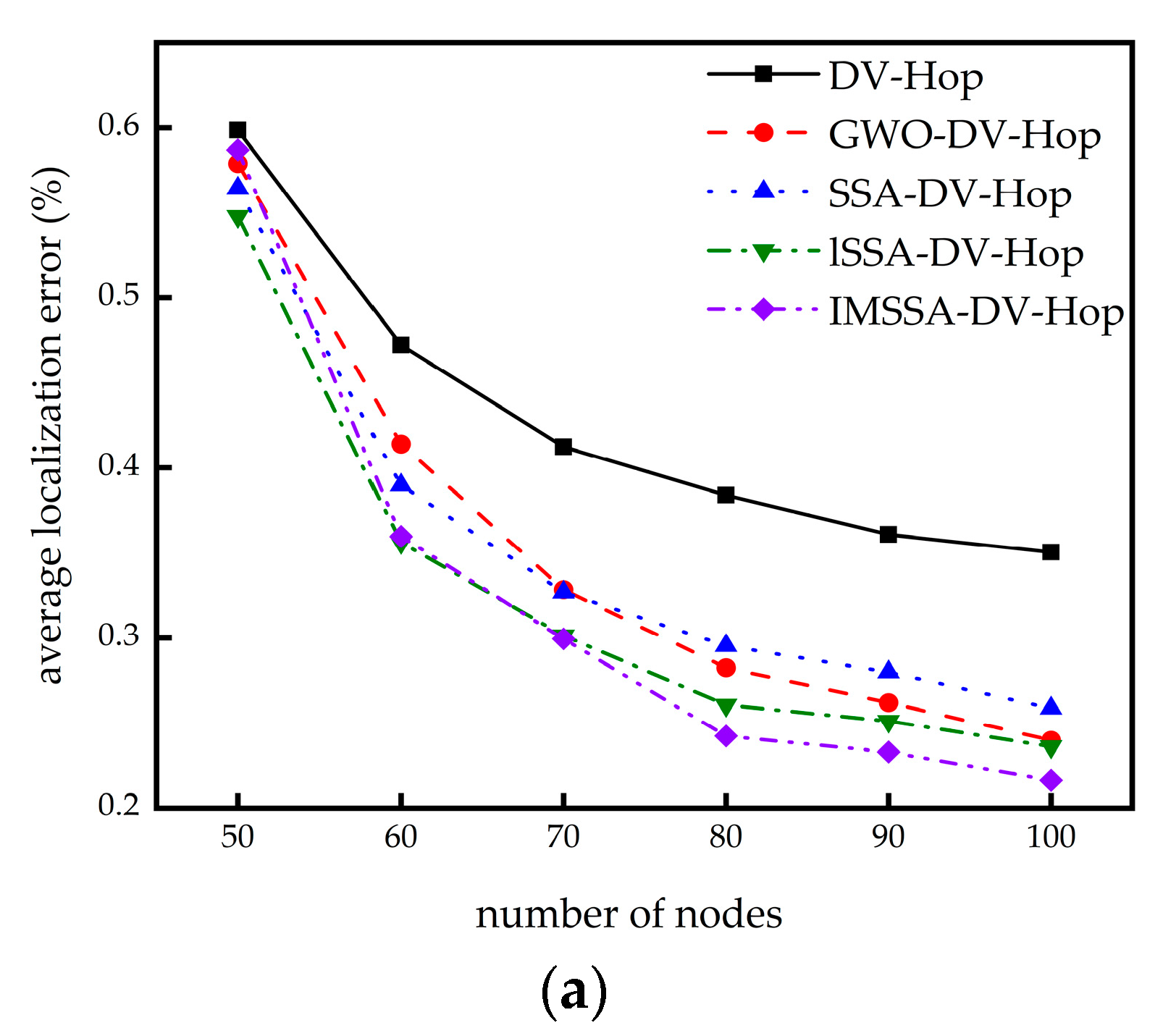
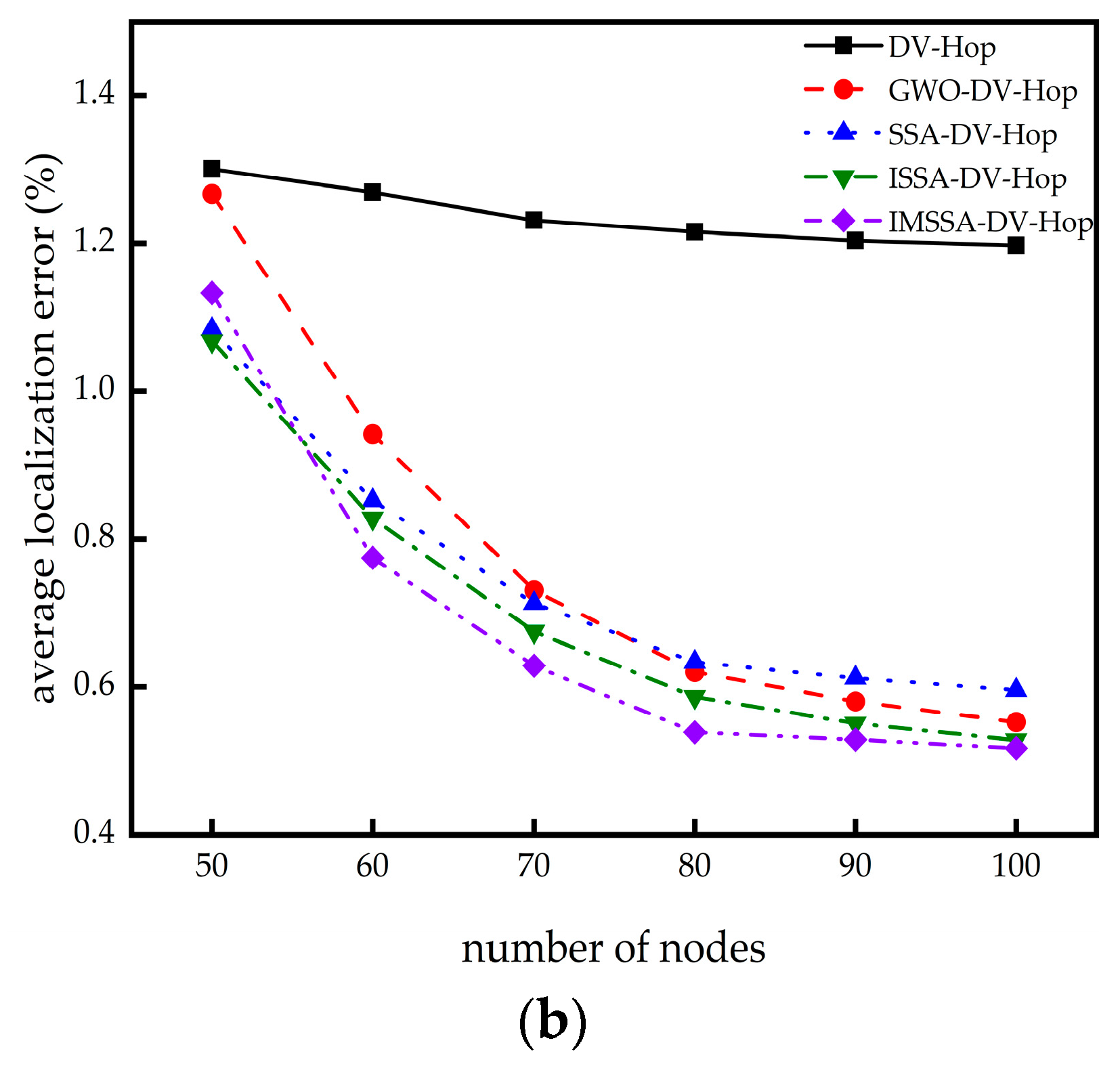
In this section, we investigate the effect of different node numbers on the localization error. The communication radii and the beacon node numbers remain the same, while the node numbers are increased from 50 to 100. The comparison results are shown in Figure 6.
Figure 6. Localization error diagrams for different number of nodes: (a) square random topology; (b) C-shaped random topology.
It can be seen from Figure 6a,b that in the two network topologies, the localization error of the IMSSA-DV-Hop algorithm is slightly greater than that of the three comparison algorithms when the node numbers are small. With the increase in the node numbers, the location errors of the IMSSA-DV-Hop algorithm improve significantly. No matter how the node numbers change, it is better than the DV-Hop algorithm.
The specific experimental data are shown in Table 4 and Table 5. The bolded data in Table are the optimal localization error values.
Table 4. Localization error in different number of nodes in square random topology.
Table 5. Localization error in different number of nodes in C-shaped random topology.
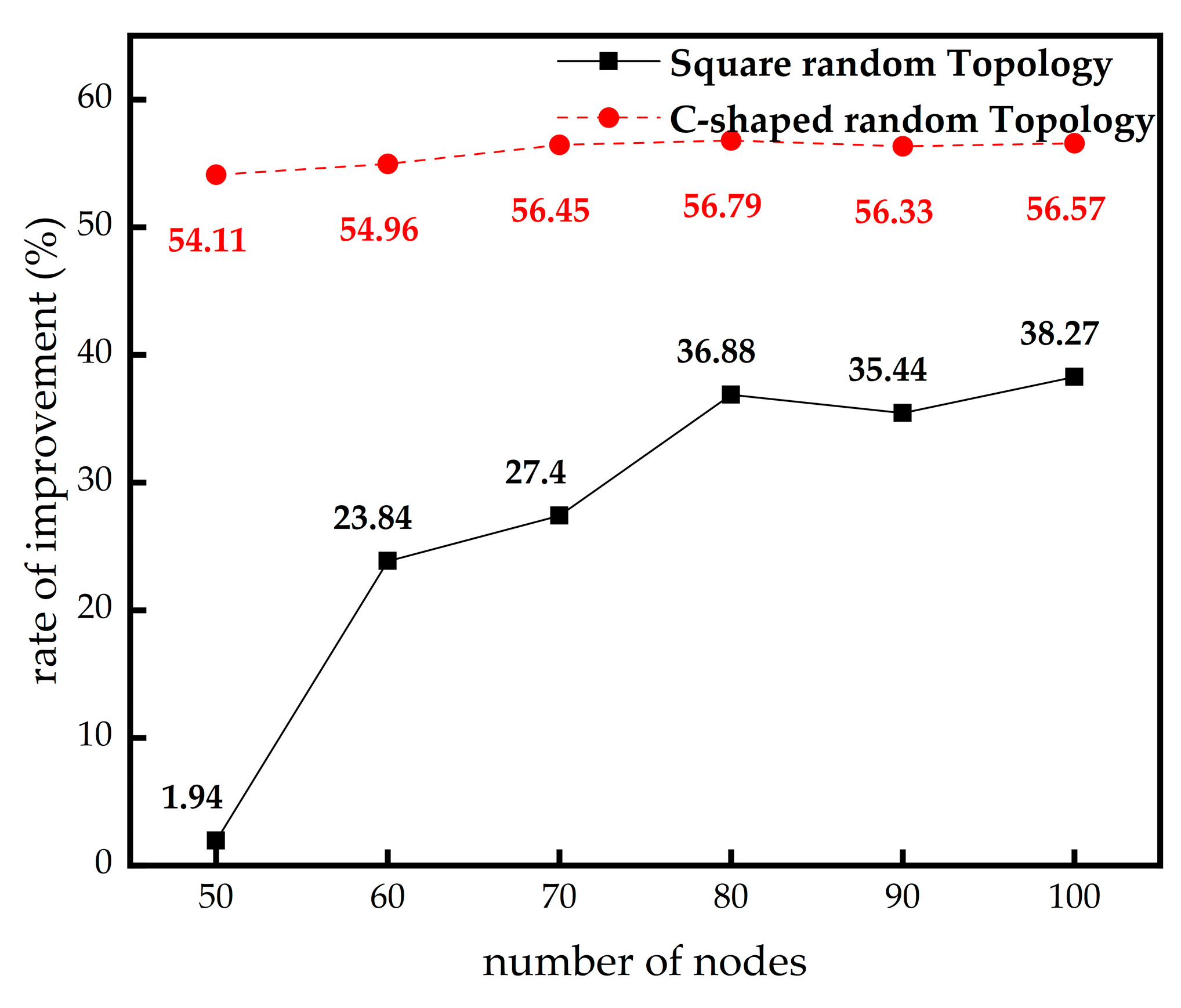
From Table 4, in the square random topology, compared with the DV-Hop algorithm, the IMSSA-DV-Hop algorithm reduces the localization errors by 1.94%, 23.84%, 27.40%, 36.88%, 35.44%, and 38.27%. From Table 5, In the C-shaped random topology, it reduces 54.11%, 54.96%, 56.45%, 56.79%, 56.33%, and 56.57%. The comparison of localization error improvement is shown in Figure 7.
Figure 7. Comparison of localization error improvement in different number of nodes.

4.4. The Influence of Beacon Node Numbers on Localization Error

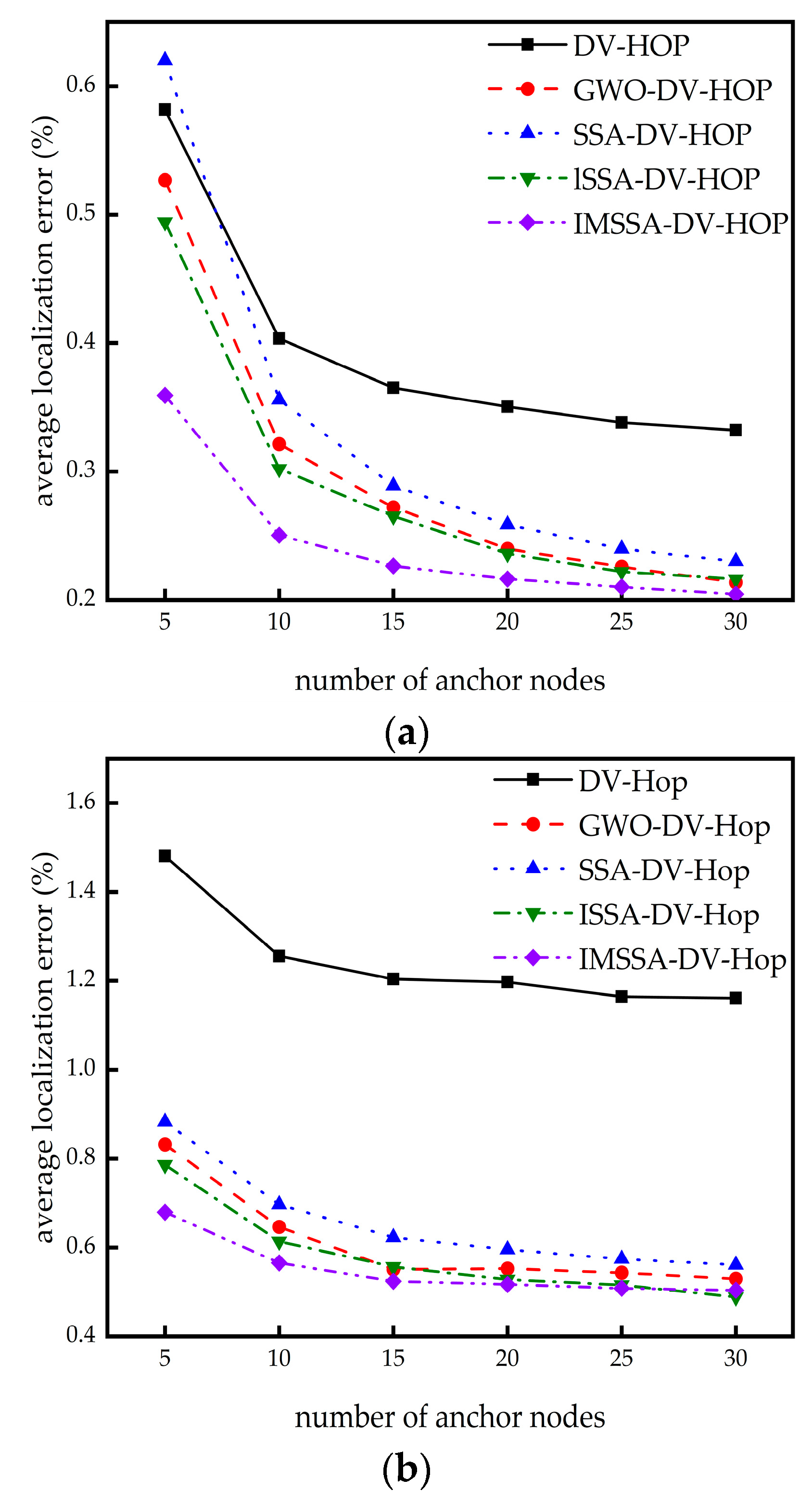
In this section, we research the influence of different beacon node numbers on localization error. The node numbers and communication radius remain the same, while the beacon node numbers are increased from 5 to 30. The comparison results are shown in Figure 8.
Figure 8. Localization error diagrams for different number of anchor nodes: (a) square random topology; (b) C-shaped random topology.
From Figure 8a,b, it can be seen that the IMSSA-DV-Hop algorithm in two random topologies can achieve lower localization error compared with the three algorithms compared in the case of fewer beacon nodes. In the C-shaped random topology, the performance of this algorithm is close to that of the ISSA-DV-Hop algorithm when the numbers of beacon nodes are large.
The specific experimental data are shown in Table 6 and Table 7. The bolded data in Table are the optimal localization error values.
Table 6. Localization error in different number of anchor nodes in square random topology.
Table 7. Localization error in different number of anchor nodes in C-shaped random topology.
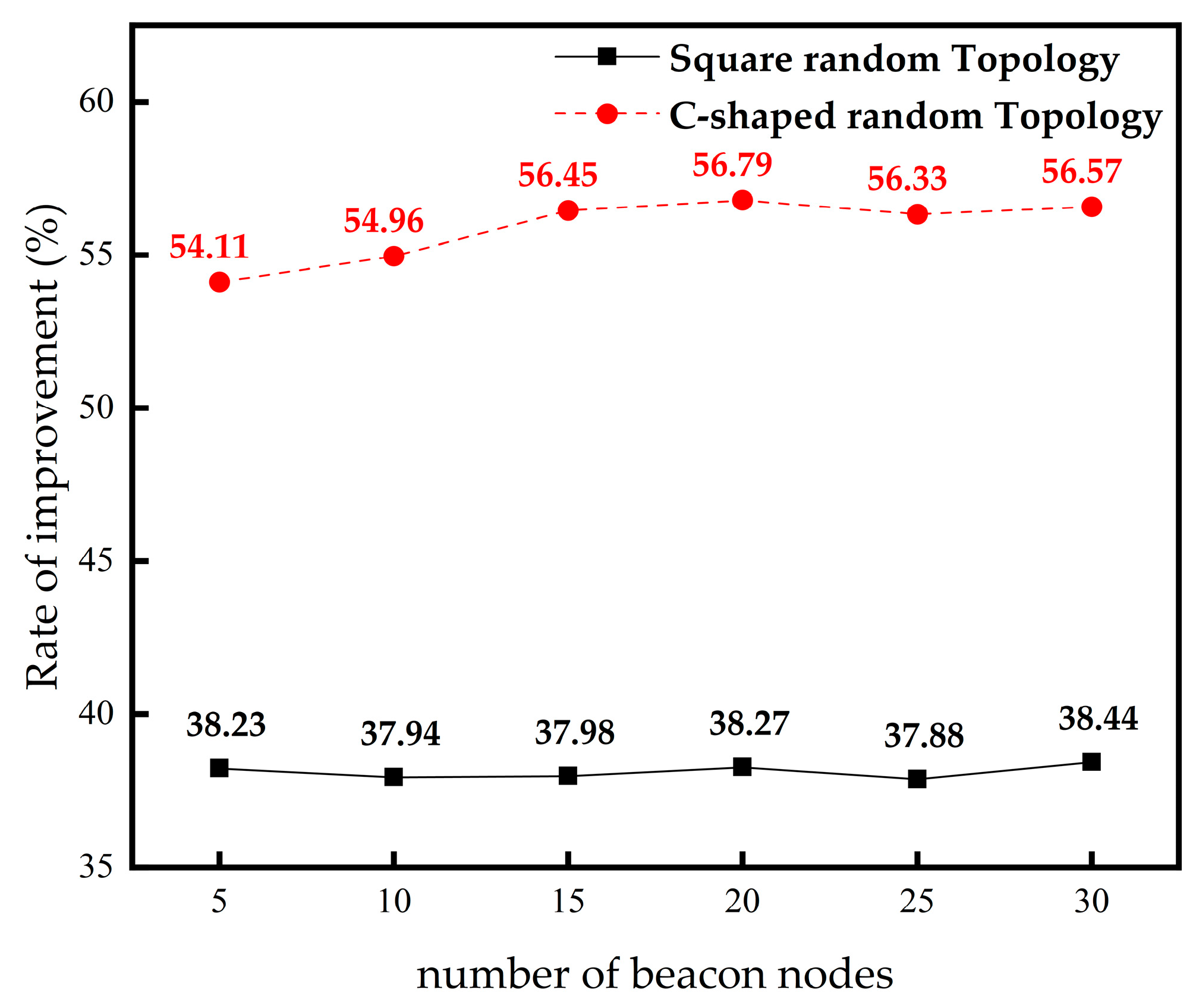
From Table 6, in square random topology, compared with the DV-Hop algorithm, the localization errors of the IMSSA-DV-Hop algorithm are reduced by 38.23%, 37.94%, 37.98%, 38.27%, 37.88%, and 38.44%. From Table 7, In the C-shaped random topology, the localization errors are reduced by 54.11%, 54.96%, 56.45%, 56.79%, 56.33%, and 56.57%. The comparison of localization error improvement is shown in Figure 9. Compared with ISSA-DV-Hop, the localization errors of IMSSA-DV-Hop in the two topologies are increased by 27.31% and 13.59%.
Figure 9. Comparison of localization error improvement in different number of anchor nodes.

4.5. The Influence of Area on Localization Error

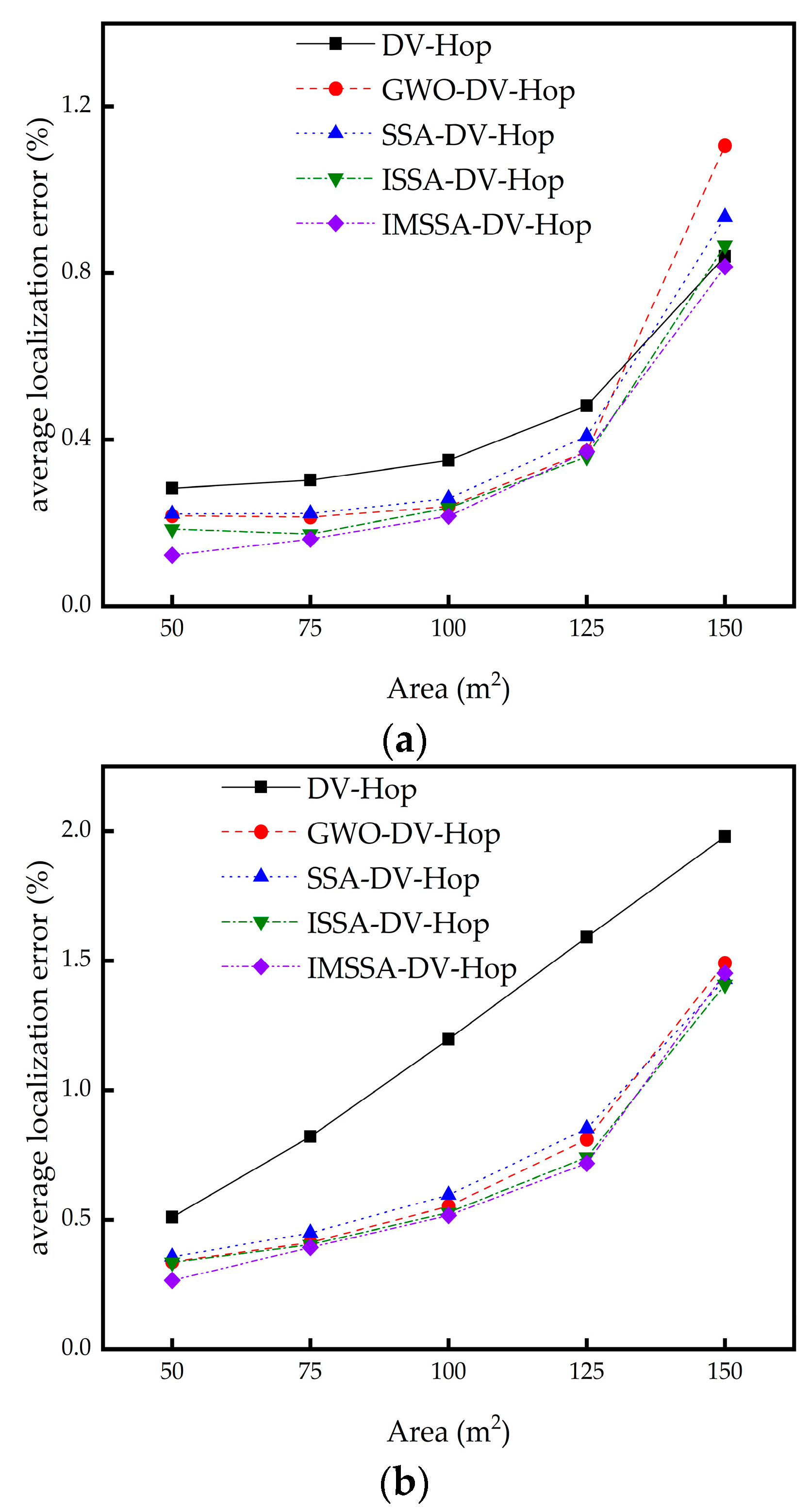
In this section, we study the influence of different regional areas on localization error. The area is increased from 50 × 50 m to 150 × 150 m. The comparison results are shown in Figure 10.
Figure 10. Localization error diagrams for different Area: (a) square random topology; (b) C-shaped random topology.
It can be seen from Figure 10a,b that the IMSSA-DV-Hop algorithm is significantly superior to the DV-Hop algorithm and three comparison algorithms in the two random topologies when the area is small at the initial stage. However, in the square topology structure, with the increase in the area, the localization errors of the proposed algorithm and the three comparison algorithms increase significantly. However, in the two topologies, the proposed algorithm is superior to the DV-Hop algorithm regardless of the size of the area.
The specific experimental data are shown in Table 8 and Table 9. The bolded data in Table are the optimal localization error values.
Table 8. Localization error in different Area in square random topology.
Table 9. Localization error in different Area in C-shaped random topology.
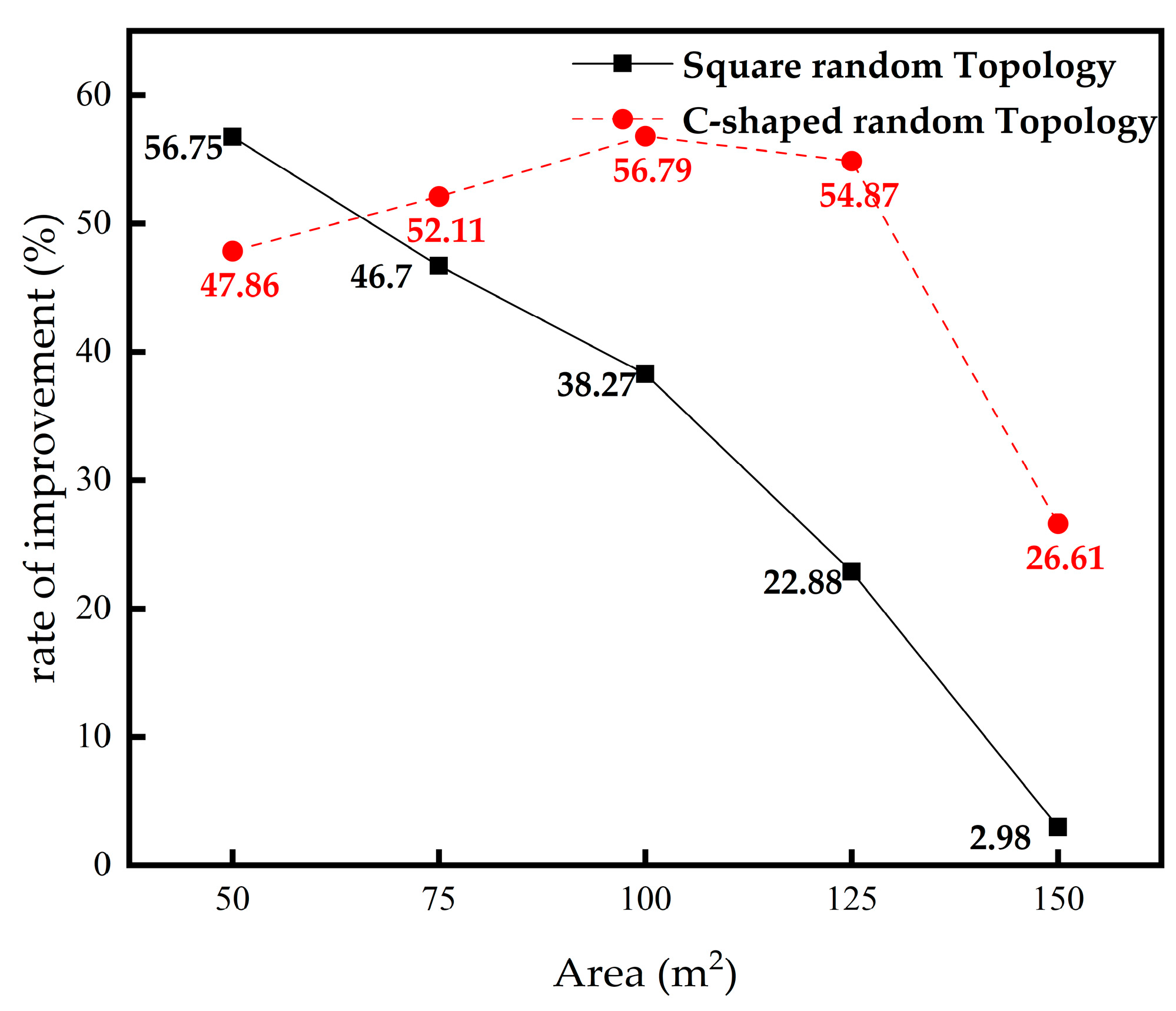
As can be seen from Table 8, in the square random topology, the localization errors of the IMSSA-DV-Hop algorithm are reduced by 56.75%, 46.70%, 38.27%, 22.88%, and 2.98%, compared with the DV-Hop algorithm. As can be seen from Table 9, localization errors in C-shaped random topology are reduced by 47.86%, 52.11%, 56.79%, 54.87%, and 26.61%. The comparison of localization error improvement is shown in Figure 11.
Figure 11. Comparison of localization error improvement in different Area.

5. Conclusions

In this paper, we propose an IMSSA-DV-Hop localization algorithm, which uses a multi-objective model based on the DV-Hop single-objective model to reduce the localization error. The first stage of traditional DV-Hop adopts subdivide hop count, average hop distance based, and minimum mean-square error weighting to reduce the errors in the first two stages of the DV-Hop algorithm and improve the localization accuracy. In IMSSA, the initial population of a good point-set is used to facilitate getting rid of local optimal solutions. Additionally, replacing the selection mechanism in the multi-objective salp swarm algorithm with fuzzy selection well selects the desired non-dominated solutions in the repository. In addition, the Levy flight strategy and the floating algorithm position update formula are used in the leader and follower position update, respectively, which improves the search efficiency of the algorithm and reduces the localization error. Experiments are conducted under two network topologies, and the experimental results show that the IMSSA-DV-Hop algorithm outperforms DV-Hop, GWO-DV-Hop, SSA-DV-Hop, and ISSA-DV-Hop.

Author Contributions

Conceptualization, W.L. and J.L.; methodology, J.L. and A.Z.; software, A.Z. and J.L.; formal analysis, W.L.; writing—original draft preparation, W.L., J.L., X.J. and S.Z.; writing—review and editing, W.L., Z.Z. and A.Z.; supervision, W.L. and A.Z.; project administration, W.L. and Z.Z.; funding acquisition, W.L., A.Z. and Z.Z. All authors have read and agreed to the published version of the manuscript.

Funding

This research was supported by the S&T Program of Hebei (22282203Z), Natural Science Foundation of Hebei Province (E2022209086).

Institutional Review Board Statement

Not applicable.

Informed Consent Statement

Not applicable.

Data Availability Statement

All data are included in the work. No additional data present.

Conflicts of Interest

The authors declare there are no competing interests.

References

  1. Kanwar, V.; Kumar, A. DV-Hop-based range-free localization algorithm for wireless sensor network using runner-root optimization. J. Supercomput. 2020, 77, 3044–3061. [Google Scholar] [CrossRef]
  2. Rawat, P.; Singh, K.D.; Chaouchi, H.; Bonnin, J.M. Wireless sensor networks: A survey on recent developments and potential synergies. J. Supercomput. 2013, 68, 1–48. [Google Scholar] [CrossRef]
  3. Elhabyan, R.; Shi, W.; St-Hilaire, M. Coverage Protocols for Wireless Sensor Networks: Review and Future Directions. J. Commun. Netw. 2019, 21, 45–60. [Google Scholar] [CrossRef] [Green Version]
  4. Ullah, I.; Shen, Y.; Su, X.; Esposito, C.; Choi, C. A Localization Based on Unscented Kalman Filter and Particle Filter Localization Algorithms. IEEE Access 2020, 8, 2233–2246. [Google Scholar] [CrossRef]
  5. Wan, X.W.; Lu, J.C. Improved DV-Hop Localization Algorithm Based on Weighted Least Squares Cycle Optimization in Anisotropic Networks. Wirel. Pers. Commun. 2022, 126, 895–909. [Google Scholar] [CrossRef]
  6. Messous, S.; Liouane, H. Online Sequential DV-Hop Localization Algorithm for Wireless Sensor Networks. Mob. Inf. Syst. 2020, 2020, 8195309. [Google Scholar] [CrossRef]
  7. Ahmad, T.; Li, X.J.; Seet, B.C.; Cano, J.C. Social Network Analysis Based Localization Technique with Clustered Closeness Centrality for 3D Wireless Sensor Networks. Electronics 2020, 9, 738. [Google Scholar] [CrossRef]
  8. Chen, T.F.; Hou, S.X.; Sun, L.J.; Sun, K.K. An Enhanced DV-Hop Localization Scheme Based on Weighted Iteration and Optimal Beacon Set. Electronics 2022, 11, 1774. [Google Scholar] [CrossRef]
  9. Zhang, L.Z. Improved DV-Hop Algorithm Based on Swarm Intelligence for AI and IoT-Federated Applications in Industry 4.0. Math. Probl. Eng. 2022, 2022, 1194752. [Google Scholar] [CrossRef]
  10. Sun, L.J.; Chen, T.F. Difference DV_Distance Localization Algorithm Using Correction Coefficients of Unknown Nodes. Sensors 2018, 18, 2860. [Google Scholar] [CrossRef] [Green Version]
  11. Yassin, A.; Nasser, Y.; Awad, M.; Al-Dubai, A.; Liu, R.; Yuen, C.; Raulefs, R.; Aboutanios, E. Recent Advances in Indoor Localization: A Survey on Theoretical Approaches and Applications. IEEE Commun. Surv. Tutor. 2017, 19, 1327–1346. [Google Scholar] [CrossRef] [Green Version]
  12. Wang, Y.; Wang, X.D.; Wang, D.M.; Agrawal, D.P. Range-Free Localization Using Expected Hop Progress in Wireless Sensor Networks. IEEE Trans. Parallel Distrib. Syst. 2009, 20, 1540–1552. [Google Scholar] [CrossRef]
  13. Chowdhury, T.J.S.; Elkin, C.; Devabhaktuni, V.; Rawat, D.B.; Oluoch, J. Advances on localization techniques for wireless sensor networks: A survey. Comput. Netw. 2016, 110, 284–305. [Google Scholar] [CrossRef]
  14. Gui, L.; Zhang, X.; Ding, Q.; Shu, F.; Wei, A. Reference Anchor Selection and Global Optimized Solution for DV-Hop Localization in Wireless Sensor Networks. Wirel. Pers. Commun. 2017, 96, 5995–6005. [Google Scholar] [CrossRef]
  15. Elnahrawy, E.; Xiaoyan, L.; Martin, R.P. The limits of localization using signal strength: A comparative study. In Proceedings of the First Annual IEEE Communications Society Conference on Sensor and Ad Hoc Communications and Networks, Santa Clara, CA, USA, 4–7 October 2004; pp. 406–414. [Google Scholar] [CrossRef] [Green Version]
  16. Singh, P.; Mittal, N.; Salgotra, R. Comparison of range-based versus range-free WSNs localization using adaptive SSA algorithm. Wirel. Netw. 2022, 28, 1625–1647. [Google Scholar] [CrossRef]
  17. Chen, T.F.; Hou, S.X.; Sun, L.J. An Enhanced DV-Hop Positioning Scheme Based on Spring Model and Reliable Beacon Node Set. Comput. Netw. 2022, 209, 108926. [Google Scholar] [CrossRef]
  18. Chen, H.Y.; Liu, B.; Huang, P.; Liang, J.L.; Gu, Y. Mobility-Assisted Node Localization Based on TOA Measurements Without Time Synchronization in Wireless Sensor Networks. Mob. Netw. Appl. 2012, 17, 90–99. [Google Scholar] [CrossRef]
  19. Luomala, J.; Hakala, I. Analysis and evaluation of adaptive RSSI-based ranging in outdoor wireless sensor networks. Ad Hoc Netw. 2019, 87, 100–112. [Google Scholar] [CrossRef]
  20. Mao, G.Q.; Fidan, B.; Anderson, B.D.O. Wireless sensor network localization techniques. Comput. Netw. 2007, 51, 2529–2553. [Google Scholar] [CrossRef] [Green Version]
  21. Han, G.; Xu, H.; Duong, T.Q.; Jiang, J.; Hara, T. Localization algorithms of Wireless Sensor Networks: A survey. Telecommun. Syst. 2011, 52, 2419–2436. [Google Scholar] [CrossRef]
  22. Liu, J.P.; Liu, M.; Du, X.J.; Stanimirovi, P.S.; Jin, L. An improved DV-Hop algorithm for wireless sensor networks based on neural dynamics. Neurocomputing 2022, 491, 172–185. [Google Scholar] [CrossRef]
  23. Jiang, R.; Yang, Z. An improved centroid localization algorithm based on iterative computation for wireless sensor network. Acta Phys. Sin. 2016, 65, 030101. [Google Scholar] [CrossRef]
  24. Liu, J.; Wang, Z.; Yao, M.; Qiu, Z. VN-APIT: Virtual nodes-based range-free APIT localization scheme for WSN. Wirel. Netw. 2015, 22, 867–878. [Google Scholar] [CrossRef]
  25. Wang, X.; Nie, Y. An improved distance vector-Hop localization algorithm based on coordinate correction. Int. J. Distrib. Sens. Netw. 2017, 13. [Google Scholar] [CrossRef] [Green Version]
  26. Niculescu, D.; Nath, B. DV based positioning in ad hoc networks. Telecommun. Syst. 2003, 22, 267–280. [Google Scholar] [CrossRef]
  27. Cui, L.; Xu, C.; Li, G.; Ming, Z.; Feng, Y.; Lu, N. A high accurate localization algorithm with DV-Hop and differential evolution for wireless sensor network. Appl. Soft Comput. 2018, 68, 39–52. [Google Scholar] [CrossRef]
  28. Messous, S.; Liouane, H.; Cheikhrouhou, O.; Hamam, H. Improved Recursive DV-Hop Localization Algorithm with RSSI Measurement for Wireless Sensor Networks. Sensors 2021, 21, 4152. [Google Scholar] [CrossRef]
  29. Zhang, Z.-Y.; Gou, X.; Li, Y.-P.; Shan-shan, H. DV-Hop Based Self-Adaptive Positioning in Wireless Sensor Networks. In Proceedings of the 5th International Conference on Wireless Communications, Networking and Mobile Computing, Beijing, China, 24–26 September 2009. [Google Scholar] [CrossRef]
  30. Shoufeng, H.; Xiaojia, Z.; Xinxin, L. A novel DV-Hop localization algorithm for asymmetry distributed wireless sensor networks. In Proceedings of the 2010 3rd International Conference on Computer Science and Information Technology, Chengdu, China, 9–11 July 2010; Volume 4, p. 248. [Google Scholar] [CrossRef] [Green Version]
  31. Wang, J.; Hou, A.; Tu, Y.; Yu, H. An Improved DV-Hop Localization Algorithm Based on Selected Anchors. Comput. Mater. Contin. 2020, 65, 977–991. [Google Scholar] [CrossRef]
  32. Chen, T.; Sun, L.; Wang, Z.; Wang, Y.; Zhao, Z.; Zhao, P. An enhanced nonlinear iterative localization algorithm for DV_Hop with uniform calculation criterion. Ad Hoc Netw. 2021, 111. [Google Scholar] [CrossRef]
  33. Gui, L.; Val, T.; Wei, A.; Dalce, R. Improvement of range-free localization technology by a novel DV-hop protocol in wireless sensor networks. Ad Hoc Netw. 2015, 24, 55–73. [Google Scholar] [CrossRef] [Green Version]
  34. Peng, B.; Li, L. An improved localization algorithm based on genetic algorithm in wireless sensor networks. Cogn. Neurodyn. 2015, 9, 249–256. [Google Scholar] [CrossRef] [PubMed] [Green Version]
  35. Singh, S.P.; Sharma, S.C. A PSO Based Improved Localization Algorithm for Wireless Sensor Network. Wirel. Pers. Commun. 2017, 98, 487–503. [Google Scholar] [CrossRef]
  36. Kaur, A.; Kumar, P.; Gupta, G.P. Nature Inspired Algorithm-Based Improved Variants of DV-Hop Algorithm for Randomly Deployed 2D and 3D Wireless Sensor Networks. Wirel. Pers. Commun. 2018, 101, 567–582. [Google Scholar] [CrossRef]
  37. Chai, Q.-W.; Chu, S.-C.; Pan, J.-S.; Hu, P.; Zheng, W.-M. A parallel WOA with two communication strategies applied in DV-Hop localization method. EURASIP J. Wirel. Commun. Netw. 2020, 2020, 50. [Google Scholar] [CrossRef]
  38. Li, J.; Gao, M.; Pan, J.-S.; Chu, S.-C. A parallel compact cat swarm optimization and its application in DV-Hop node localization for wireless sensor network. Wirel. Netw. 2021, 27, 2081–2101. [Google Scholar] [CrossRef]
  39. Sabahat, E.; Eslaminejad, M.; Ashoormahani, E. A new localization method in internet of things by improving beetle antenna search algorithm. Wirel. Netw. 2022, 28, 1067–1078. [Google Scholar] [CrossRef]
  40. Wang, P.; Xue, F.; Li, H.; Cui, Z.; Chen, J. A Multi-Objective DV-Hop Localization Algorithm Based on NSGA-II in Internet of Things. Mathematics 2019, 7, 184. [Google Scholar] [CrossRef] [Green Version]
  41. Kanwar, V.; Kumar, A. Range Free Localization for Three Dimensional Wireless Sensor Networks Using Multi Objective Particle Swarm Optimization. Wirel. Pers. Commun. 2020, 117, 901–921. [Google Scholar] [CrossRef]
  42. Huang, X.; Han, D.; Weng, T.-H.; Wu, Z.; Han, B.; Wang, J.; Cui, M.; Li, K.-C. A localization algorithm for DV-Hop wireless sensor networks based on manhattan distance. Telecommun. Syst. 2022, 81, 207–224. [Google Scholar] [CrossRef]
  43. Mirjalili, S.; Gandomi, A.H.; Mirjalili, S.Z.; Saremi, S.; Faris, H.; Mirjalili, S.M. Salp Swarm Algorithm: A bio-inspired optimizer for engineering design problems. Adv. Eng. Softw. 2017, 114, 163–191. [Google Scholar] [CrossRef]
  44. He, G.; Lu, X.L. Good point set and double attractors based-QPSO and application in portfolio with transaction fee and financing cost. Expert Syst. Appl. 2022, 209, 118339. [Google Scholar] [CrossRef]
  45. Deepa, R.; Venkataraman, R. Enhancing Whale Optimization Algorithm with Levy Flight for coverage optimization in wireless sensor networks. Comput. Electr. Eng. 2021, 94, 107359. [Google Scholar] [CrossRef]
  46. Zervoudakis, K.; Tsafarakis, S. A mayfly optimization algorithm. Comput. Ind. Eng. 2020, 145, 106559. [Google Scholar] [CrossRef]
Figure 1. Flow chart of IMSSA-DV-Hop algorithm.
Sensors 23 03698 g001
Figure 2. Ranging error diagrams: (a) square random topology; (b) C-shaped random topology.
Sensors 23 03698 g002
Figure 3. Node distribution diagrams: (a) square random topology; (b) C-shaped random topology.
Sensors 23 03698 g003
Figure 4. Localization error diagrams for different communication radius: (a) square random topology; (b) C-shaped random topology.
Sensors 23 03698 g004
Figure 5. Comparison of localization error improvement in different communication radius.
Sensors 23 03698 g005
Figure 6. Localization error diagrams for different number of nodes: (a) square random topology; (b) C-shaped random topology.
Sensors 23 03698 g006aSensors 23 03698 g006b
Figure 7. Comparison of localization error improvement in different number of nodes.
Sensors 23 03698 g007
Figure 8. Localization error diagrams for different number of anchor nodes: (a) square random topology; (b) C-shaped random topology.
Sensors 23 03698 g008
Figure 9. Comparison of localization error improvement in different number of anchor nodes.
Sensors 23 03698 g009
Figure 10. Localization error diagrams for different Area: (a) square random topology; (b) C-shaped random topology.
Sensors 23 03698 g010
Figure 11. Comparison of localization error improvement in different Area.
Sensors 23 03698 g011
Table 1. Experimental parameter settings.
ParameterValue
Communication radius (R)25 m
Nodes100
Beacon nodes20
Area100 × 100 m
Table 2. Localization error in different communication radius in square random topology.
Communication Radius2025303540
Square random
topology
DV-Hop0.47930.35040.30970.29580.2849
GWO-DV-Hop0.39210.23970.21160.21050.2051
SSA-DV-Hop0.36730.25870.23040.24170.2162
ISSA-DV-Hop0.36510.23600.21090.20480.2024
IMSSA-DV-Hop0.38690.21630.17730.15500.1402
Table 3. Localization error in different communication radius in C-shaped random topology.
Communication Radius2025303540
C-shaped
random
topology
DV-Hop1.58471.19700.92250.77660.6467
GWO-DV-Hop0.81490.55250.44840.43400.3692
SSA-DV-Hop0.83350.59570.49660.44230.3981
ISSA-DV-Hop0.74380.52830.44020.39630.3589
IMSSA-DV-Hop0.71810.51720.43110.38320.3322
Table 4. Localization error in different number of nodes in square random topology.
Number of Nodes5060708090100
Square random
Topology
DV-Hop0.59860.47230.41240.38390.36080.3504
GWO-DV-Hop0.57890.41410.32840.28240.26200.2397
SSA-DV-Hop0.56440.38970.32680.29540.27980.2587
ISSA-DV-Hop0.54790.35620.30140.26060.25110.2360
IMSSA-DV-Hop0.58700.35970.29940.24230.23290.2163
Table 5. Localization error in different number of nodes in C-shaped random topology.
Number of Nodes5060708090100
C-shaped
random
Topology
DV-Hop1.30091.26891.23151.21561.20361.1970
GWO-DV-Hop1.26680.94180.73090.62030.58060.5525
SSA-DV-Hop1.08390.85230.71310.63380.61220.5957
ISSA-DV-Hop1.06800.82840.67510.58680.55090.5283
IMSSA-DV-Hop1.13300.77490.62890.53890.52880.5172
Table 6. Localization error in different number of anchor nodes in square random topology.
Number of Beacon Nodes51015202530
Square random
Topology
DV-Hop0.58170.40350.36520.35040.33820.3322
GWO-DV-Hop0.52690.32130.27210.23970.22580.2136
SSA-DV-Hop0.62000.35590.28890.25870.23970.2301
ISSA-DV-Hop0.49430.30210.26520.23600.22200.2162
IMSSA-DV-Hop0.35930.25040.22650.21630.21010.2045
Table 7. Localization error in different number of anchor nodes in C-shaped random topology.
Number of Beacon Nodes51015202530
C-shaped
random
Topology
DV-Hop1.48061.25561.20381.19701.16431.1610
GWO-DV-Hop0.83210.64640.55070.55250.54330.5298
SSA-DV-Hop0.88280.69690.62290.59570.57420.5611
ISSA-DV-Hop0.78640.61420.55680.52830.51600.4888
IMSSA-DV-Hop0.67950.56550.52420.51720.50850.5042
Table 8. Localization error in different Area in square random topology.
Area5075100125150
square random
Topology
DV-Hop0.28330.30260.35040.48130.8404
GWO-DV-Hop0.21720.21390.23970.37171.2178
SSA-DV-Hop0.22140.22270.25870.40850.9347
ISSA-DV-Hop0.18540.17300.23600.35890.9519
IMSSA-DV-Hop0.12250.16130.21630.39471.1674
Table 9. Localization error in different Area in C-shaped random topology.
Area5075100125150
C-shaped
random
Topology
DV-Hop0.51020.82161.19701.59131.9785
GWO-DV-Hop0.33780.41270.55250.81081.4908
SSA-DV-Hop0.35690.44940.59570.85231.4290
ISSA-DV-Hop0.33530.40450.52830.74181.4082
IMSSA-DV-Hop0.26600.39350.51720.71811.4520
Disclaimer/Publisher’s Note: The statements, opinions and data contained in all publications are solely those of the individual author(s) and contributor(s) and not of MDPI and/or the editor(s). MDPI and/or the editor(s) disclaim responsibility for any injury to people or property resulting from any ideas, methods, instructions or products referred to in the content.

Share and Cite

MDPI and ACS Style

Liu, W.; Li, J.; Zheng, A.; Zheng, Z.; Jiang, X.; Zhang, S. DV-Hop Algorithm Based on Multi-Objective Salp Swarm Algorithm Optimization. Sensors 2023, 23, 3698. https://doi.org/10.3390/s23073698

AMA Style

Liu W, Li J, Zheng A, Zheng Z, Jiang X, Zhang S. DV-Hop Algorithm Based on Multi-Objective Salp Swarm Algorithm Optimization. Sensors. 2023; 23(7):3698. https://doi.org/10.3390/s23073698

Chicago/Turabian Style

Liu, Weimin, Jinhang Li, Aiyun Zheng, Zhi Zheng, Xinyu Jiang, and Shaoning Zhang. 2023. "DV-Hop Algorithm Based on Multi-Objective Salp Swarm Algorithm Optimization" Sensors 23, no. 7: 3698. https://doi.org/10.3390/s23073698

APA Style

Liu, W., Li, J., Zheng, A., Zheng, Z., Jiang, X., & Zhang, S. (2023). DV-Hop Algorithm Based on Multi-Objective Salp Swarm Algorithm Optimization. Sensors, 23(7), 3698. https://doi.org/10.3390/s23073698

Note that from the first issue of 2016, this journal uses article numbers instead of page numbers. See further details here.

Article Metrics

Citations

Crossref
 
ads
 
PubMed
 
PMC
 
Web of Science
 
Scopus
 
Google Scholar

Article Access Statistics

Created with Highcharts 4.0.4Chart context menuArticle access statisticsArticle Views23. Apr24. Apr25. Apr26. Apr27. Apr28. Apr29. Apr30. Apr1. May2. May3. May4. May5. May6. May7. May8. May9. May10. May11. May12. May13. May14. May15. May16. May17. May18. May19. May20. May21. May22. May23. May24. May25. May26. May27. May28. May29. May30. May31. May1. Jun2. Jun3. Jun4. Jun5. Jun6. Jun7. Jun8. Jun9. Jun10. Jun11. Jun12. Jun13. Jun14. Jun15. Jun16. Jun17. Jun18. Jun19. Jun20. Jun21. Jun22. Jun23. Jun24. Jun25. Jun26. Jun27. Jun28. Jun29. Jun30. Jun1. Jul2. Jul3. Jul4. Jul5. Jul6. Jul7. Jul8. Jul9. Jul10. Jul11. Jul12. Jul13. Jul14. Jul15. Jul16. Jul17. Jul18. Jul19. Jul20. Jul21. Jul0k1k2k3k
For more information on the journal statistics, click here.
Multiple requests from the same IP address are counted as one view.
Back to Top  返回顶部Top
Rawat, P.; Singh, K.D.; Chaouchi, H.; Bonnin, J.M. Wireless sensor networks: A survey on recent developments and potential synergies. J. Supercomput. 2013, 68, 1–48. [Google Scholar] [CrossRef]