On-page SEO has the power to bring countless new visitors — and customers — right to your website.
网站内 SEO 能够为您的网站带来大量新访客——以及潜在客户。
Additionally, on-page SEO is also completely up to you: You get to establish what the topic and/or goal of each page will be. You get to decide on the target audience for that page. And you get to choose the target keywords and phrases you want to focus on.
此外,网站内 SEO 完全由您掌控:您可以决定每一页的主题和/或目标,确定该页面的目标受众,并选择您希望聚焦的关键词和短语。
Download Now: Free On-Page SEO Template
立即下载:免费网站内 SEO 模板
This can be intimidating and empowering at the same time. If you're unsure how to get started, we've built this on-page SEO checklist to help guide you.
这既可能令人感到压力,也充满力量。如果您不确定如何开始,我们为您准备了这份网站内 SEO 检查清单,帮助您明确方向。
Jump To: 跳转至:
- What is On-Page SEO?
什么是网站内 SEO? - Why On-Page SEO is Important
为什么网站内 SEO 很重要? - On-Page SEO Elements 网站内 SEO 要素
- On-Page SEO Checklist 页面 SEO 检查清单
- How to Manage On-Page SEO at Scale
如何规模化管理页面 SEO

On-Page SEO Template 页面 SEO 模板
Save time with content planning and rank higher on Google with the help of this beginner-friendly SEO template.
使用这个适合初学者的 SEO 模板,规划内容可节省时间,并帮助你在 Google 上获得更高的排名。
-
Organize your on-page SEO strategy
整理你的页面 SEO 策略 -
Coordinate pages and keywords
协调页面与关键词 -
Implement key SEO elements
实施关键的 SEO 元素 -
Track changes and results all in one place
在一处跟踪变更和结果
Download Free
All fields are required.
What is on-page SEO? 什么是页面 SEO?
On-page SEO, or on-site SEO, is the process of optimizing various front-end and back-end components of your website so that it ranks in search engines and brings in new traffic. On-page SEO components include content elements, site architecture elements, and HTML elements.
页面 SEO(也称为站内 SEO)是指优化网站的各种前端和后端组件,以提升搜索引擎排名并吸引新流量。页面 SEO 的组成部分包括内容元素、网站结构元素以及 HTML 元素。
Google's algorithm ranks your website on three main factors: on-page SEO, off-page SEO, and technical SEO:
谷歌的算法主要根据三个因素来对网站进行排名:页面 SEO、离页 SEO 和技术 SEO:
- On-page SEO refers to the page elements that enable search engines to crawl and index a page.
页面 SEO 指的是能让搜索引擎抓取和索引网页的页面元素。 - Off-page SEO refers to social sharing, external linking, and more.
离页 SEO 指的是社交分享、外部链接等。 - Technical SEO refers to all the SEO elements not included in on-page and off-page practices, such as structured data, site speed, and mobile readiness — the more technical parts of SEO.
技术 SEO 是指不包含在页面内和页面外优化中的所有 SEO 要素,例如结构化数据、网站速度和移动设备适配性——这些是 SEO 中更技术性的部分。

Note: This SEO "trilogy" isn't always divided into three clean sections; some of these SEO elements will overlap. You'll see how and why throughout this piece.
注意:这个 SEO“三部曲”并不总是被清晰地分为三个部分;其中一些 SEO 要素会有所重叠。你将在本文中看到这种重叠及其原因。
Why is on-page SEO important?
为什么页面 SEO 很重要?
On-page SEO is important because it tells Google all about your website and how you provide value to visitors and customers. It helps your site be optimized for both human eyes and search engine bots.
页面 SEO 很重要,因为它告诉 Google 关于你的网站的全部信息,以及你如何为访客和客户创造价值。它有助于让你的网站同时优化人类用户和搜索引擎机器人。
Merely creating and publishing your website isn't enough — you must optimize it for Google and other search engines in order to rank and attract new traffic.
仅仅创建并发布你的网站是不够的——你必须对其进行优化,以在 Google 及其他搜索引擎中获得排名,并吸引新的流量。
On-page SEO is called "on-page" because the tweaks and changes you make to optimize your website can be seen by visitors on your page (whereas off-page and technical SEO elements aren't always visible).
页面 SEO 之所以被称为“页面”SEO,是因为你为优化网站而做的调整和更改,访客可以在你的网页上看到(而离页 SEO 和技术 SEO 要素并不总是可见的)。
Every part of on-page SEO is completely up to you; that's why it's critical that you do it correctly. Now, let's discuss the elements of on-page SEO.
页内 SEO 的每个部分都完全由你决定;这就是为什么正确执行它至关重要。现在,让我们讨论页内 SEO 的要素。
On-Page SEO Elements 页面 SEO 元素
- Keyword Research 关键词研究
- Visual Content 视觉内容
- Page Titles 页面标题
- Headers 标题
- Meta Descriptions 元描述
- Image Alt-Text 图片替代文字
- Structured Markup 结构化标记
- Page URLs 页面网址
- Internal Linking 内部链接
- Mobile Responsiveness 移动设备友好性
- Site Speed 网站速度
All on-page SEO elements fall into three main categories:
所有页面 SEO 元素可分为三大类:
You'll see these elements divided into sections below.
您将在下面的各个部分中看到这些元素。
Content Elements 内容要素
In this section, we’ll focus on keyword research and how keywords should be incorporated into your content. We’ll also discuss the importance of including images in your content.
在本节中,我们将重点介绍关键词研究,以及如何将关键词融入您的内容中。我们还将讨论在内容中包含图片的重要性。
1. Keyword Research 1. 关键词研究
The first step to creating high-quality content is choosing relevant keywords and topics. Conduct keyword research by searching Google for terms and seeing what surfaces for competitors and other websites. You can also use tools like Ahrefs, AnswerthePublic, SE Ranking, and UberSuggest.
创建高质量内容的第一步是选择相关的关键字和主题。通过在 Google 中搜索关键词,查看竞争对手和其他网站出现的结果来进行关键词研究。你还可以使用 Ahrefs、AnswerThePublic、SE Ranking 和 UberSuggest 等工具。
Also, read our Beginner's Guide on How to Do Keyword Research for SEO.
此外,请阅读我们关于如何进行 SEO 关键词研究的初学者指南。
When doing keyword research, consider how your page content falls into the buyer's journey and visitors' search intent. This will impact how you will use your keywords and what types of content you will create:
进行关键词研究时,请考虑您的页面内容处于买家旅程的哪个阶段以及访问者的搜索意图。这将影响您如何使用关键词,以及您将创建哪种类型的内容:
| STAGE IN THE BUYER'S JOURNEY 购买者旅程阶段 |
SUGGESTED CONTENT/WEBSITE PAGES 建议的内容/网站页面 |
| Awareness 认知 | Blog posts, video, homepage 博客文章、视频、首页 |
| Consideration 考虑因素 | Buyer's guides, case studies, about page 购买指南、案例研究、关于我们页面 |
| Decision 决策 | Product demos, comparison tools, product or pricing pages, contact page 产品演示、对比工具、产品或定价页面、联系页面 |
Now, it's time to write your page content or clean it up if you're currently auditing your on-page SEO.
现在,是时候撰写页面内容,或者如果你正在审核网站的页面 SEO,则需要清理现有内容。
On-Page SEO Template 页面 SEO 模板
Save time with content planning and rank higher on Google with the help of this beginner-friendly SEO template.
使用这个适合初学者的 SEO 模板,规划内容可节省时间,并帮助你在 Google 上获得更高的排名。
-
Organize your on-page SEO strategy
整理你的页面 SEO 策略 -
Coordinate pages and keywords
协调页面与关键词 -
Implement key SEO elements
实施关键的 SEO 元素 -
Track changes and results all in one place
在一处跟踪变更和结果
Download Free
All fields are required.
2. Visual Content 2. 视觉内容
Visual content — like images, graphics, and charts — play an important role in on-page SEO for several reasons.
视觉内容——如图片、图形和图表——在页面 SEO 中起着重要作用,原因有以下几点。
Images can enhance the visual appeal and engagement of web pages. They help make content more scannable and easier to digest. Plus, optimizing images with alt tags (more on that below) can help drive traffic from image search results.
图片可以提升网页的视觉吸引力和用户参与度。它们有助于让内容更易于快速浏览和理解。此外,通过为图片添加替代文本(稍后会详细介绍)进行优化,还可以从图片搜索结果中带来流量。
HTML Elements HTML 元素
HTML elements refer to the elements in your source code.
HTML 元素指的是你源代码中的各个元素。
Note: To see the source code for any page in your browser, click View > Developer > View Source in the top menu.
注意:要在浏览器中查看任意页面的源代码,请点击顶部菜单中的“查看”>“开发者”>“查看源代码”。
3. Page Titles 3. 页面标题
Your website page titles (also known as title tags) are one of the most important SEO elements.
您的网站页面标题(也称为标题标签)是最重要的 SEO 元素之一。

Titles tell both visitors and search engines what they can find on the corresponding pages.
标题告诉访问者和搜索引擎他们可以在相应页面上找到什么。
To ensure your site pages rank for the proper intent, be sure to include the focus keyword for each page in the title. Incorporate your keyword as naturally as possible.
为了确保您的网站页面为正确的搜索意图排名,请务必在每个页面的标题中包含目标关键词。尽可能自然地融入您的关键词。
4. Headers 4. 标题
Headers, also known as body tags, refer to the HTML element <h1>, <h2>, <h3>, and so on.
标题(也称为正文标签)指的是 HTML 元素 <h1>、<h2>、<h3> 等。

These tags help organize your content for readers and help search engines distinguish what part of your content is most important and relevant, depending on search intent.
这些标签有助于为读者整理内容,并帮助搜索引擎根据搜索意图判断你内容中哪个部分最重要、最相关。
5. Meta Descriptions 5. 元描述
Meta descriptions are the short page descriptions that appear under the title in search results. Although it's not an official ranking factor for search engines, it can influence whether or not your page is clicked on — therefore, it's just as important when doing on-page SEO.
元描述是出现在搜索结果标题下方的简短页面描述。虽然它不是搜索引擎排名的正式因素,但会影响用户是否点击你的页面——因此,在进行页面 SEO 时,它同样重要。

Meta descriptions can also be copied over to social media when your content is shared (by using structured markup, which we talk about below), so it can encourage click-throughs from there, too.
元描述还可以在内容被分享到社交媒体时一同复制过去(通过下面将要提到的结构化标记),从而也能鼓励来自那里的点击。
6. Image Alt-text 6. 图片替代文字
Image alt-text is like SEO for your images. It tells Google and other search engines what your images are about ... which is important because Google now delivers almost as many image-based results as they do text-based results.
图片的替代文本(alt-text)相当于图片的 SEO。它告诉谷歌和其他搜索引擎您的图片内容是什么……这一点很重要,因为谷歌现在提供的图片搜索结果几乎与文字搜索结果一样多。
That means consumers may be discovering your site through your images. In order for them to do this, though, you have to add alt-text to your images.
这意味着消费者可能会通过你的图片发现你的网站。不过,为了让这一点成为可能,你必须为图片添加替代文本(alt-text)。
7. Structured Markup 7. 结构化标记
Structured markup, or structured data, is the process of "marking up" your website source code to make it easier for Google to find and understand different elements of your content.
结构化标记(或称结构化数据)是指对网站源代码进行“标记”,以便 Google 更轻松地查找和理解您内容的不同元素。
Structured markup is the key behind those featured snippets, knowledge panels, and other content features you see when you search for something on Google. It's also how your specific page information shows up so neatly when someone shares your content on social media.
结构化标记是谷歌搜索结果中那些精选摘要、知识面板及其他内容特征背后的关键技术。它也是当他人在社交媒体上分享你的内容时,你的页面信息能够清晰整洁地显示出来的方式。
Note: Structured data is considered technical SEO, but I'm including it here because optimizing it creates a better on-page experience for visitors.
Site Architecture Elements
Site architecture elements refer to the elements that make up your website and site pages. How you structure your website can help Google and other search engines easily crawl the pages and page content.
8. Page URLs
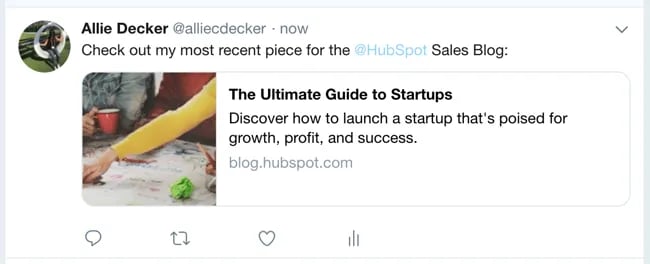
Your page URLs should be simple to digest for both readers and search engines. They are also important when keeping your site hierarchy consistent as you create subpages, blog posts, and other types of internal pages.

For example, in the above URL, "blog" is the sub-domain, "hubspot.com" is the domain, "sales" is the directory for the HubSpot Sales Blog, and "startups" indicates the specific path to that blog post.
9. Internal Linking
Internal linking is the process of hyperlinking to other helpful pages on your website. (See how the words "internal linking" are linked to another HubSpot blog post in the sentence above? That's an example.)
Internal linking is important for on-page SEO because internal links send readers to other pages on your website, keeping them around longer and thus telling Google your site is valuable and helpful.
Also, the longer visitors are on your website, the more time Google has to crawl and index your site pages. This ultimately helps Google absorb more information about your website and potentially rank it higher on the search engine results pages.
Download our free guide to Internal Linking for SEO.
10. Mobile Responsiveness
Google started favoring sites that are optimized for faster mobile speeds — even for desktop searches.
Mobile responsiveness matters.
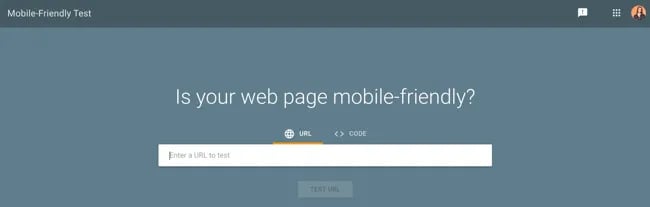
It's critical to choose a website hosting service, site design and theme, and content layout that's readable and navigable on mobile devices. If you're not sure about your own site's mobile readiness, use Google's Mobile-Friendly Test tool.
11. Site Speed
Whether viewed on a mobile device or desktop, your site must be able to load quickly. When it comes to on-page SEO, page speed counts big-time.
Google cares about user experience first and foremost. If your site loads slowly or haphazardly, it's likely your visitors aren't going to stick around — and Google knows that. Moreover, site speed can impact conversions and ROI.
Check your website's speed anytime using Google's PageSpeed Insights tool. If your website is movin' slow, check out 5 Easy Ways to Help Reduce Your Website’s Page Loading Speed.
Note: Mobile responsiveness and site speed are considered technical SEO, but I'm including them here because optimizing them creates a better on-page experience for visitors.

Now that we’ve covered the elements of on-page SEO, let’s dive into our checklist that you can use when optimizing individual pages on your website.
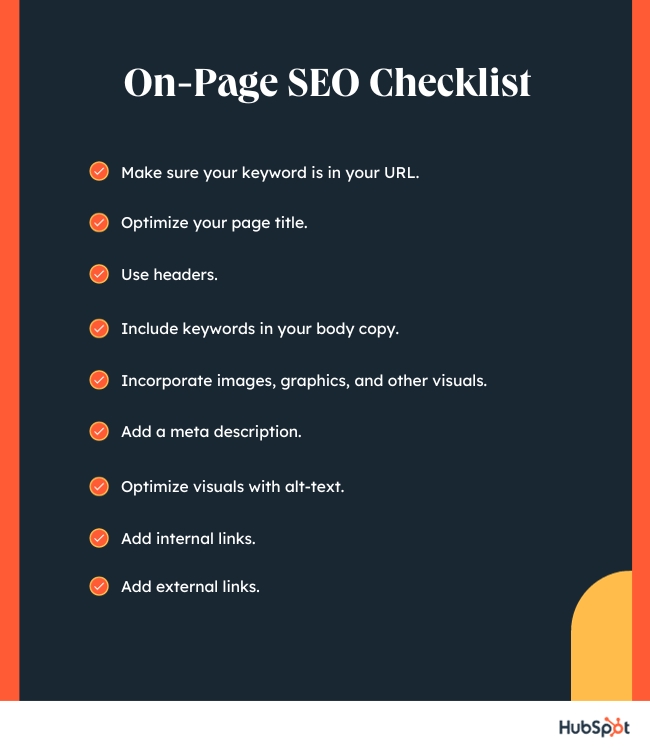
On-Page SEO Checklist
- Make sure your keyword is in your URL.
- Optimize your page title.
- Use headers.
- Include keywords in your body copy.
- Incorporate images, graphics, and other visuals.
- Add meta description.
- Optimize visuals with alt-text.
- Add internal links.
- Add external links.
1. Make sure your keyword is in your URL.
Add your target keyword to your URL so users and search engines know what kind of content they will find on the page.
For example, imagine you own a hot yoga studio called ADYoga. You have a web page that includes videos of your classes. The keyword for this page is "hot yoga online classes" — so, you'd want to include that keyword in your URL. The URL for this web page may look like this: www.ADyoga.com/hot-yoga-online-classes.
Here are a few tips on how to write SEO-friendly URLs:
- Remove the extra, unnecessary words.
- Use only one or two keywords.
Use HTTPS if possible, as Google now uses that as a positive ranking factor.
On-Page SEO Template
Save time with content planning and rank higher on Google with the help of this beginner-friendly SEO template.
- Organize your on-page SEO strategy
- Coordinate pages and keywords
- Implement key SEO elements
- Track changes and results all in one place
Download Free
All fields are required.
2. Optimize your page title.
Craft a descriptive title that includes your target keyword and accurately describes the page’s content.
Here are some best practices for when developing a page title:
- Keep it under 60 characters (per Google's update) to ensure that your titles display correctly. Although Google doesn't have an exact character limit, its display titles max out at 600 pixels. Keeping your titles at 60 characters or less ensures the title won't be cut off in search results.
- Don't stuff the title with keywords.
- Don't use all caps.
- Include your brand in the title, i.e. "The Ultimate Guide to On-Page SEO in 2022 — HubSpot Blog".
Check out our free data-driven guide to writing effective page titles.
3. Use headers.
Organize your content with header tags to make it more scannable and search-engine friendly.
Be sure to naturally incorporate important keywords in your headers, but choose different ones than what's in your page title. Put your most important keywords in your <h1> and <h2> headers.
4. Include keywords in your body copy.
In addition to your URL, title, and headers, you'll want to add your keyword throughout your web page(s). Sprinkle your keyword throughout your content as well where it fits naturally.
While keywords are both helpful and necessary for SEO, it’s important to avoid keyword stuffing. This is when you excessively repeat keywords or key phrases in your content with the intention of manipulating search engine rankings.
Keyword stuffing can be detrimental to your website and web page's SEO. Not only does keyword-stuffing present a spammy and tacky reading experience, but modern search engines are smarter than ever — they've been designed to specifically monitor for (and penalize!) content that's unnaturally stuffed with keywords.
5. Incorporate images, graphics, and other visuals.
Add engaging and relevant visuals to your content to break up large blocks of text and make it more visually appealing. Visuals can also help drive potential image search traffic.
To optimize images for on-page SEO, ensure they are appropriately compressed for faster loading times, use descriptive filenames, and provide informative alt tags. By doing so, you can enhance both the user experience and the visibility of your web pages in search engine results.
6. Add a meta description.
Write a compelling meta description that summarizes the page’s content and encourages users to click through from search results.
Here's what makes for a good meta description:
- Keep it under 160 characters, although Google has been known to allow longer meta descriptions. (Note
- Include your entire keyword or keyword phrase.
- Use a complete, compelling sentence (or two).
- Avoid alphanumeric characters like —, &, or +.
7. Optimize visuals with alt-text.
We talked earlier about image alt text. You'll want to optimize your visual content this way — and be sure to include your keyword in your image alt text. It'll help with the page's SEO as well as offer the potential to rank in image search (e.g. on a search engine image results page or image carousel).
Here's what to keep in mind when adding image alt-text:
- Make it descriptive and specific.
- Make it contextually relevant to the broader page content.
- Keep it shorter than 125 characters.
- Use keywords sparingly, and don't keyword stuff.
8. Add internal links.
Help search engines discover and understand the relationships between different pages on your website by adding internal links to your content.
To add internal links to your content, you’ll need to:
- Identify relevant anchor text. Determine the anchor text (the clickable text) that you want to use for your internal link. The anchor text should be descriptive and related to the content of the page you're linking to.
- Identify the target page. Determine the specific page on your website that you want to link to. Choose a page that is contextually relevant and provides additional value or information related to the current content.
- Place links strategically throughout the page. Aim for a reasonable number of links per page, ensuring they are contextually relevant and add value to the user experience. Avoid excessive linking, as it may be seen as spammy.
9. Add external links.
It may seem counterintuitive to include external links throughout your page considering we just covered multiple reasons why internal linking is so important for on-page SEO. However, external links are also important.
By externally linking to credible and trustworthy sites, Google will know your page is also credible and trustworthy. Not only does Google want to know your site is well-referenced, but your visitors do, too.
On-Page SEO Template
Save time with content planning and rank higher on Google with the help of this beginner-friendly SEO template.
- Organize your on-page SEO strategy
- Coordinate pages and keywords
- Implement key SEO elements
- Track changes and results all in one place
Download Free
All fields are required.
Now that you know how to make on-page optimizations for a single page, let's talk through the steps of auditing and improving your on-page SEO at scale.
How to Manage On-Page SEO at Scale
- Crawl your website.
- Conduct an SEO audit and define your site architecture.
- Update URLs, page titles, and meta descriptions.
- Track keywords and topics for each page.
- Establish value propositions for each page.
- Define your target audience.
- Plan new page titles.
- Add new meta descriptions.
- Review and edit page content as needed.
- Incorporate visual content.
- Add relevant links.
- Optimize for conversions.
If you've been in search of a solution for organizing and tracking the various on-page SEO elements, you're in luck. The HubSpot marketing team released an updated version of our On-Page SEO Template, an Excel document that allows you to coordinate pages and keywords — and track changes — all in one place.
Download Now: On-Page SEO Template
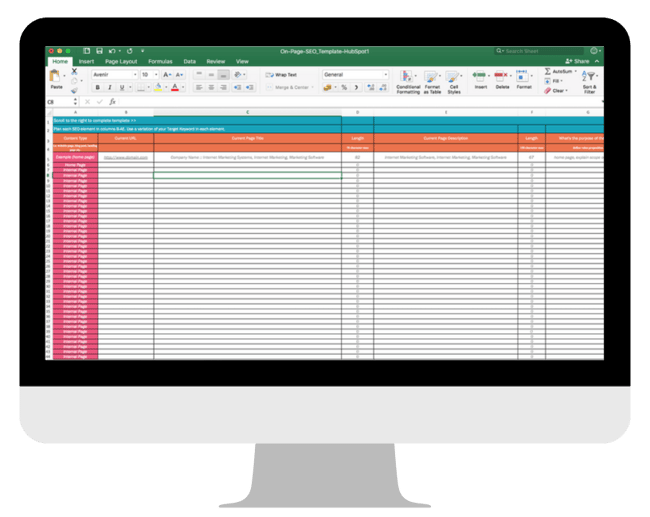
In this section, we'll be using this template as a guide as we walk you through a checklist for your on-page SEO management, step by step. Download the template now and follow along.
Note: The fictional website "http://www.quantify.ly" will be used as an example throughout this post. It's simply meant to help you imagine how your own website will fit into the template.
1. Crawl your website.
Get an overview of all of your website pages that search engines have indexed. For HubSpot customers, our Page Performance tool (under Reports) will allow you to do this. If you're not using HubSpot, you can try using a free tool like Xenu's link crawler.
After crawling your site and exporting the results into an Excel (or .csv) file, there will be three key columns of data that you should focus on:
- The web address (a.k.a. URL)
- The page title
- The page meta description
The URL should be pasted into column B, the page title into column C, and the description into column E.

2. Conduct an SEO audit and define your site architecture.
Now that you have a basic index of your site in the template, you'll want to organize and prioritize your web pages. Start by defining where within your site architecture your existing pages currently sit.
Do this in column A. Note whether a page is your homepage (ideally you'll only have one of those), a page in your primary (or secondary) navigation menu, an internal page, and so on.

3. Update URLs, page titles, and meta descriptions.
Review your current URLs, page titles, and meta descriptions to see if they need updating.
(This is the beauty of using a template to organize your SEO: You get a broad overview of the type of content you have on your website.)

Notice how column D and column F automatically calculate the length of each element. The recommended length for page titles is anything under 60 characters. (And, actually, a quick and easy optimization project is to update all page titles that are longer than 60 characters.)
The recommended length for page meta descriptions is 155-160 characters. This is the perfect length to ensure none of the description is cut off by the ellipses. Make sure you're not too repetitive with keywords in this space. Writing a good meta description isn't tough, but it deserves just as much consideration as the page content itself.
(Note: For some sites, you may also have to update the URLs, but that's not always the case and thus was not included as part of this optimization template.)
4. Track keywords and topics for each page.
Think of your target keyword as the designated topic for a particular page. If you're using the HubSpot template, In column O, define just one topic per page.

By doing this, you'll be able to go more in-depth and provide more detailed information about that topic. This also means that you are only optimizing for one keyword per page, meaning you have a greater chance to rank for that keyword.
Incorporating primary keywords throughout the page will ensure you optimize your content for the highest exposure on search engines. You should even optimize your pages around semantic keywords and primary keywords, this ensures search engines do not assume the context of the page.
For example, when you write a page around “Paris”, include semantic keywords like “Capital City of France”, “City of Love”, “Eiffel Tower”, etc. By including these semantic keywords there’s no room for assumption from search engines that the page is not about anything but Paris city in the country of France.
While you’re optimizing your existing pages for specific keywords, you also need content ideas that not only are engaging but also relevant to your keywords. Tools such as the Blog Topic Generator can not only suggest topics but also provide search volume data for the keywords you plan to use.
There are, of course, a few exceptions to this rule. Your homepage is a classic example. The goal of your homepage is to explain what your entire website is about, and thus you'll need a few keywords to do that. Another exception is overview pages like services and product pages, which outline what all of your products and services may be.
On-Page SEO Template
Save time with content planning and rank higher on Google with the help of this beginner-friendly SEO template.
- Organize your on-page SEO strategy
- Coordinate pages and keywords
- Implement key SEO elements
- Track changes and results all in one place
Download Free
All fields are required.
5. Establish value propositions for each page.
A very important next step, which is often overlooked, is establishing a value proposition for each page of your website. Each page should have a goal aside from just ranking for a particular term.
If you're using the template, you'll do this in column G.

6. Define your target audience.
Define your target audience — do you have a single buyer persona or multiple personas? Keep this persona in mind as you optimize your site's pages. (Remember, you are optimizing for humans, too — not just search engine robots.)
In column H of our template, you'll have the opportunity to define your page's target audience.

7. Plan new page titles.
Now that you've documented your existing page titles and have established value propositions and target audiences for each of your pages, write new page titles (if necessary) to reflect your findings.
You can do this in column K of the template — and double-check each title length in column L.

People usually follow the formula of "Keyword Phrase | Context." The goal of the page title is to lay out the purpose of the page without being redundant. You should also keep the additional recommendations we made above related to titles.
8. Add new meta descriptions.
As we covered above, meta descriptions should be a short, declarative sentence that incorporates the same keyword as your page's title.
It should not reflect the content verbatim as it appears on the page. Get as close as you can to the 150-character limit to maximize space and tell visitors as much as possible about your page.
If you need to create new meta descriptions, do so in column M of the template.

9. Review and edit page content as needed.
Good copy needs to be thorough, clear, and provide solutions ... so, be compelling! Write for your target audience and about how you can help them. Compelling content is also error-free, so double-check your spelling and grammar.
Aim to have at least 500 words per page, and format content to make it easier to read and digest with the use of headers and subheaders.
Columns P through R can be used to keep track of changes that you've made to your content or to note where changes need to be implemented.

10. Incorporate visual content.
Content can be more than just text, so consider what kind of visual content you can incorporate into each page (if it adds value and serves a purpose, of course). Columns S and T allow you to note which visual elements need to be added. When adding an image to a page, be sure to include a descriptive file name and image alt-text.

11. Add relevant links.
As mentioned earlier, incorporating links throughout your pages is a must, but it's often something that's easily overlooked.
Make sure that your anchor text includes more than just your keywords. The goal isn't to stuff in as many keywords as possible, but to make it easy for people to navigate your site.
You’ll want to regularly review your internal and external links to ensure they are still valid and point to the intended destination. Broken or outdated links can harm the user experience and SEO.
Use columns U through W to plan for these elements if you don't already have them, or to document how you'll improve them.

12. Optimize for conversions.
If you're also not optimizing your site to increase the number of leads, subscribers, and/or customers you're attracting ... you're doing it wrong.
Remember that each page of your website presents a conversion opportunity. That means every page of your website should include at least one call-to-action (CTA), though many pages may have multiple CTAs.
Columns X through AF allow you to plan for conversions.
Be sure that your site has a mix of CTAs for different stages of the flywheel.
(Note: The On-Page SEO Template refers to the stages of the buying funnel — top of the funnel, middle of the funnel, and bottom of the funnel. If you are a HubSpot customer, you can even use Smart Content to display these specific CTAs only to people in a specific part of the funnel.)
Also, as you add, edit, or update CTAs, be sure to note conversion rate changes in columns Z, AC, and AF.

Put Your On-Page SEO to Work
Once you finalize your SEO plans, implement these changes on your website or pass them along to someone to implement for you. This will take time to complete, so aim to work on 5 to 10 pages per week.
Remember: SEO is not a one-and-done deal. It's something you should continually improve upon. You should treat this On-Page SEO Template as a living, breathing document that will help guide your SEO strategy for months (or years) to come.
Editor's Note: This post was originally published in October 2012 and has been updated for freshness, accuracy, and comprehensiveness.
On-Page SEO Template
Save time with content planning and rank higher on Google with the help of this beginner-friendly SEO template.
- Organize your on-page SEO strategy
- Coordinate pages and keywords
- Implement key SEO elements
- Track changes and results all in one place
Download Free
All fields are required.





![The Anatomy of a Search-Friendly URL [Infographic]](http://53.fs1.hubspotusercontent-na1.net/hubfs/53/search-friendly-url-structure.jpeg)
![Want to Rank Better in Search? Avoid These 10 SEO Mistakes [Infographic]](http://53.fs1.hubspotusercontent-na1.net/hubfs/53/00-Blog_Thinkstock_Images/SEO_Mistakes_Infographic.jpeg)
![How to Easily Track Your On-Page SEO Strategy [Free Excel Template]](http://53.fs1.hubspotusercontent-na1.net/hubfs/53/00-Blog-Related_Images/seo-template-blog.png)