


Advances in Malaria Diagnostic Methods in Resource-Limited Settings: A Systematic Review
疟疾诊断方法在资源有限地区的进展:系统性综述

 ,
, 作者:阿库亚·K·亚利
 ,
, 1
、乔伊斯·奥克兰
2
、雅各布·E·科宾纳埃万杰琳·奥博代
艾萨克·K·扬克森
安娜·A·卡芬图-夸希
, 格洛丽亚·阿梅加彻
1
,艾萨克·阿尼姆-拜多 and 1 ,尼古拉斯·I·尼-特雷比
1,*
和戴安娜·A·普拉 加纳大学科勒布校区生物医学与辅助健康科学学院医学检验科学系,邮政信箱 KB 143,阿克拉
生物医学科学系,联合健康科学学院,海岸角大学,PMB,加纳海岸角
加纳大学野口纪念医学研究所病毒学系,加纳阿克拉邮政信箱 LG 581
CSIR-建筑与道路研究所,加纳库马西,邮政信箱 UP40
加纳大学传染病病原体细胞生物学西非研究中心,邮政信箱 LG 54,加纳阿克拉莱贡
阿克拉技术大学应用科学学院科学实验室技术系 加纳阿克拉巴恩斯路邮政信箱 GP 561
应向其发送通信的作者。
《热带医学与传染病》2024 年第 9 卷第 9 期第 190 页;https://doi.org/10.3390/tropicalmed9090190
收稿日期:2024 年 6 月 27 日 / 修回日期:2024 年 7 月 31 日 / 录用日期:2024 年 8 月 19 日 / 发布日期:2024 年 8 月 23 日
(本文属于"疟疾流行病学、检测与治疗"特刊)
Abstract 摘要
疟疾持续对全球健康构成挑战,其消除问题始终是公共卫生讨论的核心议题。实现疟疾消除的关键在于对寄生虫(尤其是无症状感染者)的早期精准检测,因此改进诊断方法的重要性再怎么强调都不为过。本文综述了近年来疟疾诊断工具与检测方法的进展,重点比较了这些先进诊断技术在低收入/中低收入国家与发达经济体的应用差异。研究检索了 Google Scholar、PUBMED、多学科数字出版机构(MDPI)等科学数据库。结果表明:从快速诊断检测(RDTs)、分子检测技术到先进的无创检测方法和计算机化技术,疟疾检测领域已取得重要突破。值得注意的是,分子检测、RDTs 和计算机化检测在资源有限地区也已投入实际应用。 在总共八十个中低收入国家中,仅有二十一个国家(26%)显示出采用了现代疟疾诊断方法的证据。各国政府及相关机构亟需将工作重点转向疟疾研究,以加速全球消除疟疾的进程,特别是在通常资源有限的疟疾流行地区。
关键词:疟疾;聚合酶链式反应(PCR);环介导等温扩增(LAMP);诊断方法
1. Introduction 1. 引言
疟疾消除已成为过去十余年公共卫生讨论的核心议题。尽管属于热带地区流行的寄生虫感染,疟疾的影响却极为深远,至今仍是全球性健康威胁。世界卫生组织 2023 年度报告显示,2022 年全球疟疾病例数攀升至约 2.49 亿例,较 2021 年新增 500 万病例[1]。虽然各国持续实施防控策略并付出不懈努力,但要实现全球范围内(尤其是撒哈拉以南非洲等疟疾流行区本土国家——这些地区集中了绝大多数病例[2])彻底消除这种寄生虫感染,仍需付出更多努力。
消除疟疾的核心在于对这种寄生虫感染进行早期、准确的检测、定量和鉴别,尤其是在无症状人群中。无症状的疟原虫感染者虽未表现出临床症状,却作为寄生虫储存库存在,对疟疾在全球范围内的传播构成重大威胁[3]。值得注意的是,传统诊断技术往往会漏诊大多数这类无症状感染。因此,亟需建立可靠、灵敏且特异的诊断或检测方法,这些方法也将有助于监测疟疾传播的下降趋势[4]。
近年来,疟疾诊断技术虽取得进展,但实验室基础设施匮乏、运营成本高昂、电力供应需求以及专业操作技能等因素,阻碍了这些先进技术在绝大多数疟疾流行地区的推广应用。分子检测技术尤其如此,这类检测不仅费用特别昂贵,还面临疟疾及其他传染病共有的多重挑战[5]。世界卫生组织将显微镜检查(薄/厚血膜法)列为首要检测方法[6]。尽管显微镜检查应用广泛,却无法有效检出低原虫血症——这对实现有效治疗及后续消除寄生虫感染至关重要[7]。此外,该检测流程繁琐,需要大量专业知识和经验才能确保诊断准确性[4,8]。其他争议还包括该技术的侵入性操作(需通过疼痛的针刺采集血样),而准确诊断却仅依赖于实验室人员的主观判断。 在多个发展中国家,缺乏准确检测所需的专业知识、设备和物资;因此,存在更高的污染和误诊风险[9]。此外,随着传播率下降,区分低水平感染变得更加不可靠和困难;因此,在考虑消除疟疾时,需要采用替代检测方法[4]。
是否存在一种更快、更特异且更灵敏的疟疾检测方法,能够轻松在资源有限地区实施?这仍是全球科学家共同关注的问题。随着能够早期检测和区分极微量疟疾感染技术的出现,人类是否有望消除疟疾并挽救更多生命?人类是否可能实现无针疟疾检测、即时诊断设备和个性化疟疾药物的突破?根据世界银行数据,对于分别有 26 个和 54 个的低收入及中低收入国家(表 1),这些地区能否获得此类高效诊断工具[10]?值得注意的是,根据 2023 年世卫组织报告[1](表 1),其中 11 个全部位于撒哈拉以南非洲的国家承担着全球 70%的疟疾负担。上述问题仅是萦绕在科学家心头、推动相关研究的诸多疑问中的一小部分。
表 1. 2024 年世界银行定义的低收入及中低收入经济体国家分类[1,10]。该表格将所有资源有限国家划分为低收入(上部)和中低收入(下部)国家,并特别标注了共同承担全球 70%疟疾负担的 11 个国家(右侧部分)。

随后,多年来已开发出多种技术以应对金标准技术中的部分挑战。快速诊断检测(RDTs)具有快速可靠的特点。疟疾 RDTs 无需专业人员操作或持续电力供应,但与疟疾显微镜检查相比,其成本较高、保质期较短且仅能提供定性结果[11]。其他诊断技术如酶联免疫吸附试验(ELISA)、侧流免疫层析(LFIA)、微阵列、适配体生物传感器、基因组测序、环介导等温扩增(LAMP)、巢式 PCR、实时荧光定量 PCR 以及基于定量核酸序列的扩增技术,通常仅用于研究和监测目的。相较于显微镜检查和 RDTs,这些技术在疟疾诊断方面具有更高的敏感性和特异性。尽管如此,其中部分技术在资源有限地区实施时仍存在操作繁琐且成本高昂的问题。
本系统综述从主要优缺点及适用国家维度,对比分析了传统与现代疟疾诊断技术,重点关注中低收入国家的应用情况。同时将着重探讨分子诊断技术的普及程度——这类技术往往在资源有限地区(通常也是疟疾流行区)的应用现状。
2. Materials and Methods 2. 材料与方法
为确保本系统综述结果的准确性与可靠性,研究团队严格遵循《系统评价与荟萃分析优先报告条目》(PRISMA)指南开展工作。本综述已在开放科学框架数据库注册(注册号:https://doi.org/10.17605/OSF.IO/DV6Z3,访问日期 2024 年 6 月 28 日)。由于文献检索工作完成于 2023 年初,所有必要数据均来自 2022 年及之前发表的期刊论文与数据库资料。检索采用的核心关键词包括:"疟疾检测方法"、"疟疾新兴技术"、"疟疾检测/诊断最新进展"、"疟疾诊断新兴方法"、"传统疟疾检测手段"、"疟疾即时检测设备"、"无创/无针疟疾检测"以及"个性化疟疾诊疗"。通过谷歌学术、PUBMED 和 MDPI 等数据库及期刊平台,我们获取了大量相关文献资料。
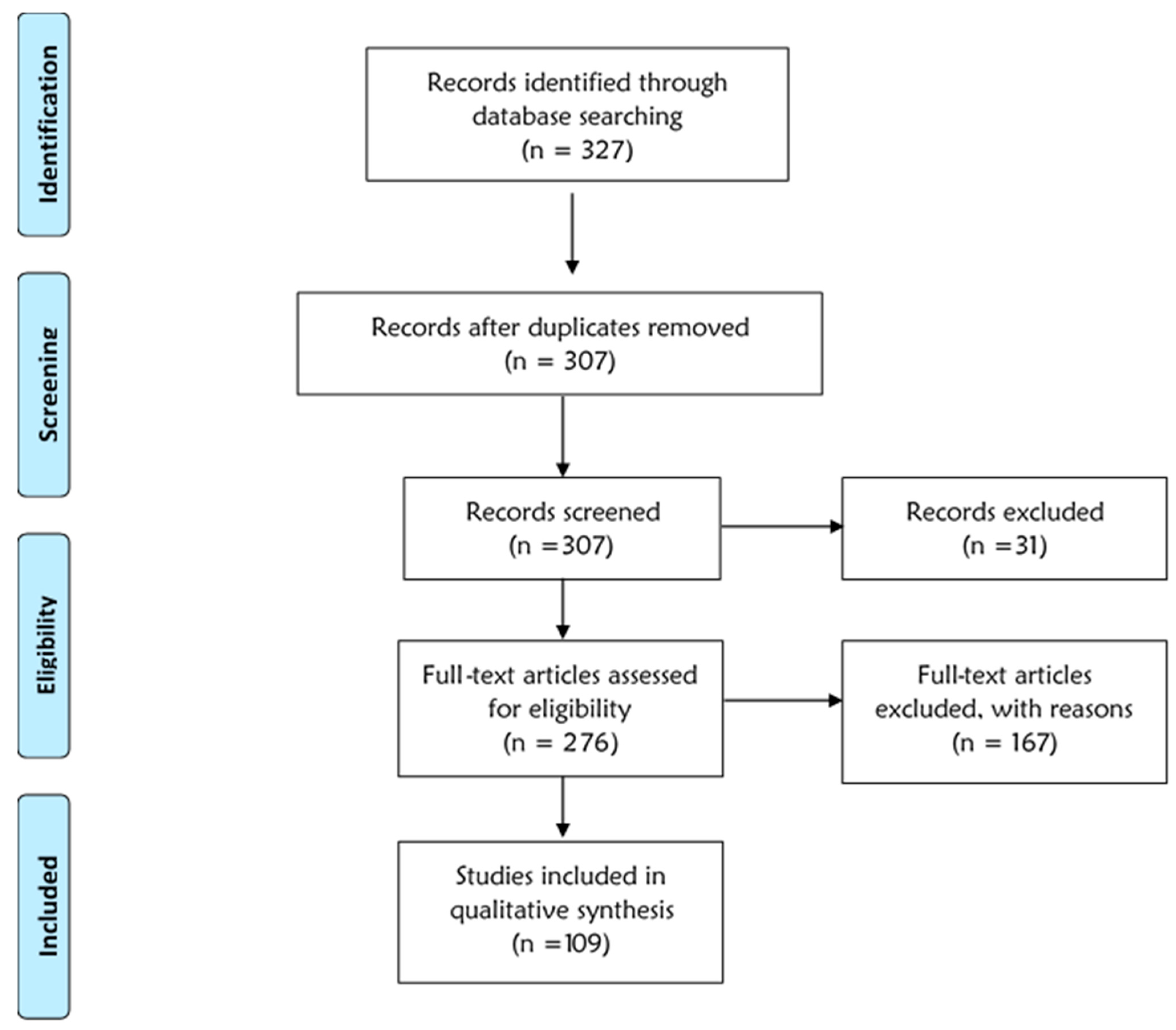
从各数据库中共识别出 327 篇文献。经过检索后,对出版物进行整理以去除重复项,移除了 20 篇文献。进一步筛选记录以排除所有不完整、未发表的文章以及不符合条件的出版物。考虑到近年发表的文章,所有可获取的出版物均被列为备选,排除了需要购买、受限制或无法直接获取完整论文 PDF 版本的期刊文章。
在摘要筛选阶段,根据以下通用标准选择文章:研究采用传统或现代疟疾检测诊断方法。共获得 276 篇文章,将其上传至 Mendeley 文献管理器和 Endnote 软件,并仔细审查全文资格与结果呈现情况。
在这些文献中,部分研究探讨了传统检测方法,而大多数则聚焦于各类现代检测技术。另有部分文献因涉及"疟疾检测新兴技术"或"疟疾检测进展"等主题研究或综述,被用于本综述的其他章节。经过全面筛选后,167 篇文献因不符合综述标准被剔除(剔除原因包括:发表时间早于 2014 年[针对待分析文献]、未专门研究疟疾诊断工具、获取版本非最终发表稿、研究范围与内容不明确或未聚焦可行的疟疾检测方法),最终保留 109 篇文献进行评述。值得注意的是,部分单篇出版物中识别出多种疟疾检测方法,因此所鉴定的检测方法数量超过了实际采用的出版物数量。图 1 展示了文献筛选流程。

3. Results 3. 结果
3.1. Traditional Methods Used for Malaria Detection
3.1 疟疾检测的传统方法
下表 2 总结了传统疟疾检测方法,详细说明了这些方法的操作流程及其诊断应用的优缺点。尽管近年来已开发出诸多创新检测技术,但采用厚薄血片结合吉姆萨染色的显微镜检查法,仍是诊断疟原虫感染的金标准[8,12]。
3.2. Modern Methods Used for Malaria Detection
3.2. 资源有限地区疟疾诊断方法进展:系统综述
在有效治疗疟疾并逐步实现消除疟疾的目标驱动下,各种疟疾诊断工具和检测方法得以发展(4)。表 3 和表 4 列出了近年来(不早于 2014 年)开发或应用的疟疾诊断新方法及其使用地区。这些诊断方法差异显著,涵盖从生物传感器、分子检测到计算机算法和自动化分析仪等多种技术。每种诊断方法的优势与局限性均被纳入考量,并概述了其实施流程。
表 3. 用于疟疾检测的现代(基于 PCR/LAMP)方法及其在发达国家应用证据
表 4. 用于疟疾检测的现代(非 PCR/非 LAMP 技术)方法及其在发达国家应用证据
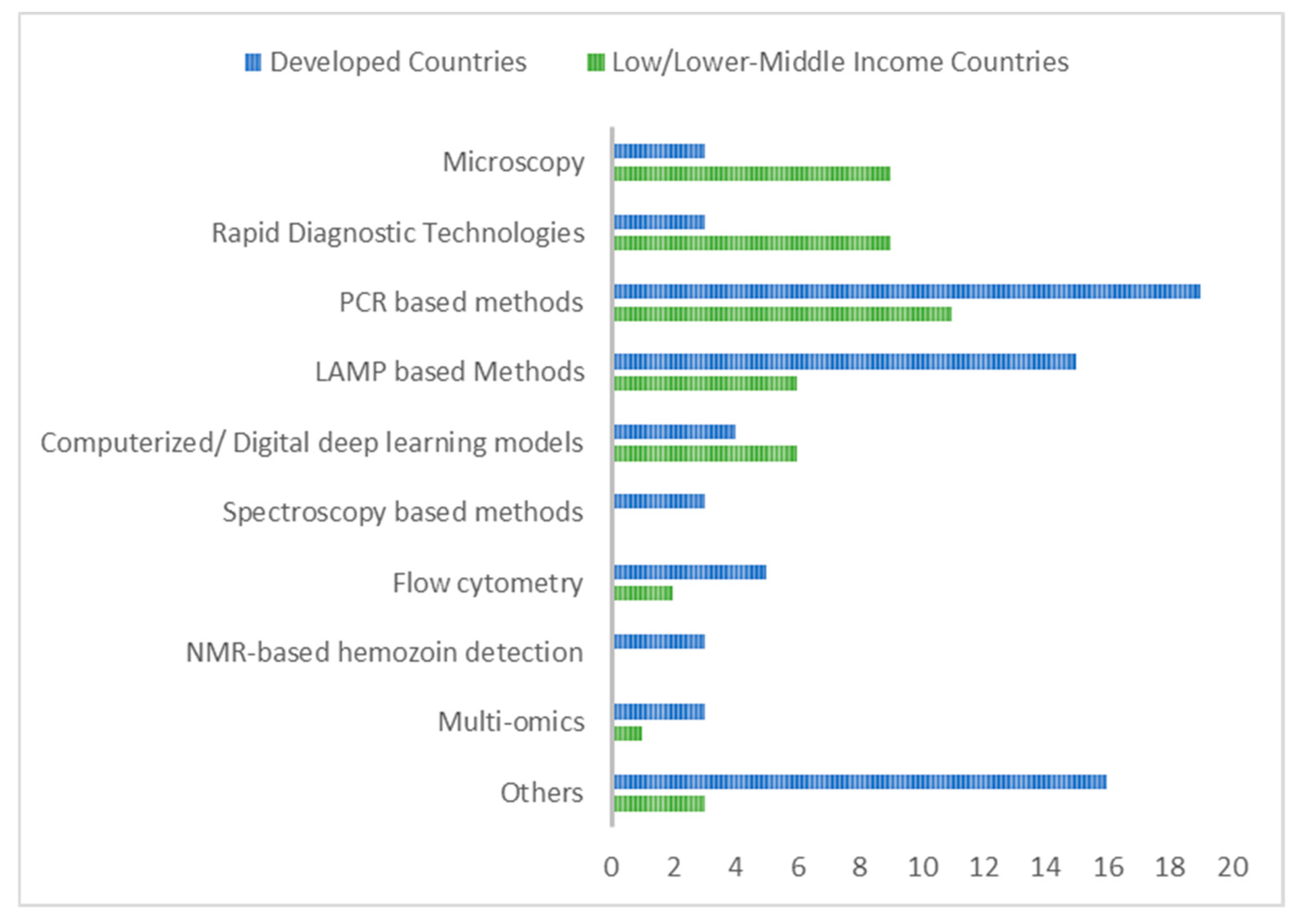
表 5 分析了在资源往往有限的中低收入国家使用一些最新开发的检测工具的证据。出版物中最常出现的检测类型是 PCR 技术(11 项),其次是 RDT 检测(9 项),然后是 LAMP 技术和计算机化/数字深度学习技术(各 6 项)。总共有 21 个国家发表了采用现代疟疾诊断方法的出版物。
表 5. 中低收入国家采用现代疟疾检测方法的证据。
图 2 以图形方式呈现了所纳入研究中报告的各种疟疾检测方法,展示了哪些诊断趋势受到广泛研究、更频繁使用或获得较多研究关注。该图表反映了 2014 年至 2022 年间研究的疟疾诊断技术发展情况。基于 PCR 的方法和基于 LAMP 的方法是最主流的检测技术。

4. Discussion 4. 讨论
实现疟疾有效控制、治疗及最终消除的关键在于及时检测寄生虫感染。面对这一威胁性感染,需要持续进展与创新研究,从而开发出有助于抗击疟疾的新工具[117]。本文综述了疟疾诊断方法的最新进展及其在即时检测和个性化疟疾护理中的应用潜力,特别关注了这些方法在经济欠发达国家中的使用情况。
本综述的研究结果表明,近期疟疾诊断技术取得了重大进展。全球众多科学家的研究已从改进疟疾显微镜技术,发展到开发更精准的分子、免疫学、计算机化、数字化检测方法,以及自动化分析仪和即时检测设备。研究表明,这种古老传染病对全球健康的影响促使人们设计出更高效的诊断方法,重点开发适用于资源有限地区的即时检测设备[7]。要实现消除疟疾的积极目标,必须采用能够检测低水平寄生虫感染的早期诊断方法[3]。
如表 2、表 3、表 4 和表 5 所示,本综述结果表明当前正在使用或研究的疟疾检测方法包括传统方法、基于聚合酶链反应(PCR)的分子技术、环介导等温扩增(LAMP)检测法,以及机器学习/计算机化技术(利用疟原虫感染红细胞的物理和/或生物学特性来增强疟疾诊断)等。图 2 展示了近十年发表文献中各类检测方法的使用频率。目前还有多项其他技术和化学检测法正在研发中以应对疟疾负担。如表 5 和图 2 所示,在资源有限地区,快速诊断检测(RDTs)属于常用或重点研究的现代方法之一,这并不令人意外,因其成本相对较低且易于操作。
研究证实基于 PCR 的技术因其高灵敏度且能检测极低寄生虫血症水平而在全球广泛应用[3,22,35]。聚合酶链式反应主要利用从全血或其他样本中提取的 DNA 进行操作。该过程包括变性、扩增和延伸步骤,之后可评估检测的灵敏度和特异性[35]。研究表明在相同反应参数下,PCR 方法可诊断所有五种疟原虫寄生感染[35]。我们的研究结果显示过去十年已开发或使用了多种 PCR 检测方法,这些方法操作简便且能提供更快速准确的结果[22]。此外,基于 PCR 的检测方法因多项优势被广泛采用,包括可同步进行虫种特异性检测与定量分析、更高灵敏度、更强特异性、耗时更少、操作简便以及能诊断亚临床感染等[13,18,22,23,41,42]。
尽管 PCR 是一种有效的疟疾检测方法,但由于需要昂贵的实验室设备和专业技术人员,其在资源有限地区和即时检测场景中的应用价值受限[3]。尽管如此,如表 5 和图 2 所示,包括部分非洲国家在内的资源有限地区仍有大量研究采用基于 PCR 的技术[13,16,18,23,25,29,35,36,37,38,40]。其他先进 PCR 技术(如实验室芯片实时 PCR(LRP)和毛发 qPCR)被发现适用于即时检测或资源有限环境,但目前尚未发现前者在低收入或中低收入国家应用或研究的证据[29,31]。Gómez-Luque 等学者指出,鉴于观察到的局限性,需要更多研究来确认毛发 qPCR 作为疟疾检测高效技术的可行性[29]。毛发 qPCR 相较于其他 PCR 类型的优势在于使用非侵入性样本。而 LRP 凭借高灵敏度、高特异性和较低成本,将为疟疾流行国家的诊断与防控提供重要帮助[31]。
基于 LAMP 技术的检测方法在疟疾诊断研究中同样占据主导地位。如表 3 所示,多项研究证实了各类 LAMP 检测技术的开发与应用,这些技术都是有效的疟疾诊断手段[118]。Rei Yan 等学者对 LAMP 检测技术进行综述后发现,该技术在临床专业知识和分子生物学设备获取受限的地区易于实施。改良型 LAMP 检测技术——包括结合试纸条 DNA 色谱的多重 LAMP、高通量 LAMP、18S rRNA LAMP、联合侧流层析检测(LFD)的介导 LAMP 等——具有高灵敏度、操作简便、结果稳定、使用便捷、成本效益显著等优势,适用于即时检测场景[55,56,58,59],为实现个性化医疗提供了技术路径。表 5 列举了 LAMP 技术在低收入和中低收入国家(包括疟疾流行的撒哈拉以南非洲地区)开发与应用的相关证据[45,48,56,57,58,59]。
其他值得注意的分子检测方法因其兼具即时检测或操作简便特性,包括基于核磁共振(NMR)的血红素检测、超亮表面增强拉曼散射纳米摇铃技术、重组酶辅助扩增结合侧流层析试纸条检测法以及染料偶联适体捕获酶催化分析法[86,104,105,110,111,112]。尽管后两种方法因成本低廉可用于资源有限地区,但研究发现仅染料偶联适体捕获酶催化分析法在印度得到应用[104]。Veiga 和 Peng 指出基于核磁共振的血红素检测技术有望实现无针诊断,为个性化疟疾治疗(即根据个体特征定制治疗方案)提供可能[119]。该技术可检测表型变异——由遗传多样性、宿主-寄生虫相互作用或环境因素等导致的同种寄生虫间可观察特征差异[120,121]。 例如,存在耐药变异株、表面抗原变异株以及具有不同临床表现的变异株等[121, 122, 123]。检测此类变异株的能力将提高诊断准确性,并对抗寄生虫耐药性具有重要价值。随着变异株持续增加,获取这些具有时间特异性和患者特异性的表型标识符是实现个性化疟疾治疗的基础步骤[119]。与基于核酸扩增的基因组分析方法相比,利用核磁共振技术进行表型变异检测的一个优势在于某些设备的检测速度极快[110]。遗憾的是,根据所综述研究文章中的已发表数据,目前没有证据表明此类方法在低收入和中低收入国家得到应用。
此外,多种可实现即时诊断的新技术相继涌现。与传统显微镜检测和常用快速诊断试纸不同,部分新技术被证实具有高灵敏度、样本采集无创性以及成本效益优势,尽管尚无证据表明这些高性价比方法已在经济欠发达地区得到应用[85,95,99,100,101,102]。除上述技术外,Aggarwal 等学者将组学诊断技术归类为疟疾诊断与消除领域的另一重要范畴[124]。多组学技术通过整合基因组学、蛋白质组学、代谢组学、表型组学和转录组学,筛选最适合疾病诊断与治疗的生物标志物。尽管各类组学技术均存在局限性,但多组学联用能更全面地解析疟疾感染机制,从而催生更有效的治疗方案[124]。本综述发现,印度是唯一应用多组学技术的发展中经济体,未见非洲国家相关报道。
5. Conclusions 5. 结论
根据文献综述,现有充分证据表明疟疾检测诊断技术将在未来十年及更长时间内朝着无创检测方向取得重大进展。然而这一进步需要对疟疾感染的各类分子标识物和表型变异特征开展更深入、细致且针对性的研究,同时提升现代化即时诊断工具的准确性、精密度和特异性。由此可见,个性化医疗在疟疾治疗中的应用已奠定基础。尽管如此,传统薄/厚血片镜检和快速诊断试纸条仍将在疟疾精准检测中发挥重要作用,特别是在医疗资源有限、现代化诊断工具匮乏且缺乏先进疟疾检测方法研究的地区。值得欣慰的是,包括非洲国家在内的这些地区已开始应用基于 PCR 和 LAMP 技术的检测方法,但撒哈拉以南非洲地区尚未推广其他现代化分子/即时检测技术。 本研究发现,在八十个低收入和中低收入国家中,约四分之一(26%)采用了最先进的疟疾诊断方法。这凸显出各国政府、非政府组织和资助机构亟需加强疟疾诊断和研究工作,以推进疟疾防治进程。
Author Contributions 作者贡献
研究构思:A.K.Y.;方法设计:A.K.Y.、J.O.和 J.E.C.;软件开发:A.K.Y.和 J.O.;验证:A.K.Y.、J.O.、J.E.C.、N.I.N.-T.、E.O.、I.K.Y.、A.A.K.-K.、G.A.、I.A.-B.和 D.A.P.;形式分析:A.K.Y.和 J.O.;调查:A.K.Y.、J.O.和 J.E.C.;资源提供:A.K.Y.、J.O.、J.E.C.、N.I.N.-T.、E.O.、I.K.Y.、A.A.K.-K.、G.A.、I.A.-B.和 D.A.P.;初稿撰写:A.K.Y.、J.O.和 J.E.C.;文稿审阅与编辑:A.K.Y.、J.O.、J.E.C.、N.I.N.-T.、E.O.、I.K.Y.、A.A.K.-K.、G.A.、I.A.-B.和 D.A.P.;资金获取:A.K.Y.、N.I.N.-T.、E.O.、I.K.Y.、A.A.K.-K.、G.A.、I.A.-B.和 D.A.P.。所有作者均已阅读并同意最终稿件版本。
Funding 资金支持
本综述研究未接受任何外部资助。
Institutional Review Board Statement
机构审查委员会声明
Informed Consent Statement
知情同意声明
Data Availability Statement
数据可用性声明
Conflicts of Interest 利益冲突
作者声明无利益冲突。
References 参考文献
- WHO. World Malaria Report. 2023. Available online: https://www.who.int/publications/i/item/9789240086173 (accessed on 19 July 2024).
世界卫生组织.《世界疟疾报告》.2023 年.在线访问:https://www.who.int/publications/i/item/9789240086173(访问日期:2024 年 7 月 19 日) - Tetteh-Quarcoo, P.B.; Dayie, N.T.; Adutwum-Ofosu, K.K.; Ahenkorah, J.; Afutu, E.; Amponsah, S.K.; Abdul-Rahman, M.; Kretchy, J.-P.; Ocloo, J.Y.; Nii-Trebi, N.I. Unravelling the perspectives of day and night traders in selected markets within a sub-saharan african city with a malaria knowledge, attitude and practice survey. Int. J. Environ. Res. Public Health 2021, 18, 3468. [Google Scholar] [CrossRef]
Tetteh-Quarcoo, P.B.; Dayie, N.T.; Adutwum-Ofosu, K.K.; Ahenkorah, J.; Afutu, E.; Amponsah, S.K.; Abdul-Rahman, M.; Kretchy, J.-P.; Ocloo, J.Y.; Nii-Trebi, N.I. 通过疟疾知识态度行为调查揭示撒哈拉以南非洲城市选定市场中昼夜商贩的认知差异.《国际环境研究与公共健康期刊》2021 年第 18 卷,第 3468 页。[ Google Scholar ] [ CrossRef ] - Zheng, Z.; Cheng, Z. Advances in molecular diagnosis of malaria. Adv. Clin. Chem. 2017, 80, 155–192. [Google Scholar]
郑志;程志。疟疾分子诊断技术进展。临床化学进展。2017 年,第 80 卷,155-192 页。[谷歌学术] - malERA Consultative Group on Diagnoses and Diagnostics. A research agenda for malaria eradication: Diagnoses and diagnostics. PLoS Med. 2011, 8, e1000396. [Google Scholar]
疟疾根除诊断与诊断技术咨询组。疟疾根除研究议程:诊断与诊断技术。公共科学图书馆·医学。2011 年,第 8 卷,e1000396。[谷歌学术] - Yalley, A.K.; Ahiatrogah, S.; Kafintu-Kwashie, A.A.; Amegatcher, G.; Prah, D.; Botwe, A.K.; Adusei-Poku, M.A.; Obodai, E.; Nii-Trebi, N.I. A systematic review on suitability of molecular techniques for diagnosis and research into infectious diseases of concern in resource-limited settings. Curr. Issues Mol. Biol. 2022, 44, 4367–4385. [Google Scholar] [CrossRef] [PubMed]
亚利,A.K.;阿希亚特罗加,S.;卡芬图-夸希,A.A.;阿梅加彻,G.;普拉,D.;博特韦,A.K.;阿杜塞-波库,M.A.;奥博代,E.;尼-特雷比,N.I.。资源有限地区传染病诊断与研究分子技术适用性的系统评价。分子生物学当前问题。2022 年,第 44 卷,4367-4385 页。[谷歌学术] [交叉引用] [PubMed] - WHO. Global Malaria Program. 2024. Available online: https://www.who.int/teams/global-malaria-programme/case-management/diagnosis/microscopy (accessed on 10 June 2024).
世界卫生组织。全球疟疾规划。2024 年。在线访问:https://www.who.int/teams/global-malaria-programme/case-management/diagnosis/microscopy(访问于 2024 年 6 月 10 日)。 - Krampa, F.D.; Aniweh, Y.; Awandare, G.A.; Kanyong, P. Recent progress in the development of diagnostic tests for malaria. Diagnostics 2017, 7, 54. [Google Scholar] [CrossRef] [PubMed]
克拉姆帕,F.D.;阿尼维,Y.;阿万达尔,G.A.;坎永,P. 疟疾诊断检测方法的最新进展。《诊断学》2017 年第 7 卷第 54 页。[谷歌学术] [交叉引用] [PubMed] - Singh, K.; Bharti, P.K.; Devi, N.C.; Ahmed, N.; Sharma, A. Plasmodium malariae Detected by Microscopy in the International Bordering Area of Mizoram, a Northeastern State of India. Diagnostics 2022, 12, 2015. [Google Scholar] [CrossRef]
辛格,K.;巴尔蒂,P.K.;德维,N.C.;艾哈迈德,N.;夏尔马,A. 显微镜检测印度东北部米佐拉姆邦国际边境地区的三日疟原虫。《诊断学》2022 年第 12 卷第 2015 页。[谷歌学术] [交叉引用] - Edwards, H. Tales from the bench: Laboratory diagnosis of malaria. Trop. Dr. 2011, 41, 106–107. [Google Scholar] [CrossRef] [PubMed]
爱德华兹,H. 实验室轶事:疟疾的实验室诊断。《热带医生》2011 年第 41 卷第 106-107 页。[谷歌学术] [交叉引用] [PubMed] - Worldbank. World Bank Country and Lending Groups. 2024. Available online: https://datahelpdesk.worldbank.org/knowledgebase/articles/906519-world-bank-country-and-lending-groups (accessed on 13 May 2024).
世界银行。世界银行国家与贷款类别。2024 年。在线访问:https://datahelpdesk.worldbank.org/knowledgebase/articles/906519-world-bank-country-and-lending-groups(访问日期:2024 年 5 月 13 日)。 - Azikiwe, C.C.; Ifezulike, C.; Siminialayi, I.; Amazu, L.U.; Enye, J.; Nwakwunite, O. A comparative laboratory diagnosis of malaria: Microscopy versus rapid diagnostic test kits. Asian Pac. J. Trop. Biomed. 2012, 2, 307–310. [Google Scholar] [CrossRef] [PubMed]
Azikiwe, C.C.; Ifezulike, C.; Siminialayi, I.; Amazu, L.U.; Enye, J.; Nwakwunite, O. 疟疾实验室诊断方法比较:显微镜检查与快速诊断试剂盒。Asian Pac. J. Trop. Biomed. 2012, 2, 307–310. [ Google Scholar] [ CrossRef] [ PubMed] - Iqbal, J.; Hira, P.R.; Al-Ali, F.; Khalid, N.; Sher, A. Modified Giemsa staining for rapid diagnosis of malaria infection. Med. Princ. Pract. 2003, 12, 156–159. [Google Scholar] [CrossRef]
Iqbal, J.; Hira, P.R.; Al-Ali, F.; Khalid, N.; Sher, A. 改良吉姆萨染色法快速诊断疟疾感染。Med. Princ. Pract. 2003, 12, 156–159. [ Google Scholar] [ CrossRef] - Nadeem, M.F.; Khattak, A.A.; Yaqoob, A.; Awan, U.A.; Zeeshan, N. Assessment of Microscopic detection of Malaria with Nested Polymerase Chain Reaction in War-torn Federally Administered Tribal Areas of Pakistan. Acta Parasitol. 2021, 66, 1186–1192. [Google Scholar] [CrossRef]
Nadeem, M.F.; Khattak, A.A.; Yaqoob, A.; Awan, U.A.; Zeeshan, N. 巴基斯坦联邦直辖部落区战乱环境中疟疾显微镜检测与巢式聚合酶链反应评估。Acta Parasitol. 2021, 66, 1186–1192. [ Google Scholar] [ CrossRef] - Awosolu, O.B.; Yahaya, Z.S.; Farah Haziqah, M.T. Efficacy of Plasmodium falciparum histidine-rich protein 2 (Pfhrp 2) rapid diagnostic test (RDT) and microscopy in the detection of falciparum malaria among symptomatic patients in Akure, Nigeria. Trop. Biomed. 2022, 39, 144–149. [Google Scholar] [CrossRef] [PubMed]
Awosolu, O.B.; Yahaya, Z.S.; Farah Haziqah, M.T. 尼日利亚阿库雷地区症状患者中恶性疟原虫富组氨酸蛋白 2 快速诊断试剂盒与显微镜检测恶性疟的效果评估。Trop. Biomed. 2022, 39, 144–149. [ Google Scholar] [ CrossRef] [ PubMed] - Badiane, A.; Thwing, J.; Williamson, J.; Rogier, E.; Diallo, M.A.; Ndiaye, D. Sensitivity and specificity for malaria classification of febrile persons by rapid diagnostic test, microscopy, parasite DNA, histidine-rich protein 2, and IgG: Dakar, Senegal 2015. Int. J. Infect. Dis. 2022, 121, 92–97. [Google Scholar] [CrossRef]
巴迪亚内, A.; 斯温, J.; 威廉姆森, J.; 罗吉尔, E.; 迪亚洛, M.A.; 恩迪亚耶, D. 快速诊断检测、显微镜检查、寄生虫 DNA、富组氨酸蛋白 2 和 IgG 对发热患者疟疾分类的敏感性与特异性:塞内加尔达喀尔 2015 年研究。国际传染病杂志 2022 年第 121 卷,92-97 页。[谷歌学术] [CrossRef] - Fontecha, G.; Escobar, D.; Ortiz, B.; Pinto, A.; Serrano, D.; Valdivia, H.O. Field Evaluation of a Hemozoin-Based Malaria Diagnostic Device in Puerto Lempira, Honduras. Diagnostics 2022, 12, 1206. [Google Scholar] [CrossRef] [PubMed]
丰特查, G.; 埃斯科瓦尔, D.; 奥尔蒂斯, B.; 平托, A.; 塞拉诺, D.; 瓦尔迪维亚, H.O. 基于疟原虫血红素诊断设备在洪都拉斯莱姆皮拉港的现场评估。诊断学 2022 年第 12 卷,1206 页。[谷歌学术] [CrossRef] [PubMed] - Ahmad, A.; Soni, P.; Kumar, L.; Singh, M.P.; Verma, A.K.; Sharma, A.; Das, A.; Bharti, P.K. Comparison of polymerase chain reaction, microscopy, and rapid diagnostic test in malaria detection in a high burden state (Odisha) of India. Pathog. Glob. Health 2021, 115, 267–272. [Google Scholar] [CrossRef] [PubMed]
艾哈迈德, A.; 索尼, P.; 库马尔, L.; 辛格, M.P.; 维尔马, A.K.; 夏尔马, A.; 达斯, A.; 巴蒂, P.K. 聚合酶链反应、显微镜检查与快速诊断检测在印度高负担地区(奥里萨邦)疟疾诊断中的比较。全球病原体与健康 2021 年第 115 卷,267-272 页。[谷歌学术] [CrossRef] [PubMed] - Ugah, U.I.; Alo, M.N.; Owolabi, J.O.; Okata-Nwali, O.D.G.; Ekejindu, I.M.; Ibeh, N.; Elom, M.O. Evaluation of the utility value of three diagnostic methods in the detection of malaria parasites in endemic area. Malar. J. 2017, 16, 189. [Google Scholar] [CrossRef] [PubMed]
乌加, U.I.; 阿洛, M.N.; 奥沃拉比, J.O.; 奥卡塔-纳瓦利, O.D.G.; 埃克金杜, I.M.; 伊贝, N.; 埃洛姆, M.O. 三种疟疾诊断方法在流行区检测疟原虫的实用价值评估。疟疾杂志 2017 年第 16 卷,189 页。[谷歌学术] [CrossRef] [PubMed] - Karimi, A.; Navidbakhsh, M.; Haghi, A.M.; Faghihi, S. A morphology-based method for the diagnosis of red blood cells parasitized by Plasmodium malariae and Plasmodium ovale. Scand. J. Infect. Dis. 2014, 46, 368–375. [Google Scholar] [CrossRef] [PubMed]
卡里米, A.; 纳维德巴赫什, M.; 哈吉, A.M.; 法吉希, S. 基于形态学的疟原虫感染红细胞诊断方法:三日疟原虫与卵形疟原虫的鉴别. 斯堪的纳维亚传染病杂志, 2014, 46, 368–375. [谷歌学术] [CrossRef] [PubMed] - Mohanty, S.; Sharma, R.; Deb, M. Usefulness of a centrifuged buffy coat smear examination for diagnosis of malaria. Indian J. Med. Microbiol. 2015, 33, 63–67. [Google Scholar] [CrossRef] [PubMed]
莫汉蒂, S.; 夏尔马, R.; 德布, M. 离心白细胞层涂片检查在疟疾诊断中的应用价值. 印度医学微生物学杂志, 2015, 33, 63–67. [谷歌学术] [CrossRef] [PubMed] - Echeverry, D.F.; Deason, N.A.; Davidson, J.; Makuru, V.; Xiao, H.; Niedbalski, J.; Kern, M.; Russell, T.L.; Burkot, T.R.; Collins, F.H.; et al. Human malaria diagnosis using a single-step direct-PCR based on the Plasmodium cytochrome oxidase III gene. Malar. J. 2016, 15, 128. [Google Scholar] [CrossRef]
埃切韦里, D.F.; 迪森, N.A.; 戴维森, J.; 马库鲁, V.; 肖, H.; 尼德巴尔斯基, J.; 克恩, M.; 拉塞尔, T.L.; 伯科特, T.R.; 柯林斯, F.H.; 等. 基于疟原虫细胞色素氧化酶 III 基因的单步直接 PCR 人类疟疾诊断方法. 疟疾杂志, 2016, 15, 128. [谷歌学术] [CrossRef] - Schneider, R.; Lamien-Meda, A.; Auer, H.; Wiedermann-Schmidt, U.; Chiodini, P.L.; Walochnik, J. Validation of a novel FRET real-time PCR assay for simultaneous quantitative detection and discrimination of human Plasmodium parasites. PLoS ONE 2021, 16, e0252887. [Google Scholar] [CrossRef] [PubMed]
施耐德, R.; 拉米恩-梅达, A.; 奥尔, H.; 维德曼-施密特, U.; 基奥迪尼, P.L.; 瓦洛奇尼克, J. 一种新型 FRET 实时 PCR 检测方法的验证:人类疟原虫的同步定量检测与鉴别. 公共科学图书馆·综合, 2021, 16, e0252887. [谷歌学术] [CrossRef] [PubMed] - Ranjan, P.; Ghoshal, U. Utility of nested polymerase chain reaction over the microscopy and immuno-chromatographic test in the detection of Plasmodium species and their clinical spectrum. Parasitol. Res. 2016, 115, 3375–3385. [Google Scholar] [CrossRef] [PubMed]
Ranjan, P.; Ghoshal, U. 巢式聚合酶链反应在疟原虫检测及临床分型中相对于镜检和免疫层析试剂的优势。《寄生虫学研究》2016 年第 115 卷,第 3375-3385 页。[谷歌学术] [CrossRef] [PubMed] - Freitas, D.R.C.d.; Gomes, L.T.; Fontes, C.J.F.; Tauil, P.L.; Pang, L.W.; Duarte, E.C. Sensitivity of nested-PCR for Plasmodium detection in pooled whole blood samples and its usefulness to blood donor screening in endemic areas. Transfus. Apher. Sci. 2014, 50, 242–246. [Google Scholar] [CrossRef] [PubMed]
Freitas, D.R.C.d.; Gomes, L.T.; Fontes, C.J.F.; Tauil, P.L.; Pang, L.W.; Duarte, E.C. 巢式 PCR 在混合全血样本中检测疟原虫的灵敏度及其在疟疾流行区献血者筛查中的应用价值。《输血与单采科学》2014 年第 50 卷,第 242-246 页。[谷歌学术] [CrossRef] [PubMed] - Li, P.; Zhao, Z.; Wang, Y.; Xing, H.; Parker, D.M.; Yang, Z.; Baum, E.; Li, W.; Sattabongkot, J.; Sirichaisinthop, J.; et al. Nested PCR detection of malaria directly using blood filter paper samples from epidemiological surveys. Malar. J. 2014, 13, 175. [Google Scholar] [CrossRef]
李鹏; 赵志强; 王勇; 邢辉; Parker D.M.; 杨志; Baum E.; 李伟; Sattabongkot J.; Sirichaisinthop J.; 等. 基于血滤纸样本的巢式 PCR 直接检测疟疾流行病学调查方法. 疟疾杂志. 2014 年, 13 卷, 175 页. [谷歌学术] [交叉引用] - Pomari, E.; Silva, R.; Moro, L.; Marca, G.L.; Perandin, F.; Verra, F.; Bisoffi, Z.; Piubelli, C. Droplet digital PCR for the detection of Plasmodium falciparum DNA in whole blood and serum: A comparative analysis with other molecular methods. Pathogens 2020, 9, 478. [Google Scholar] [CrossRef] [PubMed]
波马里, E.; 席尔瓦, R.; 莫罗, L.; 马尔卡, G.L.; 佩兰丁, F.; 维拉, F.; 比索菲, Z.; 皮乌贝利, C. 液滴数字 PCR 技术在全血和血清中检测恶性疟原虫 DNA 的应用:与其他分子检测方法的比较分析. 《病原体》2020 年第 9 卷第 478 页. [谷歌学术] [交叉引用] [PubMed] - Srisutham, S.; Saralamba, N.; Malleret, B.; Rénia, L.; Dondorp, A.M.; Imwong, M. Four human Plasmodium species quantification using droplet digital PCR. PLoS ONE 2017, 12, e0175771. [Google Scholar] [CrossRef] [PubMed]
斯里苏塔姆, S.; 萨拉兰巴, N.; 马勒雷, B.; 雷尼亚, L.; 东多普, A.M.; 伊姆旺, M. 应用液滴数字 PCR 定量检测四种人类疟原虫. 《公共科学图书馆·综合》2017 年第 12 卷第 e0175771 页. [谷歌学术] [交叉引用] [PubMed] - Xu, W.; Morris, U.; Aydin-Schmidt, B.; Msellem, M.I.; Shakely, D.; Petzold, M.; Björkman, A.; Mårtensson, A. SYBR green real-time PCR-RFLP assay targeting the Plasmodium cytochrome B gene—A highly sensitive molecular tool for malaria parasite detection and species determination. PLoS ONE 2015, 10, e0120210. [Google Scholar] [CrossRef] [PubMed]
徐, W.; 莫里斯, U.; 艾丁-施密特, B.; 姆塞勒姆, M.I.; 沙克利, D.; 佩佐尔德, M.; 比约克曼, A.; 马滕松, A. 靶向疟原虫细胞色素 b 基因的 SYBR Green 实时 PCR-RFLP 检测技术——一种高灵敏度的疟原虫检测与虫种鉴定分子工具. 《公共科学图书馆·综合》2015 年第 10 卷第 e0120210 页. [谷歌学术] [交叉引用] [PubMed] - Gómez-Luque, A.; Parejo, J.C.; Clavijo-Chamorro, M.Z.; López-Espuela, F.; Munyaruguru, F.; Lorenzo, S.B.; Monroy, I.; Gómez-Nieto, L.C. Method for malaria diagnosis based on extractions of samples using non-invasive techniques: An opportunity for the nursing clinical practice. Int. J. Environ. Res. Public Health 2020, 17, 5551. [Google Scholar] [CrossRef]
戈麦斯-卢克,A.;帕雷霍,J.C.;克拉维霍-查莫罗,M.Z.;洛佩斯-埃斯佩拉,F.;穆尼亚鲁古鲁,F.;洛伦佐,S.B.;蒙罗伊,I.;戈麦斯-涅托,L.C. 基于非侵入性技术样本提取的疟疾诊断方法:护理临床实践中的机遇。《国际环境研究与公共健康期刊》2020 年,第 17 卷,第 5551 页。[谷歌学术] [CrossRef] - Chua, K.H.; Lee, P.C.; Chai, H.C. Development of insulated isothermal PCR for rapid on-site malaria detection. Malar. J. 2016, 15, 134. [Google Scholar] [CrossRef]
蔡,K.H.;李,P.C.;柴,H.C. 绝缘等温 PCR 技术在疟疾快速现场检测中的开发。《疟疾杂志》2016 年,第 15 卷,第 134 页。[谷歌学术] [CrossRef] - Kim, J.; Lim, D.H.; Mihn, D.-C.; Nam, J.; Jang, W.S.; Lim, C.S. Clinical usefulness of labchip real-time PCR using lab-on-a-chip technology for diagnosing malaria. Korean J. Parasitol. 2021, 59, 77. [Google Scholar] [CrossRef]
金,J.;林,D.H.;闵,D.-C.;南,J.;张,W.S.;林,C.S. 采用芯片实验室实时 PCR 技术诊断疟疾的临床实用性。《韩国寄生虫学杂志》2021 年,第 59 卷,第 77 页。[谷歌学术] [CrossRef] - Barbosa, L.R.; da Silva, E.L.; de Almeida, A.C.; Salazar, Y.E.; Siqueira, A.M.; Alecrim, M.d.G.C.; Vieira, J.L.F.; Bassat, Q.; de Lacerda, M.V.; Monteiro, W.M. An Ultra-Sensitive Technique: Using Pv-mtCOX1 qPCR to Detect Early Recurrences of Plasmodium vivax in Patients in the Brazilian Amazon. Pathogens 2020, 10, 19. [Google Scholar] [CrossRef]
- Obaldía, N.; Barahona, I.; Lasso, J.; Avila, M.; Quijada, M.; Nuñez, M.; Marti, M. Comparison of PvLAP5 and Pvs25 qRT-PCR assays for the detection of Plasmodium vivax gametocytes in field samples preserved at ambient temperature from remote malaria endemic regions of Panama. PLoS Neglected Trop. Dis. 2022, 16, e0010327. [Google Scholar] [CrossRef] [PubMed]
- Bouzayene, A.; Zaffaroullah, R.; Bailly, J.; Ciceron, L.; Sarrasin, V.; Cojean, S.; Argy, N.; Houzé, S.; Joste, V.; Angoulvant, A.; et al. Evaluation of two commercial kits and two laboratory-developed qPCR assays compared to LAMP for molecular diagnosis of malaria. Malar. J. 2022, 21, 204. [Google Scholar] [CrossRef] [PubMed]
- Sazed, S.A.; Kibria, M.G.; Alam, M.S. An optimized real-time qpcr method for the effective detection of human malaria infections. Diagnostics 2021, 11, 736. [Google Scholar] [CrossRef]
- Grignard, L.; Nolder, D.; Sepúlveda, N.; Berhane, A.; Mihreteab, S.; Kaaya, R.; Phelan, J.; Moser, K.; van Schalkwyk, D.A.; Campino, S.; et al. A novel multiplex qPCR assay for detection of Plasmodium falciparum with histidine-rich protein 2 and 3 (pfhrp2 and pfhrp3) deletions in polyclonal infections. EBioMedicine 2020, 55, 102757. [Google Scholar] [CrossRef]
- Aimeé, K.K.; Lengu, T.B.; Nsibu, C.N.; Umesumbu, S.E.; Ngoyi, D.M.; Chen, T. Molecular detection and species identification of Plasmodium spp. infection in adults in the Democratic Republic of Congo: A populationbased study. PLoS ONE 2020, 15, e0242713. [Google Scholar] [CrossRef]
- Canier, L.; Khim, N.; Kim, S.; Eam, R.; Khean, C.; Loch, K.; Ken, M.; Pannus, P.; Bosman, P.; Stassijns, J.; et al. Malaria PCR detection in Cambodian low-transmission settings: Dried blood spots versus venous blood samples. Am. Soc. Trop. Med. Hyg. 2015, 92, 573–577. [Google Scholar] [CrossRef]
- Phuong, M.; Lau, R.; Ralevski, F.; Boggild, A.K. Sequence-based optimization of a quantitative real-time PCR assay for detection of Plasmodium ovale and Plasmodium malariae. J. Clin. Microbiol. 2014, 52, 1068–1073. [Google Scholar] [CrossRef]
- Leski, T.A.; Taitt, C.R.; Swaray, A.G.; Bangura, U.; Reynolds, N.D.; Holtz, A.; Yasuda, C.; Lahai, J.; Lamin, J.M.; Baio, V.; et al. Use of real-time multiplex PCR, malaria rapid diagnostic test and microscopy to investigate the prevalence of Plasmodium species among febrile hospital patients in Sierra Leone. Malar. J. 2020, 19, 84. [Google Scholar] [CrossRef] [PubMed]
- Murillo, E.; Muskus, C.; Agudelo, L.A.; Vélez, I.D.; Ruiz-Lopez, F. A new high-resolution melting analysis for the detection and identification of Plasmodium in human and Anopheles vectors of malaria. Sci. Rep. 2019, 9, 1674. [Google Scholar] [CrossRef]
- Amaral, L.C.; Robortella, D.R.; Guimarães, L.F.F.; Limongi, J.E.; Fontes, C.J.F.; Pereira, D.B.; De Brito, C.F.A.; Kano, F.S.; De Sousa, T.N.; Carvalho, L.H. Ribosomal and non-ribosomal PCR targets for the detection of low-density and mixed malaria infections. Malar. J. 2019, 18, 154. [Google Scholar] [CrossRef]
- Frickmann, H.; Wegner, C.; Ruben, S.; Behrens, C.; Kollenda, H.; Hinz, R.; Rojak, S.; Schwarz, N.G.; Hagen, R.M.; Tannich, E. Evaluation of the multiplex real-time PCR assays RealStar malaria S&T PCR kit 1.0 and FTD malaria differentiation for the differentiation of Plasmodium species in clinical samples. Travel Med. Infect. Dis. 2019, 31, 101442. [Google Scholar] [CrossRef] [PubMed]
- Lee, P.C.; Chong, E.T.J.; Anderios, F.; Lim, Y.A.L.; Chew, C.H.; Chua, K.H. Molecular detection of human Plasmodium species in Sabah using PlasmoNex™ multiplex PCR and hydrolysis probes real-time PCR. Malar. J. 2015, 14, 28. [Google Scholar] [CrossRef]
- Hayashida, K.; Kajino, K.; Simukoko, H.; Simuunza, M.; Ndebe, J.; Chota, A.; Namangala, B.; Sugimoto, C. Direct detection of falciparum and non-falciparum malaria DNA from a drop of blood with high sensitivity by the dried-LAMP system. Parasites Vectors 2017, 10, 26. [Google Scholar] [CrossRef]
- Colbert, A.J.; Co, K.; Lima-Cooper, G.; Lee, D.H.; Clayton, K.N.; Wereley, S.T.; John, C.C.; Linnes, J.C.; Kinzer-Ursem, T.L. Towards the use of a smartphone imaging-based tool for point-of-care detection of asymptomatic low-density malaria parasitaemia. Malar. J. 2021, 20, 380. [Google Scholar] [CrossRef] [PubMed]
- Imai, K.; Tarumoto, N.; Misawa, K.; Runtuwene, L.R.; Sakai, J.; Hayashida, K.; Eshita, Y.; Maeda, R.; Tuda, J.; Murakami, T.; et al. A novel diagnostic method for malaria using loop-mediated isothermal amplification (LAMP) and MinION™ nanopore sequencer. BMC Infect. Dis. 2017, 17, 621. [Google Scholar] [CrossRef] [PubMed]
- Azam, M.; Upmanyu, K.; Gupta, R.; Sruthy, K.S.; Matlani, M.; Savargaonkar, D.; Singh, R. Development of two-tube loop-mediated isothermal amplification assay for differential diagnosis of Plasmodium falciparum and Plasmodium vivax and its comparison with loopamp™ malaria. Diagnostics 2021, 11, 1689. [Google Scholar] [CrossRef] [PubMed]
- Jang, W.S.; Lim, D.H.; Choe, Y.; Jee, H.; Moon, K.C.; Kim, C.; Choi, M.; Park, I.S.; Lim, C.S. Development of a multiplex loop-mediated isothermal amplification assay for diagnosis of Plasmodium spp., Plasmodium falciparum and Plasmodium vivax. Diagnostics 2021, 11, 1950. [Google Scholar] [CrossRef]
- Mohon, A.N.; Getie, S.; Jahan, N.; Alam, M.S.; Pillai, D.R. Ultrasensitive loop mediated isothermal amplification (US-LAMP) to detect malaria for elimination. Malar. J. 2019, 18, 350. [Google Scholar] [CrossRef]
- Viana, G.M.R.; Silva-Flannery, L.; Barbosa, D.R.L.; Lucchi, N.; do Valle, S.C.N.; Farias, S.; Barbalho, N.; Marchesini, P.; Rossi, J.C.N.; Udhayakumar, V.; et al. Field evaluation of a real time loop-mediated isothermal amplification assay (RealAmp) for malaria diagnosis in Cruzeiro do Sul, Acre, Brazil. PLoS ONE 2018, 13, e0200492. [Google Scholar] [CrossRef] [PubMed]
- Cuadros, J.; Martin Ramírez, A.; González, I.J.; Ding, X.C.; Perez Tanoira, R.; Rojo-Marcos, G.; Gómez-Herruz, P.; Rubio, J.M. LAMP kit for diagnosis of non-falciparum malaria in Plasmodium ovale infected patients. Malar. J. 2017, 16, 20. [Google Scholar] [CrossRef] [PubMed]
- Lau, Y.L.; Lai, M.Y.; Fong, M.Y.; Jelip, J.; Mahmud, R. Loop-mediated isothermal amplification assay for identification of five human Plasmodium species in Malaysia. Am. J. Trop. Med. Hyg. 2016, 94, 336–339. [Google Scholar] [CrossRef]
- Patel, J.C.; Lucchi, N.W.; Srivastava, P.; Lin, J.T.; Sug-Aram, R.; Aruncharus, S.; Bharti, P.K.; Shukla, M.M.; Congpuong, K.; Satimai, W.; et al. Field evaluation of a real-time fluorescence loop-mediated isothermal amplification assay, realamp, for the diagnosis of Malaria in Thailand and India. J. Infect. Dis. 2014, 210, 1180–1187. [Google Scholar] [CrossRef] [PubMed]
- Moonga, L.C.; Hayashida, K.; Kawai, N.; Nakao, R.; Sugimoto, C.; Namangala, B.; Yamagishi, J. Development of a multiplex loop-mediated isothermal amplification (LAMP) method for simultaneous detection of spotted fever group rickettsiae and malaria parasites by dipstick DNA chromatography. Diagnostics 2020, 10, 897. [Google Scholar] [CrossRef]
- Aydin-Schmidt, B.; Morris, U.; Ding, X.C.; Jovel, I.; Msellem, M.I.; Bergman, D.; Islam, A.; Ali, A.S.; Polley, S.; Gonzalez, I.J.; et al. Field evaluation of a high throughput loop mediated isothermal amplification test for the detection of asymptomatic Plasmodium infections in Zanzibar. PLoS ONE 2017, 12, e0169037. [Google Scholar] [CrossRef] [PubMed]
- Lucchi, N.W.; Gaye, M.; Diallo, M.A.; Goldman, I.F.; Ljolje, D.; Deme, A.B.; Badiane, A.; Ndiaye, Y.D.; Barnwell, J.W.; Udhayakumar, V.; et al. Evaluation of the Illumigene Malaria LAMP: A Robust Molecular Diagnostic Tool for Malaria Parasites. Sci. Rep. 2016, 6, 36808. [Google Scholar] [CrossRef] [PubMed]
- Sharma, S.; Kumar, S.; Ahmed, M.Z.; Bhardwaj, N.; Singh, J.; Kumari, S.; Savargaonkar, D.; Anvikar, A.R.; Das, J. Advanced multiplex loop mediated isothermal amplification (mLAMP) combined with lateral flow detection (LFD) for rapid detection of two prevalent malaria species in india and melting curve analysis. Diagnostics 2022, 12, 32. [Google Scholar] [CrossRef]
- Aninagyei, E.; Boakye, A.A.; Tettey, C.O.; Ntiri, K.A.; Ofori, S.O.; Tetteh, C.D.; Aphour, T.T.; Rufai, T. Utilization of 18s ribosomal RNA LAMP for detecting Plasmodium falciparum in microscopy and rapid diagnostic test negative patients. PLoS ONE 2022, 17, e0275052. [Google Scholar] [CrossRef] [PubMed]
- Lai, M.Y.; Ooi, C.H.; Jaimin, J.J.; Lau, Y.L. Evaluation of WarmStart colorimetric loop-mediated isothermal amplification assay for diagnosis of Malaria. Am. J. Trop. Med. Hyg. 2020, 102, 1370–1372. [Google Scholar] [CrossRef]
- Barazorda, K.A.; Salas, C.J.; Braga, G.; Ricopa, L.; Ampuero, J.S.; Siles, C.; Sanchez, J.F.; Montano, S.; Lizewski, S.E.; Joya, C.A.; et al. Validation study of Boil & Spin Malachite Green Loop Mediated Isothermal Amplification (B&S MG-LAMP) versus microscopy for malaria detection in the Peruvian Amazon. PLoS ONE 2021, 16, e0258722. [Google Scholar] [CrossRef]
- Vincent, J.P.; Komaki-Yasuda, K.; Iwagami, M.; Kawai, S.; Kano, S. Combination of PURE-DNA extraction and LAMP-DNA amplification methods for accurate malaria diagnosis on dried blood spots 11 Medical and Health Sciences 1108 Medical Microbiology. Malar. J. 2018, 17, 373. [Google Scholar] [CrossRef]
- Cordray, M.S.; Richards-Kortum, R.R. A paper and plastic device for the combined isothermal amplification and lateral flow detection of Plasmodium DNA. Malar. J. 2015, 14, 472. [Google Scholar] [CrossRef] [PubMed]
- Aninagyei, E.; Abraham, J.; Atiiga, P.; Antwi, S.D.; Bamfo, S.; Acheampong, D.O. Evaluating the potential of using urine and saliva specimens for malaria diagnosis in suspected patients in Ghana. Malar. J. 2020, 19, 349. [Google Scholar] [CrossRef]
- Turnbull, L.B.; Ayodo, G.; Knight, V.; John, C.C.; McHenry, M.S.; Tran, T.M. Evaluation of an ultrasensitive HRP2–based rapid diagnostic test for detection of asymptomatic Plasmodium falciparum parasitaemia among children in western Kenya. Malar. J. 2022, 21, 337. [Google Scholar] [CrossRef]
- Briand, V.; Cottrell, G.; Tuike Ndam, N.; Martiáñez-Vendrell, X.; Vianou, B.; Mama, A.; Kouwaye, B.; Houzé, S.; Bailly, J.; Gbaguidi, E.; et al. Prevalence and clinical impact of malaria infections detected with a highly sensitive HRP2 rapid diagnostic test in Beninese pregnant women. Malar. J. 2020, 19, 188. [Google Scholar] [CrossRef]
- Wardhani, P.; Butarbutar, T.V.; Adiatmaja, C.O.; Betaubun, A.M.; Hamidah, N.; Aryati. Performance comparison of two malaria rapid diagnostic test with real time polymerase chain reaction and gold standard of microscopy detection method. Infect. Dis. Rep. 2020, 12, 8731. [Google Scholar] [CrossRef] [PubMed]
- Naeem, M.A.; Ahmed, S.; Khan, S.A. Detection of asymptomatic carriers of malaria in Kohat district of Pakistan. Malar. J. 2018, 17, 44. [Google Scholar] [CrossRef] [PubMed]
- Maltha, J.; Guiraud, I.; Lompo, P.; Kaboré, B.; Gillet, P.; Van Geet, C.; Tinto, H.; Jacobs, J. Accuracy of PfHRP2 versus Pf-pLDH antigen detection by malaria rapid diagnostic tests in hospitalized children in a seasonal hyperendemic malaria transmission area in Burkina Faso. Malar. J. 2014, 13, 20. [Google Scholar] [CrossRef] [PubMed]
- Fedele, P.L.; Wheeler, M.; Lemoh, C.; Chunilal, S. Immunochromatographic antigen testing alone is sufficient to identify asymptomatic refugees at risk of severe malaria presenting to a single health service in Victoria. Pathology 2014, 46, 551–554. [Google Scholar] [CrossRef] [PubMed]
- Kim, J.; Cao, X.E.; Finkelstein, J.L.; Cárdenas, W.B.; Erickson, D.; Mehta, S. A two-colour multiplexed lateral flow immunoassay system to differentially detect human malaria species on a single test line. Malar. J. 2019, 18, 313. [Google Scholar] [CrossRef] [PubMed]
- Abubakar, A.; Ajuji, M.; Yahya, I.U. Deepfmd: Computational analysis for malaria detection in blood-smear images using deep-learning features. Appl. Syst. Innov. 2021, 4, 82. [Google Scholar] [CrossRef]
- Kassim, Y.M.; Palaniappan, K.; Yang, F.; Poostchi, M.; Palaniappan, N.; Maude, R.J.; Antani, S.; Jaeger, S. Clustering-Based Dual Deep Learning Architecture for Detecting Red Blood Cells in Malaria Diagnostic Smears. IEEE J. Biomed. Health Inform. 2021, 25, 1735–1746. [Google Scholar] [CrossRef]
- Sriporn, K.; Tsai, C.F.; Tsai, C.E.; Wang, P. Analyzing malaria disease using effective deep learning approach. Diagnostics 2020, 10, 744. [Google Scholar] [CrossRef]
- Nakasi, R.; Mwebaze, E.; Zawedde, A. Mobile-aware deep learning algorithms for malaria parasites and white blood cells localization in thick blood smears. Algorithms 2021, 14, 17. [Google Scholar] [CrossRef]
- Yang, F.; Poostchi, M.; Yu, H.; Zhou, Z.; Silamut, K.; Yu, J.; Maude, R.J.; Jaeger, S.; Antani, S. Deep Learning for Smartphone-Based Malaria Parasite Detection in Thick Blood Smears. IEEE J. Biomed. Health Inform. 2020, 24, 1427–1438. [Google Scholar] [CrossRef] [PubMed]
- Manescu, P.; Shaw, M.J.; Elmi, M.; Neary-Zajiczek, L.; Claveau, R.; Pawar, V.; Kokkinos, I.; Oyinloye, G.; Bendkowski, C.; Oladejo, O.A.; et al. Expert-level automated malaria diagnosis on routine blood films with deep neural networks. Am. J. Hematol. 2020, 95, 883–891. [Google Scholar] [CrossRef] [PubMed]
- Islam, M.R.; Nahiduzzaman, M.; Goni, M.O.F.; Sayeed, A.; Anower, M.S.; Ahsan, M.; Haider, J. Explainable Transformer-Based Deep Learning Model for the Detection of Malaria Parasites from Blood Cell Images. Sensors 2022, 22, 4358. [Google Scholar] [CrossRef]
- Abdurahman, F.; Fante, K.A.; Aliy, M. Malaria parasite detection in thick blood smear microscopic images using modified YOLOV3 and YOLOV4 models. BMC Bioinform. 2021, 22, 112. [Google Scholar] [CrossRef]
- Chibuta, S.; Acar, A.C. Real-time Malaria Parasite Screening in Thick Blood Smears for Low-Resource Setting. J. Digit. Imaging 2020, 33, 763–775. [Google Scholar] [CrossRef] [PubMed]
- Ashraf, S.; Khalid, A.; de Vos, A.L.; Feng, Y.; Rohrbach, P.; Hasan, T. Malaria Detection Accelerated: Combing a High-Throughput NanoZoomer Platform with a ParasiteMacro Algorithm. Pathogens 2022, 11, 1182. [Google Scholar] [CrossRef] [PubMed]
- Kongklad, G.; Chitaree, R.; Taechalertpaisarn, T.; Panvisavas, N.; Nuntawong, N. Discriminant Analysis PCA-LDA Assisted Surface-Enhanced Raman Spectroscopy for Direct Identification of Malaria-Infected Red Blood Cells. Methods Protoc. 2022, 5, 49. [Google Scholar] [CrossRef]
- Wang, W.; Dong, R.L.; Gu, D.; He, J.A.; Yi, P.; Kong, S.K.; Ho, H.P.; Loo, J.F.C.; Wang, W.; Wang, Q. Antibody-free rapid diagnosis of malaria in whole blood with surface-enhanced Raman Spectroscopy using Nanostructured Gold Substrate. Adv. Med. Sci. 2020, 65, 86–92. [Google Scholar] [CrossRef]
- Heraud, P.; Chatchawal, P.; Wongwattanakul, M.; Tippayawat, P.; Doerig, C.; Jearanaikoon, P.; Perez-Guaita, D.; Wood, B.R. Infrared spectroscopy coupled to cloud-based data management as a tool to diagnose malaria: A pilot study in a malaria-endemic country. Malar. J. 2019, 18, 348. [Google Scholar] [CrossRef] [PubMed]
- McBirney, S.E.; Chen, D.; Scholtz, A.; Ameri, H.; Armani, A.M. Rapid Diagnostic for Point-of-Care Malaria Screening. ACS Sens. 2018, 3, 1264–1270. [Google Scholar] [CrossRef] [PubMed]
- Ngo, H.T.; Gandra, N.; Fales, A.M.; Taylor, S.M.; Vo-Dinh, T. Sensitive DNA detection and SNP discrimination using ultrabright SERS nanorattles and magnetic beads for malaria diagnostics. Biosens. Bioelectron. 2016, 81, 8–14. [Google Scholar] [CrossRef] [PubMed]
- Yoon, J.; Jang, W.S.; Nam, J.; Mihn, D.C.; Lim, C.S. An automated microscopic Malaria parasite detection system using digital image analysis. Diagnostics 2021, 11, 527. [Google Scholar] [CrossRef] [PubMed]
- Kim, J.D.; Nam, K.M.; Park, C.Y.; Kim, Y.S.; Song, H.J. Automatic detection of malaria parasite in blood images using two parameters. Technol. Health Care 2015, 24, S33–S39. [Google Scholar] [CrossRef]
- Linder, N.; Turkki, R.; Walliander, M.; Mårtensson, A.; Diwan, V.; Rahtu, E.; Pietikäinen, M.; Lundin, M.; Lundin, J. A malaria diagnostic tool based on computer vision screening and visualization of Plasmodium falciparum candidate areas in digitized blood smears. PLoS ONE 2014, 9, e104855. [Google Scholar] [CrossRef] [PubMed]
- Post, A.; Kaboré, B.; Reuling, I.J.; Bognini, J.; Van Der Heijden, W.; Diallo, S.; Lompo, P.; Kam, B.; Herssens, N.; Lanke, K.; et al. The XN-30 hematology analyzer for rapid sensitive detection of malaria: A diagnostic accuracy study. BMC Med. 2019, 17, 103. [Google Scholar] [CrossRef]
- Dumas, C.; Bienvenu, A.L.; Girard, S.; Picot, S.; Debize, G.; Durand, B. Automated Plasmodium detection by the Sysmex XN hematology analyzer. J. Clin. Pathol. 2018, 71, 594–599. [Google Scholar] [CrossRef]
- Racsa, L.D.; Gander, R.M.; Southern, P.M.; McElvania TeKippe, E.; Doern, C.; Luu, H.S. Detection of intracellular parasites by use of the CellaVision DM96 analyzer during routine screening of peripheral blood smears. J. Clin. Microbiol. 2015, 53, 167–171. [Google Scholar] [CrossRef] [PubMed]
- Pillay, E.; Khodaiji, S.; Bezuidenhout, B.C.; Litshie, M.; Coetzer, T.L. Evaluation of automated malaria diagnosis using the Sysmex XN-30 analyser in a clinical setting. Malar. J. 2019, 18, 15. [Google Scholar] [CrossRef] [PubMed]
- Hashimoto, M.; Yokota, K.; Kajimoto, K.; Matsumoto, M.; Tatsumi, A.; Yamamoto, K.; Hyodo, T.; Matsushita, K.; Minakawa, N.; Mita, T.; et al. Quantitative detection of Plasmodium falciparum using, luna-fl, a fluorescent cell counter. Microorganisms 2020, 8, 1356. [Google Scholar] [CrossRef] [PubMed]
- Costa, M.S.; Baptista, V.; Ferreira, G.M.; Lima, D.; Minas, G.; Veiga, M.I.; Catarino, S.O. Multilayer thin-film optical filters for reflectance-based malaria diagnostics. Micromachines 2021, 12, 890. [Google Scholar] [CrossRef]
- Orbán, Á.; Longley, R.J.; Sripoorote, P.; Maneechai, N.; Nguitragool, W.; Butykai, Á.; Mueller, I.; Sattabongkot, J.; Karl, S.; Kézsmárki, I. Sensitive detection of Plasmodium vivax malaria by the rotating-crystal magneto-optical method in Thailand. Sci. Rep. 2021, 11, 18547. [Google Scholar] [CrossRef] [PubMed]
- Pukáncsik, M.; Molnár, P.; Orbán, Á.; Butykai, Á.; Marton, L.; Kézsmárki, I.; Vértessy, B.G.; Kamil, M.; Abraham, A.; Aly, A.S.I. Highly sensitive and rapid characterization of the development of synchronized blood stage malaria parasites via magneto-optical hemozoin quantification. Biomolecules 2019, 9, 579. [Google Scholar] [CrossRef] [PubMed]
- Orbán, Á.; Butykai, Á.; Molnár, A.; Pröhle, Z.; Fülöp, G.; Zelles, T.; Forsyth, W.; Hill, D.; Müller, I.; Schofield, L.; et al. Evaluation of a novel magneto-optical method for the detection of malaria parasites. PLoS ONE 2014, 9, e96981. [Google Scholar] [CrossRef]
- Lukianova-Hleb, E.Y.; Campbell, K.M.; Constantinou, P.E.; Braam, J.; Olson, J.S.; Ware, R.E.; Sullivan, D.J.; Lapotko, D.O. Hemozoin-generated vapor nanobubbles for transdermal reagent- and needle-free detection of malaria. Proc. Natl. Acad. Sci. USA 2014, 111, 900–905. [Google Scholar] [CrossRef]
- Gandarilla, A.M.D.; Glória, J.C.; Barcelay, Y.R.; Mariuba, L.A.M.; Brito, W.R. Electrochemical immunosensor for detection of Plasmodium vivax lactate dehydrogenase. Mem. Inst. Oswaldo Cruz 2022, 117, e220085. [Google Scholar] [CrossRef] [PubMed]
- de la Serna, E.; Arias-Alpízar, K.; Borgheti-Cardoso, L.N.; Sanchez-Cano, A.; Sulleiro, E.; Zarzuela, F.; Bosch-Nicolau, P.; Salvador, F.; Molina, I.; Ramírez, M.; et al. Detection of Plasmodium falciparum malaria in 1 h using a simplified enzyme-linked immunosorbent assay. Anal. Chim. Acta 2021, 1152, 338254. [Google Scholar] [CrossRef] [PubMed]
- Hemben, A.; Ashley, J.; Tothill, I.E. Development of an Immunosensor for Pf HRP 2 as a biomarker for malaria detection. Biosensors 2017, 7, 28. [Google Scholar] [CrossRef]
- Jang, I.K.; Jiménez, A.; Rashid, A.; Barney, R.; Golden, A.; Ding, X.C.; Domingo, G.J.; Mayor, A. Comparison of two malaria multiplex immunoassays that enable quantification of malaria antigens. Malar. J. 2022, 21, 176. [Google Scholar] [CrossRef]
- Singh, N.K.; Jain, P.; Das, S.; Goswami, P. Dye coupled aptamer-captured enzyme catalyzed reaction for detection of pan malaria and p. Falciparum species in laboratory settings and instrument-free paper-based platform. Anal. Chem. 2019, 91, 4213–4221. [Google Scholar] [CrossRef] [PubMed]
- Lin, H.; Zhao, S.; Liu, Y.; Shao, L.; Ye, Y.; Jiang, N.; Yang, K. Rapid Visual Detection of Plasmodium Using Recombinase-Aided Amplification With Lateral Flow Dipstick Assay. Front. Cell. Infect. Microbiol. 2022, 12, 922146. [Google Scholar] [CrossRef] [PubMed]
- Yang, D.; Subramanian, G.; Duan, J.; Gao, S.; Bai, L.; Chandramohanadas, R.; Ai, Y. A portable image-based cytometer for rapid malaria detection and quantification. PLoS ONE 2017, 12, e0179161. [Google Scholar] [CrossRef]
- Liu, Q.; Nam, J.; Kim, S.; Lim, C.T.; Park, M.K.; Shin, Y. Two-stage sample-to-answer system based on nucleic acid amplification approach for detection of malaria parasites. Biosens. Bioelectron. 2016, 82, 1–8. [Google Scholar] [CrossRef]
- Shah, J.; Mark, O.; Weltman, H.; Barcelo, N.; Lo, W.; Wronska, D.; Kakkilaya, S.; Rao, A.; Bhat, S.T.; Sinha, R.; et al. Fluorescence In Situ hybridization (FISH) assays for diagnosing malaria in endemic areas. PLoS ONE 2015, 10, e0136726. [Google Scholar] [CrossRef] [PubMed]
- Shah, J.; Poruri, A.; Mark, O.; Khadilka, U.; Mohring, F.; Moon, R.W.; Ramasamy, R. A dual colour fluorescence in situ hybridization (FISH) assay for identifying the zoonotic malaria parasite Plasmodium knowlesi with a potential application for the specific diagnosis of knowlesi malaria in peripheral-level laboratories of Southeast Asia. Parasites Vectors 2017, 10, 342. [Google Scholar] [CrossRef]
- Peng, W.K.; Kong, T.F.; Ng, C.S.; Chen, L.; Huang, Y.; Bhagat, A.A.S.; Nguyen, N.-T.; Preiser, P.R.; Han, J. Micromagnetic resonance relaxometry for rapid label-free malaria diagnosis. Nat. Med. 2014, 20, 1069–1073. [Google Scholar] [CrossRef]
- Thamarath, S.S.; Xiong, A.; Lin, P.-H.; Preiser, P.R.; Han, J. Enhancing the sensitivity of micro magnetic resonance relaxometry detection of low parasitemia Plasmodium falciparum in human blood. Sci. Rep. 2019, 9, 2555. [Google Scholar] [CrossRef]
- Fook Kong, T.; Ye, W.; Peng, W.K.; Wei Hou, H.; Marcos; Preiser, P.R.; Nguyen, N.-T.; Han, J. Enhancing malaria diagnosis through microfluidic cell enrichment and magnetic resonance relaxometry detection. Sci. Rep. 2015, 5, 11425. [Google Scholar] [CrossRef]
- Tomescu, O.A.; Mattanovich, D.; Thallinger, G.G. Integrative omics analysis. A study based on Plasmodium falciparum mRNA and protein data. BMC Syst. Biol. 2014, 8, S4. [Google Scholar] [CrossRef]
- Awasthi, G.; Tyagi, S.; Kumar, V.; Patel, S.K.; Rojh, D.; Sakrappanavar, V.; Kochar, S.K.; Talukdar, A.; Samanta, B.; Das, A. A proteogenomic analysis of haptoglobin in malaria. PROTEOMICS–Clin. Appl. 2018, 12, 1700077. [Google Scholar] [CrossRef]
- Lindner, S.E.; Swearingen, K.E.; Shears, M.J.; Walker, M.P.; Vrana, E.N.; Hart, K.J.; Minns, A.M.; Sinnis, P.; Moritz, R.L.; Kappe, S.H. Transcriptomics and proteomics reveal two waves of translational repression during the maturation of malaria parasite sporozoites. Nat. Commun. 2019, 10, 4964. [Google Scholar] [CrossRef] [PubMed]
- Gardinassi, L.G.; Arévalo-Herrera, M.; Herrera, S.; Cordy, R.J.; Tran, V.; Smith, M.R.; Johnson, M.S.; Chacko, B.; Liu, K.H.; Darley-Usmar, V.M. Integrative metabolomics and transcriptomics signatures of clinical tolerance to Plasmodium vivax reveal activation of innate cell immunity and T cell signaling. Redox Biol. 2018, 17, 158–170. [Google Scholar] [CrossRef]
- Commonwealth. The Commonwealth Malaria Report. 2022. Available online: https://reliefweb.int/report/world/commonwealth-malaria-report-2022 (accessed on 15 June 2024).
- Yan, S.L.R.; Wakasuqui, F.; Wrenger, C. Point-of-care tests for malaria: Speeding up the diagnostics at the bedside and challenges in malaria cases detection. Diagn. Microbiol. Infect. Dis. 2020, 98, 115122. [Google Scholar]
- Veiga, M.I.; Peng, W.K. Rapid phenotyping towards personalized malaria medicine. Malar. J. 2020, 19, 68. [Google Scholar] [CrossRef] [PubMed]
- Su, X.-Z.; Zhang, C.; Joy, D.A. Host-malaria parasite interactions and impacts on mutual evolution. Front. Cell. Infect. Microbiol. 2020, 10, 587933. [Google Scholar] [CrossRef]
- Laishram, D.D.; Sutton, P.L.; Nanda, N.; Sharma, V.L.; Sobti, R.C.; Carlton, J.M.; Joshi, H. The complexities of malaria disease manifestations with a focus on asymptomatic malaria. Malar. J. 2012, 11, 29. [Google Scholar] [CrossRef] [PubMed]
- Leski, T.A.; Taitt, C.R.; Colston, S.M.; Bangura, U.; Holtz, A.; Yasuda, C.Y.; Reynolds, N.D.; Lahai, J.; Lamin, J.M.; Baio, V. Prevalence of malaria resistance-associated mutations in Plasmodium falciparum circulating in 2017–2018, Bo, Sierra Leone. Front. Microbiol. 2022, 13, 1059695. [Google Scholar] [CrossRef] [PubMed]
- Bull, P.C.; Berriman, M.; Kyes, S.; Quail, M.A.; Hall, N.; Kortok, M.M.; Marsh, K.; Newbold, C.I. Plasmodium falciparum variant surface antigen expression patterns during malaria. PLoS Pathog. 2005, 1, e26. [Google Scholar] [CrossRef] [PubMed]
- Aggarwal, S.; Peng, W.K.; Srivastava, S. Multi-omics advancements towards Plasmodium vivax malaria diagnosis. Diagnostics 2021, 11, 2222. [Google Scholar] [CrossRef] [PubMed]

图 2. 纳入文献中疟疾检测/诊断方法的使用频率分布

| LOW AND LOWER-MIDDLE INCOME COUNTRIES | |||||||||
|---|---|---|---|---|---|---|---|---|---|
| 70% GLOBAL MALARIA BURDEN | |||||||||
| LOW-INCOME COUNTRIES | Afghanistan | Burundi | Central African Republic | Chad | Eritrea | Ethiopia | Gambia | Burkina Faso | Congo, Dem. Rep |
| Guinea-Bissau | Korea, Dem. People’s Rep | Liberia | Madagascar | Malawi | Rwanda | Sierra Leone | Mali | Mozambique | |
| Somalia | South Sudan | Sudan | Syrian Arab Republic | Togo | Yemen, Rep | Niger | Uganda | ||
| LOWER-MIDDLE INCOME COUNTRIES | Angola | Algeria | Bangladesh | Benin | Bhutan | Bolivia | Cabo Verde | Cameroon | Ghana |
| Cambodia | Comoros | Congo, Rep. | Côte d’Ivoire | Djibouti | Egypt, Arab Rep. | Eswatini | India | Nigeria | |
| Guinea | Haiti | Honduras | Jordan | Iran, Islamic Rep | Kenya | Kiribati | Tanzania | ||
| Kyrgyz Republic | Lao PDR | Lebanon | Lesotho | Mauritania | Micronesia, Fed. Sts. | Mongolia | |||
| Morocco | Myanmar | Nepal | Nicaragua | Pakistan | Papua New Guinea | Philippines | |||
| Samoa | São Tomé and Principe | Senegal | Solomon Islands | Sri Lanka | Tajikistan | Timor-Leste | |||
| Tunisia | Ukraine | Uzbekistan | Vanuatu | Vietnam | Zambia | Zimbabwe | |||
表 2. 疟疾检测使用的传统方法
| Traditional Methods 传统方法 | Specimen Used 使用样本 | Summary of Procedure 操作步骤概述 | Invasive/Non-Invasive 侵入性/非侵入性 | Advantages 优势 | Disadvantages 劣势 | Refer-ences 参考文献 |
|---|---|---|---|---|---|---|
| Thin film microscopy 薄片显微镜检查 | Blood 血液 | Thin blood smears are prepared and stained using Giemsa stain. Thin smears are examined with a 100× oil immersion objective. 薄血涂片采用吉姆萨染色法制备。薄涂片需使用 100 倍油镜进行镜检。 | Invasive 侵入性 | Reliable in the identification of four human plasmodium species and their various stages 可准确鉴别四种人类疟原虫及其各发育阶段 | Limited by quality of blood smears as well as availability of skilled microscopists. 受限于血涂片质量及熟练显微镜技师的稀缺性。 Lack of sensitivity where non-falciparum or mixed infections exist. 对非恶性疟原虫或混合感染检测灵敏度不足。 | [8,13,14,15,16,17,18] |
| Thick film microscopy 厚血膜镜检法 | Blood 血液 | Thick blood smears are prepared and stained using Giemsa stain. Thin smears are examined with a 100× oil immersion objective. 厚血涂片采用吉姆萨染色法制备。薄血涂片需使用 100 倍油镜进行观察。 | Invasive 侵入性检测 | Reliable in the detection of four human plasmodium species 可可靠检出四种人类疟原虫 | Limited by quality of blood smears as well as availability of skilled microscopists. 受限于血涂片质量及熟练显微镜技师的稀缺性 | [8,13,14,15,16,17,18] |
| Morphology-based diagnosis 基于形态学的诊断 | Blood 血液 | Optical images from Giemsa-stained infected blood are measured using Olysia and Scanning Probe Image Processor software based on morphology of red blood cells. 通过 Olysia 和扫描探针图像处理器软件,基于红细胞形态对吉姆萨染色感染血液的光学图像进行测量。 | Invasive 侵入性 | Faster prediction of malaria cases 更快预测疟疾病例 | Expertise needed 需要专业知识 | [19] 《资源有限地区疟疾诊断方法进展:系统性综述》 |
| Centrifuged buffy coat smear examination (CBCS) 离心后白细胞层涂片检查(CBCS) | Blood 血液 | Centrifugation of buffy coat is done prior to Giemsa staining and microscopic examination 在吉姆萨染色和显微镜检查前需进行血沉棕黄层离心处理 | Invasive 侵入性检测 | Specificity is similar to conventional method but sensitivity a bit better than conventional method 特异性与传统方法相当,但灵敏度略优于传统方法 | Limited by availability of skilled microscopists 受限于熟练显微镜操作人员的稀缺性 | [20] |
| Modern Methods | Specimen Used | Description | Invasive/Non-Invasive | Point of Care/Molecular/Other | Advantages | Disadvantages | Developed Countries | References |
|---|---|---|---|---|---|---|---|---|
| Direct conventional PCR | Blood | With plasmodium cytochrome oxidase III gene (COX-III) as target, direct conventional PCR is conducted on bloodspot samples. Results are visualized on a gel. | Invasive | Molecular | High Sensitivity; faster than nested; does not require DNA isolation | Requires much expertise and expensive | USA | [21] |
| Nested Polymerase Chain Reaction (PCR) | Blood | Using different primer pairs to run 2 sequential amplification reactions. Plasmodium genomic DNA extracted from dried blood spots | Invasive | Molecular | High sensitivity and specificity | Time consuming, expensive, requires much expertise | Thailand, USA, Brazil, United Kingdom, Austria | [13,16,18,21,22,23,24,25] |
| Droplet Digital PCR (ddPCR) | Blood, Serum | DNA extracted from blood and serum samples are analyzed using the ddPCR method, which is based on water–oil emulsion droplet technology | Invasive | Molecular | High sensitivity using blood samples | Low sensitivity using serum samples; expensive | Italy, Thailand | [26,27] |
| Photo- Induced Electron transfer PCR (PET-PCR) | Blood | Total DNA is extracted from dried blood spots and PCR performed using photo-induced electron transfer fluorogenic primers | Invasive | Molecular | High sen-sitivity for parasite identification and characterization. | Requires much expertise and is expensive | USA | [15] |
| Fluoresen-ce reson-ance energy transfer (FRET) real time PCR | Blood | Real-time PCR utilizing FRET whereby fluorophores are brought in close proximity after hybridization is performed on DNA extracted from lyophilized blood samples targeting the 18S rRNA gene | Invasive | Molecular | High sensit-ivity, and allows for simultaneous quantitative and species-specific detection | This specific protocol could not differentiate between P. vivax and P. knowlesi; expensive | United Kingdom, Austria | [22] |
| SYBR Green Real-Time PCR-RFLP Assay | Blood | Real-time PCR using sybr green dye that binds to all double-stranded DNA followed by restriction fragment polymorphism to differentiate species | Invasive | Molecular | High sensitivity | Meltcurve required in PCR since Sybr green alone can be non-specific; expensive | Sweden | [28] |
| Hair qPCR | Head hairs | Hairs without roots are taken from patients and qPCR assay conducted | Non-invasive | molecular | Requires no special trans-port/storage conditions for samples | Sensitivity lower than when blood samples are used | Spain | [29] |
| Insulated Isothermal PCR (iiPCR) | Blood | PCR is performed in a portable device using an assay based on the Rayleigh–Bénard convection method | Invasive | Molecular/point of care | Portable, easy and fast operation; direct interpretation | Not as sensitive as qPCR | Malaysia | [30] |
| Lab Chip Real Time PCR (LRP) | Blood | DNA is extracted from collected blood samples and a portable LRP device is used to detect malarial parasites based on lab-on-chip technology | Invasive | Molecular/point of care | High sensitivity and specificity. Fast and cost effective | Risk of false negatives higher than traditional real-time PCR | Korea | [31] |
| Pv-mt Cox PCR | Blood | DNA is extracted from collected blood samples and qPCR with mitochondrial gene target is carried out | Invasive | Molecular | More sensitive in the detection of P. vivax | Expensive | Brazil | [32] |
| PvLAP5 and Pvs25qRT-PCR assays | Blood | Extracted RNA is subjected to quantitative reverse transcription PCR | Invasive | Molecular | Suitable assay for the determination of human transmission reservoir | Expensive | Panama | [33] |
| Other Quantita-tive PCR (qPCR) | Blood | Real-time PCR performed using primers targeting different regions and SYBR green or probe-based technology on DNA extracted from whole blood | Invasive | Molecular | High sensitivity and rapid | Extreme caution needed to prevent contamination; expensive | France, Canada, USA Columbia Germany, Brazil, China, Malaysia | [34,35,36,37,38,39,40,41,42,43,44] |
| Dry LAMP system (CZC-LAMP) | Blood | Blood samples are analyzed directly without extraction using the assay made up of dried reagents | Invasive | Point of care/molecular | High sensitivity and specificity; no need for prior extraction | Not widely available | [45] | |
| Particle Diffusometry (PD)-LAMP | Blood | PD, which senses images, is combined with LAMP on a smartphone-enabled device to detect low levels of parasitemia | Invasive | Point of care/molecular | Sensitivitities higher than RDTs and similar to qPCR | Sensitivity slightly lower than nested PCR | USA | [46] |
| LAMP and MinION™ nanopore sequencer | Blood | Primers targeting the 18S–rRNA gene of all five human Plasmodium species are generated and samples subjected to LAMP. Min-ION™ nanopore sequencer is used on amplicons to identify Plasmodium spp. | Invasive | Molecular | Highly sensitive, and simple | Expensive | Japan | [47] |
| Other Loop-mediated isothermal amplification (LAMP), | Blood | Extracted DNA is subjected to loop-mediated isothermal amplification with a variety of detection methods | Invasive | Point of care/molecular | Simple, low cost; can be used in resource-limited settings and point-of-care settings | Some cannot quantify par-asite density; some are insensitive towards low parasitemia and mixed infections | France, Korea, Thailand Italy, Brazil Spain, Mala-ysia, Japan, Peru, USA | [26,34,48,49,50,51,52,53,54,55,56,57,58,59,60,61,62,63] |
| Modern Methods | Specimen Used | Description | Invasive/Non-Invasive | Point of Care/Molecular/Other | Advantages | Disadvantages | Developed Countries | References |
|---|---|---|---|---|---|---|---|---|
| Malaria SD Bioline RDT kit | Urine, Saliva, Blood | Using immuno-chromatography to detect PfhRP2 and PLDH following manufacturer’s instructions | Non-invasive/Invasive | Point of care | Effective for non-invasive detection of malaria; low cost | Low sensitivity | [64] | |
| Other (RDTs) | Blood | Immunochromatography/ according to manufacturer’s instructions | Invasive | Point of care | Suitable for point of care in hard-to-access areas; low cost | Low sensit-ivity for some kits; poor identification of non-falciparum infections for some brands | Indonesia Australia, USA | [14,15,17,18,65,66,67,68,69,70,71] |
| Computeri-zed/digital deep mach-ine learnin-g approach | Blood | Machine learning models are used to detect malaria parasites in blood smears. Some can be integrated into smartphone detection apps | Invasive | Other | Accurate/ reliable | For some, results are affected by quality of smears | USA, Taiwan, China, Turkey | [72,73,74,75,76,77,78,79,80,81] |
| Spectros-copy | Blood | Blood samples are analyzed using spectroscopy | Invasive | Other | Highly effective for identifying infected cell | Only qualitative results obtained | Thailand, China, Australia | [82,83,84] |
| Portable Optical Diagnostic System (PODS) | Blood | Works by differential optical spectroscopy. The change in optical power before and after a magnet is applied, is monitored in order to determine β-hematin concentration in whole blood | Invasive | Point of care | Portable; low cost; useful for low resource settings; high sensitivity | Not widely available | USA | [85] |
| Ultra bright SERS nanorattles | Blood | DNA detection method that uses sandwich hybridization of magnetic bead, target sequence, and ultrabright SERS nanorattle are employed | Invasive | Molecular/point of care | Sensitive; can be automated and added to portable devi-ces for POC diagnosis; can identify SNPs hence, discri-minate betw-een wild-type and mutant parasites | Not widely available | USA | [86] |
| Automated Microscopy/Digital Analysis | Blood | Comprises a fluorescent dye staining or Giemsa staining and an automated microscopy platform and digital analysis | Invasive | Other | Rapid diagn-osis and par-asite density monitoring. High sens- itivity, linear-ity, and precision | Not widely available | Korea, Finland, Sweden | [87,88,89] |
| Flow cytometry | Blood | Parasites are detected and quantified in blood by use of analyzers utilizing flow cytometry technology | Invasive | Molecular | Rapid and high sensiti-vity; useful for mass screening | May not be able to distinguish plasmodium species | Netherlands, France, USA, South Africa, Japan | [90,91,92,93,94] |
| Thin-Film Optical Filters | Blood | A thin film optical device is used based on optical reflectance spectrophotometry, for the parasite detection through haemozoin quantification | Invasive | Point of care | High sensitivity | High transmittance regions outside target wavelength | Portugal | [95] |
| Rotating cr- ystal magn-eto optical detection (RMOD) method | Blood | RMOD works by detection of the periodic modulation of light transmission. This is induced by hemozoin crystals which co-rotates with a rotating magnetic field | Invasive | Other | Higher sensitivity and accuracy than light microscopy | Sensitivity is poorer than PCR methods | Thailand, Hungary | [96,97,98] |
| Hemozin-Based Malaria diagnostic device (GazelleTM) | Blood | Using magneto-optical technology, the device detects hemozoin produced by Plasmodium | Invasive | Other | Sensitivities comparable to light micr-oscopy; faster than micros-copy; portab-le; can run on battery power | Unable to distinguish between species | [16] | |
| Hemozoin-generated vapor nanobubbles | Blood vessel (transdermal) | Hemozoin generates a transient vapor nanobubble around hemozoin in response to a short and safe laser pulse. The acoustic signals of these nanobubbles that are malaria specific enable detection | Non-invasive | Point of care | Non-invasive; rapid | Not widely available | USA | [99] |
| Electroche-mical immunosensor | Blood | Egg yolk IgY antibodies against Plasmodium vivax lactate dehydrogenase antigen are immobilized on a gold electrode surface followed by differential pulse voltammetry and contact angle measurements are made. | Invasive | Point of care | High Sensitivity for malaria caused by P. vivax | Only malaria caused by P. vivax can be detected | Brazil | [100] |
| Simplified ELISA)/PfHRP 2 ELISA | Blood | Modified ElISA was performed on blood samples. | Invasive | Point of care | High sensitivity, portable and low cost | Not widely available | Spain UK Denmark | [101,102] |
| Multiple-xed ELISA based assay | Blood | Multiplexed ELISA-based (either planar-based array or magnetic bead-based platforms) technologies are used for malaria detection | Invasive | Molecular | Can detect malaria spe-cies mutants; have high throughput potential | Not widely available | USA | [103] |
| Dye-Cou-pledApt-amer-Capt-ured Enzy-me-Cataly-zed assay | Blood | Aptamer- and enzyme-based method is used to detect malaria infection in blood. Method can be used on instrument or instrument free platform | Invasive | Molecular/point of care | Low cost; useful for resource-limited and point-of-care settings. | Not widely available | [104] | |
| Recombinase-Aided Amplificat-ion with Lateral Flow Dip-stick Assay (RAA-LFD) | Blood | A combination of recombinase-aided amplification lasting for 15 min at 37 degrees and lateral flow dipstick is used to detect plasmodium species in blood | Invasive | Molecular/point of care | Highly sensitive, specific, low cost, convenient for on-site screening and low resource settings. | Not widely available | China | [105] |
| Portable image-based Cytometer | Blood | P. falciparum-infected blood cells are identified and counted from Giemsa-stained smears using the image based portable cytometer. | Invasive | Other | Simple to operate; low cost | Not widely available | Singapore | [106] |
| Two-stage sample-to-answer sy-stem based on nucleic acid ampl-ification approach | Blood | It combines the dimethyl adipimidate (DMA)/thin film sample processing (DTS) technique and the Mach–Zehnder interferometer isothermal solid-phase DNA amplification (MZI-IDA) technique to detect infection in blood | Invasive | Molecular | High sensitivity, rapid | Not widely available | Singapore, Korea | [107] |
| Fluorescen-ce In Situ Hybridization (FISH) Assays | Blood | Detects and localizes specific malaria nucleic acid sequences by hybridizing with complementary sequences that are labeled with fluorescent probes | Invasive | Molecular | High sensitivity | Skilled expertise required. | USA | [108,109] |
| NMR-based hemozoin detection | Blood | Detection is based on the ability to recognize the paramagnetic susceptibility of malaria hemozoin crystals | Invasive | Molecular/point of care | High sensitivity and rapid | Not widely available | Australia, Singapore, USA | [110,111,112] |
| Multi-omics | Varies | Integrating data from different omic methods | Invasive/non-invasive | Other | Comprehen-sive underst-anding of the infection | Requires skilled experitise | Austria USA Columbia | [113,114,115,116] |
| Modern Method | Resource-Limited Countries | References |
|---|---|---|
| Malaria rapid test kit (SD Bioline RDT kit) using urine and saliva samples | Ghana | [64] |
| Other rapid diagnostic tests | Nigeria, Senegal, Kenya, Benin, Pakistan, Burkina Faso | [14,15,17,18,65,66,68,69] |
| Nested polymerase chain reaction (PCR) | Pakistan, Nigeria, Myanmar, Honduras, India | [13,16,18,23,25] |
| Hair qPCR | Rwanda | [29] |
| Other quantitative polymerase chain reaction (qPCR) | Bangladesh, Eritrea, Tanzania D.R. Congo, Sierra Leone, Cambodia | [35,36,37,38,40] |
| Dry LAMP system (CZC-LAMP | Zambia | [45] |
| Other loop-mediated isothermal amplification (LAMP), | India, Tanzania, Senegal, Ghana | [48,56,57,58,59] |
| Computerized/digital deep machine learning approach | Nigeria, Uganda, Bangladesh, Ethiopia, Zambia, | [59,75,77,78,79,80] |
| The rotating-crystal magneto-optical detection (RMOD) method | Papua New Guinea | [96] |
| Hemozin-based malaria diagnostic device (GazelleTM) | Honduras | [16] |
| Flow cytometry | Burkina Faso, India | [90,93] |
| Dye-coupled aptamer-captured enzyme-catalyzed assay | India | [104] |
| Multi-omics | India | [114] |
Disclaimer/Publisher’s Note: The statements, opinions and data contained in all publications are solely those of the individual author(s) and contributor(s) and not of MDPI and/or the editor(s). MDPI and/or the editor(s) disclaim responsibility for any injury to people or property resulting from any ideas, methods, instructions or products referred to in the content. |
© 2024 by the authors. Licensee MDPI, Basel, Switzerland. This article is an open access article distributed under the terms and conditions of the Creative Commons Attribution (CC BY) license (https://creativecommons.org/licenses/by/4.0/).
Share and Cite
Yalley, A.K.; Ocran, J.; Cobbinah, J.E.; Obodai, E.; Yankson, I.K.; Kafintu-Kwashie, A.A.; Amegatcher, G.; Anim-Baidoo, I.; Nii-Trebi, N.I.; Prah, D.A. Advances in Malaria Diagnostic Methods in Resource-Limited Settings: A Systematic Review. Trop. Med. Infect. Dis. 2024, 9, 190. https://doi.org/10.3390/tropicalmed9090190
Yalley AK, Ocran J, Cobbinah JE, Obodai E, Yankson IK, Kafintu-Kwashie AA, Amegatcher G, Anim-Baidoo I, Nii-Trebi NI, Prah DA. Advances in Malaria Diagnostic Methods in Resource-Limited Settings: A Systematic Review. Tropical Medicine and Infectious Disease. 2024; 9(9):190. https://doi.org/10.3390/tropicalmed9090190
Chicago/Turabian StyleYalley, Akua K., Joyous Ocran, Jacob E. Cobbinah, Evangeline Obodai, Isaac K. Yankson, Anna A. Kafintu-Kwashie, Gloria Amegatcher, Isaac Anim-Baidoo, Nicholas I. Nii-Trebi, and Diana A. Prah. 2024. "Advances in Malaria Diagnostic Methods in Resource-Limited Settings: A Systematic Review" Tropical Medicine and Infectious Disease 9, no. 9: 190. https://doi.org/10.3390/tropicalmed9090190
APA StyleYalley, A. K., Ocran, J., Cobbinah, J. E., Obodai, E., Yankson, I. K., Kafintu-Kwashie, A. A., Amegatcher, G., Anim-Baidoo, I., Nii-Trebi, N. I., & Prah, D. A. (2024). Advances in Malaria Diagnostic Methods in Resource-Limited Settings: A Systematic Review. Tropical Medicine and Infectious Disease, 9(9), 190. https://doi.org/10.3390/tropicalmed9090190