

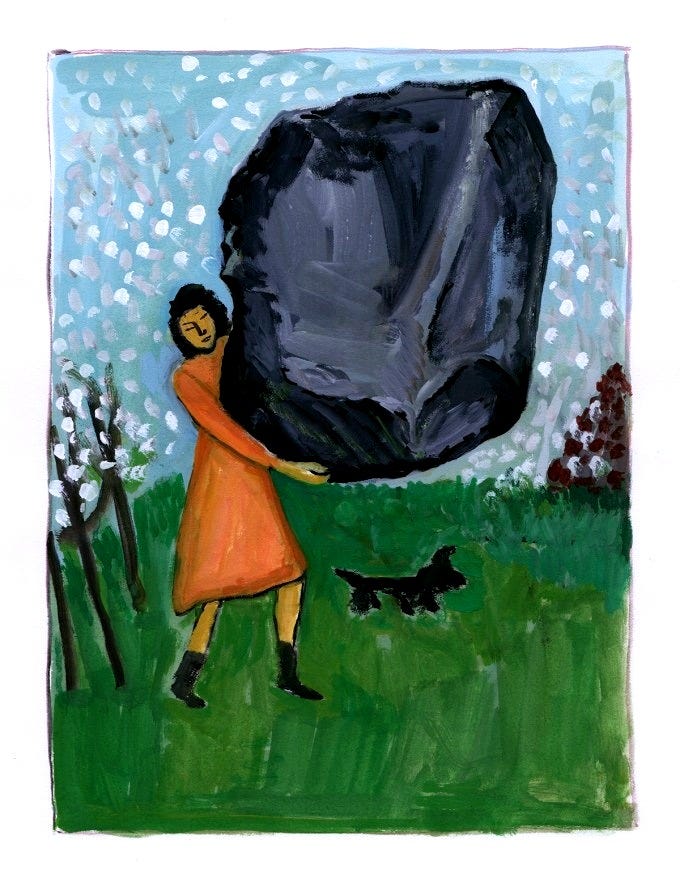
We instinctively tie weight to value.
我們本能地將重量與價值連結。
Gold is solid. Wood is dense. And back when we still printed things on paper, a heavy stapler was a luxury.1
黃金是固體。木材是密實的。在我們還在紙上印刷東西的時候,一把重重的打孔機是一種奢侈品。1
If something is heavy, we assume it matters. And often, it does. Weight signals quality, durability, presence, permanence.
如果某樣東西很重,我們就認為它很重要。而且通常確實如此。重量代表品質、耐用性、存在感、永恆性。
Even the objects we choose reflect this. At first, we buy cheap, lightweight furniture—easy to build, easy to trash. But eventually, we want weight. A solid oak table. A leather armchair. Something built to last. Heavy things comfort us—a weighted blanket stills the body, a heavy door makes a home feel secure.
即使是選擇的物品也反映了這一點。起初,我們買便宜、輕便的家具—容易製造,也容易丟棄。但最終,我們想要重量。一張堅固的橡木桌。一把皮質沙發椅。一些經過精心製造、可以長久使用的東西。重東西讓我們感到安心—一個加重的毯子可以安撫身體,一扇沉重的門讓家感覺安全。
Winners of major awards almost always say the same thing as they lift the trophy: ‘Wow! It’s so heavy.’ As though the weight itself validates the achievement. Simple logic: Light achievements beget light awards. Heavy achievements beget heavy awards.
獲得主要獎項的冠軍幾乎總是在舉起獎杯時說同一句話:「哇!好重啊。」好像重量本身就能證明成就。簡單邏輯:輕微的成就帶來輕輕的獎項。重大的成就帶來沉重的獎項。
We accept this in the physical world.
我們接受這一點在物理世界裡。
But online, we forget. 但在網路上,我們會忘記。
The internet is (mostly) a machine for light things.
互聯網是(大多數情況下)一個輕鬆事物的機器。
The modern makers’ machine does not want you to create heavy things. It runs on the internet—powered by social media, fueled by mass appeal, and addicted to speed. It thrives on spikes, scrolls, and screenshots. It resists weight and avoids friction. It does not care for patience, deliberation, or anything but production.
現代創作者的工具不希望你創造重物。它在互聯網上運作—由社交媒體驅動,以大眾吸引力為燃料,並沉迷於速度。它依賴尖峰、滾動和截圖。它抗拒重量並避免摩擦。它不在乎耐心、深思熟慮,或任何與生產無關的事。
It doesn’t care what you create, only that you keep creating. Make more. Make faster. Make lighter. (Make slop if you have to.) Make something that can be consumed in a breath and discarded just as quickly. Heavy things take time. And here, time is a tax. And so, we oblige—everyone does.
它不在乎你創造什麼,只在乎你持續創造。再多做些。更快地做。做得輕一點。(如果必須的話,就做些粗製濫造的。)創造些能在一呼氣中消耗掉,並同樣快速拋棄的東西。重東西需要時間。而這裡,時間是一種稅。因此,我們不得不從——每個人都這樣。
We create more than ever, but it weighs nothing.
我們創造得比從前還多,但它毫無重量。
AI now promises results without the reckoning, but frictionless creation leads to weightless rewards. No one dreams of merely pushing a button to generate their magnum opus. The output matters, but the intention, the struggle, the care is what makes it count — what gives it weight.2
AI 現在承諾無需付出代價就能獲得成果,但無摩擦的創造導致了輕飄飄的獎賞。沒有人夢想僅僅按一下按鈕就能產生他們的傑作。輸出很重要,但意圖、掙扎、用心才是讓它有價值的東西——才是賦予它重量。2
Of course, there’s a range from light to heavy, and not all light things are bad. An entire economy thrives on lightness. Memes, breaking news, and celebrity drama shape culture in spades. But movement isn’t meaning. A million views doesn’t make a pound of significance. Light things shape culture, but rarely shape us.
當然,從輕到重有一個範圍,而且不是所有輕微的事物都是壞的。整個經濟都依賴於輕鬆感。迷因、破新聞和名人劇情深刻地塑造了文化。但運動不代表意義。百萬觀看次數不會讓一磅的重要性增加。輕微的事物塑造文化,但很少塑造我們。
Creation isn’t just about output. It’s a process of becoming. The best work shapes the maker as much as the audience. A founder builds a startup to prove they can. A writer wrestles an idea into clarity. You don’t just create heavy things. You become someone who can.
創造不只是關於輸出。它是一個成長的過程。最好的作品同樣塑造了創作者,不僅僅是觀眾。創始人建立一家創業公司來證明他們能做到。作家把一個想法掙扎成清晰。你創造的並不僅僅是重要的東西。你成為了能夠做到的人。
Many light things don’t add up to one heavy thing.
許多輕微的事物,加起來也抵不上一件重物。
So many creators start in the shallow pool of some algorithm’s grip—until, inevitably, they go searching for something heavier. From short-form to long-form. From building in public to locking in to solitude, obsession, deep work. To create a book, a film, an album, a company—something that stands alone.
這麼多創作者開始時陷入某個演算法的淺層池中——直到,他們不可避免地開始尋找更重的事物。從短篇到長篇。從公開創作到鎖定在孤獨、痴迷、深度工作之中。要創作一本書、一部電影、一張專輯、一家公司——某種獨立存在的事物。
No matter how many you stack, Tweets and TikToks don’t add up to something heavy. They don’t solidify. At best, they’re a pile of snowflakes, intricate yet ephemeral. Beautiful while they’re here, gone before they hit the ground.3
無論你堆多少,推文和 TikTok 都不會累積成為重物。它們不會固化。至多,它們只是一堆雪花,精緻卻易逝。在它們存在時很美麗,但在它們落地之前就已消失。3
Substack, with its many virtues, finds itself at a crossroads — I’d put it in the midweight creation zone (if used well). Writers stack posts, building up a library of words that starts to feel substantial. It’s good that long-form posts can go viral faster and stick around longer. But it’s still not quite as heavy as writers’ loftiest dreams, at least not yet. Even the most successful Substackers, those who’ve turned newsletters into brands and businesses, start pondering their endgame.
Substack,儘管有很多優點,卻發現自己站在十字路口——我認為它(如果使用得當)屬於中重量級創作區域。寫作者堆疊文章,建立起一個開始感覺相當有分量的文字庫。長篇文章能更快地病毒式傳播並持續更久,這很好。但它仍然不夠重,至少還達不到寫作者最夢寐以求的境界,至少目前還沒有。即使是最成功的 Substack 寫作者,那些將訂閱信變成品牌和企業的人,也開始思考他們的終局。
They want to make one really, really good thing. One truly heavy thing. A book. A manifesto. A movie. A media company. A monument. — A masterpiece.4
他們想做出一件真的、真的好的東西。一件真正沉重的東西。一本書。一份宣言。一部電影。一家媒體公司。一座紀念碑。— 一件傑作。4
Not just for the prestige or the money, but for the proverbial "F-U" to ephemerality. For the way it anchors them to something lasting while giving them the freedom to breathe. For the way it sticks in the hearts and minds of other people who encounter it too.
Heavy projects are the lifeblood of creative fulfillment — and creative longevity. And for now, no platform truly offers that kind of weight on its own. Platforms are built to amplify, not anchor.5
You’re either making in light mode or in heavy mode.
Light mode is fast and iterative, producing work that’s quick to make but just as quick to fade. It’s the mode of rapid experiments, side quests, and prolific posting. Heavy mode is slower, deliberate, and intentional (often hermit mode). It’s the mode of deep work that builds over time and carries lasting weight.
Some go straight for the heavy: building the billion-dollar startup, writing the world-changing book, recording the defining album. No pit stops. Or, in less relative terms: things that will stand on their own and stand the test of time. Weight is lindy.6 Others build up to the heavy things: essays before the book, short films before the feature, prototypes before the big product (maybe a few silly ‘GPT wrappers’ before the serious one). Lightness has its virtues — it helps keep you fresh, get in the reps, and work up to the heavy thing.
At any given time, you’re either pre–heavy thing or post–heavy thing. You’ve either made something weighty already, or you haven’t. Pre–heavy thing people are still searching, experimenting, iterating. Post–heavy thing people have crossed the threshold. They’ve made something of substance—something that commands respect, inspires others, and becomes a foundation to build on. And it shows. They move with confidence and calm. (But this feeling doesn’t always last forever.)7 Your gut knows what state you’re in. And the cycle repeats.
No one wants to stay in light mode forever. Sooner or later, everyone gravitates toward heavy mode—toward making something with weight. Your life’s work will be heavy. Finding the balance of light and heavy is the game.8
Note: heavy doesn’t have to mean “big.” Heavy can be small, niche, hard to scale. What I’m talking about is more like density. It’s about what is defining, meaningful, durable.
You feel like an imposter when you only make light things.
Everyone calls themselves a creator now. It’s the default title of the moment, the identity of an era. But does everyone who claims it actually feel it? Do they know the deep, anchored satisfaction of having made something that carries weight?
Telling everyone they’re a creator has only fostered a new strain of imposter syndrome. Being called a creator doesn’t make you one or make you feel like one; creating something with weight does. When you’ve made something heavy—something that stands on its own—you don’t need validation. You just know, because you feel its weight in your hands. And that weight is its own reward.
It’s not that most people can’t make heavy things. It’s that they don’t notice they aren’t. Lightness has its virtues—it pulls us in, subtly, innocently, whispering, 'Just do things.' The machine rewards movement, so we keep going, collecting badges. One day, we look up and realize we’ve been running in place.
And then you feel it: a quiet, gnawing hollowness that, for all the making, nothing has truly been made. Why does it feel bad to stop posting after weeks of consistency? Because the force of your work instantly drops to zero. It was all motion, no mass—momentum without weight. 99% dopamine, near-zero serotonin, and no trace of oxytocin. This is the contemporary creator’s dilemma—the contemporary generation’s dilemma.
You don’t feel like a true creator because you haven’t made anything heavy, and deep down, you know light things don’t count. Your output is high, but your imprint is low. You ship, but you do not build. You call yourself a creator, but what have you made that could survive a month offline? A year? A decade? If you stopped posting tomorrow, would anything remain? Creating for 24-hour cycles isn’t freedom, leverage, or legacy—it’s just renting out your time.
The weight of what we make matters.
Creative people are restless souls, forever chasing the horizon until they’ve made something substantial. We spend our lives crafting weighted blankets for ourselves—something heavy enough to anchor our ambition and quiet our minds.
Weight is tangible in the physical world—a place we should care about and create more for than we have of late, even if it’s harder to scale. Working with your hands, with weight, shape, and dimension, holds an abundance of untapped virtue and value. Online, by nature, weight is harder to find, harder to hold on to, and only getting harder in a world where it feels like anyone can make anything.
But it is just as imperative.
People ask, "What are you working on?" They’re really asking: What’s your endgame? (It’s one of my favorite questions, too.)
My answer is simple, but not easy:
Make something heavy.
If you enjoyed this essay, consider sharing it with a friend or community that might enjoy it too. This is a topic I care deeply about, so I welcome reactions, reflections, and thought-provoking questions as well. Email me here or DM via Substack or Twitter / X.
Related essays: The Aesthetic Is The Art Now, Taste Is Eating Silicon Valley, Your dreams demand your best hours, Pursuits that can’t scale, Status limbo.
In the spirit of walking the walk, one among a couple heavy creative projects on my mind:

My dad gave me an appreciation for quality in material and form and utility from a young age, and it unwittingly grew with me. Fond memories of amateur carpentry, summertime stone masonry, and avant-garde materials crafted into whimsical apparel I called fashion. I still gravitate towards weighty wood, stone, and metal objects.
AI making things easier to create and easier to disrupt of course brings value into question too, not only at the outset but over the long-term. AI largely breaks moats and wipes out the middle.
Not all “light” and “heavy” things are created equal. Some light things can be considered more weighty, and may stack to some effect. To borrow a construct from one of my favorite authors, George Orwell: All light things are light, but some light things are lighter than others. All heavy things are heavy, but some heavy things are heavier than others.
I understand what may be considered a masterpiece, what feels “heavy” to us, will change over time — culture is a powerful influence — but there are some objective attributes that I believe remain consistent judges of heft (I may explore this in a future essay).
Platforms build compounding power through network effects, benefiting themselves. They scale through you. Your job is to build network effects around yourself, your own work, the value only you create. That’s how your work gains weight beyond you.
I decided not to go on this tangent, but in many ways, having children itself is making something heavy, and something that on its default course is enduring beyond yourself. Weight is not restricted to “work” in a traditional sense but to every arena of meaning.
Not everyone who endeavors to create something significant will 'succeed' by their own early definition, but to endeavor itself is important, and the definition of success will be shaped by the journey.
Note: heavy doesn’t always mean “big.” Heavy can be small or niche or hard to scale. What I’m talking about is more like density. It’s better understood as what’s defining, meaningful, durable.


This is a read that will sit with me for a long time. Thank you.
Brilliant writing, and hits me right in the soul.
I've taken a liking to architecture recently because, by nature, permanence is a key feature in a building. The world grows and changes around the building rather than consuming and moving on.
This piece calls me to make something not to be consumed, but to be lived and experienced for years to come even as the world around it changes.
Thank you so much for sharing