
這是用戶在 2025-8-7 14:34 為 https://www.mdpi.com/2223-7747/13/9/1227 保存的雙語快照頁面,由 沉浸式翻譯 提供雙語支持。了解如何保存?
 
 
Article  開放取用文章

Regulation of Root Exudation in Wheat Plants in Response to Alkali Stress
《鹼脅迫下小麥根系分泌物的調控機制》

by 1,†,   作者:王歡 1,†,
1,† 、趙舒婷
1,†,
1,† 、齊澤鑫
2,
1,† ,楊昌剛
1,
2 ,丁丹
3,
1 ,肖彬彬
2,* and
3 ,王世宏
3
2,* 與楊春武
1
Department of Agronomy, Jilin Agricultural University, Changchun 130118, China
吉林農業大學農學院,中國長春 130118
2
Wheat Research Institute, Gansu Academy of Agricultural Sciences, Lanzhou 730070, China
甘肅省農業科學院小麥研究所,中國蘭州 730070
3
Key Laboratory of Molecular Epigenetics of Ministry of Education, Northeast Normal University, Changchun 130024, China
東北師範大學分子表觀遺傳學教育部重點實驗室,中國長春 130024
*
Author to whom correspondence should be addressed.
應聯繫的作者。
These authors contribute equally to this work.
這些作者對本研究的貢獻程度相同。
Plants 2024, 13(9), 1227; https://doi.org/10.3390/plants13091227
《植物》2024 年,第 13 卷第 9 期,第 1227 頁;https://doi.org/10.3390/plants13091227
Submission received: 28 February 2024 / Revised: 19 April 2024 / Accepted: 24 April 2024 / Published: 28 April 2024
投稿日期:2024 年 2 月 28 日 / 修訂日期:2024 年 4 月 19 日 / 接受日期:2024 年 4 月 24 日 / 出版日期:2024 年 4 月 28 日
(This article belongs to the Special Issue New Insights into Plant Signaling Mechanisms in Biotic and Abiotic Stress)
(本文屬於特刊《植物在生物與非生物脅迫下信號傳導機制的新見解》)

Abstract  摘要

Soil alkalization is an important environmental factor limiting crop production. Despite the importance of root secretion in the response of plants to alkali stress, the regulatory mechanism is unclear. In this study, we applied a widely targeted metabolomics approach using a local MS/MS data library constructed with authentic standards to identify and quantify root exudates of wheat under salt and alkali stresses. The regulatory mechanism of root secretion in alkali-stressed wheat plants was analyzed by determining transcriptional and metabolic responses. Our primary focus was alkali stress-induced secreted metabolites (AISMs) that showed a higher secretion rate in alkali-stressed plants than in control and salt-stressed plants. This secretion was mainly induced by high-pH stress. We discovered 55 AISMs containing –COOH groups, including 23 fatty acids, 4 amino acids, 1 amino acid derivative, 7 dipeptides, 5 organic acids, 9 phenolic acids, and 6 others. In the roots, we also discovered 29 metabolites with higher levels under alkali stress than under control and salt stress conditions, including 2 fatty acids, 3 amino acid derivatives, 1 dipeptide, 2 organic acids, and 11 phenolic acids. These alkali stress-induced accumulated carboxylic acids may support continuous root secretion during the response of wheat plants to alkali stress. In the roots, RNAseq analysis indicated that 5 6-phosphofructokinase (glycolysis rate-limiting enzyme) genes, 16 key fatty acid synthesis genes, and 122 phenolic acid synthesis genes have higher expression levels under alkali stress than under control and salt stress conditions. We propose that the secretion of multiple types of metabolites with a –COOH group is an important pH regulation strategy for alkali-stressed wheat plants. Enhanced glycolysis, fatty acid synthesis, and phenolic acid synthesis will provide more energy and substrates for root secretion during the response of wheat to alkali stress.
土壤鹼化是限制作物生產的重要環境因子。儘管根系分泌物在植物應對鹼脅迫的反應中具有重要性,其調控機制仍不清楚。本研究採用廣泛靶向代謝組學方法,利用以標準品建構的本地 MS/MS 數據庫,對小麥在鹽分和鹼脅迫下的根系分泌物進行鑑定與定量分析。透過測定轉錄組和代謝組反應,我們分析了鹼脅迫小麥植株根系分泌的調控機制。我們主要關注鹼脅迫誘導分泌的代謝物(AISMs),這些代謝物在鹼脅迫植株中的分泌率高於對照組和鹽脅迫植株。此種分泌主要受高 pH 值脅迫誘導。我們發現了 55 種含有-COOH 基團的 AISMs,包括 23 種脂肪酸、4 種胺基酸、1 種胺基酸衍生物、7 種二肽、5 種有機酸、9 種酚酸以及 6 種其他化合物。 在根部,我們還發現了 29 種代謝物在鹼脅迫下的含量高於對照組和鹽脅迫條件,包括 2 種脂肪酸、3 種氨基酸衍生物、1 種二肽、2 種有機酸和 11 種酚酸。這些由鹼脅迫誘導累積的羧酸類物質,可能支持小麥植株在應對鹼脅迫期間持續進行根系分泌。根部 RNAseq 分析顯示,5 個 6-磷酸果糖激酶(糖解作用限速酶)基因、16 個關鍵脂肪酸合成基因以及 122 個酚酸合成基因,在鹼脅迫下的表現量均高於對照組和鹽脅迫條件。我們認為,分泌多種帶有-COOH 基團的代謝物是鹼脅迫小麥植株重要的 pH 調節策略。增強的糖酵解、脂肪酸合成和酚酸合成將為小麥應對鹼脅迫期間的根系分泌提供更多能量和底物。
Keywords:
wheat; pH regulation; root secretion; respiration; carboxylic acid
關鍵詞:小麥;pH 調節;根系分泌;呼吸作用;羧酸

1. Introduction  1. 緒論

As the ecological environment continues to deteriorate through unreasonable development and use, the global area of saline land has increased yearly [1,2,3,4,5]. The harmful salts in saline soils mainly include NaCl, Na2SO4, NaHCO3, and Na2CO3. About 46% of saline soils contain only neutral salts, NaCl, and Na2SO4, but the remaining 54% contain both neutral salts and alkaline salts [6]. The stress type exerted by NaCl and/or Na2SO4 is defined as salt stress, whereas the stress type exerted by NaHCO3 and/or Na2CO3 is defined as alkali stress [7,8]. Previous studies have verified that the destructive effect of alkaline salt stress on plants is significantly stronger than that of neutral salt stress at the same salinity [7,8,9]. Soil alkalization has caused serious environmental problems in some areas of the world. For example, in northeastern China, about 50% of grassland is threatened by soil alkalization [10]. Soil pH in the alkalized area even reaches above 10.5. Only a few alkali-resistant halophytes can survive under such heavily alkaline conditions, and no crop can survive extreme alkalinity. Therefore, further research on soil alkalization and alkali stress is warranted.
隨著不合理的開發利用導致生態環境持續惡化,全球鹽鹼地面積逐年增加[1, 2, 3, 4, 5]。鹽鹼土壤中的有害鹽類主要包括 NaCl、Na₂SO₄、NaHCO₃和 Na₂CO₃。約 46%的鹽鹼土壤僅含有中性鹽 NaCl 和 Na₂SO₄,其餘 54%則同時含有中性鹽與鹼性鹽[6]。由 NaCl 和/或 Na₂SO₄所產生的脅迫類型被定義為鹽脅迫,而由 NaHCO₃和/或 Na₂CO₃所產生的脅迫類型則定義為鹼脅迫[7,8]。先前研究證實,在相同鹽度條件下,鹼性鹽脅迫對植物的破壞效應顯著強於中性鹽脅迫[7, 8, 9]。土壤鹼化已在全球部分地區造成嚴重的環境問題,例如中國東北地區約有 50%的草原正受到土壤鹼化威脅[10]。鹼化區域的土壤 pH 值甚至高達 10.5 以上,在此類強鹼性環境下僅有少數耐鹼鹽生植物能夠存活,一般作物皆無法在極端鹼性條件下生存。 因此,針對土壤鹼化與鹼脅迫的進一步研究是必要的。
Salt stress produces negative effects on plants through osmotic stress and ion toxicity. However, in addition to osmotic stress and ion toxicity, alkali stress produces high-pH stress. High pH caused by alkali stress can lead to the precipitation of Ca2+, Mg2+, Fe2+, Mn2+, Cu2+, Zn2+, and PO43− to surrounding roots, which induces a reduction in the bioavailability of nutrient elements [2,9]. Additionally, a proton gradient across root plasma membranes is the driving force for mineral ion uptake. HCO3 or CO32− from alkaline soils will neutralize the proton outside the root plasma membrane, thus breaking the proton gradient and inhibiting the uptake of mineral ions. The plants living in alkaline soils must regulate rhizosphere pH to alleviate nutrient stress. Therefore, the pH regulation of the roots is essential for alkali tolerance in plants.
鹽脅迫通過滲透脅迫和離子毒性對植物產生負面影響。然而,除了滲透脅迫和離子毒性外,鹼脅迫還會產生高 pH 值脅迫。鹼脅迫引起的高 pH 值會導致 Ca 2+ 、Mg 2+ 、Fe 2+ 、Mn 2+ 、Cu 2+ 、Zn 2+ 和 PO 4 3− 在根系周圍沉澱,從而降低營養元素的有效性[2,9]。此外,根細胞膜兩側的質子梯度是礦質離子吸收的驅動力。來自鹼性土壤的 HCO 3 或 CO 3 2− 會中和根細胞膜外的質子,從而破壞質子梯度並抑制礦質離子的吸收。生長在鹼性土壤中的植物必須調節根際 pH 值以緩解營養脅迫。因此,根系的 pH 值調節對於植物的耐鹼性至關重要。
In the past 30 years, great progress has been made in several areas of salt stress study, such as ion homeostasis, signal transduction, and hormone regulation [11,12,13,14,15]. To date, multilevel signal networks mediating salt tolerance and Na+ compartmentalization mechanisms at the subcellular level have been elucidated [11,12,13,14,15,16]. However, relatively few studies have focused on plant alkali tolerance [3,4,17,18,19,20,21,22,23,24,25,26,27,28]. Important progress in research on plant alkali tolerance has been made in Arabidopsis [21], maize [25], and wheat [27], in which H+-ATPase was demonstrated to play an important role in alkali tolerance.
過去 30 年間,鹽分脅迫研究在離子平衡、信號傳導與激素調控等領域已取得重大進展[11,12,13,14,15]。迄今為止,學界已闡明介導耐鹽性的多層級信號網絡及亞細胞層面的鈉離子區隔化機制[11,12,13,14,15,16]。然而針對植物耐鹼性的研究相對匱乏[3,4,17,18,19,20,21,22,23,24,25,26,27,28]。目前關於擬南芥[21]、玉米[25]和小麥[27]的耐鹼性研究已取得重要進展,其中氫離子幫浦 ATP 酶被證實在耐鹼性中扮演關鍵角色。
Our group and other researchers have found that root secretion is the main pH regulation pathway of plants under alkali stress [29,30,31]. Root exudates usually include amino acids, phenolics, fatty acids, organic acids, and carbohydrates [22,32]. Secretion of organic acids induced by alkali stress has been reported in many plants, such as P. tenuiflora [30,33], grape plants [31], and Chloris virgata [29]. However, the physiological and molecular mechanisms underlying root secretion regulation during the response of plants to alkali stress are poorly understood. Wheat provides about 20% of the calories consumed by humans [34]. Soil alkalization is an important factor limiting wheat production in northern China. To explore the specific effects of high pH caused by alkali stress on root secretion, we applied salt stress and alkali stress treatments at the same Na+ concentration and total salt concentration but with different pH values. Thus, differences in plant root secretion in response to the two stress conditions were mainly attributed to pH differences. In this study, we identified and quantified root exudates of wheat under salt and alkali stresses. To ascertain the regulatory mechanism of root secretion in wheat under alkali stress, we also analyzed the transcriptional and metabolic responses of wheat roots to alkali stress.
我們的研究團隊及其他學者已發現,根部分泌作用是植物在鹼脅迫下調節 pH 值的主要途徑[29,30,31]。根系分泌物通常包含胺基酸、酚類物質、脂肪酸、有機酸及碳水化合物[22,32]。許多植物如羊草[30,33]、葡萄植株[31]及虎尾草[29]均被報導會在鹼脅迫下誘導有機酸分泌。然而,關於植物響應鹼脅迫時調控根部分泌作用的生理與分子機制仍所知甚少。小麥提供了人類攝取熱量的約 20%[34],而土壤鹼化是限制中國北方小麥生產的重要因素。為探究鹼脅迫所致高 pH 值對根部分泌的具體影響,我們在相同 Na+濃度與總鹽濃度但不同 pH 值條件下,分別施加鹽脅迫與鹼脅迫處理,因此兩種脅迫條件下植物根部分泌的差異主要可歸因於 pH 值的不同。本研究針對小麥在鹽脅迫與鹼脅迫下的根系分泌物進行了鑑定與定量分析。 為釐清小麥在鹼脅迫下根部分泌的調控機制,我們同時分析了小麥根部對鹼脅迫的轉錄組與代謝組反應。

2. Results  2. 結果

2.1. Components of Root Exudates
2.1. 根部分泌物的組成成分

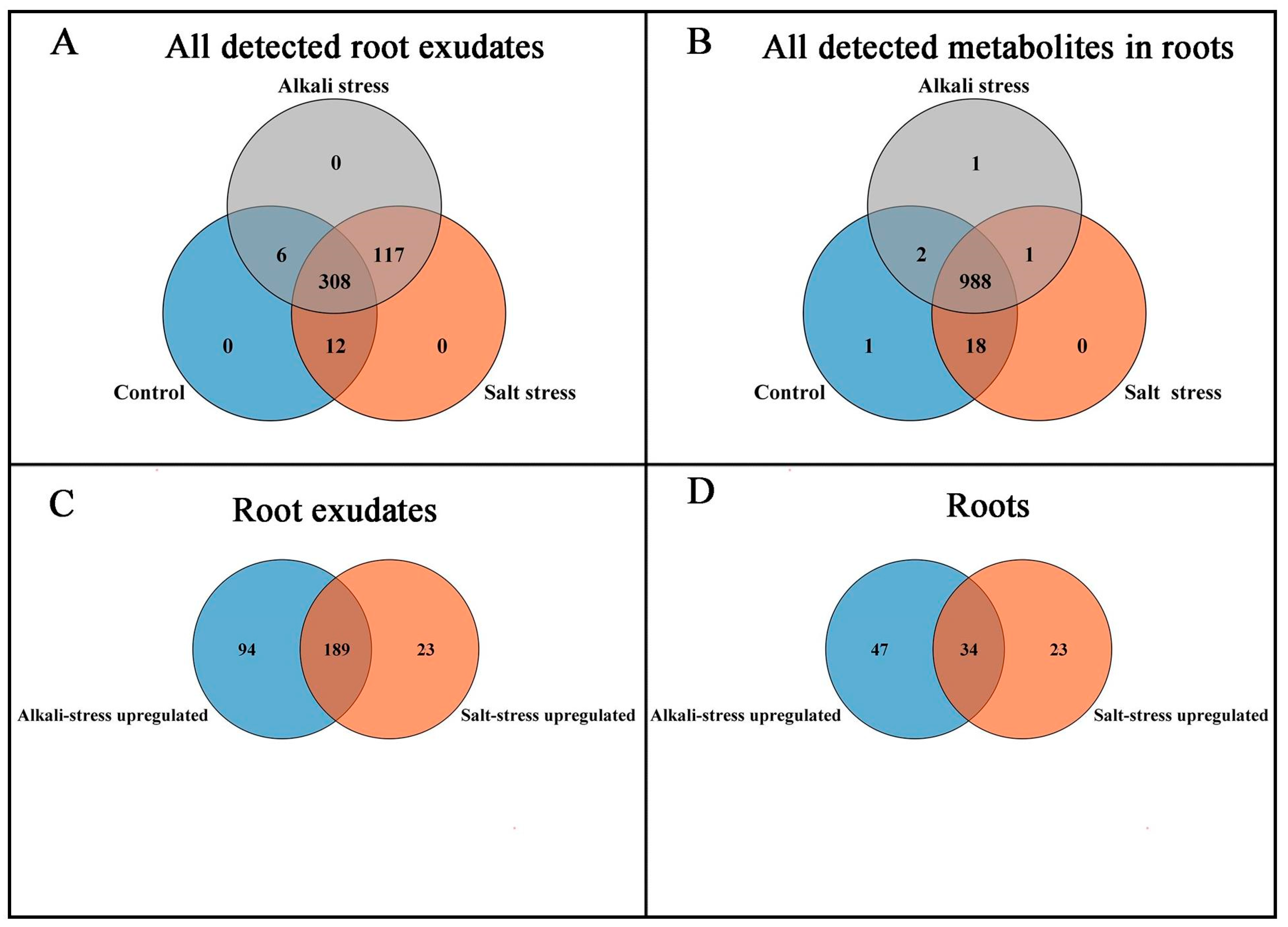
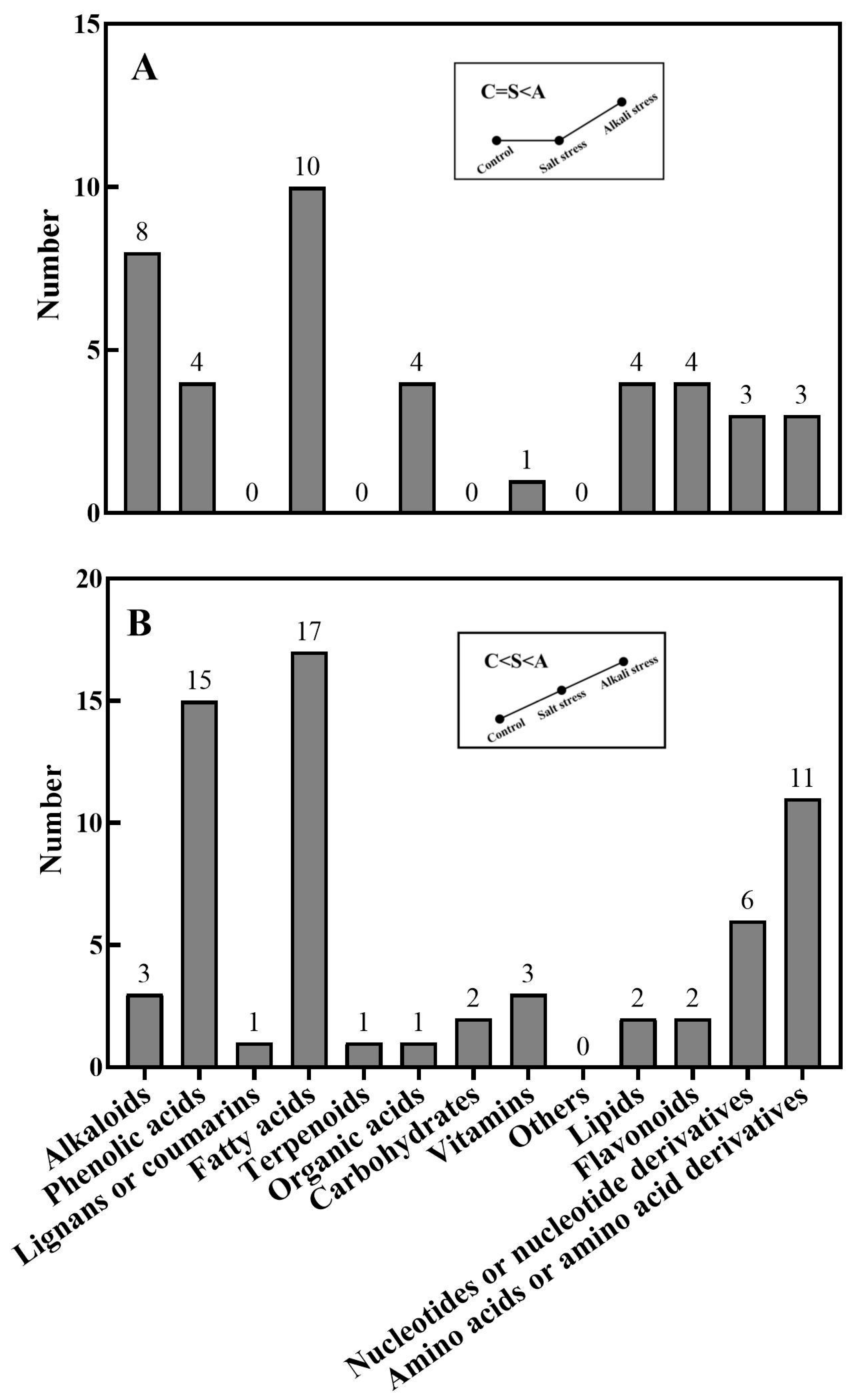
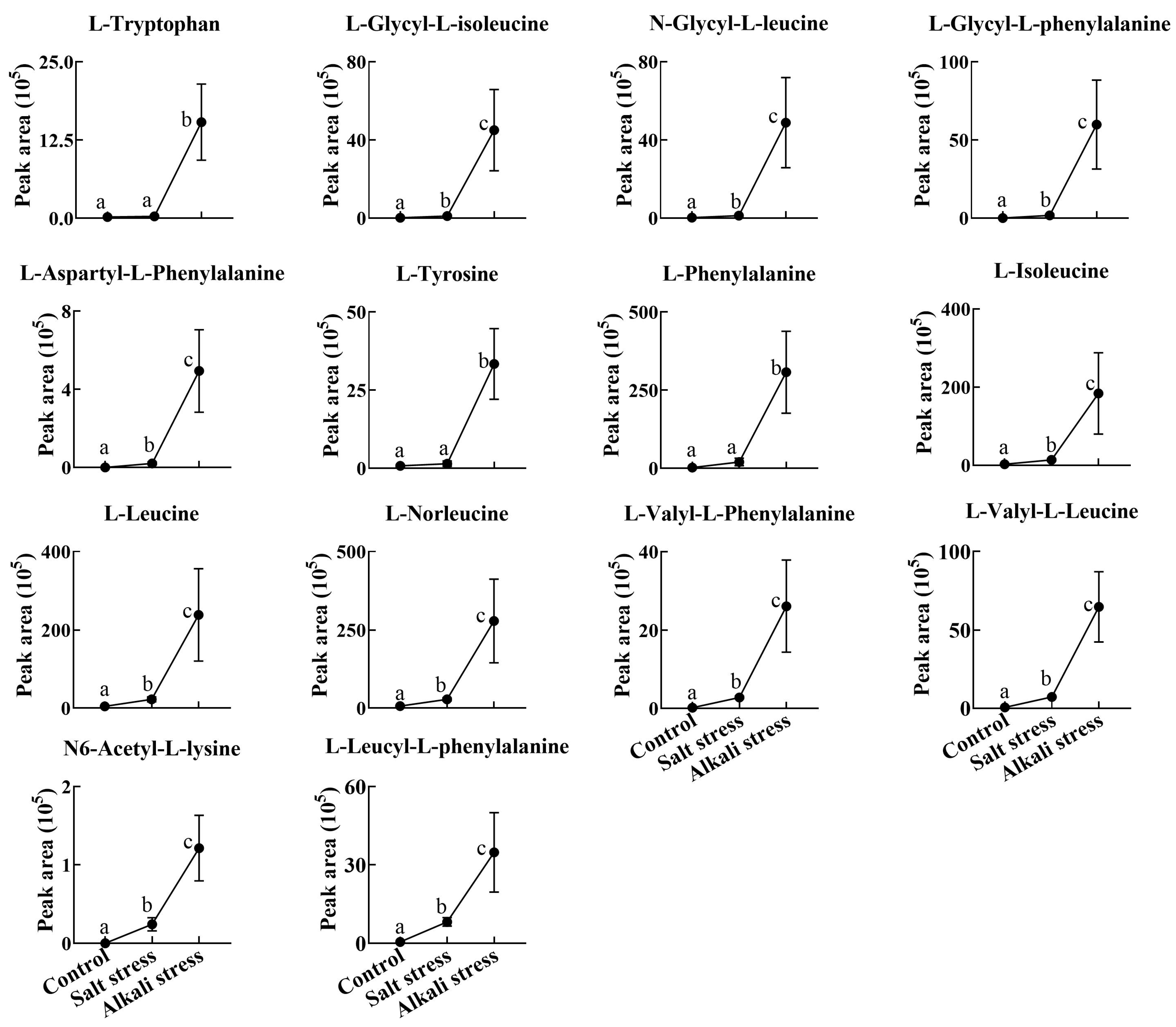
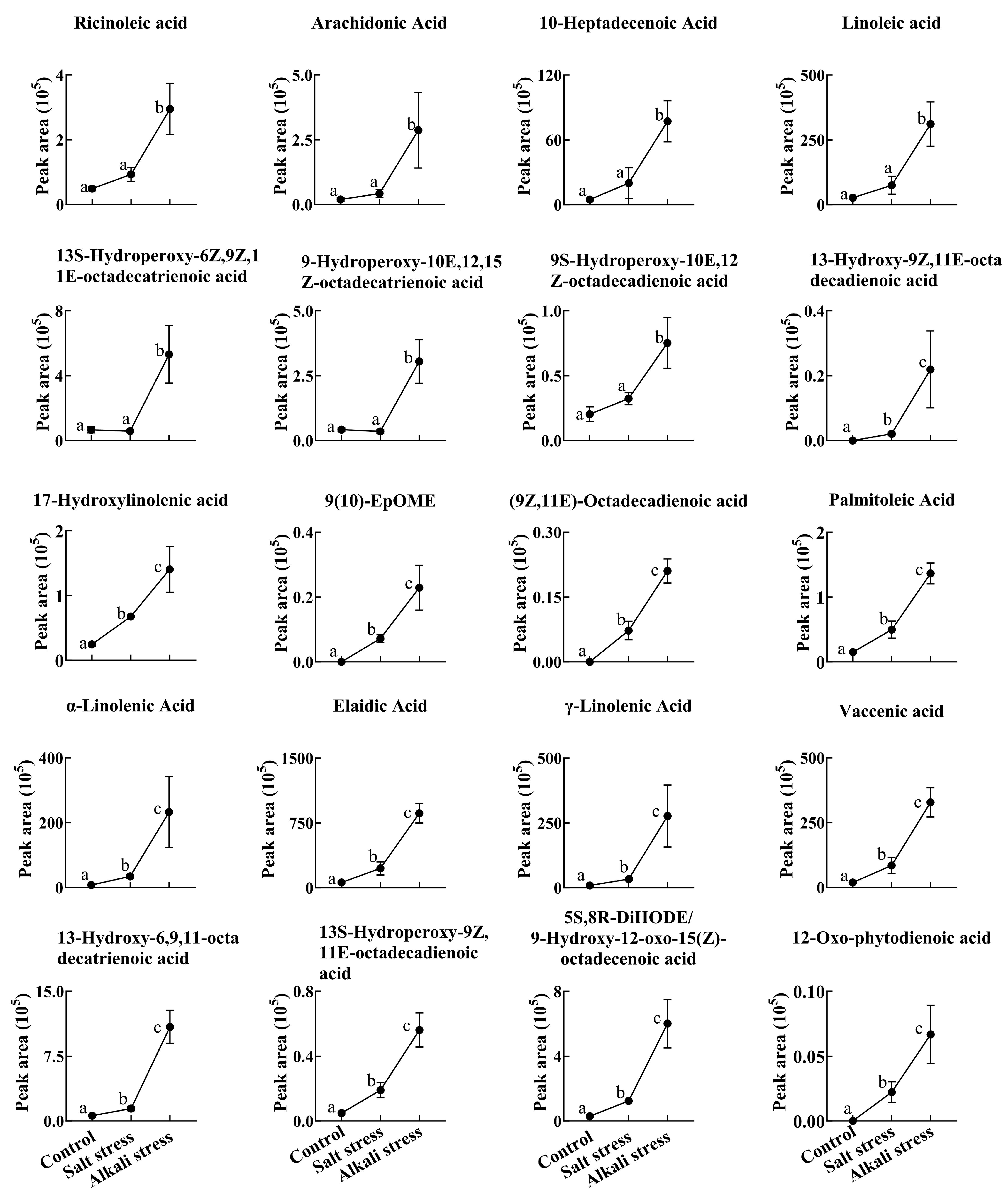
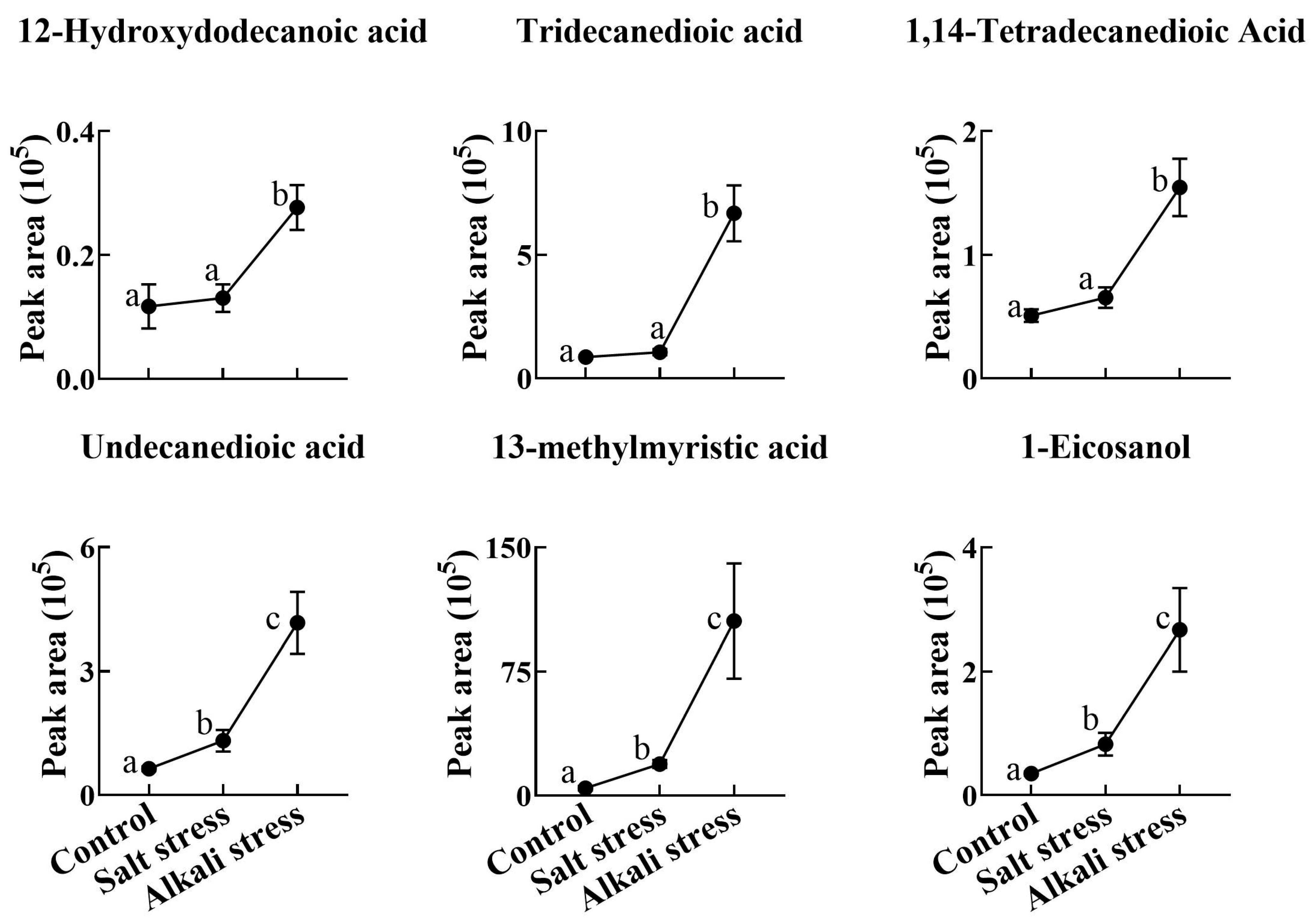
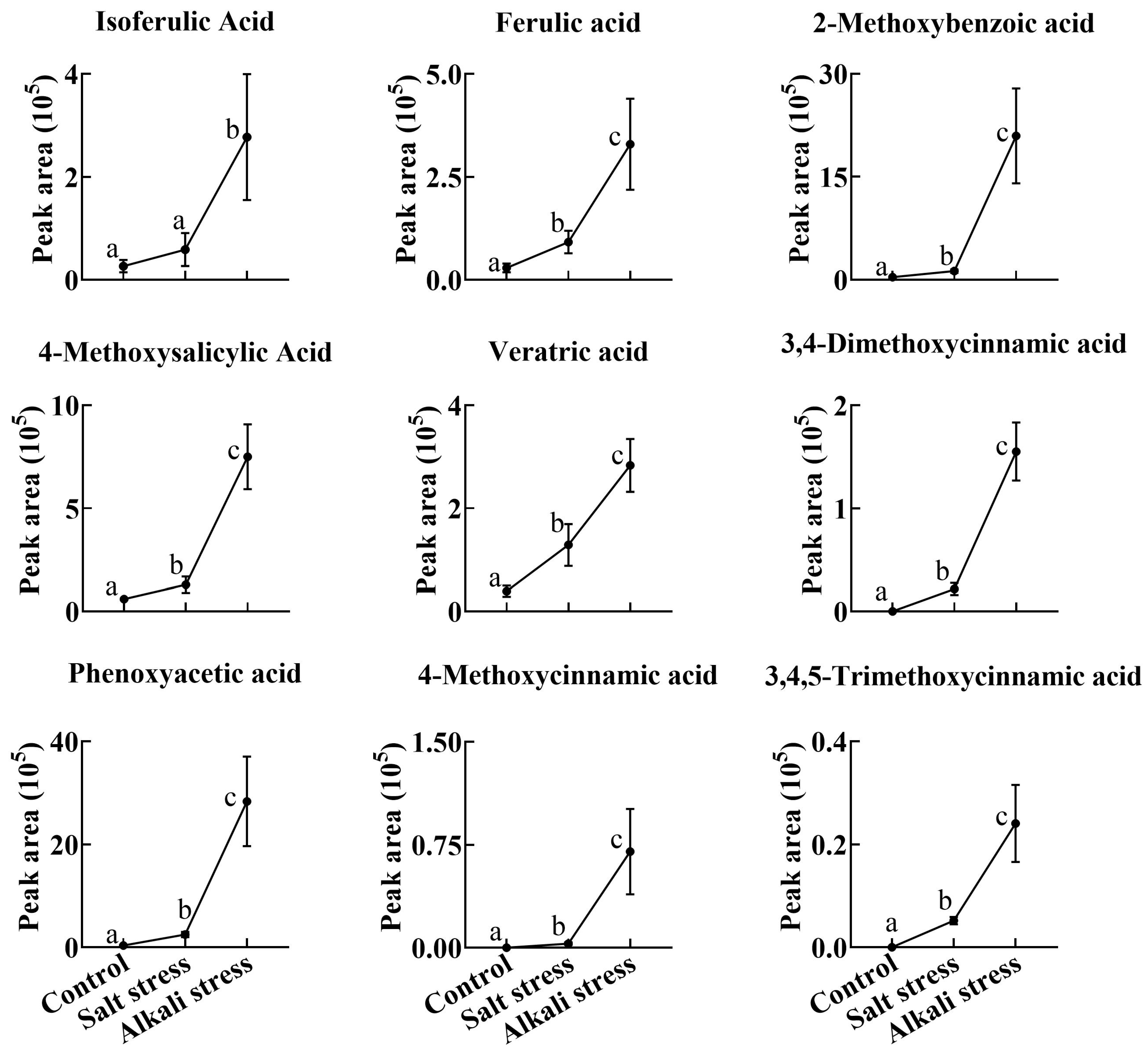
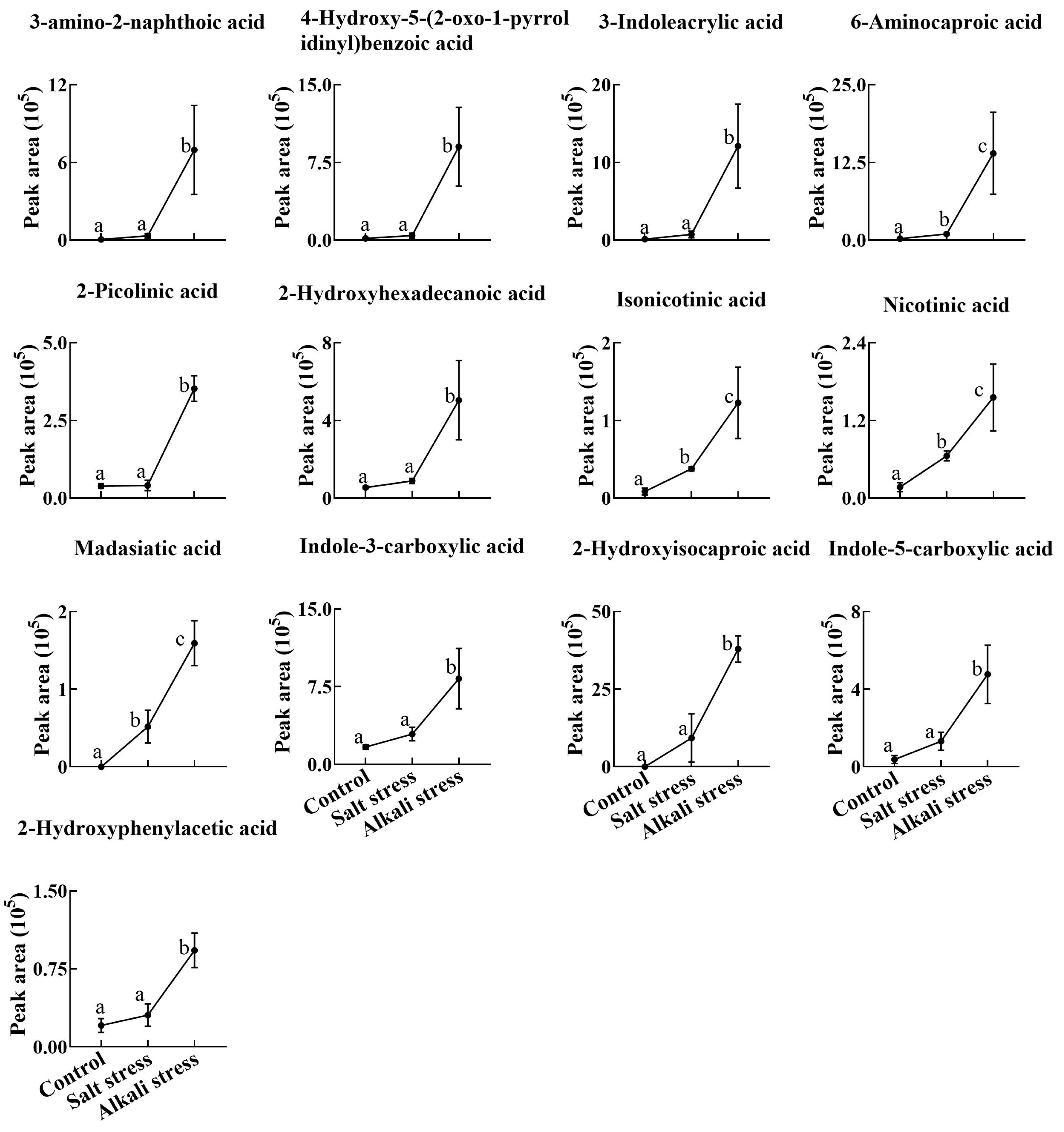
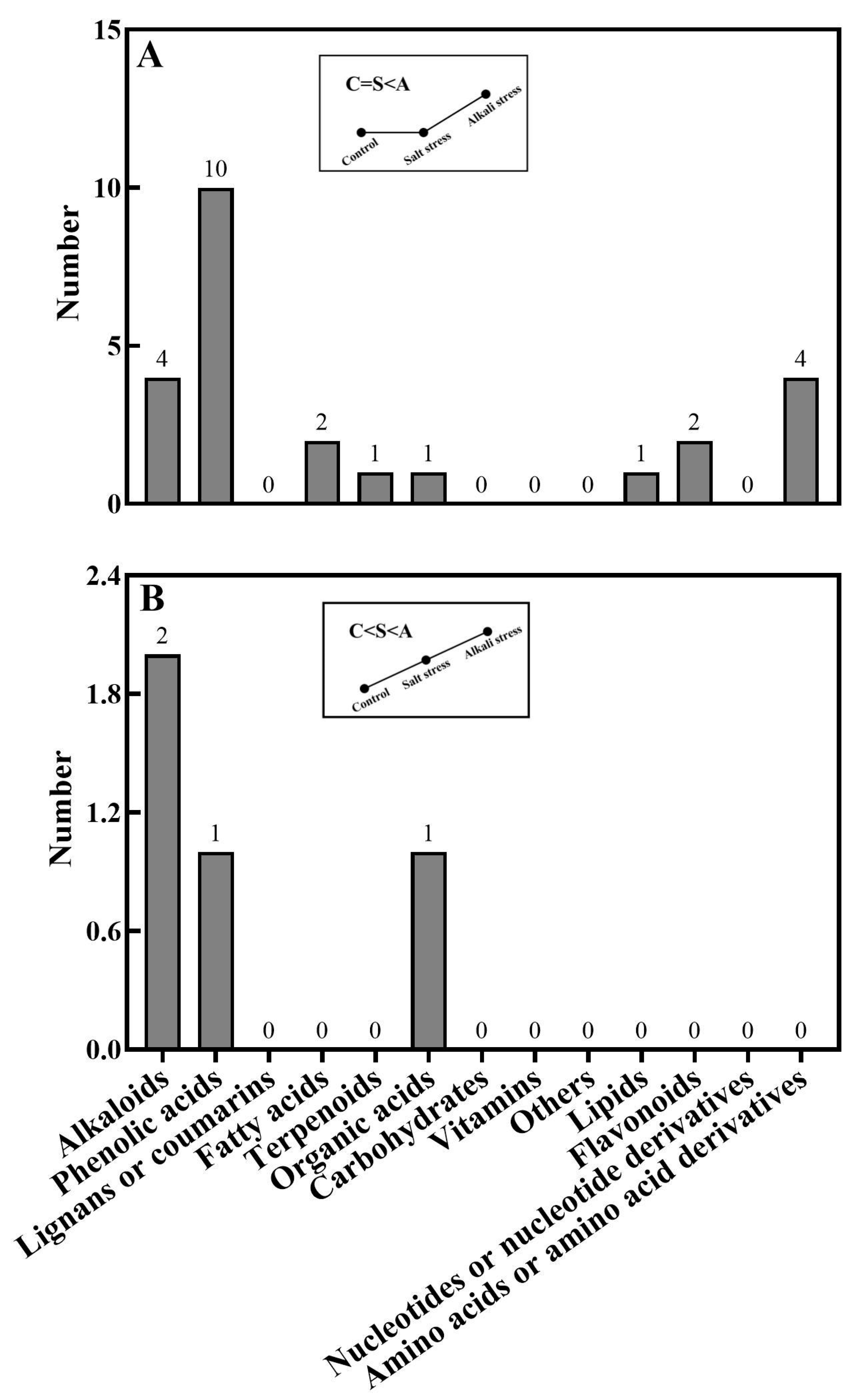
We used a high throughput metabolomic method to detect metabolites in the root exudates (Figure 1A) and root tissues of wheat plants (Figure 1B). Collectively, we detected 443 root exudates in wheat plants under three conditions (Figure 1A), including 75 fatty acids, 52 lipids, 27 organic acids, 31 amino acids or amino acid derivatives, 81 phenolic acids, 28 nucleotides or nucleotide derivatives, 54 flavonoids, 38 alkaloids, 7 terpenoids, 18 carbohydrates, 8 vitamins, 7 lignans or coumarins, and 17 others (Table S1). In wheat plants, 326 root exudates were detected under control conditions, 437 under salt stress, and 431 under alkali stress (Table S1 and Figure 1A). We particularly focused on alkali stress-induced secreted metabolites (AISMs), which were found at a higher root secretion rate under alkali stress condition than under control and salt stress conditions. The number of AISMs for each type of metabolite is displayed in Figure 2A,B. In Figure 2A, salt stress did not affect the secretion rate of the metabolites, but alkali stress enhanced the secretion rate. Conversely, in Figure 2B, both salt stress and alkali stress enhanced the secretion rate of the metabolites, with greater enhancement in alkali stress than in salt stress. We discovered 105 AISMs in wheat root exudates, including 27 fatty acids, 6 amino acids, 1 amino acid derivative, 7 dipeptides, 5 organic acids, 19 phenolic acids, 9 nucleotides or nucleotide derivatives, 6 flavonoids, 1 lignan or coumarin, 11 alkaloids, 2 carbohydrates, 1 terpenoid, 6 lipids, and 4 vitamins (Figure 1C and Figure 2). Of 105 AISMs, 55 AISMs contained the –COOH group, including 23 fatty acids, 4 amino acids, 1 amino acid derivative, 7 dipeptides, 5 organic acids, 9 phenolic acids, 3 alkaloids, 1 terpenoid, and 2 others (Figure 3, Figure 4, Figure 5, Figure 6 and Figure 7). These data revealed that fatty acids, amino acids, dipeptides, and phenolic acids were dominant AISMs for alkali-stressed wheat plants. Some plant “hub” fatty acids, such as γ-linolenic acid, arachidonic acid, α-linolenic acid, linoleic acid, and palmitoleic acid also showed higher root secretion rates under alkali stress conditions than under control and salt stress conditions (Figure 4 and Figure 5). All of the three aromatic amino acids (tryptophan, tyrosine, and phenylalanine) were discovered in the list of AISMs (Figure 3).
我們採用高通量代謝組學方法檢測了小麥植株根系分泌物(圖 1A)和根組織中的代謝物(圖 1B)。總計在三種處理條件下共檢測到 443 種根系分泌物(圖 1A),包括 75 種脂肪酸、52 種脂質、27 種有機酸、31 種氨基酸或其衍生物、81 種酚酸、28 種核苷酸或其衍生物、54 種黃酮類化合物、38 種生物鹼、7 種萜類化合物、18 種碳水化合物、8 種維生素、7 種木脂素或香豆素,以及 17 種其他代謝物(表 S1)。小麥植株在對照條件下檢測到 326 種根系分泌物,鹽脅迫下 437 種,鹼脅迫下 431 種(表 S1 與圖 1A)。我們特別關注鹼脅迫誘導分泌代謝物(AISMs),這類代謝物在鹼脅迫條件下的根系分泌速率顯著高於對照組與鹽脅迫組。各類代謝物中 AISMs 的數量分布如圖 2A、B 所示。圖 2A 顯示鹽脅迫未影響代謝物分泌速率,而鹼脅迫則顯著提升了分泌速率。 相反地,在圖 2B 中,鹽脅迫和鹼脅迫都提高了代謝物的分泌速率,且鹼脅迫的增強效果大於鹽脅迫。我們在小麥根系分泌物中發現了 105 種 AISM(鹼脅迫誘導代謝物),包括 27 種脂肪酸、6 種胺基酸、1 種胺基酸衍生物、7 種二肽、5 種有機酸、19 種酚酸、9 種核苷酸或核苷酸衍生物、6 種黃酮類、1 種木脂素或香豆素、11 種生物鹼、2 種碳水化合物、1 種萜類、6 種脂質和 4 種維生素(圖 1C 和圖 2)。在這 105 種 AISM 中,有 55 種含有-COOH 官能基,包括 23 種脂肪酸、4 種胺基酸、1 種胺基酸衍生物、7 種二肽、5 種有機酸、9 種酚酸、3 種生物鹼、1 種萜類和 2 種其他物質(圖 3、圖 4、圖 5、圖 6 和圖 7)。這些數據顯示脂肪酸、胺基酸、二肽和酚酸是鹼脅迫小麥植株的主要 AISM。某些植物「樞紐」脂肪酸,如γ-亞麻酸、花生四烯酸、α-亞麻酸、亞油酸和棕櫚油酸,在鹼脅迫條件下的根系分泌速率也高於對照組和鹽脅迫條件(圖 4 和圖 5)。 三種芳香族胺基酸(色胺酸、酪胺酸與苯丙胺酸)均被發現列於 AISMs 清單中(圖 3)。
Figure 1. Comparison of metabolite components in root exudates and roots of wheat plants under control, salt stress, and alkali stress conditions. (A) Number of all detected root exudates; (B) number of all detected metabolites in roots; (C) number of the metabolites with enhanced root secretion rate; (D) number of the metabolites with upregulated accumulation in roots. The 30-day-old wheat seedlings were treated with salt (88 mM Na+ and pH 6.7) and alkali (88 mM Na+ and pH 8.8) solutions for 3 days. Three biological replicates were used for each treatment.
圖 1. 小麥植株在對照組、鹽脅迫與鹼脅迫條件下根部滲出物與根部代謝物成分比較。(A) 所有檢測到的根部滲出物數量;(B) 所有檢測到的根部代謝物數量;(C) 根部分泌速率增強之代謝物數量;(D) 根部累積量上調之代謝物數量。30 日齡小麥幼苗分別以鹽溶液(88 mM Na + ,pH 6.7)與鹼溶液(88 mM Na + ,pH 8.8)處理 3 天。每種處理設置三個生物重複。
Figure 2. Alkali stress-induced secreted metabolites. The number of metabolites for each type of metabolite was displayed. (A) Control and salt-stressed plants showed a similar secretion rate for each metabolite, with a lower secretion rate than that in alkali-stressed plants; (B) alkali-stressed plants > salt-stressed plants > control plants in the secretion rate of metabolites. The 30-day-old wheat seedlings were treated with salt (88 mM Na+ and pH 6.7) and alkali (88 mM Na+ and pH 8.8) solutions for 3 days. Three biological replicates were used for each treatment.
圖 2. 鹼脅迫誘導的分泌代謝物。顯示各類代謝物的數量。(A)對照組與鹽脅迫植株對各代謝物的分泌速率相近,但均低於鹼脅迫植株;(B)代謝物分泌速率呈現:鹼脅迫植株>鹽脅迫植株>對照組植株。試驗採用 30 天齡小麥幼苗,分別以鹽溶液(88 mM Na + ,pH 6.7)與鹼溶液(88 mM Na + ,pH 8.8)處理 3 天,每種處理設置 3 個生物重複。
Figure 3. Comparative effects of salt and alkali stresses on the secretion of amino acids and amino acid derivatives in wheat plants. Alkali stress-induced secreted amino acids or amino acid derivatives are displayed. The 30-day-old wheat seedlings were treated with salt stress (88 mM Na+ and pH 6.7) and alkali stress (88 mM Na+ and pH 8.8) solutions for 3 days. Three biological replicates were used for each treatment. Different letters above the bar indicate significant differences.
圖 3. 鹽鹼脅迫對小麥植株分泌胺基酸及其衍生物的比較效應。圖中顯示鹼脅迫誘導分泌的胺基酸或胺基酸衍生物。30 天齡小麥幼苗分別接受鹽脅迫(88 mM Na + ,pH 6.7)與鹼脅迫(88 mM Na + ,pH 8.8)溶液處理 3 天。每組處理設置三個生物重複。柱狀圖上方不同字母表示顯著性差異。
Figure 4. Comparative effects of salt and alkali stresses on the secretion of unsaturated fatty acids in wheat plants. Alkali stress-induced secreted unsaturated fatty acids are displayed. The 30-day-old wheat seedlings were treated with salt (88 mM Na+ and pH 6.7) and alkali (88 mM Na+ and pH 8.8) solutions for 3 days. Three biological replicates were used for each treatment. Different letters above the bar indicate significant differences.
圖 4. 鹽鹼脅迫對小麥植株分泌不飽和脂肪酸的比較效應。圖中顯示鹼脅迫誘導分泌的不飽和脂肪酸。30 天齡小麥幼苗分別接受鹽(88 mM Na + ,pH 6.7)與鹼(88 mM Na + ,pH 8.8)溶液處理 3 天。每組處理設置三個生物重複。柱狀圖上方不同字母表示顯著性差異。
Figure 5. Comparative effects of salt and alkali stresses on the secretion of saturated fatty acids in wheat plants. Alkali stress-induced secreted saturated fatty acids are displayed. The 30-day-old wheat seedlings were treated with salt stress (88 mM Na+ and pH 6.7) and alkali stress (88 mM Na+ and pH 8.8) solutions for 3 days. Three biological replicates were used for each treatment. Different letters above the bar indicate significant differences.
圖 5. 鹽與鹼脅迫對小麥植株飽和脂肪酸分泌的比較效應。顯示鹼脅迫誘導分泌的飽和脂肪酸。30 天齡小麥幼苗分別以鹽脅迫溶液(88 mM Na + ,pH 6.7)與鹼脅迫溶液(88 mM Na + ,pH 8.8)處理 3 天。每種處理設置三個生物重複。柱狀圖上方不同字母表示顯著性差異。
Figure 6. Comparative effects of salt and alkali stresses on the secretion of phenolic acids with a –COOH group in wheat plants. Alkali stress-induced secreted phenolic acids are displayed. The 30-day-old wheat seedlings were treated with salt stress (88 mM Na+ and pH 6.7) and alkali stress (88 mM Na+ and pH 8.8) solutions for 3 days. Three biological replicates were used for each treatment. Different letters above the bar indicate significant differences.
圖 6. 鹽與鹼脅迫對小麥植株含-COOH 基團酚酸分泌的比較效應。顯示鹼脅迫誘導分泌的酚酸。30 天齡小麥幼苗分別以鹽脅迫溶液(88 mM Na + ,pH 6.7)與鹼脅迫溶液(88 mM Na + ,pH 8.8)處理 3 天。每種處理設置三個生物重複。柱狀圖上方不同字母表示顯著性差異。
Figure 7. Comparative effects of salt and alkali stresses on the secretion of other carboxylic acids in wheat plants. The 30-day-old wheat seedlings were treated with salt stress (88 mM Na+ and pH 6.7) and alkali stress (88 mM Na+ and pH 8.8) solutions for 3 days. Three biological replicates were used for each treatment. Different letters above the bar indicate significant differences.
圖 7. 鹽鹼脅迫對小麥植株其他羧酸分泌的比較影響。將 30 天齡的小麥幼苗分別以鹽脅迫(88 mM Na + ,pH 6.7)和鹼脅迫(88 mM Na + ,pH 8.8)溶液處理 3 天。每種處理設置三個生物重複。柱狀圖上方不同字母表示顯著性差異。

2.2. Metabolic Profiling of the Roots
2.2. 根部代謝輪廓分析

In wheat roots, we collectively detected 1011 metabolites, including 91 fatty acids, 93 lipids, 81 organic acids, 97 amino acids or amino acid derivatives, 164 phenolic acids, 71 nucleotides or nucleotide derivatives, 128 flavonoids, 111 alkaloids, 22 terpenoids, 64 carbohydrates, 16 vitamins, 44 lignans or coumarins, 5 quinones, and 24 others (Figure 1B,D and Table S2). Of these metabolites, 106 metabolites displayed different concentrations under control and salt stress conditions, 224 metabolites displayed different concentrations under control and alkali stress conditions, and 144 metabolites were differentially accumulated under salt stress and alkali stress conditions. We displayed alkali stress-induced accumulated metabolites (AIAMs), which were found at a higher concentration in the roots under alkali stress conditions than under control and salt stress conditions (Figure 8). The number of AIAMs for each type of metabolite is shown in Figure 8A,B. In Figure 8A, salt stress did not affect the accumulation of the metabolites, but alkali stress enhanced the accumulation. In Figure 8B, both salt stress and alkali stress enhanced the concentration of the metabolites, with greater enhancement in alkali stress than in salt stress. We discovered 29 AIAMs in wheat roots, including 2 fatty acids (γ-linolenic acid and α-linolenic acid), 3 amino acid derivatives, 1 dipeptide, 2 organic acids (shikimic acid and muconic acid), 11 phenolic acids, 2 flavonoids, 1 lipid, 1 terpenoid, and 6 alkaloids (Figure 8 and Table S3). Integrated analysis of root exudates and root metabolome data showed higher levels of γ-linolenic acid and α-linolenic acid in alkali-stressed roots than in control and salt-stressed roots, as well as a faster secretion rate in alkali-stressed roots than in control and salt-stressed roots.
在小麥根部,我們共檢測到 1011 種代謝物,包括 91 種脂肪酸、93 種脂質、81 種有機酸、97 種胺基酸或胺基酸衍生物、164 種酚酸、71 種核苷酸或核苷酸衍生物、128 種黃酮類化合物、111 種生物鹼、22 種萜類化合物、64 種碳水化合物、16 種維生素、44 種木脂素或香豆素、5 種醌類以及 24 種其他代謝物(圖 1B、D 及表 S2)。其中,106 種代謝物在對照組與鹽脅迫條件下呈現濃度差異,224 種代謝物在對照組與鹼脅迫條件下顯示不同濃度,另有 144 種代謝物在鹽脅迫與鹼脅迫條件間存在差異性累積。我們特別標示出鹼脅迫誘導累積代謝物(AIAMs),這類代謝物在鹼脅迫條件下的根部濃度顯著高於對照組與鹽脅迫條件(圖 8)。各類代謝物中 AIAMs 的數量分布如圖 8A、B 所示。圖 8A 顯示,鹽脅迫未影響代謝物累積,但鹼脅迫顯著促進其累積。 在圖 8B 中,鹽脅迫和鹼脅迫均提高了代謝物濃度,且鹼脅迫的增強效果大於鹽脅迫。我們在小麥根部發現了 29 種 AIAMs(逆境誘導代謝物),包括 2 種脂肪酸(γ-亞麻酸和α-亞麻酸)、3 種氨基酸衍生物、1 種二肽、2 種有機酸(莽草酸和黏康酸)、11 種酚酸、2 種黃酮類化合物、1 種脂質、1 種萜類化合物以及 6 種生物鹼(圖 8 和表 S3)。根部滲出物與根部代謝體數據的整合分析顯示,鹼脅迫根部中的γ-亞麻酸和α-亞麻酸含量高於對照組和鹽脅迫根部,且其分泌速率也快於對照組和鹽脅迫根部。
Figure 8. Alkali stress-induced accumulated metabolites in wheat roots. The number of metabolites in each type is displayed. (A) Control and salt-stressed plants showed similar levels for each metabolite, with lower levels than those in alkali-stressed plants; (B) alkali-stressed plants > salt-stressed plants > control plants in levels of metabolites. The 30-day-old wheat seedlings were treated with salt stress (88 mM Na+ and pH 6.7) and alkali stress (88 mM Na+ and pH 8.8) solutions for 3 days. Three biological replicates were used for each treatment.
圖 8. 小麥根部在鹼脅迫下累積的代謝產物。各類代謝產物數量如圖所示。(A)對照組與鹽脅迫處理植株各代謝產物含量相近,均低於鹼脅迫處理植株;(B)代謝產物含量呈現鹼脅迫處理植株>鹽脅迫處理植株>對照組植株。試驗採用 30 日齡小麥幼苗,分別以鹽脅迫溶液(88 mM Na + ,pH 6.7)與鹼脅迫溶液(88 mM Na + ,pH 8.8)處理 3 天,每種處理設置 3 個生物學重複。

2.3. Gene Expression Response in the Roots
2.3. 根部基因表達反應

The results of the RNAseq were validated with real-time quantitative PCR (qRT-PCR) (Table S4). In 10 of the 12 randomly selected genes, the fold changes of the RNAseq experiment were similar to those of the qRT-PCR experiment, indicating that the results of the RNAseq experiment were reliable (Table S4). Compared with the control, salt stress upregulated the expression of 2108 genes and downregulated the expression of 1470 genes, whereas alkali stress upregulated the expression of 8542 genes and downregulated the expression of 6764 genes. The expression level of 5967 genes was higher in alkali-stressed roots than in salt-stressed roots, and 8147 genes displayed a lower level of expression in alkali-stressed roots than in salt-stressed roots. Alkali stress-induced genes (AIGs) were considered those with an expression level higher in alkali-stressed plants than in control and salt-stressed plants. We discovered 5764 AIGs, which were exposed to KEGG enrichment. The AIGs were enriched in phenylpropanoid biosynthesis, amino acid metabolism, nitrogen metabolism, amino acid-related enzymes, phenylalanine metabolism, flavonoid biosynthesis, alpha-linolenic acid metabolism, and other pathways (Table S5). AIGs involved in alkali tolerance are shown in Figures S1–S6. The AIGs included 18 NRT1/PTR FAMILY (NPF) genes, 22 NRT genes (Figure S1), 11 1-aminocyclopropane-1-carboxylate (ACC) oxidase genes, and 38 ethylene-responsive transcription factor genes (Figure S2). In the AIG list, we also discovered 29 glycolysis/gluconeogenesis genes including 5 glycolysis rate-limiting enzyme (6-phosphofructokinase) genes, and 16 key fatty acid synthesis genes (4 FabG genes, 1 FabF gene, 1 medium-chain acyl-[acyl-carrier-protein] hydrolase gene and 4 long-chain acyl-CoA synthetase genes) (Figure S3). Additionally, we also found 122 phenolic acid synthesis genes in the list of AIGs (Table S5), including 4 phenylalanine ammonia-lyase (PAL, phenolic acid synthesis rate-limiting enzyme) genes, 7 4-coumarate-CoA ligase (4CL) genes, and 2 trans-cinnamate 4-monooxygenase genes (Figure S4). The expression level of 22 peptide transporter genes, 3 oligopeptide transporter genes, 6 protease genes, 1 ubiquitin-conjugating enzyme gene, and 13 E3 ubiquitin-protein ligase genes was also higher in alkali-stressed roots than in control and salt-stressed roots (Figures S5 and S6).
RNA 定序(RNAseq)的結果透過即時定量聚合酶鏈鎖反應(qRT-PCR)進行驗證(表 S4)。在隨機選取的 12 個基因中,有 10 個基因的 RNAseq 實驗倍數變化與 qRT-PCR 實驗結果相似,表明 RNAseq 實驗結果可靠(表 S4)。與對照組相比,鹽脅迫上調了 2108 個基因的表達,下調了 1470 個基因的表達;而鹼脅迫則上調了 8542 個基因的表達,下調了 6764 個基因的表達。有 5967 個基因在鹼脅迫根部的表達水平高於鹽脅迫根部,另有 8147 個基因在鹼脅迫根部的表達水平低於鹽脅迫根部。我們將在鹼脅迫植株中表達水平高於對照組和鹽脅迫植株的基因定義為鹼脅迫誘導基因(AIGs)。共發現 5764 個 AIGs,並對其進行了 KEGG 富集分析。 AIGs 在苯丙素生物合成、胺基酸代謝、氮代謝、胺基酸相關酶、苯丙胺酸代謝、類黃酮生物合成、α-亞麻酸代謝等途徑中顯著富集(表 S5)。參與鹼耐受性的 AIGs 如圖 S1-S6 所示。這些 AIGs 包含 18 個 NRT1/PTR 家族(NPF)基因、22 個 NRT 基因(圖 S1)、11 個 1-氨基環丙烷-1-羧酸(ACC)氧化酶基因,以及 38 個乙烯響應轉錄因子基因(圖 S2)。在 AIG 列表中,我們還發現了 29 個糖酵解/糖異生基因,其中包括 5 個糖酵解限速酶(6-磷酸果糖激酶)基因,以及 16 個關鍵脂肪酸合成基因(4 個 FabG 基因、1 個 FabF 基因、1 個中鏈醯基-[醯基載體蛋白]水解酶基因和 4 個長鏈醯基輔酶 A 合成酶基因)(圖 S3)。此外,我們還在 AIG 列表中發現 122 個酚酸合成基因(表 S5),包括 4 個苯丙胺酸解氨酶(PAL,酚酸合成限速酶)基因、7 個 4-香豆酸輔酶 A 連接酶(4CL)基因,以及 2 個反式肉桂酸 4-單加氧酶基因(圖 S4)。 在鹼脅迫處理的根部中,22 個肽轉運蛋白基因、3 個寡肽轉運蛋白基因、6 個蛋白酶基因、1 個泛素結合酶基因以及 13 個 E3 泛素蛋白連接酶基因的表現量,均高於對照組與鹽脅迫處理的根部(圖 S5 與 S6)。

3. Discussion  3. 討論

Root secretion has a vital role in the tolerance of plants to abiotic stresses, such as phosphorus deficiency, heavy metal pollution, aluminum toxicity, and alkali stress [22,32]. The roles of organic acid secretion in pH regulation under alkali stress have been reported in grapevine roots [35], grape plants [31], and C. virgata plants [29]. High pH caused by alkali stress can precipitate various mineral element ions at the rhizosphere, leading to nutrient deficiency [28]. High pH can also induce the over-accumulation of Na+ and enhance ion toxicity [28]. Thus, the regulation of pH at the rhizosphere or within roots is vital for plant survival under high alkali conditions. In this study, we detected a diverse array of metabolites covering most types of metabolites in the root exudates of alkali-stressed wheat plants. We particularly focused on secreted metabolites induced by alkali stress (high-pH). We discovered 55 AISMs contained a –COOH group, including 23 fatty acids, 4 amino acids, 1 amino acid derivative, 7 dipeptides, 5 organic acids, 9 phenolic acids, 3 alkaloids, 1 terpenoid, and 2 others. We propose that the secretion of multiple types of metabolites with the –COOH group may be an important pH regulation strategy for wheat roots under alkali stress. Recently, root exudates of a halophyte Puccinellia tenuiflora under alkali stress were also analyzed by a metabolomics approach [33]. In P. tenuiflora plants, 75 AISMs with the –COOH group were discovered, including 42 fatty acids, 3 amino acid derivatives, 22 phenolic acids, and 8 organic acids [33]. Our recently published work revealed that halophyte Leymus chinensis responded to alkali stress via the secretion of phenolic acids, free fatty acids, organic acids, and amino acids [36]. However, that study did not apply salt stress treatment, so the root secretion response of L. chinensis to a high pH was not explored. The above data demonstrated that the secretion of fatty acids, phenolic acids, and organic acids was the common response of plants to alkali stress. However, amino acids and dipeptides were discovered in AISMs of wheat and not in P. tenuiflora. This suggests that wheat and the halophyte P. tenuiflora have different pH regulation strategies under alkali stress. The secretion of amino acids and dipeptides may play more important roles in wheat alkali tolerance.
根系分泌物在植物對非生物脅迫(如磷缺乏、重金屬污染、鋁毒性和鹼脅迫)的耐受性中具有關鍵作用[22, 32]。有機酸分泌在鹼脅迫下調節 pH 值的作用已在葡萄根系[35]、葡萄植株[31]和虎尾草[29]中被報導。鹼脅迫引起的高 pH 值會使根際各種礦質元素離子沉澱,導致營養缺乏[28]。高 pH 值還會誘導 Na+過量累積並加劇離子毒性[28]。因此,調節根際或根內 pH 值對於植物在高鹼環境下的生存至關重要。本研究在受鹼脅迫小麥植株的根系分泌物中檢測到涵蓋多數代謝物類型的多樣化代謝物。我們特別關注由鹼脅迫(高 pH 值)誘導分泌的代謝物,發現 55 種鹼脅迫誘導分泌代謝物含有-COOH 官能基,包括 23 種脂肪酸、4 種胺基酸、1 種胺基酸衍生物、7 種二肽、5 種有機酸、9 種酚酸、3 種生物鹼、1 種萜類化合物和 2 種其他代謝物。 我們提出,分泌多種帶有–COOH 基團的代謝產物可能是小麥根系在鹼性脅迫下調節 pH 值的重要策略。近期研究同樣透過代謝體學方法分析了鹽生植物星星草(Puccinellia tenuiflora)在鹼脅迫下的根系分泌物[33]。在星星草植株中,共發現 75 種帶有–COOH 基團的鹼誘導分泌代謝物(AISMs),包括 42 種脂肪酸、3 種胺基酸衍生物、22 種酚酸及 8 種有機酸[33]。我們近期發表的研究亦揭示,鹽生植物羊草(Leymus chinensis)透過分泌酚酸、游離脂肪酸、有機酸及胺基酸來應對鹼脅迫[36]。然而該研究未施加鹽分脅迫處理,故未探討羊草根系對高 pH 值的分泌反應。上述數據表明,分泌脂肪酸、酚酸與有機酸是植物應對鹼脅迫的共通反應。值得注意的是,小麥的 AISMs 中發現的胺基酸與二肽並未出現於星星草,此差異暗示小麥與鹽生植物星星草在鹼脅迫下可能採取不同的 pH 調控策略。 胺基酸和二肽的分泌可能在小麥耐鹼性中扮演更重要的角色。
Glycolysis provides the reducing power (ATP and NADH) and carbon source for metabolisms and the root secretion process. In the wheat roots, five 6-phosphofructokinase (glycolysis rate-limiting enzyme) genes displayed higher expression levels under alkali stress than under control and salt stress conditions (Figure S3). Enhanced glycolysis will provide more reducing power and carbon sources for the synthesis of fatty acids, phenolic acids, and organic acids to support their secretion into the rhizosphere during the response of wheat to alkali stress. We also focused on metabolites with a higher level in alkali-stressed wheat roots than in control and salt-stressed wheat roots, including 2 fatty acids, 3 amino acid derivatives, 1 dipeptide, 2 organic acids, 11 phenolic acids, 2 flavonoids, 1 lipid, 1 terpenoid, and 6 alkaloids. These alkali stress-induced accumulated carboxylic acids not only have roles in osmotic regulation but also directly or indirectly support root secretion during the response of wheat to alkali stress. The enhanced accumulation of carboxylic acids (e.g., amino acids, fatty acids, and organic acids) has also been observed in alkali-stressed rice [19], alfalfa [9], and sunflower [37]. RNAseq analysis showed that 16 key fatty acid synthesis genes and 122 phenolic acid synthesis genes (including rate-limiting enzyme genes PAL) have a higher expression level in wheat roots under alkali stress conditions than under control and salt stress conditions (Figure S4), indicating a strategy for the regulation of gene expression for the accumulation and secretion of fatty acids and phenolic acids during the response of wheat roots to alkali stress. Additionally, the expression level of 18 NPF genes and 25 peptide transporter genes was higher in alkali-stressed wheat roots than in control and salt-stressed wheat roots (Figure S1). The NPF family can transport multiple substrates, including chloride, potassium, carboxylate, plant hormones, peptides, nitrate, and metabolites containing a –COOH group [38]. The upregulated expression of the NPF genes may accelerate the secretion of metabolites containing the –COOH group and facilitate rhizosphere pH regulation in alkali-stressed wheat. Although we have identified some candidate genes that can mediate root secretion of wheat plants under alkali stress, some important questions remain, such as which genes mediate the co-expression of 19 NPF genes and 25 peptide transporter genes under alkali stress and what mechanism coordinates the production and secretion of AISMs. In wheat plants, alkali stress-induced secreted dipeptides and amino acids may be produced from protein degradation, while other secreted carboxylic acids may be generated from continuous biosynthesis. The upregulation of E3 ubiquitin-protein ligase genes, ubiquitin-conjugating enzyme genes, and protease genes facilitates the protein degradation that generates oligopeptides or amino acids (Figure S6), which provides materials for the secretion of dipeptides and amino acids by wheat roots under alkali stress. In wheat roots, the expression of 11 key ethylene synthesis genes and 38 ethylene-responsive transcription factor genes was particularly upregulated under alkali stress condition, suggesting that ethylene may mediate the response of wheat roots to alkali stress. It has been reported that ethylene plays a beneficial role in enhancing the salt tolerance of plants [39]. Ethylene may exert important effects in mediating the production and secretion of carboxylic acids and dipeptides during the response of wheat roots to alkali stress, which warrants further investigations.
糖解作用為代謝過程和根部分泌作用提供了還原力(ATP 和 NADH)及碳源。在小麥根部,五個 6-磷酸果糖激酶(糖解作用限速酶)基因在鹼脅迫下的表現量高於對照組和鹽脅迫條件(圖 S3)。增強的糖解作用將為脂肪酸、酚酸和有機酸的合成提供更多還原力和碳源,以支持這些物質在小麥響應鹼脅迫期間分泌至根際。我們也關注了在鹼脅迫小麥根部含量高於對照組和鹽脅迫小麥根部的代謝物,包括 2 種脂肪酸、3 種胺基酸衍生物、1 種二肽、2 種有機酸、11 種酚酸、2 種黃酮類、1 種脂質、1 種萜類和 6 種生物鹼。這些由鹼脅迫誘導累積的羧酸不僅在滲透調節中發揮作用,也在小麥響應鹼脅迫期間直接或間接地支持根部分泌作用。 在鹼脅迫下的水稻[19]、苜蓿[9]和向日葵[37]中也觀察到羧酸(如胺基酸、脂肪酸和有機酸)的累積增加現象。RNAseq 分析顯示,與對照組和鹽脅迫條件相比,小麥根部在鹼脅迫條件下有 16 個關鍵脂肪酸合成基因和 122 個酚酸合成基因(包括限速酶基因 PAL)表現量更高(圖 S4),這表明小麥根部在應對鹼脅迫時,存在調控脂肪酸和酚酸累積與分泌的基因表現策略。此外,鹼脅迫下小麥根部有 18 個 NPF 基因和 25 個肽轉運蛋白基因的表現量高於對照組和鹽脅迫組(圖 S1)。NPF 家族能轉運多種底物,包括氯離子、鉀離子、羧酸鹽、植物激素、肽類、硝酸鹽以及含有–COOH 基團的代謝物[38]。NPF 基因的上調表現可能加速含有–COOH 基團代謝物的分泌,有助於鹼脅迫下小麥根際 pH 值的調節。 儘管我們已鑑定出一些能夠調控小麥植株在鹼脅迫下根部分泌的候選基因,但仍有若干關鍵問題尚待釐清,例如哪些基因介導了 19 個 NPF 基因與 25 個肽轉運蛋白基因在鹼脅迫下的共表達現象,以及何種機制協調了 AISMs 的生成與分泌過程。在小麥植株中,鹼脅迫誘導分泌的二肽與胺基酸可能源自蛋白質降解途徑,而其他分泌的有機酸類則可能透過持續的生物合成途徑產生。E3 泛素蛋白連接酶基因、泛素接合酶基因及蛋白酶基因的上調表現,促進了生成寡肽或胺基酸的蛋白質降解過程(圖 S6),這為小麥根部在鹼脅迫下分泌二肽與胺基酸提供了物質基礎。研究發現,小麥根部在鹼脅迫條件下特別顯著上調表現了 11 個關鍵乙烯合成基因與 38 個乙烯響應轉錄因子基因,暗示乙烯訊號可能介導了小麥根部對鹼脅迫的應答機制。 已有研究指出,乙烯在增強植物耐鹽性方面發揮有益作用[39]。乙烯可能透過調控羧酸與二肽的生成與分泌,在小麥根系應對鹼脅迫反應中產生重要影響,此機制值得進一步研究探討。

4. Materials and Methods
4. 材料與方法

4.1. Stress Treatment and Root Exudate Collection
4.1. 逆境處理與根系分泌物收集

Xiaobingmai33, a spring wheat variety widely cultivated in Northeast China, was selected as the test organism. The wheat seeds were provided by Prof. Jinsong Pang from Northeast Normal University, China. The seeds were sown in plastic pots containing sand. All pots (15 seedlings per pot; pot size height 19 cm and diameter 18.5 cm) were watered with half-strength Hoagland nutrient solution for 30 days in a greenhouse (23–25 °C day and 17–20 °C night, 16 h light). The experiment was conducted from mid-April to mid-May in Changchun, China. Based on the pH and salinity levels of moderate soda salt-alkaline in Northeast China, NaHCO3 and Na2CO3 were added at a 9:1 molar ratio (80 mM total salt concentration, 88 mM Na+ concentration, and pH 8.8) to mimic alkali stress conditions in the moderate soda salt–alkaline soil. To explore the specific effects of high-pH, NaCl and Na2SO4 were added at a 9:1 molar ratio (80 mM total salt concentration, 88 mM Na+ concentration, and pH 6.7) for the salt stress treatment. The control was cultured with a half-strength Hoagland nutrient solution (pH 6.6). The final pH values of the salt stress and alkali stress treatment solutions were determined after adding the nutrient solution. Wheat plants can finish their life cycle under such stress conditions. The pots with uniform wheat seedlings were treated with salt or alkali treatment solution containing nutrient components for three days, and then root exudates were collected and stored at −80 °C according to a method by Li et al. [33]. After root exudate collection, the root samples were collected and freeze-dried, and RNA samples were collected and stored at −80 °C. Ten plants were pooled as a biological replicate, with three biological replicates for metabolome analysis and RNA sequencing.
選用中國東北地區廣泛種植的春小麥品種「小冰麥 33 號」作為試驗材料。小麥種子由中國東北師範大學龐金聲教授提供。種子播種於裝有沙質基質的塑膠盆中。所有盆器(每盆 15 株幼苗;盆器尺寸高 19 公分、直徑 18.5 公分)在溫室條件下(日溫 23-25°C、夜溫 17-20°C,每日光照 16 小時)以半濃度霍格蘭營養液澆灌 30 天。實驗於中國長春進行,時間為四月中旬至五月中旬。根據中國東北地區中度蘇打鹽鹼土的 pH 值與鹽分濃度,以 9:1 莫耳比例添加 NaHCO₃與 Na₂CO₃(總鹽濃度 80 mM,Na⁺濃度 88 mM,pH 值 8.8)模擬中度蘇打鹽鹼土的鹼性逆境條件。為探究高 pH 值的特定效應,另以 9:1 莫耳比例添加 NaCl 與 Na₂SO₄(總鹽濃度 80 mM,Na⁺濃度 88 mM,pH 值 6.7)作為鹽分逆境處理組。 對照組使用半濃度霍格蘭營養液(pH 6.6)進行培養。鹽脅迫與鹼脅迫處理液的最終 pH 值於添加營養液後測定。小麥植株在此脅迫條件下能完成其生命週期。將生長均勻的小麥幼苗盆栽分別以含營養成分的鹽處理液或鹼處理液處理三天後,依據 Li 等人[33]的方法收集根系分泌物並儲存於-80°C。根系分泌物採集完成後,收取根部樣本進行冷凍乾燥,同時採集 RNA 樣本儲存於-80°C。每 10 株植株混合為一個生物學重複,代謝體學分析與 RNA 定序各設置三個生物學重複。

4.2. Metabolome Analysis  4.2. 代謝體學分析

Metabolites in root exudates and root tissues were qualified and quantified using a widely targeted metabolomics approach based on a local MS-MS data library constructed with authentic standards [40]. The secretion rate of each metabolite was expressed as the relative amount (peak area) of g−1 root DW. Metabolites in root exudates and root tissues were measured according to Li et al. [33]. Briefly, freeze-dried root samples and freeze-dried root exudates were treated with 70% methanol, and then the extracts were loaded onto an LC–MS/MS system (QTRAP, AB SCIEX). A mixed sample of all extracts in equal volumes was loaded onto an LC–MS/MS system (QTRAP, AB SCIEX) to construct an MS2 spectral tag library. Retention time, m/z ratio, and fragmentation information were applied to identify each metabolite through an in-house database (MWDB, https://www.metware.cn accessed on 11 December 2021). All the metabolites identified were quantified using the MRM method [40]. We defined differentially accumulated metabolite (DAM) or differentially secreted metabolite (DSM) as VIP > 1, p value (t test) < 0.05, and |Log2(Fold change)| > 1.
採用基於真實標準品建立的本地 MS-MS 數據庫[40],透過廣泛靶向代謝組學方法對根系分泌物及根組織中的代謝物進行定性與定量分析。各代謝物分泌速率以每克根乾重(g −1 root DW)的相對含量(峰面積)表示。根系分泌物與根組織代謝物測定參照 Li 等人[33]方法:將冷凍乾燥的根樣品與冷凍乾燥的根系分泌物經 70%甲醇處理後,萃取液導入 LC-MS/MS 系統(QTRAP, AB SCIEX);另取等體積混合萃取液建立 MS2 光譜標籤庫。透過保留時間、質荷比(m/z)及碎片資訊,利用內部數據庫(MWDB, https://www.metware.cn 2021 年 12 月 11 日存取)鑑定代謝物,並採用多反應監測模式(MRM)進行定量[40]。差異累積代謝物(DAM)與差異分泌代謝物(DSM)的篩選標準為:變數重要性投影(VIP)>1、p 值(t 檢定)<0.05 且|Log2(倍數變化)|>1。

4.3. RNAseq and qRT-PCR  4.3. 轉錄組測序(RNAseq)與即時定量 PCR(qRT-PCR)

Conventional methods were applied to conduct RNAseq experiments and data analyses [2]. Total RNA samples were used as input material for library construction. The prepared libraries were sequenced on an Illumina platform. Wheat reference genome and gene model annotation files were downloaded from the Ensembl Plants website (http://plants.ensembl.org/Triticum_aestivum/Info/Index accessed on 20 December 2021). The paired-end clean reads were mapped to the reference genome using Hisat2 v2.0.5. Differentially expressed genes (DEGs) were identified using the DESeq2 R package 1.20.0 (adjusted p value ≤ 0.05 and |log2fold change| ≥ 1) [41]. We applied the TBtools program to conduct GO and KEGG enrichments for DEGs [42]. The reliability of the RNAseq analysis was validated using qRT-PCR. RLI, Actin 2, Actin 7, and β-tubulin were selected as internal control genes. The expression level of the genes was calculated using the ΔΔCt method [43].
本研究採用常規方法進行 RNAseq 實驗與數據分析[2]。以總 RNA 樣本作為文庫構建的輸入材料,製備的文庫於 Illumina 平台進行測序。小麥參考基因組及基因模型註釋文件下載自 Ensembl Plants 網站(http://plants.ensembl.org/Triticum_aestivum/Info/Index,存取日期 2021 年 12 月 20 日)。使用 Hisat2 v2.0.5 將雙端乾淨讀段比對至參考基因組,並透過 DESeq2 R 套件 1.20.0 鑑定差異表現基因(DEGs)(調整後 p 值≤0.05 且|log2 倍數變化|≥1)[41]。運用 TBtools 程式進行 DEGs 的 GO 與 KEGG 富集分析[42]。以 qRT-PCR 驗證 RNAseq 分析可靠性,選用 RLI、Actin 2、Actin 7 及β-tubulin 作為內參基因,採用ΔΔCt 法計算基因表現量[43]。

5. Conclusions  5. 結論

The secretion of multiple types of metabolites with a –COOH group is an important pH regulation strategy for alkali-stressed wheat plants. Enhanced glycolysis, fatty acid synthesis, and phenolic acid synthesis will provide more energy and substrates for root secretion during the response of wheat to alkali stress. In wheat plants, alkali stress-induced secreted dipeptides and amino acids may be produced from protein degradation, while other secreted carboxylic acids may be generated from continuous biosynthesis. Some NPF genes and peptide transporter genes may play important roles in the pH regulation of alkali-stressed wheat plants.
分泌多種帶有-COOH 基團的代謝物是小麥植株應對鹼脅迫的重要 pH 調節策略。在響應鹼脅迫過程中,增強糖酵解、脂肪酸合成和酚酸合成將為根部分泌提供更多能量和基質。在小麥植株中,鹼脅迫誘導分泌的二肽和胺基酸可能來自蛋白質降解,而其他分泌的有機酸則可能來自持續的生物合成。某些 NPF 基因和肽轉運蛋白基因可能在鹼脅迫小麥植株的 pH 調節中發揮重要作用。

Supplementary Materials  補充材料

The following supporting information can be downloaded at: https://www.mdpi.com/article/10.3390/plants13091227/s1. Table S1: Mass spectrum information of all detected metabolites in root exudates of wheat plants. Table S2: Mass spectrum information of all detected metabolites in wheat roots. Table S3: Mass spectrum information of accumulated metabolites induced by alkali stress in wheat roots. Table S4: Results of qPCR. Table S5: KEGG enrichment for alkali stress-induced genes. Figure S1: Comparative effects of salt and alkali stresses on the expression of NPF genes. The 30-day-old wheat seedlings were treated with salt (88 mM Na+ and pH 6.7) and alkali (88 mM Na+ and pH 8.8) solutions for 3 days. Three biological replicates were used for each treatment. Different letters above the bars indicate significant differences. In the figures, each gene ID represents different members of a gene family. Figure S2: Comparative effects of salt and alkali stresses on the expression of genes involved in ethylene signal transduction. The 30-day-old wheat seedlings were treated with salt (88 mM Na+ and pH 6.7) and alkali (88 mM Na+ and pH 8.8) solutions for 3 days. Three biological replicates were used for each treatment. Different letters above the bars indicate significant differences. In the figures, each gene ID represents different members of a gene family. Figure S3: Comparative effects of salt and alkali stresses on the expression of the genes involved in glycolysis and fatty acid synthesis. The 30-day-old wheat seedlings were treated with salt (88 mM Na+ and pH 6.7) and alkali (88 mM Na+ and pH 8.8) solutions for 3 days. Each treatment had three biological replicates. Different letters above the bars indicate significant differences. In the figures, each gene ID represents different members of a gene family. Figure S4: Comparative effects of salt and alkali stresses on the expression of genes involved in phenolic acid synthesis. The 30-day-old wheat seedlings were treated with salt (88 mM Na+ and pH 6.7) and alkali (88 mM Na+ and pH 8.8) solutions for 3 days. Three biological replicates were used for each treatment. Different letters above the bars indicate significant differences. In the figures, each gene ID represents different members of a gene family. Figure S5: Comparative effects of salt and alkali stresses on the expression of peptide transporter genes. The 30-day-old wheat seedlings were treated with salt (88 mM Na+ and pH 6.7) and alkali (88 mM Na+ and pH 8.8) solutions for 3 days. Each treatment had three biological replicates. Different letters above the bars indicate significant differences. In the figures, each gene ID represents different members of a gene family. Figure S6: Comparative effects of salt and alkali stresses on the expression of the genes involved in protein degradation. The 30-day-old wheat seedlings were treated with salt (88 mM Na+ and pH 6.7) and alkali (88 mM Na+ and pH 8.8) solutions for 3 days. Three biological replicates were used for each treatment. Different letters above the bars indicate significant differences. In the figures, each gene ID represents different members of a gene family.
以下補充資料可於此處下載:https://www.mdpi.com/article/10.3390/plants13091227/s1。 表 S1:小麥植株根系分泌物中所有檢測到代謝物的質譜資訊。 表 S2:小麥根部所有檢測到代謝物的質譜資訊。 表 S3:鹼脅迫誘導小麥根部累積代謝物的質譜資訊。 表 S4:定量聚合酶鏈式反應(qPCR)結果。 表 S5:鹼脅迫誘導基因的 KEGG 富集分析結果。 圖 S1:鹽脅迫與鹼脅迫對 NPF 基因表達的比較影響。30 日齡小麥幼苗分別以鹽溶液(88 mM Na + ,pH 6.7)與鹼溶液(88 mM Na + ,pH 8.8)處理 3 天。每組處理設置三個生物重複。柱狀圖上方不同字母表示顯著性差異。圖中各基因 ID 代表同一基因家族的不同成員。 圖 S2:鹽脅迫與鹼脅迫對乙烯信號轉導相關基因表達的比較影響。30 日齡小麥幼苗分別以鹽溶液(88 mM Na + ,pH 6.7)與鹼溶液(88 mM Na + ,pH 8.8)處理 3 天。 每種處理均設置三個生物重複。柱狀圖上方不同字母表示顯著性差異。圖中各基因 ID 代表同一基因家族的不同成員。圖 S3:鹽鹼脅迫對糖解作用與脂肪酸合成相關基因表現的比較影響。30 日齡小麥幼苗分別以鹽溶液(88 mM Na + ,pH 6.7)與鹼溶液(88 mM Na + ,pH 8.8)處理 3 天。每種處理設置三個生物重複。柱狀圖上方不同字母表示顯著性差異。圖中各基因 ID 代表同一基因家族的不同成員。圖 S4:鹽鹼脅迫對酚酸合成相關基因表現的比較影響。30 日齡小麥幼苗分別以鹽溶液(88 mM Na + ,pH 6.7)與鹼溶液(88 mM Na + ,pH 8.8)處理 3 天。每種處理均設置三個生物重複。柱狀圖上方不同字母表示顯著性差異。圖中各基因 ID 代表同一基因家族的不同成員。 圖 S5:鹽鹼脅迫對胜肽轉運蛋白基因表現的比較影響。將 30 天齡小麥幼苗分別以鹽溶液(88 mM Na + ,pH 6.7)和鹼溶液(88 mM Na + ,pH 8.8)處理 3 天。每組處理設三個生物重複。柱狀圖上方不同字母表示顯著性差異。圖中各基因 ID 代表同一基因家族的不同成員。圖 S6:鹽鹼脅迫對蛋白質降解相關基因表現的比較影響。將 30 天齡小麥幼苗分別以鹽溶液(88 mM Na + ,pH 6.7)和鹼溶液(88 mM Na + ,pH 8.8)處理 3 天。每組處理設三個生物重複。柱狀圖上方不同字母表示顯著性差異。圖中各基因 ID 代表同一基因家族的不同成員。

Author Contributions  作者貢獻

Conceptualization: H.W. and S.W.; formal analysis: S.Z., Z.Q., C.Y. (Changgang Yang), D.D., B.X. and C.Y. (Chunwu Yang); investigation: H.W., S.Z., Z.Q., D.D. and B.X.; methodology: S.Z., Z.Q., D.D. and B.X.; project administration: S.W.; supervision: H.W. and S.W.; writing—original draft: H.W., S.Z., Z.Q. and S.W. All authors have read and agreed to the published version of the manuscript.
研究構思:H.W.與 S.W.;形式分析:S.Z.、Z.Q.、C.Y.(楊昌剛)、D.D.、B.X.與 C.Y.(楊春武);調查研究:H.W.、S.Z.、Z.Q.、D.D.與 B.X.;方法設計:S.Z.、Z.Q.、D.D.與 B.X.;專案管理:S.W.;研究指導:H.W.與 S.W.;初稿撰寫:H.W.、S.Z.、Z.Q.與 S.W.。全體作者皆已閱讀並同意最終出版版本之論文內容。

Funding  經費來源

This work was supported by the Technology Development Plan of the Jilin Provincial Government (No. 20220202006NC), National Natural Science Foundation of China (Regional Science Fund) (No. 32360505), Basic construction funding (Innovation Capacity construction) of the Jilin Province budget for 2023 (No. 2023C035-7), Fundamental Research Funds for the Central Universities (No. CGZH202202), and Research Condition Construction and Achievement Transformation Project of Gansu Academy of Agricultural Sciences (No. 2021GAAS03).
本研究獲以下單位資助:吉林省科技發展計畫項目(編號:20220202006NC)、中國國家自然科學基金(地區科學基金)(編號:32360505)、2023 年度吉林省預算內基本建設資金(創新能力建設)(編號:2023C035-7)、中央高校基本科研業務費專項資金(編號:CGZH202202),以及甘肅省農業科學院科研條件建設與成果轉化項目(編號:2021GAAS03)。

Data Availability Statement
資料可用性聲明

All RNA sequencing raw data are deposited at NCBI (Accession number PRJNA970414). The datasets used and/or analyzed during the current study are available from the corresponding author upon reasonable request.
所有 RNA 定序原始資料已存放於 NCBI(登錄號 PRJNA970414)。本研究所使用及/或分析之數據集可依合理要求向通訊作者索取。

Conflicts of Interest  利益衝突

The authors have no conflicts of interest.
作者聲明無利益衝突。

References  參考文獻

  1. Liu, B.; Hu, Y.; Wang, Y.; Xue, H.; Li, Z.; Li, M. Effects of saline-alkali stress on bacterial and fungal community diversity in Leymus chinensis rhizosphere soil. Environ. Sci. Pollut. Res. 2022, 29, 70000–70013. [Google Scholar] [CrossRef] [PubMed]
    劉斌;胡勇;王洋;薛華;李哲;李明。鹽鹼脅迫對羊草根際土壤細菌與真菌群落多樣性之影響。《環境科學與污染研究》2022 年第 29 卷,第 70000–70013 頁。[ Google Scholar ] [ CrossRef ] [ PubMed ]
  2. Xiao, B.; Lu, H.; Li, C.; Bhanbhro, N.; Cui, X.; Yang, C. Carbohydrate and plant hormone regulate the alkali stress response of hexaploid wheat (Triticum aestivum L.). Environ. Exp. Bot. 2020, 175, 104053. [Google Scholar] [CrossRef]
    蕭柏、盧華、李超、Bhanbhro N.、崔曉、楊晨。《碳水化合物與植物激素調節六倍體小麥(Triticum aestivum L.)的鹼脅迫反應》。環境與實驗植物學。2020 年,175 卷,104053 頁。[ Google Scholar] [ CrossRef]
  3. Yan, H.; Liu, B.; Cui, Y.; Wang, Y.; Sun, S.; Wang, J.; Tan, M.; Wang, Y.; Zhang, Y. LpNAC6 reversely regulates the alkali tolerance and drought tolerance of Lilium pumilum. J. Plant Physiol. 2022, 270, 153635. [Google Scholar] [CrossRef]
    嚴華、劉斌、崔陽、王穎、孫松、王軍、譚敏、王勇、張燕。《LpNAC6 反向調控細葉百合的耐鹼性與耐旱性》。植物生理學雜誌。2022 年,270 卷,153635 頁。[ Google Scholar] [ CrossRef]
  4. Zhang, G.; Peng, Y.; Zhou, J.; Tan, Z.; Jin, C.; Fang, S.; Zhong, S.; Jin, C.; Wang, R.; Wen, X. Genome-Wide Association Studies of Salt-Alkali Tolerance at Seedling and Mature Stages in Brassica napus. Front. Plant Sci. 2022, 13, 857149. [Google Scholar] [CrossRef] [PubMed]
    張剛、彭宇、周杰、譚志、金超、方森、鍾山、金川、王瑞、文翔。《甘藍型油菜幼苗期與成熟期耐鹽鹼性的全基因組關聯分析》。植物科學前沿。2022 年,13 卷,857149 頁。[ Google Scholar] [ CrossRef] [ PubMed]
  5. Liu, B.; Li, M.; Wang, Y.; Li, J.; Xue, H. Effects of saline-alkali stress on the functional traits and physiological characteristics of Leymus chinensis leaves. Grassl. Sci. 2022, 68, 336–342. [Google Scholar] [CrossRef]
    劉斌;李明;王洋;李杰;薛華。鹽鹼脅迫對羊草葉片功能性狀及生理特性的影響。《草地科學》2022 年,第 68 卷,第 336–342 頁。[ Google Scholar ] [ CrossRef ]
  6. Tanji, K.K. Salinity in the soil environment. In Salinity: Environment-Plants-Molecules; Tanji, K.K., Ed.; Kluwer Academic Publishers: Dordrecht, The Netherlands, 2002; pp. 21–51. [Google Scholar]
    Tanji, K.K. 土壤環境中的鹽分。見《鹽度:環境-植物-分子》;Tanji, K.K. 主編;Kluwer Academic Publishers:荷蘭多德雷赫特,2002 年;第 21–51 頁。[ Google Scholar]
  7. Shi, D.; Sheng, Y. Effect of various salt–alkaline mixed stress conditions on sunflower seedlings and analysis of their stress factors. Environ. Exp. Bot. 2005, 54, 8–21. [Google Scholar] [CrossRef]
    Shi, D.; Sheng, Y. 不同鹽鹼混合脅迫條件對向日葵幼苗的影響及其脅迫因子分析。《環境與實驗植物學》2005 年,第 54 卷,第 8–21 頁。[ Google Scholar] [ CrossRef]
  8. Shi, D.; Wang, D. Effects of various salt-alkaline mixed stresses on Aneurolepidium chinense (Trin.) Kitag. Plant Soil. 2005, 271, 15–26. [Google Scholar] [CrossRef]
    Shi, D.; Wang, D. 不同鹽鹼混合脅迫對羊草(Aneurolepidium chinense (Trin.) Kitag.)的影響。《植物與土壤》2005 年,第 271 卷,第 15–26 頁。[ Google Scholar] [ CrossRef]
  9. Guo, R.; Zhou, Z.; Cai, R.; Liu, L.; Wang, R.; Sun, Y.; Wang, D.; Yan, Z.; Guo, C. Metabolomic and physiological analysis of alfalfa (Medicago sativa L.) in response to saline and alkaline stress. Plant Physiol. Biochem. 2024, 207, 108338. [Google Scholar] [CrossRef] [PubMed]
    Guo, R.; Zhou, Z.; Cai, R.; Liu, L.; Wang, R.; Sun, Y.; Wang, D.; Yan, Z.; Guo, C. 紫花苜蓿(Medicago sativa L.)對鹽鹼脅迫的代謝組學與生理學分析。《植物生理學與生物化學》2024 年,第 207 卷,108338。[ Google Scholar] [ CrossRef] [ PubMed]
  10. Yao, R. Characteristics and agro-biological management of saline-alkalized land in the Northeast China. Soils 2006, 38, 256–262. [Google Scholar]
    姚榮。東北地區鹽鹼地特徵與農業生物學管理。《土壤》2006 年,第 38 卷,第 256–262 頁。[ Google Scholar ]
  11. Maryum, Z.; Luqman, T.; Nadeem, S.; Khan, S.M.U.D.; Wang, B.; Ditta, A.; Khan, M.K.R. An overview of salinity stress, mechanism of salinity tolerance and strategies for its management in cotton. Front. Plant Sci. 2022, 13, 907937. [Google Scholar] [CrossRef]
    瑪麗姆,Z.;盧克曼,T.;納迪姆,S.;汗,S.M.U.D.;王波;迪塔,A.;汗,M.K.R.。棉花鹽脅迫概述、耐鹽機制及其管理策略。《植物科學前沿》2022 年,第 13 卷,第 907937 頁。[ Google Scholar ] [ CrossRef ]
  12. Guo, M.; Wang, X.-S.; Guo, H.-D.; Bai, S.-Y.; Khan, A.; Wang, X.-M.; Gao, Y.-M.; Li, J.-S. Tomato salt tolerance mechanisms and their potential applications for fighting salinity: A review. Front. Plant Sci. 2022, 13, 949541. [Google Scholar] [CrossRef] [PubMed]
    郭明、王曉松、郭海東、白思雨、Khan A、王曉梅、高玉梅、李建生。《番茄耐鹽機制及其在對抗鹽害中的潛在應用:綜述》。植物科學前沿。2022 年,第 13 卷,949541 頁。[ Google Scholar ] [ CrossRef ] [ PubMed ]
  13. Price, L.; Han, Y.; Angessa, T.; Li, C. Molecular pathways of WRKY genes in regulating plant salinity tolerance. Int. J. Mol. Sci. 2022, 23, 10947. [Google Scholar] [CrossRef] [PubMed]
    Price L、韓陽、Angessa T、李超。《WRKY 基因調控植物耐鹽性的分子途徑》。國際分子科學雜誌。2022 年,第 23 卷,10947 頁。[ Google Scholar ] [ CrossRef ] [ PubMed ]
  14. Rasheed, F.; Anjum, N.A.; Masood, A.; Sofo, A.; Khan, N.A. The key roles of salicylic acid and sulfur in plant salinity stress tolerance. J. Plant Growth Regul. 2020, 41, 1891–1904. [Google Scholar] [CrossRef]
    拉希德,F.;安朱姆,N.A.;馬蘇德,A.;索佛,A.;汗,N.A.。水楊酸與硫在植物耐鹽性中的關鍵作用。《植物生長調節期刊》2020 年,第 41 卷,第 1891–1904 頁。[ Google Scholar ] [ CrossRef ]
  15. Chen, T.; Shabala, S.; Niu, Y.; Chen, Z.-H.; Shabala, L.; Meinke, H.; Venkataraman, G.; Pareek, A.; Xu, J.; Zhou, M. Molecular mechanisms of salinity tolerance in rice. Crop. J. 2021, 9, 506–520. [Google Scholar] [CrossRef]
    陳濤;沙巴拉,S.;牛勇;陳志宏;沙巴拉,L.;明克,H.;文卡塔拉曼,G.;帕瑞克,A.;徐健;周明。水稻耐鹽性的分子機制。《作物學報》2021 年,第 9 卷,第 506–520 頁。[ Google Scholar ] [ CrossRef ]
  16. Munns, R.; Tester, M. Mechanisms of salinity tolerance. Annu. Rev. Plant Biol. 2008, 59, 651–681. [Google Scholar] [CrossRef] [PubMed]
    Munns R、Tester M。《鹽分耐受機制》。植物生物學年評。2008 年,第 59 卷,651–681 頁。[ Google Scholar ] [ CrossRef ] [ PubMed ]
  17. Zhou, Y.; Xu, K.; Gao, H.; Yao, W.; Zhang, Y.; Zhang, Y.; Azhar Hussain, M.; Wang, F.; Yang, X.; Li, H. Comparative proteomic analysis of two wild Soybean (Glycine soja) genotypes reveals positive regulation of saline-alkaline stress tolerance by tonoplast transporters. J. Agric. Food Chem. 2023, 71, 14109–14124. [Google Scholar] [CrossRef] [PubMed]
    周怡;徐凱;高華;姚偉;張陽;張穎;Azhar Hussain, M.;王芳;楊曉;李輝。比較蛋白質組學分析揭示液泡膜轉運蛋白正向調控兩種野生大豆(Glycine soja)基因型之鹽鹼脅迫耐受性。《農業與食品化學期刊》2023 年,第 71 卷,第 14109–14124 頁。[ Google Scholar] [ CrossRef] [ PubMed]
  18. Zhao, Z.; Liu, J.; Jia, R.; Bao, S.; Chen, X. Physiological and TMT-based proteomic analysis of oat early seedlings in response to alkali stress. J. Proteom. 2019, 193, 10–26. [Google Scholar] [CrossRef] [PubMed]
    趙哲;劉杰;賈蓉;鮑森;陳曉。基於生理學與 TMT 蛋白質組學分析燕麥幼苗對鹼脅迫之響應。《蛋白質組學期刊》2019 年,第 193 卷,第 10–26 頁。[ Google Scholar] [ CrossRef] [ PubMed]
  19. Qian, G.; Wang, M.; Wang, X.; Liu, K.; Li, Y.; Bu, Y.; Li, L. Integrated Transcriptome and Metabolome Analysis of Rice Leaves Response to High Saline–Alkali Stress. Int. J. Mol. Sci. 2023, 24, 4062. [Google Scholar] [CrossRef]
    錢剛;王敏;王欣;劉凱;李陽;卜陽;李林。整合轉錄組與代謝組分析水稻葉片對高鹽鹼脅迫之響應。《國際分子科學期刊》2023 年,第 24 卷,第 4062 頁。[ Google Scholar] [ CrossRef]
  20. Xu, W.; Jia, L.; Shi, W.; Balu¡ ka, F.E.; Kronzucker, H.J.; Liang, J.; Zhang, J. The tomato 14-3-3 protein TFT4 modulates H+ efflux, basipetal auxin transport, and the PKS5-J3 pathway in the root growth response to alkaline stress. Plant Physiol. 2013, 163, 1817–1828. [Google Scholar] [CrossRef] [PubMed]
    徐偉;賈林;石偉;Baluška, F.E.;Kronzucker, H.J.;梁杰;張杰。番茄 14-3-3 蛋白 TFT4 通過調節 H⁺外流、向基生長素運輸及 PKS5-J3 途徑參與根系對鹼脅迫之生長響應。《植物生理學》2013 年,第 163 卷,第 1817–1828 頁。[ Google Scholar] [ CrossRef] [ PubMed]
  21. Yang, Y.; Wu, Y.; Ma, L.; Yang, Z.; Dong, Q.; Li, Q.; Ni, X.; Kudla, J.; Song, C.; Guo, Y. The Ca2+ sensor SCaBP3/CBL7 modulates plasma membrane H+-ATPase activity and promotes alkali tolerance in Arabidopsis. Plant Cell 2019, 31, 1367–1384. [Google Scholar] [CrossRef] [PubMed]
    楊洋、吳洋、馬力、楊志、董強、李強、倪曉、Kudla J.、宋超、郭勇。鈣離子感測器 SCaBP3/CBL7 調節質膜 H@1@-ATPase 活性並促進阿拉伯芥的鹼耐受性。《植物細胞》2019 年 31 卷,1367-1384 頁。[Google Scholar] [CrossRef] [PubMed]
  22. Wang, N.Q.; Kong, C.H.; Wang, P.; Meiners, S.J. Root exudate signals in plant–plant interactions. Plant Cell Environ. 2021, 44, 1044–1058. [Google Scholar] [CrossRef] [PubMed]
    王寧強、孔垂華、王鵬、Meiners S.J.。植物間相互作用中的根系分泌物信號。《植物細胞與環境》2021 年 44 卷,1044-1058 頁。[Google Scholar] [CrossRef] [PubMed]
  23. Mei, S.; Zhang, G.; Jiang, J.; Lu, J.; Zhang, F. Combining genome-wide association study and gene-based haplotype analysis to identify candidate genes for alkali tolerance at the germination stage in rice. Front. Plant Sci. 2022, 13, 887239. [Google Scholar] [CrossRef]
    梅松、張國、江軍、陸軍、張峰。結合全基因組關聯分析與基因單倍型分析鑑定水稻萌發期鹼耐受性候選基因。《植物科學前沿》2022 年 13 卷,887239 頁。[Google Scholar] [CrossRef]
  24. Que, T.; Wang, H.; Yang, W.; Wu, J.; Hou, C.; Pei, S.; Wu, Q.; Li, L.M.; Wei, S.; Xie, X. The reference genome and transcriptome of the limestone langur, Trachypithecus leucocephalus, reveal expansion of genes related to alkali tolerance. BMC Biol. 2021, 19, 67. [Google Scholar] [CrossRef] [PubMed]
    闕濤、王浩、楊威、吳傑、侯超、裴松、吳強、李黎明、魏松、謝鑫。白頭葉猴參考基因組與轉錄組揭示鹼耐受相關基因擴增。《BMC 生物學》2021 年 19 卷,67 頁。[Google Scholar] [CrossRef] [PubMed]
  25. Cao, Y.; Zhang, M.; Liang, X.; Li, F.; Shi, Y.; Yang, X.; Jiang, C. Natural variation of an EF-hand Ca2+-binding-protein coding gene confers saline-alkaline tolerance in maize. Nat. Commun. 2020, 11, 186. [Google Scholar] [CrossRef] [PubMed]
    曹洋;張明;梁鑫;李芳;石岩;楊曉;姜超。EF-hand 鈣結合蛋白編碼基因的自然變異賦予玉米耐鹽鹼性。《自然通訊》2020 年第 11 卷,第 186 頁。[ Google Scholar] [ CrossRef] [ PubMed]
  26. Guo, R.; Yang, Z.; Li, F.; Yan, C.; Zhong, X.; Liu, Q.; Xia, X.; Li, H.; Zhao, L. Comparative metabolic responses and adaptive strategies of wheat (Triticum aestivum) to salt and alkali stress. BMC Plant Biol. 2015, 15, 170. [Google Scholar] [CrossRef] [PubMed]
    郭榮;楊志;李峰;閆超;鍾鑫;劉強;夏雪;李華;趙亮。小麥(Triticum aestivum)對鹽鹼脅迫的比較代謝反應與適應策略。BMC 植物生物學。2015,15,170。[谷歌學術][CrossRef][PubMed]
  27. Cui, M.; Li, Y.; Li, J.; Yin, F.; Chen, X.; Qin, L.; Wei, L.; Xia, G.; Liu, S. Ca2+-dependent TaCCD1 cooperates with TaSAUR215 to enhance plasma membrane H+-ATPase activity and alkali stress tolerance by inhibiting PP2C-mediated dephosphorylation of TaHA2 in wheat. Mol. Plant 2023, 16, 571–587. [Google Scholar] [CrossRef] [PubMed]
    崔明;李陽;李靜;尹芳;陳曉;秦林;魏琳;夏光;劉松。鈣離子依賴性 TaCCD1 與 TaSAUR215 協同增強質膜 H+-ATPase 活性,通過抑制 PP2C 介導的 TaHA2 去磷酸化來提高小麥耐鹼性。分子植物。2023,16,571–587。[谷歌學術][CrossRef][PubMed]
  28. Wang, H.; Ahan, J.; Wu, Z.; Shi, D.; Liu, B.; Yang, C. Alteration of nitrogen metabolism in rice variety ‘Nipponbare’ induced by alkali stress. Plant Soil. 2012, 355, 131–147. [Google Scholar] [CrossRef]
    王浩;阿汗;吳哲;石東;劉斌;楊成。鹼脅迫誘導水稻品種「日本晴」氮代謝的改變。植物與土壤。2012,355,131–147。[谷歌學術][CrossRef]
  29. Yang, C.; Guo, W.; Shi, D. Physiological roles of organic acids in alkali-tolerance of the alkali-tolerant halophyte Chloris virgata. Agron. J. 2010, 102, 1081–1089. [Google Scholar] [CrossRef]
    楊成;郭偉;石東。有機酸在耐鹼鹽生植物虎尾草(Chloris virgata)耐鹼性中的生理作用。農學期刊。2010,102,1081–1089。[谷歌學術][CrossRef]
  30. Guo, L.; Shi, D.; Wang, D. The key physiological response to alkali stress by the alkali-resistant halophyte Puccinellia tenuiflora is the accumulation of large quantities of organic acids and into the rhyzosphere. J. Agron. Crop Sci. 2010, 196, 123–135. [Google Scholar] [CrossRef]
    郭磊;石東;王東。耐鹼鹽生植物小花鹼茅(Puccinellia tenuiflora)對鹼脅迫的關鍵生理響應是向根際分泌大量有機酸。《農業與作物科學期刊》2010 年第 196 期,123-135 頁。[ Google Scholar ] [ CrossRef ]
  31. Guo, S.-H.; Niu, Y.-J.; Zhai, H.; Han, N.; Du, Y.-P. Effects of alkaline stress on organic acid metabolism in roots of grape hybrid rootstocks. Sci. Hortic.-Amst. 2018, 227, 255–260. [Google Scholar] [CrossRef]
    郭淑華;牛玉娟;翟華;韓寧;杜玉萍。鹼脅迫對葡萄雜交砧木根系有機酸代謝的影響。《園藝科學-阿姆斯特丹》2018 年第 227 期,255-260 頁。[ Google Scholar ] [ CrossRef ]
  32. Chen, Y.-T.; Wang, Y.; Yeh, K.-C. Role of root exudates in metal acquisition and tolerance. Curr. Opin. Plant Biol. 2017, 39, 66–72. [Google Scholar] [CrossRef] [PubMed]
    陳怡婷;王瑜;葉國強。根系分泌物在金屬吸收與耐受中的作用。《植物生物學當前觀點》2017 年第 39 期,66-72 頁。[ Google Scholar ] [ CrossRef ] [ PubMed ]
  33. Li, H.; Xu, C.; Han, L.; Li, C.; Xiao, B.; Wang, H.; Yang, C. Extensive secretion of phenolic acids and fatty acids facilitates rhizosphere pH regulation in halophyte Puccinellia tenuiflora under alkali stress. Physiol. Plant 2022, 174, e13678. [Google Scholar] [CrossRef] [PubMed]
    李華;徐超;韓磊;李晨;肖斌;王浩;楊超。酚酸與脂肪酸大量分泌促進鹼脅迫下鹽生植物小花鹼茅根際 pH 調節。《植物生理學》2022 年第 174 期,e13678。[ Google Scholar ] [ CrossRef ] [ PubMed ]
  34. Dubcovsky, J.; Dvorak, J. Genome plasticity a key factor in the success of polyploid wheat under domestication. Science 2007, 316, 1862–1866. [Google Scholar] [CrossRef] [PubMed]
    Dubcovsky, J.; Dvorak, J. 基因組可塑性為多倍體小麥在馴化過程中成功的關鍵因素。科學 2007, 316, 1862–1866. [ Google Scholar] [ CrossRef] [ PubMed]
  35. Xiang, G.; Ma, W.; Gao, S.; Jin, Z.; Yue, Q.; Yao, Y. Transcriptomic and phosphoproteomic profiling and metabolite analyses reveal the mechanism of NaHCO3-induced organic acid secretion in grapevine roots. BMC Plant Biol. 2019, 19, 383. [Google Scholar] [CrossRef] [PubMed]
    Xiang, G.; Ma, W.; Gao, S.; Jin, Z.; Yue, Q.; Yao, Y. 轉錄組學與磷酸化蛋白質組學分析及代謝物研究揭示葡萄根系在 NaHCO₃誘導下有機酸分泌的機制。BMC 植物生物學 2019, 19, 383. [ Google Scholar] [ CrossRef] [ PubMed]
  36. Wang, H.; Zhao, S.; Sun, B.; Osman, F.M.; Qi, Z.; Ding, D.; Liu, X.; Ding, J.; Zhang, Z. Carboxylic acid accumulation and secretion contribute to the alkali-stress tolerance of halophyte Leymus chinensis. Front. Plant Sci. 2024, 15, 1366108. [Google Scholar] [CrossRef] [PubMed]
    Wang, H.; Zhao, S.; Sun, B.; Osman, F.M.; Qi, Z.; Ding, D.; Liu, X.; Ding, J.; Zhang, Z. 羧酸積累與分泌有助於鹽生植物羊草的鹼脅迫耐受性。植物科學前沿 2024, 15, 1366108. [ Google Scholar] [ CrossRef] [ PubMed]
  37. Lu, H.; Wang, Z.; Xu, C.; Li, L.; Yang, C. Multiomics analysis provides insights into alkali stress tolerance of sunflower (Helianthus annuus L.). Plant Physiol. Biochem. 2021, 166, 66–77. [Google Scholar] [CrossRef] [PubMed]
    Lu, H.; Wang, Z.; Xu, C.; Li, L.; Yang, C. 多組學分析揭示向日葵(Helianthus annuus L.)耐鹼脅迫的分子機制。植物生理學與生物化學 2021, 166, 66–77. [ Google Scholar] [ CrossRef] [ PubMed]
  38. Kanstrup, C.; Nour-Eldin, H.H. The emerging role of the nitrate and peptide transporter family: NPF in plant specialized metabolism. Curr. Opin. Plant Biol. 2022, 68, 102243. [Google Scholar] [CrossRef] [PubMed]
    Kanstrup, C.; Nour-Eldin, H.H. 硝酸鹽與肽轉運蛋白家族 NPF 在植物特化代謝中的新興角色。植物生物學當前觀點。2022 年,68 卷,102243 頁。[ Google Scholar] [ CrossRef] [ PubMed]
  39. Lin, Y.; Yang, L.; Zhao, X.; Tang, Z. Effects of increased endogenous ethylene on plant salt tolerance in Arabidopsis seedlings under saline condition. Bull. Bot. Res. 2010, 30, 703–707. [Google Scholar]
    Lin, Y.; Yang, L.; Zhao, X.; Tang, Z. 內源性乙烯增加對阿拉伯芥幼苗在鹽分條件下耐鹽性的影響。植物研究通報。2010 年,30 卷,703–707 頁。[ Google Scholar]
  40. Chen, W.; Gong, L.; Guo, Z.; Wang, W.; Zhang, H.; Liu, X.; Yu, S.; Xiong, L.; Luo, J. A novel integrated method for large-scale detection, identification, and quantification of widely targeted metabolites: Application in the study of rice metabolomics. Mol. Plant 2013, 6, 1769–1780. [Google Scholar] [CrossRef] [PubMed]
    Chen, W.; Gong, L.; Guo, Z.; Wang, W.; Zhang, H.; Liu, X.; Yu, S.; Xiong, L.; Luo, J. 一種新穎的大規模代謝物檢測、鑑定與定量整合方法:在水稻代謝組學研究中的應用。分子植物。2013 年,6 卷,1769–1780 頁。[ Google Scholar] [ CrossRef] [ PubMed]
  41. Love, M.I.; Huber, W.; Anders, S. Moderated estimation of fold change and dispersion for RNA-seq data with DESeq2. Genome Biol. 2014, 15, 1–21. [Google Scholar] [CrossRef]
    Love, M.I.; Huber, W.; Anders, S. 使用 DESeq2 對 RNA-seq 數據進行折變與離散度的調節估計。基因組生物學。2014 年,15 期,1–21 頁。[ Google Scholar ] [ CrossRef ]
  42. Chen, C.; Chen, H.; Zhang, Y.; Thomas, H.R.; Frank, M.H.; He, Y.; Xia, R. TBtools: An integrative toolkit developed for interactive analyses of big biological data. Mol. Plant 2020, 13, 1194–1202. [Google Scholar] [CrossRef] [PubMed]
    陳晨、陳華、張洋、Thomas H.R.、Frank M.H.、何勇、夏睿。TBtools:一款用於大規模生物數據交互式分析的整合工具包。《分子植物》2020 年第 13 期,1194-1202 頁。[ Google Scholar ] [ CrossRef ] [ PubMed ]
  43. Livak, K.J.; Schmittgen, T.D. Analysis of relative gene expression data using real-time quantitative PCR and the 2−ΔΔCT method. Methods 2001, 25, 402–408. [Google Scholar] [CrossRef] [PubMed]
    Livak K.J.、Schmittgen T.D.。使用實時定量 PCR 與 2−ΔΔCt 方法分析相對基因表現數據。《方法》2001 年第 25 期,402-408 頁。[ Google Scholar ] [ CrossRef ] [ PubMed ]
Figure 1. Comparison of metabolite components in root exudates and roots of wheat plants under control, salt stress, and alkali stress conditions. (A) Number of all detected root exudates; (B) number of all detected metabolites in roots; (C) number of the metabolites with enhanced root secretion rate; (D) number of the metabolites with upregulated accumulation in roots. The 30-day-old wheat seedlings were treated with salt (88 mM Na+ and pH 6.7) and alkali (88 mM Na+ and pH 8.8) solutions for 3 days. Three biological replicates were used for each treatment.
Plants 13 01227 g001
Figure 2. Alkali stress-induced secreted metabolites. The number of metabolites for each type of metabolite was displayed. (A) Control and salt-stressed plants showed a similar secretion rate for each metabolite, with a lower secretion rate than that in alkali-stressed plants; (B) alkali-stressed plants > salt-stressed plants > control plants in the secretion rate of metabolites. The 30-day-old wheat seedlings were treated with salt (88 mM Na+ and pH 6.7) and alkali (88 mM Na+ and pH 8.8) solutions for 3 days. Three biological replicates were used for each treatment.
Plants 13 01227 g002
Figure 3. Comparative effects of salt and alkali stresses on the secretion of amino acids and amino acid derivatives in wheat plants. Alkali stress-induced secreted amino acids or amino acid derivatives are displayed. The 30-day-old wheat seedlings were treated with salt stress (88 mM Na+ and pH 6.7) and alkali stress (88 mM Na+ and pH 8.8) solutions for 3 days. Three biological replicates were used for each treatment. Different letters above the bar indicate significant differences.
Plants 13 01227 g003
Figure 4. Comparative effects of salt and alkali stresses on the secretion of unsaturated fatty acids in wheat plants. Alkali stress-induced secreted unsaturated fatty acids are displayed. The 30-day-old wheat seedlings were treated with salt (88 mM Na+ and pH 6.7) and alkali (88 mM Na+ and pH 8.8) solutions for 3 days. Three biological replicates were used for each treatment. Different letters above the bar indicate significant differences.
Plants 13 01227 g004
Figure 5. Comparative effects of salt and alkali stresses on the secretion of saturated fatty acids in wheat plants. Alkali stress-induced secreted saturated fatty acids are displayed. The 30-day-old wheat seedlings were treated with salt stress (88 mM Na+ and pH 6.7) and alkali stress (88 mM Na+ and pH 8.8) solutions for 3 days. Three biological replicates were used for each treatment. Different letters above the bar indicate significant differences.
Plants 13 01227 g005
Figure 6. Comparative effects of salt and alkali stresses on the secretion of phenolic acids with a –COOH group in wheat plants. Alkali stress-induced secreted phenolic acids are displayed. The 30-day-old wheat seedlings were treated with salt stress (88 mM Na+ and pH 6.7) and alkali stress (88 mM Na+ and pH 8.8) solutions for 3 days. Three biological replicates were used for each treatment. Different letters above the bar indicate significant differences.
Plants 13 01227 g006
Figure 7. Comparative effects of salt and alkali stresses on the secretion of other carboxylic acids in wheat plants. The 30-day-old wheat seedlings were treated with salt stress (88 mM Na+ and pH 6.7) and alkali stress (88 mM Na+ and pH 8.8) solutions for 3 days. Three biological replicates were used for each treatment. Different letters above the bar indicate significant differences.
Plants 13 01227 g007
Figure 8. Alkali stress-induced accumulated metabolites in wheat roots. The number of metabolites in each type is displayed. (A) Control and salt-stressed plants showed similar levels for each metabolite, with lower levels than those in alkali-stressed plants; (B) alkali-stressed plants > salt-stressed plants > control plants in levels of metabolites. The 30-day-old wheat seedlings were treated with salt stress (88 mM Na+ and pH 6.7) and alkali stress (88 mM Na+ and pH 8.8) solutions for 3 days. Three biological replicates were used for each treatment.
Plants 13 01227 g008
Disclaimer/Publisher’s Note: The statements, opinions and data contained in all publications are solely those of the individual author(s) and contributor(s) and not of MDPI and/or the editor(s). MDPI and/or the editor(s) disclaim responsibility for any injury to people or property resulting from any ideas, methods, instructions or products referred to in the content.
免責聲明/出版商聲明:所有出版物中的陳述、意見和數據僅代表作者及供稿者個人觀點,不代表 MDPI 和/或編輯部立場。MDPI 和/或編輯部對因內容中提及的任何想法、方法、說明或產品所導致的人身傷害或財產損失不承擔責任。

Share and Cite  分享與引用

MDPI and ACS Style  MDPI 與 ACS 格式

Wang, H.; Zhao, S.; Qi, Z.; Yang, C.; Ding, D.; Xiao, B.; Wang, S.; Yang, C. Regulation of Root Exudation in Wheat Plants in Response to Alkali Stress. Plants 2024, 13, 1227. https://doi.org/10.3390/plants13091227
王, H.; 趙, S.; 齊, Z.; 楊, C.; 丁, D.; 肖, B.; 王, S.; 楊, C. 《鹼脅迫下小麥根系分泌物的調控機制》. 植物學期刊 2024, 13, 1227. https://doi.org/10.3390/plants13091227

AMA Style  AMA 格式

Wang H, Zhao S, Qi Z, Yang C, Ding D, Xiao B, Wang S, Yang C. Regulation of Root Exudation in Wheat Plants in Response to Alkali Stress. Plants. 2024; 13(9):1227. https://doi.org/10.3390/plants13091227
王歡、趙淑婷、齊澤鑫、楊昌剛、丁丹、肖彬彬、王世宏、楊春武。《鹼脅迫下小麥根系分泌物的調控機制》。Plants。2024 年;13(9):1227。https://doi.org/10.3390/plants13091227

Chicago/Turabian Style  芝加哥/圖拉比安格式

Wang, Huan, Shuting Zhao, Zexin Qi, Changgang Yang, Dan Ding, Binbin Xiao, Shihong Wang, and Chunwu Yang. 2024. "Regulation of Root Exudation in Wheat Plants in Response to Alkali Stress" Plants 13, no. 9: 1227. https://doi.org/10.3390/plants13091227
王歡、趙淑婷、齊澤鑫、楊昌剛、丁丹、肖彬彬、王世宏與楊春武。2024 年。"鹼脅迫下小麥根系分泌物的調控機制"《Plants》13 卷,第 9 期:1227 頁。https://doi.org/10.3390/plants13091227

APA Style  APA 格式

Wang, H., Zhao, S., Qi, Z., Yang, C., Ding, D., Xiao, B., Wang, S., & Yang, C. (2024). Regulation of Root Exudation in Wheat Plants in Response to Alkali Stress. Plants, 13(9), 1227. https://doi.org/10.3390/plants13091227
王、H.、趙、S.、齊、Z.、楊、C.、丁、D.、蕭、B.、王、S.、與楊、C.(2024)。小麥植株根系分泌物對鹼脅迫的調控機制。《植物》,13(9),1227。https://doi.org/10.3390/plants13091227

Note that from the first issue of 2016, this journal uses article numbers instead of page numbers. See further details here.
請注意,自 2016 年第一期起,本期刊採用文章編號取代頁碼。詳情請參閱此處說明。

Article Metrics  文章指標

Citations  引用次數

Crossref
 
Scopus
 
Web of Science   科學引文索引(Web of Science)
 
PubMed   PubMed 醫學文獻資料庫
 
Google Scholar   Google 學術搜尋

Article Access Statistics
文章存取統計

Created with Highcharts 4.0.4Chart context menuArticle access statisticsArticle Views10. May11. May12. May13. May14. May15. May16. May17. May18. May19. May20. May21. May22. May23. May24. May25. May26. May27. May28. May29. May30. May31. May1. Jun2. Jun3. Jun4. Jun5. Jun6. Jun7. Jun8. Jun9. Jun10. Jun11. Jun12. Jun13. Jun14. Jun15. Jun16. Jun17. Jun18. Jun19. Jun20. Jun21. Jun22. Jun23. Jun24. Jun25. Jun26. Jun27. Jun28. Jun29. Jun30. Jun1. Jul2. Jul3. Jul4. Jul5. Jul6. Jul7. Jul8. Jul9. Jul10. Jul11. Jul12. Jul13. Jul14. Jul15. Jul16. Jul17. Jul18. Jul19. Jul20. Jul21. Jul22. Jul23. Jul24. Jul25. Jul26. Jul27. Jul28. Jul29. Jul30. Jul31. Jul1. Aug2. Aug3. Aug4. Aug5. Aug6. Aug7. Aug05001000150020002500300030. JunSum: 2269Daily views: 1
For more information on the journal statistics, click here.
如需更多期刊統計資訊,請點擊此處。
Multiple requests from the same IP address are counted as one view.
來自同一 IP 位址的多重請求將被計為一次瀏覽。