
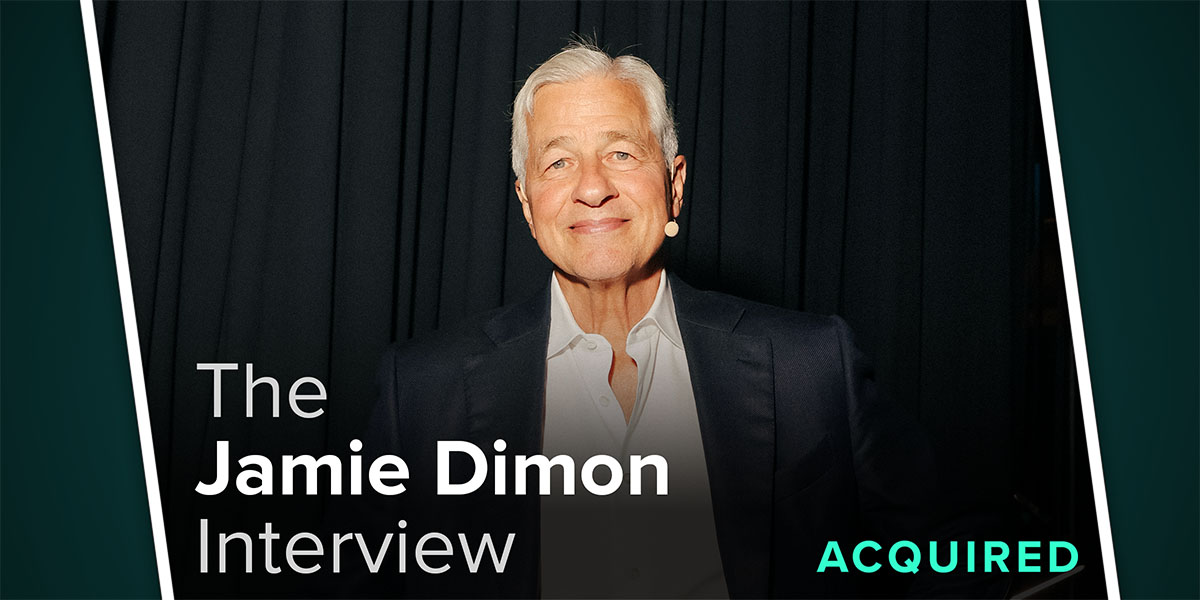


Sponsors:
Sponsors:
获取电子邮件更新与提示下一集和后续行动,从最近的插曲- 加入 Slack
- 订阅 ACQ 2
看看最新的赃物在 ACQ Merch 商店 !


Oops! Something went wrong while submitting the form
成绩单:(免责声明:可能包含无意中混淆,不准确和/或有趣的转录错误)
本:大卫,我们完全搞砸了。我们去了杰米·戴蒙的办公室,开了个小小的见面会。我们没有问决斗手枪的事。
大卫:从决斗,亚历山大汉密尔顿和亚伦伯尔,其中 J. P 摩根拥有并保持在他们的总部。我们搞砸了。我们没要求见他们。我们只能回来了。
本:等新大楼完工后,我肯定他们会住在行政楼层。我们可以去看看美国历史。
大卫:说到美国历史,让我们开始吧。
Ben:让我们开始吧。欢迎来到 2025 年夏季的收购季,这是一个关于伟大公司及其背后故事和剧本的播客。我是本吉尔伯特。
我是大卫·罗森塔尔
本:我们是你们的东道主。
今天这集讲的是20世纪80年代华尔街一位冉冉升起的星星的故事,他和他的导师一起在90年代通过并购登上了金融界的顶峰,然后他被同一位导师意外解雇了,他决定下一步做什么,然后在2000年接受了一份工作,扭转了一家经营不善的中西部银行。在接下来的25年里,他策划了银行史上最引人注目的挤兑之一,实际上是整个公司史上最引人注目的挤兑之一。
这是杰米·戴蒙的故事,他是如何从一号银行、摩根大通、贝尔斯登、华盛顿互惠银行和第一共和国的四面楚歌中创造出现代金融巨头摩根大通的。
杰米:你们为我打扮了一下。
大卫:你也为我们打扮了一番。谢谢去年我们让你在蔡斯的视频板上,你在那里看起来很夏天。你今晚看起来很棒。
杰米:谢谢。
本:我们知道你是个历史迷,我们也认为自己是历史学家。今晚我们想做的是和你一起回顾20年来的故事,你是如何把摩根大通从一家银行变成世界上最具系统重要性的金融机构的。你想玩吗?
大卫:我们想从1998年开始。你和你的导师,桑迪威尔,在过去的13年里建立了现代金融机构集团,实际上是摩根大通今天的蓝图,只不过它不是摩根大通,而是花旗集团。全世界华尔街的每个人都希望你能很快被任命为花旗集团的首席执行官。
我会说,这不是完全的模式,因为如果你看看我们在商业信贷 Primerica(然后旅行者和合并),我们是一个金融集团。我们收购了很多公司和很多不同的企业。我们把他们整顿好,我们扭亏为盈,我们赚钱了,然后我们把它和花旗银行合并,这显然是一家大银行。
我的观点是,我们应该精简它,去掉对公司其他部分不那么重要的部分,把战略上属于一起的东西放在一起。这是我和桑迪关于公司未来的一个小分歧。但它很大。它赚了很多钱。这在当时相当成功。后来我被炒了。
本:那你当时感觉怎么样?
杰米:我被解雇的时候?
是的,那一刻。
杰米:嗯,我妻子在这里,我在纽约市的公寓里接待了100个招募孩子的人。我现在住的公寓他们打电话给我。我们有我,并问我周日下午4:00那天晚上。桑迪和约翰·里德打电话给我说,你能早一点来吗?我们有很多事要谈。我是总裁兼首席运营官。我说了,不行。他们说,嗯,这真的很重要,所以我开车去了那里。我和桑迪、约翰坐在房间里。他们说他们想做一些改变,有三个。
他们说,第一,我们想让这个人负责那个。我说,好吧,这对我来说没有意义。第二个,他们想让某人负责全球投资银行,我正在运行。我以为这又是一个愚蠢的决定。第三个是他们说,我们希望你辞职。我说,好吧。
我回家了,去看我的孩子们。我的一个女儿也在这里。他们分别是14岁,12岁和10岁。我走进前门告诉他们我被解雇了。最小的一个说,爸爸,我们必须睡在街上吗?我说,不。我们没事。中间的那个不知为什么总是对大学很着迷。我还能上大学吗?他们说,是的。在这里的那个人是最老的一个说,太好了。既然你不需要,我可以用你的手机吗?
然后那天晚上,大约50个人来了,都是我刚遇到的人,所有的管理团队都带了威士忌。就像是,一直在你自己的觉醒中。有一个很高的人进来了,我的一个很好的朋友。我女儿抬起头问,你是谁?他说,我为你爸爸工作。她说,不再是了,你不需要,就这样。我没事。我告诉人们,我的净价值,而不是我的自我价值。
杰米:是的。我花了一段时间退出,签署协议,然后离开。他们很刻薄。然后我走进办公室,已经很晚了。我们去度了一个愉快的长假之类的。当我九月份回来的时候,也就是六个月后,我开始在这里工作。我无事可做,但我从九点到五点,开始打电话给人们,思考我要做什么。它是在[…]所以我每天都下楼吃午饭。
本:在四季酒店。
杰米:在四季酒店,我探索了一切。我开了自己的商业银行。我本可以退休,教书,投资,但我已经42岁了。
本:你接了一个关于经营亚马逊的电话,是吗?
杰米:我去拜访了杰夫·贝佐斯,他当时正在寻找一位总统。他和我很合得来。从那以后我们一直是朋友。他是个很特别的人。但这就像一座桥太远了。虽然那部电影刚上映,当莎莉遇见哈里时,我在想,天啊,我再也不穿西装了.我要住在船屋里。这真是太好了
本:我们会生活在一个什么样的平行宇宙?
杰米:那会是另一个世界,但我和杰夫还是好朋友。我从中至少得到了一件好事。然后我就认真了。我得到了管理其他大型全球投资银行的工作。美国国际集团的汉克·格林伯格打电话给我说,你应该加入我们。我在想,我要从桑迪威尔到你?我不得不检查我的头才能做这样的事情。
本:我不知道 AIG 的故事。
杰米:嗯,那也是几年后的事了。然后我接到猎头打来的电话,询问一号银行的情况。你们说你们中的很多人可能都知道肯·兰戈内,伯尼·马库斯和亚瑟·布兰克经营着家得宝。我爱他们。但是在我第一次和他们吃饭的时候,我去亚特兰大看了看,我说,我必须坦白。在你们打电话来之前,我从来没有去过家得宝。
本:我们其实在想,大卫和我在[.]。
大卫:我们说的是终身纽约客。
杰米:我的朋友让我去那里,拿一些设备,植物之类的东西。但我喜欢他们的文化,他们的态度。他们想让我做这件事。肯·朗格尼说,我还是应该得到你。我没打算付你足够的钱。当然,这与类似的事情无关。我有一号银行。
但第一银行是我的栖息地。我习惯了金融公司,服务业,银行业。它不是全球性的。当时它有点全球化,而且是一家陷入困境的银行。我决定生活是你创造的。在我的家庭里,这很困难。我们有一招。对于任何要搬家的人来说,孩子们(我想)他们14岁,12岁,10岁左右,这很难。
大卫:给不熟悉的人介绍一下一号银行的背景。不在纽约。这是一家大银行,但它是一家陷入困境的银行。总部在芝加哥。
本:大卫,你说的大银行是一家市值300亿美元的银行。花旗集团,你刚才去过,是一家2000亿美元的银行。
杰米:当时是210亿美元。你有正确的数字,但它做了分裂,所以如果你回头看,它是200亿美元或类似的东西。花旗是200美元,但我不担心。在生活中,你让事情成为现实。我不喜欢抱怨打翻的牛奶。你只要穿上裤子就可以走了。你看看你能从中得到什么。
大卫:但听起来你有机会留在纽约,经营更大、更有魅力的事情。
杰米:是的。这一次,我打算经营公司。其他的可能是一些投资银行。我真的不相信一些和我谈论这个的人。我还探索了很多其他的东西。我接了一些电话,一些小公司,一些大公司。有几家次级抵押贷款公司打电话给我。我说,绝对不行。
大卫:我们会谈到的。
杰米:我们会谈到的。所以我觉得这是个机会。如果这家人愿意搬家--我们花了一段时间,不得不在租来的房子里住一段时间--得到了一栋漂亮的褐砂石房子,我们最终爱上了芝加哥。芝加哥在很多方面都是一个很棒的城市。就像我说的,这是你做的。
我当时把一半的钱都投在股票上了。我将成为这艘船的船长。我要和船一起沉下去。我跟大家说得很清楚了我就一直在这里,就这样吧。所以我第二天就开始工作了。
本:我们算对了吗?就在你加入第一银行之前你买了六千万的股票
杰米:是的。
本:我从来没有听说过有人在做首席执行官的时候说,我现在要把我一半的净资产投资到这家公司。
杰米:我认为它可能被高估了一点,因为人们认为它可能会被出售或类似的东西,但我不在乎。如果你在一家公司工作,新的首席执行官来了,他来自外地,你会有很多股东,我认识很多股东。我认识很多股东。
本:你到了那里发现了什么?第一天上班你就开始调查比你想象的更好还是更坏?
杰米:有一个叫迈克马约的分析师做了一份报告。我记得报告中有一句很棒的话,“即使是大力神也无法修复它。”它是由第一银行、第一芝加哥银行和底特律国家银行合并而成的。他们从来没有把公司放在一起。他们有多个报表系统,处理系统,支付系统,SAP 系统。
他们有不同的品牌和服务。我们失去了客户,他们关闭了分行。简直是一团糟。但这是它的一切系统,人,操作。但是,我再次见到了管理团队。这很难我走进去,见了六个导演。有21个董事,11个讨厌其他10个。
大卫:等等,等等。有21个董事会成员?
杰米:21名董事会成员来自多个收购。他们是部落。他们最后互相憎恨。我进去的时候就知道了。我认识很多人。我和很多人谈过,在银行做过调查。
但同样,在生活中,你得到这些东西,它不是完美的。即使在今天,人们也希望得到完美的东西。它并不完美。我见过六个导演。我走进去。当我得到这份工作的时候,我和他们都握了手。我告诉他们,我会尽我所能。我要告诉你真相,全部真相,只有真相,好的,坏的,丑陋的。我们不是在胡扯。我们将努力建立一个伟大的公司。我需要你的帮助。然后他们就走了
所以现在我在行政楼层,我都不知道该去哪。所以我敲了一个人的门,人力资源主管。我说,我确实需要一间办公室,我真的需要一个助手。他们要把角落里的主席办公室给我。我说,不,不。我想站在中间,这样我就能看到人了。我把头伸出来。
然后我去见了管理团队。他们把它们都放在这个会议室里,漂亮的,白色,毛绒地毯。我拿着一杯咖啡走进去,他们说,杰米,我们不喝咖啡,原因很明显。我看着他们,我看着咖啡,我看着他们,我说,你现在有了。
然后我就开始和他们见面是的,系统很糟糕。公司在赔钱。我并不了解所有的业务,所以信用卡公司倒闭了。这可能是我知道的最少的业务。但是,这对我来说并不重要,我打算试着修复它,它有一些好的资产和类似的东西,所以我卷起袖子开始工作。
大卫:几周前,我们在为这个项目做准备的时候,我们问你,在摩根大通的背景下,你认为是什么样的关键因素使摩根大通成为今天的样子?你说的第一件事是风险,围绕风险的文化,你对待风险的方式。
本:还有对风险管理的基本理解.
大卫:当你到了第一银行,我想这是你第一次开始实践风险文化的地方。第一银行的风险文化是什么,你是如何改变的?
当我到了那里,我就开始和人们见面,经历。我很快意识到,第一银行的美国企业信贷风险比花旗银行更大。他们解释的方式令人难以置信的咄咄逼人。他们的资本更少,储备更少,更少。他们说这些东西有利可图,但他们基本上是赔钱的。
贷款在很多企业,你必须非常小心的信贷业务。当我发现这一点时,我有点恐慌。我检查了账簿上的每一笔贷款,把它们都记下来,增加准备金,告诉董事会,然后想从每一美元的风险中赚取更多的收入。
例如,在中间市场业务中,对于每笔贷款 NII,我们有 80 美分和 20 美分-
本:非银行业务的净利息收入。
杰米:贷款的净利息收入,还有 20 美分的其他收入,比如付款。当我们与 J.P.摩根合并时,我们有 40 个 NII 用于贷款,60%的 NIR 来自其他类型的东西,如付款。第一,你的风险得到了回报,第二,你的风险得到的回报很少。我总是进行压力测试,我向董事会展示,如果我们有一个衰退,我们即将有一个,多少钱,我们会失去信贷?
我雇了一个叫琳达·巴曼的女人她说,好吧,如果你让我做信贷,你会让我卖贷款吗?我说,是的。你要让我对冲贷款吗?是的我能出100亿吗?我说,是的。她说,好吧,我加入。我们可能减少了500亿美元的资产负债表。然后我们确实经历了经济衰退,但我们对他们来说还不错,有一个很大的坏消息是曼联,它破产了。我们基本上拥有它一小段时间。
本:似乎有一个基本的杰米迪蒙主义,这是不要爆炸。很多其他人在定价风险方面都做得不错,但其他人似乎都愿意比你更接近这条线。你从哪学来的这个不惜一切代价不爆炸的想法?
杰米:如果你看看周围的风险,总是有这个生态系统。你一直都听到了。每个人都这么做。每个人都没事。一定会成功的。这次不一样历史告诉你,学习,教你很多。
我总是说,如果你知道,我爸爸是个股票经纪人。我14岁时买了第一只股票。1972年,股票市场达到1000点。1968年达到1000人。我已经帮了一点忙了。到1974年,下降了45%。
华尔街所有的豪华轿车都不见了。餐馆都关门了。市场波动剧烈。然后我们有一个复苏。1980年,经济衰退。1982年,经济衰退。1982年,它比1968年要低。它达到了800。然后在1987年,市场在一天内下跌了25%。1990年,所有这些银行--摩根大通,花旗,大通,化工--都被真实的房地产损失压垮了,它们都价值约10亿美元。
I think Citi was $3 billion at the time, and the other ones were about a billion dollars. Then you had the 1997, also real estate-related thing. You had the 2000 internet bubble. Then you had the great financial crisis.
如果你回顾历史,有很多这样的事情。安德鲁·罗斯·索金在这里我刚读了他的书。他很好,1929年寄给我的。天啊,历史真押韵。杠杆太大,风险太大。每个人都认为这将是伟大的。没有人认为它可以下降很多。股市一年下跌20%,明年下跌30%,明年下跌20%。一度下跌90%。倒霉的事总会发生。
本:看来你的哲学是最坏的事情会发生。所以要做好计划。不要说,哦,只要这个疯狂的,疯狂的四西格玛事件不发生,我们就很好。你会说,不,这会发生的,而且经常发生。
杰米:是的。当我看着它的时候,当我做压力测试和高收益的风险时,我记得去摩根大通,翻阅风险账簿。他们的压力测试表明,高收益率将使信贷息差移动40%。当时是400度左右。这意味着560。
我说,不。我们的压力测试会是最糟糕的。有史以来最差的是17%。他们说,这种事再也不会发生了。市场更复杂。在2008年,它达到了20%,你不可能卖掉一只债券。没有市场。所以这些事情确实发生了。
关键不是你要猜他们。关键是你可以处理它们,所以你继续建立你的业务。我总是看着我所谓的胖尾巴,并设法我们可以处理所有的胖尾巴。不是美联储给我们的压力测试,而是所有的肥尾。
市场下跌50%,利率上升到8%,信贷息差回到有史以来最糟糕的水平。当然,你的结果会更糟,但你在那里。关于金融服务,杠杆会杀死你。激进的会计会杀了你,很多公司都是这样做的。还有信心如果你作为一家金融公司亏损了--我也一直知道这一点--头条新闻就是人们读到的。如果他们把钱放在你身上,他们会看到这种差异。
他们失去了信任。
杰米:他们失去了信任,这就是导致银行挤兑的原因。你最近看到一些,因为人们把钱拿出来。
本:第一,你刚才说了一件事,那就是你可能会做得更糟,但你在那里。这是一种权衡,你在短期内获利较少,但至少你坚持下去。
如果你回顾一下你经营过的公司--第一银行、摩根大通--在好的年份里,你的利润率真的比那些冒险的公司低吗?
杰米:有一点。你是说,如果你看看银行的历史,从2007年开始,很多银行的股本收入都是30%。他们中的大多数都破产了。我们从来没做过那么多。但在2008年和2009年,我们很好,他们不是。
但你想建立一个真实的强大的公司,有真实的利润,真实的客户,保守的会计,你不依赖杠杆。在任何企业中,利用杠杆来提高回报都很容易,但在银行业,这可能特别危险。
大卫:这似乎是一个核心部分,如果不是整个这蒸馏到您的经营战略的堡垒资产负债表。你什么时候听说堡垒资产负债表的?
杰米:我回到了 Primerica。我以前常说。你一定能挺过坚韧的。
本:那是90年代初?
杰米:可能是90年代。就像我说的,我长大了。我父亲和我一起去了市场。我记得华尔街的人有多艰难。堡垒的资产负债表是你经营一家为客户服务的公司。你有很好的利润,流动性,资本。我是你能找到的最保守的会计。当我可以把利润分摊到一段时间后,我就不预付利润了。
当然,会计师讨厌我这么说。你可以开着卡车去会计规定的地方。会计本身,某些东西被认为是费用,但他们是好的。它们是对未来的投资,但它们被称为费用。那么收入,如果我发放不良贷款,它们就是不良收入。他们会杀了你但有一段时间他们看起来很好。都是为了利润客户。
在银行业务中,你所拥有的客户的性格将反映在你的银行上。第一件事是,你在和谁做生意?你是怎么做生意的还要确保你的薪酬计划不会为愚蠢或不道德的事情付钱。你总是要回顾这些事情,以确保你有他们的权利,因为他们改变了所有的时间。
本:好了,听众朋友们。现在是一个很好的时间来感谢我们最喜欢的公司之一,Vercel。
大卫:Vercel 是一家很棒的公司。在过去的几年里,它们已经成为推动现代 Web 开发的基础设施支柱,现在是 AI 浪潮。如果你最近访问了一个快速、响应迅速、现代化的网站,或者使用了一个带有代理和超个性化界面的光滑 AI 原生应用程序,那么它很有可能是在 Vercel 上构建和部署的。
本:在过去的十年里,他们的使命是使巨人的课程民主化。像谷歌、亚马逊和 Meta 这样的公司。这个想法是开发人员不应该花费数周时间和工程资源来整合数十个服务,只是为了推出一个 Web 应用程序。
大卫:维塞尔让事情变得简单。你写代码,然后发布。很快。全球分布,并且在部署的细微差别中没有开发第二种技能。这就是他们框架定义的基础设施的魔力,它基本上让开发人员和大型团队从想法到生产没有任何摩擦。
Ben:你可能知道,Vercel 一直是前端开发的代名词。但现在他们也做后端和代理工作负载。Vercel 称之为 AI Cloud,专为下一个应用程序时代而构建,并且已经在 Under Armour,PayPal,Notion 等公司以及 Runway,Decagon 和 Browserbase 等 AI 初创公司中投入使用。
大卫:人工智能云需要消除部署摩擦,甚至更进一步。在某些情况下,开发人员甚至不再需要推送代码。代理可以持续发布功能,基础设施可以自行配置,接口可以适应您的工作方式。
Ben:如果你想打造软件的未来,就去 vercel.com/acquired,告诉他们是 Ben 和大卫派你来的。
现在也是感谢我们最喜欢的另一家公司 Anthropic 和他们的人工智能助手 Claude 的好时机。
大卫:克劳德真的改变了我们在收购这里的工作流程。准备采访杰米·戴蒙需要认真的研究。显然,几十年的银行业历史、监管变革、三次金融危机,构筑了资产负债表的堡垒。这正是克劳德擅长的复杂分析。
本和我在这里从来没有得到过帮助,因为我们认为自己做研究很重要,但克劳德现在给了我们两个世界最好的。这是一个额外的手,我们有充分的控制和可见性,它在做什么和如何。
本:克劳德对我来说特别棒的地方是扩展思维模式。当我要求它分析摩根大通在多次金融危机中的战略时,我可以看到克劳德一步一步地通过每个决策点进行推理。
大卫:它有完整的上下文,通过连接我们在 Acquired 的整个 10 年的知识库,通过一种叫做 MCP 的东西,你可能听说过模型上下文协议。他们已经与 Gmail 和 Google Chrome 进行了预构建集成,还提供了 Jira,Asana,Linear,Square,PayPal 等服务,以及您拥有的任何内部工具的自定义集成。
本:克劳德是由 Anthropic 制造的,专注于准确性和可靠性,这正是我们所需要的。
大卫:如果你想开始使用克劳德自己或为您的组织,请访问 claude.ai/acquired。他们有一个特殊的报价为收购听众,半价克劳德专业三个月,这让你获得所有功能上述。
本:因此,无论您是在为自己的高风险会议、面试或对话做准备,还是您只是需要一个可以信赖的 AI 来处理严肃的工作,Claude 都会与您一起思考,而不是为您而思考。网址是 claude.ai/acquired。
大卫:所以你在芝加哥经营了四年的第一银行,然后在2004年与摩根大通合并,当时称之为平等合并。我想摩根大通称之为第一银行的股东获得合并后公司42%的股份。我认为人们没有意识到摩根大通今天有多少是一号银行。
杰米:这就是为什么它让我有点恼火。他们说你一直在经营它。自从我经营摩根大通以来,我一直在经营公司的 40%。当我到一号银行的时候,我并没有夜以继日地工作,我已经知道一个合乎逻辑的战略合并可能是 J.P.摩根。我知道所有这些公司。堡垒资产负债表的另一个特点是,你还有经得起时间考验的真实的策略。你不是在翻筋斗。
Then I’m sitting there and of course the tape comes, J.P. Morgan Chase to merge. We’re worth $25 billion. They’re now worth like $80 or $90 billion or whatever the number was. I’m like, well, there goes that dream. 重试 错误原因
Four years later, our stock was up to doubled or something like that. Theirs actually come in and it was in the target range. I had been meeting with Bill Harris and the current chairman of J.P. Morgan at the time. We were talking about it. We both knew it made business sense. They were looking for a CEO. We had been talking probably for a year-and-a-half before that. 重试 错误原因
Ben: They’re looking for a CEO. Did they give Bank One shareholders 42% because they were looking for a CEO? 重试 错误原因
Jamie: There were two lawsuits. We got the premium, they got the name and location. I effectively had control from day one because inside the merge agreement—this is almost unheard of—when we get the premium, is to not have me become CEO 18 months later, 75% of the board would have to vote me out. 重试 错误原因
董事会由 8 名第一银行的人和 8 名 J.P.摩根的人组成。我也认识摩根大通的很多董事会成员,他们都很尊重我,比尔·哈里斯和我关系很好,但这是协议。他们因为花太多钱买我而被起诉。我因为拿得不够而被起诉。如果你被起诉了,穿这个是赢不了的。
大卫:我想每个股东可能都很高兴。
杰米:但它成功了。
大卫:在我们到 2006 年之前,当你经历这个过程的时候,甚至可能在你和比尔谈话的几年前,你开始考虑把摩根大通作为一个合伙人,我很好奇。品牌,J. P.摩根这个名字有没有影响到你的想法?你认为这是一种资产吗?
J.P. Morgan 是 Tiffany 的名字。我在交易中没有重视它。当我看的时候,我已经给了我的董事会。我认为第一件事是把你的公司经营好。人们认为我会立即开始做交易。我说,不。我们太烂了。我们还没有赢得经营别人公司的权利。当我们经营一家好公司时,我们可以和别人合并。
我首先考虑的是商业逻辑。每一项业务,我们都有一个消费者业务。他们有消费者业务,我们有信用卡业务。他们俩都很糟糕。他们有信用卡业务。他们有一家大投资银行。我们有一家大型美国企业银行,需要一些投资银行服务。我们都有财富管理业务。我知道我们可以节省很多成本,所以商业逻辑将是无可挑剔的。
然后是执行的能力。你真的能做到吗?因为你们都见过很多失败的交易。他们没有管理层,他们没有整合系统,他们有内部斗争,发生在花旗,所以你没有实现。
然后是价格。我知道我们有一个蒂芙尼品牌,但它并不值钱,因为如果其他一切都不成功,我不认为这有那么重要。
大卫:有意思。
本:我要快进几年。现在是2006年你现在是摩根大通的董事长兼首席执行官了。
大卫:2006年的华尔街就像是,去吧,去吧,宝贝。就像回到了80年代。
本:我认为你和其他人一样有同样的动机,但你的行为却大不相同。我错过了什么吗?你也有同样的动机还是-
大卫:你在2006年把摩根大通拉回到了风险方面。
杰米:是的。2006年那里出现了裂缝。你可能还记得宽客。2006年底,量化分析师开始出现问题。我们确实看到了次级抵押贷款的恶化。我收回了次级贷款。我希望我做得更多,因为如果你看看我做的,你会说,好吧,你节省了一半的钱,但你会节省更多。
杰米:是的,但我们也有,我会说更少,也许是大投资银行的三分之一的杠杆和更多的流动性。所以在 2006 年,我开始储备流动性,看到现在的情况,我很担心。你可能不记得了,但是杠杆率,因为会计规则和巴塞尔 III,巴塞尔 I,投资银行,特别是大的投资银行,杠杆率从 12 倍上升到 35 倍开始了,开始了。CMO,过桥贷款,所有的一切。
2007 年,华尔街的桥牌账簿是 4500 亿美元。今天是 400 亿美元。J.P.摩根今天可以处理全部 400 亿美元,尽管我们不是今天的 400 亿美元,而且他们的杠杆交易更多。很多人都崩溃了。当然,那是在抵押贷款崩溃之前,抵押贷款确实摧毁了很多银行。
本:但你确实有与其他许多人相同的激励措施,也有与其他许多人相同的信息获取渠道,但你并没有爆炸。怎么解释呢?因为通常情况下,行为遵循激励。
杰米:嗯,首先,如果你为我工作,我会告诉你我不在乎奖励是什么。别做错事不要对客户做错事。如果你是当事人,你希望别人怎么对待你?我已经摆脱了,我提到了一个风险的事情。有很多这样的风险。他们被雇来承担风险。
大卫:你刚才跟我们说汽车贷款的事。
杰米:是的,但他们会得到报酬。但是当我把所有这些新的风险控制措施都放进去的时候,突然之间你就不能通过杠杆来赚钱了,因为我在看如果情况变糟的话,实际上可以部署多少资本。所以我一直在看整个周期的收益,但非常重要的是,所有这些投资银行都在做副业,私人交易,三年期交易,五年期交易,我几乎把它们都处理掉了。
大卫:这是给高级银行家的。
杰米:几乎所有的。今天,在摩根大通,我们确实做了一些事情--我认识在座的一些合伙人--但我们都知道这一点。没有什么不好的。没有什么附加条件。几乎没有人在某件事上得到报酬,因为如果你在某件事上得到报酬,你可能会做错事,同时也不会帮助公司管理风险或类似的事情。所以我们改变了激励计划。
我很清楚激励计划,他们不会创造错误的行为。但同样重要的是,如果你在一家公司,你说激励计划会这样做,你应该告诉公司。该激励计划并未激励客户采取正确的行为。很多都是筹码。
如果你看看这些证券化和抵押贷款账簿中的杠杆率,如果你有30倍的杠杆率,你得到20%的利润,你会达到40倍的杠杆率。它会增加25%的奖金。所以我去掉了20%的利润池和杠杆。同时我也失去了一些人。
大卫:很有趣。摩根大通作为系统的一部分,有相同的激励措施,但你改变了公司内部团队的激励措施。
好吧,我们得回到2008年。2008年3月13日,星期四。今天是周四晚上。你接到贝尔斯登总裁的电话该股当天收于每股57美元。几个月前才150美元。三天后,天哪,我记得就像昨天一样,我在华尔街的公园大道工作,我记得那天晚上-每股2美元。你要买下贝尔斯登告诉我们这个故事。
杰米:我在47街的阿芙拉,我父母和我父母最喜欢的餐馆。我全家都在那里。那天正好是我的生日。我一般不会接到紧急电话-
大卫:生日快乐。
杰米:艾伦·施瓦茨是现任首席执行官。我们看到他们的股票下跌。我知道他们有一些真实的问题,因为我们看到了他们的对冲基金和那里正在发生的一些事情。他说,杰米,在亚洲开放之前,我今晚需要300亿美元。我说,我不知道怎么给你弄到300亿美元。你给保尔森打电话了吗你给蒂姆·盖特纳打电话了
所以我们都打了电话。我给管理层打了电话。我又进去了。我可能吃了点东西然后说再见。回办公室了。那晚大概有100人进来他们都穿好衣服,回去工作了。紧急情况我们现在拉响了所有的紧急铃。贝尔斯登破产了,并与美联储讨论了让他们度过周末的问题。我们只有一天的时间,我们需要周六和周日,我们捏造了这笔贷款。
我们不能借出300亿美元。从技术上讲,美联储不能借给我们300亿美元,但从技术上讲,美联储可以借给我们。严格来说我可以用贝尔斯登的抵押品我们得到了一天的贷款。
第二天,我们有成千上万的人来做尽职调查。我们花了两三天的时间,检查了每一笔贷款、每一项资产、每一张资产负债表、所有的衍生品、所有的诉讼、所有的人力资源政策、真实的尽职调查,并在当晚以每股2美元的价格收购了这家公司。
汉克·保尔森说,你为什么要为此付出代价?我说,好吧,我必须得到股东投票,这就变成了-
大卫:你需要花旗股东批准这笔交易。
杰米:这是一笔公开交易,最糟糕的是,我会受到贝尔斯登股东的起诉。我知道,但我们不能让它破产。它不像一家破产的工业公司。它就会消失危机就会出现。
David: Okay, two questions: (1) What would’ve happened if it went down? (2) Afterwards, did you think it was over?
Jamie: No. That was March. What happened with Lehman was an uncontrolled failure. There was money locked up everywhere. People panicked. They started pulling money out everything. That would’ve happened with Bear. It did stop that, and I would’ve thought that it gave other people other time to clean up their act.
Literally six months later, I would’ve thought some of these other firms had more liquidity, more capital, and were a little bit more prepared for what might be happening. We already had the stress in the system was you saw it already. It was going to mount. It wasn’t going to go away. There were tremendous losses coming.
We bought it and probably did help. In hindsight, it didn’t stop the crisis from unfolding. We bought it, and then a week later, we changed the $10 a share. It had been at $120. The way to think of it is, it was $300 billion of assets and a $12 billion tangible book value.
We wrote off the whole tangible book value when we bought the company. We had to liquidate the loans. We had to hedge stuff, we had severance costs, lawsuit costs, and we basically used all that.
We paid a billion dollars for a company that had been worth $20 billion recently. The building we’re in now was worth a billion dollars on the balance sheet for zero. The fact we got some very good people and we got some good businesses, but it was an extremely painful process.
Ben: I’ve seen estimates that in the fullness of time, after really dealing with unwinding all the stuff there, it cost you $15–$20 billion.
David: It cost you 20 anyway.
Jamie: Yeah. It was the $12 billion we wrote off. That didn’t cost us. We didn’t really pay for it. Then the government sued us on the mortgages, which I was quite offended by. And I really was. I thought it was—
Ben: Take this problem and then we’ll see.
Jamie: Well, this is the government. Whatever government you did a deal with, that’s not the government down the road decides, I don’t care. We’re going to come after you anyway. So while we saved the system a lot, we bailed a lot of people out, they made us pay $5 billion on the bad mortgages that Bear Stearns had done. That’s what made me make the statement I wouldn’t do it again. Put it this way. I don’t know how to say this. I wouldn’t really trust the government again.
Ben: I got to ask a follow-up question to that. Is that a structural thing? Just the way that we’re set up with a new administration every four years?
Jamie: Yeah. They don’t feel obligated to what the prior administration did. Even some contracts were violated in this thing, which I won’t go through. Literally contracts. It would’ve been tortuous interference had it been company-to-company. But basically, since you operate under their laws, they can basically take you down.
I went to see Eric Holder trying to settle this mortgage stuff, which we settled. I brought my lead director. He expected me to come and be pounding my chest. I went in and said, Eric, I am here to surrender. I cannot fight and I cannot win against the federal government. You know that a criminal indictment can sink my company. I will not do that to my company or my country. I’m here to surrender.
Before I surrender, I want you to know the circumstances by which we bought WaMu and Bear Stearns, because 80% of what they’re asking for related to Bear Stearns and WaMu, not J.P. Morgan Chase. I went through the whole thing. He said, thank you. I’ll take it in consideration. But they never gave me the accounting. I don’t know what they did. It is what it is. It was quite painful, but it’s got to move on.
Ben: We’ll move on from this.
David: I do have one more thing. Whether you would’ve done it again, very clear it was not a great deal on paper for J.P. Morgan. But as we look at it, the reputation of J.P. Morgan now is unlike any other in the industry.
Ben: Part of why you’re worth $800 billion is that reputation. A lot of what created that reputation…
David: Was that weekend.
Jamie: Yeah, I know. And I know I say I wouldn’t trust the government if the government called me up. They did it again. They called me again and said, we need your help to save our country. Well, of course, I’m a patriot that way. I would just try to come with some ways to avoid the punishment by the next president. I would come up with something.
David: You know what you need? The version of the merger agreement with J.P. Morgan Chase, where it’s like 75% of Congress needs to vote not to sue you. The default is you’re not going to get sued.
Ben: So Bear Stearns happens. Six months later, you get another phone call. WaMu is going under. You do buy WaMu. Contrary to everything we’re talking about with Bear, WaMu is actually a great acquisition, right?
Jamie: This is a lesson about acquisitions. It’s very hard. Remember, we bought WaMu a week after Lehman went bankrupt. Most boards wouldn’t have touched that at all. The whole system was in trouble. But WaMu put us in California, parts of Nevada, Georgia, Florida, which we weren’t in. So think of these really healthy states. They had 2300 branches.
They had huge mortgage problems, but we had looked at it over and over and over. We knew their mortgage books called and we wrote off. We bought it for $30 billion discount to tangible book value, because they had debt, and we left the debt behind. That $30 billion was approximately what the Moore’s law was going to be.
We bought the company. I think if we bought a company clean, we wrote off all that stuff. The books were clean. Then we did something unheard of, too. The next day or two days later, I went and the market raised $11 billion of equity, which I didn’t really need. But again, this is my conservatism. I was like, you know what? This could get even worse, and I don’t want to be short capital liquidity. So we raised that to make sure our balance sheet was just as strong as it was after WaMu than it was before WaMu.
Ben: And you already had the reputation to pull this off. I’m imagining in the worst month of the financial crisis, who can go out and raise $11 billion of equity? People trust you.
Jamie: Well, yeah. We knew a lot of the shareholders, and you earn your trust over time with shareholders. And we explained. We gave them a quick little presentation. A lot of them stepped up and said, this is great.
They also knew we can execute it because behind the Bear Stearns, people forget the work is the next day you got 50,000 people consolidating 5000 applications, branches, compensation programs, settlement programs, payment systems. It’s a lot of work. But we obviously have the capability to do that.
We have the capability of doing WaMu. I think we finished the WaMu consolidations in nine months, all of them. That was nine months that we’re all in the same systems, which allows you to start doing a better job in customer service and things like that.
Ben: This fortress balance sheet strategy, raising this equity capital, having additional margin of safety, and conservative accounting, in retrospect, it seems like the obvious right strategy for running a large financial institution. Why wasn’t everyone else copying it? Have people changed and does everyone else run their banks like this now?
Jamie: I think people are more conservative today. I think regulators are more conservative today. But again, I go back to people get involved in aggressive accounting. They don’t look at stressing their own bank in a real way. You saw people take too much interest rate risk, too much credit exposure, too much optionality risk, or sometimes it’s new products.
If you look at the financial services, very often it’s the new products that blow up. It takes a while. They haven’t been through a cycle. You had that with equities way back in 1929, you had it with options, you had it with equity derivatives, you had it with mortgages. Even Ginnie Maes at one point blew up, even though they’re government guaranteed.
David: Arguably, you had it with quant and with LT and CM.
Jamie: It happened with quant. It happened with leveraged lending. People then become more rational how they run these balance sheets now they think through the risk.
Ben: I have to ask you, is this private credit today?
Jamie: I don’t really think so. It’s $2 trillion. It’s grown rapidly. That’s an issue. The other thing about Mark is there are some very good actors in it who know what they’re doing. Customers like the product. I always say, well, the customers like it.
But there are also people who don’t know what they’re doing, and it’s grown rapidly. There may be something in there would become a problem one day. I don’t think it’s systemic. That $2 trillion, the mortgage market, when the time it blew up was (I’m going to say) $9 trillion, and a trillion dollars was lost.
David: A trillion dollars was more than a trillion dollars back then.
Jamie: Yeah, a lot of these private credit are not leveraged like that. But that doesn’t mean there won’t be problems. It’s slightly different. You look at the whole system. There are other things out there that are leveraged that can cause problems. Of course, people take secret leverage in the ways you don’t necessarily see it.
Ben: What are some of these in your mind that are potentially problematic today?
Jamie: When you look at asset price, they’re rather high. Now, I’m not saying that’s bad, but if today PEs were 15 as opposed to 23, I say that’s a lot less risk. A lot less to fall, and you have some upside. I would say at 23, there’s not a lot of upside, and there’s a long way to fall. That’s true with credit spread.
We stress test everything. We do 100 stress tests a week to make sure we can handle a wide variety of things. The biggest risk to me is cyber. I think the cyber stuff is we were very good at it. We work with all the government agencies. They would say the [...] we spend $800 million a year or something on it. We educate people on it. We just do. But it is.
You’re talking about grids, communications companies, water, and even part of the military establishment. The protections are not what we need, but if we ever get in any kind of war where cyber’s involved, and China is very good at it, and so is Russia, but Russia is mostly criminal which is slightly different.
Ben: I’m going to pull us back to the story. We’re going to fast forward to 2023.
David: We’re not really equipped to talk about Russia. It’s not what we do on Acquired, but think…
Ben: Silicon Valley Bank and First Republic both fail. You’re there again. Did you see it coming? What lessons did you learn from how 2008 went that you could apply in 2023? Obviously you bought First Republic.
Jamie: Silicon Valley Bank did some very good stuff. They both had something unique that we didn’t know at the time. I’m going to call them concentrated deposits. Not uninsured because people missay that concentrated, so a lot of venture capital.
What happened with Silicon Valley Bank and First Republic is some of these large venture capital companies—hundreds of them, maybe a thousand—told their constituent clients that they invested in, who all banked in the Silicon Valley and First Republic, the banks aren’t safe, get out, and they all removed their deposits.
Silicon Valley Bank (I think) had $200 billion deposits, $100 billion in one day. That caused the problem. But they also had other problems. They didn’t have proper liquidity, they didn’t have their collateral posted at the Fed, and they had taken too much interest rate exposure.
The interest rate exposure was hidden by accounting. It was called held to maturity, where you don’t have to mark even treasuries to market. I always hated held to maturity, but it gives you better regulatory returns and stuff like that. But when that held to maturity, if you said what’s the tangible book value of one of these banks, and you said it was 100, well all of a sudden it was 50 if you just marked that one thing to market.
Now you’re into judgment land. At what point, if you saw a bank where just that one mark had the tangible book value drop to 40 or 30 cents to a dollar, would you panic? I would’ve said, that’s too much risk.
The regulators helped us because they said rates are going to stay low forever. So these banks bought a lot of 3% mortgages. When rates went up to 5% worth 50 cents on the dollar, that was it. They took too much instrument exposure known to management, known to the regulators, and fixable.
We knew a little bit about Silicon Valley Bank. We were trying to compete in that area, so we learned a lot afterwards about how to do a better job for that ecosystem of venture capital. We have a whole campus in Palo Alto now. We’ve hired 500 innovation bankers. We cover venture capital companies. We’re not as good as they are yet. We’re going to get there because we’re organized slightly differently, and we knew First Republic. We were watching it.
I had called Janet Yellen. I said that company’s in trouble, and one or two others. If you want to, we’ll take a look. We could probably buy it and eliminate the problem. They waited a little bit too long. It was a little melting ice cube. But you can imagine, the day we bought it, you never heard about it again. We hedged all their exposures in a couple of days and we merged everything. We wrote everything down, but we did get some good stuff from them. We actually got some good people.
The normal thing in acquisition is they’re terrible, get rid of them, or they failed. But we also looked at what they did, how they dealt with clients. Some of them are maybe clients here. They did a great job with high net worth clients. Single point of contact concierge services. Now if you go down Madison Avenue, you see things called J.P. Morgan Financial Center.
Ben: That’s your first J.P. Morgan-branded consumer effort, right?
Jamie: Yes, because it’s based on that. When you walk in there, we know your small business, we know your mortgage, we know your consumer banking. We can get you travel, we can do a whole bunch of different stuff. We’re very high level services. I think we have 20 of them now, but I’d love it. If it works in 20 years we’ll have 300. These things are opportunities and I hope it works. You don’t always know they’re going to work for a fact, but so far so good.
Ben: All right, listeners. Now it is time to talk about one of our favorite companies, Statsig.
David: Statsig is the tool of choice for product development teams at hundreds of great companies, including OpenAI, Notion, Rippling, Brex, Atlassian and more. Why are all of these hypergrowth companies using Statsig?
Ben: Well, in the past, every major tech company spent years rebuilding the same internal data tools like feature flags, product A/B testing, logging services, product analytics, dashboards, you name it. But the latest generation of great companies are just using Statsig.
David: Yup. Statsig has rebuilt the entire suite of data tools that previously was only in use at the biggest tech giants as a standalone product. This includes cutting edge product experimentation, feature flags for safe deployments, session replays, analytics and more, all backed by a single set of product data. It’s a holistic suite to build better products.
Ben: Statsig is also warehouse-native, so it can plug directly into your existing data in Snowflake, BigQuery, whatever you’re using. That means way more privacy and security, great for any finance listeners out there, plus no sending your data to yet another tool.
David: If you’re ready to give your product and engineering teams access to great data tools, go to statsig.com/acquired to get started. They have a generous free tier and a $50,000 startup program. Just remember to tell them that Ben and David sent you.
Ben: We’re effectively caught up to today. Now we’ve got the whole story, we’ve got a lot of context. Obviously didn’t go into every detail, but if we’re now trying to answer the question, how did you separate from the pack? Why did you become a completely different animal than your whole competitive set? What are the things in your mind that led to this success?
Jamie: Well first of all, we skipped over strategy a little bit, and this is important for all. What we do is the same thing that a community bank does other than global investment banking.
If you walk into a small community bank, they know your business account, they know your consumer account, and they usually have a trust company. They used to call it trust. They manage your private affairs, they set up a trust for you, and they do stuff like that. Their CRM is up here. They don’t need a Salesforce CRM because they know everyone in town. They didn’t do big time global investment banking.
But the strategy, those businesses fit together, they feed each other, and so does investment banking. A lot of our middle market clients use investment banking products. A lot of our consumer clients use some FX. All of our businesses feed each other. There’s no extraneous. We got rid of everything that didn’t fit a strategy. Then you start building client businesses and client services, fortress balance sheet, fortress accounting, and all those various things. I’ve always talked about—
Ben: So it’s holding a portfolio of things that actually feed each other?
Jamie: They actually fit. Whereas Citi had consumer finance that didn’t fit, life insurance that didn’t fit, property [...] that didn’t… They eventually got rid of them all. Sandy just wanted to do more of them.
He bought American generalists, did truck leasing for God’s sake. Once you get involved in these things, it is hard for people to understand the risk in each one of these businesses, but all of ours fit. I don’t like hobbies, I don’t like things. We’ve made plenty of mistakes because you have to try and test things. Then you’re always investing for the future.
That investment is always people, branches, and technology. That’s true whether investment banking people or consumer bank people or opening consumer branches. I think Doug Petno was here and Troy Rohrbaugh, who run the Global Investment Bank, but they’ve opened commercial banking branches all over Europe. And I think you’re telling me it’s going great and it’s feeding all other parts of the company.
So just sticking to your knitting, constantly investing, not overreacting to the market. Markets are like accordions. Then sometimes if you’re strong when others aren’t, you have a chance to buy things you want to buy. Then always look at the world from the point of view of the consumer. What do you want? How do you want it? How do you want to get it? Can we provide it to you in a way that makes sense for us too? Not going for the last dollar and not nothing like that. And building teams of people.
Our people are curious and smart. They have heart, they have soul. They give a damn about the guards in the company and the receptionists. It’s not just about the big time bankers and people pounding their chest. We try not to put up with that. And we have big time bankers. They’re exceptional, but the company serves the clients, and I think the clients know that.
Ben: When you really dig in to start analyzing J.P. Morgan’s financials, you see this one thing that jumps right out at you, which is the efficiency ratio. For every dollar that you make compared to your competitors, you get to keep 15 cents more of that dollar as profit. It’s not hard to see how that compounds and how that allows reinvestments. Why is your efficiency ratio so much better than competitors?
Jamie: It is literally continuously investing, gaining business at the margin, not stopping and not stop starting. The thing about margins too is that we have that margin while investing a lot. It’s much easier to have that margin. We can cut billions of dollars of marketing out tomorrow. We can stop opening branches and save a billion dollars next year. We could do a lot of things.
Your margins will go up, your growth will go down. Your long-term margins will probably get worse. So we look right through the cycle and we look at the actual economics that we do, not the accounting of what we do. And we’ve built it over time.
We have great people and great products. There’s some secret sauce I’m not going to tell you about. We do investor day and we tell everyone everything. I’m sitting there. I never do presentations. I’m watching them do the presentations. I’m saying, oh God, we’re just giving away too many secrets here.
Ben: So there are secrets as to why the efficiency ratio—
Jamie: I saw Howard Schultz here before, and I’m not supposed to say that.
David: It’s okay.
Jamie: No, but look what he built over the years. The consistency, the curiosity, the heart, the branch-by-branch products. It’s just always doing that, knowing you’re going to make mistakes, but building the culture that just plows through that.
You all know I do use sports. Sports is a great analogy. If you have a sport team with a bunch of real jerks on it, are they going to be a great team? Almost never. You look at Tom Brady. Every day at practice he worked hard. If people are not giving their best, how you’re going to have a great team?
It’s not that different in business. The difference in business, you can BS about it all the time. You can make up stories. But in sports, you see it on the playing field. Do they have the team? They play together. They don’t even have to be friends. They have to practice, know their teams. So I do think companies have that. It’s like a sauce that works. And you’ve seen it. Lots of different companies, not just J.P. Morgan Chase.
David: So, we’ve got one last question for you. If you look back to 2008, which was a long time ago now, all of the other leaders that were involved in that era have long since retired. I think many folks within J.P. Morgan Chase have long since retired since then. It seems like you’re working as hard as ever, and in it as much as ever. Why are you still here? What keeps you going?
Jamie: I want to thank my wife who was here, too, who suffered through all this, with me all these years, and probably couldn’t have done it without her. Look, I don’t know. But I do believe, my grandparents, all Greek immigrants, who didn’t finish high school, but there’s a Greek ethic. You don’t even realize you’re learning from your parents from the ground up. Judy’s parents, my wife’s parents were the same.
Have a purpose. It could be art, it could be science, it could be military, it could be business, it could be just being a great parent, a great teacher. But have a purpose. Then do the best you can. Give it your all. Don’t be one of those people who’s complaining all the time. You give it your best. And then treat everyone properly. Everyone.
If there’s a bully beating up on someone, you had to stand up for the someone. You were not allowed to allow a bully to do it, so how you treat people you do.
In my hierarchy of life, the most important thing is my family. Still is. The second thing is my country because I think this country is the indispensable nation that brought freedom of speech, freedom of religion, freedom of enterprise, which we have to teach everywhere we go about how important it is, because I don’t think people fully understand it sometimes.
Then my purpose, because my family doesn’t want me home every day, this is my contribution. Through this company, I can help cities, states, schools, companies, employees. I get the biggest kick out of that, so that’s what I do. As long as I have the energy, I’m going to do it.
I don’t play golf. One of my daughters said, dad, you need some hobbies. I said, I do. Hanging out with you, family travel, barbecuing, wine. We now like whiskeys. I love history. I think history is the greatest teacher of all time. Hiking. I can’t play tennis anymore because of my back. But those are my hobbies.
I don’t buy fancy cars and stuff like that. But this gives me purpose in life beyond family and beyond country. Plus, I think this helps the country. I get to do a lot of things for our country that I just think are quite meaningful from this job.
When I’m done with this, I don’t know. I’ll teach and write. I may write a book like Andrew Ross Sorkin did. I’ll do something, but I got to do something, and I’m not going to twiddle my thumbs and smell the flowers.
Ben: There are a lot of people who have floated your name for political or policy roles over the years. It is hard. There is only one job that could possibly impact the country in a bigger scale than you’re currently doing. Do you agree?
Jamie: Right now, yeah.
David: Well, that’s probably a great place to leave. Jamie, thank you so much for joining us.
Jamie: David, Ben, these guys are great, by the way, so thank you.
Ben: Well, that is it for our conversation with Jamie Dimon, listeners. Thank you so much to all 6000 of you who came to watch in person. It was so cool.
David: So cool.
Ben: Well, we have some thank yous. First to our partners this season. J.P. Morgan, an incredible partner does here at Acquired. Statsig, the best way to do experimentation and more as a product development team. Vercel, your complete platform for web development. And Anthropic the makers of Claude. You can click the links in the show notes to learn more about each of them.
As always, a huge thank you to Arvind Navaratnam at Worldly Partners for his excellent write-up on the Jamie Dimon years of J.P. Morgan, which is linked in the show notes.
If you like this episode, go check out other recent episodes, like the start of our Google series, which is off to a screaming start. Our Rolex episode, which is another one of our biggest ever. And then our interviews—Steve Ballmer, Mark Zuckerberg, Howard Schultz. If you’re new to the show, I think all of those are great places to start.
After this episode, if you are still looking for more and you are like, I’ve already listened to all of those other episodes, we have a second show for you, ACQ2. The most recent is an episode with Jesse Cole, the founder and the CEO? Founder and owner?
David: Owner, yeah.
Ben: He wears a lot of hats, all of them are yellow, at the Savannah Bananas.
David: For something completely different.
Ben: Yes. And if you want to talk about this with the Acquired community, come join the Slack, acquired.fm/slack. And with that, listeners, we’ll see you next time.
David: We’ll see you next time.
Note: Acquired hosts and guests may hold assets discussed in this episode. This podcast is not investment advice, and is intended for informational and entertainment purposes only. You should do your own research and make your own independent decisions when considering any financial transactions.
