New IFR position paper on humanoid robots published
인간형 로봇에 대한 새로운 IFR 입장 문서 발표
Position Paper Humanoid Robots - Vision and Reality
인간형 로봇 - 비전과 현실
Jul 17, 2025 — The latest IFR position paper takes a closer look at humanoid robots und tries to separate vision and reality, taking a glance also on the regional differences.
2025년 7월 17일 — 최신 IFR 백서에서는 휴머노이드 로봇에 대해 자세히 살펴보고 비전과 현실을 구분하려는 시도를 하며, 지역별 차이점에도 주목합니다.
2025년 7월 17일 — 최신 IFR 백서에서는 휴머노이드 로봇에 대해 자세히 살펴보고 비전과 현실을 구분하려는 시도를 하며, 지역별 차이점에도 주목합니다.

Hype about humanoid robots
인간형 로봇에 대한 열풍
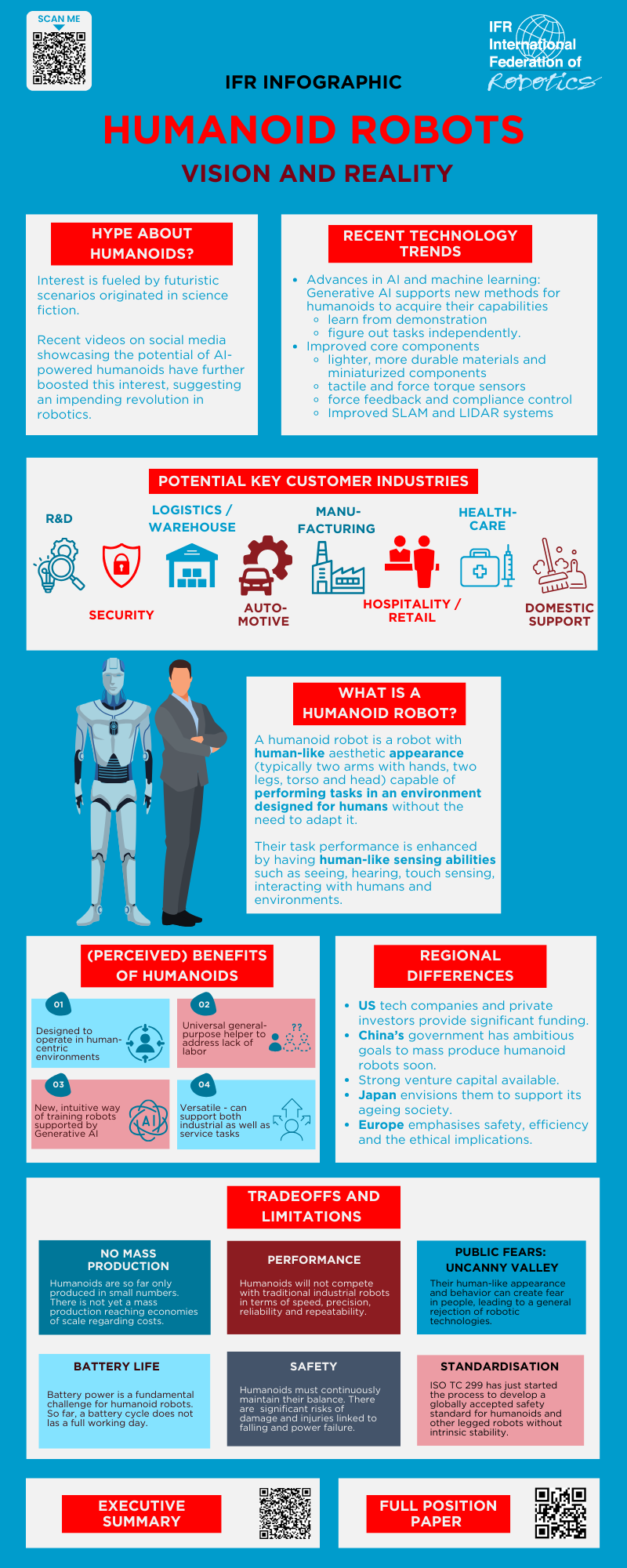
People's interest has been fueled by futuristic scenarios involving humanoid robots in homes, businesses, and public spaces. This fascination has a cultural backdrop, as humanoids have long been a staple of science fiction, particularly in film. People are intrigued by the prospect of these fictional depictions becoming reality. Recent videos on social media showcasing the potential of AI-powered humanoids have further boosted this interest, suggesting an impending revolution in robotics.
사람들의 관심은 가정, 기업, 공공 공간에서 활동하는 휴머노이드 로봇을 포함한 미래 지향적인 시나리오에 의해 자극받고 있습니다. 이 매력은 문화적 배경을 가지고 있으며, 휴머노이드는 오랫동안 과학 소설, 특히 영화의 주요 요소로 자리 잡아 왔기 때문입니다. 사람들은 이러한 허구적인 묘사가 현실이 될 가능성에 매료되고 있습니다. 최근 소셜 미디어에 게시된 AI 기반 휴머노이드의 잠재력을 보여주는 영상들은 이 관심을 더욱 높이며, 로봇공학 분야의 혁명이 임박했음을 시사하고 있습니다.
Robots for human-centric environments
인간 중심 환경을 위한 로봇
The objective behind constructing humanoid robots is to tackle tasks in human-centric environments and push the boundaries of robotics in both research and practical applications. The vision is to create a general-purpose robot that can perform not just one task, but many. The demand for a quick, universal helper to maintain manufacturing and services is evident given that most developed economies are experiencing persistent labor shortages and impending demographic shifts. To the extent that our environments are optimized for the human body, a general-purpose robot based on human motion mechanics and form factor could have an advantage. As technology evolves, these robots are expected to be increasingly used in fields ranging from industrial use and service use.
인간형 로봇을 개발하는 목적은 인간 중심 환경에서 작업을 수행하고 로봇공학의 연구 및 실용적 응용 분야에서 한계를 넘어서는 것입니다. 목표는 단순히 한 가지 작업이 아닌 다양한 작업을 수행할 수 있는 다목적 로봇을 창조하는 것입니다. 제조업과 서비스 산업을 유지하기 위해 빠르고 보편적인 보조 로봇에 대한 수요는 명확합니다. 대부분의 선진국에서 지속적인 노동력 부족과 인구 구조 변화가 예상되기 때문입니다. 인간 신체에 최적화된 환경에서 인간 운동 메커니즘과 형태 요소를 기반으로 한 다목적 로봇은 우위를 가질 수 있습니다. 기술이 발전함에 따라 이러한 로봇은 산업용부터 서비스용까지 다양한 분야에서 점점 더 널리 사용될 것으로 예상됩니다.
Trends driving development
개발을 주도하는 트렌드
Significant technological breakthroughs have been made in recent years, including advances in AI, machine learning and improved core components, which have enhanced the capabilities of humanoids. In particular, generative AI has led to new methods by which humanoids acquire their capabilities. They can learn from demonstration and even figure out tasks independently. This could also transform the way traditional robots are programmed and pave the way for new application scenarios of smart manufacturing.
최근 몇 년간 인공지능(AI), 머신러닝 및 핵심 부품의 기술적 혁신이 이루어지며 휴머노이드의 성능이 크게 향상되었습니다. 특히 생성형 AI는 휴머노이드가 능력을 습득하는 새로운 방법을 가능하게 했습니다. 이들은 시연으로부터 학습할 수 있으며 심지어 독립적으로 작업을 해결할 수 있습니다. 이는 전통적인 로봇의 프로그래밍 방식을 혁신하고 스마트 제조 분야의 새로운 응용 시나리오를 열 수 있습니다.
US Tech and government invest
미국 기술 산업과 정부가 투자합니다.
The idea of a revolution in robotics is reinforced by major tech companies such as NVIDIA, Tesla and Amazon, as well as private investors, announcing significant funding for humanoid robots. The support of a growing number of start-ups is also contributing to the current hype. Additionally, there is significant interest in their use for military and security purposes, resulting in substantial funding from DARPA and the US Department of Defense.
로봇공학 분야의 혁명적 변화는 NVIDIA, Tesla, Amazon 등 주요 기술 기업과 민간 투자자들이 휴머노이드 로봇 개발에 대규모 자금을 투입하며 강화되고 있습니다. 또한, 점점 더 많은 스타트업의 지원도 현재의 열풍에 기여하고 있습니다. 또한, 군사 및 보안 분야에서의 활용에 대한 관심이 높아지면서 DARPA와 미국 국방부로부터 상당한 자금이 지원되고 있습니다.
China promotes humanoid robots
중국은 휴머노이드 로봇을 적극 육성하고 있습니다.
At the same time, China - the world´s largest market for industrial robots - published detailed goals for the country’s ambitions to mass-produce humanoids. China’s Ministry of Industry and Information Technology (MIIT) predicts humanoids are likely to become another disruptive technology, similar to computers or smartphones, that could trans-form the way we produce goods and the way humans live. China's initiative to promote humanoid robots as a cutting-edge technology is an important next step in integrating robotics with other emerging technologies.
동시에, 세계 최대의 산업용 로봇 시장인 중국은 인간형 로봇의 대량 생산을 목표로 한 상세한 계획을 발표했습니다. 중국 공업정보화부(MIIT)는 인간형 로봇이 컴퓨터나 스마트폰과 같은 또 다른 혁신 기술로 부상해 제품 생산 방식과 인간의 생활 방식을 근본적으로 변화시킬 수 있다고 예측했습니다. 중국이 휴머노이드 로봇을 첨단 기술로 육성하는 이니셔티브는 로봇공학을 다른 신흥 기술과 통합하는 데 있어 중요한 다음 단계입니다.
*requires registration *등록이 필요합니다.